THE CRUISE OF THE "JANET NICHOL" (continued 3)
Reading edition
A little later a soft hand tapped me on the shoulder; I turned—it was the King, Tembinoka himself, smiling and holding out both hands to me. He looked much better and was greatly concerned at Louis being ill. Mr. Henderson is going to take the King's boat back to Apemama for him with his harem and court.
4th.—Got under way at eight o'clock with about two hundred deck passengers—all the King's wives and body-guard and retainers generally—and steamed down to Apemama flying the royal ensign at the main truck. The whole ship, every plank of her, covered at night with sleeping natives. Among the rest were babies and three dogs, the latter with strange, glassy, white eyes. The King's favourite wife had a snub-nosed puppy, which, when it became restless and whined, she put to her breast and suckled. All the head women had their devil boxes, taking the greatest care of them. They consulted me about ours through every interpreter they could find. They always referred to the box indirectly; the interpreter would be told first to ask if I had not carried away from Apemama something very precious. Upon my answering that I had, questions were then put as to its whereabouts, etc. Louis and I were talking to the King on a different matter in which the escape of hissing steam was mentioned. His Majesty jumped to the conclusion that we were speaking of the devil box, and assured us that we need feel no alarm when the shell inside (representing the devil, Tiaporo) made a noise. We had only to give it a very small bit of tobacco and that would settle him. He thought it a good sign, and that the shell was in proper mediumistic order when Tiaporo was noisy, though he confessed it would be better if we had a "dog-star" handy. A quarter of an hour later all the King's women were in a state of ferment concerning our devil box, the news of Tiaporo's behaviour causing the most excited comments.
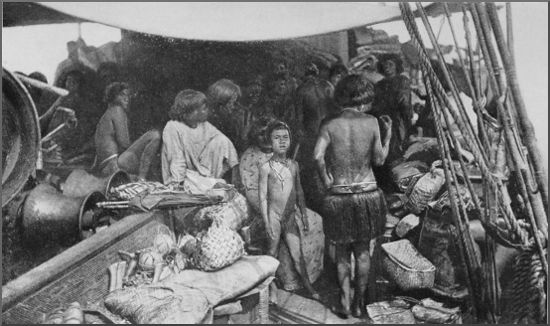
Harem and little son of King Tembinoka on board the "Janet Nichol," passing from Aranuka to Apemama
The getting on board of the people was a wild affair of noise and confusion. Boat after boat was unladen, and piles of the most extraordinary household goods blocked up every space that should have been kept clear; at least twenty-five large zinc pails came from one boat. There were sewing-machines, large rosewood musical boxes, axes and spades, cutlasses, unwieldy bag pillows, every conceivable sort of bag and basket, cocoanut shells of toddy syrup, and shells of water; old nuts, new nuts, every sort of nut; also large packages of the native pudding (giant taro pounded up with pandanus syrup and cocoanut milk, baked underground in taro leaves), and piles of neatly done up sticks of what we call sweet sawdust, made of the beaten pandanus nut. There were camphor-wood chests of every size, and mat packages without end. One woman was trying in vain to find a place for her ear piercer, a stick of hard, black seaweed, some two feet long, tapering from the circumference of a couple of inches in the middle to a smooth, sharp point at either end; round each side of the centre, where it was intended the hand should grasp it, was a ring of yellow feathers worked with human hair; these looked just the same as the royal Hawaiian feathers—also those on the peace spears I got at Savage Island—but I have never seen the bird that produces them.
Our black boys are almost insane with excitement and "Tom Sawyered" to such a degree, showing off before the court ladies, that it was a wonder and mercy none were killed. When they were raising the boats to the davits, Louis said they were upside down more often than not, doing herculean feats of strength. The harem ladies were gathered together aft and a tapu placed round them. Ladies of a lower station found what places pleased them best and had a much gayer time than the great ones, for the black boys sang, and danced, and shouted with merriment the whole night through. The very old ladies of high rank—the King's mother, hopelessly drunk on gin, which she carried everywhere with her, the King's aunt, and one or two others—spent the night on the captain's bridge. The people all showed the utmost affection for us, our old friend and servant "Snipe" in particular. ("Snipe" was one of three slave girls lent us by Tembinoka when we lived at Apemama, in Equator Town. The other two we called Stodge and Fatty.) She would seize every opportunity to get beside me, when she would smooth my hair, fondle my hands, and alternately put her arm round my waist and poke me in the ribs with her elbows, giggling sentimentally the while.
Quite late at night Uncle Parker sneaked down to the saloon and squatted on the floor with a kindly grin. He was not in the least surprised nor offended when Louis hustled him out. I had not had the heart to do it myself, as I should.
Among the rest of the people was a man who had known us in Butaritari; he gave us full news of our Cowtubs[21] there. Tembinoka's governor, whom we had known as Reuben, who now says his name is Raheboam, begged that I would speak to the King and ask that he might go away with us. I assured him that it would be useless; the King could not afford to part with a man of his talents and acquirements, which is quite true. In the forecastle were the unfortunate exiles of Piru, among them our "Boat's crew" looking very pretty and pert but grown no larger. Some years ago, I do not know how many, a large party of the natives of Piru, thinking to see the world, bought return tickets from the Wightman line to one of the other islands. They were warned that they must take their chances of a schooner going back to their own place. No schooner did; but they were carried on from island to island, each trip getting a little nearer home. The boy called "Boat's crew" had been a servant of ours at Apemama, one of their halting places. They are to be taken on to Nanouti, a station so much the nearer home. An old man who was anxious to die on his native soil is still living and looks a hundred years old, his head entirely bald except for a tuft at the nape of his neck.
5th.—At Apemama, landing the court. Tin Jack had to sell a pet canoe he was taking to his station to the King, who insisted on having it. It cost five dollars and the King gave twenty for it; so, as a commercial speculation, it was no loss. When the King came on board this morning he laid a fine mat on my lap.
Later a great wailing arose from the forward deck. A woman who had taken possession of another woman's husband was being sent away with her people of the Piru party, and conceived it her duty to have an attack of nerves. She did not do it so well as they manage in France, but it was of the same order, and reasonably creditable. Her hysterical kicking and choking cries, when held back by her companions from drowning herself, was the most effective part of the performance. She soon gave it up, probably because of the lack of interest shown by the bystanders.
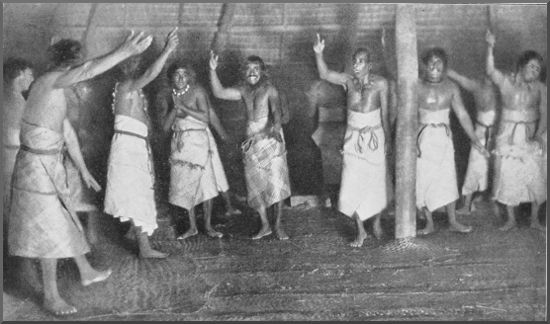
Dance at Apemama
In the evening we had a farewell dinner with Tin Jack, champagne, toasts, speeches, etc. At night a party went on shore with fireworks; Mr. Henderson answered with a display from the ship. As I was watching them I overheard a conversation between a white fireman and our cook about the dangers of the land. "Why, one of my mates," said the fireman, "got lost in the bush once, and it was a whole day before he got a drink of water. I wouldn't take the chance of that for all the money you could give me." I reminded him that wrecked sailors had been known to suffer from thirst; he had never thought of that, he said, but anyhow it didn't seem the same. The fireworks were very successful, and I think pleased our black boys more than any one else. The ship rang with their shouts and musical, girlish laughter. All afternoon they had been scraping the ship's sides under water; it looked very odd to see them kicking like frogs and working at the same time; yet, after all this, they were ready for more dancing and songs. Louis and I agreed that we would willingly pay a high price for only Sally Day's superfluous energy to use at our discretion. All these men are from cannibal islands, but do not like that fact referred to. When Mr. Hird teases them about it they declare they were mere infants when they were taken away and can remember nothing about the savage customs of their people.
6th.—Off Apemama, our black boys lying in a row under the awning, one reading the Bible (it was Sunday) and another playing hymns on an accordion. The King took breakfast with us, and we bade him good-bye, not so sadly as before, because now we have some hope of seeing him again.
7th.—Nanouti first thing in the morning. Went on shore after breakfast to "Billy Jones's cousin's" place where British colours were flying. Tin Jack wished to be photographed in his new place in the midst of his new surroundings, so we had the camera with us. Lloyd and I wandered about and were astonished at the number of houses we saw piled up with dried cocoanuts not yet made into copra. We were told that a famine was feared and these nuts were stored as provisions. Speaking of provisions, we were struck by the difference in the condition of our Piru friends since we were fellow passengers with them on the schooner Equator. Then they were in the most abject poverty, hardly a mat among them, no food, only a few shells of water and a few old nuts. When we took them off Apemama they came as rich people, with bundles of fine mats, stacks of "sawdust" food and dried pandanus fruit (very good, tasting like dried figs) and quantities, generally, of the best food produced in Apemama. The people all have cotton-print clothing as well as fine ridis and baskets full of tobacco with plenty of pipes.
While Lloyd and I were walking about in Nanouti, Tin Jack went back to the ship quite oblivious of the fact that we were left prisoners on account of the tide, for the entire day. When we arrived we had to take down part of the wall of a fishing ground to land at the house. We left the ship at ten and were tired, hungry, and very cross at being so deserted. Lloyd finally went off to try and find a canoe, hoping to reach the ship in that way and get something for me to eat. I had got very wet in crossing the surf in our own boat and was dressed in a filthy gown and chemise lent me by a native woman. I asked for a dry gown when I arrived and the woman gave me one she had cast off; I did not know what to do, as it was quite transparent, so I had to stay in the inner room. Tin Jack, hearing of this, demanded a chemise for me. The woman removed the one she was wearing, in a dark corner, folded it up, and then pretended to take it out of a trunk which she opened for the purpose. After this piece of either pride or delicacy I felt bound to put it on. As my head ached, I lay down on a mat, with an indescribably filthy pillow under my head, and tried to sleep. The people of the house, some twenty in number, came in every few moments to look at me; if the children made a noise they were smacked, thereupon bawling loudly enough to raise the roof, and occasionally a crowd of outside children would be beaten from the house with howls and yells. I never saw so much "discipline" administered before in any of the islands. Outside my window a child was steadily smacked for crying for at least half an hour. I actually did fall asleep once, but was quickly awakened by a savage dog fight just under where I lay, the house standing high on piles. This house, belonging to the trader, was one of the best I had seen, containing four rooms separated by stockades, with a lofty, airy roof, while along the shady side ran a neat veranda. The whole house was tied together with sennit the sides and ends thatched as well as the roof.
Lloyd, having searched for about an hour and a half, had found a canoe, and a native willing to take him off for the high price of ten sticks of tobacco. In the meantime, Tin Jack, awakening to a sense of the enormity of his behaviour, had dispatched another canoe from the ship with some sandwiches, a tin of sardines (useless with no tin opener), and a bottle of stout without a corkscrew. When Lloyd discovered this, he would not wait a moment, but tried to get back to me. In spite of all he could do, he was landed in the surf some two miles short of where I was. He struggled along the reef, sometimes knocked down by the surf and most of the time up to his armpits in water. He had on shoes of leather which became water-logged, and the nails, coming loose, tore the soles of his feet, adding to the difficulty of walking. He also cut his ankle on the reef and grazed his leg, both serious things to have happen here. (A scratch from dead coral is apt to cause blood-poisoning and is greatly feared. The captain of a man-of-war was said to have lost his leg in this way.) There was also the fear in his mind that, thinking he had landed, I might have given my leavings to the natives. I really cannot imagine why I did not; I several times made a movement to do so and then something distracted my attention. It was quite dark before the ship's boat could get in for us, and very chill. Tin Jack, most eager in his apologies, had a bad quarter of an hour.
A cat, I hear, has been added to our ship's company. At Majuro a man who had been shipwrecked there, and was taken on board the Janet for Sydney, had a pet cat. One of the sailors found her swimming round the ship trying to climb up the steep sides. An oar was put out for her and she climbed in, almost drowned.
I begged a fish from one of the black boys, and with a nut, a pinch of cayenne pepper, an old dried lemon, and some sea water, I made "miti" sauce and gave Louis a nice dish of raw fish for his dinner. He relished it very much, and ate all I prepared.[22]
8th.—Remained all day and left at night. A long reef, and much trouble in getting Tin Jack's things clear of the ship. Heard the labour brig Cito had been landing rifles and cartridges. Tin Jack gone; he left late in the afternoon, the boat taking him to the reef, where we could see him being carried over it on a native's back. There were still fifty bags of copra to come on board; these were packed out to the boat on the backs of natives and our black boys. Mr. Henderson gave Tin Jack two black pigs and a very fine, handsome mat; I gave him a supply of medicines carefully labelled, and a pillow with an extra case. When we left we blew the steam-whistle in farewell, burned a blue light, and let off two rockets, to which he responded with a rocket from the shore. One of our rockets was let off by the captain (who is quite ill) on the bridge. It shot at us and fire was sputtering all about the bridge, to our terror. A woman has been following me about all day trying to get me to adopt her little half-caste boy. She tried to bribe me with a mat, which in the end she gave me as a present. I gave her a bottle of scent. Everybody bargaining for shells, even the black boys and Mr. Stoddard, the engineer. When the boat returned from landing Tin Jack it brought me from him an immense spear, very old and curious.[23]
9th.—Piru. I am disgusted by the apathy of our exiles. Except one woman, they did not even raise their heads to look on their native land. There was no excitement, no appearance of interest. The Samoan missionary and friends of his, all well-dressed, superior-looking people, came on board. The missionary demanded, in a high and mighty way, that paper, and envelopes, and pen and ink be brought him. Lloyd was working the typewriter to my dictation, which amused them all extremely. Mr. Clark, the missionary from Samoa, has just been here. To our disappointment we have missed him by only twenty-four hours. He has gone, they say, to Apemama, to try and persuade the King to allow them to land a missionary. I think he will not succeed. The King fears the power missionaries get over the people. The traders have also been on board, the braggart Briggs and a Mr. Villiero from the Argentine Republic. Mr. Villiero's father was Italian, his mother Tyrolese. He seems an intelligent, pleasant fellow, and I talked a long time with him. A few years ago, he tells me, a man died on this island who was once secretary to Rajah Brooke. He asked to bring his wife and his adopted daughter, a half-caste Tahitian named Prout, to see me.
I was talking to the two traders to-day when Briggs said that he used to carry the lepers from Honolulu to Molokai. "Did he know Father Damien?" I asked. After much searching in his memory, at last he said he did. "A Catholic priest he was, who seemed to be all right when I knew him, but some pretty ugly stories have come out about him since in Honolulu, I understand." I gave them Louis's pamphlet without a word more.
The tides very low; there is a good deal of copra here, and our black boys worked last night until two in the morning, and to-night they expect to be up still later. One of the black boys is ill with a sore throat, headache, and diarrhœa. We gave him some castor-oil and laudanum, not knowing what else to do. The captain very weak, indeed, with intense headache, sickness, and an intolerable burning in his stomach. There is an odd dryness of his skin, not like fever. He has taken no nourishment but barley-water for days. Louis is better, the hæmorrhage having stopped.
10th.—Still lying off Piru. Mr. Hird came back yesterday with a sickening account of the man Blanchard who was supposed to be implicated in what was called "the Jim Byron poisoning case." Blanchard has contracted some terrible disease which makes it necessary for him to lift up his eyelids with his fingers when he wishes to look at one, and has swelled his nose to a monstrous size. Blanchard is, he says, an American, and when he first met the man, some years ago, had some pretentions of being a gentleman, but has now fallen to a state of degradation that is horrible. Blanchard spoke of the murder and confessed that he knew it was to be done and that he was there when it was done.
11th.—Still at Piru at ten o'clock P.M. Mr. Villiero has come on board with his wife, a handsome young woman, to whom I gave a wreath, some lollies for the children (all adopted, her own being dead), and a piece of lace. A little later Mr. Hird brought in several traders and gave them luncheon.
Lifting anchor.
12th.—Left Piru last night, arriving at Noukanau this morning. We carry with us a native man, as an exile, to this island. The Samoan native missionaries told their people that for certain crimes it was allowable to kill the offender. Such a case occurred, and the guilty person, who richly deserved his fate, was put to death. Then the native missionaries said that the taking of life called for capital punishment. Fortunately, at this juncture, a white missionary from Samoa appeared in the missionary ship, and it was arranged that the avenger be exiled for an indefinite period. As this man has large possessions in Noukanau, it is to be hoped that he may not experience much discomfort. He is a fine-looking, respectable man of early middle age and had his family with him.
The ship all morning has been filled with crowds of natives (among them the inevitable leper with elephantiasis), all chattering like monkeys. I have bought from them three pronged shark's-tooth spears, one for a striped undershirt, the other two for a couple of patterns apiece of cotton print. I also bought a mat with rows of openwork running through it, just like hemstitching, and for a florin I got an immense necklace of human teeth. A little while ago, in some of these islands, especially Maraki, a good set of teeth was a dangerous possession, as many people were murdered for them. I trust mine were honestly come by—at least taken in open warfare.
Last evening our pigs fought like dogs, biting each other and rushing about the deck like mad. The noise they made was more like barking than grunting or squealing. The cook has cut his leg; Mr. Hird has a bad cold; the engineer, Mr. Stoddard, is sneezing, and Louis feels as though he had caught the cold also; the captain still very bad; he caught more cold last night. Lloyd's wounds, from the reef on Tin Jack's island much better. I bound them with soap and sugar first and then covered them with iodoform.
We have been to two settlements to-day and are now returning to the first. At the second Tom Day came on board and had a meal; also Captain Smith. Our coal is very low; hardly any left, in fact, and we are all burning with curiosity as to where we are going next—to the Hebrides, Fiji—or perhaps to Brisbane. Spent the evening talking to Tom Day. He told many tales of Bishop Patterson and of hunts for necklace teeth. A father who has good teeth often leaves them as a heritage to his children. They are worth a great deal—or were. He has known many murders for teeth. My necklace seems a gruesome possession.
13th.—Left Noukanau in the morning; arrived at Piru at eleven o'clock; left at one, Monday morning, for Onoatoa. Louis had a long talk there with Frank Villiero. Land here is divided into large and small lots; the large, one and a half acres, the small, half an acre. There are never any smaller divisions. A large lot is quite enough for a family to live on. Some great families own many lots and have picked as many as fifteen hundred nuts in one month. Pieces of land are confiscated for theft, or murder, by those who suffer loss through the crime. A piece of land so taken from a murderer can be regained by the criminal pouring a bottle of oil over the body of the man he has murdered. But this is never done if the person fined bears malice or enmity toward the dead man. The island was formerly in a far more prosperous state owing to the fact that a large proportion of the inhabitants were then kept as slaves.
The duties of the "old men" (the democratic islands are supposed to be ruled by the "old men," who meet in a body to make laws) are really the demarcation and recording of lands; they can go back for generations in the division of island lands. The population of Piru is about twenty-five hundred; the police, at present, number about one thousand men uniformed in blue jumpers, jean trousers, and a wisp of red on the arm. There are three districts, each being patrolled at night by the police, who call the roll of every grown person, and must be answered. The fines go one half to the teacher (for his private benefit) one fourth to the old men, one fourth to the police. Villiero has seen a policeman receive no more than ten cocoanuts for a whole year's work, and he must find his own uniform of which he is not proud. Every portion of the island is owned and the demarcations owned. They are a mean lot here; their fights mere broils, and very little feeling is shown for each other. A canoe drifted away, or a man dead, is almost instantly forgotten. Little or no sour toddy is drunk since the missionaries came. Mr. Clark, the missionary from Samoa, told them that on Sundays when a ship came up to the island they must allow a couple of men to take the trader off; formerly these boatmen were always fined.
Mr. Villiero brought his wife and adopted daughter, Miss Prout, to see me in the afternoon. It was very embarrassing, for they came laden with gifts, and I had nothing suitable to offer in return. We had an adoption ceremony by which I became either mother, or daughter, to Mrs. Villiero, no one quite knew which, not even her husband. Miss Mary Prout was quite the "young person," shy and silent. Both were well dressed and wore European rings. Mrs. Villiero makes all her husband's clothes. The presents consisted of a little full-rigged ship inside a bottle, the mouth of which it could not pass. Mr. Villiero was three weeks in making it, working all the time, a regular sailor's present; also a large, fine mat with a deep fringe of red wool, in very bad taste, a couple of plaited mats, a pair of shells, and an immense packet of pandanus sweetmeat. When we met Mrs. Villiero she threw round my neck a string of porpoise teeth, thick and long, the preliminary to adoption. With Louis's help, Mr. Villiero made his will. (He was afterward lost in a labour vessel—virtually a slaver—that sank with many unfortunate natives on board as well. It was on the way to South America.) He has a feeling that his life is not safe here with some of the other traders, the poisoners, in fact. He told Louis of an unfortunate affair that happened on the fourth of July. Villiero, Briggs, and the Chinese trader made a signed bargain that they would all buy copra at a certain fixed price, with a fine of two hundred dollars to be paid by the one breaking the bargain. Soon all the custom had fallen into the hands of the Chinaman. On inquiry it came out that while the Chinaman ostensibly bought at the agreed price, he gave a present of tobacco besides, thereby evading the letter of the bargain. Following Briggs's foolish advice, the other traders armed themselves to the teeth and went at night to the Chinaman's house. Briggs and Blanchard guarded the door, while Villiero, holding a pistol to the Chinaman's head, demanded the two hundred dollars fine. Of course it was paid. When the missionary ship came in Villiero told this tale to the white missionary who advised immediate restitution of the money, and said he was bound to report the traders' conduct. I wonder that a man of Villiero's intelligence should have been led by a person like Briggs.
The captain is very weak, but Louis better.
14th.—Onoatoa Island.
15th.—At Tamana early in the morning. One of our passengers taken on at Tom Day's island and introduced by Tom as "Captain Thomas, this old Cinderella," went on shore with all his belongings. Another passenger whom we are taking to Sydney made me a native drill which will cut through the most delicate shell, or through the iron of a boiler, or a dish, or a glass tumbler. I made holes through some red and white bone whist counters and strung them into necklaces, really very pretty. Since we were at Tamana before there has been a murder and an execution. A man from another island, indignant at being worsted in a wrestling match, watched at the church and struck a spear into his victim, who soon died. The execution was by hanging. They dragged the man up by the neck, then let him down to see if he was dead, then pulled him up again only to lower him for another look, continuing this barbarity until they were satisfied no life was left in the wretch.
16th.—Arorai in the morning. The first thing we hear is that poor McKenzie, the man who was starving, is dead, supposedly from a surfeit on the soups we left him. He ate ravenously; said in reply to a question of how he felt, "I feel full," immediately became insensible, and so remained for three days, when he died. It did not occur to me to warn him against overeating; soup seemed such an innocent thing; I was afraid to let him have solid food at first.
"Cockroach," one of our black boys, has got his fingers badly crushed. He has been crying like a child ever since. The captain still very ill; he and I went through two medical books and both came to the conclusion that he must be suffering from inflammation of the stomach. He says he has been worse ever since one day when three black boys refused to work on a Sunday. Sally Day, he says, was very impudent, and he was too weak to knock Sally down, which fact preys on his spirits.
To-day one of the boats steered by Mr. Hird suddenly disappeared in the surf, and Mr. Henderson at once put out for her. She had capsized and stove a small hole in one end. Mr. Hird came dripping from his involuntary bath. Fortunately, no one was injured but the engineer and Mr. B—— (a passenger from Jaluit) and they only in their feelings. They were waiting a long way down the reef when the accident happened, and could not get another boat in time for dinner. We killed a pig to-day, the first, our sheep being now done. Charley, passenger from Jaluit, working his way, gave me a belt of human hair. Some natives brought off a shark they had just killed, hoping to sell it to us for food. Mr. Hird told a story of a shark he had seen chasing a fish. The shark could easily catch the fish, swimming in a straight line, but could not turn quickly, so the fish knowingly swam round and round him. They were very near the ship when the fish jumped out of the water. With the quickness of lightning the shark struck it with his tail straight into his mouth. There is a swordfish here with a snout like a spear, long and sharp, which follows the flying-fish. When the natives are fishing they have to be on the lookout, as he jumps at them and tries to stab them with his sword. One of our passengers knew a man who was killed by such a stab. I forgot to mention that Tom Day told me that during this present epidemic of measles he saw a woman buried alive. "She was too weak to resist, so her husband just buried her"; the same sort of tale as Mr. Hird's of Penrhyn.
17th.—Had a sharp squall in the night. Lloyd slept through it all, his things swimming in the water. I put my head out of the port and watched the rain-drops strike the sea, each producing a spark like a star. It looked as though the heavens were reversed. I often find my bath, when I take it after dark, blazing like liquid fireworks. The weather continues bad, and we are rolling a good deal. Louis much better; the captain very weak and ill. Lloyd's leg, hurt on the reef at Tin Jack's island, shows uncomfortable symptoms. I suppose I should burn it out, but it requires courage to perform that operation.
18th.—Arrived at Vanumea at ten o'clock. Left at nightfall under sealed orders, steering S.S.W.
24th.—First thing in the morning sighted Eromango about fifteen miles away, and a little later, Tanna. Eromango is the place where the missionary John Williams (always spoken of as "the martyr Williams") was killed by the natives.
Some time ago a good deal of amusement was got from discussions concerning the mango and the proper way to eat it. Mr. Stoddard said it should be eaten with a spoon, which is impossible. We soon discovered that he had confused the mango with the barbadine, though he would not confess it. One evening when the bread was underbaked I pressed the crumb into the semblance of a spoon and solemnly presented it to him as a "mango spoon." This morning I found a large pumpkin hanging up to ripen. I borrowed it from the cook, and Mr. Hird and I tied it up in an enormous parcel, while Louis wrote out a card in printing letters to go with it.
For Walter Stoddard Esq., —One Mango— With the fond love of the inhabitants of Eromango.
(This is gathered, with a spoon, from the finest mango swamp in the island. But beware of the fate of the martyr Williams, who died from trying to eat one with too short a spoon. O mango and do likewise.)
To make the presentation scene more impressive, I made a pair of false eyes to be worn like spectacles by hooking wire round the edges of a very large pair of green cat's-eye opercula, which Mr. Henderson donned at the appearance of the pumpkin. The parcel was brought in at dinner by the chief steward with the assurance that it had come off in a boat from Eromango, sent by the people of the island. Anything more truly diabolical than the expression of the cat's-eyes cannot be well conceived. I chose very clear, dark ones, with a well-marked white ring on one side, which I made the upper, so that the eyes were apparently starting from their sockets with fiendish surprise and malevolence.
25th.—Mare Island, Loyalty group; lay off the Sarcelle passage all night, about forty-five miles from Noumea, our first civilised port and the last we shall make until we reach the end of our cruise at Sydney. A large, most strange, and picturesque island. At first sight it seemed only desolate cliffs and terraces. Here and there at wide intervals a tree, very tall and close-growing, stood up straight like a needle. As we drew nearer, however, enchanting little bays began to open up. We could make out groves of cocoa-palms and the needle trees clustered together, making a curious edging to the cliffs. In one of these bays was the mission station; we could see the white wooden house smothered in trees, the plantation of palms following the indentations of the shore-line, and stretching far back to the white and coloured cliffs that ran up into the precipitous hills. In a niche on a cliff side was a great statue of the Virgin, dazzling white in the sun. Before the mission house ran a broad, smooth beach. We could distinguish many people standing there, and a fine large boat.
26th.—At half past one, Noumea. A succession of the most lovely bays began to open up as we steamed nearer. The surf runs out some forty miles and is studded with small islands, some like little hills rising from the sea, and some miniature low islands fringed with cocoa-palms. We all don the clothes of civilisation to go on shore, looking very strange to each other.
FOOTNOTES: