THE CRUISE OF THE "JANET NICHOL" (continued 2)
Reading edition
17th.—Nassau is a small, high-low island enclosing a lagoon which has now dwindled to a pond. It is triangular in shape and roughly measures five miles round. We could see that the ground rose up from the beach at a considerable slope, and between the ti-trees I could make out that grass was growing. With a glass I could distinguish a breadfruit tree. Nassau has no anchorage and the landing was thought to be too dangerous for me to attempt, so, to my great disappointment, the men went without me; from the description they gave when they returned, and from the outside view, it must be the loveliest of all the high-low islands. There are many pigs and fowls, and all the high-island fruits flourish exceedingly; turtle abound, both the green turtle beloved of aldermen and the turtle that produces the shell of commerce. The owner of the island had not visited the place for two years, so the few people living there felt as though they had been marooned. They sent two pigs on board, and offered Mr. Hird a large piece of tortoise-shell which he refused because of its value. There were some forty boxes of copra ready for sale, but, as the sea was high and the landing bad, Mr. Hird did not care to take it. Mr. Henderson, however, gave them what "trade" they wanted, some fifteen dollars' worth, as a present.
When Louis came back he gave me the following account of his visit, starting from the very beginning:
"First thing in the morning we saw the whole population gathered on the beach. As we came nearer in and lowered a boat it was a strange thing to see the two women dancing like jumping-jacks for joy. All three men came down to the edge of the reef. H. signed to them from the bridge to jump in, and swim, which two of them, Joe and Jim, did, the boat meeting them half way. We could see them scramble in solemnly and shake hands with Johnny, who was at the steer oar, and sit down. They had a good many old friends on board, Joe especially, and it was a treat to see the absurd creature dance up to them for all the world like a clown in a pantomime. A little later, seeing Lloyd come out from under a blanket where he had been changing plates in the camera, he made us all nearly die laughing with his pantomime of terror. He called everybody 'old man'; and was always either laughing himself or the cause of laughter in others. He said they had no fish; 'got no canoe,' he said, 'why not make one,' asked one of us; 'Too much wo'k!' cried Joe with infinite gusto. He is very strong, and in reality most industrious, only he is simply marooned and means to do nothing needless. After breakfast we go ashore. The third man and a dog met us on the reef; and singular thing, the dog is afraid of us. At the house we are introduced to Mrs. Joe, Mrs. Jim and the five children, the whole party like crazy folk, dancing and clapping their hands and laughing for mere excitement. On into the island, a garden-like place, with limes, bananas, and figs growing, and the ground in many places carpeted with turf. Not in all, however, and as I had bare feet, and the morning was hot, I presently turned back and arrived alone at the settlement. Mrs. Joe was out waiting for me with a green cocoanut; while I was drinking she tried to abstract my ring. Failing in this she led me into a shed where Mrs. Jim was, piled up pillows at my back, supported me in her arms and proceeded to feed me like an infant with cocoanut pudding. Mrs. Jim, meanwhile, patted and smoothed me, and both at the pitch of their excited voices plied me with questions as to my age, country, family, wife and business. When they heard my wife was on board, they cried out with regret that she had not come; and Mrs. Joe intimated that she was dying to go on board to see her but lacked clothes. (Both were quite well dressed,) Mrs. Joe a comely fellow, in blue, Mrs. Jim in red; they began at once to build up a heap of presents for the fafine (lady). In the meanwhile, or concurrently, they were all through my pockets and robbed me of all I possessed; all my money, tobacco, matches, and my pocket handkerchief; some capsules I saved, telling them they contained poison, and (more fortunate than the rest) my cap. They were perfectly good natured when refused anything, but returned again to the assault like flies. Mrs. Jim offered to give me her baby in exchange for Lloyd, which I accepted. When the party arrived they were all subjected to similar pillage; though, being so many, scarcely to the same endearments. (I was simply petted, smoothed, caressed, and fed like a pet animal.) The scene was one of the wildest excitement and I am sure they all had headaches. All came down to the reef to see us off; Joe and Jim were to take us out; the ladies stood a little back up to their knees, and when the boat was launched, I saw Mrs. Joe make a sudden plunge under her skirts, and next moment her gaudy lava-lava was flying in the air for a signal of farewell. When a native woman dons a civilised garment she still retains her native garment, the lava-lava twisted round her body. Once we were clear of the breakers under the able pilotage of Joe, 'this is very beastiness' said he severely, to one of our black boys who volunteered advice. Jim and he stood upon the thwarts, 'good-bye, old man,' heels up, head down, and next moment they were pushing for the shore."
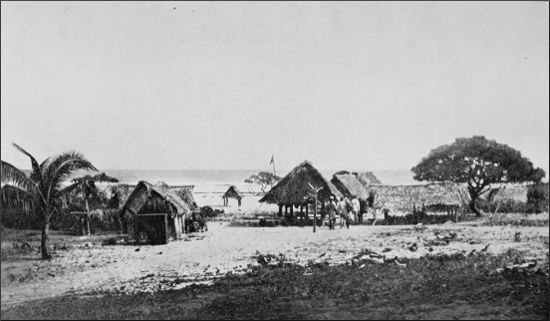
The settlement on Nassau Island
19th.—Quiros (the Jennings) in the morning. After Nassau it seems commonplace and tamely prosperous. We walked across to the lagoon which is very large and only slightly brackish. Lloyd and Tin Jack took a swim, and I went back to the women. After drinking many cocoanuts we returned to the ship.
20th.—Mrs. Jennings and her sister-in-law, with a singing boat's crew Samoan fashion, visited us. Unfortunately, one of the ladies became seasick, which cut their visit short.
21st.—Fakaafo, of the Tokalau group. Louis and I went on shore very early in the morning. There was a big swell and all our boatmen had different views at the same moment, the consequence being that we broached to and were nearly swamped. I got drenched from head to foot and felt very cold. We walked about the village and were taken to the house of the King. The Queen spread a mat on the ground for us and we sat down beside her; she was holding a precocious little baby in her arms, her grandchild, I presume, for she looked quite an old woman. The King came to the opening of the hut and, thrusting out his head and shoulders, shook hands with us and tried to converse. Cocoanuts were offered us, but I felt too chilly for that refreshment. It seemed a languid place; the very children soon tired of following us.
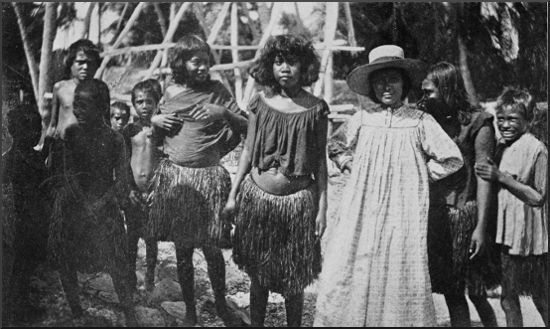
Missionary from a civilized island, and some of her converts
As I felt symptoms of rheumatism from the wetting I had got, I hunted up the trader, a pallid Portuguese, and asked if his wife could lend me a gown. He said if we crossed the island we would find a board house, belonging to him, where his wife would give me a native dress. As we drew near the place several handsome, smiling women joined us; we all sat down on the veranda and waited for the trader, who was not far behind us, and I was soon clad in comfortable dry clothes. We refused cocoanuts but accepted brandy and water. I gave the trader's wife the wreath from my head and a gold ring, after which we came back to the ship, very nearly upsetting our boat in the surf. I had with me a number of plain gold wedding rings; I always wore a few that I might take them from my own hand to offer as presents.
In the afternoon the trader's wife sent me a present of a hat. The trader used the most puzzling English possible; in passing Lloyd's room he caught sight of a guitar. "Who that music?" he asked. When told, he asked to have the guitar put in his hands and demanded that Lloyd be sent for. In the meantime he examined the instrument and found two broken strings. When Lloyd came the trader said he wanted two fine guitar strings. Not having too many, Lloyd was loath to part with the strings, but the man was so bent on having them that the box of strings was sent for. On Lloyd asking the man about his own guitar, to our surprise he said he had none at all, and yet he went on choosing out strings with the utmost excitement. "Really," said Lloyd, "I can't let you have all those; I will give you this lot but no more; and I don't see what you want with them if you have no guitar"; apparently, he wanted them to "play with." Then it occurred to us that he might have some other sort of instrument on which guitar strings could be used; but no, he said he had no sort of instrument whatever. At last, after great perplexity and wild endeavours to find out what he would be at, Lloyd suddenly, as if by inspiration, asked: "Do you want to buy this guitar?" That was the mystery. As we had only one guitar we could not give it to him, so the poor fellow sadly returned both strings and instrument.
22d.—We celebrated the anniversary of our marriage[8] in front of the trade room. Champagne was set to cool in wet towels, and at about four we gathered together at the appointed place, each person to do what he could for the amusement of the others. Tin Jack gave a reading from Shakespeare, standing in a pulpit that was part of our cargo. Mr. Hird sang "Afton Water" charmingly with much grace and feeling. Lloyd sang, and Louis, taking what he saw before him as a text (it was an advertisement of St. Jacob's oil), mounted the pulpit and delivered a sermon.
Sight land, Atafu, where I hope to get Tokalau buckets, which are very useful in place of portmanteaus.
23d.—Mr. Henderson went ashore very early this morning, at Atafu. He boasts that he ate three chicken legs as well as half a breast and quantities of taro. As I have a little rheumatism from wearing my wet clothes so long at Fakaafo, and it rains, I decided to stay on board and take a dose of salicylate. Later the sun comes out; my rheumatism flies before the salicylate, but too late; Louis has gone in the boat and there is no other for me. I spend a dreary time watching the people with an opera-glass. The wind occasionally brings the sound of singing to my ears. Then the opera-glass gives me a headache, and I try reading, first "Olla Podrida," which I cannot manage, and afterward the South Pacific Directory, with which I succeed better. The boat comes back at dinner time, everybody talking at once about the curious experiences they have had.
24th.—To my regret I did not feel well enough to go on shore. A trader, the brother of the man who wished to buy the guitar, told me his wife was coming to see me and introduced his son, a fine, little, brown fellow of about eleven. Mr. Hird informed me that he is quite a travelled youth. He, himself, told me he had been to Sydney, and when I asked, "To San Francisco?" he replied: "No, but I have been to Frisco." This child was on board a schooner when she was nearly destroyed by fire, and also when she was in imminent danger of being shipwrecked. The fire was an incendiary act. One of the sailors had several times been very impudent to the captain of the schooner and was regarded as a dangerous character. He, one day, in a fit of rage, attacked the cook with a knife and nearly murdered him. The captain, who seemed a pitiful fellow, was frightened at the thought of putting the man in irons and bungled to such an extent with the handcuffs that the culprit, himself, obligingly put them on. The supercargo asked that the culprit be confined in the cabin next his, but the captain was alarmed at the idea of having him so near. It was not long before he managed to get loose, set the ship on fire, and jump overboard. A few hours after the fire they were nearly driven on a rock before a heavy squall. When they were so close that they could almost have jumped on the rock, the vessel stopped dead and remained perfectly quiet. The rock had taken the wind out of her sails, and the backwash held them off.
By and by the trader's wife and her friend, a handsome woman with a haughty, high-bred expression, came on board. With a simplicity that was almost cynical, the trader explained that at one time there had been a great many German sailors about the islands, so, as his wife had yellow hair, he just took it for granted that she was a German half-caste. She certainly did look very like a sentimental German governess, with her yellow hair and blinking eyes, but I perceived at once that whatever else she might be, she was certainly an albino. She brought me a basket and a small Tokalau bucket. In return I gave her a gold ring which she replaced with three tortoise-shell rings and a thicker one ingeniously tied in a true-lovers' knot. I gave the friend a wreath and received a hat as an exchange present. These people are desperate flatterers; we call this "The Isle of Flatterers." A native met Mr. Henderson in Louis's hearing. "You handsome man!" he cried, his voice thrilling with emotion as he eagerly studied Mr. Henderson's face. "You good woman!" said Mrs. Trader to me continually, her eyes melting into mine with admiration and affection as she tenderly embraced me. I asked for a lock of her beautiful hair, which, after asking permission of her husband, she gave me; I pinned it in my diary and she wrote under it, "Fani mai feleni" (Fanny, my friend) and her own name, "Amalaisa"; then she fanned me, and caressed me, and flattered me, and finally, getting hold of my photograph, pressed it to her bosom and face, saying: "All same you." I wonder if they really do "rub noses" anywhere! All I have seen is a pressing together of the two faces with a slight inspiration through the nostrils. While I was sitting with Amalaisa and her friend, holding a hand of each, I became aware that a very ragged but superior-looking young native man had joined our party. "That boy, King," whispered Amalaisa, so I shook hands with his majesty and called Louis to be introduced. The last words of royalty were "You good woman," delivered in most seductive tones.
Most of these natives are suffering from a skin disease which covers them with whitish scales and is contagious. I trust we have not all caught it. The scaliest boy in the island has been walking about all day with his arm round Louis's waist, patting and smoothing down his hands with a purring: "You good papalagi" (foreigner).
When it came time to part Amalaisa gave me another hat and put more sentimental expression into her tofa (farewell) than one would think possible. We shook hands, Amalaisa suddenly kissed me and was gone in a flash.
Louis has written here the following account of his adventures in Atafu: "Immediately on landing I was surrounded by boys more or less scaly; the little girls fled before us in a squadron, looking coquettishly back; if they came too near the boys cast handfuls of stones upon the ground by way of a hint. 'You Peletania?' (British) they asked, one after another and again and again, always receiving my affirmative with 'Peletania—Aloha!' taken in an indrawn breath. One boy walked all the way, caressing me. 'You good papalagi,' he cried at intervals. I suppose I had fifty of our escort. Presently we found some twelve stalwart dames sitting on a wall. They made me sit by them, sent for cocoanuts, caressed me with the most extraordinary fervour of admiration, and breathed, from time to time, in an emotional chorus: 'Peletania—Aloha!' Although not accustomed to the offer of gallantry based upon political considerations, I suspected something was intended; and presently one of the boys was called by the ladies and stood forth as an interpreter. 'All these girls he laugh at you' (these ladies smile upon you is what he meant). 'You flatter me,' said I. The disappointment caused by this miscarriage was inconceivable. A little later one of the boys asked me: 'You want wife?' 'I got wife on board,' I said. 'Wife on board,' cried he with unmistakable scorn, 'no good!' The newcomers laid traps for me as to my nativity. I could hear them asking and hearing what I claimed to be; and then they would come up and ask in a fine, offhand manner: 'You Melican?' (American). Certainly we have no possession more loyal than Atafu. Another specimen of Atafu English (they all speak some) is this: I had given a boy a stick of tobacco; another asked for one. 'No,' I said, 'all done.' 'Eet ees feenished,' said the boy who had the stick; but the boy who had it not regarded me with a playful smile. 'You go hell! no done.'
"I saw the cure for scaly itch, invented by old Jennings of Olesenga—a barrel sunk in the earth where they are smoked with sulphur. The girl who was undergoing treatment was the most European little soul—skin of a fair brown, eyes a light hazel, hair golden chestnut. Strange that folk of a low island should so incline to fairness. Amalaisa first claimed me as 'mai feleni'; hearing of my wife, she transferred her allegiance and began to write her love-letters; the factitious nature of this sentiment (me judice) didn't prevent its being an immense success."
27th.—We expect to make Funafuti, the first of the Ellices, by daybreak; at nine o'clock there was no sign of the island. "Bad steering," growled the captain. "We've run past it, and now we have to turn round and run back." At about two we anchor in the lagoon, and almost immediately the traders are aboard, two wretched-looking objects. One was a half-caste from some other island, with elephantiasis, very bad, in both legs. There were recent scarifications as though he had been attempting the Samoan plan of tapping. The other trader was not thin but the most bloodless creature I ever saw; his face, hands, legs, and feet were without sunburn, smooth, and of a curious transparent texture like wax. It seemed an over-exertion to raise his large, heavy eyes when he spoke to us. The two men had pulled the boat in which they came. The pallid one panted and held both hands over his heart as though suffering acutely. I asked him if he liked the island. "Not at all," he answered and went on to describe the people; he said he could not keep chickens, ducks, or pigs; no one could, for their neighbours, jealous that another should have what they had not, would stone the creatures to death. The same with the planting of fruit-trees; the soil was good, and there were a few breadfruits and bananas, but any attempt to grow more is frustrated. The young trees are torn up and even the old ones are occasionally broken and nearly destroyed. Before the great earthquake in Java there were plenty of good fish fit for eating. The half-caste can remember when a poisonous fish was a thing unknown; now all outside the reef are poisonous, and many inside. The worst of it is that a fish, to-day innocuous, may to-morrow become deadly. Turtle do not come to the islands at all; so there is no food besides copra except what chance vessels may bring. I fear this poor man is simply dying of starvation. A steward on board the missionary ship, who knew a little about medicine, had told him that he only needed iron and good food. "They gave me a bottle of iron," he said, "and I got better on that, or I'd be dead by now, but how could I get the nourishing food?" I suggested his leaving the island, but the loyal soul replied that, though he knew he could save his life by doing so, he would not desert his native wife and children.
The half-caste told us several stories that sickened us to hear and yet were most interesting. In 1886 he was away from Funafuti. During his absence two American vessels, under the Peruvian flag, came to the island and distributed presents right and left to all who came to receive them. Naturally, the people were delighted, and when it was proposed that as many as liked should go to Peru to be educated by these kind people, they flocked on board in crowds. The King, anxious that as many as possible should participate in this good fortune, blew his horn, which is the royal summons. On the return of the half-caste two thirds of the population had gone, and the King was in the very act of blowing his horn again to gather in his remaining subjects, now reduced to the very young and the very old. It is needless to add that the vessels were slavers, and the entrapped islanders were never seen again.
Throughout the islands (Funafuti and her chicks, one might call them) there are not now above one hundred and fifty inhabitants all together. They have a bad name—are said to be a dirty, rough, dishonest lot; dishonest, that is, as far as cheating goes, but they do not steal. No wonder they are dishonest, for they learned in a good school. Here is another tale of the half-caste. Mata, of Samoa, come to buy copra; there was none but what had been engaged by another vessel, the price being one and a quarter cents. "I'll give you two," said Mata promptly, which offer was as promptly accepted. But Mata's scales weighed nothing higher than one hundred and four pounds; so, though he paid two cents, he left with tons for which he paid nothing.
Resterau, the pallid trader, had sailed with both "Bully Hayes" and "Bully Pease,"[9] of whose names I am quite sick and hope I'll never hear them again. Louis and I went with Mr. Henderson over to the island, where we met the wives and children of the traders, handsome, healthy, and with excellent manners; two young girls were quite beautiful. Resterau's wife had but one eye and was a plain, kindly old body.
After a little, Louis and I strolled across the island, becoming more and more amazed by what we saw. Everything that one naturally expects to find on a low island is here reversed. To begin with, the fact of the poisonous fish being outside the reef is contrary to what one has reason to expect. The soil is very rich for a low island, with ferns and many shrubs and flowering plants growing. We saw a little taro and quite a large patch, considering, of bananas. There was much marsh and green stagnant pools, and the air was heavy with a hothouse smell. The island seemed unusually wide, but what was our astonishment when we pushed through the bushes and trees to find ourselves not on the sea beach, as we had expected, but on the margin of a large lagoon emptied of its waters almost entirely by the low tide. The lagoon was everywhere enclosed, but the traders told us there was a blow-hole outlet into which the natives had thrown piles of coral hoping to block it up. A little girl had once fallen into the lagoon when the tide was turning; three days after her body was found far out at sea. It was then that the blow-hole, where she had been sucked through, was discovered. Off on one side there seemed to be an opening by which we hoped to reach the beach. We crossed a bit of mangrove swamp, climbed over loose piled-up shingle that rang with a metallic sound very unlike coral, and at last reached the beach. I wandered away from Louis, gathering shells, but was recalled by a wild shout. I found Louis bending over a piece of the outer reef that he had broken off. From the face of both fractures innumerable worms were hanging like a sort of dreadful, thick fringe. The worms looked exactly like slender earthworms, more or less bleached, though some were quite earthworm colour. They lengthened out and contracted again until I felt quite sick and had to fly from the sight. Afterward Louis broke other pieces of rock; one kind always contained worms; another kind, lighter in colour and firmer in texture, contained much fewer worms, also empty holes in the process of closing up; still others were close and hard and white, like marble. I got a good many shells, and after a fruitless search for some other way across the island than round the inland lagoon, I gave it up and we retraced our footsteps; that is, for a certain time, when we became lost, or as Louis indignantly put it: "Not lost at all; we only could not find our way."
The two traders dined with us, and I was glad to see that the bloodless man ate a large double helping of meat. Lloyd, fortunately, thought of giving him some stout and asked Mr. Henderson if the man were the sort to give stout to; Mr. Henderson thought it a good thing to do, and Louis explained to the trader that it was given him as medicine, not as a beverage to be handed round to others, asking him to promise that he would drink it all himself. He readily enough gave the promise but said in that case Mr. Henderson would have to smuggle it over to him, as he must drink it in secret. I also gave him a large and small bottle of iron, all that we had, telling him when that was done to put nails in his drinking water. I went to bed early, very tired, but was driven below by repeated squalls, and slept on the saloon floor.
Not long ago the George Noble called at this island, her destination being the island of Piru (pronounced Peru). The natives who were on board heard the word and fled incontinently, nor could they be persuaded to go back; the dread word "Peru" was enough.
28th.—Left Funafuti early this morning. After every one was off, Lloyd photographed the ship's company to the delight of the black boys, who posed themselves with great dramatic effect.
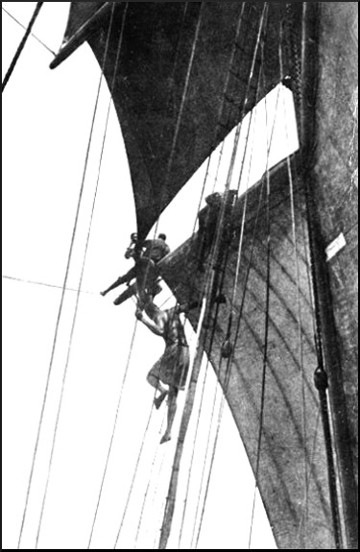
Native boys setting sail on S. S. "Janet Nichol"
Arrived at Natau after dark. Mr. Hird called to us that there was another vessel close at hand. We rushed on deck and saw a schooner putting up a light. In a few moments the mate was on board the Janet. There is no landing at this island, and an unusually heavy swell will make a big surf in the morning. The only one of the Ellices I have as yet seen gave me such an unpleasant impression that I shall not be disappointed if I cannot go ashore.
29th.—Early this morning we anchor near the schooner. She is painted white and looks just like the Equator.[10] Louis says that every time he looks at her he expects to see ourselves. There seems to be great excitement aboard the little vessel; canoes filled with people are going to and fro, continually, between her and the shore. Only one canoe has as yet come near us; it was filled with women who paddled about the ship, following my movements; one of the women handsome, and the others by no means plain. The canoe was very long, tapering off into a beautiful fish's tail, something like this:

and was ornamented at both ends with mother-of-pearl let into the wood in bands and patterns. The people here wear ridis, not so good as the Gilberts, however. The ridis are too full, too much like ballet-dancers' skirts, though the colour is pleasantly gay, a mixture of dull red, blackish maroon, and faded yellow. The surf, as I expected, was too high for us to get on shore dry, so we did not attempt it.
In the afternoon the schooner (of 80-ton burden) began to fill up with natives; we were told that she was going to take a party of one hundred and eighty people on an excursion round the group, for which a lump sum of twenty-five tons of copra was paid. The decks of the little vessel were closely packed with laughing, chattering people; the hum of their voices came to us like the sound of bees. It was just so, not very long ago, that slave-ships used to carry them away. "What a haul that would be for labour!" remarked Tin Jack when he first caught sight of them.
There is a small enclosed lagoon in this island. Tin Jack, while on shore, broke off some of the reef coral and found it full of the same living worms as Louis discovered before on the other island, only here there were two varieties; one like a pallid earthworm and the other something like a small centipede. Tin Jack brought me a wreath of gardenias, and a spray of scarlet leaves. Mr. Hird brought me a bunch of jack-fruit leaves to polish my Tokalau buckets with. Some young banana plants were sent on board, I suppose for friends on another island.[11] Tin Jack was strongly tempted to stop here as is his custom at most islands. The trader at Natau was a rather dreadful-looking person, apparently afflicted with leprosy. He shook hands with me, to my dismay, for his fingers were dropping off. "I think I've got some native disease," said the poor fellow as he held out his hand.
30th.—Still a heavy swell and the surf too strong for boats to venture in. A great crowd of natives on shore and many canoes drawn up on the beach. Pretty soon the canoes swarmed about the ship and we were overrun with eager venders of merchandise, mats, chickens, and eggs. One man followed me about beseeching me to buy a silver half dollar. "You want buy money?" said he. "How much tobac you give?" I bought one mat for ten sticks of tobacco, one for a comb, and one for a pattern of calico. I saw Mr. Henderson, in the midst of the harassing business of weighing copra, stop and paint a broad mark, with violet ink, down the breast of a fine young lad who swaggered about afterward with a conscious air of superiority.
For a long time we saw no women, but at last a canoe containing two, pretty and young, was seen paddling wildly up and down beside the ship; the women were shouting for a sight of the "Beretani fafine" (white woman). I was called, and showed myself, whereupon they threw up their hands and shouted with excitement. Soon after this I met on the companion stairs the captain, half dragging, half persuading one of the young women I had seen in the canoe to come down to the saloon. Naturally she did not understand that he was only trying to bring her to me. At the sight of me she gave a cry and, breaking loose from the captain, flung herself upon me and clung to me like a frightened child. I could feel her heart beating against my breast and she was trembling from head to foot. As she held me she bent down, for she was taller than I, and smiled in my face. Plainer than words her smile said: "You are a woman, too; I can trust you; you will protect me, will you not?" I put my arm round her and talked to her in English and tried to soothe her fears. She understood my English as well as I her smiles. I brought her into the saloon and Louis gave her sweetmeats; she turned to me with a gesture that asked if they were safe to eat. She had already a bit of ship's biscuit tightly clinched in her hand, and of that she alternately took a bite with the sweetmeats; but at the sound of a footstep she was trembling again and would throw her arms round me with the same pathetic, questioning smile. I placed a wreath of yellow and red tulips on her pretty head—she was a lovely young creature—and the captain brought her a necklace of large blue beads and a pair of earrings. All the while, though I did not know it, the girl's father was hanging about the companion way with a very dangerous expression on his countenance.
After a little, another woman, seeing that no harm came to the first, was persuaded to come down to the saloon where she stood, quivering and starting like a timid, wild animal, ready to fly at a sound. The difference between this place and Manihiki is very marked. So far from there being any fear shown in Manihiki, the very children pushed through the darkness to clasp the white man's hand, and after that there was no getting rid of the gentle, affectionate, little creatures. I remember, at Manihiki, seeing Louis sitting with a tall boy of fourteen, beautiful as an angel, holding him round the neck, a young girl leaning over his shoulder, while a little child nestled up to his breast. But these islands were a favourite recruiting place for slavers and, worse still, a haunt of the loathsome "Bully Hayes." I gave a wreath to the other girl also, and after Lloyd (they seemed to have no instinctive fear of either Lloyd or Louis) had sprinkled them with scent from a bottle of "Jockey Club" they paddled to the shore to be met by a crowd of friends who rushed into the surf up to their necks to hear the news. The wreaths, necklaces, and earrings were taken off and examined, criticised, and tried on by all who could get hold of them; the excitement was tremendous. All the while the young girl was in the saloon the three large port-holes were entirely closed up by the faces of men, who watched every movement with the keenest anxiety.
In the meantime the ship was noisy with the squawking of fowls and the squealing of pigs. The latter are of a curious mouse colour and most amiable creatures. Later on our pretty girl, accompanied by an elder sister, very handsome, and the startled one who had visited me before, came back to the ship. Lloyd took the younger girl's photograph at the end of the bridge. I had to stand beside her with my arm round her for some time before she would keep in one spot long enough for the camera to be pointed at her. Though much less frightened, she was still suspicious. She brought a chicken and some cocoanuts for a present to me, also another fowl which she wished to exchange for a comb, and a mat to exchange for cotton print, both of which I gave her. The startled one brought some shells which she wished to have me understand cancelled the gift of the wreath. I wish I knew how to explain that I do not want return gifts; but that might be an unpardonable breach of etiquette.
I was sitting on a box near the trade room when a fine, intelligent-looking man, a missionary from another island, came up and began talking to me. Unfortunately, his English was so hopeless that I could understand but little that he said, except that a native he presented to me was the King, and that if we would call at the island on our way back there would be an immense load of copra ready. The King had a look of breeding, and only one of his ear-lobes hung down to his shoulder in the native fashion, the other having somehow miscarried. The outer rim of the ear is sliced round and grafted against the jaw, thus making a much larger hole than can be managed at the Gilberts with mere boring and stretching.
Moving through the crowds on deck were three unmistakable lepers, one with elephantiasis also. The toes of the man with elephantiasis were dripping blood, not very pleasant for us barefooted people. I have asked the steward to hang all the mats, some of which are very handsomely decorated, over the side when next we anchor and let them be thoroughly washed by the sea. Just before we left the King asked for me; he had brought me a present of a large mat, a bunch of husked cocoanuts, and a very fine ridi[12] of different colours. I bought one, also, not so fine, from a woman for seven sticks of tobacco. I had nothing to give the King in return for his present—I am bound to say he seemed to expect nothing—so I pulled a gold ring from my finger and gave him that. He was overcome by the magnificence of the gift, as were the crowd who gathered round him to examine it.
During dinner we weighed anchor and shoved off. The captain had expected to meet the schooner at this island; there were no signs of her until late at night, when she was sighted, apparently on a wrong tack. The captain fears they may be out longer than they expected and the provisions run out; however, there are always the twenty-five tons of copra at hand in case of an emergency, and the passengers can eat their currency, which is more than we would be able to do. The Janet has taken to her old trick of rolling, which makes things very uncomfortable. When I went to bed the cackling of hens, the crowing of cocks, and the grunting of pigs gave quite the effect of a farmyard. Our three cats seem to be getting the "rattage" well under; at least there are no more rats on deck and the old, businesslike Tom now takes his ease and sleeps all night.
31st.—The Island of Nanui. A very violent surf and very broad. Louis goes on shore and returns with a mat. Tin Jack is in great feather as the Nanui people speak the Gilbert Island tongue which he knows. Louis is instantly accepted as a kaupoi (rich man), though he cannot imagine why, as he was clothed only in an old, ragged undershirt and a lava-lava.
June 1st, Sunday.—Still at Nanui. Mr. Henderson asked his black boys, as he was afraid of a change of weather, to work to-day. He said it was a case of necessity, so they consented and fell to like good fellows. After work was done they all gathered together, as is their custom on Sunday, and held a service. It was strange to hear them singing a Scotch hymn tune with words in their own tongue—or tongues, I should say.
2d.—Still taking on copra. Johnny, one of our men, the cleverest one, brought his wife, a native of Nanui, to see me—a strapping fat wench of sixteen, though she looks twenty-five. I gave her some cotton print and a silk handkerchief. A little after Johnny came, with a most serious countenance, to ask Louis to go on deck, where he found a large, mouse-coloured pig and a great pile of cocoanuts awaiting him. Among the people on deck I saw a man the facsimile of the leper at the last island; involuntarily, I looked at his feet, and, sure enough, the poor fellow had elephantiasis also.
The captain offers to make me a plan of a surfriding canoe. There was a light rain last night which the captain thinks must have fallen on my eyes, as they are inflamed and swollen to-day. When rain in these latitudes touches the captain's eyes, which happens often on the bridge, he is affected in the same way.
4th.—At the Island of Nanomea. Two traders come on board, the company's trader known through the groups as "Lord ——" and an "independent" trader, a pathetic figure of an old man with both legs bound up; he said he suffered from boils. Soon after, the missionary and his wife came on board, both Samoans, the woman a fine, kindly looking creature with a very sad expression. I said as much to Louis and she wished my remark translated. With the aid of a dictionary Louis told her what I had said. "I am sad," was the reply. She brought me a present of a mat, and I gave her a print gown. I bought, also, a few mats from the people. One man, followed me about, insisting that he and I should be brothers. He had a mercenary countenance, wherefore I refused steadily the proffered relationship. In spite of me, however, he managed to thrust a bunch of cocoanuts into my cabin door to ratify the tie.
The surf is very high. When the boats went off, the one containing the traders and the missionaries turned over, end for end, and the poor, old "independent" was nearly drowned. The missionary woman dived for him again and again, and we could see people carrying him along the beach after she rescued him. Several canoes smashed during the day and some bags of copra were lost. In the evening we had a long discussion as to whether Lord —— is a gentleman, I taking the affirmative with no more to go upon than the way he raised his hat.
7th.—Have been lying at Nanomea, the last of the Ellices we shall visit, for three days, unable to get the cargo on board till to-day owing to the fearful surf. A good many canoes are broken to pieces, and our own boats have had many escapes. While I was looking through the glasses a great wave swamped one of our boats and pressed her down out of sight. In a moment black heads popped up everywhere and the boat was hauled on shore. Another boat was just on the point of crossing when the steersman was snapped off his perch and flung into the sea; he was almost instantly back and crossed in triumph. Every success was cheered from the ship by the watching men.
It is always a great pleasure to the natives to help raise the ship's boats to the davits for the night. They know that white sailors make a sort of cry or "chanty" when hauling on a rope, so they, too, try to do the correct thing. The result is a noise very like a mob of schoolgirls let loose, a confusion of soprano screams. No one would suspect the sounds to come from the throats of men. Our own black sailors are the same; we hear them screaming and laughing in the forecastle exactly like girls. We are so used to island life that it has but just struck us as odd and picturesque that our almost naked sailors (they wear only a short lava-lava round their loins) should be working in wreaths like queens of the May.
It is only to-day that any women have been able to get on board. Not knowing there were any on deck, I started toward the trade room. There was an instant loud cry of "Fafine! Beretani fafine!" and I was in the midst of them. The two who seemed of higher rank than the others took possession of me, and it was explained to me by our Johnny that they had come prepared to make a trade. Each had an elaborate ridi for which she wanted two patterns of cotton print. The bargain seemed so unfair that I added a necklace apiece of yellow and white beads. They were enchanted with the necklaces, calling everybody to look at them. Then they began pulling off their rings to put on my hands; I did not like taking their rings, but I need have had no scruples, for one of them with prompt energy removed a gold ring from my finger to her own. These exchanges made, they fell to examining my clothes, which filled them with admiration. The next thing, they were trying to take my clothes off; finding this stoutly resisted, they turned up my sleeves to the shoulders. Their taste differed from mine, for, while I was thinking what a cold, ugly colour a white arm looked beside their warm, brown ones, they were crying out in admiration. One woman kissed my feet (the island kiss) and sniffed softly up and down my arms. She was plainly saying to the others, "She's just like a pickaninny; I would like to have her for a pet," holding out her arms as she spoke and going through the motions of tossing and caressing a baby. My hands and feet were measured by theirs and found to be much smaller (they were large women made on a more generous scale than I). "Pickaninny hands and feet," they said. The discovery of vaccination marks caused great excitement, especially as one of them could proudly show similar "Beritani" marks. Whether they were real vaccination scars or only accidental, I could not be sure. She, however, declared that they were true Beritani. Suddenly they all began calling out names; there were now five or six women sitting in a circle round me on the floor of the corridor at the head of the companion stairs. In a moment all their husbands' heads appeared at the doors and windows. My sleeves, in spite of my struggles, were dragged to my shoulders and, to my dismay, my petticoats were whipped up to my knees. At that I began to cry, when the men instantly disappeared, and except for an occasional sniffing the women behaved with more decorum. One woman was most anxious that I should stop on the island with her. I really think she had some hope that she might keep me as a sort of pet monkey. At last they were warned that the ship would be off soon, so they fled to their canoes.
For some time eight or ten canoes, loaded with people, hung to the ship's sides, rocking to and fro with her as she rolled. It was a beautiful sight, and Louis and I leaned over admiring them. Suddenly a lovely young girl (we were told she is to be married next week) climbed up to me like a cat, pulled off a ring, and pushed it on my finger. I ran back and got a blue-bead necklace for her and she climbed down in a state of great delight. The beads will doubtless serve as wedding jewels, for she did not put them on but tied them up carefully in a bit of cotton stuff. We watched the canoes go over the surf; one, filled with women, upset, but nobody appeared to mind so small a mishap.
Mr. Hird tells us a story it is well to remember. There was some sort of disturbance at Penrhyn, where his vessel was trading, and all on the ship were afraid for their lives to go ashore except himself. The moment his boat touched ground he dashed up to a little maid of seven, the chief's daughter, and, taking her by the hand, calmly walked to where he wished to go.
Last night, as we were sitting round the lamp, some one looked up and perceived that all three port-holes had as many faces looking through them as could find an eyehole. Mr. Henderson went into his room and arranged a few conjuring tricks. When he returned he made money disappear in a box, bits of cork change places, etc. While speaking to one of us he carelessly tore off a piece of newspaper and handed it to a man at the port-hole, but as the man's fingers closed on it the paper disappeared. "Tiaporo!" (the devil!) he cried, his eyes almost starting from his head. This was followed by the throwing up of money which apparently fell back through the crown of a hat and jingled inside. The last and most thrilling feat was after Mr. Henderson had been pulling money from all our heads, noses, and ears. He seemed to be retiring quietly to his room when he gave a start, looked up in the air over his head, and with a leap caught a silver dollar that seemed to be falling from the ceiling.
I forgot to say that in the afternoon Louis was dictating to Lloyd, who used his typewriter. All the air and most of the light was cut off from them by heads at the port-holes. I watched the faces and saw one intelligent old man explaining to the others that Lloyd was playing an accompaniment to Louis's singing; the old man several times tried to follow the tune but found it impossible. He did not appear to think it a good song, and once, with difficulty, restrained his laughter.
9th.—We should have picked up Arorai yesterday at four o'clock, but somehow missed it and did not arrive until this morning. An atoll about six miles long, the first of the Kingsmills (or Gilberts). Natives swarmed round the ship in canoes built somewhat after the pattern of the American Indian birch-bark canoe. The pieces are tied together with cocoanut sennit and the boats leak like sieves. Louis, Lloyd, and I went on shore in the afternoon; Louis, to my distress, for it was very hot, with a hammer to break off bits of the reef for examination and Lloyd with the camera. Louis found the rock he wished to break but was a little afraid to use the force necessary. Seeing a powerful young man standing near, he offered a stick of tobacco for the job. The fellow smiled with delight, took the hammer, and struck one blow. "Too much work," said he, dropping the hammer.
Lloyd and I were taken in tow by an old man and led to the house of the missionary, who was himself on board the ship; but his wife and family, a handsome young Samoan woman with a pair of sickly twins, were at the door to give us welcome. We drank cocoanuts with her and took a photograph of the group.
There is very little soil on the island, which is subject to severe droughts; yet there are a number of breadfruit and jack-fruit trees growing luxuriantly, not many, however, old enough to bear. The village looked clean and prosperous. Children and women were pulling weeds and carrying them away in baskets. Lloyd and I strolled along a wide avenue that ran through the town for about a quarter of a mile, stopping once to photograph an old woman who had evidently dressed up for the ship. She was standing in the doorway of a neat house built of stockades tied together—the first I've seen in these islands. The house belonged to a trader who was abroad at the time. Returning, we saw two women, tall and superior in carriage and looks to the common people, marching abreast toward us; they were dressed in gala-day ridis of smoked and oiled pandanus strips and swung the heavy fringe from side to side, as they walked, in the most approved and latest style. As they came nearer to us their four eyes were fixed on the horizon behind us, and they swaggered past as though unaware of our existence, though we were attended by a following of the greater part of the village. I stopped and looked after them, but neither turned a head.[13]
At the veranda of the mission house we found Louis entertained by the old man and indignant at receiving no attention from the missionary people; we suggested that his chopping at the reef in the hot sun had convinced them that he was a lunatic.
We had heard of a sick trader, so we all three went to his house with an immense tail of followers, who seated themselves outside in a circle eight or ten deep while we talked to the sick man. A forlorn being he looked, lying on a mat, his head thrust out into the open through the thatched sides of the hut to catch what air there was. He had been ill a month and a half, he said; the whole population had been ill, also, his wife and children with the rest. With them it came first as a rash, then a fever, followed by convalescence. He had no rash, but after feeling very badly for a week or two, fell down in a fit, foaming at the mouth and black in the face. Since then he had been suffering from an intolerable pain in the head and could not stand for weakness. I asked if he had proper food, which Louis followed by asking if his appetite was good. When he could get anything to eat, he replied, he liked it well enough; but he could not get anything. A bit of fish or a chicken he could relish, but the people seldom fished and a chicken was impossible. His food consisted almost entirely of pounded pandanus seeds, in which there was about as much nourishment as in chopped straw. His hands and feet were pallid and bloodless and he looked very near the end. He was born, he said, in Colton Terrace, Edinburgh. "I'm frae Edinburgh mysel'," said Louis. "We are far frae hame," returned the poor fellow with a sigh. We went at once to the beach to get a boat, intending to consult "Hartshorn," our medical authority, as to his case, which I believed to be suppressed measles. Louis spoke to Mr. Henderson about sending the man a case of soups to begin with, anything heavier being dangerous in his weak state and semistarved condition. Mr. Henderson, who is generosity itself, seemed rather hurt that we had not taken it for granted that anything the man needed would be supplied him at once. Mr. Henderson's only fear was that the man would, in the usual native custom, give all the food away. He first divides with his family, and then they divide with the outside relations, so that provisions sufficient for a month may only last a day. It is an amiable weakness, certainly, but one could wish that the recipients of his bounty showed a little more gratitude. Fishing would be no more than play for them; but I fear neither fish, flesh, nor fowl can save him now.
The missionary who came aboard showed Louis his eye, in which he was blind, the effect of measles, and begged for a cure. Of course there was none, but Louis advised him to live as generously as possible and, instead of a continual diet of pandanus seeds, to try and get some fish. As soon as it was dark the sea was crowded with fishing-boats, lighted up with flaring torches, made by wrapping sennit round a dry cocoanut leaf; so we hope our poor trader may receive some benefit, also. We could see that they were scooping up in their nets many flying-fish. The light from the torch attracts the fish, which come to the surface of the water round the boats and are then dipped up in little nets on the ends of long poles.
While I was resting after my excursion to the island I heard a great commotion; a native had been discovered trying to stow away in the hold among the coal. Two large men could not overpower him, and for a long time he refused to come out. One of the white firemen finally leaned over the open hatch and held out a stick of tobacco. "Won't you come out for that?" he asked with an insinuating smile. "He is making signs that he will," he continued, looking at me quite proud of his cleverness. Sure enough, up came the native, a beautiful youth with a sullen face and blazing eyes. He strode haughtily past the fireman, looking neither at him nor his proffered tobacco, sprang upon the side of the ship, where he balanced himself a moment, and then jumped into the sea and swam ashore. I sympathised with the boy and was sorry he was caught, the more especially that another man had chosen a better hiding-place and was not discovered until we were well at sea.
When we left the island we should have signalled a boat, but a canoe lying at hand, we took that instead. We waded out toward the canoe, but, as the water began rising above my knees, I stopped in alarm when a native caught me up in his arms, unawares, before I had time to arrange my skirts, and I was carried out, willy-nilly, my legs waving frantically in the air. I tried to shield them from the view of the ship with my umbrella, which I was unable to open, but I fear my means were inadequate. The canoe was a fourth filled with water; its owner sternly commanded Louis and me to bail and Lloyd to paddle.
From the last island we took on some passengers—two cats in an onion crate—and at this island exchanged them for a woman and a sickly baby. I was much amazed at seeing the mother spread a thick, dry mat on the wet deck for her own comfort, her baby being planted on the cold boards. I made her take it up and lay it beside her on the mat, which seemed to amuse her a great deal. As the baby still shivered, I got an old lava-lava of Tin Jack's and wrapped it up in that, charging the mother not to dare remove the lava-lava.
This is the island where, in 1871, three slave-ships, the Moroa (bark), Eugenie (schooner), and a barkentine, name unknown, came for "recruits." The King, in his fright, offered them all his people except the very young, the very old, and a few young girls reserved for his harem. It is needless to say that his offer was accepted. I have since met and conversed with a man who was on board one of these ships.
12th.—Arrived early this morning at Onoatoa. The missionary's child is named Painkiller.
13th.—Noukanau in the morning. Met the German "labour" brig Cito, after recruits, doubtless for Samoa; then ran over to Piru and back again to Noukanau at night. At Piru we met the American schooner Lizzie with two passengers.
At Piru came on board a man named Cameron, another named Briggs, and a person with an Italian name I forget. Briggs said he made much more money by "doctoring" than by trading. A strange disease, he told us, had broken out in the island; the Samoan wife of a trader had died the night before and many others were down with it. It is contagious, and the natives take no care to avoid infection. I said it was measles, which Briggs denied, declaring it was typhus. I asked him where he got his knowledge of "doctoring." "Straight from my father," said he; "my father was the celebrated Doctor Briggs, and if you buy a bottle of his patent medicine you can read an account of his life on the wrapper."
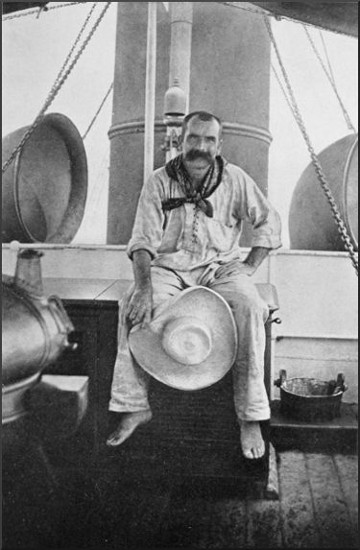
Tom Day—a trader of Noukanau Island
Cameron is a Scotsman with a twinkling, hard blue eye, the daft Scotch eye. He followed every word we said with sly caution (partly, no doubt, in consequence of drink) as though he feared being trapped into some dangerous admission. He was one of the men of the Wandering Minstrel that was so mysteriously wrecked on Midway Island, and was afterward charged by the captain with not reporting the fact of there being other starving castaways left on Midway when he was rescued. To us he denied this vehemently, and said he at once delivered a letter written by the captain. Louis tried to get a hint of how and why the vessel was wrecked, but failed. "Mosey," the Chinaman who was in the boat with Cameron, was afterward wrecked again on the Tiernan, the schooner we so nearly took passage in ourselves.[14] Louis got this much from Cameron—but I am sure very little, if any, of it is true—that he had written an account of the wreck which, with the log he kept on the boat, had been left on one of the islands we are about to visit, for safe-keeping. Before Cameron left he had given Louis a signed order for the apocryphal manuscript. Of the two men we brought one back with us, Captain Smith, who, having lost his schooner on this island, remained as a trader. He seemed a modest, intelligent young man, rather above the South Sea average. Tom Day, however, is—must be—the "flower of the Pacific." Tom is fifty years of age, with a strong, alert figure and the mobile face of an actor; his eyes are blue-grey in deep orbits, blazing with energy and drink and high spirits. "Tom Day" is not his real name, he says, and Tom Drunk would do quite as well; he had found it necessary to go to the expense of a shilling to have it changed, as he had three times deserted from men-of-war. "I've been in prison for it," he said cheerfully, "and I got the cat for it, and if you like you can see the stars and stripes on my back yet." He took pleasure in representing himself as the most desperate of ruffians. Tin Jack asked him to go back to Sydney with him. "I couldn't leave my old woman behind," said he; "and besides, you see, I got into trouble there. The fact is, I've got another wife there, and I think I'd do better to keep away." He then began to tell of a quarrel he'd had with his "old woman" when he took her to Auckland. How she chased him along the street with a knife in one hand and a bag of sovereigns—his entire fortune—in the other; he begged for the bag of sovereigns, trying to lay hold of it and at the same time avoid the knife wielded by the "old woman" (a young native girl, no doubt), who alternately lunged at him with the knife and cracked him over the head with the bag of sovereigns. The bursting of the bag, which scattered the sovereigns in every direction, fortunately ended the quarrel. He mentioned Maraki, on which Louis called to mind a story he had been told many times over.
"You are the Tom Day who had a native's head cut off," said he; "now tell me the story," which Tom presently did. A native had shot at him without provocation. Some one said: "Don't shoot; it's a white man." "A white man can cut a bullet as well as another," was the native's reply as he fired. Tom put his hand to his ear, found that the shot had grazed it and his head, and the blood was running from the wound. Infuriated, he rushed into the house for his rifle, but when he got back, the man frightened at what he had done, had disappeared. Tom tried to persuade the people standing about to go after the man, pinion him, and fetch him back to be tried. To this they objected; they could not get him, they said, as he was a chief and had people to protect him. One of the men came close to Tom. "Better we kill him," he said in a low voice, which Tom imitated. "If you do," was Tom's answer, "fetch me the head." Then turning to us with an apologetic air he explained that "If I had not asked to see the head they'd just have gone and killed some poor, inoffensive fellow and I'd never have known the difference." That night he was called up by the men who had the head, sure enough. "I made 'em stick it up on the wall," said Tom, "and then I got a light and looked at it. I jerked it down and slung it as far as I could; and, by golly, the old woman was in the way, half scared to death, and it took her on the side of the head and knocked her down, and I had to pour three or four pails of water over her, for she had fainted dead away."
"And after that," he continued with an air of virtuous indignation, "they wanted to make trouble about it in Sydney—they said I had killed a man. What did they mean by it, I'd like to know? I never killed no man; I only told them to fetch his head so I could be sure it was him."
It was very cold last night and my bed and tent and things nearly blew away; I could not leave them and go below where it was warmer, but had to stay and hold on to my belongings lest I should lose them entirely; so to-day I lashed everything securely. No one stayed on the hatch but Lloyd and me. The onions alongside Lloyd's and my beds are decaying, and smell horrid, as do a great lot of sharks' fins drying over our heads.
15th.—Waked to find that we were lying off Tapituea, Tin Jack's station. He had packed the day before and was all ready to land, his pig tied up and lying on deck. Tapituea looks a large and dreary island, the whole lee side submerged, making it very dangerous. We could not venture inside the lagoon, and even if we did we should have to anchor far away from the landing-place. It was a long time before any one came on board, but finally a Hawaiian who spoke a little English came out in his canoe. As Tin Jack appeared to be rather depressed with the news from his place, and it was almost impossible to land his stuff, we left Tapituea and ran on to Nanouti, where he thought he might prefer to stop. He has a sort of partner at Nanouti, known as "Billy Jones's cousin." The partner was soon on board, a man with a big head and one hand blown off by dynamite. A new arrangement was made with Tin Jack, who said he preferred staying in the ship as long as possible. We are now to carry him on with us, and land him at Nanouti as we return. A pleasant-looking young native came on board with the trader. He wore a rosary round his neck, which reminded me that there were Catholic missionaries on the island; I therefore made a little parcel of four Catholic pictures for them, and Louis put in his card; Tin Jack added a bag of garlic.
We left Nanouti before dinner, had a beautiful golden sunset, and are now steaming on to somewhere else, Apemama,[15] I trust. To-night the evening star is extraordinarily brilliant, with the blue fire of a diamond. Last night Mr. Hird came to the hatch and called out in a most excited voice: "Osbourne, we are just passing the equator!" Lloyd jumped out of a sound sleep and ran aft, crying: "Where is she? I don't see her!" It was a sorry joke; we were crossing the line, and it was not Captain Reid's schooner, on which we had passed so many delightful months.
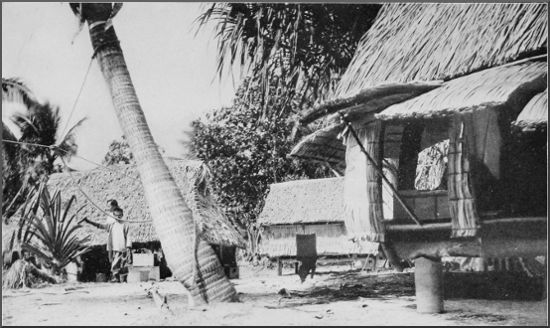
"Equator Town," showing corner of the sleeping-house and cook-house
16th.—Early this morning we were lying outside the lagoon of Apemama, just alongside the little island at the entrance. There was no sign of life, so, after waiting awhile, a boat with Mr. Henderson, Tin Jack, and Louis went to find out the reason. They came back with the news that the King was away visiting his island of Kuria, so off we started to hunt for him. Arrived at Kuria, a boat came out to tell us that the King was ill from the sequelæ of measles; also it brought an insulting letter to Mr. Henderson, signed by the King but written in a white man's hand; Mr. Henderson, very angry, showed the letter to Louis, who proposed that he should be present at the interview with the King. To this Mr. Henderson consented. Of course we all went on shore; Louis and Lloyd and I took our presents with us; from Louis a chibouk, from Lloyd a filled cartridge-belt with a sheathed dagger, mine being the King's own flag after my design. I thought it very generous of Mr. Henderson that he advised me to keep my flag back in case the King came on board, so we might get a better effect by breaking his colours man-of-war fashion—this after the insulting letter and before what promised to be a very unpleasant interview.
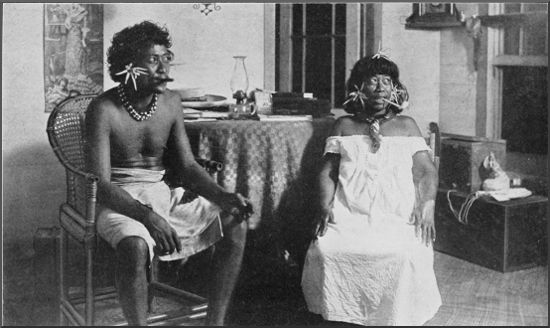
"The Baron and Baroness," Butaritari, one of the Gilbert Islands
Our black fellows pulled us across in splendid style, passing the King's returning messenger, who made a fine though unsuccessful spurt to catch up with us. As we rowed along the beach surprised cries of "Pani! Pani!" (Fanny! Fanny!) ran through the moniaps (native houses) where the King's wives were sitting. The King, looking older and thinner, received us in the native fashion with no apparent astonishment. The presents were given, and then Lloyd and I left the party to get their explanations over, the King smoking his chibouk the while with great enjoyment, while the cartridge-belt hung over his shoulder.
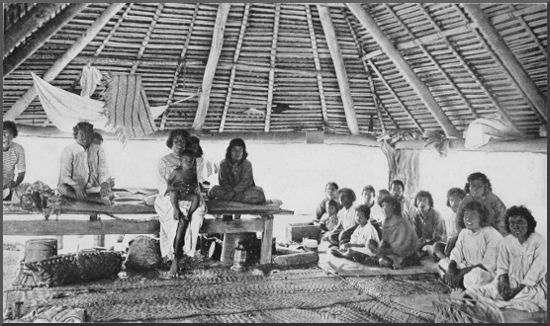
Interior of the moniap of Tembinoka's harem
We soon found the moniap of the harem and sat down beside the King's mother. The women received us with fervent expressions of welcome and pleasure. We passed through several houses on our way, and in every one our attention was called to a "devil box" similar to one we bought from the medicine-man at Apemama, then the only one in the three islands. In the centre of the big moniap was a circular piece of "devil work" with a ring of sacred white shells about it. Tin Jack followed after us, and we got him to act as interpreter. It seems they have been suffering here severely with measles, though there were only four deaths, two men and two women. Children escaped with slight attacks, but grown people were very ill, the King himself being at one time very near death. The first question put to us by the women was concerning Louis's health; then what had we done with our devil box? I fear that our accidental reconversion of Butaritari to Christianity[16] has been offset by our having inadvertently strengthened these Apemamans in their heathen superstitions. A sick foreigner comes, is cured by means of a devil box manipulated by a "dog-star" (doctor), and naturally he desires to possess an article so valuable, going so high in his offers for it as the worth of a ton of copra. The foreigner is a very clever and learned man. "He savee too much," they say. And when measles falls upon the land the first thought is the devil box, and a praying place for devil worship is erected in the very centre of their moniap. I wish I could find out if they really worship the spirit of evil or whether, having been enlightened by the missionaries, they have not given their god that name. If the latter, how much better to have accepted their god and shown them where they had mistaken his attributes? And that reminds me that when I heard the people with the scaly disease on the other islands erroneously called lepers I wondered if that could have been the leprosy of the Bible that was miraculously cured. The darkest people turn quite white when covered with the scales.
But to return to Tembinoka, the King. Louis, fortunately, was able to clear up the misunderstanding caused, no doubt, by a white man, though the King loyally refused to give the name. Louis proposed that the King should apologise for the insulting letter, at which his Majesty looked very black, indeed; but when Louis told him that under the same circumstances an English gentleman would certainly offer an apology, his countenance cleared, the apology was handsomely made and accepted, and so, all being well, the King proposed to go on board. We wished some of our party to be on the ship to break out the flag at the right moment, so hunted up our black boys who were filling bags with grass for the ship's sheep; Mr. Hird went off with them, and the rest of us begged permission to accompany the King, who invited us to ride out with him to his boat in the royal litter. I was told to get in first, then Lloyd, then Louis and Mr. Henderson together, and then his Majesty. The black boys passed us on the way with Mr. Hird, and afraid that the flag might be forgotten by some mischance, Mr. Henderson shouted: "Hird, elevate the royal bunting." That was because the King would have understood had he said: "Break the flag." The black boys put their elegant backs into it and were in time to send up the flag in fine style. Every one cried out in admiration; it could not have had a better setting than the "long, low, rakish black" steamer. The King, who steered his own boat, and was greatly pleased to learn that the Hawaiian King was a good sailor as well as himself, had been smiling on Louis, and Louis on him, in the most melting way. He now directed his attention to the flag, and there was no doubt but the sight gave him the keenest gratification. We came down to the cabin, where "champagne was opened," and then Mr. Henderson left Louis and me alone with the King.
The moment that Mr. Henderson was gone the apathy that in these islands "doth hedge in a king" broke down. The dear old man clasped Louis in one arm and me in the other and kissed us and wept over us for joy. He told us how, day after day, he looked through his glass out over the sea pretending to himself that he could see us coming back. Sometimes, he said, he deluded himself so far that he beheld our very faces. This day he had been looking out as usual and was not surprised when our boat came near; he had seen it all like that before in his day-dreams. Suddenly he recognised a particular dress I wore that he had given me. "Then I felt like this," he said, making a gasping sound of surprise and emotion—"O-o-oh!"—and pressing his hand on his breast with a dramatic gesture. Often, he said, he made an errand over to his taro pits that he might look upon the place where our houses had stood. "I too much sorry," he said; "I want see you."
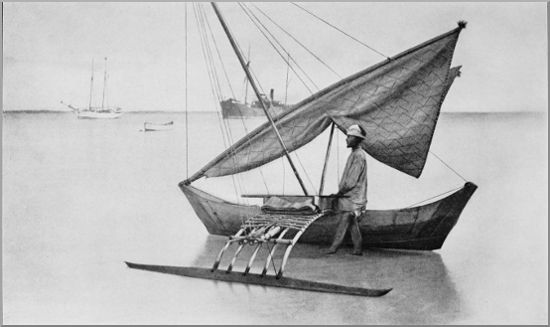
A Marshall Island canoe
The time came to say good-bye until the Janet came back on her return voyage; the flag was hauled down and presented to the King, and he went off in his boat with a very depressed countenance.
Reuben is now called "the governor." As we were sitting at dinner some one said: "The anchor's coming up. There's a man at the port wants to speak to you, Mr. Stevenson." We all looked up, and there, grinning like an ape, was "Uncle Parker!" (Uncle Parker was a servant the King had lent us when we visited him before.) He thrust as much of himself through the port-hole as was possible, and we all climbed up and shook hands with him. He told us that there had been further trouble with the impudent cook, and in consequence the King had shot him. Louis gave Uncle Parker a magnificent gift of six sticks of tobacco. The King said he had sent us ten mats by Captain Reid. On this island is a house of refuge, an octagon to which criminals may run. I am told that the people have a system of palmistry.
17th.—Maraki. We stopped at the wrong settlement, and, as men were seen on the beach, Mr. Henderson sent a boat for them in case they wished to go on with us to the other settlement. One was a stranger, the other an old friend known as the "passenger".[17] We heard his meagre news and he heard ours, and drank stout with Louis and Lloyd. It was pleasant to meet him again. He expects to be in Samoa in a twelvemonth. Left the silk dress, "blackee coat," and other presents with him to forward to Maka and the Nan Toks, and I gave a gold ring to the Hawaiian missionary for his wife. This missionary expects to return to Honolulu on the Morning Star in company with Maka, so our presents will fall in at the right moment. Louis also sent one of his photographs to a young Hawaiian I met under peculiar circumstances when we were here before.[18] We stayed a very short time, and then, with several sails set, took our way toward Jaluit. A sheep and a pig struck attitudes and dared each other to fight—a comical sight. Both were delighted when the strained situation was broken by a chance passerby. The black boys are playing cards in the forecastle. Mr. Hird and Foo-foo (black boy) sang in the evening.
18th.—Very hot weather. Our sails are still up, and one of the boats hanging over the side has its sail also set. It looks very odd.
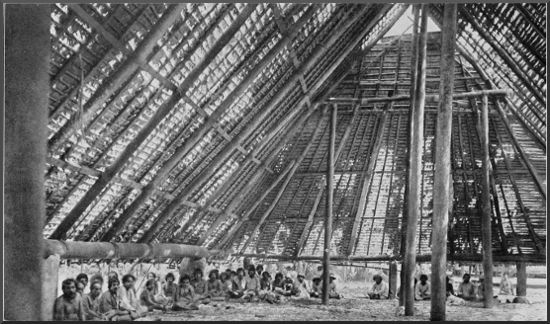
Speak House, Island of Maraki
19th.—Jaluit, the German seat of government for the Marshalls. We could see the commissioner's house, painted a terra-cotta red, looking very pretty under the green trees. Went on shore, a blazing hot day. We were all dressed up for the occasion, Louis with his best trousers, yellow silk socks of a very odd shape, knitted by his mother for a parting present, dirty white canvas shoes, and a white linen coat from the trade room that could not be buttoned because of its curious fit. It was hoped, however, that a gold watch and chain might cover all deficiencies. I wore a blue linen native dress, entirely concealed by a long black lace cloak, and on my head a black turban with a spotted veil. Our feet were certainly the weak point, my stockings being red and my shoes cut in ribbons by the coral. Not having gloves, I put on all my rings which flashed bravely in the sun. On board ship our appearance caused a decided sensation and was considered most respectable, and reflecting great credit on the Janet. The commissioner received us at his door, offered us wine, and while we were drinking it in came Captain Brandeis,[19] a slender, sallow man with a small head and the most extraordinary eyes of glittering blackness which seemed to shrink from meeting one's gaze and yet to challenge it with a nervous defiance. He was pale, and I thought he was prepared for an unpleasant meeting with Louis; that wore off very quickly, and the two were soon deep in conversation, I talking twaddle with the commissioner that Louis might have the captain alone. Louis is fascinated by the captain and I do not wonder; but his eye is too wild, he is too nervous, and his nose is not to be depended on—a weak and emotional nose. A man, I should say, capable of the most heroic deeds, sometimes preternaturally wise, and sometimes proportionately foolish; a born adventurer, but never a successful one.
The commissioner showed me the "garden," an acre or so of high-island plants grown in foreign soil brought in vessels. The commissioner's room was decorated with trophies of native arms, armour, etc. He promised to have a native sailing chart made for Louis. These charts are very curious things, indeed, made of sticks, some curved, some straight, caught here and there by a small yellow cowry. The cowries represent islands, the sticks both currents and winds and days' sailing. The distances between the islands have nothing to do with miles, but with hours only. These charts are very little used now, only one old chief knowing how to make them, but the time was when each young chief must pass his examination in the charts, knowing them by heart, as they were never taken to sea but kept at home for reference and continual study. We lunched with the commissioner and, the steam-whistle calling us soon after, we went on board to start immediately for Majuro.
20th.—At Majuro early in the morning, a pearl of atolls. The lagoon, large and round, but not so large that we cannot distinctly follow the coastline. At the entrance it is broken into the most enchanting small islets, all very green and soft, the lagoon clear and in colour like a chrysoprase. Mr. Henderson offered us a little house on the windward side, so we took our mats and blankets and a lantern with us in the boat. The house was the old "lookout" consisting of a single room with latticework running along two sides of the wall under the roof; this lattice served for windows. The door had a padlock so we could lock it as we came and went.
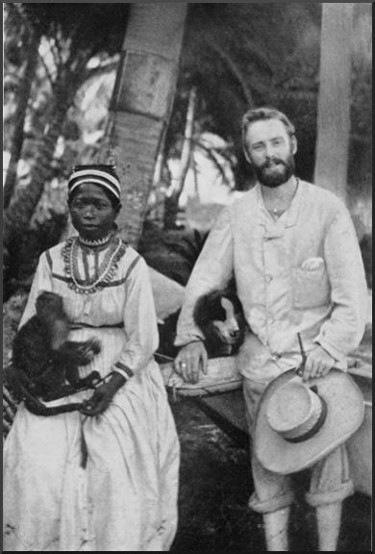
White trader and his wife "Topsy," Majuro Island
I had taken my paints with me and made a little portrait of a native girl called "Topsy" by her white husband. She was a very small, very thin creature, greatly given to dress. She seemed to live with several other women in a sort of boatbuilders' shed, where I would always find her, her thick hair shining with oil and carefully braided, a different head-dress for a different hour—her keys hanging below her rows of necklaces, busily employed at something or other; sometimes it was a necklace she was stringing on shreds of pandanus leaves, sometimes a new print gown she was cutting out with a most capable, businesslike air; or she might be feeding her monkey ("monkaia," she called it) or her gentle-eyed dog; or, most interesting task of all, sorting her possessions into order. She had two pretty large camphor-wood chests quite filled up with cotton prints, coloured handkerchiefs, and various accessories of the toilet. She dressed for the portrait in a gown of cheese-cloth drawn in at the waist by a white cotton belt edged with blue and white; the yoke of the bodice and the sleeves were trimmed to match, and the hem of the skirt was marked with a black braid. Her hair, smoothly drawn back over her little rabbit head, was ornamented by two bands worked in a design with beads, and her necklaces were innumerable. On one arm she proudly showed me the word Majuro tattooed and on the other, Topsy. It seems that she was a castaway from another island, every other soul in the canoe being lost. She was absolutely ignorant, and when something was said about her heart, gravely assured us that she had no heart, being solid meat all through. Topsy sat for her portrait most conscientiously as though it were a photograph, not moving a hair's breadth, nor hardly winking. After each sitting she returned to exactly the same position. I tried in vain to make her take it more easily; when I talked to her (she knew half a dozen words of English) she responded with stiff lips, trying to speak without moving them. I took her a wreath which delighted her, and just before we left I came across a red silk bodice with a smocked yoke and embroidered cuffs; just the thing, I felt, for Topsy. The captain, Louis, and Lloyd were with me when I gave it to her. She instantly slipped off her upper garments, showing a very pretty little figure, and we all together robed her in the bodice. Topsy is quite a great lady with her female attendants, living in her boat-house, sleeping on her mat beside her two chests with her dog, and that rich possession the "monkaia." Some one the captain knew took a large monkey to Savage Island, but the people would not allow it to remain; it was, they said, derogatory to their dignity.
There are broad, well-kept walks on Majuro, and to cross the island to our cabin was like passing through a palm-house. When somebody remembered it, fresh palm toddy[20] was brought to us in the early morning, and once tea. Louis slept on shore with me one or two nights, and then, as it rained a good deal, it was judged better for him to remain on board. The next night I slept alone. At about two in the morning I waked with the consciousness that some one was in the room besides myself. I peered about without moving and saw two native men who moved into the moonlight so I could see them distinctly. I said, "Who's there? What do you want? Get away with you!" in the gruffest voice I could assume, and after a few moments' hesitation, they made off. One evening, while Louis still slept in the lookout, quite late, the room became filled with a peculiar and pleasant fragrance. For some time we could not make it out, but it finally occurred to us that it was the scent of pandanus nut. Some native, overcome by curiosity, must have crept to the house so softly that we did not hear him, but the pandanus he had been chewing betrayed him. As they all seemed to think that I should not stop alone so far away, Lloyd came over and slept on Louis's mat. Some of the pandanus nuts here I like very much; they are juicy and of fragrant, tart flavour like a good apple.
One day while I was talking to Topsy at her door, the monkey being fastened by a long, light chain to a tree close by, a girl fell down in a fit. Her head struck a woman's lap, but the woman hastily thrust her off so that she lay, half smothering, face down, in the sand. She sniffed, and moaned, and clicked her teeth together, but neither frothed at the mouth, nor protruded her tongue, as I supposed people did in fits. Not a soul moved to help her, but "monkaia" leaped on her head like a demon and began biting and plucking at her hair and face. I tore him off with difficulty, the men and women standing by quite helpless with laughter. I had to threaten a woman with physical violence before she would drag the girl away from the monkey while I held the brute. The next morning, while I was painting at Topsy's portrait, the girl who had the fit sat on the floor beside me watching the process. My bottle of oil and a basket of coral just given me were standing between the legs of the easel. Suddenly the girl lurched forward, upsetting the bottle of oil, and had a fit with her face in the basket of coral. The instinct of saving property brought Topsy to my aid this time, however, and together we dragged the girl to a safer position.
One afternoon I asked the name of a particularly bright-looking girl who came to visit the ship. "Neel," was the reply. "How did she get that name?" I asked. "Oh, it came in this way: She was a sharp little child, and some white man said she was sharp as a needle, so they called her needle." Neel is the nearest they come to pronouncing it. I was told that Neel was a capital mimic and actress. I made an offering of a wreath and she agreed to give me an example of her skill if all the white men went away. First, she said (Johnny, a half-caste, interpreting), she would represent a well-known native woman, with an impediment in her speech, on a visit to a neighbour; immediately her round, fat face twisted itself into a thousand wrinkles, and her thick, protruding lips became pinched and thin, on one side lifted like a harelip. She spoke like a person with a cleft palate, very garrulously, making polite inquiries about different members of the family she was supposed to visit, but never waiting for an answer. After this impersonation she assumed a prim air and, with a dry, nipping precision of speech, and neat little persuasive gestures, gave us a bit of an English missionary's sermon. The voice was a man's voice, and the English accent in speaking the native words perfect. Had I not been aware that the girl was speaking, I should have felt certain I could pick out the man by his face; I knew it, and his figure, and his umbrella.
I am told they go in for "devil work" here; they call it "bu-bu," which reminds one of the negro word. When their old witch women (they are always old) wish to lure a vessel to destruction they run up and down the beach shouting their incantations, waving, as they run, a long stick with a red rag on the end. A man whose vessel was wrecked on these islands told me that as the ship neared the rock where they struck they could distinctly see an old woman rushing along the beach waving her red rag.
A Mr. R—— told Lloyd that in New Ireland he had had a similar experience to that of Tom Day. A man had attacked him, and he had said to the bystanders: "I'll give an axe for that man's head." The next morning he discovered the head stuck on his gate-post. He said he had often bought victims set apart to be eaten for ten sticks of tobacco. If he paid up honourably, the natives were honourable in return, and never after molested his man.
One evening I stopped at Mr. M——'s to wait while some one went on board for my key, which I had forgotten. Tin Jack, who was there, promptly presented me with a fine piece of staghorn coral belonging to our host, following up the coral with presents of elaborately worked mats, some of which he gave in his own name and some in Mr. M——'s, until he had made me the embarrassed recipient of four. The captain, who dropped in, was also requested to make choice of a pair of the best. Poor Mr. M——, feeling that it would be more graceful to give his own presents, then offered me a curious fish preserved in a bottle which Mr. Hird, much to my distress, scornfully refused on my behalf as a present "unfit for a lady."
The Marshalls seem a very damp, rainy group of islands, but, in consequence, breadfruit grows on most of them, and bananas on many. We had expected to fill up with copra at Majuro, but measles has been ravaging the islands. The King himself, whom we had wished greatly to see, old Jebberk, lay dying and tapued to whites. Two other Kings came to visit us on the vessel, both very fine, intelligent-looking men. One was dressed in a mat breech-clout and a comical red shirt or jacket, and had his hair done up on the top of his head Japanese fashion. The other wore a red-and-blue-figured petticoat, very full at the waist, where it was gathered in with native cord. Around his neck he had a pink shell necklace, and his hair was done in the same high knot as affected by the first King. We had finished luncheon when the last king came, so he had his alone spread at one corner of the table. I gave him a wreath, of the best, for his queen; he admired it greatly, and examined it over and over. Finally he turned to me saying, "What you want?" pointing to the wreath. He meant to ask what would I like for a return present. I said "Nothing," which was a mistake, afterward cleverly rectified by Louis. The King asked through an interpreter how long it would be before the Janet sailed, as all his things were at his own village, and he wanted to get some mats for me. Louis replied that we were sailing almost immediately but that when we returned we would be most happy to receive his present. This proved satisfactory, and the King was put at his ease.
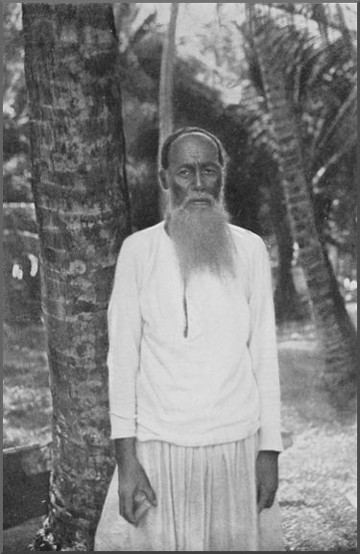
Kaibuke—one of the kings of Majuro
24th.—Left Majuro.
26th.—Again at Jaluit. Went to see the commissioner, where we found our island charts awaiting us. Louis and the commissioner and Captain Brandeis tried to make out the names of the islands by comparing the charts with our European map, but failed; a man who had been thirty years in the islands was consulted, and afterward a native, but still they were baffled. It was finally settled that the thirty-year resident should see the maker of the charts (now absent) and get a complete key to be sent to Samoa. Lloyd bought some German beer, which is excellent, and I bought two jars of sweeties, a couple of Pleasant Island baskets, several pieces of tortoise-shell, and some abominable sausages. The commissioner gave me two shells and Captain Brandeis gave me a lovely one, also a black mother-of-pearl shell, such as the Gilbert Islanders use for trade.
Left the same day, towing out a schooner.
27th.—Arrived at Namorik. Louis went on shore and met a wicked old man who afterward appeared in the "Beach of Falesa."
28th.—First thing in the morning at Ebon; anchored in the passage nearly opposite the wreck of the Hazeltine, American schooner. Left early in the afternoon.
July 1st.—Arrived Apiang, lay outside. Louis ill. Captain Tierney came off in a canoe. No copra. The missionaries in power and a general tapu. On to Tarawa.
3d.—Aranuka, one of Tembinoka's islands. Louis still ill. He was lying in his bunk when the King and his people came on board. A pleasant-faced man, who, with the rest, was shaking hands with me, asked for Louis. I said he was ill, whereupon he demanded to be taken at once to the sick man. I guessed that he was a medicine-man. Louis said he stood beside his bed, with the gently soothing, insinuating, professional manner of the European practitioner, asking his symptoms and very anxious to know if there was a "dog-star" in Samoa.