ILLUSTRATIONS (continued 5)
Reading edition
"But that is Jean's affair," he said.
Julie's eyebrows arched.
"Really!"
"She and I settled it in the beginning that she should have that room for her work."
His sister drew her knife through an inoffensive chop with bloodthirsty vehemence.
"Indeed!" she returned.
"I will look after its decoration," put in Jean, quietly.
Mrs. Van Ostade's dusky skin shadowed with the dull red which marked her infrequent flush.
"It must be in harmony with the other rooms," she said sharply. "At times it will be necessary to throw everything open."
"Of course."
"And it should be done immediately. In fact, Mr. Satterlee promised to look in at the studio about it at five o'clock to-day."
Jean was staggered, but she could not hesitate.
"I will meet Mr. Satterlee," she answered.
Julie's thin lips parted in a travesty of a smile.
"You are sure it would be agreeable?" she asked.
Atwood lifted his eyes at her tone.
"Agreeable, Julie?" he said. "Why do you give the word that twist? Why shouldn't it be agreeable?"
Jean felt like an animal in a trap, but she faced Mrs. Van Ostade with head erect and unflinching eyes.
"Yes; why?" she demanded.
Julie seemed to weigh a reply which prudent second thought bade her check.
"How tragic you two have suddenly become," she drawled. "Isn't it possible that the exacting Richter may have a prior claim? I am only too happy that Jean can find time to revisit the studio—and meet Mr. Satterlee. I hope, Craig, you will be present yourself?"
Atwood looked frankly distressed over the rancorous turn the discussion had taken.
"If you'll wait for me, Jean," he said, "we will walk over together. Miss Hepworth is to give me a sitting at three."
Jean went heavy-hearted to her room and flung herself down to wonder dully how it would end. Drowsiness overtook her in these unprofitable questionings, and, spent with her wearing night, she fell into a deep slumber which shut out all thought till a knock called her back to face reality smugly embodied in a servant with a card-tray.
Paul! The bit of pasteboard fluttered to the floor. What brought him here? Then, perceiving a gleam of human curiosity light the face of the automaton with the tray, she gripped her self-control and bade the man tell Bartlett that she would see him.
"It's Amy," explained the dentist, rising from a respectful survey of Mrs. Van Ostade's drawing-room. "Nothing will do her but that you must come up to the flat. It isn't a thing I could 'phone or I wouldn't have broken in on you like this, let alone hustling down here between appointments and maybe missing other patients."
"But what is it?"
"The drummer. Amy thinks he means to shake her, and she's gone all to pieces. I ran in there to ask for the rent, which is 'way behind, and found her all in a heap. It was no place for P.B. Amy needs another woman and needs her bad; and it seems to be up to you. I know it's tough, asking you to go back to the Lorna Doone where every stick of furniture—"
"I'll go," she interrupted. "If Amy didn't need me, I know you would not have come."
"I'm afraid I can't wait to ride up with you," Paul apologized. "You see, I'm only here between appointments, and—"
"I understand. Besides, I must see Mr. Atwood first."
She mounted hurriedly to the billiard-room where Craig must still be at work, but hesitated on the threshold. The door was half open, and, unseen herself, she saw both painter and sitter. Virginia Hepworth had dropped her pose and had come behind Craig's chair. Neither spoke, though his brush was idle. They merely faced the canvas in a silence, the long-standing intimacy of which stabbed Jean with a jealous pang and sent her away with her message unspoken.
She trusted Craig, but she could not trust herself, and deemed it the part of wisdom to leave word with the dispassionate butler that a friend's sickness would prevent her going to the studio.
XXVII
Jean entered the Lorna Doone with a sense of having known the place in some former life. Its braggart onyx, its rugs, its palms, all the veneer which went to make for "tone"—that fetich of the dentist—greeted her with a luster scarcely dimmed; the negro hall-boy flashed a toothful smile of recognition; and even a scratch, which their moving had left on the green denim by the flat door, had its keen associations.
It was a relief to lay eyes upon Amy, who had no close relationship to this dead yet risen past. Amy, poor wight, seemed related to nothing familiar. Easily flooding tears, which gushed afresh at sight of Jean, had washed her prettiness away.
"I knew you'd come," she whispered, clinging desperately. "Paul thought it was no use to ask, but I made him go. You're not mad at me, Jean, for sending? I've nobody else—not a soul."
Jean soothed her as she would a child, and leading her into a bedroom close at hand, made her lie down. No sooner did her head touch the pillow, however, than she struggled up again.
"I can't lie still," she pleaded. "Don't make me lie still. I tossed here all night. I can't rest, I must talk. I want you to know what's happened. I want you to tell me what to do. I must do something. It can't go on. I'll lose my mind. I'll die."
Jean drew the woebegone figure to her.
"Tell me, Amy," she said gently. "Perhaps it isn't as black as it seems."
Amy rocked herself disconsolately.
"It's blacker than it seems," she lamented. "Oh, if I'd never taken the flat! Fred never wanted me to do it. I've only myself to thank. I didn't know when I was well off."
"But what has the flat to do with your trouble?"
"Everything. I thought it would be heaven to keep house,—my own house,—but it's been a hell. Fred said we couldn't afford a girl, though I never saw why, for he's done splendid in his new territory. And he didn't like my cooking! I only learned the plain things at the refuge, you know, and he's been pampered, living so much at hotels. Somehow I never can do things his way. Traveling men think a lot of their stomachs, and Fred is more particular than most."
Jean began to comprehend the sordid little tragedy.
"But you'll learn," she comforted. "Make Fred buy you a first-class cook-book. Try the recipes by yourself till you succeed. Don't feed him on the experiments."
"I did try by myself. I practiced on a Welsh rabbit, and I thought I had it down fine. So I surprised him one night after the theater when he came home hungry. He said it wasn't fit for a h-h-hog!"
Jean's indignation boiled over.
"It was a thousand times too good for him," she cried.
"Don't," begged Amy. "I didn't blame him after I tasted it. The thing I do blame him for and can't bear is the way he criticises my looks. I can't always look pretty and do my work. Fred seems to think I ought, and is always holding up Stella to me without stopping to remember that she has nothing to do but sing and change her clothes."
"Stella! Do you let Stella Wilkes come here?"
"Fred made me ask her. She's got a flat herself—just a common sort of a place that she rents furnished, with two chorus-girls. She's making money now. She left the Coney Island beer-hall for one of those cheap Fourteenth Street theaters. Fred says she's bound to make a hit. He's crazy about her,"—her voice rose to a wail,—"just crazy!"
Jean held the shaking form closer.
"Aren't you mistaken?" she said, without conviction.
"Mistaken!" The girl wrenched herself erect. "Last night I saw her in his arms."
"Amy!"
"I saw them—here—in my own house! Stella was here when Fred came home from Newark—I guess she knew he was coming—and he made her take off her things and stay to supper. It wasn't a good supper. The gas-range wouldn't work, and I'd forgotten to put Fred's beer in the ice-box. I was hot and cross from standing over the fire, and hadn't a minute to do my hair. I saw Fred looking from me to Stella, who was dressed to kill, and I knew what he thought. I could have cried right there. I don't know how I got through the meal, but it ended somehow, and they went off into the parlor, leaving me to clear away the things. I washed the dishes up, for, company or not, I hate to let them stand over until morning; and then fixed myself a little to go where they were. I must have got through sooner than they expected. I saw him kiss her as plain as I see you."
"Did they know you saw them?"
"I let them know," rejoined Amy, with a heart-breaking laugh. "I'll bet her ears burn yet. I ordered her out of the house, and she went, double-quick!"
"And he?"
The light died out of Amy's face.
"Fred went, too," she said numbly. "I haven't seen him since. I'll never see him again, I guess. I'm the most miserable girl alive! What shall I do? What shall I do?"
"Divorce the scoundrel," counseled Jean, promptly. "I'll take care of the lawyer. I'll employ detectives, too, if you need more evidence, as I suppose you will. He must be made to pay alimony. But you've nothing to fear, even if you don't get a cent. You earned your living once; you can do it again. Be rid of him at once."
Amy turned her face away.
"You don't know," she moaned.
"What is it I don't know?"
"The truth—the real truth."
"You mean you still care for him?"
"I do care for him—I always shall—but that's not what I mean. I can't divorce Fred. I'm not—not his wife."
Jean sprang to her feet.
"You're not married!"
A spasm of anguish racked the shrinking form.
"Not—not yet."
Jean stood in rigid dismay, striving to read this enigma.
"Not yet," she repeated slowly. "Did you believe, Amy, could you believe, he ever meant to deal honestly with you?"
"Yes!" The girl turned passionately. "Yes, yes, a thousand times yes! He couldn't at first. His wife had divorced him, and he wasn't allowed to remarry for three years. The time wasn't up when we met again; it wasn't up when we began to live together. It seemed so long to wait. I trusted him. I loved him."
"But now? He is free now?"
"Yes."
"And does nothing!"
"We—we put it off."
"You mean, he put it off. Amy! Amy! Can't you realize that he is worthless? Can't you understand that you must root him out of your life? Face this like a brave woman. I'll help you make a fresh start. Be independent. Cut yourself off from him completely. Do it now—now!"
Amy's haggard eyes were unresponsive.
"It's too late."
"No, no!"
"It's too late. I can't cut myself off from him. Jean!" Her voice quavered to shrill intensity. "Jean! Don't you—don't you see!"
Jean saw and was answered, and her womanhood bade her sweep the weakling to her breast.
"I've kept it from him," wept Amy. "He hates children about. I did not dare tell him."
"I dare," cried Jean, like a trumpet-call. "And I will."
Her assurance quieted the girl like an anodyne, and presently she slept. Sundown, twilight, and night succeeded. The watcher's muscles grew cramped, but whenever she sought to loose the sleeper's clasp, Amy whimpered like a feverish child, and so she sat compassionately on aiding nature's healing work. Meanwhile she tried to frame her appeal to the drummer. How or when she should reach him she knew not; Amy must bring about a meeting. She did not believe that he had definitely deserted his victim. His sample-cases in the hall, his innumerable pipes, his clothing strewn about the bedroom, all argued a return. She longed that he might come now while her wrath burned hottest and she might scorch him to a sense of his infamy. It could be done. She was confident that she could stir him somehow. Surely, he was not all beast. Somewhere underneath the selfish hide lurked a torpid microscopic soul, some germ of pity, some spark of manhood.
Then Amy awoke, refreshed, heartened, yet still spineless, clinging, and dependent; and Jean threw herself into the task of cheering this mockery of a home. She made Amy bathe her dreadful eyes, arrange her hair, don a dress the drummer liked; and then set her ordering the neglected flat, while she herself conjured up a meal from the unpromising materials which a search of the larder disclosed. The little kitchen was haunted with ghosts of her other life. The dentist's astonishing ice-cream freezer and the patent dish-washer stared her in the face, and her hunt for the tea-canister revealed the kit of tools she had bought to surprise him. Not a utensil hung here which was not of their choosing.
And so it was with the other rooms. When she came to lay the cloth, its grape-vine pattern greeted her like a forgotten acquaintance; the colonial sideboard and the massive table, as formerly, united to resist invasion of their tiny stronghold. The silver candelabra, restored to the giver, still flanked Grimes's Louis XV clock upon the mantelpiece; the galaxy of American poets hung where she had appointed. The Jean who had done these things, lived this existence, was a distant, shadowy personality, and the feat of making her intelligible to another seemed more than ever impossible. She rejoiced that she had locked this chapter from Craig. Her present self was her real self, the Jean he idealized, the real Jean.
The belated supper braced Amy's mood. She became apologetic for the drummer and sanguine of the future.
"Don't be harsh with Fred," she entreated. "Tell him the truth, but don't hurt his pride. Fred is so proud. He's the proudest man I ever knew. Besides, I'm every bit as much to blame. Stroke him the right way, and he'll do almost anything you want. I could have managed him, if I'd been well. He means all right. He'll do right, too. I wish—I wish you could see us married, Jean. If he would only come now, we could get a minister in and have it over to-night."
Jean hoped as fervently as Amy for the drummer's coming, and in this hope lingered till she could wait no longer.
"Go to bed," she charged. "Sitting up won't hurry him home. If he comes, don't weep, don't reproach him, don't plead with him, don't—above all—don't apologize. Keep him guessing for once, and leave the talking to me. Find out in some way where I can see him. If he will be home to-morrow evening, I'll come here; if there's a chance of catching him earlier at the office of his firm, let me know and I'll go there. Meanwhile say nothing, but look your best."
Amy promised all things, and Jean hurried out, horrified at the lateness of the hour. The long down-town journey at this hour daunted her till she shook off the atmosphere of the Lorna Doone sufficiently to recall that penny-saving was no more a vital factor in her life. Cabs were not wont to stalk custom in this neighborhood, however, and even a search of the nearest cross-street, where business predominated, was fruitless. As she hesitated, scouring the scene, the attentions of a group of corner loafers became pointed, and, believing one of them about to accost her, she darted down a convenient stair of the subway and boarded a train which was just about to depart. She rode past two stations before she discovered that in her haste she had entered from an uptown platform.
Dismounting, she began a wait in the whited suffocating cavern, which seemed endless. Under the hard glitter of the arc-lights the raw flamboyant advertisements of soaps, whiskies, hair tonics, liver pills, and department-store specials became a physical pain. The voices of the ticket-choppers, gossiping across the tracks of the President whom they called by a diminutive of his first name, were like the drone of monster flies in a bottle. Then the green and yellow eyes of her dilatory train gleamed far down the tunnel, and the rails quickened and murmured under its onset. This show of speed was delusive, however. They halted leisurely at platforms where no one got off or on, and loitered mysteriously in the bowels of the earth where were no stations whatsoever. The system seemed hopelessly out of joint and the handful of passengers sighed or swore, according to sex, and tried with grotesque noddings to nap through the tedious delays. Then more waits and more stations succeeded, and the ranks of the sufferers thinned until only Jean and a red-nosed woman, who smelled of gin and thirsted for conversation, were left.
At last came release, and, spurred forward by the waxing friendliness of the red-nose, who also alighted, she hurried to the surface. The remaining distance was short, and in five minutes she was rummaging her shopping-bag for a latch-key. The servants were of course abed. Not a light was visible. All the house apparently slumbered in after-midnight peace. She experienced a burglarious sense of adventure in fitting her key to the lock, and a guilty start when the heavy door escaped her fingers and shut with a resounding slam. At the same instant a light streamed from the library at the farther end of the hall, disclosing Julie haughtily erect in the opening, and Craig's stricken face just behind.
XXVIII
"It is I, Craig," Jean called. "Surely you haven't worried?"
The man groaned.
"Worried!" he cried. "What does it all mean, Jean?"
He would have come out to her, but Julie laid a restraining hand on his sleeve, saying,—
"Keep yourself in hand, Craig dear."
Jean moved quickly down the hall and confronted them.
"What is this mystery?" she demanded. "Did not the servant deliver my message?"
Mrs. Van Ostade signed for her to enter the library. She passed in with a bewildered look at Atwood, who walked uncertainly to the fireplace and stood gazing down into its lifeless grate. His sister shut the door and put her back against it.
"Didn't you receive my message?" Jean again addressed Craig. "Miss Hepworth was with you, and I disliked to interrupt. There was no time for a note. I left too hurriedly."
"With whom?" The question was Julie's and was delivered like a blow.
Jean faced her.
"I went alone," she replied quietly. "Does it matter?"
Mrs. Van Ostade flung out an imperious finger.
"Read that card beside you on the desk," she directed. "'Paul Bartlett, D.D.S. Crown and bridge work a specialty,' Do you deny meeting that person to-day?"
"Certainly not. He brought word that a sick friend needed me, and left immediately afterward."
"And you have not seen him since?"
"No." Her denial rang out emphatically. "Craig," she appealed, "what is the meaning of this catechism? I have been with Amy ever since I left the house. She is in great trouble. It is a terrible story."
"It is indeed," struck in Julie. "Do you swallow it, Craig? Can anybody! Perhaps now you will begin to use the reasoning powers which your infatuation for this adventuress has clouded. How could you ever have trusted her! Wasn't the bare fact of the reformatory enough?"
"Craig!" Appeal, reproach, anguish, all blended in that bitter cry.
Atwood disclaimed responsibility with a gesture.
"Your mother," he said.
"Yes; your mother," Julie echoed. "Before she sat ten minutes in this room she had told all she knew—do you understand me?—all she knew! I was your friend till then. I don't pretend I was not cut to the heart by Craig's mad marriage. I would have given my right hand to prevent it. Hadn't I seen you before you ever entered his studio? Didn't I know how vulgar your associates were? Perhaps your 'Amy' was the drunken little fool who created a scene in the restaurant where I made your acquaintance? But I tried to put that out of mind when I accepted the marriage. I took you into my own home; I hoped to school you to fill your new place in life worthily."
"And have I not?" Jean interpolated proudly. "Have I shamed you or him?"
Julie scorned reply.
"But I knew nothing of the refuge story," she railed on. "I never suspected the awful truth when you evaded every question I asked about your girlhood. I knew your past had been common; I could not dream it had also been criminal."
"Julie!" Atwood entreated.
"The time has come for plain dealing," she answered him. "You will live to thank me for opening your eyes."
Jean took a step nearer her accuser.
"Let her go on," she challenged contemptuously. "She only distorts what I have told you already."
Julie's dark face grew thunderous.
"Do I!" she retorted. "Let us see. What have you told Craig of this man Bartlett? What have you told him of the flat at the Lorna Doone? Where are your glib answers now? Can you suppose that, knowing your history, I would suspect nothing when Satterlee put you out of countenance at the Copley Studios? A double, indeed! From that moment you avoided the place. From that moment every shift of yours strengthened my belief that I had stumbled on one more murky chapter of your life. Satterlee's memory improved; he recalled your twin's name. Thereafter my investigations were child's play. Can you, dare you, deny that you were known at the Lorna Doone as Bartlett's wife?"
Jean's face grew pale; Craig's, her agonized glance perceived, was whiter still.
"It was a mistake," she answered. "They thought—"
"Ah!" Julie's cry was long-drawn, triumphant. "Do you hear, Craig? She admits that she was known as Mrs. Bartlett. My poor brother! By her own confession you have married either a discarded mistress or a bigamist!"
Jean's brain whirled. That passion could put such a monstrous construction on her conduct, passed belief.
"Lies!" she gasped.
"Prove them false!"
"Lies, cruel lies!"
Atwood sprang to her side.
"I could not believe them, Jean," he cried. "You are too honest, too pure—"
"Prove them false!" Julie challenged again.
Jean turned her back upon her.
"This is between you and me, Craig," she pleaded, struggling for self-control. "I am the honest woman you have always believed me. I have concealed nothing shameful. My only thought was to spare you pain. You shall know now, everything; but it is a story for your ears alone. It concerns us only, dear, our happiness, our love."
He cast a look of entreaty at Julie, who met it with an acid smile.
"You are wax in her hands," she taunted. "She can cajole you into thinking black is white."
"No, no," he protested. "You are unjust to her, Julie. I know her as you cannot. She is the soul of truth."
Jean's heart leaped at his words.
"God bless you for that!" she exclaimed. "Let her hear, then! Why should I fear her now?"
The dentist's attentions at the boarding-house, their walks and theater-goings, his help when the department store cast her out, their engagement, the taking and furnishing of a flat, the apparition of Stella, the confession and the crash—all she touched upon without false shame, without attempt to gloss her free agency and responsibility. She dealt gently with Paul, magnifying his virtues, palliating his great fault, bearing witness to the sincerity of his remorse. But Craig she could not spare, pity him as she might. She saw his drawn face wince as if under bodily pain, and before she ended he was groping for a chair. She perceived, as she had feared, that an ideal was gone from him, perhaps the dearest ideal of all; yet she did not realize what a blow she had struck this stunned, flaccid figure with averted head, till, breaking the long silence which oppressed the room when she had done, he asked,—
"Did you love this man, Jean?"
She weighed her answer painfully.
"Not as we know love, Craig," she said.
"You would have sold yourself for a home—for a flat in the Lorna Doone! Where was your remembrance of the birches then?"
She forgave the words in pity for the pain which begot them. She forgot Julie. Nothing in life mattered, if love were lost. A great devouring fear lest he slip from her drove her forward and flung her kneeling at his side.
"You were with me always, Craig, always," she said brokenly. "Is it too hard to believe? If you try to paint an ideal and the picture falls short, does that make your ideal less dear? What hope had I ever to meet you again? How could I dream that I stood for more in your thoughts than a heedless fugitive of whom you were well rid? You could not know that you had given me courage for the guardhouse and the prison; made me strive to become the girl you thought me; changed the whole trend of my foolish life! How then have I been unfaithful? Was it treachery to you, whom I never looked to see again, that when a good man—yes; at heart, Paul is a good man—offered me a way of escape I should take it? You ask me if I would have sold myself for a home, for that poor little flat in the Lorna Doone whose cheapness I never appreciated till to-night—I answer no. I know now that I did not love him; but I did not know it then. It was left for you to teach me."
He made no response when she ceased. His hands lay nerveless under hers; his eyes still brooded on the fireless hearth. So for a hundred heart-beats they remained together.
"You believe me, Craig?"
"Yes," he wrenched forth at last.
Jean slowly withdrew her hands.
"But you cannot wholly forgive?"
He had no answer.
"I can say no more," she added, rising; and came again face to face with Julie, who made way for her at the door. "I leave your house to-morrow, Mrs. Van Ostade. If I could, I would go to-night."
Free of gnawing secrecies at last! The thought brought a specious sense of peace. Julie's yoke broken! Her step on the stair grew buoyant. The battle desired by MacGregor had been fought. Precipitated by causes with which neither had reckoned, waged with a fierce heat alien to art, Craig's emancipation had nevertheless been at stake. The break had come, and it was beyond remedy. He must cleave to his wife.
Too excited for sleep, she began at once her preparations for quitting Julie's hateful roof, and one after another overcame the obstacles which packing in the small hours entailed. Each overflowing chair, every yawning door and drawer, testified the increased complexity of her life and the bigness of her task. The bride of a single dinner-dress had become under Craig's lavish generosity the mistress of great possessions. There were gowns of many uses and many hues; hats and blouses in extravagant number; shoes—a little regiment of shoes aligned neatly in their trees; costly trifles for her desk; books and pictures in breath-taking profusion.
She now remembered that her one trunk, with Craig's many upon which she depended, was stored on the top floor, and she debated whether to wake one of the servants or await her husband's help. In the end she did neither. She disliked Mrs. Van Ostade's servants, one and all, suspecting them of tale-bearing, and after a vain wait for Craig, who still lingered below, she went about the business for herself. It was a difficult matter to accomplish without rousing the house, and when, after much travail of mind and disused muscle, she effected the transfer of her own trunk, she was tempted to do what she could with it and let her other belongings follow as they might. This course, also, she rejected. Nothing except a complete evacuation would satisfy, and she craved the joy of leaving Julie's bridal gift conspicuously unpacked.
By three o'clock all was done, and as she flung herself wearily upon her bed she heard Craig's leaden step mount the stair. He entered their living-room, which, save for one or two small articles he would scarcely miss, she had not dismantled, switched on the electricity, and after a pause closed the door of the dressing-room connecting with the darkened chamber where she lay. Jean heard him light a cigarette and drop heavily into a chair, which he abandoned almost at once to pace the floor. The sound of his pacing went on and on, varied only by the scrape of matches as he lit cigarette after cigarette, the penetrating oriental scent of which began in time to seep into her own room and infect her with his unrest.
She took alarm to find him so implacable. Did his sister sway him still? Had Julie poisoned the truth with the acid of her hate? Might she lose him after all? She could scarcely keep herself from calling his name. And the monotonous footfall went on and on, on and on, trampling her heart, grinding its iteration into her sick brain. Then, when it seemed endurable no longer, it became a sedative, and she slept to dream that she was a new inmate of Cottage No. 6, with a tyrannous, vindictive matron whose face was the face of Julie Van Ostade.
She stirred with the day and lay with shut eyes, tasting the blissful reality of familiar things. This was no cell-like room, no refuge pallet. She had only to stretch out her hand—thus—to the bed beside her own, and touch—? Nothing! Craig's bed stood precisely as the maid had prepared it for his coming. Was he pacing yet? She listened, but no sound came. Creeping to the living-room door she listened again; then turned the knob. Empty! The untouched pillows of the divan, the overflowing ash-tray, the lingering haze, bespoke an all-night vigil. He had not only let the sun go down upon his wrath, he had watched it rise again! An answering glow kindled in her bruised pride.
Left rudderless by his silence, she cast about eagerly for some new plan of action while she dressed. Last night she had meant to order her things sent to the studio until they could plan the future, but that course seemed feasible no longer. She searched her pocketbook for funds and found only tickets for a popular comedy. She smiled upon them grimly. Comedy, forsooth! Here was more comic stuff—the screaming farce of woman's lot! Flouted, she had no choice but to fold her hands and wait while the dominant male in his wisdom decided her destiny.
At her accustomed hour she touched the bell for her coffee, and with sharpened observation saw at once that, unlike other days, the tray held but a single service.
"Mr. Atwood breakfasted downstairs?" she said carelessly.
The maid's eyes roved the dissipated scene of Atwood's reflections and lit upon a strapped trunk which Jean had for convenience pulled into the dressing-room.
"Yes," she answered. "Mr. Craig came down very early."
"Did he go out?"
"More than an hour ago."
Jean let the coffee go cold and crumbled her toast untasted. How could she endure this passivity! Must she forever be the spectator? Amidst these drab reveries her eyes rested for some minutes upon the topmost of the morning papers, which the maid had brought as usual with the breakfast, before one of its by no means modest head-lines resolved itself into the words,—
MURDERED IN CENTRAL PARK
Then a familiar name and a familiar address leaped from the context, and she seized breathlessly upon the brief double-leaded paragraph and read it twice from end to end.
"The northern extremity of Central Park," ran the account, "became last night the scene of a tragedy which its loneliness and insufficient lighting have long invited. Shortly after midnight the body of Frederic Chapman, a commercial traveler in the employ of Webster, Cassell & Co., residing in the Lorna Doone apartments, not ten blocks from the spot where he met his death, was found with a bullet through the heart. Up to the time of going to press, no trace of the murderer or weapon had been discovered, although the physician summoned by Officer Burns, who came upon the body in his regular rounds, was of the opinion that life had been extinct less than an hour. Both precinct and central office detectives are at work upon the case. Mr. Chapman leaves a young widow, who is prostrated by the blow."
Jean sprang to her feet, her own woes forgotten in her horrified perception of Amy's dire need. Tearing out the paragraph, she penciled across its head-lines, "I have gone to her," and enclosing it in an envelope addressed to Atwood, set it conspicuously on his desk.
XXIX
Early as she reached the Lorna Doone, Jean found others before her, drawn by the morbid lure of sudden death. The hawkers of "extras" already filled the street with their cries; open-mouthed children swarmed about the entrance of the apartment-house as if this, not the park, were the historic ground; while Amy's narrow hall was choked with reporters, amidst whom Amy herself, colorless, bright-eyed, babbled wearilessly of the drummer's virtues.
"He was the best salesman they ever had," she was saying. "Put that in the paper, won't you? In another year he'd most likely have had an interest in the business. They couldn't get along without him, they said. He was the best salesman they ever had. People just had to buy when Fred called. He seemed to hypnotize customers. One man—" and she rambled into the story of a conquest, beginning nowhere and ending in fatuity with the unceasing refrain, "He was the best salesman they ever had."
The sight of Jean shunted her from this theme to self-pity. She clung to her hysterically, declaring she was her only friend and calling upon the reporters to witness what a friend she was! They had, of course, heard of Francis Craig Atwood, the great artist? This was his wife—her old friend, her only friend. Jean urged her gently toward the bedroom, and, shutting the door upon her, turned and asked the pressmen to go. They assented and left immediately, save one of boyish face who delayed some minutes for sympathetic comment on the tragedy.
"I'm only a cub reporter, Mrs. Atwood," he added, "and I have to take back something. That's the rule in our office—get the story or get out. Poor Mrs. Chapman was too upset to give me anything of value. Perhaps you'd be willing to help me make good?"
"I know nothing but what the papers have told," Jean replied.
"I don't mean the shooting—merely a fact or two about Mr. and Mrs. Chapman, whom you know so well. When were they married?"
"I can't tell you," she said hastily. "I—I was not present."
"But approximately? I don't want the dates. She looks a bride, and you know the public is interested in brides. They haven't lived here long, I suppose?"
"No; not long," she assented, thankful for the loophole; "a few weeks."
"This was their first home?"
"Practically. They boarded for a time. Excuse me now, please. You must see how much she needs me."
"She is lucky to have you, Mrs. Atwood. Girlhood friends, I presume?"
"Yes, yes. Go now, please."
She turned him out at last and paused an instant to brace her nerves before joining Amy. At the far end of the hall the parlor door stood ajar, and she saw with a shiver that the shades were down. Then Amy peered from the bedroom in search of her, a grief-stricken figure with wringing hands.
"Don't keep me in here," she moaned. "Let me walk, walk." And she moved toward the darkened room.
"Not there!" Jean cried, preventing her. "Not there!"
Amy stared an instant and then uttered a laugh more terrible than tears.
"He is not in the parlor," she replied. "They took him to an undertaker's. There's a man—I forgot to tell you—there's a man from the undertaker's here now. He wants clothes, black clothes. He's in the spare room, hunting. I—I couldn't touch them. I told him to look for himself. You help him, Jean. I couldn't touch Fred's things. It seemed—oh, I just couldn't!"
Jean let her wander where she would, and opened the guest-room door. A heavy-jowled man pivoted about at her entrance and stuffed a handful of letters into a pocket of one of the dead drummer's coats. The garment was not black.
"What are you doing there?" she demanded. "That coat might answer for a horse-race, not a funeral."
The man had a glib answer ready.
"I took it down to look behind," he said. "The letters fell out."
She doubted his word and, walking to the closet, made a selection from the more sober wear.
"Take these," she ordered.
He thanked her, gathered the clothing together, and left the room; and she heard the hall door close after him while she lingered a moment to replace the things his rummaging had disturbed. Coming out herself, the first object to meet her eye was a telltale bit of cloth protruding from the umbrella-rack, into which, she promptly discovered, the supposed undertaker's assistant had stuffed every article she had given him. The sight unnerved her, and she sought Amy in the parlor and told her what she had seen.
"Don't let people in here," she warned. "The man was, of course, a reporter. No experienced detective would have left the clothes behind."
Amy plucked at her throat as if stifled.
"What did he w-want?" she chattered. "What did he want?"
"Scandal, probably."
"You think so?" whispered the girl, ghastly white. "You think so? You don't suppose he came because—because he suspects—"
"Suspects whom?"
"Me!" she wailed, her cry trembling to a shriek. "Me! Me! Me! I did it, Jean. I shot him. I killed Fred. I'm the one. I—"
Jean clapped a hand over her mouth.
"Hush!" she implored. "You're mad!"
Amy tore herself free and dropped huddled to the floor.
"I'm not mad. I wish I were. They'd only lock me up, if I were mad. Now they'll kill me, too."
Jean shook her roughly.
"Stop!" she commanded. "Some one might overhear and believe you. Don't say such things. It's dangerous."
Amy threw back her head with a repetition of her awful laugh.
"You don't believe me!" she cried. "I'll make you believe me. Listen: He came home last night after you left. You hadn't been gone ten minutes when he came. He'd been drinking, but he was good-natured, and I thought I would speak to him myself. It didn't seem as if I could wait for you to speak to him, Jean. I thought I could manage it—he was so good-natured—and so I asked him to make me an honest woman. I never mentioned the baby—then! And I wasn't cross or mean with him. I asked him as nice as I knew how. But he wouldn't listen—it was the drink in him—and he struck me. Fred never struck me before in his life. He was always such a gentleman. It was the drink in him made him strike me. After that I went into the bedroom and cried, and I heard him go to the sideboard and pour out more whisky. He did it twice. By and by he came into the hall and took his hat, and I called to him and asked him not to go out again. I said I was sorry for bothering him; but he went out just the same. Then I followed. I knew, I don't know how, but I knew he was going to Stella's, and it didn't seem, after all I'd been through, I could stand for it. Sure enough, he turned down the avenue toward that flat of hers I told you about, with me after him keeping on the other side. I lagged behind a little when he reached Stella's street, for it was lighter by her door than on the avenue, and when I got around the corner he wasn't anywhere to be seen, and I knew for certain he'd gone in at her number. I'd been trembling all over up to then, but now I felt bold as a lion, I was so mad, and I marched straight up to the house myself. I decided I wouldn't ring her bell—it's just one of those common flat-houses without an elevator—but somebody else's, and then, after the catch was pulled, go up and take them by surprise.
"I was half running when I came to the steps, and before I could stop myself, or hide, or do anything, I banged right into Fred, who hadn't been able to get in at all and was coming away. His face was terrible when he saw who it was, but I wasn't afraid of him any more and told him he'd got to hear something now that would bring him to his senses, if anything could. He saw I meant business and said, 'Oh, well, spit it out!' But just then some people came along and walked close behind us all the way to the corner. The avenue was full of people, too, for the show at that little concert-hall near the park entrance was just over, so we crossed into the park to be by ourselves. We were quite a way in before I spoke, for I was thinking what to say, and finally when Fred said he wasn't going a step farther, I up and told him about the baby. He said that was a likely story and started to pull away, and then—then I took out the pistol. It was Fred's six-shooter; he'd kept it in the top bureau drawer ever since the last scare about burglars, and I caught it up when I followed him out. I didn't mean it for him. I only meant to shoot myself, if he wouldn't do right by me when he'd heard the truth. But he thought I wanted to kill him, and he grabbed hold of my arm to get it away. Then, somehow, all of a sudden it was done, and there he was lying across the path with his head in the grass. I don't know how long I stood there, or why I didn't kill myself. I ought to have shot myself right there. But I only stood, numb-like, till all at once I got frightened and began to run. I ran along by the lake and threw the revolver in the water, and went out of the park by another entrance and came back here. Nobody saw me go out; nobody saw me come in. The elevator boy goes home at twelve o'clock. I guess you believe me now, don't you?"
Jean froze before the horror of it. While she mechanically soothed the hapless creature who, her secret out, had relapsed into ungovernable hysteria wherein Fred's praises alternated with shuddering terror of the future, her own thoughts crowded in a disorder almost as chaotic. She faced a crime, and yet no crime. Must she bid Amy give herself up to the law? Must this frail girl undergo the torture of imprisonment and trial for having served as little more than the passive tool of circumstance? If they held their peace, the mystery might never be cleared. Would justice suffer greatly by such silence? But Amy would suffer! The fear of discovery—the fear Jean herself knew so well—would dog her to her grave. To trust the law was the frank course, but would the law—blind, clumsy, fallible Law whose heavy hand had all but spoiled her own life—would the law believe Amy had gone out, carrying a weapon, without intent to do murder? The dilemma was too cruel.
The door-bell bored itself into her consciousness, and she went out to confront more reporters.
"Mrs. Chapman is too ill to see you," she said curtly.
"But it's you we want to see," returned one, whose face she recalled from the earlier invasion. "There are new developments, and we'd like to have your comment. It's of public interest, Mrs. Atwood."
Her anger flamed out against them.
"What have I to do with your public?" she demanded. "I have nothing to say to it."
"But you consented to an interview this morning," rejoined the spokesman for the group. "Why do you object to another?"
"I consented to an interview!"
"Here you are," he said, producing one of the more sensational newspapers. "'The beautiful wife of the well-known illustrator, Francis Craig Atwood, has been with the heart-broken little bride since early morning. Mrs. Atwood and Mrs. Chapman were schoolgirl chums whose friendship has endured to be a solace in this crushing hour. Mrs. Atwood brokenly expressed her horror at the catastrophe and added one or two touching details concerning the Chapmans' ideal married life. Their wedding—'"
Jean seized the cub reporter's "story" and read it for herself. The drummer shone a paragon of refinement in the light of her friendship and Craig's, for Atwood was not neglected; two paragraphs, indeed, were given over to a résumé of his artistic career.
Tears of mortification sprang to her eyes.
"What an outrage!" she exclaimed. "Mr. Atwood has never seen these people, never set foot in this building! I myself met this unfortunate man but once in my life!"
The group pricked up its ears.
"We shall be very glad to publish your denial," assured the spokesman.
"Oh, don't publish anything," she cried. "Drop us out of it altogether, I beg of you!"
"But in the light of the new developments, it would be only just to you and Mr. Atwood," he persisted.
"What developments?"
"The revelations concerning Chapman's—er—irregular mode of life. His former wife—she lives in Jersey City—has laid certain information before the police. She seems to care for him still, after a fashion. She only heard this morning of his remarriage, though she met and talked with him day before yesterday."
Jean's hand sought the wall.
"What does she know?"
"The police won't disclose. But they say her information, taken with another clew that's come into their hands, will lead shortly to an arrest. Shall we publish the denial, Mrs. Atwood?"
"Yes," she answered; "yes."
As she closed the door, Amy tottered down the hall.
"I heard!" she gasped. "I heard all they said. The police—the police will come next! They've found out I'm not Fred's wife. I'll be shamed before everybody. They'll suspect me first of all. They'll find out everything. You heard what they said about a clew? When they get hold of a clew, they get everything! They'll take me to the Tombs—the Tombs! Hark!"
The fretful bell rang again.
"The police!" chattered Amy. "The police!"
The same fear gripped Jean, but she mustered strength to push the girl into the bedroom and shut the door; and then, with sinking knees, went to answer the summons.
XXX
No uniformed agent of pursuing justice confronted her; only the face of him she loved best; and the great uplifting wave of relief cast her breathless in Craig's arms.
"Come away," he begged, his answering clasp the witness and the seal of their reconciliation. "Come away."
"Craig!" she whispered. "Craig!"
"I only just learned where you were. A reporter came to the studio, showed me his paper—"
"Falsehoods! They perverted my words—"
"I knew, I knew. I'm the one to blame, not you. If I'd gone home, stayed home, you would never have come here. Forgive me, Jean. I've been a fool."
"Hush," she said, laying a hand upon his lips. "We were both wrong. But I must have come to Amy. After what she told me last night, there was no choice. You'll understand when I explain. It's ghastly clear."
"But come away first. Don't give anyone a chance to ferret out your life, Jean. Why should you stay here now?"
A low, convulsive moan issued from the bedroom. Jean sprang to the door.
"Amy!" she called. "Don't be frightened. It's only Craig. Do you hear me? It was Craig who rang. I'll come to you soon."
Atwood followed to the little parlor.
"You see?" she said.
"But there must be some one else, some other woman—"
"There is no one who knows what I know. You must hear it, too, Craig. It's more than I can face alone. You must think for me, help me." And she poured the whole petrifying truth into his ears.
"She must give herself up," he said, at last.
"But—" And the dilemma of moral and legal guilt plagued her again.
He brushed her tender casuistry aside.
"The law must deal with such doubts," he answered. "We must help her face it, help her see that delay only counts against her. She must tell her story before they come at the facts without her."
"She believes they suspect already. They've found out something about that wretched man's life,—the reporters don't say what,—and she lies in that room shaking with terror at every ring of the bell. We thought you were the police."
"We must help her face it," he repeated. "I will drive her to police headquarters."
"Not you, Craig. You must not. The papers shall not drag you into this again. I will go with her."
"Isn't your name mine? You see it makes no difference. I'll not allow you to go through this alone. I've let you meet too much alone. We'll talk to Amy together, if you think best."
Jean's glance fell on Grimes's gilt clock.
"Amy has tasted nothing, and it's nearly noon," she said. "I must make coffee or something to give her strength. Wait till she has eaten."
She started for the kitchen, but brought up, white-faced, at the recurring summons of the bell. Their eyes met in panic. Were they too late? The ring was repeated while they questioned. Jean took a faltering step toward the door, listening for an out-burst from the bedroom; but Amy seemed not to hear. Craig stepped before her into the hall.
"Let me answer it," he said.
Then, before either could act, a key explored the lock, and Paul Bartlett's anxious face peered through the opening. He started at sight of them, but came forward with an ejaculation of relief.
"I remembered I had a key," he explained. "It was so still I thought something had gone wrong. Where's Amy?"
Jean signed toward the bedroom, and the three tip-toed into the parlor and shut the door. An awkward silence rested upon them for an instant. Jean's thoughts raced back to her last meeting with the dentist in this room, and she knew that Paul could be scarcely less the prey of his memories. Atwood himself, divining something of what such a reunion meant, was stricken with a share of their embarrassment.
Paul pulled himself together first.
"I came to help Amy, if I could," he said to Jean; "and also to see you. I've read the papers, and I thought"—he hesitated lamely—"I thought somebody ought to take your place. It's not pleasant to be dragged into a murder case—not pleasant for a lady, I mean," he corrected himself hastily. "I don't mind. Mrs. St. Aubyn won't mind, either. I've 'phoned her—she always liked Amy, you know—and she's coming soon. You needn't wait. You mustn't be expected to—to—oh, for God's sake, sir," he broke off, wheeling desperately upon Atwood, "take your wife away!"
Jean's eyes blurred with sudden tears, which fell unrestrained when Craig's chivalry met the dentist's halfway.
"Now I know you for the true man Jean has praised," he said, gripping Paul's hand. "But I can't take her away. She has a responsibility—we both have a responsibility it's impossible to shirk. Tell him, Jean!"
The dentist squared his shoulders in the old way, when she ceased.
"I'll see that Amy reaches headquarters," he said doggedly. "Neither of you need go. There isn't the slightest necessity. I'm her old friend, the lessee of this flat: who would be more likely to act for her? You convince her that she must toe the mark—I can't undertake that part; and then, the sooner you leave, the better."
Atwood turned irresolutely toward the window and threw up the shade as if his physical being craved light. Jean met the straightforward eyes.
"Why should you shoulder it, Paul?"
Bartlett shot a look at Atwood, who nervously drummed the pane, his gaze fixed outward; and then, with a sweeping gesture, invoked the silent argument of the room.
"I guess you know," he added simply.
Her face softened with ineffable tenderness.
"I'll tell Amy you are here," she said.
The men heard her pass down the hall and knock; wait, knock again, calling Amy's name; wait once more; and then return.
"Shall we let her sleep while she can?" she whispered. "It's a hideous thing that she must meet."
Atwood's look questioned the dentist, whose reply was to brush by them both and assault Amy's door.
"Amy!" he shouted. "Amy!"
They held their breath. Back in the parlor the gilt clock ticked like a midsummer mad insect; the cries of newsboys rose muffled from the street; even a drip of water sounded from some leaky kitchen tap; but from the bedroom came nothing.
Jean tried the knob.
"Locked!"
The dentist laid his shoulder to the woodwork, put forth his strength, and the door burst in with an impetus that carried him headlong; but before either could follow he had recovered himself and turned to block the way.
"Keep back, Jean," he commanded sharply. "Keep back!"
Their suspense was brief. Almost immediately he came out, closed the door gently after him, and held up a red-labeled vial.
"Carbolic acid!" he said hoarsely.
Jean uttered a sharp cry.
"A doctor!" she exclaimed.
Paul shook his head.
"I am doctor enough to know death. Atwood, get your wife away."
"But now—" Jean resisted.
"Go, go!" he commanded, driving them before him. "Mrs. St. Aubyn will do what a woman can. I will attend to the police. You left for rest, believing her asleep. I suspected suicide, and broke down the door. That's our story. Go while you can."
They went out as in a dream, striking away at random when they issued on the street, seeking only to shun the still idling curious, grateful beyond words for release, avid for the pure, vital air. Presently, in some quarter, they knew not where, a cab-driver hailed them, and they passively entered his hansom and as passively sat dependent on his superior will.
"Where to?" asked the man, impatiently.
Atwood shook himself awake. "The Copley Studios," he answered. "Do you know the building? It's near—"
The closing trap clipped his directions, and they drove away. They gave no heed to their course till, passing a park entrance, they came full upon a knot of urchins and nursemaids clustered between lake and drive.
"That's where the Chapman murder took place," volunteered the driver.
Jean shut her eyes.
"This way of all ways!"
"It is behind us now," Craig comforted. "It's all behind us now."
Neither spoke again till they reached the studio, and a porter announced the arrival of several trunks.
"They're yours, Jean," Atwood said. "I ordered them sent here when Julie telephoned for instructions. I realize that there is no going back. She admits that she did you a wrong—she will tell you so herself; but that doesn't alter matters. We must live our own lives. To-night we'll go away for a time. In the mountains or by the sea, whichever you will, we'll plan for the future. It's time the air-castles were made real."
He ordered a luncheon from a neighboring restaurant, forced her to eat, and then to rest. She said that sleep was impossible, and that she must repack against their journey; but her eyelids grew heavy even while she protested, and she was just drowsily aware that he threw over her some studio drapery which emitted a spicy oriental scent.
It was a dreamless sleep until just before she woke, when she shivered again under the obsession of Amy's door-bell. The studio furnishings delivered her from the delusion, but a bell rang on. Where was Craig? Then her eye fell upon a scrawl, transfixed to her pillow by a hatpin, which told her that he had gone to arrange for their departure; and she roused herself to answer the door. Here, for an instant, the dream seemed still to haunt, for the caller who greeted her was the reporter of the morning who had taken her denial.
"I'm right sorry to bother you again, Mrs. Atwood," he apologized. "I'm looking for your husband."
"Mr. Atwood is out."
"Could I see him later, perhaps? It's about five-thirty now. Would six o'clock suit?"
"Why do you annoy him?" she asked wearily. "I told you that he has nothing to do with this awful affair."
"The public thinks he has, and in a way, through your knowing Mrs. Chapman, it's true. Anyhow, I'm authorized to make him a proposition with dollars in it. Our Sunday editor is willing to let him name his own figure for a column interview and a sketch of the Wilkes girl, in any medium he likes, which he can knock off from our own photographs. We got some rattling good snap-shots just as she was taken into custody."
Jean stared blankly into his enthusiastic face.
"Taken into custody?" she said. "The Wilkes girl! You mean—on suspicion—of murder!"
"Haven't you seen the afternoon editions?" cried the man, incredulously. "You don't say you haven't heard about the new figure in the case, the Fourteenth Street music-hall favorite, Stella Wilkes! It was Chapman's divorced wife who put the police on the scent. She'd spotted them together, and the janitor of the Wilkes girl's flat-house identified Chapman as a man who'd been running there after her. Of course by itself, that's no evidence of guilt; but they've unearthed more than that. One of the clever men of our staff got hold of a letter which the girl wrote Chapman. The police are holding it back, but it's a threat of some kind, and strong enough to warrant them gathering her in for the grand jury's consideration. But let me send up a hall-boy with the latest. I'll try again at six for Mr. Atwood."
Stella! Stella accused of the murder! She pressed her hands to her dizzy head and groped back to the studio. Could fate devise a more ironic jest! Stella, wrecker of Amy's happiness, herself dragged down! Then, her brain clearing, her personal responsibility overwhelmed her. She alone had received Amy's confession. She alone could vouch for Stella's innocence. She must dip her hands again into this defiling pitch, endure more publicity, risk exposure, humiliate Craig! And for Stella—byword of Shawnee Springs, fiend who had made the refuge twice a hell, terror of her struggle to live the dark past down—of all human creatures, Stella Wilkes!
But it must be done. She made herself ready for the street with benumbed fingers, till the thought of Craig again arrested her. Should she wait for him?
He entered as she hesitated.
"Rested, Jean?" he called cheerily, delaying a moment in the hall. "Here are your papers. The boy said you wanted them." Then, from the threshold, "You're ill!"
She caught one of the newspapers from him and struck it open. Its head-lines shouted confirmation of the reporter's words.
"Look!"
"'Footlight favorite ... damaging letter ... journalistic enterprise,'" he repeated.
"You see what it means?"
"Wait, wait!" He read on feverishly to the end.
Jean gave a last mechanical touch to her veil.
"I am going down to police headquarters to tell what I know, Craig."
"No," he cried. "You must not mix in this again. You shall not. There is some better way. We must think it out. There is Bartlett—he knows!"
"Through me!"
"I think he'd be willing—no; that's folly. We can't ask the man to perjure himself. We must hit on something else. You must not be the one. Think what it might mean!"
"I've thought."
"They would dig up the past—all your acquaintance with Amy. The Wilkes creature's tongue could never be stopped. She doesn't know now that Mrs. Atwood means Jean Fanshaw. She must not know. Take no rash step. We must wait, temporize."
"Temporize with an innocent person accused of crime!"
"They don't accuse her yet—formally. She is held—detained—whatever the lawyer's jargon is. She isn't convicted. She never will be. They can't convict her on one letter.—I doubt if they'll indict her. Why, she may prove an alibi at once! Wait, Jean, wait! She's merely under suspicion of—"
"Murder!" She stripped away his sophistries with a word. "Isn't that enough? What of her feelings while we wait? Is it nothing to be suspected of killing a man?"
"What is her reputation now? Unspeakable!"
"More reason that we make it no worse. No, no, Craig; I must do this thing at any cost."
He threw out his hands in impassioned appeal.
"Any cost! Any cost!" he cried. "Do you realize what you're saying? Will you let her rag of a reputation weigh against your own, against the position you've fought for, against my good name? If you won't spare yourself, spare me!"
"Craig!" she implored, "be just!"
"I am only asking you to wait. A night may change everything. It can't make her name blacker; it may save you."
"Suppose it changes nothing; suppose no alibi is proved; suppose they do indict! How would my delay look then? Can't you see that my way is the only way? Don't think I'm not counting the cost." Her voice wavered and she shut her eyes against his unnerving face which seemed to have shed its boyishness forever, against this room which everywhere bespoke the future she jeopardized. "I do! I do! But we must go—go at once."
His face set sternly.
"I refuse."
"Craig!"
"I refuse. This morning, when we had no way to turn, I was ready to stand by you. But now—now I wash my hands of it all. If you go—"
Her face turned ashen.
"If I go?" she repeated.
"You go alone."
"And afterward?"
He dashed a distracted hand across his forehead and turned away without answer.
"Yet I must go," she said.
Before her blind fingers found the outer door, he was again beside her.
"You're right," he owned. "Forgive me, Jean. We'll see it through."
Their ride in the twilight seemed an excursion in eternity. Home-going New York met them in obstructive millions. Apparently they alone sought the lower city. From zone to zone they descended—luxury, shabby gentility, squalor succeeding in turn—till their destination loomed a dread tangible reality. It was fittingly seated here, Jean felt, where life's dregs drifted uppermost, sin was a commonplace, arrest a diversion. Would not such as these glory in the deed she found so hard? Would not the brain beneath that "picture" hat, the sable plumes of which—jaunty, insolent, triumphant—floated the center of a sidewalk throng, envy her the publicity from which she shrank? Then, as the ribald crowd passed and the garish blaze of a concert-saloon lit the woman's face, she threw herself back in the shadow with a sharp cry.
"Look, Craig! Look!"
Atwood craned from the cab, which a dray had blocked, but saw only agitated backs as the saloon swallowed up the pavement idol.
A policeman grinned sociably from the curb.
"Stella Wilkes," he explained. "Chesty, ain't she? She was pretty wilted, though, when they ran her in. I saw her come."
Craig's hand convulsively gripped Jean's.
"They've let her go?" he questioned. "She's free?"
"Sure—an' callin' on her friends. Hadn't you heard? Mrs. Chapman left a note ownin' up. If they'd found it sooner, this party would have had a pleasanter afternoon. Still, I guess she's plenty satisfied. They say a vaudeville house has offered her five hundred a week. She'd better cinch the deal to-night. It will all be forgotten to-morrow."
Atwood strained the white-faced figure to his breast.
"You heard him, Jean? He's right. It will be forgotten to-morrow."
From that dear shelter she, too, foresaw a kindlier future.
"To-morrow," she echoed.
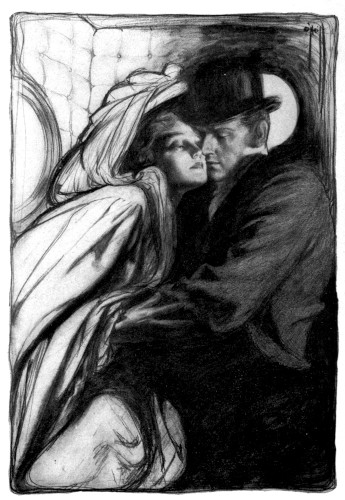
From that dear shelter she, too, foresaw a kindlier future.