ILLUSTRATIONS (continued 3)
Reading edition
"I want to polish off Mr. Rose," he said, doubling his fist suggestively. "You made a good beginning, but the pup needs a thorough job. I know where he boards—he told me that night he butted in; and if you'll just let me call round as a friend of yours—"
"No, no. Promise me you won't!"
"But he needs it," argued the dentist, plaintively. "I'd also like, if it could be managed, to say a few things to the head of the firm."
"Indeed you mustn't," cried Jean. "Promise me you'll say nothing about it in any way!"
"Can't I even tell Rose what I think?"
"Never. I've got to accept this thing and make a new start. I must forget it, not brood over it. You mustn't thrash him, you mustn't tell him what you think—above all, you mustn't go to the firm. Promise me you won't!"
"All right," he assented, manifestly puzzled. "A girl looks at things differently. I've got another proposition, though, which I hope you won't veto. Any prejudice against dentists, present company excepted?"
"No," smiled Jean.
"Some folks have, you know. Can't understand it myself. Why isn't it as high-toned to doctor teeth as it is to specialize an inch higher up, say, on the nose? Yet socially the nose-specialist gets the glad hand in places where the dentist couldn't break in with a Krupp gun. It makes me hot. But enough said along that line just now. What I started in to tell you is that there's an opening at the parlors."
"For me—a girl?"
"For a girl?" Paul pretended to weigh this handicap gravely. "Of course, a lady assistant is generally a man, but still—"
Jean was unfamiliar with this adjunct of modern dentistry.
"What must she do?" she asked.
"Be a lady and assist. That sums it all up. Some old fogies would specify thirty summers and a homely face, but I believe in a cheery office straight through. We've been looking round for the right party lately—the girl who has the berth now is going to be married; but it never occurred to me to offer it to you until to-day. It would mean eight dollars a week right at the start, and a raise just as soon as they appreciate what an air you give the whole place. There'd be more still in it if you liked the work well enough to branch out."
"Branch out? In what way?"
"Operating-room. At first you'll act as secretary and cashier, receive patients, and see that the hulk of a janitor keeps the parlors neat. Then, if you get on as I think you will, you'll very likely have an assistant yourself, and put in most of your time elsewhere. A clever girl can be no end of help in the operating-room. Say, for instance, I'm doing a contour filling, which, let me tell you, needs an eagle-eye and the patience of a mule. Well, while I pack and figure how to do an artistic job, you anneal gold and pass it to me in the cavity. See what I mean? One bright little woman we had for a while drew thirty-five a week, but she was a trained nurse, too."
Jean had doubts of her usefulness amid these technicalities, but the office work sounded simple, and she caught thankfully at the chance.
The dentist waved aside her gratitude.
"I'm simply doing a good stroke of business for the Acme Painless Dental Company," he said. "I'll tell Grimes in the morning that I've located the right party,—Grimes is the company, by the way, the whole painless ranch,—and you can drop in later and cinch the deal."
Jean's thoughts took a leap ahead to ways and means, and she drew a worn shoe farther beneath her skirt.
"You're sure I'll do?" she hesitated.
"You! I only wish you could see some of the procession who've answered our ad." Then, almost as if he read her mind, he added with unwonted bashfulness: "If I were in your place, I'd borrow Amy's black feather boa for your first call. It suits you right down to the ground."
She took the hint laughingly. There were more things than the boa to be borrowed for the conquest of Grimes. She was touched by Paul's transparent diplomacy, and glad that in his slow man's way he had at last perceived why their outings had ceased. So, by grace of Paul and Amy, it fell out before another week elapsed that the affianced lady assistant of the Acme Painless Dental Company left to prepare for her bridal, and Jean reigned in her stead.
The company's outworks on Sixth Avenue were a resplendent negro and a monumental show-case, both filled with glittering specimens of the painless marvels accomplished within. The African wore a uniform of green and gold, and all day forced advertisements into the unwilling hands of passers-by, chanting meanwhile the full style and title of the establishment in a voice which soared easily above the roar of the elevated trains overhead. Passing this personage, you mounted a staircase whose every step besought you to remember the precise whereabouts of the parlors, while yet other placards of like import made clear the way at the top and throughout the unmistakable corridor leading to the true and only Acme Painless Dental Company's door.
Entering here to the trill of an electric bell, you came full upon the central office, or, as the leaflets read, the elegant parlor, from which the operating-rooms led on every hand. In character this apartment was broadly eclectic. Jean's special nook, with its telephone, cash-register, and smart roll-top desk, was contemporary to the minute; yet in the corner diagonally opposed, a suit of stage armor jauntily bade the waiting patient think upon knights, jousts, and the swashbuckling Middle Ages. In still another quarter a languorous slave girl of scanty raiment, but abundant bangles, postured upon a teak-wood tabouret, backed by way of further realism with Bagdad hangings and a palm of the convenient species which no frost blights and an occasional whisk of the duster always rejuvenates. The chairs were frankly Grand Rapids and built for wear, though the proprietor's avowed taste ran to a style he called "Lewis Quince"; and the gilt he might not employ here he lavished upon the frames of his pictures, which, nearly without exception, were night-scenes wherein shimmering castle windows or the gibbous moon were cunningly inlaid in mother-of-pearl. In the midst of all this, now pacifying the waiting with vain promises of speedy relief, now pottering off into this room or that in as futile attempts to make each of several sufferers believe his blundering services exclusive—big, easy-going, slovenly, yet popular—moved Grimes.
Of the operating-rooms, which by no means approached the splendor of the parlor, the next best to Grimes's own was Paul Bartlett's, for Paul was a person of importance here. Of the four assistant dentists, he was at once the best equipped and the best paid, receiving a commission over and above his regular thirty-five dollars a week. The more discriminating of the place's queer constituency coolly passed Grimes by in Paul's favor, but the elder man was not offended. A month or so after Jean's coming he even offered his clever helper a partnership, which Paul unhesitatingly declined. He was ambitious for an office of his own, when his capital should permit, and he planned it along lines which would have fatigued his slipshod employer to conceive.
"It's all too beastly bad," he told Jean, in answer to her query why he did not accept Grimes's offer and insist on reform. "You'd simply have to burn the shop from laboratory to door-mat. To advertise as he does is against the code of dental ethics, and his practice ought to be jumped on by the board of health. Look at this junk!" he added, shaking an indignant fist under the nose of the slave girl. "Lord knows how many good dollars it cost, and yet we haven't got more than one decent set of instruments in the whole shebang. I reach for a spatula or a plugger that I've laid down two minutes before, and I find it's been packed off by old Grimes to use on another patient. As for sterilizing—faugh! You could catch anything here. How he's shaved through so far without a damage suit euchres me."
"Yet I like him," said Jean.
"So do I. So does everybody. And he's getting rich on the strength of it."
"I'm getting rich on the strength of it, too," Jean laughed. "Next week I shall really be able to put money in the bank."
Better paid, better dressed, with easy work and not infrequent leisure to read, she felt that at last she had begun to live. Her position long retained a flavor of novelty, for the dental company's patrons were infinitely various and furnished endless topics of interest to herself and Paul. They usually went to and from Mrs. St. Aubyn's together, and as the summer excursion season drew on, their Sunday pleasurings began to flourish afresh. Sometimes Amy joined them, but more often she made labored excuses, and they went alone. Jean thought her more secretive and reserved than of old, and Paul, too, remarked a change.
"How did you two get chummy?" he asked abruptly, after one of Amy's declinations. "You're not at all alike."
"Chums are usually different, aren't they?" Jean said, her skin beginning to prickle.
"Not so much as you two. You're a lady and she—well, she isn't. Known her some time?"
"Yes."
"Where did you meet? You were certainly green to the city when you struck our house. Amy's an East Sider Simon-pure."
"It was in the country. Amy stayed in the country once."
"Shawnee Springs?"
"No, no. Another place."
"Was that where you knew Miss Archer?"
Jean turned a sick face upon him, but Paul's own countenance was without guile.
"I've overheard you and Amy mention her once or twice," he explained.
"Yes," she stammered. "We both knew her there."
"Out of breath?" he said, still too observant. "I thought we were taking our usual gait."
She blamed the heat and led him to speak of other things, but the day was spoiled. She debated seriously whether it were not wise to make a clean breast of her refuge history, but Paul's belief in her unworldliness had its sweetness, and the fit chance to dispel his illusion somehow had not come when Stella, for weeks almost forgotten, so involved the coil that frankness was impossible.
XV
Motley as were the dental company's patrons, Jean never entertained the possibility of Stella's crossing the threshold, till her coming was an accomplished fact. Luckily she happened to be elsewhere in the office when the bell warned her that some one had entered, and she was able, accordingly, to sight the caller with her admiring gaze fixed upon the slave girl. Her own retreat was instant and blind, and by a spiteful chance took her full tilt into the arms of Paul.
"What's up?" he demanded, holding her fast. "What's happened to you?"
She was dumb before his questions. He noticed her pallor and helped her into the nearest operating-chair.
"There is a patient waiting," she got out at last.
"You're the first patient," he said; and brought smelling-salts, which he administered with a liberal hand. "You girls eat a roll for breakfast and a chocolate caramel for lunch, and then wonder why you faint."
She finally persuaded him to leave her on her promising that she would not stir till his return, and he went in her stead to receive Stella, whom he brought to a room so near that almost every word was audible. Stella had evidently visited the parlors before. She addressed Paul familiarly as "Doc," spoke of other work he had done for her, and lingered to make conversation after he had fixed an appointment. The dentist's responses were cool and perfunctory, and in leaving she chaffed him on having lost his old-time sociability.
He returned with a red face to find Jean outwardly herself.
"Better?" he said awkwardly.
"Much better."
Paul fidgeted with the mechanism of the chair.
"As long as you're O.K. now," he went on, "I'm not sorry you missed that party. That's the worst of Grimes. He caters to all sorts. You heard her talk, I suppose?"
"Yes."
He furtively studied her face. "I hope you don't think we're as friendly as she made out?"
"Oh, no."
Paul looked greatly relieved.
"I bank a lot on what you think," he said. "You're the kind of girl who makes a fellow want to toe the mark."
"Don't," she entreated, writhing under his praise. "You rate me too high."
"Too high!" He laughed excitedly and caught her hand when she moved to go. "You didn't mind my telling you?" Then, without awaiting a reply, he blurted: "There's a heap more to say. I want to take you out of all this—away from such riffraff as the girl you didn't see; I want—I want you, Jean."
She tried to speak, but he read refusal in her troubled eyes and cut her short.
"Don't answer now," he begged. "I didn't expect to tell you this so soon. I don't expect you to say yes straight off. I'm not good enough for you, Lord knows, but nobody could care more. Promise me you'll think it over. Promise me that, anyhow."
She would have promised anything to escape. Again at her desk, she strove to think things out, but from the whirl of her thoughts only one fixed purpose emerged: she must know the day and hour of Stella's intended return, for this detail had escaped her. Making some excuse, therefore, when Paul came for her at closing time, she watched him to the street and then hurried to search his operating-room for the little red-covered book in which his personal appointments were kept. It was not in its usual place, however, nor in his office-coat behind the door, nor in any possible drawer of the cabinet. He had evidently slipped it into some pocket of the suit he wore.
She dragged home in miserable anxiety, pinning all her hopes on obtaining a glance at the book while the dentist was at dinner; but this plan failed her, too, since that night, contrary to his custom, Paul made no change in his dress. The book was in his possession. Of this she was certain, for a corner of its red binding gleamed evilly at her from beneath his coat. Once, in an after-dinner comparison of biceps, which the insurance agent inaugurated in the hall, the thing actually fell to the floor at her feet, only to be noted by a watchful chorus before she might even think of advancing a casual ruffle. She devised a score of pretexts for asking Paul to let her see it, any one of which would have passed muster before his enamored eyes, but she dismissed each as too flimsy and open to suspicion; and so, before a safe course suggested itself, the evening was gone, and she climbed her three flights to spend hours in horrid wakefulness succeeded by even more merciless dreams.
Fate was kinder on the morrow. Paul laid the appointment-book upon an open shelf of his cabinet in the course of the forenoon, and she seized a moment when he was scouring the establishment for one of his ever-vagrant instruments, to wrest its secret at last. She found the record easily. It was among the engagements for that very day: "Miss Wilkes, 11-11.30." The little clock on the cabinet indicated ten minutes of eleven now!
She evaded Paul, who was returning, caught up her hat, and telling Grimes that she was too ill to work that day—which the big incompetent sympathetically assured her he could see for himself—fled in panic to the stairs only to behold Stella's nodding plumes already rounding the sample show-case below. Fortunately she was mounting with head down, and it took Jean but an instant to dart for the staircase to the floor above, from whose landing, breathless, lax-muscled, yet safe, she followed Stella's rustling progress to the dental company's door. When she cautiously descended, the hall reeked with a musky perfume from which she recoiled as from a physical nearness to the woman herself.
Luncheon brought Paul and questions which she answered, as she could, from behind her closed door. He had no suspicion of the real cause of her sudden leaving, ascribing her indisposition, as yesterday, to insufficient nourishment, and joined his imagination to Mrs. St. Aubyn's, and that of the proprietor of a neighboring delicatessen shop, in the heaping of a tray whose every mouthful choked. It tortured her to brazen out this deception, but unaided she could see no other way, and advisers there were none. She might have confided in Amy, had the need arisen earlier; but Amy was become a creature of strange reserves and silences.
She left her room at evening and braved the galling solicitude of the dining room. Mrs. St. Aubyn was for extracting her precise symptoms, and led a discussion of favorite remedies, to which nearly all contributed some special lore, from the librarian, who swore by a newspaper cholera mixture, to the bankrupt, whose panacea was Adirondack air. Paul refrained from the talk, perceiving that Jean wished nothing so much as to be let alone. He was more silent than she had ever known him at table, and she twice surprised him in a brown study, of which Amy was seemingly the subject. Dinner over, he brought about a tête-à-tête in an upper hall, a meeting made easy by the boarders' summer custom of blocking the front steps in a domestic group, of which Mrs. St. Aubyn, watchful of other clusters obviously less presentable, was the complacent apex.
"I didn't trot out a remedy downstairs," he said, "but I've got one all the same. It's a vacation."
"But—" Jean began.
"No 'buts' in order. I've got the floor. It's a vacation you need, and it's a vacation you'll have. Grimes has arranged everything. You're to have a week off, beginning to-morrow, and your pay will go on same as ever."
"This is your doing."
"No," he disclaimed; "it's Grimes's. I only told him it would do you more good now than in August. It was due you anyhow."
"But I'm not sick," she protested. "I can't let you think I am. It's not right to deceive—"
"The question now before the house," Paul calmly interposed, "is, Where do you want to spend it? How about Shawnee Springs?"
"No."
"Thought not. You never mention the Springs as though you pined to get back. Ever try Ocean Grove, where the Methodists round up?"
"No."
"Then why don't you? There's more fun in the place than you'd think. They can't spoil the ocean, and Asbury Park is just a stone's throw away whenever the hymns get on your nerves. I mention Ocean Grove, because Mrs. St. Aubyn's sister has a boarding-house there—Marlborough Villa, she calls it—where she'll take you cheap, coming now before the rush. I'll run down Sunday and see how you're making out."
He had an answer for every objection, and in the end Jean let herself be persuaded, although to yield here seemed to imply a tacit assent to other things she was wofully unready to meet. The future stretched away, a jungle of complexity. Perhaps the sea, the real sea she had never beheld, for Coney Island did not count, would help her think it out.
Early the following morning the dentist saw her aboard the boat.
"You'll not mind if I come down?" he asked.
She smiled "No" a little wanly, but he went away content. Sunday would be crucial, she foresaw. He would press for his answer then, and she——Perhaps the salt breeze would shred these mists.
But neither the breeze, full of the odor of sanctity, which cooled encamped Methodism, nor the secular, yet not flagrantly sinful, atmosphere of the twin watering-place, had aided much when the week-end brought Paul to solve the riddle for himself.
Many things allied in his favor. In the first place, Jean was unfeignedly glad to see him, as the agitated veranda rockers of Marlborough Villa bore witness. In a world which she had too often found callous, Paul Bartlett, for one, had proved himself a practical friend. She felt a distinct pride in him, too, as he withstood the brunt of the veranda fire; a pardonable elation that, in a social scheme overwhelmingly feminine, she led captive so presentable a male.
Again, Paul was tactful in following up his welcome. His only concern Saturday evening, and throughout Sunday till almost the end, was seemingly to give her pleasure. Sometimes she played the cicerone to her own discoveries: now a model of Jerusalem, its Lilliputian streets littered with the peanut shucks of appreciative childhood; the pavilion where free concerts were best; the bathing-beach where the discreetly clothed crowd was most diverting; or a little lake, remote from the merry-go-rounds and catch-penny shows, which she secretly preferred to all. Or Paul would display the results of his past researches. He knew an alley in one of the great hotels, where she had from him her first lesson in the ancient game of bowls; a catering establishment whose list of creams and ices exceeded imagination; and a drive—Sunday morning this—past opulent dwellings, whose tenants they commiserated, to an old riverside tavern overhung by noble trees.
Sundown found them watching the trampling surf from the ramparts of their own sand-castle, which Paul, guided by her superior knowledge of things mediæval, had reared. The transition from sandcastles to air-castles was easy, and presently the man was mapping his future.
"Grimes wants me to renew our contract," he said. "It runs out October first, you know. But I think it's up to me to be my own boss. I've got what I needed from the dental company—practical experience. If I stay on, I may pick up some things I don't need, just as the other fellows finally drop into old Grimey's shiftless ways. I don't want to take any of his smudge into my office. He can keep his gilt gimcracks and his slave girl and his bogus armor. A plain reception-room, but cheerful, I say; and an operating-room that's brighter still. Canary or two, maybe; plants—real plants—and fittings strictly up to date. Electricity everywhere, chair best in the market, instruments the finest money will buy, but out of sight. No chamber of horrors for me! As for location, give me Harlem. I know a stack of folks there, and I like Harlem ways. I've even looked up offices, and I know one on a 'Hundred-and-twenty-fifth Street that just fills the bill. Well, that's part of the programme."
Jean was roused from visions of her own.
"I know you'll succeed," she said.
"That's part of the programme," he repeated; then, less confidently: "The other part includes a snug little flat just round the corner, where a fellow can easily run in for lunch. I don't mean a bachelor's hall. I mean a bona-fide home, with a wife in it—a wife named Jean!"
He was a likable figure—clean-cut, earnest, manly—as he waited in the dusk, and the home he offered had its appeal. Marriage would solve many problems. She would be free of the grinding struggle for a livelihood, which the stigma of the refuge made dangerous. She would be free of the fear of such vengeance as Stella could wreak. If the need arose, it would be a simple matter, once they were married, to tell Paul the truth of things. His love would make light of it. As for her love——But what was love? Where in life did one meet the rose-colored dream of fiction? Love was intensified liking, and Paul, as has been recorded, was a likable figure—clean-cut, earnest, manly—as he waited in the dusk.
Yet, even then, recurred a still undimmed picture wherein, against a background of forest birches, there shone an indubitable hero of romance.
XVI
Jean shrank from the congratulations of the boarding-house and the office, and they decided at the outset to keep their engagement to themselves.
"Not barring your mother, of course," Paul amended. "To play strictly according to Hoyle, I expect I ought to drop her a line. What do you think?"
"It won't be necessary," Jean said.
The dentist sighed thankfully.
"Glad to hear it. The chances are she'd say no, straight off the bat, if I did. Letter-writing isn't my long suit. What will you say about a proposition like me, anyhow?"
"Nothing."
"Nothing? Least said the better, eh?"
"I mean I'm not going to write."
"Not at all?"
"Not till we are married. I will write home then."
Paul whistled meditatively.
"Mind telling why?" he queried. "Can't say that this play seems according to Hoyle, either."
Jean's real reason was rooted in a fear that Mrs. Fanshaw's erratic conscience might be capable of a motherly epistle to Paul, setting forth the refuge history. So she answered that she and her family were not in sympathy, and was overjoyed to find that Paul thought her excuse valid.
"I know just how you feel," he said. "My governor and I could never hit it off. But about writing your mother: we'll need her consent, you know. You're still under twenty-one."
"I come of age September tenth."
"But we want to be married the third week in August."
"We can't," said Jean; and that was the end of it.
This postponement notwithstanding, it seemed to her that she fairly tobogganed toward her marriage. Even before her return to work, Paul notified Grimes of his intention to shift for himself after October and leased the office of which he had told her. With the same energy, of which he gratefully assured her she was the dynamo, he promptly had her hunting Harlem for the little flat, just around the corner, of his imaginings. For so modest a thing, this proved singularly elusive, and it took a month of Sundays, besides unreckoned week-day explorations, before they lit finally upon what they wanted, in a building so new that the plumbers and paper-hangers still overran its upper floors.
The "Lorna Doone" was an apartment house. The prospectus said so; the elevator and the hall service proved it. Mere flats have stairs and ghostly front doors which unseen hands unlock. Mere flats have also at times an old-fashioned roominess which apartments usually lack; but as Paul, out of a now ripe experience with agents and janitors, justly remarked, they have no tone. This essential attribute—the agents and janitors agreed that it was essential—seemed to him to exhale from the Lorna Doone with a certainty not evident in many higher-priced buildings whose entrances boasted far less onyx paneling and mosaic. Besides tone or, more correctly perhaps, as a constituent of tone, this edifice had location, which Jean was surprised to learn was a thing to be considered even in this happily unfashionable section.
There was Harlem and Harlem, it appeared; and taught partly by Paul, partly by the real-estate brokers, she became adept in the subtle distinctions between streets which seemingly differed only in their numerals. For example, there was a quarter, the quarter to be accurate, once called Harlem Heights, which now in the full-blown pride of its cathedral, its university, and its hero's mausoleum, haughtily declared itself not Harlem at all. They had scaled this favored region in their quest, admired its parks, watched the Hudson from its airy windows, and hoped vainly to find some nook their purse might command; but they had to turn their steps from it at last. This glimpse of the unattainable was a strong, if not controlling, factor in their final choice.
"We can't be hermits and live in a hole," Paul argued. "I know a big bunch of people here already, and we'll soon know more. We've got to hold up our end. Nice name we'd get in our club if we didn't entertain once in a while like the rest."
"Our club!" she echoed. "We're to join a club?"
"Sure. Bowling club, I mean. Everybody bowls in Harlem. We must think about the office, too. It's the women who make or break a dentist's practice, and sooner or later they find out how he lives and the kind of company he keeps."
After a reflective silence he frightened her by asking abruptly whether she remembered a loud girl who had come to the dental parlors for an appointment the day of her first illness.
"The chatty party who thought I wasn't sociable," he particularized. "Her name's Wilkes."
Jean remembered.
"Well, she came back," pursued the dentist, slowly. "I filled a tooth for her the next morning. She had a good deal to say."
She brought herself to look at him. If the past must be faced now, she would meet it like the honest girl she was. But Paul's manner was not accusing, and when he spoke again, it was of neither Stella nor herself.
"How much does Amy get a week?" he asked.
She told him, and he nodded as over a point proved.
"Would it surprise you to hear that she draws five dollars less? That does surprise you, doesn't it?"
"How do you know?"
"My drug-department patient told me long ago. I didn't think much about it at the time, for some girls dress well on mighty little; but when—well, the long and short of it is, that Wilkes woman knows Amy!"
Jean pulled herself together somehow. Amy's defense was for the moment her own.
"Need that condemn Amy?" she said.
"Of course not," returned Paul judiciously. "It might happen to you, or anybody. Perhaps she says she knows me. It's the way she came to know her that counts. The Wilkes girl got very confidential when I left her mouth free. She had tanked up with firewater for the occasion, and it oiled her tongue. I didn't pay much attention until Amy Jeffries's name slipped out, but I listened after that. I thought it was due you."
"And she said—?"
"She said a lot I won't rehash, but it all boils down to the fact that they both graduated from the same reformatory."
She must tell him now! White-faced, miserable, she nerved herself to speak.
"Paul!" she appealed.
He was instantly all concern for her distress.
"Don't take it so hard," he begged. "She isn't worth it."
"You don't understand. I—I knew."
"You knew what?"
"About the—reformatory. I once told you I met Amy in the country."
"I remember."
"Well," the confession came haltingly, "it was the refuge I meant. I met her at the refuge."
She waited with eyes averted for the question which should bare all. Instead, she suddenly felt Paul's caress and faced him to meet a smile.
"You are a trump!" he ejaculated. "To know all the while and never give her away!"
He had not understood! Trembling like a reprieved criminal, she heard him go on to complete his self-deception.
"I was going to ask you to let Amy slide after we were married," he said, "but if you believe in her this much, I reckon she's worth helping. I don't suppose all refuge girls are of the Wilkes stripe."
The crisis past, she half regretted that she could not have screwed her courage to the point of a full confession, but this feeling was transitory. Paul rested content with his own explanations and talked of little else than their flat, and she, too, presently found their home-building absorbing.
A more minute inspection of the Lorna Doone, after the signing of the lease, revealed that the outer splendor had its inner penalties.
"Looks like a case of rob Paul to pay Peter, this trip," said the dentist. "Peter is the owner's first name, you know. The woodwork is cheap, the bathtubs are seconds, and the closets, as you say, aren't worth mentioning. I'll gamble the building laws have been dodged from subcellar to cornice. I hear he has run up a dozen like it, and every blessed one on spec. That's why we're getting six weeks' rent free. It's anything to fill the house and hook some sucker who hankers for an investment and never suspects the leases don't amount to shucks."
"Don't they?"
"Ours doesn't. Why, the man as much as told me to clear out when the building changes hands, if I like."
Jean looked round the bright little toy of a kitchen where they stood.
"I shan't want to leave," she said. "It already seems like home."
It seemed more and more a home as their preparations went forward. They were not supposed to enter into formal possession till late in August, but the complaisant owner gave Paul a key some weeks before and made no objection to their moving in anything they pleased. So it fell out that their modest six-rooms-and-bath in the Lorna Doone became in a way a sanctuary to which they went evenings when they could, and made beautiful according to their light.
It was a precious experience. Such wise planning it involved! Such ardent scanning of advertisements, such sweet toil of shopping, such rich rewards in midsummer bargains! They did not appreciate the magnitude of their needs till an out-of-the-way store, which fashion never patronized, put them concretely before their eyes in a window display. In successive show-windows, each as large as any of their rooms at the Lorna Doone, this enterprising firm had deployed a whole furnished flat. Furthermore, they had peopled it. In the parlor, which one saw first, a waxen lady in a yellow tea-gown sat embroidering by the gas-log, while over against her lounged a waxen gentleman in velvet smoking-jacket and slippers—a most inviting domestic picture, even though its atmosphere was somewhat cluttered with price-marks.
"That's you and me," said Paul, tenderly ungrammatical.
Jean was less romantically preoccupied.
"I'd quite forgotten curtains," she mused. "They'll take a pretty penny."
Thereupon the dentist discovered things which he had overlooked.
"We must have a bookcase," he said. "That combination case and desk certainly looks swell. What say to one like it?"
"Have you any books?"
"I should smile. I've got together the best little dental library you can buy."
"Then you'll keep it at your office," decided Jean, promptly. "When we have a library about something besides teeth, we'll think about a case."
The shopkeeper's imaginative realism extended also to the other rooms. Real fruit adorned the dining-room buffet; the neat kitchen was tenanted by a maid in uniform, whom they dubbed "Marie" and agreed that they could do without; while in one of the bedrooms they came upon a crib whose occupant they studiously refrained to classify.
"But for kitchenware," said Paul, abruptly, "the five-and-ten-cent stores have this place beaten to a pulp."
With this, then, as a working model, to which Paul was ever returning for inspiration, they made their purchases. It was, of course, his money in the main which they expended, but Jean also drew generously on her small hoard. They vied with each other in planning little surprises. Now the dentist would open some drawer and chance upon a kit of tools for the household carpentering, in which his mechanical genius reveled; or Jean would find her kitchen the richer for some new-fangled ice-cream freezer, coffee-machine, or dish-washer which, in Paul's unvarying phrase, "practically ran itself." They derived infinite amusement also from the placing and replacing of their belongings—a far knottier problem than any one save the initiate may conceive, since the wall spaces of flats, as all flat-dwellers know, are ingeniously designed to fit nothing which the upholsterer and the cabinet-maker produce. Luckily they discovered this profound law early in their buying, though not before Paul, adventuring alone among the "antique" shops of Fourth Avenue, fell victim to an irresistible bargain in the shape of a colonial sideboard which, joining forces with an equally ponderous bargain of a table, blockaded their little dining room almost to the exclusion of chairs.
Half the zest of all this lay in its secrecy; for although the boarding-house suspected a love affair,—and broadly hinted its suspicions,—it innocently supposed their frequent evenings out were spent at the theaters. Quite another theory prevailed at the Lorna Doone, however, as Jean learned to her dismay one Sunday when she was addressed as "Mrs. Bartlett" by the portly owner, whom they passed in the entrance hall.
"Oh, they've all along taken it for granted we're married," said Paul, carelessly. "I thought it was too good a joke to spoil."
Jean did not see its humor.
"We must explain," she said.
"And be grinned at for a bride and groom! What's the use? It will be true enough two weeks from now."
She privily decided that she would undeceive the owner at the first opportunity, but the chance to speak had not presented itself when far graver happenings brushed it from her thoughts as utterly as if it had never been.
XVII
Amy had, in fairness, to be told as August waned. To Jean's suggestion that very likely either the stenographer or the manicure would be glad to share the room of the three dormers, she replied that she could easily afford to keep it on by herself while she remained.
"It won't be for long," she vouchsafed airily. "In fact, I'm going to be married myself."
Jean's arms went round her instantly, the restraint of months forgotten.
"And you've never breathed a word!" she reproached.
"No more have you," retorted Amy, glacial under endearments.
"I know, I know. But you have seemed so different. You have kept to yourself, and I thought—"
"You thought I wasn't straight," Amy took her up bitterly as Jean hesitated. "I knew mighty well what was in your mind every time I got a new shirt-waist or a hat."
"You weren't frank with me."
"I couldn't be."
"I don't see why."
"Because," she wavered, melted now, "because you are you, so strait-laced and—and strong. I've always been afraid to tell you just how things stood."
"Afraid, Amy? Afraid of me!" Jean felt keenly self-reproachful. "I am horribly sorry. Heaven knows I haven't meant to be unkind. I've found my own way too hard to want to make things worse for anybody else, you above all. You believe me, don't you?"
"Yes."
"Then be your old self, the Amy who made friends with me in Cottage No. 6. Who is he? Any one I know?"
"You've met him."
"I have! Where?"
Amy's color rose.
"Remember the night you struck New York?"
"Perfectly."
"And the traveling man who jollied you?"
"Yes."
"Well," she faltered, "he's the one. His name is Chapman."
Jean was too staggered for a prompt response, but Amy was still toiling among her explanations.
"You mustn't think anything of his nonsense that night," she went on. "It was only Fred's way. He's a born flirt. You couldn't help liking him, Jean, if you knew him."
Jean met her wistful appeal for sympathy, woman-wise. Words were impossible at first. By and by, when she could trust herself to speak, she wished her happiness.
"Does he—know?" she added.
Amy's fair skin went a shade rosier.
"My record, you mean? Nobody knows it better. Don't you—don't you catch on, Jean? He was the—the man!"
"He! You've taken up with him again! The man who saw your stepfather send you to the refuge and never lifted a finger—"
"Don't!"
"Who let his child—"
"Stop, I tell you!" She barred Jean's lips passionately. "You see! Is it any wonder I couldn't bear to tell you? I wish to God I'd never said a word."
Jean stared blankly at this lamb turned lioness.
"Forgive me," she begged. "Perhaps I don't understand."
"Understand! You!" She laughed hysterically, "Yet you're going to be married! If you loved Paul Bartlett, you'd understand."
"You must not say that."
"Then don't say things that hurt me. Understand! If you did, you would know that it would make no difference if he was rotten clear through. But he's not. Fred never knew about the baby. He cried when he heard—cross my heart, he did. He said if he'd known—but what's the use of digging up the past! He is trying to make up for it now. He's been trying ever since we ran across each other again. It was in the cloak department he caught sight of me," she digressed with a pale smile. "I was wearing a white broadcloth, sable-trimmed evening wrap, and maybe he didn't stare! He couldn't do enough for me. That's where the new clothes came from. I could have had money if I'd wanted it—money to burn, for he makes a lot; but I wouldn't touch it. It would have looked—oh, you see for yourself I could not take money. You don't sell love, real love, and God knows mine is real! I've never stopped loving him. I never can."
She, too, it appeared when she grew more calm, aspired to be mistress of a flat.
"Though not at the start," she continued. "Fred wants to board at first. He says I've had work enough for one while. I said I shouldn't mind that kind of work, but he is dead set on boarding, till I've had a good long rest. Fred can be terrible firm. But by and by we're to keep house, and you'll be able to tell me just what to do and buy. You will, won't you, Jean?" she ended anxiously. "You'll stick by me?"
"Yes," Jean promised.
"And you'll come to see me—afterward? Say you'll come."
"Yes, I'll come."
"And you won't let Fred suspect that you've heard about—about everything? I want him to see that I know a girl like you. I've talked to him about you, but I've never let on that you're a refuge girl yourself. Promise me you will be nice to him!"
"I'll try."
Amy kissed her fervently.
"This makes me awful happy," she sighed. "I think a heap of you, Jean. Honest, I do. You come next to Fred."
As a proof of her affection she presently bought a wedding gift of a pair of silver candelabra which she could ill afford, and which Jean accepted only because she must. These went to flank Grimes's gift—for he was party to the secret now—a glittering timepiece for their mantel, densely infested with writhing yet cheerful Cupids, after the reputed manner of his admired "Lewis Quince." Mrs. St. Aubyn's contribution was a framed galaxy of American poets: Bryant, Emerson, Longfellow, Whittier, Lowell, Holmes, and Walt Whitman, the last looking rakishly jocular at the Brahminical company in which he found himself thus canonized.
Everything was finally in place at the Lorna Doone, and with the actual beginning of their lease-hold Paul moved his personal chattels from Mrs. St. Aubyn's to the flat, and slept there nights. This was the twenty-fifth of August. A week later Jean climbed the Acme Painless Dental Company's sign-littered stairway for her last day's service. She was a little late, owing to a fire which had impeded traffic in a near-by block, and the morning's activity at the parlors was already under way. She busied herself first, as usual, at her desk, sorting the mail which the postman had just left. In addition to the office mail there were personal letters for Grimes and the various members of the staff, which she presently began to distribute, reaching Paul's operating-room last of all.
The dentist was at work, but he glanced up when she entered and sent her a loverlike look over his patient's head. No creature with eyes and a reasoning brain could have misread it, and the occupant of the chair, who had both, squirmed to view its object; but Paul threw in a strategic "Wider, please," and held the unwilling head firmly to the front.
"Chuck them anywhere, Jean," he directed, his glance dropping to her hand.
Her obedience was literal; the next instant the letters strewed the rug at his feet. With the enunciation of the name, the patient twisted suddenly from Paul's grasp, and Jean found herself staring full into the malignant eyes of Stella Wilkes.
Paul first found voice.
"We'll go on, Miss Wilkes," he said, his gaze still intent upon the tragic mask, which was Jean.
Stella waved him aside.
"Hold your horses, Doc," she rejoined coolly. "I've met an old friend."
"Do you know each other?" It was to Jean he put the question.
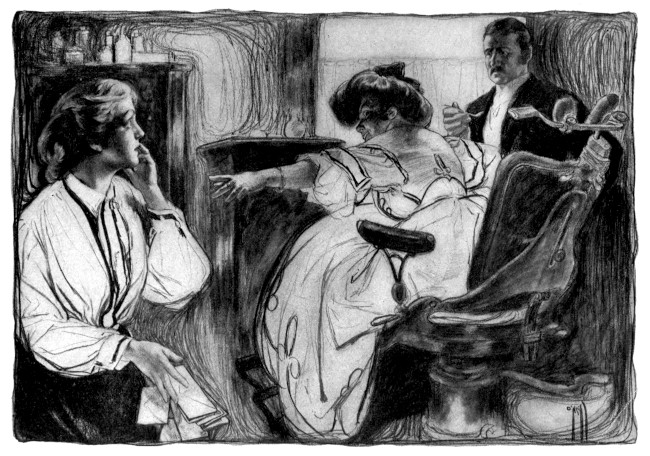
"Do you know each other?"
Stella answered for her.
"Do I know Jean Fanshaw!" Sure of how matters stood between these two, sure also of her own rôle in the drama, she sprang from the chair and bestowed a Judas kiss upon Jean's frozen cheek. "Do I know her! Why we're regular old pals!"
Freed somehow from that loathsome touch, Jean stumbled to her desk. Patients came and went, the routine of the office ran its course; her share in the mechanism got itself mechanically performed; yet, whether she sped or welcomed, plied the cash-register, receipted bills, or soothed a nervous child, some spiteful goblin at the back of her brain was ever whispering the shameful tale which Stella was pouring out in that inner room. Those lies would be past Paul's forgetting, perhaps even past his forgiving, say what she might in defense. His look at Stella's kiss had been ghastly. What was he thinking now!
Then, when her agony of suspense seemed bearable no longer, came Stella, her pretense of friendship abandoned, her real vengeful self to the fore.
"I guess we're square," she bent to whisper, her face almost touching Jean's. "I guess we're square."
She vanished like the creature of nightmare she was, but the nightmare remained. Paul would demand his reckoning now. He would come and stand over her with his accusing face and ask her what this horror meant. She could not go to him, she felt, or at least unless he sent. But throughout that endless forenoon the dentist kept to his office, though twice there were intervals when she knew him to be alone. Her lunch hour—and his—came at last. She lingered, but still Paul delayed. At last, driven by an imperative craving to be done with it, she hurried to his room and found it empty. Grimes told her that he had seen Paul leave the place by a side door. The news was a dagger-thrust in her pride. Of a surety, now, he must seek her.
Between five o'clock and six, a dull hour, he came, woebegone and conciliatory.
"For God's sake, clear this up," he begged. "Haven't you anything to say?"
"A great deal, Paul. But first tell me what that woman said about me."
"You heard."
"But what else?"
"Nothing."
"Nothing!" The thing was incredible.
"Only that you'd probably be glad to explain things yourself."
At that half her burden fell. Stella's cunning had overreached itself. She had thought to rack her victim most by forcing her to betray herself, but she had reasoned from the false premise that Jean had a truly shameful past to conceal.
"Glad," she repeated. "Yes, I am glad. I should have told you some day, Paul. It's a long story."
The door opened to admit a caller with a swollen jowl.
"To-night, then?" said the dentist, hurriedly.
"Yes," she assented. "I will tell you to-night."
"At the flat?"
"Yes; at the flat."
Spurred on by her unrest, she reached the Lorna Doone before Paul had returned from his evening meal, and found the flat in darkness. She was relieved that this was so. It would give her a quiet interval in which to turn over what she meant to say. She entered the little parlor and seated herself in an open window where a shy midsummer-night's breeze, astray from river or sound, stole gently in and out and fingered her hair. It was wonderfully peaceful for a city. The sounds from below—the footsteps on the pavement, the cries of children at play under the young elms lining the avenue, the jests of the cigar-store loungers, the chatter of the girls thronging the soda-fountain at the corner druggist's, the jingle of bicycle bells, the beat of hoofs, the honk of occasional automobiles, even the strains of a hurdy-gurdy out-Heroding Sousa—one and all ascended, mellowed by distance to something not unmusical and cheerily human. She realized, as she listened, that the city, not the country, this city, this very corner, this hearth which she and Paul had prepared, was at last and truly home.
Presently she heard Paul's latch-key in the lock and his step in the dark corridor.
"You here?" he called tonelessly. "Better have a light, hadn't we?"
"It is cooler without," she answered. Even though her explanations need not fear the light, she thought obscurity might ease their telling.
With no other greeting, the dentist passed to the window opposite hers, slouched wearily into a chair, and waited in silence for her to begin.
Jean told her story in its fullness: her tomboy girlhood, the hateful family jars, the last quarrel with Amelia, her sentence to the refuge, her escape, return, riot-madness, and release, and the inner significance of her late struggle for a living against too heavy odds. She told it so honestly, so plainly, that she thought no sane being could misunderstand; yet, vaguely at first, with fatal clearness as, ending, she strained her eyes toward the dour shadowy figure opposite, she perceived that she had to deal with doubt.
"Do you think I am holding something back?" she faltered, after a long silence. "Must I swear that I've told you the whole truth?"
The man stirred in his place at last.
"I guess an affidavit won't be necessary," he returned grimly.
She endured another silence impatiently, then rose proudly to her feet.
"I'll say it for you," she flashed. "This frees you of any promises to me, Paul. You are as free as if you had never made them. Go your own way: I'll go mine. It—it can't be harder than the one I've come. Good-by."
He roused himself as she made to leave.
"Hold on, Jean," he said, coming closer. "I guess we can compromise this thing somehow."
"Compromise! I have nothing to compromise."
"Haven't you?" He laughed harshly. "I should say—but let that pass. Of course, after what's turned up, you can't expect a fellow to be so keen to marry—"
"I've told you that you are free," she interrupted.
"But I don't want to be free—altogether. We could be pretty snug here, Jean. The parson's rigmarole doesn't cut much ice with me, and I don't see that it need with you. They think downstairs we're married. That part's dead easy. As for Grimes and the rest—"
She had no impulse to strike him as she had the floor-walker. Waiting in his folly for an answer, the man heard only her stumbling flight along the corridor and the jar of a closing door.
XVIII
Yet, an hour later, Paul came seeking her at Mrs. St. Aubyn's, and, failing, returned in the morning before she breakfasted. Unsuccessful a second time, and then a third, he wrote twice, imploring her not to judge him by a moment's madness.
Jean made no reply. Moved by the eloquent memory of Paul's many kindnesses and with the charity she hoped of others for herself, she did him the justice to believe him better than his lowest impulse. But while she was willing to grant that the Paul who, in the first shock of her revelation, thought all the world rotten, was not the real Paul, she would not have been the woman she was, had his offense failed to bar him from her life. Her decision was instinctive and instant, requiring no travail of spirit, though she could not escape subsequent heart-searchings whether she had unwittingly laid herself open to humiliation and a scorching shame that the dentist, or any man, could even for a moment have held her so cheap.
Necessity turned her thoughts outward. The marriage plans had all but devoured her savings, and while she was clothed better than ever before, she lacked ready money for even a fortnight's board. Immediate employment was essential, yet, when canvassed, the things to which she might turn her hand were alarmingly few. After her experience with Meyer & Schwarzschild, she was loath to go back to her refuge-taught trade except as a last resort, while department-store life, as she had found it, seemed scarcely less repellent. At the outset it was her hope to secure somewhere a position like her last, but the advertisements yielded the name of only one dentist in need of an assistant, and this man had filled his vacancy before she applied. Thereafter she roamed the high seas of "Help Wanted: Female" without chart or compass.
The newspapers teemed with offers of work for women's hands. The caption "Domestic Service" of course removed a host of them from consideration, and the demand for stenographers, manicures, and like specialized wage-earners disposed of many others; but, these aside, opportunity still seemed to beckon from infinite directions. Thus, the paper-box industry clamored for girls to seam, strip, glue, turn in, top-label, close, and tie; the milliners wanted trimmers, improvers, frame-makers, and workers in plumage and artificial flowers; the manufacturers of shirt-waists and infants' wear called for feminine fingers to hemstitch, shirr, tuck, and press; deft needles might turn their skill toward every conceivable object from theatrical spangles to gas-mantles; nimble hands might dip chocolates, stamp decorated tin, gold-lay books, sort corks, tip silk umbrellas, curl ostrich feathers, fold circulars, and pack everything from Bibles to Turkish cigarettes.
But this prodigious demand, at first sight so promising, proved on close inspection to be limited. Beginners were either not wanted at all or, if taken on trial, were expected to subsist on charity or air. Experience was the great requisite. Day after day Jean toiled up murky staircases to confront this stumbling-block; day after day her resources dwindled.
Amy was keenly sympathetic and pored over the eye-straining advertisement columns as persistently as Jean herself.
"How's this?" she inquired, glancing up hopefully from one of these quests. "'Wanted: Girl or woman to interest herself in caring for the feeble-minded.'"
"I tried that yesterday."
"No good?"
"They only offered a home."
"And with idiots! They must be dotty themselves."
Then Jean, ranging another column, thought that she detected a glimmer of hope.
"Listen," she said. "'Wanted: Girl to pose for society illustrations.' Do you think there is anything in this?"
"Too much," returned Amy, sententiously. "Don't answer model ads. It isn't models those fellows want any more than they are artists. Real artists don't need to advertise. They can get all the models they want without it. I never thought to mention posing. Why don't you try it? You have got the looks, and it's perfectly respectable."
"Is it?" rejoined Jean, dubiously. "I thought this advertisement sounded all right because it says 'society illustrations.'"
"It's just as proper to pose nude, if that's what you're thinking about. I know the nicest kind of a girl who does. Her mother is paralyzed. But that's only one branch of the business, and it's all respectable. Why, you'll find art students themselves doing it to help along with their expenses. I know what I'm talking about, because I've posed."
"You!"
"Just a little. It was for an artist who boarded here a while before you came. He moved uptown when he began to get on, and now you see his pictures in all the magazines. I was a senator's daughter in one set of drawings and a golf-girl in a poster. It's easy work as soon as your muscles get broken in, and it stands you in fifty cents an hour at least. The girl I told you of sometimes makes twenty-five or thirty dollars a week, but she poses for life classes; they're in the schools, you know. I made up my mind to go into it once."
"Why didn't you?"
Amy laid a derisive finger on her tip-tilted nose.
"Here's why," she laughed. "It was this way: The artist who used to board here told me of another man who paid three or four models regular salaries. He did pictures about Greeks and Romans, and all those girls had to do, I heard, was to loaf round in pretty clothes, and once in awhile be painted. I went up there one day and it certainly was a lovely place, just like a house in a novel I'd read called 'The Last Days of Pompey-eye.' A girl was posing when I came, and, if you'll believe me, that man had rigged up a wind-machine that blew her clothes about just as though she was running a race. Well, I didn't stay long. The artist—he was seventy-five or eighty, I should say, and grumpy—turned me sideways, took one look at my nose, and said I was too old, nineteen hundred years too old! He thought he was funny. Somebody told me afterward that he was a has-been and couldn't sell his pictures any more."
With the idea that posing might answer as a stop-gap until she found some other means of support, Jean forthwith visited an agency whose address Amy furnished. She found the proprietor of this enterprise a jerky little man with a disquieting pair of black eyes which thoroughly inventoried her every feature, movement, and detail of dress.
"Chorus, front row, show-girl, or church choir?" he demanded briskly.
"I thought this was a model agency," Jean said; "I wish to try posing if—"
"Right shop. What line, please?"
"In costume."
"You don't follow me. Fashion-plate, illustrating, lithography, or commercial photography."
"I'm not sure," she hesitated, bewildered by this unexpected broadening of the field. "What can I earn?"
The little man waved his arms spasmodically.
"Might as well ask me what the weather'll be next Fourth of July," he sputtered. "See that horse there?" pointing out of his window at a much-blanketed thoroughbred on its way to the smith's. "How fast can he trot? You don't know! Of course you don't. How much can you earn? I don't know. Of course I don't. You see my point? Same case exactly. Illustrators pay all the way from half a dollar to a dollar and a half an hour. Camera-models make from one dollar to three. And there you are."
"I've had no experience."
"That's plain enough. Sticks out like a sore thumb. But you don't need any. Fact, you don't. That's the beauty of the business. Appearance and gumption, they're the cards to hold. You've got appearance. A girl has to have the looks, or I don't touch her fee. Fair all round, you see. If a girl's face or get-up is against her, I've no business taking her money. If an illustrator says, 'Send me up a model who looks so and so,' that's just the article he gets. First-class models, first-class illustrators, there's my system."
"I need work at once," Jean stated. "What is my chance?"
"Prime. You ought to fill the bill for a man who 'phoned not two minutes before you walked through the door. High-class artist, known everywhere, liberal pay. There needn't have been any delay whatever, if you'd thought to bring your father or mother along."
Jean's rising spirits dropped dismally at this remark.
"My father is dead," she explained. "My mother lives in the country."
"Then get her consent in writing. Means time, of course, and time's money, but it can't be helped."
"Is it absolutely necessary?"
"You'll have to have it to do business with me," replied the agent, beginning to shuffle among his papers.
"But my mother knows I am trying to earn a living," she argued. "Besides, I'm nearly of age. I shall be twenty-one next week."
"Drop in when you get your letter," directed the little man, inflexibly. "Minor or not, I make it a rule to have parents' consent. Troubles enough in my line without papa and mamma. Good day."
Outside the door Jean decided upon independent action. This last resource was at once too attractive and too near to be relinquished lightly. The idea of obtaining Mrs. Fanshaw's consent was preposterous, even if she could bring herself to ask it—the term "artist's model" conveyed only scandalous suggestions to Shawnee Springs; but there was nothing to prevent her hunting employment from studio to studio. Amy had mentioned the address of the illustrator whom success had translated from Mrs. St. Aubyn's world, and to him Jean determined to apply first.
Her errand brought her to one of the innumerable streets from which wealth and fashion are ever in retreat before a vanguard of the crafts of which wealth and fashion are the legitimate quarry, and to a commercialized brownstone dwelling with a modiste established in its basement, a picture-dealer tenanting its drawing-room, and a mixed population of artists, architects, and musicians tucked away elsewhere between first story and roof. She found the studio of Amy's acquaintance readily, and obeying a muffled call, which answered her knock, pushed open the door of an antechamber that had obviously once done service as a hall-bedroom. Here she hesitated. The one door other than that by which she entered led apparently into the intimacies of the artist's domestic life, for the counterpane of a white iron bed, distinctly visible from her station, outlined a woman's recumbent form.
"In here, please," called the voice. "I'm trying to finish while the light holds."
On the threshold Jean had to smile at her own unsophistication. The supposed bedroom was a detail of the studio proper, the supposed wife a model impersonating a hospital patient who held the centre of interest in a gouache drawing, to which the illustrator was adding a few last touches by way of accent.
"I see you don't need a model," Jean said, with a smile inclusive of the girl in the bed.
He scrutinized her impersonally, transferred a brush from mouth to hand, and caught up a bundle of galley-proofs.
"No," he decided, more to himself than Jean. "It's another petite heroine, drat her! But I'd be glad to have you leave your name and address," he added, indicating a paint-smeared memorandum book which lay amidst the brushes, ink-saucers, and color-tubes littering a small table at elbow. "I may need your type any day."
Jean complied, thanked him, and turned to go.
"Try MacGregor, top floor—Malcolm MacGregor," he suggested. "Tell him I said to have a look at your eyes."
Much encouraged, she mounted two more flights, knocked, and, as before, let herself in at an unceremonious hail. This time, however, she passed directly from hall to studio, coming at once into an atmosphere startling in its contrast to the life she left behind. MacGregor's Oasis, one of the illustrator's friends called it, and the phrase fitted happily. The rack of wonderfully chased small arms and long Arab flintlocks; the bright spot of color made upon the neutral background of the wall by some strange musical instrument or Tripolitan fan; the curious jugs, gourds, and leathern buckets of caravan housekeeping; the careless heaps of oriental stuffs and garments from which, among the soberer folds of a barracan or camel's-hair jellaba, one caught the red gleam of a fez or the yellow glow of a vest wrought with intricate embroideries; the tropical sun-helmet,—MacGregor's own,—its green lining bleached by the reflected light of Sahara sand; the antelope antlers above the lintel; the Soudanese leopard skins under foot—these and their like, in bewildering number and variety, recalled the charm and mystery of the African desert which this man knew, loved, and painted superlatively.
MacGregor himself, whom she found at his easel, was, despite his name, not Scotch, but American, with seven generations of New England ancestors behind him. Tall, thin-featured, alert, and apparently in his late thirties, he had the quizzical, shrewdly humorous eye which passes for and possibly does express the Connecticut Yankee's outlook upon life. In nothing did he suggest the artist.
"I'll be through here in no time, if you'll take a chair," he said, when Jean had repeated the other artist's message.
Her wait was fruitful, for it emphasized most graphically the dictum of the agent that gumption was fundamental in the successful model's equipment. The man now posing for MacGregor in the character of an aged Arab leading a caravan down a rocky defile, was mounted upon nothing more spirited than an ingenious arrangement of packing-cases, but he bestrode his saddle as if he rode in truth the barb which the canvas depicted. He dismounted presently and disappeared in an adjacent alcove from which he shortly issued a commonplace young man in commonplace occidental garb, who pocketed his day's wage and went whistling down the stairs.
MacGregor turned to Jean.
"I do want a model," he said. "I want one bad. By rights I should be painting over yonder,"—his gesture broadly signified Africa,—"but my market, the devil take it! is here. So I'm hunting a model. I have had plenty come who look the part (which you don't) even Arabs from a Wild West show; but I've yet to strike one who has any more imagination than a rabbit. I tell you this frankly because it's easy to see you're not the average model. That is why I asked you to wait. The model I'm looking for must work under certain of the Arab woman's restrictions. Out there"—his hand again swept the Dark Continent—"you never see her face, as you probably know. You glimpse her eyes, if they're not veiled; you try to read their story. If even the eyes are hidden, you find yourself attempting to read the draperies. Do you grasp my difficulty? I want some one who can express emotions not only with the eyes, but without them. Now you," he ended, with a note of enthusiasm, "you have the eyes. Don't tell me you haven't the rest."
Jean laughed.
"I won't if I can help it," she assured him.
He caught up a costume which lay upon a low divan, and ransacked a heap of unframed canvases that leaned backs outward against the wall.
"This sketch will give you a notion how the dress goes," he said, and carried his armful into the alcove.
When she reëntered the studio, MacGregor was arranging a screen of a pattern Jean had never seen.
"It was made from an old lattice," he explained, placing a chair for her behind it. "I picked it up in Kairwan. This little door swings in its original position. You are looking now from a window—a little more than ajar, so—from which generations of women, dressed as you are dressed, have watched an Arab street."
He passed round to the front of the screen and studied her intently.
"Eyes about there," he said, indicating a rose-water jar upon a low shelf. "Expression," he paused thoughtfully. "How shall I tell you what I want you to suggest from the lattice? Don't think of those women of the Orient. You can't truly conceive their life. Think of something nearer home. Imagine yourself in a convent—no, that won't do at all. Imagine yourself a prisoner, an innocent prisoner, peering through your grating at the world, longing—"
"Wait," said Jean.
She threw herself into his conception, closed her mental vision upon the studio and its trophies, erased the bustling city from her thoughts. She was again a resentful inmate of Cottage No. 6, lying in her cell-like room at twilight, while the woods called to her with a hundred tongues. There were flowers in the sheltered places; arbutus, violets—
"You've got it!" MacGregor's exultant voice brought her back. "You've got it! We'll go to work to-morrow at nine."
"No admission, Mac?" asked a man's voice from the doorway. "I gave the regulation knock, but you seemed—" He stopped and gazed hard into the eyes which met his with answering wonder from the lattice.
"I've found her, Atwood," MacGregor hailed him jubilantly. "I've found her at last."
The newcomer took an uncertain step forward, halted again, then strode suddenly toward the screen.
"I think I have, too," he said, at the little window now. "It's Jack, isn't it?"
XIX
And Jean?
It was as if she still dwelt in fancy in that unforgettable past. She had burst her bars; she had come, a fugitive, to the birch-edged shore of a lonely lake; her knight of the forest stood before her.
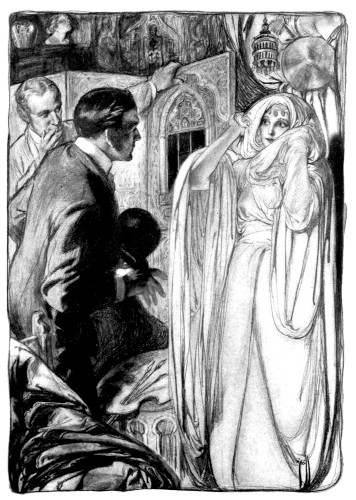
Her knight of the forest stood before her.
The astonished MacGregor, having waited a decent interval for some rational clew to the situation, recalled his own existence by the simple expedient of folding the screen.
"Step inside, won't you?" he invited with a dry grin. "You may take cold at the window."
Atwood turned an illumined face.
"It's been years since we met," he explained. "I was not sure at first—the costume, the place."
MacGregor's eye lingered upon him in humorous meditation.
"Perhaps you'll see your way in time to introduce me," he suggested. "This has been a business session, so far. We hadn't come to names."
The younger man floundered, glowing healthily, but Jean retained her wits.
"Miss Fanshaw," she supplied promptly. "I should have mentioned it before."
She vanished into the alcove, questioned her unfamiliar image in the little mirror, and began to resume her street-dress with fingers not under perfect control. There came an indistinct murmur of talk from the studio in which MacGregor's incisive tones predominated. His companion's responses were few and low. When she reëntered, Atwood stood waiting by the outer door.
"At nine, then," reminded MacGregor. "So-long, Craig, if you must go."
"So-long," answered the other, absently.
On the stair they faced each other with the wonder of their meeting still upon them.
"You are not a professional model," he said; "I should have come across you before, if you were."
"You have seen me get my first engagement."
"And with MacGregor! Was it chance?"
"Just chance."
"Jove!" he ejaculated. "It might have been myself. Yet it's strange enough as it is. MacGregor in there was the chap I was to camp with, you remember? The man whose grandmother—"
"Great-grandmother, wasn't it?" she smiled.
"You do remember!"
A silence fell upon them for a little moment and they assayed each other shyly, he keenly aware of the fuller curves which had made a woman of her, she searching rather for reminders of the youth whose image had gone back with her through the gatehouse into bondage. He was more grave, as became a man now looking back upon his golden twenties, with thoughtful lines about the eyes, and a clearer demarcation of the jaw, which was, as of old, shaven, and pale with the pallor of a dweller in cities. The mouth was the mouth of the youth, sensitive, unspoiled; and the direct eyes had lost nothing of their friendliness, though she divined that he weighed her, questioning what manner of woman she had become.
"You went back," he broke the pause, "you went back to that inferno because of what I said. You saw it through. Plucky Jack!"
"Jean," she corrected.
"Why?"
"Jack was another girl, a girl I hope I've outgrown."
"Don't say that," he protested. "I knew her. But this Jean of the staircase—"
"Well?" she challenged, avid for his mature opinion.
"Makes me wonder," he completed, "whether I've not been outgrown, too."
It was not a satisfying answer. She remembered that growth may be other than benign.
"You!" she said.
"Why not? I was young, preposterously young. Had I been older, I should never have dared meddle with your life."
"Meddle!" she repeated, his self-reproach rang so true; "you gave me the wisest advice such a girl could receive. That girl could not appreciate how wise it was, but this one does and thanks you from the bottom of her heart."
Atwood drew a long breath.
"You can say that!" he exclaimed. "You knew what it meant to return; I did not. Since I have realized the truth, the thought of my folly has given me no peace. I imagined—God knows what I haven't imagined! To see you here, as you are; to have you thank me, when I thought I deserved your undying hate, is like a reprieve."
Jean's face went radiant. "Yet you say you knew her!"
Their eyes met an instant; then they laughed together happily.
"You're right," he acknowledged. "It seems I don't know either of you. But we can't talk here, can we? We need—" He paused, then, "Give me this day," he entreated. "We're not strangers. Say you will!"
As they issued upon the pavement, the driver of a passing cab raised an interrogative whip. Atwood nodded, and a moment afterward they had edged into the traffic of one of the avenues and were rolling northward. To Jean, reveling silently in her first hansom, it seemed that they had scarcely started before they turned in at one of the entrances of Central Park, and for a time followed perforce the flashing afternoon parade before striking into a less frequented roadway, where they dismounted. Atwood, too, had said nothing amidst the jingling ostentation of the avenue and main-traveled drives, and he was silent now as they forsook the asphalt walks for quiet paths, where their feet trod the good earth, and the odor of leaf mold rose pungently.
Presently he halted.
"Will you shut your eyes for a little way?" he asked. "It's my whim."
She assented, and they went forward slowly, her hand upon his sleeve. She felt the path drop, by gentle slopes at first, then with sharp turns past jutting rocks, where there seemed no path at all. Her sense of direction failed her, and with it went her recollection of the city's nearness. The immediate sounds were all sylvan. She heard the call of a cat-bird, the bark of a squirrel, the laughing whimper of a brook among stones, which she guessed, if her ear had not lost its woodcraft, merged its peevish identity in some neighboring lake or pool.
"Now," said her guide, pausing.
She looked, started, and rounded swiftly upon Atwood to find him beaming at her instant comprehension.
"It might be the very same!" she exclaimed.
"Mightn't it? The birches, the shore-line—"
"And the stream, even the little stream! Could I find watercress there, I wonder?"
The man laughed.
"Ah, it is real to you! I, too, forgot New York when I first stumbled on it. I even looked for watercress. But it knows no such purity, poor little brook! I've had to pretend with it, as I've pretended with the lake. The landscape-gardener was a clever fellow. He makes you believe there are distances out there—winding channels, unplumbed depths; he cheats you into thinking you have a forest at your back. Sometimes he has almost persuaded me to cast a clumsy line into that thicket yonder."
Jean's look returned to him quickly. He was smiling, but with an undercurrent of gravity.
"You know it well," she said.
"I ought. It was here, the summer after we met, that I came to realize something of what I had asked you to do. I began to study refuges. I went to such as I could, boys' places, mainly; I even tried to get sight or word of you. Somehow, though, I never came at the right official, and it seemed that men weren't welcome. I learned a few things, however. I grubbed among reports; I found out what your daily life was like, what your companions must be, and once I saw a newspaper account of a riot. But of you I heard nothing. How could I? I did not even know your name—I, your judge!"
The girl moved toward the border of the lake and for a space stood looking dreamily into its tranquil counterfeit of changing foliage and September sky. To the miracle of their meeting was added the revelation that even as he had filled her thoughts in the dark days, so had she possessed his.
"Will you sit here?" he asked, again beside her. "I want to hear the whole story—the story which began back among the other birches."
"It began farther back than there."
"Not for me."
"But it should. If you thought about me at all, you must have wondered how I came to be in a refuge uniform."
"I wondered, yes; but I never really cared. I could see with my own eyes what you were."
She searched his face with the skepticism which the world had taught, then, with a swift intake of breath, looked believing away.
"We must begin at the beginning," she said.
She told him her story as she had told it to the dentist that hideous night of explanations at the Lorna Doone, but where Paul's black silence had stifled her, lamed her speech, made her almost doubt herself, this listener's faith leaped before her words, bridged the difficult places where she faltered, spread the cloak of chivalry in the miry way. Yet, with all his sympathy, it hurt her, so senseless always seemed the reckoning for her follies, so poignant were her regrets, and once, when she began to speak of Stella and the riot, he stopped her.
"Don't go on," he begged. "I see what it costs you."
"I'd rather you heard it all," she replied. "It's your due."
Nevertheless, she did not tell him all. She could speak of Stella, of Amy, of young Meyer, of the floor-walker, but no word of Paul passed her lips. She let Atwood infer that the stigma of the refuge had driven her from Grimes's employ, as it had thrust her from the department store. The whole chain of circumstances which the dentist's name connoted had become suddenly as inexplicable to herself as to this transcendent hero of a perfect day.
The sun was low when she made an end, and the long-drawn shadows of the birches in the lake turned their thoughts again to that other sundown.
"You were a lonely little figure as I looked back," he said. "I took that picture with me through the hills, and it remained my sharpest memory. It was a sad memory, a mute reproach, like the poor things I bought for you to wear."
"Then you did get them!" she cried, her dress instinct astir. "What were they like?"
"I will show them to you some day."
"You've kept them? I must pay my debt."
He shook his head. "They're not for sale. You shall see them when you come to my studio."
"You are an artist, too?"
"I paint," he replied simply. "When you are not busy with MacGregor, you will find work with me. We'll arrange that among us. Old Mac little dreams our secret."
"It is a secret?"
"With me, at any rate. I've never told. You see"—he looked away with a sudden diffidence almost boyish; then back again with a temerity that was boyish, too—"you see, I was jealous of my memories. I wanted to keep them wholly to myself. Our meeting was—how shall I say it?—a kind of idyl. And you—have you told?"
"Never."
"Was it partly for my reason?"
"Yes," she answered; "partly for your reason."
"But those clothes," he said, after a moment, "you'll smile when you see them. I've tried many a time to imagine you wearing them, braving the world as you planned so stoutly. Perhaps it would have been no harder than the other way. Perhaps—but that's over with, thank heaven! You've earned your freedom and have a brighter lot than a fugitive's to face. I don't mean a model's life. That will be temporary. There's something in you, something fine that only needs its chance. I can't tell you how I know this any more than I can tell you what it is, but I believe in it as I believe in my own existence. I know it's true, as true as the fact that we stand here face to face."
By some necromancy of the mind he mirrored back her own vague hopes.
"But I am a woman," she said, eager for more.
"So much the better. You live in woman's day. But don't forget that you have given me a part of it," he added, as she rose. "My own particular solar day isn't ended yet. When we first met, you had me to luncheon, or was it breakfast? I'm going to return the courtesy."
"But—"
"You couldn't be more appropriately dressed for a park restaurant," he cut in, pursuing her glance. "They'll serve us under an arbor where the wistaria blooms in May. We'll have to pretend about the wistaria, but it ought to be easy. The great pretense has come true."
XX
She learned from MacGregor what Atwood's modest "I paint" signified.
"He is an illustrator who illustrates," he told her their first day, while they worked. "I mean—left arm a trifle higher, please; you've shifted the pose—I mean he gets into the skin of a writer's characters, when they have any. If they're mere abstractions, he creates blood, bones, and epidermis for them outright. Rarer thing than you imagine, I dare say, in spite of the newspaper jokes. You can count the men on one hand who do it here in New York, and to my mind Craig deserves the index finger. He'd find a soul for a rag doll. But I'm only telling you what any top-notch magazine you pick up says more forcibly."
Jean cloaked her ignorance in silence and put her trust in MacGregor's enthusiasm for further light. After an industrious interval it came.
"But that isn't all," he added, tilting back to study his canvas through half-shut eyes. "The public doesn't know Atwood's true metier. He's bigger than they think. I'll show you something in a minute. It's time for rest."
He lingered for a brush stroke, which at one sweep filled a languid fold of drapery with action, and then crossed the studio to the stack of unfinished work beside the wall.
"Wait," he warned, placing a canvas in the trial frame and wheeling an easel tentatively. "It's in the rough, but we can give it light and a setting. Now look. That's what I call portraiture."
Even her unschooled eye perceived its strength. It was MacGregor who looked out at her, MacGregor as she herself had twice seen him that day with his working fit upon him, New York forgotten, Africa filling every thought.
"And Mr. Atwood did it?"
"Nobody else. He sat over there in that corner, while I worked in mine, and painted what he saw."
"It's a wonderful likeness."
"Likeness!" MacGregor shook the poor word contemptuously. "Likeness! Child, it's divination!"
He dismissed her early in the afternoon, for it was raining fitfully and the light was uncertain, and on leaving she turned her steps toward the Astor Library, intent on a purpose inspired by MacGregor's talk. She had some acquaintance with the lending libraries, but none with this sedate edifice whose size and gloom oppressed her as she looked vainly about for her elderly fellow-boarder who spent his life somewhere amidst its dinginess. In this quandary, she was spied by a mannered attendant whose young face, framed in obsolete side-whiskers, reminded her of certain middle-Victorian bucks of Thackeray's whom she had come to know during spare moments at the dental parlors. This guide led her into a large reading-room where he assured her ladies were welcome, despite the frowns of the predominant sex whose peace they ruffled, and found her the two or three illustrated periodicals she named.
Without exception these contained Atwood's work, a fact which impressed her tremendously; and without exception they bore testimony to his superiority as emphatically as MacGregor. She pored over these drawings one by one, weighing them much as she weighed his spoken thought, and judging them, no less than his speech, most candid mirrors of his personality. In what this personality's appeal consisted, she had neither the detachment nor the wish to define; she could only uncritically feel its sincerity, its romance, and its power.
She craved a fuller knowledge, however, than these mute witnesses could give, and the desire presently drew her back into the high-vaulted chamber where the library's activities seemed to focus; and here, bewildered by the riches of the card catalogue, she was luckily seen by the quiet old man who lent his dignity to the head of Mrs. St. Aubyn's table. He smiled gently upon her over his spectacles, pondering the motive behind her request as he had speculated about the motives of thousands before her, and instantly, out of a head whose store she felt that she had scantily appreciated, produced half a dozen likely references which he straightway bade a precocious small boy to track to their fastnesses in some mysterious region he called the stacks; himself, meanwhile, with a faded gallantry, escorting her to a desk in a scholarly retreat where only feminine glances questioned her coming.
So ensconced, she came upon the facts she sought in a bound volume of a journal devoted chiefly to the fine arts. She learned here that her knight errant's full name was Francis Craig Atwood, that New York claimed the honor of his birthplace, and that he was a trifle less than ten years older than herself. There followed a list of his schools, which ended with Julien's Academy in Paris, where it appeared he had gone the autumn after their meeting, and had exhibited canvases at the Salons of two successive years. His return to America and his instant recognition coincided closely with her own coming to New York. The concluding analysis of his work bristled with technicalities, but she read into it the qualities which she perceived or imagined in the man, and, staring into the dusty alcove over against her seat, lost herself in a brown study of what such success as this probably meant to him. Newspaper paragraphs about his comings and goings, she supposed, many sketches like this under her hand, social opportunities of course, the flattery of women, friendships with the clever and the rich. It rather daunted her to find him a celebrity, and at this pass nothing could have so routed her self-possession as to discover that a man, of whose nearness at an adjacent bookcase she had been vaguely aware, was no other than Atwood himself.
"Thank you," he laughed, with a wave of the hand toward the telltale page. "But there's better reading in the library."
Jean clapped to the offending volume and blushed her guiltiest.
"You must think me very silly," she stammered. "Mr. MacGregor praised your work, showed me the portrait—"
"Of course he did. You have discovered Mac's weakness and his dangerous charm. He believes all his friends are geniuses. You'll grow as conceited as the rest of us in time."
"And have the other conceited friends done work like yours and said nothing about it?" she asked.
"A thousand times better. You've no idea what a clever lot of men and women Mac knows." He rapidly instanced several artists, sculptors, and writers of prominence, adding: "But you will see them all at The Oasis sooner or later. You've probably noticed that Mac is one of those rareties who can talk while they work. What would hinder most people, only stimulates him. And it stimulates the other fellow, too. I always drop in on him for a tonic when my own stuff lags. I was there this afternoon, in fact, though for another reason. I wanted to see you. It must have been telepathy that brought me down here; I thought it was 'The Gadzooks'!"
"'The Gadzooks,'" she puzzled.
"Merely my slang for the Revolutionary romance," he explained. "I'm illustrating still another one, and ran in here to resolve my doubts about bag-wigs. My novelist seems to have invented a new variety. But about you: if you don't mind the weather, and have nothing better to do, I should like to take you over to a Fifth Avenue picture dealer's to see a so-called Velasquez that's come into the market."
Jean absorbed more than the true rank and value of Velasquez's portraiture. Wet or dry, the weather was irreproachable. Did it rain, there were yet other picture dealers' secluded galleries where one might loiter luxuriously; while for the intervals of sunshine the no less fascinating shop-windows awaited, each a glimpse into the wonderland of Europe, which her guide seemed to know so well. They even discussed going on to the Metropolitan to look in at a Frans Hals and a Rembrandt, which the talk of Velasquez suggested, but Atwood's absurd watch, corroborated by several equally ridiculous clocks of the neighborhood, said plainly that it was well past closing time at the museum and indeed quite the day's end here among the shops.
He was loath to let her go.
"It's been like a too short trip abroad," he said. "I hate to book for home just yet. Why can't we dine as we did last night?"
She shook her head.
"Yesterday was an occasion."
"Say Italy?" he persisted. "We've skimmed England, France, the Low Countries; why not Italy? I know a little place that's as Italian as Naples. You would never guess its existence. It looks like every other brownstone horror outside, with not a hint of its real business, for they say old Gaetano Sanfratello has no license. He looks you over through the basement grating, and, if you're found worthy, leads you through a tunnel of a hallway into the most wonderful kitchen you ever saw. It's as clean as clean and is a regular treasure-house of shining copper. Then you'll find yourself out in what prosaic New York calls a back yard, but which, in fact, is a trattoria in the kingdom of Victor Emmanuel, whose lithograph you will see above the door. There are clusters of ripening grapes in the trellis overhead, and Chianti or Capri antico—real Capri—on the cloth below; and they'll serve you such artichoke soups, cheese soufflés, and reincarnations of the chestnut, as the gods eat! And Gaetano's pretty daughter will wait upon us and sing 'Bella Napoli,' and perhaps, if we're in great luck, she'll let us have a peep at her bambino which she keeps swaddled precisely like the one in that copy of Luca della Robbia you are staring at this minute. Aren't you tempted?"
She was, but resisted successfully; and when he saw that she was inflexible, he walked with her to her own street, planning other holidays of a future which should know no shadows.
"You must forget that gray time you've left behind you," he declared. "Call this your real beginning—your rebirth, your renaissance."
So in truth it was. The weeks following were weeks of rapid growth and ripening, which, Atwood's influence admitted, yet found their compelling force in the girl's own will. The ambition to do her utmost for MacGregor, to learn what books could teach of the life he knew by living, took her back repeatedly to the library; then other suggestions of the studio, which, even at its narrowest, was a school of curious knowledge about common things that few, save the artist, seemed to see as they were. Who but he, for instance, stopped to consider that sunlight filtering through leaves fell in circles; that shadows were violet, not black; that tobacco smoke from the mouth was of another color than the graceful spiral which rose from the tip of a cigarette? But this field opened into innumerable others in the wide domain where her two friends plied their differing talents; while these, in turn, marched with the boundaries of others still, whose only limits were Humanity's. Life itself set the true horizon to MacGregor's Oasis.
Among MacGregor's intimates who shared the secret of a knock which admitted them at all hours, but who, busy men themselves, came oftenest after the north light failed, was a sculptor named Karl Richter. This man's specialty was the American Indian, but he also had known the Arab at first-hand, and Africa in one or another of its myriad phases was ever the topic when he and MacGregor foregathered. Listening to their talk, Jean came to visualize the bronze-skinned folk, the vivid market-places, the wild music of hautboys and tom-toms, the gardens of fig and olive and orange and palm, the waysides thicketed with bamboo, tamarisk, or scarlet geranium, and the desert,—above all, the mysterious, terrible, beautiful desert,—as things which her own senses had known. It chanced one day that they spoke of camels and, as often, began to argue; and that Richter, to prove his point, whipped from his pocket a lump of modeling wax, which, under his wonderful fingers, became in a twinkling a striking counterfeit of the beast itself. It could not have been more than an inch in height, but it was a very camel, stubborn, complaining, alive. MacGregor confuted, the sculptor annihilated the little animal with a careless pinch, tossed the wax aside, and soon after went his way.
Dissatisfied with his work, MacGregor presently caught his canvas from the easel, and, laying it prone upon the floor, began by shifting strips of card-board to hunt the truer composition. Jean, left to herself, took up the discarded wax, tried vainly to coax back the vanished camel, and then amused herself with a conception of her own. So absorbed did she become that MacGregor finished his experiments unheeded, and, receiving no answer to a question, still unregarded came and peered over her shoulder.
"Great Jupiter Pluvius!" he exclaimed.
Jean whirled about.
"How you startled me!" she said.
"It's nothing to the way you've startled me. Where did you see that head you've modeled?"
"Oh, this?" She tried to put the wax away. "It's nothing—only a baby in our block."
MacGregor pounced upon the model and bore it to the light.
"Nothing! Merely a study from life, that's all! Just a trifle thrown off in your odd moments!" He turned the little head round and round, showering exclamations. "Who taught you?" he demanded, striding back. "Somebody had a finger in it besides you. There are lines here that can't be purely intuitive."
"I used to watch my father."
"Was he a sculptor?"
"He might have been, if he'd had the chance. But he had to work at other things, and he married—"
"I know, I know," MacGregor groaned. "Love in a cottage and to hell with art! But he couldn't keep his thoughts or his hands from it. He modeled when he could?"
Jean nodded dreamily.
"Sundays, mainly," she answered. "We used to go into the country together. He found a bed of good clay near a creek where the mint grew. I can never smell mint without remembering. I couldn't go back there after he died."
MacGregor gave her a sidelong glance, hemmed, made an unnecessary trip across the studio, and kicked a fallen burnous violently.
"But you went on modeling?" he asked, returning.
"Yes—by and by. Then, later, I stopped."
"Why?"
"I—I hadn't the clay?" she evaded.
MacGregor brooded over her handiwork a moment longer, then squared his jaw.
"You'll have the 'clay' hereafter," he said.
XXI
At the outset she was rather skeptical of his faith in her. Had not Atwood said that MacGregor saw genius in all his friends? But the younger man now hailed him a most discerning judge.
"It's the something I divined," he declared jubilantly, "the gold-bearing vein I believed in, but hadn't the luck to unearth. Now to develop it! What does Mac advise?"