ILLUSTRATIONS (continued 4)
Reading edition
"One of the art schools," said Jean. "I can go evenings, it seems."
"And work days! It's a stiff programme you plan."
"But the school won't mean work," she declared. "Then, too, the posing comes far easier than it did. Mr. MacGregor says my muscles are almost as steady as a professional's."
"So he tells me. I'm going to insist on sharing your time. He has monopolized you long enough."
MacGregor's monopoly did not cease at once, however. His first step on discovering Jean's talent was to enlist Richter's expert criticism and counsel with the practical outcome that the sculptor's door swung open to her in the daylight hours when MacGregor worked with male models. The clay-modeling-room at the art school was a wonderful place. Its casts, its tools, its methods, were a revelation after the crude shifts with which her father had had to content himself; but Richter's studio transcended it as a university transcends a kindergarten. Here were conceived ideas which found perpetuity in bronze!
Studio and sculptor were each unique. A little man of crippled frame, Karl Richter delighted in the muscular and the colossal and walked a pigmy amidst his own creations. Michael Angelo was his god; but his manner was his own, and the Indians and cow-boys he loved best to express were remote enough from the great Florentine's subjects to acquit him of imitation. His frail physique notwithstanding, he had been at pains to see for himself the primitive life he adored, and the idler who coined "The Oasis" dubbed the sculptor's place "The Wigwam," and spread a facetious tale that Richter went about his work in blanket and moccasins, and habitually smoked a calumet which had once belonged to Sitting Bull. Richter never denied this myth, which by now had received the sanction of print, and took huge satisfaction in the crestfallen glances unknown callers gave his conventional dress. However, the studio itself, a transformed stable, was sufficiently picturesque. It overflowed with spoils from ranch and tepee, and, thanks to the Wild West show which furnished MacGregor occasional Arabs, sometimes sheltered genuine, if sophisticated, red men.
About this time Jean left Mrs. St. Aubyn's, whose neighborhood Paul, after dejected silence, had again begun to haunt. She had thus far eluded him, but meet they must, she felt, if she remained; and with Amy's abrupt departure, which now came to pass, she changed to a boarding-house of Atwood's recommending in Irving Place.
"There are no signs of the trade about it, fashionable or unfashionable," he said. "It's just a homelike place, neither too large nor too small, where you will see mainly art students. Many of them, like you, are making their own way, and all of them are dead in earnest. All the illustrators know Mrs. Saunders. Half of us have lived under her roof some time or other."
"You, too!"
He smiled at her tone.
"I wasn't born with a golden spoon, you know. Some New Yorkers aren't. I inherited a little money, but I'm not a plutocrat yet, even if editors do smile upon me. Julie and I thoroughly mastered the gentle art of scrimping at one time. Have I ever mentioned my sister, Mrs. Van Ostade?"
"You spoke of her the day I saw you first."
"At the birches?" he returned, surprised.
"You said she would not understand."
His eyes sobered.
"I remember," he said. "And it was true. Neither would she understand now, I fear. She has been both wedded and widowed since. You'll see her at the studio yet, if MacGregor ever lets us begin work together. She surprises me there when she thinks I am neglecting my duties as a social being. Julie has all the zeal of a proselyte in her missionary labors for society," he added laughingly. "She married into one of the old Dutch families."
Jean found that a tradition of Mrs. Van Ostade's residence in Irving Place still lingered there. She was spoken of as Craig Atwood's sister, the clever girl who had jockied for position, on nothing a year, by cultivating fashionable charities. Settlement work, it appeared, had been the fulcrum for her lever. No one here, however, had known her personally, save Mrs. Saunders, who was a paragon of reticence when gossip was afield. Indeed, a dearth of gossip, in the invidious sense of the word, was a negative virtue to which her whole establishment might lay claim. Mainly art students, as Atwood had predicted, the sharpest personalities of Jean's new acquaintances dealt with the vagaries of masters whom they furtively admired and not seldom aped. Thus the life-class girl would furrow her pretty forehead over the drawing of a beginner at antique with the precise "Ha!" and "Not half bad!" of the distinguished artist and critic who twice a week set her own heart palpitating with his crisp condemnation or praise.
Illustrating, painting, sculpture, architecture, decorative design, whatever their individual choice, life for each had its center in the particular school of his or her adhesion. Art—always Art—was the beginning and end of their table-talk, and even the two young men who had other interests, a lawyer and a playwright, both embryonic, spoke the language of the studios. To this community of interest was added the discovery that all derived from country stock. Half a dozen states had their nominal allegiance, and not even Mrs. Saunders, who seemed as metropolitan as the City Hall, could boast New York as her birthplace. They brimmed with a fine youthful confidence in their ability to wrest success from this alien land of promise, which charged their atmosphere electrically and spurred Jean's already abundant energy to tireless endeavor. Her days were all too short, and Atwood, whose invitations she repeatedly refused for her art's sake, began to caution her against overwork.
"Philosophic frivolity, as my sister calls it, has its uses," he said. "I usually agree with her social preachments, even if I don't observe them very faithfully. You must know Julie. I'll ask her to call."
Whether he did so or not, Jean was unaware. At all events, Mrs. Van Ostade did not renew her acquaintance with Irving Place, nor did Atwood broach the subject again. If the social columns might be believed, the lady was amply preoccupied with philosophic frivolity. MacGregor presently turned a searching light upon her personality.
"Notice that bit of impertinent detail, the unnecessary jewel?" he queried, stabbing with his pipe-stem at one of Atwood's drawings which a premature Christmas magazine had reproduced in color. "Craig never did it."
"Then who did?" Jean asked.
"His sister."
"Does she draw?"
"By proxy. I mean she suggested this as she has suggested every false, vitiating note that's crept into his work. Left to himself, Craig never paints the lily. But he defers to her as a younger brother often will to a sister who has mothered or stepmothered him. It was probably a good thing once—I admit she has brains and push; but now it's time the coddling stopped. It did let up for a while when she went over to the Dutch—she was too busy to bother with him; but with her husband underground and Craig coming on, it has begun again. Artistically she's his evil genius. Of course he can't see it, or won't. I've done my level best to beat it into him."
"You have told him!"
"Certainly; and her too. I have known them both for years. What are you grinning at?"
"Your candor. What did he say?"
MacGregor scowled.
"Same old rot I'm always hearing," he grumbled. "Called me a woman-hater. What do you think?" challenging her abruptly. "You've seen me at close quarters for some time. Do I strike you as that sort of man? I want your unvarnished opinion."
Jean answered him with his own frankness.
"A woman-hater?" she repeated. "Never. I think you are"—she searched for the word—"a woman-idolater."
MacGregor grimly assured himself that no sarcasm was intended.
"Expound," he directed.
"I mean it seems to me you rate Woman so high that mere women can't realize your ideal."
"Humph!" he commented ungraciously. "Where did you learn to turn cheap epigrams? Probably it's an echo of something you've read."
He addressed her variously as Miss Epigrams, Lady Blessington, and Madame de Staël as the work went forward, always with profound gravity, until finally, when he saw her color rise to his teasing, he gave his full-lunged laugh and confessed.
"All the same, you're right, Miss Epigrams. That's one reason why I'm still unattached. It's also why I haven't cared to see Craig take the only sure cure. A wife would teach his sister her place, if she had the right metal." He chuckled at the vision his words conjured. "But it would be a battle royal."
It was spring before Jean herself saw Mrs. Van Ostade. She had posed for Atwood frequently after Christmas, but had chanced always to be either with MacGregor or Richter when his sister visited the studio, until the April afternoon when Julie's knock interrupted an overdue illustration which Atwood was toiling mightily to finish. He frowned at the summons and answered it without putting down the maul-stick, palette, and brushes with which his hands were cumbered; but his "You, Julie!" at the door hinted no impatience, nor his returning step aught but infinite leisure as he issued with his dark-eyed, dark-haired, dark-skinned caller from behind the screen.
"Those stairs!" sighed the lady. Then, observing Jean, she subjected her to a drastic ordeal by lorgnon, which, raking her from face to gown,—where the inquisition lingered,—returned with added intensity upon her face.
Hot plowshares could have been no more fiery for poor Jean, who, sufficiently aglow with the knowledge that the dress upon her back was a piece of Mrs. Van Ostade's evening finery abandoned to the uses of the studio, found herself tormented by the certainty that somewhere in her vulnerable past she and this sister of Craig Atwood's had met before.
A sympathetic reflection of her embarrassment lit the man's face.
"This is Miss Fanshaw," he interposed, "herself an artist. You have heard me speak of her, Julie."
The lorgnon dropped and the two women exchanged a bow perceptible to the naked eye.
"I know the face," stated Mrs. Van Ostade, with an impersonal air of classifying scientific phenomena. "Where did I see it?"
Jean now recalled this elusive detail most vividly, but she kept her head.
"Probably in Mr. Atwood's work," she suggested coldly.
"Of course," seconded Atwood, keen to end the incident. "You will find Miss Fanshaw in half my recent stuff."
"The living face has no pictorial associations whatever," retorted his sister, with decision. "I shall remember in time. But go on with your work, Craig. I did not come to disturb you—merely to bring a piece of news which I'll tell you as soon as I get my breath."
Atwood placed a chair and, returning to his easel, made a show of work which Jean's trained eye knew for his usual polite pretense with visitors who assumed themselves no hindrance; while Mrs. Van Ostade, throwing back her furs, relegated the model to the ranks of the inanimate studio properties, of which her leisured survey now took stock.
"Those stairs!" she said again, pursuing her breath by the unique method of lavishing more. "Really, Craig, you couldn't have pitched on a more inconvenient rookery."
"We thought it a miracle for the money once," he reminded. "I dare say I could find a more convenient workshop in one of the new office-buildings, but then I shouldn't have my open fire."
"You could have it at the Copley Studios, and modern comforts, too."
"Up there!" he scoffed. "I don't belong in the pink-tea circle, Julie."
Mrs. Van Ostade refused to smile with him.
"The location counts," she insisted.
"With some people."
"With the helpful people. I've thought it over carefully; I've used my eyes and ears. The studio unquestionably carries weight. It ought to be something more than a workshop, as you call it. It should have atmosphere. Even our friend down the street has achieved that. Barbaric as it is, MacGregor's studio has a distinct artistic unity."
"Mac's place reflects his work. So does mine."
"Yours! It's a jumble of everything, a junk-shop."
"Of course it is," he laughed. "I've ransacked two-thirds of these treasures from the Ghetto. But even junk-shops have atmosphere—a musty one—and so, it logically follows, must my studio."
She indulged his trifling with a divine patience.
"Could you receive Mrs. Joyce-Reeves in such a place?" she queried sweetly.
"Certainly; if any possible errand could bring that high and mighty personage over the door-sill."
"There is a possible reason."
Her tone drew him round. Jean, forgotten by both, discerned that he also attached a significance to the hypothetical visit. She was at a loss to account for this, Mrs. Joyce-Reeves's prominence in the social world of New York notwithstanding.
"Is this your news, Julie?" he demanded.
His sister savored his quickened interest a moment.
"Part of it," she replied. "She saw your dry-point of me at Mrs. Quentin Van Ostade's the other day."
"The dry-point!" he deprecated. "It was only an experiment."
"So I told her. She asked if you do anything in the way of portraiture in oil, and of course I answered yes."
"I say!"
"Well, haven't you?"
"Trash, yes; cart-loads of it."
"Perhaps you call your portrait of Malcolm MacGregor trash? Mrs. Joyce-Reeves did not."
"She saw it!"
"I dropped casually that it had been hung with the Fifth Avenue exhibition of MacGregor's African studies, and she took the address. That was day before yesterday. This afternoon I met her again—met her leaving the gallery."
"Well?" jogged Atwood, impatiently.
"She told me she had bought two of MacGregor's things," continued Mrs. Van Ostade, not to be hurried. "She took a desert nocturne and that queer veiled woman at a window—you remember?"
"Do I!" He spun about. "You heard that, Jean? Mrs. Joyce-Reeves has bought 'The Lattice'! Miss Fanshaw posed for it, Julie."
"Indeed!" The lorgnon, again unsheathed at the intimate "Jean," once more took cognizance of that young person's existence. "I don't care for it. But, what is more important, Mrs. Joyce-Reeves mentioned your portrait."
"Yes?"
"And this time asked for your address."
"Jove! You think—"
"I'm positive she'll give you a commission."
"Jove!" he exclaimed again, "what a chance!" and paced the studio. "Yet she may. It's her whim to pose as a discoverer. What a chance! What a colossal chance! It would mean—what wouldn't it mean?" He stopped excitedly before the escritoire where Jean sat waiting to resume her interrupted impersonation of a note-writing débutante. "It would take nerve, no end of it. She's been painted by Sargent, Chartran, Zorn—all the big guns. A fellow would have to find a phase they'd missed. But if he could! You can't conceive her influence, Jean. If she buys a man's pictures, all the little fish in her pond tumble over one another to buy them, too. That's not the main issue, however, though I don't blink its importance. The opportunity to paint her, to search out the woman behind—that's the big thing. I have a theory. I met her once—she'd bought an original of mine, thanks again to Julie—and something she let fall makes me think—but I'm talking as if I had the commission in my hands."
Jean scarcely heard. Sympathize with him as she might, Julie Van Ostade's face, from the moment Atwood's talk ceased to be hers exclusively, absorbed her more.
"Craig," broke in his sister, crisply, "my furs."
He touched earth blankly.
"Not going, Julie?"
"My furs," she repeated.
"But I haven't begun to thank you," he said, obeying.
"Is not that also premature?" She rustled majestically toward the door, which he sprang before her to open. The girl was but a lay figure in her path.
Then the door closed and Atwood, wearing a look of bewilderment, came slowly up the studio to meet still another problem in feminine psychology in the now thoroughly outraged Jean.
"Why did you introduce me?" she demanded bitterly. "Why couldn't you let me remain a common model to her? I am a common model in her eyes—common in every sense. I remember well enough where she saw me, and she'll remember, too, never fear."
"Jean! Jean!" He came to her in distress.
"It was a drinking-place, and the girl with me had drunk too much. We amused your sister's theater-party immensely. They were probably slumming—seeing low life!"
He drew a calmer account from her presently.
"I know the place," he said. "It had rather a vogue before people found out that it was only sham-German, after all. It's a perfectly respectable rathskeller. You went with some gentleman, of course?"
Jean's passion for confession flagged.
"With a friend of Amy's from the boarding-house," she answered briefly.
Atwood gave a relieved laugh.
"You have made a mountain of a mole-hill," he told her; "but I'm glad you mentioned the circumstances. I'll explain to Julie, if she ever thinks of it again. Don't misjudge her, Jean. I admit she's unsympathetic at first sight, even brusque; but there's another side, believe me. You saw how devoted she is to my interests."
She had indeed seen, and the knowledge rankled.
"You should not have introduced me, made me share your talk," she said. "You meant a kindness, but it was no kindness; it was a humiliation, a—" Then the tension snapped and her head went down between her arms.
"Kindness!" He swept her stormily to himself. "Kindness, Jean! Can't you see why I wanted you to share it with me? Can't you see that I want you to share everything? I love you, Jean."
For a long moment she yielded; the next she had slipped from him and the escritoire was between them.
"Don't," she forbade. "You must not say these things to me."
"Must not?"
"I can't marry you."
"Can't! Yet a moment ago—"
"I can't marry you," she repeated breathlessly.
"But your kiss—"
"Was a lie—pity—what you like. I was unstrung. I—I don't love you."
He searched her face for a perplexed instant.
"Jean," he commanded; "look at me!"
She faced him.
"Now tell me that again—straight in the eyes."
"Don't," she entreated.
"Say it!"
"You heard me."
"I want to hear it again—on your honor!" He waited.
"I—I refuse."
He strode toward her in triumph.
"You can't," he cried. "The kiss was no lie. It was the truth, the sacred truth! What unselfish madness made you try to deceive me?"
"Remember your career," she protested; "your sister's world, which is your world, too."
But the time for reasoning was past.
XXII
What passed forthwith between brother and sister Jean neither heard nor particularly conjectured. Ways, means, and motives were for the time being eclipsed by the tremendous fact that Julie called. That she acquitted herself of this formality at an hour when the slightest possible knowledge of the girl's habits would argue her absence from Irving Place, roused in Jean only a vast relief. The mute pasteboard was itself sufficiently formidable.
She was even more relieved that through some mischance, for which Atwood, who went with her, taxed himself, her return call found Julie out. Visiting-cards she had none, their urgent need having hitherto never presented itself; but Atwood helped her pretend before the rather overpowering servant that she had forgotten them, and, scribbling her name upon one of his own, bore her off for an evening at the play.
Here, for the space of a week, matters rested, only to hatch a fresh embarrassment in the end, beside which calls were trivialities. This was no less than an invitation to dine, and to dine, not with Mrs. Van Ostade and Atwood merely, but as one of a more or less formal company—so Craig enlightened her—of the clever or socially significant.
Jean heard these depressing explanations with a sick face.
"I can't go," she protested quickly. "Don't ask me."
"Can't!" he repeated. "Why not?"
"You know why. They're different, these people—as different from me as if I were Chinese."
"What rubbish!"
"It's the truth. Perhaps later, when I've studied more, seen more, I can meet them and not shame you—"
"Shame me, Jean! If you realized how proud I am—"
"Then don't put me in a position where you may feel anything but proud. Don't make me go."
He reasoned with her laughingly, but without real understanding of her reluctance.
"Besides," he concluded, "you can't decline. The dinner is really for you."
Her cup of misery brimmed over.
"For me!"
"In a way, it's in honor of our engagement, even though it isn't known."
"Your sister wrote nothing of this."
"But she told me. She said she wanted you to meet some of our friends. Don't be afraid of them, Jean. You're as clever as any of them, while in looks not a woman Julie knows can hold a candle to you."
"But their clothes! Don't you see it's impossible? I've absolutely nothing to wear."
The man flicked this thistle-down airily away.
"Dowds, half of 'em, Julie's crowd," he declared. "You don't need anything elaborate. Just wear some simple gown that doesn't hide your neck. Simple things tell."
"And cost," she added, smiling ruefully at his nebulous solution. "I have never owned a dinner-gown in my life."
Atwood had an inspiration.
"Why, the studio is full of them," he cried.
"Your sister's—every one. Could I wear one of her dresses to her dinner?"
"Hardly. What inferior intellects men have! But is there any objection to your wearing one of my gowns? None of the properties fit the scheme of illustrations I've planned for that last novel, and I've decided to have one or two things made. Now, if you'll choose the material and bother with the fittings—"
Jean's laugh riddled this improvisation.
"I'll go if I must," she promised, "but I'll wear my own clothes. After all, I know something about dressmaking."
Nevertheless, the dress problem was serious when she came to marshal her resources, and she still vacillated in a choice of evils, when Amy happened in with a fresh point of view and an authoritative knowledge of the latest mode, which cleared the muddle magically.
"Put those away," she ordered, dismissing with a glance the alternatives arrayed despairingly on the bed. "Wear white or a color, and you'll have every old cat there rubbering to see how it's made. Where's your black net?"
"Here," said Jean, producing it without enthusiasm. "It's hopeless."
"It is a sight by daylight," agreed Amy, candidly. "That cheap quality always gets brown and rusty. But under gas it will never show. Cut those sleeves off at the elbow and edge them with lace. The forty-nine-cent kind will do, and you'll only need two yards."
Jean's spirits rebounded under this practical encouragement.
"I might turn in the neck about so much," she suggested, indicating an angle by no means extravagant.
Amy snatched the garment away.
"Scissors!" she commanded decisively. "This yoke is coming out altogether. Can't you see, Jean Fanshaw, that if you give your shoulders a chance, people won't think twice about your dress? I'd just give millions for your shoulders. The black will set them off as nothing else could. If you want a dash of color, I don't know anything smarter than a spray of pink-satin roses. Fred thinks I twist them up almost like real."
Jean evaded the artificial flowers with tact, but otherwise let herself be guided by Amy, under whose fingers the transformation of the black net went forward rapidly.
"It's a treat to have something to do," Amy avowed, declining aid. "I get awful lonesome over at our boarding-place. You never have time any more to run in, and, excepting Saturday afternoon and Sunday, I don't see anything of Fred. This is his busiest time, he says. Fred's a crackerjack salesman. Last month he sent in more orders than any man the firm ever put on the road. He just seems to hypnotize customers, same as he did me. I know you would like him, too, Jean, if you would ever come over while he's home. He spoke about that very thing the other day. He said it looked as if you were trying to dodge him. He wanted me to ask you to go down to the Coney Island opening last Saturday, but I was afraid you'd say no and hurt his feelings, so I told him you were sure to be at your art school. I was glad afterward you didn't come, for we met Stella Wilkes."
The name failed to stir Jean as of old.
"I don't fear Stella now," she said.
"I do," Amy rejoined. "It gives me the creeps to be anywhere near her. Fred says he can't see why. Men are queer that way. She came up to us on the Iron Pier, where we were having beer and sandwiches, and in spite of all my hints, he asked her to have something, too. She told us she was singing in one of the music-halls down there, and nothing would do Fred but we must go that night and see what her voice was like. She spotted us down in the crowd and waved her hand at us as bold as you please. I was so mad! Fred didn't care. He thought she had a bully voice. It did sound first-rate in 'coon songs,' and I really had to laugh myself at some of her antics when she danced a cake-walk. Wouldn't it be a queer thing if she got to be well known? Fred says there's no reason why she shouldn't earn big money, and he's a dandy judge of acting. You ought to hear him spout some of the speeches from 'Monte Cristo.' We always go to a show Saturday nights, when he's home, and generally Sundays to sacred concerts and actors' benefits. I wouldn't go Sundays if the rest of the week wasn't so dull. If I only had a flat, it would help pass the time away. I tease Fred for one all the time. Maybe I can pretty soon. He's to have Long Island and North Jersey for his territory, and that will bring him home oftener nights. Haven't you a better drop-skirt than this?"
"Drop-skirt?" The transition caught Jean daydreaming over a contrast between Amy's drummer and an illustrator not unknown to fame.
"This one is so scant it spoils the whole dress," explained the critic. "I always said so."
"I know; but it's the best I have. Does it matter so much?"
"Matter!" Amy mourned over the offending detail with artistic concern. "There's nothing I'm so particular about. A drop-skirt like this would spoil a Paquin gown, or a Redfern, let alone a—a—"
"Rusty black net?" Jean prompted. "Aren't you forgetting my wonderful shoulders? Nobody is to look at anything else, you know!"
Amy ignored the implication.
"It won't be so funny if they do," she reproved. "I do wish I had something to lend you, but since I left the store, I never wear black. Fred likes lively colors. Isn't there anything at the studio you could borrow?"
There was, though Jean forbore to mention it. As certain as her need, was the knowledge that from the third right-hand hook of the studio wardrobe depended its easy satisfaction. She had told Atwood with almost rebuking emphasis that she must wear her own clothes, but in the befogging nervousness which the bugaboo of the dinner wrought, the temptation to make use of at least this discarded trifle of Mrs. Van Ostade's plenty assailed her with waxing strength, till success or failure seemed to hang on her decision. The garment had its individuality, like most things belonging to Julie, who, Atwood said, had her own notions of design; but Jean told herself that it need not be flaunted.
To assure herself whether, after all, she might not be overrating its importance, she wore the silken lure home under her street-dress the evening of the dinner. This candid course was most efficacious. In the light of the miracle it worked, consistency troubled her no more than Amy. Its influence transcended the material; it fortified her courage; and when at last the admiring maid brought word that a gentleman waited below, she gave a final glance mirrorward, which was almost optimistic, and went down for Craig's verdict with starry eyes.
No faintest premonition prepared her to confront in the dim-lit room, not Craig, but Paul.
The dentist took an uncertain step toward her.
"I had to come, Jean," he said defensively. "There hasn't been a more miserable cuss in the city. I—" Then, seeing her clearly under the flare of the gas-burner nearest the door, which her hand sought instantly, he stood a moment, wide-eyed and mute, in fascinated survey of her unwonted garb. No tribute to its effectiveness could be more sincere. As if it spoke for her like a symbol, answering a question he could no longer put, he made a simple gesture of renunciation, the pathos and dignity of which sounded the very well-springs of her pity. "Excuse me for butting in," he added. "I can see now it was no use."
Jean put out her hand. The mystery of her dead affection—she could not call it love—for this man was never more baffling. The woman she was seemed as far removed from her who pledged herself to Paul, as that girl in turn was remote from the mutinous rebel of Cottage No. 6; but the dentist's gesture, his words, his shabbiness—so different from the half-dandified neatness of old—touched her where a direct appeal to their common past would have found her flint.
"It was no use in the way you mean, Paul," she said gently. "But sit down. I am sorry if you have been unhappy."
Whereupon an inconceivably subdued Paul Bartlett sat down beside her and with a gush of mingled self-pity and remorse poured the tale of his manifold sorrows into an absorbed and—her wrongs, her sex considered—sympathetic ear. Life had fared ill with the dentist. He had not been able, he said, to swing the enterprise of the new office quite as he had hoped. The location was all right, the equipment was all right, but for some reason, perhaps the election-time flurry, perhaps because he himself may not have pushed things as he did when feeling quite up to par, patients had not flocked his way. The hell he had been through! To know there wasn't a more up-to-date office in Harlem, not one that paid a stiffer rent, and yet, for a month, six weeks, two months, to see almost nobody drift in except "shoppers"—Jean would remember their sort!—who haggled over dinkey little jobs such as amalgam fillings, or beat him down on a cheap plate to a figure that hardly paid a man to fire up his vulcanizer—well, he'd sooner handle a pick and shovel than go through that again.
"But it's better now?" she asked.
"Shouldn't have showed my face here if it wasn't," Paul retorted, with a flicker of his old spirit. "The luck changed just when I'd about decided to go back to Grimes. Yes, I'm doing so-so. Nothing record-breaking, but I'm out of debt."
"I'm very glad."
"Thanks," he said gratefully. "You've no call to be, God knows! When I think—but what's the good? I've thought till I'm half crazy. Just to look into the little place at the Lorna Doone queers a whole week for me. It stands about as it did, Jean. All the time the pinch was hardest, I had to carry the flat, too—empty. I couldn't live there, and nobody else wanted it. I missed my chance to clear out when the building changed hands—I tumbled just too late, not being on the spot. The new owners would make trouble, and I've had trouble enough. I just can't sell the things—leastways some of them—and I thought perhaps you—they're really yours, you know—perhaps you—No? Well, I don't blame you. If folks were only living there, I guess I'd feel different. I would sublet for a song."
Amy's consuming desire flashed into Jean's mind to relieve a situation too tense for long endurance, and Paul thankfully made note of the drummer's address. This mechanical act seemed to put a period to their meeting and both rose; but although they shook hands again, and exchanged commonplaces concerning neither knew what, the man continued to imprison her fingers in an awkward solemnity which, more sharply than words, conveyed his sense of a bitter, yet just, finality.
So occupied, Atwood's hurried entrance found them.
"I'm late, very late," he said from the hall, at first seeing only Jean; "but the cab-horse looks promising, and the driver says—I beg your pardon!"
Acutely conscious of a burning flush, which Paul's red-hot confusion answered like an afterglow, Jean made the presentation.
"Bartlett—not Barclay," Paul corrected Atwood's murmured greeting, with the footless particularity of the embarrassed.
"I beg your pardon," said Atwood again.
"Often mixed, those two names, Bartlett and Barclay," babbled the dentist, with desperate stage laughter. "Half the people who come to my office call me Barclay. Feel sometimes as if it must be Barclay after all. Dare say Barclay is as good a name—that is—"
Jean stilled the parrot cry with an apology for running off, and the trio passed down the steps together. Atwood glanced back curiously as they whipped away.
"Who is Mr. Bartlett—not Barclay?" he smiled.
"A dentist I knew when I worked for the Acme Company," she answered, and then, with a generous impulse added, "He was very kind to me once when I needed kindness."
"So?" Atwood's interest livened. "Then I have double reason not to forget his name. I don't dare picture what Julie's thinking," he went on, peering at a jeweller's street-clock. "We're undeniably late. But I have the best excuse in the world. Guess!"
Jean tried, but found her wits distraught between the scene just past and the trial to come.
"No; tell me," she entreated.
He drew a full exultant breath.
"It's the Joyce-Reeves commission," he said. "I received the order to-night."
XXIII
They were not unpardonably late, yet were tardy enough to render their coming conspicuous to what seemed to Jean an ultramodish company which peopled not only Mrs. Van Ostade's drawing-room, but the connecting music-room and library as well.
Julie, her dark good looks set off by yellow, met them with observant eyes, nodded "Yes, Craig; I know" to Atwood's great news, murmured a conventional word of regret to Jean that both their calls should have been fruitless, made two or three introductions to those who chanced nearest, and with the lift of an eyelid set in motion the mechanism of a statuesque butler; whereupon Jean found herself hazily translated to her place at table between a blond giant, who took her in, and a shadowy-eyed person with a pointed beard, who languidly quoted something resembling poetry about what he called the tinted symphony of Mrs. Van Ostade's candle-light.
"How clever!" said Jean, at a venture, and welcomed the voice of her less ethereal neighbor.
"Corking race," remarked the giant, beaming at her over the rim of his cocktail.
This was concrete, if indefinite.
"You mean—"
"Yesterday—France. Wonderful! Gummiest kind of course—two days' hard rainfall, you know. I've been saying 'I told you so' all day. Didn't surprise me in the least. I knew her, d'ye see, I knew her."
Jean looked as intelligent as she could, and hoped for a clew. The big man checked his elliptical remarks altogether, however, and, still beaming, awaited her profound response.
"Is she French?" she hazarded, jumping at an inference.
"But it was a man won. The sporting duchess, you mean, drew out."
"I'm speaking of the horse," Jean struggled.
"Horse! What horse?" ejaculated the giant. "I'm talking automobiles."
She judged frankness best.
"There is nothing for it but to confess," she said. "I know nothing about automobiles. I never set foot in one in my life."
Her companion wagged a large reproachful finger.
"Don't string me," he begged. "Didn't Julie Van Ostade put you up to this? I know I'm auto-mad and an easy mark, but—Jove! I believe you're serious. Why, it's—it's incredible! Just think a bit. You must have been in one of those piffling little runabouts?"
"Never."
"Well, then, a cab—an electric cab?"
"Not even a 'bus."
He shook his head solemnly and besought the attention of the petite guest in mauve on his left.
"What do you think?" Jean heard him begin. "Miss Fanshaw here—"
Then the shadowy-eyed seized his chance.
"I hail a kindred spirit," he confided softly. "To me the automobile is the most hideous, blatant fact of a prosaic age. Its coarsening pleasures are for the few; its brutal sins against life's meager poetry touch the unprivileged millions."
"Rot!" cut in the giant, whose hearing was excellent. "The motor is everybody's servant. As for poetry, man alive! you would never talk such drool again if you could see a road-race as the man in the car sees it. Poetry! It's an epic!" Wherewith he launched into terse description, jerky like the voice of his machine and bestrewn with weird technicalities, but stirring and roughly eloquent of a full-blooded joy in life.
While the battle raged over her—for the man with the pointed beard showed unexpected mettle—Jean evolved a working theory as to the uses of unfamiliar forks and crystal, and took stock of her other fellow-guests. It was now, with a start of pleasure, that she first met the eye of MacGregor, whom she had overlooked in the hurry of their late arrival. His smile was encouraging, as if he divined her difficulties, and she took a comfort in his presence, which Atwood's, for once, failed to inspire.
Craig seemed vastly remote. He was in high spirits and talking eagerly to an odd-looking girl with a remarkable pallor that brought out the vivid scarlet of her little mouth and the no less striking luster of her raven hair, which she wore low over the ears after a fashion Jean associated with something literary or theatrical. She caught a word or two of their conversation, and it overshot her head, though the talk at MacGregor's Oasis had acquainted her with certain labels for uncertain quantities known as Nietzsche and George Bernard Shaw. She perceived a sophisticated corner of Atwood's mind, hitherto unsuspected, so deceptive was his boyish manner; and the anæmic girl, juggling the Superman with offhand ease, became clothed with piquant interest. She wondered who she was, what Atwood saw in her, and whether they knew each other well.
Of his own accord her neighbor with the beard enlightened her.
"Pictorial, isn't she?" he said. "Pre-Raphaelite, almost, as to features; hair Cleo de Merode. I hope Mrs. Van Ostade pulls the match off. They're so well suited; clever, both of them, and in different ways. Then, her money. That is a consideration."
"Is it?" groped Jean.
"Rather! Wealthy in her own name, you know, and virtually sure of her uncle's fortune. They're very soundly invested, the Hepworth millions. But it's the psychological phase of it that interests me. I'm curious to see what effect she'll have upon his work. For the artistic temperament marriage is twice a lottery. I've never dared risk it myself."
His tone offered confidences, but Jean found his celibacy of slight interest beside Miss Hepworth's. She was conscious that he was permitting her glimpses into the lone sanctities of what he termed his priesthood, as she was aware of a whir and rush of motor-maniacal anecdote on her other side, and of a ceaseless coming and going of courses amidst the generally pervasive fog of conversation. She made the automatic responses which seemed all her immediate fellow-guests required of her, and masked her face with a smile, into which she threw more spontaneity after the bearded one said it suggested Mona Lisa's and belied her glorious youth.
"For she is 'older than the rocks among which she sits,'" he quoted. "You remember Pater's famous interpretation?"
Jean knew neither quotation nor writer, but she was familiar with Leonardo's picture and turned the personality with a neutral question, which served the man as a spring-board for fresh verbal acrobatics, amusing to him and restful for her. He was shrewder than she had thought. In truth, she felt both young and old; young, if this dismal futility could be the flower of much living; old, if by chance it should be, as she questioned, merely puerile.
She sighed for the dinner's end, but when it came and the women, following a custom she had read about without dreaming she should yet encounter it, left the men behind, she sighed to be back with her loquacious seat-mates, talk what jargon they would. Her sex imposed no conversational burden upon any one here. She fitted naturally into none of the little clusters into which the rustling file dissolved; and, after some aimless coasting among these groups where women to whom she had been presented smiled upon her vaguely and chattered of intimacies and happenings peculiarly their own, she cut adrift altogether and grounded with feigned absorption by a cabinet of Chinese lacquer. If Julie meant her kindness, she told a remarkable golden dragon, this was the time to show it, but her hostess remained invisible, and the dragon's gaze, though sympathetic, seemed presently to suggest that the social possibilities of lacquer had their limits. In this crisis, she made a lucky find of a portfolio of Craig's sketches, none of which she had ever seen.
While turning these drawings, she was approached by some one, and, looking up with the expectation of seeing Mrs. Van Ostade, met instead the gaze of a very old and excessively wrinkled lady, who, without tedious formalities, calmly possessed herself of the sketch Jean had in hand.
"They're amazingly deft," she said, after a moment. "Even the academic things have their charm. Take this charcoal, for instance," she went on, selecting another drawing. "It's not the stereotyped Julien study in the least. They couldn't extinguish the boy's individuality. Somewhere here there is another still better."
"You mean this, don't you?" Jean asked, delving into the portfolio for a bold rendering of a human back.
"Ha!" said the old lady, staring. "Of course I do. But what made you think so?"
"It was the only one of the Julien studies you could mean," returned Jean, promptly. "He did not draw like this till the year he exhibited."
The explosive "Ha!" was repeated, and the girl felt herself thoroughly assayed by the shrewd old eyes.
"You are a close student of Mr. Atwood, my dear," came dryly. "Perhaps you are a critic of contemporary art?"
Jean reddened, but, surprising the twinkle behind the sarcasm, laughed.
"Is it probable?" she asked.
"It's possible. Half the celebrities I meet seem young enough to be my grandchildren. But you are telling me nothing. Are you one of Julie Van Ostade's discoveries? She collects geniuses, you know. What is your name?"
Jean told her.
"It means nothing, you see," she smiled. "I am only a student."
"Of painting?"
"No; sculpture."
"Are you! But you look original. Where are you at work? I hope you don't mind my questions? I'm an inquisitive old person."
Jean named her school and mentioned Richter.
"But I have accomplished nothing yet," she added.
"Ha!" said the old lady. "Then it's time you did. I shall ask Richter about it. If I forget your name, I'll describe your eyes. There is something singularly familiar about your eyes."
The men and Mrs. Van Ostade made a simultaneous entrance, and the latter at once bore down on Jean's catechist.
"Peroni will sing," she announced with a note of triumph. "He volunteered as a mark of respect to you."
"Really!" The octogenarian's smile was extraordinarily expressive. "Yet they call him mercenary."
The opening bar of an accompaniment issued from the music-room, and Jean joined the drift toward the piano. She wondered who this sprightly personage might be for whom the spoiled tenor volunteered, and then, in the magic of his voice, forgot to wonder.
In the babel following the hush, MacGregor leaned over her chair.
"So the irrepressible conflict is on?" he greeted her.
Jean's welcome was whole-hearted.
"Craig has told you?" she said softly.
"Yesterday. I wish you both all the usual things. I ought to have seen it from the first, I suppose, but as a matter of fact I did not. Certainly I never figured you in the lists when I spoke of the battle royal. Any war news?"
"We have exchanged calls without meeting."
"Preliminary skirmishes."
"Next came the dinner-invitation. Not exactly a war measure, should you say?"
"Knowing Julie, yes. I should call it the first engagement."
Jean perceived his military metaphor was but a thin disguise for a serious opinion.
"And the victor?" she said.
"Apparently yourself."
"I don't feel especially victorious," she said, a little wistfully. "What makes you think the battle is on? Oh, but we must not talk this way here," she immediately added. "We've eaten her salt."
"What if the salt is an ambush?" queried MacGregor. "Besides, I never pretended to be a gentleman. Look over this menagerie carefully, guileless child! Do you suppose Julie usually selects her dinner-guests after this grab-bag fashion? Not to my knowledge. She loathes big dinners, so she has told me. It's her study and pride to bring together people of like tastes. The seating of a dinner-party is to her like a nice problem at chess. Do you think it a mere chance shuffle that settled your destiny at table? Do you know one automobile from another?"
"No."
"Of course not. And half the time you hadn't a glimmer of a notion what the decadent poet with the Vandyck beard was driving at?"
"More than half."
"Neither should I. A steady diet of the hash he serves up to women's clubs would land me in a padded cell. But perhaps the general talk amused you?"
"I could not make much of it," she admitted.
"Sensible girl! Neither could most of the talkers. But—here was where you scored a point—you looked as if you did. The minor poet and the motor-maniac couldn't wait their turns to bore you. Then, point number two, your gown. Logically, it's point number one, and a big point, too. I happened to be watching Julie when you arrived. Yes; you scored."
Jean caught gratefully at the tribute. She remembered that Craig had been too preoccupied with the Joyce-Reeves commission to notice her dress, and wondered whether the pictorial girl's æsthetic draperies had drawn his praise. She was shy of mentioning Miss Hepworth to MacGregor; he might think her jealous. Nor did he speak her name, though Craig and his dinner-partner, again in animated converse, were in plain view from their own station. Jean guessed that he trusted her instinct to light readily on the significance of this factor in Mrs. Van Ostade's strategy.
"Lastly," he enumerated, "you bagged Mrs. Joyce-Reeves."
"What! The woman who talked to me about Craig?"
"You're surprised to find her here? So was Julie. She invited herself. Julie met her somewhere this afternoon and mentioned that she was giving a dinner. Mrs. Joyce-Reeves asked questions—you discovered that trait of hers, probably—and said she'd be punctual. Quite royal, isn't she? She is strong enough to be as eccentric as she pleases. So Craig was your topic? Then she had your secret out of you, mark my word. How did you fall in with her?"
"She came to me while I was turning over some of Craig's sketches."
"Pretending to enjoy yourself, but really feeling as lonesome as Robinson Crusoe?"
"Almost."
"That is very likely why she spoke to you. She does that sort of thing, they say. It's one of her curious eccentricities. I think your motor-maniac is edging this way," he added. "Yes, and your poet, too. Can it be that you are going to score again!"
With the three men grouped about her chair, Jean had an intoxicating suspicion that she was scoring, provided MacGregor's embattled theory held; and when Mrs. Van Ostade herself entered the scene just as the blond giant, under fire from the Vandyck beard, was begging her to set a day for her initiation into the joys of motoring, a certain rigidity in Julie's smile convinced her that MacGregor was right. Atwood's opportune arrival in his sister's wake charged the situation, she felt, with the last requisite of drama. But Mrs. Van Ostade's eye was restless, however staccato her smile, and Jean, conscious, though no longer unhappy under its regard, reflected that even without its terrible lorgnon it had its power. Then, even as she framed the thought, she beheld its sudden concentration, tracked its cause, and caught its glittering rebound from the nether edge of her too tempestuous petticoat. For an instant the brown eyes braved the black, then struck their colors, conquered.
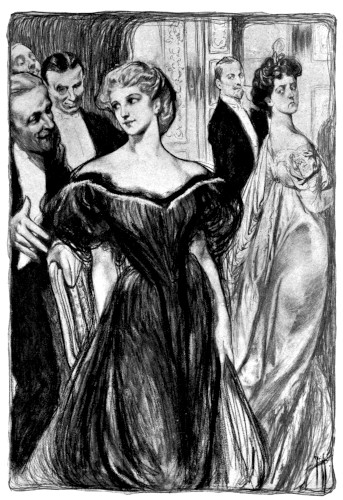
She was scoring.
Without a word Julie Van Ostade had shouted, "Cast-off clothes!" louder than the raucous dealers of the curb.
Luckily, the ghastly business was not prolonged. The leave-takings began at once, and Jean passed out among the first. Some hitch in the carriage arrangements delayed her a moment in the vestibule, however, and MacGregor came by.
"Did something happen back there?" he asked bluntly. "I don't think the others noticed anything; I didn't grasp anything tangible myself; but still—are the honors doubtful, after all?"
Jean shook her head.
"No," she answered grimly; "not doubtful in the least. She won."
Then Craig put her in the coupé, and asked if it had not been a jolly evening.
"It was a mixed crowd for Julie," he said, "but it seems she wanted to show you all sorts. You see how absurd it was to dread coming. Every time I laid eyes on you, you were holding your own. Virginia Hepworth asked who you were. Did you notice her? I want you to know her. You mightn't think it at first blush, but she's very stimulating; at least I always find her so. We had a famous powwow. I should like to paint her sometime against a sumptuous background. What did you think of her hair?"
Jean's response was incoherent. Then an illuminated turning brought her face sharply from the shadows.
"Jean!" he cried. "What is it? What's wrong?"
"Myself. We had best face it—face it now; better now than later. I am only a drag upon you, a handicap—not the kind of woman you should marry. You must marry a stim—stim—stimulus."
Atwood drew her into his arms.
"And so I shall," he answered, "so I shall the first minute she'll let me. To-night even! Do you understand me, Jean? Why shouldn't it be to-night? What do you say?"
Jean said nothing. What folly she had uttered! Give him up! His mere touch exorcised that madness. All the primitive woman in her revolted from the sacrifice. He was hers—hers! Could that pale creature love him as she loved him? Could Julie love him as she loved him? Julie! A gust of passion shook her; part anger with herself for the weakness to which she had stooped, part hot resentment against this superior being who set traps for her inexperience. For it was a trap, that dinner! MacGregor was wholly right. There was war between them; the night had witnessed a battle. What was it all but a manœuvre to humble her before her lover, prove her unfitness, alienate his love?
Then Craig's words took on a meaning.
"I'm in earnest," he was saying. "It isn't a spur-of-the-moment idea. These three days I've had it in mind to ask you to slip off with me quietly and without fuss. We've never been conventional, you and I. Why should we begin now? Nothing could be simpler. It is early yet—little more than ten o'clock. I'll drop you in Irving Place long enough for you to change your dress and pack a bag. Meanwhile I can pick up my own and make sure of the clergyman. That part is easy, too. I'll ask a friend of mine who lives not five blocks off. His wife and sister will be our witnesses. Then the midnight train for Boston and a honeymoon in some coast village."
"But the portrait?" she wavered.
"The best of reasons. The sensible thing is to marry before I begin work. Don't hunt for reasons against it, dear. None of them count. It's our wedding, not Mrs. Grundy's. We'll let her know by one of the morning papers, if there's time to give notice on our way to the train. Julie I'll wire."
A blithe vision of Julie digesting her telegram flitted across Jean's imagination with an irresistible appeal.
"I'll need half an hour, Craig," she said, as the carriage halted.
XXIV
Julie's congratulations reached them three days later at the decayed seaport, an hour's run out of Boston, which they had chosen at laughing haphazard in their flight. It was a skillful piece of literature. Ostensibly for both, its real message was for the errant Craig. There were delicate allusions to their close companionship of years, so precious to her. To him, a man, it had of course meant less. A woman's devotion—but she would not weary him with protestations. What she had been, she would always be. She bore him no unkindness for shutting her out at the momentous hour; she knew marriage would raise no future barrier. That was all.
"Dear old Julie!" said Atwood. "It did cut her." He smoked for a pensive interval, gazing out from their balcony over the rotting hulks of a vanished trade. "She's been my right hand almost," he went on presently. "Not many endearments between us—surface tendernesses. Some people think her hard, but she's as stanch as stanch. Did I tell you how she nursed me through typhoid?"
"Yes."
"That showed! Or take our Irving Place days. Many a play or concert she gave up for me—and gowns! She believed in me from the first. I can't forget that. What nonsense to talk of marriage shutting her out! We must not let her feel that way, Jean."
"No," said the wife; for to such charity toward the beaten enemy had she already come.
Indeed, her happiness had softened her to a point where she questioned whether MacGregor did Julie complete justice. He was a man of strong prejudices, set, dogmatic; even, she suspected, a man with a grievance, for Craig now told her that something in the nature of an engagement had once existed between his sister and his friend. Might not Atwood's insight be the truer? She began to put herself in Julie's place, and then, without much difficulty, saw herself acting Julie's part. Ambitious for Craig, scheming for him always, self-sacrificing if need arose, why should she not resent his marriage to a nobody whom she knew only as a model?
This flooding charity likewise embraced Mrs. Fanshaw. Her mother's chronicles of the small beer of Shawnee Springs had continued with the punctuality of tides. The weekly letter seemed to present itself to her mind as an imperative duty, like the Wednesday prayer-meeting, Saturday's cleaning, or church-going Sunday. Duty bulked less prominently in Jean's view of it, but she had answered, desultorily at first, and then by habit, almost with her mother's regularity. Yet she had told little of her life. The changes from cloak-factory to department store, from store to the Acme Company, and from the dental office to the studio had been briefly announced, but despite questions, never lengthily explained. Now she felt the need for confidence. Feelings quickened in her which she supposed atrophied, and under their impulsion she wrote her mother for the first time the true history of her flight from the refuge and traced the romance there begun to its miraculous flower.
A second note from Mrs. Van Ostade, received two days later, voiced in the friendliest way her acceptance of things as they were. She wondered whether they had formulated any plans for living? Craig's bachelor quarters, she pointed out, were scarcely adaptable for housekeeping, and surely they would not care for hotel life or furnished apartments? What they did want, she assumed, was an apartment of their own; that is, eventually. But, again, did they at this time of such critical importance in Craig's work, want the exhausting labor of house-hunting? Her suggestion—she was diffident, but oh, not lukewarm, in broaching it—was that for the time being they make the freest use of her much too spacious home. Craig knew how burdensome the East Fifty-third Street place had seemed to her since Mr. Van Ostade's death; he would remember how often she had urged his sharing it. Well, why not now? It need be only temporary, if they wished; merely for the critical present. It could easily be arranged from a financial point of view. When had he and she ever quarreled over money! And the domestic problem was as simple. Wouldn't they consider it? She meant literally consider, not decide. They could decide on the spot, for come to her they must on their return. She claimed that of them at least. They should be her guests first; then—but no more of that now.
They read the letter shoulder to shoulder; and so, without speaking, sat for a long moment after they reached the end.
"Well?" he said at last, with a vain reading of the still face.
"Well, Craig?"
"Bully of her, isn't it?"
She assented.
"And practical," he added; "more practical than our air-castles, I dare say."
A quick fear caught at her throat.
"Could you give them up, Craig?"
"Give them up!" he exclaimed. "Give up the air-castles that we've planned while drifting in the bay, roaming the fields, watching the sunset from this dear window? Never! We'll have our own home yet. But it does mean time, as Julie says, and this is a critical period in my affairs. I feel it strongly."
"And I."
"It would be practical," he said again thoughtfully. "We must admit it, Jean. How Julie seems to set her heart upon it! We owe her some reparation, I suppose. We might—at least, till the portrait is under way? Oh, but you must decide this point."
"No," she answered. "Your work must decide. But need we worry over it now?"
"Indeed, we'll not," he declared. "When we reach town will be soon enough, as Julie says. Come out for a row."
The end of the honeymoon came sooner than they thought. A third missive from Julie, laid before them at breakfast, asked when she might look for them, and added that Mrs. Joyce-Reeves also wished enlightenment, as she should soon be leaving town. Jean herself had urged a prompt return for the portrait's sake, but it seemingly needed his sister's spur to prick Craig to action. Time-tables immediately absorbed him. Noon saw them in Boston and the evening in New York, where a week to a day, almost to an hour, from the fateful dinner, they passed again through Mrs. Van Ostade's door.
Throughout the homeward journey Jean had shrunk from this moment, and, though he said nothing, she divined that Craig himself dreaded facing Julie. But the actual meeting held no terrors. Mrs. Van Ostade greeted them cordially and at once led the way to the suite of rooms set apart for their use.
"This is your particular corner," she said at the threshold, "but the whole house, remember, is yours."
"My books!" exclaimed Atwood, bringing up in the little living-room, the charm of which won Jean instantly. "My old French prints! Have you moved me bag and baggage, Julie?"
"I did send to your rooms for a few things to make you comfortable. I think you'll find the essentials. Had I dared," she added, turning smilingly on Jean, "I should have laid hands on your belongings, too."
They came upon discovery after discovery as they traversed the successive rooms. Julie's deft touch showed itself everywhere. Flowers met them on every hand, and a great bowl of bride's roses lavished its fragrance from Jean's own dressing-table. Her face went down among their petals.
"You don't mind?" murmured Julie at her side. "I wanted to do something, belated as it seems."
Atwood caught up one of the dainty trifles with which the dressing-table was strewn.
"See, Jean!" he called. "They're yours. This is your monogram."
The remorseful lump in the girl's throat stifled speech.
"You don't mind?" Julie repeated.
Jean's response was mute, but convincing. Atwood went out precipitately and closed the door upon his retreat.
Nor did Mrs. Van Ostade's thoughtfulness stop at their welcome, or yet at the almost imperceptible point where, the portrait deciding, their status as guests changed to a relation less transient. It concerned itself with the revision of Jean's wardrobe, with the more effective dressing of her hair, with the minutiæ of calls and social usages, intricate beyond her previous conception, but not lacking rime and reason in her altered life.
Jean had no galling sense of pupilage—the thing was too delicately done. Often Julie's lessons took the sugar-coated form of a gentle conspiracy against Craig, who, his sister confided, had in some respects lapsed into a bohemianism which needed its corrective. A portrait-painter, she reasoned, must defer to society more than other artists. It was an essential part of his work to acquaint himself sympathetically with the ways of the leisured class who made his profession commercially possible. Mrs. Joyce-Reeves furnished a concrete illustration. Even if the studio stairs had not proved too great an obstacle for her years, how enormously more to Craig's advantage it was that he could paint her here! Coming to this house, his sitter entered no alien environment. She retained her atmosphere.
"I make it a point to serve tea at their afternoon sittings," she added. "And I try to chat with her whenever I can. It draws her out, lets Craig see her as she really is, makes up for his lack of knowledge of her individuality."
Plastic as she was under coaching, Jean nursed a healthy doubt of the wisdom of Mrs. Van Ostade's constant presence in the billiard-room over the extension, which Atwood had chosen for the work because of its excellent north light. When had he so changed that the chatter of a third person helped him to paint?
Moreover, Craig was openly dissatisfied.
"I'm only marking time," he fretted, as he and Jean sat together before the canvas after Mrs. Joyce-Reeves's third sitting. "All my preconceived notions were merely blind scents. I'm not getting at the woman behind."
"Yet it's wonderfully like her," she encouraged, studying the strong, mocking old face.
"So are her photographs! Is that portraiture? Look at their stuff," he cried, catching a handful of unmounted prints from a drawer. "See what Huntington did with her girlhood! See Millais's woman of thirty! Look at Zorn's great portrait! Take Sargent's!"
"But none of them have painted her old age," she reminded. "You have that advantage."
"And what have I got out of it? Wrinkles!"
Crossing Madison Square a day or two later, Jean met MacGregor. He had congratulated them promptly by letter and sent them one of his desert studies which he knew for a favorite; but she had not come face to face with him since her marriage. She wanted to speak to him, for an unfulfilled penance hung over her, and almost her first word was a confession of her feeling that she had done Julie an injustice.
He listened with a caustic stare.
"Buried the hatchet?" he remarked.
"If there ever was a hatchet. I'm not so sure there was. I think we both misjudged her."
"Both, eh!" snorted MacGregor, huffily. "I dare say. After all, I'm a raw young thing with no experience."
"No; seriously," Jean laughed.
He changed the topic.
"Is the portrait coming on?" he asked.
"Craig is despondent."
"Good thing!" he ejaculated. "Stimulates the gray matter." His face went awry, however, when she mentioned Julie's theory and practice. "So it's the tea-drinking Mrs. Joyce-Reeves our mighty painter thinks most important," he broke out acidly, after violent bottling of comment more pungent. "Fine! What insight! What originality!"
Jean's eyes snapped loyally.
"Don't be disagreeable," she retorted. "You know Craig doesn't think anything of the kind."
They separated with scant courtesy, but she had not quitted the park before MacGregor's tall figure again towered over her.
"Enlighten the brute a little further," he said with elaborate meekness. "What is to become of your work? Richter says you haven't darkened his door since your marriage."
"Four whole weeks!"
"Oh, jeer away," he grumbled. "Honeymoon or not, it's too long."
"I must think of Craig's interests first."
MacGregor lifted his hat.
"Your father also dabbled in clay—and matrimony, I believe," he said, and left her definitely to herself.
She admitted the justice of his reminder when her cheek cooled, and, turning into a cross-town street, set a straight course for Richter's. The swathed model of a colossal group called "Agriculture," which he had in hand for a Western exposition, hid the sculptor as she pushed open the door of the big studio, and when she finally came upon the little man it was to discover Mrs. Joyce-Reeves beside him in close examination of an uncovered bit of foreground where a child tumbled in joyous, intimate communion with the soil.
They broke out laughing at sight of Jean.
"I told you I should ask Richter," declared the old lady, briskly. "His answer was to show me this."
Jean flushed at this indirect praise from the master.
"Mr. Richter let me have a hand in it," she said.
"A hand! He told me he should have had to leave the figure out altogether if you had not experimented with the janitor's baby."
The sculptor was now blushing, too.
"He did not tell me," Jean laughed.
"Why didn't you?" demanded Mrs. Joyce-Reeves, abruptly. "Why didn't you encourage the girl?"
"I think praise should be handled gingerly," he explained.
"Is it such moral dynamite? I don't believe it."
She beamed her approval of Jean's physical endowments as well, lingering in particular upon her eyes. Suddenly she gave a little cluck of surprise, whipped out a handkerchief, and laid it unceremoniously across the girl's lower face.
"Do you know Malcolm MacGregor?" she demanded. "Yes? Then I'm the owner of your portrait. It's called 'The Lattice.' Atwood's wife, MacGregor's inspiration, Richter's collaborator—my dear, you are very wonderful. Shall I take you home? I've promised your husband a sitting."
Jean said she must remain and work. She had thought only to run in and appease Richter, but between his grudging praise and MacGregor's goad, she found her fingers itching for the neglected tools; and she was into her comprehensive studio-apron before Mrs. Joyce-Reeves's electric brougham had purred halfway down the block. The sculptor squandered no more compliments that day, however. Indeed, he swerved heavily to the opposite extreme, but Jean dreamed audacious dreams over the penitential copying of a battered antique, and the afternoon was far gone when she reluctantly stopped work.
Leaving Richter's door, she beheld her husband swinging gayly down the street. He waved to her boyishly and quickened his step.
"Good news?" she queried.
"The very best," he said, seizing both her hands, to the lively edification of two nursemaids, a policeman, and the driver of a passing dray. "I've got my interpretation, Jean! Got it at last! And it came through you!"
For some reason, he told her, Mrs. Joyce-Reeves had arrived earlier than her appointment. Julie was out, but luckily she caught him, and so an hour of vast significance tamely began. By and by his sitter mentioned Jean, her work, and Richter's opinions, and plied him with kindly inquisitive questions about their love affair and elopement, till—all in a lightning flash—it came to him that here, peeping from behind the worldly old mask which everybody knew, was another, unguessed Mrs. Joyce-Reeves with a schoolgirl's appetite for romance.
"And that is what I want to paint," he declared. "Cynic on the surface, romanticist at heart."
The way home was too ridiculously short, and they pieced it out with park and shop-window saunterings. The future was big with promise. Both should wear the bays.
"For something she dropped set me thinking," Atwood said. "She sees, like all of us, that children are your forte, and she thinks that in this day of child study, your talent can't fail to make its mark. The janitor's baby seems to have swept her off her feet. She said the janitors, proud race though they be, must not be allowed to monopolize your time. Then she spoke of her great-grandchild, and I think there's something in the wind."
Jean trifled with the intoxicating possibilities for a dozen paces.
"Oh," she said finally, as if shaking herself awake, "Richter would never consent to my trying such things yet."
They composed their frivolous faces under the solemn regard of Julie's butler, who told Jean that a caller awaited her in the library.
"A lady from out of town," he added.
Jean wondered, "Why the library?" and, then, advancing, wondered again as a silvery tinkle reached her ears; but the chief marvel of all was the spectacle of Julie Van Ostade and Mrs. Fanshaw in amicable, even intimate, converse over afternoon tea.
XXV
Surprise held her at the threshold an instant, whereupon a rare, beaming, even effusive, Mrs. Fanshaw, whom Jean's memories linked with calls from the minister, bore down on her, two steps to her one, and engulfed her in a prolonged embrace. Then, holding her daughter at arm's length in swift appraisement of her dress and urban air,—
"Death brought me," she explained.
"Death!"
"Your great-aunt Martha Tuttle died last Friday at brother Andrew's in Paterson," she announced in lugubrious tones with which her blithe visage could not instantly be brought in harmony. "I am on my way home from the funeral."
"I've been trying to persuade your mother to break her journey here for a few days," Julie contributed, with a fugitive smile; "but she says she must hurry away."
"Amelia expects her little stranger any time now," murmured Mrs. Fanshaw, chastely. "But I will stop overnight, perhaps part of to-morrow, thanking you kindly, Mrs. Van Ostade."
"Pray don't," deprecated Julie, moving toward the door. "This is Jean's home, you know. Unfortunately, I'm dining out this evening."
Jean learned of Mrs. Fanshaw's haste and Julie's engagement with equal relief. She felt no snobbish shame for her mother's rusticity, but she did fear her babbling tongue, and her first word on Julie's withdrawal was one of caution.
"Not a syllable about the refuge here," she charged. "Neither Craig nor I wish Mrs. Van Ostade to know. Remember, mother."
The visitor's eyes widened.
"Oh," she observed slowly, "I don't see—"
"We see," Jean cut her short. "You must respect my wishes in this."
"All right," assented Mrs. Fanshaw, with amazing meekness. "Is your husband on the premises?"
"You will meet him soon," she replied, thinking it expedient that Julie or herself should first give Atwood some hint of what lay in store.
"He is really quite well known, isn't he? I've taken more notice of magazine pictures since I heard I had another son-in-law. I hope he's not wild. They tell of such goings-on among artists and models. I seem to recollect, though, they were French."
"Craig is a gentleman."
"I'm bound to say his sister is a lady," Mrs. Fanshaw replied to this laconic statement. "Is she any connection of that Mrs. Quentin Van Ostade the papers mention so much?"
"Julie is her daughter-in-law."
"You don't tell me!" She was impressed to the verge of awe. "Why, that makes you sister-in-law to Mrs. Quentin Van Ostade's son!"
"He is dead."
"Dead!" Her face paid the late Mr. Van Ostade the fleeting tribute of a shadow. "What a pity! But I presume his mother still sees something of his widow?"
"Oh, yes."
"And comes here sometimes?"
"Frequently."
Mrs. Fanshaw resurveyed her surroundings as if they had taken on historic interest.
"You've seen her?"
"Yes."
"I mean, really met her—been introduced?"
"Yes," Jean admitted, without humility.
Her mother eyed her with respectful interest.
"I hope you'll keep your head, Jean," she admonished solemnly. "This is a great come-up in the world for you."
An impish impulse took shape in Jean's brain, and, under cover of showing the house, she guided Mrs. Fanshaw by edifying stages to Craig's temporary studio and the great work.
"A portrait he's doing!" she dropped carelessly.
Her mother as carelessly bestowed a brief glance upon the canvas.
"What a wrinkled old woman," she commented, turning away. "But I suppose it is the money your husband is thinking of?"
"Partly."
"What will he get for it?"
Jean pondered demurely.
"It is hard to say. Perhaps a thousand, perhaps two thousand dollars."
"What!" She wheeled upon the portrait. "Why, who is the woman?"
"Mrs. Joyce-Reeves."
The effect was as dramatic as Jean's unfilial fancy had hoped.
"The Mrs. Joyce-Reeves of Fifth Avenue and Newport?"
"And of Lenox, Aiken, and Ormond—yes."
Mrs. Fanshaw's attitude toward the portrait became reverential. Here was hallowed ground!
"Have you met her, too?" she asked finally, with the realization that even her child might share the sacerdotal mysteries.
"Yes."
"You have talked with her?"
"Only this afternoon."
"Here?"
"She was here to-day, for a sitting, but I ran across her at Mr. Richter's studio."
"That is where you go to—"
"To model; yes." Then, with great calm, "Mrs. Joyce-Reeves admires my work."
A chastened, pensive, almost deferential, being, who from time to time stole puzzled glances at her ugly duckling turned swan, let herself be shown to her room and smartened for dinner, to which she descended at what seemed to her robust appetite an unconscionably late hour. Here the fame of her son-in-law and the even more disconcerting attentions of the butler combined to make her subjugation complete.
Sweet as was her victory, however, Jean had no wish to see her mother ill at ease, and she rejoiced when Craig exerted himself to entertain this visitor whose subdued, almost shy, manner was so bewilderingly at variance with the forbidding image his fancy had set up. Moreover, he succeeded. If Mrs. Fanshaw's parochial outlook dulled the edge of his choicer quips and anecdotes, his boyish charm, at least, required no footnotes; and before the dinner ended she was bearing her gustful share in the conversation with such largess of detail that a far less imaginative listener than he might reconstruct therefrom the whole social and economic fabric of Shawnee Springs.
To Jean, who in dark moments had longed to forget it utterly, the narrow little town recurred with sharp, unlovely lines. Forget it! She could as easily forget that this was her mother. Flout it as she would, it yet stood closer to her than any spot on earth. Its censure and its respect were neither despicable; her rehabilitation in its purblind eyes was a thing desirable above all other ambitions. Then, presently, in this hour when she craved such justification deepest, its possibility, even its certainty, came to her. She had slipped away to answer one of the more imperative letters which Craig's detestation of affairs left to her, and as she mused a moment over her finished task, the drift of Mrs. Fanshaw's monologue in the room beyond penetrated her revery.
She was talking, as Jean had heard her talk times innumerable, with endless variations upon a single theme. But the burden of her laud was no longer Amelia! Now it was Jean—her childish spirit, her school-time precocity, her early love of shaping things in clay, her promise, her beauty, her future—Jean, always Jean! And as the girl at the desk drank it in thirstily, she foresaw the end. Signs there had been already that Amelia was wavering on her pedestal—her husband and her husband's family, the proud Fargos, had impaired her sainthood; and now in the tireless, fatuous, sweet refrain, Jean read her own elevation to the vacant niche. Hot tears blinded her. It might not be her noblest compensation; but it was the dearest.
If Mrs. Fanshaw's coming marked the dawn of another day in Jean's spirit, its effect on her external welfare was less happy. Her relations with Julie were beyond question altered, though precisely where the difference lay was not easy to detect. Intuition, rather than any overt act or word of Mrs. Van Ostade's, told her this, for their surface intercourse went on much as before; but, elusive and volatile as this changed atmosphere was, she nevertheless knew it for something real, alert, and vaguely hostile. Yet this aloofness, if aloofness it could be called, was so bound up in Julie's propaganda on behalf of Craig's career that Jean took it for a not unnatural jealousy.
Atwood fed the flame with repeated acknowledgments of his wife's share in solving his riddle, the fervor of which leaped from bud to bloom with tropic extravagance as the portrait went rapidly forward and the judgment of MacGregor and other experts assured him of its strength. His sister, Jean noted, always took these outbursts in silence. The portrait expressed a Mrs. Joyce-Reeves with whom she was unfamiliar, either over the tea-cups or elsewhere, but she had the breadth to recognize its bigness and set her restless energy to work to exploit it with all her might.
Of her methods Jean perhaps saw more than Mrs. Van Ostade supposed. For a fortnight Atwood let the nearly finished portrait cool, as he said, and busied himself at his regular studio with such illustrative work as he was still under contract to deliver. This was Julie's opportunity. That Atwood was painting Mrs. Joyce-Reeves was no secret—a discreet paragraph or two had sown the seed of publicity in fertile ground; and Julie furthermore let it leak out among those it might interest that the sittings took place beneath her roof. Skillful playing of influential callers who rose eagerly to allusions to the opinions of the critics—Mr. Malcolm MacGregor, for example—would lead usually, in strictest confidence, to a stolen view of the masterpiece. By such devices—and others—it came to pass that Atwood, happily ignorant of the wire-pulling which loosed the falling manna, found himself commissioned to paint three more persons of consequence so soon as his engagements to Mrs. Joyce-Reeves and the publishers would permit.
Craig ascribed it all to society's proneness to follow its bell-wethers.
"But I never gauged Mrs. Joyce-Reeves's true power, the magic of her mere name," he said repeatedly. "Three orders on the bare gossip that she has given me sittings!"
Julie begged Jean not to undeceive him.
"At least not yet," she qualified. "He is quixotic enough to throw his chance away, if he thought I used a little business common sense to make his art pay. I've never dared let him know the labor it cost to interest Mrs. Joyce-Reeves. Not that it was illegitimate or in any way underhanded. All this is as legitimate as the social pressure a clever architect brings to bear, and nobody thinks of censuring. But illusions are precious to Craig; they feed his inspiration. So I say, let him enjoy them while he can. Let him think commissions drop from the skies."
Jean doubted the truth of this estimate of Craig, but she did full justice to Mrs. Van Ostade's motives and to the signal success of her campaign which, for all she knew of such matters, might be, as Julie said, legitimate, and at this time even vitally important. The necessity for a change of studio, which now recurred, seemed logical, too.
"You now see for yourself, Craig, how unsuited to portrait work your old quarters are," Julie argued.
"Virginia Hepworth won't mind coming here—she is next, you know; but you can't go on this way indefinitely. Of course, it's possible that you may find it desirable to take a temporary studio at Newport for the summer; but in the fall people will expect a city studio worthy of your reputation."
Atwood was tractable.
"We must have a look around," he assented.
"I have looked around," announced his sister; "and I've found something you couldn't possibly better. It has every convenience—a splendid workroom, a large reception-room, a dressing-room, and an extra chamber which would be useful for the caterer when you receive. It will require very little redecorating, though they're willing to do it throughout, if we like."
"That sounds like the Copley Studios."
"It is."
Atwood laughed.
"Must it be the pink-tea district, after all, Julie? Boy in buttons at the door, velvet-coated poseur—Artist with a capital A—in the holy of holies. What will old Mac say! Jean, what do you think?"
She felt Julie's compelling eye upon her, and resented its domination; but she saw no choice of ways.
"The velvet jacket isn't compulsory, is it?" she said lightly. "Why not look at the studio?"
"I'll drop in the first time I am near," he agreed.
Julie coughed.
"I ventured to make an appointment," she said. "They only show it by special permission of the owners, the Peter Y. Satterlee Company. Mr. Satterlee himself offered to be at the building at twelve o'clock to-morrow, if that hour will suit. To deal with him in person would be an advantage."
"Would it?" responded Craig, hazily. "Very well. Can you go, Jean?"
"If you want me," she returned, feeling outside the discussion.
"Of course. I count on you and Julie to browbeat the real-estate shark into reducing the summer's rent. All I shall be good for is to tell you whether there is a practicable north light."
Jean came late. Richter had abruptly taken her off the spirit-mortifying antique to aid him with one of his lesser studies for the Western exposition, and the forenoon had been absorbing. To watch Richter model was much; to help him a heaven-sent boon to be exercised in fear and trembling and exceeding joy. The stroke of twelve, which should have found her with Craig, saw her but leaving Richter's door. The distance was short, however, and at a quarter past the hour the overupholstered elevator of the Copley Studios bore her without vulgar haste aloft.
It was all vastly different from Craig's unfashionable top-story back, a mile or more down-town. No shabby street confronted this temple of the fine arts; its benign façade overlooked a trim park and the vehicles of elegant leisure. No base odor of cabbage or garlic rose from the nether lair of its janitor; no plebeian tailor or dressmaker debased the tone of its lower floors. Its courts were of marble, and its flunkies had supple spines.
The door to which Jean was directed stood ajar, and she let herself in to encounter other mighty differences. The entrance to the down-town studio precipitated the caller squarely into the travail of artistic production, but the architect who planned the Copley Studios had interposed a little hall with a stained-glass window-nook and a reception-room of creamy empire fittings between genius and its interruptions.
From the studio proper issued Julie's level tones, presumably in discussion with Peter Y. Satterlee, for Jean heard Craig's meditative whistle in another direction. Following a small passage, she came upon him studying the convolutions of a nervous jet of steam which found vent among the myriad chimneys of the nearer outlook.
"Will it do?" she smiled.
"Splendidly—almost too splendidly. Julie and the magnificent Satterlee are settling terms, I believe. Behold your studio, sculptress mine!" he added with a grandiloquent gesture. "This is the extra chamber of Julie's rhapsodies, otherwise a bachelor's bedroom about to be dedicated to nobler ends. Notice your view, Jean! New York, the Hudson, Jersey's hills, and the promise of sunsets beyond compare! And look here"—descending to practicality—"running water handy and my workshop next. We shall virtually work side by side."
He pushed open the connecting door, and they entered the studio. Julie and a globular man in superfine raiment stood like ill-balanced caryatids in support of either end of the mantelpiece.
"I agree to everything," he was saying. "The leases shall be ready to-morrow."
The voice signaled some cell in Jean's brain. The face, which he turned immediately upon her, gave memory its instant clew, and she felt her skin go hot and cold under Peter Y. Satterlee's earnest gaze.
"Have you a double, Mrs. Atwood?" he asked, after a moment's idle discussion of the studio.
She tried to face him calmly.
"A double? I think not."
"Why?" demanded Julie.
Satterlee pursued his investigations with maddening care.
"It's a most extraordinary resemblance, particularly as to eyes," he said. "There was a young woman, a dentist's wife, living in a Harlem apartment of ours—the Lorna Doone, it was—who might be Mrs. Atwood's twin. You didn't marry a widow, sir?" he broke off jocularly.
Atwood laughingly shook his head.
"How curious!" he exclaimed. "What was her name?"
"There you have me," admitted the agent, after brain-fagging efforts. "I can't recollect. I sold the property very soon."
XXVI
Rid of them all, Jean was tormented by a host of replies and courses of action, any one of which, she believed, would have blunted the edge of Julie's suspicion. For she was suspicious! There could be no doubt of it. To Craig she longed to offer some explanation, but her love bade her reject anything short of the whole truth, even as it told her that the whole truth was impossible. Every hour of her wedded happiness heaped proof on proof of the joy he took in the belief that he alone had filled her heart. And was he not right? Had not his dear image persisted—canonized, enshrined, worshiped—since their forest meeting! Paul had never displaced it. In truth, it had shone the brighter because of Paul. But how put this holy mystery in words!
She took refuge in an opportunism not unlike Amy's. Did not time and chance rule the world! Yet her peace of mind was fitful, and she shunned the Copley Studios with a fear which hearkened to no argument. It was useless to remind herself that Satterlee was a man of many interests. Her imagination always figured him as haunting the room where she had come upon him. There he waited, a rotund bomb by the mantelpiece, with the explosive "Bartlett" in his subconsciousness ready to destroy her the instant her face should at last apply the fatal spark. So it fell out that, pleading her own work whenever Craig, himself absorbed in the Hepworth portrait, asked her opinion of his sister's ideas, the new studio's furnishing went forward without her and in unhampered accord with Julie's ambitious plans.
How far-reaching these plans were she first adequately perceived through MacGregor, whose card came up to her one evening when both Atwood and Mrs. Van Ostade were out.
"I counted on finding you alone," he owned with characteristic bluntness. "Craig has gone to the Salmagundi doings, of course,—I'm due there later; while I happen to know that Julie is dining with her mother-in-law. I met Julie this afternoon at the Copley Studios."
"Then you saw Craig's new quarters?"
"Yes. Have you seen them?"
"Why do you ask that question?"
"I gathered that you hadn't."
"I went there the day Craig took the place."
"And have not returned! Why?"
"I am working hard with Richter."
"So he tells me. Don't overwork. Art isn't everything."
"Aren't you inconsistent?" she laughed.
"Lord, yes! Consistently inconsistent. Life would lose half its sparkle, if I weren't. But the new studio; you should have a look in; it would interest you. I don't often trouble the pink-tea district, but an errand took me into the Copley building to-day just as Julie entered, and she offered to show me through."
His meditations became irksome.
"Well?" Jean prompted.
"Julie should have been a stage-manager," he said. "Her scenic instinct is remarkable. She sees Craig's place peopled with a fashionable portrait-painter's clientele, and has set her properties accordingly. His Italian finds,—his tapestries, his old furniture, his Pompeian bronzes,—the new grand piano, and the various other newnesses, all present themselves as background for society drama. I take off my hat to her. She, too, is an artist, an artist of imagination. It is all perfectly done. Nothing lacks but the fashionable portrait-painter."
"And the drama?" Jean suggested.
"Oh, that is being looked after. She plans a house-warming of some sort. You haven't been consulted?"
"No."
"Neither has Craig, I dare say. Perhaps the idea only took shape while she talked with me. I can't give you the technical name of the function, but it will be worthy of the manager's reputation. The scheme is to get Mrs. Joyce-Reeves's portrait, Miss Hepworth's, and mine—yes, mine!—before as many as possible of the opulent beings who itch to hand their empty faces down to posterity. By the way, I want to see the Hepworth portrait."
She took him to the billiard-room and brought the unfinished picture to the easel. MacGregor turned off a warring light, chose a view-point, bestrode a chair, and lapsed into a long silence. Jean tried to read his rugged face, but finding it inscrutable, herself studied the canvas. Fuller knowledge of Craig's sitter had failed to reveal the qualities of mind he found so stimulating; but now, confronting the immobile counterfeit, she hit with disturbing certainty upon the truth that Virginia Hepworth's appeal was physical, and to men as men.
A moment afterward MacGregor confirmed her intuition.
"I don't know her any better," he said. "Outwardly she is the same neurotic creature I've seen all along. Apathetic with other women, she stirs to life and takes her tints from the particular male with whom she chances to be. Craig has missed an opportunity to dissect a chameleon."
"You think it's a failure!"
"Psychologically, I do; technically, no. In color, texture, it is masterly. Don't distress yourself about its success; it will be only too successful. I think it will even have the bad luck to be popular."
Jean's loyalty rose to do battle.
"It's to Craig's credit that he could not see her truly," she retorted. "If she takes her tints from the man with whom she talks, then he has painted into her something of himself, something fine. But wasn't it hers for the moment? Why, then, shouldn't he show her at her best, not her worst?"
MacGregor laughed immoderately.
"That is stanch and wifely and nonsensical. It is not a portrait-painter's business to supply the virtues or the vices. His palette ought to contain neither mud nor whitewash. It is his duty to see things as they are."
"But how can you expect Craig to see Miss Hepworth as she is? He's not—"
"Middle-aged, like myself," suggested MacGregor, as she hesitated. "Say it! It makes your fling concrete, personal, feminine."
Jean's wrath cooled in a smile.
"I was going to add, cynical," she said. "Is that a personality?"
"It's wide of the mark, whatever we call it. I'm no cynic. If I were, I should merely stand by and laugh, not interfere."
"Don't put it that way."
"It amounts to interference. I can't cheat you, and I don't fool myself into thinking my talk about Craig's work is impersonal. Neither is what I say about Julie impersonal. Of course you've heard that she jilted me for Van Ostade? Eh? I thought so. Don't think you must say you're sorry," he protested hastily, as her lips parted. "I'm not sorry. I'm thankful for my escape. That sounds bitter to you. Perhaps I am bitter, but the bitterness is for myself, not her; and it doesn't sway my judgment of her influence upon Craig by a hair's breadth. He thinks it does, naturally, and he discounts my warnings. But I know, and you will know, if you don't see it yet, that he must shake her off. Otherwise he's damned."
Jean kindled from his fiery earnestness.
"What must I do?" she asked. "Do you think the new studio is a mistake?"
"No; I don't say it is. Craig had to come uptown. I'm not maintaining, either, that he can't paint under such conditions. Some men they stimulate. It isn't the studio; it's the commercial campaign it stands for which makes my gorge rise. Mind you, I don't censure Craig for not grasping Miss Hepworth in character. His youth is responsible for that fluke. But if he listens to Julie, he'll soon be painting everybody at their best moments. He'll take orders like a factory—yes; and execute then? like a factory—shallow, slap-dash, characterless vanities all of a mould, which fools will buy and the future ignore. There is no lost soul so tortured as the fashionable portrait-painter who has once known honest work. You must save Craig from such a fate. Don't think he is too strong to succumb. I've seen men with as much promise as his go under. Help him keep his feeling fresh. See that he has time to linger over and search out each subject. Make him paint even the mediocrities as they are."
"How shall I begin?"
"Throw Julie overboard," answered MacGregor, instantly. "I did not come here to mince words. I want to bring this home to you before I leave the country. I sail for Africa day after to-morrow."
"For Africa!"
"Yes. This is good-by. A magazine has made me an offer I can't afford to refuse."
She was oppressed by a great loneliness.
"Then I must fight it out single-handed," she said.
"You would fight single-handed if I were here, I'm afraid. Nobody can help you much. The most I can do is to try to convince you that you must fight. You must show Julie her place, and show her soon. Don't be soft-hearted about it. She's not soft, trust my word. You are dealing with an enemy—understand it clearly. She is an enemy and a clever one. Julie could not prevent your marriage, but she may break it."
She paled at the conviction of his tone.
"I can't believe it!"
"Can't you? I tell you the process of alienation has begun. Doesn't Craig think you indifferent about the studio?"
"Perhaps. I had reasons—"
"Chuck them away."
"And he knows I've been busy with Richter. Craig himself is lukewarm about the studio."
"You must not be. It may be your battle-ground. I don't say it will; but it may be, and it behooves you to look after your defences." He glowered at the painted face a moment, then: "You may know that the Chameleon was Julie's own choice for sister-in-law. Yes? It's a fact worth thinking over. Good-by, Jean, and good luck! I haven't been agreeable, but I've spoken as a friend. You feel that, I hope?"
"Yes," she answered unsteadily; "and thank you."
MacGregor winced as her voice broke.
"Buck up, buck up!" he charged. "You'll win out, sure!"
She brooded over his words till Atwood's return, but without seeing her way, and a restless night suggested only courses too fantastic for the light of day. She could not repeat MacGregor's warnings to Craig, nor could she voice them as her own; while to attack Julie openly seemed maddest of all. She could only drift and bide a time to assert herself with dignity.
Such a chance seemed to offer at luncheon when Mrs. Van Ostade asked Craig for suggestions regarding the decoration of the small room off the main studio.
"It has never been done up, you know," she continued. "The last tenant did not occupy it at all. We shall need it, however, and I think it should be put in order at once. I'll use my own discretion, if you don't want to be bothered."