MAJOR SAMPSON'S PART IN THE SCHEME.
Reading edition
"Now, I don't care what you may think of Sampson. Sampson told you that he played with the shells. He told you he had been in the bridewell, but never in the penitentiary; he told you he had followed gatherings and made money in a crooked way—he as much as said all that. But who was it that was familiar with all this? and where did the learned counsel who cross-examined him for the defense learn the man's record, except from Dan Coughlin? How did they know the history of this man Sampson unless they got it from Coughlin? How did they know what he had done in Michigan? They didn't happen to ask him if he was ever in Hancock, Mich. But they knew all of his doings in Michigan and southern Illinois, when he was following James G. Blaine. If Sampson was a crook, a thief and a robber—if he were the man they would have you believe—Dan Coughlin, in the pay of the city, and not doing his duty in this respect, was not fit to be on the police force. He must have known of this. The attorney could not have dreamed or guessed it, because Sampson says it is so. With all their cross-examination they didn't even impeach him on these questions. Then how about Garrity. Garrity says he was arrested for selling liquor without a license, but the case was dismissed, and Dan Coughlin had charge of it."
"The evidence is that Captain Schaack had charge of the case," interrupted Forrest. "Coughlin swore out the warrant."
"But the lawyer insisted," responded Judge Longenecker, "that Dan Coughlin was the man who got Garrity's license revoked. If this man was violating the law, and Dan Coughlin swore out the warrant, it was his duty to prosecute; but they bring Loewenstein on the stand and he tells you that Garrity's saloon was a place for thieves and robbers. If that is so, then what is the duty of those police officers; what was their duty as men put on the force to look after the interests of this city? It was their duty to forever shut up the doors of this saloon—forever blot it out of existence, this robbers' roost, and not to come here and try to break down the evidence we gathered from the very men who were the associates of Dan Coughlin.
"Now there is more in that, gentlemen, than you can think of. When you couple it with Dan Coughlin's expression to Dinan, 'Don't say anything because I have had trouble with Dr. Cronin—because they know I am his enemy,' it is very significant. Why did they know it? He had told Garrity he wanted to see Sampson; he told Sampson he wanted him to slug Dr. Cronin, and he had whispered into the ears of O'Connor that Cronin was a spy. He had charged in a North Side saloon that a prominent North Side Catholic would soon be destroyed. On every corner he had raised his hand against Dr. Cronin. In the lodge he moved to appoint this secret committee to investigate Dr. Cronin, and when you couple it all together it is a good piece of evidence in this case, as tending to show the direction in which Daniel Coughlin was moving at the time he uttered the words."
TRUE TO THE IRISH CAUSE.
"Now, gentlemen, I want to say, before I pass on to the 4th of May, and I think it is due from me, as a public prosecutor, to say this: You have seen from day to day that we have called on the stand unwilling witnesses from Camp 20, and I want to say this, that the best patriots in the Irish cause to-day are the men we got on the stand to tell you the truth in reference to this case—Thomas O'Connor, and Henry Owen O'Connor, Patrick Dolan and Patrick McGarry. They are the best patriots that have appeared on the face of the globe. Here are men that stood up in this court-room and dared to tell the truth of what had happened in Camp 20, and I feel that it is due upon this occasion to say that the Irish cause never had better patriots than these men who came afterward and testified to the truth and to tell you where this hellish conspiracy originated. They have the nerve to come and tell us where it began, in order that the law might be vindicated; in order that the death of Patrick Henry Cronin might be avenged. I say this because it is due to them. Their evidence is undisputed. It has not been contradicted; they came out with clean hands.
"As to Sampson, I do not care what the attorney may say in regard to him. As to Garrity, I think both of them deserve credit for coming forward and telling the truth in this case. It is not often that you can get men, who are hounded to death by officers, who would lead the community to believe that they are the worst creatures on earth—it is not often that you can get them on the stand. They stood there for an hour with the counsel, prompted by the man who knows all about them, to question and put question after question as to their character."
The State's Attorney, at this point, asked the Court for an adjournment, and intimated that he would not take more than an hour further to conclude his address. Some suggestion as to an adjournment until half-past one was modestly made, but on the State's Attorney's assurance the Court adjourned proceedings until two o'clock.
THE FATAL 4TH OF MAY.
On the assembling of court at 2 o'clock, State's Attorney Longenecker resumed his address to the jury:
"If the Court please, and Gentlemen, as I stated in my opening of yesterday, I do not desire to do anything but talk about the evidence. On the 4th of May Dan Coughlin, one of the defendants here, appeared at Patrick Dinan's livery stable. It was customary for the Chicago Avenue Station to hire horses whenever they desired them at Mr. Dinan's stable, which is just north of the Chicago Avenue Station on Clark street, so that it was not an unusual thing for Dan Coughlin to go there or for any officer to call for a horse and buggy, and it was not customary for Mr. Dinan to inquire what they desired with the horse and buggy. You remember Patrick Dinan's testimony in regard to this. Coughlin said he had a friend who wanted a horse and buggy and would call for it about 7 o'clock that evening, showing that Dan Coughlin was an actor in reference to this horse and buggy that was obtained from Dinan. He told Patrick Dinan that his friend would call at 7 o'clock, and at 7 o'clock a man came. Napier Moreland, who was a buggy washer and worked in the stable, testifies that at just about 7 o'clock a man appeared there and called for the horse and buggy that Detective Coughlin had engaged. Dinan was out in the barn. Just then Dinan came back and the stranger got under the gaslight that was in the buggy part of the stable and asked for the horse that Dan Coughlin had engaged for him. Dinan ordered the horse called the gray horse and sometimes the white, to be hitched to the buggy. There was a blacksmith named Jones, there getting a horse, and the stranger did not want the white horse, but wanted the other rig. Mr. Dinan told him he could not have that; he did not know where it was going and he knew what this horse was going to do, and Moreland got the old gray horse. You remember that Dinan said that it had not been out of the stable for quite a while and had not been driven. This was a little after 7 o'clock. He wanted side curtains and Dinan told him it was a warm evening and he did not need side curtains and it would take too long to put on side curtains. The man, grumbling, got into the buggy and they put on the hitching strap to it, and Dinan tells you that this man had a low-crowned, narrow-rimmed slouch hat. That he did not see his eyes, because he pulled his hat over his forehead, but his face looked as if it had not been shaven, and he had a black or a brown mustache. He gives his height as 5 feet and 7 inches, and said that he had a dirty, faded looking overcoat. Moreland testifies to the same thing; that the man had on a low-crowned, narrow-rimmed slouch hat, and that his face looked dirty, and he describes him about the same that Dinan does.
"How did the horse start when he turned out? It went directly north. Dinan swore that he was anxious to see the horse drive off, and he watched the man drive north on Clark street. Then he was going north. Mrs. Conklin tells you that a man came there a little after seven o'clock and came to the door and rang the bell, and that Sarah McNearney and Agnes McNearney were there at the office. You remember the description of the house; there were two flats, and Dr. Cronin occupied one front room and Mr. and Mrs. Conklin used the other front room for living purposes. She states that when this man came to the door she admitted him into the room. He says he is in a hurry and wants the Doctor, and the Doctor says, 'very well; I will be there in a minute.' You remember now that the McNearney girl, who was sitting outside, says that he had on a slouch hat with a narrow brim and his face had not been shaven for some time. He had a very keen eye—his eye was so piercing that she could not look at him, and he had a restless manner. He said there was an accident to one of P. O'Sullivan's men; that he had been run over by an ice wagon, and the Doctor said: 'Why didn't you get a doctor near?' 'Doctor,' he said, 'here is O'Sullivan's card,' and Dr. Cronin took it and laid it on the mantel in his own room, and then wrote out a prescription for Sarah McNearney. Mrs. Conklin described the man, the same as the McNearney girls, saying that he had a low-crowned, narrow-brimmed hat, and that his face was dirty as if it had not been shaven."
THE MAN WHO DROVE THE WHITE HORSE.
"They all agree upon this low-crowned hat with the narrow brim and the condition of the man's face. The Doctor gathered up the cotton and splints and a little satchel in which he had his instruments. The man said: 'I have a horse and buggy here for you.' That attracted her attention to the window, and she looked out and stood by the south bay window, and looked down at the horse that was standing in front of the saloon, and she saw that the horse had an uneasy appearance, and, in describing the facts, she said that his knees were in motion. You remember she describes how he was standing there. Now, Dinan gave just the same description as to his appearance—that he looked as if he wanted to go but he was not much of a goer. Frank Scanlon was standing there, and he wanted to see the Doctor about an arrangement regarding a paper that the Doctor was publishing at that time, and gives the same description. Now, here are five or six witnesses that describe this man, three or four at the Doctor's office, and two at the livery stable.
"Now suppose the horse was not identified at all; suppose it was a bay horse or a brown horse or any other kind of a horse than a white horse or a gray horse, and suppose these two men had come that gave the same description of the man that appeared at Dinan's livery stable, and other witnesses identified him as the man that started away with the Doctor to treat one of O'Sullivan's men—keep that circumstance in mind—that Patrick O'Sullivan and Dan Coughlin were seen together on the night of the 24th of March, when Patrick O'Sullivan was to make this contract, that they both belonged to the same order, and that the contract was made and O'Sullivan says: 'My card will be presented to you if I am out of town.' Take that circumstance and what have you got? You have men who identified the horse that Dan Coughlin hired; you have that man driving north on Clark street in the direction of the Carlson cottage; you have that man presenting Patrick O'Sullivan's card and demanding the attention of the Doctor under the contract that Patrick O'Sullivan had with the Doctor, and you have them driving in the direction of the Carlson cottage. But that is not all the evidence we have on that point. Suppose that this is an ordinary horse that can not be identified, yet Mrs. Conklin tells you that that horse is a horse, that she remembers it not simply because it was a white horse and because it came from Dinan's livery stable, but she describes it from its uneasy motion; she remembers its legs and its knees. She says it has big knees, and Captain Schaack says it has big knees. And Mrs. Conklin, looking out of the window on that fatal night saw those knees. Why does she say that? The last time she saw Dr. Cronin alive he was sitting behind that horse that had knees that were wabbly. No wonder she remembers that horse, because she saw it in the same uneasy appearance that it had the night that Dr. Cronin was driven away. She identifies the horse from the knees and from the uneasy appearance, quite as much as if it was white or gray."
The State's Attorney then reviewed Captain Schaack's testimony as to how he had driven the horse around in front of Mrs. Conklin's house and as to the question of identification, and repeated his arguments that it was not the position in which the horse stood, but its peculiar, uneasy motion that enabled her to identify it. He considered that the identification of the horse by Mrs. Conklin was a fact that could not be disputed. The undertaker who arranged for Cronin's funeral and Mr. Scanlon had also observed the same horse, and he considered the identification complete.
THE IDENTIFICATION OF THE HORSE.
"They bring a man from New Jersey who stood here across the street, and the only reason why he says it is the same horse is because the horse that drove Cronin away was a gray horse, and this horse of Dinan's is a white horse. Did this man who traveled all the way from New Jersey tell you what kind of knees the horse had? Did he tell you there was anything wrong with the horse that drove Dr. Cronin away? No; but he says, looking from under an electric light on the opposite side of the street, he could see that that was a gray horse with dark legs, and therefore it was not the horse that drove Dr. Cronin away. On the question of identifying the horse, here are two witnesses where they could have a good view of the horse, swear positively that that was the horse. It is true that they brought the other man who looked across the street with nothing to attract his attention to the horse as much as the man, but Mrs. Conklin could not help looking to the parties getting into the buggy.
"But lay that aside; lay aside the evidence of the identification of the horse; when you gather up this chain from the 8th day of February—with the renting of the flat; with the writing of the letters; with the renting of the cottage; with the removal of the furniture; with the fact that Coughlin hired the horse and that his man was there at 7 o'clock on his own time—within five minutes of the time—that he appears there with P. O'Sullivan's card in his hand—what more evidence do you want to satisfy you that the horse that drove Dr. Cronin to his death was any other than the one that Daniel Coughlin hired of Dinan?
"On the 4th of May we find that about eight o'clock, or a little after, at the Carlson cottage, a gray horse is seen coming up Ashland avenue—the gray horse that was hired by Daniel Coughlin, and that started from Dinan's livery stable northward at twenty minutes after seven o'clock. Immediately after eight o'clock the gray horse was seen coming from the north on Ashland avenue, driven by a man whom the party could not describe. Remember that Dr. Cronin started with a satchel and with his box of splints, and with a roll of cotton; that he carried them on his lap, and that he wore a slouch hat with a low crown, and a brown overcoat; and that this horse and buggy that the man had seen coming north he observed that the horse was gray. He saw the buggy turned round and a tall man get out and reach in and take something out, as if it were a dark satchel, and go up the steps into the cottage, and the man in a brown coat with a high-crowned hat went into the cottage. The buggy then drove south. It was a white horse that drew it away. Here we have the white horse from Dinan's stable, seeming to start for the Carlson cottage, and here we have the white horse taking Dr. Cronin away in the buggy, and a man getting out of the buggy and going up the steps into the cottage. It looks as if Providence, working in a mysterious way, designed that there should be some one to see the last steps taken by this poor man as he rushed up the steps full of life and full of hope, going in there to relieve suffering humanity. This witness heard cries from within—heard strokes and cries as if there was a fight—and passed on. Do you have any doubt now but that Dr. Cronin was driven to the Carlson cottage? Can you as twelve men making up your minds upon the evidence have any doubt but that it was Dr. Cronin who was driven into that cottage? If not there, tell me where he was driven to."
THE MURDER IN THE COTTAGE.
"Well, we have him entering into the cottage. At 8 o'clock a wagon was seen coming from the south and a little man was driving and a tall man was with him, and they drove up to this cottage. This was after the work was done. This was after the deadly blows were dealt. They came driving up, and the big man got out. That was Daniel Coughlin and Kunze—the man who drove him there was Kunze—who slapped him on the back on the 12th of April and said, 'That is my friend.' He is the man who drove him there. He drove off with a horse with a brown face. Again at 10 o'clock Daniel Coughlin and Kunze are seen in a saloon on Lincoln avenue—Nieman's saloon—walking in there to drown the last bit of feeling they had in wine. The little German said he would take beer, and O'Sullivan said, 'Take wine,' O'Sullivan's idea was to take wine upon that occasion, and O'Sullivan and Coughlin went into the room whispering to each other and began making up their minds as to what they should do with the body and counseling together, while the little German was at the other end of the room. This was at eleven o'clock, within two blocks of the Carlson cottage. Remember that at four o'clock on that day, within three or four doors of Ashland avenue, on Lincoln avenue, this man Kettner, the man who knew Coughlin and who passed the time of day to him, says Daniel Coughlin was with another man on that street. No doubt he was showing this man the route and telling him how to drive. No doubt this chairman of the committee was then instructing him how to operate when he was seen at four o'clock in the afternoon in company with this stranger. At eight or nine o'clock he was seen with Kunze driving to the cottage, and he was afterward seen in Nieman's saloon with Kunze. Shortly after that these two men were seen by Mr. Wardell, who had been down to a neighboring saloon, on his way home a little before eleven o'clock, and he says one was a tall man and another was a small man. He says they walked into the cottage together. Nieman says that after they were in his saloon he washed his glasses and locked up at eleven o'clock, and Wardell says he saw these men walking along together—one about the size of Coughlin and one of O'Sullivan.
DISPOSING OF THE BODY.
"At 11 o'clock the committee of three with the chairman sitting on the trunk came driving along eastward on Fullerton avenue, and at half past 11, a block north of Fullerton avenue, the three men were seen with what seemed to be a carpenter's chest, by Officer Smith, going north. They were seen by Way, the private watchman, in the morning of that fatal night; they were seen to get off the wagon; they were seen to look about the lake, and when this was discovered they said, 'Where is the Lake Shore Drive?' showing that they had either missed their way or missed their connection in some way or else they were getting ready to dispose of their tool chest or trunk. Follow that back. On their return the wagon was there, but no trunk and no tool chest, and Officer Smith said to the other officer, 'Why, that is the same wagon I saw going north about 12 o'clock, and here they come back on Evanston avenue.' Here comes back the committee of three. They came to return their sealed verdicts. Their work had been accomplished; they thought that everything was sealed from the outside world. Have you any doubt as to what was in that trunk? Have you any doubt as to who guided that wagon and directed its course? If you have any doubts, tell me who did it. Here is the evidence piling up pile upon pile. Well, the night went on. Mr. and Mrs. Conklin slept; the sun rose in the east on the 5th of May. Dr. Cronin did not appear. Frank Scanlon, the last friend that saw the Doctor when he rode away, mentioned that the Doctor said when he was asked when he would come back, 'God knows when I will get back.' God did not tell him when he would come back, but God above stands ready to-day to direct this prosecution aright, and to say that the men who destroyed the life of that man shall be punished for this terrible crime."
DR. CRONIN IS FIRST MISSED.
"On that Sabbath day no Doctor returns. Dr. Cronin, who had gone to administer to suffering humanity; Dr. Cronin, who had been full of hope and ready at all times to stand by and help humanity, was not returning to his home. Mr. Conklin, who picked up the card from the mantel board, read upon it, 'P. O'Sullivan's ice house.' He started for O'Sullivan's residence and asked, 'Did you send for Dr. Cronin?' 'Why, no.' What would you have thought at that time? What would you have thought if you had been a brother in the camp with Dr. Cronin? Would you have stood there as a stone? 'No,' thought Mr. Conklin, 'this is something wrong,' and he started out to see what had occurred. Sitting there within 160 feet of where the deadly blows were struck, sitting there where the wounds were made, sitting there where the man called for God and Jesus, he never lifted a finger or undertook to unravel the mystery; and yet do you believe him innocent under this evidence? Mr. Conklin, who thought something was wrong, went to Captain Schaack and showed him this circular that Dr. Cronin had published in reference to the conspiracy, and begged him to help him hunt for the Doctor, and the Captain, like a great many others who did not understand Irish troubles at the time, thought there was nothing in it at that time. He told him he would look after it, but Mr. Conklin, not satisfied with that, goes to Mr. Murray, of the Pinkerton agency, and gets Frank Murray to go out and talk with this man privately about the contract—why he had made the contract. Well, he did not know but that there would be some accidents—his men might get drunk and run over somebody—and his contract was made for that purpose, and he referred to McGinnis' establishment. Finally Frank Murray induced him to get into a buggy and go with him. Frank Murray says that when he talked about the contract, this man, who had deliberately planned for the life of Dr. Cronin, told him that he happened to meet Justice Mahoney down town when he made the contract.
"It went on; people were looking in every direction; some thought that Dr. Cronin, was alive, and others that he was dead. The community was divided upon the question. Now, I say that Daniel Coughlin—this man signing the pay rolls of the city and drawing his salary for protecting the innocent—this man who ought to have raised his club in defense of the injured—Daniel Coughlin was hunting for the body that was found in the trunk, on the morning of the 5th of May. At about 7 o'clock, you recollect, this Thiele and two others, who were out on that Sabbath morning, found the trunk, a common trunk with a common lock, unlocked with a common key, and thrown off there, I suppose, by common hands; full of common blood; full of blood—the bottom besmeared with blood, the cotton sticking to the sides and bottom as if a hog had been stuck; as if it had been running over with blood. This trunk was brought to the station, and this man Coughlin—this cold-blooded wretch—starts out——"
"We except," said Mr. Donahoe, rising to his feet.
COUGHLIN SEARCHES FOR THE BODY.
"I submit from the evidence," said Judge Longenecker, "if this evidence does not make it out, I have no right to say so, but if this evidence nails him to that cross, in this case, he is a cold-blooded and heartless wretch. Assuming from the evidence that his hands are red with the blood of Dr. Cronin, we charge that it was a cold-blooded affair. He goes out and almost stands on the catch basin where the body lay—hunting for the body that was in the trunk. On the morning of the 6th, when the newspapers—for which my friend Donahoe has such contempt—published the fact that a white horse had driven Dr. Cronin away, the chief of police, when this was brought to his attention, gave notice to the entire force to see who had hired a white horse on the 4th of May. A policeman appears at Dinan's stable and asked if he had a white horse out, and he said 'yes,' and he goes to Chicago Avenue Station and sees Captain Schaack, and when he goes there he also sees Daniel Coughlin. Coughlin wants to know what is the trouble, and asks him to say nothing about it, 'because,' he says, 'it is understood I am an enemy of Dr. Cronin, and Cronin is missing.' That was what occurred on the 6th day of May. This was the first utterance of Coughlin in reference to the white horse or to there being any charge that he was responsible for it. He knew then that Mrs. Conklin and Frank Scanlon had identified the horse, and he knew, without having to bring a witness from New Jersey, that the horse that drove Dr. Cronin away was the horse that his friend got from this stable.
"You remember now that Coughlin was sent to find the man. Dinan did not stop there; he sent word to Schaack and Schaack sent to the chief, and Schaack had his orders from the chief to send Coughlin to find out who hired the white horse at that time. This was on May 6. Then, if you remember, the evidence shows that they were out hunting for the object that had evidently been in that trunk, and did not find it until the 22d day of May."
THE FINDING OF THE BODY.
"On the 22d day of May some men who were looking after the health of the community, cleaning catch basins in Lake View, lifted the lid of one of the basins and saw the body of a man. That body was taken out and brought to the morgue in Lake View, and identified as that of Dr. Cronin. Up to this time the word had gone out. Coughlin supposed it was all right. P. O'Sullivan was on his ice wagon again and handling ice. It was the right kind of business for him to be in. Up to this time Burke was visiting his friend in Joliet, and at work in a ditch, telling him that he had been working at the stock yards. Up to the finding of this body they all thought 'there is no danger now; our verdict is sealed and it is returned to him alone [pointing in the direction of Beggs]. No one has a right to know except the senior guardian; we are in no danger. Dan Coughlin signed his pay rolls all the same; Patrick O'Sullivan handled his ice; Burke worked in the ditch, and this body was found. It was found just half a mile from where that committee of three were seen at Edgewater—a mile south of Evanston avenue, where they had the tool chest or trunk seen by Officer Way. One-half mile south in a catch-basin was found the body of Dr. Cronin. The wagon was seen to be empty just three-quarters of a mile from where the body was found and the bloody trunk was found in the bushes. In the catch-basin there was cotton. In the trunk there was cotton—when Dr. Cronin left home he had in his arms cotton—and further on just a quarter of a mile we find that Dr. Cronin's clothes were in a sewer.
"Recollect that when they were last seen with this trunk it was at Edgewater, at 1 o'clock. The clothes were found just north of Buena avenue in the sewer with a satchel, and it turns out now that the satchel in all its measurements and appearance and quality and size is identical with that which Simonds bought, and that Burke moved into the Carlson Cottage. Now, will you tell me, going over the ground, and seeing that satchel and the trunk on the road and the clothes in the sewer—with the evidence of the cries in the cottage—the card of O'Sullivan taking him there, will you tell me that you have any doubt as to where this crime was committed or that Dr. Cronin was killed in that cottage?
"You can not hesitate upon that question. Then who did it? Go right back to the beginning; follow it up with all that we have told you in reference to these men and can you come to any other conclusion than that these men are guilty?"
THE DISCOVERY OF THE COTTAGE.
"But the cottage was not discovered on the day the body was discovered. On the night of the 22d of May Captain Schuettler tells you that he put a guard there, and next morning he, with Captain Wing, visited this Carlson cottage, which is almost under the doorsteps of this defendant, O'Sullivan, within ten seconds' walk. They examined and they found what was said to be blood and the floor painted over. On the Sunday morning, the 5th—the morning after Wardell saw these two men enter the cottage, he saw spots of blood on the wall. They found the carpet gone, the trunk gone, the trunk strap not there, but the furniture was there. The pillows were without cases, the bureau was standing out from the wall and there was the chair with its arm broken and evidence of the crime having been committed there.
"In the cottage was found the key, and the learned counsel says he will show you something about that key. We shall show all there is about that key. We never pretended that it was anything but a common key. It is a common key to unlock a common lock. You remember that evidence, the lock was hanging onto the hasp, showing that they had not a key to unlock it. It does not matter whether it was a common lock or a common key or not. The key that unfastened that lock had blood upon it and it was found in the Carlson cottage, with paint upon it, or what seemed to be paint, of the same color as the paint that was upon the floor. Do you want anything else in reference to that key and lock? That was found in that cottage and that key unlocked the lock; and that lock was on that trunk that Simonds purchased at Revell's, and which was found on Evanston road within three-quarters of a mile of the place where the body was found, and within a quarter of a mile of the place where the clothes were found that were worn by Dr. Cronin on the night he left home.
"What other evidence do you want to show that that trunk came out of that cottage? In that trunk was found hair. I will not exhibit it; other counsel in the case may; but there was hair there and there was a man came here, who has got bald on the hair question, and says he can not tell human hair from dog's hair. Why a man should waste the better part of his life looking at hair and then can not tell one kind of hair from another is more than I can understand. Why he should go over the country lecturing about hair and giving instructions about hair, and then, coming here to give testimony, to say that he doesn't know anything about hair, is more than I can comprehend."
This sally of the State's Attorney seemed to amuse some of the audience, and the Judge again threatened to clear the court-room if any more levity was indulged in.
Judge Longenecker proceeded to ridicule the testimony of the expert on the question of hair and blood corpuscles. "You, gentlemen, are the judges of the evidence as to whether that was human hair and human blood, and you are to take and determine whether that body that was in the trunk, whether the blood and the hair that were in that trunk were human hair and human blood. These men called to the stand as experts give their opinions as experts. The evidence shows that it was blood; we prove that by chemistry; we called to the stand Professor Haynes, and he says that it was human blood. Now, Gentlemen, do you believe there was a dog killed in that cottage? Do you believe there was an ox killed in that cottage? Do you believe there was a guinea pig killed in that cottage? Do you believe it was a guinea pig's blood that was on that cake of soap or in the trunk or in the cottage? If you do, very well, but the evidence all tends to show that it was human blood, and not only that it was human blood, but that it was the blood of Dr. Cronin that was found in the cottage and in the trunk. The evidence tends to show and must convince you that it was the hair and the blood of Dr. Cronin that was in the cottage and in the trunk.
"Why do I say this? Because the evidence in this case must convince you that there was a conspiracy to take his life; that he was driven to this cottage; that he was seen alive entering this cottage; that he was last seen there; and within a half mile the trunk with that hair and that blood. That it was the hair and the blood of Dr. Cronin, I think can not be disputed.
"But, gentlemen, why was this floor painted, if there was an ox killed there, or if a dog were killed in there, or if a guinea pig were killed there? If these blood corpuscles which they talk about in this case were the corpuscles of an ox, or any other animal, why did this man who rented the cottage desire to paint the floor to conceal the blood of a dog—to cover it up? I shall not take up your time to argue that proposition—that it was anything else than the blood of Dr. Cronin."
THE EXISTENCE OF AN INNER CIRCLE.
"Well, we find Martin Burke when the body is discovered. He takes a leave of absence. Now, remember what Martin Burke did in this matter, and what Kunze did in this matter, and what Coughlin did and what Beggs did. First, we find Beggs, a week after the murder, telling O'Burne and Maurice Morris that 'Cronin was all right. He will turn up all right; we are in the inner circle.' Now, the learned gentlemen brought men here to show that there are no inner circles. Men who belong to inner circles do not advertise that fact to the world. We speak of inner circles; there are inner circles in politics, in churches and in different classes of business. When there are men to do and perform certain things they are called an inner circle, I have no doubt now. Beggs had only reference to the fact that he was on the inside and understood what he was talking about; that he knew that Dr. Cronin's death would never be discovered, and he felt secure in saying 'He is all right; we are in the inner circle.' That is about the amount of it. I believe he met him on the street in front of the Chicago Opera House, and you remember that this was just after the disappearance of Cronin and before the discovery of the body. Kunze was seen in the saloon by Cameron about the 10th or 12th of April with Dan Coughlin. Now, if it was that he was with Dan Coughlin for the purpose they claim, and that he wanted to get something from Kunze, then it certainly was not the 1st of April. They proved that Coughlin was after certain papers, and that Kunze slapped him on the shoulder and said he was his friend and would do anything for him. He was seen by Washburne on the 15th or 20th of April, riding in a buggy. Kunze knew Coughlin and Coughlin knew Kunze. It was necessary to paint the floor on the 12th of May, before the cottage was discovered. On Saturday night, not when Kunze was at work—not when it was necessary for Kunze to be at work for his employer—the two men went into the real estate office; the thunders were roaring and the lightning was flashing; an officer sees these men; he says to them, 'You are late out.' A light was seen in the cottage, and when the officer came back the light was out. I have no doubt now but that Kunze was the man who put the artist's touch upon the blood of Dr. Cronin, and the officer discovering these men there, with the lightning flashing and the thunders roaring. I have no doubt that Kunze bungled the job on the 12th of May, and after they had discovered that they could not rent that cottage any longer—after the old woman had said she would not take pay for the cottage any longer. Kunze goes to the South Side and gives the name of Kizer; boards under that name, and works under another name. Now, take the evidence: seen in the flat washing his feet; seen on the 4th; seen on the 10th and 12th with Dan Coughlin drinking in a saloon, and seen with O'Sullivan in the middle of April riding, and seen by Mertes going to the cottage on the 4th of May, and saying to a man under the assumed named of Petrowsky that he had an occupied house in Lake View; and he might go there and have lots of fun, and following that, that his friend excused himself and did not go. That is Kunze. P. O'Sullivan talks to Mr. Carlson, and says to him: 'Is the cottage rented?' Then he talks about deputies and taking them into the brotherhood, and his card is presented while he is out of town. Then Coughlin, with his threats, with his desire to have Cronin slugged; Coughlin's motion for the secret committee; Coughlin whispering that Cronin is a spy; Coughlin's charge to Dinan, 'Don't say anything about it, for Cronin and I are enemies;' Coughlin telling the chief of police, when asked about the man for whom he hired the horse and buggy, that it was Smith—all this is sufficient. The chief asked: 'Where did you know Smith?' and Coughlin answered 'John Ryan, of Hancock, sent him to me.' When in Winnipeg Burke was asked to whom he wrote, and he said: 'John Ryan, of Hancock, Mich.—my friend.' Coughlin said to the chief: 'John Ryan, of Hancock, Mich., sent him to me.'"
THE GREAT CONSPIRACY.
"See the connection; see the arrangements! Take Coughlin's statement that the white horse and buggy was hired for a man named Smith. He was so anxious, so careful to tell Dinan not to say anything about it, because it might get him into trouble; yet he pretended to tell Captain Schaack, as proved by Whalen, that he saw Smith and didn't bring him in when he had instructions to find him. He told Dinan that he had worn out the leather of his shoes hunting for Smith, and yet when he sees this man, who is drawing all the trouble upon him, he didn't even bring him to the station. Away with the Smith story!
"Martin Burke, as soon as the body is discovered, is found in Winnipeg. We find him there under an assumed name, on his way to Europe. He is brought back under the laws of extradition on this charge of murder. For days and weeks before he could be removed he put the courts to the trouble of investigating as to whether he should return or not. Martin Burke flies away from Camp 20. Martin Burke leaves his friend Coughlin, his friend O'Sullivan. He goes away from his camp off to Winnipeg. He said he had been in Hancock, Mich., working for Ryan. If Burke rented the Carlson cottage for a lawful purpose, why should he go to Winnipeg and thence to the old country? Why should he flee the State of Illinois? It is because Martin Burke moved the furniture into the Carlson cottage for an unlawful purpose; it is because Martin Burke was in the cottage and dealt the blows that put out the life of Dr. Cronin; it is because his hands were red with the blood of a human being.
"Colleran testified that Martin Burke and Coughlin were together outside of the lodge. Colleran tells you that he met him on the Sunday night after the discovery of the body, and that he said he had been working in the stock-yards, when in fact he had been in Joliet."
"That was before the discovery of the body," interrupted Mr. Forrest.
"You are right," said the State's Attorney; "it was just before the discovery of the body. Well, Burke disappears. There may be something that I have omitted in this matter. As I said, the clothing was found in the sewer—Dr. Cronin's coat, his vest, his pants. Dr. Cronin's box of splints; Dr. Cronin's satchel and instruments, his cards—all were found in this sewer on the line that that wagon was driven on that fatal night. That is beyond question.
"Now, gentlemen, I have gone over the evidence as rapidly as I could, and yet at the same time kept it in connection as I understand it. There may be a great many things, and there are, that I have omitted; but my intention has been to keep your minds directed to the chain of circumstances. And if you want to get at this case, if you want to boil it down, if you want to write the history of the case, you are to write:
"'I contracted for medical services'—Patrick O'Sullivan. 'I contracted for the cottage.'—Martin Burke. 'I contracted for the horse and buggy for my friend.'—Daniel Coughlin. Then draw your line and write 'Committee of Three.' Write again: 'I contracted for your life.'—Patrick O'Sullivan. 'I contracted for the horse and buggy to drive you to death?'—Dan Coughlin. 'I rented the cottage in which to strike out your life.'—Martin Burke. Write again: 'The committee reports to this senior guardian alone.'"
JUDGE LONGENECKER CLOSES.
"Gentlemen, I have finished. I hope you will pardon me for having detained you so long. I know how anxious you are, while you may be ever so willing to sit here for weeks and months if necessary, yet you can not help but be anxious to be with your families. Yet, as a duty you owe to the public, as a duty you owe the defendants, as a duty to society, you must be patient until you hear what the others have to say in this important case. For three long months my associates have held up my hands; they have been with me night and day. They have encouraged me. It was necessary to have assistance in this case; able counsel as they are, it requires it. No one knows unless he has had the experience what it is to be left with a case of this character on his hands. No one knows unless he has had the experience, what is it to get at the bottom of a conspiracy of this character. Therefore, I have felt the necessity of these men who have sat by me for the last three months, and I want you, no matter what may be said, to feel that the people of the State of Illinois have as much right to demand the best talent the city affords, as due to men that come up out of the sewers. While these men are able, men of ability, men of standing, men of reputation, understand that this was a terrible crime; understand that this was a terrible conspiracy; understand that the very men, the officers of the law, who ought to have held up my hands, were divided against me; understand that in this case men drawing their salaries from the police department of our city stood in league with the men who struck out the life of Dr. Cronin. And while I compliment, not as a compliment, but as well deserved on their part, these associates of mine for their ability, don't understand that I under-estimate Judge Wing and Mr. Forrest and Mr. Donahoe and Mr. Foster. On the other side sit as good talent as was ever brought into a court-room. I say it without flattery, that if these men hang for the murder, they could have asked for no better men to have defended them than the gentlemen on my left. Coming out of the sewer, coming out of the chilly ice wagon, coming from the pay-rolls of the city, coming from the bar room, coming from the paint brush—these men have held his Honor and yourselves for over three long months; and if your verdict shall be that they hang on the scaffold they can not claim that they have had no time to call upon the holy Trinity.
"Gentlemen, when you come to consider your verdict, when you come to make up your minds, when, as I believe you will do, you undertake to render a truthful verdict on the law and the evidence, I want you to remember the facts in the case. I want you to look at this mountain of evidence that we have been building up and up before you until it has risen high, until it stands out with its mountain peaks illuminated by the sunshine of truth, until all who are not blind may see that these men are the murderers of Dr. Cronin. These mountain peaks stand prominently forth. This contract of O'Sullivan's, this hiring of the buggy, this renting of the cottage, this running to Canada; all these point to the fact that these men are the guilty ones. It stands up like a mountain built of truth, as solid as the granite hills against which the Coughlin, the Burke, the O'Sullivan, the Beggs, the Kunze alibis can not prevail.
"I leave the matter now in your hands. I have had this case on my hands for months and months. I feel now that the responsibility rests with you. I put it in your hands, believing confidently and expecting that you will do what your best judgment dictates. When you come to consider your verdict, think of the 4th day of May; think of that man gathering his little valise and instruments; think of him bringing to his bosom the cotton to relieve suffering; think of the splints in the box; think of his rushing out to the buggy; think of his crowded seat; think of him moving north to relieve suffering humanity. See him enter as a gentleman into the cottage; hear his cries of God and Jesus when, without giving him time to utter the other Trinity name, he was felled to the floor. Think of his wounds in his head; think of the grave in which he was placed; think of all these in making up your penalty, and may it be such a verdict as when His Honor pronounces judgment on it, that he, having an eye to God, may say: 'May the Lord have mercy on your souls.'"
Judge Longenecker received the congratulations of his colleagues for the able manner in which he had presented his case, and the Court inquired if Judge Wing wished to proceed at once. Judge Wing said he was ready to proceed if the Court desired he should go on.
An Appeal for Coughlin.
Judge Wing's address to the jury on behalf of Daniel Coughlin was an able effort, lasting over two days. He took the ground that there was absolutely no evidence whatever against his client, and quoted numerous cases in the criminal records of New York, Chicago and other cities to demonstrate the fact that circumstantial evidence was totally unreliable, and that it would be monstrous if a man's guilt or innocence were to be based upon a previous conviction. He urged that prejudice should not effect the verdict, and that the jury should not be biased against his client simply because he was a member of the Clan-na-Gael. The whole case, he said, was circumstantial, was interwoven with doubts, contradictions and possibilities, so as to be practically of no strength whatever when taken in a mass. Counsel reviewed the testimony of other witnesses for the State as it affected Coughlin, casting doubt on the evidence of Mertes, the milkman, scoring Major Sampson, and insisting there was no absolute proof that it was Dinan's white horse that drove the Physician to his death. Speaking of Sampson, he asked the members of the jury if they were going to act upon the word of a thief. Could they look the prisoner's wife in the face and say to her, "I sent your husband to prison upon the words of Major Sampson?" Could they go to his children and say to them, "I have made you, by my verdict the children of a felon. I have put eternal griefs upon you upon the words of a man who goes about the country with public speakers, seeking sporting privileges, and working 'Grangers' with the 'shell game?'" As to the knife episode, he said, that never since crime was committed by man had anyone heard of a guilty man keeping souvenirs of his crime, or preserving such evidences of his guilt. Never in the history of the world had such a thing occurred. The speaker went into the Camp 20 phase of the evidence, insisting there was an absolute lack of proof that any conspiracy had existed. He touched upon the telephone messages that passed between Coughlin and O'Sullivan, saying it was impossible that murderers or men plotting murder would trust a message to a fellow-conspirator through a telephone.
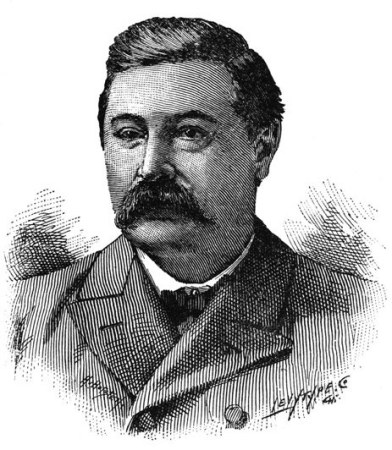
R. M. WING, ONE OF COUNSEL FOR DEFENSE.
He elaborated on the necessity of absolute proof of the cause of death, arguing that no one but a physician could definitely determine the cause of death, and unless it was shown beyond a doubt that the death of Dr. Cronin was caused as shown in the indictment, it was the duty of the jury to find the prisoners innocent. One of the most vital points in the case, the cause of the death of Dr. Cronin, remained unproved, and until this was settled, and settled beyond a doubt, the charge could not hold good and the defendants could not be convicted. Judge Wing dissected the evidence of the medical experts at length, ridiculing them mercilessly, casting doubt upon the theory of the State, that the blood found in the Carlson cottage was that of a human being. He concluded his address in these words:
"Gentlemen, I have tried to discuss this case fairly and conscientiously. We are about to part, and I beg you, in conclusion, not to go off upon any prejudice, or upon any passion or upon any suspicion. I beg of you to give these men a fair show. I believe you will do that. I beg of you to remember that a certain conclusion can only be reached after you have traveled on sure and certain ground. Do what you think is right under the law, gentlemen, and I do not doubt you will."
Counselor Ingham's Speech.
Mr. Geo. W. Ingham, in behalf of the State, followed Mr. Donahoe with a forcible review of the evidence, and which was listened to with intense interest by every one within reach of his voice. He prefaced his remarks by saying that the sanctity of human life in America was in the keeping of the juries of America. The law provided that a man guilty of murder should be punished, but it provided no method for its own enforcement, save that which was invested in twelve men. To that number of men it was entrusted. The jury came from the body of the county, and so it was that peace and good order of every community was in the keeping of its own citizens. In every criminal case the jury held in one hand the rights of the prisoners, and, to a certain extent, it held in the other hand the good name and the peace of the community in which it lived. This was a responsibility already great, but which increased in direct proportion to the enormity of the offense under consideration. Yet no responsibility could be greater than that of the twelve men before him. Only a few months before, Patrick Henry Cronin, a citizen of the State of Illinois, a resident of the great metropolis, living in fancied security and within the very shadow of the court-house in which they were now sitting, was lured from his home upon a mission of murder. Fired by professional zeal, moved by the instincts of humanity which his choice of a profession indicated, he rushed to the assistance of a suffering man. Suspecting nothing, he went out, armed, as it were, with the very instruments of his skill and profession, and then rushed into the slaughter-house prepared for his reception and death.
Then, as if the white face of death itself was not sufficient to satiate human hatred, his body was subjected to the indignity and ignominy of burial in a filthy sewer. This man, to whom sacred burial in consecrated ground was a right to which he always looked forward, was thrown into a sewer. The crime was singular in its brutality, but its brutality was not its startling feature. Why was Dr. Cronin slain? Because he was condemned to die. Condemned for what? For no offense within the laws of the State of Illinois. Condemned and executed by whom? By a tribunal that was unlawfully constituted, a tribunal that was at the same time, accuser, witness, judge and executioner. It was a tribunal which within itself in the light of day, which existed upon a territory of the State to whom its members hold allegiance, a tribunal which was treasonable to the laws of the State, the juries were called upon to execute and to the laws of the State whose protection it had a right to claim. Who could have dreamed that such a thing was possible in the State of Illinois? Who could say that six months from that day he could not be repeated in the State of Illinois. Only the twelve men who were trying the case. That was their responsibility, for their oath in the case was to well and truly try and true deliverance make between the people of the State of Illinois and the defendants, to well and truly try them upon the law and upon the evidence.
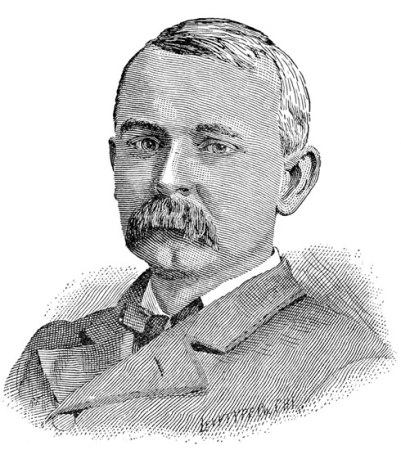
GEORGE C. INGHAM, ONE OF COUNSEL FOR PROSECUTION.
From this introduction, Mr. Ingham branched off into an elaborate dissertation of the law regarding murder and the power of circumstantial evidence. Numerous authorities on circumstantial evidence were cited from. Counsel dwelt upon Coughlin's hatred of Cronin, upon the purchase of the furniture and upon the peculiar actions of the defense. Stress was laid upon the fact, that no evidence had been produced with a view of showing that it was not Martin Burke that rented the Carlson cottage, and that he engaged the expressman to move the furniture from the Clark street flat to Lake View. The general outline of the plot as disclosed by the evidence was considered, and the conclusion drawn, that the right men were on trial. Continuing, Mr. Ingham said:
"Now, I want to call your attention to one fact, that not one attempt has been made at defense. The counsel for the defense have done the best they could. I know the counsel for the defense well. I know Forrest, and have known him for years, and have tried cases with and against him. I know he would go far and near and would remove heaven and earth, were it possible, to save his clients. I know that he believes thoroughly and heartily in the maxim of old Lord Brougham, that a lawyer should know but one man in the world, and that man his client. I have known Daniel Donahoe for years, and I know his ability. I have not known Judge Wing for so long a time, but from what I have seen of him and know of him I know him to be a skillful lawyer. His address to you, gentlemen of the jury, proves his ability, and I say to you unhesitatingly, that these men, after doing everything in their power to aid their clients, have utterly and signally failed. I ask you to remember that not one particle of evidence has been introduced by the defense either to dispose or disprove the evidence I have stated to you. Not one particle of evidence has been admitted to be proved and to be denied here, except the single statement that Burke was at the cottage on the night of the murder. There is evidence, however, which more than outweighs all the alibis they can bring here.
"The saloon-keeper came upon the stand here and plainly and clearly told you that on the night of the 4th of May, about half-past 10 o'clock, three men entered his saloon. He tells you he is positive one of them was Patrick O'Sullivan. He knows him, buys ice of him, and has no earthly reason to give evidence to injure him unless it was true. He says also that the other was a taller man, and in his opinion he believes that man was Coughlin; further, there was a little man who spoke with a German accent, and that man he says he is sure was Kunze. Now, you will remember he had only bought that saloon a few days before, and he can hardly be mistaken in the night, because he tells you he knows it was on the Saturday night, because on the night following, the Sunday night, he had an opening, and, like other Germans, he never had less than fifteen to twenty-five men at his bar. What object could he have in testifying against Patrick O'Sullivan, Coughlin and Kunze, and saying they were the men who drank wine and took cigars at his bar? Is he corroborated? Let us see. The saloon-keeper is admittedly as honest a man as there is in Chicago. No attempt has been made to impeach his evidence, and I ask you to consider whether or not he is corroborated. Let me draw your attention to the evidence given by the German gardener named Wardell. They left the saloon about 11 o'clock or a quarter after, the saloon-keeper says, and you will remember that Wardell says he left a saloon near by about twenty minutes after, and just at that time he happened to raise his eyes and saw in front of him two men, whom he describes, and believes to be O'Sullivan and Coughlin, and he saw them walk down to and enter the Carlson cottage. Where was the third man? Do you remember that about a half hour after that time, about half a mile south of the Carlson cottage, a wagon was seen with a trunk in it? The two men who went into the Carlson cottage went in there to help carry out the trunk containing Cronin's body and the clothes, while the third man went down and got the wagon that was to take the body and the clothes away.
"Now, how is that met? We are told that the saloon-keeper is mistaken, that this man never saw O'Sullivan and Coughlin and Kunze, but that on the Sunday night Patrick O'Sullivan went there to that very saloon with the two Hylands, and that they had two glasses of wine and a cigar each. Gentlemen, you will remember that the saloon-keeper, who is a German, distinctly said that the smaller man asked for beer and spoke with a German accent. The younger Hyland never spoke with a German accent in his life. Which do you propose to believe—Neiman, the saloon-keeper, who has no earthly interest whatever in giving false testimony against O'Sullivan or the friends of Patrick O'Sullivan? These two strangers who go to see him for the first time are compelled to stay and take dinner, and are then taken out to the saloon and each given two glasses of wine and a cigar at the expense of O'Sullivan. Remember, gentlemen, he had never seen these two Hylands before that Sunday afternoon. The truth is, that when they say those three men were in that saloon, the two Hylands and O'Sullivan, they admit unconsciously the fact that three men were there, as the saloon-keeper testified; they admit that O'Sullivan was there and the thing is narrowed down to a simple question of veracity between the saloon-keeper on the one hand and the Hylands on the other. There is much more reason, vastly more reason, I submit, why the evidence of the saloon-keeper, who knew O'Sullivan perfectly, should be believed in preference to that of the two Hylands, who are ready to swear anything to help their friend out of a scrape. Now, what else is disputed?
"An attempt is also made to dispute that portion of the evidence tending to show that O'Sullivan was at the Carlson cottage. How is it done? Again they resort to an alibi. As I said to you in the opening of this case, and I will now repeat, that if O'Sullivan was at home and in bed at the time the murder was committed, and you are satisfied from the evidence that he was engaged in that conspiracy, he is just as guilty as if he struck the fatal blow himself. Against the testimony of Neiman, who saw him there with Coughlin and Kunze in that saloon, and of Wardell, who saw him and Coughlin enter the Carlson cottage after they left the saloon, they produce the evidence of Mulcahey, a man who became connected with O'Sullivan under the most suspicious circumstances. That man testified that he came to Chicago a perfect stranger; that he went to O'Sullivan—went to his house on the 31st of April—was instantly taken in and kept and boarded there, slept in the same bed with O'Sullivan, rolled around the street in the ice wagon and slept with him on the night of the murder. He swears also that he was with O'Sullivan when old Carlson claimed to have heard the conversation between O'Sullivan and Burke; he swears also that he heard Coughlin and O'Sullivan arrange that O'Sullivan was to keep his eye upon Kunze and report if he saw him in Lake View. In short, gentlemen, he was a very convenient sort of witness. What was he doing there all the month? He was not working for O'Sullivan, yet he slept in the same bed with him—a perfect stranger, and, strange as it may appear, he only went into the employ of O'Sullivan a few days before the murder. I undertake to say, gentlemen, that his testimony is false, that O'Sullivan was not in bed, that on the contrary he and Burke and Coughlin were engaged in the murder at the Carlson cottage. Who is there that corroborates his testimony? The two women, a cousin of O'Sullivan's by marriage and his sister. Tom Whelan was too sound a sleeper to know whether O'Sullivan was in bed or was up or out, and they ask you to believe that sort of an alibi against the evidence you have on the part of the prosecution."
KUNZE'S PART IN THE MURDER.
"What is the evidence against Kunze? He was the friend, the tool of Coughlin. It is in evidence that he had been engaged with Dan Coughlin in working up the distillery case. How much of a detective he is I do not know, but I don't suppose he is a very great one. If I were to guess at it I should say he was a detective's stool pigeon.
"He had been engaged with Coughlin for months. Mertes swears that he saw him drive their horse with a white face up to the cottage the night of the murder, and you will remember that he picked him out from a number of men. Mertes is a countryman of Kunze's, and he would not be likely to testify against his own countryman unless truth compelled him to do so. He tells you that Kunze drove a horse and buggy up to that Carlson cottage at 8:30 o'clock on the night of the murder, and, more than that, it is in evidence that Kunze was perfectly at home in the rooms at 117 Clark street, and was seen by a very intelligent witness sitting in front of the window washing his feet. Now, what was he doing at 117 South Clark street, if he was not engaged in that conspiracy? The men who engaged that flat at 117 Clark street, those conspirators, were not going to trust their lives to men they did not know; and the truth is that he was the tool of Coughlin. More than that, it is in evidence that he said he expected to be arrested on the Cronin business. Why? Why? I repeat."
"Because I was told so," suddenly cried Kunze, springing to his feet.
"This man is defended by able lawyers," retorted Mr. Ingham, "and on their heads is the responsibility of his defense."
"God knows I am innocent of the murder of Dr. Cronin," cried Kunze, again springing to his feet, and there was a scene of excitement for a few minutes. Finally his counsel forced him to his seat, and induced him to remain quiet.
"Why did he say he expected to be arrested on the Cronin business? I repeat," continued Mr. Ingham. "It was because he felt he was connected with that business. Coughlin knew him, Coughlin had worked with him, and Coughlin knew that in this case their lives were safe in his hands. It is in evidence that shortly after the murder he was with Patrick O'Sullivan drinking, and you will remember a conversation which was detailed by a saloon-keeper, and which occurred shortly before the murder, wherein Patrick O'Sullivan made a bargain to sell to Kunze the bay horse with a white face. Why was that horse sold to Kunze, this little painter who was working around the country, this man who was in the employ of the detective and trusted by Coughlin? Will you, gentlemen of the jury, tell me why O'Sullivan, who lived at the rear of the Carlson cottage, and whose stable almost abutted on the cottage, was selling this poor painter a horse?"
WHOM THE EVIDENCE POINTS TO.
"I have gone over the salient features of the evidence, and I say unhesitatingly that there is evidence which points directly to Coughlin; it points directly to Patrick O'Sullivan, and it points directly to Burke, unerringly to those three as having a direct connection with the murder of Dr. Cronin. Are those isolated men, scattered over the city, having no bond of harmony? On the contrary, the evidence is that four of those men on trial were bound together by a bond. Judge Wing said the murder in this case was different from an ordinary case. He said truly. The motive was not robbery; it was not personal hate, but it was hatred, political hatred in its nature, growing out of a political conspiracy. That conspiracy originated in Camp 20, and it is in evidence that Beggs, Coughlin, O'Sullivan and Burke are members of that camp. There you have the start of it. In the course of circumstances, Sullivan made the contract which was to lure the doctor to destruction; Coughlin told the chief of police and told Thomas O'Connor that his enmity toward Cronin grew out of secret society matter and was of long standing. Simonds buys the furniture, Burke hires the house—the Carlson Cottage—and the full arrangements are made for the butchery of their victim. It is also in evidence that Coughlin wanted Sampson to slug the Doctor, and up to that time he had not got to the pitch when he wanted him killed, but you will see how it grew. The evidence shows he denounced him as a spy, and on the Monday morning after the murder, when he admitted his enmity to the Doctor, the Doctor's body was lying in the catch-basin.
"How about Patrick O'Sullivan? We find after the murder he goes to see Mrs. O'Farrer, and she says to him it is an awful murder. He replied 'Yes.' She then asked why did they kill him. Now, mark his reply. He says: 'They say he was a spy and gave away the secrets of the order to which he belonged, and if he did he should be killed.' Here you have the conspirators of Camp 20 at work.
"Where did the trouble begin? Recollect that O'Sullivan says to Mrs. O'Farrer when he was at her house that, 'They say Cronin gave away the secrets of the order to which he belonged.' It is in evidence in this case that the only secrets that Cronin ever gave away were about embezzlement of the money and the sending of their brethren to English prisons. You know also that it is in evidence in this case that the very first hostility toward Cronin was made apparent in Camp 20 of the Clan-na-Gael organization. There was constant turmoil and trouble in the Clan-na-Gael organization because of the embezzlements and the wrong doing of the triangle. It is in evidence also that Dr. Cronin charged at the trial of that triangle that they had embezzled over $100,000 of the funds of the organization besides sending patriotic Irishmen into British prisons. Whether that be true or false we have not been permitted to show. So far as this case is concerned it is immaterial whether true or false. You are an American jury; this is an American court; these defendants are here under indictment, and you are called upon to administer American law; and whether Dr. Cronin may have been a spy or an honest man and a patriot cuts no figure whatever in this case. One thing, however, I can say. When that sewer gave up its dead, it opened up the sunlight of heaven on these charges. 'Cronin was killed,' says O'Sullivan: 'he was killed because he gave away the secrets of his order,' and I repeat the only secrets he could have given away were the embezzlement of the funds and the imprisonment of their brothers. His mouth was closed and his charges were forever stopped by his death. That swollen and distorted body, those mute lips, prove the truth of his charges more clearly than any court or jury could possibly do, and if these charges were not true there would have been no motive for them to put him out of the way. Thomas O'Connor tells you he was present at a meeting of Camp 20 when a man, Foy, arose, and said they had better look out for spies, and there were other Le Carons among them. He says that he made a speech to that effect, I may not give you the exact details, and O'Connor said in reply that they had better look out for the men who were embezzling the funds of the organization and sending their brothers to English prisons. A storm arose. The records of that meeting show three things: They show, first, a resolution to the effect that hereafter no member should be initiated whose name had not been submitted to all the camps. They show, secondly, that a demand was proposed to be made on the executive for information in regard to the Buffalo trial, that is the trial of the triangle; and thirdly, that that was amended or changed so as to read that information should be asked from the district member.
"That record also shows the appointment, or passage of a resolution for the appointment of a secret committee of three by the senior guardian to investigate rumors afloat regarding the trial committee. What were they? O'Connor has told you that the charges were what he made, and he and others say that the camp where these charges were made was known as Dr. Cronin's camp. Denis O'Connor and others say they knew to whom Thomas O'Connor referred. To investigate the matter of these rumors then meant to investigate the men who put these rumors afloat. That man was killed, foully slain, and his body thrown into the sewer. Now Beggs wrote to the district member. Beggs asked the district member to investigate certain charges. The first resolution of the meeting required him to do that. The district member said he knew of no portion of the constitution which was violated by an act of that kind, and he knew of no section of the constitution which would enable him to inflict a penalty. That letter of Beggs' when you study it, means this: 'I do not want to do this, I would rather have nothing to do with it, but I have been compelled to notice it, and these old quarrels must stop.' And you will notice it is full of forebodings of dangers to come.
"Again, subsequently, you will remember that Beggs replied at a subsequent meeting that the committee—the secret committee which he had appointed—must report to him alone. Then the practical part of the business began with the appointment of that committee. It was Beggs' duty to appoint that committee. Beggs did appoint that committee. Beggs was an enemy of Cronin, as were the others. Beggs denounced him as did the others. Beggs said after his death, 'O, he will turn up; he is all right.' The others said the same thing. They covered his body with the filth of the sewer and his memory with the epithet of traitor. I said in an American court, before an American jury, it made no difference whether the charges which Coughlin made were true or false, it made no difference whether he was a traitor or a patriot, but the truth of history demands that the name of Cronin shall be vindicated, and it is vindicated more strongly than it could be by mortal lips when you remember that that vindication comes from the slime of the sewer on his body and the production of his clothes, also from another sewer. They murdered him because they feared his charges; they called him a spy in order to nerve their dupes to kill him, and they slew him. Gentlemen of the jury, I have now said all in this case that I intend to say. It is needless for me to say more, as I shall be followed by others of great ability. I simply ask you to do this. Your duty is unpleasant, and the duties you have already undergone have been onerous and burdensome.
"It is unpleasant for a man to sit on the trial of a fellow-man on a charge involving his life and liberty, but it is your business to do that in this case. As long as human nature is constituted in such a way as it is, law will be necessary to make some men walk straight. Crimes, murders, thefts and arsons can only be prevented by the enforcement of the law. The law, as I said, can only be enforced by the jury. On the call of Providence you are here now, and your duty is before you. Recollect, gentlemen, that while your duty is serious and burdensome, it is also of vast importance. Remember, gentlemen, that your duty is just as important and as necessary, and the necessity for courage and determination to carry out that duty is as great as it would be upon the battlefield or in any other walk of life. Deal with these men justly, execute the law, satisfy your own consciences, and the rest of us will be satisfied."
Counselor Donahoe Talks.
Mr. Ingham was followed by Mr. Donahoe, who spoke in behalf of O'Sullivan and Kunze. He prefaced his argument with the remark that there was no duty in the life of a lawyer that afforded him more pleasure than to defend the innocent; and that, therefore, he began to plead for the lives of his two clients with a heart as light as that of a newly-made bride, caressed with her husband's love. It was the apparent desire of the public prosecutor to disgrace every witness, who appeared to testify to any fact or circumstance, tending to show the innocence of the accused, but this course would never deter him from exercising the best ability that God had given him, in procuring for his clients every legal right known to the law and the country. He urged the jury to banish all prejudice, and to adopt reasonable judgment in considering the legal evidence of the case and the laws of the country, and urged that if they did so, his two clients would soon be breathing the free air of heaven. The counsel drew attention to the fact, that he had been especially assigned to the defense of Kunze by the Court, the prisoner having sworn that he did not have a dollar, and also said that until the opening of the present case he had had no connection with O'Sullivan or any of his friends. There was nothing to prove, the counsel went on to argue, that Kunze was in any way connected with the crime. The young man who claimed to have seen him wash his feet at the window of the Clark street flat, as well as the saloon-keeper, whose place he was alleged to have visited on the night of May the 4th, might easily have been mistaken. It was, in brief, a case of mistaken identity. Mr. Donahoe argued at length, with a view of showing that the testimony regarding the identification was at all times questionable, and should be received with a great degree of caution, and quoted numerous authorities to illustrate the fact that his theory was correct. Proof of criminal intent, he said, was absolutely necessary, and that that was proof absolutely lacking. Mr. Donahoe concluded his speech in these words:
"Gentlemen, I am about to say the last words for my clients. Their welfare is in your hands. I am satisfied that if you banish from your mind everything but the law and the evidence, in this case, you will unlock the prison door and let them go about their business, earning their bread by the sweat of their brows. Something was said in this case, some discussion in your presence about Alexander Sullivan. There is no proof that my clients know Alexander Sullivan. If there should exist in your minds, or if there has been injected into your minds, prejudice against that man, for God's sake don't use that against my clients, two young men whom the evidence in this case proves to be innocent. Yet the law does not say that they require to show their innocence; the law requires that the prosecution shall show their guilt. I have at heart the welfare of Kunze, although he never gave me a dollar, as much as I have the welfare of my client, O'Sullivan, who has retained me in this case. Banish all prejudice and suspicion from your minds; apply your reason and judgment and consciences to the law and the evidence in this case, and I am sure, then, that these young men will be acquitted, as they ought to be. Remember that in your hands rests the lives of these men. Remember that one day you will be called upon to give an account for every act and deed done in this life. Let nothing that you shall do in this case against my clients be such as shall be charged against you when you appear before that tribunal of the Most High, and when you are asked 'How have you dealt with your fellow-men?' don't have to say that when dealing with your fellows you had bloody hearts. Merciful! The more merciful a man is, the more godlike he is! But, gentlemen of the jury, do not misunderstand me. Do not think that I am asking for mercy for my clients. Oh, no; not at all; not at all. I ask that you carefully weigh this evidence, consider the law, be governed by the legal evidence and the law, and that is all that I ask you to do. I believe that if you banish everything from your minds but the law and the evidence in this case, that the God that gave you a head to think and a heart to feel for your fellow-men, the God that gave you an existence, will never permit you to strangle my clients. Oh, no, unless you are ready to guess them into eternity, you can't convict them on this proof. I tried this case fairly. I have treated every witness fairly, I have been respectful to the Court, and I have been respectful to you. These two young men's welfare, their lives, are confided to your hands. For God's sake, for their sake, for your sake, make no mistake. Gentlemen, I thank you."
Hynes' Great Effort.
The announcement that Mr. W. J. Hynes would commence his argument at the opening of court, upon the day following the conclusion of Mr. Donahoe's address, had the effect of attracting an immense throng to the Temple of Justice. Hundreds were admitted, while thousands were unable to gain entrance to the court-room. Judge McConnell took his seat on the bench at ten o'clock, and Mr. Hynes immediately commenced his address. He said that in what he had to say he would endeavor to be fair. He knew the importance of the great proceeding of the character under consideration. He knew that, no matter how guilty men might be, under the civilization of a century, punishment was to be visited only under due process of law. For three months or more the public time had been occupied in hearing the accusations, trying the accused, considering the evidence, listening to the arguments, through that protection of the law for which lives have been sacrificed and rivers of blood have been spilled, to secure to those charged with crime the protection of the law. That protection of the law had been thrown around the men on trial to see that they should have a fair hearing, and that the jury should render a fair verdict. All evidence that was not competent had been excluded, and, wherever a question of doubt had arisen, His Honor, the judge, exercising his natural instincts of mercy, had solved that doubt for the benefit of the accused. Hearsay evidence had been excluded; the defendants had been confronted by the witnesses who testified against them, and all these forms of law, of civilization and justice had been extended in the trial of men accused of charging a man behind his back, of killing him behind his back, of killing him first and accusing him afterward. Even such men as these, however, were entitled to all the protection of courts of law, and to all the safeguards which the law threw around them, because no human life could be taken, no human liberty or freedom could be abridged by a day or an hour, until the court of justice, the accusation against the accused had been judicially ascertained and determined by twelve fair-minded men beyond a reasonable doubt.
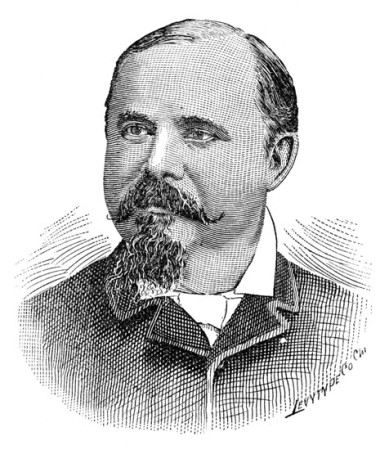
W. J. HYNES. ONE OF COUNSEL FOR PROSECUTION.
With this introduction, the learned counsel proceeded to review the case from the day of the disappearance of Dr. Cronin. He declared that the dispatches received at Chicago, from Canada, shortly after the disappearance of the physician, and to the effect that he was alive and in the flesh in the dominion, demonstrated beyond a doubt that the defense was organized before the crime was committed. It demonstrated, moreover, the existence of a wide-spread conspiracy, the conspiracy of intelligence and brains, as well as of experience in handling the telegraph and the press. John F. Beggs had said that Cronin was not dead and would turn up all right, and if the scheme of disposing of Dr. Cronin's body on the night of May 4th had not been frought with some misadventure, some miscarriage of judgment, the public, not understanding the motive which underlied the occasion, would probably have believed that what Beggs said was correct. If all the marks of the crime had been obliterated, if the body had not been found, if it had been disposed of, the murderers, and those behind the murderers would have continued to charge that Dr. Patrick H. Cronin was a British spy, and that his disappearance was to be accounted for upon the hypothesis that he had gone to England to testify against Parnell. This would have been the claim. It was to confirm the impression made upon the minds of some of the "dupes" of the triangle, that the disappearance, as well as all traces of the crime were to be wiped out, so that the story would be accepted that Cronin was a spy, and a traitor to the cause to which he had always allied himself and which he had sworn to defend, and that he had violated his oath and crossed the broad Atlantic in order to testify against his own country and in behalf of England.
The speaker proceeded to dissect the evidence at length. He paid particular attention to the testimony of the medical witnesses for the State, urging that it was entitled to full credence, and that the prosecution received all the aid of science that was possible. Continuing, Mr. Hynes said:
THE DEFENSE OF THE PRISONERS.
"Now what sort of a defense—because I propose to deal with that first—what kind of a defense is made by these five prisoners? A defense that is not a defense is worse than no defense at all. A defense that utterly fails, as this defense in my judgment has utterly failed, leaves the case of the prisoners stronger against them than it was when the State rested. You expect some defense when an accusation of this kind is brought against men. You are looking for explanations. You are hoping, like merciful men, that every circumstance and every word will find an explanation consistent with innocence, and when the defense fails to meet the accusation and to furnish an explanation, then it is disastrous to the defendants. The only defense that is set up here is the common defense that is set up for the commonest criminal—the favorite defense of an alibi. I am not here to abuse all the witnesses that appeared to prove alibis for these defendants. I remember that on the evening of the 4th of May Mrs. Whalen and Miss McCormick say they went out of the house and were out until after 10 o'clock. I do know that Miss McCormick said they went out about the time the boys were getting ready to go away to the saloon. These boys that went to the saloon fix the hour of supper all the way from 7 to half-past 8 o'clock, fluctuating between 7 and half-past 8 o'clock; that is the value of an alibi. In fixing the time, the human mind does not go back, unless there is something special about it—unless there is something at the time of the act to associate the time with the act. That makes them a part of each other and relating to each other at the time of the act; not by mere recollection afterward.
"All these witnesses testify that Patrick O'Sullivan got home on the evening of the 4th of May between half-past 5 and 6 o'clock. We had the statement of Mr. O'Sullivan himself, made to Captain Schaack—and he ought to know better than they—that he got home at half-past 7 o'clock, a difference of an hour and a half or nearly two hours in Patrick O'Sullivan's own statement when he talked with Captain Schaack. He said he arrived home at half-past 7, and that he was not out of his house that evening after he got home. They all say he got home about half-past 5 or 6 o'clock—every witness here. Who knows best, and what is the value of recollection as to the hour when the thing occurred? They all, with the exception of Mulcahey, swear that he was not out of his house after that time—after supper; that he sat down for a time in the house and then went to bed with Mulcahey. He, himself, feeling that he had been seen out of the house that night, at least back in the alley near the Carlson cottage, sent for Captain Schaack while he was still a prisoner in the jail, and said he wanted to make a correction of his former statement. He was out of the house that night, he said, but only out to the alley in the rear of his barn."
"That is not the testimony," said Mr. Donahoe.
"That is the testimony," insisted Mr. Hynes, "and I will refer to it."
"No," rejoined Mr. Donahoe, "he said he went to the rear of the barn. I have got the testimony here."
O'SULLIVAN'S CONTRADICTORY STATEMENTS.
"I have got the testimony, too," said Mr. Hynes, "and I will read it. He said he went to the rear of the shed in the alley. Let me call your attention also to the fact that Mulcahey, his room-mate, does admit that he was out of the house that night about 8 o'clock or half-past 8—out in the yard. Mulcahey fixes the supper at about half-past 7 o'clock; so that he has him out in the yard about 8 or half-past 8 that night, and not another soul in the house knew he was out of the house. All of them swore that he did not leave the house. Do I say that they perjured themselves? No; not all of them."
"Do I understand you to say," interrupted Mr. Donahoe, "that Mulcahey swore he was out of the house?"
"Mulcahey swears," replied Mr. Hynes, "that he was out at 8 or half-past 8 in the yard."
"He did not swear to it in this court," said Mr. Donahoe.
"He swore to it in this court," retorted Mr. Hynes, "and I will read you his testimony. It is perfectly proper, gentlemen," continued Mr. Hynes, addressing the jury, "for Mr. Donahoe to challenge my statements. I invite him to do it—first, to correct myself if I am in error, and, secondly, to show that I am right if I make a statement of that kind. Here is Captain Schaack's statement. Captain Schaack says: 'There is one thing I forgot; in conversation with O'Sullivan I asked him where he was on the 4th of May. He said he was on the ice wagon all day. I asked him what time he came home in the evening, and he said 7 or 7:30. He had his supper and went to bed about 8 or 8:30, and about 9:30 some men came home, and he got up and let them in and went to bed again. I asked him if he was positive that he was not away from his house, and he said he was positive he was not; that he was in the house all the evening. After he was in the jail he sent for me and I came down to see him in the jail. He told me he had forgot to tell me he was out of the house that night in the rear of the shed.'"
Here Mr. Donahoe objected, saying that nothing was said about O'Sullivan's being in the alley. Mr. Hynes said that if he was beyond the shed he was of necessity in the alley. A short dispute followed, in which some testimony was read, which was finally won by Mr. Hynes, who then continued:
"There is no more point about his being on one side of the shed than on the other; the point lies in the value of the alibi. They put young Knight on the stand and there is nothing that better illustrates the value of an alibi than his testimony. They put on Menahan and they both swore that the two Hylands came there on Sunday afternoon about 5 o'clock. Knight swears that O'Sullivan was in the house from a point of time between 4 and 5 o'clock on the afternoon of Sunday, May 5, and that when the Hylands came in he shook hands with them, and he was not out of the house from that time until he went out at 10 o'clock that night, when it is conceded that O'Sullivan was down at Mrs. Conklin's at that time, and did not get home until half-past 7 or 8. And yet they could put Knight on the stand—honestly swearing, because there was no proof that he was swearing falsely—honestly swearing and insisting, under Judge Longenecker's cross-examination, that O'Sullivan was not out of the house from 4 or 5 o'clock until 10 o'clock that Sunday night. But everybody knows he was out. He was with Detective Murray down at Mrs. Conklin's. Everybody concedes that he did not get home until half-past 7 or 8 o'clock.