MAJOR SAMPSON'S PART IN THE SCHEME. (continued 3)
Reading edition
NO PROOF OF THE CAUSE OF DEATH.
"We have in evidence that the brain was disintegrated. 'I do not find,' said the doctor, 'any indication of brain disease, because the brain was too far disintegrated.' He did find concussion and contusion of the brain, yet there was no evidence of that. If the brain was so far disintegrated that they could not tell one thing, how could they tell the other? Of course he could not tell whether he died of brain disease, yet he could, although there was no evidence, swear that the man died of concussion of the brain. I asked him whether he could discover brain diseases by the naked eye, and he said no, that it would require microscopical examination, and yet he did not make the examination required. Dr. Andrews says you can not possibly tell the cause of death from that post-mortem examination, and that is the position that all the other doctors occupy in the case. I say to you, therefore, that the indictment should have read for causing his death in an unknown way, and then men would not have had to strain their consciences and could have answered the question intelligently. Are we not to have conscience in this matter at all? The law should be executed in this country as it is in England. There is no place in the world where there is so much respect for law as there is there, and there is no place in the world where they so uniformly execute the strict letter of the law, no matter what the consequence may be. The witnesses therefore have disposed of both the internal and external evidences, and the doctors have told you they can not possibly tell you what the cause of death was. Now, if the doctors say they can not, can you? But, says the State's Attorney, you have got to sustain my theory. Now, I ask you gentlemen, as twelve law-abiding men, twelve men who look me straight in the face—you twelve men told me you would try my client according to the law and the evidence—if the Court tells you the cause of death must be proved beyond reasonable doubt, I ask you how on your consciences you can find these prisoners guilty, and even without the testimony of Drs. Andrews and Moyer? The God's truth is that no man can tell the cause of death. No man can tell how he was killed, whether the wounds caused death or whether he died from contusion or concussion of the brain. There is nothing in the evidence about blood letting, and there is nothing about concussion or contusion of the brain, and I ask you to keep to your contracts with the law and with your God, and to follow it, no matter where it leads you. You and I would risk our lives for the defense of Illinois if she were in peril. We are not cowards; we fear neither the hooting of crowds nor bullets while we are doing our duty. You care nothing for the mob, nor do I, and Illinois now says to you, do your duty on your conscience. I demand it of you and you can not give me less. Now, everything that was put in the notes was put in the hypothetical question which we submitted to our medical men, and Drs. Moyer, Andrews and Curtis tell you distinctly that it is impossible, from the description of the wounds and the notes taken at the post-mortem, to tell what the man died of. They corroborate the other witnesses that the cause of death was uncertain. How much evidence do you want? There is not only a reasonable doubt, but we have proved beyond possibility of doubt that you can not tell the cause of death. Now, gentlemen, your duties are important, and you will be required to carry them out.
"You will remember that early in the case the State's Attorney said dates are important, and they are of vital importance. Dr. Moore closed the evidence as to the cause of death on October 26th, and he and the other physicians all swear that you can not tell whether the wounds were ante or post mortem. Now what do they do? Instead of going to Dr. Fenger or other prominent medical men and asking their opinion, what do they do? They know that if they ask the opinion of eminent medical men they might be told that the boys had made a mistake, and, therefore, they say we represent the people of the State of Illinois; we represent the right wing of the Clan-na-Gael and we will show you a trick. You remember that on October 31st they discovered this witness, Mrs. Hoertel, who testified that the wounds were committed before death. They could not get any one to swear that the doctors were right, but they had got their theory that it took place in the Carlson cottage; they have got their men from Millbank prison, they have the Clan-na-Gael back of them and they say 'We will show you something.' Now, you see why we proved that we did not get that name of Mrs. Hoertel before the 31st of October. Mr. Clan-na-Gael, you may be cunning, but you are tracked into your den at last. I told you to look out for the Clan-na-Gael. Don't you see how important it was? I can not tell you whether those wounds were inflicted before or after death; the doctors can not tell you. The State well knows that it can not get any such evidence from any doctors, and therefore they say we will show you that he was murdered. On October 26th they sent out their German spies, or I will apologize for that and say detectives. Schuettler goes out, and Hoefig goes out, and a lot of others, and they look into the highways, byways and hedges of the city, and finally they find a woman who can swear that she saw the Doctor enter the cottage, heard the blows inflicted, heard him cry, 'Oh, God,' 'Oh, Jesus,' and then heard the dying moans. I believe you can talk about this murder being awful, you can say that we did not denounce the Doctor's murder, but that has been done sufficiently all over the world, and the whole world has fixed the responsibility for it on the head of my client, but I will tell you right here in your court-house, in the name of the law and justice, they would commit a legal murder to sustain a theory and a blunder. The whole thing was made necessary by the original blunder. Dates are of importance.
"Now, gentlemen, that is all I have got to say about the cause of death. Did I not tell you that those witnesses were remarkable witnesses? They turned up just at a good time, and the State's Attorney calls it providence. It seems to me that some men can appeal to God by day and rely upon the devil by night as easily and as unceremoniously as Mansfield can act the double part in 'Dr. Jekyll and Mr. Hyde.'"
"Let us talk common sense. You and I are citizens of Illinois. We are responsible for the good name and honor of Illinois or her shame. We know our families are here, and we are ready to stand up for her and give our lives for her if necessary. We intend to uphold the law, but you can not uphold the law by any such testimony as has been introduced in this case. You laugh at my catch-basin, some of you; I did not know what they wished these catch-basins might be, and you don't know. They never examined into that, and yet it is highly probable that from the condition that body was in, from its position, with the head being down and the feet up, and from the evidence of the men who told you that when they attempted to pull the body up it slipped back, it is physically possible that those very wounds on the scalp might have been made while pulling the body out. If there had been a tin oyster can or anything like that at the bottom of the catch-basin when the body slipped back, it would have made just such wounds, and in that case, or even if they were made by the bricks and hard mortar, the skull would not have been scratched, and the skull was not scratched."
Mr. Forrest then undertook to trace the course of the wagon from the cottage to where the trunk was found, and said the men must have gone over ten miles instead of going about two and a half miles, in order that the wagon must be brought to the Carlson cottage. Unless that could have been established in some way, one link in the chain of evidence would be gone. The State said they wanted to get on paved streets, yet as a matter of fact they went on unpaved streets. After spending some considerable time in going over the route alleged to have been taken by the wagon with the trunk, Mr. Forrest had the trunk brought in and proceeded to point out to the jury the defects in regard to the State's evidence in regard to that trunk. He alleged that all the blood stains could be made with a half a pint of blood judiciously distributed; that the marks on the lock showed that it had been pried off from the outside, and urged upon the jury that it would have been impossible for the three men to have kicked open the trunk from the rear in order to dump the body into the catch-basin without bending the hasp in front. The key, he insisted, was found by a trunk-maker, and that the whole thing was a fabrication by men who had been employed to get up a plausible story.
THINKS THE EVIDENCE WAS MANUFACTURED.
"And bear in mind, gentleman, that the men who had control of the lock, the Lake View men, were in the house—were in the Carlson cottage before Lorch. Schuettler enters the house, examines it and leaves it; Wing enters there, 'examines' it and leaves it, and then they send Lorch there, and they tell him to look about the cottage. Gentlemen, mark you, they tell him to look, and there right in the middle of the cottage, under some kind of furniture, they find a key. Now he tries to correct himself; he sees it is a most important matter; he tries to correct himself as to dates. Now then, gentlemen, there was a pot of paint in the house, and the paint is daubed on two or three inches thick. There is the paint; a whole pot of it right in the house. The pot of paint in the house of course accounts for the daubing on the floor; that is why it was put there.
"Then we have the trunk question; the key must be lost in order to account for the breaking open of the trunk. But, gentlemen, that trunk might easily have been broken open by simply throwing it down on the sidewalk, without any force at all, and it would have broken open of itself without being kicked open at all. But, gentlemen, for finding the key which fits the lock on the trunk, that, gentlemen, may account for the fact that the top of the trunk was broken off. Mr. Foster alluded to the confused way in which Officer Lorch fixes his dates as to the finding of the key, and to the fact that while Lorch could tell what he was doing on half a dozen days on both sides of May 25th, he could not tell what he was doing on May 25th. Now, as regards the paint upon this key. Just take a look at it, examine both sides of it, and you will see from the even edges of the paint that it was held by one end and the other dipped in. This side is rubbed off a little, you see, but it is evident it was dipped in. Dipped in, gentlemen. Well, did the police do it? I don't know, you don't know. But there is one circumstance that can not fail to strike you forcibly, namely, that the lid was evidently broken off from behind while the hasp and lock remain intact. This is evidence which in itself contradicts the theory of the State that the top of the trunk was torn off in order to get the body out of it. Gentlemen, this is an attempt to counterfeit the truth, but it is hard to counterfeit truth. God Almighty has so made it that it is hard to counterfeit it. You can not sink the truth. You can not cover it up. It is like a buoy in the water. It may be sunk under the surf ace for a short time, but when you come to stir the water by cross-examination, it will surely come to the surface again. It is hard to counterfeit the truth."
PERHAPS THE POLICE KILLED CRONIN.
"If Dr. Cronin was killed in there, in that cottage, and his body placed in the trunk, and if his murderers afterward painted that floor, they must have found that key there. They must have known that the key was lost; they must have been desirous of finding it, and if they had painted that floor, and the key was lying there, they must have found it. They would have looked pretty carefully for it and yet, lo and behold! there, right in the middle of the floor, it is found by Officer Lorch. But remember Schuettler had been there, Wing had been there, the whole Carlson family had been there, from the 21st to the 24th of May, three whole days before Lorch found it. Do you think that the Carlson family went around there and never touched any thing? I don't know; I hardly think you do. Now, right in the middle of the floor, under a washstand or some other piece of furniture, the key was found, and of all the men in the world to find it who should it be but an officer who had been a trunkmaker who found it. Lorch, whose business is trunkmaking, was the man who found it. He had worked in a trunk factory, and when he found the key, as he says, he worked for some time in order to get it to fit. Of course a carpenter might have found it, a molder might have found it, a stone mason might have found it; but of all the suspicious circumstances in the world, the most suspicious in connection with the finding of this key was the fact that it was found by a trunkmaker."
DID NOT TRACE THE WAGON.
Mr. Forrest alluded to the fact that nobody from the State had attempted to trace the wagon from the cottage, and insinuated that the reason that they had left this phase of the case alone was because the route of the wagon described by the witnesses for the State did not correspond with any rational idea of what the route would be of persons driving from the cottage to the place where the body was finally disposed of. Mr. Forrest alluded to the testimony of the expressman Mortensen, and referred sneeringly to his remarkable memory by which he was enabled to remember every article of furniture he hauled to the Carlson cottage from the Clark street flat, although there was nothing in the particular incident to distinguish it from others of its kind. Mortensen had been in the custody of the police, ever since the coroner's inquest, until he took the witness stand. He did not identify the trunk as the one he hauled, but said it was one just like it. He pretended to identify the other articles of furniture. It was plain he was drilled on this point, and, great God! if they drilled the witnesses on minor points, how did they know but they drilled them on more important things! He drew attention to the fact that neither of the Carlsons had said a word about seeing a trunk in the Carlson cottage at the coroner's inquest, but this was before the Clan-na-Gael had taken charge of this case, for when the trial came on, old Carlson was ready to swear that he had gone out expressly one night in April or March to see the trunk, and he peeped in through the window for that purpose, and then he sees the trunk and nothing else. This testimony came just before the mimic from Millbank prison came upon the stand and gave an exhibition of his powers of mimicry in a case in which a man was on trial for his life. "Well, did the judge in the English court say you were a dangerous man?" Mr. Clancy was asked, and he says, "Oh, yes, but it was only because I was a Fenian. That's all; and they tried to arrest me for being a Fenian, and I drew out my revolver and I deliberately tried to murder them (two policemen)." "That's nothing, gentlemen of the jury; this makes him a hero; this is one of the patriots who have been betrayed and sent behind British prison bars; this man who tried to murder two English policemen in the execution of their duty is one of the patriots of Irish patriots. So says your public prosecutor. Well, but the judge said he was a dangerous man, and he served out his fourteen years in Millbank prison. And now he comes here, having become a great mimic, a wonderful actor, and coolly and deliberately tries to mimic the life of poor Pat O'Sullivan away."
At this point, on the suggestion of Mr. Forrest, a recess was taken.
Before the jury retired, Juror Culver expressed a desire to take the map of Lake View introduced in evidence along with him. Mr. Forrest said he could have it, but Bailiff Santa interfered and said it could not be done without the sanction of the Court. Mr. Forrest turned to the judge and said as neither the State nor the defense had any objection to the jury having the map he thought it might be allowed. Judge McConnell said the jury could have the map but not at this particular time.
Mr. Forrest resumed his argument on the following day, Tuesday, speaking for five hours. He dwelt at length on the dry subject of blood corpuscles, and insisted that Drs. Belfield, Tolman and Haines had been mistaken in their testimony. The failure of the State to put in evidence the letter sent to the Carlsons from Hammond, Ind., informing them that the cottage was no longer needed by the murderous tenants, was due, so counsel argued, to the fact that it was afraid the defense would prove it was not in Martin Burke's handwriting. He argued at length, with the apparent purpose of convincing the jury, that it was a huge conspiracy planned to strangle his clients; that the witnesses for the State were hired perjurers, and that the lawyers were the tools of a body of men who were seeking to control an organization for political purposes, and concluded his third day's talk by telling with dramatic effect a story about the fate of a pleasure-seeker who innocently, in exploring the base of a huge cliff in Scotland, ran upon the cave of a band of smugglers. The man peered into the cave. The smugglers detected him, and believing he was a spy captured him and sentenced him to death. They tumbled him over the brow of the cliff, and his body was dashed to pieces on the jagged rocks below. A rope was used in the execution, and on this fact the lawyer laid especial stress, but just as he was rounding up his brightest and most luminous period, Judge Longenecker brought him to a dead halt by asking, in a matter-of-fact tone, what the authorities did to the man who cut the rope.
The appeal for the prisoners was closed on the following day (Wednesday, Dec. 11th,) when Mr. Forrest again spoke for five hours. He went over, in detail, the evidence relating to Dinan's horse, ridiculing the testimony of Mrs. Conklin and dwelling on the conversation between Coughlin and Dinan, to show that the former had given the correct version of it, and that therefore there was a presumption in favor of his innocence. There was no evidence that Coughlin had any motive for desiring Cronin's death, and the main testimony against him was that of thieves and keepers of disreputable resorts; nor was there any proof that Burke was connected with the crime. Concluding the most lengthy speech of the trial, Mr. Forrest said:
FORREST'S PERORATION.
"Now, Gentlemen of the Jury," continued Mr. Forrest, "I want you to find Daniel Coughlin and Martin Burke not guilty. Why? Because there is not established in this case a conspiracy in which it is alleged these men participated. In other words, to save my strength and not to exhaust your patience, there is nothing proved in this case beyond reasonable doubt that will connect them or either of them with the killing of Dr. Cronin. It is not necessary for me to repeat that. Now, then, I ask you to acquit them and when I ask you to acquit them, I ask you simply to do your duty—nothing more. Nothing has been left undone against them that could have been done. The State has had several able lawyers, and they have insulted every witness called for the defense. Every man called for the defense has been called a murderer or a sympathizer with murder. Everything has been done to insult and break down witnesses for the defense. Everything that intimidation in the court-room and out of it could do has been done in behalf of the State; everything that insinuation could do, has been done on the part of the State. The Court has given them the widest range of cross-examination, so there can't be any fault found in that respect. All the evidence which they offered was admitted by the court. We have the State's Attorney's forces, and the entire police force of Chicago. They have talked about the police force betraying them. I saw no evidence of it. Everything that one wing of the Clan-na-Gael could do has been done. In addition to the State's Attorney, they have had other distinguished orators—two of the greatest criminal lawyers of modern times, Luther Laflin Mills and George Ingham, whose business, like mine, is the pleading of criminal law; Mr. Hynes, a great lawyer, a great cross-examiner, one of the most brilliant orators of the Chicago bar, a man whom one of the largest corporations in Chicago relies upon to wring verdicts from juries in most desperate cases. He, too, has done all that he could on behalf of the State. Everything that could be done has been done to prove this charge, so that, gentlemen of the jury, you can say to your neighbors, you can say to your social worlds, you can say to your own consciences that no fault is to be found with the State; everything has been done that could be done, but there was a reasonable doubt as to the guilt of those men, and I found them not guilty for that reason. Remember, the State's Attorney has solemnly told you that the world has confidence in you, that he has confidence in you, that the Judge has confidence in you, and that whatever verdict you render will satisfy him, will satisfy the community, will satisfy the world, because the community has implicit and unlimited confidence in your honor and intelligence. This, gentlemen, I say on behalf of Martin Burke and Daniel Coughlin, in confiding their cases to your hands. No peroration have I, but simply one word will I give. The word I give is 'duty'—duty to Illinois, duty to your God, duty to yourselves. 'To thine own self be true, and it must follow as the day the night thou canst not then be false to any man.'"
Longenecker's Closing.
"If the Court please and Gentlemen of the Jury, I regret to announce that Mr. Mills is sick and not able to close this case. While I know you, gentlemen of the jury, are disappointed, while I am profoundly disappointed, yet no one is more disappointed than Mr. Mills himself. No one regrets it any more than the gentleman who was to address you himself. I left him yesterday evening at 7 o'clock, and it was determined there and then by his physician that it would not be safe for him to attempt to close this case.
"When I was struggling along here in the city of Chicago years ago, trying to earn an honest living in my profession, Mr. Mills called me into his office and said: 'Longenecker, I would like to have you as one of my assistants in the State's Attorney's office.' I said: 'Very well, I will be very glad to come into your office.' And when this case arose, and I felt the great responsibility that rested upon me as State's Attorney, I thought I would be doing the people a good service in requesting Mr. Mills to close the argument in this case. And at my earnest solicitation he agreed to do so. But it has been willed otherwise, and he is not here to address you.
"Now, I promise you, gentlemen, that I shall not talk to you long. I make that promise to you now. I know how tired you are, having been locked up so long away from your families, and it would be unreasonable, even if I could, to attempt to make a long speech in reference to this case. And if I do not cover all the points made in the case, if I do not go into details, I think you will all give me indulgence, for I do not want to impose upon your good nature and upon you as jurors any longer.
"We are not in this case for the first time after the opening with the theory of the defense. In most all murder cases, in most all important trials, when the State, or the people represented by the State's Attorney, gives an outline of the prosecution's side, the defendants' attorney arises and gives to the jury their defense. If not at the opening, then after the evidence is closed for the prosecution; then they arise and tell us how they are going to meet this evidence. That was not done. So that it remained until the last. When counsel for the defendants arose to address you in a three days' argument, for the first time, you, as jurymen, and we, as representatives of the people, were notified of the theory of the defense; that is, that there was a great conspiracy on the part of the people; that there was a conspiracy to hang innocent men; a conspiracy to murder under the guise of the law, and the gentleman was so earnest in that statement that he carried it all through his argument to the jury. He argued that proposition with the same force that he did anything else that he talked about in the case. Now gentlemen, if that is your notion of this case, if you believe there is a conspiracy to murder Martin Burke, and those other men on trial, then you ought to acquit, and you ought to recommend to His Honor that the counsel representing the people of this great State should be indicted and tried for murder. If I, as a representative of the people, am guilty of coaching evidence against Martin Burke and those other men on trial, I ought not to have a trial, but ought to be taken by the citizens of your State and hanged without court or jury. Do you believe, gentlemen, that there is a conspiracy here to convict innocent men? Do you believe that these men sitting by my side have crowded me out of my office and concocted a conspiracy against innocent men, and called in a jury of twelve men to assist them? You do not believe that they are guilty of it. If they were guilty of if, do you suppose that they could do it without my knowing it? If they did it without my knowing it or finding it out, then I am unworthy of the position, and should be prosecuted for criminal negligence and convicted. Why, the gentleman tells you that it is done by the other branch of the Clan-na-Gaels, and they are backing the prosecution; that as soon as it gets out of the hands of the Coroner they bring up witness after witness to swear falsehoods before you, and he states it in that way.
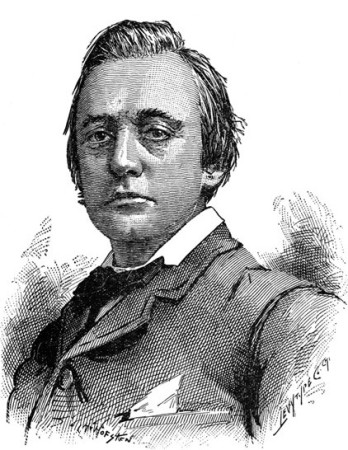
LUTHER LAFLIN MILLS, ONE OF COUNSEL FOR PROSECUTION.
"Every Clan-na-Gael witness that we have called to the stand belonged to the triangle, part of the Clan-na-Gael organization, Camp 96, from which Dr. Cronin left (I put it in that way). The learned counsel for an hour talked about his organizing an opposition camp, calling it 96, the same as old 96; Columbus Club instead of Columbia Club. The whole of that camp stood by the triangle; the very men who came here to testify from the camp were in sympathy with the triangle and believed that they were right until within the last year or so. We go right into their own camp, among their own friends, and we get the truth from men who believed that Dr. Cronin was not right in making the charges against the triangle, and yet it was fully believed that it was the other faction. It is true that P. McGarry did belong to an opposing camp, but Thomas O'Connor, John F. O'Connor, Henry Owen O'Connor, John Collins—the whole of them, were members of Camp 20, that we produced here as witnesses. Are they in a conspiracy with the other associates, the members of the same camp as John F. Beggs, Daniel Coughlin and Martin Burke? Why, they come as brothers from the same camp so that won't do to charge it in that way. Now, gentlemen, the only reason of that is to show you how far men will go in trying to mislead a jury.
"Do you believe that I could have it in my heart to put a witness on the stand that I did not believe, to swear the life away of these men. If you do, recommend to His Honor that I be prosecuted for the crime. Gentlemen, I would rather have my arms torn from my body than to be guilty of such a crime as that.'
Mr. Forrest—"We believe that."
Judge Longenecker—"Yes, you must believe it. And yet one of your lawyers wants you to believe that I was so ignorant, that I was so unworthy of my position, that I was so incompetent as to sit here like a mummy and let these men conspire to have a jury hang innocent men.
"Gentlemen, you don't believe that. You don't believe that that great big-hearted Irishman sitting there (Mr. Hynes), whose heart has always gone out for poor humanity, would be guilty of it. Mr. Foster says that he has known Mr. Ingham, and he knows him to be a truthful man, a man that is worthy of belief, and for that reason he says Ingham said nothing against Beggs, because he was such a straight, truthful man. In that regard that gentleman, that legal light of the bar, charged me with dishonesty, charged that big-hearted Irishman with dishonesty.
"Gentlemen, I may be a little disconnected in my argument before you and if I am, you will pardon me. But I wish to notice Foster's argument for his client. If there is nothing against John F. Beggs, I can not see why he said so much. It was understood, I may say, that Mr. Ingham was not to talk about Camp 20 at all. That is the truth of the matter. He was not to discuss that proposition. I had gone over it, as you recollect, I thought I had tired you out by talking of Camp 20. Mr. Hynes was to take up that, and he did, and went over the same ground as I had, and I still have to repeat myself because of this assumed sincerity on the part of Mr. Foster.
"Why this learned counsel should talk a day and a half if there is nothing against his client, I do not know. Do you wonder at it? Why is it that a man, whose services are so valuable, who never had anything but an important case, should talk a day and a half in a case where there is no evidence against his client, and out of the day and a half never talk about his client's case, except for about fifteen minutes, is more than I can understand. Was it because he was trimmed for a speech? Was it because he had to read the Irish history that he had copied into his manuscript? Was it because Foster had to advertise at the expense of his client? or was it because he thought there was something against his client? You know how he spread like the waters of the Platte river; you can look at it and you can say what a mighty river. It is all spread out. It is true it is all spread out, but there is no depth to it.
"We do not take issue with him on the smoke-stacks of Ireland. We do take issue with him in reference to Mr. Hynes, and we have given you our statement in regard to that. We do take issue with him in regard to everything except in regard to the ability on our side. I admit that we have ability here on this side helping me. Why should not the people of the State of Illinois have ability as well as the defendants? He said I had five assistants, and yet these three lawyers had to be called in to help me in this case. Has that anything to do with the case at issue? Since you began this trial three Grand Juries have been impaneled and discharged. Two other courts have been constantly in session. Over 300 cases have been disposed of—I am making a guess of that, averaging it for the actual three months. Three hundred cases have been disposed of; and three Grand Juries have been impaneled and discharged since this case began. Habeas corpuses have been heard; men have been sent to the penitentiary and others to the bridewell and some to the jail. And yet he would have you understand that I had five assistants doing nothing. Now, that is not fair, is it? That is not doing his client any good; that is not in the case. Suppose it was so, what has that got to do with the guilt or innocence of Beggs? No matter whether I had five, six, or a dozen assistants, the question is, What are the facts? Lawyers or no lawyers, that is what you have to deal with.
"Mr. Foster argued for an hour about how the Presbyterians had got away with Swing, and how the Methodists had disposed of Dr. Thomas, and how the Episcopals had disposed of Dr. Cheney. Didn't he talk a long time about that? What for? Why did he devote his time to talking about that? But suppose that the hot-headed Presbyterians had said, we do not believe that this man ought to be permitted to live? Suppose that they had ordered a committee of investigation, a secret committee to investigate Dr. Swing? Suppose that they had entered into that arrangement, not intending to murder him, but suppose they did, and suppose you can find no other people on earth that had a feeling against Dr. Swing but these men who said he was unworthy to live, and that men said he ought to be killed, and these men had themselves invited him out? Why, the Presbyterians would hang for killing him, for carrying out that conspiracy. Sometimes these conspiracies are brought about by things that ought not to affect the mind of any man. Now, our theory has been in this case that there was a conspiracy, whether it originated at the time of the appointment of the committee, or after its appointment, our theory is that there was a conspiracy to murder Dr. Cronin because they believed he was a spy, and that the men who followed that up had another object in having him murdered, namely, to prevent him from going before the honest Irishmen and showing them how they had been robbed of their funds. That has been our theory. The proof justifies us in making this statement. Did you ever think since this trial—have you heard of anybody having any feeling against Dr. Cronin? You have heard of his belonging to this organization and that. You have heard of his singing in public; you have heard of his being here and there, a man liked. Has there been any evidence of any other person on earth that would be likely to kill Dr. Cronin? None at all. Where do you go, where do you get the starting point in this great conspiracy? Where do you find it? You find it in Camp 20, in Turner Hall? Now, we do not charge that the entire camp was in it. We do not charge that the membership knew of the conspiracy, but we do charge that it started there among these parties.
"Foster treats the Beggs-Spellman correspondence as if Beggs was publishing to the world that he was going to commit murder. Not so. Our theory is, and it is the correct one, that these letters were written for the purpose of covering up that which they expected this committee to do. That is our theory. That is why they were written. That is why Mr. Beggs said to me when he was brought face to face with the record that a committee had been appointed, but does he explain? You can see that it is a blind. You can see why he flushed these letters in the face of the people; because it was the work of the conspirators to begin in this line. Nothing had yet been prepared for the disposition of Cronin. Nothing had been arranged, but they must make a sort of an investigation in this way. Talk about reading between the lines? The Lord knows there is enough in the lines without reading between the lines.
"Recollect that the letter in which he says: 'I hope no trouble will result,' is one of the links. Let us get it just right, 'I hope no trouble will result.' On the 18th the flat is rented. And on the 20th they finish laying the carpet. Now jump on to the 22d, the next meeting of Camp 20, where these minutes are approved, and what do you find? On the 22d of February in the line of his letters, in the line that he hopes that no trouble will result, what does he do? Pat McGarry read his speech, in which he said that the man who gave Le Caron his credentials to go into the convention was a greater scoundrel than ever Le Caron could pretend to be."
Mr. Donahoe—"You will concede that every Irishman knew who it was that gave Le Caron his credentials?"
Mr. Longenecker—"I do not know whether they did or not. I presume they did. Beggs said that they had members who were coming in and violating the hospitality of that camp. That would have to be stopped. It was not right. He said that they came in there talking about Alexander Sullivan, and it was cowardly to talk of a man behind his back. Why did they not say so to his face? He said Alexander Sullivan had strong friends in that camp, and he slapped his breast and says, 'I am one of them.'
"Now, gentlemen, that alone does not amount to so much. Beggs' letters alone would not amount to so much. The speech alone—story I mean—the fact of what happened in Camp 20 alone; but when you take into consideration the manner in which he speaks of the letter to Spelman—the speeches he makes and the letter on the 22d, when you bring them all in together, then it does become strong. Now, gentlemen, I am not going to bother you about reading. I am anxious that you should not be misled in reference to Beggs. Because, if Foster is correct—and I know he is—then, if Beggs is guilty, he is awful guilty. A man who is educated, a man who has practiced law, a man who ought to be ready to see that the law is executed, a man who is educated in a profession of this character, is held accountable for his acts in a higher degree than is the man who does not know the law. And for less acts he is more responsible. If this man set the machinery in motion—and his counsel says he is not a dupe—if he set this terrible conspiracy in motion, then he becomes the worst of the men on trial. And he is just the character who would do just the little which would have more effect than if he stood by in the shoes of Martin Burke or Dan Coughlin. He stands at the head of the conspiracy. He stood there helping to forge the first link in this great conspiracy; and I am anxious, gentlemen, that you do not be misled in reference to John F. Beggs. John F. Beggs made his record on this chain of evidence the same as Martin Burke made his record.
"Well, but Mr. Foster says that Beggs is acquainted with Harrison. He introduced this fact that this second constable introduced him to Bailey Dawson and Mr. Babcock, and that he only introduced him for the purpose of what? Of showing his associations. Is that the reason why he introduced this speech that Beggs had made to President Harrison? Does that show the associations of every man who has shaken the President's hand? Does it give him character? Does it throw open the record? Is it an open book of his character to go and shake the hand of President Harrison? If that is so, President Harrison had better stand and shake the hands of men who are all over this country, and give them characters. If that is opening up the book of a man, if that gives him a reputation and a standing when he is charged for cruel murder, why then Mr. Harrison ought to shake hands with a good many fellows in Chicago. That is not it. He didn't know what might come. Providence had been causing the sewer to give up the silent witness. Providence had been giving up the German woman that heard the last words of the dying man. He don't know what Providence might do before the case ended, so an alibi must be proven for Beggs, and when he finds out that he does not establish an alibi, then he wants you to understand that he was practicing a fraud on you, and simply introduced it for the purpose of showing his associations.
"Of course, take a circumstance alone, and it may be weak. But when it stands in relation to another circumstance in the line of the object, then it becomes strengthened. And Mr. Forrest will not find me disputing his propositions of law. Right here let me say that the Court will give you the law; but do not forget that you are to try this case on the facts under the law. He may give you fifty instructions that the law is so and so, and that if the facts are so and so, apply them under that law and that is so and so. He will tell you that if from all the circumstances in the case, you have no reasonable doubt as to the guilt, then you must convict; but, that if you have a reasonable doubt, then you must acquit. It is you after all who become the judges of the case. Do not forget the evidence in the case. The Court does not intend to instruct the evidence out of your mind in giving you a long chain of instructions which it is his duty under the law to give. He does not intend that you shall forget the evidence that is applicable under that law. For instance, he might give you an instruction, and it is possible he will, that before you can find the men guilty, you must believe beyond a reasonable doubt that Dr. Cronin, if killed, was killed in the manner and form as charged in the indictment, and that the cause of death was as charged in the indictment.
"Well, now, that means you are to decide whether he was killed as charged in the indictment, not as testified by any particular doctor on the stand. Why, this counsel undertakes to tell me what my duty is as State's Attorney. This man, who says there was a great conspiracy here; that Ingham and Hynes and Scanlan and the Clan-na-Gael got up a conspiracy here to murder innocent men, and I, W. S. Forrest, have discovered it. This man argues this point, that it was not the cause of death, with the same force and strength that he does any other point in the case, and yet he knows in his soul there is nothing in it. Why, he tells you that I made a blunder in that indictment. Why, gentlemen, if that indictment had charged that this man was killed and that the cause was unknown, with all these wounds on his head, with all this blood in the trunk and in the cottage, wouldn't you have a right to take that into consideration, the blood in the cottage and on the sidewalk and in the trunk, and the condition of him when he was found? If I had drawn such an indictment, he would have a reason to say that. I don't know what effect their argument has had upon you, whether you think you know more about drawing an indictment than I do, or Judge Baker, who has drawn them for years and years, and hence I am going to read to you just what the doctors say on that proposition.
"But recollect that that can be proven the same as any other circumstance. But before going into that, gentlemen, I like to talk when I come to a fact and not leave it for some other time. Mr. Culver, you buy a wad, you buy a pistol, and you buy a bullet. Now Culver may intend to have that pistol to shoot somebody. It was known that you were going to shoot him. Then you are just as guilty for buying the wad, and you the bullet, and you the powder, as he is for doing the shooting, fully so. Now, Martin Burke held the pistol, wad, bullet and all. He hired the cottage, he moved the furniture, he was present when it was ordered. But if he only did all that, just as I say, it must be a criminal intention. Suppose you said you didn't buy that powder at all, had nothing to do with it. Well, we find out that when you bought the powder that you said you were going to give it to Culver, and Culver was going to shoot Longenecker for talking so long about this case. That would nail you. The same way as the other. Now, of course, just to say that these innocent acts alone of themselves are not criminal, but what may seem to be innocent may be guilty circumstances. That is the point I want to make on that. Same with Martensen. Here is evidence from Martensen, who moved the furniture. Why Martensen tells us, 'I was hired to haul this furniture; that is my business.' He went and hauled it, and said he was the man who hauled it there. Nothing out of the way for him to haul that furniture. That circumstance of itself is innocent, while under certain circumstances it might be guilty."
The State's Attorney then took up the cause-of-death phase of the case. He had not, he said, intended to say much about it, as the Judge, according to law, would tell the jurors that they must determine the cause. But the statement made by Attorney Forrest to the effect that if the jurors returned a verdict of acquittal on the present indictment, the State could try the prisoners again on an indictment stating that the cause of death was unknown, compelled him to refer to it. The statement made by Attorney Forrest was, the speaker cried, absolutely untrue. No law would permit the suspects to be tried again. Moreover, the indictment was strictly in accord with the testimony given by the medical witnesses who had on the stand sworn that death was caused by violence from blows inflicted on the head.
The theory that because the Doctor might have, under certain circumstances, died from a stroke of apoplexy, was no reason why he had died of apoplexy.
"If he died of apoplexy," cried the State's Attorney, "why were his shirt and pantaloons cut to get them off him? Why was he stripped, his body put in one sewer and his clothes in another? The physicians, some of them, admitted that such wounds as found on the Doctor's head might not cause death. Well, a bullet in the bowels of a man might not kill him, but if a man with a bullet wound there was found dead, it would be judged by any man of sense that the man died from the effects of the bullet wound."
The assault upon the testimony of the State by Attorney Forrest came in for extended argument. "It showed how weak is the testimony of the defense," he exclaimed, "it shows how weak it is when this three-day lawyer spends nearly the whole of that time on our evidence and but fifteen minutes on his own. Forrest did quote a little Scripture, so did the devil. Forrest talked about Matthew, Mark, Luke and John, about whom his Sunday-school teacher taught him. He said that they disagreed; and because they disagreed, he tried to argue, that Mrs. Conklin and the young ladies who corroborated her, must have lied because they agreed. The only thing that Matthew, Mark, Luke and John have to do with this case is that they all point to Calvary, and, gentlemen, the evidence in this case points to Calvary [Cronin was buried at Calvary]. It was easy for him to deny the truth of our testimony, and especially that of Mrs. Hoertel, but he didn't attack Mrs. Hoertel's character. Why? Because they knew it was spotless."
"Now, the gentleman says there are other witnesses, and among them Dinan, has an interest in the museum, and all that. Why, Dinan made the statement he made here before the coroner's inquest. The same statement he made here, he made in the presence of Dan Coughlin, and yet this learned lawyer, who spent three days talking about witnesses and not fifteen minutes over his own defense, tells you Dinan swears in this case because he has an interest in keeping the gray horse in the museum. Then, gentlemen, you remember his attitude toward Mrs. Conklin, whose evidence was straight forward, who gave her testimony before the coroner, and who made her statement the very day after Dr. Cronin disappeared. What has he said but that he would have you believe she was sitting there committing willful and deliberate perjury; this woman who felt that Dr. Cronin was gone; who felt he was dead, who charged O'Sullivan with being in the conspiracy before she could induce the officers of the law to believe anything was wrong. He would have you believe, as he said, that she lied while upon the stand, and yet you noticed how she gave her evidence. The same tactics were pursued with Conklin and all the other witnesses. It was asserted that all of it came out after the coroner's inquest. Why look at it. He talked about the horse and well knows that she described and that she mentioned about his knees when before the coroner. Her identification of that horse was like your identification would be of a man who might come into your house to-night and you might see him under a gas jet. If you saw him in the street in daylight the next day you might not know him, but if you ever saw him under a gas jet under the same circumstances you would immediately say, 'There he is.' His stooping position, his eyes, and a dozen other things would strike your memory and make you certain of your identification.
"So with Mrs. Conklin. When she saw the horse in the same position it was on the evening Dr. Cronin was driven to his death, she immediately said, 'that is the horse.' Why, because she saw the unquiet appearance of the horse and the movement of its legs, and she at once said 'that is the horse.' But it was not necessary for her to be so positive in the identification of the horse. She said it was a white horse and a top buggy without side curtains from the very start, and the moment she saw Dinan's horse and buggy she identified it. Then he tells you that Mertes was fixed by us to see Coughlin driven up to that cottage, and he tells you that without Mertes we could not have proved that Coughlin was ever there. He also tells you that without Mrs. Hoertel and Mertes we could not prove that Cronin was murdered. Well, to a certain extent the great lawyer is right, for without any evidence we could not prove the crime. Now, take Coughlin's conduct in regard to that white horse. Or, before we reach that I would call your attention to the fact that it was known that Dr. Cronin had been driven away from the Conklin residence in a buggy drawn by a white horse, for on the Monday morning, long before it was known that Dr. Cronin was murdered, before any one had charged that there was anything wrong with him except Mrs. Conklin, word was sent out from the police force to see who had a white horse and buggy out on Saturday night, and yet this lawyer would have you, as an honest jury, believe that we were trying to have Mertes swear that he saw Coughlin drive there with a bald-faced brown horse for the purpose of swearing his life away. It is absurd to talk such stuff as that. Yet he would have you believe it. Mertes never mentioned the matter until after the body was found; until after the cottage was discovered and it was advertised as to what horse had driven Cronin away.
"But here is a significant fact to which I wish to direct your attention. Why should Dan Coughlin, on the Monday morning, before any one had charged that Dr. Cronin was murdered, when Captain Schaack said he would turn up all right, when he was not uneasy, when he told Mrs. Conklin to wait until night, when the world and every one almost had accepted the statement that the trunk had contained the body of a woman, on account of the statement made by a certain man, why should Dan Coughlin be so anxious about the horse his friend had driven? No one had told him that any one drove a white horse, and why should he say to Dinan, 'Don't mention it, because Cronin and I were not friends?' Gentlemen, at that time Coughlin knew that Dr. Cronin was murdered, and he knew that the white horse and buggy had carried him to his death. Think of the matter, and remember that it was on the Monday morning before any one had charged that anything had happened to Dr. Cronin that he was so anxious to have the matter concealed. Why was he induced to believe that that horse had taken Dr. Cronin to his death? No one had charged that he had anything to do with it; no one believed the poor woman, and why should Coughlin be so ready to believe it when Captain Schaack did not believe it, when the chief of police did not believe it, when the public prosecutor did not believe it, and when the community were led to believe that Dr. Cronin was alive? I ask you again, why should Dan Coughlin, on the 6th of the month, the second day after the murder, and before anything had been discovered, tell Dinan to keep still.
"This man, Forrest, tells you that because we have only one witness to a fact, therefore, it is put up and is a lie. He goes on to tell you about Matthew, Mark, Luke and John, and that is about all he knows about the Bible. He says Matthew, Mark, Luke and John are not agreed, and he quotes that to show that Mrs. Conklin and the two Miss McNearneys when they gave a description of the man who called for Dr. Cronin lied, because, as he says, they agreed in their description. The trouble with him is they didn't tell the story all alike, but the material part of it they did tell alike. All that leads up to the identification of the man who drove Cronin, the central figure, they do agree upon, and that is true. The same way with Matthew, Mark, Luke and John. While they give it in different language, do not they all point to Calvary, and so it is with this evidence of the Misses McNearney and Mrs. Conklin, and the evidence also of Dinan; it is the evidence of witnesses who tell the truth and it all points you to Calvary. I do not intend to dwell upon all that Forrest has talked to you about. He has talked about the evidence of that wagon, and seems to think a good deal more of sound than he does of sight. He regards sound as being far better than sight, hence I think he will appreciate my speech on this account.
"He says that wagon was driven from away across the railroad crossing onto Fullerton avenue. No one saw it cross the railroad track, and Officer Steib says, the first he saw of it it was east of Ashland avenue. He also says that before he saw it he heard it rumbling over the railroad track, but he does not know whether it was this wagon he heard rumbling or some other. But there is not enough in it for us to stop long to consider whether it crossed the railroad track or not. The fact is the same. They did not see it until it was east of Ashland avenue, and then they saw it coming back on Ashland avenue. There is no reason why they could not drive around the block if they wanted to, but we do not know what course they took, yet we do know they could have taken that course very easily, and if they had taken a direct course they would have been tracked from the cottage to the place of their destination.
"Forest then says to you: 'It is strange, isn't it, that they drove right down toward the city, where they could be seen by the police force?' It does not seem that the police force hurt them any. They were seen by half a dozen officers and not stopped, and the man who drove the wagon did not seem afraid of police officers, but on the contrary seemed to know just what police officer to strike. They got along to Fullerton avenue, and they knew that it was just the very thing to do to drive along a street where they would not be suspected. Suppose they had driven along Ashland avenue straight to where they went to dispose of the body, they would have been unquestionably tracked. But we are not here to argue why they did or did not do certain things. Those men who murdered Dr. Cronin and thrust his body into the sewer, can probably tell you far better than I can. There is reason for acquitting the men if you believe them guilty, simply because we can not tell exactly the way they drove around or in what direction. The fact is they were seen on Fullerton avenue, going east, about half-past 11 o'clock. At 12 o'clock they were seen going north on Clark street, and at 1 o'clock they were at Evanston avenue and Edgewater, and one man sat on the wagon, facing backward.
"Another point. Some one during the trial, and I think I took that position myself, during the time Forrest was arguing the question of the trunk, said they kicked it open. Now, it does not matter whether they kicked it open or not. Men who could open a sewer could pry that lock open as well as any one else. He wants you to understand that the officer pried it off, but you will remember that those two honest Germans testified that they found the lid separate from the trunk, and that they gathered it up and put it with the trunk. Now, it does not matter whether the lock was broken open or whether the trunk was kicked open. The fact is it was locked; that the trunk was in the wagon and the key was gone. Is it for us to say whether they pried open that trunk or kicked it open from the rear? Our theory is that they kicked it open, and that when they found it would not open wide enough they pulled the lock off. We don't know how it was done. His clients can tell you better perhaps than we can if they had anything to do with it, which we insist they had under the evidence."
"I take an exception to that remark of Judge Longenecker's," said Mr. Forrest.
"Oh, yes," replied the State's Attorney, "take your exception. Forrest also said that the key was found by a trunk-maker, because he found on the stand a man, Officer Lorch, who had worked once as a trunk-maker. Do you believe what Officer Lorch said as to where he found that key, or do you believe that he went and fitted a key to the trunk, then put some paint on it, put it where it was under the washstand, and then came into this court and swore to a lie? If you want to believe Forrest's statement against that of the officer, believe it. But we say that after they had got the trunk into the wagon they found that the trunk was locked and the key gone, but it does not matter. We could theorize as to how that key was missing on the floor, but it is not necessary. It is in evidence that that key was found in the cottage, and it is in evidence that the trunk was locked and had not a key upon it when they went to take out the body. Yet this learned lawyer would have you believe this is a conspiracy on the part of the people, and he says it began after the coroner's inquest. That is his statement. A conspiracy to convict innocent men! Now, look at it. I suppose he would have you believe, and he might just as well go on to charge, that the body of Dr. Cronin was put there by the conspirators on the part of the State, and that the trunk was put where it was by the same conspirators on May 5th, also that the clothes were put in the sewer in a sachel just like the one these men bought at Revell's, and not only that, but that Martin Burke knew he was going to be brought into that conspiracy when he went to Winnipeg. He would also have you believe that Martin Burke knew after the coroner's inquest and before his name was mentioned that there would be a great conspiracy, and that they would try to implicate him, and therefore he would go to Winnipeg. I merely mention those matters, gentlemen, because you will have observed that Mr. Forrest argued them with the same force that he argued every circumstance connected with this case, and you can appreciate the sincerity of his argument. Is it to intimidate the people's representatives, so that they would not dare go further in this hellish conspiracy? Is it for that purpose, or what does he mean by it? If it means that he thinks he can intimidate the representatives of the people in this case, he has struck the wrong blow, because it is our duty to present these matters as we get them, and we shall use our weak endeavors to do our duty.
"Mr. Forrest spoke as earnestly about that and was as much in earnest as he was when he spoke to you of the identification of Burke. He read to you an authority of a case which occurred about three hundred and fifty years ago, where the identification was contested. According to his reasoning, a man might go into your house, shoot your wife before your eyes, and then if you can identify him the moment you see him you are not to be believed. He argues that before you can be believed you must put him in a line of a hundred men, let them walk through a room one by one, and then pick him out. That he argues in the face of undisputed evidence that you saw him kill your wife, yet he would have you believe that you could not rely upon any such evidence as that for identification. The man who could be mistaken in Martin Burke's face, surely must be blind. It is a case of undisputed identification. The case Forrest refers to, is where it has been contested; where three or four witnesses swear that is the man and others swear that it is not the man; where witnesses swear that it is the horse and others swear that it is not the horse; where some witnesses swear that it is so and other witnesses swear that it is not so, but who ever heard of any man, any lawyer, any man, indeed, in his senses undertaking to talk with sincerity and urge upon twelve honest men that where five witnesses come forward and swear to the face of Martin Burke, that he is the man, and are not to be believed. Who ever heard of a second-class lawyer, or even a police court shyster, claiming that that identification was not perfect? Five undisputed witnesses, old man Carlson, Mother Carlson, Charles Carlson, Mrs. Charles Carlson, and Mortensen, five witnesses swear that that is the man who rented the cottage, yet that same learned lawyer is undertaking to mislead you into the belief that that identification is not to be relied upon. It is absurd.
"Well, if he will argue that Martin Burke is not the man who was there on the 4th of May, if he will argue under this evidence that Martin Burke did not rent that cottage, if he will argue that he did not move that furniture there, if he will argue that Martin Burke was not seen on the premises there, and tell me that he is in earnest, and you believe his argument, tell me when and where you would convict a man of crime, if the lawyer takes the position he did in this case. But he says the old man Carlson could not tell it was the 4th of May. How do you know? When that old man got on the stand, Forrest was yelling at the top of his voice, 'How do you know, how do you know?' while the old man yelled at the top of his voice, 'Because I know.' Yet he would have you believe he said 'How do you know?' in such a meek and mild tone that he could not hurt anyone's feelings. He is not sincere when he says that the State's Attorney and Mr. Hynes and Mr. Ingham are engaged in a conspiracy, and when he abuses the witnesses on the stand and charges them with perjury and lying, he knows in his heart that it is not true. He has made insinuations against that big-hearted Irishman sitting there, Mr. Hynes, of bullying witnesses, which he knows is untrue. There is not a man who practices before the bar of Chicago who is more lenient with the witness than is Mr. Hynes, and there is not a man at the bar who will get more out of him than will Mr. Hynes. You, gentlemen, heard his cross-examination of the defendants' experts, and his examination of the witnesses who came to the stand, and I will leave it to you to decide, and not to Forrest, if he abused the witnesses on the stand. For three days this learned counsel for the defense stood before you twelve gentlemen and had no stock in trade; not a word to say in their defense beyond abusing and scandalizing the men who are trying this case, and who are seeing that the people of this great State are not misrepresented. He stood here and maliciously abused Mr. Hynes, whose only effort and desire has been that the guilty men, if they are guilty, shall be punished, and it is my duty as an officer of the State, to explain this matter to you and to hurl back the insinuations at the man who made them.
"He told you further that I had made a blunder, but he did not tell you how many blunders he had made. He told you I had made a blunder with the same force that he tells you that Mertes lied when he testified that he saw Coughlin at the Carlson cottage, and when he tells you that, his clients have not been proved guilty, notwithstanding all our witnesses' lies. Suppose what he says about Mertes and his knowing it was May 4th is proved, what difference does it make whether it was on the night of May 4th or not. But he does put this man Kunze and Dan Coughlin together at the Carlson cottage. He puts Coughlin in the cottage and Kunze driving him there, and he and his associates gave you good evidence of their sincerity when they went to the cottage or house where this poor man lives, who can talk but very little of the English language, and told him that the Court had sent them to find out what he knew. Yet when he comes here and gives his evidence on the witness stand they tell him he lied, but they carefully abstained from saying what they did when they went to see him. You will remember how they examined him and put words into his mouth that he did not understand, and then tried to impeach him, but I think you, gentlemen, will admit that it is proved beyond question that Coughlin went to the cottage; that he had a key to it in his pocket; that he was perfectly at home there, and that Kunze drove him there.
"Then he says old man Carlson did not see Burke there on the night of the 4th. He could not tell you why the old man did not see him, although the old man said distinctly that he did; but this we do know, that the next morning he and his wife were out in front of the cottage and they saw something on the steps which they say looked like preserves, and he said to his wife that he supposed they had been moving in the night before. You will remember that Burke had said to old Carlson that it was about time to move in. Yes; move in. It was a bad day for Burke when he moved in, and it was a bad day for Dr. Cronin when he moved in."
"The witness said it was about time to fix up," said Mr. Forrest.
"Yes. I think he did. It was a pretty bad time to fix up," retorted the State's Attorney. "Fix up is a better word, and a nice fix they made of it. Old man Carlson tells you that the next morning he thought they had moved in. Forrest says you must not believe old Carlson, because he is an old man, and that the story about the wagon tracks he did not tell before the coroner. That is very true, but he says here that there was a wagon track, and it certainly was not necessary for the old man to commit perjury in order to prove that there was a wagon track. A great many thing's have happened which were not testified to before the coroner's inquest, but Forrest says that none of them are true. He first complains and abuses us when getting a jury because there was so much known of the case and so much published, and yet, because we did not publish the whole thing to the world and before the coroner, he abuses us before the petit jury. You can not please him, and the only way to please him is to give him evidence sufficient to acquit his clients.
"Mr. Forrest brought the trunk in here and exhibited it to you and I have a right to say a few words about that. I also desire to say a few words about the clothes and the necktie, which was cut through at the neck. They cut his pantaloons off, they cut his clothes off and did not take the time to take them off."
"I want to enter an objection to the jury's inspecting the clothes," hastily remarked Mr. Forrest, jumping to his feet.
"I don't care about the clothes," replied the State's Attorney. "You exhibited the trunk, and I am going to speak of that, although they are all in evidence. At the same time I desire to call your especial attention to the necktie, which was not unfastened in the front but cut from behind. They had the man on his face, and when they stripped his body of the clothing they cut his necktie. Now, I want to show you this bloody trunk. They never turned up the bottom of this trunk to show you what is there. There is some of the blood which ran through the trunk. Do you see this blood in the trunk? You do not believe that the man in that trunk died from apoplexy do you? You do not believe that he died from poison, do you? You do not believe he died a natural death. Where was the trunk found? It was found within three-quarters of a mile south of where the body was found in a catch-basin, and right by its side, within three or four blocks, were found the clothes of Cronin in the sewer. Remember that the wagon was seen half a mile north of where the body was found with this trunk in it, which was then thought to be a carpenter's chest, and it was seen coming this way empty three blocks east of where the body was found.
"I want to call your attention to this matter because it is important. You will remember that Mr. Ingham mentioned the fact in his statement that when seen they were north of Bryn Mawyr avenue, looking for the Lake Shore drive in the sand, whereas, if they had honestly been looking for the Lake Shore drive, they would have found it south. Now then, put these three things together. You know where the body was found and the clothes were found, and between those two points this trunk was found with blood fresh in it that could be stirred by those honest Germans the next morning, with cotton batting saturated with blood, and if you put those things together, you will have reason to believe that it was the same trunk that came from the Carlson cottage. Why? Because the trunk in the Carlson cottage was just such a trunk, and it had been moved, and in the valise was found Cronin's clothes, and that valise was moved from 117 Clark street and was found in the sewer. I am going to make up a chain of evidence in this case, although I am not going all over those outside circumstances, because every circumstance which is proved in the case is not necessary for a conviction; mark that. If you get instructions from the court that there is a necessary circumstance lacking, and if you have a reasonable doubt on that material circumstance, and if there can be no conviction without that circumstance in the case, then you can not convict. But every circumstance in the case that is proved is not a material or necessary circumstance. If such circumstances as are necessary to lead your minds to believe the guilt of the accused beyond a reasonable doubt are clearly proved, that is all that is necessary for you to be satisfied upon. You need all these little outside circumstances, because they corroborate and make stronger each link in the chain of evidence. You want to remember that every point which leads in the direction of a correct conclusion to your minds should be very clear to you. As to whether they affect the material circumstances is another matter.
"I want you to remember that Burke went to Winnipeg. Forrest says that he never attempted to deceive the officers there or to go under an assumed name, but Officer McKinnon tells you that he first said his name was Cooper, and when the chief of police told him any statement he made would be used in evidence against him, then, for the first time, he said his name was Burke. Again, when Patrick O'Sullivan was requested to come to the police station and he saw a lot of men standing back of the Carlson cottage, he wanted to know what those men were doing in that cottage, clearly showing that he knew what had transpired in the cottage. Another thing I want you to remember is what Beggs said after the murder, when he said to Maurice Morris and another person in the presence of Ward, who did not take the stand, 'Cronin is all right; we know what we are talking about and you do not; you are not in the inner circle.' Whoever said it was the organization or a part of the Clan-na-Gael which formed that inner circle? We did not, but that inner circle was made up of members of the order, men who knew what was going on. Foster says Beggs' remark was advertising the murder, but it was not. It means that he and other members who were interested in the murder of Dr. Cronin were an inner circle; that he knew where Cronin could be found, and that he believed his remains would keep there undiscovered until they could not be identified. You have another link, then, in the chain of evidence, and you have to take every circumstance in the case that leads you up to the chain, and strengthens each link in the chain that was forged by Beggs. Then he answers: 'Why didn't you call Tom Murphy?' We had him before the grand jury, and we examined his books, but the idea of calling Tom Murphy himself when his partner sits here and has sat here from the beginning of the trial as a lawyer for the defendant! As to the money in the camp, Tom Murphy did not have enough money in the funds of the organization to square his own account, let alone spending money for killing Cronin. We did not claim that he did. We do not claim that the camp paid the expenses, but we have the right to take Tom Murphy before the grand jury and investigate the camp in order to discover who were the conspirators.
"Now, gentlemen, I do not propose to dwell upon their defense at all. They have no defense. When we started in this case we groped in the valley and you groped in the valley. When you looked for the evidence you found it. If you are looking for an excuse to acquit those defendants, you may acquit them either on the ground that we have not stated the cause of death, or you can acquit them on the ground that you do not believe the evidence. But you are not going to do that; you are too honorable men to do so. The people of the State of Illinois have rights as well as these defendants. I would not ask you to convict the men unless you feel that the evidence justified you in doing so, but their defense, what is it? It is shorter than the defendants can cover themselves by lying upon it, and, as a covering, it is narrower than they can wrap themselves in. There is no defense. Since we were groping in the valley we have piled up a mountain of evidence, until you have the mountain peaks, which stand out so clearly, that all of you can not fail to see them, and there stands the evidence, irresistible, unimpeachable and indisputable. Gentlemen, let us see what we have got.
"Let us start in on this chain. Go into Camp 20 and see what there is there. You find that there was a committee appointed; you find that charges were made about spies; you find there was a circle of brothers banded together. Take in the 22d of February; take in the speech of Beggs; take in the letters of Spelman. There you have got a link. You start out from Camp 20 with that link. You go over to 117 South Clark Street; you go to Revell; you take the buying of the trunk and the buying of the valise and the buying of the furniture; the putting of it into 117 Clark street, and Kunze is in there as a man to throw the public off as to the cause of the occupancy. There you have a second link. The trunk, the valise, the strap and the furniture form a second link. Put that on and follow it up. These two links are undisputed and undenied. There is no dispute as to that second link; you find Martin Burke taking the furniture and putting the trunk and valise into that cottage. There is a third link undisputed; no question about it, unless you want to disbelieve the five witnesses as to the identification of Martin Burke. You go on and you find Patrick O'Sullivan contracting with Cronin, that is the fourth link. There are four links established by evidence and undisputed leading up to the murder of Dr. Cronin. You come to Dan Coughlin; he has the horse and buggy; that is the fifth link. These five links are as solid as the rocks—as solid as iron; five undisputed links in the chain. You find, further, on Evanston road, the trunk, the body and the clothes. That is another link. There are six links that lead from Camp 20 to the grave of Dr. Cronin. We have the first link made by the Clan-na-Gael brotherhood in Camp 20; to that add Beggs' letters and his statements about the inner circle; to that add that that committee was to report to him alone; to that add everything that Beggs did and said; it is all hanging on that link. We find Burke renting the cottage and saying that his sister is going to keep house with him; we find him disappear; we find him in Winnipeg. That is another link. Then there is the P. O'Sullivan link; you find his printed card was presented to Dr. Cronin, and the man who presents it says, 'O'Sullivan wants you to go to his ice house.' That is an undisputed circumstance. All these circumstances are leading you up to the murder of Dr. Cronin. Take Dan Coughlin's statement to Dinan; take his statement that Smith, from Hancock, Michigan, is the man who drove the rig, the very man that Burke went to see at Hancock, Michigan, and who says John Ryan is his friend.
"Look at it! There never was such a chain of circumstances. The chain itself is strong, and yet all those circumstances, those little links, are as strong—so strong that they can not be broken. And yet this lawyer will stand up here for three days and say there is not evidence enough to convict! Now, another thing that goes to add to P. O'Sullivan's link and to show that he was not honest in that contract is the testimony of this man A. J. Ford. He testifies that he made a speech in Camp 20, in which he said that there were men fraternizing with the deputies up in the Washington Literary Society in Lake View, and he gave this man O'Sullivan as his authority. There is another circumstance. Why then did O'Sullivan, if he believed that Cronin was organizing a lodge there—if he believed that that literary society was taking in men opposed to the Irish cause—why did he think Cronin was a friend of his, and why did he go and make a contract with Dr. Cronin? Now, gentlemen, I have laid down these links; you take it in Camp 20, follow it to 117 Clark street, to the cottage, to Dan Coughlin's horse and buggy, to the trunk, the body and the clothes. You come back to Camp 20 and it falls at the feet of John F. Beggs. His lawyer says that John F. Beggs is the dupe of no man. No, gentlemen; but John F. Beggs is just as guilty, if he was in this conspiracy, as Martin Burke, every bit. The learned counsel told you a story here, and it was very apt. He told you that men who had been defrauding the government and doing crooked work took a man who was on their track and put him over the brink of a precipice and swung him back and forth, and he says one of them climbed up and cut the rope, and an innocent man, innocently charged, dropped on the rocks below and was cut to pieces. The men who stood by and laughed while this was being done were just as guilty as the man who cut the rope. John F. Beggs, if he was in this conspiracy, is just as guilty as the men who dealt the blows, every bit. Now, in such a case as that, where an innocent man was swung out over the rocks—where these men who were criminals themselves, swung a man over a cliff down to death—what would you do if you were on a jury to try such men?
"Gentlemen, I am through; I promised you I would hurry up. I do not believe that if I were to talk from now till next June I would change your opinion one way or another. If you are settled to turn these men loose, you will do it; if you believe this evidence is not sufficient to convict them, why of course you will acquit them. But I want to call your attention to your responsibility. Gentlemen, this is a serious matter; it has got down to business. I have been sitting here for weeks, and indisputed evidence that must lead your minds to the conclusion that Dr. Cronin was murdered, evidence that must lead to the conclusion that it was done by a conspiracy; evidence that must convince your minds that it was a cold-blooded murder, that it was planned in secret, that it was done with the coolness of those men who swung the man over the cliff—you must have come to the conclusion that if there ever was a murder case in which the extreme penalty of the law was demanded at your hands by a verdict of that kind, this is one. Remember that you are not here to acquit guilty men; you are not here to convict innocent men. Remember that we are here insisting that this evidence is so overwhelming that you, as honest men, under your oaths, can not resist this volume of proof, and that it ought to convince you beyond a reasonable doubt that all five of these men are guilty of this crime."