MAJOR SAMPSON'S PART IN THE SCHEME. (continued 2)
Reading edition
WORTHLESSNESS OF THE ALIBI.
"Now, there is the value of an alibi. Knight says that the two Hylands got there between 4 and 5 o'clock on Sunday afternoon, and were in the house and did not leave until about 10 o'clock. The tall Hyland said nothing about their leaving O'Sullivan's house in the afternoon. Recess came, and I wondered where the memories were put together, and the fact was recalled that it had already appeared in the evidence that O'Sullivan was down at the Conklin's house at those hours. When the Smaller Hyland went on the stand in the afternoon he said they went there between 4 and 5 o'clock. He said O'Sullivan was not at home and they went off to a ball game and did not return until about 7:30 in the evening. Others of O'Sullivan's household testified to the same state of facts. Knight swears that the Hylands never left the house that Sunday afternoon—that they were there all those hours and he was in the parlor talking to them. Menahan swears that the Hylands came there about 5 o'clock, and that he did not believe he was out of the house except a few minutes when he was only around the yard. Every time he went back to the house the Hylands were there, and he said he knew they did not leave the house except to step out of the door for a moment. But were they at O'Sullivan's that afternoon? There is the value of their alibi. Would not the alibi for the Hylands be just as good as their alibi for Saturday night? Would not their alibi for that Sunday afternoon when O'Sullivan was down at Mr. Conklin's with Detective Murray, be just as good as the alibi for Saturday night? An alibi defense! But there is nothing tells better upon the alibi than O'Sullivan's own testimony. Those people swear he was home, covering the time when old man Carlson testified that voices were heard in the Carlson cottage at 7 o'clock. Mr. Carlson said he saw Martin Burke come out of the door at 5 o'clock on Saturday afternoon and spoke to him, and Burke said: 'I guess it is not too early to fix up,' and old Jonas said: 'I guess not.' Burke went in, and he came out again at 7 o'clock, and old man Carlson heard the voices of some men inside the cottage. And it was old Jonas who testified that Patrick O'Sullivan admitted to Captain Schaack that he got home about 7 or half-past 7 o'clock that evening. He did not get home before that, and he (O'Sullivan) took his supper and went to bed.
"Now the others swear that he was home from half-past 5 or before 6 o'clock up to supper time, and was not out of the house once, except, as stated by Mulcahey, when he went into the yard at half-past 7 or 8 o'clock. O'Sullivan says himself he was out. I don't care whether you put it as far as the shed, or the rear of the shed, as Captain Schaack put it in his direct examination. The fact that he was out and away from the house shows the value of the alibi! I don't claim that O'Sullivan was in the house when Dr. Cronin entered. If he was he was not immediately in view, because the word sent to the doctor was that O'Sullivan was out of town, and his card was presented, on which the Doctor would go and attend to the business; it would not answer the purpose that O'Sullivan should appear in the room the moment the Doctor entered. At least he was not in the immediate view of the Doctor when he entered the room, because his presence would have excited the Doctor's suspicion. The Doctor certainly did not see him in that room, if he was there, until after the door was closed behind him and after the first blow was struck that Mrs. Hoertel heard.
THE VALUE OF HUMAN MEMORY.
"Now, gentlemen, such is the value of human memory. These witnesses said they were there up to O'Sullivan's time of departure, and he was at home at supper. You see their anxiety to be able to account for O'Sullivan's whereabouts, and to be able to fix the time that would answer his purpose. When Tom Whalen was put on the stand I think I cross-examined him myself as to the hour in which he was in the habit of getting home. 'Oh,' he said, 'at various hours,' but it was finally narrowed down to the fact that he got home about 6:30. He had to go about a mile and a half to his home, and he said that he generally got there about 7. Then as soon as he saw that I was endeavoring to pin him down to an earlier hour, taking the hour he quitted work as a gauger, he said he would sometimes loaf around the barn and talk ten or fifteen minutes with the men. He said also that they generally waited supper for him after he got home. That shows that supper was late. It appeared that the ladies went out after supper. They say they went out on their own suggestion. Probably they did. They were absent. I am glad they were absent, but if they had not been they probably would have said they had seen O'Sullivan that evening. O'Sullivan would say to them, 'Don't you remember that I was here?' and they would not deny it, but would believe it, and in their anxiety to help and save him they would believe it surely and swear to it. That is all I wish to say about those ladies. It was necessary to get supper late. Mrs. Hoertel had seen a man standing between the two houses inside the fence about 8 o'clock—probably five or ten minutes past 8 o'clock. She saw a man standing between the Carlson cottage and the little cottage in which the Carlsons lived. He was standing on the sidewalk inside the fence—in other words, close to the back door of the Carlson cottage; when she got on Roscoe street she saw the man there. The question arises, was not that Patrick O'Sullivan? and so supper is belated, and we have an attempt to show that he was not out of the house. Mulcahey says that he was out of the yard between 8 and 8:30 o'clock. I don't know anything about Mulcahey's conduct or whereabouts that evening except what he told us. He was O'Sullivan's bed-fellow, and his bed-fellow from the first night that he arrived from those regions in Pennsylvania that have become celebrated for crimes of this nature."
"I object and except to those remarks," cried Mr. Donahoe, angrily.
"You know the Molly Maguires in Pennsylvania," continued Mr. Hynes, "down in that notorious valley."
"I don't think," remarked Judge McConnell, in a mildly expostulating tone, "that we ought to refer to that, or draw any inference from it."
"I think," responded Mr. Hynes, "I have a right to speak about the locality from where a party comes, but I bow to your honor's suggestion in the matter. At any rate, gentlemen of the jury, I can argue from dates. He arrived here on the 3d of April, but on your honor's suggestion I withdraw anything of that kind and wish the jury not to consider it. It is not a thing I should refer to, according to his honor's suggestion, and I don't want you to consider it, but consider this, that Mulcahey was the first to arrive on the scene here. Knight came afterward; Brennan came afterward; I don't know when Boyington began to appear there, but three men came to O'Sullivan's after Mulcahey arrived. He was not working for O'Sullivan but he was taken right into O'Sullivan's own room. Mulcahey says he was out about 8 or half past 8 o'clock. He does not say he was out himself; I don't know whether he was or not, but he says O'Sullivan was out in the yard about that time. It was dark at eight o'clock on the 4th of May; that is, I mean it was night, and as dark as it can be with the stars shining and a quarter moon. The moon went down about 11 o'clock that night. It was off in the southwest, nearly south at that hour. It was shining in on the south side of the Carlson cottage. There was a man there. They didn't know whether they had been seen or recognized or not. They didn't know whether more than one man was seen or not. At any rate, there is a confession that at that time Patrick O'Sullivan was out of the house."
The speaker went on to consider the testimony of Nieman, the saloon-keeper, and said that it was proven beyond a doubt that Coughlin, O'Sullivan and Kunze were in the saloon late on the night of May 4th. There was no earthly doubt about it. If there were, he would ask that the defendants be acquitted. All the facts and all the evidence tended to show that the saloon-keeper was accurate in his dates and correct in his statements, and there could be no mistake about it. The counsel went over Kunze's connection with Coughlin, Coughlin's alibi so far as it related to the night of the murder, the peculiar circumstances surrounding the curious Smith, the identity of Burke with the man that rented the Carlson cottage, and the connection of Kunze as a tool of Coughlin with the conspiracy, and urged that every circumstance pointed conclusively to the guilt of these defendants. The identification of Coughlin by Mertes, the milkman, was beyond peradventure, while the telephone messages that had passed between Coughlin and O'Sullivan showed the extent in which they had been in commadeation. Numerous exceptions to the statement of the speaker were made by Counselor Donahoe and other attorneys for the prisoners, but the speaker proceeded without paying apparent attention to these interruptions. The alibi provided for Burke was shown to be unreliable, and the charges against the triangle, the row in Camp 20 and the appointment of a secret committee to try the physician were dissected at length. The evidence of witnesses regarding the memorable meetings of that body, taken in connection with Beggs' mysterious actions and his correspondence with Spellman, of Peoria, showed beyond a shadow of a doubt that the conspiracy to accomplish the ends of the opponents of Dr. Cronin had existed.
Mr. Hynes proceeded to contend that "the trunk was bought and the valise was bought, the scheme was designed of stripping the clothes from the body for the purpose of hiding the corpse and of raising the cry to satisfy those to whom Dr. Cronin had been denounced as a spy that he had taken his leave and gone away to the other side of the water to give up his information and deliver himself and all that he knew into the hands of the British government. If his name was once successfully connected with the word 'spy,' if plausible proof were adduced that he was a spy for the British government, these lies, accusations against the triangle, would be as idle as the wind. His fate would have been regarded as no more than just by Irishmen devoted to a cause which they believed to have been betrayed. It was the interest of the reputation of the men who were attacked on a charge upon which he had collected evidence; it was the interest of the suppression of the conclusion he had arrived at; it was the interest of the men who were exposed by the honest investigation and courageous report; it was the interest of these men that Dr. Cronin should not be understood to be murdered in this country, because to be murdered here was to confess the truth of his charges. If those charges were untrue, if they were without foundation, if there was anything wanting in the evidence of them, gentlemen of the jury, there would be no occasion for killing him. No man was ever killed that way for a mere personal hatred. He must have the evidence of these men's robberies and wrong-doings to prove his assertions, and it was in the interest of their reputation, in order that they might continue to plunder and rob, and impose themselves upon a sacred cause, that his reputation was to be attacked and his memory branded as that of a spy killed upon British soil. The evidence in this case, gentlemen of the jury, that immediately after the disappearance of Dr. Cronin we had the assurance from John F. Beggs that he was all right and would turn up. Then we had Mike Whalen, who testifies that the dispatches showed he was seen here and there and elsewhere—that he had run away, that he had gone away—where? Gone off to report to the British government in London. That was the suggestion. It was not sufficient. It was not sufficient that he should be killed, that his life should be stricken out by a foul and cowardly murder without trial and without warning, behind his back, that his sins should be visited upon him, but his reputation must be stamped to death, his standing among Irishmen must be assailed as a man utterly and entirely fallen and disgraced and his character generally arraigned and pilloried as that of a spy and a renegade in the interests of those men in whose interests he was killed."
HOT SHOT FOR THE PRISONERS.
Mr. Hynes resumed his address at the opening of court on the following day. He denounced the prisoners as members of a band of blood-thirsty conspirators, and dealing with the case against Beggs, urged that the whole of the testimony showed conclusively that he was identified with the crime. The alibi for the white horse was considered at length; the speaker taking the ground that the identification of Dinan's animal by Mrs. Conklin and John T. Scanlan, Jr., was conclusive. Continuing Mr. Hynes said:
"I call your attention to the fact that not from the opening to the close of Mr. Donahoe's speech was one word said in condemnation of the murder of Dr. Cronin—not one adjective used to describe it, not one sentiment of dissent or dissatisfaction, disapprobation or condemnation of that crime, that stands out as the blackest and reddest of modern times. 'I do not know whether Dr. Cronin was a spy or not,' says the representative of P. O'Sullivan, addressing this jury, 'and I don't care.'"
"That is right," interrupted Mr. Donahoe, "I don't care anything about it."
"No, sir," said Mr. Hynes, in an impassioned tone, turning around and facing the attorney for O'Sullivan, "but as an officer of the court, as a law-abiding citizen, as a member of this human family, as a Christian gentleman, I hope, and as a man with the common instincts of mankind—in mercy's name, in decency's name, in humanity's name, find somewhere within the possibilities of your character an impulse to denounce a murder so infamous as this, if you dare to do it with your client's retainer in your hands."
"Not one word of condemnation, gentlemen," continued Mr. Hynes to the jury; "not one word of defense in the memory of that brave, courageous, honest man, whose only fault—a fatal fault—was his honest courage, when these cowardly fiends assembled in their numbers in that room, with a dim light, and after the door was closed behind his back, his heart throbbing with sympathy for anticipated suffering, with anxiety for the relief of human pain; scarcely had the door closed upon his back, when these cowardly murderers fell upon him from behind, and, like the miscreants they were, beat out his life.
"Oh, gentlemen, what savagery and brutality is palmed off for patriotism! Many and many a hot and rash act has brought calamity and suffering and shame to the face of the Irish people, but in all their history in the past, and in all the history that they can make in the future, this will stand out as the one conspicuous monument of shame, casting its dark shadow upon the reputation and character of an honorable and generous race—a race who, as a rule, sympathize with the suffering, sympathize with the weak, and are rarely, if ever, cowardly. But that honorable and courageous sentiment, when it is perverted, and when it is violated, the higher the height of generosity from which it fails, the more calamitous the break and the greater the destruction that it causes."
Speaking of the discovery of the body and its condition, the orator said: "The 'Agnus Dei,' the emblem of his faith and his religion, was around his neck. I suppose that these men thought that they were prompted by a religious sentiment, when they saved from touch and left upon his remains the 'Agnus Dei,' the symbol of his faith. I suppose these men think that there is a religious sentiment in that. A sentiment that can beat out the life and violate the ten commandments, and the divine decree issued from the mountain, 'Thou shalt not kill,' and still leaves a religious emblem around the neck, is but superstition; it is not faith; it is not religion; it is not morality. And, gentlemen, do not think that it represents the conscience of the Catholic. It does indicate one thing; that the men who killed Dr. Cronin, stripped him of his clothes, and put him in the catch-basin, had some respect for that emblem. That is all that it indicates, and it simply helps to identify the men who committed the murder. They would not desecrate it upon his neck by tearing it from his dead body; they would give him that advantage after they had killed him, as they thought. But they could bury that emblem, that they thought sacred in a sewer."
Mr. Hynes concluded his speech in this form:
"Oh, there is no conspiracy behind! There is no citadel of crime, your Honor," suddenly turning around and addressing the Court, "of which these men are simply the outworks! There is no dark nest of criminals behind these to be uncovered, and uncovered only in the face of dire results of the awful crime that they have committed!
"And committed for what? What was the motive? Judge Wing appealed to you, and Mr. Donahoe talked to you as if a prejudice of race or religion had any place in this trial. Did it ever occur to any man connected with the prosecution or the defense that any question of that kind could enter into the breasts of this jury? Do you think that Judge Wing or Mr. Donahoe has any apprehensions of that kind—that these men should be punished because they are Irishmen, or because he says they are Catholics? They may be Catholic in name. I do not know whether they are Irishmen. Burke, it appears, was born in Ireland, and Donahoe made a point when an inquiry was made of Colleran, as to what county he was born in, and it appears he was born in the County of Mayo. Why was that inquiry made? Because Colleran was from Mayo, and it was simply to show that they were neighbors and came from places within a few miles of each other. Simply to show to the jury that we had to go to his friend to get whatever information we could, and to show the earnestness of that friendship. In that Mr. Donahoe discovers an attempt to appeal to the prejudices of this jury against the County Mayo man.
"Gentlemen, Judge Wing solemnly submitted to you a proposition that he did not know how you might feel as to the right or duty of an Irishman, separated from the land of his birth, taking an interest in the affairs of that land after he has become a citizen of the United States. I am not here to criticise an Irishman's right to do that; so far as I have anything to say on that subject it would be for me to defend it, because our country, first, last, and all the time, is for the right of humanity the world over, and where humanity is suffering, and where liberty is trampled in the dust, there I think is to be found the cause of the true devotee of freedom. It is a natural thing that an Irishman, born in Ireland, or even the son of a man born in Ireland, should take an interest in that land and in its struggle for national recognition and for self-government. There are very few American citizens who do not sympathize with that effort. I justify every legitimate and honorable endeavor of every Irishman to better the condition of his native land, but let it be done as Washington did it; let it be done as Emmet attempted to do it—in honorable, open, manly and legitimate endeavor to establish self-government, and not by making war upon defenseless men and women and attacking the lives of non-combatants.
"For the past nine or ten years, when these acts have been charged on the triangle, and when these lawless, fruitless and destructive acts of the Irish cause have been charged against the triangle——
"I except to these remarks," said Mr. Donahoe. "There is no evidence to that."
"I suppose that the speech of Tom O'Connor," said Mr. Hynes, "that these men had been sent to English prisons, is not considered in evidence by the gentleman."
"There had been conversation of that kind," remarked the Court, and the objection of Mr. Donahoe being overruled, Mr. Donahoe took an exception.
"I apprehend," continued Mr. Hynes, "there has not been a rational, thinking and intelligent Irishman who has not recognized the fact that every one of these acts was embarrassing if not destructive to the cause of Ireland; that every one of them simply met as an echo a new penal act or an act of coercion on the part of the English government, and crippled the hands and silenced the voices, even, of the true champions of Ireland making their fight under Mr. Parnell. Anything of that kind, I am willing to join with Mr. Foster in saying was a perversion of the purposes of the organization to which these gentlemen belonged; a perversion of its intent; a departure from its policy and its methods; and, as I said last night, invented by them, not for the cause of Ireland or to serve its ends, but simply as a means to excuse and cover up the disappearance of money that had been stolen.
"Some allusion has been made by Mr. Donahoe to myself. I do not propose to refer to it, except in one respect. What possible personal motive could I have, except the motive that every citizen should be actuated by, and that should control the conduct of every lawyer engaged in the prosecution of a great case like this? Should I fail in my duty when invited into this case by the State's Attorney to assist him in its prosecution? Was the fact that I first saw the light of day in the same land that Martin Burke did, going to embarrass my conduct or to hinder me in the performance of my duty in any respect? A scandal to my profession, and a shame and reproach to my people, would I indeed be, if for one moment I forgot my simple function of an American lawyer, in an American court, before an American jury, pleading for the vindication of American law. If these men, unfortunately situated as they are to-day, have been personal enemies, I do not know them. I certainly have no personal feeling; I contemplate them only with pain and with regret and with shame. I never saw one of them before the commission of this crime, except John F. Beggs, and I assure you that although I had seen John F. Beggs, and had spoken with him and had a very slight acquaintance with him, I did not know that the man indicted under that name was the prisoner at the bar, until the first day that I came into court here. Whatever relation I had with him was not of an unkind character; so that I come to the trial of this case free from the impulse of personal motive—having no anxiety except an anxiety for the punishment of crime, the vindication of the law, the maintenance of its majesty, the sanctity of human life, and the punishment of the foulest crime that has blotted the calendar of this State, or of any other State of this American Union.
"Now, you have listened to me with patience; I thank you for your attention through the desultory speech that it was necessary for me to make after the exhaustive and able manner in which the people's case had been presented to you by the two distinguished gentlemen who preceded me, Judge Longenecker and Mr. Ingham. In leaving you, gentlemen of the jury, and this case and my associates in it, I trust I leave it without any trace of personal feeling toward anybody—counsel or anybody else in this case. If, in the sharp fight of a lawsuit—of a trial like this—under the spur of combat at times, I have said or done anything that has wounded the feelings or hurt the sensibilities of any man, no matter who, I am sorry for it. I want you to take this case. It is a great case and a serious case. There never was a greater nor more serious duty devolved upon any twelve men on God's earth. It is as sacred and as important as the duty of the soldiers who went out to fight for the flag and maintain the unity of the States and the sovereignty of the Constitution. I commit it to you with all its awful solemnity; with all its awful responsibilities, feeling confident that in the breast of every one of these twelve men beats the heart of an honorable, honest, a patriotic and a law-abiding man; that your verdict will be the verdict of your conscience—a verdict that your consciences and judgments will approve and that the Court will ratify, that God will sanctify, that will vindicate the law and commit the guilty to a just punishment."
Foster's Plea for Beggs.
At the conclusion of Mr. Hynes' argument, Mr. Foster, who appeared specially in behalf of John F. Beggs, claimed the attention of the Court. Among other things he said:
"Dr. Cronin was murdered. A more dastardly and heinous murder, a more atrocious and cold-blooded murder, in my judgment was never perpetrated. Are the gentlemen for the State satisfied with that? In this connection allow me to urge you to pause and consider. You remember what it is to which I refer. Whatever you may see of error on the part of counsel, in the name of heaven don't charge it on the head of his client. Don't charge the forgetfulness; don't charge the investigation; don't charge the bad judgment of the lawyer upon the head of the client he is attempting to represent. The man who does not say that the murderer or murderers of Dr. Cronin ought to be punished is a man whose friendship I don't prize, and whose citizenship, in my judgment, we can get along better without than with. Those are my sentiments; that is my belief; but in the name of God, gentlemen, must an innocent man suffer because of a crime which we concede as being perpetrated in our midst? Are the minds of men to be inflamed, are men to lose their reason by visiting vengeance on a man who is charged of the diabolical crime of the murder which is being investigated here?
"These are the questions to which I direct your attention to some extent. Because a man has espoused a cause, because a man is identified with a clan which may not meet your approval or may not meet mine, that is no reason, no excuse under heaven, why his life should be destroyed. And I thank my friend, Judge Longenecker, for the statement which he made at the very threshold of this case as to what the issue involved really was. In his opening he used this language in reference to the Clan-na-Gael Society: 'Remember that we are not called upon to try the Clan-na-Gael organization; we are not here to prosecute that organization or to defend it. If that organization has no right to exist, then it is the duty of the government under which it exists to take hold of it. It is not the duty of those trying the criminal case to settle that question. As I said, no matter what our feelings may be in regard to this, no matter what our ideas may be about an organization formed to make war with a country at peace with ours, we are not called to try that question, and you are not sworn to try that issue.' Gentlemen, every word of that is true."
Mr. Foster then went on to comment upon the questions relating to prejudice on the part of the jurors put during their examination. He said that those questions were proper and wise, because it was needful to ascertain if they entertained any religious or radical prejudice. Then he said: "John F. Beggs must be convicted of the murder of Patrick H. Cronin, or he must be discharged. There is no question here as to whether he is a Protestant or as to whether he is a Catholic. There is no question here as to whether he is a Clan-na-Gael or whether he is not. He is a murderer and must be punished for murder or he must be discharged by your verdict. The issue is simple—easy to understand. No intricate pleadings are needed in this case; no intricate issues are involved. The plain and simple question is, did John F. Beggs kill Dr. Cronin? Not necessarily with his own hand, but was he a part and parcel of a conspiracy to destroy the life of Patrick H. Cronin? Freed of all rubbish, that question is left to your consideration and no other. There are some things, gentlemen, of which I complain in this case, and I believe I have a right to complain of them. The law in its wisdom has provided means for the punishment of crime. One of the most important offices in the State of Illinois, one of the most remunerative offices is the office of State's Attorney of Cook county. Why is that office sought for? Because it is honorable, because it is remunerative, and the lawyers are few who would not gladly assume the responsibilities of the office of public prosecutor. The law not only provides for a public prosecutor, but it provides for five assistants. Mr. Foster then referred to the importance of having a competent and trustworthy man for this office, and then remarked that it was singular that the State's Attorney with his five assistants could not attend to the business of the county." At this juncture he made it evident that he was opposed to the appointment of Mr. Hynes to assist the prosecution, for he said:
"No sooner was there an arrest made on account of the murder of Dr. Cronin than war was declared in the opposing camps of the Clan-na-Gael in Chicago. It was war to the knife, and the knife to the hilt, which has been kept up incessantly from that time to this. What was the first thing to do? Employ a good lawyer. Not satisfied with the provisions of the statute to which I have referred—not satisfied with the ability of my learned friend, Judge Longenecker, and all his assistants, they looked for another man. They cast about for a man of extraordinary ability to come to the rescue and hang the lot of opposing Clan-na-Gaels, and as they cast about for the man, he, who of all others is a power before a jury, the man who first attracts their attention is the man who last addressed you—a man whose home is in the courts—a man who only lives to address juries, and by addressing juries and courts—a man who can win cases before juries regardless of the facts by the power of his ingenuity and his eloquence. That is the man they want; that is the man they will have, who, in addition to the power I have referred to, is a partisan in the conflict, an Irishman and a Clan-na-Gael of the opposing faction. What other man among the two thousand lawyers at the Chicago bar except William J. Hynes, is the man to whom their attention is called?"
Having commented on the able arguments of Mr. Ingham and Mr. Hynes, Mr. Foster said:
"All I desire that you should do, gentlemen, is this: After the arguments are finished, when the silvery-tongued orator is done and you retire to deliberate upon and consider your verdict, sit down and wait until your blood is cool, sit down and wait until calm judgment and cool discretion take the place of frenzied emotion, before you act, and by your action commit a deed which shall haunt you to your grave.
"Only a century ago Ireland blossomed as a rose. From the center to the circumference of that beautiful isle the smoke-stacks opened their black mouths toward the sky. Throughout the length and breadth of the land the fires glittered and gleamed upon the forges of industry, and everywhere the buzz of the spindle and the clatter of the loom were heard. Among the illustrious names which history gives us we find among them some of the grandest statesmen, some of the most eloquent orators and most learned scholars that ever lived upon this earth, either in times modern or ancient, were the sons of the Emerald Isle. But how have the mighty fallen! Armed forces have invaded the territory; the jury and the courts have been superseded by the drumhead court-martial; coats of tar and feathers have been resorted to; men, women and little children have been publicly whipped; the parliament has been stolen away; the smoke-stacks are cold and crumbled, and fires are out on the forges and in the furnaces, and the spindle and the loom are still."
Counsel read selections from the address of John F. Beggs to President Harrison at Indianapolis at the time he visited that city with the Irish national committee, and also President Harrison's reply to the address of the organization, and then said: "Do you question for a moment the loyalty of the Irish people in America, and would you condemn them for their loyalty to their mother country? It is not charged in this case that the Clan-na-Gaels are dynamiters. If it had been my brother Hynes is the only one connected with this case who could give you reliable and full information on that subject, because he is a dynamiter. It may possibly have been that some men would think that by throwing a little dynamite into England it would set Englishmen thinking favorably of the project of that old statesman, Gladstone, to give to the Green Isle liberty to govern herself. Or perhaps it might have been regarded as a matter of retaliation for the suffering and indignity which the sons and daughters of the Green Isle had encountered for years. I do not know anything about it and therefore shall not refer to it.
"Now, gentlemen, I have got an unpleasant duty to perform. I realize the fact that when we step upon the narrow walks of the city of the dead we are treading upon sacred ground. He who speaks of a soul departed in any other than words of commendation had better weigh well the purport of his language. Human charity is ever willing to bury with the bodies of men all the evil which they do, and remember only their virtues. That is commendable. That is right. Yet, gentlemen, I say I have a painful duty to perform because of certain expressions made by my client during the life of the man whose soul is now in eternity, and in order that I may protect his life I feel that I am justified even in censuring the conduct of the man during life, who has passed into eternity. The man who supposes or has supposed that Dr. Cronin, while here on earth, was an angel in disguise, is very much mistaken. Now, is that hard to say of a man who is dead? I hope you do not misconstrue the purpose for which I have stated it, or the object I have in view, but because my client has given his opinion while Dr. Cronin was alive. I have a right to give it so long as my client is alive in order that he may live, and that my language may be understood and justified in every regard. Whether or not this is an illegal organization, whether or not the dynamite policy existed as stated by Judge Longenecker in his opening argument, whether or not the purposes of the organization are to send dynamite to England and there to destroy human life and the lives of men and women and of children, as my friend says, I know not, but if that was the object of the organization the most active member and the promoter of the society and the purposes of the organization was Dr. Patrick H. Cronin.
"To that statement I emphatically object," said Judge Longenecker. "We wanted to prove the reverse of that, and that Dr. Cronin was expelled because he bitterly opposed the dynamite doctrine, and we were not allowed to do it. It is not right to make such an assertion against a dead man, and, for one, I will not sit here and listen to it. So far from Dr. Cronin ever taking a dynamite policy, so far from his being an active member in furthering such a purpose, we wished to prove that he wrote a circular bitterly opposing the dynamite policy, for which he was expelled from his camp. It is not right, it is not manly to charge upon a dead man something that is entirely without foundation and opposed to the truth."
"I claim that I have the right to argue that he was an active member in that project," retorted Mr. Foster, "because the gentleman shows that he organized camp after camp in this city and organized them on one basis."
"And that basis was diametrically opposed to any dynamite policy and also opposed to the triangle, which dictated that policy," said Judge Longenecker. "If Cronin were here and could defend himself it would be a different matter."
"I do not know of any testimony from which you can argue that there was any dynamite policy, Mr. Foster," said the court. "I certainly do not know of any such testimony, and therefore I do not think I can permit you to proceed on that ground."
"It is in testimony that the dynamite policy of the organization was approved, because they were all reunited," said Mr. Foster. "I know what Hynes has said and I claim the right to reply to him unless the gentleman for the prosecution particularly desires to interrupt me. He does not disturb me at all but simply interrupts me."
"I shall interrupt you just as long as you unjustly attack a dead man who can not defend himself," said Judge Longenecker.
"There is evidence in this case, gentlemen, to the effect that Cronin, in lifetime, did organize certain societies, and what that evidence is I will read by and by. If I go beyond that evidence at all, and state what I can not prove, I shall suffer by it, because if I depart from the facts as you know them to be, any remarks I may make will have no effect whatever upon you. I do say this, that if it were not a dynamite policy, and the question was not whether it was wrong to send dynamite to England, that it was wrong to steal a hundred thousand dollars to keep in this country which ought to have been spent in England, and sent there for the destruction of the lives of men, women and children. Dr. Cronin protested against that. Now, in the case of John F. Beggs, from the commencement of this trial down to the present time, there has been no objection taken before you. Where has been the concealment of a fact? Where has there been any objection against testimony? Where has there been an exception to the ruling of the court? Now, I am not complaining because the learned lawyer objected and excepted, but I say on behalf of my client that his life and connection in this case in its ramifications has been an open book before you. They called him before the coroner, and for hours he testified and was examined by the coroner as prompted by my learned friend. He was called before the grand jury and examined by the State's Attorney and his assistants by the hour as to every fact within his knowledge, as to every circumstance as to his whereabouts, and everything their ingenuity could suggest. That was the reason why I called my friend, Judge Longenecker, to the witness stand. I wanted to show you, gentlemen, and I wanted you to know that this man had been examined twice with reference to all the circumstances surrounding him in this historic Camp 20. That examination had been taken by a stenographer in shorthand in both places, and not a single statement that John F. Beggs made on either of these occasions has been disputed, and the gentlemen know it.
"I was impressed with the idea of my client's innocence the first time I ever talked with him, and I am more than ever satisfied of it at the present time. Where did they get those letters which he wrote to Spelman and received from Spelman? Did he not send for the chief of police, and tell them where he would find them in his office, and yet the prosecution in this case makes those very letters the foundation on which this jury is asked to take him out and strangle him and destroy his life. The first thing that my client is supposed to have said or done in connection with this case, as alleged by a witness, that he said Dr. Cronin ought not to be put on the trial committee to try Alexander Sullivan. It is in evidence that Dr. Cronin made all the charges of embezzlement of the funds, and the sending of the brothers to the English prison, on which the triangle was to be tried, and would you, gentlemen, like to be tried by a man you knew to be your enemy, whether it might be for your life, your liberty or your property? You must remember, gentlemen, that these facts complained of by Dr. Cronin took place two years before Beggs was a member of the Clan-na-Gael, and he spoke as he felt, and if the foundation on which he based his remarks was true then his deduction was true, and you, gentlemen, know that having made the charges of embezzlement and of worse than murder against Alexander Sullivan and the triangle, he was perfectly justified in saying that the Doctor was not a proper man to sit on the investigating committee. It is charged by one witness that Beggs is alleged to have said that Dr. Cronin was not a fit man to belong to any Irish society. Why? Because Coughlin had told him, and offered to make an affidavit to the effect, that Dr. Cronin had admitted him to the secrets of the organization without initiating him. It is claimed that Dr. Cronin was expelled from Columbia Camp. Suppose he were, was he justified because he knew all passwords and the grip and the ritual of the organization in starting hostile organizations without any authority? It is in proof here that one of his first acts after his expulsion was to start a hostile camp with the same number and a name calculated to mislead, for while he was expelled from Columbia Club, No. 98, he organized Columbus Club, No. 96.
"How often do you hear the expression that a man is not fit to belong to a church, or is not fit to belong to a political body? Some of you gentlemen of the jury are Masons, others Odd Fellows, and what would you think of a Mason, if in the judgment of the lodge he was deemed a fit subject for expulsion, and who, after being expelled and put out of the organization, went right across the street and started a lodge of his own? He would have the password, he would have the ritual. He would have all the necessary forms and ceremonies and grips to enable him to start such a lodge, and what would you say of such a man, especially if he named the new lodge the same name as you gave yours? Counsel then referred to the trial by the Presbyterian church of Professor Swing, and his subsequent expulsion therefrom; to the trial of Professor Thomas by the Methodist Church, and his expulsion therefrom for heresy; charges which a few years before would have insured the burning of those two men, then passed on to consider the disagreement in the Episcopal Church which resulted in the formation of the Reformed Episcopal Church, and inquired if the jury ever dreamed of men being put on their trial in any of those churches for saying that Dr. Swing was not fit to be in the Presbyterian Church, or that Dr. Thomas was not fit to be in the Methodist Church.
"And yet," continued Mr. Foster, "the expressions they used were the same as John F. Beggs is testified here to have used, and on account of which they ask you to destroy his life. Beggs' statement of his opinion giving the reasons upon which he made it, was harmless, yet the gentlemen stand here and argue by the hour, and ask you to find that Beggs was an enemy of Cronin because of these expressions. Now, gentlemen, the evidence of John F. Finerty is that Cronin was at that convention that appointed that trial committee to investigate the old executive, commonly designated by the name of the triangle. This is a point upon which we had some dispute to-day, and I refer to it simply to show that I was correct in my statement on that point. But the gentlemen have already conceded that they were wrong and I was right. Now I say that these were harmless expressions, and they are the only expressions which have been shown in evidence, or of which any evidence existed. I say existed, because if they ever existed anywhere they would have been proven in evidence. That was all that Beggs ever said against Cronin from the day of the beginning of the world down to the present time. That was all. All that he ever said was the statement that he ought not to have been on the trial committee which met at Buffalo, and from the statements made to him, naming the man who made them, that he (Cronin) had no business belonging to any Irish societies. They say that he claimed friendship for Alexander Sullivan—I shall refer to that hereafter—but did he ever denounce Cronin? Never! Never! All the members of the organization have been arrested, and brought to the State's attorney's office and discharged, or brought here and sworn as witnesses, and not one of them can say he ever heard a word—that he ever saw John F. Beggs rise in his place and utter one word of denunciation against the murdered Dr. Cronin.
"Gentlemen of the Jury, Beggs was right when he made that statement. If you are going to hang him for that I may as well stop here and now. Take him inside the narrow limits of the jail and hang him, and let this farce end at once, and with it end the institution which we term our glorious courts of justice."
Mr. Foster went on to say, that there was not one syllable in the case from beginning to end to show that Beggs was not one of the most consistent friends that Dr. Cronin ever had. No hatred had been proven, no ill will shown. It was simply sought to convict Beggs, because the testimony showed that Burke had gone to his office twice in January and once in February. It was not now, however, that he had ever gone there afterward, or that Beggs had ever associated with him anywhere else. As for the proceedings of Camp 20, it was simply unfortunate for Beggs that he had allowed himself to be elected senior guardian of the camp. But for that he would be walking upon the street and breathing the free air. Had he had a headache on the 8th day of February, if he had a toothache, if he had gone to the theatre with his wife, if any thing in God's world had happened to him, except the chance that took him down to preside for the first time after installation in the office of senior guardian of camp 20, he would have been a free man that day. There was no question about that, with no animosity toward Dr. Cronin, and no ill will, and a clamor and a claim for unity and peace was the offense that he had committed, and nothing more.
Mr. Foster concluded his speech on the morning of Saturday, December 7th. He again reviewed the affairs of Camp 20, urging that there was no proof of the existence of a secret committee, and no evidence against Beggs. Stress was laid upon the fact that the ex-senior guardian had set up no alibi, but that he had endeavored to aid the State by every means in his power. In conclusion Mr. Foster said:
"Now, there is another matter, gentlemen, to which I desire to call your attention. I can imagine that an Irishman, with all the hardships of his father in his mind, and all the hardships to which he has been subjected, might feel as if he could take a dagger and plunge it into the heart of a British spy, and then kneel down before his God and ask a blessing of the Divinity upon him. But John F. Beggs never believed that Dr. Cronin was a British spy. John F. Beggs is not deserving of mercy if he stood at the head of that cruel conspiracy to effect Dr. Cronin's murder. No words of commendation, no thought of pity, not one syllable, would I say in his behalf were he guilty of this atrocious and cold-blooded murder, because John F. Beggs is the dupe of no man. He is the tool of no man. He stands forth responsible for his acts, without a mitigating circumstance if he is guilty. Therefore, I say to you, gentlemen, in all candor and sincerity, you must either destroy the life of John F. Beggs or else you must turn him free.
"Are you opposed to the execution of the death penalty? You and each one of you have sworn that you were not. Are you waiting for a murder more atrocious? In the name of heaven when do you expect to hear of one? I am talking sense now. I am appealing to your reason and your judgment. If John F. Beggs is guilty John F. Beggs must die. Shame to the verdict, shame to the verdict, I say, which, under the circumstances surrounding this case, would say, 'We will not torture our minds and we have not the moral turpitude to hang a man upon this evidence, but, by guessing and imagining and speculating that he might be guilty, we will give him a term in the penitentiary upon general principles and upon speculation.' Shame to such a verdict as that. Humanity can stand no such outrage perpetrated upon her citizens. I said yesterday that the conduct of John F. Beggs had been an open book before you. Why, when the organization of the coroner's jury was effected, one of the members of Camp 20, Captain Thomas O'Connor, rushed to Beggs, as the highest officer in the camp, and said: 'How about the secrets of the organization? I have been subpœnaed as a witness.' What was his reply? Was it concealment? Captain O'Connor, the most prejudiced witness in this case against my client, the man who has more feeling than any other witness against my client, is compelled by truth to say that John F. Beggs said: 'Tell everything you know.'
"Where was the concealment then? When the men who are interested in the prosecution of the murder of Cronin, when the men who have devoted the energies of their lives to the prosecution of these defendants, in the finding out, the spying out and determining of the guilty parties, go to the senior guardian, and say: 'What shall we do when summoned before the officers of the law in regard to the secrets of the society?' they are met with the prompt response: 'Tell everything you know.' No concealment. No covering. No destruction of record. 'Tell everything you know.'
"How was it with Luke Dillon, who came from Philadelphia, interested in the prosecution of this case, going home, whining like a sick child, squealing like a stuck pig, because investigation was going too far, and giving to the public the secrets of the organization. But Beggs says: 'Tell everything you know.'
"Gentlemen, my client has already suffered too much in this case. He is ruined. A young man who has blossomed out in a noble profession is forever ruined. It requires but a charge of this kind, it matters not what your verdict may be, and the stain is fastened upon his skirts and there it must stay forever. He has already suffered too much, I have no peroration to make. I demand your cool, deliberate judgment, and that is all I ask. I make no appeal to your sympathy. On behalf of myself, and on behalf of Beggs, and of my associates, I extend to you thanks for the kind and patient manner in which you have listened to the testimony and listened to my efforts at an argument.
"I hope the time is short when he will be able to thank each one of you, to take each one of you by the hand and in person thank you for his deliverance, and then may you be returned to the loved ones at home, and may he be returned to the bosom of his loved wife, for love makes the world so small that all the beauty is in one face, all the music in one voice and all the rapture is in one kiss. Gentlemen, I thank you."
Forrest's able Plea on Behalf of his Clients.
"If your Honor please, and you, Gentlemen of the Jury, you sit in judgment on the lives of your fellow-citizens. You act, you look, like men who are thoroughly imbued with a sense of your responsibility. You have listened attentively to all the details of the testimony. You have listened with admiration to the discussion of the testimony by the distinguished gentlemen who have preceded me. You can not have failed to note the radical difference between the method of treating the evidence by counsel for the defendant and by counsel for the people. One is wrong, altogether wrong; the other is right, altogether right. The question is an important one. You will hear my discussion on it and the discussion of Brother Mills, and then you will hear the Judge pronounce upon the method of treating the evidence. You will pay no attention to what I say about the law unless it commends itself to your reason, and unless what I shall say is afterward given in principle or substance by the Court. It must be that the method of treating the circumstantial evidence has been pointed out clearly. The books are filled with decisions, and our judges can not be radically different in treating it. In England and America they treat it alike, and therefore, I say the prosecution is altogether wrong, or we are altogether wrong. The gentlemen for the prosecution tell you that the law of circumstantial evidence is represented by the fable of the farmer and the bunch of fagots, which fable was intended by Æsop, and by all reproducers of Æsop, to illustrate, not circumstantial evidence, but the fact that in unity there is strength, or, to use the expression sometimes used in politics or war,'United we stand, divided we fall.' We claim that that is altogether wrong, and, if I am right, they are altogether wrong in their method, and, if wrong in their method, my inference, is they dare not apply the legal method. Judge Wing, Mr. Donahoe and myself have applied the analytical method, which is adopted by every scientific man and every searcher after truth. I propose, gentlemen, to consume this afternoon in discussing the question as to which is right in their method of considering the evidence. Mr. Ingham commented upon the rule as laid down by the Supreme Court of Illinois, and then quoted the instruction given by Judge Wing in a case in which he appeared for the prosecution. You are convinced, as jurors, if you are convinced as men, that it is right, when properly understood, but you must not take one piece of this instruction and consider it, when the Supreme Court in passing upon a set of instructions never takes one by itself, but considers one in the light of all the others. So you must consider these instructions in the light of each other."
The counsel proceeded to read at extreme length from "Wells on Circumstantial Evidence," with the view of showing the unreliability of such testimony. Burrill's work on the same subject was also considered.
He next read a decision of the Supreme Court, which, in effect, declares that a verdict of guilty can only be arrived at when there is no reasonable hypothesis consistent with the innocence of the person charged, even though at the same time the only solution of the crime is the theory of the guilt of the defendant. The life and liberty of the citizen can not be sacrificed on the ground that only by regarding him as guilty can the crime be explained. Mr. Forrest then quoted a case showing that where a physical possibility existed of the crime being committed by some other means than that claimed in the theory of the guilt of the defendant, the supposition of his innocence was not to be excluded on the ground of its moral impossibility.
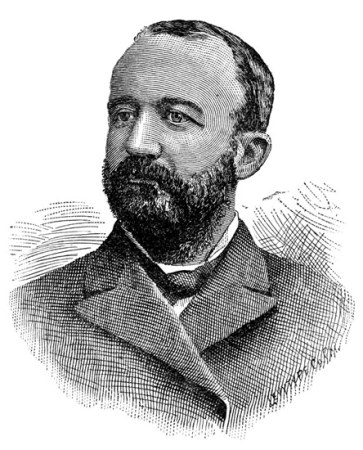
W. S. FORREST, LEADING COUNSEL FOR THE DEFENSE.
An adjournment was taken at this point until 10 o'clock Monday morning, December 9, when Mr. Forrest resumed his address to the jury.
He began with an apology for his discussion of the question of law on Saturday, stating that he thought it was his duty to do so. Then he went on to argue that witnesses may lie, but facts can not. He took a peculiar line on this point, referring to the tariff discussion, and showing that the Republicans claimed that the tariff is a benefit to the country, and that the Democrats claimed the opposite. "So you see," continued counsel, "much depends upon the disposition you have when you start to look at facts." He then read from "Taylor on the Law of Evidence," citing a case in which Macbeth was quoted to show that the smearing of the daggers was an intentional effort to create circumstantial evidence against the innocent. The decision also referred to Joseph's coat of many hues which was stained by the blood of a kid. All this was done to show the unreliability of circumstantial evidence. Then Mr. Forrest turned his attention to the case on trial, referring to the fact that Klahre had soldered the box that was supposed to contain Dr. Cronin's clothes, which, he remarked, according to the theory of the prosecution, was to have been shipped to England and received by some accomplice in the crime and afterward published to the world as containing Dr. Cronin's clothes.
"You do not claim that I said that?" asked Judge Longenecker.
"No," replied Mr. Forrest, "but that was your theory and that was the theory of the whole world. It was not only the State's Attorney's theory, gentlemen; it was not only the theory of the press of Chicago; it was the theory of the whole world. The whole world has learned the proof. These clothes were never in that box. You have since seen that the clothes that these gentlemen assure had been sent by Martin Burke to England in that box were never shipped over the sea. The box was never intended for an alleged accomplice. It was never intended to contain the corpse of Dr. Cronin. In spite of all their reasoning and of all the inferences that they drew, by chance a workman in a sewer in the town of Lake View turned up Dr. Cronin's clothes, which, instead of being in England in a tin box, were in a valise buried in a sewer in the town of Lake View.
"In all seriousness I will ask you two questions: suppose the cleaning of that sewer had not occurred until after this trial. Don't you know that in every speech of these distinguished orators they would have urged that Martin Burke was guilty because he sent Dr. Cronin's clothes over the sea? If that argument had been made to me, and these clothes had not been discovered would not I have given it weight? Can not you learn from that fact some lessons? You can learn that these gentlemen for the State are no safer guides than we are. You can learn that circumstantial evidence can lie and mislead, and although the defendant may not be able to disprove what they prove, as they say, it does not follow that the defendants are guilty."
DIFFICULT PART OF THE DEFENSE.
"You see the difficulty that the defense is in when we have to prove a negative. How could we prove that the clothes were not over the sea if accident had not turned them up in the sewer in Lake View? You see the danger of assuming to be true what we can not disprove. You see the unreliability of circumstantial evidence. You see the difficulty we have in proving a negative. Suppose that one of you were on trial, and suppose that the State's Attorney could introduce a witness to swear he saw you burning a deed or will, and suppose in the middle of the trial the deed should be produced in all its entirety, how rejoiced you would be. So rejoiced were we, and so rejoiced was the soul of Martin Burke, so gladdened was my soul, when the clothes were found in the North Town; call it fate, call it blind chance, call it an overruling Providence, call it what you will, it did for Martin Burke what his counsel and all the witnesses in the world could never have done. Suppose that the truth had not been disclosed. Suppose that the clothes had not been found; suppose that the argument had been made by these gentlemen—and what an argument they would have made in the form of a narrative!—describing how the clothes crossed the stormy sea, describing the ship containing this guilty secret. They could have speculated about what was to be done over there, and how it was to be done. Suppose they had done that; suppose that you had believed it; suppose you had drawn the conclusion that they urged you to draw in their opening, and that they would have urged you to draw in their closing. Suppose you had imposed the death penalty on Martin Burke; suppose the death penalty had been executed, and then the proof should have been discovered that the clothes were in the North Town sewer, what justification could you have made to the people of the State of Illinois? What justification could you have made in your prayers to your God? What justification could you have made in the forum of your own consciences to yourselves?
"Facts do lie. Now, by an agreement between this court and counsel for the defendant, I am not to speak of the Camp 20 conspiracy; but if that agreement had not been made, may it please your honor, I would not have spoken of the Camp 20 conspiracy, because it is wholly unnecessary. That has been done ably and exhaustively by the distinguished gentleman who represents Mr. Beggs. One thing I want to call your attention to and pass it. These gentleman have said, 'What difference does it make whether that remark of Beggs' that the committee reported to him alone was made May 3 or May 10.' Why, it makes all the difference in the world to all the defendants except Beggs, if you believe it was the appointment of a secret committee to kill Dr. Cronin. It makes all the difference in the world to them, and the gentleman that asked the question well knew it. It was made after May 3, and, therefore, if made, it is evidence against nobody but Beggs. If it was made before May 3, it would be evidence against everybody on trial, if you believe that conspiracy was entered into between them. That is the reason why these witnesses were prevailed on to swear that it was made May 3 instead of May 10. Every one of them, I believe, swore that it was May 3, but on cross-examination it turns out that it was May 10. O'Connor says that it occurred on a certain night when he was appointed on an auditing committee, and the record shows that that motion was made on May 10 and that was the only time he was there. So you see that somebody had a motive to change that from May 10 to May 3; and the motive was to make it evidence against all instead of evidence against only one."
Mr. Forrest went on to say that it was a remarkable thing in this case that the State had just one witness to every matter of importance. There was just one witness who heard Burke say that Cronin was a British spy and ought to be killed. They had just one other witness who heard Coughlin say it was rumored that Cronin was a spy; then they had just one other witness who heard O'Sullivan say, on the 22d of May, that Cronin was a spy, and is it not remarkable that there should be just one person who heard those gentlemen make such remarks? If they were in the habit of making those remarks, is it not highly probable that they made them more than once, and that they made them to more than one person, yet why was only one produced? It looks as if they were going out into the highways and by ways of the world, searching for witnesses, and had found only one.
ATTACKING THE PROSECUTING WITNESSES.
"Now I shall have something to say with respect to the credibility of the witnesses," he continued, "and shall ask you to draw inferences you may not be inclined to draw. Probably you will ask me why a person should commit perjury in a case where a citizen is on trial for his life. It is difficult to answer, because we do not know anything of the character of the witnesses or their associations, and can not find out what their connection is with other parties. There is also this to be remembered, that men have whimsical ambition. There are witnesses who desire to be distinguished, and who know it is always a great matter to know all about some great crime which has been committed. The man is a hero for the time being. He is a great man, called upon by reporters, written up and petted by the police and other persons. I can not tell what the effect of that would be. They may not intentionally commit perjury, but at the same time they may be lead entirely astray from the facts. Counsel regaled the jury with some of his experience in trying other murder cases by way of explaining what he meant, and said it is unpopular to testify on behalf of the defendant in a case like this. The enemies of my client have their claquers placed about the court, whose duty it is to applaud when anything comes out favorable to the prosecution.
"I want to know, if your Honor please, if there is any evidence of any claquers having been placed in this court in this case?" curtly inquired Mr. Ingham.
"I certainly do not know of any such evidence," replied Judge McConnell, "and the remark is a highly improper one."
"Claquers were over there in that corner and very frequently applauded, and that is where the Clan-na-Gaels were congregated," angrily retorted Mr. Forrest.
"There are no claquers in this court, and the counsel well knows it," said Mr. Ingham, sharply.
"I can not have you go into that subject or say any more on that line, Mr. Forrest," said Judge McConnell.
"Very well," said Mr. Forrest, and he then turned around to the jury and informed them that his client on a previous occasion was awarded a new trial by the Supreme Court. Now, I want to call your attention to certain evidence. There is a peculiar combination of men and circumstances against my clients, Daniel Coughlin and Martin Burke. The same remark applies to the other men, but chiefly to those two. For example, it is worth $100 a week to Patrick Dinan to have it established that his horse took the Doctor away. He told you that. He told you that his horse is in the museum, and if that fact is not established then he will lose $100 a week. Now, what effect do you suppose that will have upon his zeal in giving evidence? Again, old man Carlson was in very needy circumstances; his boy had not been living with his wife for four years. He had been traveling around the country while his wife was living out as a servant, and it was obviously to their advantage and pecuniary interest that the statement should be established that the murder was committed in that cottage. How that might tend to affect his testimony and lead him to imagine what never took place, you will decide. It is an unfortunate circumstance, and may have made him remember things which never occurred, especially as he is an old man, and the wall between memory and imagination is nearly broken down, owing to old age. Of course this is peculiarly unfortunate to my client.
"Another circumstance. It is proved that the Clan-na-Gael in the city of Chicago and throughout the United States is divided into two wings. It is proved that a division exists right through the country. One wing of this Clan-na-Gael exists in the prisoner's bar, the other wing sits in the witness seat. How does the wing that sits in the witness seat conduct itself? It involves the entire prosecution, and how does it feel toward my client? What do they say? They say your wing are robbers, betrayed their comrades to the British and sent them to British prisons by telling the British government who they were. One of the witnesses, Captain Thomas O'Connor, told you that he worked every day through May, June, July and August as a detective in this case for not one dollar, and you find there are other persons who gave their money and collected money to aid the prosecution. We have a split in the Clan-na-Gael throughout this entire country, and it is a matter of public notoriety and history that 15,000 Clan-na-Gaels were in the prosecution. Don't you know it is the same old cover of Irish slander? It is the Irish leaders slandering each other, and they will slander each other for all eternity. Now what is the effect of this? On the one side they say your wing is sending out comrades to British prisons, betraying them to the British government, and they are prosecuting them, while they say the patriots whom they laud to the sky are dynamiters who sent dynamite to England to wreck property and lives. Don't you see that stand out plainly and distinctly? And not alone has it permeated the prosecution, but if you believe what Lyman said about it, one of the dynamiters sits right here at the prosecution table. Do you suppose there is much difference between the leaders of the two wings? I do not, generally speaking. One wing charges the other with betraying their comrades and sending them to British prisons. What is the effect of it? Every man who has left Ireland for Ireland's good, because the English police were after him, and every man who came here from Millbank, came here crying, 'Revenge, revenge, revenge.' And yet they say they come here and want an American jury to pass upon an American case, while the motive behind it all is ancient Irish malice, so far as that thing is concerned. What effect has this had upon the witnesses? There is not a witness who has been discovered in this case since the coroner's jury that is not a suspicious witness. Did you notice the peculiarity of the witnesses? I never saw such a body of witnesses and you never did. They have eyes like the eagle; like the owls they can see better and farther by night than by day. Their hearing is as sensitive as that of the deer that roams through our northern forests. Their perceptive faculties are marvelous. Their recollection is beyond conception. They can remember the slightest circumstance. Every one of them, and it is an extraordinary thing and quite unnatural, remembers the slightest circumstance, and each of them does something more remarkable than the defendants about whom they testify. You will remember that it is not some public event which occurred and by which they recollect, but it is evidence of an occurrence which they themselves give, and such evidence and such memories as they have. When in the future writers on memory want to give instances of prodigious feats of memory they will search the record of the Cronin trial and cite the witnesses for the prosecution.
"There was that man Pulaski, who testified that he sold Burke a shirt. What an idea! That Burke had only one shirt, and that the witness did what no other man ever did in his life to a man who bought a shirt, asked him to take off his coat to measure him. Burke had an abiding place, and why should he go to that store on Sunday, the 5th of May, and buy a shirt? If anything of the kind ever occurred it was two of those dock loafers who work around the bridge, and who look as if they had only one shirt, and when they make a change of it they buy a new shirt. Now he says this man came in and bought a shirt, and that he told him to step back and try on a nice clean shirt, and if it did not fit to put it right back in the lot. You know as well as I do that when you go and buy a ready-made shirt there is only one question asked you—What is the size of your collar? But that is not all. He remembers another man who was standing across the street, and that this man went into the middle of the street and hailed the other man, and then they had a whispered conversation. Now he tells you that he remembers that the big man wore a 16½ collar and the little man, who subsequently came across the street, wore a 15½ collar. He remembers it exactly, and did not testify before the coroner's inquest. And then they had a photograph which he identifies, but they never introduced it in evidence, and I don't know why, but it looked to me as if a 15½ collar would go only half way round that man's neck.
"Now comes Klahre, and he says what never occurred. That on the morning of Sunday, May 5th, he read in one of the papers that Dr. Cronin was a spy, and had been made away with. As we all know, Mrs. Conklin testified that not one word was said about it until 12 o'clock Sunday, but they had to get it in quick, because Burke was out of town on the 8th and 9th. He says that on Monday morning Martin Burke came into his place with a box, a tin box, with a rope around it. The expressman brought in the box, which weighed about fifty pounds, and put it down, and we may rightly call this the box trick. Klahre said he was going to cut the rope, when Burke called out: 'Hold on; don't you cut that rope.' It would not do for him to peep into that box, because he might have seen Dr. Cronin's clothes, and then if he had, and it had turned out subsequently that the clothes were found in the sewer, it might have been shown that he told a fib. But he asked Martin Burke one question, 'What do you think of Cronin's disappearance?' He tells you that Burke said, 'He is a British spy, and ought to be killed.' So the great mystery has been solved. He further says that neither he nor Burke said another word in an hour and a half. The first man that came there told Klahre just what he wanted to know, and you will remember that they asked every man they wanted to impeach, 'Didn't you say Cronin was British spy and ought to have been killed?' Now, some one made that to order."
DRIVER SWANSON'S STORY.
"Now take Swanson. By the way, do you remember that when Captain Schuettler, the police officer who spoke to nearly every witness since the coroner's inquest, was on the stand, it turned out that every time he struck a witness from Clark street to Lake View the man was either a German or a Swede? You would not expect a German detective to find an American, nor would you expect a German detective to find an Irishman. Why I can not tell you, but that is a fact. Now, Swanson gave his testimony. Two of my witnesses go to a livery stable and get a carriage. The carriage was got to go to Fleming's opening on West Van Buren street, and Fleming was a cousin of William Coughlin. The carriage comes to William Coughlin's saloon, but Coughlin, the very person interested in going to the opening, is the very person, according to his testimony, who did not go. The Swede remembers every street he drove through, every place he stopped, and every cobblestone he drove over, and yet they tell you that although it's a large establishment their men did not wear a uniform or livery until after the 10th of May. The man says he had a tall hat, a cut-away coat, his pantaloons did not come up under his vest, and yet he was seen driving through the streets at 12 o'clock at night."
"O'Sullivan watered his garden on that day, too," dryly remarked the State's Attorney.
"Yes, and if it had been your witness he would have told you what flower it was he watered, what its color was and just how long it had been growing, in every detail," said Mr. Forrest.
The counsel then went on to give some of his college experience where a professor told him the great argument of the truth of the gospels of Matthew, Mark, Luke and John was that each one of them differed in the circumstantial details of each transaction but all agreed in the essentials of every transaction. "That is the argument which can not be answered, whereas if they had agreed in all the details, the argument would be conspiracy, collusion and fraud."
RIDICULING THE PROSECUTING WITNESSES.
Counsel then criticised the testimony given by Carberry, whom he designated as the impecunious and modest man, and who fixes the night of May 4th by his giving a large order to his grocery, and then considered what he was pleased to call the remarkable story given by Dinan and his wife and Moreland regarding the horse and the buggy which it was alleged the Doctor was driven away in. He remarked that the horse left the stable at 7:30, not at 7:20, as had been testified to, and then proceeded to review Mrs. Conklin's identification of the horse and buggy. He ridiculed the testimony of the witnesses who were able to say that there was a dim light in one room of Mrs. Conklin's house and a bright light in the other, and argued that because they all agreed on that point, therefore there was something suspicious about that testimony. "She says she observed more about that horse, with a mosquito screen behind her and an electric light in front of her, than the owner of the horse, who has had it for seven years. Why, if you sent a veterinary surgeon to look at that horse, he could not, after looking over the horse, give you a more exact description of its peculiarities than Mrs. Conklin learned through that screen.
"Now comes the knife transaction. Mr. Flynn appears. Mr. Flynn is a remarkable policeman. See if he did not do a more remarkable thing than Dan Coughlin did. He is ordered to arrest Coughlin, and he takes from his pocket a revolver and two knives—two knives not worth 10 cents, both of them. He takes the two knives to his desk at the Central Station and locks them up, and then it occurs to him that they will not be safe there and he puts them in the Fidelity deposit vault, when right beneath him on the floor below is the custodian of property taken from prisoners with a vault having a combination lock. Did you ever hear of a policeman taking a revolver and two old knives worth 10 cents to the Fidelity Bank because he was responsible for the property? He never says a word about it until last Monday, and he shows them to Conklin. And, mirabile dictu!—he says he carried those knives for two years; one of them he found on the street: he put one on the mantel, and the Doctor carried one of them in his vest and one in his pants. He just knew exactly where the Doctor carried these knives. If you have two knives you do not trouble yourselves about where you carry them; but Conklin knew that the Doctor had one knife in his vest and the other in his pants. Don't you see what remarkable feats they perform?
"Now, Neiman is a saloon-keeper, and a party happens to go to his place. His attention is called to it three months afterward, and he can remember that three people came in to get a glass of wine, and he can tell you that one of the men wore a Prince Albert coat. It never occurred to anybody that Dan Coughlin and Kunze were in that saloon until a week before Neiman testified, and then Dan Coughlin was pointed out to him by a detective. Don't you notice the urgency there was how to get him to express an opinion? Now, if witnesses were urged here, what do you suppose was urged upon them outside? Next comes the man Mertes. Owls can see by night, and he says he saw these men enter the cottage and then tells you all about it. Mrs. Hoertel has a remarkable memory. She is in the habit of going out to find her husband who is drunk, and knew certain saloons that he frequented. It was no unusual thing for her to find her husband, but on this night she knows just what streets she went along and just where she turned the corners. She is searching for her husband, and she goes to a saloon, does not see him there, but she looks at the clock and sees that it was exactly eight o'clock, and she will never forget the circumstance that it was exactly eight o'clock. She has got to remember that it was eight o'clock or she will run afoul of Mertes, and they both remember the same thing. She says she saw him enter the cottage; she hears the blows and hears the cries of 'God!' and 'Jesus!' and hears the dying moan. And yet she never says a word to any body. She is locked out and sits on the steps all night, and she goes to her husband's partner, with whom she is apparently on good terms, and does not tell her story."
EXPERTS ON THE CAUSE OF DEATH.
"Now, we go to their experts on the cause of death. How can they tell the cause of death? I have heard of men giving extraordinary opinions, but their experts can tell you what killed the man, and still they can not find any evidence of it. If the public prosecutor had put in his indictment 'cause of death unknown,' it would not have been necessary for them to say he died from some kind of violence, but the jury is prejudiced against these men because they said the death is due to that particular thing."
Mr. Forrest went on to review the testimony of the experts as to the hair and blood, and ridiculed the testimony of Professor Tolman in regard to his microscopical examinations of what he called lanugo. He said, "don't you see the Clan-na-Gaels at work? Let the two wings of the Clan-na-Gaels alone and they will make a laughing stock of American juries. You and I have got to stand between them. Everything that they introduced respecting the hair was introduced for the purpose of misleading you. The testimony of Tolman was introduced to show by the diameters of hairs that were alike that they were Dr. Cronin's hair, so that you should not be mislead. 'A little learning is a dangerous thing.' A great scientist can take an Irish setter and get two locks of hair from him and examine them; the hairs are of the same diameter; can he swear that they came from the same dog or no? The hairs of dogs are alike, and human hair is as much alike as the hair of horses or of sheep is alike. Only think of taking a bit of wool from one sheep and comparing it with the wool of another sheep to see if they came from the same sheep! We are like the animals in structure: our bones are alike, our hearts are alike, our viscera are alike; there is no material difference, and it is just as impossible to tell whether two locks came from the same human head as it is to tell whether wisps of hair came from the same horse's tail."
CAUSE OF DR. CRONIN'S DEATH.
At the opening of the afternoon session, Mr. Forrest began the discussion of the cause of death. "It is said by the learned gentlemen who represent the people, that our defense on that question is technical, but I deny it, and I will satisfy you that I am right and that it is a substantial defense. They will tell you it shows the weakness of our case. Gentlemen, I am engaged in defending the lives of these men, and I will avail myself of any technicalities and of any and every question in order to perform my duty. I will show you that it is not technical, and for this reason. They can try us again, they can indict us for causing death by hanging, by suffocation, by apoplexy, and also by causes unknown, and you are asked to convict under this indictment to repair the blunder of the State's Attorney. This is a very simple proposition of law. If I charge you with stealing my money I must prove you stole my money, and it will not do to show that you stole my potatoes; but if you are again indicted for stealing my potatoes you can only plead you didn't steal my money. Suppose the body was burned after a man was poisoned, would you be able to prove that he was poisoned? No, but you would have to charge in your indictment that he died from causes unknown. It will not do to simply prove that this man, Dr. Cronin, died from violence; that is not the question. The indictment charges death from wounds on the head, face and body. There is no evidence of any wound on the body, so that is excluded, and you are reduced to the supposition of wounds on the head and face. It is not a technical defense, as I say, because an acquittal on this indictment does not prevent their being tried a half a dozen times under different issues. I will now refer to the testimony of Dr. Egbert. In his examination, which I will read to you, he describes the wounds on the head, but distinctly and emphatically says that he can not say whether the arteries were cut. The counsel for the State very adroitly put their questions as to whether the arteries were involved, and he said they were. He meant that the arteries were in that region. However, Dr. Egbert testifies that the man did not die from hemorrhage. Dr. Perkins next comes on the stand, and tells you that the man died of concussion or contusion of the brain. There was no evidence of it, because the brain was too decomposed, but he knows and is perfectly satisfied that that was the cause of death. Dr. Egbert could not, by any possibility, assign the cause of death, owing to the decomposition which had taken place, nor could he tell whether those wounds were made before or after death. Dr. Perkins says the same thing, and Dr. Moyer says the same. If they do not know, how do you know? Some of you told me your minds were made up, but by the living God you must try us according to the law. The burden of proof is on them and they must prove the cause of death, and how do you know it? Will you guess at it? Do you propose to guess my clients guilty and then hang them?"
TESTIMONY OF THE EXPERTS.
Mr. Forrest read from the testimony of medical men at some length to show that they could not assign the cause of death, and asserted that the State had compelled its witnesses to stretch their consciences and to testify to what were not the facts, because of the State's Attorney's blunder in not putting into the indictment "cause of death unknown."
"Are you reading that testimony of Dr. Perkins correctly?" inquired Mr. Hynes. "You are putting as an answer and reading to the jury as an answer of the Doctor's what in reality was a question of your own."
"Well, possibly I did," responded Mr. Forrest, who went on reading testimony. His misquotation of the testimony in that case, however, induced the State's Counsel to keep a very sharp eye on the evidence he quoted. Mr. Forrest criticised at some length the testimony given by Dr. Perkins, and argued that if it would not be possible to tell whether the victim died from concussion or contusion of the brain without a microscopical examination, it was a remarkable thing that no such examination had been made. It was evident from the testimony that some one was straining his conscience as far as he dared, and it was also in proof that it would have been impossible to have told even by a microscopical examination of the brain whether death resulted from concussion or contusion. However, if it could, they did not do it. Yet the attorneys for the State will ask you to say that this matter is satisfactorily proved; that you know what the cause of death was, no matter whether you do or not, and, notwithstanding all the doctors say, it was impossible to say what was the cause of death. The State says to you, 'We want these men convicted,' but I say to you, 'Do your duty.' The State says to you, 'Violate your oaths and convict them now,' and that doctrine is preached by the public prosecutor in a community where, above all things, the people should be taught respect for the administration of the law. Counsel then passed to an examination of the testimony given by Dr. Moore. He argued that even Dr. Moore could not assign any cause of death, and then made a frantic appeal to the jury, inquiring, 'Are you prejudiced against these men?' If the jury wants an excuse, those doctors say, we will throw you one. They seem to say we know what you think; we know what you want to do and what you are ready to do, and all that is needed is for us to throw out a suspicion.
DR. MOORE'S TESTIMONY RECALLED.
"Dr. Moore said Dr. Cronin did not die from blood letting, because he died before he could have bled to death," remarked Mr. Hynes. "It is just as well that you should quote that to the jury."
"That doesn't matter," roared Mr. Forrest. "Moore says that he might have died and possibly would have died from concussion or contusion of the brain, but he does not dare say that he did die from it. He throws no more light on the cause of death than did the others. His evidence was the most extraordinary, and the conclusion he arrived at as to why there was contusion of the brain was also most extraordinary, and although it must be a very tiresome proceeding to you, gentlemen, I am compelled to comment upon it and go into it at some length."
Counsel then read copious extracts from the testimony of Dr. Moore, remarking that that doctor reminded him of a celebrated man named Bogardus, who had written a book upon the theory that all disease could be cured by blood-letting and hot water. "He practiced his theory, but by and by his patients began to die, and wherever he went the undertaker followed. His friends complained to him and said: 'You had better give up your theory.' 'Can't give it up,' said the doctor. 'Don't care how many die; I have written a book and have a theory, and must sustain it.' So with the indictment of the State's Attorney. 'I have written an indictment; it is my theory and has got to be sustained, right or wrong, in spite of the law and evidence, and you give me a jury which is excited and I will get some one to swear to something, and that will be enough. My theory must be sustained.' Are you gentleman ready to violate your oaths by sustaining it?"