Front matter (continued 5)
Reading edition
"But this year! One day, not very long ago, I got a letter from th' owners, an' it says for me to build a wire fence around our range. It went on to say that there was two carloads of barb' wire at Mesquite. We was to tote that wire home, an' start in. If two carloads wasn't enough, they 'd send us more. We had one busted-down grub waggin, an' Mesquite shore was fifty miles away—which meant a whoppin' long job totin'.
"When I saw th' boys, that night, I told 'em that I 'd got orders to raise their pay five dollars a month—which made 'em cheer. Then I told 'em that was so providin' they helped me build a barb' wire fence around th' range—which did n't make 'em cheer.
"Th' boundary lines of th' range we was usin' was close onto a hundred an' fifty miles long, an' three strands of wire along a trail like that is some job. We was to put th' posts twelve feet apart, an' they was to be five feet outen th' ground an' four feet in it—which makes 'em nine feet over all.
"There was n't no posts at Mesquite. Them posts was supposed to be growin' freelike on th' range, just waitin' for us to cut 'em, skin 'em, tote an' drop 'em every twelve feet along a line a hundred an' fifty miles long. An' then there was to be a hole dug for every post, an' tampin', staplin', an' stringin' that hell-wire. An' don't forget that lone, busted-down grub waggin that was to do that totin'!
"There was some excitement on th' Two-X-Two that night, an' a lot of figgerin'; us bein' some curious about how many posts was needed, an' how many holes we was to dig to fit th' aforesaid posts. We made it sixty-six thousand. Think of it! An' only eight of us to tackle a job like that, an' ride range at th' same time!"
"Oh, ho!" roared the bartender, hugging himself, and trying to carry a drink to the narrator at the same time. "Go on! That's good!"
"Is, is it?" snorted Youbet. "Huh! You wouldn't 'a' thought so, if you was one of us eight. Well, I set right down an' writ a long letter—took six cents' worth of stamps—an' gave our views regardin' wire fences in general an' this one of ourn in particular. I hated fences, an' do yet; an' so 'd my boys hate 'em, an' they do yet.
"In due time, I got a answer, which come for two cents. It says: 'Build that fence.'
"I sent Charley over to Mesquite to look over them cars of wire. He saw 'em, both of 'em. An' th' agent saw him.
"Th' agent was a' important man, an' he grabs Charley quick. 'Hey, you Two-X-Two puncher—you get that wire home quick. It went past here three times before they switched it, an' I 've been gettin' blazes from th' company ever since. We needs th' cars.'
"'Don't belong to me,' says Charley. 'I shore don't want it. I 'm eatin' beans an' bacon instead.'
"'You send for that wire!' yells th' agent, wild-like.
"Charley winks. 'Can't you keep it passin' this station till it snows hard? Have a drink.'
"Well, th' agent wouldn't drink, an' he wouldn't send that pore wire out into a cold world no more; an' so Charley comes home an' reports, him lookin' wanlike. When he told us, he looked sort of funny, an' blurts out that his mother went an' died up in Laramie, an' he must shore 'nuff rustle up there an' bury her. He went.
"Then Fred Ball begun to have pains in his stomach, an' said it was appendix somethin', what he had been readin' about in th' papers. He had to go to Denver, an' get a good doctor, or he 'd shore die. He went.
"Carson had to go to Santa Fé to keep some of his numerous city lots from bein' sold off by th' sheriff. He went.
"Th' rest, bein' handicapped by th' good start th' others had made in corrallin' all th' excuses, said they 'd go for th' wire. They went.
"I waited four days, an' then I went after 'em. When I got to th' station, I sees th' agent out sizin' up our wire; an' when I hails, he jumps my way quick, an' grabs my laig tight.
"'You take that wire home!' he yells.
"'Shore,' says I soothingly. 'You looks mad,' I adds.
"'Mad! Mad!' he shouts, hoppin' round, but hangin' onto my laig like grim death. 'Mad! I 'm goin' loco—crazy! I can't sleep! There 's twenty letters an' messages on my table, tellin' me to get that wire off'n th' cars an' send th' empties back on th' next freight! You've got to take it—got to!'"
The bartender shocked his nervous system by drinking plain water by mistake, but he listened eagerly. "Yes? What then?"
"Well, then I asks him where I can find my men, an' team, an' waggin'. He tells me. Th' team an' waggin is in a corral down th' street, but he don't know where th' men are. They held a gun to his head, an' said they 'd kill him if he didn't flag th' next train for 'em. Th' next train was a through express, carryin' mail. He was n't dead.
"He showed me ten more letters an' messages, regardin' th' flaggin' of a contract-mail train for four fares; an' some of them letters must 'a' been written by a old-time cowman, they was that eloquent an' God-fearin'. Then I went.
"Why, Charley was twenty years old; an' we figgered that, when th' last staple was drove in th' last post, he 'd 'a' been dead ten years! Where did I come in, the—?"
"Oh, Lord!" sighed the bartender, holding his sides, and trying to straighten his face so that he could talk out of the middle of it. "That's th' best ever! Have another drink!"
"I ain't tellin' my troubles for liquor," snorted Youbet. "You have one with me. Here comes some customers down th' street, I reckon."
"Say!" exclaimed the bartender hurriedly. "You keep mum about sheep. This is a red-hot sheep town, an' it hates Waffles an' all his friends. Hullo, boys!" he called to four men, who filed into the room. "Where 's th' rest of you?"
"Comin' in later. Same thing, Jimmy," replied Clayton, chief herder. "An' give us th' cards."
"Have you seen Price?" asked Towne.
"Yes; he was in here a few minutes ago. What 'd you say, Schultz?" the bartender asked, turning to the man who pulled at his sleeve.
"I said dot you vas nod right aboud vat you said de odder day. Chust now I ask Clayton, und he said you vas nod."
"All right, Dutchy—all right!" laughed the bartender. "Then it's on me this time, ain't it?"
Youbet walked to the bar. "Say, where do I get that grub? It's about time for me to mosey off an' feed."
"Next building—and you'll take mutton if yo 're wise," replied the bartender, in a low voice. "Th' hash is awful, an' the beef is tough," he added, a little louder.
"Mutton be damned!" snorted Youbet, stamping out. "I eat what I punch!" And his growls became lost in the street.
Schultz glanced up. "Yah! Und he shoot vat I eat, tarn him, ven he gan!"
"Oh, put yore ante in, an' don't talk so much!" rejoined Towne. "He ain't going to shoot you."
"It 'll cost you two bits to come in," remarked Clayton.
"An' two more," added Towne, raising the ante.
"Goot! I blay mit you. But binochle iss der game!"
"I 'll tell you a good story about a barb' wire fence tomorrow, fellers," promised the bartender, grinning.
The poker game had been going for some time before further remarks were made about the cowman who had left, and then it was Clayton who spoke.
"Say, Jimmy!" he remarked, as Schultz dealt. "Who is yore leather-pants friend who don't like mutton?"
The bartender lifted a bottle, and replaced it with great care. "Oh, just a ranch foreman, out of a job. He's a funny old feller."
"So? An' what's so funny about him? Get in there, Towne, if you wants to do any playin' with us."
"Why, he was ordered to build a hundred an' fifty miles of wire fence around his range, an' he jumped ruther than do it."
"Yas—an' most of it government land, I reckon," interposed Towne.
"Pshaw! It's an old game with them," laughed Clayton. "Th' law don't get to them; an' if they 've got a good outfit, nobody has got any chance agin 'em."
"Py Gott, dot's right!" grunted Schultz.
"Shore, it is," responded Towne, forgetting the game. "Take that Apache Hills run-in. Waffles did n't have no more right to that range than anybody else, but that did n't make no difference. He threw a couple of outfits in there, penned us in th' cabin, killed MacKay, an' shot th' rest of us up plenty. Then he threatened to slaughter our herd if we did n't pull out. By God, I 'd like to get a cowman like him up here, where th' tables are turned around on th' friends proposition."
"Hullo, boys!" remarked the bartender to the pair who came in.
"Just in time. Get chairs, an' take hands," invited Clayton, moving over.
"Who's th' cowman yo're talkin' about?" asked Baxter, as he leaned lazily against the bar.
"Oh, all of 'em," rejoined Towne surlily. "There 's one in town, now, who don't like sheep."
"That so?" queried Baxter slowly. "I reckon he better keep his mouth shut, then."
"Oh, he 's all right! He 's a jolly old geezer," assured the bartender. "He just talks to hear hisself—one of them old-timers what can't get right to th' way things has changed on th' range. It was them boys that did great work when th' range was wild."
"Yes, an' it's them bull-headed old fools what are raisin' all th' hell with th' sheep," retorted Towne, frowning darkly as he remembered some of the indignities he had borne at the hands of cowmen.
"I wish his name was Waffles." Clayton smiled significantly.
"Rainin' again," remarked a man in the doorway, stamping in. "Reckon it ain't never goin' to stop."
"Where you been so long, Price?" asked Clayton, as a salutation.
"Oh, just shiftin' about. That cow wrastler raised th' devil in th' hotel," Price replied. "Old fool! They brought him mutton, an' he wanted to clean out th' place. Said he 'd as soon eat barb' wire. They 're feedin' him hash an' canned stuff, now."
"He 'll get hurt, if he don't look out," remarked Clayton. "Who is he, anyhow, Price?"
"Don't know his name; but he 's from Arizona, on his way to th' Pecos country. Says he 's a friend of Buck Peters an' Waffles. To use one of his own expressions, he 's a old mosshead."
"Friend of Waffles, hey?" exclaimed Towne.
"Yumpin' Yimminy!" cried Oleson, in the same breath.
"Well, if he knows when he's well off, he 'll stay away from here, an' keep his mouth closed," said Clayton.
"Aw, let him alone! He's one agin' th' whole town—an' a good old feller, at that," hastily assured the bartender. "It ain't his fault that Waffles buffaloed you fellers out of th' Hills, is it? He's goin' on early tomorrow; so let him be."
"You 'll get yoreself in trouble, Jimmy, m' boy, if you inserts yoreself in this," warned Towne. "It was us agin' a whole section, an' we got ours. Let him take his, if he talks too much."
"Shore," replied Price. "I heard him shoot off his mouth, an hour ago, an' he's got altogether too much to say. You mind th' bar an' yore own business, Jimmy. We ain't kids."
"Go you two bits better," said Clayton, shoving out a coin. "Gimme some cards, Towne. It 'll cost you a dollar to see our raises."
Baxter walked over to watch the play. "I 'm comin' in next game. Who 's winnin', now?"
"Reckon I am; but we ain't much more 'n got started," Clayton replied. "Did you call, Towne? Why, I 've got three little tens. You got anythin' better?"
"Never saw such luck!" exclaimed Towne disgustedly. "Dutchy, yo 're a Jonah."
"Damn th' mutton, says I. It was even in that hash!" growled a voice, just outside the door.
A moment later, Youbet Somes entered, swinging his sombrero energetically to shake off the water.
"Damn th' rain, too, an' this wart of a town. A man can't get nothin' fit to eat for love or money, on a sheep range. Gimme a drink, sonny! Mebby it 'll cut th' taste of that rank tallow out 'n my mouth. Th' reason there is sheep on this earth of our'n is that th' devil chased 'em out 'n his place—an' no blame to him."
He drank half his liquor, and, placing the glass on the bar beside him, turned to watch the game. "Ah, strangers—that's th' only game, after all. I 've dabbled in 'em all from faro to roulette, but that's th' boss of 'em all."
"See you an' call," remarked Clayton, ignoring the newcomer. "What you got, you Dutch pagan?"
"Zwei Kaisers und a bair of chackasses, mit a deuce."
"Kings up!" exclaimed Clayton. "Why, say—you bet th' worst of anybody I ever knew! You 'll balk on bettin' two bits on threes, and plunge on a bluff. I reckoned you did n't have nothin'. Why ain't you more consistent?" he asked, winking at Towne.
"Gonsisdency iss no chewel in dis game—it means go broke," placidly grunted Schultz, raking in his winnings.
His friend Schneider smiled.
"Coyotes are gettin' too numerous, this year," Baxter remarked, shuffling.
Youbet pushed his sombrero back on his head. "They don't get numerous on a cow range," he said significantly.
"Huh!" snorted Baxter. "They've got too much respect to stay on one longer than they 've got to."
"They'd ruther be with their woolly-coated cousins," rejoined the cowman quietly. It was beneath his dignity as a cowman to pay much attention to what sheepmen said, yet he could not remain silent under such a remark.
He regarded sheep herders, those human beings who walked at their work, as men who had reached the lowest rung in the ladder of human endeavors. His belief was not original with him, but was that of many of his school. He was a horseman, a mounted man, and one of the aristocracy of the range; they were, to him, the rabble, and almost beneath his contempt.
Besides, it was commonly believed by cowmen that sheep destroyed the grass as far as cattle grazing was concerned—and this was the chief reason for the animosity against sheep and their herders, which burned so strongly in the hearts of cattle owners and their outfits.
Youbet drained his glass, and continued: "The coyote leaves th' cattle range for th' same good reason yore sheep leave it—because they are chased out, or killed. Naturally, blood kin will hang together in banishment."
"You know a whole lot, don't you?" snorted Clayton, with sarcasm. "Yo 're shore wise, you are!"
"He is so vise as a—a gow," remarked Schultz, grinning.
"You 'll know more, when you get as old as me," replied the ex-foreman, carefully placing the empty glass on the bar.
"I don't want to get as old as you, if I have to lose all my common sense," retorted Clayton angrily.
"An' be a damned nuisance generally," observed Towne.
"I 've seen a lot of things in my life," Youbet began, trying to ignore the tones of the others. They were young men, and he knew that youth grew unduly heated in argument. "I saw th' comin' of th' Texas drive herds, till th' range was crowded where th' year before there was nothin'. I saw th' comin' of th' sheep—an' barb' wire, I 'm sorry to say. Th' sheep came like locusts, leavin' a dyin' range behind 'em. Thin, half-starved cattle showed which way they went. You can't tell me nothin' I don't know about sheep."
"An' I 've seen sheep dyin' in piles on th' open range," cried Clayton, his own wrongs lashing him into a rage. "I 've seen 'em dynamited, an' drowned and driven hell-to-split over canyons! I 've had my men taunted, an' chased, an' killed—killed, by God!—just because they tried to make a' honest livin'! Who did it all? Who killed my men an' my sheep? Who did it?" he shouted, taking a short step forward, while an endorsing growl ran along the line of sheepmen at his side.
"Cowpunchers—they did it! They killed 'em—an' why? Because we tried to use th' grass that we had as much right to as they had—that 's why!"
"Th' cows was here first," replied Youbet, keenly alert, but not one whit abashed by the odds, long as they were. "It was theirs because they was there first."
"It was not theirs, no more'n th' sun was!" cried Towne, unable to allow his chief to do all the talking.
"You said you knowed Waffles," continued Clayton loudly. "Well, he 's another of you old-time cowmen! He killed MacKay—murdered him—because we was usin' a hill range a day's ride from his own grass! He had twenty men like hisself to back him up. If we 'd been as many as them, they would n't 'a' tried it—an' you know it!"
"I don't know anything of th' kind, but I do know—" began Youbet; but Schultz interrupted him with a remark intended to contain humor.
"Ven you say you doand know anyt'ing, you know somedings; ven you know dot you doand know noddings, den you know somedings. Und das iss so—yah."
"Who th' devil told you to stick yore Dutch mouth—" retorted Youbet; but Clayton cut him short.
"So yo 're a old-timer, hey?" cried the sheepman. "Well, by God, yore old-time friend Waffles is a coward, a murderer, an'—"
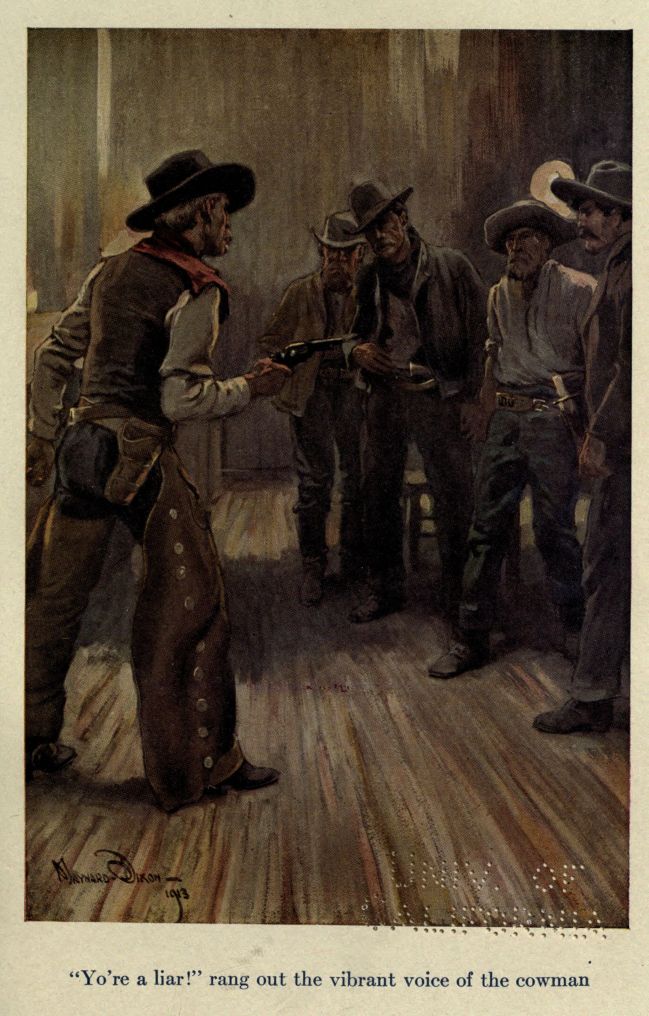
"Yo're a liar!" rang out the vibrant voice of the cowman
"Yo 're a liar!" rang out the vibrant voice of the cowman, his gun out and leveled in a flash. The seven had moved forward as one man, actuated by the same impulse; and their hands were moving toward their guns when the crashes of Youbet's weapon reverberated in the small room, the acrid smoke swirling around him as though to shield him from the result of his folly—a result which he had weighed and then ignored.
Clayton dropped, with his mouth still open. Towne's gun chocked back in the scabbard as its owner stumbled blindly over a chair and went down, never to rise. Schultz fired once, and fell back across the table.
The three shots had followed one another with incredible quickness; and the seven, not believing that one man would dare attack so many, had not expected his play. Before the stunned sheepmen could begin firing, three were dead.
Price, badly wounded, fired as he plunged to the wall for support; and the other three were now wrapped in their own smoke.
Wounded in several places, with his gun empty, Youbet hurled the weapon at Price, and missed by so narrow a margin that the sheepman's aim was spoiled. Youbet now sprang to the bar, and tried to vault over it, to get to the gun which he knew always lay on the shelf behind it. As his feet touched the upper edge of the counter, he grunted and, collapsing like a jackknife, loosed his hold, and fell to the floor.
"Mein Gott!" groaned Schneider, as he tried to raise himself. He looked around in a dazed manner, hardly understanding just what had happened. "He vas mat; crazy mat!"
Oleson arose unsteadily to his feet, and groped his way along, the wall to where Price lay.
The fallen man looked up, in response to the touch on his shoulder; and he swore feebly: "Damn that fool—that idiot!"
"Shut up, an' git out!" shouted the bartender, standing rigidly upright, with a heavy Colt in his upraised hand. There were tears in his eyes, and his voice broke from excitement. "He wouldn't swaller yore insults! He knowed he was a better man! Get out of here, every damned one of you, or I 'll begin where he stopped. G 'wan—get out!"
The four looked at him, befuddled and sorely hurt; but they understood the attitude, if they did not quite grasp the words—and they knew that he meant what he looked. Staggering and hobbling, they finally found the door, and plunged out to the street, to meet the crowd of men who were running toward the building.
Jimmy, choking with anger and with respect for the man who had preferred death to insults, slammed shut the door and, dropping the bar into place, turned and gazed at the quiet figure huddled at the base of the counter.
"Old man," he muttered, "now I understands why th' sheep don't stay long on a cattle range."
XIV
SAMMY HUNTS A JOB
Sammy Porter, detailed by Hopalong, the trail-boss, rode into Truxton three days before the herd was due, to notify the agent that cars were wanted. Three thousand three-year-olds were on their way to the packing houses and must be sent through speedily. Sammy saw the agent and, leaving him much less sweeter in temper than when he had found him, rode down the dismal street kicking up a prodigious amount of dust. One other duty demanded attention and its fulfillment was promised by the sign over the faded pine front of the first building.
"Restaurant," he read aloud. "That's mine. Beans, bacon an' biscuits for 'most a month! But now I 'm goin' to forget that Blinky Thompkins ever bossed a trail wagon an' tried to cook."
Dismounting, he glanced in the window and pulled at the downy fuzz trying to make a showing on his upper lip. "Purty, all right. Brown hair an' I reckon brown eyes. Nice li'l girl. Well, they don't make no dents on me no more," he congratulated himself, and entered. His twenty years fairly sagged with animosity toward the fair sex, the intermittent smoke from the ruins of his last love affair still painfully in evidence at times. But careless as he tried to be he could not banish the swaggering mannerisms of Youth in the presence of Maid, or change his habit of speech under such conditions.
"Well, well," he smiled. "Here I 'are' again. Li'l Sammy in search of his grub. An' if it's as nice as you he 'll shore have to flag his outfit an' keep this town all to hisself. Got any chicken?"
The maid's nose went up and Sammy noticed that it tilted a trifle, and he cocked his head on one side to see it better. And the eyes were brown, very big and very deep—they possessed a melting quality he had never observed before. The maid shrugged her shoulders and swung around, the tip-tilt nose going a bit higher.
Sammy leaned back against the door and nodded approval of the slender figure in spic-and-span white. "Li'l Sammy is a fer-o-cious cow-punch from a chickenless land," he observed, sorrowfully. "There ain't no kinds of chickens. Nothin' but men an' cattle an' misguided cooks; an' beans, bacon an' biscuits. Li'l Miss, have you a chicken for me?"
"No!" The head went around again, Sammy bending to one side to see it as long as he could. The pink, shell-like ear that flirted with him through the loosely-gathered, rebellious hair caught his attention and he leveled an accusing finger at it. "Naughty li'l ear, peekin' at Sammy that-a-way! Oh, you stingy girl!" he chided as the back of her head confronted him. "Well, Sammy don't like girls, no matter how pink their ears are, or turned up their noses, or wonderful their eyes. He just wants chicken, an' all th' fixin's. He 'll be very humble an' grateful to Li'l Miss if she 'll tell him what he can have. An' he 'll behave just like a Sunday-school boy.
"Aw, you don't want to get mad at only me," he continued after she refused to answer. "Got any chicken? Got any—eggs? Lucky Sammy! An' some nice ham? Two lucky Sammies. An' some mashed potatoes? Fried? Good. An' will Li'l Miss please make a brand new cup of strong coffee? Then he 'll go over an' sit in that nice chair an' watch an' listen. But you ought n't get mad at him. Are you really-an'-truly mad?"
She swept down the room, into the kitchen partitioned off at the farther end and slammed the door. Sammy grinned, tugged at his upper lip and fancy-stepped to the table. He smoothed his tumbled hair, retied his neck-kerchief and dusted himself off with his red bandanna handkerchief. "Nice li'l town," he soliloquized. "Fine li'l town. Dunno as I ought to go back to th' herd—Hoppy did n't tell me to. Reckon I 'll stick in town an' argue with th' agent. If I argue with th' agent I 'll be busy; an' I can't leave while I 'm busy." He leaned back and chuckled. "Lucky me! If Hoppy had gone an' picked Johnny to argue with th' agent for three whole days where would I be? But I gotta keep Johnny outa here, th' son-of-a-gun. He ain't like me—he likes girls; an' he ain't bashful."
He picked up a paper lying on a chair near him and looked it over until the kitchen door squeaked. She carried a tray covered with a snow-white napkin which looked like a topographical map with its mountains and valleys and plains. His chuckle was infectious to the extent of a smile and her eyes danced as she placed his dinner before him.
"Betcha it's fine," he grinned, shoveling sugar into the inky coffee. "Blinky oughta have a good look at this layout."
"Don't be too sure," she retorted. "Mrs. Olmstead is sick and I 'm taking charge of things for her. I 'm not a good cook."
"Nothin 's th' matter with this," he assured her between bites. "Lots better 'n most purty girls can do. If Hopalong goes up against this he 'll offer you a hundred a month an' throw Blinky in to wash th' dishes. But he 'd have to 'point me guard, or you would n't have no time to do no cookin'."
"You 'd make a fine guard," she retorted.
"Don't believe it, huh? Jus' wait till you know me better."
"How do you know I 'm going to?"
"I 'm a good guesser. Jus' put a li'l pepper right there on that yalla spot. Say, any chance to get a job in this town?"
"Why, I don't know."
"Goin' to stay long?"
"I can't say. I won't go till Mrs. Olmstead is well."
"Not meanin' no harm to Mrs. Olmstead, of course—but you don't have to go, do you?"
"I do as I please."
"So I was thinkin'. Now, 'bout that job: any chance? Any ranches near here?"
"Several. But they want men. Are you a real cowboy?"
Sammy folded his hands and shook his head sorrowfully. "Huh! Want men! Now if I only had whiskers like Blinky. Why, 'course I 'm a cowboy. Regular one—but I can outgrow it easy. I 'm a sorta maverick an' I 'm willin' to wear a nice brand. My name's Sammy Porter," he suggested.
"That's nice. Mine is n't nice."
"Easy to change it. Really like mine?"
"Coffee strong enough?"
"Sumptious. How long's Mrs. Olmstead going to be sick?"
Her face clouded. "I don't know. I hope it will not be for long. She 's had so much trouble the past year. Oh, wait! I forgot the toast!" and she sped lightly away to rescue the burning bread.
The front door opened and slammed shut, the newcomer dropping into the nearest chair. He pounded on the table. "Hello, there! I want somethin' to eat, quick!"
Sammy turned and saw a portly, flashily dressed drummer whose importance was written large all over him. "Hey!" barked the drummer, "gimme something to eat. I can't wait all day!"
A vicious clang in the kitchen told that his presence was known and resented.
As Sammy turned from the stranger he caught sight of a pretty flushed face disappearing behind the door jamb, the brown eyes snapping and the red lips straight and compressed. His glance, again traveling to the drummer, began with the dusty patent leathers and went slowly upward, resting boldly on the heavy face. Sammy's expression told nothing and the newcomer, glaring at him for an instant, looked over the menu card and then stared at the partition, fidgeting in his chair, thumping meanwhile on the table with his fingers.
At a sound from the kitchen Sammy turned back to his table and smiled reassuringly as the toast was placed before him. "I burned it and had to make new," she said, the pink spots in her cheeks a little deeper in color.
"Why, th' other was good enough for me," he replied. "Know Mrs. Olmstead a long time?" he asked.
"Ever since I was a little girl. She lived near us in Clev—"
"Cleveland," he finished. "State of Ohio," he added, laughingly. "I 'll get it all before I go."
"Indeed you won't!"
"Miss," interrupted the drummer, "if you ain't too busy, would you mind gettin' me a steak an' some coffee?" The tones were weighted with sarcasm and Sammy writhed in his chair. The girl flushed, turned abruptly and went slowly into the kitchen, from where considerable noise now emanated. In a short time she emerged with the drummer's order, placed it in front of him and started back again. But he stopped her. "I said I wanted it rare an' it's well done. An' also that I wanted fried potatoes. Take it back."
The girl's eyes blazed: "You gave no instructions," she retorted.
"Don't tell me that! I know what I said!" snapped the drummer. "I won't eat it an' I won't pay for it. If you was n't so busy you 'd heard what I said."
Sammy was arising before he saw the tears of vexation in her eyes, but they settled it for him. He placed his hand lightly on her shoulder. "You get me some pie an' take a li'l walk. Me an' this here gent is goin' to hold a palaver. Ain't we, stranger?"
The drummer glared at him. "We ain't!" he retorted.
Sammy grinned ingratiatingly. "Oh, my; but we are." He slung a leg over a chair back and leaned forward, resting his elbow on his knee. "Yes, indeed we are—least-a-wise, I am." His tones became very soft and confiding. "An' I 'm shore goin' to watch you eat that steak."
"What's that you 're going to do?" the drummer demanded, half rising.
"Sit down," begged Sammy, his gun swinging at his knee. He picked up a toothpick with his left hand and chewed it reflectively. "These here Colts make a' awful muss, sometimes," he remarked. "'Specially at close range. Why," he confided, "I once knowed a man what was shot 'most in two. He was a moss-head an' would n't do what he was told. Better sorta lead off at that steak, hombre," he suggested, chewing evenly on the toothpick. Noticing that the girl still lingered, hypnotized by fear and curiosity, he spoke to her over his shoulder. "Won't you please get me that pie, or somethin'? Run out an' borrow a pan, or somethin'," he pleaded. "I don't like to be handicapped when I 'm feedin' cattle."
The drummer's red face paled a little and one hand stole cautiously under his coat—and froze there. Sammy hardly had moved, but the Colt was now horizontal and glowered at the gaudy waistcoat. He was between it and the girl and she did not see the movement. His smile was placid and fixed and he spoke so that she should get no inkling of what was going on. "Never drink on an empty stomach," he advised. "After you eat that meal, then you can fuss with yore flask all you wants." He glanced out of the corner of his eye at the girl and nodded. "Still there! Oh, I most forgot, stranger. You take off yore hat an' 'pologize, so she can go. Jus' say yo 're a dawg an never did have no manners. Say it!" he ordered, softly. The drummer gulped and muttered something, but the Colt, still hidden from the girl by its owner's body, moved forward a little and Sammy's throaty growl put an end to the muttering. "Say it plain," he ordered, the color fading from his face and leaving pink spots against the white. "That's better—now, Li'l Miss, you get me that pie—please!" he begged.
When they were alone Sammy let the gun swing at his knee again. "I don't know how they treats wimmin where you came from, stranger; but out here we 're plumb polite. 'Course you did n't know that, an' that's why you did n't get all mussed up. Yo 're jus' plain ignorant an' can't help yore bringin' up. Now, you eat that steak, pronto!"
"It's too cold, now," grumbled the drummer, fidgeting in the chair.
The puncher's left hand moved to the table again and when it returned to his side there was a generous layer of red pepper on the meat. "Easy to fix things when you know how," he grinned. "If it gets any colder I 'll fix it some more." His tones became sharper and the words lost their drawled softness. "You goin' to start ag'in that by yoreself, or am I goin' to help you?" he demanded, lifting his leg off the chair and standing erect. All the humor had left his face and there was a grimness about the tight lips and a menace in the squinting eyes that sent a chill rippling down the drummer's spine. He tasted a forkful of the meat and gulped hastily, tears welling into his eyes. The puncher moved a little nearer and watched the frantic gulps with critical attention. "'Course, you can eat any way you wants—yo're payin' for it; but boltin' like a coyote ain't good for th' stummick. Howsomever, it's yore grub," he admitted.
A cup of cold coffee and a pitcher of water followed the meat in the same gulping haste. Tears streamed down the drummer's red face as he arose and turned toward the door. "Hol' on, stranger!" snapped Sammy. "That costs six bits," he prompted. The coins rang out on the nearest table, the door slammed and the agonized stranger ran madly down the street, cursing at every jump. Sammy sauntered to the door and craned his neck. "Somebody 's jus' naturally goin' to bust him wide open one of these days. He ain't got no sense," he muttered, turning back to get his pie.
A cloud of dust rolled up from the south, causing Briggs a little uneasiness, and he scowled through the door at the long empty siding and the pens sprawled along it.
Steps clacked across the platform and a grinning cowpuncher stopped at the open window. "They're here," he announced. "How 'bout th' cars?"
Briggs looked around wearily. For three days his life had been made miserable by this pest, who carried a laugh in his eyes, a sting on his tongue and a chip on his shoulder. "They 'll be here soon," he replied, with little interest. "But there 's th' pens."
"Yes, there's th' pens," smiled Sammy. "They'll hold 'bout one-tenth of that herd. Ain't I been pesterin' you to get them cars?"
The agent sighed expressively and listened to the instrument on his table. When it ceased he grabbed the key and asked a question. Then he smiled for the first time that day. "They 're passing Franklin. Be here in two hours. Now get out of here or I 'll lick you."
"There 's a nice place in one of them pens," smiled Sammy.
"I see you 're eating at Olmstead's," parried the agent.
"Yea."
"Nice girl. Come up last summer when Mrs. Olmstead petered out. I ate there last winter."
Sammy grinned at him. "Why 'd you stop?"
Briggs grew red and glanced at the nearing cloud of dust. "Better help your outfit, had n't you?"
Sammy was thoughtful. "Say, that's a plumb favorite eatin' place, ain't it?"
Briggs laughed. "Wait till Saturday when th' boys come in. There 's a dozen shinin' up to that girl. Tom Clarke is real persistent."
Sammy forsook the building as a prop. "Who 's he? Puncher?"
"Yes; an' bad," replied the agent. "But I reckon she don't know it."
Sammy looked at the dust cloud and turned to ask one more question. "What does this persistent gent look like, an' where's he hang out?" He nodded at the verbose reply and strode to his horse to ride toward the approaching herd. He espied Red first, and hailed. "Cars here in two hours. Where 's Hoppy?"
"Back in th' dust. But what happened to you?" demanded Red, with virile interest. Sammy ignored the challenge and loped along the edge of the cloud until he found the trail boss. "Them cars 'll be here in two hours," he reported.
"Take you three days to find it out?" snapped Hopalong.
"Took me three days to get 'em. I just about unraveled that agent. He swears every time he hears a noise, thinkin' it's me."
"Broke?" demanded Hopalong.
Sammy flushed. "I ain't gambled a cent since I hit town. An' say, them pens won't hold a tenth of 'em," he replied, looking over the dark blur that heaved under the dust cloud like a fog-covered, choppy sea.
"I 'm goin' to hold 'em on grass," replied the trail boss. "They ain't got enough cars on this toy road to move all them cows in less 'n a week. I ain't goin' to let 'em lose no weight in pens. Wait a minute! You 're on night herd for stayin' away."
When Sammy rode into camp the following morning he scorned Blinky's food, much to the open-mouthed amazement of that worthy and Johnny Nelson. Blinky thought of doctors and death; but Johnny, noticing his bunkmate's restlessness and the careful grooming of his person, had grave suspicions. "Good grub in this town?" he asked, saddling to go on his shift.
Sammy wiped a fleck of dust off his boot and looked up casually. "Shore. Best is at the Dutchman's at th' far end of th' street."
Johnny mounted, nodded and departed for the herd, where Red was pleasantly cursing his tardiness. Red would eat Blinky's grub and gladly. Johnny was cogitating. "There 's a girl in this town, an' he 's got three days' head start. No wonder them cars just got here!" Red's sarcastic voice intruded. "Think I eat grass, or my stummick 's made of rubber?" he snapped. "Think I feed onct a month like a snake?"
"No, Reddie," smiled Johnny, watching the eyebrows lift at the name. "More like a hawg."
Friday morning, a day ahead of the agent's promise, the cars backed onto the siding and by noon the last cow of the herd was taking its first—and last—ride. Sammy slipped away from the outfit at the pens and approached the restaurant from the rear. He would sit behind the partition this time and escape his friends.
The soft sand deadened his steps and when he looked in at the door, a cheery greeting on the tip of his tongue, he stopped and stared unnoticed by the sobbing girl bent over the table. One hand, outflung in dejected abandon, hung over the side and Sammy's eyes, glancing at it, narrowed as he looked. His involuntary, throaty exclamation sent the bowed head up with a jerk, but the look of hate and fear quickly died out of her eyes as she recognized him.
"An' all th' world tumbled down in a heap," he smiled. "But it 'll be all right again, same as it allus was," he assured her. "Will Li'l Miss tell Sammy all about it so he can put it together again?"
She looked at him through tear-dimmed eyes, the sobs slowly drying to a spasmodic catching in the rounded throat. She shook her head and the tears welled up again in answer to his sympathy. He walked softly to the table and placed a hand on her bowed head. "Li'l Miss will tell Sammy all about it when she dries her eyes an' gets comfy. Sammy will make things all right again an' laugh with her. Don't you mind him a mite—jus' cry hard, an' when all th' tears are used up, then you tell Sammy what it's all about." She shook her head and would not look up. He bent down carefully and examined the bruised wrist—and his eyes glinted with rage; but he did not speak. The minutes passed in silence, the girl ashamed to show her reddened and tear-stained face; the boy stubbornly determined to stay and learn the facts. He heard his friends tramp past, wondering where he was, but he did not move.
Finally she brushed back her hair and looked up at him and the misery in her eyes made him catch his breath. "Won't you go?" she pleaded.
He shook his head.
"Please!"
"Not till I finds out whose fingers made them marks," he replied. The look of fear flashed up again, but he checked it with a smile he far from felt. "Nobody 's goin' to make you cry, an' get away with it," he told her. "Who was it?"
"I won't tell you. I can't tell you! I don't know!"
"Li'l Miss, look me in th' eyes an' say it again. I thought so. You mustn't say things that ain't true. Who did that?"
"What do you want to know for?"
"Oh, jus' because."
"What will you do?"
"Oh, I 'll sorta talk to him. All I want to know is his name."
"I won't tell you; you 'll fight with him."
He turned his sombrero over and looked gravely into its crown. "Well," he admitted, "he might not like me talkin' 'bout it. Of course, you can't never tell."
"But he did n't mean to hurt me. He 's only rough and boisterous; and he wasn't himself," she pleaded, looking down.
"Uh-huh," grunted Sammy, cogitating. "So 'm I. I 'm awful rough an' boisterous, I am; only I don't hurt wimmin. What's his name?"
"I'll not tell you!"
"Well, all right; but if he ever comes in here again an' gets rough an' boisterous he 'll lose a hull lot of future. I 'll naturally blow most of his head off, which is frequent fatal. What's that? Oh, he's a bad man, is he? Uh-huh; so 'm I. Well, I 'm goin' to run along now an' see th' boss. If you won't tell, you won't. I 'll be back soon," and he sauntered to the street and headed for Pete's saloon, where the agent had said Mr. Clarke was wont to pass his fretful hours.
As he turned the corner he bumped into Hopalong and Johnny, who grabbed at him, and missed. He backed off and rested on his toes, gingery and alert. "Keep yore dusty han's off'n me," he said, quietly. "I 'm goin' down to palaver with a gent what I don't like."
Hopalong's shrewd glance looked him over. "What did this gent do?" he asked, and he would not be evaded.
"Oh, he insulted a nice li'l girl, an' I 'm in a hurry."
"G'way!" exclaimed Johnny. "That straight?"
"Too d—n straight," snapped Sammy. "He went an' bruised her wrists an' made her cry."
"Lead th' way, Kid," rejoined Johnny, readjusting his belt. "Mebby he 's got some friends," he suggested, hopefully.
"Yes," smiled Hopalong, "mebby he has. An' anyhow, Sammy; you know yo're plumb careless with that gun. You might miss him. Lead th' way."
As they started toward Pete's Johnny nudged his bunkmate in the ribs: "Say; she ain't got no sisters, has she?" he whispered.
One hour later Sammy, his face slightly scratched, lounged into the kitchen and tossed his sombrero on a chair, grinning cheerfully at the flushed, saucy face that looked out from under a mass of rebellious, brown hair. "Well, I saw th' boss, an' I come back to make everythin' well again," he asserted, laughing softly. "That rough an' boisterous Mr. Clarke has sloped. He won't come back no more."
"Why, Sammy!" she cried, aghast. "What have you done?"
"Well, for one thing, I 've got you callin' me Sammy," he chuckled, trying to sneak a hand over hers. "I told th' boss I 'm goin' to get a job up here, so I 'll know Mr. Clarke won't come back. But you know, he only thought he was bad. I shore had to take his ol' gun away from him so he would n't go an' shoot hisself, an' when las' seen he was feelin' for his cayuse, intendin' to leave these parts. That's what I done," he nodded, brightly. "Now comes what I 'm goin' to do. Oh, Li'l Miss," he whispered, eagerly. "I 'm jus' all mixed up an' millin'. My own feet plumb get in my way. So I jus' gotta stick aroun' an' change yore name, what you don't like. Uh-huh; that's jus' what I gotta do," he smiled.
She tossed her head and the tip-tilt nose went up indignantly. "Indeed you 'll do nothing of the kind, Sammy Porter!" she retorted. "I'll choose my own name when the time comes, and it will not be Porter!"
He arose slowly and looked around. Picking up the pencil that lay on the shelf he lounged over to the partition and printed his name three times in large letters. "All right, Li'l Miss," he agreed. "I 'll jus' leave a list where you can see it while you 're selectin'. I 'm now goin' out to get that job we spoke about. You have th' name all picked out when I get back," he suggested, waving his hand at the wall. "An' did anybody ever tell you it was plumb risky to stick yore li'l nose up thataway?"
"Sammy Porter!" she stormed, stamping in vexation near the crying point. "You get right out of here! I 'll never speak to you again!"
"You won't get a chance to talk much if you don't sorta bring that snubby nose down a li'l lower. I 'm plumb weak at times." He laughed joyously and edged to the door. "Don't forget that list. I 'm goin' after that job. So-long, Li'l Miss."
"Sammy!"
"Oh, all right; I'll go after it later on," he laughed, returning.
XV
WHEN JOHNNY SLOPED
Johnny Nelson hastened to the corner of the bunkhouse and then changed his pace until he seemed to ooze from there to the cook shack door, where he lazily leaned against the door jamb and ostentatiously picked his teeth with the negative end of a match. The cook looked up calmly, and calmly went on with his work; but if there was anything rasping enough to cause his calloused soul to quiver it was the aforesaid calisthenics executed by Johnny and the match; for Cookie's blunt nature hated hints. If Johnny had demanded, even profanely and with large personal animus, why meals were not ahead of time, it would be a simple matter to heave something and enlarge upon his short cut speech. But the subtleties left the cook floundering in a mire of rage—which he was very careful to conceal from Johnny. The youthful nuisance had been evincing undue interest in early suppers for nearly a month; and judging from the lightness of his repasts he was entirely unjustified in showing any interest at all in the evening meal. So Cookie strangled the biscuit in his hand, but smiled blandly at his tormentor.
"Well, all through?" he pleasantly inquired, glancing carelessly at Johnny's clothes.
"I 'm hopin' to begin," retorted Johnny, and the toothpick moved rapidly up and down.
Cookie condensed another biscuit and gulped. "That's shore some stone," he said, enviously, eying the two-caret diamond in Johnny's new, blue tie. Johnny never had worn a tie before he became owner of the diamond, but with the stone came the keen realization of how lost it was in a neck-kerchief, how often covered by the wind-blown folds; so he had hastened to Buckskin and spent a dollar that belonged to Red for the tie, thus exhausting both the supply of ties and Red's dollars. The honor of wearing the only tie and diamond in that section of the cow-country brought responsibilities, for he had spoken hastily to several humorous friends and stood a good chance of being soundly thrashed therefor.
He threw away the match and scratched his back ecstatically on the door jamb while he strained his eyes trying to look under his chin. Fixed chins and short ties are trials one must learn to accept philosophically—and Johnny might have been spared the effort were it not for the fact that the tie had been made for a boy, and was awesomely shortened by encircling a sixteen-inch neck. Evidently it had been made for a boy violently inclined toward a sea-faring life, as suggested by the anchors embroidered in white down its middle.
"Lemme see it," urged Cookie, sighing because its owner had resolutely refused to play poker when he had no cash. This had become a blighting sorrow in the life of a naturally exuberant and very fair cook.
"An' for how long?" demanded Johnny, a cold and calculating light glinting in his eyes.
"Oh, till supper 's ready," replied Cookie with great carelessness.
"Nix; but you can wear it twenty minutes if you 'll get my grub quick," he replied. "Got to meet Lucas at half-past five." He cautiously dropped the match he had thoughtlessly produced.
The cook tried to look his belief and accepted the offer. Johnny's remarkably clean face, plastered hair and general gala attire suggested that Lucas was a woman—which Lucas profanely would have denied. Also, Johnny had been seen washing Ginger, and when a puncher washes a cayuse it's a sign of insanity. Besides, Ginger belonged to Red, who also had owned that lone dollar. Red's clothes did not fit Johnny.
"Goin' to surprise Lucas?" inquired the cook.
"What you mean?"
Cookie glanced meaningly at the attire: "Er—you ain't in th' habit of puttin' on war paint for to see Lucas, are you?"
Johnny's mental faculties produced: "Oh, we 're goin' to a dance."
"Where 'bouts?" exploded the cook.
"Way up north!" One's mind needs to be active as a flea to lie properly to a man like the cook. He had made a ghastly mistake.
"By golly! I 'll give th' boys cold grub an' go with you," and the cook began to save time.
Johnny gulped and shook his head: "Got a invite?"
Cookie caught the pan on his foot before it struck the floor and gasped: "Invite? Ain't it free-fer-all?"
"No; this is a high-toned thing-a-bob. Costs a dollar a head, too."
"High-toned?" snorted the cook, derisively. "Don't they know you? An' I thought Red was broke. Show me that permit!"
"Lucas 's got it—that's why I 've got to catch him."
"Oh! An' is he goin' all feathered up, too?"
"Shore, he 's got to."
"Huh! He wouldn't dress like that to see a fight. Has she got any sisters?" Cookie finished, hopefully.
"Now what you talkin' about?"
"Why, Lucas," answered the cook, placidly. "Lemme tell you something. When you want to lose me have a invite to a water-drinkin' contest. An' before you go, be shore to rub Hoppy's boots some more; that's such a pasty shine it 'll look like sand-paper before you get to th'—dance. You want to make it hard an' slippery. An' I 've read som'ers that only wimmin ought to smell like a drug-store. You better let her do th' fumigatin'."
Johnny surrendered and dolefully whiffed the crushed violets he had paid two bits a pint for at El Paso—it was not necessary to whiff them, but he did so.
"You ought to hone yore razor, too," continued the cook, critically.
"I told Buck it was dull, I ain't goin' to sharpen it for him. But, say, are you shore about th' perfumery?"
"Why, of course."
"But how 'll I git it off?"
"Bury th' clothes," suggested Cookie, grinning.
"I like yore gall! Which clothes are best, Pete's or Billy's?"
"Pete's would fit you like th' wide, wide world. You don't want blankets on when you go courtin'. Try Billy's. An' I got a pair of socks, though one 's green—but th' boots 'll hide it."
"I did n't put none on my socks, you chump!"
"How'd I know? But, say! Has she got any sisters?"
"No!" yelled Johnny, halfway through the gallery in search of Billy's clothes. When he emerged Cookie looked him over. "Ain't it funny, Kid, how a pipe 'll stink up clothes?" he smiled. Johnny's retort was made over several yards of ground and when he had mounted Cookie yelled and waved him to return. When Johnny had obeyed and impatiently demanded the reason, Cookie pleasantly remarked: "Now, be shore an' give her my love, Kid."
Johnny's reply covered half a mile of trail.
Johnny rode alertly through Perry's Bend, for Sheriff Nolan was no friend of his; and Nolan was not only a discarded suitor of Miss Joyce, but a warm personal friend of George Greener, the one rival Johnny feared. Greener was a widower as wealthy as he was unscrupulous, and a power on that range: when he said "jump," Nolan soared.
The sheriff was standing before the Palace saloon when Johnny rode past, and he could not keep quiet. His comment was so judiciously chosen as to bring white spots on Johnny's flushed cheeks. The Bar-20 puncher was not famed for his self-control, and, wheeling in the saddle, he pointed a quivering forefinger at Mr. Nolan's badge of office, so conspicuously displayed: "Better men than you have hid behind a badge and banked on a man's regard for th' law savin' 'em from their just deserts. Politics is a h—l of a thing when it opens th' door to anything that might roll in on th' wind. You come down across th' line tomorrow an' see me, without th' nickel-plated ornament you disgraces," he invited. "Any dog can tell a lie in his kennel, but it takes guts to bark outside th' yard."
Mr. Nolan flushed, went white, hesitated, and walked away. To fight in defense of the law was his duty; but no sane man warred on the Bar-20 unless he must. Mr. Nolan was a man whose ideas of necessity followed strange curves, and not to his credit. One might censure Mr. Cassidy or Mr. Connors, or pick a fight with some of the others of that outfit and not get killed; but he must not harm their protégé. Mr. Nolan not only walked away but he sought the darkest shadows and held conversation with himself. If it were only possible to get the pugnacious and very much spoiled Mr. Nelson to fracture, smash, pulverize some law! This, indeed, would be sweet.
Meanwhile Johnny, having watched the sheriff slip away, loosed a few more words into the air and went on his way, whistling cheerfully. Reaching the Joyce cottage he was admitted by Miss Joyce herself and at sight of her blushing face his exuberant confidence melted and left him timid. This he was wont to rout by big words and a dashing air he did not feel.
"Oh! Come right in," she invited. "But you are late," she laughed, chidingly.
He critically regarded the dimples, while he replied that he had drawn rein to slay the sheriff but, knowing that it would cost him more valuable time, he had consented with himself to postpone the event.
"But you must not do that!" she cried. "Why, that's terrible! You shouldn't even think of such things."
"Well, of course—if yo 're agin' it I wont."
"But what did he do?"
"Oh, I don't reckon I can tell that. But do you really want him to live?"
"Why, certainly! What a foolish question."
"But why do you? Do you—like him?"
"I like everybody."
"Yes; an' everybody likes you, too," he growled, the smile fading. "That's th' trouble. Do you like him very much?"
"I wish you wouldn't ask such foolish questions."
"Yes; I know. But do you?"
"I prefer not to answer."
"Huh! That's an answer in itself. You do."
"I don't think you 're very nice tonight," she retorted, a little pout spoiling the bow in her lips. "You 're awfully jealous, and I don't like it."
"Gee! Don't like it! I should think you 'd want me to be jealous. I only wish you was jealous of me. Norah, I 've just got to say it now, an' find out—"
"Yes; tell me," she interrupted eagerly. "What did he do?"
"Who?"
"Mr. Nolan, of course."
"Nolan?" he demanded in surprise.
"Yes, yes; tell me."
"I ain't talkin' about him. I was goin' to tell you something that I 've—"
"That you 've done and now regret? Have you ever—ever killed a man?" she breathed. "Have you?"
"No; yes! Lots of 'em," he confessed, remembering that once she had expressed admiration for brave and daring men. "Most half as many as Hopalong; an' I ain't near as old as him, neither."
"You mean Mr. Cassidy? Why don't you bring him with you some evening? I 'd like to meet him."
"Not me. I went an' brought a friend along once, an' had to lick him th' next day to keep him away from here. He 'd 'a' camped right out there in front if I had n't. No, ma'am; not any."
"Why, the idea! But Mr. Greener's very much like your friend, Mr. Cassidy. He 's very brave, and a wonderful shot. He told me so himself."
"What! He told you so hisself! Well, well. Beggin' yore pardon, he ain't nowise like Hoppy, not even in th' topics of his conversation. Why, he 's a child; an' blinks when he shoots off a gun. Here—can he show a gun like mine?" and forthwith he held out his Colt, butt foremost, and indicated the notches he had cut that afternoon. A fleeting doubt went through his mind at what his outfit would say when it saw those notches. The Bar-20 cut no notches. It wanted to forget.
She looked at them curiously and suddenly drew back. "Oh! Are they—are they?" she whispered.
He nodded: "They are. There is plenty of room for Nolan's, an' mebby his owner, too," he suggested. "Can't you see, Norah?" he asked in a swift change of tone. "Can't you see? Don't you know how much I—"
"Yes. It must be terrible to have such remorse," she quickly interposed. "And I sympathize with you deeply, too."
"Remorse nothin'! Them fellers was lookin' for it, an' they got just what they deserved. If I had n't 'a' done it somebody else would."
"And you a murderer! I never thought that of you. I can hardly believe it of you. And you calmly confess it to me as though it were nothing!"
"Why, I—I—"
"Don't talk to me! To think you have human blood on your hands. To think—"
"Norah! Norah, listen; won't you?"
"—that you are that sort of a man! How dare you call here as you have? How dare you?"
"But I tell you they were tryin' to get me! I just had to. Why, I didn't do it for nothin'. I 've got a right to defend myself, ain't I?"
"You had to? Is that true?" she demanded.
"Why, shore! Think I go 'round killin' men, like Greener does, just for th' fun of it?"
"He doesn't do anything of the kind," she retorted. "You know he does n't! Did n't you just say he blinks when he shoots off a gun?"
"Yes; I did. But I didn't want you to think he was a murderer like Nolan," he explained. Even Cookie, he thought, would find it hard to get around that neat little effort.
"I 'm so relieved," she laughed, delighted at her success in twisting him. "I am so glad he does n't blink when he shoots. I 'd hate a man who was afraid to shoot."
Johnny's chest arose a little. "Well, how 'bout me?"
"But you've killed men; you've shot down your fellow men; and have ghastly marks on your revolver to brag about."
"Well—say—but how can I shoot without shootin' or kill without killin'?" he demanded. "An' I don't brag about 'em, neither; it makes me feel too sad to do any braggin'. An' Greener's killed 'em, too; an' he brags about it."
"Yes; but he doesn't blink!" she exclaimed triumphantly.
"Neither do I."
"Yes; but you shoot to kill."
"Lord pity us—don't he?"
"Y-e-s, but that's different," she replied, smiling brightly.
Johnny looked around the room, his eyes finally resting on his hat.
"Yes, I see it's different. Greener can kill, an' blink! I can't. If he kills a man he's a hero; I 'm a murderer. I kinda reckon he 's got th' trail. But I love you, an' you 've got to pick my trail—does it lead up or down?"
"Johnny Nelson! What are you saying?" she demanded, arising.
"Something turrible, mebby. I don't know; an' I don't care. It's true—so there you are. Norah, can't you see I do?" he pleaded, holding out his hands. "Won't you marry me?"
She looked down, her cheeks the color of fire, and Johnny continued hurriedly: "I 've loved you a whole month! When I 'm ridin' around I sorta' see you, an' hear you. Why, I talk to you lots when I 'm alone. I 've saved up some money, an' I had to work hard to save it, too. I 've got some cows runnin' with our'n—in a little while I 'll have a ranch of my own. Buck 'll let me use th' east part of th' ranch, an' there 's a hill over there that 'd look fine with a house on it. I can't wait no longer, Norah, I 've got to know. Will you let me put this on yore finger?" He swiftly bent the pin into a ring and held it out eagerly: "Can I?"
She pushed him away and yielded to a sudden pricking of her conscience, speaking swiftly, as if forcing herself to do a disagreeable duty, and hating herself at the moment. "Johnny, I 've been a—a flirt! When I saw you were beginning to care too much for me I should have stopped it; but I did n't. I amused myself—but I want you to believe one thing, to give me a little credit for just one thing; I never thought what it might mean to you. It was carelessness with me. But I was flirting, just the same—and it hurts to admit it. I 'm not good enough for you, Johnny Nelson; it's hard to say, but it's true. Can you, will you forgive me?"
He choked and stepped forward holding out his hands imploringly, but she eluded him. When he saw the shame in her face, the tears in her eyes, he stopped and laughed gently: "But we can begin right, now, can't we? I don't care, not if you 'll let me see you same as ever. You might get to care for me. And, anyhow, it ain't yore fault. I reckon it's me that's to blame."
At that moment he was nearer to victory than he had ever been; but he did not realize it and opportunity died when he failed to press his advantage.
"I am to blame," she said, so low he could hardly catch the words. When she continued it was with a rush: "I am not free—I haven't been for a week. I 'm not free any more—and I 've been leading you on!"
His face hardened, for now the meaning of Greener's sneering laugh came to him, and a seething rage swept over him against the man who had won. He knew Greener, knew him well—the meanness of the man's nature, his cold cruelty; the many things to the man's discredit loomed up large against the frailty of the woman before him.
Norah stepped forward and laid a pleading hand on his arm, for she knew the mettle of the men who worked under Buck Peters: "What are you thinking? Tell me!"
"Why, I 'm thinking what Nolan said. An', Norah, listen. You say you want me to forgive you? Well, I do, if there's anything to forgive. But I want you to primise me that if Greener don't treat you right you 'll tell me."
"What do you mean?"
"Only what I said. Do you promise?"
"Perhaps you would better speak to him about it!" she retorted.
"I will—an' plain. But don't worry 'bout me. It was my fault for bein' a tenderfoot. I never played this game before, an' don't know th' cards. Good-by."
He rode away slowly, and made the rounds, and by the time he reached Lacey's he was so unsteady that he was refused a drink and told to go home. But he headed for the Palace instead, and when he stepped high over the doorsill Nolan was seated in a chair tipped back against one of the side walls, and behind the bar on the other side of the room Jed Terry drummed on the counter and expressed his views on local matters. The sheriff was listening in a bored way until he saw Johnny enter and head his way, feet high and chest out; and at that moment Nolan's interest in local affairs flashed up brightly.
Johnny lost no time: "Nolan," he said, rocking on his heels, "tell Greener I 'll kill him if he marries that girl. He killed his first wife by abuse an' he don't kill no more. Savvy?"
The sheriff warily arose, for here was the opportunity he had sought. The threat to kill had a witness.
"An' if you opens yore toad's mouth about her like you did tonight, I 'll kill you, too." The tones were dispassionate, the words deliberate.
"Hear that, Jed?" cried the sheriff, excitedly. "Nelson, yo 're under ar—"
"Shut up!" snapped Johnny loudly, this time with feeling. "When yo 're betters are talkin' you keep yore face closed. Now, it ain't hardly healthy to slander wimmin in this country, 'specially good wimmin. You lied like a dog to me tonight, an' I let you off; don't try it again."
"I told th' truth!" snapped Nolan, heatedly. "I said she was a flirt, an' by th' great horned spoon she is a flirt, an' you—"
The sheriff prided himself upon his quickness, but the leaping gun was kicked out of his hand before he knew what was coming; a chair glanced off Jed's face and wrapped the front window about itself in its passing, leaving the bar-tender in the throbbing darkness of inter-planetary space; and as the sheriff opened his eyes and recovered from the hard swings his face had stopped, a galloping horse drummed southward toward the Bar-20; and the silence of the night was shattered by lusty war-whoops and a spurting .45.
When the sheriff and his posse called at the Bar-20 before breakfast the following morning they found a grouchy outfit and learned some facts.
"Where 's Johnny?" repeated Hopalong, with a rising inflection. "Only wish I knowed!"
A murmur of wistful desire arose and Lanky Smith restlessly explained it: "He rampages in 'bout midnight an' wakes us up with his racket. When we asks what he 's doin' with our possessions he suggests we go to h—l. He takes his rifle, Pete's rifle, Buck's brand new canteen, 'bout eighty pounds of catridges an' other useful duffle, all th' tobacco, an' blows away quick."
"On my cayuse," murmured Red.
"Wearin' my good clothes," added Billy, sorrowfully.
"An' my boots," sighed Hopalong.
"I ain't got no field glasses no more," grumbled Lanky.
"But he only got one laig of my new pants," chuckled Skinny. "I was too strong for him."
"He yanked my blanket off'n me, which makes me steal Red's," grinned Pete.
"Which you didn't keep very long!" retorted Red, with derision.
"Which makes us all peevish," plaintively muttered Buck.
"Now ain't it a h—l of a note?" laughed Cookie, loudly, forthwith getting scarce. He had nothing good enough to be taken.
"An' whichever was it run ag'in' yore face, Sheriff?" sympathetically inquired Hopalong. "Mighty good thing it stopped," he added thoughtfully.
"Never mind my face!" snorted the peace officer hotly as his deputies smoothed out their grins. "I want to know where Nelson is, an' d—d quick! We 'll search the house first."
"Hold on," responded Buck. "North of Salt Spring Creek yo 're a sheriff; down here yo 're nothin'. Don't search no house. He ain't here."
"How do I know he ain't?" snapped Nolan.
"My word 's good; or there 'll be another election stolen up in yore county," rejoined Buck ominously. "An' I would n't hunt him too hard, neither. We 'll punish him."
Nolan wheeled and rode toward the hills without another word, his posse pressing close behind. When they entered Apache Pass one of them accidentally exploded his rifle, calling forth an angry tirade from the sheriff. Johnny heard it, and cared little for the warning from his friend Lucas; he waited and then rode down the rocky slope of the pass on the trail of the posse, squinting wickedly at the distant group as he caught glimpses of them now and again, and with no anxiety regarding backward glances. "Lot's wife 'll have nothing on them if they look back," he muttered, fingering his rifle lovingly. At nightfall he watched them depart and grinned at the chase he would lead them when they returned.
But he did not see them again, although his friends reported that they were turning the range upside down to find him. One of his outfit rode out to him with supplies and information every few days and it was Pete who told him that six posses were in the hills. "An' you can't leave, 'cause one of th' cordon would get you shore. I had a h—l of a time getting in today." Red reported that the sheriff had sworn to take him dead or alive. Then came the blow. The sheriff was at the point of death from lockjaw caused by complete paralysis of the curea-frend nerve just above the phlagmatic diaphragm, which Johnny had fractured. It was Hopalong who imparted this sad news, and withered Johnny's hope of returning to a comfortable bunkhouse and square meals. So the fugitive clung to the hills, shunned sky-lines and wondered if the sheriff would recover before snow flew. He was hungry most of the time now because the outfit was getting stingy with the food supplies—and he dared not shoot any game.
Four weeks passed, weeks of hunger and nervous strain, and he was getting desperate. He had learned that Greener and his fiancée were going down to Linnville soon, since Perry's Bend had no parson; and his cup of bitterness, overflowing, drove him to risk an attempt to leave that part of the country. He had seen none of Pete's "cordon" although he had looked for them, and he believed he could get away. So he rode cautiously down Apache Pass one noon, thoughtfully planning his flight. The sand, washed down the rock walls by the last rain, deadened all sounds of his progress, and as he turned a sharp bend in the cut he almost bumped into Greener and Norah Joyce. They were laughing at how they had eluded the crowd of friends who were eager to accompany them—but the laughter froze when Johnny's gun swung up.
"'Nds up, Greener!" he snapped, viciously, remembering his promise to Sheriff Nolan. "Miss Joyce, if you make any trouble it 'll cost him his life."
"Turned highwayman, eh?" sneered Greener, keenly alert for the necessary fraction of a second's carelessness on the part of the other. He was gunman enough to need no more.
"Miss Joyce, will you please ride along? I want to talk to him alone," said Johnny, his eyes fastened intently on those of his enemy.
"Yes, Norah; that's best. I 'll join you in a few minutes," urged Greener, smiling at her.
Johnny had a sudden thought and his warning was grave and cold. "Don't get very far away an' don't make no sounds, or signals; if you do it 'll be th' quickest way to need 'em. He 'll pay for any mistakes like that."
"You coward!" she cried, angrily, and then delivered an impromptu lecture that sent the blood surging into the fugitive's wan cheeks. But she obeyed, slowly, at Greener's signal, and when she was out of sight Johnny spoke.
"Greener, yo 're not going to marry her. You know what you are, you know how yore first wife died—an' I don't intend that Norah shall be abused as the other was. I 'm a fugitive, hard pressed; I 'm weak from want of food, and from hardships; all I have left is a slim chance of gettin' away. I 've reached the point where I can't harm myself by shooting you, an' I 'm goin' to do it rather than let any trouble come to her. But you'll get an even break, because I ain't never going to shoot a man when he 's helpless. Got anything to say?"
"Yes; yo 're th' biggest fool I ever saw," replied Greener. "Yo're locoed through an' through; an' I 'm goin' to take great pleasure in putting you away. But I want to thank you for one thing you did. You were drunk at the time an' may not remember it. When you hit Nolan for talking like he did I liked you for it, an' I 'm goin' to tell you so. Now we 'll get at th' matter before us so I can move along."
Neither had paid any attention to Norah in the earnestness and keen-eyed scrutiny of each other and the first sign they had of her actions was when she threw her arms around Greener's neck and shielded him. He was too much of a man to fire from cover and Johnny realized it while the other tried to get her to leave the scene.
"I won't leave you to be murdered—I know what it means, I know it," she cried. "My place is here, and you can't deny your wife's first request! What will I do without you! Oh, dear, let me stay! I will stay! What woman ever had such a wedding day before! Dear, dear, what can I do? Tell me what to do!"
Johnny sniffled and wished the posse had taken him. This was a side he had never thought of. His wife! Greener's wife! Then he was too late, and to go on would be a greater evil than the one he wished to eliminate. When she turned on him like a tigress and tore him to pieces word by word, tears rolling down her pallid cheeks and untold misery in her eyes, he shook his head and held up his hand.
"Greener, you win; I can't stop what's happened," he said, slowly. "But I 'll tell you this, an' I mean every word: If you don't treat her like she deserves, I 'll come back some of these days and kill you shore. Nolan got his because he talked ill of her; an' you 'll get yours if I die the next minute, if you ain't square with her."
"I don't need no instructions on how to treat my wife," retorted the other. "An' I 'm beginnin' to see th' cause of yore insanity, and it pardons you as nothing else will. Put up yore gun an' get back to th' ranch, where you belong—an' keep away from me. Savvy?"
"Not much danger of me gettin' in yore way," growled Johnny, "when I 'm hunted like a dog for doing what any man would 'a' done. When th' sheriff gets well, if he ever does, mebby I 'll come back an' take my medicine. How was he, anyhow, when you left?"
"Dead tired, an' some under th' influence of liquor," replied Greener, a smile breaking over his frown. He knew the whole story well, as did the whole range, and he had laughed over it with the Bar-20 outfit.
"What's that? Ain't he near dead?" cried Johnny, amazed.
"Well, purty nigh dead of fatigue dancin' at our weddin' last night; but I reckon he 'll be driftin' home purty soon, an' all recovered." Greener suddenly gave way and roared with laughter. There was a large amount of humor in his make-up and it took possession of him, shaking him from head to foot. He had always liked Johnny, not because he ever wanted to but because no one could know the Bar-20 protégé and keep from it. This climax was too much for him, and his wife, gradually recovering herself, caught the infection and joined in.
Johnny's eyes were staring and his mouth wide open, but Greener's next words closed the eyes to a squint and snapped shut the open mouth.
"That there paralysis of th' cure-a-friend nerve did n't last; an' when I heard why you licked him I said a few words that made him a wiser man. He didn't hunt you after th' first day. Now you go up an' shake han's with him. He knows he got what was coming to him and so does everybody else know it. Go home an' quit playin' th' fool for th' whole blamed range to laugh at."
Johnny stirred and came back to the scene before him. His face was livid with rage and he could not speak at first. Finally, however, he mastered himself and looked up: "I 'm cured, all right, but they ain't! Wait till my turn comes! What a fool I was to believe 'em; but they usually tell th' truth. 'Cura-a-friend nerve'! They 'll pay me dollar for cent before I 'm finished!" He caught the sparkle of his diamond pin, the pin he had won, when drunk, at El Paso, and a sickly grin flickered over the black frown. "I 'm a little late, I reckon; but I 'd like to give th' bride a present to show there ain't no hard feelin's on my part, an' to bring her luck. This here pin ain't no fit ornament for a fool like me, so if it's all right, I 'll be plumb tickled to see her have it. How 'bout it, Greener?"
The happy pair exchanged glances and Mrs. Greener, hesitating and blushing, accepted the gift: "You can bend it into a ring easy," Johnny hastily remarked, to cut off her thanks.
Greener extended his hand: "I reckon we can be friends, at that, Nelson. You squared up with me when you licked Nolan. Come up an' see us when you can."
Johnny thanked him and shook hands and then watched them ride slowly down the canyon, hand in hand, happy as little children. He sat silently, lost in thought, his anger rising by leaps and bounds against the men who had kept him on the anxious seat for a month. Straightening up suddenly, he tore off the navy blue necktie and, hurling it from him, fell into another reverie, staring at the canyon wall, but seeing in his mind's eye the outfit planning his punishment; and his eyes grew redder and redder with fury. But it was a long way home and his temper cooled as he rode; that is why no one knew of his return until they saw him asleep in his bunk when they awakened at daylight the following morning. And no one ever asked about the diamond, or made any explanations—for some things are better unmentioned. But they paid for it all before Johnny considered the matter closed.
THE END