Front matter (continued 2)
Reading edition
Red Connors stuck his head through a small window: "Hey, if Longhorn shows up, give him my compliments. I shore bungled that shot."
"'Tain't th' first," chuckled Cassidy. But Buck cut short the arguments and led the way to Jimmy's pasture.
At daylight the Boss rolled out of his bunk, started a fire and put on a kettle of water to get hot. Buckling on his gun he opened the door and started toward the bunkhouse, where everything appeared to be as he had left it the night before.
"It's a cussed shame," he growled. "But I can't risk him bringin' a posse out here. What th' devil!" he shouted as he ducked. A bullet sang over his head, high above him, and he glanced at the bunkhouse with renewed interest.
Having notified the Boss of his intentions and of the change in the situation, Jimmy walked around the corner of the house and sent one dangerously close to strengthen the idea that sand was no longer sand. But the Boss had surmised this instantly and was greatly shocked by such miraculous happenings on his range. He nodded cheerfully at the nearing youth and as cheerfully raised his gun. "An' he gave me a chance, too! He could 'a' got me easy if he didn't warn me! Well, here goes, Kid," he muttered, firing.
Jimmy promptly replied and scored a hit. It was not much of a hit, but it carried reflection in its sting. The Boss's heart hardened as he flinched instinctively and he sent forth his shots with cool deliberation. Jimmy swayed and stopped, which sent the Boss forward on the jump. But the youth was only further proving his cleverness against a man whom he could not beat at so long a range. As the Boss stopped again to get the work over with, a flash of smoke spurted from Jimmy's hand and the rustler spun half way around, stumbled and fell. Jimmy paused in indecision, a little suspicious of the fall, but a noise behind him made him wheel around to look.
A horseman, having topped the little hill just behind the bunkhouse, was racing down the slope as fast as his worn-out horse could carry him, and in his upraised hand a Colt glittered as it swung down to become lost in a spurt of smoke. Longhorn, returning to warn his chief, felt savage elation at this opportunity to unload quite a cargo of accumulated grouches of various kinds and sizes, which collection he had picked up from the Bar-20 northward in a running fight of twenty miles. Only a lucky cross trail, that had led him off at a tangent and somehow escaped the eyes of his pursuers, had saved him from the fate of his companions.
Jimmy swung his gun on the newcomer, but it only clicked, and the vexed youth darted and dodged and ducked with a speed and agility very creditable as he jammed cartridges into the empty chambers. Jimmy's interest in the new conditions made him forget that he had a gun and he stared in rapt and delighted anticipation at the cloud of dust that swirled suddenly from behind the corral and raced toward the disgruntled Mr. Longhorn, shouting Red's message as it came.
Mr. Cassidy sat jauntily erect and guided his fresh, gingery mount by the pressure of cunning knees. The brim of his big sombrero, pinned back against the crown by the pressure of the wind, revealed the determination and optimism that struggled to show itself around his firmly set lips; his neckerchief flapped and cracked behind his head and the hairs of his snow-white goatskin chaps rippled like a thing of life and caused Jimmy, even in his fascinated interest, to covet them.
But Longhorn's soul held no reverence for goatskin and he cursed harder when Red's compliments struck his ear about the time one of Cassidy's struck his shoulder. He was firing hastily against a man who shot as though the devil had been his teacher. The man from the Bar-20 used two guns and they roared like the roll of a drum and flashed through the heavy, low-lying cloud of swirling smoke like the darting tongue of an angry snake.
Longhorn, enveloped in the acrid smoke of his own gun, which wrapped him like a gaseous shroud, knew that his end had come. He was being shot to pieces by a two-gun man, the like of whose skill he had never before seen or heard of. As the last note of the short, five second, cracking tattoo died away Mr. Cassidy slipped his empty guns in their holsters and turned his pony's head toward the fascinated spectator, whose mouth offered easy entry to smoke and dust. As Cassidy glanced carelessly back at the late rustler Jimmy shut his mouth, gulped, opened it to speak, shut it again and cleared his dry throat. Looking from Cassidy to Longhorn and back again, he opened his mouth once more. "You—you—what'd'ju pay for them chaps?" he blurted, idiotically.
IV
JIMMY VISITS SHARPSVILLE
Bill Cassidy rode slowly into Sharpsville and dismounted in front of Carter's Emporium, nodding carelessly to the loungers hugging the shade of the store. "Howd'y," he said. "Seen anything of Jimmy Price—a kid, but about my height, with brown hair and a devilish disposition?"
Carter stretched and yawned, a signal for a salvo of yawns. "Nope, thank God. You need n't describe nothin' about that Price cub to none of us. We know him. He spent three days here about a year ago, an' th' town 's been sorta restin' up ever since. You don't mean for to tell us he 's comin' here again!" he exclaimed, sitting up with a jerk.
Bill laughed at the expression. "As long as you yearn for him so powerful hard, why I gotta tell you he 's on his way, anyhow. I had to go east for a day's ride an' he headed this way. He 's to meet me here."
Carter turned and looked at the others blankly. Old Dad Johnson nervously stroked his chin. "Well, then he 'll git here, all right," he prophesied pessimistically. "He usually gets where he starts for; an' I 'm plumb glad I 'm goin' on to-morrow."
"Ha, ha!" laughed George Bruce. "So 'm I goin' on, by Scott!"
Grunts and envious looks came from the group and Carter squirmed uneasily. "That's just like you fellers, runnin' away an' leavin' me to face it. An' it was you fellers what played most of th' tricks on him last time he was here. Huh! now I gotta pay for 'em," he growled.
Bill glanced over the gloomy circle and laughed heartily. Two faces out of seven were bright, Dad's particularly so. "Well, he seems to be quite a favorite around here," he grinned.
Carter snorted. "Huh! Seems to be nothin'."
"He ain't exactly a favorite," muttered Dawson. "He 's a—a—an event; that's what he is!"
Carter nodded. "Yep; that's what he is, 'though you just can't help likin' th' cub, he 's that cheerful in his devilment."
Charley Logan stretched and yawned. "Didn't hear nothin' about no Injuns, did you? A feller rid through here yesterday an' said they was out again."
Bill nodded. "Yes; I did. An' there 's a lot of rumors goin' around. They 've been over in th' Crazy Butte country an' I heard they raided through th' Little Mountain Valley last week. Anyhow, th' Seventh is out after 'em, in four sections."
"Th' Seventh is a regiment," asserted George Bruce. "Leastawise it was when I was in it. It is th' best in th' Service."
Dad snorted. "Listen to him! It was when he was in it! Lordy, Lordy, Lordy!" he chuckled.
"There hain't no cavalry slick enough to ketch Apaches," declared Hank, dogmatically. "Troops has too many fixin's an' sech. You gotta travel light an' live without eatin' an' drinkin' to ketch them Injuns; an' then you never hardly sometimes see 'em, at that."
"Lemme tell you, Mosshead, th' Seventh can lick all th' Injuns ever spawned!" asserted Bruce with heat. "It wiped out Black Kettle's camp, in th' dead of winter, too!"
"That was Custer as did that," snorted Carter.
"Well, he was leadin' th' Seventh, same as he is now!"
Charley Logan shook his head. "We are talking about ketchin' 'em, not fightin' 'em. An' no cavalry in th' hull country can ketch 'Paches in this country—it's too rough. 'Paches are only scared of punchers."
"Shore," asserted Carter. "Apaches laugh at troops, less 'n it's a pitched battle, when they don't. Cavalry chases 'em so fur an' no farther; punchers chase 'em inter h—l, out of it an' back again."
"They shore is 'lusive," cogitated Lefty Dawson, carefully deluging a fly ten feet away and shifting his cud for another shot. "An' I, for one, admits I ain't hankerin' for to chase 'em close."
"Wish we could get that cub Jimmy to chase some," exclaimed Carter. "Afore he gits here," he explained, thoughtfully.
"Oh, he 's all right, Carter," spoke up Lefty. "We was all of us young and playful onct."
"But we all war n't he-devils workin' day an' night tryin' to make our betters miserable!"
"Oh, he 's a good kid," remarked Dad. "I sorta hates to miss him. Anyhow, we got th' best of him, last time."
Bill finished rolling a cigarette, lit it and slowly addressed them. "Well, all I got to say is that he suits me right plumb down to th' ground. Now, just lemme tell you somethin' about Jimmy," and he gave them the story of Jimmy's part in the happenings on Tortilla Range, to the great delight of his audience.
"By Scott, it's just like him!" chuckled George Bruce.
"That's shore Jimmy, all right," laughed Lefty.
"What did I tell you?" beamed Dad. "He 's a heller, he is. He 's all right!"
"Then why don't you stay an' see him?" demanded Carter.
"I gotta go on, or I would. Yessir, I would!"
"Reckon them Injuns won't git so fur north as here," suggested Carter hopefully, and harking back to the subject which lay heaviest on his mind. "They 've only been here twict in ten years."
"Which was twice too often," asserted Lefty.
"Th' last time they was here," remarked Dad, reminiscently, "they didn't stop long; though where they went to I dunno. We gave 'em more 'n they could handle. That was th' time I just bought that new Sharps rifle, an' what I done with that gun was turrible." He paused to gather the facts in the right order before he told the story, and when he looked around again he flushed and swore. The audience had silently faded away to escape the moth-eaten story they knew by heart. The fact that Dad usually improved it and his part in it, each time he told it, did not lure them. "Cussed ingrates!" he swore, turning to Bill. "They 're plumb jealous!"
"They act like it, anyhow," agreed Bill soberly. "I 'd like to hear it, but I 'm too thirsty. Come in an' have one with me?" The story was indefinitely postponed.
An accordion wheezed down the street and a mouth-organ tried desperately to join in from the saloon next door, but, owing to a great difference in memory, did not harmonize. A roar of laughter from Dawson's, and the loud clink of glasses told where Dad's would-have-been audience then was. Carter walked around his counter and seated himself in his favorite place against the door jamb. Bill, having eluded Dad, sat on a keg of edibles and smoked in silence and content, occasionally slapping at the flies which buzzed persistently around his head. Knocking the ashes from the cigarette he leaned back lazily and looked at Carter. "Wonder where he is?" he muttered.
"Huh?" grunted the proprietor, glancing around. "Oh, you worryin' about that yearlin'? Well, you needn't! Nothin' never sidetracks Jimmy."
A fusillade of shots made Bill stand up, and Carter leaped to his feet and dashed toward the counter. But he paused and looked around foolishly. "That's his yell," he explained. "Didn't I tell you? He's arrove, same as usual."
The drumming of hoofs came rapidly nearer and heads popped out of windows and doors, each head flanked by a rifle barrel. Above a swirling cloud of dust glinted a spurting Colt and thrust through the smudge was a hand waving a strange collection of articles.
"Hullo, Kid!" shouted Dawson. "What you got? See any Injuns?"
"It's a G-string an' a medicine-bag, by all that's holy!" cried Dad from the harness shop. "Where 'd you git 'em, Jimmy?"
Jimmy drew rein and slid to a stand, pricking his nettlesome "Calico" until it pranced to suit him. Waving the Apache breech-cloth, the medicine-bag and a stocking-shaped moccasin in one hand, he proudly held up an old, dirty, battered Winchester repeater in the other and whooped a war-cry.
"Blame my hide!" shouted Dad, running out into the street. "It is a G-string! He 's gone an' got one of 'em! He 's gone an' got a 'Pache! Good boy, Kid! An' how 'd you do it?"
Carter plodded through the dust with Bill close behind. "Where'd you do it?" demanded the proprietor eagerly. To Carter location meant more than method. He was plainly nervous. When he reached the crowd he, in turn, examined the trophies. They were genuine, and on the G-string was a splotch of crimson, muddy with dust.
"What's in the war-bag, Kid?" demanded Lefty, preparing to see for himself. Jimmy snatched it from his hands. "You never mind what's in it, Freckle-face!" he snapped. "That's my bag, now. Want to spoil my luck?"
"How'd you do it?" demanded Dad breathlessly.
"Where 'd you do it?" snapped Carter. He glanced hurriedly around the horizon and repeated the question with vehemence. "Where 'd you get him?"
"In th' groin, first. Then through th'—"
"I don't mean where, I mean where—near here?" interrupted Carter.
"Oh, fifteen mile east," answered Jimmy. "He was crawlin' down on a bunch of cattle. He saw me just as I saw him. But he missed an' I did n't," he gloated proudly. "I met a Pawnee scout just afterward an' he near got shot before he signaled. He says hell's a-poppin'. Th' 'Paches are raidin' all over th' country, down—"
"I knowed it!" shouted Carter. "Yessir, I knowed it! I felt it all along! Where you finds one you finds a bunch!"
"We'll give 'em blazes, like th' last time!" cried Dad, hurrying away to the harness shop where he had left his rifle.
"I 've been needin' some excitement for a long time," laughed Dawson. "I shore hope they come."
Carter paused long enough to retort over his shoulder: "An' I hopes you drop dead! You never did have no sense! Not nohow!"
Bill smiled at the sudden awakening and watched the scrambling for weapons. "Why, there 's enough men here to wipe out a tribe. I reckon we 'll stay an' see th' fun. Anyhow, it 'll be a whole lot safer here than fightin' by ourselves out in th' open somewhere. What you say?"
"You could n't drag me away from this town right now with a cayuse," Jimmy replied, gravely hanging the medicine-bag around his neck and then stuffing the gory G-string in the folds of the slicker he carried strapped behind the cantle of the saddle. "We 'll see it out right here. But I do wish that 'Pache owned a better gun than this thing. It's most fallin' apart an' ain't worth nothin'."
Bill took it and examined the rifling and the breech-block. He laughed as he handed it back. "You oughta be glad it was n't a better gun, Kid. I don't reckon he could put two in the same place at two hundred paces with this thing. I ain't even anxious to shoot it off on a bet."
Jimmy gasped suddenly and grinned until the safety of his ears was threatened. "Would you look at Carter?" he chuckled, pointing. Bill turned and saw the proprietor of Carter's Emporium carrying water into his store, and with a speed that would lead one to infer that he was doing it on a wager. Emerging again he saw the punchers looking at him and, dropping the buckets, he wiped his face on his sleeve and shook his head. "I 'm fillin' everything," he called. "I reckon we better stand 'em off from my store—th' walls are thicker."
Bill smiled at the excuse and looked down the street at the adobe buildings. "What about th' 'dobes, Carter?" he asked. The walls of some of them were more than two feet thick.
Carter scowled, scratched his head and made a gesture of impatience. "They ain't big enough to hold us all," he replied, with triumph. "This here store is th' best place. An', besides, it's all stocked with water an' grub, an' everything."
Jimmy nodded. "Yo 're right, Carter; it's th' best place." To Bill he said in an aside, "He 's plumb anxious to protect that shack, now ain't he?"
Lefty Dawson came sauntering up. "Wonder if Carter 'll let us hold out in his store?"
"He 'll pay you to," laughed Bill.
"It's loop-holed. Been so since th' last raid," explained Lefty. "An' it's chock full of grub," he grinned.
They heard Dad's voice around the corner. "Just like last time," he was saying. "We oughta put four men in Dick's 'dobe acrost th' street. Then we'd have a strategy position. You see—oh, hullo," he said as he rounded the corner ahead of George Bruce. "Who 's goin' on picket duty?" he demanded.
Under the blazing sun a yellow dog wandered aimlessly down the deserted street, his main interest in life centered on his skin, which he frequently sat down to chew. During the brief respites he lounged in the doors of deserted buildings, frequently exploring the quiet interiors for food. Emerging from the "hotel" he looked across the street at the Emporium and barked tentatively at the man sitting on its flat roof. Wriggling apologetically, he slowly gained the middle of the street and then sat down to investigate a sharp attack. A can sailed out of the open door and a flurry of yellow streaked around the corner of the "hotel" and vanished.
In the Emporium grave men played poker for nails, Bill Cassidy having corralled all the available cash long before this, and conversed in low tones. The walls, reinforced breast high by boxes, barrels and bags, were divided into regular intervals by the open loopholes, each opening further indicated by a leaning rifle or two and generous piles of cartridges. Two tubs and half a dozen buckets filled with water stood in the center of the room, carefully covered over with boards and wrapping paper. Clouds of tobacco smoke lay in filmy stratums in the heated air and drifted up the resin-streaked sides of the building. The shimmering, gray sand stretched away in a glare of sunlight and seemed to writhe under the heated air, while droning flies flitted lazily through the windows and held caucuses on the sugar barrel. A slight, grating sound overhead caused several of the more irritable or energetic men to glance up lazily, grateful they were not in Hank's place. It was hot enough under the roof, and they stretched ecstatically as they thought of Hank. Three days' vigil and anxiety had become trying even to the most stolid.
John Carter fretfully damned solitaire and pushed the cards away to pick up pencil and paper and figure thoughtfully. This seemed to furnish him with even less amusement, for he scowled and turned to watch the poker game. "Huh," he sniffed, "playin' poker for nails! An' you don't even own th' nails," he grinned facetiously, and glanced around to see if his point was taken. He suddenly stiffened when he noticed the man who sat on his counter and labored patiently and zealously with a pocket knife. "Hey, you!" he exclaimed excitedly, his wrath quickly aroused. "Ain't you never had no bringin' up? If yo 're so plumb sot on whittlin', you tackle that sugar barrel!"
Jimmy looked the barrel over critically and then regarded the peeved proprietor, shaking his head sorrowfully. "This here is a better medjum for the ex-position of my art," he replied gravely. "An' as for bringin' up, lemme observe to these gents here assembled that you ain't never had no artistic trainin'. Yore skimpy soul is dwarfed an' narrowed by false weights and dented measures. You can look a sunset in th' face an' not see it for countin' yore profits." Carter glanced instinctively at the figures as Jimmy continued. "An' you can't see no beauty in a daisy's grace—which last is from a book. I 'm here carvin' th' very image of my cayuse an' givin' you a work of art, free an' gratis. I 'm timid an' sensitive, I am; an' I 'll feel hurt if—"
"Stop that noise," snorted a man in the corner, turning over to try again. "Sensitive an' timid? Yes; as a mule! Shut up an' lemme get a little sleep."
"A-men," sighed a poker-player. "An' let him sleep—he 's a cussed nuisance when he 's awake."
"Two mules," amended the dealer. "Which is worse than one," he added thoughtfully.
"We oughta put four men in that 'dobe—" began Dad persistently.
"An' will you shut up about that 'dobe an' yore four men?" snapped Lefty. "Can't you say nothin' less 'n it's about that mud hut?"
Jimmy smiled maddeningly at the irritated crowd. "As I was sayin' before you all interrupted me, I 'll feel hurt—"
"You will; an' quick!" snapped Carter. "You quit gougin' that counter!"
Bill craned his neck to examine the carving, and forthwith held out a derisively pointing forefinger.
"Cayuse?" he inquired sarcastically. "Looks more like th' map of th' United States, with some almost necessary parts missin'. Your geography musta been different from mine."
The artist smiled brightly. "Here 's a man with imagination, th' emancipator of thought. It's crude an' untrained, but it's there. Imagination is a hopeful sign, for it is only given to human bein's. From this we surmise an' must conclude that Bill is human."
"Will somebody be liar enough to say th' same of you?" politely inquired the dealer.
"Will you fools shut up?" demanded the man who would sleep. He had been on guard half the night.
"But you oughta label it, Jimmy," said Bill. "You 've got California bulgin' too high up, an' Florida sticks out th' wrong way. Th' Great Lakes is all wrong—looks like a kidney slippin' off of Canada. An' where's Texas?"
"Huh! It 'd have to be a cow to show Texas," grinned Dad Johnson, who, it appeared, also had an imagination and wanted people to know it.
"You cuttin' in on this teet-a-teet?" demanded Jimmy, dodging the compliments of the sleepy individual.
"As a map it is no good," decided Bill decisively.
"It is no map," retorted Jimmy. "I know where California bulges an' how Florida sticks out. What you call California is th' south end of th' cayuse, above which I 'm goin' to put th' tail—"
"Not if I'm man enough, you ain't!" interposed Carter, with no regard for politeness.
"—where I 'm goin' to put th' tail," repeated Jimmy. "Florida is one front laig raised off th' ground—"
"Trick cayuse, by Scott!" grunted George Bruce. "No wonder it looks like a map."
"Th' Great Lakes is th' saddle, an' Maine is where th' mane goes—Ouch!"
"Mangy pun," grinned Bill.
"Kentucky ought to be under th' saddle," laughed Dad, smacking his lips. "Pass th' bottle, John."
"You take too much an' we'll all be Ill-o'-noise," said Charley Logan alertly.
"Them Injuns can't come too soon to suit me," growled Fred Thomas. "Who started this, anyhow?"
The sleepy man arose on one elbow, his eyes glinting. "After th' fight, you ask me th' same thing! Th' answer will be ME!" he snapped. "I 'm goin' to clean house in about two minutes, an' fire you all out in th' street!"
Jimmy smiled down at him. "Well, you needn't be so sweepin' an' extensive in yore cleanin' operations," he retorted. "All you gotta do is go outside an' roll in th' dust like a chicken."
The crowd roared its appreciation and the sleepy individual turned over again, growling sweeping opinions.
"But if them Injuns are comin' I shore wish they 'd hurry up an' do it," asserted Dad. "I ought to 'a' been home three days ago."
"Wish to G—d you was!" came from the floor.
Bill tossed away his half-smoked cigarette, Carter promptly plunging into the sugar barrel after it. "They ain't comin'," Bill asserted. "Every time some drunk Injun gets in a fight or beats his squaw th' rumor starts. An' by th' time it gets to us it says that all th' Apaches are out follerin' old Geronimo on th' war trail. He can be more places at once than anybody I ever heard of. I 'm ridin' on tomorrow morning, 'Paches or no 'Paches."
"Good!" exclaimed Jimmy, glancing at Carter. "I 'll have this here carving all done by then."
There was a sudden scrambling and thumping overhead and hot exclamations zephyred down to them. Carter dashed to the door, while the others reached for rifles and began to take up positions.
"See 'em, Hank?" cried Carter anxiously.
"See what?" came a growl from above.
"Injuns, of course, you d—d fool!"
"Naw," snorted Hank. "There ain't no Injuns out at all, not after Jimmy got that one."
"Then what's th' matter?"
"My dawg's lickin' yore dawg. Sic him, Pete! Hi, there! Don't you run!"
"My dawg still gettin' licked?" grinned Carter.
"I 'll swap you," offered Hank promptly. "Mine can lick yourn, anyhow."
"In a race, mebby."
"H—l!" growled Hank, cautiously separating himself from a patch of hot resin that had exuded generously from a pine knot. "I 'm purty nigh cooked an' I 'm comin' down, Injuns or no Injuns. If they was comin' this way they'd 'a' been here long afore this."
"But that Pawnee told Price they was out," objected Carter. "Cassidy heard th' same thing, too. An' didn't Jimmy get one!" he finished triumphantly.
"Th' Pawnee was drunk!" retorted Hank, collecting splinters as he slipped a little down the roof. "Great Mavericks! This here is awful!" He grabbed a protruding nail and checked himself. "Price might 'a' shot a 'Pache, or he might not. I don't take him serious no more. An' that feller Cassidy can't help what scared folks tells him. Sufferin' toads, what a roof!"
Carter turned and looked back in the store. "Jimmy, you shore they are out? An' will you quit cuttin' that counter!"
Jimmy slid off the counter and closed the knife. "That's what th' Pawnee said. When I told you fellers about it, you was so plumb anxious to fight, an' eager to interrupt an' ask fool questions that I shore hated to spoil it all. What that scout says was that th' 'Paches was out raidin' down Colby way, an' was headin' south when last re—"
"Colby!" yelled Lefty Dawson, as the others stared foolishly. "Colby! Why, that's three hundred miles south of here! An' you let us make fools of ourselves for three days! I 'll bust you open!" and he arose to carry out his threat. "Where 'd you git them trophies?" shouted Dad angrily. "Them was genuine!" Jimmy slipped through the door as Dawson leaped and he fled at top speed to the corral, mounted in one bound and dashed off a short distance. "Why, I got them trophies in a poker game from that same Pawnee scout, you Mosshead! He could n't play th' game no better 'n you fellers. An' th' blood is snake's blood, fresh put on. You will drive me out of town, hey?" he jeered, and, wheeling, forthwith rode for his life. Back in the store Bill knocked aside the rifle barrel that Carter shoved through a loop hole. "A joke 's a joke, Carter," he said sternly. "You don't aim to hit him, but you might," and Carter, surprised at the strength of the twist, grinned, muttered something and went to the door without his rifle, which Bill suddenly recognized. It was the weapon that had made up Jimmy's "trophies"!
"Blame his hide!" spluttered Lefty, not knowing whether to shoot or laugh. A queer noise behind him made him turn, a movement imitated by the rest. They saw Bill rolling over and over on the floor in an agony of mirth. One by one the enraged garrison caught the infection and one by one lay down on the floor and wept. Lefty, propping himself against the sugar barrel, swayed to and fro, senselessly gasping. "They allus are raidin' down Colby way! Blame my hide, oh, blame my hide! Ha-ha-ha! Ha-ha-ha! They allus are raidin' down Colby way!"
"Three days, an' Hank on th' roof!" gurgled George Bruce. "Three days, by Scott!"
"Hank on th' roof," sobbed Carter, "settin' on splinters an hot rosim! Whee-hee-hee! Three-hee-hee days hatchin' pine knots an' rosim!"
"Gimme a drink! Gimme a drink!" whispered Dad, doubled up in a corner. "Gimme a ho-ho-ho!" he roared in a fresh paroxysm of mirth. "Lefty an' George settin' up nights watchin' th' shadders! Ho-ho-ho!"
"An' Carter boardin' us free!" yelled Baldy; Martin. "Oh, my G—d! He'll never get over it!"
"Yessir!" squeaked Dad. "Free; an' scared we 'd let 'em burn his store. 'Better stand 'em off in my place,' he says. 'It's full of grub,' he says. He-he-he!"
"An' did you see Hank squattin' on th' roof like a horned toad waitin' for his dinner?" shouted Dickinson. "I'm goin' to die! I'm goin' to die!" he sobbed.
"No sich luck!" snorted Hank belligerently. "I 'll skin him alive! Yessir; alive!"
Carter paused in his calculations of his loss in food and tobacco. "Better let him alone, Hank," he warned earnestly. "Anyhow, we pestered him nigh to death las' time, an' he 's shore come back at us. Better let him alone!"
Up the street Jimmy stood beside his horse and thumped and scratched the yellow dog until its rolling eyes bespoke a bliss unutterable and its tail could not wag because of sheer ecstasy.
"Purp," he said gravely, "never play jokes on a pore unfortunate an' git careless. Don't never forget it. Last time I was here they abused me shameful. Now that th' storm has busted an' this is gettin' calm-like, you an' me 'll go back an' get a good look at th' asylum," he suggested, vaulting into the saddle and starting toward the store. No invitation was needed because the dog had adopted him on the spot. And the next morning, when Jimmy and Bill, loaded with poker-gained wealth, rode out of town and headed south, the dog trotted along in the shadow made by Jimmy's horse and glanced up from time to time in hopeful expectancy and great affection.
A distant, flat pistol shot made them turn around in the saddle and look back. A group of the leading citizens of Sharpsville stood in front of the Emporium and waved hats in one last, and glad farewell. Now that Jimmy had left town, they altered their sudden plans and decided to continue to populate the town of Sharpsville.
V
THE LUCK OF FOOLS
"Did you ever see a dog like Asylum?" demanded Jimmy, looking fondly at the mongrel as they rode slowly the second day after leaving Sharpsville.
Bill shook his head emphatically. "Never, nowheres."
Jimmy turned reproachfully. "Lookit how he 's follered us."
"Follered you," hastily corrected Bill. "He ought to. You feed an' scratch him, an' he 'll go anywhere for that. But he 's big," he conceded.
"Mostly wolf-hound," guessed Jimmy, proudly.
"He looks like a wolf—God help it—at th' end of a hard winter."
"Well, he ain't yourn!"
"An' won't be, not if I can help it."
"He ain't no good, is he?" sneered Jimmy.
"I wouldn't say that, Kid," grunted Bill. "You know there 's good Injuns; but he looks purty healthy right now. Why did n't you call him Hank? They look—Good G—d!" he exclaimed as he glanced through an opening in the hills. The ring of ashes that had been a corral still smoldered, and smoke arose fitfully from the caved-in roof of the adobe bunkhouse, whose beams, weakened by fire, had fallen under their heavy load.
"Injuns!" whispered Jimmy. "Not gone long, neither. Mebby they ain't all—ain't all—" he faltered, thinking of what might lie under the roof. Bill, nodding, rode hurriedly to the ruins, wheeled sharply and returned, shaking his head slowly. There was no need to explain Apache methods to his companion, and he spoke of the Indians instead. "They split. About a dozen in th' big party an' about eight in th' other. It looks sorta serious, Kid."
Jimmy nodded. "I reckon so. An' they 're usually where nobody wants 'em, anyhow. Would n't Sharpsville be disgusted if they went north? But let's get out of here, 'less you got some plan to bag a couple."
"I like you more all th' time," Bill smiled. "But I ain't got no plan, except to move."
"Now, if they ain't funny," muttered Jimmy. "If they only knowed what they was runnin' into!"
Bill turned in surprise. "I reckon I 'm easy, but I 'll bite: what are they runnin' into?"
"I don't mean th' Injuns; I mean that wagon," replied Jimmy, nodding to a canvas-covered "schooner" on the opposite hill. "Come here, 'Sylum!" he thundered. Bill wheeled, and smothered a curse when he saw the woman. "Fools!" he snarled. "Don't let her know," and he was galloping toward the newcomers.
"They shore is innercent," soliloquized Jimmy, following. "Just like a baby chasin' a rattler for to play with it."
Bill drew rein at the wagon and removed his sombrero. "Howd'y," he said. "Where you headin' for?" he asked pleasantly.
Tom French shifted the reins. "Sharpsville. And where in—thunder—is it?"
His brother stuck his head out through the opening in the canvas. "Yes; where?"
"You see, we are lost," explained the woman, glancing from Bill to Jimmy, whose spectacular sliding stop was purely for her benefit, though she knew it not. "We left Logan four days ago and have been wandering about ever since."
"Well, you ain't a-goin' to wander no more, ma'am," smiled Bill. "We 're goin' to Logan an' we 'll take you as far as th' Logan-Sharpsville trail," he said, wondering where it was. "You must 'a' crossed it without knowin' it."
"Then, thank goodness, everything is all right. We are very fortunate in having met you gentlemen and we will be very grateful to you," she smiled.
"You bet!" exclaimed Tom. "But where is Sharpsville?" he persisted.
"Sixty miles north," replied Jimmy, making a great effort to stop with the reins what he was causing with his shielded spur. His horse could cavort beautifully under persuasion. "Logan, ma'am," he said, indifferent to the antics of his horse, "is about thirty miles east. You must 'a' sashayed some to get only this far in four days," he grinned.
"And we would be 'sashaying' yet, if I had n't found this trail," grunted Tom. There was a sudden disturbance behind his shoulder and the canvas was opened wider. "You found it!" snorted George. "You mean, I found it. Leave it to Mollie if I did n't! And I told you that you were going wrong. Didn't I?" he demanded.
"Hush, George," chided his sister.
"But did n't I? Did n't I say we should have followed that moth-eaten road running—er—north?"
"Did you?" shouted Tom, turning savagely. "You told me so many fool things I couldn't pick out those having a flicker of intelligence hovering around their outer edges. You drove two days out of the four, did n't you?"
"Tom!" pleaded Mollie, earnestly.
"Oh, let him rave, Sis," rejoined George, and he turned to the punchers. "Friends, I beg thee to take charge of this itinerant asylum and its charming nurse, for the good of our being and the salvation of our souls. Amen."
Tom found a weak grin. "Yes, so be it. We place ourselves and guide under your orders, though I reserve the right to beat him to a pleasing pulp when he gets sober enough to feel it. At present he reclines ungracefully within."
"You mean you got a drunk guide, in there?" demanded Bill angrily.
"He feels the yearning right away," observed George. "We 'll have to take turns thrashing Bacchus, I fear."
"How long's he been that way?" demanded Bill.
"I have n't known him long enough to answer that," responded Tom. "I doubt if he were ever really sober. He is a peripatetic distillery and I believe he lived on blotters even as a child. The first day—"
"—hour," inserted George.
"—he became anxious about the condition of the rear axle and examined it so frequently that by night he had slipped back into the Stone Age—he was ossified and petrified. He could neither see, eat nor talk. Strange creatures peopled his imagination. He shot at one before we could get his gun away from him, and it was our best skillet. How the devil he could hit it is more than I know. At this moment he may be fleeing from green tigers."
"Beg pardon," murmured George. "At this moment I have my foot on his large, unwashed face."
"Why, George! You'll hurt him!" gasped Mollie.
"No such luck. He 's beyond feeling."
"But you will! It isn't right to—"
"Don't bother your head about him, Sis," interrupted Tom, savagely.
"Sure," grinned George. "Save your sympathy until he gets sober. He'll need some then."
"Now, George, there is no use of having an argument," she retorted, turning to face him. And as she turned Bill took quick advantage. One finger slipped around his scalp and ended in a jerky, lifting motion that was horribly suggestive. His other hand and arm swept back and around, the gesture taking in the hills; and at the same time he nodded emphatically toward the rear of the wagon, where Jimmy was slowly going. Across the faces of the brothers there flashed in quick succession mystification, apprehensive doubt, fear and again doubt. But a sudden backward jerk of Bill's head made them glance at the ruined 'dobe and the doubt melted into fear, and remained. George was the first to reply and he spoke to his sister. "As long as you fear for his facial beauty, Sis, I 'll look for a better place for my foot," and he disappeared behind the drooping canvas. Jimmy's words were powerful, if terse, and George returned to the seat a very thoughtful man. He took instant advantage of his sister's conversation with Bill and whispered hurriedly into his brother's ear. A faint furrow showed momentarily on Tom's forehead, but swiftly disappeared, and he calmly filled his pipe as he replied. "Oh, he 'll sober up," he said. "We poured the last of it out. And I have a great deal of confidence in these two gentlemen."
Bill smiled as he answered Mollie's question. "Yes, we did have a bad fire," he said. "It plumb burned us out, ma'am."
"But how did it happen?" she insisted.
"Yes, yes; how did it happen—I mean it happened like this, ma'am," he floundered. "You see, I—that is, we—we had some trouble, ma'am."
"So I surmised," she pleasantly replied. "I presume it was a fire, was it not?"
Bill squirmed at the sarcasm and hesitated, but he was saved by Jimmy, who turned the corner of the wagon and swung into the breach with promptness and assurance. "We fired a Greaser yesterday," he explained. "An' last night th' Greaser slipped back an' fired us. He got away, this time, ma'am; but we 're shore comin' back for him, all right."
"But is n't he far away by this time?" she asked in surprise.
"Greasers, ma'am, is funny animals. I could tell you lots of funny things about 'em, if I had time. This particular coyote is nervy an' graspin'. I reckon he was a heap disappointed when he found we got out alive, an' I reckon he 's in these hills waitin' for us to go to Logan for supplies. When we do he 'll round up th' cows an' run 'em off. Savvy? I means, understand?" he hurriedly explained.
"But why don't you hunt him now?"
Jimmy shook his head hopelessly. "You just don't understand Greasers, ma'am," he asserted, and looked around. "Does she?" he demanded.
There was a chorus of negatives, and he continued. "You see, he's plannin' to steal our cows."
"That's what he 's doin'," cheerfully assented Bill.
"I believe you said that before," smiled Mollie.
"Ha, ha!" laughed Bill. "He shore did!"
"Yes, I did!" snapped Jimmy, glaring at him.
"Then, for goodness' sake, are you going away and let him do it?" demanded Mollie.
Jimmy grinned easily, and drawled effectively. "We 're aimin' to stop him, ma'am. You see," he half whispered, whereat Bill leaned forward eagerly to learn the facts. "He won't show hisself an' we can't track him in th' hills without gettin' picked off at long range. It would be us that 'd have to do th' movin', an' that ain't healthy in rough country. So we starts to Logan, but circles back an' gets him when he 's plumb wrapped up in them cows he 's honin' for."
"That's it," asserted Bill, promptly and proudly. Jimmy was the smoothest liar he had ever listened to. "An' th' plan is all Jimmy's, too," he enthused, truthfully.
"Doubtless it is quite brilliant," she responded, "but I certainly wish I were that 'Greaser'!"
"Sis!" exploded George, "I'm surprised!"
"Very well; you may remain so, if you wish. But will someone tell me this: How can these gentlemen take us to Logan if they are going only part way and then returning after that dense, but lucky, 'Greaser'?"
"I should 'a' told you, ma'am," replied Jimmy, "that th' Logan-Sharpsville trail is about half way. We 'll put you on it an' turn back."
The strain was telling on Bill and he raised his arm. "Sorry to cut off this interestin' conversation, but I reckon we better move. Jimmy, tie that wolf-hound to th' axle—it won't make him drunk—an' then go ahead an' pick a new trail to Logan. Keep north of th' other, an' stay down from sky-lines. I 'll foller back a ways. Get a-goin'," and he was obeyed.
Jimmy rode a quarter of a mile in advance, unjustly escaping the remarks that Mollie was directing at him, her brothers, Bill, the dog and the situation in general. A backward glance as he left the wagon apprised him that the dangers of scouting were to be taken thankfully. He rode carelessly up the side of a hill and glanced over the top, ducked quickly and backed down with undignified haste. He fervently endorsed Bill's wisdom in taking a different route to Logan, for the Apaches certainly would strike the other trail and follow hard; and to have run into them would have been disastrous. He approached the wagon leisurely, swept off his sombrero and grinned. "Reckon you could hit any game?" he inquired. The brothers nodded glumly. "Well, get yore guns handy." There was really no need for the order. "There 's lots of it, an' fresh meat 'll come in good. Don't shoot till I says so," he warned, earnestly.
"O.K., Hawkeye," replied Tom coolly.
"We 'll wait for the whites of their eyes, à la Bunker Hill," replied George, uneasily, "before we wipe out the game of this large section of God's accusing and forgotten wilderness. Any big game loose?"
Jimmy nodded emphatically. "You bet! I just saw a bunch of copperhead snakes that 'd give you chills." The tones were very suggestive and George stroked his rifle nervously and felt little drops of cold water trickle from his armpits. Mollie instinctively drew her skirts tighter around her and placed her feet on the edge of the wagon box under the seat. "They can't climb into the wagon, can they?" she asked apprehensively.
"Oh, no, ma'am," reassured Jimmy. "Anyhow, th' dog will keep them away." He turned to the brothers. "I ain't shore about th' way, so I 'm goin' to see Bill. Wait till I come back," and he was gone. Tom gripped the reins more firmly and waited. Nothing short of an earthquake would move that wagon until he had been told to drive on. George searched the surrounding country with anxious eyes while his sister gazed fascinatedly at the ground close to the wagon. She suddenly had remembered that the dog was tied.
Bill drummed past, waving his arm, and swept out of sight around a bend, the wagon lurching and rocking after him. Out of the little valley and across a rocky plateau, down into an arroyo and up its steep, further bank went the wagon at an angle that forced a scream from Mollie. The dog, having broken loose, ran with it, eyeing it suspiciously from time to time. Jeff Purdy, the oblivious guide, slid swiftly from the front of the wagon box and stopped suddenly with a thump against the tailboard. George, playing rear guard, managed to hold on and then with a sigh of relief sat upon the guide and jammed his feet against the corners of the box.
"So he—went back for—his friend to—find the way!" gasped Mollie in jerks. "What a pity—he did—it. I could—do better myself. I 'm being jolted—into a thousand—pieces!" Her hair, loosening more with each jolt, uncoiled and streamed behind her in a glorious flame of gold. Suddenly the wagon stopped so quickly that she gasped in dismay and almost left the seat. Then she screamed and jumped for the dashboard. But it was only Mr. Purdy sliding back again.
Before them was the perpendicular wall of a mesa and another lay several hundred yards away. Bill, careful of where he walked, led the horses past a bowlder until the seat was even with it. "Step on nothing but rock," he quietly ordered, and had lifted Mollie in his arms before she knew it. Despite her protests he swiftly carried her to the wall and then slowly up its scored face to a ledge that lay half way to the top. Back of the ledge was a horizontal fissure that was almost screened from the sight of anyone below. Gaining the cave, he lowered her gently to the floor and stood up. "Do not move," he ordered.
Her face was crimson, streaked with white lanes of anger and her eyes snapped. "What does this mean?" she demanded.
He looked at her a moment, considering. "Ma'am, I was n't goin' to tell you till I had to. But it don't make no difference now. It's Injuns, close after us. Don't show yoreself."
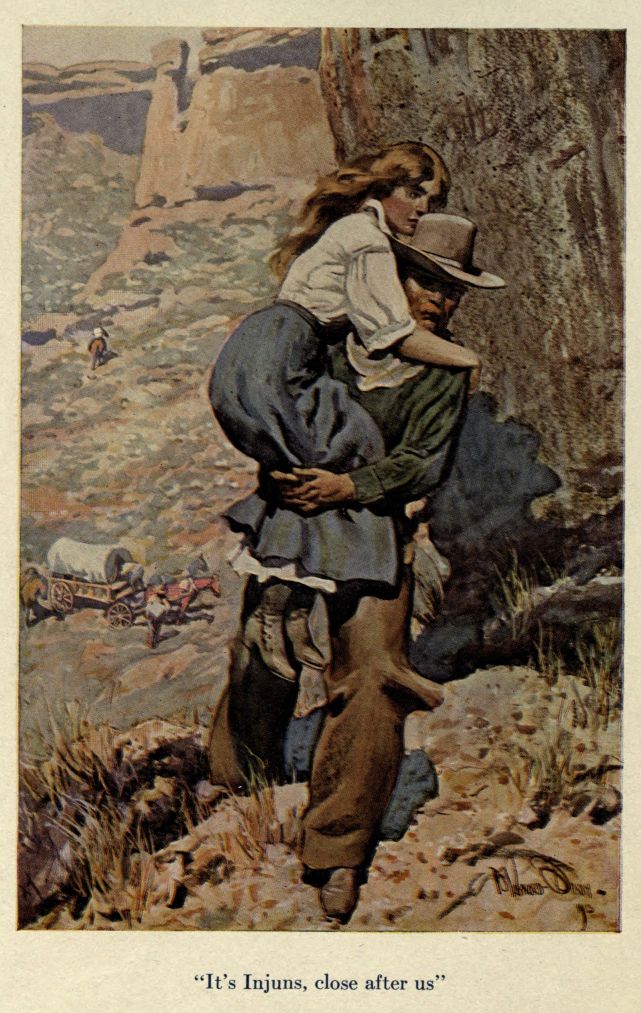
"It's Injuns, close after us"
She regarded him calmly. "I beg your pardon—if I had only known—is there great danger?"
He nodded. "If you show yoreself. There's allus danger with Injuns, ma'am."
She pushed the hair back from her face. "My brothers? Are they coming up?"
Her courage set him afire with rage for the Apaches, but he replied calmly. "Yes. Mebby th' Injuns won't know yo 're here, Ma'am. Me an' Jimmy 'll try to lead 'em past. Just lay low an' don't make no noise."
Her eyes glowed suddenly as she realized what he would try to do. "But yourself, and Jimmy? Would n't it be better to stay up here?"
"Yo 're a thoroughbred, ma'am," he replied in a low voice. "Me an' Jimmy has staked our lives more 'n onct out of pure devilment, with nothin' to gain. I reckon we got a reason this time, th' best we ever had. I 'm most proud, ma'am, to play my cards as I get them." He bent swiftly and touched her head, and was gone.
Meeting the brothers as they toiled up with supplies, he gave them a few terse orders and went on. Taking a handful of sand from behind a bowlder and scattering it with judicious care, he climbed to the wagon seat and waited, glancing back at the faint line that marked the arroyo's rim. In a few minutes a figure popped over it and whirled toward him in a high-flung, swirling cloud of dust. Overtaking the lurching wagon, Jimmy shouted a query and kept on, his pony picking its way with the agility and certainty of a mountain cat. The wagon, lurching this way and that, first on the wheels of one side and then on those of the other, bouncing and jumping at such speed that it was a miracle it was not smashed to splinters, careened after the hard-riding horseman. A rifle bounced over the tailboard, followed swiftly by a box of cartridges and an ebony-backed mirror, which settled on its back and glared into the sky like an angry Cyclops.
Mr. Purdy, bruised from head to foot and rapidly getting sober, emitted language in jerks and grabbed at the tailboard as the wagon box dropped two feet, leaving him in the air. But it met him half way and jolted him almost to the canvas top. He slid against the side and then jammed against the tailboard again and reached for it in desperation. Another drop in the trail made him miss it, and as the wagon arose again like a steel spring Mr. Purdy, wondering what caused all the earthquakes, arose on his hands and knees in the dust and spat angrily after the careening vehicle. He scrambled unsteadily to his feet and shook eager fists after the four-wheeled jumping-jack, and gave the Recording Angel great anguish of mind and writer's cramp. Pausing as he caught sight of the objects on the ground, he stared at them thoughtfully. He had seen many things during the past few days and was not to be fooled again. He looked at the sky, and back to the rifle. Then he examined the mesa wall, and quickly looked back at the weapon. It was still there and had not moved. He closed his eyes and opened them suddenly and grunted. "Huh, bet a ten spot it's real." He approached it cautiously, ready to pounce on it if it moved, but it did not and he picked it up. Seeing the cartridges, he secured them and then gasped with fear at the glaring mirror. After a moment's thought he grabbed at it and put it in his pocket just before a sudden, swirling cloud of dust drove him, choking and gasping, to seek the shelter of the bowlders close to the wall. When he raised his head again and looked out he caught sight of a sudden movement in the open, and promptly ducked, and swore. Apaches! Twelve of them!
He had seen strange things during the last few days, and just because the rifle and other objects had turned out to be real was no reason that he should absolutely trust his eyes in this particular instance. There was a limit, which in this case was Apaches in full war dress; so he arose swaggeringly and fired at the last, and saw the third from the last slide limply from his horse. As the rest paused and half of them wheeled and started back he rubbed his eyes in amazement, damned himself for a fool and sprinted for the mesa wall, up which he climbed with the frantic speed of fear. He was favored by the proverbial luck of fools and squirmed over a wide ledge without being hit. There was but one way to get him and he knew he could pick them off as fast as they showed above the rim. He rolled over and a look of mystification crept across his face. Digging into his pockets to see what the bumps were, he produced the mirror and a flask. The former he placed carelessly against the wall and the latter he raised hastily to his lips. The mirror glared out over the plain, its rays constantly interrupted by Mr. Purdy's cautious movements as he settled himself more comfortably for defense.
A bullet screamed up the face of the wall and he flattened, intently watching the rim. Chancing to glance over the plain, he noticed that the wagon was still moving, but slowly, while far to the south two horsemen galloped back toward the mesa on a wide circle, six Apaches tearing to intercept them before they could gain cover. "I was shore wise to leave th' schooner," he grinned. "I allus know when to jump," he said, and then swung the rifle toward the rim as a faint sound reached his ears. Its smoke blotted out the piercing black eyes that looked for an instant over the edge and found eternity, and Mr. Purdy grinned when the sound of impact floated up from below. "They won't try that no more," he grunted, and forthwith dozed in a drunken stupor. A sober man might have been tempted to try a shot over the rim, and would have been dead before he could have pulled the trigger. Mr. Purdy was again favored by luck.
Leaving two braves to watch him, the other two searched for a better way up the wall.
The race over the plain was interesting but not deadly or very dangerous for Bill and Jimmy. Armed with Winchesters and wornout Spencer carbines and not able to get close to the two punchers, the Apaches did no harm, and suffered because of Mr. Cassidy's use of a new, long-range Sharps. "You allus want to keep Injuns on long range, Kid," Bill remarked as another fell from its horse. The shot was a lucky one, but just as effective. "They ain't worth a d—n figurin' windage an' th' drift of a fast-movin' target, 'specially when it's goin' over ground like this. It's a white man's weapon, Jimmy. Them repeaters ain't no good for over five hundred; they don't use enough powder. An' I reckon them Spencers was wore out long ago. They ain't even shootin' close." He whirled past the projecting spur of the mesa and leaped from his horse, Jimmy following quickly. Three hundred yards down the canyon two Apaches showed themselves for a moment as they squirmed around a projection high up on the wall and not more than ten feet below the ledge. The expressions which they carried into eternity were those of great surprise. The two who kept Mr. Purdy treed on his ledge saw their friends fall, and squirmed swiftly toward their horses. It could only be cowpunchers entering the canyon at the other end and they preferred the company of their friends until they could determine numbers. When half way to the animals they changed their minds and crept toward the scene of action. Mr. Purdy, feeling for his flask, knocked it over the ledge and looked over after it in angry dismay. Then he shouted and pointed down. Bill and Jimmy stared for a moment, nodded emphatically, and separated hastily. Mr. Purdy ducked and hugged the ledge with renewed affection. Glancing around, he was almost blinded by the mirror and threw it angrily into the canyon, and then rubbed his eyes again. Far away on the plain was a moving blot which he believed to be horsemen. He fired his rifle into the air on a chance and turned again to the events taking place close at hand. "Other way, Hombre!" he warned, and Jimmy, obeying, came upon the Apache from the rear, and saved Bill's life. At hide and seek among rocks the Apache has no equal, but here they did not have a chance with Mr. Purdy calling the moves in a language they did not well understand. A bird's-eye view is a distinct asset and Mr. Purdy was playing his novel game with delighted interest and a plainsman's instinct. Consumed with rage, the remaining Indian whirled around and sent the guide reeling against the wall and then down in a limp heap. But Bill paid the debt and continued to worm among the rocks.
There was a sudden report to the westward and Jimmy staggered and dived behind a bowlder. The other four, having discovered the trick that had been played upon them on the other side of the mesa, were anxious to pay for it. Bill hurriedly crawled to Jimmy's side as the youth brushed the blood out of his eyes and picked up his rifle. "It's th' others, Kid," said Bill. "An' they 're gettin' close. Don't move an inch, for this is their game." A roar above him made him glance upward and swear angrily. "Now they 've gone an' done it! After all we 've done to hide 'em!" Another shot from the ledge and a hot, answering fire broke out from below. "My G—d!" said a voice, weakly. Bill shook his head. "That was Tom," he muttered. "Come on, Kid," he growled. "We got to drive 'em out, d—n it!" They were too interested in picking their way in the direction of the Apaches to glance at Mr. Purdy's elevated perch or they would have seen him on his knees at the very edge making frantic motions with his one good arm. He was facing the east and the plain. Beaming with joy, he waved his arm toward Bill and Jimmy, shouted instructions in a weak voice, that barely carried to the canyon floor, and collapsed, his duty done.
Bill was surprised fifteen minutes later to hear strange voices calling to him from the rear and he turned like a flash, his Colt swinging first. "Well, I 'm d—d!" he ejaculated. Four punchers were crawling toward him. "Glad to see you," he said, foolishly.
"I reckon so," came the smiling reply. "That lookin' glass of yourn shore bothered us. We could n't read it, but we did n't have to. Where are they?"
"Plumb ahead, som'ers. Four of 'em," Bill replied. "There 's two tender feet up on that ledge, with their sister. We was gettin' plumb worried for 'em."
"Not them as hired Whiskey Jeff for to guide 'em?" asked Dickinson, the leader.
"Th' same. But how 'n h—l did Logan ever come to let 'em start?" demanded Bill, angrily.
"We did n't pay no attention to th' rumors that has been flyin' around for th' last two months. Nobody had seen no signs of 'em," answered the Logan man. "We did n't reckon there was no danger till last night, when we learned they had n't showed up in Sharpsville, nor been seen anywheres near th' trail. Then we remembers Jeff's habits, an', while we debates it, we gets word that th' Injuns was seen north of Cook's ranch yesterday. We moves sudden. Here comes th' boys back—I reckon th' job 's done. They 're a fine crowd, a'right. You should 'a' seen 'em cut loose an' raise th' dust when we saw that lookin' glass a-winkin'. We could n't read it none, but we didn't have to. We just cut loose."
"Lookin' glass!" exclaimed Bill, staring. "That's twice you 've mentioned it. What glass? We didn't have no lookin' glass, nohow."
"Well, Whiskey Jeff had one, a'right. An' he shore keeps her a-talkin', too. Ain't it a cussed funny thing that a feller that's got a hardboiled face like his'n would go an' tote a lookin' glass around with him? We never done reckoned he was that vain."
Bill shook his head and gave it up. He glanced above him at the ledge and started for it as Jimmy pushed up to him through the little crowd. "Hello, Kid," Bill smiled. "Come on up an' help me get her down," he invited. Jimmy shook his head and refused. "Ah, what's th' use? She 'll only gimme h—l for handin' her that blamed Greaser lie," he snapped. "An' you can do it alone—didn't you tote her up th' cussed wall?" It had been a long-range view, but Jimmy had seen it, just the same, and resented it.
Bill turned and looked at him. "Well, I 'm cussed!" he muttered, and forthwith climbed the wall. A few minutes later he stuck his head over the rim of the ledge and looked down upon a good-natured crowd that lounged in the shadow of the wall and told each other all about it. Jimmy was the important center of interest and he was flushed with pride. It would take a great deal to make him cut short his hour of triumph and take him away from the admiring circle that hedged him in and listened intently to his words. "Yessir, by G—d," he was saying, "just then I looks over th' top of a li'l hill an' what I sees makes me duck a-plenty. There was a dozen of 'em, stringin' south. I knowed they 'd shore hit that—"
"Hey, Kid," said a humorous voice from above. Jimmy glanced up, vexed at the interruption. "Well, what?" he growled. Bill grinned down at him in a manner that bid fair to destroy the dignity that Jimmy had striven so hard to build up. "She says all right for you. She 's done let you down easy for that whoppin' big Greaser lie you went an' spun her. She wants to know ain't you comin' up so she can talk to you? How about it?"
"Go on, Kid," urged a low and friendly voice at his elbow.
"Betcha!" grinned another. "Wish it was me! I done seen her in Logan."
Jimmy loosed a throbbing phrase, but obeyed, whereat Bill withdrew his grinning face from the sight of the grinning faces below. "He 's comin' ma'am; but he's shore plumb bashful." He looked down the canyon and laughed. "There they go to get Purdy off 'n his perch. I 'm natchurally goin' to lick anybody as tries to thrash that man," he muttered, glancing at George as he passed Jimmy on the ledge. George grinned and shook his head. "I 'm going to give him the spree of his sinful, long life," he promised, thoughtfully.
Far to the west, silhouetted for a moment against the crimson sunset, appeared a row of mounted figures. It looked long and searchingly at the mesa and slowly disappeared from view. Bill saw it and pointed it out to Lefty Dickinson. "There 's th' other eight," he said, smiling cheerfully. "If it was n't for Whiskey Jeff's lookin' glass that eight 'd mean a whole lot to us. We 've had the luck of fools!"
VI
HOPALONG'S HOP
Having sent Jimmy to the Bar-20 with a message for Buck Peters and seen the tenderfeet start for Sharpsville on the right trail and under escort, Bill Cassidy set out for the Crazy M ranch, by the way of Clay Gulch. He was to report on the condition of some cattle that Buck had been offered cheap and he was anxious to get back to the ranch. It was in the early evening when he reached Clay Gulch and rode slowly down the dusty, shack-lined street in search of a hotel. The town and the street were hardly different from other towns and streets that he had seen all over the cow-country, but nevertheless he felt uneasy. The air seemed to be charged with danger, and it caused him to sit even more erect in the saddle and assume his habit of indifferent alertness. The first man he saw confirmed the feeling by staring at him insolently and sneering in a veiled way at the low-hung, tied-down holsters that graced Bill's thighs. The guns proclaimed the gun-man as surely as it would have been proclaimed by a sign; and it appeared that gun-men were not at that time held in high esteem by the citizens of Clay Gulch. Bill was growing fretful and peevish when the man, with a knowing shake of his head, turned away and entered the harness shop. "Trouble's brewin' somewheres around," muttered Bill, as he went on. He had singled out the first of two hotels when another citizen, turning the corner, stopped in his tracks and looked Bill over with a deliberate scrutiny that left but little to the imagination. He frowned and started away, but Bill spurred forward, determined to make him speak.
"Might I inquire if this is Clay Gulch?" he asked, in tones that made the other wince.
"You might," was the reply. "It is," added the citizen, "an' th' Crazy M lays fifteen mile west." Having complied with the requirements of common politeness the citizen of Clay Gulch turned and walked into the nearest saloon. Bill squinted after him and shook his head in indecision.
"He wasn't guessin', neither. He shore knowed where I wants to go. I reckon Oleson must 'a' said he was expectin' me." He would have been somewhat surprised had he known that Mr. Oleson, foreman of the Crazy M, had said nothing to anyone about the expected visitor, and that no one, not even on the ranch, knew of it. Mr. Oleson was blessed with taciturnity to a remarkable degree; and he had given up expecting to see anyone from Mr. Peters.
As Bill dismounted in front of the "Victoria" he noticed that two men further down the street had evidently changed their conversation and were examining him with frank interest and discussing him earnestly. As a matter of fact they had not changed the subject of their conversation, but had simply fitted him in the place of a certain unknown. Before he had arrived they discussed in the abstract; now they could talk in the concrete. One of them laughed and called softly over his shoulder, whereupon a third man appeared in the door, wiping his lips with the back of a hairy, grimy hand, and focused evil eyes upon the innocent stranger. He grunted contemptuously and, turning on his heel, went back to his liquid pleasures. Bill covertly felt of his clothes and stole a glance at his horse, but could see nothing wrong. He hesitated: should he saunter over for information or wait until the matter was brought to his attention? A sound inside the hotel made him choose the latter course, for his stomach threatened to become estranged and it simply howled for food. Pushing open the door he dropped his saddle in a corner and leaned against the bar.
"Have one with me to get acquainted?" he invited. "Then I 'll eat, for I 'm hungry. An' I 'll use one of yore beds to-night, too."
The man behind the bar nodded cheerfully and poured out his drink. As he raised the liquor he noticed Bill's guns and carelessly let the glass return to the bar.
"Sorry, sir," he said coldly. "I 'm hall out of grub, the fire 's hout, hand the beds are taken. But mebby 'Awley, down the strite, can tyke care of you."
Bill was looking at him with an expression that said much and he slowly extended his arm and pointed to the untasted liquor.
"Allus finish what you start, English," he said slowly and clearly. "When a man goes to take a drink with me, and suddenly changes his mind, why I gets riled. I don't know what ails this town, an' I don't care; I don't give a cuss about yore grub an' your beds; but if you don't drink that liquor you poured out to drink, why I 'll natchurally shove it down yore British throat so cussed hard it 'll strain yore neck. Get to it!"
The proprietor glanced apprehensively from the glass to Bill, then on to the business-like guns and back to the glass, and the liquor disappeared at a gulp. "W'y," he explained, aggrieved. "There hain't no call for to get riled hup like that, strainger. I bloody well forgot it."
"Then don't you go an' 'bloody well' forget this: Th' next time I drops in here for grub an' a bed, you have 'em both, an' be plumb polite about it. Do you get me?" he demanded icily.
The proprietor stared at the angry puncher as he gathered up his saddle and rifle and started for the door. He turned to put away the bottle and the sound came near being unfortunate for him. Bill leaped sideways, turning while in the air and landed on his feet like a cat, his left hand gripping a heavy Colt that covered the short ribs of the frightened proprietor before that worthy could hardly realize the move.
"Oh, all right," growled Bill, appearing to be disappointed. "I reckoned mebby you was gamblin' on a shore thing. I feels impelled to offer you my sincere apology; you ain't th' kind as would even gamble on a shore thing. You 'll see me again," he promised. The sound of his steps on the porch ended in a thud as he leaped to the ground and then he passed the window leading his horse and scowling darkly. The proprietor mopped his head and reached twice for the glass before he found it. "Gawd, what a bloody 'eathen," he grunted. "'E won't be as easy as the lawst was, blime 'im."
Mr. Hawley looked up and frowned, but there was something in the suspicious eyes that searched his face that made him cautious. Bill dropped his load on the floor and spoke sharply. "I want supper an' a bed. You ain't full up, an' you ain't out of grub. So I 'm goin' to get 'em both right here. Yes?"
"You shore called th' turn, stranger," replied Mr. Hawley in his Sunday voice. "That's what I 'm in business for. An' business is shore dull these days."
He wondered at the sudden smile that illuminated Bill's face and half guessed it; but he said nothing and went to work. When Bill pushed back from the table he was more at peace with the world and he treated, closely watching his companion. Mr. Hawley drank with a show of pleasure and forthwith brought out cigars. He seated himself beside his guest and sighed with relief.
"I 'm plumb tired out," he offered. "An' I ain't done much. You look tired, too. Come a long way?"
"Logan," replied Bill. "Do you know where I 'm goin'? An' why?" he asked.
Mr. Hawley looked surprised and almost answered the first part of the question correctly before he thought. "Well," he grinned, "if I could tell where strangers was goin', an' why, I would n't never ask 'em where they come from. An' I 'd shore hunt up a li'l game of faro, you bet!"
Bill smiled. "Well, that might be a good idea. But, say, what ails this town, anyhow?"
"What ails it? Hum! Why, lack of money for one thing; scenery, for another; wimmin, for another. Oh, h—l, I ain't got time to tell you what ails it. Why?"
"Is there anything th' matter with me?"
"I don't know you well enough for to answer that kerrect."
"Well, would you turn around an' stare at me, an' seem pained an' hurt? Do I look funny? Has anybody put a sign on my back?"
"You looks all right to me. What's th' matter?"
"Nothin', yet," reflected Bill slowly. "But there will be, mebby. You was mentionin' faro. Here 's a turn you can call: somebody in this wart of a two-by-nothin' town is goin' to run plumb into a big surprise. There 'll mebby be a loud noise an' some smoke where it starts from; an' a li'l round hole where it stops. When th' curious delegation now holdin' forth on th' street slips in here after I 'm in bed, an' makes inquiries about me, you can tell 'em that. An' if Mr.—Mr. Victoria drops in casual, tell him I 'm cleanin' my guns. Now then, show me where I 'm goin' to sleep."
Mr. Hawley very carefully led the way into the hall and turned into a room opposite the bar. "Here she is, stranger," he said, stepping back. But Bill was out in the hall listening. He looked into the room and felt oppressed.
"No she ain't," he answered, backing his intuition. "She is upstairs, where there is a li'l breeze. By th' Lord," he muttered under his breath. "This is some puzzle." He mounted the stairs shaking his head thoughtfully. "It shore is, it shore is."
The next morning when Bill whirled up to the Crazy M bunkhouse and dismounted before the door a puncher was emerging. He started to say something, noticed Bill's guns and went on without a word. Bill turned around and looked after him in amazement. "Well, what th' devil!" he growled. Before he could do anything, had he wished to, Mr. Oleson stepped quickly from the house, nodded and hurried toward the ranch house, motioning for Bill to follow. Entering the house, the foreman of the Crazy M waited impatiently for Bill to get inside, and then hurriedly closed the door.
"They 've got onto it some way," he said, his taciturnity gone; "but that don't make no difference if you 've got th' sand. I 'll pay you one hundred an' fifty a month, furnish yore cayuses an' feed you. I 'm losin' more 'n two hundred cows every month an' can't get a trace of th' thieves. Harris, Marshal of Clay Gulch, is stumped, too. He can't move without proof; you can. Th' first man to get is George Thomas, then his brother Art. By that time you 'll know how things lay. George Thomas is keepin' out of Harris' way. He killed a man last week over in Tuxedo an' Harris wants to take him over there. He 'll not help you, so don't ask him to." Before Bill could reply or recover from his astonishment Oleson continued and described several men. "Look out for ambushes. It 'll be th' hardest game you ever went up ag'in, an' if you ain't got th' sand to go through with it, say so."
Bill shook his head. "I got th' sand to go through with anythin' I starts, but I don't start here. I reckon you got th' wrong man. I come up here to look over a herd for Buck Peters; an' here you go shovin' wages like that at me. When I tells Buck what I 've been offered he 'll fall dead." He laughed. "Now I knows th' answer to a lot of things.
"Here, here!" he exclaimed as Oleson began to rave. "Don't you go an' get all het up like that. I reckon I can keep my face shut. An' lemme observe in yore hat-like ear that if th' rest of this gang is like th' samples I seen in town, a good gun-man would shore be robbin' you to take all that money for th' job. Fifty a month, for two months, would be a-plenty."
Oleson's dismay was fading, and he accepted the situation with a grim smile. "You don't know them fellers," he replied. "They 're a bad lot, an' won't stop at nothin'."
"All right. Let's take a look at them cows. I want to get home soon as I can."
Oleson shook his head. "I gave you up, an' when I got a better offer I let 'em go. I 'm sorry you had th' ride for nothin', but I could n't get word to you."
Bill led the way in silence back to the bunk house and mounted his horse. "All right," he nodded. "I shore was late. Well, I 'll be goin'."
"That gun-man is late, too," said Oleson. "Mebby he ain't comin'. You want th' job at my figgers?"
"Nope. I got a better job, though it don't pay so much money. It's steady, an' a hull lot cleaner. So-long," and Bill loped away, closely watched by Shorty Allen from the corral. And after an interval, Shorty mounted and swung out of the other gate of the corral and rode along the bottom of an arroyo until he felt it was safe to follow Bill's trail. When Shorty turned back he was almost to town, and he would not have been pleased had he known that Bill knew of the trailing for the last ten miles. Bill had doubled back and was within a hundred yards of Shorty when that person turned ranchward.
"Huh! I must be popular," grunted Bill. "I reckon I will stay in Clay Gulch till t'morrow mornin'; an' at the Victoria," he grinned. Then he laughed heartily. "Victoria! I got a better name for it than that, all right."
When he pulled up before the Victoria and looked in the proprietor scowled at him, which made Bill frown as he went on to Hawley's. Putting his horse in the corral he carried his saddle and rifle into the barroom and looked around. There was no one in sight, and he smiled. Putting the saddle and rifle back in one corner under the bar and covering them with gunny sacks he strolled to the Victoria and entered through the rear door. The proprietor reached for his gun but reconsidered in time and picked up a glass, which he polished with exaggerated care. There was something about the stranger that obtruded upon his peace of mind and confidence. He would let some one else try the stranger out.
Bill walked slowly forward, by force of will ironing out the humor in his face and assuming his sternest expression. "I want supper an' a bed, an' don't forget to be plumb polite," he rumbled, sitting down by the side of a small table in such a manner that it did not in the least interfere with the movement of his right hand. The observing proprietor observed and gave strict attention to the preparation of the meal. The gun-man, glancing around, slowly arose and walked carelessly to a chair that had blank wall behind it, and from where he could watch windows and doors.
When the meal was placed before him he glanced up. "Go over there an' sit down," he ordered, motioning to a chair that stood close to the rifle that leaned against the wall. "Loaded?" he demanded. The proprietor could only nod. "Then sling it acrost yore knees an' keep still. Well, start movin'."
The proprietor walked as though he were in a trance but when he seated himself and reached for the weapon a sudden flash of understanding illumined him and caused cold sweat to bead upon his wrinkled brow. He put the weapon down again, but the noise made Bill look up.
"Acrost yore knees," growled the puncher, and the proprietor hastily obeyed, but when it touched his legs he let loose of it as though it were hot. He felt a great awe steal through his fear, for here was a gun-man such as he had read about. This man gave him all the best of it just to tempt him to make a break. The rifle had been in his hands, and while it was there the gun-man was calmly eating with both hands on the table and had not even looked up until the noise of the gun made him!
"My Gawd, 'e must be a wizard with 'em. I 'opes I don't forget!" With the thought came a great itching of his kneecap; then his foot itched so as to make him squirm and wear horrible expressions. Bill, chancing to glance up carelessly, caught sight of the expressions and growled, whereupon they became angelic. Fearing that he could no longer hold in the laughter that tortured him, Bill arose.
"Shoulder, arms!" he ordered, crisply. The gun went up with trained precision. "Been a sojer," thought Bill. "Carry, arms! About, face! To a bedroom, march!" He followed, holding his sides, and stopped before the room. "This th' best?" he demanded. "Well, it ain't good enough for me. About, face! Forward, march! Column, left! Ground, arms! Fall out." Tossing a coin on the floor as payment for the supper Bill turned sharply and went out without even a backward glance.
The proprietor wiped the perspiration from his face and walked unsteadily to the bar, where he poured out a generous drink and gulped it down. Peering out of the door to see if the coast was clear, he scurried across the street and told his troubles to the harness-maker.
Bill leaned weakly against Hawley's and laughed until the tears rolled down his cheeks. Pushing weakly from the building he returned to the Victoria to play another joke on its proprietor. Finding it vacant he slipped upstairs and hunted for a room to suit him. The bed was the softest he had seen for a long time and it lured him into removing his boots and chaps and guns, after he had propped a chair against the door as a warning signal, and stretching out flat on his back, he prepared to enjoy solid comfort. It was not yet dark, and as he was not sleepy he lay there thinking over the events of the past twenty-four hours, often laughing so hard as to shake the bed. What a reputation he would have in the morning! The softness of the bed got in its work and he fell asleep, for how long he did not know; but when he awakened it was dark and he heard voices coming up from below. They came from the room he had refused to take. One expression banished all thoughts of sleep from his mind and he listened intently. "'Red-headed Irish gunman.' Why, they means me! 'Make him hop into h—l.' I don't reckon I 'd do that for anybody, even my friends."
"I tried to give 'im this room, but 'e would n't tyke it" protested the proprietor, hurriedly. "'E says the bloody room was n't good enough for 'im, hand 'e marches me out hand makes off. Likely 'e 's in 'Awley's."
"No, he ain't," growled a strange voice. "You 've gone an' bungled th' whole thing."
"But I s'y I did n't, you know. I tries to give 'im this werry room, George, but 'e would n't 'ave it. D'y think I wants 'im running haround this blooming town? 'E 's worse nor the other, hand Gawd knows 'e was bad enough. 'E 's a cold-blooded beggar, 'e is!"
"You missed yore chance," grunted the other. "Wish I had that gun you had."
"I was wishing to Gawd you did," retorted the proprietor. "It never looked so bloody big before, d—n 'is 'ide!"
"Well, his cayuse is in Hawley's corral," said the first speaker. "If I ever finds Hawley kept him under cover I 'll blow his head off. Come on; we 'll get Harris first. He ought to be gettin' close to town if he got th' word I sent over to Tuxedo. He won't let us call him. He's a man of his word."
"He 'll be here, all right. Fred an' Tom is watchin' his shack, an' we better take th' other end of town—there 's no tellin' how he 'll come in now," suggested Art Thomas. "But I wish I knowed where that cussed gun-man is."
As they went out Bill, his chaps on and his boots in his hand, crept down the stairs, and stopped as he neared the hall door. The proprietor was coming back. The others were outside, going to their stations and did not hear the choking gasp that the proprietor made as a pair of strong hands reached out and throttled him. When he came to he was lying face down on a bed, gagged and bound by a rope that cut into his flesh with every movement. Bill, waiting a moment, slipped into the darkness and was swallowed up. He was looking for Mr. Harris, and looking eagerly.
The moon arose and bathed the dusty street and its crude shacks in silver, cunningly and charitably hiding its ugliness; and passed on as the skirmishing rays of the sun burst into the sky in close and eternal pursuit. As the dawn spread swiftly and long, thin shadows sprang across the sandy street, there arose from the dissipated darkness close to the wall of a building an armed man, weary and slow from a tiresome vigil. Another emerged from behind a pile of boards that faced the marshal's abode, while down the street another crept over the edge of a dried-out water course and swore softly as he stood up slowly to flex away the stiffness of cramped limbs. Of vain speculation he was empty; he had exhausted all the whys and hows long before and now only muttered discontentedly as he reviewed the hours of fruitless waiting. And he was uneasy; it was not like Harris to take a dare and swallow his own threats without a struggle. He looked around apprehensively, shrugged his shoulders and stalked behind the shacks across from the two hotels.
Another figure crept from the protection of Hawley's corral like a slinking coyote, gun in hand and nervously alert. He was just in time to escape the challenge that would have been hurled at him by Hawley, himself, had that gentleman seen the skulker as he grouchily opened one shutter and scowled sleepily at the kindling eastern sky. Mr. Hawley was one of those who go to bed with regret and get up with remorse, and his temper was always easily disturbed before breakfast. The skulker, safe from the remorseful gentleman's eyes, and gun, kept close to the building as he walked and was again fortunate, for he had passed when Mr. Hawley strode heavily into his kitchen to curse the cold, rusty stove, a rite he faithfully performed each morning. Across the street George and Art Thomas walked to meet each other behind the row of shacks and stopped near the harness shop to hold a consultation. The subject was so interesting that for a few moments they were oblivious to all else.
A man softly stepped to the door of the Victoria and watched the two across the street with an expression on his face that showed his smiling contempt for them and their kind. He was a small man, so far as physical measurements go, but he was lithe, sinewy and compact. On his opened vest, hanging slovenly and blinking in the growing light as if to prepare itself for the blinding glare of midday, glinted a five-pointed star of nickel, a lowly badge that every rural community knows and holds in an awe far above the metal or design. Swinging low on his hip gleamed the ivory butt of a silver-plated Colt, the one weakness that his vanity seized upon. But under the silver and its engraving, above and before the cracked and stained ivory handles, lay the power of a great force; and under the casing of the marshal's small body lay a virile manhood, strong in courage and determination. Toby Harris watched, smilingly; he loved the dramatic and found keen enjoyment in the situation. Out of the corner of his eye he saw a carelessly dressed cowpuncher slouching indolently along close to the buildings on the other side of the street with the misleading sluggishness of a panther. The red hair, kissed by the slanting rays of the sun where it showed beneath the soiled sombrero, seemed to be a flaming warning; the half-closed eyes, squinting under the brim of the big hat, missed nothing as they darted from point to point.
The marshal stepped silently to the porch and then on to the ground, his back to the rear of the hotel, waiting to be discovered. He had been in sight perhaps a minute. The cowpuncher made a sudden, eye-baffling movement and smoke whirled about his hips. Fred, turning the corner behind the marshal, dropped his gun with a scream of rage and pain and crashed against the window in sudden sickness, his gunhand hanging by a tendon from his wrist. The marshal stepped quickly forward at the shot and for an instant gazed deeply into the eyes of the startled rustlers. Then his Colt leaped out and crashed a fraction of a second before the brothers fired. George Thomas reeled, caught sight of the puncher and fired by instinct. Bill, leaving Harris to watch the other side of the street, was watching the rear corner of the Victoria and was unprepared for the shot. He crumpled and dropped and then the marshal, enraged, ended the rustler's earthly career in a stream of flame and smoke. Tom, turning into the street further down, wheeled and dashed for his horse, and Art, having leaped behind the harness shop, turned and fled for his life. He had nearly reached his horse and was going at top speed with great leaps when the prostrate man in the street, raising on his elbow, emptied his gun after him, the five shots sounding almost as one. Art Thomas arose convulsively, steadied himself and managed to gain the saddle. Harris looked hastily down the street and saw a cloud of dust racing northward, and grunted. "Let them go—they won't never come back no more." Running to the cowpuncher he raised him after a hurried examination of the wounded thigh. "Hop along, Cassidy," he smiled in encouragement. "You 'll be a better man with one good laig than th' whole gang was all put together."
The puncher smiled faintly as Hawley, running to them, helped him toward his hotel. "Th' bone is plumb smashed. I reckon I 'll hop along through life. It 'll be hop along, for me, all right. That's my name, all right. Huh! Hopalong Cassidy! But I didn't hop into h—l, did I, Harris?" he grinned bravely.
And thus was born a nickname that found honor and fame in the cow-country—a name that stood for loyalty, courage and most amazing gun-play. I have Red's word for this, and the endorsement of those who knew him at the time. And from this on, up to the time he died, and after, we will forsake "Bill" and speak of him as Hopalong Cassidy, a cowpuncher who lived and worked in the days when the West was wild and rough and lawless; and who, like others, through the medium of the only court at hand, Judge Colt, enforced justice as he believed it should be enforced.
VII
"DEALING THE ODD"
Faro-bank is an expensive game when luck turns a cold shoulder on any player, and "going broke" is as easy as ruffling a deck. When a man finds he has two dollars left out of more than two months' pay and that it has taken him less than thirty minutes to get down to that mark, he cannot be censored much if he rails at that Will-o'-the-wisp, the Goddess of Luck. Put him a good ten days' ride from home, acquaintances and money and perhaps he will be justified in adding heat in plenty to his denunciation. He had played to win when he should have coppered, coppered when he should have played to win, he had backed both ends against the middle and played the high card as well—but only when his bets were small did the turn show him what he wanted to see. Perhaps the case-keeper had hoodooed him, for he never did have any luck at cards when a tow-headed man had a finger in the game.
Fuming impotently at his helplessness, a man limped across the main street in Colby, constrained and a little awkward in his new store clothes and new, squeaking boots that were clumsy with stiffness. The only things on him that he could regard as old and tried friends were the battered sombrero and the heavy, walnut-handled Colt's .45 which rubbed comfortably with each movement of his thigh. The weapon, to be sure, had a ready cash value—but he could not afford to part with it. The horse belonged to his ranch, and the saddle must not be sold; to part with it would be to lose his mark of caste and become a walking man, which all good punchers despised.
"Ten days from home, knowin' nobody, two measly dollars in my pocket, an' luck dead agin me," he growled with pugnacious pessimism. "Oh, I 'm a wise old bird, I am! A h—l of a wise bird. Real smart an' cute an' shiny, a cache of wisdom, a real, bonyfied Smart Aleck with a head full of spavined brains. I copper th' deuce an' th' deuce wins; I play th' King to win for ten dollars when I ought to copper it. I lay two-bits and it comes right—ten dollars an' I see my guess go loco. Reckon I better slip these here twin bucks down in my kill-me-soon boots afore some blind papoose takes 'em away from me. Wiser 'n Solomon, I am; I 've got old Caesar climbin' a cactus for pleasure an' joy. S-u-c-k-e-r is my middle name—an' I 'm busted."
He almost stumbled over a little tray of a three-legged table on the corner of the street and his face went hard as he saw the layout. Three halves of English walnut shells lay on the faded and soiled green cloth and a blackened, shriveled pea was still rolling from the shaking he had given the table. He stopped and regarded it gravely, jingling his two dollars disconsolately. "Don't this town do nothin' else besides gamble?" he muttered, looking around.
"Howd'y, stranger!" cheerfully cried a man who hastened up. "Want to see me fool you?"
The puncher's anger was aroused to a thin, licking flame; but it passed swiftly and a cold, calculating look came into his eyes. He glanced around swiftly, trying to locate the cappers, but they were not to be seen, which worried him a little. He always liked to have possible danger where he could keep an eye on it. Perhaps they were eating or drinking—the thought stirred him again to anger: two dollars would not feed him very long, nor quench his thirst.
"Pick it out, stranger," invited the proprietor, idly shifting the shells. "It's easy if yo 're right smart—but lots of folks just can't do it; they can't seem to get th' hang of it, somehow. That's why it's a bettin' proposition. Here it is, right before yore eyes! One little pea, three little shells, right here plumb in front of yore eyes! Th' little pea hides under one of th' little shells, right in plain sight: But can you tell which one? That's th' whole game, right there. See how it's done?" and the three little shells moved swiftly but clumsily and the little pea disappeared. "Now, then; where would you say it was?" demanded the hopeful operator, genially.
The puncher gripped his two dollars firmly, shifted his weight as much as possible on his sound leg, and scowled: he knew where it was. "Do I look like a kid? Do you reckon you have to coax like a fool to get me all primed up to show how re-markably smart an' quick I am? You don't; I know how smart I am. Say, you ain't, not by any kinda miracle, a blind papoose, are you?" he demanded.
"What you mean?" asked the other, smiling as he waited for the joke. It did not come, so he continued. "Don't take no harm in my fool wind-jammin', stranger. It's in th' game. It's a habit; I 've said it so much I just can't help it no more—I up an' says it at a funeral once; that is, part of it—th' first part. That's dead right! But I reckon I 'm wastin' my time—unless you happen to feel coltish an' hain't got nothin' to do for an age. I 've been playin' in hard luck th' last week or so—you see, I ain't as good as I uster be. I ain't quite so quick, an' a little bit off my quickness is a whole lot off my chances. But th' game's square—an' that's a good deal more'n you can say about most of 'em."