Front matter (continued 3)
Reading edition
The puncher hesitated, a grin flickering about his thin lips and a calm joy warming him comfortably. He knew the operator. He knew that face, the peculiar, crescent-shaped scar over one brow, and the big, blue eyes that years of life had not entirely robbed of their baby-like innocence. The past, sorted thoroughly and quickly by his memory, shoved out that face before a crowd of others. Five years is not a long time to remember something unpleasant; he had reasons to remember that countenance. Knowing the face he also knew that the man had been, at one time, far from "square." The associations and means of livelihood during the past five years, judging from the man's present occupation, had not been the kind to correct any evil tendency. He laid a forefinger on the edge of the tray. "Start th' machinery—I 'll risk a couple of dollars, anyhow. That ain't much to lose. I bet two dollars I can call it right," he said, watching closely.
He won, as he knew he would; and the result told him that the gambler had not reformed. The dexterous fingers shifting the shells were slower than others he had seen operate and when he had won again he stopped, as if to leave. "When I hit town a short time ago I didn't know I 'd be so lucky. I went an' drawed two months' pay when I left th' ranch: I shore don't need it. Shuffle 'em again—it's yore money, anyhow," he laughed. "You should 'a' quit th' game before you got so slow."
"Goin' back to work purty soon?" queried the shell-man, wondering how much this "sucker" had left unspent.
"Not me! I 've only just had a couple of drinks since I hit town—an' I 'm due to celebrate."
The other's face gave no hint of his thoughts, which were that the fool before him had about a hundred dollars on his person. "Well, luck's with you today—you 've called it right twice. I 'll bet you a cool hundred that you can't call it th' third time. It's th' quickness of my hands agin yore eyes—an' you can't beat me three straight. Make it a hundred? I hate to play all day."
"I 'll lay you my winnings an' have some more of yore money," replied the puncher, feverishly. "Ain't scared, are you?"
"Don't know what it means to be scared," laughed the other. "But I ain't got no small change, nothin' but tens. Play a hundred an' let's have some real excitement."
"Nope; eight or nothin'."
He won again. "Now, sixteen even. Come on; I 've got you beat."
"But what's th' use of stringin' 'long like that?" demanded the shell-man.
"Gimme a chance to get my hand in, won't you?" retorted the puncher.
"Well, all right," replied the gambler, and he lost the sixteen.
"Now thirty," suggested the puncher. "Next time all I 've got, every red cent. Once more to practice—then every red," he repeated, shifting his feet nervously. "I 'll clean you out an' have a real, genuine blow-out on yore money. Come on, I 'm in a hurry."
"I 'll fool you this time, by th' Lord!" swore the gambler, angrily. "You've got more luck than sense. An' I 'll fool you next time, too. Yo 're quicker 'n most men I 've run up agin, but I can beat you, shore as shootin'. Th' game's square, th' play fair—my hand agin yore eye. Ready? Then watch me!"
He swore luridly and shoved the money across the board to the winner, bewailing his slowness and getting angrier every moment. "Yo 're th' cussedest man I ever bet agin! But I'll get you this time. You can't guess right all th' time, an' I know it."
"There she is; sixty-two bucks, three score an' two simoleons; all I 've got, every cent. Let's see you take it away from me!"
The gambler frowned and choked back a curse. He had risked sixty dollars to win two, and the fact that he had to let this fool play again with the fire hurt his pride. He had no fear for his money—he knew he could win at every throw—but to play that long for two dollars! And suppose the sucker had quit with the sixty!
"Do you get a dollar a month?" he demanded, sarcastically. "Well, I reckon you earn it, at that. Thought you had money, thought you drew down two months' pay an' hain't had nothin' more'n two drinks? Did you go an' lose it on th' way?"
"Oh, I drew it a month ago," replied the sucker, surprised. "I 've only had two drinks in this town, which I hit 'bout an hour ago. But I shore lost a wad playin' faro-bank agin a towhead. Come on—lemme take sixty more of yore money, anyhow."
"Sixty-two!" snapped the proprietor, determined to have those two miserable dollars and break the sucker for revenge. "Every cent, you remember."
"All right; I don't care! I ain't no tin-horn," grumbled the other. "Think I care 'bout two dollars?" But he appeared to be very nervous, nevertheless.
"Well, put it on th' table."
"After you put yourn down."
"There it is. Now watch me close!" A gleam of joy flashed up in the angry man's eyes as he played with the shells. "Watch me close! Mebby it is, an' mebby it ain't—th' game's square, th' play 's fair. It's my hand agin yore eye. Watch me close!"
"Oh, go ahead! I'm watchin', all right. Think I 'd go to sleep now!"
The shifting hands stopped, the shells lay quiet, and the gambler gazed blankly down the unsympathetic barrel of a Colt.
"Now, Thomas, old thimble-rigger," crisply remarked the supposed sucker as he cautiously slid the money off the table, to be picked up later when conditions would be more favorable. "Th' little pea ain't under no shell. Stop! Step back one pace an' elevate them paws. Don't make no more funny motions with that hand, savvy? But you can drop th' pea if it hurts them two fingers. Now we 'll see if I win; I allus like to be shore," and he cautiously turned over the shells, revealing nothing but the dirty green cloth. "I win; it ain't there—just like I thought."
"Who are you, an' how 'd you know my name?" demanded the gambler, mentally cursing his two missing cappers. They were drinking once too often and things were going to happen in their vicinity, and very soon.
"Why, you took twenty-five dollars from me up in Alameda onct, when I could n't afford to lose it," grinned the puncher. "I was something of a kid then. I remember you, all right. My foreman told me about yore bang-up fight agin th' Johnson brothers, who gave you that scar. I thought then that you were a great man—now I know you ain't. I would n't 'a' played at all if I had n't knowed how crooked you was. Take yore layout an' yore crookedness, find th' pea an' yore cappers, an' clear out. An' if anybody asks you if you 've seen Hopalong Cassidy you tell 'em I 'm up here in Colby makin' some easy money beatin' crooked games. So-long, an' don't look back!"
Hopalong watched him go and then went to the nearest place where he could get something to eat. In due time, having disposed of a square meal, Hopalong called for a drink and a cigar, and sat quietly smoking for nearly half an hour, so lost in thought that his cigar went out repeatedly. As he reviewed his disastrous play at faro many small details came to him and now he found them interesting. The dealer was not a master at his trade and Hopalong had seen many better; in fact the man was not even second class, and this fact hurt his pride. He had played a careful game, and the great majority of his small bets had won—it was only when he risked twenty or thirty dollars that he lost. The only big bet that he had been at all lucky on was one where doubles showed on the turn and he had been split, losing half of his stake. But when he had played his last fifty dollars on the Jack, open, the final blow fell and he had left the table in disgust.
Why weren't there cue-cards, so the players could keep their own tally of the cards instead of having to depend on the cue-box kept by the case-keeper? This made him suspicious; a crooked dealer and case-keeper can trim a big bet at will, unless the players keep their own cases or are exceptionally wise; and even then a really good dealer will get away with his play nine times out of ten. While he seldom played a system, he had backed one that morning; but he was cured of that weakness now. If the game were square he figured he could get at least an even break; if crooked, nothing but a gun could beat it, and he had a very good gun. When he thought of the gun, he reviewed the arrangement of the room and estimated the weight of the rough, deal table on which rested the faro layout. He smiled and turned to the bartender. "Hey, barkeeper! Got any paper an' a pencil?"
After some rummaging the taciturn dispenser of liquid forget-it produced the articles in question and Hopalong, drawing some hurried lines, paid his bill, treated, kept the pencil and headed for the faro game across the street.
When he entered the room the table was deserted and he nodded to the dealer as he seated himself at the right of the case-keeper, who now took his place, and opposite the dealer and the lookout. He was not surprised to find no other players in the room, for the hour was wrong; later in the afternoon there would be many and at night the place would be crowded. This suited him perfectly and he settled himself to begin playing.
When the deck was shuffled and placed in the deal box Hopalong put his ruled paper in front of him on the table, tallied once against the King for the soda card and started to play quarters and half dollars. He caught the fugitive look that passed between the men as they saw his cue-card but he gave no sign of having observed it. After that he never looked up from the cards while his bets were small. Two deals did not alter his money much and he knew that so far the game was straight. If it were not to remain straight the crookedness would not come more than once in a deal if the frame-up was "single-odd" and then not until the bet was large enough to practically break him. His high-card play ran in his favor and kept him gradually drawing ahead. He lost twice in calling the last turn and guessed it right once, at four to one, which made him win in that department of the game.
When the fifth deal began he was quite a little ahead and his play became bolder, some of the bets going as high as ten dollars. He broke even and then played heavier on the following deal. His first high bet, twenty dollars, was on the eight, open, only one eight having shown. Double eights showed on the next turn and he was split, losing half the stake.
It was about this time that the look-out discovered that Mr. Cassidy was getting a little excited and several times had nearly forgotten to keep his cases. This information was cautiously passed to the dealer and case-keeper and from then on they evinced a little more interest in the game. Finally the player, after studying his cue-card, placed fifty dollars on the Queen, open, and coppered the deuce, a case-card, and then put ten more on the high card. This came in the middle of the game and he was prepared for trouble as the turn was made, but fortune was kind to him and he raked in sixty dollars. He was mildly surprised that he had won, but explained it to himself by thinking that the stakes were not yet high enough. From then on he was keenly alert, for the crookedness would come soon if it ever did, but he strung small sums on the next dozen turns and waited for a new deal before plunging.
As the dealer shuffled the cards the door opened and closed noisily and a surprised and doubting voice exclaimed: "Ain't you Hopalong Cassidy? Cassidy, of th' Bar-20?"
Hopalong glanced up swiftly and back to the cards again: "Yes; what of it?"
"Oh, nothin'. I saw you onct an' I wondered if I was right."
"Ain't got time now; see you later, mebby. You might stick around outside so I can borrow some money if I go broke." The man who knew Mr. Cassidy silently faded, but did not stick around, thereby proving that the player knew human nature and also how to get rid of a pest.
When the dealer heard the name he glanced keenly at the owner of it, exchanged significant looks with the case-keeper and faltered for an instant as he shoved the cards together. He was not sure that he had shuffled them right, and an anxious look came into his eyes as he realized that the deal must go on. It was far from reassuring to set out to cheat a man so well known for expert short-gun work as the Bar-20 puncher and he wished he could be relieved. There was no other dealer around at that time of the day and he had to go through with it. He did not dare to shuffle again and chance losing the card beyond hope, and for the reason that the player was watching him like a hawk.
A ten lay face up on the deck and Hopalong, tallying against it on his sheet, began to play small sums. Luck was variable and remained so until the first twenty dollar bet, when he reached out excitedly and raked in his winnings, his coat sleeve at the same time brushing the cue-card off the table. But he had forgotten all about the tally sheet in his eagerness to win and played several more cards before he noticed it was missing and sought for it. Smothering a curse he glanced at the case-keeper's tally and went on with the play. He did not see the look of relief that showed momentarily on the faces of the dealer and his associates, but he guessed it.
He had no use for cue-cards when he felt like doing without them; he liked to see them in use by the players because it showed the game to be more or less straight, and it also saved him from over-heating his memory. When he had brushed his tally sheet off the table he knew what he was doing, and he knew every card that had been drawn out of the box. So far he had seen no signs of cheating and he wished to give the dealer a chance. There should now remain in the deal box three cards, a deuce, five and a four, with a Queen in sight as the last winner. He knew this to be true because he had given all his attention to memorizing the cards as they showed in the deal box, and had made his bets small so he would not have to bother about them. As he had lost three times on a four he now believed it was due to win.
Taking all his money he placed it on the four: "Two hundred and seventy on th' four to win," he remarked, crisply.
The dealer sniffed almost inaudibly and the case-keeper prepared to cover him on the cue-rack under cover of the excitement of the turn. If the four lay under the Queen, Cassidy lost; if not he either won or was in hock. The dealer was unusually grave as he grasped the deal box to make the turn and as the Queen slid off a five-spot showed.
The dealer's hand trembled as he slid the five off, showing a four, and a winner for Hopalong. He went white—he had bungled the shuffle in his indecision and now he did n't know what might develop. And in his agitation he exposed the hock card before he realized what he was doing, and showed another five. He had made the mistake of showing the "odd."
Hopalong, ready for trouble, was more prepared than the others and he was well under way before they started. His left hand swung hard against the case-keeper's jaw, his Colt roared at the drawing bartender, crumpling the trouble-hunter into a heap on the floor dazed from shock of a ball that "creased" his head. He had done this as he sprang to his feet and his left hand, dropping swiftly to the heavy table, threw it over onto the lookout and the dealer at the instant their hands found their guns. Caught off their balance they went down under it and before they could move sufficiently to do any damage, Hopalong vaulted the table and kicked their guns out of their hands. When they realized just what had happened a still-smoking Colt covered them. Many of Hopalong's most successful and spectacular plays had been less carefully thought out beforehand than this one and he laughed sneeringly as he looked at the men who had been so greedy as to try to clean him out the second time.
"Get up!" he snarled.
They crawled out of their trap and sullenly obeyed his hand, backing against the wall. The case-keeper was still unconscious and Hopalong, disarming him, dragged him to the wall with the others.
"I wondered where that deuce had crawled to," Mr. Cassidy remarked, grimly, "an' I was goin' to see, only it's plain now. I knowed you was clumsy, but my G—d! Any man as can't deal 'single-odd' ought to quit th' business, or play straight. So you had five fives agin me, eh? Instead of keepin' th' five under th' Queen, you bungled th' deuce in its place. When you went to pull off th' Queen an' five like they was one card, you had th' deuce under her. You see, I keep cases in my old red head an' I did n't have to believe what th' cue-rack was all fixed to show me. An' I was waitin', all ready for th' play that 'd make me lose.
"As long as this deal was framed up, we 'll say it was this mornin'. You cough up th' hundred an' ten I lost then, an' another hundred an' ten that I 'd won if it was n't crooked. An' don't forget that two-seventy I just pulled down, neither. Make it in double eagles an' don't be slow 'bout it. Money or lead—with you callin' th' turn." It was not a very large amount and it took only a moment to count it out. The eleven double eagles representing the mornin's play seemed to slide from the dealer's hand with reluctance—but a man lives only once, and they slid without stopping.
The winner, taking the money, picked up the last money he had bet and, distributing it over his person to equalize the weight, gathered up the guns from the floor. Backing toward the door he noticed that the bartender moved and a keen glance at that unfortunate assured him that he would live.
When he reached the door he stopped a moment to ask a question, the tenseness of his expression relaxing into a broad, apologetic grin. "Would you mind tellin' me where I can find some more frame-ups? I shore can use th' money."
The mumbled replies mentioned a locality not to be found on any map of the surface of the globe, and grinning still more broadly, Mr. Cassidy side-stepped and disappeared to find his horse and go on his way rejoicing.
VIII
THE NORTHER
Johnny knew I had a notebook crammed with the stories his friends had told me; but Johnny, being a wise youth, also knew that there was always room for one more. Perhaps that explains his sarcasm, for, as he calmly turned his back on his fuming friend, he winked at me and sauntered off, whistling cheerfully.
Red spread his feet apart, jammed his fists against his thighs and stared after the youngster. His expression was a study and his open mouth struggled for a retort, but in vain. After a moment he shook his head and slowly turned to me. "Hear th' fool? He 's from Idyho, he is. It never gets cold nowhere else on earth. Ain't it terrible to be so ignorant?" He glanced at the bunkhouse, into which Johnny had gone for dry clothing. "So I ain't never seen no cold weather?" he mused thoughtfully. Snapping his fingers irritably, he wheeled toward the corral. "I 'm goin' down to look at th' dam—there 's been lots of water leanin' ag'in it th' last week. Throw th' leather on Saint, if you wants, an' come along. I 'll tell you about some cold weather that had th' Idyho brand faded. Cold weather! Huh!"
As he swung past the bunkhouse we saw Johnny and Billy Jordan leaning in the doorway ragging each other, as cubs will. Johnny grinned at Red and executed a one-hand phrase of the sign language that is universally known, which Red returned with a chuckle. "Wish he 'd been here th' time God took a hand in a big game on this ranch," he said. "I 'm minus two toes on each foot in consequence thereof. They can't scare me none by preachin' a red-hot hell. No, sir; not any."
He was silent a moment. "Mebby it ain't so bad when a feller is used to it; but we ain't. An' it frequent hits us goin' over th' fence, with both feet off th' ground. Anyhow, that Norther was n't no storm—it was th' attendant agitation caused by th' North Pole visitin' th' Gulf.
"Cowan had just put Buckskin on th' map by buildin' th' first shack. John Bartlett an' Shorty Jones, d—n him, was startin' th' Double Arrow with two hundred head. When th' aforementioned agitation was over they had less 'n one hundred. We lost a lot of cows, too; but our range is sheltered good, an' that rock wall down past Meeker's bunkhouse stopped our drifts, though lots of th' cows died there.
"We 'd had a mild winter for two weeks, an' a lot of rain. We was chirpin' like li'l fool birds about winter bein' over. Ever notice how many times winter is over before it is? But Buck did n't think so; an' he shore can smell weather. We was also discussin' a certain campin' party Jimmy had discovered across th' river. Jimmy was at th' bunkhouse that shift an' he was a great hand for snoopin' around kickin' up trouble. He reports there's twelve in th' party an' they 're camped back of Split Hill. Now, Split Hill is no place for a camp, even in th' summer; an' what got us was th' idea of campin' at all in th' winter. It riled Buck till he forgot to cross off three days on th' calendar, which we later discovered by help of th' almanac an' th' moon. Buck sends Hoppy over to scout around Split Hill. You know Hoppy. He scouted for two days without bein' seen, an' without discoverin' any lawful an' sane reason why twelve hard-lookin' fellers should be campin' back of Split Hill in th' winter time. He also found they had come from th' south, an' he swore there was n't no cow tracks leadin' toward them from our range. But there was lots of hoss tracks back and forth. An' when he reports that th' campers had left an' gone on north we all feel better. Then he adds they turned east below th' Double Arrow an' went back south again. That's different. It's plain to some of us they was lookin' us over for future use; learnin' our ways an' th' lay of th' land. There was seven of us at th' time, but we could 'a' licked 'em in a fair fight.
"In them days we only had two line houses. Number One was near Big Coulee, with Cowan's at th' far end of its fifteen miles of north line; th' west line was a twenty-five-mile ride south to Lookout Peak. Number Two was where th' Jumpin' Bear empties into th' river, now part of Meeker's range. From it th' riders went west twenty-five miles to th' Peak an' north from it twenty-five miles along th' east line. There was a hundred thousan' acres in Conroy Valley an' thirty thousan' in th' Meeker triangle, which made up Section Two. At that time mebby ten thousan' cows was on this section—two-thirds of all of 'em. When we built Number Three on th' Peak this section was cut down to a reasonable size. Th' third headquarters then was th' bunkhouse, with only th' east line to ride. One part, th' shortest, ran north to Cowan's; th' other run about seventeen miles south to Li'l Timber, where th' line went on as part of Number Two's. We paired off an' had two weeks in each of 'em in them days.
"When we shifted at th' end of that week Jimmy Price an' Ace Fisher got Number One; Skinny an' Lanky was in Number Two; an' me an' Buck an' Hoppy took life easy in th' bunkhouse, with th' cook to feed us. Buck, he scouted all over th' ranch between th' lines an' worked harder than any of us, spendin' his nights in th' nearest house.
"One mornin', about a week after th' campers left, Buck looked out of th' bunkhouse door an' cautions me an' Hoppy to ride prepared for cold weather. I can see he 's worried, an' to please him we straps a blanket an' a buffalo robe behind our saddles, cussin' th' size of 'em under our breath. I 've got th' short ride that day, an' Buck says he 'll wait for me to come back, after which we 'll scout around Medicine Bend. He 's still worried about them campers. In th' Valley th' cows are thicker 'n th' other parts of th' range, an' it would n't take no time to get a big herd together. He 's got a few things to mend, so he says he 'll do th' work before I get back.
"Down on Section Two things is happenin' fast, like they mostly do out here. Twelve rustlers can do a lot if they have things planned, an' 'most any fair plan will work once. They only wanted one day—after that it would be a runnin' fight, with eight or nine of 'em layin' back to hold us off while th' others drove th' cows hard. Why, Slippery Trendley an' Tamale Jose was th' only ones that ever slid across our lines with that many men.
"Three rustlers slipped up to Number Two at night an' waited. When Skinny opened th' door in th' mornin' he was drove back with a hole in his shoulder. Then there was h—l a-poppin' in that li'l mud shack. But it did n't do no good, for neither of 'em could get out alive until after dark. They learned that with sorrow, an' pain. An' they shore was het up about it. Ace Fisher, ridin' along th' west line from Number One, was dropped from ambush. Two more rustlers lay back of Medicine Bend lookin' for any of us that might ride down from the bunkhouse. An' they sent two more over to Li'l Timber to lay under that ledge of rock that sticks out of th' south side of th' bluff like a porch roof. Either me or Hoppy would be ridin' that way. They stacked th' deck clever; but Providence cut it square.
"Th' first miss-cue comes when a pert gray wolf lopes past ahead of Hoppy when he 's quite some distance above Li'l Timber. This gray wolf was a whopper, an' Hoppy was all set to get him. He wanted that sassy devil more 'n he wanted money just then, so he starts after it. Mr. Gray Wolf leads him a long chase over th' middle of th' range an' then suddenly disappears. Hoppy hunts around quite a spell, an' then heads back for th' line. While he's huntin' for th' wolf it gets cold, an' it keeps on gettin' colder fast.
"Me, I leaves later 'n usual that mornin'. An' I don't get to Cowan's until late. I 'm there when I notices how cussed cold it's got all of a sudden. Cowan looks at his thermometer, which Jimmy later busts, an' says she has gone down thirty degrees since daylight. He gives me a bottle of liquor Buck wanted, an' I ride west along th' north line, hopin' to meet Jimmy or Ace for a short talk.
"All at once I notice somebody 's pullin' a slate-covered blanket over th' north sky, an' I drag my blanket out an' wrap it around me. I 'm gettin' blamed cold, an' also a li'l worried. Shall I go back to Cowan's or head straight for th' bunkhouse? Cowan's the nearest by three miles, but what's three miles out here? It's got a lot colder than it was when I was at Cowan's, an' while I 'm debatin' about it th' wind dies out. I look up an' see that th' slate-covered blanket has traveled fast. It's 'most over my head, an' th' light is gettin' poor. When I look down again I notice my cayuses's ears movin' back an' forth, an' he starts pawin' an' actin' restless. That settles it. I 'm backin' instinct just then, an' I head for home. I ain't cussin' that blanket none now, an' I 'm glad I got th' robe handy; an' that quart of liquor ain't bulky no more.
"All at once th' bottom falls out of that lead sky, an' flakes as big as quarters sift down so fast they hurts my eyes, an' so thick I can't see twenty feet. In ten minutes everythin' is white, an' in ten more I 'm in a strange country. My hands an' feet ache with cold, an' I 'm drawin' th' blanket closer, when there 's a puff of wind so cold it cuts into my back like a knife. It passes quick, but it don't fool me. I know what's behind it. I reach for th' robe an' has it 'most unfastened when there 's a roar an' I 'm 'most unseated by th' wind before I can get set. I did n't know then that it's goin' to blow that hard for three days, an' it's just as well. It's full of ice—li'l slivers that are sharp as needles an' cut an' sting till they make th' skin raw. I let loose of th' robe an' tie my bandanna around my face, so my nose an' mouth is covered. My throat burns already almost to my lungs. Good Lord, but it is cold! My hands are stiff when I go back for th' robe, an' it's all I can do to keep it from blowin' away from me. It takes me a long time to get it over th' blanket, an' my hands are 'most froze when it's fastened. That was a good robe, but it did n't make much difference that day. Th' cold cuts through it an' into my back as if it was n't there. My feet are gettin' worse all th' time, an' it ain't long before I ain't got none, for th' achin' stops at th' ankles. Purty soon only my knees ache, an' I know it won't be long till they won't ache no more.
"I 'm squirmin' in my clothes tryin' to rub myself warm when I remember that flask of liquor. Th' cork was out far enough for my teeth to get at it, an' I drink a quarter of it quick. It's an awful load—any other time it would 'a' knocked me cold, for Cowan sold a lot worse stuff then than he does now. But it don't phase me, except for takin' most of th' linin' out of my mouth an' throat. It warms me a li'l, an' it makes my knees ache a li'l harder. But it don't last long—th' cold eats through me just as hard as ever a li'l later, an' then I begin to see things an' get sleepy. Cows an' cayuses float around in th' air, an' I 'm countin' money, piles of it. I get warm an' drowsy an' find myself noddin'. That scares me a li'l, an' I fight hard ag'in it. If I go to sleep it's all over. It keeps gettin' worse, an' I finds my eyes shuttin' more an' more frequent, an' more an' more frequent thinkin' I don't care, anyhow. An' so I drifts along pullin' at th' bottle till it's empty. That should 'a' killed me, then an' there—but it don't even make me real drunk. Mebby I spilled some of it, my hands bein' nothin' but sticks. I can't see more 'n five feet now, an' my eyes water, which freezes on 'em. I 've given up all hope of hearin' any shootin'. So I close th' peekhole in th' blanket an' robe, drawin' 'em tight to keep out some of th' cold. I am sittin' up stiff in th' saddle, like a soldier, just from force of habit, and after a li'l while I don't know nothin' more. Pete says I was a corpse, froze stiff as a ramrod, an' he calls me ghost for a long time in fun. But Pete was n't none too clear in his head about that time.
"Down at Li'l Timber, Hoppy managed to get under th' shelter of that projectin' ledge of rock on th' south side of th' bluff. Th' snow an' ice is whirlin' under it because of a sort of back draft, but th' wind don't hit so hard. He 's fightin' that cayuse every foot, tryin' to get to th' cave at th' west end, an' disputin' th' right of way with th' cows that are packed under it.
There 's firewood under that ledge an' there 's food on th' hoof, an' snow water for drink; so if he can make th' cave he 's safe. He 's more worried about his supply of smokin' tobacco than anythin' else, so far as he 's concerned.
"All at once he runs onto four men huddled half-froze in a bunch right ahead of him. He knows in a flash who they are, an' he draws fumblingly, an' holds th' gun in his two hands, they are so cold. One clean hit an' five clean misses in twenty feet! They're gropin' for their guns when a sudden gust of wind whirls down from th' top of th' hill, pilin' snow an' ice on 'em till they can't see nor breathe. An' a couple of old trees come down to make things nicer. Hoppy is blinded, an' when he gets so he can see again there's one rustler's arm stickin' up out of th' snow, but no signs of th' other three. They blundered out into th' open tryin' to get away from th' stuff comin' down on 'em, an' that means they won't be back no more.
"Hoppy manages to get to th' cave, tie his cayuse to a fallen tree, an' gather enough firewood for a good blaze, which he puts in front of th' cave. It takes him a long time to use up his matches one by one, an' then he pulls th' lead out of a cartridge with his teeth, shakes th' powder loose in it an' along th' barrel. Usin' his cigarette papers for tinder he gets th' fire started an' goin' good an' is feelin' some cheerful when he remembers th' three rustlers driftin' south. They was bound to hit a big arroyo that would lead 'em almost ag'in' Number Two's door. With th' wind drivin' 'em straight for it, Hoppy thinks it might mean trouble for Lanky or Skinny. He did n't think about 'em only havin' wool-lined slickers on, or he 'd 'a' knowed they couldn't live till they got halfway. They left their blankets in camp so they could work fast.
"People have called us clannish, an' said we was a lovin' bunch' because we stick together so tight. We 've faced so much together that us of th' old bunch has got th' same blood in our veins. We ain't eight men—we 're one man in eight different kinds of bodies. G—d help anybody that tries to make us less! It's one thing to stand up an' swap shots with a gunman; but it's another to turn yore back on a cave an' a fire like that an' go out into what is purty nigh shore death on a long chance of helpin' a couple of friends that was able to take care of themselves. That's one of th' things that explains why we made Shorty Jones an' his eleven men pay with their lives for takin' Jimmy's life. Twelve for one! That fight at Buckskin ain't generally understood, even by our friends. An' Hoppy crowns his courage twice in that one storm. Ain't he an old son-of-a-gun?
"He leaves that fire an' forces his cayuse to take him out in th' storm again, finds that th' arroyo is level full of snow, but has both banks swept bare. He passes them three rustlers in th' next ten minutes—they won't do no more cow-liftin'. Then he tries to turn back, but that's foolish. So he drifts on, gettin' a li'l loco by now. He 's purty near asleep when he thinks he hears a shot. He fights his cayuse again, but can't stop it, so he falls off an' lets it drift, an' crawls an' fights his way back to where that shot was fired from. G—d only knows how he does it, but he falls over a cow an' sees Lanky huggin' its belly for th' li'l warmth in th' carcass. An' he ought to 'a' found him, after leavin' his cayuse an' turnin' back on foot in that h—l storm! Th' drifts was beginnin' to make then—when th' storm was over I saw drifts thirty feet high in th' open; an' in th' valley there was some that run 'most to th' top of th' bluffs, an' they're near sixty feet high.
"Well, Lanky is as crazy as him, an' won't let go of that cow, an' they have a fight, which is good for both of 'em. Finally Lanky gets some sense in his head an' realizes what Hoppy is tryin' to do for him, an' they go staggerin' down wind, first one fallin' an' then th' other. But they keep fightin' like th' game boys they are, neither givin' a cuss for himself, but shore obstinate that he 's goin' to get th' other out of it. That's our spirit; an' we 're proud of it, by G—d! Hoppy wraps th' robe around Lanky, an' so they stagger on, neither one knowin' very much by that time. Th' Lord must 'a' pitied that pair, an' admired th' stuff He 'd put in 'em, for they bump into th' line house kerslam, an' drop, all done an' exhausted.
"Meanwhile Skinny's hoppin' around inside, prayin' an' cussin' by streaks, every five minutes openin' th' door an' firm' off his Colt. He has tied th' two ropes together, an' frequent he ties one end to th' door, th' other to hisself, an' goes out pokin' around in th' snow, hopin' to stumble over his pardner. He 's plumb forgot his bad shoulder long ago. Purty soon he opens th' door again to shoot off th' gun, an' in streaks somethin' between his laigs. He slams th' door as he jumps aside, an' then looks scared at Lanky's sombrero! Mebby he's slow hoppin' outside an' diggin' them out of th' drift that's near covered 'em! Now, don't think bad of Skinny. He dass n't leave th' house to search any distance, even if he could 'a' seen anythin'. His best play is to stick there an' shoot off his gun—Lanky might drift past if he was not there to signal. Skinny thought more of Lanky any time than he did of hisself, th' emaciated match!
"It don't take long to kick in a lot of snow with that wind blowin' an' he rubs them two till he 's got tears in his eyes. Then he fills 'em with hot stew an' whisky, rolls 'em up together an' heaves 'em in th' same bunk. It ain't warm enough in that house, even with th' fire goin', to make 'em lose no arms or laigs.
"It seems that Lanky, watchin' his chance as soon as th' snow fell heavy enough to cover his movements, slipped out of th' house an' started to circle out around them festive rustlers that held him an' his friend prisoners. He made Skinny stay behind to hold th' house an' keep a gun poppin'. Lanky has worked up behind where th' rustlers was layin' when th' Norther strikes full force. It near blows him over, an', not havin' on nothin' but an old army overcoat that was wore out, th' cold gets him quick. He can't see, an' he can't hear Skinny's shots no more! He does th' best he can an' tries to fight back along his trail, but in no time there ain't no tracks to follow. Then he loses his head an' starts wanderin' until a cow blunders down on him. He shoots th' cow an' hugs its belly to keep warm an' then he don't really remember nothin' 'till he wakes up in th' bunk alongside of Hoppy, both gettin' over an awful drunk. Skinny kept feedin' liquor to 'em till it was gone, an' he had a plenty when he began.
"Jimmy Price was at Number One when th' blow started, an' Buck was in th' bunkhouse, an' it was three weeks before they could get out an' around, on account of th' snow fallin' so steady an' hard they could n't see nothin'.
"Well, getting back to me explains how Pete Wilson came to th' Bar-20. He is migratin' south, just havin' had th' pleasure of learnin' that his wife sloped with a better-lookin' man. He was scared she might get tired of th' other feller an' sift back, so he sells out his li'l store, loads a waggin with blankets, grub, an' firewood, an' starts south, winter or no winter. He moves fast for a new range, where he can make a new beginnin' an' start life fresh, with five years of burnin' matrimonial experience as his valuablest asset. Pete says he reckoned mebby he would n't have so many harness sores if he run single th' rest of his life; heretofore he 'd been so busy applyin' salve that he did n't have time to find out just what was th' trouble with th' double harness. Lots of men feel that way, but they ain't got Pete's unlovely outspoken habit of thought. We used to reckon mebby he was n't as smart as th' rest of us, him bein' slow an' blunderin' in his retorts. We 've played that with coppers lots of times since, though. While he ain't what you 'd call quick at retortin', his retorts usually is heard by th' whole county. It ain't every collar-galled husband that's got th' gumption or smartness to jump th' minute th' hat is lifted. Pete had.
"He's drivin' across our range, an' when th' wind dies out sudden an' th' snow sifts down, he 's just smart enough to get out his beddin' an' wrap it around him till he looks like a bale of cotton. An' even at that he 's near froze an' lookin' for a place to make a stand when he feels a bump. It's me, fallin' off my cayuse, against his front wheel. He emerges from his beddin', lifts me into th' waggin, puts most of his blankets around me, an' stops. Knowin' he can't save th' cayuses, he shoots 'em. That means grub for us, anyhow, if we run short of th' good stuff. Nobody but Pete could 'a' got th' canvas off that waggin in such a gale, but he did it. He busts th' arches an' slats off th' top of th' waggin an' uses 'em for firewood. Th' canvas he drapes over th' box, lettin' it hang down on both sides to th' ground. An' in about five minutes th' whole thing was covered over with snow. Pete 's the strongest man we ever saw, an' we 've seen some good ones. Wrastlin' that canvas with stiff hands was a whole lot more than what he done to Big Sandy up there on Thunder Mesa.
"Pete says I was dead when he grabbed me, an' smellin' disgraceful of liquor. But th' first thing I know is lookin' up in th' gloom at a ceilin' that's right close to my head, an' at a sorta rafter. That rafter gives me a shock. It don't even touch th' ceilin', but runs along 'most a foot below it. I close my eyes an' do a lot of thinkin'. I remember freezin' to death, but that's all. An' just then I hears a faint voice say: 'He shore was dead.' I don't know Pete then, or that he talked to hisself sometimes. An' I reckon I was a li'l off in my head, at that. I begin to wonder if he means me, an' purty soon I 'm shore of it. An' don't I sympathize with myself? I 'm dead an' gone somewhere; but no preacher I ever heard ever described no place like this. Then I smell smoke an' burnin' meat—which gives me a clew to th' range I 'm on. Mebby I 'm shelved in th' ice box, waitin' my turn, or somethin'. I knew I 'd led a sinful life. But there wasn't no use of rubbin' it in—it's awful to be dead an' know it.
"Th' next time I opens my eyes I can't see nothin'; but I can feel somethin' layin' alongside of me. It's breathin' slow an' regular, an it bothers me till I get th' idea all of a sudden. It's another dead one, cut out of th' herd an' shoved in my corral to wait for subsequent events. I felt sorry for him, an' lay there tryin' to figger it out, an' I 'm still figgerin' when it starts to get light. Th' other feller grunts an' sits up, bumpin' his head solid against that fool rafter. No dead man that was shoved in a herd consigned to heaven ever used such language, which makes me all the shorer of where I am. But if hell's hot we 've still got a long way to go.
"He sits there rubbin' his head an' cussin' steadily, an' I 'm so moved by it that I compliments him. He jumps an' bumps his head again, an' looks at me close. 'D—d if you ain't a husky corpse,' he says. That settles it. I ain't crazy, like I was hopin', but I 'in dead. 'You an' me is on th' ragged edge of h—l,' he adds.
"'But who tipped you off?' I asks. 'They just shoved me in here an' did n't tell me nothin' at all.'
"'Crazy as th' devil,' he grunts, lookin' at me harder.
"'Yo 're a liar,' I replies. 'I may be dead, but d—d if I 'm crazy!'
"'An' I don't blame you, either,' he mused, sorrowful. 'Now you keep quiet till I gets somethin' to eat,' an' he crawls into a li'l round hole at th' other end of th' room.
"Purty soon I smell smoke again, an' after a long time he comes back with some hot coffee an' burned meat. I grab for th' grub, an' while I 'm eatin' I demands to know where I am.
"He laughs, real cheerful, an' tells me. I 'm under his waggin, surrounded by canvas an' any G—d's quantity of snow. Th' drift over us is fifteen foot high, th' wind has died down, an' it's still snowin' so hard he can't see twenty feet. It is also away down below freezin'.
"We stayed under that drift 'most three weeks, livin' on raw meat after our firewood gave out. We didn't suffer none from th' cold, though, under all that snow an' with all th' blankets we had. When it stopped snowin' we discovered a drift shamefully high about a mile northeast of us, an' from th' smoke comin' out of it I knew it was th' bunkhouse.
"Well, to cut it short, it was. An' mebby Buck wasn't glad to see me! He was worried 'most sick an' as soon as we could, we got cayuses and started out to look for th' others, scared stiff at what we expected to find."
He paused and was silent a moment. "But only Ace was missin'," he added. "We found him an' th' rustlers later, when th' snow went off."
He paused again and shook his head. "It shore was a miracle that we did n't go with 'em, all of us, except Buck. Pete was so plumb disgusted with travelin' in th' winter, an' had lost his cayuses, that when Buck offers him Ace's bunk he stays. An' he ain't never left us since. Huh! Cold? That cub don't know nothin'—mebby he will when he grows up, but I dunno, at that. Idyho!"
IX
THE DRIVE
The Norther was a thing of the past, but it left its mark on Buck Peters, whose grimness of face told what the winter had been to him. His daily rides over the range, the reports of his men since that deadly storm had done a great deal to lift the sagging weight that rested on his shoulders; but he would not be sure until the round-up supplied facts and figures.
That the losses had not been greater he gave full credit to the valley with its arroyos, rock walls, draws, heavily grassed range and groves of timber; for the valley, checking the great southward drift by its steep ridges of rock, sheltered the herds in timber and arroyos and fed them on the rich profusion of its grasses, which, by some trick of the rushing winds, had been whirled clean of snow.
But over the cow-country, north, east, south and west, where vast ranges were unprotected against the whistling blasts from the north, the losses had been stupendous, appalling, stunning. Outfits had been driven on and on before the furious winds, sleepy and apathetic, drifting steadily southward in the white, stinging shroud to a drowsy death. Whole herds, blindly moving before the wind, left their weaker units in constantly growing numbers to mark the trail, and at last lay down to a sleep eternal. And astonishing and incredible were the distances traveled by some of those herds.
Following the Norther came another menace and one which easily might surpass the worst efforts of the blizzard. Warm winds blew steadily, a hot sun glared down on the snow-covered plain and then came torrents of rain which continued for days, turning the range into a huge expanse of water and mud and swelling the water-courses with turgid floods that swirled and roared above their banks. Should this be quickly followed by cold, even the splendid valley would avail nothing. Ice, forming over the grasses, would prove as deadly as a pestilence; the cattle, already weakened by the hardships of the Norther, and not having the instinct to break through the glassy sheet and feed on the grass underneath, would search in vain for food, and starve to death. The week that followed the cessation of the rains started gray hairs on the foreman's head; but a warm, constant sun and warm winds dried off the water before the return of freezing weather. The herds were saved.
Relieved, Buck reviewed the situation. The previous summer had seen such great northern drives to the railroad shipping points in Kansas that prices fell until the cattlemen refused to sell. Rather than drive home again, the great herds were wintered on the Kansas ranges, ready to be hurled on the market when Spring came with better prices. Many ranches, mortgaged heavily to buy cattle, had been on the verge of bankruptcy, hoping feverishly for better prices the following year. Buck had taken advantage of the situation to stock his ranch at a cost far less than he had dared to dream. Then came the Norther and in the three weeks of devastating cold and high winds the Kansas ranges were swept clean of cattle, and even the ranges in the South were badly crippled. Knowing this, Buck also knew that the following Spring would show record high prices. If he had the cattle he could clean up a fortune for his ranch; and if his herd was the first big one to reach the railroad at Sandy Creek it would practically mean a bonus on every cow.
Under the long siege of uncertainty his impatience smashed through and possessed him as a fever and he ordered the calf round-up three weeks earlier than it ever had been held on the ranch. There was no need of urging his men to the task—they, like himself, sprang to the call like springs freed from a restraining weight, and the work went on in a fever of haste. And he took his place on the firing line and worked even harder than his outfit of fanatics.
One day shortly after the work began a stranger rode up to him and nodded cheerfully. "Li'l early, ain't you?" Buck grunted in reply and sent Skinny off at top speed to close a threatened gap in the lengthy driving line. "Goin' to git 'em on th' trail early this year?" persisted the stranger. Buck, swayed by some swift intuition, changed his reply. "Oh, I dunno; I 'm mainly anxious to see just what that storm did. An' I hate th' calf burnin' so much I allus like to get it over quick." He shouted angrily at the cook and waved his arms frantically to banish the chuck wagon. "He can make more trouble with that waggin than anybody I ever saw," he snorted. "Get out of there, you fool!" he yelled, dashing off to see his words obeyed. The cook, grinning cheerfully at his foreman's language and heat, forthwith chose a spot that was not destined to be the center of the cut-out herd. And when Buck again thought of the stranger he saw a black dot moving toward the eastern skyline.
The crowded days rolled on, measured full from dawn to dark, each one of them a panting, straining, trying ordeal. Worn out, the horses were turned back into the temporary corral or to graze under the eyes of the horse wranglers, and fresh ones took up their work; and woe unto the wranglers if the supply fell below the demand. For the tired men there was no relief, only a shifting in the kind of work they did, and they drove themselves with grave determination, their iron wills overruling their aching bodies. First came the big herds in the valley; then, sweeping north, they combed the range to the northern line in one grand, mad fury of effort that lasted day after day until the tally man joyously threw away his chewed pencil and gladly surrendered the last sheet to the foreman. The first half of the game was over. Gone as if it were a nightmare was the confusion of noise and dust and cows that hid a remarkable certainty of method. But as if to prove it not a dream, four thousand cows were held in three herds on the great range, in charge of the extra men.
Buck, leading the regular outfit from the north line and toward the bunkhouse, added the figures of the last tally sheet to the totals he had in a little book, and smiled with content. Behind him, cheerful as fools, their bodies racking with weariness, their faces drawn and gaunt, knowing that their labors were not half over, rode the outfit, exchanging chaff and banter in an effort to fool themselves into the delusion that they were fresh and "chipper." Nearing the bunkhouse they cheered lustily as they caught sight of the hectic cook laboring profanely with two balking pintos that had backed his wagon half over the edge of a barranca and then refused to pull it back again. Cookie's reply, though not a cheer, was loud and pregnant with feeling. To think that he had driven those two animals for the last two weeks from one end of the ranch to the other without a mishap, and then have them balance him and his wagon on the crumbling edge of a twenty-foot drop when not a half mile from the bunkhouse, thus threatening the loss of the wagon and all it contained and the mangling of his sacred person! And to make it worse, here came a crowd of whooping idiots to feast upon his discomfiture.
The outfit, slowing so as not to frighten the devilish pintos and start them backing again, drew near; and suddenly the air became filled with darting ropes, one of which settled affectionately around Cookie's apoplectic neck. In no time the strangling, furious dough-king was beyond the menace of the crumbling bank, flat on his back in the wagon, where he had managed to throw himself to escape the whistling hoofs that quickly turned the dashboard into matchwood. When he managed to get the rope from his neck he arose, unsteady with rage, and choked as he tried to speak before the grinning and advising outfit. Before he could get command over his tongue the happy bunch wheeled and sped on its way, shrieking with mirth unholy. They had saved him from probable death, for Cookie was too obstinate to have jumped from the wagon; but they not only forfeited all right to thanks and gratitude, but deserved horrible deaths for the conversation they had so audibly carried on while they worked out the cook's problem. And their departing words and gestures made homicide justifiable and a duty. It was in this frame of mind that Cookie watched them go.
Buck, emerging from the bunkhouse in time to see the rescue, leaned against the door and laughed as he had not laughed for one heart-breaking winter. Drying his eyes on the back of his hand, he looked at the bouncing, happy crowd tearing southward with an energy of arms and legs and lungs that seemed a miracle after the strain of the round-up. Just then a strange voice made him wheel like a flash, and he saw Billy Williams sitting solemnly on his horse near the corner of the house.
"Hullo, Williams," Buck grunted, with no welcoming warmth in his voice. "What th' devil brings you up here?"
"I want a job," replied Billy. The two, while never enemies nor interested in any mutual disagreements, had never been friends. They never denied a nodding acquaintance, nor boasted of it. "That Norther shore raised h—l. There 's ten men for every job, where I came from."
The foreman, with that quick decision that was his in his earlier days, replied crisply. "It's your'n. Fifty a month, to start."
"Keno. Lemme chuck my war-bag through that door an' I'm ready," smiled Billy. He believed he would like this man when he knew him better. "I thought th' Diamond Bar, over east a hundred mile, had weathered th' storm lucky. You got 'em beat. They 're movin' heaven an' earth to get a herd on the trail, but they did n't have no job for me," he laughed, flushing slightly. "Sam Crawford owns it," he explained naïvely.
Buck laughed outright. "I reckon you did n't have much show with Sam, after that li'l trick you worked on him in Fenton. So Sam is in this country? How are they fixed?"
"They aims to shove three thousan' east right soon. It's fancy prices for th' first herd that gets to Sandy Creek," he offered. "I heard they 're havin' lots of wet weather along th' Comanchee; mebby Sam 'll have trouble a-plenty gettin' his herd acrost. Cows is plumb aggervatin' when it comes to crossin' rivers," he grinned.
Buck nodded. "See that V openin' on th' sky line?" he asked, pointing westward. "Ride for it till you see th' herd. Help 'em with it. We 'll pick it up t'morrow." He turned on his heel and entered the house, grave with a new worry. He had not known that there was a ranch where Billy had said the Diamond Bar was located; and a hundred miles handicap meant much in a race to Sandy Creek. Crawford was sure to drive as fast as he dared. He was glad that Billy had mentioned it, and the wet weather along the Comanchee—Billy already had earned his first month's pay.
All that day and the next the consolidation of the three herds and the preparation for the drive went on. Sweeping up from the valley the two thousand three- and four-year-olds met and joined the thousand that waited between Little Timber and Three Rocks; and by nightfall the three herds were one by the addition of the thousand head from Big Coulee. Four thousand head of the best cattle on the ranch spent the night within gunshot of the bunkhouse and corrals on Snake Creek.
Buck, returning from the big herd, smiled as he passed the chuck-wagon and heard Cookie's snores, and went on, growing serious all too quickly. At the bunkhouse he held a short consultation with his regular outfit and then returned to the herd again while his drive crew turned eagerly to their bunks. Breakfast was eaten by candle light and when the eastern sky faded into a silver gray Skinny Thompson vaulted into the saddle and loped eastward without a backward glance. The sounds of his going scarcely had died out before Hopalong, relieved of the responsibilities of trail boss, shouldered others as weighty and rode into the north-east with Lanky at his side. Behind him, under charge of Red, the herd started on its long and weary journey to Sandy Creek, every man of the outfit so imbued with the spirit of the race that even with its hundred miles' advantage the Diamond Bar could not afford to waste an hour if it hoped to win.
Out of the side of a verdant hill, whispering and purling, flowed a small stream and shyly sought the crystal depths of a rock-bound pool before gaining courage enough to flow gently over the smooth granite lip and scurry down the gentle slope of the arroyo. To one side of it towered a splinter of rock, slender and gray, washed clean by the recent rains. To the south of it lay a baffling streak a little lighter than the surrounding grass lands. It was, perhaps, a quarter of a mile wide and ended only at the horizon. This faint band was the Dunton trail, not used enough to show the strong characteristics of the depressed bands found in other parts of the cow-country. If followed it would lead one to Dunton's Ford on the Comanchee, forty miles above West Bend, where the Diamond Bar aimed to cross the river.
The shadow of the pinnacle drew closer to its base and had crossed the pool when Skinny Thompson rode slowly up the near bank of the ravine, his eyes fixed smilingly on the splinter of rock. He let his mount nuzzle and play with the pool for a moment before stripping off the saddle and turning the animal loose to graze. Taking his rifle in the hope of seeing game, he went up to the top of the hill, glanced westward and then turned and gazed steadily into the northeast, sweeping slowly over an arc of thirty degrees. He stood so for several minutes and then grunted with satisfaction and returned to the pool. He had caught sight of a black dot far away on the edge of the skyline that split into two parts and showed a sidewise drift. Evidently his friends would be on time. Of the herd he had seen no sign, which was what he had expected.
When at last he heard hoofbeats he arose lazily and stretched, chiding himself for falling asleep, and met his friends as they turned into sight around the bend of the hill. "Reckoned you might 'a' got lost," he grinned sleepily.
"G'wan!" snorted Lanky.
"What'd you find?" eagerly demanded Hopalong.
"Three thousan' head on th' West Bend trail five days ahead of us," replied Skinny. "Ol' Sam is drivin' hard." He paused a moment. "Acts like he knows we 're after him. Anyhow, I saw that feller that visited us on th' third day of th' round-up. So I reckon Sam knows."
Lanky grinned. "He won't drive so hard later. I 'd like to see him when he sees th' Comanchee! Bet it's a lake south of Dunton's 'cordin' to what we found. But it ain't goin' to bother us a whole lot."
Hopalong nodded, dismounted and drew a crude map in the sand of the trail. Skinny watched it, grave and thoughtful until, all at once, he understood. His sudden burst of laughter startled his companions and they exchanged foolish grins. It appeared that from Dunton's Ford north, in a distance of forty miles, the Comanchee was practically born. So many feeders, none of them formidable, poured into it that in that distance it attained the dignity of a river. Hopalong's plan was to drive off at a tangent running a little north from the regular trail and thus cross numerous small streams in preference to going on straight and facing the swollen Comanchee at Dunton's Ford. As the regular trail turned northward when not far from Sandy Creek they were not losing time. Laughing gaily they mounted and started west for the herd which toiled toward them many miles away. Thanks to the forethought that had prompted their scouting expedition the new trail was picked out in advance and there would be no indecision on the drive.
Eighty miles to the south lay the fresh trail of the Diamond Bar herd, and five days' drive eastward on it, facing the water-covered lowlands at West Bend, Sam Crawford held his herd, certain that the river would fall rapidly in the next two days. It was the regular ford, and the best on the river. The water did fall, just enough to lure him to stay; but, having given orders at dark on the second night for an attempt at crossing at daylight the next morning, he was amazed when dawn showed him the river was back to its first level.
Sam was American born, but affected things English and delighted in spelling "labor" and like words with a "u." He hated hair chaps and maintained that the gun-play of the West was mythical and existed only in the minds of effete Easterners. Knowing that, it was startling to hear him tell of Plummer, Hickock, Roberts, Thompson and a host of other gunmen who had splotched the West with blood. Not only did every man of that section pack a gun, but Crawford, himself, packed one, thus proving himself either a malicious liar or an imbecile. He acted as though the West belonged to him and that he was the arbiter of its destiny and its chosen historian—which made him troublesome on the great, free ranges. Only that his pretensions and his crabbed, irascible, childish temper made him ludicrous he might have been taken seriously, to his sorrow. Failing miserably at law, he fled from such a precarious livelihood, beset with a haunting fear that he had lost his grip, to an inherited ranch. This fear that pursued him turned him into a carping critic of those who excelled him in most things, except in fits of lying about the West as it existed at that time.
When he found that the river was over the lowlands again he became furious and, carried away by rage, shouted down the wiser counsel of his clear-headed night boss and ordered the herd into the water. Here and there desperate, wild-eyed steers wheeled and dashed back through the cordon of riders, their numbers constantly growing as the panic spread. The cattle in the front ranks, forced into the swirling stream by the pressure from the rear, swam with the current and clambered out below, adding to the confusion. Steers fought throughout the press and suddenly, out of the right wing of the herd, a dozen crazed animals dashed out in a bunch for the safety of the higher ground; and after them came the herd, an irresistible avalanche of maddened beef. It was not before dark that they were rounded up into a nervous, panicky herd once more. The next morning they were started north along the river, to try again at Dunton's Ford, which they reached in three days, and where another attempt at crossing the river proved in vain.
Meanwhile the Bar-20 herd pushed on steadily with no confusion. It crossed the West Run one noon and the upper waters of the Little Comanchee just before dark on the same day. Next came East Run, Pawnee Creek and Ten Mile Creek, none of them larger than the stream the cattle were accustomed to back on the ranch. Another day's drive brought them to the west branch of the Comanchee itself, the largest of all the rivers they would meet. Here they were handled cautiously and "nudged" across with such care that a day was spent in the work. The following afternoon the east branch held them up until the next day and then, with a clear trail, they were sent along on the last part of the long journey.
When Sam Crawford, forced to keep on driving north along the Little Comanchee, saw that wide, fresh trail, he barely escaped apoplexy and added the finishing touches to the sullenness of his outfit. Seeing the herd across, he gave orders for top speed and drove as he never had driven before; and when the last river had been left behind he put the night boss in charge of the cattle and rode on ahead to locate his rivals of the drive. Three days later, when he returned to his herd, he was in a towering fury and talked constantly of his rights and an appeal to law, and so nagged his men that mutiny stalked in his shadow.
When the Bar-20 herd was passing to the south of the little village of Depau, Hopalong turned back along the trail to find the Diamond Bar herd. So hard had Sam pushed on that he was only two days' drive behind Red and his outfit when Hopalong rode smilingly into the Diamond Bar camp. He was talking pleasantly of shop to some of the Diamond Bar punchers when Sam dashed up and began upbraiding him and threatening dire punishment. Hopalong, maintaining a grave countenance, took the lacing meekly and humbly as he winked at the grinning punchers. Finally, after exasperating Sam to a point but one degree removed from explosion, he bowed cynically, said "so-long" to the friendly outfit and loped away toward his friends. Sam, choking with rage, berated his punchers for not having thrown out the insulting visitor and commanded more speed, which was impossible. Reporting to Red the proximity of their rivals, Hopalong fell in line and helped drive the herd a little faster. The cattle were in such condition from the easy traveling of the last week that they could easily stand the pace if Crawford's herd could. So the race went on, Red keeping the same distance ahead day after day.
Then came the night when Sandy Creek lay but two days' drive away. A storm had threatened since morning and the first lightning of the drive was seen. The cattle were mildly restless when Hopalong rode in at midnight and he was cheerfully optimistic. He was also very much awake, and after trying in vain to get to sleep he finally arose and rode back along the trail toward the stragglers, which Jimmy and Lanky were holding a mile away. Red had pushed on to the last minute of daylight and Lanky had decided to hold the stragglers instead of driving them up to the main herd so they would start even with it the following morning. It was made up of the cattle that had found the drive too much for them and was smaller than the outfit had dared to hope for.
Hopalong had just begun to look around for the herd when it passed him with sudden uproar. Shouting to a horseman who rode furiously past, he swung around and raced after him, desperately anxious to get in front of the stampede to try to check it before it struck the main herd and made the disaster complete. For the next hour he was in a riot of maddened cattle and shaved death many times by the breadth of a hand. He could hear Jimmy and Lanky shouting in the black void, now close and now far away. Then the turmoil gradually ceased and the remnant of the herd paused, undecided whether to stop or go on. He flung himself at it and by driving cleverly managed to start a number of cows to milling, which soon had the rest following suit. The stampede was over. A cursing blot emerged from the darkness and hailed. It was Lanky, coldly ferocious. He had not heard Jimmy for a long time and feared that the boy might be lying out on the black plain, trampled into a shapeless mass of flesh. One stumble in front of the charging herd would have been sufficient.
Daylight disclosed the missing Jimmy hobbling toward the breakfast fire at the cook wagon. He was bruised and bleeding and covered with dirt, his clothes ripped and covered with mud; and every bone and muscle in his body was alive with pain.
The Diamond Bar's second squad had ridden in to breakfast when a horseman was seen approaching at a leisurely lope. Sam, cursing hotly, instinctively fumbled at the gun he wore at his thigh in defiance to his belief concerning the wearing of guns. He blinked anxiously as the puncher stopped at the wagon and smiled a heavy-eyed salutation. The night boss emerged from the shelter of the wagon and grinned a sheepish welcome. "Well, Cassidy, you fellers got th' trail somehow. We was some surprised when we hit yore trail. How you makin' it?"
"All right, up to last night," replied Hopalong, shaking hands with the night boss. "Got a match, Barnes?" he asked, holding up an unlighted cigarette. They talked of things connected with the drive and Hopalong cautiously swung the conversation around to mishaps, mentioning several catastrophes of past years. After telling of a certain stampede he had once seen, he turned to Barnes and asked a blunt question. "What would you do to anybody as stampeded yore stragglers within a mile of th' main herd on a stormy night?" The answer was throaty and rumbling. "Why, shoot him, I reckon." The others intruded their ideas and Crawford squirmed, his hand seeking his gun under the pretense of tightening his belt.
Hopalong arose and went to his horse, where a large bundle of canvas was strapped behind the saddle. He loosened it and unrolled it on the ground. "Ever see this afore, boys?" he asked, stepping back. Barnes leaped to his feet with an ejaculation of surprise and stared at the canvas. "Where'd you git it?" he demanded. "That's our old wagon cover!"
Hopalong, ignoring Crawford, looked around the little group and smiled grimly. "Well, last night our stragglers was stampeded. Lanky told me he saw somethin' gray blow past him in th' darkness, an' then th' herd started. We managed to turn it from th' trail an' so it did n't set off our main herd. Jimmy was near killed—well, you know what it is to ride afore stampeded cows. I found this cover blowed agin' a li'l clump of trees, an' when I sees yore mark, I reckoned I ought to bring it back." He dug into his pocket and brought out a heavy clasp knife. "I just happened to see this not far from where th' herd started from, so I reckoned I 'd return it, too." He held it out to Barnes, who took it with an oath and wheeled like a flash to face his employer.
Crawford was backing toward the wagon, his hand resting on the butt of his gun, and a whiteness of face told of the fear that gripped him. "I 'll take my time, right now," growled Barnes. "D—d if I works another day for a low-lived coyote that 'd do a thing like that!" The punchers behind him joined in and demanded their wages. Hopalong, still smiling, waved his hand and spoke. "Don't leave him with all these cows on his hands, out here on th' range. If you quits him, wait till you get to Sandy Creek. He ain't no man, he ain't; he 's a nasty lil brat of a kid that couldn't never grow up into a man. So, that bein' true, he ain't goin' to get handled like a man. I 'm goin' to lick him, 'stead of shootin' him like he was a man. You know," he smiled, glancing around the little circle, "us cowpunchers don't never carry guns. We don't swear, nor wear chaps, even if all of us has got 'em on right now. We say 'please' an' 'thank you' an' never get mad. Not never wearin' a gun I can't shoot him; but, by G—d, I can lick him th' worst he's ever been licked, an' I 'm goin' to do it right now." He wheeled to start after the still-backing cowman, and leaped sideways as a cloud of smoke swirled around his hips. Crawford screamed with fear and pain as his Colt tore loose from his fingers and dropped near the wheel of the wagon. Terror gripped him and made him incapable of flight. Who was this man, what was he, when he could draw and fire with such speed and remarkable accuracy? Crawford's gun had been half raised before the other had seen it. And before his legs could perform one of their most cherished functions the limping cowpuncher was on him, doing his best to make good his promise. The other half of the Diamond Bar drive crew, attracted by the commotion at the chuck wagon, rode in with ready guns, saw their friends making no attempt at interference, asked a few terse questions and, putting up their guns, forthwith joined the circle of interested and pleased spectators to root for the limping redhead.
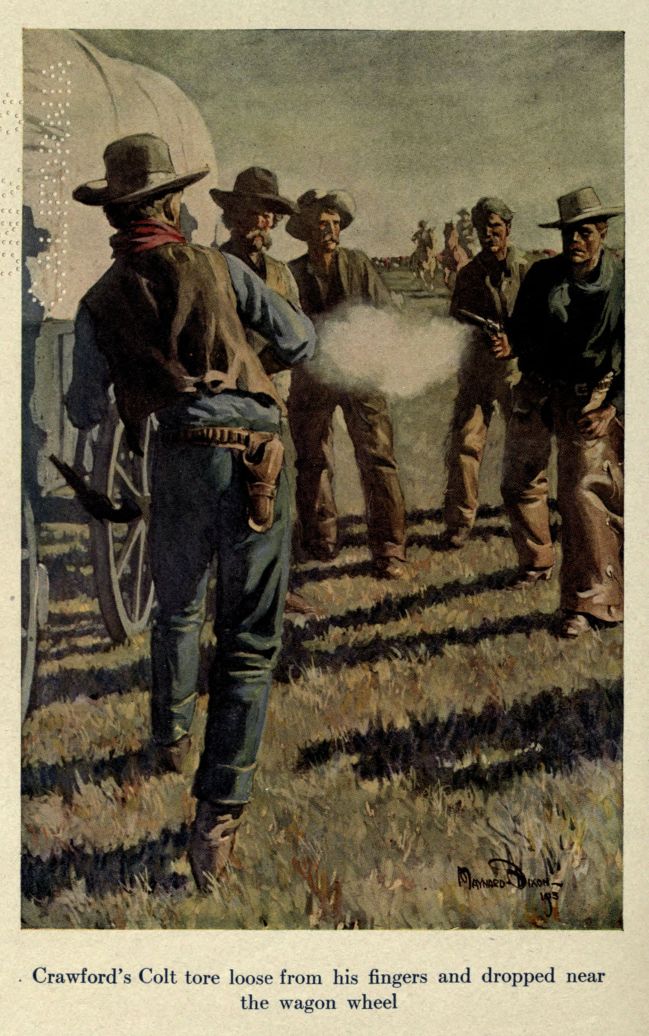
Crawford's Colt tore loose from his fingers and dropped near the wagon wheel
* * * * *
Red, back at the Bar-20 wagon, inquired of Cookie the whereabouts of Hopalong. Cookie, still smarting under Jimmy's galling fire of language, grunted ignorance and a wish. Red looked at him, scowling. "You can talk to th' Kid like that, mebby; but you get a civil tongue in yore head when any of us grown-ups ask questions." He turned on his heel, looked searchingly around the plain and mounting, returned to the herd, perplexed and vexed. As he left the camp, Jimmy hobbled around the wagon and stared after him. "Kid!" he snorted. "Grown-ups!" he sneered. "Huh!" He turned and regarded Cookie evilly. "Yo 're gonna get a good lickin' when I get so I can move better," he promised. Cookie lifted the red flannel dish-rag out of the pan and regarded it thoughtfully. "You better wait," he agreed pleasantly. "You can't run now. I 'm honin' for to drape this mop all over yore wall-eyed face; but I can wait." He sighed and went back to work. "Wish Red would shove you in with th' rest of th' cripples back yonder, an' get you off'n my frazzled nerves."
Jimmy shook his head sorrowfully and limped around the wagon again, where he resumed his sun bath. He dozed off and was surprised to be called for dinner. As he arose, grunting and growling, he chanced to look westward, and his shout apprised his friends of the return of the missing red-head.
Hopalong dismounted at the wagon and grinned cheerfully, despite the suspicious marks on his face. Giving an account of events as they occurred at the Diamond Bar chuck wagon, he wound up with: "Needn't push on so hard, Red. Crawford's herd is due to stay right where it is an' graze peaceful for a week. I heard Barnes give th' order before I left. How's things been out here while I was away?"
Red glared at him, ready to tell his opinion of reckless fools that went up against a gun-packing crowd alone when his friends had never been known to refuse to back up one of their outfit. The words hung on his lips as he waited for a chance to launch them. But when that chance came he had been disarmed by the cheerfulness of his happy friend. "Hoppy," he said, trying to be severe, "yo 're nothing' but a crazy, d—d fool. But what did they say when you started for huffy Sam like that?"
X
THE HOLD-UP
The herd delivered at Sandy Creek had traveled only half way, for the remaining part of the journey would be on the railroad. The work of loading the cars was fast, furious fun to anyone who could find humor enough in his make-up to regard it so. Then came a long, wearying ride for the five men picked from the drive outfit to attend to the cattle on the way to the cattle pens of the city. Their work at last done, they "saw the sights" and were now returning to Sandy Creek.
The baggage smoking-car reeked with strong tobacco, the clouds of smoke shifting with the air currents, and dimly through the haze could be seen several men. Three of these were playing cards near the baggage-room door, while two more lounged in a seat half way down the aisle and on the other side of the car. Across from the card-players, reading a magazine, was a fat man, and near the water cooler was a dyspeptic-looking individual who was grumbling about the country through which he was passing.
The first five, as their wearing apparel proclaimed, were not of the kind usually found on trains, not the drummer, the tourist, or the farmer. Their heads were covered with heavy sombreros, their coats were of thick, black woolens, and their shirts were also of wool. Around the throat of each was a large handkerchief, knotted at the back; their trousers were protected by "chaps," of which three were of goatskin. The boots were tight-fitting, narrow, and with high heels, and to them were strapped heavy spurs. Around the waist, hanging loosely from one hip, each wore a wide belt containing fifty cartridges in the loops, and supporting a huge Colt's revolver, which rested against the thigh.
They were happy and were trying to sing but, owing to different tastes, there was noticeable a lack of harmony. "Oh Susanna" never did go well with "Annie Laurie," and as for "Dixie," it was hopelessly at odds with the other two. But they were happy, exuberantly so, for they had enjoyed their relaxation in the city and now were returning to the station where their horses were waiting to carry them over the two hundred miles which lay between their ranch and the nearest railroad-station.
For a change the city had been pleasant, but after they had spent several days there it lost its charm and would not have been acceptable to them even as a place in which to die. They had spent their money, smoked "top-notcher" cigars, seen the "shows" and feasted each as his fancy dictated, and as behooved cowpunchers with money in their pockets. Now they were glad that every hour reduced the time of their stay in the smoky, jolting, rocking train, for they did not like trains, and this train was particularly bad. So they passed the hours as best they might and waited impatiently for the stop at Sandy Creek, where they had left their horses. Their trip to the "fence country" was now a memory, and they chafed to be again in the saddle on the open, wind-swept range, where miles were insignificant and the silence soothing.
The fat man, despairing of reading, watched the card-players and smiled in good humor as he listened to their conversation, while the dyspeptic, nervously twisting his newspaper, wished that he were at his destination. The baggage-room door opened and the conductor looked down on the card-players and grinned. Skinny moved over in the seat to make room for the genial conductor.
"Sit down, Simms, an' take a hand," he invited. Laughter arose continually and the fat man joined in it, leaning forward more closely to watch the play.
Lanky tossed his cards face down on the board and grinned at the onlooker.
"Billy shore bluffs more on a varigated flush than any man I ever saw."
"Call him once in a while and he 'll get cured of it," laughed the fat man, bracing himself as the train swung around a sharp turn.
"He 's too smart," growled Billy Williams. "He tried that an' found I did n't have no varigated flushes. Come on, Lanky, if yo 're playing cards, put up."
Farther down the car, their feet resting easily on the seat in front of them, Hopalong and Red puffed slowly at their large, black cigars and spoke infrequently, both idly watching the plain flit by in wearying sameness, and both tired and lazy from doing nothing but ride.
"Blast th' cars, anyhow," grunted Hopalong, but he received no reply, for his companion was too disgusted to say anything.
A startling, sudden increase in the roar of the train and a gust of hot, sulphurous smoke caused Hopalong to look up at the brakeman, who came down the swaying aisle as the door slammed shut.
"Phew!" he exclaimed, genially. "Why in thunder don't you fellows smoke up?"
Hopalong blew a heavy ring, stretched energetically and grinned: "Much farther to Sandy Creek?"
"Oh, you don't get off for three hours yet," laughed the brakeman.
"That's shore a long time to ride this bronc train," moodily complained Red as the singing began again. "She shore pitches a-plenty," he added.
The train-hand smiled and seated himself on the arm of the front seat:
"Oh, it might be worse."
"Not this side of hades," replied Red with decision, watching his friend, who was slapping the cushions to see the dust fly out: "Hey, let up on that, will you! There's dust a-plenty without no help from you!"
The brakeman glanced at the card-players and then at Hopalong.
"Do your friends always sing like that?" he inquired.
"Mostly, but sometimes it's worse."
"On the level?"
"Shore enough; they're singing 'Dixie,' now. It's their best song."
"That ain't 'Dixie!'"
"Yes it is: that is, most of it."
"Well, then, what's the rest of it?"
"Oh, them's variations of their own," remarked Red, yawning and stretching. "Just wait till they start something sentimental; you 'll shore weep."
"I hope they stick to the variations. Say, you must be a pretty nifty gang on the shoot, ain't you?"
"Oh, some," answered Hopalong.
"I wish you fellers had been aboard with us one day about a month ago. We was the wrong end of a hold-up, and we got cleaned out proper, too."
"An' how many of 'em did you get?" asked Hopalong quickly, sitting bolt upright.
The fat man suddenly lost his interest in the card-game and turned an eager ear to the brakeman, while the dyspeptic stopped punching holes in his time-card and listened. The card-players glanced up and then returned to their game, but they, too, were listening.
The brakeman was surprised: "How many did we get! Gosh! we didn't get none! They was six to our five."
"How many cards did you draw, you Piute?" asked Lanky.
"None of yore business; I ain't dealing, an' I would n't tell you if I was," retorted Billy.
"Well, I can ask, can't I?"
"Yes—you can, an' did."
"You didn't get none?" cried Hopalong, doubting his ears.
"I should say not!"
"An' they owned th' whole train?"
"They did."
Red laughed. "Th' cleaning-up must have been sumptuous an' elevating."
"Every time I holds threes he allus has better," growled Lanky to Simms.
"On th' level, we couldn't do a thing," the brakeman ran on. "There 's a water tank a little farther on, and they must 'a' climbed aboard there when we stopped to connect. When we got into the gulch the train slowed down and stopped and I started to get up to go out and see what was the matter; but I saw that when I looked down a gun-barrel. The man at the throttle end of it told me to put up my hands, but they were up as high then as I could get 'em without climbin' on the top of the seat.
"Can't you listen and play at th' same time?" Lanky asked Billy.
"I wasn't countin' on takin' the gun away from him," the brakeman continued, "for I was too busy watchin' for the slug to come out of the hole. Pretty soon somebody on the outside whistled and then another feller come in the car; he was the one that did the cleanin' up. All this time there had been a lot of shootin' outside, but now it got worse. Then I heard another whistle and the engine puffed up the track, and about five minutes later there was a big explosion, and then our two robbers backed out of the car among the rocks shootin' back regardless. They busted a lot of windows."
"An' you did n't git none," grumbled Hopalong, regretfully.
"When we got to the express-car, what had been pulled around the turn," continued the brakeman, not heeding the interruption, "we found a wreck. And we found the engineer and fireman standin' over the express-messenger, too scared to know he would n't come back no more. The car had been blowed up with dynamite, and his fighting soul went with it. He never knowed he was licked."
"An' nobody tried to help him!" Hopalong exclaimed, wrathfully now.
"Nobody wanted to die with him," replied the brakeman.
"Well," cried the fat man, suddenly reaching for his valise, "I 'd like to see anybody try to hold me up!" Saying which he brought forth a small revolver.
"You 'd be praying out of your bald spot about that time," muttered the brakeman.
Hopalong and Red turned, perceived the weapon, and then exchanged winks.
"That's a fine shootin'-iron, stranger," gravely remarked Hopalong.
"You bet it is!" purred the owner, proudly. "I paid six dollars for that gun."
Lanky smothered a laugh and his friend grinned broadly: "I reckon that'd kill a man—if you stuck it in his ear."
"Pshaw!" snorted the dyspeptic, scornfully. "You wouldn't have time to get it out of that grip. Think a train-robber is going to let you unpack? Why don't you carry it in your hip-pocket, where you can get at it quickly?"
There were smiles at the stranger's belief in the hip-pocket fallacy but no one commented upon it.
"Was n't there no passengers aboard when you was stuck up?" Lanky asked the conductor.
"Yes, but you can't count passengers in on a deal like that."
Hopalong looked around aggressively: "We 're passengers, ain't we?"
"You certainly are."
"Well, if any misguided maverick gets it into his fool head to stick us up, you see what happens. Don't you know th' fellers outside have all th' worst o' th' deal?"
"They have not!" cried the brakeman.
"They 've got all the best of it," asserted the conductor emphatically. "I 've been inside, and I know."
"Best nothing!" cried Hopalong. "They are on th' ground, watching a danger-line over a hundred yards long, full of windows and doors. Then they brace th' door of a car full of people. While they climb up the steps they can't see inside, an' then they go an' stick their heads in plain sight. It's an even break who sees th' other first, with th' men inside training their guns on th' glass in th' door!"
"Darned if you ain't right!" enthusiastically cried the fat man.
Hopalong laughed: "It all depends on th' men inside. If they ain't used to handling guns, 'course they won't try to fight. We 've been in so many gun-festivals that we would n't stop to think. If any coin-collector went an' stuck his ugly face against th' glass in that door he 'd turn a back-flip off 'n th' platform before he knowed he was hit. Is there any chance for a stick-up to-day, d'y think?"
"Can't tell," replied the brakeman. "But this is about the time we have the section-camps' pay on board," he said, going into the baggage end of the car.
Simms leaned over close to Skinny. "It's on this train now, and I 'm worried to death about it. I wish we were at Sandy Creek."
"Don't you go to worryin' none, then," the puncher replied. "It 'll get to Sandy Creek all right."
Hopalong looked out of the window again and saw that there was a gradual change in the nature of the scenery, for the plain was becoming more broken each succeeding mile. Small woods occasionally hurtled past and banks of cuts flashed by like mottled yellow curtains, shutting off the view. Scrub timber stretched away on both sides, a billowy sea of green, and miniature valleys lay under the increasing number of trestles twisting and winding toward a high horizon.
Hopalong yawned again: "Well, it's none o' our funeral. If they let us alone I don't reckon we 'll take a hand, not even to bust up this monotony."
Red laughed derisively: "Oh, no! Why, you could n't sit still nohow with a fight going on, an' you know it. An' if it's a stick-up! Wow!"
"Who gave you any say in this?" demanded his friend. "Anyhow, you ain't no angel o' peace, not nohow!"
"Mebby they 'll plug yore new sombrero," laughed Red.
Hopalong felt of the article in question: "If any two-laigged wolf plugs my war-bonnet he 'll be some sorry, an' so 'll his folks," he asserted, rising and going down the aisle for a drink.