THE COMIC ALMANACK For 1848. (continued 2)
Reading edition
But whose is that ecstatic figure? It is as familiar to my vision as Cooper in George Barnwell. Who can it be? Yes—no—yes! It cannot be! By St. Jullien, it is the dismal Child of France! The clock of St. Clement's strikes ten. What! Monsieur, hast thou for three foggy hours been poring over those self-same pies? Thy admiration smacks, methinks, of the bigot. Thou art indeed an enthusiast. Hie thee to Soyer! Catch him between a poem and a pâté, bursting with the richest stuffing of the goose—I mean the pâté. Perform the same rites before his household pans of stew; let thy every limb speak thy admiration, and my head of hair, bought but yesterday at Truefitt's, he will give thee, for half such prodigal worship, thy weight in pies, be they of gooseberry or mutton, or the ham and veal dedicated to Thespis, or even the delicate eel, the dear object of thy silent love! Concealment has indeed fed upon thy damask cheek, and picked it—would I could say clean!—to the bone. "Voici, mon Noble Seigneur, de quoi te régaler." He sees not the proffered Joseph; he hears not my tones, sweet with charity. He stirs not: he stands on holy pavement. Poor Frenchman, I would tarry with thee, but I must rush me home to supper. Haven't I tripe waiting kindly for me! My clay, too, points to heavy wet; and my pewter will lose its head if I am not quickly with it. Adieu.
Night has spread its shutters over London. All is still, save a spirituous cry of "Va-ri-e-ty," that comes at muffled intervals leaping through the air. There is not a Gent to be seen. Even Lord Ellam has retired to his bed under the ducal counter. Sleep snores heavily in the Strand, and the nightmare rules in the City. All humanity, save editors and milkmen, is between the sheets.
All, did I say? It is false. There is one figure still, very still, on its legs. He is no purveyor of chalk, or human kindness. He is not a thief either, save one of Time; and better to rob him than Rogers' bank,—though, it is true, the notes may be stopped, but the minutes, alas! never. Whose is that figure? Egad! It is the Frenchman's.
There he stands, opposite the same identical emporium. He is wrapt in mystery and a Spanish cloak, with a collar borrowed from the poodle. He has not moved the whisper of a pig to the right or to the left. What fearful secret can chain him to that awful spot?
His iron glances seem as if they would pierce like nails at tenpence a-piece the shutters of that Depôt. The hunger on his countenance is not yet appeased. I offer him an Havannah, the best that the Green of Turnham can produce. He answers me only with a sallow smile. No complaint escapes his lips, though it is clear as Thames water that is filtered that he is ill at ease. Ah! perhaps he is doing penance for some early crime? Perhaps it is a vow he has registered in some album to please his Love? Perhaps—but I waste the valuable ink of the printer with these idle sur-mises; 229be the awful cause what it will, from the bottom of my purse, noble stranger from the noble Land of the Cancan, I do feel for thee! Thou wouldst never remain outside a piscatorial pastrycook's for nine long hours, transfixed like a pose plastique (only thou art dressed), unless there were some strange mystery at the bottom of it!
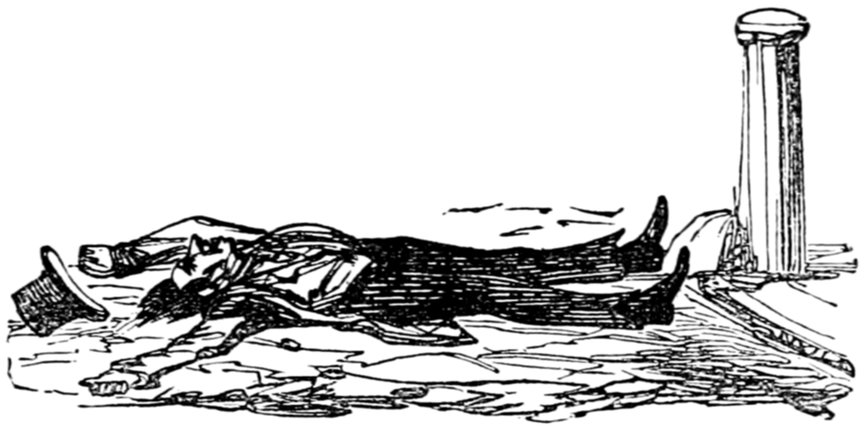
THE SPIRIT LEVEL.
I cannot sleep. My pillow is burning hot. Fever shares my bed. The vision of that unhappy Frenchman keeps pulling aside the curtains, and crying aloud in my ear, "Curiosity doth murder sleep." It is too true! Who can close his eyes, though they be weighed down with two bottles of port, of the best Public Dinner vintage, and sealed with the smoke of three-times-ten cigars, when he has a secret gnawing at his heart? I don my morning suit, and walk breathless, breakfastless to the Strand.
Clerks are plodding to their high stools in the City. All waistcoats are turned towards St. Paul's. Omnibuses are laden with cashiers—strict lovers of punctuality—who eat, and drink, and sleep, and make love, by the chronometer. The antique apple-woman is putting on her great coat, the relic of her late relict, a deceased cabman. Holloway determines to have an immense spread, and lays down a roll of ointment eight yards without a seam. Newspaper boys sing in quires as they canter along with wet bundles under their arms. The sun rises; the puddles reflect its golden smiles; the cocks and hens visit their daily cab-stand; the postman's knock is heard; the clock of St. Clement's strikes nine. London has begun a new day.
But what are these facts to me? No more than Spanish Bonds, for I do not even look at them. I have but one object in view, and that is the Frenchman.
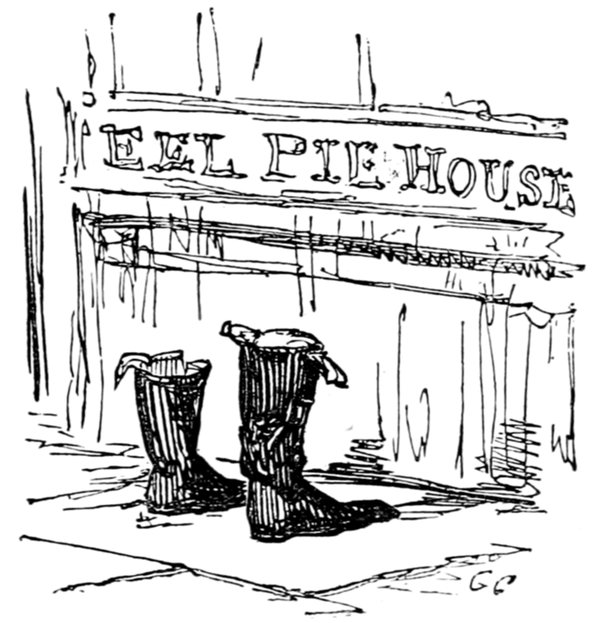
But the cloak has disappeared, and the person inside it. His penance doubtless, is at an end—his humble vow fulfilled. He is gone: but, how strange! he has left his boots behind him. There they stand, in the middle of the pavement, bolt upright—one a Blucher, its companion a Wellington—as if they had risen out of the coal-cellar over night, like a couple of mushrooms. A phantom policeman attempts to take them up, but they are riveted to the spot. But, see! the poor exile comes this way: slippers are on his feet. He claims his boots. "Take them," says the man of law, bound in blue, and lettered B 32. No! They will not stir. He pulls them with a pair of boot-hooks, but if there were a Woman's Obstinacy in each sole, they could not maintain their ground more stoutly.
230A pickaxe is brought. The boots are pulled up at length, but in company with the flag-stone. They are carried on the latter, as on a tray, before the magistrate. Their disconsolate owner follows them in his slippers. He unfolds his simple unadorned tale of woe. First he identifies the boots. The name of "Marquis de Carambole" appears inside each. Next he states he had been giving a lesson in French for sixpence to a family in the Lane of Leather. On his way home he stopped to admire some pies arrayed most temptingly in a sumptuous window. He tarried longer than he intended, but the luxury of the sight beguiled away the unconscious moments. He felt his feet getting very warm, but he thought it was only the grateful steam of the shop. He still looked on, turning over the sixpence alternately in his mind and in his pocket, whether he should spend it, or keep it to have his hair curled. At last he resolved on the rash purchase. He attempted to move, but his right foot was fastened to the pavement, and his left foot too; he was motionless; he was literally screwed—he had grown to the ground. He was riveted to the spot, not only in admiration, but in positive reality. For four interminable hours he endured worse than the torture of Tantalus, for eel pies were not known in the dark ages of Pluto. A feast was before him which he could not touch. Twelve o'clock at last put a friendly termination to his sufferings: the shop closed. He was left in the streets of London all by himself. He felt cold. His feet were benumbed, but he could not do anything to keep them warm. Stamping was out of the question, for he could not even lift them. A policeman told him once to "move on," but unfortunately he came like a shadow, and so departed. He thought of his landlord, of his tailor, of his washerwoman, of everything that was dear to him. A tear washed his cheek. He trembled like a creditor. He did not like to shout for aid, his position was so very ridiculous. At last necessity, the coldest he ever experienced, conquered his vanity. He cut his straps, and ran away like a second Napoleon, leaving Wellington and Blucher masters of the field. Having finished, the poor Orphan of France demands, in a voice of tears, that his boots may be restored to him.
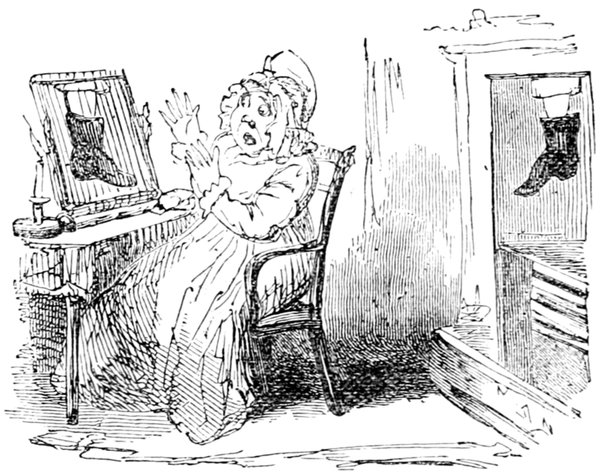
THE APPROACH OF BLUCHER.—INTREPID ADVANCE OF THE FIRST FOOT.
"Certainly," says the urbane magistrate; "but you must first pay for the damage you have done to the pavement."
231The poor Frenchman pleads that it is not his fault; but his plea is as bootless as himself.
A policeman, with the bump of science, craves leave to explain the mystery.
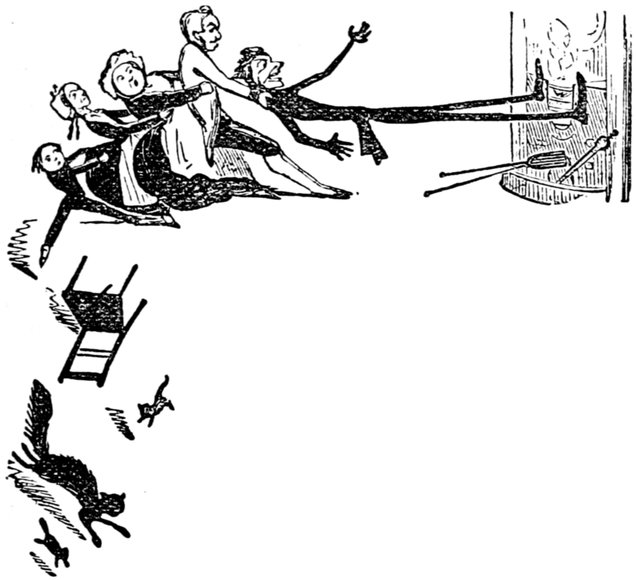
Leave is given to him; and, clearing his throat, he speaks thus:—"I think I can tell, sir, what is the mystery at the bottom of all this. It is Gutta Percha. This Gutta Percha, sir, is a new material of a waterproof substance; at first soluble, which afterwards hardens, and resists the action of water. It is used largely for boots. It is not proof, however, against heat. The consequence is that when it is exposed to a great warmth it becomes adhesive, and very tenacious of the footing it occupies. There is an instance of a cook whose Irish cousin was warming his feet at the fire; he had on soles made of Gutta Percha. His boots adhered to the hobs, and there he stuck in the kitchen for a fortnight till a frost came. It was called Hobbes' 'Essay on the Understanding.'"
The man of the oil-skin cape is reprimanded severely for this joke, and then resumes: "It is exactly the same scrape with this gentleman, if he will excuse the liberty I take in calling him so," he said, bowing to the Frenchman. "The fact is he remained so long admiring those eel pies that his soul expanded at the sight, and when he wanted to go he found he could not tear himself away: the Gutta Percha had become melted with the heat of the cook-shop, and strapped him to the pavement like a statue on a pedestal."
The mystery was as clear as if it had been strained with isinglass. The boots were investigated, and lo! the policeman's words for once were truth. Gutta Percha was at the bottom of each boot! The spell was solved, and so after a time were the soles. But let the reader scrutinize closely the pavement in the Strand; and on the left side, before he comes to Temple Bar, he will be able to pick out a flag-stone, opposite the "Royal Emporium for Eel Pies," which has on it the perfect imprint of the soles of a Blucher and a Wellington. It was on that very bit of granite where the poor Frenchman stood for nine hours, buffeted by the stream of people that kept flowing backwards and forwards, and tortured beyond any modern martyrdom by the tempting feast spread before him, which he could only devour with his hungry eyes.
Of all the new inventions there is not one which is likely to make a firmer stand, or keep its ground longer, than Gutta Percha.
232
THE FEMALE TARS OF GREAT BRITAIN. FASHIONABLE YACHTING.
The ladies are invading everything. The Stock Exchange, Capel Court, the field, the lecture-room, the betting-ring—places exclusively devoted hitherto to black coats and legs of the same colour—have been recently graced, or disgraced, as the case has been, with the presence the fair, and sometimes unfair, sex. The clubs, it is true, are still in the hands of men, and woman, though she has voice enough in laying down the law at home, has none as yet in Parliament; though we are confident if a handsome duchess, or Mrs. Nisbett, were only to put up for a county (say Bucks), that she would no sooner announce her intention of standing, than every Buck in the borough would rush forward to offer her a seat. Common politeness would carry her into the House of Commons. Government, however, is not the only floating and sinking thing that has a helm. Our yachts are open to the ladies; and, till they can steer the Vessel of State, they are at full liberty to soil their gants de Paris in handling the tiller of a Yacht. Are the quick-sands of office more dangerous to thread than the Needles? And what are the breezes, and the ups and downs of a parliamentary life, to those of the ocean? Go, ask Earl Grey, and he will tell you that he would sooner have fifty berths under Government than one in a royal yacht, any day!
The example set by the Queen every year has turned all the ladies mad for a Yacht. It is customary now, instead of packing up the drawing-room furniture whilst the family is out of town, to have it carried on board, where it is fitted up on deck, or does state duty in the cabins. The Turkey carpet covers the vulgar planks, the bell ropes are substituted for the coarse ropes; and chairs, richly inlaid with mother-of-pearl, replace the plain lockers. The whole household is transported generally as well, though apoplectic footmen sometimes desert after the first day, preferring board wages in May Fair to the best wages on board, in the Mediterranean.
The following extract from a Lady's Log Book will best illustrate this new fashion. It is written in the beautifully small handwriting of the enterprising Lady Augusta Fiddle-Faddle, who sailed in the Jenny Lind on a cruise to Paris, last October.
Sept. 2nd.—Started from Cowes. Sea just like a rocking-horse, up and down, up and down; not at all pleasant; very giddy; wind blowing all day at my back, nearly breaking my beautiful ostrich feather; no appetite for dinner; took an early tea, no muffins, not even a sally-lunn. Gave orders that the French cook (a promising pupil of Soyer's) might be told "to take good care it didn't occur again." In bed at eight, very unwell; ordered the rocking of the vessel to be stopped immediately, but not a soul paid any attention to my sufferings.
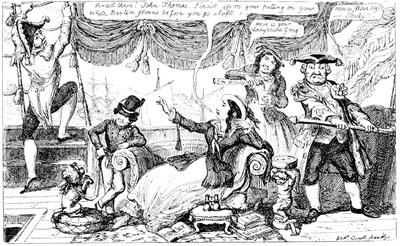
YACHTING FOR LADIES—MAYFAIR IN THE MEDITERRANEAN.
2333rd.—No new milk for breakfast; told the butler to send for some directly; the impudent fellow sent word, "that there was no possibility of making Cowes so soon." Ordered his beer to be stopped. Dreadful noise overhead. Told Adolphus to inquire what it was. The intelligent lad brought me intelligence that it was the housemaid sweeping the carpets on deck. Went upstairs, and asked the reason why the deck was not ready before twelve o'clock. Told Jane and Maria Louisa that I would have the strictest discipline maintained in my Yacht, or else they had better suit themselves at once with other situations. Superintended the dusting of the ottomans, and reprimanded John Thomas for going up the dirty ropes without his Berlin gloves on. Detected a faint smell of tar, and ordered the carpet to be sprinkled with eau-de-Cologne, and feathers to be burnt in every room in the Yacht. Threw my glove over the railing of the vessel to see which way the wind blew; but on its going straight down and sinking very rapidly recollected that my purse was inside. A thorough draft arising at that moment blew off my fichu towards the right, and proved beyond a doubt that the wind was in a straight line to Brighton. Determined to go there, and told the coachman in charge of the Yacht to make as much haste as possible, as I wished to make a morning call on Lady Bandury Bunn, who was staying there, with all her little Bunns. It turned out, however, towards four o'clock, that we were not many hundred yards' distance from Havre; but as I had not a French bonnet with me I declined going on shore. In the evening, a ball, and I played a small concertina (I had brought with me to charm the dolphins), to enable the poor servants to dance. John Thomas and Jane Hussey went through a hornpipe as well as the uneven state of the Yacht would allow them. Served out tea and sugar at eight. Towards nine there was a very strong smell of tobacco; searched the Yacht, escorted by Adolphus, who carried two wax candles before me; we found the smell proceeded from the servants' hall. Descended the narrow staircase cautiously, and surprised, in the pantry, the butler, John Thomas, and the French cook, each smoking with the window open, what is called, I believe, a pipe. Ordered these offensive articles to be seized, and to be instantly thrown into the lowest depths of the sea; and did not retire to rest before my orders were strictly executed. Looked into the housekeeper's room, and gave directions for a muslin cover to be made for the gold Cupid that holds the compass; if I am correct in so terming the long darning-needle that is kept under a glass shade.
4th.—Wind very fair to-day. Curled my hair for the first time in ringlets. Inspected some Valenciennes lace I have bought, a perfect bargain, of a French smuggler; it will look well on a velvet dress. Told John to drive direct to Paris. The insolent fellow asked "if I would go by Brussels, or did I prefer Vienna?" Gave him instantly warning. He turned the vessel round with its head towards London. Told him that was not the road to Paris, when he said he "was going back to Southampton to suit himself with another place." Rang the bell, and told Grisetta to tell all the servants to come upstairs. The poor girl only speaking French, the stupid servants, who worry my life out, did not understand her. Directed my page Adolphus to summon the butler before me. Mr. Smithers appeared with his hat on; I asked him how he dared to appear in my presence with his head covered? His answer was, "that he had had two wigs blown off already, and he had caught a violent cold in his head." Asked him "What was his cold in the head when the discipline of the ship was at stake?" and he could not answer a word. Told him I should report him to Sir Valentine as soon as we landed in Grosvenor Square. Being determined to punish the coachman, ordered him to leave the box, and took the whip out of his hand in the presence of my maid and the German governess. The menial coloured, and to make his degradation the more striking, I pulled the cockade off his hat. I then took the what-d'ye-call-it, the long pole that pushes the vessel along, and attempted to guide it. The fatigue, however, was too much for my wrists, and I split my gloves in the exertion; was afraid, besides, of turning the vessel upside down, but disguised my fears before the dependents. Left the pole, and picked my way down to the servants' hall. Found the servants, male and female, at dinner, the butler in the chair, and Mrs. Bantam, the housekeeper, at the bottom. Apologized for intruding, for I thought it was best to be civil. Spoke kindly, and told them to serve me properly, and their rations of tea and sugar should be doubled. Mrs. Bantam thanked me. Then told them that "a great act of insubordination had been shown by the coachman above, and that I had been obliged to strip him"—(Here I paused to take note of the effect of my words; but no sympathy was, I am glad to say, evinced)—"of his situation." I reminded them of their duties, and conjured them to be faithful to their mistress, and they should not repent it when their wages were paid; but I told them plainly, if they coalesced with the coachman it should be as much as their situations were worth. If any one of them was displeased, and thought herself ill-used, or out of her proper element, she might leave the ship that instant, and I would be the last person to prevent her bettering herself. Not one amongst them took me at my word, and I was pleased more than I can express at their fidelity. I told them as much, and confessed I had anticipated a mutiny, but had made up my mind fully how to act in case the smallest soupçon of treachery had declared itself. "I would have opened the plugs at the bottom of the yacht," I said loudly to them, "and we should have all sunk together, after I had taken the precaution to write a letter to the Times, in which every one of your names would have been reported at full length, with your christian names and ages." I was going on in the most eloquent strain, when the most dreadful thumping occurred to the ship, and there was a noise overhead such as I had never heard before, even at one of Verdi's operas. I nearly fainted, for I thought a whale had run against us, and had burst in one of our panels; but a young footman, who had run upstairs and down again whilst I was losing my colour, assured me it was only the bowsprit (for so he called the long pole which protrudes from the front of the vessel) which had been shattered to pieces in consequence of its coming in collision with Southampton Pier, which happened at that moment to be in the way. I then recollected that I had left no one in charge of the Yacht, and hastened upstairs. I found a Custom-House officer coming up the rope ladder by the side, and gave the coachman into custody for having violated the laws of his country. The man searched him, and said, with the greatest nonchalance, that there was nothing about him that warranted his detaining him. He then asked me if I had anything to declare. "Anything to declare?" I said. "Yes, I declare that your conduct is the greatest piece of impertinence I have ever heard of;" and I went on in a great passion for a long time. The man got very angry, and I had a very good mind to have him thrown into the sea for his insolence; but I conquered my pride, for at that moment Prince FitzunStartz, the young Bohemian nobleman who first brought over the polka, came tripping on the yacht, and I was too glad, in order to escape, to take his arm, though he had just been smoking. I recounted to him the dangers I had gone through, and he would have it I was "quizzing" him, just as if I was likely to joke upon such a matter of life and death. We had scarcely reached the end of the pier when an officer stopped us, and informed me that the Jenny Lind was seized by the Custom House authorities for having on board a quantity of smuggled goods. Oh dear! oh dear! that Valenciennes will cost me dearer than what I might have got it for at Howell and James's, and they wouldn't have asked me for the money for six years to come at least; whereas I paid that smuggler every bit in sovereigns. Oh! that stupid Yacht!
234
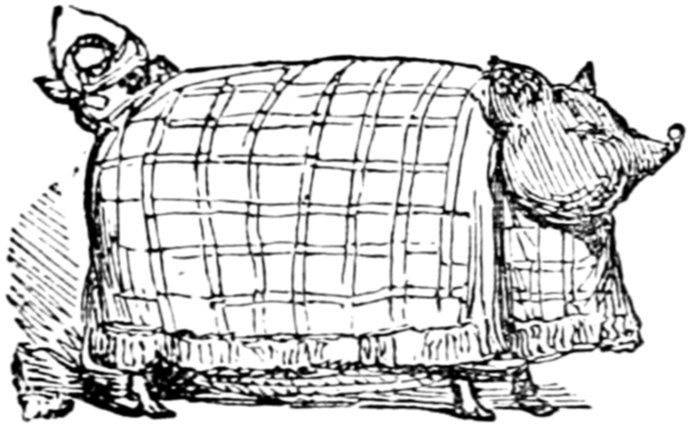
Hints To Agricultural Societies.—About November stuff your calves for approaching show, and put the tails of your pigs over night into curl paper. Rub a little bear's grease on the head of your sheep, and pass small-tooth combs through their fleecy wool. Wash your Southdowns in warm soap-and-water, and let your little porkers have a good lathering, particularly about the chops. Trim your cows with satin ribbons, part the hair on their foreheads down the middle, and fix it with bandoline. Black the hoofs of your bulls, stir up your Durhams well, and see that they are properly mustered.
Pretty Thought.—"I would not be a pig," says a Dutch poet, "for then I could not eat it."
235
LAYS OF MODERN BABY-LON. BY YOUNG WHAT-YOU-MAY-CALLEE.
(Aged five years and a day.)
"High diddle lofty diddle and diddle wondrous high—
Diddle exalted like balloons far up into the sky."
Thus sung a youth of Kensington, a youth of gentle mien,
Whose mother came from Knightsbridge, and whose sire from Turnham Green.
"High diddle diddle," warbled he, "the fiddle and the cat,"
But very much I marvel now what meant the youth by that.
But words contain all mysteries, as difficult to trace
As Cleopatra's needle when it works the fragile lace,
And into many patterns all rapidly it flies—
As the clouds take strange appearances in floating through the skies.
"High diddle diddle," sung the youth with energy intense,
"The cat and fiddle," whispered he—alack, he spoke not sense.
"The cow," he murmured mournfully, and rather out of tune,
"Has at a bound sprung from the ground, and cleared the silver moon."
I wot not of his purpose in singing such a strain,
But hush! don't interrupt the youth, he takes it up again:
"Over the moon the cow has jumped, and then, such sport to see,
The little dog laughs quite outright, with a loud ha! ha! HEE!"
And now a sad elopement it is our lot to mark—
Why should the little dog have laughed? how came he not to bark?
For 'twas his solemn duty to try the course to stay
Of the roguish dish to thwart the wish, ere with spoon he ran away.
The song of youth is ended, but ever and anon
The murmur of the melody goes undulating on;
The echoes give in fragments the words "high diddle diddle,"
Then with a rush there comes a gush of—hark! "the cat and fiddle."
The melody again I think I hear—or shall hear very soon—
The line that says the rampant cow has jumped right o'er the moon,
The little dog is laughing too, such merry sport to see,
So in half-broken accents whispers a voice to me.
But worst of all, and last of all, and saddest thing to say,
A voice insists "that with the spoon the dish has run away."
The music of the melody has floated through the air,
And died off like the premium upon a railway share.
236
A BUNDLE OF DEFINITIONS.
The Seat of Pain.—A seat in the front row of the dress circle of the Adelphi Theatre, judging from first impressions, which they say last the longest, is decidedly the Seat of Pain.
A pew in a fashionable church is a religious ordinary, held every Sunday, price one shilling!
The weathercock, after all, points to the highest moral truth, for it shows man that it is a vane thing to a-spire.
The Horse Guards are the Bright Pokers of the army. They are kept up exclusively for show, most highly polished, but never intended to go into the thick of the fire.
Sons treat their governors like oysters: they never cease "sticking" them till they have made them "shell out."
The Press of England and the Press of France are both noted for their convictions—but the first are moral convictions, and the second legal ones.
Abd-el-Kader and a Turkey carpet are very much alike. They never come out so strongly, their designs are never so apparent, and their colours never have so much effect, as after a thorough good beating.
The Albert Hat is one of those things very much better described than felt.
Many ideas are exceedingly pretty, which, when inquired into, are found, like a necklace of birds' eggs, to hang upon the slightest thread, and to have absolutely nothing in them. Some authors evidently look upon ideas as children do upon birds' eggs—public property which there is no harm in stealing. They string them, too, very much in the same strain—drawing everything they can out of them, and decorating themselves afterwards with the empty shells.
Agricultural Sports.—About Autumn catch your prize labourer, and joke him at your annual Show; put him on a platform, and make good quiet fun of his having brought up sixteen children on five shillings a week for twenty years. Compliment him most highly on his sobriety and all the cardinal virtues, and give him a good-natured dig about his little potato ground. Give him a glass of wine and five shillings; and when you are tired of the absurdity, tell him to sit down, and call up your fattest pig and bull, and sustain the rollick of the day's amusements by awarding them premiums of 10l. and 15l. each. This is capital sport, and gentlefolks come far and near to see it, only we doubt if the poor labourer sees exactly the fun of it.
Truefitt on Shakspeare.—An aspiring hairdresser, who has been to see Romeo and Juliet, wishes to be informed whether the "parting" which the lady describes to be "such sweet sorrow" was in the middle, or only on one side? We are really unable to say with any certainty; but the faults of lovers, which often lead to a parting, are generally on both sides.
237
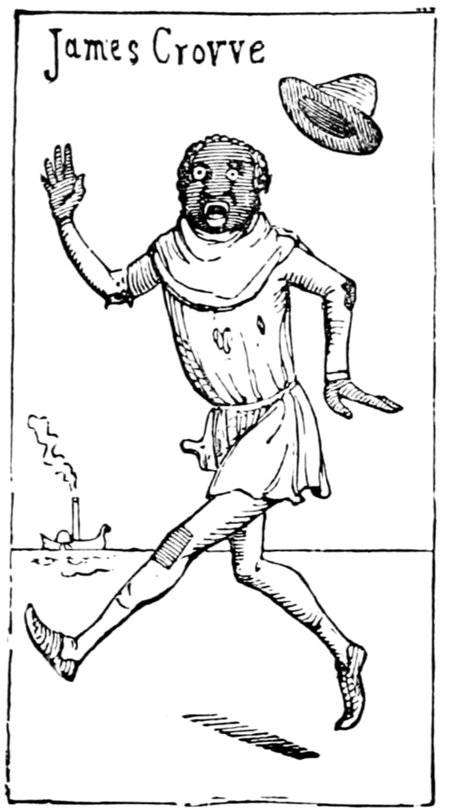
Portrait of Jim Crow, after Herbert.
MOVEMENT OF THE FINE ARTS.
The Fine Arts are seized at present with a strange movement; they are all going backwards. One would fancy they were retreating, or that they had lost something on the road, and were turning back to pick it up. We scarcely imagine it was worth while going out of their way to embrace the Middle Ages; it shows but little taste on their part. They might as well dress in the costume of that period, and wear Gothic night-caps, and mediæval high-lows, and talk, and write, and flirt in the language of that period, as to attempt to reconcile its hard angular painting (all their pictures look to us like coloured problems—as if Euclid had been their drawing-master) to the spirit of our own times. Imagine portraits of the heroes of the present age in the stiff kitchen-poker style which Messrs. Pugin, Dyce, and such like retrograders, would wish to revive! How would the immortal Simpson look? How would the popular Jim Crow appear to us, when carried two hundred years back? Why! we should not know them again.
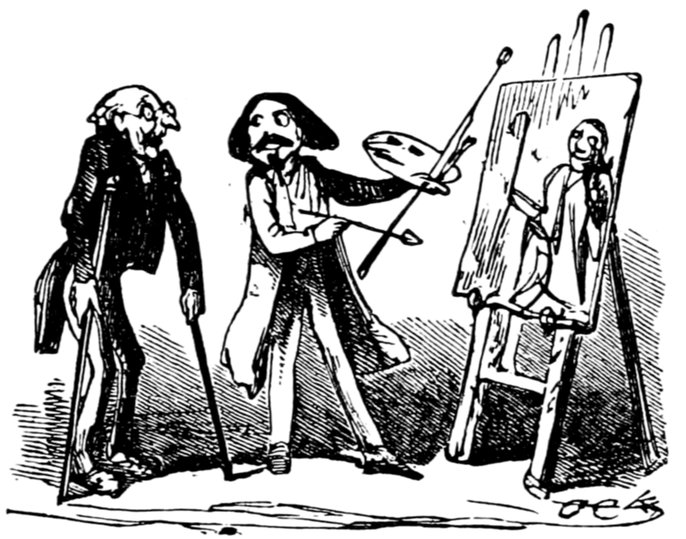
Perhaps this going backwards is for the purpose of enabling the artists to jump farther onwards, as the French proverb says, "Reculer pour mieux sauter;" or is it to make the Fine Arts so much younger, by knocking some three hundred years off their age? We always thought that art was of no particular period, but for all time. Antiquated ladies may gain by the above process of youth-making, and we can imagine in our own mind's ear (if the mind has an eye it must have an ear) a very old man saying, "Ah! I wish I could go back to the Middle Age!" but really the Fine Arts should be above such weakness. This love of going backward may account, perhaps, for so few artists getting forward in their profession. Let them turn their backs upon the past, and the future may smile brightly again upon them. The English school of painting will not stand long, if it is built with old materials; some four hundred years old.
238
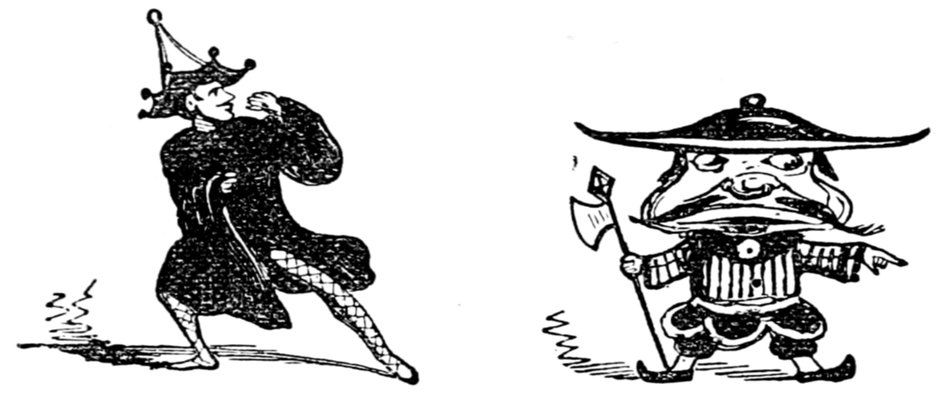
THE FIRST NIGHT OF A PANTOMIME.
'Tis boxing night—every theatre is crammed,
As close as a jelly the people are jammed;
Every corner is full from the roof to the floor,
And money is being refused at the door.
The play of George Barnwell is being gone through,
'Mid the usual regular hullabaloo.
A middle-aged actor appears on the scene,
Representing the weak-minded youth of eighteen;
'Tis true he's past forty, but collars turned down,
With tie à la Byron, and wig of light brown,
With whiskers shaved off, and rouge daubed on in plenty,
The old boy of forty looks something like twenty.
But our sympathies, somehow, he doesn't engage,
He's laughed at whenever he comes on the stage;
His uncle they wont let him murder in peace,
But the incident causes a cry of "police."
The uncle elicits no pity at all,
For shouts of rude merriment follow his fall;
And when his assassin has killed him outright,
Some "wag" in the gallery bids him "good night."
The pathos of Trueman, though good of its sort,
Is met with proposals for cutting it short;
And Barnwell goes off to be hanged 'mid a cry
Of "shame," "turn him out," "serve him right" and "good-bye."
The pantomime now is awaited by all;
The house for the overture raises a call;
Confusion prevails, bits of orange-peel flit
From the gallery's hands to the heads of the pit;
The cat-call so loud, and the whistle so shrill,
Are blended with shouts such as "Bob, where's your 'Bill!'"
At length the musicians have taken their seats,
The leader a lamp with his fiddle-stick beats;
Such silences ensues that the dropping of pins
Might be heard through the house when the playing begins.
The overture's always a musical salad,
A mixture of Polka, Cachuca, and ballad:
If the season has furnished a popular air,
The ear that is ticklish will meet with it there.
The taste of the public will often insist on
A solo for trumpet or cornet-à-piston,
Which, played well or ill, from the audience draws,
At Christmas, a general round of applause;
During holiday time you can never do wrong
If even a passage you gave to the gong,
Or formed a quartette most delicious and tender,
With poker, and shovel, and tongs, and the fender.
239The overture's finished, the curtain's ascended,
A scene is before us exceedingly splendid.
A lovely princess is reduced to despair
At long being wooed by a man she can't bear,
A wretch in a mask with inelegant features,
That are found nowhere else but in pantomime creatures;
But after the lady there constantly dangles
A youth whose thin calves are bedizened with spangles;
For under his cloak his legs we discover,
And "afterwards harlequin" peeps through the lover.
Of course the princess has a father severe,
With a mouth quite extending from ear unto ear;
His head is terrific, and, monstrous surprise,
If you look down his mouth you'll distinguish his eyes.
And as to his voice, if its source you should trace,
You'll find it proceeds from a very odd place—
A sort of incision just under his chin,
Through which he sends forth a most horrible din.
The choice of his daughter he does not approve,
And nothing the heart of the tyrant will move;
The lovers are both to despair giving way,
When of splendid machinery there's a display.
Some clouds from the stage unexpectedly rise,
While a sort of pavilion descends from the flies;
But somehow or other, it seems, in the air,
Their machine always is out of repair;
The clouds make a hitch, and refuse to expand,
Or the flying pavilion is brought to a stand.
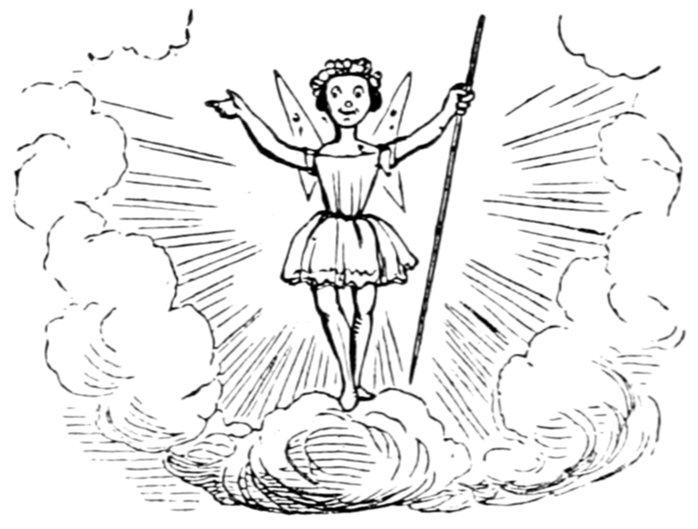
The obstacle soon is surmounted, when straight
A fairy appears—the expounder of fate.
She bids the fair lady abandon her gloom,
And the aspect of columbine quickly assume;
At which the princess, being gone to the wing,
Has the whole of her dress dragged away by a string;
Then in petticoats wondrously short she advances,
And gives at the house the most sunny of glances.
To the youth in the spangles the fairy next speaks,
And bids him of harlequin practise the freaks;
240The shape he assumes, and attention to win,
His head he sets off in a wonderful spin—
So rapidly twisting and twirling it round,
That we wonder it does not drop off on the ground.
The father and friend are let loose on the town,
As pantaloon one—and the other as clown;
A loud "here we are!" gains a general shout,
Pantaloon says his mother's aware he is out;
And then, 'mid a mutual kicking of shins,
The fun of the pantomime fairly begins.
Of course there's a baker who's robbed by the clown;
Of course there's an image-tray coolly pushed down;
Of course there's a baby crushed flat as a flounder;
Of course there's a lady with pickpockets round her;
Of course there's a pie, and of course (who could doubt of it?)
Directly it's opened, live pigeons fly out of it;
Of course there's a window, and steadfastly view it,
Of course you'll see harlequin neatly jump through it;
Of course there's an uproar, and then, to enrich it,
Of course there's a clamour for "Tippitywitchet;"
Of course it's encored, and, it need not be said,
Of course we're indulged with "Hot Codlins" instead;
Of course they all meet in the Cave of Despair,
And of course no one knows how they ever got there;
And of course the last scene is the Realms of Delight,
And of course there's a hope that you'll come every night;
And of course the kind fairy appears once again,
But why, she of course don't attempt to explain;
Of course she propitiates "all her kind friends."
The curtain then falls, and the pantomime ends.
CHANGE.
How many minds has Julia got?
'Tis really hard to say;
But she must have a precious lot—
She changes one each day!
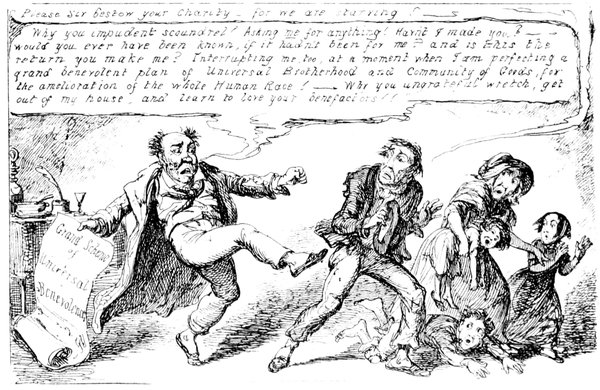
THE UNIVERSAL PHILANTHROPIST.
241
THE UNIVERSAL PHILANTHROPIST.
Philanthropy, how pleasant is thy name!
How often have I sat up half the night
Some panegyric on thee to indite,
Until I've warmed myself into a flame
Enough to melt my heart within my frame.
Yes, on the subject I delight to dwell,
Penning those sentiments that always tell—
Calling on wealth to wear the blush of shame,
Because 'tis sometimes slow to "give, give, give"
The means whereby the famished poor may live.
Philanthropy! thy dictates I obey;
To pay thee homage I shall never cease;
(To "Poor Man.")
"Give you a penny! Nonsense! get away;
If you're not off I'll call for the police!"
THE CITY "FAST MAN."
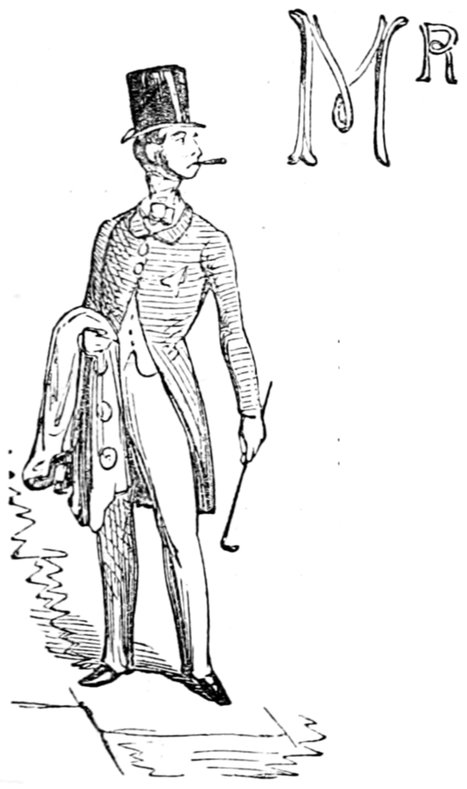
Faddle is a distinguished member of the Stock Exchange, and decidedly one of the "fastest men" in the City. He makes his appearance in the City at about half-past eleven every day; strolls about the neighbourhood of the Bank, with his hands in the pockets of his coat-tails; takes a sandwich at the Auction Mart, or oysters in Finch Lane; and goes away about three, with the idea that he has been very busy. We first met him at the Hanover Square Rooms. His dress was rather peculiar; and at the first glance you said (to yourself), "This is no common man;" and it is rather singular that the more you knew of him, the more you became confirmed in that opinion. His coat was very long in the waist, with singularly capacious sleeves; his neckcloth very narrow; and his whiskers a triumph of art in the curling line. His waistcoat was considerably larger than any you ever saw, except on an ostler; his shirt was embroidered and very transparent, with some pink substance underneath, that made one fancy he had recently been using the flesh-brush very vigorously. His trousers were very tight about the legs; and his boots very tight about the feet. The first remark he made was on a young lady, who he said was "a good stepper." He next stated 242that he had been at the "Corner" all day: on our inquiring where that was, he said, with a contemptuous look, "Tattersall's, to be sure!" He then told us that Lord Levant's "Wide Awake" was a likely horse for the Leger; and said, if we were doing anything on it, we had better not lay out our money on Captain Spavin's "Flare Up." His next inquiry was if we knew Tom Spraggs? and upon our answering in the negative, he ejaculated, quite loud, "Don't he drive cattle, that's all?" We fancied at first that Mr. Spraggs might be a drover, but abandoned the idea in favour of its being some technical term we did not understand. Here the conversation flagged, and to resuscitate it we made a remark on Mr. Faddle's coat-studs, and asked what they were made of? "Teeth," he said. "Teeth!" we could not help exclaiming; "what teeth?" "Why, foxes' teeth, to be sure," he said, turning away with an air of infinite disgust, and never spoke to us again.
We watched him at supper, and found he did not wait on other people much, but took great care of himself. We heard him offer to get a spaniel of some extraordinary breed for a young lady; but he never thought of asking her if she would take anything, though he was eating all the while himself. His appetite, in fact, was rather extensive. He partook largely of the substantials, then addressed himself to the plovers' eggs and lobster salads, and finished with a deep tankard of beer, which he called "malt." Later in the evening we thought a strong odour of tobacco pervaded the hall, and going out we found the "fast man" with a "weed in his off-cheek," as he elegantly expressed it, just preparing to start. His dog-cart was at the door, he jumped in, the small tiger (quite a portable boy) climbed up behind, Mr. Faddle blew a few loud notes with his post-horn, and we saw him no more.
EXPRESSIVE CHINESE PROVERBS.
New milk is not got from a statue.
An emperor may have the measles.
A disobedient son is a mad bull tied to his father's pigtail.
The man who breaks his egg in the centre is a fool.
He who marries an angry woman must sleep in a bed of fireworks.
One bird's-nest in the soup is worth two hundred in the bush.
A wise man at court is like a mermaid in a ball-room.
Carrying a peacock on your head does not make you a nobleman.
Teaching a woman scandal is like teaching a kettle to boil.
A comet can be caught any time by putting a little salt on its tail.
Ambition is like hunting for fleas.
If a golden key wont open a woman's heart, try one of brass.
Shave with a file, if you like, but don't blame the razor.
Looking into the future is like giving a blind man a pair of spectacles to see through a millstone.
The hasty man drinks his tea with a fork.
243
AN IMAGINARY RUN ON A TURKISH RAILWAY.
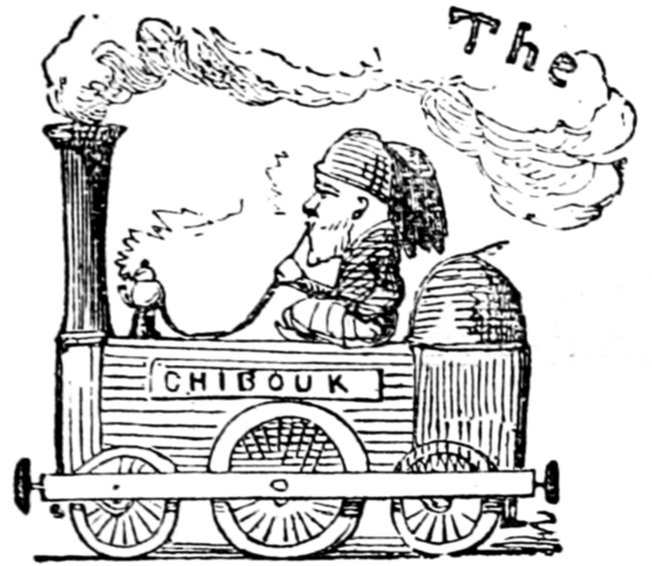
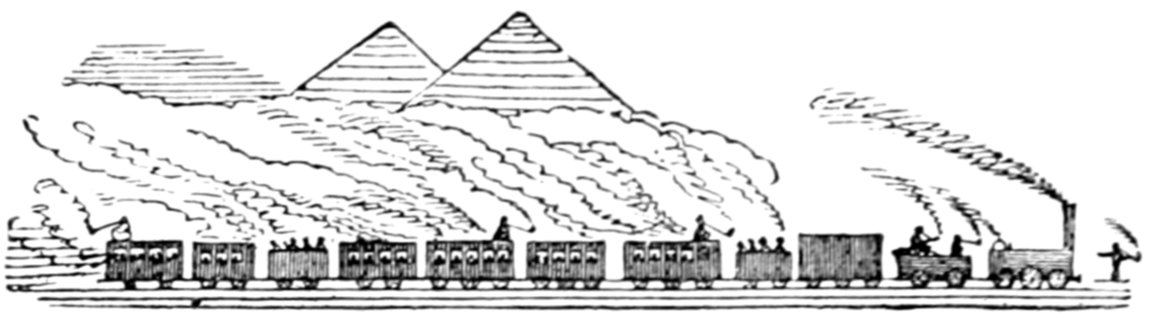
FORMATION of the new railway across the Isthmus of Suez is suggestive of some curious speculation as to the mode in which business will be conducted by the Turks, whose tree of knowledge is rather green upon such matters, and may get its owners into a line from which it will not be easy to extricate themselves.
The Lamp of Aladdin, of course, will be used as a safety signal, and the bow-string (that "great moral engine" which draws everybody in the East into one common terminus) as a signal of danger. It is also understood that the celebrated "Slave of the Ring" will be posted by turns at the different stations to announce the arrival of the trains; and that in place of the electric telegraph, the celebrated telescope of Prince Ali (which beat Lord Rosse's hollow) will be used in conjunction with the Prince Hassein's carpet to discover accidents and despatch assistance; while the apple of Prince Ahmed, which cured all diseases, will be used for the relief of the sufferers. The solemnity of Eastern manners will have a singular effect among the—to us—every-day associations connected with railway travelling. We can fancy a director, on a dividend day, exclaiming, "Holy Profit!" but we can not fancy the chairman and directors dining together afterwards at the Bosphorus Blackwall, wherever that may be, without wine or whitebait, and getting through the gormandizing process with their fingers. Then, on coming away, what a tedious process it must be; the finding of the slippers which have been left in the hall—an annoyance which an English director could imagine if he had ever been obliged to leave a festive party at the Crown and Sceptre in a small Wellington and a big Blucher, belonging to other gentlemen. Of course, the subordinates on the line will be equally polite with their betters. As a train arrives at a station, the Oriental guard will rise from his chibouk, and say, with a profound salaam, "Kosh Amedid! You are welcome!" and express a hope to the party, Pasha or highly-fed Aga, as they alight from the first-class carrages, that their respective shadows may never be less—which, by the way, to men who are wont to indulge in habitual oxen, stuffed with perpetual pistachio nuts, is rather an uncharitable wish than otherwise. Then the official will solemnly approach the second class, and exclaim, "Mashallah, oh ye gents—(there are doubtless gents in the East)—but are the tickets of the faithful ready?" and add, on receiving them, "Bishmillah, the Mare of Mahomet be praised!" To the third class, where the unbelievers will throng, the expression will be—"Allah is great, and 244Mahomet is his Prophet. Dogs of Christians, tickets!" Reversing the English custom, a carriage must be set apart in every train for the infidels who do not smoke.
THE POTATO ITSELF AGAIN.
We are glad to announce the recovery of the Potato. It has been too long absent from the festive board, and we are sure its reappearance at the dinner table will be hailed with all the warmth of a public friend, whose generous nature enables thousands to keep the pot boiling all the year round. How rejoiced the Baked Leg of Mutton will be to embrace its old companion once more! The two agree so well that they never should be separated. We can imagine the pans and kettles too, which have been growing rather rusty in its absence, will now brighten up again at its return, and bless "its dear eyes," à la T. P. Cooke, to see it looking so well. In Ireland its recovery will be quite a national feast. The "whole biling" of them will be, let us hope, in every man's mouth. In England, also, it will be a guest everywhere, from the palace to the potato-can. England is proud of its Champion; and justly—for no Champion strips so quickly for his rounds as the Potato. May it never leave us again! We could well spare a better vegetable.
HOW TO MAKE SURE TO WIN. A TALE OF A FAT CATTLE SHOW.
The other day, in some country town,
A husbandman, who owned the name of Brown,
Had such a heifer as was never matched
In all the homesteads round;
So fine a head, such legs, and buttocks clean,
Small-boned, well-fleshed, its peer was never seen,
Juste milieu—fat and lean.
Farmers admired, and graziers praised galore.
Until the lucky owner vowed and swore,
"The lowest price for't wor a hundred pound."
245But we all know that love can't get fat upon flowers,
And the heifer was found to fatten on praise.
Rent day would come round,
Yet no hundred pound
Appearing—our farmer "flared up" to a blaze,
And getting a hint the "stumpy" to raise,
Thought the very best way to get the best price
Was to dabble a bit—he was not very nice—
In a morsel of gambling, and offer his friends
A chance for the prize, which should certainly go
By way of a raffle—five guineas a throw.
——
Great was the clatter, the noise and array,
Of farmers at dinner the next market day.
The host of the Crown
In Diddleton town
Counted up on his fingers that forty sat down
To devour his hot roast and to drink his best ale,
Whilst they talked over crops, or reckoned the sale
Of their hay and their oats,
And the eels from their moats,
Of their lucerne, their tares,
Their apples, their pears,
Their boars and their sows,
Their calves and their cows;
But one and all joined, when the dinner had past,
In the cry "Now the raffle; who'll win her at last?"
But amidst all the noise one farmer was still,
Till he'd given his stomach a right hearty fill.
Then from deep 'neath his waistcoat a deeper voice stuttered,
"Cousin Stumps, thou'lt be in't, mind, and I'll share wi' you,
And Hodge, bo', you've paid, and I'm halves wi' you too.
And as for my meaning, I'se just dropped the tin,
And wi' your luck and mine I feel cock-sure to win.
I doant come from Yorkshire for nothing, you know—
It's just three to one that I win on the throw;
And my luck, which has stood up so mony a time,
Makes me sure in a hour the beast'll be mine."
——
"Clear off the dishes and cloth in a trice;
Bring in the grog and bring in the dice,
Two, three, four, and seven,
Eight, ten, and eleven."
The dice rattle down, and the numbers are told,
One after another the farmers are sold.
Till it's Farmer York's turn,
And his digits they burn
246To handle the box and to give it the twist
That at old Crockford's College is taught to the wrist.
The ivories clatter—
All silence their chatter,
As they see with surprise and vexation enow,
How Dame Fortune will always well grease the fat sow.
The gamble is done—
Fat Yorkshire has won!
And the heifer, the glory of Diddleton town,
Is to trudge to his straw-yard from that of old Brown.
"Stop awhile", halloos Stumps, "half York's chance was mine,
And, safe enough, Hodge, t'other half must be thoine:
He went 'halves' in my chance, and he went shares in yours;
And he's won the prize heifer to make it all ours.
He don't come from Yorkshire for nothing, you see,
But makes 'cock sure to win'—for you and for me".
MORAL.
Now all good youths and maidens, pray,
Who this true story scan,
Remember what I'm going to say.
And act on't—if you can;
Still on life's chequered strange highway,
Whatever path you cross,
Don't be too greedy, or you may
Make sure to win—a loss.
WHAT A GENTLEMAN MAY DO, AND WHAT HE MAY NOT DO.
He may carry a brace of partridges, but not a leg of mutton.
He may be seen in the omnibus-box at the Opera, but not on the box of an omnibus.
He may be seen in a stall inside a theatre, but not at a stall outside one.
He may dust another person's jacket, but mustn't brush his own.
He may kill a man in a duel, but he mustn't eat peas with his knife.
He may thrash a coalheaver, but he mustn't ask twice for soup.
He must pay his debts of honour, but he needn't trouble himself about his tradesmen's bills.
He may drive a stage-coach, but he mustn't take or carry coppers.
He may ride a horse as a jockey, but he mustn't exert himself in the least to get his living.
He must never forget what he owes to himself as a gentleman, but he need not mind what he owes as a gentleman to his tailor.
He may do anything, or anybody, in fact, within the range of a gentleman—go through the Insolvent Debtors Court, or turn billiard-marker; but he must never on any account carry a brown paper parcel, or appear in the streets without a pair of gloves.
247
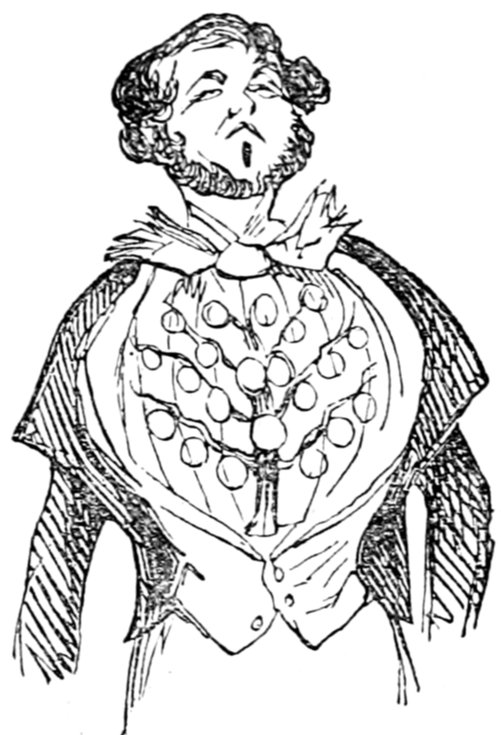
THE GENEALOGICAL SHIRT.
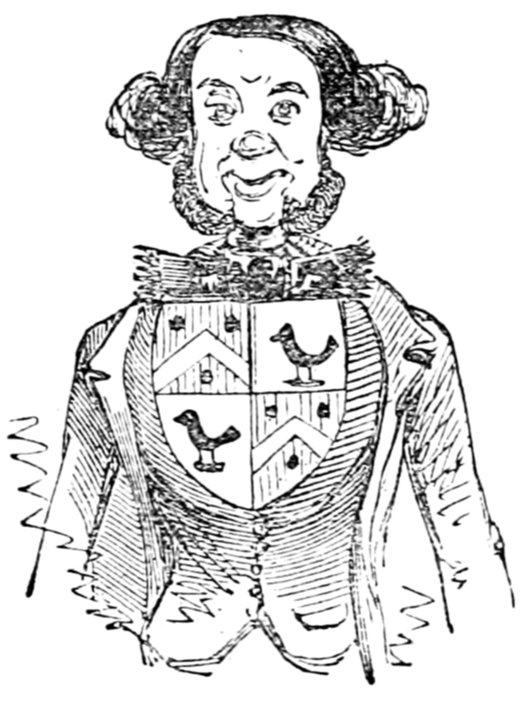
SHIRTICULTURE.
A new branch of the Fine Arts has lately flourished, which we do not know how to designate by any better name than Shirticulture. It is the art of painting on shirts—an art which cannot fail to go to the bosom of every one who enters at all into it. It was a favourite maxim of Buffon, that "Le style c'est l'homme." With all due respect to one who dressed animals in the finest language, we beg to say, that nowadays "La chemise c'est l'homme." The shirt is the man. Depend upon it, that shortly the particular profession, trade, penchant, or weakness of every one, will be laid bare to the whole world upon his breast. The gent has nearest to his heart a ballet-girl; and the sportsman is immediately detected by the last winner of the Derby peeping through his "Dickey." The noble game of cricket has been got up on a piece of lawn, no bigger than your chest; and we have seen Jack Sheppard breaking through a publican's shirt-front. Rowing matches not unfrequently run down the back of a river swell; and we know a gentleman who never appears on the turf without a whole steeple-chase galloping right over him, with a tremendous hunter jumping over each shoulder. The rage for pictorial shirts will ultimately spread over everybody in the kingdom. Men of noble descent will be drawing out their genealogical tree on a square of fine calico; and admirers of the "Fancy" will be putting their pet bull-dogs into muslin. We shall have heraldic shirts, theatrical shirts, military shirts, archæological and antiquarian shirts, temperance and convivial shirts, and shirts with portraits of puppy-dogs, men, parrots, and women. We shall have artists in shirts, as we have artists in hair; and every washerwoman's drying-ground will be an exhibition, to which the public will be admitted without having to pay a shilling to witness the pictures. A catalogue, in fact, could be drawn up, and might run as follows:—
EXHIBITION OF SHIRTS IN THE WASHING ACADEMY OF MRS. TUBBS AND JACK TOWELL, ESQ., BALL'S POND.
1. Portrait of a Fat Cook, in the possession of A 1 and B 2.
2. A Lion's Head, sketched from a celebrated door-knocker in Portland Place, which was taken off on November 15, 1842, by a noble marquis.
3. Cleopatra, a beautiful pug, and Sulky Bob, a lovely terrier, belonging to the Houndsditch Stunner.
4. The Last o' Peel—Sir Robert tendering his resignation to Her Majesty.
5. Leg of mutton and trimmings—the shirt of an alderman.
6. Views of Canterbury and York cathedrals—The two sleeves of a bishop.
2487. A Soldier's Beer, and Relieving Guard; the shirt of two Blues—The souvenirs of a housemaid.
8. "'Till so gently stealing;" Jack Sheppard helping himself in Mr. Wood's shop—The shirt of a young gentleman in Field Lane.
9. The Last Man—the property of a life-pill manufacturer.
10. St. George's, Hanover Square—The bosom comforter of a young lady.
11. "When hollow hearts shall wear a mask;" a view of Jullien's Masquerade—A False Front, late the property of a medical student, but now belonging to his cherished Uncle.
12. Distant view of Reading—The shirt of a critic.
13. Polly, a celebrated Hampshire pig, who won the prize for short snouts and curly tails, at the Royal Agricultural Show, 1845—The chemise of Mr. Giblett.
A LONDON INTERIOR.
If you have ever been to the Casino, you must have seen young Watts O'Clock. He aspired, in his Gentish soul, to be "a Fast Man;" and certainly his ambition was gratified, for he was universally looked upon as the "Fastest of the Fast." He went so fast that eventually he disappeared altogether.
I was going home very late, one dark morning, when I heard my name called out. I looked up, and noticed before my door an immense advertising van. The name issued again from one of the little windows at the side, and, lo! I recognised the Roman nose of Watts O'Clock peeping through it. Where there is a nose, I said, there must be a face; and if there is a face, it is highly probable that there is a body somewhere to it.
"Come up, my boy," the same voice and nose continued. I needed no further invitation. In another minute I was inside the van. True enough, it was young Watts. The interior was fitted up not very stylishly, but just as good as any lodging-house. The walls were papered with a handsome pattern, at three-halfpence a yard. In one corner of the room was a turn-up bedstead, and in the other a large sofa. A table and two chairs completed the furniture—with a meerschaum and a lucifer-box.
"Glad to see you," he said; "make yourself at home."
"It's a queer place for home," I could not help saying.
"Not at all. I've been here ten days, and I can assure you it's precious comfortable. No taxes; and rent only three shillings a week; and nothing for attendance. Not an extra, except occasionally a turnpike."
"And it has one advantage, you can go wherever you like, and move as often as you please."
"Exactly. Last night I slept in Drury Lane; the night before in the Borough; to-night, you see, I honour your neighbourhood with a visit; this morning I make a call in Tottenham Court Road, and then on to Gretna Green."
"Gretna Green!" I exclaimed; "whatever is taking you in an advertising van to Gretna Green?"
"A matter of affection," he said, seriously. "Jack, did you ever see an elopement in high life? Well, then, my good fellow, you shall see one this morning. Here, I say, old slowcoach," he exclaimed, putting his head out of the door, and speaking to the driver. "The old shop, Great Russell Street; and take care of the corners, mind. The stupid fool nearly upset the van the other day, driving sharp round Percy Street. I was breakfasting at the time, and received the teapot in my bosom, besides stamping a medal with the exact copy of my features on a pound of butter."
249"But how came you here?"
"Why, the constable drove me to it. We had a running match together last week. The long-legged runner of the law was gaining rapidly upon me. I saw Whitecross before me. Fear lent me the rapidity of a mad bull. Every one got out of my way. I bounded through the Little Turnstile like a pea through a tube. I found myself in Holborn. I felt the asthma of the bailiff close behind me. My left shoulder ached with the ague of a thousand writs. There is a touch in human nature which makes all mankind run; and that is the touch of a sheriff's officer. I ran across the road, but lo! an immense tower, a moving house, a mountain on wheels, in short, an advertising van, obstructed my path. Hope whispered into my ear, 'Get into it, you donkey!' In another minute I had jumped over the driver's head, and was inside these hospitable walls. I peeped through one of the eyes of 'Grimstone's Snuff' posters, and saw my pursuer looking wildly for me in every direction, wondering where I had disappeared to. I bought that good driver's silence, and I have remained his tenant ever since. We go on remarkably well together, excepting when he takes a strange turn, and upsets me by his clumsy driving. I stop here, because it is not safe to venture out, and so I have furnished my portable apartment as comfortably as I can." Here the van stopped, and Watts said, "Now, my good fellow, I must trouble you to leave me. This is the house where my flame lives. You see it is burning now in the bedroom window. She elopes with me to-night. I have been courting her now, thanks to that long ladder, for the last week. A modern version of Romeo and Juliet. She has consented to entrust her fortune to me. She is an heiress, as I needn't tell you. But her window opens. Dear creature, how anxiously she's expecting me. Fondest Emily, I fly to you. Leave me, Jackey, and witness this elopement in high life outside my humble habitation." So saying, he ran up the ladder which was perched against the side of the interior of his lodging. I watched him from the street. The top of the monster cart was just on a level with the bedroom windows. A fair form issued out of one. A pair of arms caught the trembling figure, and they disappeared together down the hollow square of the van. The next moment a handkerchief, with a portrait of the winner of the Derby, was waved out of one of the little windows of the vehicle, and I heard Watts's voice call out, "Coachman, Gretna Green!" Whether the van ever reached its destination is a mystery which must remain in darkness for the present.
POPULAR CONTINENTAL DELUSIONS RESPECTING ENGLAND.
That Englishmen never eat anything but "biftecks" and "pomme-de-terres."
That a Lord, when he is displeased with his wife, can take her to Smithfield, and putting a rope round her neck, sell her in the market for a pot of beer, or whatever a drunken drover chooses to bid for her.
That brandy is allowed to be drunk in the House of Lords.
That no daguerreotype can be taken in London, in consequence of the perpetual fogs; and that the church clocks are illuminated for the same obscure reason.
That the only pastry is plum-pudding; the only wine, ale or porter; the only fruit, baked potatoes; the only song, "God Save the Queen," and the only national amusement, boxing.
That no gentleman's establishment is complete without a bull-dog.
That the ladies propose to the gentlemen; that Gretna Green is an omni-bus-ride 250from London, and that half the marriages in England, those of Royalty and cooks included, are celebrated by The Blacksmith.
That commissions are purchasable in the police force, and that the sons of noblemen are proud to serve in it.
That the result of every dinner-party is for the gentlemen to drop, one by one, underneath the table, after which they are carried upstairs to the ladies.
That half the population is "milors," and the other half "millionaires."
That there is no English school of painting, excepting that practised by Clowns and Ethiopians.
That the Boy Jones is (if the truth was known) a member of the Royal Family.
That George the Fourth was in the habit of going to the Coal Hole.
That Watt stole his steam-engine from the French; and other absurdities by far too numerous to mention.
NEW YEAR'S GIFTS.
A little Wrinkle for next Session.—If the parliamentary privilege of freedom from arrest is done away with, we are afraid that the question of the Jews in a British Parliament will touch not only the prejudices but the persons of certain members too closely ever to be admitted.
Curious Discovery of a Skeleton.—The perfect skeleton of a goose is found in November next in Thames Tunnel by a police-officer looking for an escaped criminal. The poor animal is supposed to have taken refuge there on Michaelmas day, and to have died of starvation. This little paragraph is written to record its sagacity. Readers, if you have any sympathy, you will drop a tear to the memory of that goose!
Why do sailors serving in brigs make bad servants?
Because it's impossible for a man to serve two-masters.
A Novelty.—Prince Albert's pig does not get a prize this year. The law is a long Chancery Lane that hath no turning but Portugal Street.
"Our Natural Enemies"—tailors.
"The Bottle."—"Ah, my dear fellow, you're gradually drinking yourself into the grave," as the Pint Bottle said to the Quart.
Proverb just Imported from Boulogne.—A moustache covers a multitude of debts.
QUESTION AND ANSWER.
Shakspeare.—"What's in a name?"
Widdicombe.—"The continual nuisance of writing your autograph."
FULL-FLAVOURED SIMILE.
Men are frequently like tea—their real strength and goodness is not properly drawn out of them till they have been for a short time in hot water.
Who says it isn't?—The reason so many whales are found about the North Pole is, because they supply all the Northern Lights with oil.—Communicated by a Traveller.
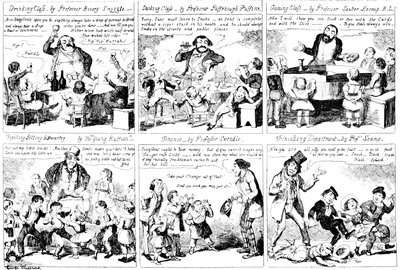
The Preparatory School for Fast Men. To teach the young idea how to shoot, smoke, drink, fight, cheat, and the various accomplishments of "regular bricks."
251