THE COMIC ALMANACK For 1847. (continued 2)
Reading edition
Again: I don't like to hear Miss Pertness abusing Captain Rover, and calling him an impudent fellow and a coxcomb in so spiteful a tone; especially when I know that a few evenings back she danced with him nearly every quadrille, and that she is now curling her pretty lip simply because Miss Flirt's sparkling eyes have bewitched the Captain for a time. Nor should Miss Pertness run across the room to Miss Prude (whom she laughs at for "dressing like a girl of eighteen, when all the world knows she's thirty, if she's a day"), to point out how the said Miss Flirt is coquetting with the said Captain Rover.
Rest assured, my dear creatures, when you can say nothing good of any one, the best way is to keep your pretty mouths closed, and to say nothing at all. Talk any little innocent nonsense you like that is natural to you; but do not, for goodness sake, be satirical or ill-natured. Leave that to philanthropists.
Above all, don't flirt too much: it's very dangerous, and may ruin your prospects in the world. For rely upon it, that though most men like flirts very well for an evening, they would hardly think of linking themselves to one for a lifetime.
Moreover, don't affect blueness, or music-madness, or any kind of literary or scientific mania: though if you must, for mercy sake, don't be silly enough to believe that you show your intellect by neglecting your dress or personal appearance. Philosophy and Polkas are very distinct things; so either throw up one or the other; for the song that says, "I must have lov'd thee hadst thou not been fair," is one of those fictions that Bunn and the other British Poets have been in the habit of getting set to music, and foisting on the public from time immemorial.
Now, adieu! and though I am quite aware that the main object of your lives is to make us the slaves of your charms, and then to render us miserable by marrying us (the bare idea sets us trembling), still we wish you success the most brilliant. May Park phaetons, opera-boxes, diamond suites, and even coronets and plain gold rings, be showered at your dear little feet; and, above all, may you be happy, whether your wedding-cards bear the address of Belgrave Square or Clapham Common.
Yours, ever Platonically,
Albert de Berlins.
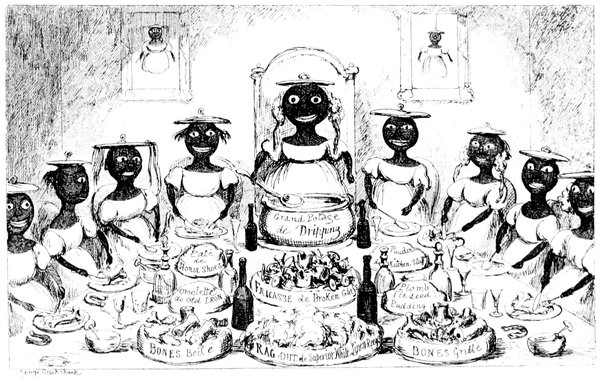
THE BANQUET OF THE BLACK DOLLS In commemoration of the Reduction of the Duty on Rags.
179
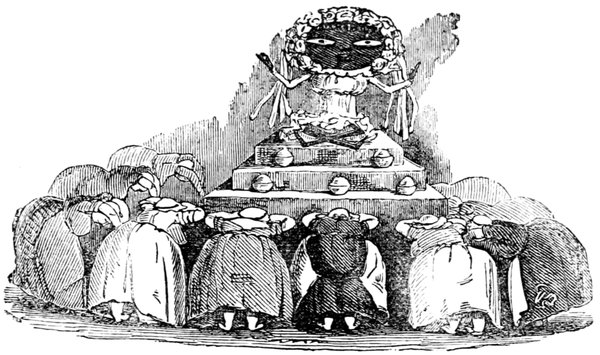
The Cooks of England offering up their Kitchen Stuff to their Black Idol.
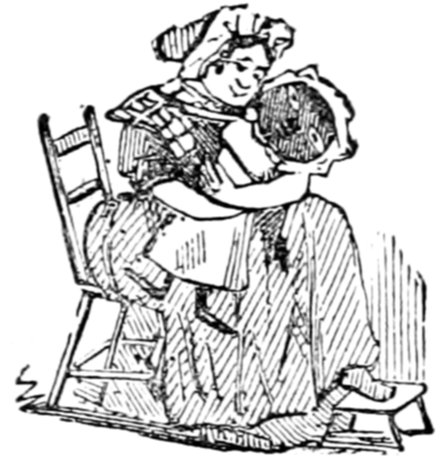
It shall have all the kitchen stuff—so it shall.
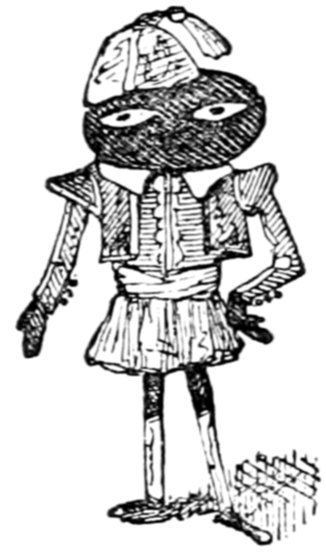
A Lover of Grease.
DE BLACK DOLLIBUS.
The Black Dolls of England are a highly comic race. They were the first to mingle the unctuous joke with the dry details of business, and to give a lightness to puffs before unknown to the paste of the Billsticker. They are the Smolletts of Posters, and the Fieldings of the Broad Sheet. Clare Market appears to be the grand centre of these right merrie marine store shops. Here a magazine of linen rags and witty conceits displays a thoroughly Gran-tian work of art, in which one cook is inquiring of another, who wears a chapeau in tremendously full flower, "My dear, where did you get that splendid new bonnet from?" to which the other replies, "Why, by carrying my bones and fat to the real original Black Doll, No. 12," &c. Another racy repository exhibits a grand transparency, representing a tête-à-tête between the Black Doll and one of her fellow-countrymen, in which the dark gentleman, in a most unniggerly dialect, is made to ask, "Why, Dinah, do all the people come to Massa's shop?" and Dinah to reply, "Because Sambo, Massa gives the best price for all old-iron, linen rags, and kitchen stuff." Then there is the highly popular bellman, who is eternally crying, "Oh yes! Oh yes! WE (!) are now giving two-pence for three pounds of old bones," &c. And last of all, the exceedingly tempting inquiry, "Do you want a plum pudding?" of which dainty there is prefixed a splendidly coloured caricature, and for which one spirited rag merchant subjoins the following curious recipe:—
The Black Doll's Receipt for a Good Plum Pudding.
Take 8lbs. of the best white linen rags, 4lbs. of broken flint glass, and 12 ditto of old bones; throw in a handful of old nails, with a few horses' shoes, and flat irons at discretion. Put these into a bag, and bring them to No. 12, &c., and you will find that it will make you a good family plum pudding; but if you wish to give it additional richness, you should add a few pounds of kitchen-stuff, and put a pound or two of candles into the grease pot.
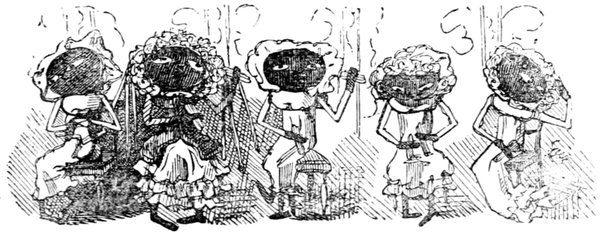
The Real Ethiopian Serenaders or the first that extracted Notes (Bank) from Bones.
180
THE HONOUR OF THE READER'S COMPANY IS REQUESTED TO A DINNER PARTY.
The Dining Room's quite a sight! The Chairs have had their pinafores taken off for the occasion, and now stand out in all the glory of Morocco. The table, which in the morning was only a modest square, has by means of its telescope been stretched into an oblong. You can count the number of guests by the number of chairs, and before each seat stands a small cluster of wine glasses, of different shapes and colours, two plates, and a napkin folded into the form of a triangle, with a small sandball-looking French roll secreted within it. The salt has changed its colour—is pink, and looks flushed with excitement. The supernumerary silver has been taken from its catacomb of the plate chest, where it has been kept since the last grand dinner, shrouded in wash leather, and like an old Dowager has now been rouged into brightness.
At the Sideboard stands Kitson, the host, with a shiny soapy face, decanting the wine, and consequently in a bad humour. And the honest Coal and Potato Warehouseman, who "beats carpets and attends evening parties," is fortifying himself in the passage by swallowing all that is left at the bottom of the bottles, with a look of extreme disgust for all spirituous liquors; and Master Kitson is helping his Father with the Wine, and himself to the Almonds and Raisins, when the Governor is not looking. On one side stand half a dozen of generous Port, in rich coats of Cobweb, with their chalk fronts; and on the other, two or three bottles of that tall, stately-looking, silver-headed, dinner-party-drinking Champagne.
In the Drawing-room is Mrs. Kitson, in a dreadful state of mind, standing on a chair—on which she has spread her handkerchief, from the fear of soiling the damask of the cushion—groaning over the Ormolu Lamp, and trying to discover why it has been dripping on the yellow satin Ottoman beneath.
In the midst of this a hungry double knock comes at the door, and the hostess has just got time enough to snatch one of the showily-bound books, which are placed at regular distances round the drawing-room table, and arrange herself and her dress on the Sofa, with a look of deep interest, when the Coal and Potato Warehouseman announces the first small appetite in a voice that savours strongly of "Below." And in the said small appetite walks in a love of a dress that talks French as fast as it can rustle. The conversation takes a lively turn, first, as to the weather, and then as to the children of the two establishments, each fond mother trying to make out that "her dear Herbert" or "her dear Kitty" was more delicate than the other fond Mother's sweet offspring.
Now the hungry double knocks come quicker and stronger, and the plates and the glasses jingle a kind of chorus. The next-door neighbours keep running to the windows, and are quite sure there is something going on at the Kitson's, and feel highly indignant at people not treating their neighbours as themselves, and vow revenge at their next evening party. There 181is a small crowd of half a dozen errand-boys and nursery-maids in front of the house, who closely criticise the dress of each small appetite as it arrives.
The company now are only waiting for the family Doctor; and Mrs. K. begins to have dreadful visions of the haunch of Venison done to a cinder, and the Turbot about the consistency of curds and whey. Every now and then young Kitson comes into the room and whispers into his mother's ears, and receives a mysterious something, that sounds like keys. Kitson has got three or four of his old Cronies together, and is letting them into the secret of some miraculous quack pill, and how it has done him a world of good.
At length in walks the dilatory family Doctor, with a volume of splendid excuses, and, being a jocular man of the world, he easily obtains a pardon. Then comes a general move for the dinner-table, where Mrs. Kitson looks over a kind of Index of the Chairs, which she has on a card, and tells each party where he or she is to eat his or her dinner; by which contrivance she cleverly manages to place bashful gentlemen next to talkative ladies, and bashful ladies next to talkative gentlemen.
Then the family Doctor insists on Mrs. Kitson letting him help the Turbot, whereupon Kitson informs the whole table that he shall be jealous if the Doctor "goes on in that way," which being, of course, a good joke, causes the guests to giggle unanimously. Every now and then the Doctor does a witticism, whereat the Coal and Potato Warehouseman, who is of a facetious turn of mind, chuckles inwardly, and manages to lodge a slice of Venison or a cutlet in some lady's back hair. Now Kitson gives a mysterious nod, and immediately Champagne is handed round, and Master K. ventures on a glassful; on which his Father looks as black as gentility will allow him, and determines within himself not to allow Augustus to dine at table again until he knows how to behave himself.
On the removal of the cloth Mrs. Kitson's proud moment arrives. She has thrown the whole strength of the footman into the French polish, and her domestic reputation stands upon her tables. At the sight of them all her female friends fall into violent admiration, and, "How do you do it; I can never get ours half as bright," &c., &c., bursts from every housewife. With the Dessert come the dear little Master and Miss K.'s, beautifully got up with bear's grease and pink sarsenet for the occasion, but looking rather pale from the effects of having dipped their tiny fingers into each dish as it left the Parlour (the Doctor is in doubt whether it arises from Bile, or a nasty Influenza that is flying about); and each of the ladies begs to have "the little pets" next to her.
Now the gentlemen begin tempting the ladies, by cutting oranges into the shapes of lilies and baskets, or cracking nuts for them. And so matters proceed, until Mrs. Kitson looks inquiringly at each lady, and each lady having smiled in answer, they all rise and make for the door, which two or three of the younger gentlemen rush to open. As soon as they have departed, the gentlemen draw near to the fire, and Kitson says, "Let us be comfortable," and puts on the table such wines as weak woman is unable to appreciate.
182Then come Claret, Old Port, and Politics, and with the sixth bottle they begin discussing Moral Philosophy. Mrs. Kitson's health is at length proposed by the family Doctor, who speaks of her as "the exemplary wife—the tender mother—and the woman whom to know is to admire, ay! and he would say—to love." And then Kitson wants words to express his feelings for the honour they have done him, and winds up his catalogue of Mrs. K.'s virtues with a tear. Now "the exemplary wife" upstairs gets nervous about her husband and the wine below, and sends the footman in every ten minutes to say that "Tea is ready." Suddenly the ladies commence singing, and the family Doctor, who lives but to please, proposes to join them.
As soon as the gentlemen have retired upstairs, Kitson, who remains below, carefully locks up the remnants of the fruit and wine, and reminds Master K. of that little affair of the Champagne, and trusts he may never have to speak to him on that subject again. Then the gentlemen upstairs ask each lady in turn to oblige them with a song, and after considerable difficulty, prevail upon Mrs. Kitson's unmarried sister to favour them with "Did you ne'er hear of Kate Kearney;" but unfortunately the nuts spoil the runs. And then the gentlemen begin to have a strong inclination for Sofas and forty winks, and will put their "nasty greasy heads" on the bright yellow satin damask cushions. And then the company grows very silent; so that Kitson, who can't get up his rubber, is not sorry when he hears the Coal and Potato Warehouseman announce the first carriage. Then comes the hunting for Cloaks, and the running for Cabs, and the giving generous shillings and very generous half-crowns to the Coal and Potato Warehouseman, who is very careful to be at the door as each party is leaving. At length they have all gone, and Kitson tells his better half to see the plate right, and retires to bed.
Next morning he is very surly all breakfast, and very late for business, and Mrs. K. speaks out about the quantity of wine that was drunk; and the family, much to the delight of the little K.'s, have the remainder of the jellies, and other good things, for dinner all the next week.
PEOPLE ONE MEETS IN SOCIETY.
No. 1. THE YOUNG GENTLEMAN WHO HAS JUST GOT HIS COMMISSION.
Do you see that young man at the top of the quadrille, dancing with that pretty flaxen-haired girl? That's Arthur Bumpshus; he has just got his commission; though one might guess as much, for he's paying more attention to himself, as you perceive, than to his partner, and he holds his coat by both of the lapels, so as to keep it off his shoulders, while he puffs out his chest like a pouter pigeon. His hair too, you observe, is cut very short behind, and frizzed out at the sides, and stuck up at the top, with the true 183military effect; and whenever his partner speaks to him he looks down on the floor, and, inclining his head slightly on one side, listens with a haughty frown.
The quadrille is over, and now here he comes. Hark! he's talking to the flaxen-haired girl about Chatham, and the Provisional Battalion, and the Mess, larding his conversation with as many military technicalities as he can possibly cram into it, though, between you and me, he has not yet joined his regiment, and has dined only once—or twice at the outside—at Chatham. He says, too, that it's deuced unpleasant being bottled up in uniform this hot weather, though we know for a fact that his own regimentals are not yet finished, and that he means "to let out at the tailor above a bit" for disappointing him with his things for this evening. When however a friend asks him how it is that he does not appear en militaire, he replies, "Oh, when a man (rich that, for a boy of eighteen!) is forced to wear uniform he naturally prefers being in Mufti whenever he can."
He walks across the room digging his heels down at every step with a ferocity intended to inspire all beholders with a high idea of his determination, and asks, when a person's name is mentioned, whether he's in "the Service;" and, on being told to the contrary, speaks of him ever afterwards as "a Civilian." And when the host's young nephew, who is home for the holidays, accidentally treads on the toe of Mr. Arthur Bumpshus's Patent Leather Boots, Mr. A. B. frowns in a way that makes the poor youth in the jacket tremble again in his pumps; for the young military gentleman is anxious to distinguish himself for his valour in the eyes of his friends.
He will not allow the engraver to have any peace until he sends home Mr. Arthur Bumpshus's cards, with the No. of his regiment printed upon them; and, when he gets them, Mr. A. B. goes the whole round of his acquaintance, and calls at the house of each of his friends at a time when he hopes they are in the park, so that he may have an opportunity of leaving them one of the bits of glazed pasteboard which announces that he has got his Commission.
He also pays a visit to Laurie, for the purpose of ordering his saddle; and hearing Major Splatterdash, of "the Heavies," swear at the saddler for something which is not quite to the Major's satisfaction, the young gentleman follows his brother-officer's example, and gets a not very gentle hint from the tradesman, that unless he can behave himself he had better leave the shop; for though Laurie may consider it worth his while to pocket an insult from a Major of ten years' standing, it does not exactly answer his purpose to do the like with a sucking ensign.
In short, the young military gentleman persists in making himself as obnoxious as possible to all people, with the view of impressing them with his importance, though he forgets that while he is endeavouring to play the Lion, the Ass's bray continually betrays him.
No. 2. THE YACHTING MAN.
"Beg your pardon! hope I've not hurt you; but you were right in the gangway!" exclaims a light-haired, blue-coated specimen of humanity, as he enters the ball-room, and treads on the feet, and grinds the head of one of the guests against the door-post he fancies he is ornamenting; and then he rushes violently up to the lady of the house, and shakes her hand with a vehemence more cordial than "comme-il-faut;" and then, turning to the 184host, apologizes for being so late, declaring that he had carried away every stitch of canvas he could stagger under, and would have made the house half-an-hour before, but he'd had a capsize in a cab, and it took him some time to get under weigh again.
Then he mixes in the crowd, and on closer inspection, you perceive by the bright buttons on his blue coat, which have a crown and anchor and some inscription upon them, that he belongs to one of the Royal Yacht Clubs; while the same bright buttons with the same crown and anchor, &c., only a size smaller, adorning his white waistcoat, tell you that he is not ashamed of it.
From his conversation we are made acquainted with the important fact that there had been a match that day at Erith, and that his yacht must have won only his gaff-topsail was carried away in a squall; and we learn, moreover, that he fully sympathizes with Lord Freshwater, who would have come in a good second had not a Hatch Boat run right into his starboard-bow, and driven her bowsprit clean through his lordship's balloon-jib. And then he tells the listeners a remarkably funny story of a friend of his, who went for a cruise with him, and would persist in calling "going on deck" "going upstairs;" whereat the yachting man laughs immoderately, and takes care all the evening through to term "going downstairs," "going below."
He does not dance much, but whenever he does stand up for a Quadrille he talks very loud to his partner, saying, "Aye, aye," to all her questions; and he rushes to the refreshment-room with her directly the dance is over, where he does not restrict himself to negus and ices, but attacks the port wine at once.
During the supper he does not do much until the ladies have left, and then he falls to with surprising vigour, and calling the footman on one side, inquires whether there is any malt to be had. When the beer arrives he professes an intense contempt for champagne, and says that as far as he is concerned a glass of two-water grog is better than all the wine in the Docks, especially when one's on deck at night; all which causes the younger men of the party to look upon him as a very dashing sort of a fellow. And if by any chance he is asked for a song, he is sure to squall "I'm afloat," or "A Life on the Ocean Wave," though his knowledge of such a state of existence must be very limited, for he has seldom been beyond the Nore, and at farthest to Ramsgate,—excepting, by-the-by, once, when we believe he did get as far as the Isle of Wight, during the Cowes Regatta. Nevertheless, a life in his father's country-house would be more in character with his habits.
And when the party is breaking up the Yachting Man is seen in the Hall putting on a very rough Pea-Jacket, with large horn buttons, and a cap with a gold-lace band round it. He says something about it's being time to turn in, as four bells have gone; and having lit a cigar at the hall-lamp, he finally disappears, chanting—
"Good-night!—All's well."
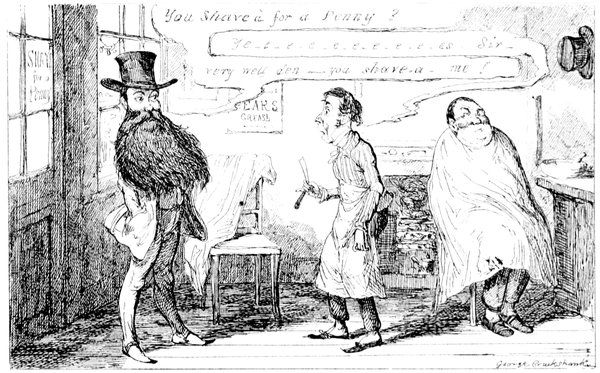
A GOOD PENNY-WORTH.
185