THE COMIC ALMANACK For 1847.
Reading edition
140
DER BAILIFFE JÄGER: AN ENGLISH BALLAD IN THE GERMAN STYLE.
Who is it that paces that street o'er and o'er?
Why keeps he his eye ever fix'd on that door?
What seeketh he there, at an hour like this?
Bears he tidings of woe?—bears he tidings of bliss?
No tidings of bliss does the stranger convey;
But for a bold Captain he hears a fi: fa:
And he paces that street, and he eyes that thresh-hóld;
For he seeketh to capture that Captain so bold.
And where is the Captain he seeketh to seize?
At the "Coal Hole," he taketh his grog, and his ease.
God send he may stop there until morning comes!
For God shield the Captain to-night from the Bums!
But hark! in the distance, a footfall occurs;
And clinketty-clink! sounds the jingling of spurs;
And then the street echoes with "La-li-e-tee!"
Now God shield the Captain! for sure it is he.
And he reacheth the door, and he knocketh thereat,
With a thundering rat-a-tat-tat-a-tat-tat!
And he giveth the bell such a furious ring
That the street rings again, with its cling-a-ling-ling!
Oh Captain! bold Captain! now hie thee away!
For near draws that Bum, with his fearful fi: fa:
Hurrah! now he sees him as nearer he steals;
And away hies the Captain! with the Bum at his heels.
Then, hurrying—scurrying—the Captain doth fly;
And following—hollowing—the Bum rusheth by.
Away! and away! thro' each square, and each street!
Though fleet runs the Captain, the Bum runs as fleet.
On! on! my bold Captain, see, help is at hand;
For lo! in the distance, appears a cab stand.
Quick! he's in one, and off, at a galloping pace;
Quick! The Bum's in another cab, giving him chase.
Then, "haste thee, my Cabman!" the Captain did say;
"The Bailiff behind has for me a fi: fa:
'Tis in Middlesex though! so there's Gold, if you'll hurry;
Yes, Gold! if you drive me now safe into Surrey."
141And, "Haste thee, my Cabman!" the Bailiff did say,
"For the Captain before us I've got a fi: fa:
'Tis in Middlesex though! so there's Gold, if you hurry
Yes, Gold! if I catch him before he's in Surrey."
Then gee up! and gee on! they go tearing along,
Now jerking the reins—and now plying the thong;
And the horses they bound away over the ground:
And the mud flies about, as the wheels fly around.
Bump! bump! over the stones—slosh! slosh! over the wood,
Whack! whack! goeth each whip—quick! quick! quicker who could?
And clattering—spattering—onward they go,
"Hark forward! hark forward! for Surrey halloo!"
Right and left, flieth past every gaslight, how fast!
How fast! right and left, too, each street flieth past!
The shops, and the houses, like lightning, are gone,
As the horses keep galloping, galloping on.
See yonder! see yonder's a small breakfast stall;
"Have a care! have a care!" or the Sáloupe must fall:
Round the corner, unheeding, the vehicles dash;
Crash! down come the coffee and cups with a smash.
And still they go pacing—and racing—and chasing:
And the Bum still the steps of the Captain is tracing:
Away! and away! through each square, and each street!
Though fleet rides the Captain, the Bum rides as fleet.
"On! on!" shouts the Captain: "On! on!" shouts the Bum;
"I promised thee Gold: come! I'll double the sum;
So, on! push along! my good trusty Jehu!
On! on! to the bridge that is called Waterloo."
Now, galloping fast, by St. Giles's they've past;
The Captain still first, and the Bailiff still last.
Now, through High Street they pace—now, down Cross Street they race:
With the Captain ahead, and the Bum giving chase.
Then Long Acre's clear'd—and then Bow Street is near'd—
Then the Theatre Royal Covent Garden appear'd—
And then quickly in view came the Lyceum too—
Hurrah! now they're close to the bridge Waterloo.
142So, gee up! and gee on! they go tearing along;
Now jerking the reins—and now plying the thong;
And the horses they bound away over the ground;
And the mud flies about, as the wheels fly around.
Bump! bump! over the stones—slosh! slosh! over the wood;
Whack! whack! goeth each whip—quick! quick! quicker who could?
And clattering—spattering—onward they go:
"Hark forward! hark forward! for Surrey halloo!"
Now there's no time to wait; and see! merciless fate!
At the bridge a curst wagon doth block up the gate.
'Tis ruin to stay!—but one moment's delay,
And the Captain he falls to the Bailiff a prey.
But quickly the wight from the cab doth alight,
Pays the toll, and on foot then continues his flight;
Still ripe for the race, the Bum bounds from his place,
Clears the gate, and on foot too continues the chase.
Then huzzā! and huzzā! they go tearing away,
Now out in the road—now upon the pavé:
And, racing—and chasing—still onward they go;
"Hark forward! hark forward! for Surrey halloo!"
Now the goal draweth nigh—now the toll is hard by;
And now, how they scamper!—and now, how they fly!
And now, how they hurry!—and now, how they scurry!
And, hip! hip! hurrah! now the Captain's in Surrey.
Then the Captain turned round to the Limb of the Law;
And he chaff'd, and he laugh'd at his craft, Haugh! haugh! haugh!
And says he, "To catch me, sure the Bum must be cunning
For the constable I have a knack of outrunning."
That the Sheriffs in one county cannot arrest
The "bodies" that bide in another's confest;
So that Bailiff no longer that Captain can worry,
For the Bum is in Middlesex—the body's in Surrey.
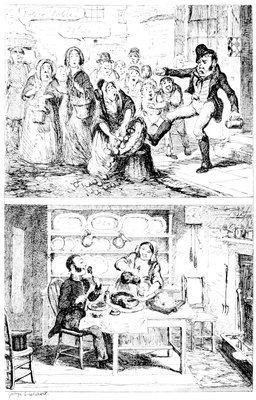
WHERE CAN THE POLICE BE?
143
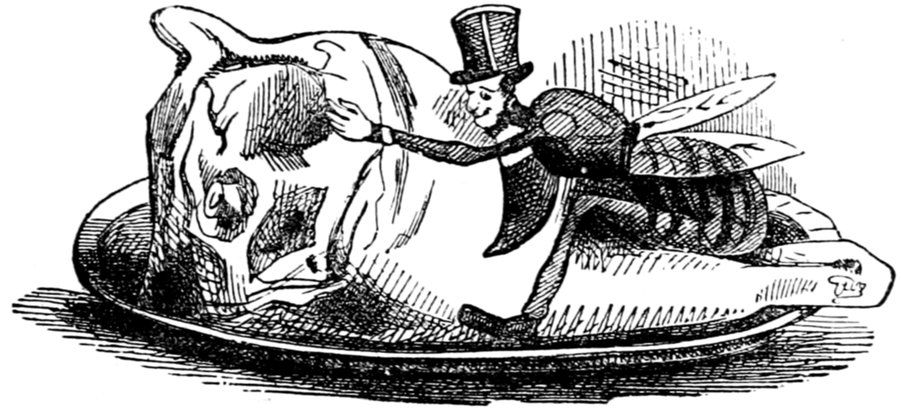
THE BLUEBOTTLE THAT DESTROYS ALL THE COLD MEAT.
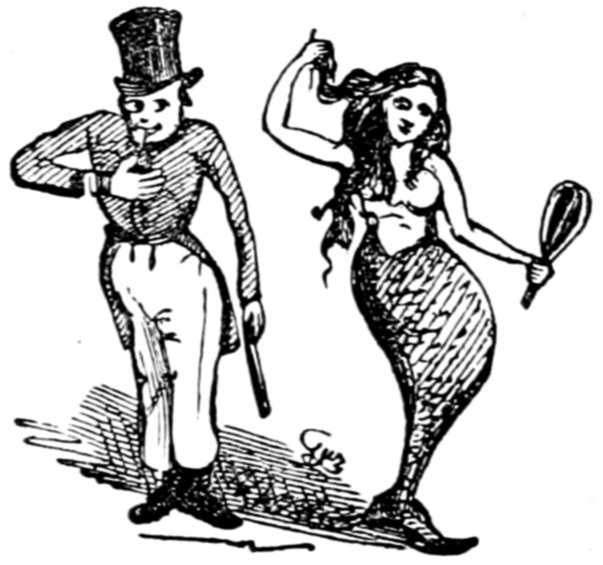
Two things equally difficult to be met with.
CURIOUS EXHIBITION. NEVER SEEN IN THIS COUNTRY.
The Proprietors of the Egyptian Hall are happy to state that they have made arrangements with the authorities of Scotland Yard, and, after considerable difficulty, procured the services of
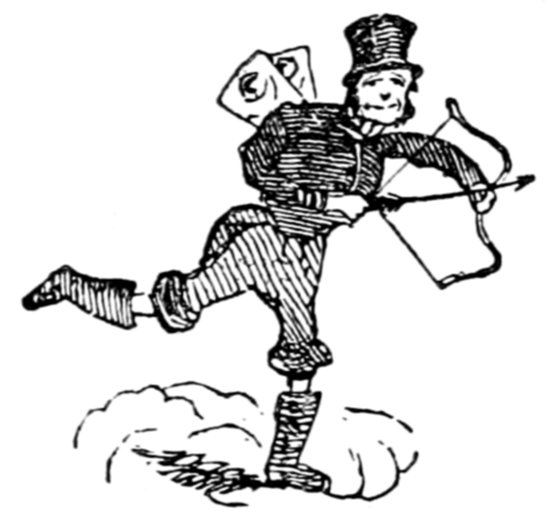
The Kitchen Cupid.
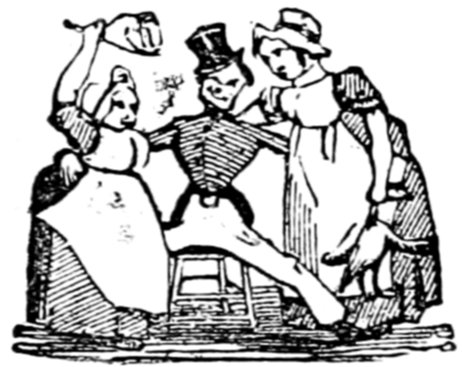
The Modern Macheath; or, how happy could I be with either?
THE INVISIBLE POLICEMAN.
A NATURAL CURIOSITY,
TO WHOM THOUSANDS HAVE ALREADY
PAID, AND
NOBODY HAS EVER YET SEEN.
THIS RETIRING INDIVIDUAL
WILL, STRANGE TO SAY,
ANSWER CIVILLY ANY QUESTION THAT
MAY BE PUT TO HIM;
HE WILL
TELL ANY PERSONS WHAT THEY HAD FOR DINNER THE DAY BEFORE;
HE WILL
NAME THE COLD MEAT DAYS IN EACH FAMILY;
AND
STATE THE COLOUR OF THE HAIR AND EYES
OF THE FEMALE SERVANTS IN EVERY
ESTABLISHMENT;
LIKEWISE
WHETHER THE MAIDS FIND THEIR
OWN TEA AND SUGAR;
Indeed, it will be found that this Wonderful Creature
POSSESSES A KNOWLEDGE
EXTENDING OVER THE WHOLE AREA OF THE
METROPOLIS.
"'Tis not a wonder:
'Tis Nature."—Times.
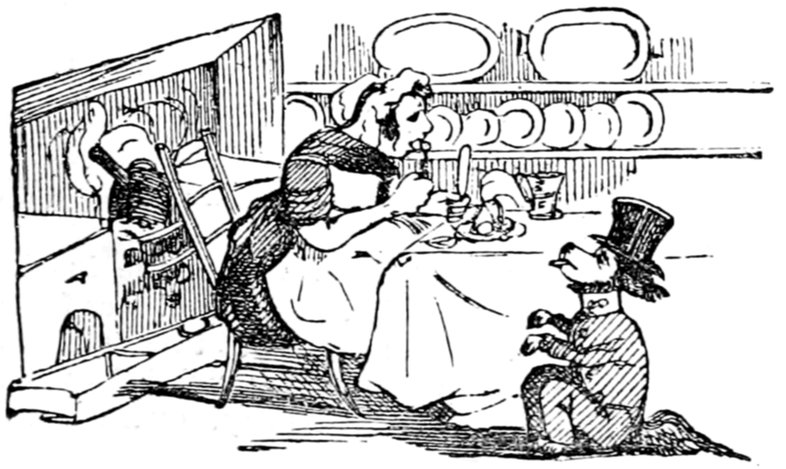
THE COOK AND HER FAITHFUL ATTENDANT.
144
"SAY YOU DID IT!" A ROMANCE OF SMILES AND TITTERS. TITTER THE FIRST.
That ordinary-looking middle-aged gentleman, who is just emerging from that Jeweller's shop, is Signor Goffoni. He has been there to purchase a pair of earrings for his pretty young wife, with which he purposes to bribe her into good-humour with him again. For, to say the truth, the happy couple have lately been living on the usual matrimonial terms which follow the union of Signoras, who are scarcely out of their teens, with Signors, who are half way through their 'tys. And this morning the conjugal breezes had swollen into a perfect hymeneal hurricane. It had blown divorces and separate maintenances. The Signora had gone into the customary hysterics, and the Signor had left the house with that violent bang of the street-door which is the especial property of enraged husbands. And "the cause—the cause" was precisely the same as made Mr. Othello determine to put an extinguisher upon his better-half, instead of his night-lamp. The green-eyed monster had kittened his horrid suspicions in Signor Goffoni's bosom, and had lapped up all the milk of human kindness in the dairy of his heart. He had accidentally discovered a billet—something more than a doux—addressed to his black-eyed young wife, from a gentleman calling himself the Marchese di Castellinaria, and which expressed a regard for her that—tested by the very delicate thermometer of the Signor's jealousy—did appear to him not quite so tepid as mere friendship would dictate. And he had not scrupled to say as much to the black eyes he had taken for better or for worse. Whereupon the said ebon optics had looked scissors, though they'd used none—had vowed eternal separation—usque ad mensam et torum—and wound up with those effective convulsions of which married ladies generally keep a plentiful supply, ready for use. Jealousy, however, had galvanized the iron of the Signor's heart, and made it no longer susceptible of being acted upon by the salt water of his wife's eyes; so, as we said before, he bounced out of the house with a bang like a human cracker.
Long before evening, however, Goffoni had relented; he felt convinced that he had wronged his dear little wife by his unjust suspicions, and arrived at the sage conclusion that he was a brute and she was an angel; so that an hour before his usual time for quitting business he hurried off to the nearest Jeweller's to buy her a pair of earrings, determined to hasten home and shed over her the diamond drops of repentance. But on arriving at his domicile, he found the dark-eyed young partner of his bosom absent from home. Could his unkind treatment have driven her from his roof? The very thought was stilettoes. He rang furiously and inquired of the servant concerning her mistress. She had quitted the house about half an hour ago, leaving directions that the letter which the maid then presented should be delivered to the Signor immediately on his return. He seized it. It was unaddressed, and ran as follows:—
"After your insulting conduct I can no longer consent to the continuance of our acquaintance. I must beg, therefore, that henceforth we be as Strangers; and that you will never again dare to offend me with the protestation of your regard, which it is utterly impossible for me further to acknowledge.
"Carlotta."
"Gone! gone!" groaned Goffoni; and he sunk overwhelmed upon the sofa, and buried his face in his hands. Presently he started up again—buttoned his coat vehemently—knocked his hat on his head—and dashed from the house with a wild look of despair and prussic acid.
That miserable-looking middle-aged gentleman, seated on that stone in the heart of that wood, is Signor Goffoni. And that small phial, which he takes from his waistcoat-pocket, is labelled "Laudanum!" He has sought out this secluded spot, and purchased this poisonous potion, to put a premature "finis" to his wretched biography. For "what is the world now to him?" he says—"a wilderness—a 145desert. He has lost the angel who made it a paradise; and as he always felt convinced that there was not another woman like her upon earth, why should he go dawdling on alone to the grave? No! he is resolved! Bereft of his Carlotta, he cares not to live, and fears not to die. She has bidden adieu to him, so he will bid adieu to the world."
With this brief oration the woe-begone Goffoni drew the stopper from the phial, and swallowed its contents.
No sooner had he drunk off the deadly draught than a Signor, habited in a capacious cloak, started up from behind the stone on which Goffoni was seated, and inquired whether he would save the life of a fellow-creature?
"I save the life of a fellow-creature!" gasped Goffoni, dropping the empty phial with amazement from his hand; "I am a dying man myself!"
"Yes! I know that," replied the Signor in the cloak, "and that is the cause of my making the request. The fact is, the other gentleman, whose life is in danger, is not quite so tired of his existence as you seem to be of yours. And since you are determined on going out of the world, you may as well leave it with the grace of a good action, and let your death be the salvation of his life."
Goffoni, who was now ready to clutch at any straw that appeared likely to save him from sinking in the next world, simply asked, "How that could be?"
"Oh, never mind about that," returned he in the cloak; "only you consent to do it, and I'll soon tell you how. Come! what do you say? Recollect 'charity covers a multitude of sins,' and you've got a pretty good lot here to answer for, certainly."
Goffoni felt that he had, and being anxious now to obtain absolution by any means, he, not very reluctantly, promised to do what the stranger desired.
Whereupon the Signor in the cloak informed Goffoni that, finding himself rather short of cash, he had requested the loan of some gold from a drover whom he had met that evening in the forest; but that the drover had not only in the most un-gentleman-like manner refused to accommodate him, but had even been base enough to doubt the honesty of his intentions. That this had so exasperated him in the cloak that he had knocked the scoundrel down, and borrowed of him all the money he possessed. That the cries of the drover had brought the soldiers to his assistance, when the Signor in the cloak was obliged to run for his life; but that in his flight he had dropped his hat on the road. That he had only just succeeded in avoiding his pursuers by secreting himself behind that stone, when Signor Goffoni had come up and seated himself upon it. "However," added he, "the soldiers can't be far off; and when they find I've given them the slip they will be certain to return, for I know them of old. So that, you see, what I want of you now, my friend, is, should the rogues come this way again, and question you about that nonsensical piece of business, that you'll just have the kindness—since it can't make any difference to you in your present situation—to say you did it."
Goffoni, when he heard what was required of him, hardly liked the office he had undertaken to perform. But as it certainly could not make any difference to him in his present situation, and as he had given his promise, he told the gentleman in the cloak he would be as good as his word and say he did it. The stranger thanked Goffoni heartily, called him his preserver, and many other equally complimentary names, and was about hurrying off, when a sudden thought detained him, "Stay!" he exclaimed, "this cloak will make your confession all the more veritable, while the possession of the identical purse I took from that rascally drover will put the affair beyond the shadow of a suspicion." And so saying, he threw the one hastily over the back of Goffoni, and, having divested the other of its contents, slipped the empty leathern bag into the breeches-pocket of that poor gentleman, who, by this time, lay writhing on his stomach, under the painful effects of the deadly draught he had swallowed.
"And now once more, Addio!" exclaimed the stranger, putting on the hat of Signor G. as a substitute for the one he had dropped on the road; "and mind!" he added, "I rely upon you to—say you did it!"
[Second Titter, page 147.]
146
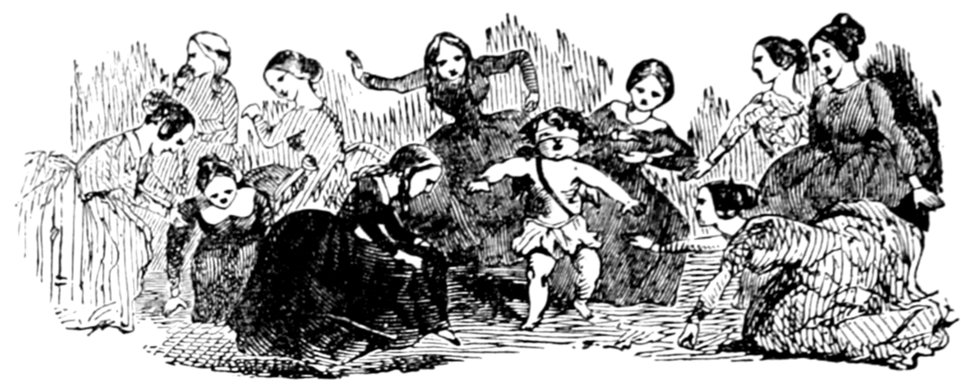
BLIND BOY'S BUFF AT THE LADIES' SCHOOL.
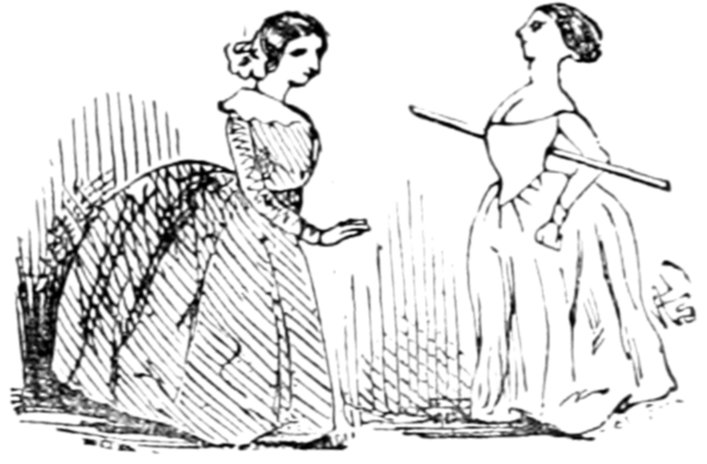
Bringing her up in the way she should go.
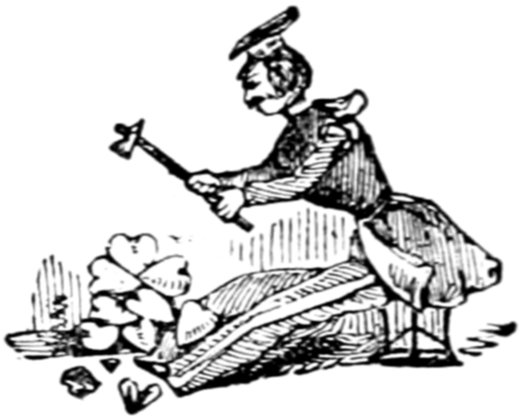
The Heart Breaker.
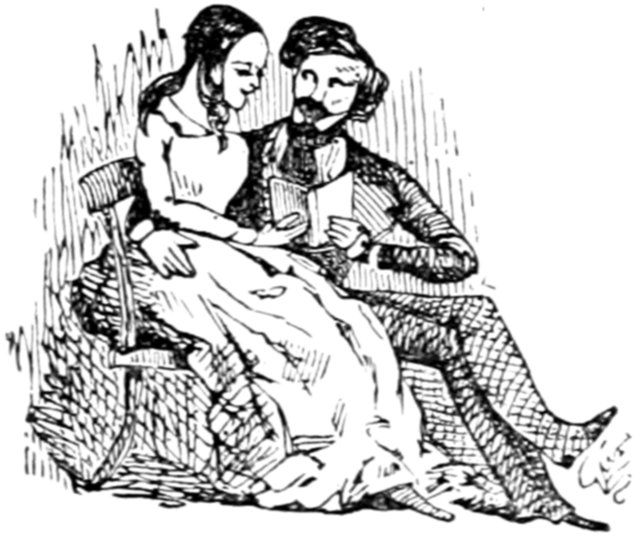
Getting her French by Heart.
A LETTER FROM "LA NATIVE DE PARIS," AT MISS THIMBLEBEE'S ESTABLISHMENT FOR YOUNG LADIES, TO HER MOTHER IN YORKSHIRE.
"Belle Vue House, Blackheath, Judy Swore.
"Ma Share Mare,—I take up my plume to inform you that this leaves me in a state of perfect convalescence, or as we say in French, sar var beang havoc more, as I hope it does havoc twore. I pass very well now for un Nattif de Parry. I have combed back my front hair, à la Shinwars; so that I have tutor fay le hair Fransay. And, yet oh! ma share Mare, say treest!—set hawreeble, to be compelled to deny the land of one's birth, and all poor le daygootang argong de set mizzyrarble V! What, after all, too, is 20l. a-year poor une Damn kom more? A paltry pittance!—vollar 2. Apprepo, I must tell you of an awkward wrongconter which happened last Macready Mattang, to Miss Thimblebee and lay Demmozel. As we were promenaying on the Heath we came across dew June Offishya de Woolwich. They were dreadfully impudent and frightfully handsome—Oh, ma Mare! Kell bell Ome! Kell jolly Moostarch! Kell bows U! I think if you were to send me the Pork Pies you talked of I could keep them in my Sharmbrer a Kooshay, and eat them when I went to bed, dong mong Lee—as we have no pastry here but rice puddings—Say malle-roeze!—Ness Pa?
"And now, Addèw, ma tray share Mare! I have to put the Parlour Boarders cheraux ong pappya. So Pa plooze a presong from Vòtrer Ammeroose Feel,
"Crinoline de Corset, nay Sarah Skeggs."
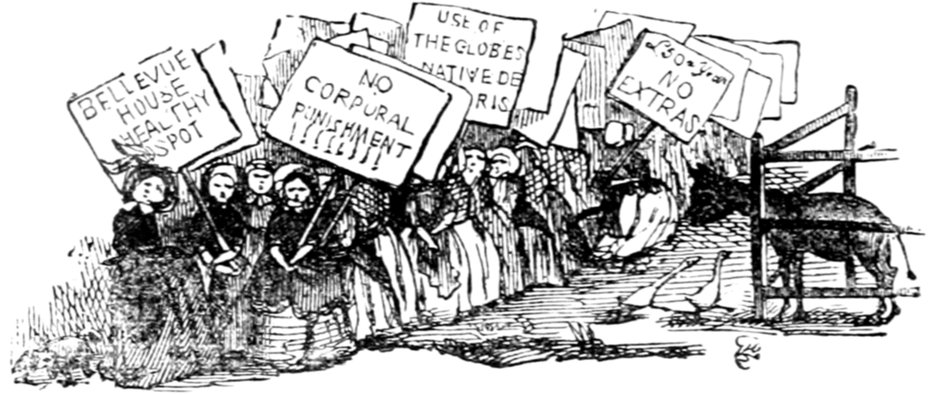
THE BEST WAY OF ADVERTISING A LADIES' SCHOOL.
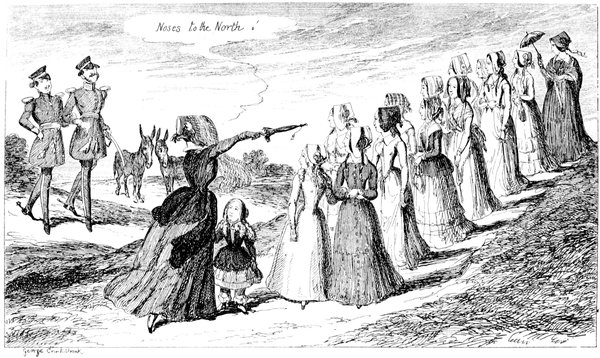
THE SCHOLASTIC HEN AND HER CHICKENS. Miss Thimblebee loquitur.—"Turn your heads the other way my dears, for here are two horridly handsome Officers coming."
147
"SAY YOU DID IT!" A ROMANCE OF SMILES AND TITTERS. Titter the Second.
The sound of the stranger's retiring footsteps had scarcely died upon the ear, when, as he had predicted, the soldiers came up, led by the drover, of whom the late proprietor of the Mantello had spoken.
"I tell you it's hereabouts I missed him," said the owner of the lost purse. "And ecco!" he exclaimed, as his eyes fell on the prostrate figure of Goffoni, enveloped in the cloak, "by all the Saints! here lies the rascal, shamming asleep, too, as I live!"
The sleep, however, was no make-believe on the part of poor Goffoni, who, under the growing influence of the opiate, was rapidly sinking into the joint embraces of Messrs. Morpheus and Mors, and had just commenced nodding off—to Death.
"Come, get up here!" shouted one of the soldiers, giving Goffoni a kick that even in his drowsy state had the effect of making him open his eyes. "Get up, I say! We want you about a little bit of highway robbery that you've been having a finger in this evening—do you hear?" And the military querist punctuated the ribs of the wretched Signor with a heavy note of interrogation from his regulation boot.
"Yes, I hear!" replied the agonized Goffoni; "I know! a highway robbery! I did it! I did it!"
"Mark that, gentlemen!" said the drover to the soldiers. "The fellow confesses he did it; mark that!"
"Oh, you did it, did you?" said the soldier. "Come, then, you must go with us. So quick! stir yourself, I say." And again the regulation-boot hammered away at the sides of the unfortunate Goffoni.
"Do let me die here, do!" implored the moribund Signor G.
"Die here!" returned the man of war. "No, no! you'll have to die in a rather more public place than this, I'm thinking. But come! we're not going to be played the fool with in this manner. Get up, I tell you once more!" So saying, the soldier took the prostrate Signor by the collar and set him on his legs.
"Oh! why wont you let me be quiet?" groaned Goffoni; "I've taken poison—indeed I have!"
"Taken poison!" the soldier exclaimed, with a sneer; "taken a purse, you mean, and it will prove just as fatal to you, I'll be sworn. However, we're not to be gulled by any such flams, don't think it. So let's see what you've got in your pockets. Oh! a pair of diamond earrings, eh? Very pretty indeed! the produce of some other robbery, no doubt! A gold watch, and ditto snuff-box! Equally honestly come by, I'll wager. A good stroke of business you've been doing this evening, my man! And here's a silk purse, with lots of money in it; and here's a leathern one without a soldo."
"The leathern one's mine!" cried the drover; "but it was full when the scoundrel took it from me."
"Of course it was! and the rogue's emptied the contents of the one into the other. But that don't matter—the mere finding of the purse upon him is quite enough to take the breath out of his body. So, come! give over this shamming," continued the soldier, violently shaking the drowsy Signor, who was again nodding under the somnorific effects of the laudanum. "We're too old birds to be caught by such chaff as this, I can tell you. So on to prison with you—get on."
Whereupon two of the soldiers placed themselves, one on either side of the ill-fated Goffoni, and commenced dragging him by the collar to the Casa di Correzione, while the two others attended him in the rear, and by the aid of their bayonets, applied to that part of his person where a gentleman's honour is supposed 148to reside, kept continually dissipating the incipient slumbers of the somnolent Signor, and goading him like an untractable donkey on to the nearest house of entertainment for brigands and patriots.
The bayonets of the soldiers were so efficacious in counteracting the somniferous tendency of the opiate which Signor Goffoni had swallowed, that by the time he had reached the gates of the Casa di Correzione, a distance of at least five miles from the scene of his capture, the exercise had done him so much good that it had "worked off" all his drowsiness, and he was, the morning after, in the most miserable state of perfect convalescence.
Goffoni instantly began protesting his innocence; but the incredulous jailor assured him it was to no purpose, and that he might look upon himself as a dead man; for that his own confession, let alone the circumstantial evidence, was quite enough to settle his business.
The wretched Signor called himself a fool, an idiot, a jackass, a nincompoop, and a volume of other titles equally complimentary to his intellect, for ever having consented to take another man's crime upon himself—as he pledged his honour to the jailor he had done in the present instance.
The jailor, however, was a man of too great experience to place much faith in the honour of gentlemen charged with highway robbery. And so to the Signor's asseveration, he replied with a knowing wink—"Gammon! Well, I've heard many lame defences in my time, but, hang me! if that isn't the most rickety concern I ever listened to. I should like to know the judge," he continued, "that you think would swallow such indigestible stuff as that. For everyone is aware that gentlemen in your line of business an't quite such born donkeys as to take other men's sins upon their shoulders, when they've always got a pretty tidy load of their own. So if you follow my advice, my man," considerately added the jailor, "you'll plead guilty like a Christian, and then, perhaps, you may be lucky enough to get off with the galleys for life."
Goffoni, however, finding his declarations of innocence made no impression upon the officers of justice, determined at length upon seeking the advice and consolation of some counsel learned in the chicanery of the law. But the Gentleman in Black afforded him little comfort; for though he himself, he said, had no doubt of the truth of the Signor's strange statement, still, he thought that Goffoni would find it extremely difficult to make a court of justice believe that human stupidity could go to such lengths. And he was afraid that his unfortunate client must make up his mind to the worst; for that, of late, the robberies in the neighbourhood had so much increased that the authorities had resolved to make an example of the very next culprit.
Whereupon Goffoni again declared that he was a fool, an idiot, &c., for ever having consented to stand as godfather to a foot-pad, and take the transgressions of a gentleman with a passion for highway robbery, upon himself. And he tore his toupée and he thumped his cranium, as though he were trying to cudgel his brains for allowing him to—say he did it.
[Third Titter, page 150.]
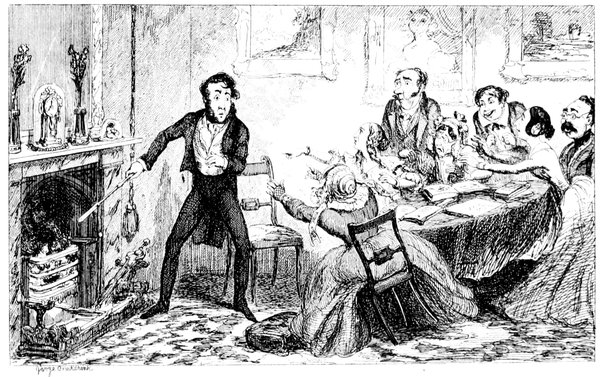
THE DESECRATION OF THE BRIGHT POKER.
149
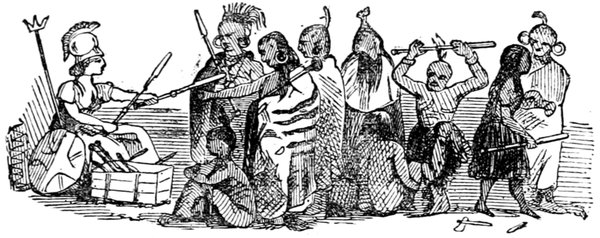
BRITANNIA DISTRIBUTING THE BRIGHT POKER OF CIVILIZATION TO THE SAVAGES.
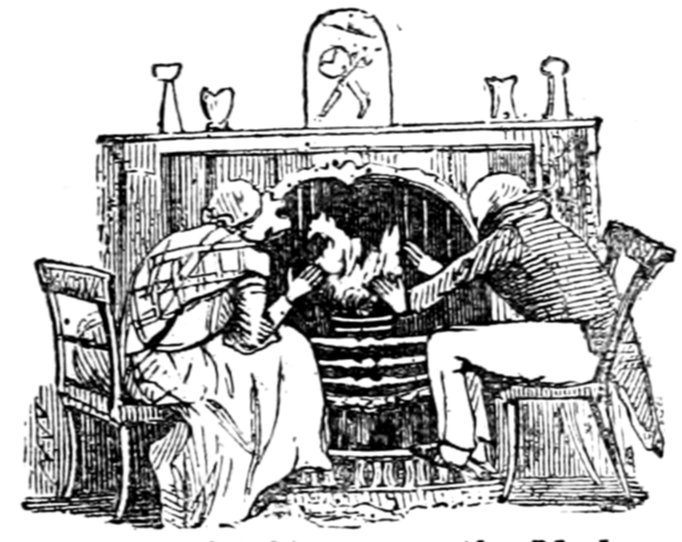
The Bright Stove; or the Modern Englishman's Fireside.
REPORT OF THE SOCIETY FOR THE PROPAGATION OF CIVILIZATION, AND THE HANDBOOK OF ETIQUETTE ALL OVER THE WORLD.
The Distingué Committee of this Society, which has for its noble object the elevation of the poor degraded Savage, and the dissemination of horse-hair petticoats and finger-glasses among all the dark members of the human family, have published their Report.
The Report states the Committee have distributed to their coloured relations their sister Agogos's celebrated "Code of Good Manners;" as well as the instructive little tract "How to Live well upon a Hundred a-year;" which have effected a great moral change. And the Committee are now engaged in preparing the "Savage's own Edition" of "The Guide to the Toilet," and have made arrangements with a philanthropic Parisian Milliner for the weekly publication of a "Courier des Dames Noires" in the wilds of Africa and America.
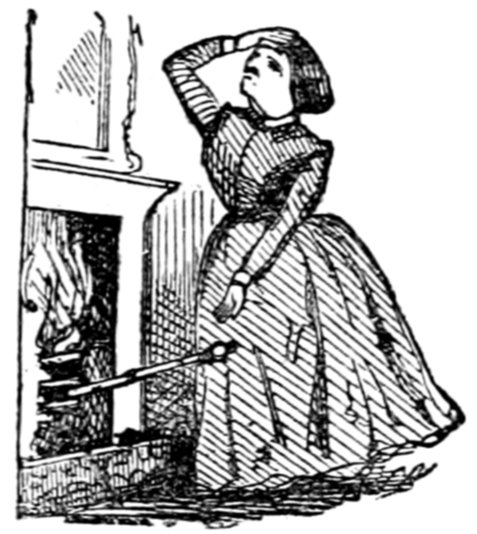
A Case of Real Distress.
In Domestic Economy they have succeeded in introducing the Bright Poker to the hearths of the benighted savages, and so impressing them with the noble truth that there are Pokers for use and Pokers for ornament. They have not, however, as yet, been able to confer upon them the enjoyment of the Silver Fork; but still they have accustomed them to the use of that article in Britannia Metal, which having, as a moral writer justly observes, quite the appearance of Silver, lends to the dinner-table all the show of plate.
In the article of Food the poor things have much improved. They have now given over eating their meat raw, while some families had advanced in Civilization so far as to have fed Turkies before the Fire, until they died from enlargement of the Liver, so that they might be able to partake of the luxury of the "Paté de Foie Gras."
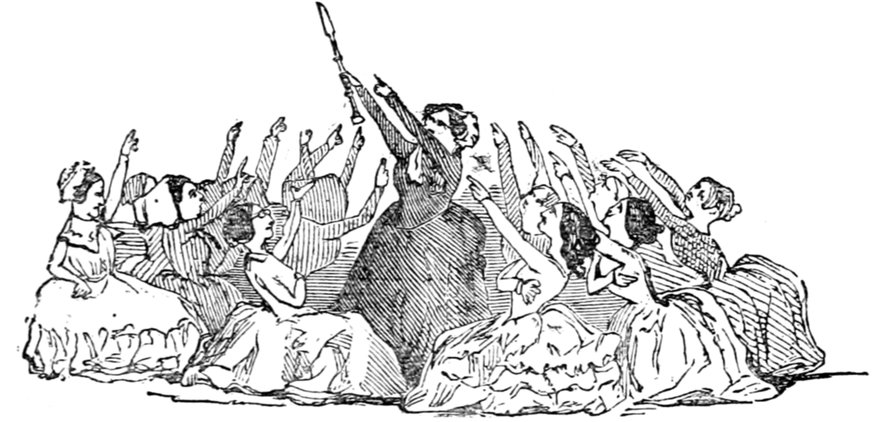
THE WIVES OF ENGLAND SWEARING TO PROTECT UNSULLIED THE BRIGHT POKER.
150
"SAY YOU DID IT!" A ROMANCE OF SMILES AND TITTERS. Titter the Third.
Goffoni, however, though he hardly relished the idea of bidding adieu to the world, and a generous Italian public, on the boards of a scaffold—and which he now felt there was something stronger than a mere probability of his doing—at length began to contemplate his lot with all the melodramatic magnanimity of injured innocence. And though he had but little of the martyr in his constitution, yet as Fate had cast him the part, he was determined to fudge up as much stoical sternness as his nature would allow him to throw into the character. Besides, deserted by his Carlotta, he had still no great desire to continue a solitary unit on the slate of creation; so that, to use his own expression, it mattered not when he was sponged out. "What was the world to him?" again he asked himself, and again he gave himself precisely the same answer, videlicet,—"a wilderness, a desert!" Existence, he said, he viewed as a piece of burnt rag, with but a few bright specks flitting across its dark surface; and he cared not how soon "the parson and the clerk" appeared to announce the departure of his vital spark.
But Goffoni had no sooner made up his mind to play the unmitigated hero to the last, than the presence of her whose absence had given him such supernatural fortitude thawed all the artificial ice of his stoicism, and made the hero melt into the man.
Yes! the dark-eyed young partner of his bosom and four-poster—she whom he believed had left him for ever for the Marchese di Castellinaria, had come to console him in his affliction! and Goffoni, though he could have been a Regulus without his Carlotta, felt, when he saw her, all his magnanimity ooze out of his eyes.
"Oh! Bartolo! Bartolo!" sobbed the Signora, "if I hadn't seen it in all the papers I should never have dreamt of finding you here. You can't tell what I've suffered on your account!"
"Oh! Carlotta! Carlotta!" groaned Goffoni: "and what have I not suffered on your account? But for you, alas! I should not have been here."
"For me-e!" hysterically exclaimed Carlotta. "Oh! don't say so! How could I possibly have anything to do with it?"
"Didn't you tell me," inquired the woe-begone Signor, "that you'd leave me—for ever? You did! You know you did!"
"Yes! but I'd done so a hundred times before," retorted Mrs. Goffoni; "and I thought you knew women better than to believe such things."
"Nor should I have been such a booby as to do so," remarked Mr. G., "if you hadn't written me that horrid letter."
"Letter!" cried Carlotta. "Oh! I see it all now! I do! That letter was intended for the Marchese di Castellinaria, and you—you—wretched—stupid man—you thought it was meant for yourself."
"Intended for that cursed Marchese!" shouted Signor Goffoni. "Then why the deuce did you leave the house, and tell the maid to give it to me?"
"Oh! I thought it would make you so happy and comfortable!" exclaimed his miserable little wife. "I thought it would please you so on your return home to find how I'd answered the fellow's impertinent note."
"Then! oh dear! oh dear!" replied Goffoni; "why couldn't you have shown it to me yourself?"
"Why, because you were so cruel, and so put out about that note in the morning, that I didn't like to see you again until I had made you acquainted with what I had done. So I left the copy for you to read, while I went out to post the original."
Goffoni now saw through the mistake as clearly as his better half; and again he railed at the limited extent of his intellectual faculties, applying to himself the same complimentary terms as he had previously used. And then he kissed his Carlotta, and called her his own blessed angel of a wife, and himself her own cursed fool of a husband; and gave vent to his feelings—which were now a kind 151of a piebald of grief and joy—in a manner that makes a bankrupt of description, and forces history to take the benefit of the insolvent act. For he plainly perceived that, without any real cause, he had taken poison and a highway robbery upon himself; and that he would be forced to separate from his Carlotta at a time when he had no desire to leave her, and by a species of divorce for which he had now lost all relish.
The sorry Signor then recited to his wondering little wife the tale which we have before told the reader (only not quite so cleverly as ourselves); and on showing her the cloak that he had received from the stranger, his distress of mind was in no way relieved by hearing his Carlotta—who could swear to the clasp and collar—peremptorily pronounce it to be the property of the very Marchese from whom he dated all his troubles. So that he now saw, in addition to his miseries, not only that he had saved the life of him who was the primary cause of all his jealousy, but that he was about to die outright for the crimes of the very man whose peccadilloes had nearly put an end to his existence by poison before.
Yes! facetious reader, it was even so! The Signora's gallant Marchese was none other than the Signor's ungallant stranger, a gentleman better known in the romance of highway robbery as Virtuoso, the brigand! and who, in the glowing language of one of the many instructive novels, of which he afterwards became the hero, "was no vulgar Freebooter." No! his was a spirit too proud to beg, too chivalrous to work, and too generous to trade. If he took from the rich he freely gave to the poor; and if, in the pursuance of his romantic vocation, he was compelled, in self-defence, to sacrifice the life of some obstinate victim, he ever after endeavoured to remove the stain of the blood from his soul by the scouring drops of contrition. Nor was his love of the poor greater than his love of—Woman! To her his lustrous eye and soft guitar-like voice, coupled with the perils of his adventurous life, had ever a magical charm. He was not merely the Freebooter of Lucre, but—the Brigand of the Heart! And if his passion was of too fickle and roving a nature, at least in extenuation it may be pleaded that he never parted from the object of his love without first abstracting from her some article of jewellery or plate, by which to treasure up her remembrance.
However, to return to poor Goffoni. The day of his trial at length arrived. On being placed in the dock it seemed to him as if he were standing on the doorstep of Eternity; for reflection and everybody had conspired to assure him of the utter hopelessness of his case. And when, to his infinite horror, he heard the drover, without the least hesitation, swear that he, the Signor, was the man who had taken his purse, Goffoni felt as though his shoulders had already served his head with notice to quit. The judge, however, finding that the case turned on a point of disputed identity, ordered the prisoner to put on the hat which had been dropped on the road. Goffoni did so, and was suffused with a cold perspiration on finding that it fitted him to a hair. He was then directed to endorse his body with the cloak, which, alas! also suited the poor devil as though it had been made to measure. The drover looked at him for a second, and then swore with even greater certainty than before that he was the identical person who had robbed him. Goffoni now saw that the sands of his last moments were fast running through the egg-boiler of his existence, when—as the gentlemen of the Italian press afterwards expressed it—"a stranger, dressed in the first style of fashion, rose from the body of the court, and requested to be permitted to put on the articles in which the prisoner had just appeared." Having obtained the sanction of the judge, he attired himself in the cloak and hat, and demanded of the drover, on his oath, whether he, the stranger, was not the party who had taken his purse? The drover eyed the stranger from top to toe, and then, after a little deliberation, swore even still more emphatically that he was. Whereupon the stranger pointed out to the judge that since the drover had sworn with equal certainty to two different parties as the culprit, it was clear that he might be mistaken in both.
A word to the wise is sufficient. So, reader, if your skull be not as thick as a bombshell, it is hardly necessary for us to tell you that Goffoni was acquitted—that it was Virtuoso, the brigand, who procured his acquittal; and that the Moral of all this is (for we must be "moral to the last"), never take the good or bad action of another to yourself, nor be shabby or silly enough to—"SAY YOU DID IT."
152
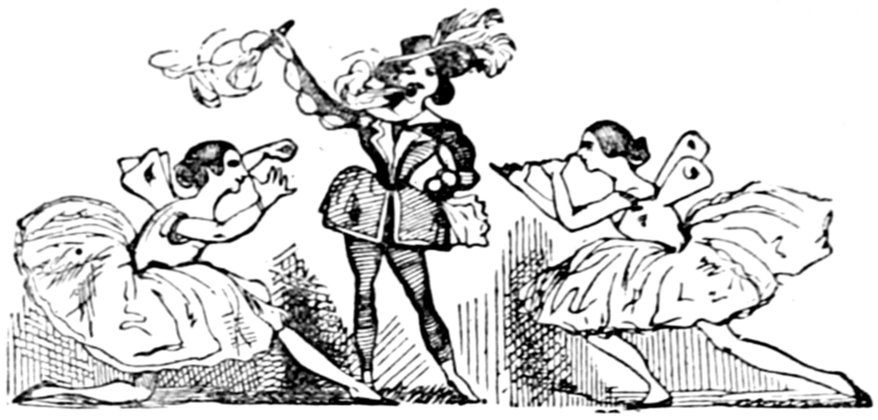
ELEGANT EXTRACTS FROM THE LAST NEW BURLESQUE.
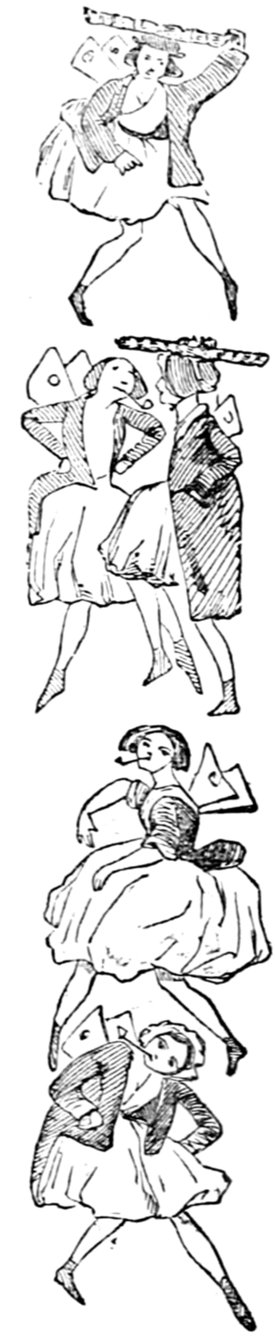
Billingsgate in the ascendant.
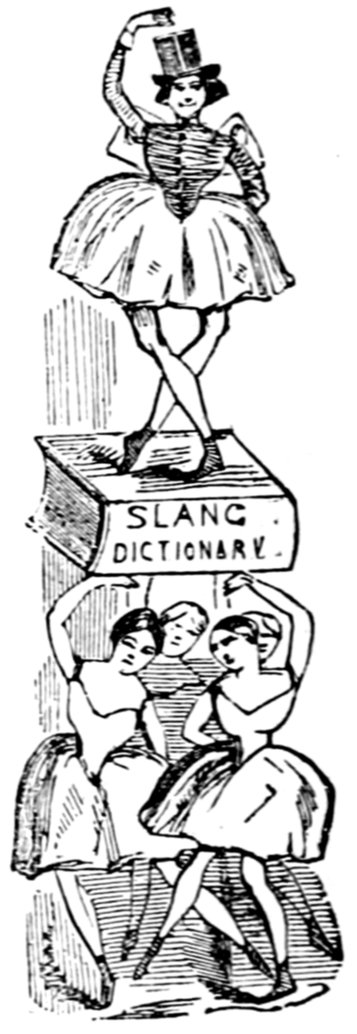
Burlesque standing on its merits.
A BATTLE WITH BILLINGSGATE. SUGGESTED BY THAT OF BLENHEIM.
It was the Christmas Holidays,
And seated in the Pit,
A Father saw the new Burlesque,
That was so full of wit.
And by him sat—in Slang unskill'd—
His pretty little girl, Clotilde.
She heard some "ladies" on the Stage
Say they would "cut their sticks!"
And one in male attire declare
That she'd "go it like bricks."
She ask'd her Father what were "bricks?"
And what they meant by "cut their sticks?"
The Father heard the audience laugh,
As at some witty stroke;
And the old man he scratch'd his head,
For he couldn't see the joke.
"I don't know what they mean," said he,
"But sure 'tis some facetiæ."
And then she heard one, nearly nude,
Say something else about
"Has your fond mother sold her mangle?
And does she know you're out?"
And when the people laughed, cried she,
"Oh, Pa! there's more facetiæ!"
And then the little maiden said,
"Now, tell me why, Papa,
That lady ask'd him if the mangle
Was sold by his Mamma?"
"I can't tell why, my dear," said he,
"Though, of course, 'tis some facetiæ."
But when she saw the lady's fingers
Unto her nose applied,
"Why, 'tis a very vulgar thing!"
The little maiden cried.
"The papers all, my child, agree,
'Tis brimful of facetiæ!
"And everybody says the Piece
With brilliant wit is fill'd;"
"And what is wit, my dear Papa?"
Quoth innocent Clotilde.
"Why, that I cannot say," quoth he,
"But wit is not—vulgarity."
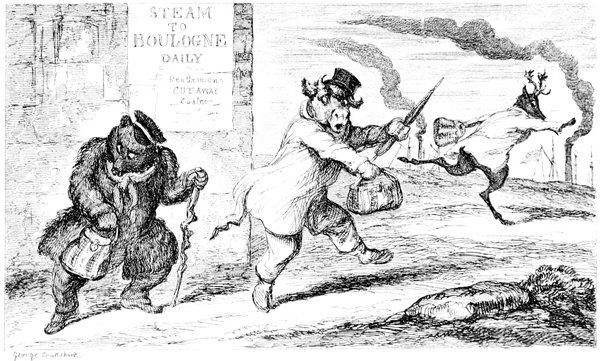
THE STAG, THE BULL, AND THE BEAR. (A Railway Fable.)
153
THE STAG, THE BULL, AND THE BEAR. A RAILWAY FABLE.
A Stag there was—as I've heard tell,
Who in an attic us'd to dwell,
Or rather—to use a fitter phrase—
Who in an attic us'd to graze;
And being blest, like many I know,
With little Conscience, and less Rhino,
Took to that frailest of all frail ways,
And wrote for shares in all the Railways;
Applied, without the least compunction,
For Seventy five in each new "Junction,"
And gen'rally—the more's the pity—
Got thirty shares from each Committee,
Whereof though it for sale was not meant,
He sold the Letter of Allotment.
But this he did, forsooth, because it
Said something rude about Deposit.
Now he'd applied, and—what was better—
This Stag had just receiv'd a letter,
Allotting him some shares, then far
Above the Railway Zero—"par."
"How kind of them," says he, "to gi'e me 'em,
Since they're at such a whacking premium!
'Tis to my soul 'a flatt'ring unction,'
Oh! Good St. James' and St. Giles' Junction."
And then the Stag went cap'ring down,
Like many another "buck on town,"
To where "the common herd" resort,
The stony field hight Capel Court,
And where the half-starved hinds are seen,
Trying to nibble all the "Green."
But soon to this fam'd cervine quarter
There came a Bull intent on slaughter,
And finding that the Stag I tell of
Had got some shares which were thought well of,
The Bull began to run them down,
And swore they weren't worth half-a-crown;
He call'd it all the worst of names,
This Junction of St. Giles and James;
And thus—these Bulls have so much art with 'em—
At last he got the Stag to part with 'em.
For 'tis with these same Bulls on 'Change
As 'tis with those that meadows range;
To both alike this rule applies,
What they run after's sure to rise.
Then, wand'ring from his gloomy lair,
In Copthall Court, there came a Bear;
One of that curs'd unfriendly race
Who crush whatever they embrace;
154Whose grip is such, whate'er they maul
Is generally sure to fall.
And, when he heard the Stag declare
He'd parted with his ev'ry share,
He vow'd the Bull had sorely treated him,
Nay—more he'd say—the Bull had cheated him.
It was the noblest of all schemes,
This Junction of St. Giles and Jeames!
However, as he hated knavery,
To do him an especial favour, he
Would let the Stag have thirty more,
At what he sold the others for;
The Stag of gratitude discourséd,
And took 'em on the terms aforesaid.
Now all this kindness of the Bear
Was nothing but a "ruse-de-guerre;"
For no one knew so well as Bruin
To hold the Shares was perfect ruin;
The whole affair was but a swindle,
And down to discount soon would dwindle.
And, truth to say, the Bear was right,
The Panic came, like Lillywhite,
That terror of the Lords, and bowl'd out
Ev'ry man Jack who hadn't sold out;
So that there was on "settling day,"
The Devil and the Bear to pay.
"But," says the Stag, "that cunning buffer,
The Bull, will be the chap to suffer;
So in a cab to him I'll dash up,
And get my taurine friend to cash up."
But when he gets to Mr. Taurus's,
Pasted upon the outer door, he sees
A card with these words written over,
"Gone to Boulogne viâ Dover."
Now as the Bull had run away,
Unable for the shares to pay,
'Twas clear, as he'd no cash to spare,
The Stag then couldn't pay the Bear;
So when the Bear went for his due,
The Stag had gone to Boulogne too.
And, since the Stag had cut and run,
'Twas plain the Bear could pay no one;
So those to whom he money ow'd,
When they sought out the brute's abode,
Found that the Bear, or him they call so,
Had cut and run to Boulogne also.
MORAL.
Pursue the paths of Virtue, and such stale ways,
And don't never have nothing to do with none of those bothering Railways.
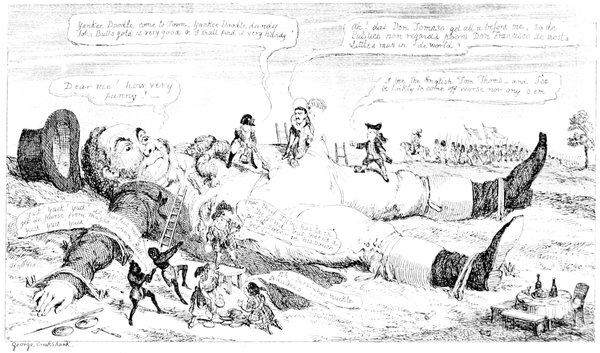
JOHN BULL AMONG THE LILLIPUTIANS.
155
THE MODERN GULL IVER.
MEETING OF THE DWARFS.
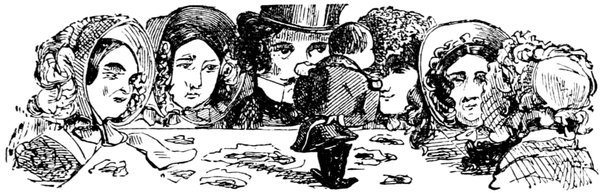
A meeting of the real bipeds, or little human beings who run about upon two feet, was held at the Lilliputian Warehouse, in New Street, Covent Garden, to move an address of thanks to Her Majesty, for her liberal patronage of the least of the Rational Animals.
General Tom Thumb, L.S.D., was unanimously voted to the Child's Chair, and the business of the Meeting having been opened by the Small Germans.
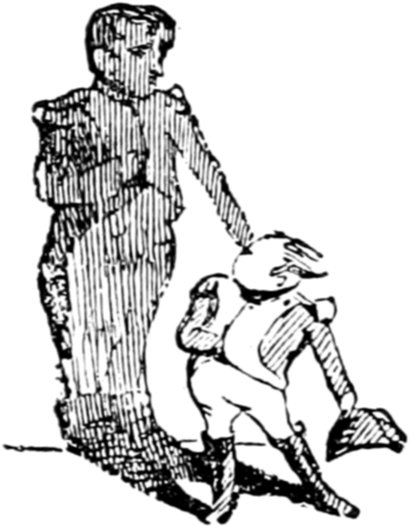
The Substance and the Shadow.
The General rose—a few inches—to address his brother Homuncules. He said they had met to offer up an act of gratitude from the Shortest men to the Highest Personage in the Realm—to her who had refused to patronize everything great, and had stooped to take them by the hand—to her who had originally given them that lift, which had caused them—short as they were—to be looked up to by—Lovely Woman. And he would be happy to favour the company with "God Save the Queen," gratis.
The English Tom Thumb here rose to rebut the General's assertions, and was proceeding to complain of the want of patronage offered to native insignificance, when he was carried out.
The Highland Dwarfs, in a Scotch accent as broad as their size would admit, said, "a' the Gen'ral had drapt was unco' true." When they left the Land o' Cakes they could hardly raise a Bawbee among them, and now they could put down 1000l. any day.
The Boshie Men, or Pigmy Race, through their interpreter, stated, they were happy to find that, though the Dwarfs had come over to England little by little, they now formed so large a body.
Don Francisco Hidalgo said, "Dat as el smallest man in el vorld, he objec to el proceed; for he never meet vith el couragement el dam Dom Dum speak of."
The little Men here got to very high words, and the meeting broke up in confusion.
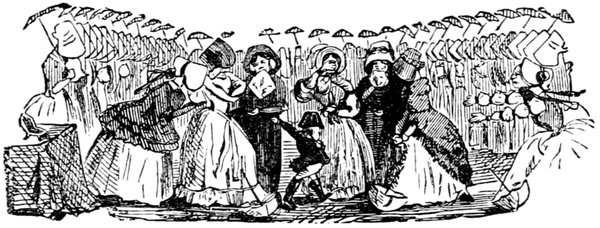
NAPOLEON'S ADIEU D'EGYPTIAN HALL.
156
PHLARUPPE! AN OSSIANIC POEM.
DUAN THE FIRST.
Argument.
This poem is addressed to the Maid of "the Rainbow" (in Fleet Street), where Ossian is enjoying his Whisky and Cigar. The Phlaruppe here spoken of is the same as the Aquævadius mentioned so frequently in Police History, and who in the year '40 headed an expedition against the Knockers of Cockaigne, and was repulsed by "the force" under the command of Rowan, the chief of Scotland (Yard), though not until Phlaruppe had routed several of his "Divisions." Tradition assigns the date of this event to the year '42, but on searching the pages of the historian Hodder, we find no mention made of the circumstance in his valuable work entitled, "Sketches of Life and Character taken at Bow Street."
Bring, daughter of the Rainbow! bring me the pen of steel! The mountain-dew sparkles in Ossian's brain, and it is brilliant with song. As is the black reviver to the garment whose seams are white with age, so is the cream of the valley to the seedy soul of the bard. It brings back the freshness of youth.
A tale of high life! The deeds of the superior classes!
The draught of the waters of Kinahan wakens the memory of the past. The odour of thy weeds, mild Lopez! is pleasant in Ossian's nose. Like the brow of Ben-Primrose, his head is veiled in clouds. Listen, thou daughter of the Rainbow! to the deeds of the superior classes.
A tale of high life!
Fair is thy Garden, O Covent! Green are its paths with the leaves of the cabbage. There the cauliflower of Fulham rests its white head, and the pine of Jamaica perfumes the breeze. The daughters of Erin are there laden with Pippins of gold. Near are the halls of Evans. Music is heard in them by night. The morning dawns in song. The voice of Llewellyn of Wales gladdens the feast! and Sloman, the son of Israel, pours forth his numbers, apt as the bard of Moses. Glad are the halls of Evans! It is the abode of Joy!
Wilt thou not listen, bright maid of the Rainbow! to the voice of Ossian? My soul is bursting with song. The collars of my Corazza droop like the ears of the Greyhound, and my eye in a fine frenzy rolls. Thus the mighty Bunn appears when he dreams that he dwells in marble halls. Dost thou not behold, bright maid! the head of a lion in Ossian's hand? A ring of iron depends from its mouth, and its face wears a look of rage. That head the noble Phlaruppe, Lord of Belgravia, tore away. Phlaruppe tore it away by the strength of his arm. Listen, then, daughter of the Rainbow! to the tale of high life! The deeds of the superior classes!
What sound is that kisses the ear? Across thy Garden, sweet Covent! it comes dancing along the breeze. Can it be the song of the lark climbing the sky? But the lark wakes not the night with his notes; and bright burns the gas in the lamp of the Tavistock. 'Tis the voice of Von Joel, the toothless, gladdening the halls of Evans. Of Evans, the son of Thespis.
The Thespian son sits in his hall of state. The feast is spread around. The strong waters of Hodges and Betts sparkle on the board. A thousand Havannahs perfume the air. A thousand glittering tankards foam with the nectar of Barclay. There is the ripe fruit of Erin, and the rabbit of Wales is there.
Who comes from the Saloons of the West, with his warriors around him? He smokes the Dodeen of peace. His face glows with the juice of the Gooseberry. His cheeks are as red as the garments of the bearers of letters on the festival of May? Who is it but the noble Phlaruppe, the Lord of Belgravia? In his train is Sutton the Sambo; and Burke, the hard of hearing, attends him. Mighty in battle are they.
The Lord of Belgravia graces the board: the Bards hail his presence with a 157song. He quaffs the brown stout of Dublin. The night reels away in revelry. The morning peeps in at the casement; and Phlaruppe, the Lord of Belgravia, is glorious with Guinness's.
A tale of high life! The deeds of the superior classes!
DUAN THE SECOND.
Grey grows the air with the Day's young light. With the carmine of Morning the cheek of Heaven is rouged. The Camphine lamp of the Moon has gone out; and turned off is the Gas of the Stars. Yawning the tired Policeman crawls on his rounds.
Hushed are the halls of Evans.
Where art thou, Belgravia's Lord? Thou pride of the West, where art thou? Lo! he comes; but his steps are unsteady with Beer. On the sinewy arms of the dark-skinned Sutton, and Burke, surnamed the Deaf, he leans. From them he bursts of a sudden, like the cork from the Waters of Soda. The head of a lion on the gates of Gliddon, the chief of the Divan, frowns on the valiant Phlaruppe. Dauntless as the brute-taming Van Amburgh, he grapples with the iron beast. He sounds the "fake away" of Belgravia. One potent wrench of his arm and the head of the forest king hangs drooping from Phlaruppe's hand. Knockerless are the gates of Gliddon! Of its lion the divan is bereft!
The lynx-eyed C 16 beheld the wrong. His dander arose. He drew his staff in vengeance. He seized the noble Phlaruppe. Sutton, the heavy-handed son of Africa, raised his arm. His white teeth grinned defiance on the blue son of Peel. Into the murky waters of the kennel he hurled the pride of the yard of Scotland. His blood crimsoned the flags. Groaning for help, he sprang the rattle of war.
Like rockets at Vauxhall the azure force of Rowan rushed up. Their hands grasped the staff of power. Phlaruppe heard the tramp of their Wellingtons. He sounded the Lullalietee of battle. He gathered his warriors around him. Firm as the cement of Pouloo they stood. As a torrent from a shower-bath poured the stiff-necked sons of Peel upon the foe.
As the cats of Kilkenny they fight. Like the shop of the maker of trunks rings the street with the blows. Stained is the earth with the claret of life.
Battle of the Garden of Covent, why should Ossian, like Robins, the chief of Garraway's, pen the catalogue of thy wounds? Thou art with the son of Kean, a calamity of the past.
The force of the Yard of Scotland overcame!
On the stretcher of Ignominy, Phlaruppe, the Lord of Belgravia, was laid!
DUAN THE THIRD.
In the cell of the Station, Phlaruppe hiccups out the Morn. The benches of wood pillow his burning head. He sighs for a draught of the sparkling Waters of Carrara, or a goblet of the bubbling Powders of Seidilitz. But the ice of the Lake of Wenham is not more cold than the hearts of his victors. In the cell of the Station, Phlaruppe hiccups out the Morn.
On the throne of Justice the even-handed Twyford sits. Before him Phlaruppe, Belgravia's hope, is dragged. He quails, for the voice of the Judge is severe as Hicks the lusty-lunged Son of the Surrey. And lo! to the terrors of Brixton's wheel an alms-seeking child of want he condemns. What then shall be the doom of Phlaruppe?
But Phlaruppe is the Lord of Belgravia. In his presence the heart of Twyford, the even-handed, grows soft as the Asphalte of Claridge before the Sun in the days of the Dogs. With the milk of human kindness the veins of his bosom are filled. Pity touches his heart-strings; and his tone with compassion is soft as the Piccolo of Jullien, the Emperor of all the Polkas.
But why, Maid of the Rainbow, should Ossian, like a penny-a-liner, recite the fine that Phlaruppe paid to his Queen; or tell how the generous Twyford, for a crown, forgave him who tore the Lion's head from Gliddon's halls?
A tale of high life! The deeds of the superior classes!
158
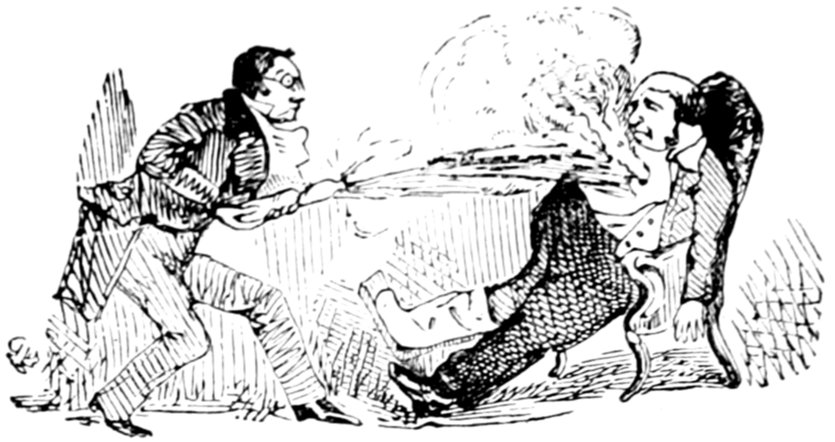
The Carrara Water is found very efficacious in cases of Heart-burn.
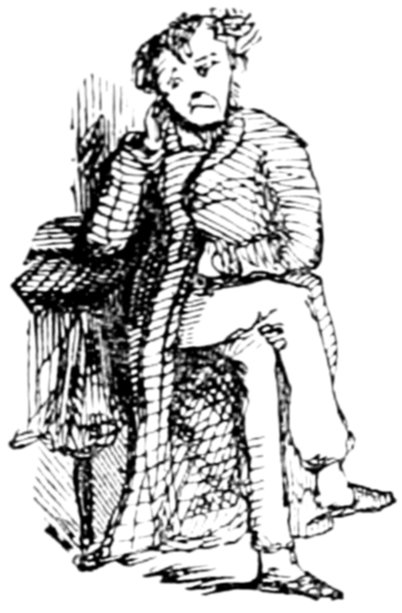
Oh! that dreadful British Brandy!
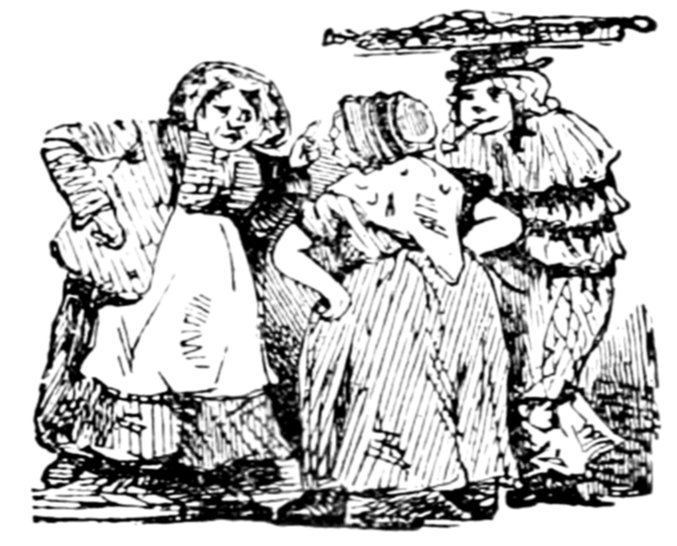
It is strongly recommended in cases of foul tongue.
AN ANACREONTIC: IN PRAISE OF CARRARA WATER.
Come, let us quaff the Wine of Moet!
Come, let us sing like Moses' Poet!
To thee and to thy sparkling daughter,
Carrara's copper-cooling Water!
Maugham! come let us sing of thee,
St. Swithin of Sobriety!
Sweet, after drinking too much wine,
Kind Cockle! are those pills of thine:
Or when the bowl has drown'd the wits,
Sweet are thy Powders—Seidilitz!
Or seedy with the dew of Mountains,
The water's sweet from Soda's fountains.
Yes! sweet are these—but sweeter far are
Thy sparkling Waters—O Carrara!
And Maugham! thy fame doth far outstep
The fame of Cockle—fame of Schweppe.
So when I burn with too much 'toddy,'
Carrara! thou shalt cool my body;
Yes! then I'll seek that Water's aid,
That's from Carrara marble made:
And as I drain it from the chalice,
I'll dream I drink some melted palace;
Or quaff some Venus in solution,
Of fam'd Canova's execution;
Or fancy, as the draught decreases,
I'm swallowing bottled chimney-pieces.
Carrara! thy delicious fluid
To me's the loveliest liquor brewéd;
My throbbing brain grows calm and placid.
Whene'er I quaff thee—sweet Antacid!
Thine is the gift of being able
To cure "the excesses of the table,"
And all the ills that thence attack us,
Thou brightest, healthiest child of Bacchus
For when I've drunk too much Glenlivat,
And my head is splitting with it,
Carrara! thou can'st ease my pain,
And fit my soul to drink again.
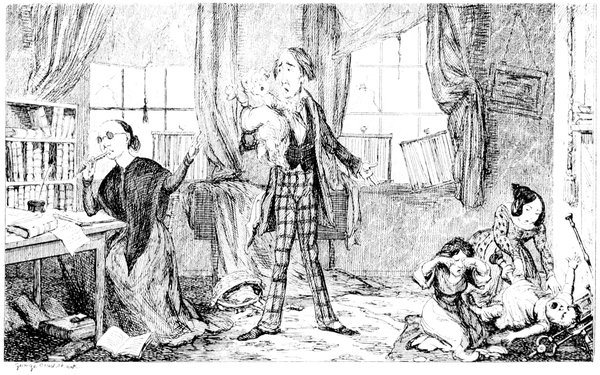
"MY WIFE IS A WOMAN OF MIND."
159
THE WOMAN OF MIND.
My wife is a woman of mind,
And Deville, who examined her bumps,
Vow'd that never were found in a woman
Such large intellectual lumps.
"Ideality" big as an egg,
With "Causality"—great—was combined;
He charg'd me ten shillings, and said,
"Sir, your wife is a woman of mind."
She's too clever to care how she looks,
And will horrid blue spectacles wear,
Not because she supposes they give her
A fine intellectual air;
No! she pays no regard to appearance,
And combs all her front hair behind,
Not because she is proud of her forehead,
But because she's a woman of mind.
She makes me a bushel of verses,
But never a pudding or tart,
If I hint I should like one, she vows
I'm an animal merely at heart;
Though I've notic'd she spurns not the pastry,
Whene'er at a friend's we have din'd,
And has always had two plates of pudding,
Such plates! for a woman of mind.
Not a stitch does she do but a distich,
Mends her pen too instead of my clothes;
I haven't a shirt with a button,
Nor a stocking that's sound at the toes;
If I ask her to darn me a pair,
She replies she has work more refined:
Besides, to be seen darning stockings!
Is it fit for a woman of mind?
The children are squalling all day,
For they're left to the care of a maid;
My wife can't attend to "the units,"
"The millions" are wanting her aid.
And it's vulgar to care for one's offspring—
The mere brute has a love of its kind—
But she loves the whole human fam'ly,
For she is a woman of mind.
160Every thing is an inch thick in dust,
And the servants do just as they please;
The ceilings are cover'd with cobwebs,
The beds are all swarming with fleas;
The windows have never been clean'd,
And as black as your hat is each blind;
But my wife's nobler things to attend to,
For she is a woman of mind.
The Nurse steals the tea and the sugar,
The Cook sells the candles as grease,
And gives all the cold meat away
To her lover, who's in the Police.
When I hint that the housekeeping's heavy,
And hard is the money to find,
"Money's vile filthy dross!" she declares,
And unworthy a woman of mind.
Whene'er she goes out to a dance,
She refuses to join in the measure,
For dancing she can't but regard
As an unintellectual pleasure:
So she gives herself up to enjoyments
Of a more philosophical kind,
And picks all the people to pieces,
Like a regular woman of mind.
She speaks of her favourite authors
In terms far from pleasant to hear;
"Charles Dickens," she vows, "is a darling,"
"And Bulwer," she says, "is a dear;"
"Douglas Jerrold," with her "is an angel,"
And I'm an "illiterate hind,"
Upon whom her fine intellect's wasted;
I'm not fit for a woman of mind.
She goes not to Church on a Sunday,
Church is all very well in its way,
But she is too highly inform'd
Not to know all the parson can say;
It does well enough for the servants,
And was for poor people design'd;
But bless you! it's no good to her,
For she is a woman of mind.
161
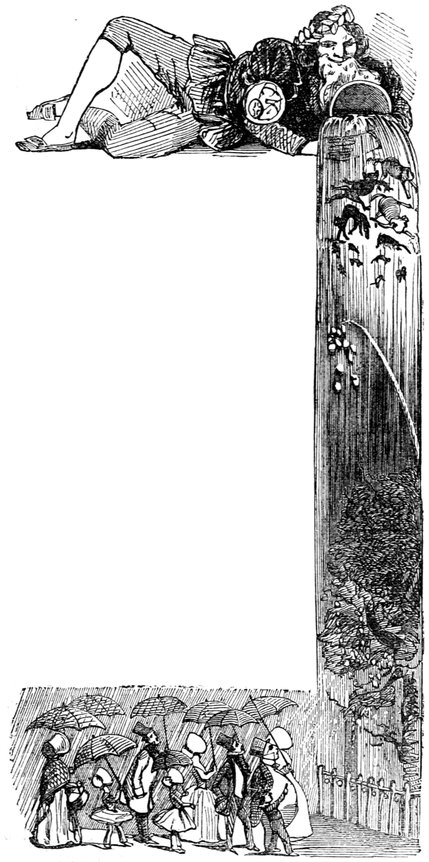
Old Father St. Swithin, the Gentleman who presides over the Cat and Dog Days. A Grand Gala at Vauxhall, under the Patronage of St. Swithin
THE CLOUD.
(Another Version of Shelley's partial view of the subject.)
I bring cats and dogs, and November fogs,
For the folks of Cockney land;
And I brew the flood of slush and mud
In Fleet Street and the Strand.
From my watery bed spring colds in the head,
And highly inflam'd sore-throats;
And I'm the Mama[7] of the bad Catarrh,
And the Mother of Waterproof Coats.
I gave birth to Goloshes and Macintoshes,
The clog, the cork sole, and the patten;
And I act as wet Nus to each Omnibus,
For 'tis on my moisture they fatten.
I come down pretty thick at every Pic Nic,
And throw my cold water upon it;
And delight at each Fête that is called a Champêtre,
To spoil every new silk bonnet;
I'm more kind to each Jarvey than was Wittle Harvey,
When he was Commiss'oner of Stamps;
I'm the foe of Vauxhall's Grand Fancy Dress Balls,
Where I love to extinguish the Lamps;
And whenever a fellow leaves at home his Umbrella,
Oh Lord! how I chuckle and grin!
For then you may warrant I'll come down in a torrent,
And soak the poor wretch to the skin.
162
JUPITER AND THE MOTHER. AN IDYLL.
At the altar of Jupiter knelt a poor woman. She was about to become a Mother, and thus she invoked the God:—
"Oh Jupiter! King of the Heavens! and Ruler of the Earth! grant that the dear burthen which I now bear may be a Stranger to the cares of Life! Vouchsafe unto it such gifts that it may be the most admired of all thy Children,—the richest—the happiest of Men. Oh Jupiter! King of the Heavens! and Ruler of the Earth! hear me!"
She spoke, and Mercury, the winged messenger of Jove, stood before her.
"Mortal!" said he, "return with Joy to thy hearth! He who wieldeth the sceptre of Fate hath heard thy petition; and the Child shall be as thou hast asked."
In time the Mother bore a Son. His form rivalled that of the boy-god Cupid. And she rejoiced to think he was the blest of Jupiter.
A year passed on, and the proud Mother saw the Infant bud blossom into the Child.
But the second year came and went, and the Boy increased not in Stature.
The third year stole away, and still the little thing grew not.
The fourth—the fifth—the sixth rolled by, and yet the Child remained in figure as at the end of the first.
Albeit the Mother murmured not, for she remembered the promise of him who wieldeth the sceptre of Fate, and hoped in patience.
But when twelve summers had gone, and the anxious Matron beheld her Boy still a Babe in form though a Youth in years, Hope and Patience left her; and thus she complained:—
"Oh Jupiter! Jupiter! have the promises of the Gods become as those of Men? Didst thou not in thy bounty vouchsafe unto me a Boy that should be the most admired of all thy Children? And what hast thou sent me? A little thing to whom even the shape of Manhood is denied! and at whose stunted figure the world gapes with pitying wonder. Oh Jupiter! Jupiter! for what mysterious good hast thou thus visited me?"
The cloud-compelling Jove heard the Mother's murmurs and thus from on high rebuked her:—
163
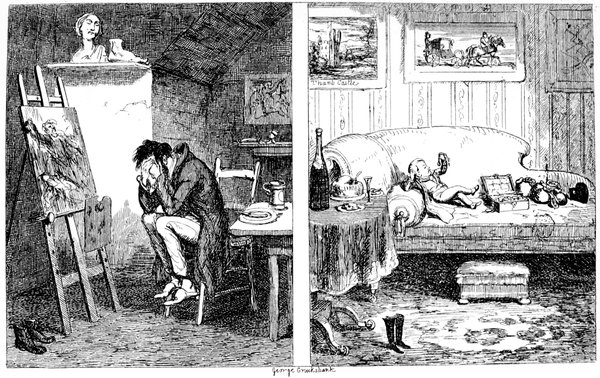
BORN A GENIUS AND BORN A DWARF.
"Why, Child of Clay! dost thou question the goodness of the Gods? Thy petition was heard, and has been granted. What more wouldst thou have had? Didst thou not beseech me that thy Boy should be the richest and happiest of Men?"
"I did, Great Jove!" replied the trembling Mother; "but thou, in thy strange bounty, hast given to me a Child with limbs too small and weak to earn even the scantiest subsistence; and whose wretched deformity must make his life a burthen to him and me."
"And what, blind Mortal! wouldst thou that I had done?" exclaimed the God.
"Oh that thou hadst blest him with a form of Power, and a mind of Genius!" cried the heavy-hearted parent; "then would Wealth and Joy have gladdened his days."
"Fool that thou art!" said the Sovereign of the Skies; "listen and learn how I have blest, and thou wouldst have curst, thy Child! Had I conferred on him the Genius thou sighest after he would have felt but Want and Neglect in the world. Had I quickened him with a sense of the Beautiful, his Life would have been a Misery—his Death a Crime. For know that Mind alone can sympathize with Mind; and mindless Man enriches those who minister rather to the luxury of his Senses than to the refinement of his Intellect."
"Oh, all-wise Jove!" exclaimed the abashed Mother.
"See how thou wouldst have beggared thy Boy with Genius," continued the Thunderer. "And now listen how I have enriched him with Deformity. He shall go forth a wonder to the staring and senseless world. Monarchs shall smile upon him, and rejoice to gird his neck with precious Jewels. He shall be the beloved of Matrons, and the fondling of Damsels. Crowds shall flock to behold him, heaping his little lap with countless riches and costly gifts. His car shall be drawn through the public ways in triumph; and he—the stunted dwarf—shall play the Giant Emperor among men. Thank thou, then, the Gods, oh Woman! whose bounty has given thee a Dwarf, and not a Genius for thy Child."
Thus spake the mighty Jove, and the Mother in gratitude cried out:—
"Oh, Jupiter! King of the Heavens, and Ruler of the Earth! I thank thee! for now I see thou hast, indeed, vouchsafed that my Boy shall be the most admired of all thy Children—the richest—the happiest of Men."
164
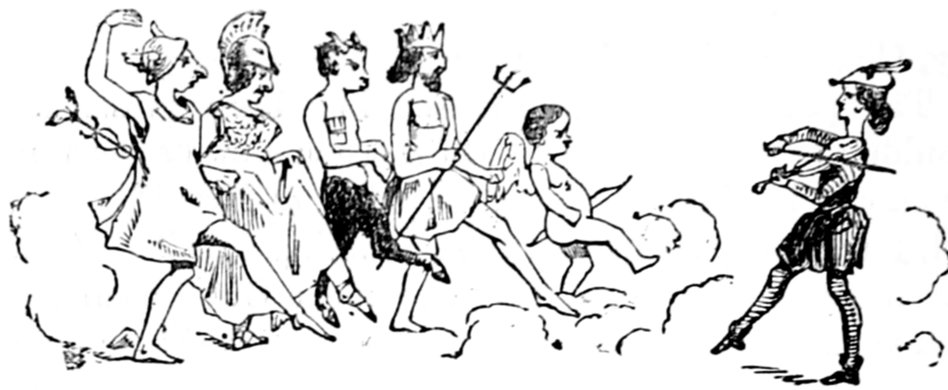
Perrot teaching the Gods and Goddesses how to dance.
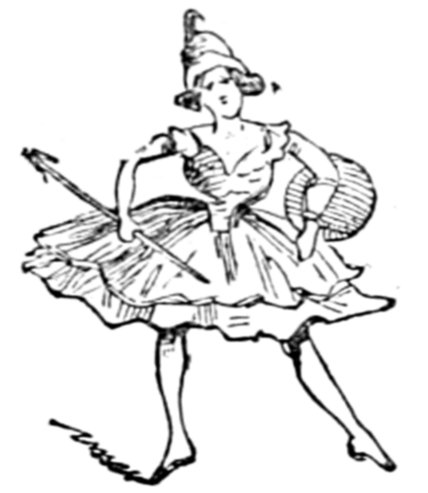
Minerva, as she did appear at the Italian Opera.
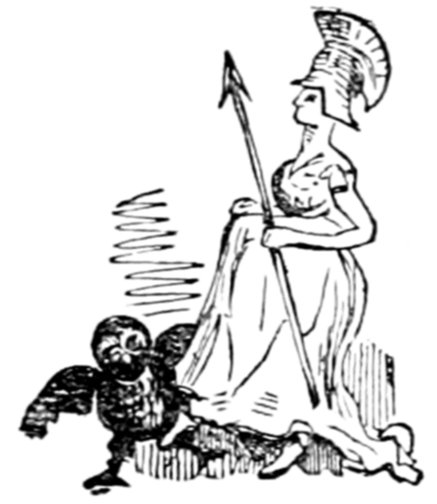
Minerva, as she ought to have appeared at the Italian Opera.
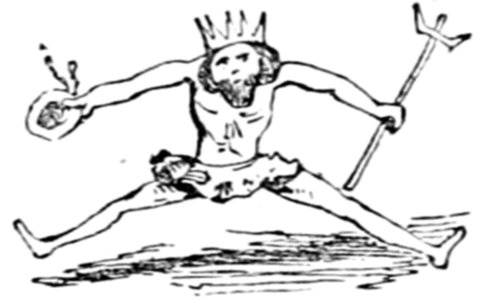
Neptune, as he probably will appear at the Italian Opera.
A MONO-RHYME.
Oh, Monsieur Perrot! oh, Monsieur Perrot!
Whatever on earth could have made you do so?
Put the Judgment of Paris all into dumb-show!
Bring the Gods and the Goddesses down from en haut!
Paris—Mercury—Venus—Minerva—Juno—
To trip "on the light fantastic toe!"
For who ever heard of a Fandango—
A Gavotte—a Cotillion—a Bolero—
Balancez—avancez—chaine des dames—dos-à-dos,
Or indeed any pas (excepting a "faux")
Perform'd by a Goddess, I'd like to know?
Whate'er in the name, too, of Lemprière and Co.,
Could have made it come into your head to bestow
On the Goddess of Wisdom, so comme il faut,
And who Keightley informs us was "chaste as snow,"
A petticoat scarcely, Sir, reaching below
The knees of the lady—and looking as though
'Twas a kilt of book-muslin or calico!
Whereas every classical cameo
Assures us she usen't her legs to show—
Perhaps they were bandy and form'd like a bow—
Or her ankles were gummy—but whether or no
Sure the Goddess half-naked objected to go.
Now it wouldn't have been such a dreadful blow,
And to Mamselle Minerva much more à propos,
Had you comb'd back the hair of the Virago—
Dress'd it à la Chinoise 'stead of en Bandeau—
While a pair of "blue specs" would have served to throw
Round the Goddess of Wisdom a learned halo!
But short Petticoats surely are rather de trop
For the Sapient Minerva and Stately Juno!!
Then Oh, Mister Lumley! Oh, Monsieur Perrot!
And Oh, Lucille Grahn! and Oh, Cerito!
Whatever on earth could have made you do so?
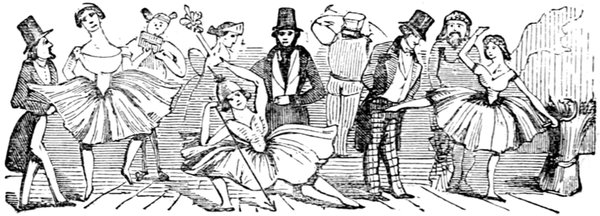
The Gods and Goddesses behind the Scenes at the Italian Opera.
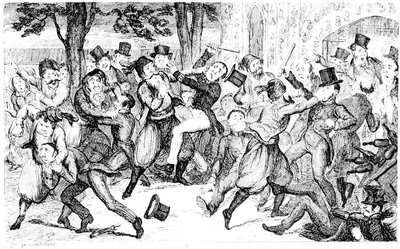
SHAM IBRAHIM, or the Pacha at Vauxhall.
165
A LAY OF MODERN ENGLAND OR, IBRAHIM PACHA AT VAUXHALL.
Great Ibrahim of Egypt has promised the Lessee
The Masquerade at Vauxhall he'll go in State to see;
To Allah he has vowed it—to Allah and the Clown,
That in his royal Glass-Coach he will in State go down.
It's posted in all Quarters—it's stuck up in all Parts,
It's carried about by Boardmen and advertising Carts;
It is in every paper—it is on every wall,
That Ibrahim of Egypt is going to Vauxhall.
To-night the Clerks of London shall "Merry Monarchs" be;
To-night each Linendraper shall get his Captaincy;
The Tailors Metropolitan to-night shall strut as Greeks,
And Jews for Don Giovannis shall rouge their sallow cheeks.
But there are six young Doctors who dearly love a Laugh,
One is disguised as Ibrahim, the others as his staff;
They've hired a seedy Glass-Coach—they've Beards and Caps and All,
And as Ibrahim of Egypt they're going to Vauxhall.
And now they leave the Borough with many a loud Huzzā;
Drive on! drive on! to Vauxhall—On to the Bal Masqué!
On! shout the six young Doctors, and, as the crowd Hurrah,
They laugh to find they're taken for Ibrahim Pacha.
In swarms the Masqueraders are whirling to the Doors,
Of Sailors there are Hundreds—of Soldiers there are Scores,
And lots of German Students who nought of German know,
And not a few Postillions who're not from Lonjumeau.
And many illegal Lawyers with borrow'd Wigs and Gowns,
And lively Undertakers—and melancholy Clowns,
And Debardeurs and Tomboys—and many a Bow-bell Swain,
And dressed as "Heeland Lassies," the Lasses of Cockaigne.
From Eastward and from Westward the Masks are pouring there,
The Nobbish and the Snobbish from Mile End and May Fair;
They pour from many a Mess-room—and many a Second Floor,
They pour from Swan and Edgar's—from Lincoln's Inn they pour.
But now Inspector Higgins rides up the way to clear;
"Stand back! stand back! you fellows, great Ibrahim is near!"
And then, far in the distance, the welkin's heard to ring,
With "Long live Ibrahim Pacha! Long life to Egypt's King!"
And Nearer still and Nearer the seedy Glass-Coach steals,
And Louder grows and Louder the rumbling of its Wheels,
And Plainly and more Plainly is heard the People's din,
But Nothing still—no Nothing does the Pacha do but Grin.
For Clearly, very Clearly, the Ibrahim they cheer'd,
Was only a Sham Ibrahim with only a Sham Beard,
And Truly, very Truly, the Pacha's present Suite
Came not from Mighty Egypt, but from Great Tooley Street.
166Now the Lessee of the Gardens receives them at the Gates,
And thinks the six young Doctors six Eastern Potentates,
And trusts His Royal Highness some Wine will deign to quaff,
Whereat His Royal Highness winks at His Royal Staff.
But the Lessee's looks are angry, and the Lessee's Brows depressed,
A Jest he loves most dearly, but this is past a Jest;
For he hears another Party with Beards and Caps and All,
As Ibrahim of Egypt has come unto Vauxhall.
Then to the Great Sham Ibrahim he talks extremely Large,
Assures his Sham Royal Highness he'll give the Rogues in charge,
Whereon the Sham Interpreter swears t'other's come to Fleece,
And calls aloud for "Vengeance!" and louder for "Police!"
Off to Inspector Higgins the Lessee Flies forthwith;
"There'll be a row," says Ibrahim, "as sure as my name's Smith;
Though if it comes to Fighting, boys, I am a match for Three,
And I will fight like Bricks to-night if You will stand by Me."
Then outspake young O'Driscoll, one of the Staff was He,
"I'll fight for hours for Thee, by the pow'rs! and I will stand by Thee!"
And outspake "Charley" Smivens, and outspake t'other Three,
"We'll fight like mad for Thee, my Lad! and We'll all stand by Thee!"
Now down the Lessee rushes with Higgins to the Gates,
And vows he'll have the Pacha up before the Magistrates;
He calls His Royal Highness an Impostor and a cheat,
And tells Inspector Higgins to collar Him and Suite.
Cries Higgins, when he sees him—"This beats cock-fighting holler,
That there's the King of Egypt you're telling me to collar;
Yes, I'd take my affidavey, although you looks and starts,
That there's the King of Egypt what lodges at Mivart's!"
"That Ibr'im!" cries the Lessee, "then t'other's all a Flam,
But I'll bow in the Real One if you'll kick out the Sham;"
"I will! I will!" shouts Higgins, then with a small Array
Of gallant young Policemen he hurries to the Fray.
Young Smivens knock'd down Higgins into the gutter—smack!
O'Driscoll sent C 30 Whap! right upon his Back;
At two more of "the Body" Smith gave a potent Thrust,
And then C 6 and 7 lay groaning in the Dust.
But they've sent for more Policemen to come and keep the Peace,
And yonder from the Station march twenty more Police;
"Cut off! Cut off, O'Driscoll!" loud cried the Doctors all,
"Cut, Smith! Cut, Charley Smivens! Cut, over the Garden Wall."
Off ran both Smith and Smivens, and off O'Driscoll ran,
The other Three ran off too, pursued by man a Man,
And o'er the Wall they scrambled, and scrambled o'er the Ground,
Nor stopt till in the Borough they were All Safe and Sound.
And now, when of an Evening they want a hearty Laugh,
When they sit smoking "Dodeens," and drinking Half and Half,
And when they're getting Jolly they Love this Chant to squall,
Telling how as Ibrahim Pacha they went into Vauxhall.
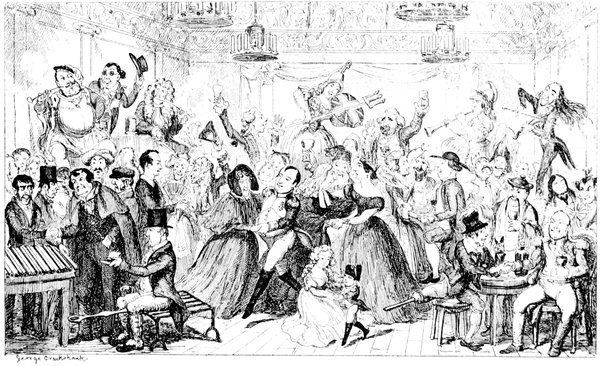
"I DREAMT I SLEPT AT MADAME TUSSAUD'S."
167
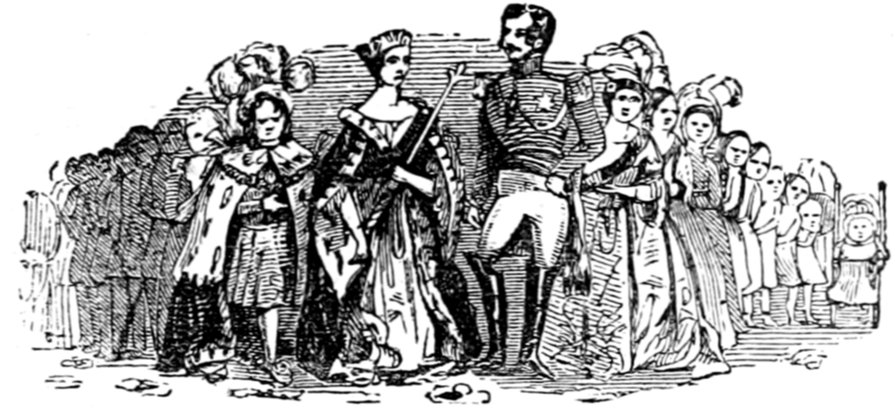
The Magnificent Group of the Royal Family, as it will appear at Madame Tussaud's in a few years' time.
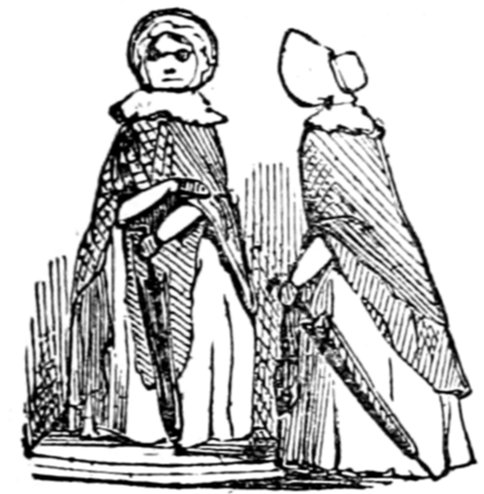
Madame Tussaud beside herself
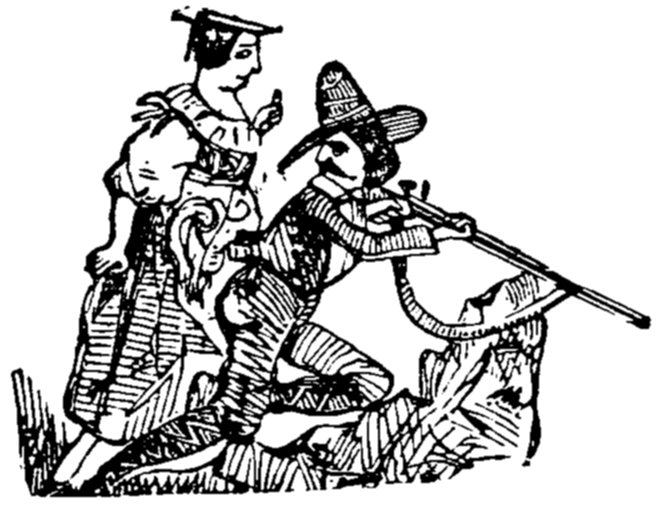
The Brigand of Windmill Street on the look-out down the Haymarket.
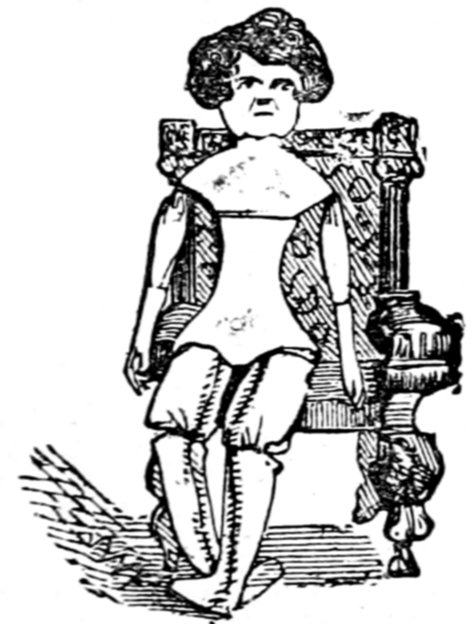
George IV. at Madame Tussaud's without his grand Coronation Robes.
I DREAMT THAT I SLEPT AT MADAME TUSSAUD'S.
I.
I dreamt that I sle-ept at Madame Tussaud's,
With Cut-throats and Kings by my si-i-de;
And that all the Wax-figures in tho-ose abodes
At Midnight became vivifi-i-ied.
I dreamt William the Four-urth sat dow-own to smoke
With Collins, who aimed at his eye,
And I a-also dre-eamt King Hal—what a joke!—
Danc'd the Polka with Mi-istress Fry
Danc'd the Polka—the Polka with Mi-istress Fry,
Danc'd the Polka—the Polka with Mi-istress Fry.
II.
I dreamt that Napo-le-on Bo-onaparte
Was waltzing with Madame T-e-ee;
That O'Connell, to study the regicide art,
Had a gossip with Fieschi-e-ee;
And Penn making eyes with Queen Be-ess I saw,
And Pitt taking gro-og with Fox.
And I a-also dreamt the Sun melted—oh la!
The nose of Lord Brougham and Vaux—
The nose of—the nose of Lord Brougham and Vaux,
The nose of—the nose of Lord Brougham and Vaux.
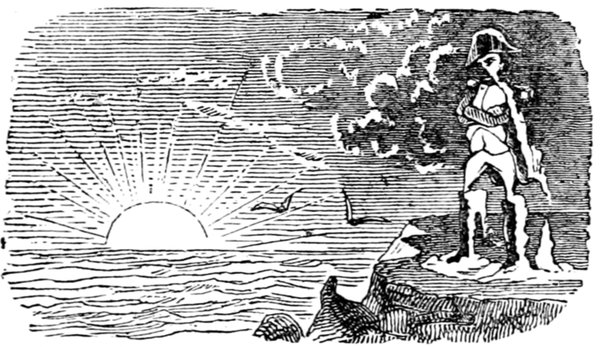
Napoleon, at Madame Tussaud's, melting before the Sun of England.
168
SIR THOMAS BROWN ON WELSH RABBITS. BEING A CONTINUATION OF HIS "INQUIRIES INTO VULGAR AND COMMON ERRORS."
The common opinion of the Welsh Rabbit conceits that it is a species of Cuniculus indigenous to Wales; of which assertion, if Prescription of time and Numerosity of assertors were a sufficient Demonstration, we might sit down herein as an orthodoxical Truth, nor should there need ulterior Disquisition. Pliny discourseth of it under the Head of De Animalibus Walliœ. Seneca describeth it as an exosseous Animal, or one of the invertebrated or boneless kind. Claudian saith that it delighteth to burrow underground in Coal Holes and Cyder Cellars. Scaliger affirmeth it to be like to the Hyena, incapable of Domitation or taming, for the cause that he never heard of one being domesticated in a Hutch. Sarenus Sammonicus determineth it to be like unto the Salamander, moist in the third degree, and to have a mucous Humidity above and under the Epidermis, or outer skin, by virtue whereof it endureth the Fire for a time. Nor are such conceits held by Humane authors only, for the holy Fathers of the Church have likewise similarly opinioned. St. Augustine declareth it to be an unclean Animal; insomuch that like to the Polecat it is Graveolent, emitting a strong Murine, or Micy Effluvium. The Venerable Bede averreth that it is Noctiparent, as the Bat or Owl, and seldom quitteth its Warrenne until Midnight, for food; for the reason that being Cœcigenous, or possessing no organs of Vision, it loveth Tenebrosity.
All which notwithstanding, upon strict inquiry, we find the Matter controvertible. Diodorus, in his Eleventh Book, affirmeth the Welsh Rabbit to be a creature of Figment, like unto the Sphinx and Snap-Dragon. Mathiolus, in his Comment on Dioscorides, treateth it not as an Animal, but as a Lark. Sextius, a Physitian, saith that having well digested the matter, he was compulsed to reject it; whilest Salmuth, the Commentator of Pancirollus, averreth that one Podocaterus, a Cyprian, kept one for Months in a Cage, without ever having attained the sight of the remotest Manifestation of Vitality.
Now, besides Authority against it, Experience doth in no way confirm the existence of the Welsh Rabbit as an Animant Entity. But, contrariwise, the principles of Sense and Reason conspire to asseverate it to be, like unto the Myths of Paganism, an Inanimant Body, vivificated by the Ignoration and Superstitiosity of men. For had they but inquired into the Etymon, or true meaning of the name of the Entity in question, they would have experienced that it was originally merely the Synonyme for a British Dainty, or Cymric Scitamentum; insomuch as it was primitively appellated, "The Welsh Tid, or Rare-Bit;" which, by elision, becoming Metamorphosed into Ra'bit, was, from its Homophony, vulgarly supposed to have respect to the Cuniculus rather than to the Scitamentum of Wales.
Again, the Doctrine of the Existence of the Welsh Rabbit as a 169Vivous Entity, doth in nowise accord with the three definitive Confirmators and Tests of things dubious: to wit, Experiment, Analysis, and Synthesis. And first by Experiment. For if we send to Wales for one of the Rabbits, vernacular to the Principality, we shall discriminate on the attainment of it, no Difformity in its Organism from that of the Cuniculi vulgar to other Countries. And if we then proceed to discoriate and exossate the Animal thus attained, or to deprive it of both its Skin and Bones, and after to macerate the residuary Muscular Fibre into a papparious Pulp, we shall experience, upon diffusing the same on an Offula tosta, or a thin slice of toast, that so far from the concoction partaking in the least of the delectable Sapor of the Welsh Scitamentum, it will in no way titillate the lingual Papillæ, but, contrariwise, offer inordinate Offence to the Gust.
And, secondly, by Analysis, If, in the stead of sending to Wales, we betake ourselves to any Hostelrie or place of Cenatory Resort, vicine to Covent Garden (whereanent they be celebrious for the concoction of such like Comestibles, for the Deipnophagi or eater of Suppers), and thence provide ourselves with one of the Welsh Rarebits or Scitamenta, whereof we are treating, we shall discriminate upon the Dissolution or Discerption of its parts, that it consisteth not of any Carnal Substance, but simply of a Superstratum of some flavous and adipose Edible, which, to the Sense of Vision, seemeth like unto the Unguent, denominated Basilicon, or, the Emplastrum appellated Diachylon; whilest to the Sense of Olfaction it beareth an Odour that hath an inviting Caseous or Cheesy Fragror, and fulfilleth all the conditions and Predicaments of caseous matter or Cheese, which hath undergone the process of Torrefaction; whereof, indeed, if we submit a portion to the Test of the Gust, we shall, from the peculiar Sapor appertinent thereto, without Dubitation determine it to consist.
And, thirdly and lastly, by Synthesis. If we provide ourselves with about a Selibra or half pound of the Cheese, entitulated Duplex Glocestrius, or Double Gloucester; and then go on to cut the intrinsic caseous Matter into tenuous Segments or Laminæ; and, positing such Segments within the coquinary commodity distinguished by Culinarian's as the Furnus Bataviœ or Dutch Oven, submit the same to the Fire, until by the action of the Caloric they become mollified unto Semiliquidity: whereupon, if we diffuse the caseous fluid on an Offula of Bread, the Superfices whereof hath been previously torrified, and then Season the same with a slight aspersion of the Sinapine, Piperine, and Saline Condiments, or with Mustard, Pepper, and Salt, we shall find that the Sapor and Fragror thereof differ in no wise from the Gust and Odour of the Edible we had præ-attained from the Covent Garden Cœnatorium; and, consequentially, that the Welsh Rabbit is not, as the Vulgar Pseudodox conceiteth, a species of Cuniculus vernacular to Wales, but as was before predicated, simply a Savoury and Redolent Scitamentum or Rarebit, which is much existimated by the Cymri or Welsh people, who, from time prætermemorial, have been cognized as a Philocaseous, or Cheese-loving, Nation.
170
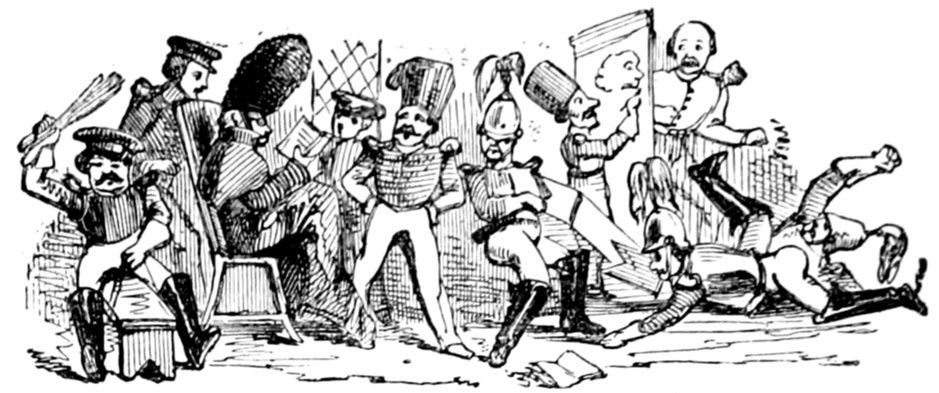
THE MILITARY ACADEMY IN AN UPROAR.
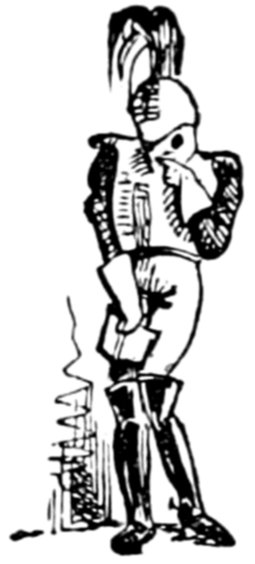
The Naughty Life-Guardsman.
THE EDUCATION OF THE SOLDIER.
A great deal of Ink has been shed upon the question whether Dilworth should enter the army; but we have met with no greater instance of the necessity of sending the sons of Mars, or, in other words, the children "in arms," to an infant school, than the following copy of verses which were picked up in one of the Areas of Albany Street, and which are supposed to be the outpourings of some Cupid in the Life Guards, to his Psyche in the Kitchen:—
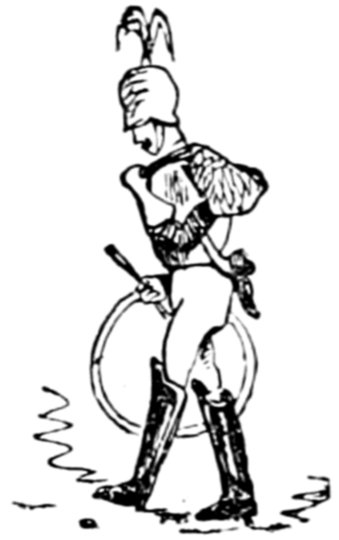
"Creeping like Snail lazily to School."
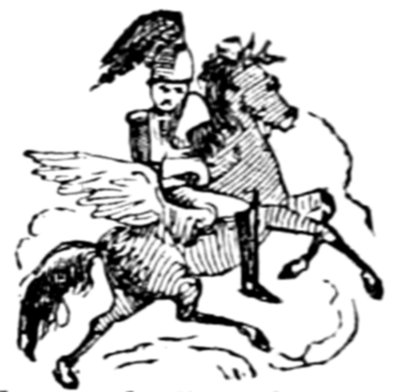
The Life-Guardsman on his Pegasus.
TO THE IDLE OF MY HEART.
ark! to the Blarst of Waw, luv,
fal, la, lal, la
hit His the cannings Raw, luv,
fal, la, lal, la
yes! yes! that Marshall Orn, luv,
purclames i must be Gorn, luv,
and brake that Art of Yourn, luv,
fal, la, lal, la
wy duz that buzzum Sy, luv,
fal, la, lal, la
hand teers bejew that High, luv,
fal, la, lal, la
but Hair i Mounts my charjer, luv,
i Wood the gift wur Larger, luv,
take thou this Here mustarsher, luv,
fal, la, lal, la
we Har the boys for Luving, luv,
fal, la, lal, la
for deth we dont Care Nuffin, luv,
fal, la, lal, la
but Hif i Falls a marter, luv,
sa will you Hever Harter, luv,
weep Hore my sad Departur, luv,
fal, la, lal, la
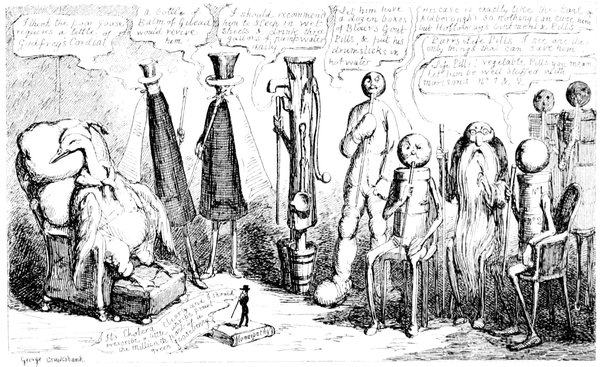
THE SICK GOOSE AND THE COUNCIL OF HEALTH.
171
WELTHE, HELTHE, AND HAPPINESSE. A RYGHTE MERRIE CONCEITTE.
In Inglande's fam'd Metropolis
There dwelte inne dayes of yore,
A wondrous greate Philosopher,
Uppe inne a seconde flore.
His lerninge was prodigious,
And ofte myghte he be sene,
Wastinge ye mydnyghte rushlyghte, o'er
Ye Pennie Magazene.
Eftsoons his fame came to ye eares
Of one steept to hys chinne
Inne sicknesse and inne miserie,
And shockinge shorte of tinne.
He hadde been jilted by ye mayde
Who sholde have been hys spouse,
He'd ye Lumbagoe inne hys loynes,
Ye Sherriffe inne hys house.
So he soughte out ye sage's celle,
Resolv'd to take advise,
And didde for ye Philosopher
Ye myddel belle ringe twyce.
Ye sage came downe immediatelie
Ye soundes felle onne hys eare,
Inne trothe ye greate Philosopher
Didde thynke it was hys beere.
But, whenne he saw ye Invalede,
And lernt whatte he didde lacke,
Ye sage he kindlie askéd hym
Uppe to his two paire backe:
For, like a nutte, ye sage was kinde
Atte hearte, tho' roughe inne huske,
And to afflixion kepte hys eares
Open from tenne tille duske.
So he ye sorrie Invalide
Withe everie kindnesse treted,
He drewe a trunke from neathe hys bedde,
And begg'd he wolde be seated.
"Now lette me heare from thee," he sedde,
"Thy sorrowfulle reporte;
Tho' yffe 'tis longe," observed the sage,
"Be plees'd to cutte itte shorte."
172Thenne brieflie spoke ye Invalede,
"Ye wretche who to thee comes
Is sufferinge bytterlie from Love,
Lumbagoe, and ye Bummes."
"Butte," said ye greate Philosopher,
"Whatte seekeste thou of mee?
Thou arte a manne withe whom I feare
Itt's nearlie alle U—P."
"Oh no!" exclaim'd ye Invalede,
"You'll clere me from this messe,
Iffe you'll tell me ye Waye to Welthe,
And Helthe, and Happinesse."
"I feare," sedde ye Philosopher,
"Thatt's more thanne I canne doo;
To solve so deepe a problemme, boye,
Requires a pype or two."
He fill'd hys bowle, thenne pufft and thought,
And mutter'd "No! that's notte itte!
Ye waye to Welthe!—Yes! lette mee see!
I' feckings! boye, I've gotte itte!"
"Marke welle my wordes," thenne sedde ye sage,
"Yffe thou dost longe for rytches,
A quack Lyfe Pille withe golde wille fille
Ye Pockettes of your britches."
"Moste surelie," crie'd ye Invalede,
"Thatte is ye waye to Welthe;
Butte oh! thou greate Philosopher!
Whiche is ye waye to Helthe?"
"Thatte's quicklie tolde," returned ye sage,
"Ye Quacke Pille, whenne you make itte,
Lette others swallowe!—butte be sure,
Neverre yourselfe to take itte."
"Oh, lerned sage!" ye youthe exclaim'd,
"Thy wordes I'll live to bless!
Butte one more question stille remanes,
Ye waye to Happinesse."
"Yffe that you'd know," replied ye sage,
"Withe thee this maximme carrie;
As you wolde lede a happie lyfe,
Take my advise-Don't marry!"
Ye Invalede returnéd home,
And liv'd to be four score,
Amasst ne ende of golde, and died
A happie batchelore.
173
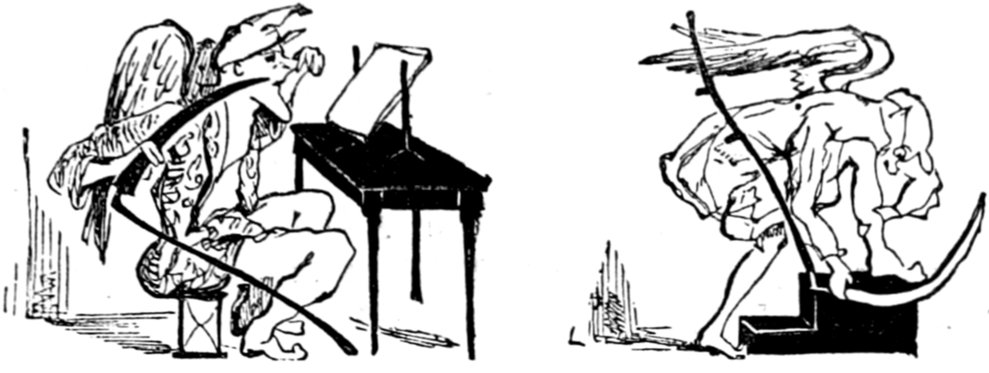
"THERE NEVER WERE SUCH TIMES."
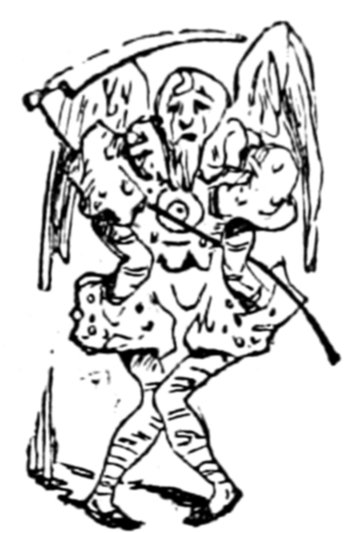
Here we are again!
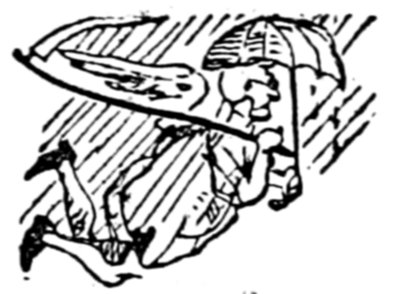
"Time Flies."
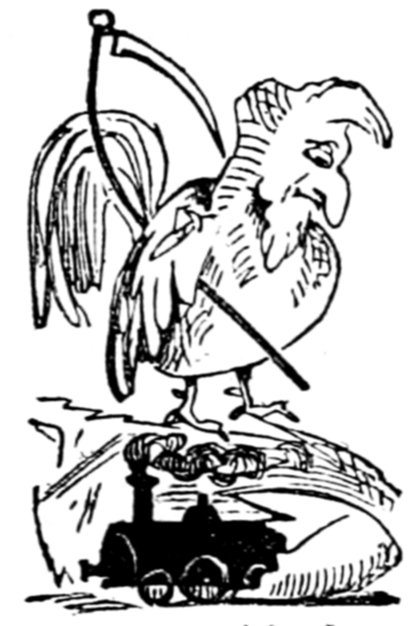
Just hatched.
TEMPUS EDAX RERUM.
Old Time is a regular glutton,
Something dainty for ever he's munching;
The leg of a Statue's his dinner,
And the wing of a Palace his luncheon.
Rhodes' Colossus is merely a chicken,
In the maw of this greedy old soul;
And Stonehenge only rashers of granite,
And Pompeii a "toad in the hole."
Trajan's Column to him's a Poloney,
And the Pyramids Omelettes Soufflées;
Irish stew are ould Erin's Round Towers,
And a nice little hash is Herne Bay.
But of late, he'd had little worth eating,
So one day he—inclin'd for a treat—
At the Board of Works called to inquire
What new buildings they'd got he could eat.
The Commissioners said, "They were sorry
They'd got nothing nice for him; but
There's the Wellington Statue just up, Sir,
And Westminster Bridge in low cut.
"Nelson's Monument wasn't quite ready"
For old Edax Rerum to swallow;
"But he might have the National Gallery,
With Trafalgar Square Fountains to follow."
But though he lik'd things in bad odour,
The Gallery pleas'd not his whim;
For though very fair game was the building,
'Twasn't rotten enough yet for him.
"On the ruins of Greece have I feasted,"
Cried Old Time, with contemptuous raillery;
"And having a taste for the Parthenon,
How the deuce can I stomach that Gallery?"
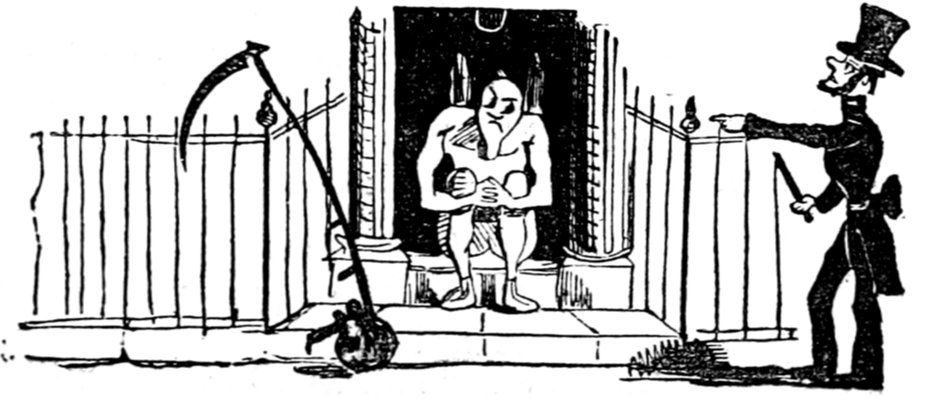
COME, MOVE ON THERE, MY MAN.
174
THE STAGE COACHMAN AND THE POST BOY. AN IMAGINARY CONVERSATION.
Stage Coachman (meeting Post Boy).
Vy! who'd a thought o' seeing you! Vell! how's your vife and fammerly? and how do you find yourself, Muster Joe?
Post Boy.
Only middlin', thank ye!—but how can you hexpect a man, who's a yarning nuffin a-veek, to find himself, I should like to know?
Stage Coachman.
Ah! these here is hard times for you and me, Joe; since every hindivid'al hobjects vith us now to ride—
I'm blow'd if I an't been empty for this month past, and gone every journey vith nuffin at all in my hinside.
Post Boy.
And as for the matter of po-chaises, Vill'm, bless you! there's so plaguy little for a boy now to do—
That I'm sure I don't know how I should ever be able to ive, if I didn't hoccasionally make a dinner out of a "Fly" or two.
Stage Coachman.
Vell! all I can say is, Joe, I can't keep on a running of my coach vithout never no passengers;
Only, I can't a-bear the hidea of my poor 'osses a going the vay of all 'oss-flesh, and a being made into beef sassengers.
Post Boy.
Yes! that'll be the hend on the poor critturs, no doubt; for I have heerd—and it sartinly is my belief—
That, since the railvays have come in, many houses in town rig'larly every veek biles down three 'osses and a gallovay for halamode beef.
Stage Coachman.
Cuss all railways and steam ingins, says I! I vonders how people can like to travel by sitch houtlandish modes—
Only, to be sure, there is jist now vot they calls a "Manier" for mangling all the country, and hironing all the roads.
Post Boy.
And if they only goes on a using up the iron in the vay they're now doing, depend on it, Vill'am—though I hopes I shan't live to see it!
Every poor 'oss that is left vill be hobligated to vander about the streets, vithout never so much as a shoe to his feet.
Stage Coachman.
And vorser still!—Hang me! if each blessed Landlord vont be hinsolvent, and each blessed hinn be sqvashed—
For I heerd t'other day that even "The Red Lion" had got over his head and ears in debt, and vas a going to get vhitevashed.
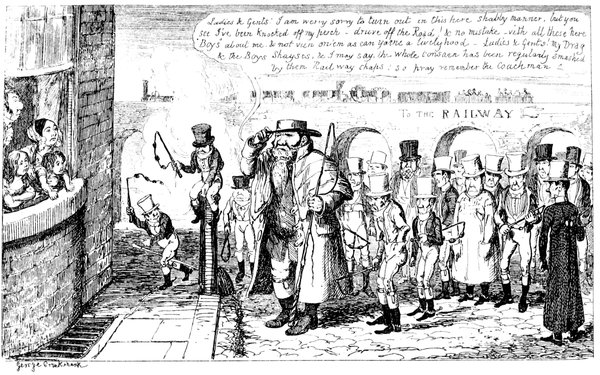
STEAMED OUT, or the Starving Stage-Coachman and Boys.
175Post Boy.
They do say, too, that the Sheriff has seized all "The Hangel's" things, and "The 'Ole in the Vall" is to be closed afore another twelvemonth comes round—
And, vot's more! that "The Pig in the Pound"'s broke, and von't be hable to pay his creditors nuffin at all votsomdever in the pound.
Stage Coachman.
And then the Chambermaids has all gone to stand behind mahogany counters at the Stations—though a body would hardly think it—
Vhere they sarves out hot tea and soup, to poor half-starv'd devils of passengers, vot arn't hallowed no time to drink it.
Post Boy.
All the Boots, too, has turned railvay policemen, and hangs out them signals, of vhich you've werry likely heerd speak;
And vhich they uses to purvent the gen'l'men, as is travelling in sitch a werry particular hurry, a being druv slap into the middle of next veek.
Stage Coachman.
Yes! and the vorst of that there cursed railvay is, that vhenever there is a haccident on it—
The're sartin to mangle a person's poor body so, that even the Coroner don't like sitting upon it.
Post Boy.
And though, Vill'am, I've bolted with dozens of heiresses in my time, I an't had a 'lopement for this plaguy long vhile;
For the 'appy couples, hang 'em! now takes a "day ticket" to Gretna Green, and runs avay in the most hunromanticated style.
Stage Coachman.
Yes! and vhere now is that beautiful purcession, on the fust of May, to show off the new scarlet coats of the Drivers of Her Majesty's mails?
Vy! if there vos to be sitch a thing, now-a-days, Joe! it 'ud be nuffin but von one long line of them beastly dirty Stokers to them nasty filthy rails.
Post Boy.
Vell! Vill'am, I only vish I vas the hingineer to them there railvay trains—and then their business I vouldn't be werry long sp'iling;
For, if I only had the driving of all of them as likes travelling behind steam ingins, blow me! but I'd bust the bilers of the whole biling.
Stage Coachman.
And, as for my part, if I only had the tooling along of them there D'rectors—into 'em, Crikey! Joe, vouldn't I stick it?
Yes! I'd tool 'em along slap to that "bourne from which no traveller returns;" or, in other words, from which nobody can't get no "Return Ticket."
176
ADVICE TO PARENTS AND GUARDIANS.
(Strictly private and confidential.)
My very dear Friends,
I have frequently observed your praiseworthy though unavailing attempts to reduce your domestic expenses, by getting your wards and daughters "off your hands." I regret to say I have seen much energy on your parts misdirected, and many an elegant and expensive supper given by you to no purpose.
Now, to prevent these failures in future, and to allow the "dear girls" a better chance of getting "comfortably settled" in life, I am about to confide to you a secret, which experience has shown me to be well worth knowing.
What I would first ask you, is the primary object of all evening parties? Why do you engage Weippert's band, or order your supper and ices from Gunter? Is it—candidly now between ourselves—to make your friends happy? Or is it not to catch some amiable and independent young bachelor, who is willing to make your girl the partner of his bosom and banker's account? Of course you are people of the world, and don't mind throwing one of Gunter's sprats to catch an aristocratic herring.
To command success, however, in this style of marital fishing, one thing, let me tell you, above all, is necessary, and that is, a conservatory leading from the ball-room. Think, oh ye Parents and Guardians! for a moment of the advantages of such an arrangement.
The bashful or timid young man, after the quadrille, is sure to propose a temporary retirement among the flowers, because they afford him something beyond the weather to talk about, and if he only be matrimonially disposed, no place—depend upon it—is more likely to make him speak out. For instance, he asks the young lady to pick him a Camelia, she does so of course, and, if she has nice eyelashes, takes advantage of the opportunity afforded her, to display some little timidity and the said eyelashes while arranging the leaves. But if not blest with those bewitching adjuncts to a pretty face, I have known a half-suppressed sigh from the interesting creature answer very well; for your bashful young gentleman very frequently labours under the notion that he is a lady-killer; and ten to one but he is thus led to think he has made a conquest of the poor girl, and so, resolving to make her happy, proposes on the spot.
The conservatory is quite as useful for what is called "the fast man," or for the man of the world, or indeed for any other species of the genus homo; though of course the treatment must in each of these cases be judiciously varied.
Your "fast man"—who is generally given to capacious coat-sleeves, and an eccentric narrowness of neckcloth—prefers a young girl with "something to say for herself," and who does not leave him to supply all the conversation. "The agreeable rattle" should therefore be kept up by the young lady, and if the dear girl have a pretty hand she may take off her "Houbigant," and amuse herself by dipping her taper fingers in the basin of the little fountain, with its three miserable gold fish. The "fast man" will then probably essay a joke, or a compliment, whereupon the young lady may playfully sprinkle him with a few drops of water; and thus, doubtlessly, matters will proceed, until the "rapid" gentleman thinks her "a deuced nice girl with no nonsense about her;" so that the flirtation, if not nipped by bad 177management in the bud, may, in due course of time, blossom into a proposal.
For a sentimental young man the "language of flowers" presents a very "taking" subject for conversation; while to the scientific bachelor, a conservatory affords an easy means for a botanical discussion; besides, the examination of a plant is sure to bring the faces of the couple into proximity; and no disciple of Linnæus, however ardent, is proof against that peculiar thrill which is caused by a pretty girl's glossy and perfumed ringlets brushing against the cheek.
With the matter-of-fact young man a conservatory is quite as useful. He likes his own comfort better than anything else, and considers the supper the best part of the evening; a seat among the flowers saves him the trouble of dancing, so that he will think any young lady "a very sensible girl" for proposing such a thing; and, as he considers himself a very sensible young man, why of course the sensible young man would like a sensible young lady for his wife.
In all these arrangements a maiden aunt, or the useful "friend of the family," should be stationed near the conservatory door; for occasionally the "dear girls" are disposed to flirt with Captains, with large moustachios and small means. All elderly mammas having unmarried daughters should be carefully excluded, as every mother of a family is well known to take a malicious delight in interrupting promising affairs of this kind, when their own girls do not form part of the tête-à-tête.
Believe me, my dear Friends, yours very sincerely,
A Victim to a Conservatory.
ADVICE TO YOUNG LADIES.
My Dear Creatures,
Yes, you are all dear to me—so dear that when I watch you, as I do at times, most anxiously, I feel how sadly you stand in need of an adviser.
But do not alarm yourselves! I am not going to be ill-natured. No! I will not find fault with Miss Crinoline's bustle; though I certainly must confess it is rather absurd to see her doing the very agreeable in one room, with the hind breadths of her skirt half-way across another. Nor will I say anything to Miss Nude about wearing her dresses so low as she does; for though I am an ardent admirer of the "blanches épaules," still I cannot help observing that she does allow her gown to slip a leetle too far off her shoulders sometimes. But I can't spare Miss Carney, who calls Miss Nude "dear," and then tells me confidentially, "how bad it looks to see such a nice girl as she is go about with her shoulders so dreadfully exposed; that it really makes people think her so bold, and that it's pity some one doesn't tell her of it." And this Miss Carney does with a look of such pretty pity that for a moment I think she is the most good-natured creature since Mrs. Adam, and feel inclined to run and tell the bare shoulders that she ought to be ashamed of herself. It's a great mark of talent in a young lady, by-the-bye, to be able to say ill-natured things in a good-natured way.
And I should most strongly recommend Miss Madonna, who wears her hair plain, not to find fault with Miss Chevelure's crisp ringlets. Why 178should Miss Madonna say they are not becoming? Miss Chevelure's soft blue eyes and aquiline nose certainly proclaim her to be the prettier of the two; and I would bet my favourite whisker that Miss Madonna is a far better customer to Isadore for cosmetique, bandoline, fixature, and other toilet luxuries than she of the crisp ringlets whom she decries. And why should Miss Madonna be severe upon Miss Blue Stocking (whom she calls her "dear Cloè," and rushes to embrace when she enters the room)? Why should she say that Miss Blue Stocking has her hair dressed "à la Chinoise," to show off her forehead, and make her look more intellectual? But I don't believe it; though I certainly must say that it would be better if the fair bas bleu did wear her hair a little less like the ladies of China, and a little more like those of England.
My dear creatures, take my advice—never call a young lady "dear," when every one knows you detest her; and never try to exalt yourselves by the detraction of others. Depend upon it, the diminishing spectacles of envy do not become you.