THE TRADE OF RUSSIA
Reading edition
(“THE TRADE OF THE WORLD” PAPERS)
BY JAMES DAVENPORT WHELPLEY
Author of “The Commercial Strength of Great Britain,” “Germany’s Foreign Trade,” etc.
IF they knewe their strength, no man were able to make match with them: nor they that dwel neere them should have any rest of them. But I thinke it is not God’s will: For I may compare them to a young horse that knoweth not his strength, whome a little childe ruleth and guideth with a bridle, for all his great strength; for if hee did, neither childe nor man could rule him.—From “The Voyage of Richard Chancellor, Pilote Major, the First Discoverer by Sea of the Kingdome of Moscovia, Anno 1553.” (Hakluyt’s “Voyages.”)
THE day of the awakening has come, and nearly four hundred years after these Northern voyagers discovered “the Kingdome of Moscovia” the world is witness to the greatest economic evolution in history. A nation of 165,000,000 people, increasing in numbers at the rate of nearly 3,000,000 a year despite famines, wars, and the rigors of terrible winters, occupying an area of 8,650,000 square miles, or two and a half times that of the United States, and with a proportionate wealth of natural resources, is finding itself.
The results are not problematical. The same laws of progress and development now govern Russia as have governed other countries in the past, and brought them to their present position of wealth and continuing prosperity. In all times some one nation has led the rest as the most powerful of all. It is equally true that no one nation has held this position for more than the allotted time. In the past the ascendancy of one people over another has been largely due to a greater spirit of aggressiveness or warlike tendency. In the future one nation will lead another through greater economic wealth and sturdiness of national character. In a broad sense the world is becoming commercialized, though in its best meaning this does not imply that the trader is the leader and the exponent of the nation’s life; he is merely the means to an end. Through him the world becomes more of a kin; he opens the road to civilization with all its equalizing and protective features, and, having served as the pioneer, is then regulated through the influences which follow in the wake of his adventures. Despoiling the weak is no longer the unrebuked spirit of strong nations, and international neutralization is gradually spreading its protecting influence over a large part of the earth’s surface. It is from the point of national wealth and national character, therefore, that the near future of every country must now be judged. The prophet of to-day talks not of wars and plagues; he foresees the true value of what lies in the ground and the strength or weakness of a people in realizing wisely or wastefully upon their entail.
The most powerful country of the future will be Russia, and her elements of greatness are writ fair across her thousands of miles of territory and in the character of her sturdy, peaceful, industrious, and phlegmatic people. The wealth of Russia lies in the ground, and centuries of industry will not exhaust the possibilities of expansion. From her 900,000,000 acres of forest, as compared with the 88,000,000 in the United States, will come the world’s supply of timber. There are now 250,000,000 acres of land under the plow, whereas there is nearly double that amount in the United States; but Russia can expand her cultivated area twenty-fold and still leave virgin land for coming generations. From this vast farm will come the grain demanded by bread-hungry people in other lands. Oils, minerals, and fuel abound. The advance in development and transportation achieved each year will be the only measure of increasing national and individual wealth. Within the empire itself tremendous and complicated problems face the people.
Political, social, and economic conditions are as in no other land. It is only since 1861 that 22,000,000 peasants ceased to be slaves under the law, and it was some years after that before the law came into practical effect throughout any wide area. It was not until 1864, with the establishment of the zemstvos, or district assemblies, that any measure of local government fell to the lot of the people. It was not until 1890 and the years following that appreciable effort was made in the direction of general education. To-day twenty-seven per cent. of the people above nine years of age can read and write, this being an average for the whole empire, which includes the seventy per cent. of illiterates in Poland and the ninety-five per cent. of illiterates in central Asia. In 1912 the imperial budget provided for an expenditure of $55,000,000 for educational purposes, and the local governments contribute nearly as much more. This is an increase of fifteen per cent. over 1911, and is over three per cent. of the total revenue of the Government. There are now 90,000 primary schools, employing 155,000 teachers, attended by over 4,000,000 pupils.
The change that this one feature of national life will bring about among the people of Russia in the next few years can be appreciated only when the conditions of twenty years ago are fully understood—conditions which gave rise to the stigma of “Darkest Russia.” The light is being let in, and with it are coming perforce changes in administrative methods and in political life which are replete with promise of a new and better era. It requires no effort of the imagination to picture the state of a great nation buried in ignorance and at the mercy of an educated and more or less unscrupulous bureaucracy, but it needs a heroic readjustment of preconceived ideas, a sweeping away of prejudices, and a wide comprehension, to grasp the potentialities of a land and a people like these when latent natural wealth is made accessible and education and comparative freedom of thought and action are given to all. The process must be gradual; limitations upon material development are always severe, and the pace a disappointment to the enthusiastic. Mental and political development is even slower, for it is the new generation and not the old which goes to school, learns to think, and then acts upon the thought. Too rapid growth is dangerous, and unproductive of permanently good results. Some of the greatest and wisest men of Russia, men who have the interests of the country and its people unselfishly at heart, are among those who have been denounced in other countries as well as in their own as “reactionaries.” The closer this really unknown land is studied, the more tremendous and overwhelming in their complexities appear the problems with which its rulers and the people are faced. They can be solved only through the coöperation of all classes.
So far this is a long way from being achieved, but progress has been made, and when all conditions and circumstances are taken into consideration, this progress can be regarded as comparatively rapid; for the work of modernizing Russia dates back no further than the birth of the German Empire or that of modern Italy; in point of fact, less than thirty years. In the last ten years the foreign trade of Russia has doubled, exports and imports keeping pace one with the other in their increasing volume and value. Ten years ago this trade amounted to about $700,000,000; in 1912 it is about $1,400,000,000, of which fifty-six per cent. is exports and forty-four per cent. imports. This total foreign commerce, large as it appears, is considerably less than half that of the United States, though it is worth noting that in no ten-year period in its history did the foreign commerce of the United States ever increase by one hundred per cent., as did that of Russia in the last ten years, and there is every reason to believe that the present rate of increase will continue, barring such hindrances as great droughts or serious political or military disturbances.
The real growth and development of Russia are within. Her increasing foreign trade is only a sign of what is taking place in a gigantic and largely unexploited empire. Education is spreading slowly but effectively among the people; millions of acres of virgin land yield annually to the plow; railroads are steadily pushing into new territory; population is being transferred from the densely settled areas to the open spaces of Siberia at the rate of a quarter of a million every year. The land and the forests are being held by Russia for Russians, and settlement is a requisite of purchase. Manufacturing plants are increasing apace, and factories of all descriptions, ranging from the mills of Moscow, one of which, a cotton mill, employs nearly 20,000 people, to the smaller establishments of the eastern-frontier cities, are all sharing in the benefits of the increasing purchasing power of the Russian unit.
The needs of the Russian people are not greater than their country can supply in time, but they are far beyond what is now being produced to supply them, or will be for many years to come. Hence they are faring abroad for markets for their raw materials, for raw materials to supply deficiencies of home production, and for the vast supplies of machinery and other manufactured goods needed to meet the demands of interior expansion and modernization now in progress and as yet only in its beginning.
It is concerning this country and this people, and at such a time, that the Congress of the United States has seen fit to denounce a long-existent treaty of trade and friendship and create a situation the outcome of which can only be to the serious detriment of the American people in their political prestige abroad and to their loss industrially, commercially, and financially. This action on the part of the United States Government came as a complete surprise and no little of a shock to the people of Russia, from the highest official in the Government to the most modest Russian vendor or purchaser of American wares. To the not inconsiderable group of adventurous Americans who have entered Russia in the last few years and built up great and profitable businesses in importing American goods or representing American financial institutions it brought bewilderment and consternation. The Russian Government, confident that it retains the right to adjust its domestic laws and economies as may be deemed best for the Russian people, or right or wrong, according to their own judgment or wishes, looks for a reason for what is deemed in St. Petersburg as unwarranted interference from without. It is recalled that within a recent year fewer than a score of naturalized Americans were refused permission to visit Russia, and these for serious political or economic reasons, while hundreds of Russians were refused admission to the United States on rulings from the immigration authorities, to say nothing of the hundreds of thousands of Russian subjects whom no steamship company would accept as passengers for America, knowing that, by reason of discrimination against the Asiatic races, they would be denied. The Russian Government’s official attitude toward this action on the part of the United States Government is one of contemptuous resentment; contemptuous because it is believed that American politicians yielded to anti-Russian influences for purely selfish reasons; resentment because they find from their point of view no just cause for thus destroying in offhand manner the extremely friendly and profitable relations between two great nations—relations which have become a unique and historical example of long-continuing, unbroken, and even undisturbed friendship. The diplomatic position in St. Petersburg is simple. The Russian Government maintains in effect that the United States has chosen to denounce the treaty, hence it rests with the United States to ask for a new convention. In the meantime the United States has been dismissed from the official mind except that so far as governmental influence is concerned it is now actively anti-American. No American bids to furnish steel for the great Russian navy to be built will be considered—because they are American. The present treaty expires December 31, 1912. After that date, unless some new arrangement is made, all American imports will be subjected to a heavy surtax or increase of customs dues. American life insurance companies are carrying policies in Russia amounting to nearly $100,000,000. To do this business they are compelled to maintain a cash reserve in Russian banks amounting in the case of a single New York company to about $20,000,000. After the thirty-first of December, through the antagonism which would result from the absence of a treaty, American financial institutions might be subjected to such restrictions as would make business in Russia impossible. In 1911 the Russian farmers bought $27,000,000 worth of imported agricultural machinery, mostly American.
From a photograph, copyright, by Underwood & Underwood
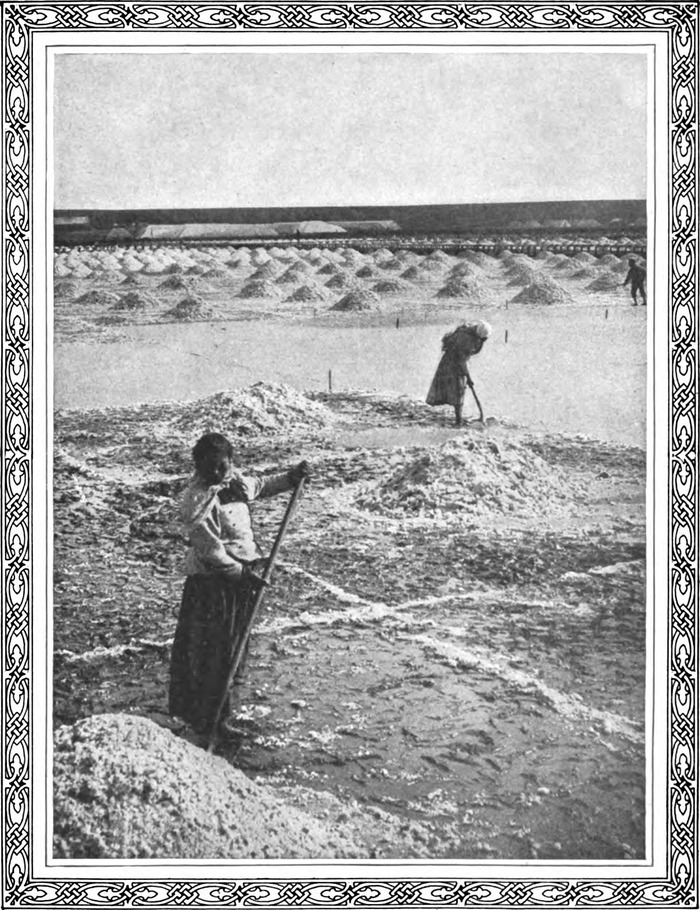
RUSSIAN PEASANT WOMEN WORKING IN A SALT MINE
The prospect of a tariff discrimination against such an industry as this is viewed with anything but equanimity by those who have spent laborious years bringing it to its present stage of development. American figures of exports to Russia are of small value as showing the real state of trade between the two countries. According to the figures compiled at Washington, the direct exports to Russia in 1909 amounted to about $30,000,000. In 1911 they were $52,000,000, a growth of eighty per cent. The truth is that more than twice this value is the real measure of American sales to Russia. Over one half of the trade is indirect, American goods being shipped to England, Germany, France, Denmark, Holland, and other countries, and credited as sales thereto, whereas they are immediately reshipped to Russia, and in fact were bought originally on the trade-account of that country. Estimates as to the real amount of American sales to Russia vary from $90,000,000 to $190,000,000, and the latter figure is probably nearer the mark.
From a photograph, copyright, by Underwood & Underwood
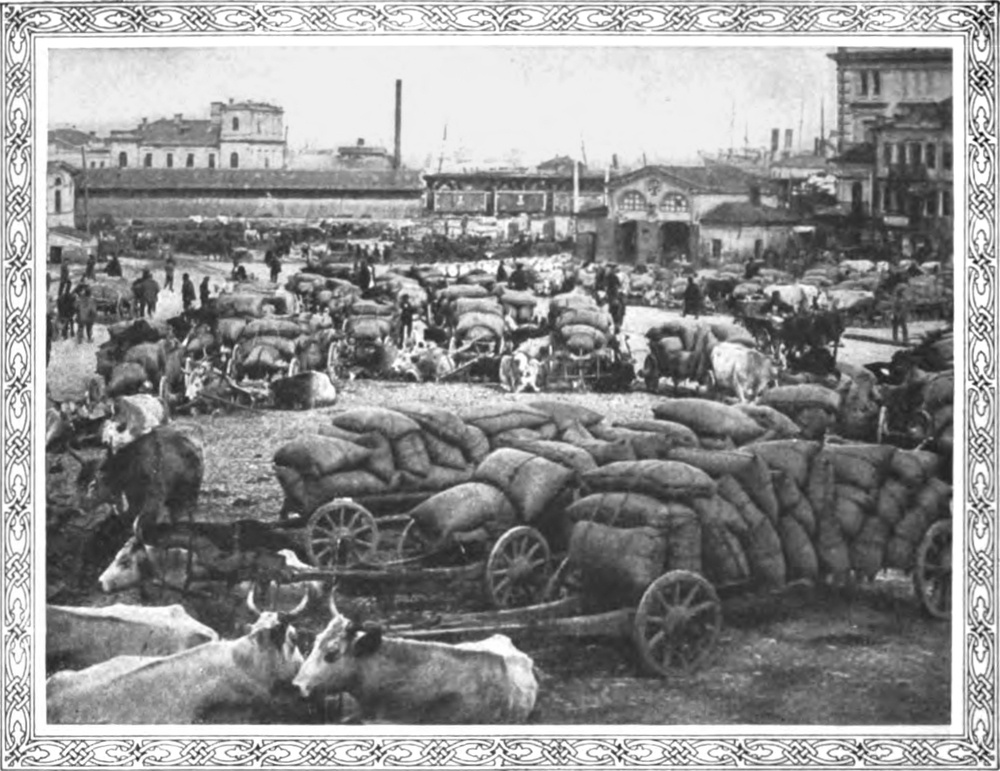
BUNDLING WHEAT FOR EXPORT AT ODESSA, THE GREAT SEAPORT OF SOUTHERN RUSSIA
There is reason to believe that American sales of one item alone—raw cotton—exceed the total amount of $50,000,000 credited to the Russian import account from the United States. The annual consumption of raw cotton in Russia is approximately $125,000,000. Fifty million of this is grown in central Asia: one fifth comes from Egypt, India, and other places, leaving at least $50,000,000 to be bought from the United States, as there is no other place from which it can come. The American export statistics show that less than $7,000,000 of raw cotton is sold to Russia direct. There is therefore over $40,000,000 worth the purchase of which is credited to other countries, but which in fact goes to Russia and is paid for by the Russian cotton-spinners. Purchases of raw material such as cotton by one country from another are purchases of necessity, and no matter what the diplomatic relations of those countries may be short of actual war, this business continues. If the relations be unfriendly, however, efforts are made to supply deficiencies elsewhere or to stimulate home production to its highest possible point.
Dependence upon American cotton is a sore point throughout Europe, and millions are being spent by various governments and combinations of milling interests to create a cotton surplus elsewhere. Englishmen and Germans are developing African cotton-fields, the Dutch are at work elsewhere, and now Russia is spending enormous sums upon extensive irrigation schemes in the near East to enlarge the not inconsiderable cotton-producing area of the empire. In the case of manufactured goods, however, a nation has the markets of the world to choose from, and the American manufacturer meets the Englishman, the German, the Frenchman, the Belgian, and others in the fiercest kind of competition when he offers for sale the products of iron and steel, the textile mills, machinery, large and small, and, in fact, anything which, given the raw material, human ingenuity fashions to the hand of man.
From a photograph, copyright, by Underwood & Underwood
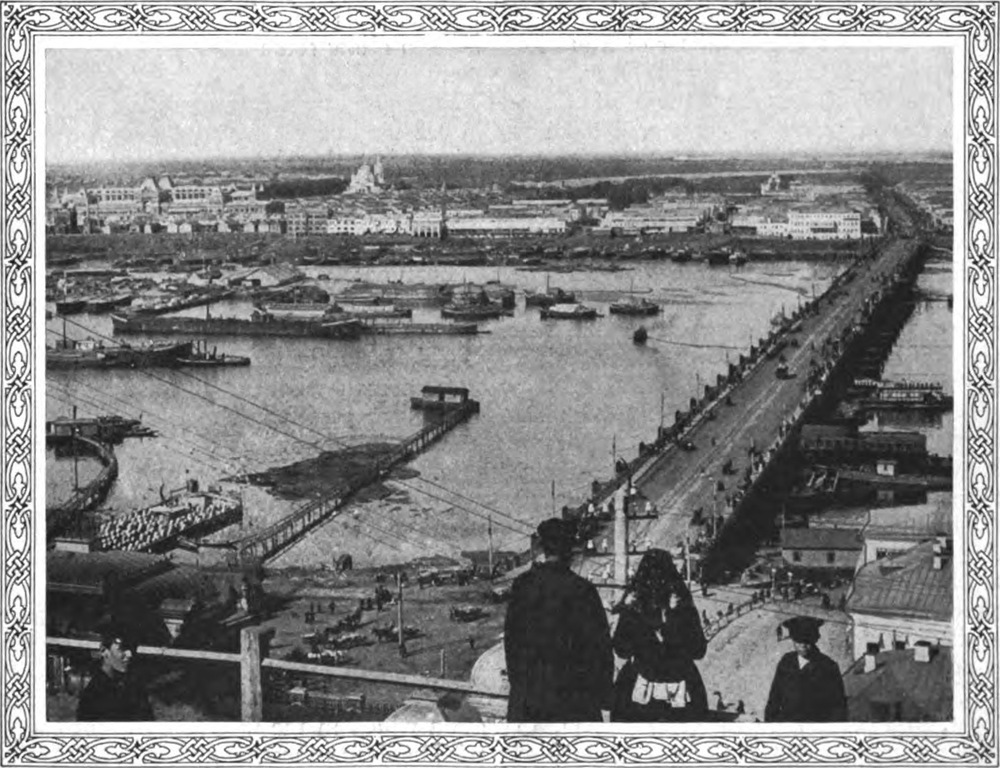
THE BRIDGE OVER THE OKA RIVER, SHOWING THE FAIR AT NIJNI-NOVGOROD IN THE DISTANCE
It is in this field that diplomacy joins hands with commerce and industry, for modern diplomacy is based upon equal trading rights and trade extension. The foreign minister or secretary of state of to-day is judged by his people upon the success or failure of his policy as it affects the export trade of his country at the moment, or in its guarantees for the future. There is still much high-flown talk about national honor, the dignity of nations, and the cause of humanity, but careful analysis fails to discover in any recent international dispute or agreement a single instance where the maintenance of trade, its extension, or trade jealousy or rivalry, is not the fundamental question at issue. This is not to the discredit of diplomacy, nor does it put it on a lower plane than in the days when territorial aggression or offensive and defensive alliance was the purpose of pourparlers. In fact, while it may lose some of its romance in the telling, the extension of commercial spheres for the most advanced nations is an extension of enlightenment, justice, and modernization which makes for the permanent betterment of those coming under their sway. A most effective and dangerous appeal to ignorance and prejudice was made not long ago by a certain cartoon which found its way into many American newspapers. It represented the hand of Uncle Sam grasping and waving an American flag across which was written the legend “Passport.” An impression which will not stand analysis exists in the United States that a passport issued by the State Department is the same thing as the flag of the nation in that it demands equal recognition and respect abroad. This construction is an absurdity, for a passport is no more or less than a certificate of citizenship. It contains no clause giving the support of the issuing country to the holder should he do other than observe the laws and regulations of any foreign countries in which he may be traveling or residing. The same question which has caused the present strained situation between the United States and Russia was broached in the Parliament of Great Britain, for Russian laws and police regulations apply to English citizens traveling in Russia, as they do to the citizens of every other country, including the United States. The English Minister of State for Foreign Affairs, Sir Edward Grey, very promptly informed the House of Commons that a treaty of commerce did not give the British Government a right to demand exemption for British subjects which are contrary to the general laws of a foreign country, and there the matter ended. Where it will end in the case of the United States no one can say, but the outlook is not promising, as Russia cannot by reason of interior conditions yield the principal point at issue. There is no controversy, for it takes two to make a quarrel, and so far the United States has been the aggressor. Russia has accepted the situation, and her people have turned their attention to other fields for coöperation in the material development of the Russian Empire. In the language of the street, it is up to the United States to find a place to “get off,” and at present there is no sign of a comfortable landing-stage.
The American Government assumes the right, and with entirely good reason, to regulate the use of the Panama Canal under an ordinary interpretation of a favored nation clause; but by the action taken in the matter of the use of American passports in Russia, it denies to the latter country the right to regulate its actual domestic affairs or enforce the laws standing upon the statute-books of the country. Russia has long accepted cheerfully and without question American discrimination against millions of her subjects, and in a matter as vital to the Russian political and social system as the regulation of travel and population naturally assumes some if not equal right to act as her rulers deemed best for the safety of the individual and the peace and welfare of the community as a whole.
The seriousness of the situation brought about by this action of Congress cannot be overestimated either diplomatically or from an industrial, commercial, or financial point of view. It is realized by every American, official and other, living in Russia, or familiar with conditions in that country, that the United States is in the wrong; no one, not even those most closely concerned with the matter diplomatically, can suggest a way out, and yet there is hope that Russia will agree to a continuation of the treaty status, at least so far as commerce is concerned, for a sufficient time to allow some new adjustment to be reached, if such an outcome is possible. The apparently insurmountable difficulty in the way of a new treaty is the determined fact that Russia cannot give way on the one point which influenced the Congress of the United States to denounce the convention.
Fortunately for the United States, that country has at the moment in St. Petersburg as ambassador the Hon. Curtis Guild, formerly Governor of Massachusetts, a man whose knowledge of Russia and whose personal friendships among the Russian people render his services invaluable. His position under present circumstances is not enviable, and if at the expiration of the present treaty an open breach between the two governments is even temporarily avoided, and the United States continues to maintain an embassy in St. Petersburg, it will be due to the patience, understanding, and untiring efforts of Mr. Guild to bridge over a situation which in the interests of both countries he deems most deplorable.
Recently a well-known English writer made the statement that Russia afforded the most prolific field in the world for the novelist and the sensation-monger, and that the English-reading public had been so fed up with those forms of Russian literature that a writer who ventured to treat of the country in a normal manner, to attempt to tell of its wealth, its industry, and the real life of the people, would either find a scanty audience or be accused of interested motives; and there is much truth in this observation.
From a photograph, copyright, by Underwood & Underwood
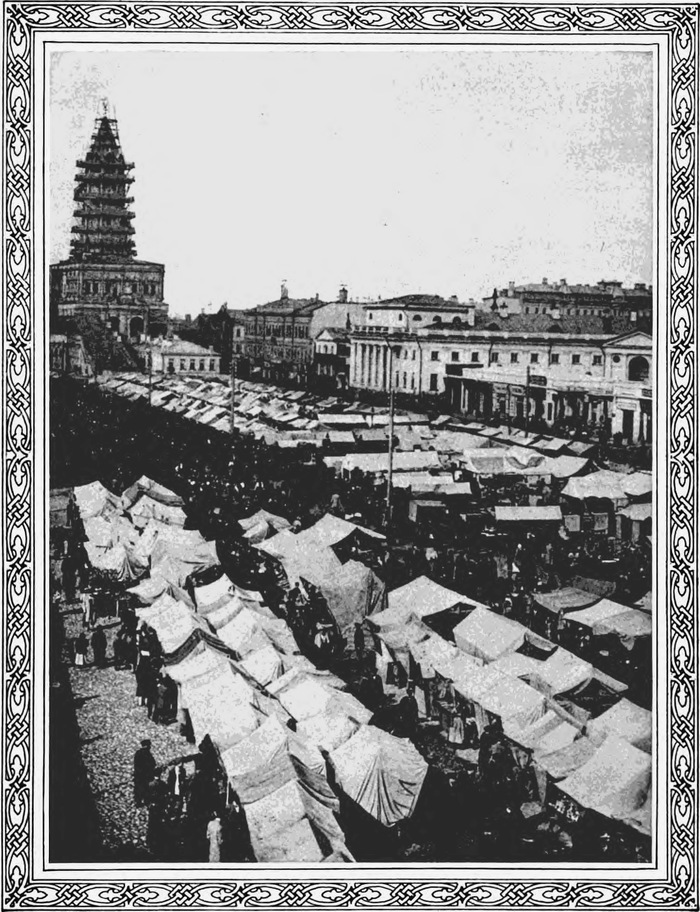
THE GREAT SUNDAY MARKET IN MOSCOW
Russia is a country of tremendous contrasts and contradictions. The new jostles the old. A government and a people emerging from feudal conditions, absolutism, and superstition present a phase of national life somewhat bewildering to the seeker after truth. Ancient rights and privileges exist in close juxtaposition to new liberties and initiative, the former not always in harmony with the latter. It is a land which reaches south to north from the semi-tropics far into the undefined boundaries of the eternally frozen North; and west to east includes populous cities born of yesterday and others dating their beginnings centuries ago; mountain-ranges giving of their long-hidden precious metals under the persuasion of American machinery driven by American engineers, and great stretches of hundreds of miles of plain and shallow valley such as caused the American pioneers to doubt the fact that the earth was round. On this land lives a people as varied in their physique and in their tongue as are the physical characteristics of their habitat. The big, slow-moving Russian peasant, with his ox-like strength and simplicity of character; the Tatar, the Mongol, and the Chinaman each have their place in the foreground as the traveler covers the ten-day journey across the country by rail from west to east. Far to the south the prayer to Allah is cried from the turrets of the Russian mosque with a fervor equal to that of the dweller in the land of the Turks, and over five per cent. of the Russian people are of the Jewish faith.
To harmonize this population, successfully to maintain a centralized government of all these races, so different in character, needs, and actions, is a stupendous task. To see that every part of this great land gets its fair share of all that the Imperial Government has to give; to guard these far-reaching boundaries against continually threatened invasion; to watch with jealous eye the constantly shifting political boundary-lines of contiguous lands, that the people of no part of Russia, west, south, or east may find themselves barred from free access to foreign markets by land or by sea—all this is not the work of an amateur or weakling administration. The Prime Minister of Russia, administrative director of the governmental energies of this great empire, affecting as they do the welfare of nearly two hundred million people, has a responsibility lying upon him and a power in the world for good or evil such as no ruler of to-day or so-called world-conqueror of yesterday even dreamed of falling within his grasp. A wise expediency, a conservative progression, mark such a government, if it is to live. To compromise between the old and the new, the perfect theory and the actual possibility, is the task of rulers so placed, and the world must judge by permanent results in decades rather than in years, such judgment even then tempered by a real knowledge of the conditions to be met.
In this light it is evident that Russia is making progress toward that high destiny which is written across the face of things as they are within her imperial boundaries to-day. The great natural resources of the country are being conserved as well as developed. Method marks the cutting of timber, even with the countless miles of forest yet to draw upon, and forestration is even now a feature of treeless areas. Restrictions upon the acquisition of land are all in the interests of actual settlers. The Russianizing of the whole empire is proceeding with marked rapidity. The surplus population of the West is being moved into the sparsely inhabited East at an amazing rate. Several years ago it was decided to move a million people every year from west to east. In 1907, the first year of this governmental assisted exodus, 800,000 Russians, men, women, and children, entered Siberia with the intention of making it their permanent home. This was found to be more than could be handled and assisted effectually. In 1908 over 400,000 were sent eastward, but the following year and since that date an average of 250,000 have been annually successfully transplanted to the open lands of Siberia, and the movement will continue indefinitely at about that rate.
Every family is allowed about $100 in cash, and for every male in the family is given about forty acres of land. Supplies are sold at long credits, the local banks assist financially in some cases, and it is interesting to note that the American harvesting-machine manufacturers have done a great deal toward opening up the grain areas by selling machinery on long time, taking their pay when the farmer has realized upon his crop. The losses which have accrued to American companies through giving these credits to the farmers have been less than one per cent. annually, a good record for any country and any people.
These American companies have also shown the Russian people that it is not only possible, but more profitable in the end, to do away with any system of commissions, bribery, or “squeeze,” as it is known to the Chinese, in the sale of goods. This was an innovation in Asia, but from the beginning this rule has been adhered to in sales of American machinery, and is now recognized as an admirable peculiarity of American methods. Such losses as have come to American firms doing business in eastern Russia have occurred through the failure or dishonesty of middlemen, or local agents. The Russian peasant or farmer is honest, and will pay if he can. The local agent, or middleman, ostensibly at least of better social business and intellectual status than the farmer, has not proved as scrupulous.
It is in the development and building up of new communities that the so-called zemstvos are proving their usefulness. These organizations may be compared to the boards of county commissioners which exist in the United States, but the powers of the Russian organizations are almost unlimited. They have complete local authority, subject only to the governors of the provinces. They have from fifteen to sixty-two members, representation being based upon population, and are elected by the people. The voters are those who pay taxes on at least $7500 worth of property. In addition to exercising the usual functions of local government, such as taxation, road-building, school supervision, etc., they conduct agricultural credit banks, provide fire and crop insurance, maintain a medical department, give agricultural instruction, and conduct stores much on a coöperative plan.
Some indication of their activities is shown in the one item of agricultural machinery, for about thirty-two per cent. of all the sales made in Siberia in 1908 were made through these government agencies, and the agricultural loan made through the zemstvos banks amount to many millions annually. As far east as Vladivostok the emigrant trains arrive daily, crowded with settlers, laborers, and soldiers. Farther to the west this emigrant movement becomes at times an actual blockade of traffic, and the most notable feature of it all is the amazing number of children ranging from babes in arms to half-grown boys and girls. They are a big, strong people, these Russian peasants, and their children give equal promise of sturdy physique. The men are given work in town and country, and the tremendous task of double-tracking the Trans-Siberian and of building the many feeder-lines now under construction, give employment to many thousands.
It is Russia for the Russians now in the East, and all foreign Chinamen have been given notice to go home. They are being ousted from Russian towns, and no longer outnumber the Russians in the construction work in progress everywhere. Thousands of Russian soldiers line the railroad from Europe to the Sea of Japan, and in northern Manchuria, ostensibly a Chinese possession, fifty thousand Russian troops guard the right of way and the small towns or groups of houses which cluster about every railway station. These soldiers are in reality only the pioneers of the home-builders who are en route.
From the inception of the enterprise the locomotives of the Siberian railroads have burned wood, but the wood-burner is now doomed. The great strata of coal which underlies the extreme eastern part of Siberia is soon to be extensively worked, and with the expiration of the present fuel contracts on the railroads coal will be substituted. Westward from Vladivostok for hundreds of miles there is as yet virtually no human settlement, though the country is as promising, as fertile, and as inviting to the plow as were the millions of acres of the Dakotas prior to their settlement.
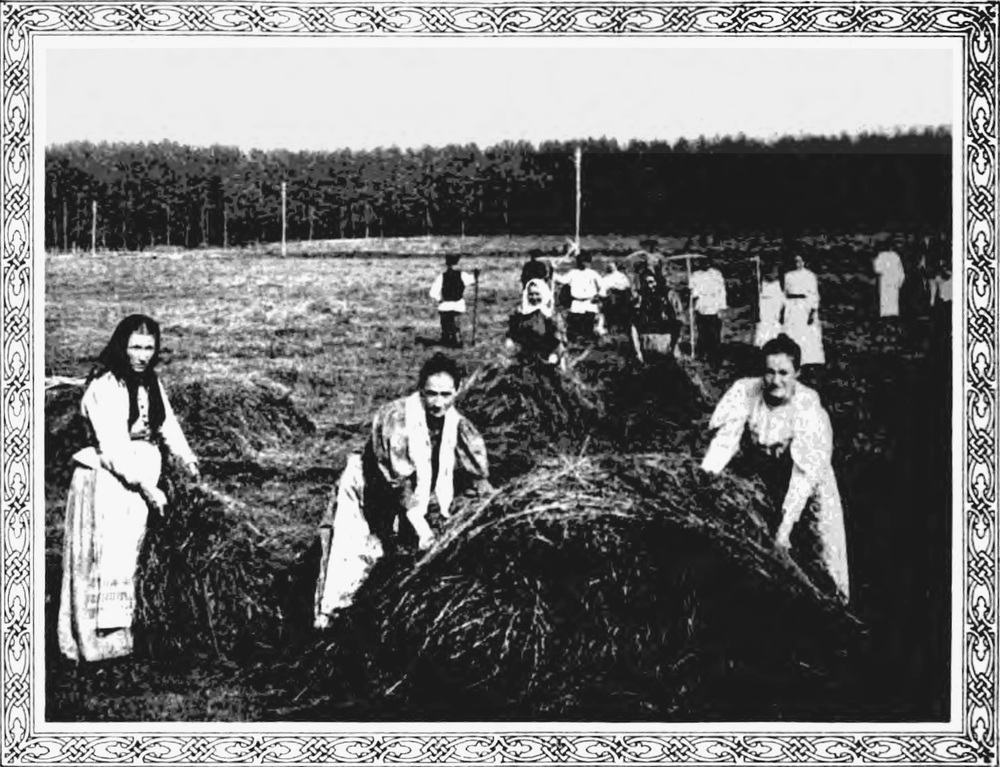
From a photograph, copyright, by Underwood & Underwood
RUSSIAN PEASANTS IN THE HAY-FIELDS
The word “Siberia” has always called to the mind great stretches of bleak or snow-covered landscape, intense cold, and human suffering and privation. It has figured in truth, in art, and in fiction as the scene of heart-breaking cruelties to chained gangs of prisoners, criminals, and exiles. Packs of ravening wolves sought out the lonely traveler, and to be sent to Siberia was to leave the world behind. There is still enough reality in these tales to serve as a foundation of truth in the telling, but this is not the Siberia of the Russian emigrant, farmer, and trader. It is the five thousand miles which lie east and west between latitudes 40° and 60° north toward which his ambitions lead. A new United States lies within these boundaries. The fertile plain, the broad valley, the virgin forest, and the massive mountain-range of this region all lie within the temperate zone. Cold in winter, warm in summer, the seasons regular and normal the year round, this is the Siberia traversed by the Russian Trans-Continental Railroad, and which is destined as time goes on to play a part, constantly increasing in importance and seriousness, in the economics of the world. The productive power of this region is limited only by the degree of development attained, and its absorptive power will be of equally heroic measure. Cities and towns of no inconsiderable size are rapidly appearing at the most central points of the new settlement, and in many ways their life and appearance is reminiscent of the boom days of Western America. Novonikolaesevsk in ten years has achieved a population of over 50,000. Omsk, Petropavlovsk, Irkutsk, Tomsk, Nikolaievsk, Vladivostok, and others are as modern, as bustling, as prosperous, and are growing as rapidly as if they were situated west of the Missouri.
Nearly all of these prosperous towns are built on the banks of magnificent rivers, the names of which in some cases are familiar only to students of geography. These great and numerous streams constitute a system of natural waterways invaluable in the development of the country. In summer they are navigable for steamers of considerable size, and in winter they are highways of travel for vehicles. Their sources lie in the hearts of the great forests to the north, and their quick-flowing currents bear upon them rafts of timber of great size. The inland trade of Siberia has grown in ten years from $30,000,000 to $75,000,000, and in one province alone, that of Akmolinsk, there are held 105 yearly fairs, at which over $50,000,000 worth of merchandise changes hands.
Government revenues increase only gradually, and with great and varied areas to be served in national utilities make progress seemingly slow. In the matter of posts and telegraphs an unusual state exists, for on the operations of this branch of the Government in 1911 a profit of $17,000,000, or fifty-one per cent., was recorded. In 1912 the profit was reduced to thirty-one per cent., showing that the service was extended and improved. It would be better that the entire profit were wiped out through extensions of facilities, for now there is only one post-office for every ten thousand people, and in the Moscow province, with a population of over 4,000,000, there are only eleven sub-post-offices. As shown by an annual decrease in the surplus, it is probable that the Russian post-office budget will in time balance itself or show a deficit, as is the rule in other countries. Labor legislation is coming in Russia much along the same lines that now prevail in Germany.
The status of the Russian laborer is not very different from that of his brother in other European countries. His wages are somewhat lower in many occupations, but in the large industrial centers of European Russia conditions are much the same as elsewhere. Of all the labor-strikes recorded of 1911, twenty-five per cent. were determined favorably to the strikers, and forty per cent. were compromised as between employer and employed. Nearly $500,000,000 is now on deposit in the Russian savings-banks, and if the population of outlying territory, where there are no banks, be deducted, the showing per capita is on all fours with that of many other countries where consideration for the interests of the wage-workers is much older in its application to national affairs. As it is, there are nearly eight million depositors, or more than in any other country excepting the United States, England, or Germany. In 1911 the foreign trade of Russia across the Black Sea and Finnish borders, together with the trade across the eastern boundaries by land and sea, amounted to over $1,400,000,000. During the five years 1901 to 1905 the total foreign trade amounted to about $350,000,000 annually. In the five years 1906-10 the annual average was $980,000,000, and in 1911 it was, as stated, over $1,400,000,000. The following figures illustrate the growth of the foreign commerce account in the last ten years expressed in millions of dollars:
RUSSIAN FOREIGN TRADE
YEAR IMPORTS EXPORTS TOTAL EXCESS OF EXPORTS
1902 275 425 700 150
1904 300 500 800 200
1906 322 514 836 192
1908 390 484 874 94
1910 490 713 1203 223
1911 600 800 1400 200
The exports for 1911 are thirty-two per cent. larger than the average of the five preceding years, and the imports show a gain of thirty-four per cent. The revenue from the customs for 1911, which amounted to $173,000,000, shows a gain of twenty per cent. over the average for the preceding five years. The customs dues of Russia amount to about twenty-nine per cent. of the value of the imports. Nearly half of the export trade of Russia is of grain, the entire export being roughly divided into food-stuffs, sixty-five per cent.; raw material and partly manufactured goods, thirty per cent.; animals, two and one half per cent.; and manufactured goods, two and one half per cent. The export wheat of Russia, amounting to nearly four and a half millions of tons, goes principally to Holland, England, Italy, France, Germany, and Belgium, in the order named. The barley goes to Germany, the oats to Holland and England, the corn to England, and the bran to Germany. The principal manufactures exported are rubber goods, textiles, crockery, glass, and metal goods. The exports of manufactured goods have not increased to a great extent in the last ten years, and probably will not for some time to come, as Russia is developing so rapidly within that the home market absorbs more of everything than can be produced with present facilities. The import trade of Russia for the last six years, expressed in millions of dollars, was as follows:
YEAR FOOD PRO- DUCTS RAW MA- TERIAL AND PARTLY MANUFACT. LIVE STOCK MANUFAC- TURED GOODS TOTAL
1906 55 174 .500 93 322
1907 61 194 .550 106 361
1908 65 212 .762 114 392
1909 60 212 .800 132 405
1910 63 266 1.580 161 492
1911 69 266 1.780 190 527
As compared with the average of the preceding five years, the figures of 1911 show an increase in the imports of food products of fourteen per cent.; in raw material and partly manufactured goods of twenty-six per cent.; in live stock of one hundred and twelve per cent.; and in manufactured goods of fifty-six and a half per cent. The increase in food-stuff importations was due to the increased consumption of fish, this increase amounting to over $26,000,000. Other increases noted consisted largely of fertilizers, building materials, machinery, and the thousand and one manufactured articles long in use in other countries.
The five-year average of manufactured goods imported into Russia annually tells the story of the growing importance of this trade to the manufacturers of the world. From 1897-1901 it was $92,751,000. From 1902-06 (the period of the war with Japan) it was $84,048,000. From 1907-11 it was $140,440,000. The larger part of the export trade of Russia goes to Germany, England, Holland, Austria-Hungary, France, and Italy in the order named, Germany being by far the largest buyer of Russian goods. According to the figures of direct trade, Russia buys nearly all of her supplies from Germany, England, the United States, France, and Austria-Hungary in the order named; but if the indirect trade be taken into consideration, the United States comes second. Even then Germany, with her Russian sales amounting as they did in 1911 to $250,000,000, is by far the most important trader. The position of Germany in Russia in trade, finance, and diplomacy is very strong. To Germany goes more of Russian produce than to any other three countries, and from Germany are purchased at least half of all the imports of the Russian people. Much of this is indirect business, it is true, the Germans acting as brokers for other nations; but a considerable profit on the transaction remains in Germany, and the mere fact of the enormously strong trade relation constitutes a powerful factor in holding the two peoples in close friendship and in giving to all German enterprise in Russia a predominating prestige.
The beginnings of this Russo-German trade date back many years, for geographic and racial reasons, but it has been encouraged at all points by the Germans themselves, or it would not have maintained its phenomenal lead over that of other countries. The effect of this trade is apparent everywhere. German is the most useful language in Russia to those who do not speak Russian. A stroll along any one of the principal business streets of Moscow or St. Petersburg will reveal the names of scores of German firms with large Russian connections, or, in fact, the names of many German firms whose sole business is in Russia. The Germans come, stay, and conquer in foreign trade matters here as elsewhere, because they do not deal through foreign agencies or commission houses, but through their own people on the ground, to sell direct to the consumer. Another point in foreign trading which forces itself upon the attention everywhere is the banking facilities furnished to German traders by German banks or branches of German banks established in foreign cities. The bank and the trader arrive at the same time, and coöperate most successfully in their joint campaign for business. German railroads at home give low through rates on goods to any part of the world; German ships are waiting at the docks to carry the goods; German firms are at the other end of the journey to receive the goods and distribute them; and German banks advance the money to facilitate purchase, shipment, and sale until such time as the money is available from the consumer. Long credits are the rule in Russia, as in many other countries, and financial coöperation is a requisite of successful trading in a majority of cases.
English banks do little or no industrial or commercial business. Years ago there were private banks in England that worked in harmony with the English foreign traders, and it was partly due to the liberality and activity of these banks that the foreign commerce of England gained such headway as it did in far-away places. For one cause or another, these private or trading banks have disappeared in England, and in the financial districts money is now a commodity, as it is in the United States, handled without imagination and with no sympathy or understanding of the needs of foreign business. An English or American bank of to-day is nothing more or less than a glorified pawnbroker, who will cheerfully lend ninety-five per cent. on a gold dollar as security, but will lock his moneybags when a man with orders for goods to be sold on long time in foreign countries comes asking for intelligent coöperation in the production and vending thereof. Able financial experts devote pages of good white paper and pounds of ink in England and America to criticism of the German industrial banking system, but whatever may be its faults at home, it is beyond cavil almost entirely responsible for the tremendous gains made in German and foreign commerce in recent years.
Nowhere is this illustrated more forcibly than in Russia, and here as elsewhere the class of goods sold by the Germans contains larger elements of labor and profit than the foreign trade of most nations. To export raw materials, food-stuffs, steel rails, and other staples at infinitesimal margins of profit when the home markets are slack may bring export figures up into the hundreds of millions, but it does not leave in the country of origin the paid wage-roll or the manufacturing or middleman profit recorded of intricate machinery, novelties, chemicals, and other high-priced products of hand, loom, or other ingenious machines inspired by mechanical and inventive genius.
The United States buys from Russia about seven million dollars’ worth of goods, eighty per cent. of which are included in alcoholic product, glycerin, furs, hides, and skins. Among other important items of Russian export to America are flax, fusil-oil, and wool. In 1911, Russia sent nothing to the island possessions of the United States. There is no branch of manufacturing in which Russia competes seriously with America. Three years ago the Russian steel mills on the Black Sea underbid the American steel mills in the efforts of the latter to secure a large order from the Argentine Government, but since that time the Russian producers have joined the international steel conference, and serious underbidding is no longer feared from that direction. The United States sells to Russia about fifty million dollars’ worth of raw cotton, eleven million dollars in agricultural machinery, five million dollars in leather, three million dollars in general machinery, a million and a half dollars in flour, a million in raw rubber, and the balance of her sales comprise a variety of manufactured products. In this latter classification it is encouraging to note half a million dollars in type-writers, and the same amount in automobiles. Indirect trade in these items adds largely to these figures, but is difficult of exact determination.
A number of great American industries have organized Russian companies and built factories in Moscow and elsewhere. Notable among these is the sewing-machine industry, which employs 4000 people in its Moscow factory, and is said to have 20,000 selling agents in the Russian Empire. The American harvesting-machinery interests manufacture in Russia such implements as fall under import duties in the Russian tariff, and import duty free those which are under the existing treaty of commerce. Should no new treaty be negotiated between Russia and the United States, it is evident that new extensions of the Russian-American factories must result, and importations from the United States must decline.
The result of this serious threat of discrimination against American goods is already felt throughout Russia. Experiments are now being made with German, Belgian, and other competitive machinery in the effort to substitute them for American products, and while the American machines have at present a tremendous lead in public favor, this is no guaranty that other countries will not ultimately derive advantage from the situation. It is true that American inventions may still dominate the Russian market, but the machines themselves will be manufactured in Belgium, Germany, France, or elsewhere to avoid any discrimination that might be imposed upon an American manufactured product. This is not such a difficult result to achieve as might be supposed, for the foundations are already laid, and one great American industry which has recently fallen under the displeasure of the American Government will within a short time be able to supply its entire foreign trade from plants erected in other countries than the United States, and thus restrict the output of American mills to the supplying of the home market.
Nearly one half of the export trade of Russia leaves the port of Riga on the north, but the goods originate in Moscow and other inland cities. St. Petersburg, Libau, and other north-coast points share in the great shipping industry of the Baltic. To the south, Odessa, Batum, and other ports on the Black Sea are the outlets for southern Russia, and serve the near Eastern trade. In the far East, Vladivostok is destined to become an important commercial stronghold, and the entrepôt by sea of Oriental products, serving at the same time as the shipping-point for grain and other food products to Japanese, Chinese, and South Sea communities.
The great causes of trade increase or decrease in Russia are the fullness or poverty of the harvest and the peace or disturbance of political conditions in Europe and the near East. War in Persia, Turkey, or elsewhere in that part of the world has a directly unfavorable effect upon the total of Russian commerce. This is strikingly illustrated in the loss which has come to Russian trade by the closing of the Dardanelles for even a short time. Bad crops mean famine in large areas, and considering the vastness of the territory involved, it is not surprising that hardly a year passes that some part is not demanding relief for a stricken people. This feature of national life is so well recognized as a probable annual occurrence that the Government deals with the same almost as a regular business, and the whole plan of relief has been systematized to the best advantage of all concerned. Business organization is not yet very strong in Russia, but is improving. Chambers of commerce are being formed, and in course of time the shipper of goods to Russia or the seeker after commercial information will find the same conditions there as elsewhere so far as the machinery of trade is concerned.
There is now a strong movement in England for political as well as commercial reasons to take advantage of the present development of Russia. In 1911 there were organized in Russia forty foreign companies for the purpose of doing Russian business. Out of this number, thirty were English, four were French, two Belgian, two German, and not one American. Out of the $40,000,000 capital of these forty companies nearly $35,000,000 were English money. In that same year there were 222 Russian concerns organized to do business in Russia, and one of them was an American harvesting company, with a large manufacturing plant in Moscow. As a nation, England is showing more interest in Russian industrial affairs than any other country except Germany. This interest comes a little late in the day for full advantage to be reaped, but the interest now shown in England is far more general and practical than has shown itself in the United States, with the exception of that manifested by a few powerful American manufacturing concerns that are able financially to perform all the functions of buyer, manufacturer, seller, and banker from their own resources and within their own company organizations.
It is difficult to bring the mind to a full comprehension of the vastness of the Russian Empire and its interests. It is not a scattered domain of far-flung possessions, held at the cost of sleepless vigilancy, and constant treaty-making, but a great, compact possession; and yet while Russian diplomacy is demanding the neutralization of the far-Eastern border state of Mongolia, a quarter of a million men, or more than the entire standing army of Great Britain, are lying under arms five thousand miles distant from Mongolia, but still in Russia, to protect that country’s interests in case the long-deferred but long-expected explosion takes place in the near East.
One nation’s honor or dignity cannot be compromised for the sake of continuing favorable commercial relations with another; but it is a serious matter for one government, at the dictation of whatever interest it may be, or whatever may be the result to be gained at home, to destroy the long-existing friendship and profitable commercial exchanges of two peoples without a full understanding of the consequences of such action. The United States cannot impose its views upon Russia, for the good and sufficient reason that such views do not coincide with the necessities of Russian interior government. The United States has no power to punish her old friend for not agreeing with her; in fact, quite the reverse, hence an impasse. Those upon whom the burden of this action falls diplomatically and financially are now trying to find a basis for honorable compromise. That they will fail, is feared; that they will succeed, is the earnest hope of every understanding friend of the two nations.

NEW ANXIETIES ABOUT VOTING
SHALL IT BE COMPULSORY?
MACAULAY, who did not believe in universal suffrage, had a fine sneer at the folly of supposing that the great policies of a modern nation could be determined by the ballot-box. But this will do to put alongside his famous prediction that “spoliation” of the rich by the poor would begin in the United States in the twentieth century. That century is here and spoliation has not begun, while the ballot-box has gone on, in England as well as in America, from one conquest to another; until now, in either country, it is regarded, if not as the final arbiter of national destinies, at least as the power which sets up one party or administration and puts another down. Yet during the very years when voting by the mass of the citizens has been marching on to political supremacy, there has been coming in a new set of doubts, or anxieties, concerning the whole process. This concern may be only one way of recognizing the sovereignty of the ballot. If it is sovereign, care must be taken that it functions safely. Granted that its decisions are conclusive, the more reason for seeing to it that they are freely and clearly pronounced. If we are to listen for the voice of the people in their votes, nothing must be permitted to obstruct or confuse that utterance.
It was doubtless this feeling that lay behind the movement to reform and simplify the ballot and to guard elections against corruption. That is a long and familiar story. One device after another, one safeguard following another, has been urged and adopted, and each has in its turn done something to purify our electoral methods. It would be impossible for the nation to lurch back now to the loose and hugger-mugger system under which both State and national elections were held fifty or sixty years ago. The “repeater” has been largely eliminated; the way of the venal voter has been made hard; official ballots have replaced the tricky things that party-workers used to “hand out”; corrupt-practice acts and registration laws have weeded out a great deal of the bribery and fraud that were formerly common. Yet despite all these and the other advances, a distinctly new uneasiness about the whole process of voting has recently been making itself manifest. Many thoughtful citizens have been troubled by doubts not whether elections are honest, but whether they can be made fully representative of the popular will; not whether the citizen can freely cast a pure ballot, but whether he cares enough about it to cast any ballot at all.
What disturbs many in this connection is the evidence seeming to show that the number of voters is not increasing as fast as the population. Figures both of registered voters and of actual ballots cast are scrutinized, with the result of appearing to prove a growing disinclination to make full exercise of the right of suffrage. From one Presidential campaign to another during the last dozen years, the total poll has not risen as it should. Some statistics of the vote in Wisconsin were recently published which seemed startling in their implications. That State, though having a marked growth in population, has been casting a vote fewer by many thousands than were polled ten years ago. Partial explanations suggest themselves. Wisconsin elections have been one-sided and foregone conclusions; so that the inducement to make efforts to bring out a full vote has often been lacking. Moreover, the very reforms in the State’s election laws may have had the effect of cutting off what was before a purchasable or fraudulent vote. This was the kind of vote which in the old days Tammany used to ask for money in order to “get out.” One rich man replied to a solicitor of funds that he would not give five thousand dollars to get that vote “out,” but would gladly subscribe ten thousand to keep it “in.” It is possible that the keeping “in” of corrupt votes, by means of reform legislation vigorously enforced, has had something to do with the apparent check in the normal increase of the voters.
After every fair allowance has been made, however, the fact is notorious that many citizens entitled to vote do not go to the polls. The registration figures often fall far below what they should be, and the ballots finally cast and counted reveal a surprisingly large number of indifferents or stay-at-homes. Hence the demand, which seems to be a rising demand, that the citizen be compelled by law to do his duty as an elector, if he will not do it unforced. Compulsory voting has been advocated of late by the Attorney-General of the United States. No one would class Mr. Wickersham among the impetuous faddists. He has studied European practice and precedents in the matter of inflicting penalties upon citizens who fail to exercise the franchise, and favors the adoption of some modified form of such legislation in this country. The argument for it will certainly be greatly reinforced if we are widely to enter upon the experiment of law-making by initiative and referendum. The people are sovereign, but if only a portion of them speak, how are we to know the real voice of authority? There have been elections, some of them passing on statutes referred to the electorate, some on important constitutional changes, in which the votes of only a majority of a minority were effective. If that should become common, the case for compulsory voting would obviously be stronger. Objections to it at present lie mainly against details. It is urged, for example, that no compulsion should be laid upon the voter to choose between two candidates neither of whom could he conscientiously support. But in that event he could cast a blank or a “scratched” ballot. He is within his right in refusing to express a preference between two equally offensive nominees; but it may be held that he has no right to remain away from the polls. Mr. Chesterton has argued that all who fail to vote should be “counted in the negative,” but that is to put a premium upon sloth. An active negative by ballot is much more significant than mere abstention. We know too well what “apathy” means in elections; but we should be much better off if, instead of their apathy at home, we had all our citizens expressing their honest zeal or their burning indignation at the polls.
The whole subject is not yet ripe for positive remedies embodied in law, but the deep interest taken in it is both suggestive and encouraging. It helps one to believe that the democratic experiment will continue to keep level with its problems as they successively present themselves. Whatever the exact method of reform that may be adopted, it must not omit to tie up intelligence with duty. Voting, whether it should be made compulsory or not, cannot safely be severed from education. The two must always go together, as they did in Emerson’s vision of the ideal commonwealth, where, before
Each honest man shall have his vote, Each child shall have his school.
THE CHILDREN’S UNCENSORED READING
WITH A PRACTICAL SUGGESTION
THE old saying that “Books make the best presents” must be in the minds of many in the pre-Christmas season, and many a parent is puzzling over the problem of selection. The classics of their childhood they know—some of these the classics of three generations; in fact, ever since children began to be considered as worth writing for. But here is the year’s new “bumper” crop of books, in fine array of type and picture and gay cover—what is to be done with them? Who is to sift and choose between the good and the bad? And all that are not good must be considered bad, for nothing is so bad as a poor book. May the publishers’ imprint be implicitly relied upon? May the authors’ reputation, name, or vogue be blindly accepted? May the reviewers’ judgment be made the standard? Obviously it is impossible, if only for economic reasons, to buy and sample, not to say read, a tithe of the books presented for choice. Either parents must renounce the responsibility, restrict the range to a few volumes, or get some efficient aid from others.
We venture a suggestion. This issue of THE CENTURY will appear just a month before Christmas. In nearly every town of 2500 inhabitants there is a literary club or a woman’s club which through a committee of its members might set on foot an advisory censorship of children’s reading, which another year would become more effective. To be helpful, it should start with a standard of what are the desiderata in books for the young. Negatively, one must aim to exclude immoral, priggish, namby-pamby, artificial, cynical, and unsympathetic writing. To these must be added the seventh deadly sin of dullness.
No profit grows where is no pleasure ta’en,
and unless a book is interesting, it would better never have been conceived. On the positive side the aim should be wholesomeness, vitality, inspiration, humanness, and, most of all, an appeal to the imagination. A child needs not so much books of knowledge of the “how” type, which satisfy craving for facts, as those that set forth the wonders of the world so suggestively as to stimulate his search for the “why.” Those of two generations ago who were steeped in copy-book morality know what an effort it was to displace it with the natural religion of human sympathy. And it is because, in the reading and training of boys, there is danger of neglecting the robust—what we may call the wholesomely perilous—that it is important that every such committee as we have suggested should have the counsel of men. When its list shall have been made, the committee should be subjected to cross-examination, in order that the principles of selection should become fixed not only in the minds of its members, but in those of the entire club. Whatever the result might be upon children, it would be salutary upon parents, arousing them to the importance, and to the qualities, of mental pure food. It is not to be expected that the committee’s recommendations would be impeccable or that they would always be followed. Indeed, the same experiment might be tried with more advantage in a circle of a dozen families of friends related by a similarity of tastes and standards.
Even more in need of supervision is the periodical pabulum. There are two or three American magazines for children the tone and traditions of which are so firmly established and so well known as to place them beyond the need of censorship. Their editors are alive to the exclusion of the objectionable, but are chiefly occupied with the search for valuable and delightful articles. The editorship of a child’s magazine, by reason of its many limitations, is one of the most difficult tasks in the educational world. The bearing of every article, poem, and picture has to be considered in its formative influence upon character. The editor has to think for the child, the parent, and the teacher, and at the same time he must never lose sight of the noble function of delight, which it is his privilege to exercise. We know of one such, to whom, through his rare sympathy with children, these responsibilities have become insight. Joyous himself, he knows how to communicate joy to a world of children.
When it comes to the juvenile page of the newspaper, the need of censorship is acute. Some of the daily journals, which are properly proud of their own ethical standards and of the influence of their editorial columns, have no moral compunction in leaving to a syndicate the preparation of the children’s page or the colored supplements. Otherwise careful and conscientious parents will turn over to their children, without examination, sheets of vulgar, grotesque, badly drawn, and badly colored pictures on unworthy themes, the chief influence of which is to glorify sheer mischief and bad manners. Many protests have been made against these by public associations and in some quarters there has been improvement, but the censorship of thoughtful and mature minds would still find much to condemn.
In what is selected for the children let us make a plea for the best poetry. A world is all before us where to choose, and if the interpretation of masterpieces of verse be not pedagogic, but sympathetic, the resources of pleasure thus available are rich and enduring. The parsing and analysis of Pope’s “Essay on Man” may so spoil one’s taste for that writer as to obscure the sublimity of his “Universal Prayer.” America more than any other country cultivates, and needs to cultivate, the love of poetry. Here we are confronted with materialism as a daily spectacle.
Things are in the saddle, And ride mankind.
We need every stimulus to the imagination, every spur to spirituality, every rhythm of harmony. We need not only music itself but the music that is in poetry. The arts are, so to speak, fighting for their lives, and a brave fight it is. We need them to uplift and crown and glorify democracy, and we shall produce greater poetry as there is a deeper love and appreciation of the great poetry that exists. It is, therefore, no small service to the future of America to instil in our young people a respect and love for poetry. We find these suggestive lines in the autobiography of Charles Darwin:
If I had to live my life again, I would have made a rule to read some poetry and listen to some music at least once every week; for perhaps the parts of my brain now atrophied would thus have been kept active through use. The loss of these tastes is a loss of happiness, and may possibly be injurious to the intellect, and more probably to the moral character, by enfeebling the emotional part of our nature.
A CHRISTMAS THOUGHT ON WAR AND ARBITRATION
THE year 1912, by its manifestations of internal violence, its external wars, and by its hardly less disquieting rumors of wars, has afforded from time to time the pretext for much cynical satire at the expense of the advocates of peace and arbitration. A strange sort of beginning of the millennium this, it is said, which has witnessed Italy’s year-long war with Turkey; the old Balkan wounds reopened, with the religious issue involved; China aflame with bloody revolt against her Manchu dynasty; Mexico in the throes of a rebellion little less than civil war; turbulent Cuba barely escaping American intervention, actually exercised in Nicaragua; Morocco the bone of contention of two snarling powers; and withal Great Britain and Germany like open powder-magazines exposed to the peril of a careless smoker—a year, moreover, that has seen strikes of unusual acerbity in England and in Massachusetts, and the unearthing of such vast conspiracies against life and property as the one executed by the McNamaras and their associates and the other avowed by the Industrial Workers of the World. The threat of the latter to raze the Salem jail is matched by the intention of McNamara, recently revealed, to blow up the Panama Canal. As a climax of horror comes the attempt of a disordered mind to assassinate Colonel Roosevelt. Surely, at first glance one might think that the wild beast in man has lately come to the surface to a surprising and disheartening extent.
It would be futile to claim that this sinister impression is entirely offset by the fact that some of these events have aspects of self-restraint and progress; that China, through her overturn, is making the way toward freedom and self-government; that Cuba has again shown that she is learning the same lessons; that the responsible conservative forces of England, France, and Germany have refused to follow the hotheads who talk lightly of war. There remain in human nature, modern or barbarian, primal impulses of hatred, violence, and lawlessness.
It is one of the most important functions of education, government, and religion to subdue these impulses, and this can be done, in part, by turning their force into new channels. Through Tesla’s discovery and invention the natural turbulence of the mountain stream, even that of Niagara itself, is electrically utilized to do the work of the world at a great distance. It is the aim of the inventive resources of philanthropy to do something similar with the wild and waste forces of humanity itself. Wise benevolence is increasingly occupied with imposing not only upon others, but upon ourselves, restraints without which we should revert to the brute. Sometimes this is done by solemn formalities like the Constitution of the United States; sometimes the compact is the tacit one of civilization involved in the establishment and observance of law. This it is now sought to extend to nations, by the agreement to enlarge the limits of judicial arbitration which already exist in every modern country, and thus through men and peoples of advanced ideas of justice to affect those more backward. Because of this great opportunity to uplift the world, those in authority are under obligation—a sort of noblesse oblige—to hold their own country to its highest standards of conduct, internal or international.
Whatever the croakers may say, there is no relapse from the sentiment in favor of arbitration and peace. There have been righteous rebellions, and probably there will be others, but there are many wars based on territorial aggression or trivial or fancied wrongs which may be prevented by an appeal to an international court. Compulsory this appeal must be, by our consent in the cool air of wisdom: but along with humanity at large we shall be the gainer. Arbitration is a shorter cut to justice than war has ever been.
At this time of the recurrence of the festival of the Prince of Peace, it is becoming to the Christian world to renew its faith in the power of love to cast out hatred, of good-will to accomplish the uplifting of humanity through sympathy and opportunity. Such a vast work demands the ultimate release of the forces now held in readiness for international wars. Prevent by arbitration the causes of such wars, and you divert colossal waste forces—including the constant anxieties of the people—to the real and crying need of the times.
GIVING AWAY THE NATION’S PROPERTY
THE NEEDLESS INVASION OF THE YOSEMITE NATIONAL PARK
ON the twenty-fifth of November there is to be a hearing before the Secretary of the Interior to receive and consider the report of a board of army engineers to determine whether or not there is any other adequate source of water-supply for San Francisco than the beautiful Hetch-Hetchy Valley, which the city desires to submerge for a reservoir. This valley, as our readers know, is a part of the great Yosemite National Park, and lies eighteen miles north of the Yosemite Valley, just over the divide, so to speak. The representatives of the city have already acknowledged before the Public Lands Committee of the Senate that they could find an adequate supply of pure water “anywhere along the Sierra,” to the north of the valley—“if,” as they said, “we would pay for it!” The mainspring of the assault upon the people’s National Park—and, if it shall succeed, it will be but the first of many similar assaults on other parks—is the desire to get something for nothing. The public interest in resisting the attempt is to save from destruction one of the most wonderful of the Sierra gorges, which a good wagon road would make an integral part of the Yosemite trip. It remains to be seen whether any amount of speciousness, any elaborate and misleading volume of argument will be able to obscure the main issue—the wanton invasion of the people’s greatest park.
We believe that the Roosevelt administration had no more legal or moral right to divert a part of this National Park from the purposes for which it was created, as was done by the Garfield grant, than it would have had to give away the nation’s coal-fields in Alaska. The Sierra Club, contending with the unlimited financial resources of San Francisco, has yet presented a “brief” which riddles the arguments of the city’s case.
That fable teaches that the time to save the rest of our great scenery is before it is largely visited, for then it will become to the advantage of some “interest” to divert it from the use of posterity.
EDITORIAL NOTE: CONTRIBUTIONS DESIRED
THE Editor of THE CENTURY invites the offer of contributions to the departments of “Open Letters” and “Lighter Vein.”
In “Open Letters” the aim should be a light and lively treatment of social, political, domestic, artistic, or other topics in an easy, natural, epistolary style, having the give-and-take of correspondence, and witty or humorous treatment, mellow, without didacticism; articles should have a novel and piquant motive; and, in order to save them from dilettantism, they should have useful and substantial suggestions. A convenient length is fifteen hundred words.
For the “Lighter Vein” Department contributions are invited of brief narratives from real life, of a humorous character, and of such entertaining interest as will entitle them to rank as good “after-dinner stories.” What is desired is not so much a short anecdote as a narrative of about a thousand words, having a certain natural plot. It is desired to avoid stock stories which, told in past generations, are located in the present. While in general the stories should be humorous, once in a while that quality might be varied by something unusually dramatic, quaint, or curious. The Editor must be assured that the articles have not before been in print.
All contributions found available will be paid for at the magazine’s customary rates.

ON MAGIC CASEMENTS
... “Magic casements, opening on the foam Of perilous seas, in faery-lands forlorn.” —KEATS, “Ode to a Nightingale.”
From a Seeker after the Ideal House, Recommending the Latest Thing in Windows
Margaret Dear:
Enjoy our new home? Indeed I do, as much as you enjoy “Parva sed Apta.” Yet I confess to a little restlessness at times, such as Browning’s Juan in “Fifine” felt over his “honest civic house.” I want to cut away, and to wander foot-loose and free. And if it weren’t for the magic casement—don’t you want to hear about the magic casement?
The architect’s assistant proposed it, a young fellow with irregular eyebrows and a nice smile. You would like him. We had been talking windows, and he asked me all of a sudden:
“Since you like the type, sha’n’t I put a magic casement in your study? We sometimes find it a very acceptable little addition in suburban building.”
I gasped, and seized on a familiar phrase. “Will it add materially to the cost?” I inquired.
“No, not materially,” he answered. “And it would harmonize capitally with the study.”
For many a day after we moved I forgot all about the conversation and the casement. You know what it is to get settled. The dining-room flue wouldn’t draw, and our invaluable but expansive Maggie grumbled because she had to turn sidewise to get up the narrow back stairs, and to arrange family and furniture absorbed my energies. But a day came finally when I shut myself in the study for a bout of work. A set of examination blue-books had come in from my college classes, and my mood was grim. I learned that the “Shepheard’s Calendar” consisted of twelve pastoral decalogues, and that Ariel’s song was intended to “guide Hamlet to his shipwrecked father,” or, as another student suggested, “to lead Minerva on.” Most of the papers were equally stupid and less funny. My muscles were aching, for the furniture had been heavy. As for my heart, here I was starting life afresh and receiving felicitations in a pretty new house, but life seemed over. Well, dear, never mind that; but you will understand. You know what narrow house guarded by two tall cypresses is always before my eyes.
Suddenly I noticed the casement. I never had tried the patent spring.
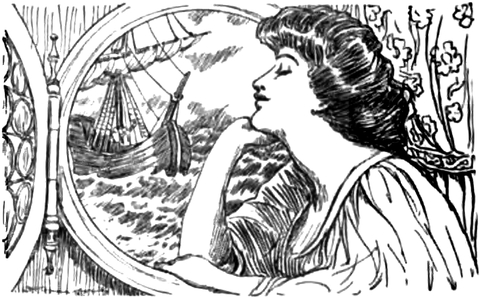
It opened at a touch. I had expected to look out on Mr. Baker’s hen-yard; but I didn’t. There was instead a wide stretch of tumbling seas—splendid, perilous seas, gray and fierce, with glints of silver at the horizon, and great waves racing inland and breaking in sheets of foam below! As I leaned out and drew deep breaths of salty, foamy air, I saw a dim sweep of coast through the spray.
The moving waters at their priest-like task Of pure ablution
were plain enough; but were those “human shores” or the forlorn coasts of faery-land?
“Please, Miss, the butcher,” called Maggie’s voice behind me, and I shut the window and ran down-stairs as though I had never heard of tired muscles or heart. When I got back to blue-books, it was amazing how brilliantly the students were writing.
When I next opened the casement the sea was moony-calm, and a nightingale was singing outside in balm-laden air. Mr. Baker’s hen-yard, viewed from the next window, never varied, but let me tell you that out of a magic casement one does not see the same sight twice. I did not let myself open it often. When I was leaning from it I forgot the passage of time, and you can’t imagine how “jobs” crowded last winter. But if, while I worked, I left a crack ajar, and this grew to be rather a habit, the air that came in kept me fresh and fit, so that I have never carried my work so easily.
One day—inside, I remember, it was bleak winter twilight—there was an island rising from the sea. The tremulous waters were tinged with the first promise of dawn. A planet on the horizon glowed red. Though the heavens elsewhere were clear, the summit of the mountain isle was veiled in drifting mists, like tears; yet behind the mists the sun seemed to be shining on level reaches of springlike verdure, which caught the longing of the heart, yet stilled all longing with an exceeding peace. As the dawn brightened, I could discern two figures on the low sands at the base of the hill, and presently, speeding across the waters faster than flight of bird, appeared a spark, glowing as though the planet had left the sky. Faint shining grew at sides and center, till I could see the vesture and the two wings, serving as sails, of an angel whose face was as the morning star. If you had only been there! Of the blessed folk who filled the ship, some looked affrighted, some exceeding glad; and though I could not clearly hear the chant they sang, one voice sweet above the rest, I knew it to be a song of deliverance. Do you remember our Dante readings under the pines? All that day there was absolution in the air.
But there was none on that other day when sky and sea blazed blue fire, thunder-caps lay pearled in the west, and a high-pooped ship dropped anchor beneath my window. Sea-weary serving-folk in medieval garb, went ashore by ones and twos, while a knight in green array and a most fair lady lay talking on the deck. Now and again he touched a harp, with skill, I thought, seeking languidly to please her; but she looked on him in distaste. Then a page brought them liquid from a crystal flask of curious fashioning, and the two drank thirstily, for it was hot. Then they gazed startled on each other with changed eyes. The thunder-caps rolled up, and I heard them speak in troubled, riddling words of “aimer” and “la mer,” and I shut the window lest I prove indiscreet. Besides, the air was stifling.
It was not always sea that greeted me. You can imagine the pleasure of opening in harsh March weather on the cool depths of a summer forest, where the angel face of a sleeping girl in white nun’s habit made a sunshine in the shade! My worries rolled away as I watched joyous wood-folk—fauns, satyrs, and fair hamadryads—caper and dance through the forest, and saw them, awestruck at her sweet holiness, bend their knees before her, grinning gently, and crown her with garlands. In that same wood, when the moon was risen, I saw star-crossed lovers misled by faery pranks, and the queen of faery herself beguiled. But the next evening my window gave on a blasted, treeless heath, where weird women lay in wait for two doomed soldiers.
One of the best things I got from the window was a glimpse of Utopia. Several of us had spent the day trying to organize relief in a mill town where a three-cornered strike was going on, and the regular unions, the employers, and the I. W. W. were involved in a hideous wrangle-tangle. It was worse than any of our old settlement experiences. I came back sick at heart and touched the casement spring, afraid that I couldn’t see out for the smart in my eyes. But there lay Utopia before me. Yes, dear, Utopia.
Did it? I dared not be sure. Past the rear gardens of the pleasant houses a clear river ran sweetly, just as Sir Thomas More had said, and through the wide street passed comely, alert citizens, full of grave, friendly cheer. But might there not be slums and strikers round the corner? The power of faith was blurred in me that night.
Just then a man who carried a kit of carpenters’ tools, whistling as he walked, looked up and waved his cap. It was young Stanton of our economics department. He was always tinkering at his house, but it looked odd to see him carry a kit on the public way.
“Good morning. Isn’t Utopia the greatest ever?” he cried. “My lectures are over; I’m off to help with those new houses around the bend.”
“Is this real Utopia?” I asked eagerly.
He nodded.
“I perceive, however, that the inhabitants have not changed their nature,” he laughed. “You have your old skeptical mind.”
“If it’s Utopia,” I retorted, “why in the name of common sense are you still lecturing on economics?”
“The wonder is how I lectured on it in the old days,” he replied. “I was like a professor of harmony, with nothing to expound but discords. Now we have a symphonic whole to study and even fuller harmonies to evolve. The department is the largest in the college.”
“Have pity on my skeptical mind,” I pleaded. “Give me a sign that Utopia is here.”
He motioned to the passing people.
“Why, look!” he said.
And I was satisfied: for never could there have been that serenity of eye had one factory been left exploiting the labor of children, one sweat-shop, or one malcontent. Yet even while I watched, a woman, dressed in black, passed, sobbing bitterly. Tears? In Utopia?
“We are still on the earth, you know,” said Stanton, gently; “we are not exempt from tears.”
NOT long after I met the architect’s assistant. I had been worrying somewhat. I was troubled about the price of the magic casement, even though he had said that it would not add materially to the cost of the house. He caught the same train as I to town by a flying jump at the last minute. He was scurrying by, but I pulled his coat and made him sit down.
“I hope the house is satisfactory?” he asked.
“Very, on the whole,” I replied. “The door-panels warp, but no house is perfect. I want to ask you about the price of the magic casement. It was not included in the specifications, and I am anxious to settle for it.”
He wriggled, looking annoyed.
“If you like it, you ought not to haggle about the price,” he said.
“I shall not haggle,” I replied with spirit; “but if the window is as expensive as I fear, perhaps you wouldn’t mind being paid on the instalment plan.”
“If I had not supposed you perfectly solvent, I should never have put that casement in,” he returned.
“You had strict instructions to avoid all luxuries,” I said with indignation, for I was frightened. “You knew that I was living on a salary and that I had to mortgage in order to build. However, I am not complaining. I am willing to pay heavily for the casement, for it certainly is a shipshape affair.”
“That’s better talk,” said the assistant. “Now, as a matter of fact, you’ve paid already. The contract for magic casements is to the effect that the article is paid for by use. It runs, ‘For so much value received in vision, equivalent price in use, thus and so.’ I knew you could pay cash for that window.”
To pay by using! Now, Margaret, did you ever hear of anything like that! “How uncommon,” I protested. “How absurd!”
“Nobody would suppose that you had a look into Utopia lately,” he sighed.
“We’re not in Utopia,” I argued.
“Are you so sure?” he asked; and looking at him, I found I wasn’t.
“People are dull,” he complained ruefully. “Of course they are in Utopia the minute they believe themselves there.” As he talked, I was noticing that ruffled hair of his and those queer, triangular, merry eyebrows.
“Does your firm approve your way of doing business?” I asked.
“They have nothing to do with magic casements. Those are a little specialty of my own which I put in now and then for a suitable client like yourself.”
“Who are you, anyway?” I cried; and with a flourish he handed me a card engraved in the latest style. Mr. Robert Goodfellow was the name it bore. The wind from the train window blew the hair from his ears.
“Robin!” I shouted.
“At your service,” he laughed. “You see, I adapt myself to the times. There’s no use playing helter-skelter pranks on systematic Americans. They get their cream by a separator, so they never put out bowls of milk for me; the chores are done by machinery; and if I prowl about the kitchen by night, I get nervous prostration for fear some one will turn on the electricity. So I went in for scientific efficiency, and studied for the professions. I have lots of fun. But you people who live in steam heat are so afraid of drafts that hardly anybody will let me put in a magic casement. I was really grateful to you for giving me the chance. Hello! Here we are at Back Bay! Good-by!”
There’s my story. Now, may I not send Robin to give you a magic casement in “Parva sed Apta”? I am sure he would not mind the journey. But I suspect you may have one already; Robin and you were always on good terms.
Lovingly yours, Vida D. Scudder.


AN AFTER-DINNER STORY
BY BADDELEY BOARDMAN
A REMINISCENCE OF MARION CRAWFORD
MANY visitors to Rome will remember the German book-store on the Piazza di Spagna, kept by Herr S——, of whom a story is told which throws a backward light upon the apparently troublesome activities, as a boy, of a distinguished American novelist. Herr S——, who had been established in Rome as a bookseller almost a lifetime, once met in his store another elderly gentleman, who said:
“Isn’t it fine, Mr. S——, about Frank Crawford?”
“Fine about Frank Crawford? Vot you mean?”
“Why, about his book—a great success. Haven’t you heard? Haven’t you read it?”
“Read his pook? No. Frank Crawford ride a pook? Imbossible!”
“Oh, yes; no doubt of it. Giuseppe,”—calling a salesman,—“let me have a copy of ‘Mr. Isaacs,’ please.”
When the volume was brought to the incredulous bookseller, he held it at arm’s-length, looking at it curiously as he turned it from side to side and from end to end; then he cautiously examined the title-page, with its “—th edition,” which he greeted with a guttural “Huh!” Next he turned to the last page, and read the concluding sentence with another grunt of astonishment. Then he dipped into the volume in two or three places, and finally, satisfied that he was not being deceived, handed back the book to Giuseppe without looking at him, and said:
“Vell, vell! dot brooves dot you must neffer trown a poy.”
THOUGHTS, DECEMBER TWENTY-FOURTH
BY DEEMS TAYLOR
’TIS Christmas eve. The very air Seems charged to-night, seems subtly thrilled By glad previsions of a rare, Strange happiness, yet unfulfilled. I sense this thing, and still my heart Is numb, lethargic, dead. I hold Myself from all the world apart. The Christmas spirit leaves me cold. Below me, in the frosty street, I hear the city’s muffled song Of carnival—the tramp of feet, The voices of the passing throng. I watch them as they hurry by In kind confusion, faces bright With Christmas comradeship; but I— I am not one of them to-night. Each hastens, in that host below, To choose the gifts that shall delight Another on the morrow. No, I am not one of them to-night. The laughing crowd, the siren call Of blazing shops that beckon; nay, Untouched, unmoved, I hear it all: I did my shopping yesterday!
EMMY JANE’S CHRISTMAS
BY JULIA B. TENNEY
MAWNIN’, Miss Johnson. Is yer out doin’ yer Chris’mas shoppin’? You sure is de forehandestest pusson I eber did see. Here ’t is five whole days ’fore Chris’mas, an’ you ’most frough gettin’ ready.
What’s we goin’ ter do? Why, jes as usu’l, an’ dat’s good ’nough fer we. You see, we spends Chris’mas day sorter foragin’ roun’ ’mongst de white folks, an’ c’llectin’ things tergether, an’ ketchin’ ’em Chris’mas gif’; den de nex’ day we all has our Chris’mas.
What? We ain’t got it on de right date? What’s dat got to do wid de ’joyment ob it, I’d like to know? An’, anyhow, no one doan’ know fer sure what is de right date nohow, ’ca’se dere ain’t no one erlivin’ now what was erlive when Chris’mas started in on us, an’ if dere was, I wouldn’ b’lieve him nohow, ’ca’se he’d be too ole ter trus’ his mem’ry. So one day’s as good as anudder, an’ maybe better. Dis here way suits me, an’ it saves er lot ob trouble an’ hard wuk, not ter speak ob de money.
Dis is de way we wuks it, an’ ’scusin’ de walkin’ roun’ an’ totin de load home, it ain’t no trouble ’t all.
We ’vides de city up into pahts. I takes de av’nues, ’Lindy teks de lengthways streets, li’le Polly Ann an’ John Andrew de cross streets, an’ Jeemes William—my ole man—de gen’lemen’s clubs. We all has our own way ob doin’ it, but we all gits de things.
Jeemes William he jes stan’s near de do’ ob de club-houses wid his hat in his han’, an’ as de gen’men goes in, he says ter all ob de sassy-lookin’ ones, “Chris’mas gif’, Gen’al,” an’ p’ints ter de army-button what he foun’ in de White Lot, an’ what he puts in his buttonhole on dese ’casions. Den as de South’rn gen’men goes in, he hol’s dat li’le ’Federate flag ober de button an’ says, “Chris’mas gif’, Massa.” An’ I’ve knowed him ter come home wid as much as twelve dollars in his pocket jes f’om his good manners; dey is so skase nowerdays, wid all dis passle ob young niggers growin’ up roun’ here, dat de white folks is willin’ ter pay high fer ’em when dey do come ’cross ’em.
’Lindy she puts on dat black alpacky frock of hern an’ er white collar an’ a starched white ap’on, an’ she takes de rich-lookin’ houses an’ rings de bells, an’ asks kin she hope out wid de extra wuk jes fur er tas’e oh de Chris’mas-time, an’ dat fetches some one ’fore she’s made more ’n five or six tries, an’ den she jes lays herse’f out ter please de white folks, an’ ebery endurin’ one ob dem gibs her sumpen ’nudder what dey doan’ want an’ what somebody else done gib dem, an as ’Lindy mos’ in gen’al picks out de big famblies, dere ain’t no mean showin’ f’om her.
Polly Ann an’ John Andrew dey sings “I’s er-rovin’ li’le darky all de way f’om Alabam’” an’ some yudder sech chunes un’er de winders, an’ folks t’rows dem pennies an’ nickels, an’ lots ob ’em gibs ’em cakes an’ or’nges an’ candy an’ de like er dat.
Me? How do I git my share? Now yer’ll laugh! Jeemes William say’, “No one wouldn’t thunk er sech er thing ’cep’in’ you, Emmy Jane,” but I ain’t nuss nine li’le white chillun, ’sides thirteen ob my own piccaninnies, countin’ de halves an’ de dade ones, an’ not learn nothin’ ter hope me ’long in dis world.
I jes puts on er clean purple caliker frock an’ er stiff white ap’on wid er white handkuchief roun’ my neck, an’ I ties er colored handkuchief ober my h’ad ter make our kind er white folks ’member de days when we all uster be jes like one fambly, an’ laugh an’ cry togeder, an’ dat’s how come it dat I done foun’ out so many ob de quality.
What I do ’sides dress up like ole times? Well, all de endurin’ year I saves up all de putty fedders f’om de tu’keys an’ chickens an’ geese an’ sech, an’ I gets me er ball ob red cord fer five cents, an’ I ties de fedders up in li’le bunches an’ puts ’em in er basket.
Chris’mas I teks dat basket on my arm, an I s’lec’s de houses where dey is babies, an’ dere is plenty ob ’em on de av’nues, too, ’spite ob Mr. Roosterfelt er-sayin’ rich chillun is fallin’ off in comin’ ter our big cities. He oughter hab my job one year an’ see fer hisse’f.
Well, I rings de bell an’ asks kin I gib de baby er Chris’mas gif’, an’ ’most ebery fambly say “Yes,” an’ brings de baby out, an’ acts pleased-like. Den I hol’s out my arms to de li’le chile an’ says, “Come ter Mammy, Honey!” an’ most in gen’al dey jumps right to me, an’ dat settles de mas an’ pas.
Den I s’lec’s er bunch ob fedders an’ gibs dem to de baby. All chillun, white or black, loves ter play wid fedders. Reckon it’s ’ca’se dey ain’t so long lef’ dem off in de wing-country what dey come f’om, an’ I tell you dat basket is er heap sight heavier on de home trip dan on de goin’ out.
Next day we all brings out our pickin’s an’ we builds er fire in de bes’ room, an’ den’s our Chris’mas.
Doan’ we give no presen’s? Co’se we does. We s’lec’s all de things what we doan’ want, same as de white folks does, an’ we makes er pile ob ’em, den we makes a lis’ ob de names ob de people what we wants ter gib to,—’Lindy she does dat paht, ’ca’se she’s had schoolin’ an’ kin write grand,—den we blin’fol’s li’le John Andrew, an’ ’Lindy she calls out er name, an’ John Andrew grabs er gif’. Dat’s how come you ter git er pair of gallusses, an’ Daddy Bundy er long gingham ap’on las’ year.
I hopes de givin’ dis year will turn ter tu’key an’ cramberry, jes fer de sake ob ole times down home. I sure does get lonesome fer de ole place roun’ ’bout Chris’mas.
INCUBATOR CHICKENS
BY RUTH McENERY STUART
INCUBATOR CHICKENS
DEM inkybator chickens dat’s hatched by de clock Wid a lamp for love, is lonesome stock; Dey feeds in droves but dey envies de others Dat scratches for grubs wid any ol’ mothers. An’ dey ain’t by deyselves, po’ orphans, in dat— No, dey ain’t by deyselves in dat!
THE CAULIFLOWER
When de cabbage got ambitiom, in a uppish hour, He lost ’is head an’ bu’st into flower Wid ’is brains outside, an’ addled, at dat— Den he sot ’isself up for a ’ristocrat. An’ he ain’t by ’isself in dat, in dat— An’ he ain’t by ’isself in dat!