HENRI BERGSON
Reading edition
PRONOUNCED “THE FOREMOST THINKER OF FRANCE”
HIS PERSONALITY, HIS PHILOSOPHY, AND HIS INFLUENCE[1]
BY ALVAN F. SANBORN
IF the generation now coming to the front in France is healthy and vigorous physically, mentally, and morally, and proud of its health and vigor, if it is confident, expectant, full of energy and will, impatient for action and fit to act, if it dares to be happy, if it will have none of the pessimism of Schopenhauer or of the nihilism of Renan; if it is, in a word, a generation of young young men, whereas the generation that preceded it was a generation of old young men, melancholy, morbid, dilettante, neurasthenic, and proud of its melancholia, morbidness, dilettantism, and neurasthenia,—and such is generally admitted to be the case,—certainly not the least of the numerous and varied influences that have combined to bring about this radical transformation is the inspiriting message of Henri Bergson.
In the early years of the twelfth century, at the base of the Tower of Clovis, on the summit of the Montagne Ste.-Geneviève in Paris, a scholar in the habit of a monk, Pierre Abélard, proclaimed under the open sky “the rights of the earth, the right of the reason to reason” in discourses which Michelet characterizes as “the veritable point of departure of the first Renaissance for France and for Europe.” The élite of the then civilized world—two popes, twenty cardinals, fifty bishops, “all the orders,” Romans, Germans, Englishmen, Italians, Spaniards, Flemings—flocked thither to listen to the great innovator. He was silenced by the dogmatists of the period, but he left behind him an idea which “became more and more the fixed idea of the Renaissance, namely, ‘wisdom is not wisdom if it confines itself to logic, if it does not add thereto erudition, all human knowledge.’”
Five hundred years later, on this same Montagne Ste.-Geneviève, René Descartes demolished scholasticism and founded modern psychology. Persecuted by the Sorbonne, as was nearly every other expounder of new doctrines at that time, he nevertheless created a veritable furor among the bluestockings of the magnificent court of Louis XIV. His “vortexes” and “fluted matter,” his “three elements” and his “innate metaphysical ideas,” were the small talk of the précieuses; snobbishness for the most part, of course, but it is one of the redeeming features of snobbishness that it sometimes bestows its plaudits and its patronage upon genuine merit.
At the present time the philosopher Henri Bergson is assailing, in his turn, another scholasticism—the scholasticism of science. At the Collège de France, the consummation and the coronation of the various schools of the Montagne Ste.-Geneviève, he is creating a flutter in the dove-cotes of bluestockingdom such as no pure philosopher has created there since the time of Descartes. Indeed, Bergson has become so fashionable that soon, as some one facetiously observed regarding Francis of Assisi after the appearance of Sabatier’s fascinating biography of that saint, “they will be wearing him upon bonnets,” another instance of snobbishness adoring actual achievement.
The biggest amphitheater the Collège de France can provide is quite too small for M. Bergson’s would-be auditors. Long before the lecture-hour, the seats and the steps of the aisles, which can be made to serve as seats, are preëmpted by patient waiters of both sexes, of varying ages, sorts, conditions, and all nationalities. The standing-room fills up rapidly also, while about the doors are enacted scenes vaguely reminiscent of those that occur daily at the City Hall terminal of the Brooklyn Bridge during the rush hours, in which the gentle, but not always mannerly, sex does rather more than its share of pushing, tugging, elbowing, and treading upon toes, in virtue, no doubt, of its superior zeal for knowledge.
When the lecture begins, the sitters, and such of the standers as are lucky enough to have their arms free, scribble furiously in their note-books, the hapless strugglers at the doors and in the vestibule crane their necks in a futile attempt to catch a glimpse of the platform through the rifts in the monstrous feminine headgear now in fashion, and all alike, those who neither see, hear, nor comprehend, as well as those who do, promptly take on the rapt, superior expression of initiates—the expression that used to characterize the audiences at “Pelléas and Mélisande” when Debussyism was in its infancy.
The lecturer is short of stature, spare, an almost perfect ascetic type, somewhat, gray and slightly bald. He has slender hands, tapering fingers, a weasel-shaped head, heavy eyebrows, a close-cropped mustache grayer than the hair, and “liquid and profound eyes that suggest mysterious molten metals in the stars.” He is correctly, even fastidiously, but not foppishly, dressed. He speaks slowly and distinctly, but easily, with engaging indifference to his notes and without any effort at oratory, his nearest approaches to gestures being abruptly arrested semispasmodic workings of the hands, periodical inclinations of the head, and an occasional deepening and darkening of the eyes. It is as though sheer intellect, abstract intellect, were endowed with the power of speech. There is not the slightest trace in M. Bergson’s manner of the overweening vanity that too often mars the public appearances of world celebrities, nor is there a scrap of the unlovely pedantry and arid officialism against the prevalence of which at the Sorbonne a considerable portion of cultivated France recently rose in revolt. On the contrary, he is constantly referred to in university circles as “the lark,” partly perhaps because he offers a certain physical resemblance to that ungarish creature; but mainly because there is a touch of lyricism in all his utterances, even his most trenchant analyses. He presents his views progressively and with a modest tentativeness which makes his auditors feel that they are assisting at the birth of a system rather than listening to the exposition of a perfected one. They seem to see the lecturer suffer and create, as the symbolical pelican of ecclesiastical tradition pierces her flank for the wherewithal to feed her young. Indeed, the regular attendants follow the stages of the creative process as eagerly and impatiently as though they were the instalments of an absorbing novel.
How far Henri Bergson’s extraordinary vogue is due to the substance and how far to the form of his thought is not easy to determine, since either alone amply suffices to account for it. His philosophy is a rehabilitation, to employ untechnical language, of God and the soul. It is a reconciliation “in a harmony felt by the heart of terms irreconcilable, perhaps, by the intellect,” of science and metaphysics with religion, of knowledge with life, of law with conduct, of liberty with authority, of the ideals of the Occident with the ideals of the Orient, of the present with the past and with the future. According to M. Bergson, the universe, which is incessant mobility, perpetual, continuous flux, is acquiring a constantly swelling volume of free creative activity, and the inner life of each and every person in the universe is absolutely original. “Life is really creation. It is not a fabrication determined by the idea of an end to be realized; it is an impetus, an initiative, an effort to make matter produce something which it would not produce of itself.” We know reality by living it. We may act freely, and in so acting we experience creation.
M. Bergson’s philosophy is a vindication of intuition, the faculty upon which the poets, the Shelleys and the Keatses, the Villons and the Verlaines, have always depended for their knowledge of themselves, of the universe, and of their relations to the universe. We who are not poets are the deluded victims, says M. Bergson in effect, of our reasoning faculty, which is constantly playing hob with us. We should submit to the authority of intuition, for to do a thing without reason, even against reason, may in certain cases be to act from the best of reasons. This does not mean that reason should be despised or discarded, as some of the philosopher’s overzealous followers are prone to proclaim,—even the great poet must resort to it in expressing the conceptions his intuition gives him,—but rather that reason is a highly useful subordinate of intuition, bearing much the same relation thereto that the housemaid bears to the housewife, the mason or carpenter to the architect, the private soldier to the strategist. In short, M. Bergson’s attitude toward reason is essentially that of the immortal seers. It recalls Pascal’s “The heart has its reasons which reason knoweth not,” Joubert’s “It is easy to know God if you do not attempt to define Him,” Emerson’s “With consistency a great soul has simply nothing to do,” and Browning’s “Others may reason and welcome, ’t is we musicians know.”
Our William James pronounced every page of Henri Bergson to be “like the breath of morning and the song of birds.” M. Bergson’s style, though delightfully free from affectation, is not so simple and direct as these comparisons imply. They suggest admirably its freshness, melodiousness, graciousness, and grace, but they fail to suggest the exquisite subtlety which is its most distinctive trait. They may be given a fair approach to adequacy, however, by substituting for “the morning,” a morning of luminous haze such as Corot loved to paint, and for “the song of birds,” the cuckoo’s “wandering voice.” As soft, tenuous, filmy, fluid as mist or wreathing smoke, it is as precise, not to say geometrical, in design as the spider’s gossamer web, and is equally iridescent. The critic who characterized it as Arachnean, therefore, was most happily inspired, though his purpose in doing so was, if I remember right, to hold it up to derision. No living writer, not even Maurice Maeterlinck, surpasses Henri Bergson in evoking, in projecting, in visualizing, so to speak, those subconscious activities of the soul which are commonly esteemed unanalyzable and, great poetry, possibly, apart, unutterable. He “forces language to express things for which language was not intended.” With impalpable pigments and ghostly brushes he paints upon imaginary canvases veritable landscapes of the soul. We do not go to pure philosophers for esthetic sensations,—no one ever frequented Kant, for instance, for his style,—and in general we enjoy or do not enjoy them according as they do or do not succeed in convincing us. Henri Bergson is a striking exception to this rule. We read Bergson, as we read Plato, out of sheer infatuation with his verbal artistry, and we should continue to read him ecstatically if he should undertake to prove that the moon was made of green cheese.
Such as he is in the lecture-room, such as he is in his books, unassuming, unpedantic, gracious, well-poised, subtle, tactful, alert, resourceful, stimulating, such Henri Bergson is in his every-day existence. In his case, and to an unusual degree, the style is the man. An easy talker, ever ready to speak freely upon all subjects,—his personal affairs, work, and politics excepted,—he nevertheless goes little into society, not because he dislikes social functions, but because he cannot contrive to make the necessary leisure. He resides about midway between the Seine and the Bois de Boulogne, in an umbrageous and incredibly tranquil corner of the Auteuil quarter, where he is well nigh as secure from the hustle and bustle of Paris as he would be in a provincial village; and he spends his summers in Switzerland at St.-Cergue, almost ten miles from the nearest railway station, in a modest two-story villa, surrounded by meadows and evergreen woods, the front windows and veranda of which afford ravishing views of Lake Geneva and Mont Blanc. Winter and summer alike, six in the morning finds him installed at his desk, and from that moment until he retires for the night he allows himself virtually no respite save that which is afforded by an occasional varying of occupations.
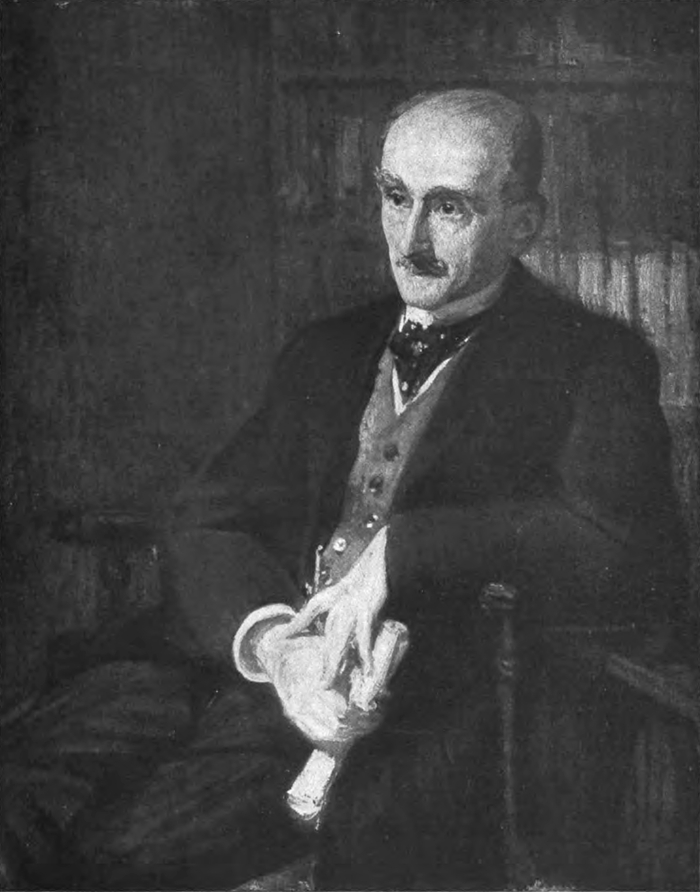
Half-tone plate engraved by H. Davidson
HENRI BERGSON
FROM THE PORTRAIT BY JACQUES BLANCHE
Though so little of a Parisian in the sense in which the word is currently employed, M. Bergson is one of the relatively few famous Frenchmen who possess a clear title to that distinction. He was born in Paris on the eighteenth of October, 1859. From nine to eighteen he attended as a day student the Lycée Condorcet (then Lycée Bonaparte), in the Opéra quarter, an institution founded in 1803 under the consulship of the First Napoleon, which numbers among its illustrious alumni Dumas fils, De Banville, the Goncourts, Eugène Sue, and Hippolyte Taine. Less precocious than Pascal, who at sixteen wrote a treatise on conic sections that excited the admiration of Descartes, and who is said to have rediscovered at twelve the first propositions of Euclid, young Bergson was nevertheless sufficiently advanced at eighteen to produce in the concours général of the Paris lycées a mathematical solution which was accorded the unusual honor of being published in full in the “Annales Mathématiques,” and which, if I mistake not, exempted him from the obligation of military service. From the Lycée Condorcet he went to the Ecole Normale Supérieure, matriculating in the section of letters, which he had chosen over the section of sciences after not a little hesitation and misgiving, for he was at that time an ardent disciple of Herbert Spencer and dreamed of perfecting Spencerianism. While at the Ecole Normale he came under the joint influence of Félix Ravaisson, harmonizer of the Greek spirituality of the intelligence and the Christian spirituality of the will and of the heart, and Emile Boutroux, author of a memorable assault upon the then dominant determinism entitled “De la contingence des lois de la nature,” and now President of the Institut de France, who speedily freed him from his Spencerian obsession and turned him in the direction he has since followed. Obliged, after his graduation from the Ecole Normale to submit, like the majority of its graduates, to a period of banishment from Paris, he taught philosophy for two years at the Lycée of Angers, in the province of Anjou, and for five years at the Lycée of Clermont-Ferrand, in the province of Auvergne. During his stay at Clermont, he delivered a number of lectures in the university of that city, and wrote the work “L’essai sur les données immédiates de la conscience,” which revealed him as an original thinker and as a redoubtable antagonist of determinism. At Clermont he also mapped out his life-work (studies, researches, and publications), calculating carefully the time to be allotted to each subject, and thus far he has not only succeeded in executing his program to the letter, but he has been able to permit himself such interludes as a course of lectures on Plotinus, his essay on laughter, a lecturing sojourn at Oxford, and the projected visit to the United States.
His “stage” in the provinces over, he taught first in the Collège Rollin and then in the Lycée Henri IV, located upon the very spot where Abélard held his open-air classes. While connected with the latter institution, he published “Matière et mémoire,” and it is thanks, no doubt, to the sensation this work created in the university world that he was called in 1897 to an assistant professorship in the Ecole Normale, and, in 1900, to his present professorship at the Collège de France.
Teaching, for Henri Bergson, is not a makeshift, but a veritable sacrament. His former pupils are virtually unanimous in testifying to his conscientiousness and zeal, as well as to his magnetic qualities as a teacher. Not a few of them, become teachers in their turn, call upon him often for counsel and guidance, which he invariably bestows gladly, however preoccupied and harassed by his formidable undertakings he may be at the time. And this is not the least of the reasons why a goodly proportion of the younger professors of philosophy in the French lycées and collèges of France proclaim themselves Bergsonians. Furthermore, the young men who have attended his classes or his lectures or who have come under the less direct, but only a shade less potent, spell of his writings, seem to be possessed with a passion for “living things”—for “doing things,” we would say in America—as distinguished from analyzing things.
Bergson has been hailed as “the inaugurator of a new era in philosophy,” “the foremost thinker of France,” “the most original and significant figure in the philosophical field of Europe,” “the sole philosopher of the first rank France has had since Descartes and Europe since Kant,” “the restorer of psychology,” “the modern Heraclitus,” “the Darwin or the Newton of philosophy,” “the Wells of philosophy, adventurous inventor of a new machine for exploring the world.” And his system has been characterized as “a new principle for the integral renovation of philosophy,” “the matrix of all future systems,” “the ruin of Marxism,” “the annihilation of materialism.”
Whether all of these appraisals be just or none of them be just, whether Bergsonism be sound or unsound, enduring or ephemeral, time, the supreme winnower, will of course determine. In the meanwhile it is perfectly safe to affirm that Bergson is a peculiarly fine and rich personality, an admirable example of the consecrated scholar, a consummate literary artist, a genuine prose poet, a keen psychologist, an observer of life, and one of the most suggestive and stimulating of contemporaneous thinkers; and this, even though his philosophy may ultimately share the fate of the greatest of its predecessors, is enough to make the glory of one man.
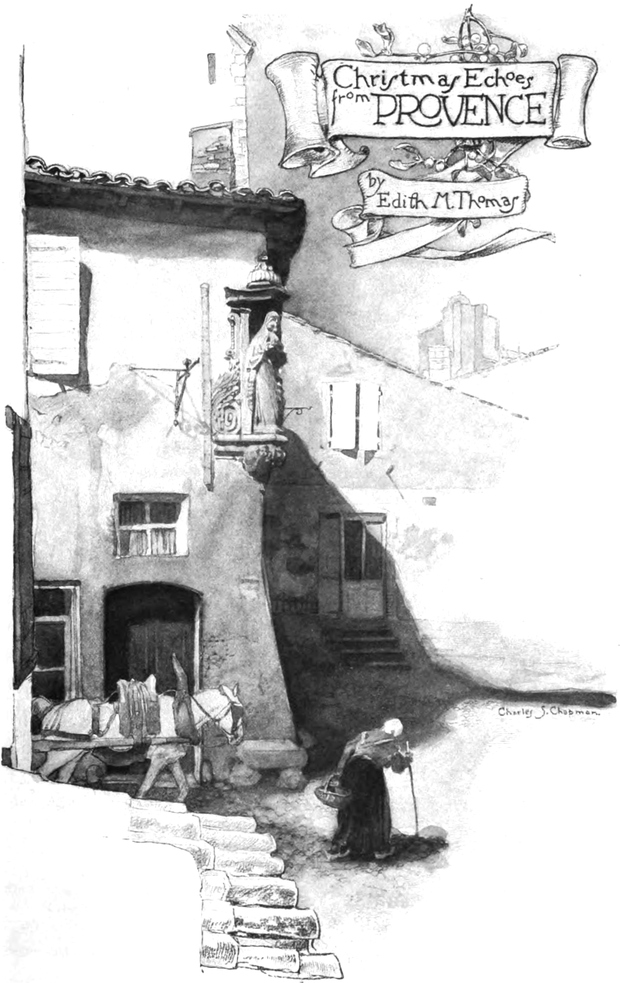
⇒ LARGER IMAGE
The Almond Branch
(Cache-Fiò)
I
“Come answer me this, petite, petite— A riddle for you to guess, my sweet: What is the tree that in winter’s gloom Breaks in an hour into bloom, into bloom? Here’s silver for her who tells” (Hark to the nougat bells!)[2]
II
“Mon vieux, mon vieux, that’s no riddle for me ’Tis a branch of the little almond tree The poor man brings from the orchard-plot; A branch for a yule-log—is all he has got, While his children sing noëls” (Hark to the nougat bells!)
III
“But it snaps in the fire and the whole branch glows— Breaks into blossoms of white and rose! His wife and his children laugh to see Those blossoms of fire from the almond tree— And the smoke how sweet it smells!” (Hark to the nougat bells!)
Edith M. Thomas
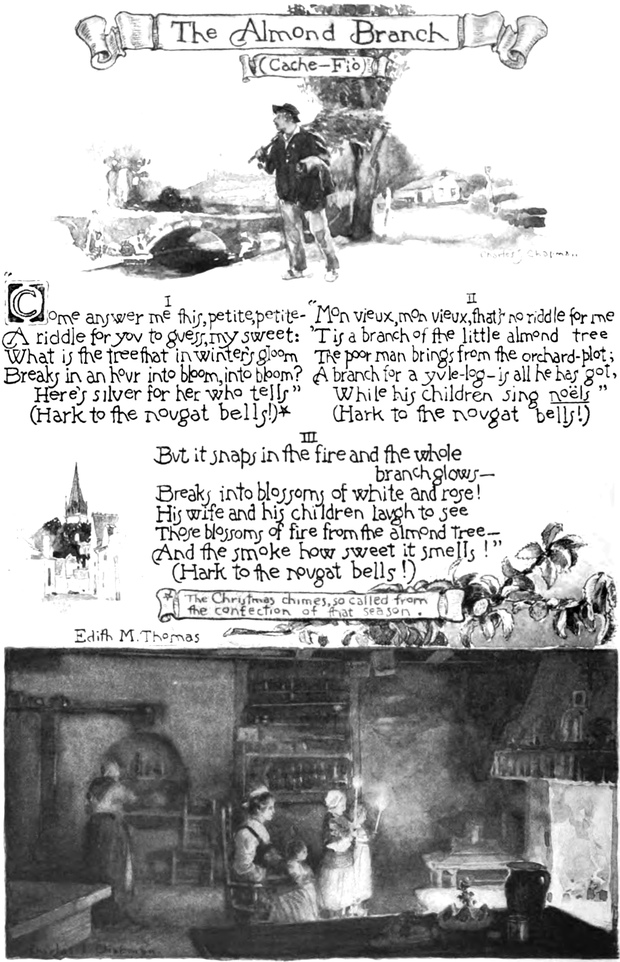
Original page
⇒ LARGER IMAGE
Saboly
Seventeenth Century—
Saboly is dead, Is dead in Avignon! He made the organ sing As it had been a choir Of angels of the Lord Cleaving and brightening The roof of dark St. Pierre! The sound was of great glory, It trembled all around And quivered through our hearts. Saboly is dead, The maker of noëls That all the people loved, Saboly is dead— And Yule is here again; The great log on the hearth, The crèche with all its lights, The children gathering there; The Kings are on the road— The twilight road that leads From out the purple East The road from St. Remys!... How shall we sing his songs Who sang so well of these! Folk say, when death was near He set his hand to write For us a new noël. (So many a one before He wrote with pen of gold!) When he to Heaven came I wis was silence then. While Mary Mother bent And raised him to his place, The sweetness on his lips Of that last, best noël! But we—how can we sing The songs he made for us, Though Yule is here again! For Saboly is dead, Is dead in Avignon.
Edith M. Thomas
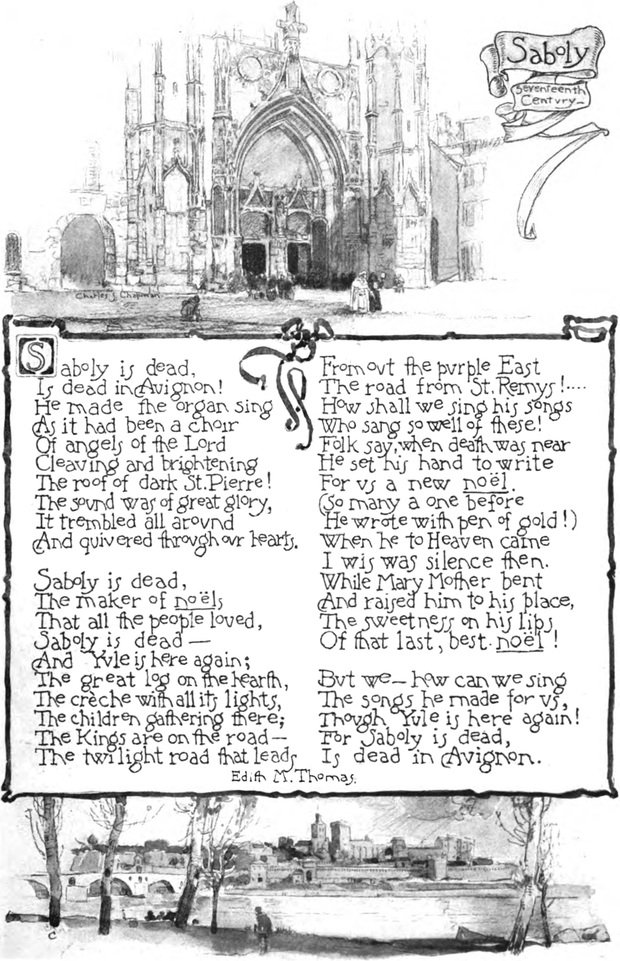
Original page
⇒ LARGER IMAGE
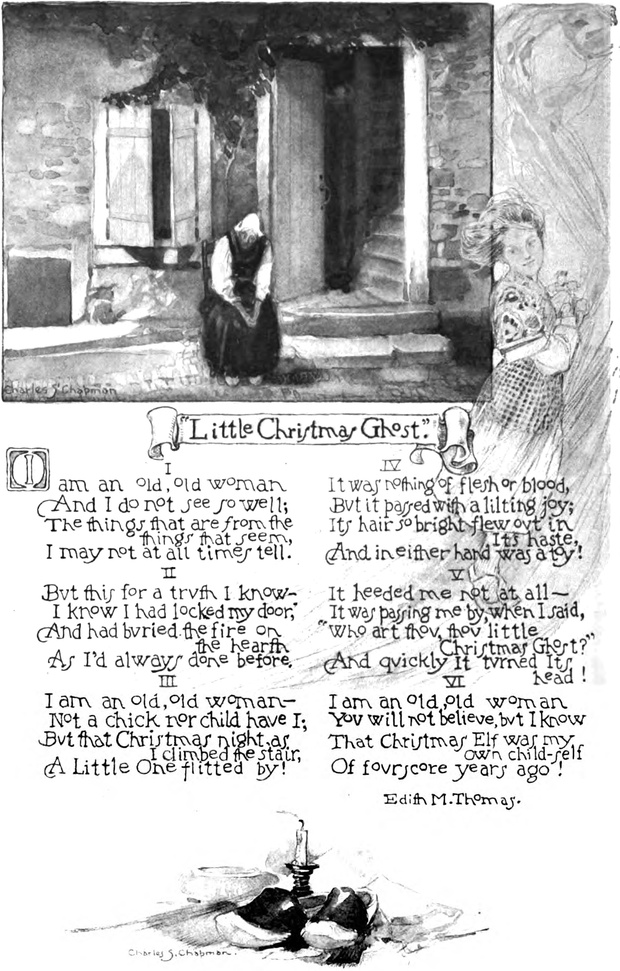
“Little Christmas Ghost.”
I
I am an old, old woman And I do not see so well; The things that are from the things that seem, I may not at all times tell.
II
But this for a truth I know— I know I had locked my door; And had buried the fire on the hearth As I’d always done before.
III
I am an old, old woman— Not a chick nor child have I; But that Christmas night, as I climbed the stair, A Little One flitted by!
IV
It was nothing of flesh or blood, But it passed with a lilting joy; Its hair so bright flew out in Its haste, And in either hand was a toy!
V
It heeded me not at all— It was passing me by, when I said, “Who art thou, thou little Christmas Ghost?” And quickly it turned Its head!
VI
I am an old, old woman You will not believe, but I know That Christmas Elf was my own child-self Of fourscore years ago!
Edith M. Thomas
Original page
⇒ LARGER IMAGE
BY VIRGINIA YEAMAN REMNITZ]
Drawn by Joseph Clement Coll
LIZETTE AMBOISE sat beside the window making lace. The lovely line of her profile caught the light; the clear white of cap and kerchief enriched the olive of her skin. Seen thus from within the room, she was so beautiful that the old eyes of Pierre’s mother brightened as they looked at her.
Pierre himself was working in the woolen mills at Lisieux. Soon after he went his house had caught fire, and Lizette, rushing through the flames, had led his mother out to safety. Since then the old woman had remembered only in flashes.
So there she sat in Lizette’s cottage, her eyes brightening as they rested on the girl. But all at once they clouded; she had remembered.
“If it was as it used to be,” she broke out in a quavering voice, “you might be restored for Pierre’s coming home.”
At the words Lizette turned, and the old woman began to cry.
“For him to come back at Christmas,” she wailed, “to see that!”
The girl looked quickly away. The rich olive of her cheek had faded to a dead pallor; her hands lay idle in her lap. “For him to come back to see that!” She used to rejoice in Pierre’s love of beauty. He was different from the other young men of the village, who cared more for a woman’s strength than for her face, and who looked always at the earth they tilled and never at the sky. Pierre could be keen and shrewd as any other Norman peasant; but Lizette knew his dreams, his delight in beauty, the thoughts he hid from his neighbors.
Once Lizette had said to him:
“Perhaps I can serve you as well making my lace as though I were strong to work in the fields.”
And Pierre, his dark eyes glowing, had answered:
“It is not your service I want, my Lizette. I want only to have you near me, to be able to look into your face.”
The words had pleased her when he spoke them; now they stabbed her to the heart. And so did these lines of the letter Pierre had written after he heard from the curé about the burning of his house, and how Lizette had saved his mother: “My beautiful, brave Lizette! How shall I wait to see you! Your face is always before me.”
“Mère Bernay,”—Lizette had turned again to the old woman,—“listen to me, Mère Bernay. What did you mean when you said I could be restored for Pierre’s return if it was as it used to be?”
“By a miracle of Little Noël. You would make the nine-days’ prayer before Christmas mass. Many are the cures were made so at our church in the old days. But that was long ago; they are made no more.”
The miracles of Little Noël! Lizette had heard of them ever since she was a child, but they had seemed merely a tradition. Suppose—her eyes widened and she drew her breath in quickly.
If the miracles had ceased, it must be because the faith of the people had died. Had not the curé often bewailed the worldliness of the times, the love of pleasure that had replaced piety? If she had faith, if she prayed with her whole heart, it might be that a miracle of Little Noël would be wrought even now for her!
Drawn by W. T. Benda.
Half-tone plate engraved by C. W. Chadwick
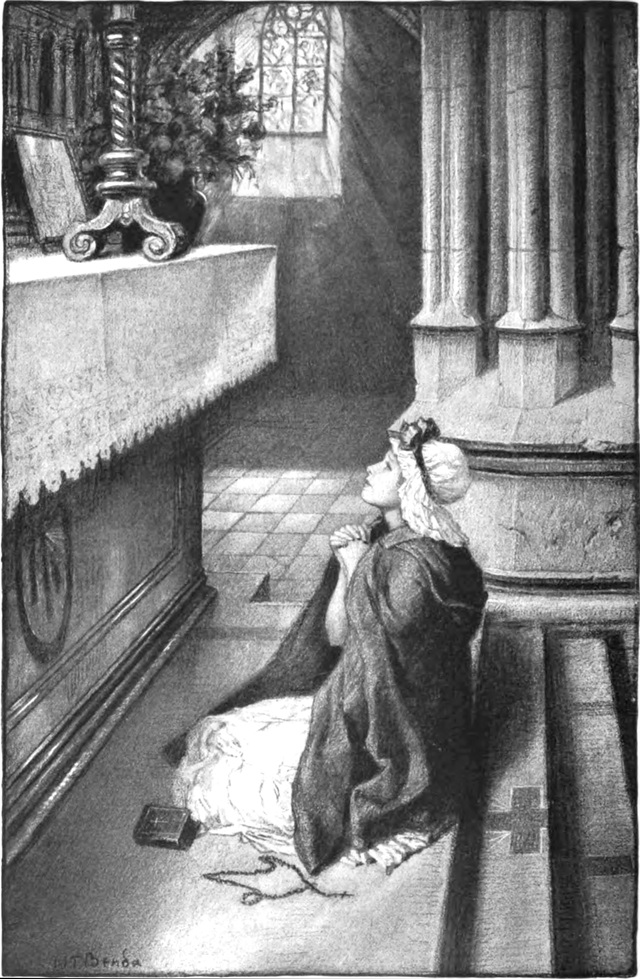
“THE STARRY EYES, UPRAISED, OVERFLOWED WITH TEARS; THE LIPS QUIVERED IN THEIR SUPPLICATIONS: ‘GRANT TO ME FAITH, THAT A MIRACLE OF LITTLE NOËL MAY BE WROUGHT UPON ME’”
⇒ LARGER IMAGE
It was only two weeks before Christmas. Soon she could begin the nine days of special fasting and prayer; and there was time before that for preparation. Lizette rose, took down her long cloak, bent over Pierre’s mother, kissed her withered cheeks, and then went out into the golden light of the sunset.
She pulled the hood of her cloak far over her face, and walked rapidly. She saw no one until Mère Fouchard came to her door, calling shrilly to the little Henri. Mère Fouchard stopped shrilling when she saw Lizette.
“How the girl keeps the hood over her face!” she said to herself. And then, “Does she think she can hide it thus from Pierre Bernay when he comes back!”
She called a greeting, hoping Lizette would turn; but she was disappointed. The girl answered without looking around.
The church was in the middle of the wood in which the village was built. In Normandy these little villages try to hide themselves among the trees; but the gleam of their white-walled cottages betrays them.
When Lizette reached the church, twilight was gathering, and the branches of the trees wove delicate traceries against a sky of pale amethyst and rose. The old stone church, with its square tower, made a picture amid that setting which Lizette was quick to note. Pierre had taught her to see such things.
But she noted also, and with a sorrow she had never felt before, the dilapidated condition of the church. In the days when the miracles of Little Noël made the village famous, it had been different. Then, as Lizette knew, not a crumbling bit of mortar had gone untended or a candlestick unpolished. And the women of the village had woven finest cloth for the altars, and bordered them with lace of their own making. Lizette resolved that she would begin such an altar-cloth on the morrow.
Now she pushed the door open and looked shrinkingly about. There was only stillness and peace within, and the Virgin with the Child in her arms. It seemed she was waiting for Lizette. With a little sob, swept by a wave of emotion that laid bare all her heart, the girl went forward and fell on her knees, throwing back the hood from her head.
Her face was now revealed, as though for the pitiful eyes of the Virgin to see. On one side it was the beautiful face Pierre Bernay hungered for day and night: on the other it was furrowed across by the crimson scars the fire had made.
The starry eyes, upraised, overflowed with tears; the lips quivered in their supplications: “Grant to me faith, that a miracle of Little Noël may be wrought upon me! Have pity upon me and restore me for Pierre’s return!”
How often she had pictured that return—the leap of her lover’s eyes to her face, their horrified turning away; for she had begged the curé to write no hint of her disfigurement. She would have no pretense, she who had throbbed and glowed under the long caress of Pierre’s gaze. If he could not bear to look upon her, she must know it. It would be better than finding out little by little. If it should be as she feared, she would go away. She had a cousin who worked on a farm in the rich country to the east. Perhaps she could find the place; it did not much matter.
Suddenly Lizette realized that these thoughts were intruding themselves upon her devotions; that fear and foreboding were driving out the faith she longed for. She began to pray again, and little by little her heart grew still within her. It was as though a light broke softly and grew; there was no room left for fear.
In the church, meantime, the dusk had been gathering. Lizette, when she rose to her feet, could just see the face of the Child. It was in honor of his birthday the cures had been made; for the sake of the little Jesus, who had come to heal the sicknesses and sorrows of all the world.
For some minutes Lizette stood there. Then she remembered the Mère Bernay, sitting all alone, with the fire dying on the hearth; and she hurried away. But the crushing weight was gone from her heart. She walked with light steps, and looked up at the stars, which were beginning to come out in the sky.
Every day now Lizette prayed in the church, but no one who saw her pass guessed at what was in her heart. It may be, however, that Pierre’s mother knew; she knew many things that no one ever told her. Sometimes when Lizette came in with that light on her face the old woman would look at her with eyes which seemed to understand.
When the time came for her to make the nine-days’ prayer, Lizette went to her devotions both morning and evening, and so absorbed was she that the fire often died on the hearth, and Pierre’s mother shivered as she sat beside it. But it was on the last day of her waiting that the girl knelt longest in the little church. When she came again it would be for the midnight mass; she hardly dared to think further than that. The old fear seemed to be hovering near, threatening to seize her. She sought shelter from it in her prayers: she even tried to forget a certain resolve she had made, lest it argue lack of faith. This resolve was that Pierre’s eyes should be the first to rest upon her after the midnight mass. She would neither look in her glass nor touch her face with her fingers. His eyes, and his alone, should tell her whether the miracle had been performed.
Pierre had written again, saying that he would come early on Christmas morning. In a few hours he would be on his way, walking from Lisieux to a little inn where he slept. But long before dawn he would start again, and be with her soon after the sun was up. She was glad that Mère Bernay lay in bed until late. She wished to watch for Pierre alone.
That evening she told the old woman that they would eat the réveillon before mass. “You would be too weary if you waited for my return,” she said; but the true reason lay in her resolve that Pierre should be the first to see her face after the midnight mass.
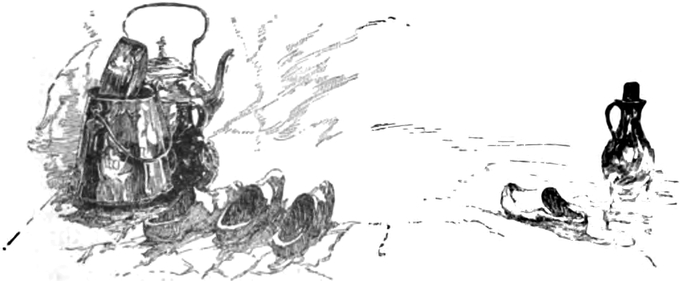
The réveillon may be spread either before or after that mass. Lizette brought out the roasted chestnuts soaked in wine and the little cakes. Her heart was suddenly light and gay. She made Mère Bernay put her shoes on the hearth, ready for gifts; then Lizette put one of her own beside them, and next to that she put the other of the pair for her lover.
The gifts were in readiness; the cottage wore a festive air. Branches of laurel and pine were fastened over the fireplace, and the vessels of copper and brass twinkled in the light of the yule log. Père Fouchard had brought the log in that morning. He was as kind as his wife was shrewish.
When the feast was eaten and Pierre’s mother was in bed, Lizette made herself ready to go to the church. With greater care than ever she hid her face in the hood of her cloak; then she lighted her lantern and stepped out into a white mist, which seemed to open to receive her. The frosty road crackled beneath her feet, and the branches of the trees waved ghostly arms on each side.
The mist was like a delicate veil, entwining everything. Lizette knew that the little procession of village folk had already passed on its way to the church. She had heard them singing a few minutes before as they went; but she had not wished to join them.
Now that she was on her way, she realized that her gaiety had deserted her, that she felt frightened. But she must not be frightened; she must have faith. It was faith that would make the miracle possible.
So Lizette came to the church after the others, and slipped into a dim corner. Nevertheless, several saw her and peered curiously. Among these was Mère Fouchard. Like all the rest, she had heard that Pierre Bernay returned on the morrow.
Lizette scarcely heard the hymns or the sermon. She sat like one tranced, waiting. Her rosary slipped through her fingers, and her pale lips moved. She tried to think of the words of the prayers, and she tried not to see Pierre’s eyes as they leaped to her face. Beyond her meeting with Pierre everything was a blank.
The mass was over, and Lizette was on her way home. The others had lingered to sing the Christmas carols and to exchange greetings; but Lizette had slipped out quickly, and went alone through the fog. She held her cloak tight about her with both hands. At first it had been all she could do not to touch her face, but that temptation had passed. She did not even think of it; she knew she would wait for Pierre’s coming.
But the reaction after the long strain had set in. She felt a great weariness; she would have liked to creep away into the wood and cry like a little child. But she stumbled on through the fog, came to the cottage, and lay down on her bed.
Then it was morning, and the mist was lifting and drifting away. It drifted away in trailing veils, clinging to everything it passed. But Lizette looked at the mist only a few moments; she had to make herself ready for Pierre’s coming.
She watched for him from the window where she sat when she made her lace, and the mist rose as though to let her see as far down the road as possible. She could not have said whether she believed herself healed. There was a sort of blankness in her head. Yet she knew she was suffering supreme suspense. Now and again the anguish of it pierced through the blankness; but it was only for a moment, or she could not have borne it.
Then a figure came into sight at the farthest point of the road she could see. She rose instantly; she knew it was Pierre. His tall figure, his eager gait—how often she had seen him coming thus to the cottage! But now her heart seemed to stop, and she felt she would never get to the door; never put on her cloak, and pull her hood over her head. She held the hood tight about her face as she went.
When Pierre saw her coming he stood perfectly still, his head lifted up. It was as though his very longing, the piercing delight of her nearness, had fixed him there. And Lizette, her knees trembling beneath her, went on toward him. Then stopping suddenly, she lifted her hands and threw back the hood from her face.
Ah, the leap of Pierre’s eyes! But before Lizette’s there came a swimming blackness; the earth seemed to rise up and the trees to rush past her. She tried to speak, she tried to see; then the deadly struggling ceased.
She found herself in Pierre’s arms. His eyes were on her face. Their love enveloped her and drew her close—closer than ever before. It was like something in which she lost herself. She lay still, looking up at him.
“Lizette,” he whispered brokenly. He put his face down against hers. “My brave, beautiful Lizette!”
Tears sprang to her eyes; an incredible happiness flooded her being.
“It is the miracle of Little Noël,” she whispered.
Pierre paid no heed. He seemed not to care about her meaning; he cared only for her. Raising her to her feet, he supported her with his arm. He gazed in her face as though his hunger for it could never be appeased; and at last he put one hand beneath her chin and turned her head gently to one side.
“This is the Lizette I left,” he said—“the Lizette whose beautiful face made me forget her soul. I loved her as a man loves a woman when both are young.”
He stopped, and then he turned Lizette’s face so that his eyes rested upon the side which had been burned.
“And this—” He broke off; when he could speak again, his voice had a hushed, exquisite note—“and this,” he said, “is the Lizette I never knew. It is the wonderful, beautiful soul of Lizette. When we are old and our bodies have changed, still I shall always see your brave, tender, beautiful soul.”
But Lizette, with a low cry, had pushed him from her. She put a hand to her face.
“The burns!” she gasped. “I feel the burns!”
Pierre seized her hands in his. He drew her to him, kissing the scars again and again.
“My Lizette,” he whispered, “I did not know before what love was—this love of soul and body!”
And Lizette, raising her head, clasped her hands together.
“It is the miracle of Little Noël,” she said.
THE IMPEACHMENT OF ANDREW JOHNSON
INTRODUCTION
No period of our history better repays perusal by thoughtful readers and good citizens than the political happenings of the three years following the Civil War, culminating in the attempt to “recall” President Johnson. But the subject is so vast that no magazine article can more than suggest its outlines, or sketch the personalities involved in the first efforts to reëstablish civil order in the South.
Probably no actor in that series of passionate events could write of them without some bias; nor would any picture be quite true without the perspective due to individual experience.
Considered in the large, the long fight between Congress and President Johnson must be regarded as a wrestling of political forces, a struggle for major influence in reconstruction, between the executive and legislative branches of the Government.
In the Civil War the Democratic party, which for many years had been dominated by the slave-holding interests of the South, had been dethroned by the new Republican party, which, however, could not have achieved its purpose to save the Union and abolish slavery without the aid of the large body of War Democrats who had been rallied to the support of Lincoln by his defeated rival, Senator Douglas.
At the end of the war, the Republican party was dominated by its Radical wing, whose extreme aims were almost as offensive to the War Democrats as to their old allies of the South; and the latter were not slow to grasp at the political advantage of a reunion which promised Democratic control of the National Government.
A fourth great factor in the war had been the Union men of the South, formerly Democrats, of whom Andrew Johnson had been the forceful leader. It was this prominence which dictated his nomination for Vice-President in 1864. When, at the close of the war, by the assassination of Lincoln he became President, his utterances gave the Republicans hope that as a convert his zeal would equal if not exceed that of the Radicals in their purpose to subject the South to a period of political probation. But it was soon manifest that he would steer the course of conciliation which Lincoln, before the end of battle, had already charted and begun. The tendency of Johnson’s policy was to draw to him men imbued with the old Democratic sentiment. In a little while, the Republican leaders perceived that as soon as the Democrats of the South should be allowed to vote they would unite with the Democrats of the North, and thus Republican ascendancy might come to a sudden end, and some of the results achieved by battle might be reversed at the ballot-box.
The black man had been freed, and, to protect him against the political power of his former masters, the Republicans decided to give him the ballot. This, it was expected, would also offset Democratic votes in the South, and help to perpetuate Republican rule. President Johnson had championed emancipation, but was opposed to immediate Negro suffrage. In the minds of the Radicals that attitude not only stamped him as a traitor to the party which elected him, but also incited an obstinate South. When the efforts to thwart the President by obstructive laws had failed, the Radicals sought to remove him by impeachment.
Each side had abundant legal and moral grounds for its actions, and each believed that the other was reaching for selfish political advantage. Outbreaks of lawlessness in the South, peculiar to the extraordinary conditions, and chargeable to both sides, convinced each that its worst fears were justified.
In the pages which follow, the main motives for impeachment are sketched by General Otis, who fought through the Civil War as a Union soldier, then entered the long political contest as a militant journalist, and finally resumed his place by the flag in the war with Spain. A more conservative view is taken by General Henderson, a War Democrat high in Lincoln’s confidence, and a slaveholder who yet proposed the final edict of freedom in the Senate. He is the only survivor of the seven Republican senators who thwarted impeachment, ex-Senator George F. Edmunds, of Vermont, being the only other surviving member of the court. Out of his personal recollection General Henderson describes his intercourse with Lincoln in securing emancipation, and his part in the impeachment fiasco.
Papers to follow, in the January CENTURY, will include an account of the impeachment trial, largely based on the President’s notes and letters, and an anecdotal sketch of Andrew Johnson, one of the most peculiar characters in American history.
In subsequent papers, after an interval, the later aspects of “Reconstruction” will be treated from the Southern point of view.—THE EDITOR.

THE CAUSES OF IMPEACHMENT
BY HARRISON GRAY OTIS
Editor of the “Los Angeles Times”; veteran of the war for the Union; Brevet Major-General in the war with Spain
THE SAVING OF THE UNION
THE War of the Rebellion was the offspring of a desire on the part of the South to secure exemption from laws that its people believed would be enacted by a great Northern party, following the election of Abraham Lincoln, and which would put an end to the extension of slavery, and menace its safety in the States where it existed. In vain Republican statesmen protested that slavery would not be interfered with south of the Potomac. Behind Lincoln and Seward the South beheld Garrison and Lovejoy and Phillips. It was the belief of Davis and Breckinridge and Benjamin and Toombs that to exclude slavery from Kansas and Nebraska would be to sound the prelude of its abolition in Virginia and the Carolinas, and that those who commended the raid of John Brown and indorsed Helper’s “Impending Crisis” would sooner or later dominate the Republican party and commit it to universal abolition of the system of servile labor, upon the perpetuation of which depended the industrial life of the South.
It was believed by Southern publicists that the Dred Scott decision would be reversed by a reorganized Supreme Court, and that a Republican Congress would enact laws denying the slaveholders the right to carry their slaves into the territories, and to be protected there by Federal power. As a matter of fact, slave labor could not have been employed profitably in the corn-fields of Kansas and Nebraska, and the cotton States had no slaves to spare. As was wittily said by Charles Francis Adams, “The South seceded because she couldn’t get protection for a thing she hadn’t got, in a place where she didn’t want it.”
In the months between the election and inauguration of Lincoln, during which the Southern Confederacy was organized, members of the Thirty-sixth Congress made futile efforts to avert the coming struggle. Senator Mason of Virginia sneeringly characterized the Crittenden compromise resolutions as “a bread pill.” Senator Douglas rejoined that “hypochondriacs were sometimes best cured of imaginary disorders by the use of bread pills.” Compromise was impossible. The South was determined on separation. Her press and her orators cherished the delusion that Northern men would not fight to preserve the Union. They fired the Southern heart and precipitated the cotton States into a revolution.
The uprising in the North that followed the assault on Sumter amazed the South and astonished the world; but it was not until nearly two years after Sumter that the nation became fully aroused to a sense of its power, its duty, and its destiny. The Emancipation Proclamation of President Lincoln struck swift and sure at the cause of the war, which was the Southern determination to perpetuate slavery. It enlisted the sympathies of Christian civilization. By the late summer of 1864 it became apparent that the sacrifices, the generalship, and the desperate valor of the Confederates could not much longer hold out against the superiority of the Union forces in numbers and arms, and the financial resources of the Federal government. The one hope of the Confederacy was that, at the ensuing election, the people of the loyal States might decree to end the contest. But the soul went out of the Confederacy on the sixth of November, 1864, when the ballots cast for Abraham Lincoln settled the issue of continuing the war for the Union. Victory succeeded victory, until the old banner, hallowed by the new motive, floated over every Southern stronghold.
AN ELECTION ON THE MARCH
MANY of the volunteer troops had been authorized by the laws of their respective States to vote in the field for President of the United States. In the case of my command, this voting was done in the Shenandoah Valley on November 6, about a fortnight after the famous battle of Cedar Creek, the scene of “Sheridan’s Ride.” My brigade was then on the march from Cedar Creek to Martinsburg as guard to a long supply-train. The usual practice on infantry marches was to march fifty minutes and rest ten minutes. Our troops availed themselves of the opportunity offered by these ten-minute rests to go to the polls and cast their ballots. Polling-places had been provided in every regimental line, proper election blanks supplied by the State, and the voting was done not “early and often,” but with honesty and a fair degree of regularity. In my own regiment the care of the rolls fell to me and my associate election judges, who had charge of the polling throughout the day. A bullet through the leg, received in the battle of Kernstown three months before, had deprived me of my full “hiking” powers, compelling me to resort to the “hurricane-deck” of a mule for transportation throughout the march; but I “arrived” all right, and on the following day, in the midst of a snow-storm, I was able to collect the rolls, certify to the results, and officially transmit the papers to the Ohio Secretary of State. The votes cast were almost entirely for Abraham Lincoln’s reëlection, General George B. McClellan, his Democratic, anti-war opponent, securing scarcely more than a “look in” at the hands of this steadfast Ohio brigade. McClellan fared little better at the hands of those Ohio volunteers than had Clement L. Vallandigham when he was a candidate for governor of the Buckeye State.
CIVIC AND MATERIAL DESOLATION
THE surrender of Lee and Johnston left the South in a deplorable condition. Its people were without money or credit, and their labor system was destroyed. Its legislators and judges were fleeing or hiding from Federal soldiers. The organic and statutory laws of the South that were in existence before the war had been changed by State conventions and legislatures during the war. Twelve millions of people, white and black, were not only without representation at Washington, but they were without local law, without civil government of any kind, without other protection than the bayonets of Federal troops. Somewhere there must exist the power to create, to adjust, to set the machinery of government again in motion. Clearly the creative power was in the people of each State capable of giving their consent to be governed, and not in a few, or in a class who should assume to govern the others. The adjusting power was in Congress under Section 8 of Article I of the Federal Constitution, which provides that Congress “shall have the power to provide for the general welfare of the United States.”
The national statesmen of those days were confronted with a perplexing problem. They desired to remove the blight from the fair face of the South, to open her seaports to the ships of the world, to restore her marts to commerce, her fields to plenty, her people to prosperity, to citizenship, to equality, and to a place in the councils of the Government. Nothing less than this was intended by those who undertook the task of reconstruction. There was no vengeful outbreak of passion, no proscription of the Southern people, no spirit of retaliation in the hearts of Union men.
The new nation which was to issue from the war began to take form before the surrender of Lee or the assassination of President Lincoln. The Thirteenth Amendment, validating the Emancipation Proclamation and abolishing slavery, had been ratified by eleven of the States which had joined the Confederacy, also by Maryland and Missouri of the border States, and by all the Northern States. Delaware and Kentucky alone had refused to ratify. But it was unfortunate for the Southern people that their leaders in the fighting did not participate in the public affairs of the South and advise the politicians that they could not expect to win from Union statesmen what their armies had failed to gain on the battle-field. Southern soldiers, as a whole, showed the spirit of men who had fought bravely and lost fairly, and recognized the duty, not less than the patriotism, of submitting to the inevitable. Almost without exception, Union soldiers of the line and their officers stood ready to reflect in their acts, attitude, and feelings the sentiments of their great commander General Grant, who had said to the vanquished at Appomattox: “Take your horses home with you; you will need them to put in your crops.” Had the Southern people, the non-combatants among them, taken the attitude of the mass of the Confederate soldiers, the difficulties of reconstruction would have been lessened. But in the first year after the close of the war the country, as already described, was convulsed by disturbing political events, in which the rebellious spirit shown by the Southern people caused deep anxiety and created marked revulsion in the North. There were strong exhibitions of aroused and indignant sentiment in Union conventions and other public assemblies, and there was a tremendous outpouring of protest and warning. At the same time the South was aflame with claims of Southern rights denied and of wrongs suffered.
INCIDENTS OF PROVOST-MARSHAL RULE
TWO incidents within my personal knowledge illustrate the inconvenience caused by the total absence of civil law in the South at that juncture. In June, 1865, I was serving as provost-marshal at the town of Harrisonburg, in the Valley of the Shenandoah, with instructions to preserve order, gather up various sorts of United States military property scattered through the country, arrest outlaws and marauders, and receive the surrender of, and give paroles to, bands of scattered Confederate soldiers who had not been “in” at the all-compelling surrender at Appomattox Court House two months before. The country was honeycombed with stragglers, and I was burdened with my unique tasks. Civil government being non-existent, there was not even authority for the issuance of marriage-licenses and for the performance of like civic duties. One day, in this emergency, I received a personal application from an ardent Virginia swain, who announced that he wished to get married, and appealed to me for instructions as to how to go about the tender though untimely task. Rising to the occasion, I told him that I would issue him a license, and accordingly did so in my capacity as a captain of United States Volunteers, and for the time being provost-marshal of that district. I wrote out the necessary authority, observing no forms, empowering any minister of the gospel, or any former justice of the peace under the Confederacy, to perform the ceremony. Then I sent the happy lover on his way rejoicing, and assumed that the knot was tied with due solemnity, that the couple would live happily ever after, and rear a family of Virginia children.
As provost-marshal I imposed a fine on a portly Negro saloon-keeper for violating a military order commanding the closing of all liquor shops in the town. The amount of the fine was fifty dollars in greenbacks, which was promptly, albeit ungraciously, paid by the aggrieved dispenser of firewater. Then, not knowing what to do legally with the money, I transmitted it to the regimental and post commander. He, also, not knowing how to dispose of this exceptional collection under any section of the army regulations, sent it to the Treasury of the United States at Washington, accompanied by an explanatory letter. The treasury officials, likewise “stumped” by the unusual problem, sent the fifty dollars back to the colonel commanding. He in turn threw the money back upon me, with a hint that in the unique dilemma the colored man’s unwilling contribution might not inappropriately be covered into the treasury of a certain regimental fund which was then being raised to promote a permanent, patriotic, and reverent object. Without delay I proceeded to act upon the hint, and to this day I hold among my private military archives the receipt of the regimental quartermaster for the money thus forcibly extorted from that Negro at Harrisonburg who had undertaken to sell Virginia apple-jack without a military license.
OPPOSITION TO THE EDICT OF FREEDOM
THE Thirteenth Amendment to the Constitution, abolishing slavery, which was pending when Lee surrendered, was not acceptable to the South. Almost the first acts of the Southern legislatures which assembled under President Johnson’s proclamation of amnesty, and the provisional organizations provided for by these agencies, breathed antagonism to the abolition of slavery. In November, 1865, Mississippi provided by legislative enactment that any Negro over eighteen years of age found in that State with no lawful employment or business should be deemed a vagrant. Conviction of vagrancy was punished by fine, and for non-payment of fine for five days it was made the duty of the sheriff to hire out the “vagrant” to any person who for the shortest period of service would pay the fine. In March, 1865, three months after the Thirteenth Amendment was declared in force, Georgia enacted a vagrant law authorizing the sale of the black man’s time for a year. The same law provided for the return and punishment by fine and imprisonment of runaway black employees, and authorized the employer to pay the fine and deduct it from the servant’s wages. Alabama, South Carolina, and Virginia had vagrant laws similar to those of Mississippi, and Louisiana had an additional provision requiring employers to pay only half-wages, and giving them the right to keep the remainder if the laborer quit before his time was out; and also the right to complain of a laborer who might quit work, and cause him to be put on the public works, without pay, until he returned to his employer.
Union men who had left their Southern homes during the war came back to find their property, real and personal, in the hands of Confederates, who refused to surrender it. Returning Unionists encountered such persecution as compelled them to leave again. There was, under “the black law,” a virtual reënslavement of Negroes. Confederate sentiment was nearly as dominant from the Potomac to the Gulf as when the Stars and Bars floated from every flagstaff. Georgia elected, or tried to elect, Alexander H. Stephens a United States Senator. Mobile made Raphael Semmes, the captain of the Alabama, a probate judge. Monroe was elected mayor of New Orleans, and Robert E. Lee was offered the nomination for Governor of Virginia. National airs were hissed in the theaters, and the national flag was insulted in the streets. The local press extolled the “Lost Cause” and flouted those who had overthrown it. Former Confederate officers were the chosen leaders of public sentiment. Taxation was levied to pay municipal indebtedness contracted to fit out Confederate regiments. The generally expressed Southern opinion was that, if reconstruction was necessary, it was the Confederates who should do the reconstructing.
Northern representatives in Congress, under the leadership of Thaddeus Stevens and Henry Winter Davis, were not hospitable to the Southern claims for immediate and unconditional representation in Congress. In substance they said: The alleged “right” of secession has been trampled under the feet of the Union armies; the Confederate claims of exemption from the consequences of their action is not allowed. The North does not demand punishment of Confederates, nor indemnity for the past, but it will have security for the future. Taxation is a consequence of war which the South must bear with the North. Representation—participation in public rule—is a privilege which, except under satisfactory conditions and guarantees, will not be extended to the people of the cotton States.
THE MILITARY STATE GOVERNMENTS
A LAW of Congress was enacted authorizing an officer not below the rank of brigadier-general of the United States army to make a list of all the voters in a State which might be under his command as a military district. In making this list, residence and manhood were the only qualifications.[3] The general was authorized and directed to issue a proclamation inviting the listed voters to assemble at the polls and elect delegates to a convention to draft a State constitution to be submitted to a vote of the people, and if ratified and approved by Congress, the State to be placed at once in practical political relations with the other States, and accorded her proper representation in Congress. The only persons excluded from participation in reconstruction were those who before the war had taken an official oath to support the Government and Constitution of the United States, and who had afterward violated that oath by voluntarily bearing arms against the Government of the United States. The class thus excluded from suffrage was perhaps 30,000 in number. The conventions were required to perpetuate the basis of suffrage set forth in the Reconstruction Act and to ratify the Fourteenth Amendment. That amendment provided that Federal indebtedness should be paid, and that Confederate indebtedness should not be paid; that those who were under disabilities should not be eligible to office until Congress should remove their disabilities; that representation in Congress and in the Electoral College should not be accorded to those to whom the right of suffrage had been or might be denied, and that all persons should be protected in their rights of liberty and property.
The Fourteenth Amendment was opposed both South and North by those who asserted that the Union armies had fought to establish the doctrine that no State could secede from the Union; that the Union victories had established such doctrine; that as no State could secede, therefore no State did secede, and, so being in the Union, every Southern State was entitled to representation without conditions.
To such reasoning it was answered that no statesman and no party had ever claimed that a State might not destroy herself, even as a city might disincorporate, or a county merge itself with another. No State could absolve its citizens from their allegiance to the United States or release them from their obligation to obey Federal laws and their liability for Federal taxes, or deprive them of their right to Federal protection. No State could withdraw her territory or her people from the dominant jurisdiction of the United States. But, nevertheless, a State might destroy her internal government, repeal her local laws, and discontinue her political relations with the other States. She might commit state suicide. If she sent no senators or representatives to the Federal Congress; if through her officers she emptied her treasury, abrogated her courts, disrobed herself of sovereignty, dissolved her legislature, smote her constitution to pieces with anarchic blows, and submitted to military rule or to the sway of a revolutionary central power, she did not take her territory or her people out of the Union, but she took herself out of existence as a State, leaving only her territorial boundaries to mark her place on the map. In such circumstances it became the duty of the Government of the United States to treat such disorganized Federal territory as it would treat unorganized Federal territory acquired by purchase or by conquest.
LINCOLN’S RECONSTRUCTION POLICY IN WAR AND JOHNSON’S IN PEACE
BETWEEN the assassination of President Lincoln and the meeting of Congress in December, 1865, an interval of over seven months, there was no authoritative Republican declaration of the party policy as to reconstruction. The murder of Lincoln, hastily and unjustly charged by some Union men against the entire South, was received with an outburst of rage that encouraged Thaddeus Stevens and other leading Radicals to propose that the South should be reconstructed by treating the eleven late Confederate States as conquered territory, wiping out State lines, and organizing the Territory of Grant, the Territory of Lincoln, the Territory of Sherman, the Territory of Sheridan, and other territories to be named after Union officers, which should be governed like the Territories of Idaho, Montana, and Colorado, and in due time admitted to the Union on a satisfactory showing in each case.
President Johnson opposed the program of Thad. Stevens. He called attention to the fact that before the surrender of Lee at Appomattox the white men of Tennessee elected two United States senators and a full complement of congressmen, made Brownlow governor, and gave a majority for Lincoln and Johnson. He reasoned that if Tennessee was in the Union sufficiently to provide a Vice-President who had become President, she was in the Union absolutely, and entitled to have her senators and representatives admitted to seats in Congress. Johnson’s policy was to ignore everything in the past; to readmit senators and representatives from the late Confederate States without guarantees and without delay; to withdraw our armies, and permit the Confederates to reëstablish their local governments to suit themselves. He proposed, in effect, that the Confederates, after four years of fighting, having surrendered to the Union, Union men in turn should, after four weeks of rejoicing, surrender to the Confederacy.
In assuming this position, Johnson claimed that he was carrying out Lincoln’s plan of reconstruction, for Lincoln had said long before the surrender of Lee that his purpose was to save the Union, whether such saving was accomplished by abolishing slavery or by preserving it. But Lincoln was a progressive and constructive statesman, and a policy which he might have favored to obtain peace conditioned on the disbandment of the Confederate armies, while they were still in the field as a mighty force, might not have been his policy after the enforced surrender of Lee and Johnston.
There was no time between the collapse of the Confederacy and the assassination of Lincoln for him to formulate any policy. It may be said, however, that he was not in favor of the plan of Thad. Stevens and Ben. Wade to blot out lines and names in eleven States, and deal with them as conquered territory. Lincoln’s plan was not to destroy the Southern States as existing entities, but to recognize the fact that, as far as government in those entities was concerned, “chaos had come again,” and it was the duty of Congress to provide for a reëstablishment of government there, and to prescribe the conditions on which the people of those States should be accorded national representation.
NEGRO SUFFRAGE
CONGRESS was determined that one of the conditions of reconstruction should be the admission of colored men to the right of suffrage. Most of those who advised this were influenced by politico-economic rather than moral or sentimental considerations. They said to the South, the action of your legislatures and the utterances of your public men and newspapers all evince your determination virtually to restore slavery by establishing peonage. We must either garrison every school district in the South with soldiers at enormous cost in order to protect the Negro, or else we must give him the ballot and enable him to protect himself. If he is made a voter, the struggle of candidates to obtain his vote may protect him.
Congress, as subsequently appeared, was determined to make Negro suffrage an essential part of any plan of reconstruction. Johnson was equally determined to refuse the franchise to the black man, and he had the power to do it.
KU-KLUX OUTRAGES
ONE of the most potent instrumentalities in discrediting Andrew Johnson was the Ku-Klux Klan. It would be impossible within the limits of this article to give even a brief synopsis of the outrages of this remarkable band of outlaws. The report of the “Congressional Committee on Affairs in the Insurrectionary States,” made to the Forty-second Congress, fills thirteen large volumes. The Ku-Klux organization extended over eleven States. It was estimated that its membership exceeded one hundred thousand, and included men who otherwise were reputable and respected citizens. Its avowed purpose was to exclude from participation in public affairs, either as voters or office-holders, all Negroes, all “carpet-baggers,” as incomers from the North were called, and all “scallywags,” as Southern Union men were designated.
The purpose of the Ku-Klux Klan was not primarily to depredate private property, but for a long period they were merciless in dealing with those who came under their ban. A white man obnoxious to them was ordered to leave the vicinage. If he failed to obey, the torch was applied to his home, and he was openly assaulted or secretly assassinated. If he offered armed resistance, he was murdered. The colored man who attempted to exercise the right of suffrage was called from his cabin at midnight, tied to a tree, and whipped, and his house was burned to the ground. Prosecutions of the members of the Ku-Klux instituted in the Federal courts in North Carolina, in South Carolina, and in other States almost invariably resulted in failure for want of proof, hard to get; and not until the second administration of General Grant were these outlaws finally disbanded and dispersed.
PUBLIC SENTIMENT AGAINST JOHNSON’S POLICIES
TWO great national conventions were held in the year 1866, one at Pittsburg and the other at Philadelphia. The latter, beginning on September 3, was made up in large measure of Southern loyalists and other civilians, among whom the tide of patriotism ran high. It made a tremendous impression upon the country and upon the recalcitrant and dissatisfied South. Among the delegates were Ralph Waldo Emerson, James Russell Lowell, Oliver Wendell Holmes, John G. Whittier, eleven governors, and eight United States senators. Among the thousands of Unionists whom I met there was James A. Garfield, who had won his spurs as a major-general in the field, who subsequently served in the House of Representatives, became President, and died that tragic death which history has sadly recorded. In his joyousness and geniality he seemed to me like a great overgrown boy. While masses of shouting, cheering, and singing men were parading through Independence Square, within the sound of the Liberty Bell, that big man passed his arms affectionately about the shoulders of a young soldier, whom he did not know, and strode proudly along as though the latter had been his lifelong friend. It was enough for Garfield to know that the other was a comrade. I was the obscure young soldier.
The object of the convention was to devise means for the protection of the imperiled lives and property of loyal Southerners. The chairman, the Hon. Charles Gibbons, voiced the purpose of the convention when he said: “It is the honest sentiment of the North, held and uttered in the interests of union, of peace, and of Christianity, that when the South returns to her duty she must come in new robes, with new covenants for liberty, equality, and justice, led by her own loyal Unionists, who are free from the guilt of treason.”
The Union Soldiers’ and Sailors’ convention, at Pittsburg, followed the other in the same month. It was equally large, equally serious and determined in its character and utterances. It was attended by hosts of soldiers of all grades, from private to major-general. The speeches and resolutions breathed a sentiment of deep devotion to the restored Union, expressed a fearless determination to prevent the fruits of the nation’s sacrifices from being snatched away or diluted. Revolt against the tendencies in the White House and the South was general among the friends of the Union.
THE FAILURE TO DISLODGE THE PRESIDENT
IN 1867 an act of Congress was passed depriving the President of the power to issue an amnesty proclamation, which he overrode. His disposition and his plans to defy Congress and pursue his own method of reconstructing the South caused Congress to deprive him of the command of the army, a bold act, the constitutionality of which might well be disputed at any stage, but which illustrates the almost desperate frame of mind in which Congress then was. Johnson’s continued defiance was met by the enactment into law of the Tenure-of-Office bill, which prevented him from making a change in his cabinet, his own official household.
These strained relations between the President and Congress, which had existed for more than two years, reached an open rupture on February 21, 1868, when the President informed the Senate that he had removed Edwin M. Stanton as Secretary of War, contrary to the Tenure-of-Office act. The House at once adopted a resolution, by a vote of 122 to 47 (not voting 17) to “impeach Andrew Johnson, President of the United States, of high crimes and misdemeanors.” James G. Blaine, in his “Twenty Years of Congress,” says that, in adopting this resolution of impeachment, Congress acted hastily; but it is the opinion of many still living that he did not consider the precedent circumstances, which, as much as the removal of Stanton, led 122 congressmen to cast their votes for impeachment. Still, it was probably fortunate for the nation that Johnson was saved from impeachment by one senatorial vote. If Johnson had been impeached, Ben. Wade of Ohio, a fearless Republican statesman, would have become President. Wade was a Radical of the Radicals, who always had the courage of his convictions. He probably would have given the whole force of his administration to the plan of Thad. Stevens to organize the South into territories and govern it as such, yet granting the States readmission to the Union gradually and on stipulated terms. The people of the North were so enraged over the assassination of Lincoln and the continued efforts of the Southern States to nullify the Thirteenth Amendment that they might then have approved the Stevens plan of reconstruction. At this day, nearly half a century after Appomattox, it seems best that neither the Johnson plan nor the Stevens plan did prevail.
TWO CONSTITUTIONAL AMENDMENTS
THE failure to impeach Johnson accentuated the need of further constitutional amendment. As early as June 13, 1866, the Fourteenth Amendment, declaring that no State may abridge the rights of citizens of the United States, was proposed in Congress, but it was not finally ratified and declared to be in force until July 28, 1868. California never took final action on this amendment. It was rejected by Delaware, Maryland, and Kentucky. New Jersey and Ohio rescinded their ratification of it. Arkansas, Florida, Louisiana, Mississippi, North Carolina, South Carolina, Texas, and Virginia at first rejected the amendment, but afterward ratified it.
Notwithstanding the adoption of the Fourteenth Amendment, feud, anarchy, and devastation continued in the Southern country, and the failure to impeach Johnson was an incentive to continued disorder. How to secure peace, justice, and prosperity was the pressing question of the hour. Congress had tried constitutional amendments, and the South ignored them. It had tried civil-rights bills, which were useless without military power to enforce them. Then Congress said in effect to the Southern people: “If you have not a loyal white majority which can be trusted with the administration of civil government, we will enfranchise the black man. We must either garrison every school district with Union troops in order to protect the Negro from a peonage that is practical reënslavement, or we must give him the ballot and let him protect himself.” It was believed that the contending ambitions of office-seekers to obtain the colored man’s vote would cause them to treat him justly.
It was such conditions that produced the Fifteenth Amendment, providing that no State might deprive a citizen of his vote “on account of race, color, or previous condition of servitude.” The first draft contained the word “nativity,” which was obnoxious to the Pacific coast because of the apprehension of Chinese suffrage, so the word was eliminated. Nevada was the first State to ratify the Fifteenth Amendment. California, Oregon, Delaware, Kentucky, Maryland, and New Jersey rejected it. Georgia and Ohio at first rejected it, but finally ratified it. New York rescinded her ratification. The amendment was proposed February 26, 1869, and declared in force March 30, 1870.
Half a century ago human slavery had been banished from every civilized nation in the world except the United States. Here it was intrenched behind apparently impregnable fortifications composed of cotton-bales, pulpits, and counting-rooms, of bank vaults and political conventions.
The reverberations of Sumter’s guns changed a majority of the people of the Northern States from conservative indifference to toleration of antislavery sentiments, and, as the war progressed, into active abolitionists; and thus the Emancipation Proclamation was acclaimed by millions who three years before would have scouted such a measure. It is more than forty-seven years since the last gun was fired in the Civil War; it is more than forty years since the last measure of reconstruction was enacted. The generals and statesmen of that historic era have journeyed on. The veterans in the soldiers’ homes grow rapidly fewer in number, and it will not be many years until the last of them will have joined the great majority. The acerbities and rancors of the war have been submerged in Lethean waters, and the Southern States, once desolated, have become prosperous and powerful supporters of the Old Flag.
Drawn by Joseph Pennell
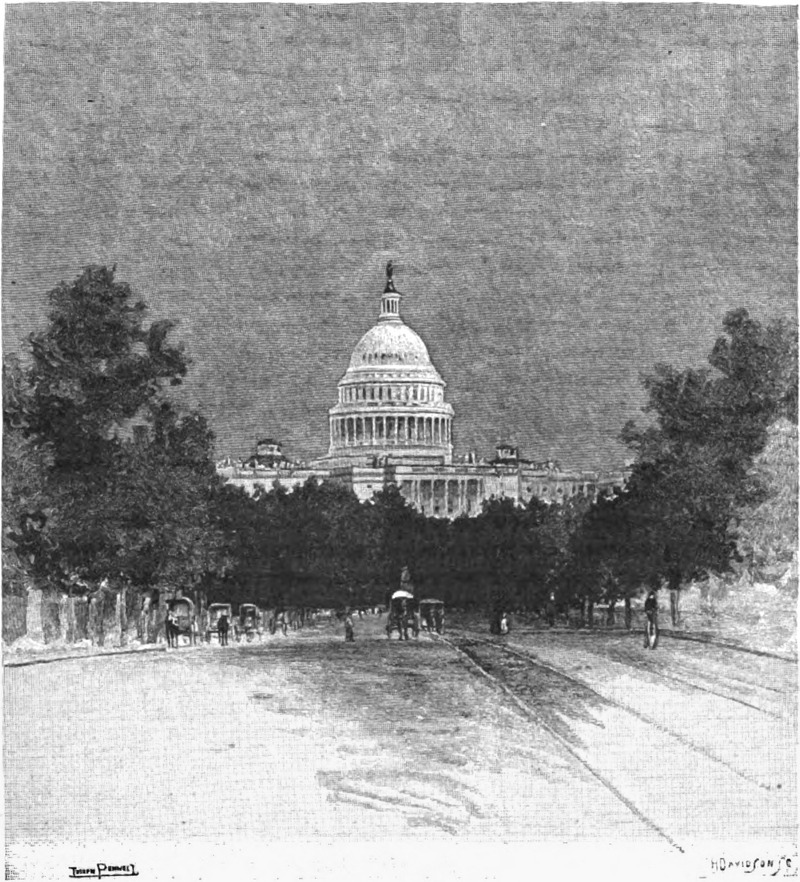
THE CAPITOL, FROM PENNSYLVANIA AVENUE