Volume 1 — THE TRUTH OF SUPPOSED LEGENDS AND FABLES. BY H. E. CARDINAL WISEMAN. [Footnote 79 ]
Reading edition
The subject of the address which I am about to deliver is as follows: Events and things which have been considered legendary, or even fabulous, have been proved by further research to be historical and true.
Before coming directly to the subject upon which I wish to occupy your attention, I will give a little account of a very extraordinary discovery which may throw some light upon the general character and tendency of our investigation. In the year 1775 Pius VI. laid the foundation of the sacristy of St. Peter's. Of course, as is the case whenever the ground is turned up in Rome, a number of inscriptions came to light; these were carefully put aside, and formed the lining, if I may so say, of the corridor which unites the sacristy with the church. It was observed, however, that a great many of these inscriptions referred to the same subject, and a subject which was totally unknown to antiquarians: they all spoke of certain Arval Brethren—Fratres Arvales. Some were mere fragments, others were entire inscriptions.
These, to the number of sixty-seven, were carefully put together and illustrated by the then librarian of the Vatican, Mgr. Marini. It was an age when in Rome antiquarian learning abounded. There were many, perhaps, who could have undertaken the task, but it naturally belonged to him as being attached to the church near which the inscriptions were found. He put the fragments together, collated them one with another, and with the entire inscriptions. He procured copies at least, when he could not examine the originals, of such other slight fragments as seemed to have reference to the subject, the key having now been found, and the result was two quarto volumes, [Footnote 80] giving us the entire history, constitution, and ritual of this singular fraternity. Before this period two brief notices in Varro, one passage in Pliny, and allusions in two later writers, Minutius Felix and Fulgentius, were all that was known concerning it. One merely told the origin of it from the time of the kings, and the others only stated that it had something to do with questions about land; and there the matter ended. Now, out of this ignorance, out of this darkness, there springs, through the researches of Mgr. Marini, perhaps the most {434} complete account or history that we have of any institution of antiquity. So complete was the work, in fact, that only two inscriptions relating to this subject have been found since; one by Melchiorri, who undertook to write an appendix to the work; and the other in 1855 in excavating the Dominican garden at Santa Sabina, which indeed threw great light upon the subject. From these inscriptions we learn that this was one of the most powerful bodies of augurs or priests in Rome. Yet neither Pliny, nor Livy, nor Cicero, when expressly enumerating all the classes of augurs, ever alludes to them. Now, we know how they were elected. On one tablet is an order of Claudius to elect a new member, so to fill up their number of twelve, in consequence of the death of one. They wrote every year, and published, at least put up in their gardens, a full and minute account of all the sacrifices and the feasts celebrated by them. They were allied to the imperial family, and all the great families in Rome took part in their assemblies. They had a sacred grove, the site of which was perfectly unknown until the last inscription, found in 1855, revealed it. It was out of Porta Portese, on the road to the English vineyard at La Magliana. There they had sacrifices to the Dea Dia, whose name occurs nowhere else among all the writers on ancient mythology. It is supposed to be Ceres. They had magnificent sacrifices at the beginning of the year. There are tablets which say where the meetings will be held, whether at the house of the rector or pro-rector, leaving the date in blank, to be filled in the course of the year. We are told who were at the meetings, especially who among the youths from the first families—four of whom acted somewhat as acolytes; and we are told how they were dressed, which of their two dresses they wore. Then there is a most minute ritual given. We are told how each victim was slain; how the brethren took off the toga praetexta, their crowns and golden ears of corn, then put them on again, and examined the entrails of the sacrifices; all as minutely detailed as the rubrics of any office of unction and coronation could possibly be. Then we are told how many baskets of fruit they carried away, and what distribution there was of sweetmeats at the end, every one taking a certain quantity. All this is recorded, and with it their song in barbarous Oscan or early Etruscan, perfectly unintelligible, in which their acclamations were made. So that now we know perfectly everything about them. I may mention as an interesting fact, that Marini's own copy of his work on the Arval Brethren, two quarto volumes, having their margins covered with notes for a second edition, which was never published, and filled with slips of paper with annotations and new inscriptions of other sorts, which he subsequently found, is now in the library at Oscott.
What do I wish to draw from this account? It is that history may have remained silent upon points which it seems impossible, in the multiplicity of writers that have been preserved to us, should not have cropped out, not have been mentioned in some way, not even have been made known to us through innumerable anterior discoveries. One fortunate circumstance brought to light the whole history of this body. How unfair, then, is it, on the reticence of history, at once to condemn anything, or to say, "We should have heard of it; writers who ought to have told us would not have concealed it from us." For a circumstance may arise which will bring out the whole history of a thing, and make that plain and clear before us which has been scouted completely by others, or of which we have been kept in the completest ignorance.
I could illustrate this by several other examples which I have collected together, but I foresee that I shall not get anything like through the subject I propose to myself. But here is one such instance bearing on Scripture truth. It was said by infidel writers {435} of the last century, "How is it that there could have been such a remarkable occurrence as the massacre of the Innocents without a single profane historian ever mentioning it—Josephus, if no one else?" Of course the answer was, "We do not know why, except that we might give plausible reasons why it should not have been noticed." That is all we need say. It is our duty to accept the fact. We must not reject things because we cannot find corroboration of them all at once. We may have to wait with patience; the world has had to wait centuries even before some doubted truth has come out clearly.
I. The subject which I wish to bring before you is one of those which, perhaps beyond any other, may be said to be considered thoroughly legendary, and even perhaps worse:—it is the history of St. Ursula and her eleven thousand companions, virgins and martyrs. At first sight it may appear bold to undertake a vindication of that narrative, or to bring it within the compass of history by detaching from it what has been embellishment, what has been perhaps even wilful invention, and bringing out in its perfect completeness a history corroborated on all sides by every variety of research. Such, however, is the object at which I aim to-day; other instances may occupy us afterward.
It has, in fact, been treated as fabulous by Protestants, beginning with the Centuriators of Magdeburg down to the present time. There is hardly any story more sneered at than this, that an English lady, with eleven thousand companions, all virgins, should have met with martyrdom at Cologne, and should have even gone to Rome on their journey by some route which is very difficult to comprehend; for they are always represented in ships. Hence the whole thing has been treated as a fable. But the more refined Germanism of later times takes what is perhaps meant to be a mitigated view, and treats it as a myth, that is, a sort of mythological tale. Thus the writer of a late work, [Footnote 81] entitled the History, or fable, of St. Ursula and the Eleven Thousand Virgins, printed in Hanover, in 1854, considers that St. Ursula is the ancient German goddess Rehalennia, and explains the history by the mythology of that ancient divinity.
But let us come to Catholics. A great number have been staggered completely by this history, and have said, "It is incredible; it is impossible to believe it; we must reject it: what foundation is there for it?" Some have tried to search one out; and perhaps one of the most ingenious explanations, though the most devoid of any foundation, is that which Sirmondus and Valesius [Footnote 82] and several other Catholics have brought forward—that there were only two saints, St. Ursula and St. Undecimilla, and that this last has been turned into the eleven thousand. This name Undecimilla has nowhere been found; there have been some like it, but that name is not known. The explanation is the purest conjecture, and has now been completely rejected. But still many find it very difficult to accept the history. If they were interrogated, and required to answer distinctly the question, "What do you think about St. Ursula?" there are very few who would venture to face the question and say, "I believe there is a foundation for it in truth."—For that is all one might be expected to say about a matter which has come down to us through ages, probably with additions.—"I believe the substance of it; it has been so altered by time as to reach us clogged with difficulties; still I believe there were martyrs in great number who had come from England that were martyred at Cologne." But there are few who like to talk about it: most say it is a legendary story. Even Butler only gives about two pages of history. He rejects the explanation which I have {436} just mentioned; but he throws the whole narrative into the shade, and passes it over with one of those little sermons which he gives us, to make up for not knowing much about a saint; so that his readers are left quite in the dark.
Then unfortunately while many Catholics have been inclined to look at it as more legendary than historical, they have been badly served by those who have undertaken the defence or explanation of the event. There may be many here who have gone into what is called the golden chamber in the church of St. Ursula at Cologne, and have seen that multitude of skulls and bones that line the walls, and have been inclined to give an incredulous shrug and to say, "How could these martyrs have been got together? where did they come from? how do we know they were martyrs?"
We generally content ourselves with looking at such things through the eyes of Mr. Murray's traveller who tells us about them. Accordingly we look round at these startling objects, and say, "It is very singular; it is very extraordinary." But there is very little awe, very little devotion felt by us; while, to a good native of Cologne, it is the most venerable, sacred, and holy place almost in Christendom. He prays earnestly to the virgins of Cologne, and considers that they are his powerful patrons and intercessors.
However, little has been done to help us. Works have been published in favor of the truth of this history, but then they have run into excess. The most celebrated of all is one by a Jesuit named Crombach, who was led to compose it by Bebius, another learned Jesuit, whose papers were unfortunately burned in a conflagration at the college in Cologne. Crombach in 1647 published two large volumes entitled "St. Ursula vindicata." In them he has included an immense variety of things. He has accepted with scarce any discrimination works that are entitled to little or no credit—contradictory works; he has mingled them all up; and he insists upon the story or the history being true with all details. The consequence is that the work has been very much thrown aside, or severely attacked.
Yet it is acknowledged that it contains a great deal of valuable information, together with an immense quantity of documents which may be made good use of when properly examined, when the chaff is separated from the wheat. On the whole, however, it has not been favorable to the cause of the martyrs.
Now, however, there has appeared such a vindication, such a wonderful re-examination of the whole history, as it is impossible to resist. It is impossible to read the account of St. Ursula given in the 9th volume for October of the Bollandists, published in 1858, without being perfectly amazed at the quantity of real knowledge that has been gained upon the subject, and still more at the powerful manner in which this knowledge has been handled;—an erudition which, merely glancing over the pages and notes, reminds us of the scholars of three hundred years ago, in whom we have often wondered at the learning which they brought to bear on any one point.
This treatise occupies from page 73 to 303, 230 pages of closely printed folio in two columns. I acknowledge that it is not quite a recreation to read it, but still it is very well worth reading. All documents are printed at full length. Now, it so happened, that just after the volume had come out, I was at Brussels, and called at the library of the Bollandists, and had a most interesting conversation with Father Victor de Buck, the author of this history. He gave me an interesting outline of what he had been enabled to do. He told me that when they came to October 21, and he had to write a life of St. Ursula and her companions, his provincial wrote to him from Cologne and said, "Take care what you say, for the people are tremendously alarmed lest you should knock down all their traditions, and I {437} do not know what will be the case if you do." He replied, "Don't be at all afraid; I shall confirm every point, and I am sure they will be pleased with what I have to say." He was kind enough to put down in a letter the chief points of his vindication for me; but I have lost it, and so there was nothing left but to read through the whole of this great work. But, beside, a very excellent compendium has appeared, which takes pretty nearly the same view on every point, and approves of everything the author has said; indeed some points are perhaps put more popularly in it, though the history is reduced to a much smaller compass. I have the work before me. It is entitled, "St. Ursula and her Companions: A Critical, Historical Monograph. By John Hubert Kessel. Cologne, 1863." It is a work which is not too long to be translated and made known. What I have to say, after having gone through this preliminary matter, is, that I lay claim to nothing whatever beyond having been diligent, and having endeavored to grasp all the points in question, and reduce them to a moderate compass. I have changed the order altogether, taking that which seems to me most suitable to the subject, and co-ordinating the different parts and facts so as to make it popularly intelligible. In this I have the satisfaction to find that in a chapter at the end of the book, in which the history is summed up, exactly the same order is taken which I have adopted here. It will not be necessary to give a reference for every assertion that I shall have occasion to make; but I may say that I have the page carefully noted where the subject is fully drawn out and illustrated.
Now, let me first of all give, in a brief sketch, what Father de Buck considers the real history, which has been wrapt up in such a quantity of legendary matter—that which comes out from the different documents laid before us, as the kernel or the nucleus of the history, as Kessel calls it. He supposes that this army of martyrs, as we may well call them, was composed of two different bodies: a body of virgins who happened, under circumstances which I shall describe to you, to be at Cologne, and a body of the inhabitants, citizens of Cologne, and others, very probably many English and other virgins who had there sought safety. It may be asked how came these English to be there? About the year 446 the Britons began to be immensely annoyed by the incursions of the Picts and Scots, which led to their calling in (after the manner of the old fable, about the man calling in the dogs to hunt the hare in his garden) the Anglo-Saxons, who in return took possession of the country; and the inhabitants that they did not exterminate they made serfs. At this period we know the English were put to sad straits. Having so long lain quiet and undisturbed under the Roman dominion, they had almost lost their natural valor, and were unable to defend themselves. There was, therefore, a natural tendency to emigrate and get away. They had already done this before; for as De Buck shows, with extraordinary erudition, the occupation of Brittany or Armorica was a quiet emigration from England, which sought the continent, and also established colonies in Holland and Batavia, and by that means obtained a peace which they could not have at home. We have a very interesting document upon this subject. The celebrated senator Aëtius was at that time governor of Gaul; the Britons sent to him for help, and this is one passage of a most touching letter which has been preserved by Gildas: "Repellunt nos barbari ad mare, repellit nos mare ad barbaros; oriuntur duo genera funerum; aut jugulamur aut mergimur." [Footnote 83] They were tossed backward and forward by the sea to the barbarians, and by the barbarians to the sea; when they fell upon the barbarians they were cut to pieces, and when they were driven into the {438} sea "mergimur"—we go to the bottom. It does not mean that they ran into the sea, but that they went to their ships, and many of them perished in the sea by shipwreck or by sinking—"aut jugulamur aut mergimur." That shows that the English were leaving England to go to the continent. I am only giving you the web of the history, without its proofs; but I quote this passage to show it is not at all unlikely that at that moment, when they were in a manner straitened between the barbarians of the north and those coming upon them in the south, a great many of them went out of the country, and that especially being Christians they would wend their way to Catholic countries. Religious and other persons of a like character, we know, in every invasion of barbarians, were the first to suffer a double martyrdom. This is a supposition, therefore, about which there is no improbability, that a certain number, I do not say how many, of Christian ladies of good family, some of them, perhaps, royal, got over to Batavia or Holland (where there have been always traditions and names of places in confirmation of this), and made their way to Cologne, which was a capital and a seat of the Roman government, a Christian city, and in every probability considered a stronghold, both on account of its immense fortifications, and on account of the river.
Well, then comes the history, very difficult indeed to reconcile, of a pilgrimage to Rome, which it is said they made; but let us suppose that instead of the whole of them a certain number of them might go there. It is not at all improbable that at that time, as De Buck observes, a deputation, or a certain number of citizens and others, did go to Rome to obtain assistance there, as their only hope against the invasion, which I shall describe just now. There is no great difficulty in supposing this; and assuming that some of the English virgins also went, that would be a foundation for the great legendary history, I might say the fabulous history, which has been built upon it. Now, there is a strong confirmation of such a thing being done. St. Gregory of Tours [Footnote 84] mentions that at this very time Bishop Servatius did go to Rome to pray the Apostles Sts. Peter and Paul to protect his country and city against the coming invasion, and he saw no other hope of safety. He must have passed through Cologne exactly at that time, and, therefore, there is nothing absurd or improbable in supposing that some inhabitants of Cologne went with him as a deputation to Rome, and that some of the English virgins may have accompanied them. In the year following, Attila, the scourge of God, the most cruel of all the leaders of barbaric tribes who invaded the Roman empire, was marching along the Rhine with the known view of invading Gaul, and not only invading it, but, as he said, of completely conquering and destroying it; for his maxim was, "Where Attila sets his foot no more grass shall ever grow"—nothing but destruction and devastation. I will say a little more about the Huns later. In the meantime we leave them, in 450, on their way to cross the Rhine, with the intention of invading and occupying France. Attila united great cunning with his barbarity; he pretended to the Goths that he was coming to help them against the Romans, and to the Romans that he was going to help them to expel the Goths. By that means he paralyzed both for a time, until it was too well seen that he was the enemy of all. It is most probable, knowing the character as we shall see just now of the Huns, that the inhabitants of the neighboring towns would seek refuge in the capital, and that all living in the country would get within the strong walls of cities. We have important confirmation, at this very time, in the history of St. Genevieve, [Footnote 65] who was {439} a virgin living out in the country, but who, upon the approach of the Huns, hastened, we are told, immediately to seek safety in Paris, and was there the means of saving the city, by exhorting the inhabitants to build up walls, to close their gates, and to fight. This they did, and so saved themselves. That is just an example. When it is known that throughout his march Attila destroyed every city, committing incredible barbarities (ruins of some of the places remaining to this day), not sparing man, woman, or child, it is more than probable that there would be a great conflux and influx to the city of Cologne, where the Roman government still kept its seat, and where, of course, there was something like order, although we have unfortunate proofs, in the works of Salvianus, [Footnote 86] that the morality of the city had become so very corrupt that it deserved great chastisement. However, so far all is coherent. In 451, after Attila had gone to France, and had been completely defeated, he made his way back, greatly exasperated, burning and destroying everything in his way, sparing no one. Then he appeared before Cologne; and this is the invasion in which it is supposed the martyrdom took place.
Having given you what the Bollandist considers the historical thread, every part of which can be confirmed and made most probable, I will now, before going into proofs of the narrative, direct your attention for a few minutes to what we may call the legendary parts of the history. When we speak of legends we must not confound them with fables, that is, with pure inventions. We must not suppose that people sat down to write a lie under the idea that they were edifying the Church or anybody. There have been such cases, no doubt; for Tertullian mentions the delinquency of a person's writing false acts of St. Paul, and being suspended from his office of priest in consequence. Such follies have happened in all times. We have had many instances in our own day of attempts at forging documents, and committing the worst of social crimes; but old legends as we have them, and even the false acts as they were called, were no doubt written without any intention of actually deceiving, or of passing off what was spurious for genuine. The person who first suggested this was a man certainly no friend of Catholics, Le Clerc, better known by his literary name of Clericus; who observes that school exercises were sometimes drawn from martyrdoms, as in our day from a classical subject, as Juvenal says of Hannibal:
"I demens et saevas curre per Alpes Ut pueris placeas et declamatio flas."
Not that students professed to write a real history, but they gave wonderful descriptions of deeds of valor and marvellous events which had never occurred, and were never intended to be believed. In the same way, at a time when nothing but a religious subject could create interest, that sort of composition came to be applied to acts of saints and martyrs; so that many books and narratives which we have of that description may be thus accounted for. It is much like our historical novels, or the historical plays of Shakespeare, for instance. Nobody imagines that their authors wished to pass them off for history, but they did not contradict history; they kept to history, so that you may find it in them; and you might almost write a history from some of those books which are called historical works of fiction. In early times such compositions were of a religious character. Then came times of greater ignorance, and those works came to be regarded as true historical accounts. But, are we to reject them on that ground altogether? Are we to say, any more than we should with regard to the fictitious works of which I have just spoken, that there is no truth in them? We should proceed in the same way as people do who seek for gold. A {440} man goes to a gold-field, and tries to obtain gold from auriferous sand. Now suppose he took a sieve full, and said at once, "It's all rubbish," and threw it away; he might go on for a long time and never get a grain of gold. But if he knows how to set to work, if he washes what he obtains, picks out grain by grain, and puts by, he gets a small hoard of real genuine gold; and nobody denies that when, many such supplies are put together they make a treasure of sterling metal. So it is with these legendary accounts. They are never altogether falsehoods—I will not say never, but rarely. Whenever they have an air of history about them, the chances are that, by examining and sifting them well, we may get out a certain amount of real and solid material for history.
The legendary works upon these virgins are numerous and begin early. The first is one which I shall call, as all our writers do, by its first words, "Regnante Domino." This is an account of traditions, evidently written between the ninth and eleventh centuries. It is impossible to determine more closely than this. But we know that it cannot have been written earlier than the ninth century, nor later than the eleventh. It contains a long history of these virgins while in England, who they were, and what they were; of a certain marriage contract that was made with the father of St. Ursula, a very powerful king; how it was arranged that she should have eleven companions, and each of these a thousand followers; how they should embark for three years and amuse themselves with nautical exercises; how the ships went to the other side of the channel. It is an absurd story and full of fable, but there are three or four most important points in it. Geoffrey of Monmouth comes next. He gives another history, totally different from that of the "Regnante Domino;" but retains two or three points of identity. His is evidently a British tradition, which, of course, it is most important to compare with the German one; and we shall find how singularly they agree. Then, after these, come a number of legends called Passiones, long accounts filled with a variety of incongruous particulars which may be safely put aside; but in the same way germs or remnants of something good, which have been thus preserved, are found in them all, and when brought together may give us some valuable results. We next meet with what is more difficult to explain—the supposed revelations of St. Elizabeth of Schönau, and of Blessed Hermann of Steinfeld. It is not for us to enter into the discussion, which is a very subtle one, of how persons who are saints really canonized and field in immense veneration—one of them, Hermann, singularly so—can be supposed to have been allowed to follow their own imaginations on some points, while at the same time there seems no doubt that they lived in an almost ecstatic state. This question is gone into fully; and the best authorities are quoted by the Bollandist. It would require a long discussion, and it would not be to our purpose, to pursue it further. These supposed revelations are rejected altogether. Now we come to positive forgeries, consisting of inscriptions, or of engraved stones with legends carved upon them. One of these mentions a pope who never existed, and also a bishop of Milan who never lived, beside a number of other imaginary people. From the texture and state of these inscriptions there can be no doubt whatever that they are absolute forgeries, and the author of them is pretty well discovered. He was a sacristan of the name of Theodorus. In order to enhance the glory of these virgins, they are represented, as you see in legendary pictures, as being in a ship accompanied by a pope, bishops, abbots, and persons of high dignity, who are supposed to have come from Rome with them. All this we discard, making out what we can from the sounder traditions.
And this is the result. There are {441} two or three points on which, whether we take the English or the German traditions, all are agreed. First, we have that a great many of these virgins were English: that the Germans all agree upon; the earliest historical documents say the same. Secondly, that they were martyred by the Huns: that we are told both by the English and the German writers. It is singular that they should agree on such a point as this; and you will see how—I do not say corroborated, but absolutely proved it is. The third fact is, that there was a tremendous slaughter at the time, a singular slaughter of people committed at Cologne by these Huns. This comes out from all the legendary histories, which agree upon this point, and we can hardly know how they should do so except through separate traditions; for they evidently have nothing else in common. Their separate narratives we may reject as legendary.
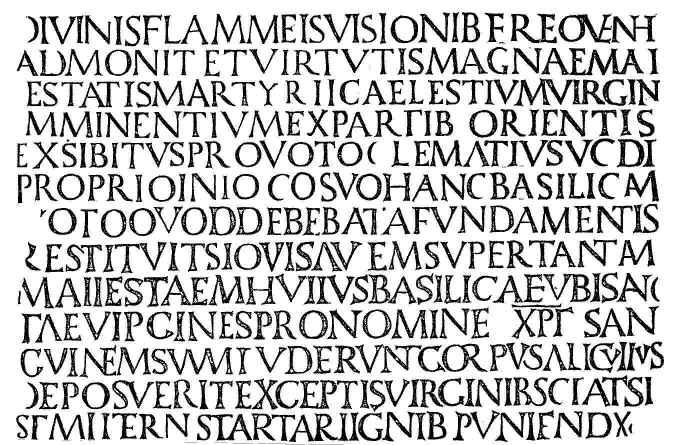
Thus we come to an investigation of the true history, and see how it is proved. And first I must put before you what I may call the foundation-stone of the whole history on which it is based—the inscription now kept in the church of St. Ursula. It had remained very much neglected, though it had been given by different authors, until, when the Bollandists were going to write their history, they took three casts of it; one they gave to the archbishop of Cologne, another they kept for themselves; the third—I cannot say what became of it, but I think it went to Rome, having been taken by De Rossi. I could not afford to have a cast brought here, but I have had a most accurate tracing made of it. Those of you who are judges of graphic character will see the nature of the letters; they are capital, or uncial letters. First, you may ask what is the age of this inscription? It is pretty well agreed that it cannot be later than the year 500—that would be fifty years after that assigned to the martyrdom of the virgins. De Buck, who is really almost hypercritical in rejecting, says he does not see a single objection to the genuineness of this inscription. There is not a trace of Lombard or later character about it; it is purely Roman. The union of some of the letters is just what we find about that time in Roman inscriptions. It is then, as nearly as one can judge, of the age I have mentioned—about the year 500. De Rossi, passing through Cologne three or four years ago, examined it and pronounced it to be genuine, and said it could not be of a later period than that. Dr. Enner, a layman of Cologne, when writing his "History of Cologne," could not bring himself to believe that the inscription was so old, and he sent an exact copy in plaster (perhaps that was the third) to Professor Ritschl, the well-known editor of Plautus, and a Protestant, at Bonn. I have a copy of the Professor's letter here, in which he says that he has minutely examined the inscription, and that he cannot see anything in it to make it more modern than the date assigned to it, and that it contains peculiarities which no forger would ever hit upon, such as the double i, and other forms. He says, "I am not sufficiently acquainted with the history of St. Ursula to connect it in any way; but I have no hesitation in saying that the inscription cannot be later than the beginning of the sixth century;" which, you see, takes us back very nearly to the time when the martyrdom is supposed to have occurred. Then I may mention that the very inscription is copied in the next historical document that we have, as being already in the church. This is the translation of the inscription, of which I present an exact copy:
"Clematius came from the East; he was terrified by fiery visions, and by the great majesty and the holiness of these virgins, and, according to a vow that he made, he rebuilt at his own expense, on his own land, this basilica." Then follows a commination at the end, which is not unusual in such cases. Now, every expression here is to be found in inscriptions of the time.
{442}
{443}
For instance, "de proprio;" "votum;" "loco suo" (sometimes it is "loco empto"), meaning of course land which one made his own, or which was his own before. There had been then a basilica—not the church that now exists, but a basilica—at the tombs where these saints were buried, which we shall have to describe later. He rebuilt the basilica fifty years after the martyrdom, destroyed no doubt during the constant incursions of barbarians. It was probably a very small one; for we know that at Rome every entrance to the tombs of martyrs had its basilica. De Rossi has been successful in finding one or two. One was built by St. Damasus, who wrote: "Not daring to put my ashes among so many martyrs, I have built this basilica for myself, my mother and sister;" and there are three niches at the end for three sarcophagi. It is universally allowed that there never was a catacomb without its basilica. In fact, in that of Pope St. Alexander, and Sts. Evantius and Theodulus, found lately, there is a basilica completely standing, and the bodies of these saints were found—one under the altar—and the others near it. Then from the basilica you go into the catacomb. So that nothing is more natural than that in the place where these martyrs were buried, Clematius should rebuild their basilica. After this monument we proceed to the next genuine document, though one of a later date, and by an unknown author—the "Sermo in Natali." This, there is no doubt, was written between the years 751 and 839; and I will give the ingenious argument by which this date is proved. But first it quotes the inscription I have read, with the exception of the threat at the end; in the second place it mentions that the virgins were probably Britons—that it was not certain, but the general opinion was that they had come from Britain; thirdly, it attributes the martyrdom to the Huns; fourthly, it insinuates what is of great importance in filling up the history, that it is by no means to be supposed that they were all virgins, but that many were widows and married people. The reason for fixing the earliest date at 751 is, that it quotes Bede's Ecclesiastical History, which was written in that year, giving apparently his account of the conversion of Lucius; though one cannot say that it is certainly a copy from Bede, because Bede himself copied from more ancient books, and both may have drawn from the same source. Then it could not have been written after 839 for two reasons. In 834 there was a tremendous incursion of other barbarians—of Normans; and it is plain from our book that there had been no such invasion when it was written; nothing was known of it, because the writer speaks of countries, particularly Holland, as being flourishing, which were completely destroyed by them. There is also this singular circumstance. In speaking of the great devotion to the virgins in Batavia, the writer states that this happened at a time when Batavia was an island formed by the two branches of the Rhine. Now in 839 an inundation completely destroyed it, one of the horns or arms being entirely obliterated. Therefore that gives us a certain compass within which the book was written. The author himself was a native of Cologne—for in referring to the inhabitants he once or twice speaks of "us"—and he would therefore be familiar with the traditions of the people. He says there was no written history at that time; he defends the traditions, and shows how natural it was that the people should have kept them. I ought to mention that he calls the head of the band of martyrs Pinnosa. He says, "She is called in her own country Vinosa, in ours Pinnosa;" and there is evidence that this was the name first given to the leader; how, by what transformation, it came to be St. Ursula, we cannot tell; it is certain that up to that time hers was not the name of the leader. Afterward Pinnosa appears on the list, but not as the chief, St. Ursula being the prominent name.
{444}
After that period there comes a mass of historical proofs that one can have no difficulty about. From 852 there are an immense number of diplomas giving grants of land to the nuns of the monastery of St. Ursula, at her place of burial. There is no doubt of the existence of that church, from other documents. Then the martyrologies repeat the whole tradition again and again. Thus, then, we fill up that gap of four hundred years (from A.D. 400 to A.D. 800). There is the inscription; there is the "Sermo in Natali," which quotes it, and gives old traditions; and afterward there are diplomas and other testimonies which are abundant.
We now proceed to compare the whole tradition with history, with known history, for after all this is our chief business. When we possess a tradition of a country and people, we ask, "What confirmation, what corroboration, have we? what does history tell us?" Let us then see what history does tell. It tells us, in the first place, that in the year 450 Attila was known to be coming to invade and take possession of Gaul, having been ejected from Italy. His army is said by contemporary writers to have been composed of 700,000 men. It was a hostile emigration. They brought their women and children in carts, as the Huns always used to do, and they of course marched but slowly. They went along both sides of the Danube, and got at length into France. De Buck, by a most interesting series of proofs, makes it almost as evident as anything can be that they crossed over at Coblentz, therefore not coming near Cologne. They entered, as I have said, into Gaul, destroying everything in their march. Some of their barbarities and massacres are almost incredible. After devastating nearly the whole of the country, they besieged Orleans. The inhabitants having been encouraged to resist, at last succeeded in obtaining certain terms; that is, Attila and his chiefs went into the city and took what they liked, but left the city standing. After this they were pursued by the general whom I have mentioned—Aetius, a Gaul, but who got together all the troops he could, Goths, Visigoths, Franks, and others, who saw what the design of these horrible barbarians was.
A most tremendous battle was now fought, that of Catalaunia (Châlons-sur-Marne), in which contemporary historians tell us 300,000 men were left on the field; but that number has been reduced to 200,000. Such battles, thank God! we seldom hear of now-a-days. Attila, routed, immediately took to flight, and got clear away from his pursuers. He went through Belgium, destroying city after city, leaving nothing standing, and massacring the people in the most barbarous way.
Here comes the most difficult knot of the whole history. Authors agree that Attila now made his way into Thuringia, that is to the heart of Germany; he must therefore be supposed to have got clear over the Rhine, and marched a long way through the country. On this subject De Buck has one of the most exquisite and beautiful geographical investigations, I should think, that have ever appeared. He proves, so that you can no more doubt it than you can doubt my having this paper before me, that there was Thuringia which lay on this side of the Rhine; he proves it by a series documents taken from mediaeval writers, and from inscriptions, that there was a Thuringia which stretched from Louvain to the Rhine. Indeed, it is impossible to conceive how Attila could have got, as by a leap, into the very midst of Germany. He traces the natural course of march (which you can follow by any map), taking the cities destroyed as landmarks, and brings him to this province; and when there, there was no possible way of crossing the Rhine but by Cologne; there was the only bridge, the only military pass of any sort. So there can be no doubt that the Huns, exasperated by their tremendous losses, and by being driven {445} out of Gaul, which they intended to occupy, having revenged themselves as they went on, were obliged to go through Cologne; and if you calculate the date of the victory, and consider the country through which Attila passed, destroying everything as he went, you bring him almost to a certainty to Cologne about the 21st of October, nearly the day of the martyrdom. The "Regnante Domino," which attributes the martyrdom to the Huns, corroborates all this account, which is the result of a most painstaking examination, extending over many pages.
Next we come to another important point. Why attribute this massacre to the Huns? Because there was no other invasion and passage of savages except that one. It accords, then, both with geographical and chronological facts. We have the martyrs at Cologne at the very time when these barbarians came.
But we must needs say something about the Huns. There is no question that the Huns were the most frightful, cruel, and licentious barbarians that ever invaded the Roman empire. They were not of a northern race, Germans or Scandinavians; they were, no doubt, Mongols or Tartars; they came from Tartary, from Scythia, and settled on the Caspian sea; they then moved on to the mouths of the Danube, and again to Hungary, and rolled on in this way toward the richer countries of the west. There are several authors of that period—Jornandes, Procopius, and others—who describe them to us. [Footnote 87] They tell us that when they were infants their mothers bound down their noses, and flattened them in such a way that they should not come beyond the cheek-bones; that their eyes were so sunk that they looked like two caverns; that they scarified all the lower part of the face with hot irons when young, so that no hair could grow; that they had no beard, and were more hideous than demons; that they wore no dress except a shirt fabricated by the women in the carts in which they entirely lived; it was never changed, but was worn till it dropped off, under a mantle made entirely of wild-rat skins. Their chaussure consisted of kid skins round their legs, with most extraordinary shoes or sandals, which had no shape whatever, and did not adapt themselves to the form; the consequence was that they could not walk, and they fought entirely on their wretched horses. They had no cuisine except between the saddle and the back of the horse, where they put their steaks and softened them a little before eating; but as to drink, they could take any amount of it. With regard to their morality it cannot be described. The writers of that age tell us that no Roman woman would allow herself to be seen by a Hun. They were licentious to a degree, and they carried off all the women they could into captivity; probably they destroyed a great many; which was their custom when they became a burden to them. These, then, were the sort of savages that reached Cologne.
They had another peculiarity; of all the hordes of savages that invaded the Roman empire, they are the only ones that used the bow and arrow. The Germans hardly made any use of the bow, except a few men who mixed in the ranks; as a body their execution was with the sword, the lance, and the pike. The use of the bow was distinctly Tartar, or Scythian. Then we are told that their aim from horseback was infallible; that when flying from a foe they could turn round and shoot with perfect facility; that they rode equally well astride or seated sideways like a woman; in fact that they flew and turned just like the Parthians and Scythians from whom they were descended. In this great battle of Catalaunia they either lost heart or steadiness, and they could not fire upon their enemies, so that they were pursued and tremendously routed. That their mode of fighting was by the bow and arrow, you {446} will see in the representations given in the beautiful shrine at Hamelink, where the martyrs are fired into by the barbarians with bows and arrows. Let us see what this has to do with our question. The "Regnante Domino," which we have mentioned as legendary, gives a most beautiful description of the mode of dealing with the bodies. The writer says that when the inhabitants saw that the enemy were gone they came out, and in a field they found this great number of virgins lying on the ground. They collected their blood, got sarcophagi, or made graves, and put them in; "and there they lay, as they were placed," the writer says, "as any one can tell who has seen them," evidently suggesting that he had seen them. Now, in the year 1640, on July 2, Papebroch, an authority beyond all question, and Crombach, whose word may be relied on as that of a most excellent and holy man, were at the opening of the tombs. From all tradition this was no doubt the place of the stone of Clematius; there has always been a convent there; and you remember that part of the inscription which threatens eternal punishment to those who should bury any but virgins there. It is now called "St. Ursula's Acker," a sort of sacred field where the basilica was. Here they were buried, and so they remained undisturbed except by some translations of the middle ages, which do not concern us. In 1640 there was a formal exhumation, and eye-witnesses tell us what they saw. A nuncio came afterward to verify the facts.
I will give you the account of how these bodies were found. Many of them were in graves, in rows, but each body separate, there being a space of a foot between them. In other places there were stone sarcophagi in which they were laid separately. Then Crombach describes that there were some large fosses, sixty feet long, eight feet deep, and sixteen wide, containing a large number of bodies. They were placed in a row with a space between them; at their feet was another row; then a quantity of earth was thrown on, and another row was placed, and so on, until you came to the fourth. Every skeleton in the three rows was entire, and they all looked toward the east. They had their arms crossed upon their bosoms, and almost every one had a vessel containing blood, or sand tinged with blood. The fourth, or upper stratum, consisted of disjointed bones, and with these also there were vessels containing blood or colored sand. In this way, the writer says, he saw a hundred bodies. Then there was this remarkable circumstance about their clothes. Eutychianus, [Footnote 88] the pope, had published a decree that no body of a martyr was ever to be buried without having a dalmatic put upon it; and clothes in abundance were found upon these bodies.
Another important discovery was, that immense quantities of arrows were found mingled with the bones; some sticking in the skull, others in the breast, others in the arms—right in the bones. So it was clear that all these bodies had been put to death by means of arrows, and there was no other tribe but the Huns which made use of the arrow as its instrument of death. I may add that there were no signs of burning, or of any heathen burial about them. This also is most important. I have said that there had been other exhumations in the eleventh and twelfth centuries. There are pictures of these, and there are sarcophagi preserved in which bodies were found. These are laid in exactly the same manner as others were found in 1640. Crombach says the whole had been done most scientifically, that the distances were all arranged by measure, so that there was not a quarter of a foot difference anywhere.
Now, I ask, could these bodies have been put there in consequence of a plague, or an earthquake, or any event of that kind? Putting aside the arrows found in immense quantities, and the {447} vessels containing blood, we know that when people die in a plague to the number of hundreds, a foss is made, and they are thrown in, and there is an end of them. This could not have been a common cemetery. It contained nothing but the bodies of these women (I will speak of their physical characteristics later), all laid in studied order, with great care, and with such peculiarities, and all evidently buried at the same time. After reading all this, may we not exclaim with St. Ambrose, "We have found the signs of martyrdom," and with St. Gaudentius, "What can you desire more to show that they were all martyred?" [Footnote 89] And who does not see here confirmed the history of Clematius? Comparing the whole with traditions, both English and German, it seems to me that you have as much proof as you can reasonably require.
Having given you concisely the facts and corroborations of history, let me now proceed to answer objections.
And, first there is the question, Were all these martyrs? Well, if they were to be tried by the rules established very justly in the modern Church, it would no doubt be difficult to say; because how can you prove that each of these women laid down her life voluntarily for Christ? The tradition of Cologne is that they would not sacrifice their virtue to those heathens, and that they were surrounded and shot. But in those times a wider meaning was sometimes attached to the word "martyr." There were what are called martyres improprie dicti, where there could not be the same kind of evidence as in the case of others; or martyres latiore sensu. A person was called a martyr when he was put to death without his will being consulted, as in the case of our own St. Edmund, and in the case of St. Wenceslaus, who was put to death without being interrogated as to whether he would remain a Christian or not, and many others. De Buck shows that there was nothing more common. We have the remarkable case of the Theban legion—another instance of a large number of men being surrounded and cut down by soldiers without being questioned as to whether they were in a state of grace, or whether they were prepared to die. The deed was done in odium religionis, by people who merely looked to the gratification of their own passions and their desire for revenge. In those days the question of such persons being martyrs would be a very simple one, if it were known that they were killed by the Huns in hatred, as was supposed, of their virginity and because of their resistance. We have in martyrologies the account of Nicomedia and its twelve thousand martyrs. De Buck supposes that the number included all the martyrs of the persecution. And the 6,700 of the Theban legion are explained in the same way.
The next question is, Were these persons all virgins? Who can know? It is quite certain that even married persons, when martyred, had sometimes the title of virgins given to them. Many instances are supplied by the martyrologies and offices. St. Sabina, [Footnote 90]for instance, is called a virgin martyr, though she was a married person. It was considered that martyrdom raised all women to a higher degree of excellence. There are some curious questions, too, arising, which would not very well do for a discussion here. It is, however, sufficiently proved that when there was a great number of virgins, and others were mixed with them, the nobler title was given to all. Just as, if you have a great many martyrs and some confessors united, the title of martyrs is applied to all, as they are included in one office, each sharing in the glory of martyrdom. The "Sermo in Natali" expressly tells us that it was not supposed at its early period that all were virgins, but that there were ladies of all ranks and children amongst them. Indeed, some remains of children were found.
{448}
Then comes the question, Were there eleven thousand? Certainly not as all one company. It is supposed, and there appears nothing unreasonable in it, that when once the rage of the Huns was excited they would give way to an indiscriminate massacre, and that the eleven thousand most probably included persons who had sought refuge, perhaps their own captives, and probably a great number of the inhabitants of the city.
But does it not seem a frightful number of persons to be massacred? Not by the Huns. In the year 436 these same Huns slaughtered at once in Burgundy 30,000 men. They were of the same race, the same family of men, as Tamerlane, who had 70,000 heads cut off in Ispahan. And the Turks, when they took the island of Chios, reduced the population of 120,000 to 8,000. So that those slaughters, which to us seem so fearful, are not to be considered in the same light when occurring in those times. We have a frightful example in the case of Theodosius and the inhabitants of Thessalonica. It is said that 15,000 persons were put to death in the theatre for a simple insult. The most moderate calculation is that by St. Ambrose, who gives the number as 7,000. Human life, of course, was not then regarded as by us, especially by men who devastated whole cities and burned them to the ground. Hence the difficulty as to the number of persons, including among them not merely the followers of St. Ursula, but the bulk of the female inhabitants, is explained.
Another question arises, Were they English, or were there English amongst them? That is answered unhesitatingly, Yes. All the traditions, English and German, agree that these ladies had come from England and sought refuge.
I have mentioned the facilities for emigration, and the way in which many went out of the country; so that there would be nothing wonderful in a certain number of British women being at Cologne at that time. Now there is this curious fact illustrating the subject. Very lately the Golden Chamber, as it is called, adjoining the church, where the chief remains are deposited, was visited by Dr. Braubach and Dr. Gortz of Cologne, Dr. Buschhausen of Ratingen, and others, who examined the skulls and pronounced them to be Celtic, not German. The Celtic characteristics, as given by Blumenbach and other writers, are quite distinct—the chin falls back considerably, the skull is very long, and the vertex of the head goes far behind—quite distinct from the Romans or Germans. Moreover, with the exception of ten or fifteen out of from eighty to a hundred, they were all the bodies of females. Now all the writers—all that I have seen at least—say that there could not have been an emigration of some hundreds of women without some men, some persons to guard them, and these would be with them and would share their martyrdom. Then, in the next place, they were all young people, there was no sign of their having died of a plague or any other casualty, but they appeared to be strong, healthy young women; which of course, as far as we can judge, verifies the narrative to the utmost.
I now leave you to judge how very different historical research has made this legend, as it is called, appear, and how much we have a right to regard it in a devotional spirit, as the inhabitants of Germany certainly do. I do not say that there have not been many exaggerations, false relics, and stories; but critical investigation enables us to put all these aside, and to sift their evidence. But certainly we have a strong historical verification of what has been considered until within the last few years as legendary, not only by real discoveries which have come to light, but also by a right use of evidence which before had been overlooked and neglected.
The whole of what I have said relates to events. But my subject embraces "events and things." The latter part remains untouched, and I have {449} yet to show how things or objects which have been looked upon as fabulous have been proved to be real and genuine.
II. I proceed, therefore, to objects which have been, or may be, easily misrepresented, as if asserted to be what they are not, and involving an imputation of imposture on the part of those who propose them to the notice or veneration of Catholics.
I will begin with a rather singular example, but one which, I trust, will verify the assertion which I have made; and if time permits, I will multiply the examples by giving two or three other instances.
I do not know whether any of you in your foreign travels have visited the cathedral of Chartres; I have not seen it myself, but I believe that it is one of the most noble, most majestic, and most inspiring of all Gothic buildings on the continent. The French always speak of it as combining the great effects of a mediaeval church, more perhaps than any other in their country; and as my address will relate to that cathedral, I think it is necessary to give a little preliminary account of it; at the same time warning you that I do not by any means intend to plunge into the depths of the singular mystery in which the origin of that cathedral is involved. It takes its rise from a Druidical cavern which was for some time the only church or cathedral. Over that the Christians—for the town was early converted to Christianity—built a church, of course modest, and simple, and poor, as the early churches of the Christians were; but in this was preserved, with the greatest jealousy, and with the deepest devotion, what was called a Druidical image of Our Lady, which was always kept in the crypt, for it was over the crypt that the church was built. It was said to have existed there before the building of the church; but into that part of the history it is not necessary to enter. In the year 1020 this poor old church was struck by lightning, was set on fire, and entirely consumed. The bishop at that time was one of the most remarkable men in the French Church—Fulbert, who has left us a full account of what was done in his time there. He immediately set to work to build another church, proposing that it should be perfectly magnificent according to all the ideas of the age; and to enable him to do so, he had recourse to our modern practice of collecting money on all sides. Among others Canute, king of England and Denmark, and Richard, duke of Normandy, and almost all the sovereigns of the north contributed largely. The result was the beginning of a very magnificent church. The singularity of the building was this, that everybody labored with his hands, not only men, but women, not only the poor, but the noble. These furnished with their own hands provisions or whatever was necessary for the workmen. However, after Fulbert's death, like most undertakings of that class, the work became more languid; and before it was completed (that was in 1094), the building, in which there was a great quantity of wood used, was again burnt to the ground. Well, this time it was determined that there should be a splendid church, such as had never been seen before; and here, again, that same plan of working with their hands was adopted to an extent which, as stated in an account given us by Haymon and one or two others, seems incredible. The laborers relieved one another day and night, lighting up the whole place with torches; provisions were abundantly furnished to all the workmen without their having to move from their places. In fact, the writer says that you might see noblemen, not a few, but hundreds and thousands, dragging carts or drawing materials and provisions; in fact, not resting until, in 1160, seventy years after the destruction, the church was consecrated; and there it remains, the grand cathedral church of Chartres at this day.
Now, it may be asked, what was {450} there which most particularly made Chartres a place of such great devotion, and so attached the inhabitants to its cathedral that they thus sacrificed their ease and comfort so many years to build a church worthy of their object? It was a relic—a relic which had existed for several hundred years at that time in the church, which made it a place of pilgrimage, and which was considered most venerable. What was this relic? The name which it has always borne in the mouths of the simple, honest, and devoted people of Chartres and its neighborhood, and in fact of all France, is La Chemise de la Sainte Vierge—that is, a tunic which was supposed and believed to have been worn by the Blessed Virgin, her under-clothing, and was of course considered most venerable from having been in contact with her pure virginal flesh. However, you may suppose that you require strong proof of such a relic at all, and you will remember that my object is to show how things which may have been doubtful, and perhaps considered almost incredible, have received great proof and elucidation by research. I do not pretend to say that in all respects you can prove the relic: the research to which I allude is modern, but it may guide us back, may confirm a tradition, may give us strong reasons in its favor, showing that it has not been received without good ground, though it may not be able to penetrate the darkness which sometimes surrounds the beginning of anything in very remote antiquity. I am not going, then, to prove the relic, but I am going to show you the grounds on which it had been accepted, and then come to the modern verification of it.
The history is this. A Byzantine writer of the fourteenth century, Nicephorus Calixtus, [Footnote 91] tells us that this very relic was in the possession of persons in Judaea, to whom it was left by our Blessed Lady before her death; that it fell, in the course of time, into the hands of a Jew in Galilee; that two patricians of Constantinople, Galbius and Candidus, traced it, purchased it, and took it to Constantinople, where, considering themselves in possession of a great treasure, they concealed it, and would not let it be known (this was in the middle of the fifth century); that the Emperor Leo, in consequence of the miracles which were wrought, and by which this relic was discovered, in spite of those who possessed it, immediately entered into negotiations, obtained it, and built a splendid church in Constantinople expressly to keep it; and that the church so built was considered as the safety, the palladium as it were, of the city of Constantinople. He mentions another fact which is important; that is, that there were at that time in Constantinople three other churches, each built expressly for the preservation of one relic of our Lady. I mention these facts for this purpose: there is a very prevalent idea, I believe among Catholics as well as certainly among Protestants, that what may be called the great tide of relics came into Europe through the crusades; that the poor ignorant crusaders, who were more able to handle a sword than to use their discretion, were imposed upon, and bought anything that was offered to them at any price, and so deluged Europe with spurious and false relics. Now, you will observe, that all that I have been relating is referred to an age quite anterior to the crusades, or to any movement of the west into the east. It is true that Nicephorus Calixtus is a comparatively modern writer, but he could bear testimony to churches that were existing, and tell by whom they were built. The mere writer of a hand-book can trace out the history of a church or any other public monument which is before the eyes of all: but he was not of that character: he was a historian, and he tells us that there were [Footnote 92] three churches in Constantinople, just as we might say that {451} in Rome there is the church of Santa Croce, built by Constantine to preserve the relics of the cross. Nobody can doubt that the church was built for the relic, that the relic was deposited there, and that earth from the Holy Land was put into its chapel. Monuments like that preserve their own history. Therefore, when this writer tells us that these churches existed from that period, we can hardly doubt that he could arrive at a knowledge of such facts; and at any rate it removes the impression that these wonderful relics were merely the sweepings, as it were, of Palestine during a fervent and pious but at the same time ignorant and unenlightened age.
Thus, we get the history so far. Now, we know that there was no one who valued relics to such an extent as Charlemagne. We see, by Aix-la-Chapelle and other places, what exceedingly curious relics he collected. I am not here to defend them individually, because I do not know their history; nor is it to our purpose. He was in close correspondence with the east, from which he received large presents; for it was very well known what he valued most. There was a particular reason for this. The Empress Irene at that time (Charlemagne died in 814) wished to have his daughter Rothrude in marriage for her son Porphyrogenitus, and later offered her own hand to himself.
Many relics existed at the time of this correspondence; and as presents are now made of Arab horses and China services, so were they then made of relics, which, if true, monarchs preferred to anything else. Now, there is every reason to suppose that among the presents sent by Irene to Charlemagne was this veil or tunic. [Footnote 93] There is in the cathedral of Chartres a window expressly commemorating the passage of this relic from the east to Chartres. Secondly, the relic, as you will see later, was, up to a few years ago, wrapped in a veil of gauze, which was entirely covered with Byzantine work in gold and in silk, which had never been taken off; and it was wrapped up in it till the last time it was verified. We have every reason to suppose that it had come from Constantinople, and that it was delivered at Chartres in that covering. In the third place, it is historical—there is no question about it, for all chronicles and authorities agree upon the point—that Charles the Bald, the grandson of Charlemagne, being obliged to leave Aix-la-Chapelle, in consequence of going to settle in France, which was the portion of the empire allotted to him, took the relic away, and deposited it in the cathedral of Chartres. So that, as far as we can trace a transaction of this sort, there seems to be as much evidence as would be accepted in respect to the transmission of any object of a profane character from one country to another. There is the correspondence of the workmanship; there are the records of the place; and there is the fact that the relics were brought from Aix-la-Chapelle, where Charlemagne had collected so many relics that he had received from Constantinople. Mabillon, who certainly is an authority in matters of ecclesiastical history, says it would be the greatest rashness to deny the genuineness of this relic. "Who will presume to deny that it is real and genuine?" This is in a letter to the bishop of Blois, in which he is expressly treating the subject of discerning true relics. Everything so far, therefore, helps to give authenticity to this extraordinary relic which made Chartres a place of immense pilgrimage.
Bringing it down so far, we may ask, what was the common, and we may say the vulgar, opinion of the people regarding it? It had never been opened, and was never seen until the end of the last century. The consequence was, that it was called by the name I have mentioned. It was represented as a sort of tunic. It was the custom to make tunics of that form, which were laid upon the shrine and {452} worn in devotion; they were sent specially to ladies of great rank, and were so held in veneration that it was the rule, that if any person going to fight a duel had on one of these chemisettes, as they were called, he must take it off; as it was supposed his rival had not fair play so long as he carried it upon him. In giving an account of the building I forgot to mention the wonderful miracles in connection with the relic there, which are believed by everybody to have taken place. It is even on record that the Chevalier sans peur et sans reproche went to Chartres pour se faire enchemiser before he went to war.
In 1712, we find that the relic was in a cedar case richly ornamented with gold and jewels—the original case in which it had arrived. The wood being worm-eaten and crumbling, it was thought proper to remove and clean it, and put it in some better place. The cedar case had no opening by which it could in any way be examined, and the bishop of the time, Mgr. de Merinville, proposed to open it. He chose a jury of the most respectable inhabitants of the town, clergy and laity, to assist. The box was unclosed, and the relic was found wrapped up, as I have said, in the veil of Byzantine work. The veil was not unclosed, so that they did not see the relic itself. The debris of the box was swept away, and the relic, as it was, was put into a silver case that had been prepared; this was locked up, and then deposited in a larger shrine distinct from all the other relics. The procès verbal still exists in the archives of Chartres giving an account of all that took place, from which the account I have given you is taken.
Infidelity was then spreading in France, and, as you may know, a great deal of ridicule was thrown on this relic. It was said that such a garment was not worn in those days, that the system of dress was quite different, and that it was absurd to imagine any article like this. Now, as no one had seen the relic, there was no way of answering these reproaches. In 1793, three commissioners came from the French government, went into the sacristy, and imperiously desired to look at the relic; it was very richly enshrined, and they intended to carry it off. The shrine was brought to them, as the procès verbal of the second examination relates, when they seemed to be seized with a certain awe, and said, "We will not touch it; let it be opened by priests." Two priests were ordered to open the box, and they did so. These men had come prepared to have a good laugh, and scoffing at this wonderful relic. For antiquarians had been saying that such inward clothing was not known so early as the first century, but that instead a long veil used to be wrapped round the body.
Well, they found a long piece of cloth four and a half ells in length—exactly what had been said should be the proper garment. The commissioners were startled and amazed, and said, "It is clear that this is not the relic the people have imagined; perhaps it is all an imposture." They then cut off a considerable piece and sent it to the Abbé Barthélemy, author of the "Travels of Anacharsis" and member of the Institute—a man who had made the customs and usages of antiquity his study; they did not tell him where it came from, but desired him to give an opinion of what it might be. He returned this answer: that it must be about 2,000 years old, and that from the description given him it appeared to be exactly like what the ladies in the East wear at this day, and always have worn—that is, a veil which went over the head, across the chest, and then involved the whole body, being the first dress worn. I ask, could a verification be more complete than this? And, recollect, it comes entirely from enemies. It was not the bishop or clergy that sought it. The relic was in the hands of those three infidel commissioners, who sent a portion to Paris without saying or giving any hint of what it was (they {453} wanted to make out that the whole was an imposture), and the answer was returned which I have mentioned, and which is contained in the procès in the archives of the episcopal palace at Chartres. If any one wants to read the whole history, I refer him to a most interesting book just published by the curé of St. Sulpice (Abbé Hamon), entitled "Notre Dame de France, ou Histoire du Culte de la Sainte Vierge en France." The first volume, the only one out, contains the history of the dioceses of the province of Paris.
I will proceed to a second popular charge, and it is one the opportunity of easily verifying which may never occur again. It refers to the head of St. John the Baptist, or, shall I say, to the three heads of St. John the Baptist? Because, if you read English travellers of the old stamp, like Forsyth, you will find that they make coarse jokes about it. Forsyth, I think, says something about Cerberus; but more gravely it has been said, that St. John must have had three heads—one being at Amiens, one at Genoa, and another at Rome; that at each place they are equally positive in their claims; and that there is no way of explaining this but by supposing that St. John was a triceps.
When we speak of a body you can easily imagine that one piece may be in one place, another in another, a third elsewhere, and so on. That is the common way in which we say that the bodies of saints are multiplied; because the Church considers that the place which contains the head or one of the larger limbs of a saint, or the part in which, if a martyr, he was killed or received his death-wound, has the right of keeping his festival and honoring him just as if it had the whole body. Therefore, in cathedrals and places where festivals are held in honor of a particular saint, where they have relics, which have perhaps been sealed up for years, and never examined, they often speak as if they have the entire body. This is a common practice, and if I had time I might give you an interesting exemplification of it. [Footnote 94] Suffice it to say, that according to travellers there are three heads of St. John. Now as I have said, a body can be divided, but you can hardly imagine this to be the case with a head.
A very interesting old English traveller—Sir John Mandeville—went into the East very early, and returned in 1366; soon after which, almost as soon as any books were published, his travels appeared. He is a very well-known writer. Of course you must not expect that accuracy in his works which a person would now exhibit who has books at his command and all the conveniences for travelling. He was not a profound scholar: he believes almost whatever is told him, so what we must do is to let him guide us as well as he can, and endeavor to judge how far he is right. I will read you an extract, then, from Sir John Mandeville: [Footnote 95]
"From thence we go up to Samaria, which is now called Sebaste; it is the chief city of that country. There was wont to be the head of St. John the Baptist inclosed in the wall; but the Emperor Theodosius had it drawn out, and found it wrapped in a little cloth, all bloody; and so he carried it to Constantinople; and the hinder part of the head is still at Constantinople; and the fore part of the head to under the chin, under the church of St. Silvester, where are nuns; and it is yet all broiled, as though it were half burnt; for the Emperor Julian above mentioned, of his wickedness and malice, burned that part with the other bones, as may still be seen; and this thing hath been proved both by popes and emperors. And the jaws beneath which hold to the chin, and a part of the ashes, and the platter on which the head was laid when it was smitten off, are at Genoa; and the Genoese make a great feast in honor of it, and so do the Saracens also. And some men say that the {454} head of St. John is at Amiens in Picardy; and other men say that it is the head of St. John the bishop. I know not which is correct, but God knows; but however men worship it, the blessed St. John is satisfied."
This is a true Catholic sentiment. Right or wrong, all mean to honor St. John, and there is an end of it. We could not expect a traveller going through the country like Sir John, not visiting every place, but hearing one thing from one and another from another, to tell us the exact full truth. But we have here two very important points gained. First, we have the singular fact of the division of the head at all. We occasionally hear of the head of a saint being at a particular place, but seldom of a part of a head being in one place and a part in another. Here we have an unprejudiced traveller going into the East; he comes to the place where the head of St. John used to be kept, and he finds there the tradition that it was divided into three parts, one of which was at Constantinople, one at Genoa, and another at Rome. Then he adds, "Other people say that the head is at Amiens." So much Sir John Mandeville further informs us: he mentions the places where it was reported the head was, telling us that it was divided into three.
This is a statement worthy of being verified. It was made a long time ago, and yet the tradition remains the same. It was as well believed in the thirteenth century in the East, at Sebaste, as it is in Europe at the present moment.
The church of S. Silvestro in Capite, which many of you remember, is a small church on the east side of the Corso, entered by a sort of vestibule: it has an atrium or court, with arches round, and dwellings for the chaplains; the outer gates can be shut at night so as to prevent completely any access to the church. The rest is an immense building, belonging to the nuns, running out toward the Propaganda. When the republicans in the late invasion got hold of Rome, the first thing, of course, which they did was to turn out the monks and nuns right and left, to make barracks; and the poor nuns of S. Silvestro were ordered to move. The head of St. John is in a shrine which looks very brilliant, but is poor in reality. I think it is exposed high beyond the altar, and the nuns kept it in jealous custody in their house. The republicans sent away the nuns in the middle of the night, at ten or eleven o'clock, just as they were, with what clothes they could get made into bundles: there were carriages at the door to send them off to some other convent, without the slightest warning or notice. The poor creatures were ordered to take up their abode in the convent of St. Pudentiana. The only thing they thought of was their relic, and that they carried with them. The good nuns received them though late at night, and did what they could to give them good cheer; they gave up one of their dormitories to them, putting themselves to immense inconvenience.
When the French came to Rome, they found S. Silvestro so useful a building for public purposes that they continued to hold it, but permitted the nuns to occupy some rooms near the church. I was in Rome while they were still at my titular church, and went to visit the nuns attached to it. Their guests asked, "Would you not like to see our relic of St. John?" I said, "Certainly I should; perhaps I shall never have another opportunity." I do not suppose it had been out of their house for hundreds of years. There is a chapel within the convent which the nuns of St. Pudentiana consider a sacred oratory, having a miraculous picture there, to which they are much attached; and in this they kept the shrine. On examination I found that there was no part of the head except the back. It is said in the extract I have read to you that the front part of the head is at Rome; but it is the back of the skull merely; the rest is filled up with some stuffing {455} and silk over it. The nuns have but a third of the head; and the assertion that they pretend to possess the head, which travellers make, is clearly false. I can say from my own ocular inspection that it is but the third part—the back part, which is the most interesting, because there the stroke of martyrdom fell. I was certainly glad of this fortunate opportunity of verifying the relic.
Some time afterward I was at Amiens. I was very intimate with the late bishop, and spent some days with him. One day he said to me, "Would you wish to see our head of St. John?" "Yes," I replied, "I should much desire it." "Well," he said, "we will wait till the afternoon; then I will have the gates of the cathedral closed, that we may examine it at leisure."
We dined early, and went into the chapel of the Blessed Sacrament, where the relic was exposed, with candles. After saying prayers, it was brought, and I had it in my hands; it was nothing but the mask, the middle and back portions being totally wanting. You could almost trace the expression and character of the countenance in the bony structure. It was of the same size and color as the portion which I had seen at St. Pudentiana; but the remarkable thing about it is that there are stiletto marks in the face. We are told by Fathers, that Herodias stabbed the head with a bodkin when she got it into her hand, and here are the marks of such an operation visible. You could almost say that you had seen him as he was alive. I have not seen the third fragment, but I can hardly doubt that it is a portion of the same head, and that it would comprise the parts, the chin and the jaw, because there is no lower jaw in the front part, which is a mere mask. The only other claimant is Genoa, and its relic I have not seen. But this is exactly the portion allotted by Mandeville to that city. I have, however, had the satisfaction of personally verifying two of the relics, each of which comprises a third part of the head, leaving for the other remainder exactly the place which our old traveller allots to it.
Mr. Cashel Hoey, one of our learned contributors, has kindly furnished me with a most interesting corroboration of this account. It is an extract from the Revue Archéologique, new series, Jan. 1861, p. 36, in a paper by M. Louis Moland, entitled "Charlemagne à Constantinople," etc., giving an account of a MS. in the library of the Arsenal, anterior to the thirteenth century. The following is the account of the relic which the emperor is stated to have brought from Constantinople to Aix-la-Chapelle: "Li empereres prist les saintuaires tot en disant ses orisons, si les mist en eskerpes (écharpes) totes de drap de soie et si les enporta molt saintement avoec lui trosqu Ais la Capele en l'eglise Nostre Dame qu'il avoit ediflie. Là fu establis par l'apostolie (Le Pape) et par les archevesques et les evesques as pelerins li grans pardons, qui por Deu i venoient. Oiés une partie des reliques, que li empereres ot aportées: il i fu la moitiés de la corone dont Nostre Sires fu coronés des poignans espines. Et si i ot des claus dont Nostre Sires fu atachiés en la crois al jor que li Jui le crucifierent. Et si i ot de la vraie crois une pieche et del suaire Nostre Segnor, O le chemise Nostre Dame."
{456}