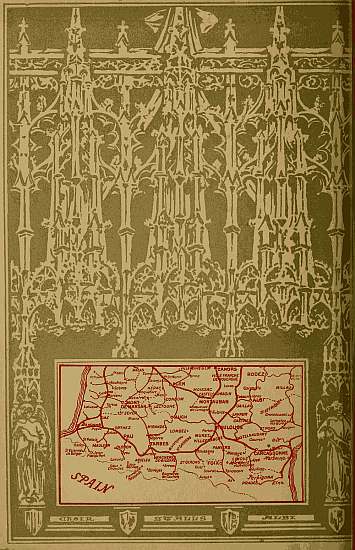
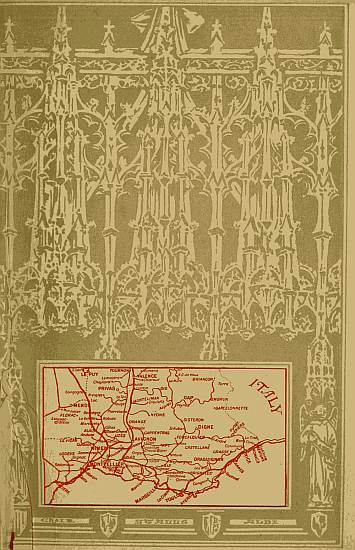
PART V The Valley of the Garonne (continued 2)
Reading edition
By reason of its uncommon constructive elements,—though by no means is it the sole representative of its kind in the south of France,—Ste. Cécile stands forth as the most considerable edifice of its kind among those which were constructed after this manner of Roman antiquity.
Brickwork of this nature, as is well known, is very enduring, and it therefore makes much for the lasting qualities of a structure so built; much more so, in fact, than the crumbling soft stone which is often used, and which crumbles before the march of time like lead in a furnace.
Ste. Cécile was begun in 1282, on the ruins of the ancient church of St. Croix. It came to its completion during the latter years of the fourteenth century, when it stood much as it does to-day, grim and strong, but very beautiful.
The only exterior addition of a later time is the before-remarked florid south porch. This baldaquin is very charmingly worked in a light brown stone, and, while flamboyant to an ultra degree, is more graceful in design and execution than most works of a contemporary era which are welded to a stone fabric whose constructive and decorative details are of quite a distinctly different species. In other words, it composes and adds a graceful beauty to the brick fabric of this great church; but likely enough it would offend exceedingly were it brought into juxtaposition with the more slim lines of early Gothic. Its detail here is the very culmination of the height to which Gothic rose before its final debasement, and, in its spirited non-contemporaneous admixture with the firmly planted brick walls which form its background, may be reckoned as a baroque in art rather than as a thing outré or misplaced.
In further explanation of the peculiar fortress-like qualities possessed by Ste. Cécile, it may be mentioned here that it was the outcome of a desire for the safety of the church and its adherents which caused it to take this form. It was the direct result of the terrible wars of the Albigenses, and the political and social conditions of the age in which it was built,—the days when the Church was truly militant.
Here, too, to a more impressive extent than elsewhere, if we except the papal palace at Avignon, the episcopal residence as well takes on an aspect which is not far different from that possessed by some of the secular châteaux of feudal times. It closely adjoins the cathedral, which should perhaps dispute this. In reality, however, it does not, and its walls and foundations look far more worldly than they do devout. As to impressiveness, this stronghold of a bishop's palace is thoroughly in keeping with the cathedral itself, and the frowning battlement of its veritable donjon and walls and ramparts suggests a deal more than the mere name by which it is known would justify. Such use as it was previously put to was well served, and the history of the troublous times of the mediæval ages, when the wars of the Protestants, "the cursed Albigenses," and the natural political and social dissensions, form a chapter around which one could weave much of the history of this majestic cathedral and its walled and fortified environment.
The interior of the cathedral will appeal first of all by its very grand proportions, and next by the curious ill-mannered decorations with which the walls are entirely covered. There is a certain gloom in this interior, induced by the fact that the windows are mere elongated slits in the walls. There are no aisles, no triforium, and no clerestory; nothing but a vast expanse of wall with bizarre decorations and these unusual window piercings. The arrangement of the openings in the tower are even more remarkable—what there are of them, for in truth it is here that the greatest likeness to a fortification is seen. In the lower stages of the tower there are no openings whatever, while above they are practically nothing but loopholes.
The fine choir-screen, in stone, is considered one of the most beautiful and magnificent in France, and to see it is to believe the statement. The entire clôture of the choir is a wonderful piece of stonework, and the hundred and twenty stalls, which are within its walls, form of themselves an excess of elaboration which perhaps in a more garish light would be oppressive.
The wall-paintings or frescoes are decidedly not beautiful, being for the most part crudely coloured geometrical designs scattered about with no relation one to another. They date from the fifteenth and sixteenth centuries, and are doubtless Italian as to their workmanship, but they betray no great skill on the part of those unknowns who are responsible for them.
The pulpit is an unusually ornate work for a French church, but is hardly beautiful as a work of art. No more is the organ-case, which, as if in keeping with the vast interior, spreads itself over a great extent of wall space.
Taken all in all, the accessories of the cathedral at Albi, none the less than the unique plan and execution thereof, the south porch, the massive tower, the jube and clôture of the choir, the vast unobstructed interior, and the outré wall decorations, place it as one of the most consistently and thoroughly completed edifices of its rank in France. Nothing apparently is wanting, and though possessed of no great wealth of accessory—if one excepts the choir enclosure alone—it is one of those shrines which, by reason of its very individuality, will live long in the memory. It has been said, moreover, to stand alone as to the extensive and complete exemplification of "l'art decoratif" in France; that is, as being distinctively French throughout.
The evolution of these component elements took but the comparatively small space of time covered by two centuries—from the fourteenth to the sixteenth. The culmination resulted in what is still to be seen in all its pristine glory to-day, for Ste. Cécile has not suffered the depredation of many another shrine.
The general plan is distinctly and indigenously French; French to the very core—born of the soil of the Midi, and bears no resemblance whatever to any exotic from another land.
With the decorative elements the case may be somewhat qualified. The baldaquin—like the choir-screen—more than equals in delicacy and grace the portals of such masterworks as Notre Dame de Rouen, St. Maclou, or even the cathedral at Troyes, though of less magnitude than any of these examples. On the other hand, it was undoubtedly inspired by northern precept, as also were the ornamental sculptures in wood and stone which are to be seen in the interior.
Albi was a bishopric as early as the fourth century, with St. Clair as its first bishop. At the time the present cathedral was begun it became an archbishopric, and as such it has endured until to-day, with suffragans at Rodez, Cahors, Mende, and Perpignan.
XXI ST. PIERRE DE MENDE
In the heart of the Gévaudan, Mende is the most picturesque, mountain-locked little city imaginable, with no very remarkable features surrounding it, nor any very grand artificial ones contained within it.
The mountains here, unlike the more fruitful plains of the lower Gévaudan, are covered with snow all of the winter. It is said that the inhabitants of the mountainous upper Gévaudan used to "go into Spain every winter to get a livelihood." Why, it is difficult to understand. The mountain and valley towns around Mende look no less prosperous than those of Switzerland, though to be sure the inhabitants have never here had, and perhaps never will have, the influx of tourists "to live off of," as in the latter region.
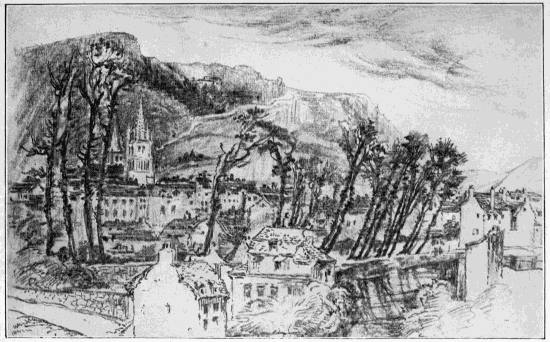

During an invasion of the Alemanni into Gaul, in the third century, the principal city of Gévaudan was plundered and ruined. The bishop, St. Privat, fled into the Cavern of Memate or Mende, whither the Germans followed and killed him.
The holy man was interred in the neighbouring village of Mende, and the veneration which people had for his memory caused them to develop it into a considerable place. Such is the popular legend, at any rate.
The city had no bishop of its own, however, until the middle of the tenth century. Previously the bishops were known as Bishops of Gévaudan. At last, however, the prelates fixed their seat at Mende, and "great numbers of people resorted thither by reason of the sepulchre of St. Privat."
By virtue of an agreement with Philippe-le-Bel, in 1306, the bishop became Count of Gévaudan. He claimed also the right of administering the laws and the coining of specie.
Mende is worth visiting for itself alone and for its cathedral. It is difficult to say which will interest the absolute stranger the more.
The spired St. Pierre de Mende is but a fourteenth-century church, with restorations of the seventeenth, but there is a certain grimness and primitiveness about its fabric which would otherwise seem to place it as of a much earlier date.
The seventeenth-century restorations amounted practically to a reconstruction, as the Calvinists had partly destroyed the fabric. The two fine towers of the century before were left standing, but without their spires.
The city itself lies at a height of over seven hundred kilometres, and the pic rises another three hundred kilometres above. The surrounding "green basin of hillsides" encloses the city in a circular depression, which, with its cathedral as the hub, radiates in long, straight roadways to the bases of these verdure-clad hills.
It is not possible to have a general view of the cathedral without its imposing background of mountain or hilltops, and for this reason, while the entire city may appear dwarfed, and its cathedral likewise diminished in size, they both show in reality the strong contrasting effect of nature and art.
The cathedral towers, built by Bishop de la Rovère, are of sturdy though not great proportions, and the half-suggested spires rise skyward in as piercing a manner as if they were continued another hundred feet.
As a matter of fact one rises to a height of two hundred and three feet, and the other to two hundred and seventy-six feet, so at least, they are not diminutive. The taller of these pleasing towers is really a remarkable work.
The general plan of the cathedral is the conventional Gothic conception, which was not changed in the seventeenth-century reconstruction.
The nave is flanked with the usual aisles, which in turn are abutted with ten chapels on either side.
Just within the left portal is preserved the old bourdon called la Non-Pareille, a curiosity which seems in questionable taste for inclusion within a cathedral.
The rose window of the portal shows in the interior with considerable effect, though it is of not great elegance or magnificence of itself.
In the Chapelle des Catechismes, immediately beneath the tower, is an unusual "Assumption." As a work of art its rank is not high, and its artist is unknown, but in its conception it is unique and wonderful.
There are some excellent wood-carvings in the Chapelle du Baptistère, a description which applies as well to the stalls of the choir.
Around the sanctuary hang seven tapestries, ancient, it is said, but of no great beauty in themselves.
In a chapel on the north side of the choir is a "miraculous statue" of la Vierge Noir.
The organ buffet dates from 1640, and is of the ridiculous overpowering bulk of most works of its class.
The bishopric, founded by St. Sévérein in the third century at Civitas Gabalorum, was reëstablished at Mende in the year 1000.
The Ermitage de St. Privat, the holy shrine of the former habitation of the holy man whose name it bears, is situated a few kilometres away on the side of Mont Mimat. It is a favourite place of pilgrimage, and from the platform of the chapel is to be had a fine view of the city and its cathedral.
XXII OTHER OLD-TIME CATHEDRALS IN AND ABOUT THE BASIN OF THE GARONNE
Dax
At Dax, an ancient thermal station of the Romans, is a small cathedral, mainly modern, with a portal of the thirteenth century.
It was reconstructed from these thirteenth-century remains in the seventeenth century, and exhibits no marks of beauty which would have established its ranking greatness even at that time.
Dax was a bishopric in the province of Auch in the third century, but the see was suppressed in 1802.
Eauze
Eauze was an archbishopric in the third century, when St. Paterne was its first dignitary. Subsequently—in the following century—the archbishopric was transferred to Auch.
As Elusa it was an important place in the time of Cæsar, but was completely destroyed in the early part of the tenth century. Eauze, therefore, has no church edifice which ever ranked as a cathedral, but there is a fine Gothic church of the late fifteenth century which is, in every way, an architectural monument worthy of remark.
Lombez
The bishopric of Lombez, in the ancient ecclesiastical province of Toulouse, endured from 1328 (a tenth-century Benedictine abbey foundation).
Its first bishop was one Roger de Comminges, a monk who came from the monastic community of St. Bertrand de Comminges.
The see was suppressed in 1790.
St. Papoul
St. Papoul was a bishopric from 1317 until 1790. Its cathedral is in many respects a really fine work. It was an ancient abbatial church in the Romanesque style, and has an attractive cloister built after the same manner.
Rieux
Rieux is perhaps the tiniest ville of France which has ever possessed episcopal dignity. It is situated on a mere rivulet—a branch of the Arize, which itself is not much more, but which in turn goes to swell the flood of La Garonne. Its one-time cathedral is perhaps not remarkable in any way, though it has a fine fifteenth-century tower in brique. The bishopric was founded in 1370 under Guillaumé de Brutia, and was suppressed in 1790.
Lavaur
Lavaur was a bishopric, in the ecclesiastical province of Toulouse, from 1317 to 1790.
Its cathedral of brick is of the fourteenth century, with a clocher dating from 1515, and a smaller tower, embracing a jacquemart, of the sixteenth century.
In the interior is a fine sixteenth-century painting, but there are no other artistic treasures or details of note.
Oloron
Oloron was a bishopric under St. Gratus in the sixth century; it ceased its functions as the head of a diocese at the suppression of 1790.
The former cathedral of Ste. Marie is a fine Romanic-Ogivale edifice of the eleventh century, though its constructive era may be said to extend well toward the fifteenth before it reached completion. There is a remarkably beautiful Romanesque sculptured portal. The nave is doubled, as to its aisles, and is one hundred and fifty feet or more in length and one hundred and six wide, an astonishing breadth when one comes to think of it, and a dimension which is not equalled by any minor cathedral.
There are no other notable features beyond the general attractiveness of its charming environment.
The ancient évêche has a fine Romanesque tower, and the cathedral itself is reckoned, by a paternal government, as a "monument historique," and as such is cared for at public expense.
Vabres
Vabres was a bishopric which came into being as an aftergrowth of a Benedictine foundation of the ninth century, though its episcopal functions only began in 1318, and ceased with the Revolutionary suppression. It was a suffragan in the archiepiscopal diocese of Albi.
Its former cathedral, while little to be remarked to-day as a really grand church edifice, was by no means an unworthy fane. It dates from the fourteenth century, and in part is thoroughly representative of the Gothic of that era. It was rebuilt in the eighteenth century, and a fine clocher added.
St. Lizier or Couserans
The present-day St. Lizier—a tiny Pyrenean city—was the former Gallo-Romain city of Couserans. It retained this name when it was first made a bishopric by St. Valère in the fifth century. The see was suppressed in 1790.
The Église de St. Lizier, of the twelfth and thirteenth centuries, consists of a choir and a nave, but no aisles. It shows some traces of fine Roman sculpture, and a mere suggestion of a cloister.
The former bishop's palace dates only from the seventeenth century.
Sarlat
A Benedictine abbey was founded here in the eighth century, and from this grew up the bishopric which took form in 1317 under Raimond de Roquecarne, which in due course was finally abolished and the town stripped of its episcopal rank.
The former cathedral dates from the eleventh and twelfth centuries, and in part from the fifteenth. Connected therewith is a sepulchral chapel, called the tour des Maures. It is of two étages, and dates from the twelfth century.
St. Pons de Tomiers
St. Pons is the seat of an ancient bishopric now suppressed. It is a charming village—it can hardly be named more ambitiously—situated at the source of the river Jaur, which rises in the Montagnes Noir in Lower Languedoc.
Its former cathedral is not of great interest as an architectural type, though it dates from the twelfth century.
The façade is of the eighteenth century, but one of its side chapels dates from the fourteenth.
St. Maurice de Mirepoix
Mirepoix is a charming little city of the slopes of the Pyrenees.
Its ancient cathedral of St. Maurice dates from the fifteenth and sixteenth centuries, and has no very splendid features or appointments,—not even of the Renaissance order,—as might be expected from its magnitude. Its sole possession of note is the clocher, which rises to an approximate height of two hundred feet.
The bishopric was founded in 1318 by Raimond Athone, but was suppressed in 1790.

Appendices
I
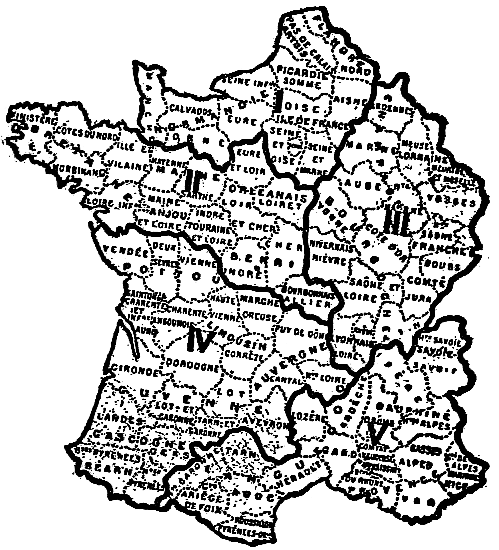
Sketch map showing the usual geographical divisions of France. I., north; II., northwest; III., east; IV., southwest; V., southeast: also the present departments into which the government is divided, with their names; and the mediæval provinces which were gradually absorbed into the kingdom of France.
There is in general one bishopric to a department.
The subject-matter of this book treats of all of southwestern and southeastern France; with, in addition, the departments of Saône-et-Loire, Jura, Rhône, Loire, Ain, and Allier.
II
A Historical Table of the Dioceses of the South of France up to the beginning of the nineteenth century.
Province d'Aix
Name Diocese founded First bishop Date of suppression
Aix Nice, Avignon, Ajaccio, and Digne were allied therewith in 1802, and Marseilles and Alger in 1822.
(Archbishopric) First century (?) St. Maxim (?)
Antibes Transferred to Grasse
Apt First century (?) St. Auspice 1790
Grasse (Jurisdiction over Antibes.)
Gap Fifth century St. Démétrius
Riez Fifth century St. Prosper 1790
Fréjus Fourth century Acceptus
Sisteron Fifth century Chrysaphius
Province d'Albi
Albi Fourth century St. Clair
Bishopric (Archbishopric) 1317 (?) Anthime
Castres 647 as a Benedictine Abbey. 1317 as a Bishopric Robert, the first Abbot 1790
Mende Third century at Civitas Gabalorum. Reëstablished here in the year 1000 St. Sévérein and Genialis
Cahors Fourth century St. Genulphe
Rodez Fifth century St. Amand
Arisitum Sixth century detached from the diocese of Rodez Déothaire Rejoined to Rodez 670
VabresBenedictine Abbey, 862. Bishopric, 13171790
Province d'Arles
Arles (Archbishopric)First century St. Trophime 1790
Marseilles First century St. Lazare
St. Paul-Trois Châteaux, or Tricastin Second century St. Restuit 1790
Toulon Fifth century Honoré 1790
Orange Fifth century St. Luce 1790
Province d'Auch
Eauze (Archbishopric) Third century St. Paterne 720
Auch (Bishopric then Archbishopric) Fourth century Citerius
Dax Third century St. Vincent 1802
Lectoure Sixth century Heuterius 1790
Comminges Sixth century Suavis 1790
Conserans Fifth century St. Valère 1790
Aire Fifth century Marcel
Bazas Sixth century Sextilius (?)
Tarbes Sixth century St. Justin
Oloron Sixth century Gratus 1790
Lescar Fifth century St. Julien 1790
Bayonne Ninth century Arsias Rocha
Province d'Avignon
Avignon (Bishopric, becoming Archbishopric in fifteenth century)Fourth century St. Ruf
Carpentras Third century St. Valentin 1790
Vaison Fourth century St. Aubin 1790
Cavaillon Fifth century St. Genialis 1790
Province de Bordeaux
Bordeaux
(Bishopric) Third century
(Archibishopric) Fourth centuryOriental
Agen Fourth century St. Phérade
Condom Raimond de Galard
(Ancient abbey--foundation date unknown) Bishopric) Fourteenth century
Angoulême Third century St. Ansome
Saintes Third century St. Eutrope 1793
Poitiers Third century St. Nectaire
Maillezais (afterward at La Rochelle) Fourteenth century Geoffrey I.
Luçon (Seventh-century abbey) 1317 Pierre de La Veyrie
Périgueux Second century St. Front
Sarlat (Eighth-century Benedictine abbey) 1317Raimond de Roquecorne
Province de Bourges
Bourges (Archbishopric) Third century St. Ursin
Clermont-Ferrand Third century St. Austremoine
St. Flour (Ancient priory) 1318 Raimond de Vehens
Limoges Third century St. Martial
Tulle (Seventh-century Benedictine abbey) 1317Arnaud de Saint-Astier
Le Puy Third century St. Georges
Province d'Embrun
Embrun (Archbishopric) Fourth century St. Marcellin 1793
Digne Fourth century St. Domnin
Antibes (afterward at Grasse) Fourth century St. Armentaire
Grasse Raimond de Villeneuve (1245) 1790
Vence Fourth century Eusèbe 1790
Glandève Fifth century Fraterne 1790
Senez Fifth century Ursus 1790
Nice (formerly at Cemenelium) Fourth century Amantius
Province de Lyon
Lyon (Archbishopric) The Archbishop of Lyon was Primate of Gaul. Second century St. Pothin
Autun Third century St. Amateur
Mâcon Sixth century Placide 1790
Chalon-sur-Saône Fifth century Paul 1790
Langres Third century St. Just
Dijon (Fourth-century abbey) Bishopric in 1731 Jean Bonhier
Saint Claude (Fifth-century abbey) Bishopric in 1742 Joseph de Madet
Province de Narbonne
Narbonne (Archbishopric)Third century St. Paul 1802
Saint-Pons-de-Tomières (Tenth-century abbey) 1318 Pierre Roger 1790
Alet (Ninth-century abbey) 1318 Barthélmy 1790
Béziers Fourth century St. Aphrodise 1702
Nîmes Fourth century St. Felix
Alais 1694 Chevalier de Saulx 1790
Lodève Fourth century (?) St. Flour 1790
Uzès Fifth century Constance 1790
Agde Fifth century St. Vénuste 1790
Maguelonne (afterward at Montpellier) Sixth century Beotius
Carcassonne Sixth century St. Hilaire
Elne (afterward at Perpignan) Sixth century Domnus
Province de Tarentaise
Tarentaise (Archbishopric) Fifth century St. Jacques
Sion Fourth century St. Théodule
Aoste Fourth century St. Eustache
Chambéry 1780 Michel Conseil
Province de Toulouse
Toulouse (Bishopric) (Archbishopric) Third century 1327St. Saturnin
Pamiers (Eleventh-century abbey) 1297 Bernard Saisset
Rieux 1317 Guillaume de Brutia
Montauban (Ancient abbey) 1317 Bertrand du Puy
Mirepoix 1318 Raimond Athone 1790
Saint-Papoul 1317 Bernard de la Tour 1790
Lombès (Tenth-century abbey)1328Roger de Commminges 1790
Lavaur 1317 Roger d'Armagnac1790
Province de Vienne
Vienne (Archbishopric)Second century St. Crescent 1790
Grenoble Third century Domninus
Genève (Switz.) Fourth century Diogène 1801
Annency 1822 Claude de Thiollaz
Valence Fourth century Emelien
Dié Third century Saint Mars
Viviers Fifth century Saint Janvier 1790
St. Jean de Maurienne Fifth century Lucien
III
The Classification of Architectural Styles in France according to De Caumont's "Abécédaire d'Architecture Religieuse."
Architecture RomainePrimordiale From the Vth to the Xth centuries.
SecondaireFrom the end of the Xth century to the beginning of the XIIth
Tertiaire or transition XIIth century
ArchitecturePrimitive XIIIth century
Ogivale Secondaire XIVth century
Tertiaire XVth and the first part of the XVIth century

IV
A Chronology of Architectural Styles in France
Following more or less upon the lines of De Caumont's territorial and chronological divisions of architectural style in France, the various species and periods are thus further described and defined:
The Merovingian period, commencing about 480; Carlovingian, 751; Romanesque or Capetian period, 987; Transitional, 1100 (extending in the south of France and on the Rhine till 1300); early French Gothic or Pointed (Gothique à lancettes), mid-twelfth to mid-thirteenth centuries; decorated French Gothic (Gothique rayonnant), from the mid-thirteenth to mid-fifteenth centuries, and even in some districts as late as the last decade of the fifteenth century; Flamboyant (Gothique flamboyant), early fifteenth to early sixteenth; Renaissance, dating at least from 1495, which gave rise subsequently to the style Louis XII. and style François I.
With the reign of Henri II., the change to the Italian style was complete, and its place, such as it was, definitely assured. French writers, it may be observed, at least those of a former generation and before, often carry the reference to the style de la Renaissance to a much later period, even including the neo-classical atrocities of the seventeenth and eighteenth centuries.
Bizarre or baroque details, or the style perruque, had little place on French soil, and the later exaggerations of the rococo, the styles Pompadour and Dubarri, had little if anything to do with church-building, and are relevant merely insomuch as they indicate the mannerisms of a period when great churches, if they were built at all, were constructed with somewhat of a leaning toward their baseness, if not actually favouring their eccentricities.
V
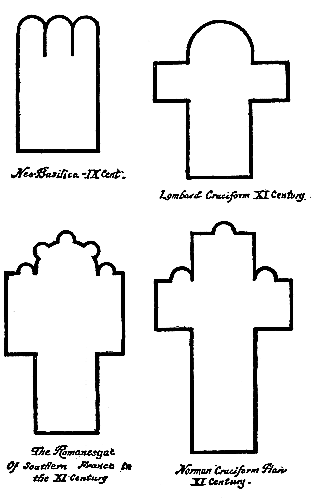
Leading forms of early cathedral constructions
VI
The disposition of the parts of a tenth-century church, as defined by Viollet-le-Duc
Of this class are many monastic churches, as will be evinced by the inclusion of a cloister in the diagram plan. Many of these were subsequently made use of, as the church and the cloisters, where they had not suffered the stress of time, were of course retained. St. Bertrand de Comminges is a notable example among the smaller structures.
In the basilica form of ground-plan, which obtained to a modified extent, the transepts were often lacking, or at least only suggested. Subsequently they were added in many cases, but the tenth-century church pur sang was mainly a parallelogram-like structure, with, of course, an apsidal termination.
Plan X Century Church
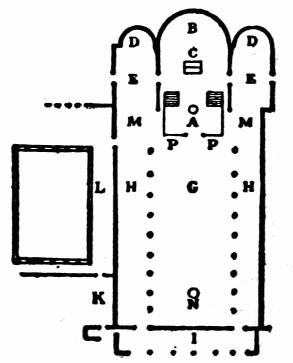
AThe choir
BThe exedra, meaning literally a niche or throne—in this instance for the occupancy of the bishop, abbot, or prior—apart from the main edifice
CThe high-altar
DSecondary or specially dedicated altars
EThe transepts, which in later centuries expanded and lengthened
GThe nave proper, down which was reserved a free passage separating the men from the women
HThe aisles
IThe portico or porch which precedes the nave (i. e., the narthen of the primitive basilica), where the pilgrims who were temporarily forbidden to enter were allowed to wait
KA separate portal or doorway to cloisters
LThe cloister
MThe towers; often placed at the junction of transept and nave, instead of the later position, flanking the west façade
NThe baptismal font; usually in the central nave, but often in the aisle
OEntrance to the crypt or confessional, where were usually preserved the reliques of the saint to whom the church was erected
PThe tribune, in a later day often surrounded by a screen or jubé
VII
A brief definitive gazetteer of the natural and geological divisions included in the ancient provinces and present-day departments of southern France, together with the local names by which the pays et pagi are commonly known
GévaudanIn the Cevennes, a region of forests and mountains
VelayA region of plateaux with visible lava tracks
Lyonnais-BeaujolaisThe mountain ranges which rise to the westward of Lyons
MorvanAn isolated group of porphyrous and granite elevations
Haute-AuvergneThe mountain range of Cantal
Basse-AuvergneThe mountain chains of Mont Dore and des Dômes
LimousinA land of plateaux, ravines, and granite
AgenaisRocky and mountainous, but with its valleys among the richest in all France
Haut-QuercyA rolling plain, but with little fertility
Bas-QuercyThe plains of the Garonne, the Tarn, and the Avéyron
ArmagnacAn extensive range of petites montagnes running in various directions
LandesA desert of sand, forests, and inlets of the sea
BéarnA country furrowed by the ramifications of the range of the Pyrenees
Basse-NavarreA Basque country situated on the northern slope of the Pyrenees
BigorreThe plain of Tortes and its neighbouring valleys
SavoieA region comprising a great number of valleys made by the ramifying ranges of the Alps. The principal valleys being those of Faucigny, the Tarentaise, and the Maurienne
BourbonnaisA country of hills and valleys which, as to general limits, corresponds with the Department of the Allier
NivernaisAn undulating region between the Loire and the Morvan
BerryA fertile plain, slightly elevated, to the northward of Limousin
SologneAn arid plain separated by the valleys of the Cher and the Indre
GatinaisA barren country northeast of Sologne
SaintongeSlightly mountainous and covered with vineyards—also in parts partaking of the characteristics of the Landes
AngoumoisA hilly country covered with a growth of vines
PérigordAn ensemble of diverse regions, often hilly, but covered with a luxuriant forest growth
Bordelais(Comprising Blayais, Fronsadais, Libournais, Entre-deux-mers, Médoc, and Bazadais.) The vine-lands of the Garonne, La Gironde, and La Dordogne
DauphinéAnother land of mountains and valleys. It is crossed by numbers of ranges and distinct peaks. The principal subdivisions are Viennois, Royonnais Vercors, Trièves, Dévoluy, Oisons, Graisivaudan, Chartreuse, Queyras Valgodemar, Champsaur.
ProvenceA region of fertile plains dominated by volcanic rocks and mountains. It contains also the great pebbly plain in the extreme southwest known as the Crau
CamargueThe region of the Rhône delta
LanguedocProperly the belt of plains situated between the foot of the Cevennes and the borders of the Mediterranean
RousillonThe region between the peaks of the Corbière and the Albère mountain chain. The population was originally pure Catalan
LauragaisA stony plateau with red earth deposited in former times by the glaciers of the Pyrenees
AlbigeoisA rolling and fertile country
ToulousainA plain well watered by the Garonne and the Ariège
CommingesThe lofty Pyrenean valleys of the Garonne basin
VIII
Sketch map of the bishoprics and archbishoprics of the south of France at the present day
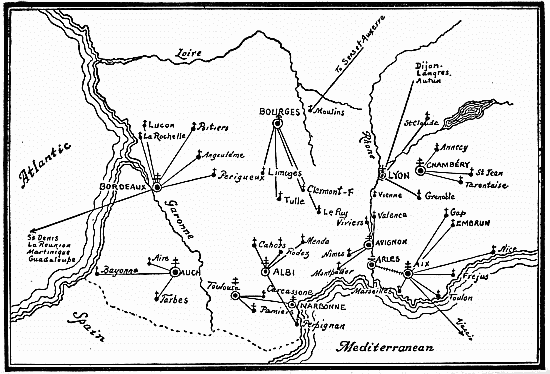
IX Dimensions and Chronology
CATHEDRALE D'AGDE
Bishopric founded, Vth century
Bishopric suppressed, 1790
Primitive church consecrated, VIIth century
Main body of present cathedral, XIth to XIIth centuries
ST. CAPRIAS D'AGEN
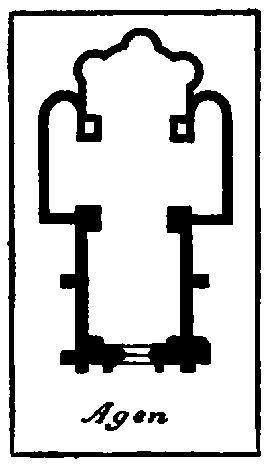
Former cathedral of St. Etienne, destroyed at the Revolution, 1790
Apse and transepts of St. Caprias, XIth century
Width of nave, 55 feet
ST. JEAN BAPTISTE D'AIRE
Cathedral begun, XIIIth century
ST. SAVEUR D'AIX
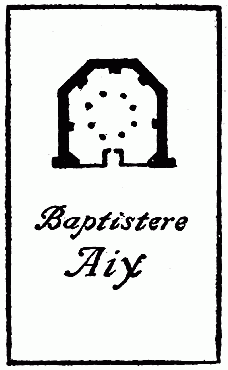
Eglise St. Jean de Malte, XIVth century
Remains of a former St. Saveur's, XIth century
Choir, XIIIth century
Choir elaborated, XIVth century
South aisle of nave, XIVth century
Tower, XIVth century
Carved doors, 1503
Episcopal palace, 1512
North aisle of nave, XVIIth century
Baptistère, VIth century
ST. JEAN D'ALAIS
A bishopric only from 1694 to 1790
Remains of a XIIth century church
STE. CECILE D'ALBI
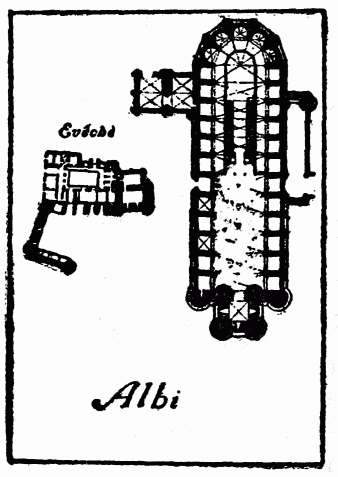
Begun, 1277
Finished, 1512
South porch, 1380-1400
Tower completed, 1475
Choir-screen, 1475-1512
Wall paintings, XVth to XVIth centuries
Organ, XVIIIth century
Choir stalls, 120 in number
Height of tower, 256 feet
Length, 300 (320?) feet
Width of nave, 88 feet
Height of nave, 98 feet
ST. PIERRE D'ALET
Primitive cathedral, IXth century (?)
Rebuilt, XIth century
Eglise St. André, XIVth to XVth centuries
ST. PIERRE D'ANGOULEME
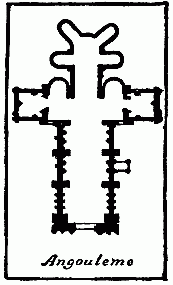
City ravaged by Coligny, XVIth century
Cathedral rebuilt from foundations of primitive church, 1120
Western dome, XIIth century
Central and other domes, latter part of XIIth century
Episcopal palace restored, XIXth century
General restoration of cathedral, after the depredations of Coligny, 1628
Height of tower, 197 feet
ST. PIERRE D'ANNECY
Christianity first founded here, IVth century
Cathedral dates from XIVth century
Tomb of St. François de Sales, 1622
Tomb of Jeanne de Chantal, 1641
Episcopal palace, 1784
ST. CASTOR D'APT
Gallo-Romain sarcophagus, Vth century
Tomb of Ducs de Sabron, XIIth century
Chapelle de Ste. Anne, XVIIth century
ST. TROPHIME D'ARLES
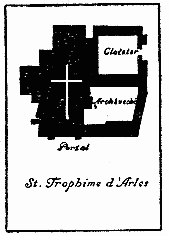
Primitive church on same site, 606
Foundations of present cathedral laid, 1152
Nave completed, 1200
Choir and chapels, 1423-1430
Cloisters, east side, 1221
Cloisters, west side, 1250
Cloisters, north side, 1380
Length, 240 feet
Width, 90 feet
Height, 60 feet
Height of clocher, 137 feet
STE. MARIE D'AUCH
Ancient altar, IVth century
First cathedral built by Taurin II., 845
Another (larger) by St. Austinde, 1048
Present cathedral consecrated, 1548
Additions made and coloured glass added, 1597
West front, in part, XVIIth century
Towers, 1650-1700
Episcopal palace, XIVth century
Length, 347 feet
Height to vaulting, 74 feet
NOTRE DAME DES DOMS D'AVIGNON
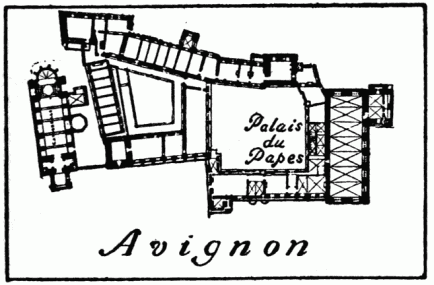
Territory of Avignon acquired by the Popes from Joanna of Naples, 1300
Popes reigned at Avignon, 1305-1370
Avignon formally ceded to France by Treaty of Tolentino, 1797
Palais des Papes begun, XIIIth century
Pope Gregory left Avignon for Rome, 1376
Cathedral dates chiefly from XIIth century
Nave chapels, XIVth century
Frescoes in portal, XIVth century
Height of walls of papal palace, 90 feet
" " tower " " 150 feet
Length of cathedral, 200 (?) feet
Width of cathedral, 50 (?) feet
NOTRE DAME DE BAYONNE
Foundations, 1140
Choir and apse, XIIth century
Destroyed by fire, 1213
Choir rebuilt, 1215
Completed and restored, XVIth century
ST. JEAN DE BAZAS
Foundations date from Xth century
Walls, etc., 1233
West front, XVIth century
CATHEDRALE DE BELLEY
Gothic portion of cathedral, XVth century
ST. NAZAIRE DE BEZIERS
Primitive church damaged by fire, 1209
Transepts, XIIIth century
Towers, XIVth century
Apside and nave, XIVth century
Glass and grilles, XIVth century
Cloister, XIVth century
Height of clocher, 151 feet
ST. ANDRE DE BORDEAUX
Three cathedral churches here before the XIth century
Romanesque structure, XIth century
Present cathedral dates from 1252
North transept portal, XIVth century
Noailles monument, 1662
Length, 450 feet
Width of nave, 65 feet
NOTRE DAME DE BOURG
Main body dates from XVth to XVIIth centuries
Choir and apse, XVth to XVIth centuries
Choir stalls, XVIth century
ST. ETIENNE DE CAHORS
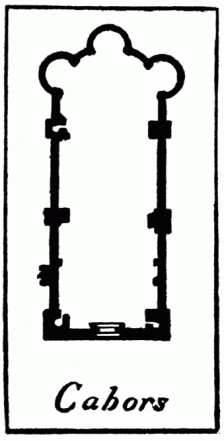
Bishopric founded, IVth century
Cathedral consecrated, 1119
Cupola decorations, 1280-1324
Choir chapels, XVth century Choir, 1285
Tomb of Bishop Solminiac, XVIIth century
Choir paintings, 1315
Cloister, XIIth to XVth century
Cupolas of nave, 50 feet in diameter
Cupolas of choir, 49 feet in height
Height from pavement to cupolas of choir, 82 feet
Height from pavement to cupolas of nave, 195 feet
Portal and western towers, XIVth century
ST. NAZAIRE DE CARCASSONNE
Present-day cathedral, St. Michel, in lower town, 1083
Restored by Viollet-le-Duc, 1849
Visigoth foundation walls of old Cité, Vth to VIIIth centuries
Cité besieged by the Black Prince, 1536
Château of Cité and postern gate, XIth and XIIth centuries
Outer fortifications with circular towers of the time of St. Louis, XIIIth century
Length inside the inner walls, ¼ mile
Length inside the outer walls, 1 mile
Saracens occupied the Cité, 783
Routed by Pepin le Bref, 759
Viscountal dynasty of Trencavels, 1090
Besieged by Simon de Montfort, 1210
Romanesque nave of St. Nazaire, 1096
Choir and transepts, XIIIth and XIVth centuries
Remains of Simon de Montfort buried here (since removed), 1218
Tomb of Bishop Radulph, 1266
Statues in choir, XIVth century
High-altar, 1522
Crypt, XIth century
Sacristy, XIIIth century
The "Pont Vieux," XIIth and XIIIth centuries
ST. SIFFREIN DE CARPENTRAS
A Roman colony under Augustus, Ist century
St. Siffrein, patron of the cathedral, died, XVIth century
Edifice mainly of the XVIth century
Paintings in nave, XVIIIth and XIXth centuries
Tomb of Bishop Buti, 1710
Episcopal palace built, 1640
Arc de Triomphe, Ist or IId century
Porte d'Orange, XIVth century
ST. BENOIT DE CASTRES
Cathedral dates mainly from XVIIth century
ST. VERAN DE CAVAILLON
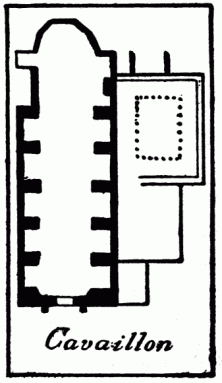
Cathedral consecrated by St. Veran, in person, 1259
Tomb of Bishop Jean de Sade, XVIIth century
ST. ETIENNE DE CHALONS-SUR-SAONE
Cathedral completed, XVIth century
Rebuilt, after a disastrous fire, XVIIth century
Remains of early nave, dating from XIIIth century
Bishopric founded, Vth century
Height of nave, 90 feet
Length of nave, 350 feet
CATHEDRALE DE CHAMBERY
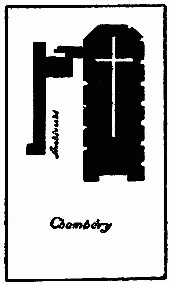
First bishop, Michel Conseil, 1780
Main body of cathedral dates from XIVth century
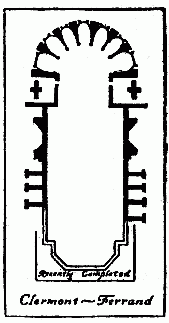
NOTRE DAME DE CLERMONT-FERRAND
Choir and nave, 1248-1265
Urban II. preached the Crusades here, 1095
Sanctuary completed, XIIIth century
Nave completed, except façade, XIVth century
Rose windows, XVth century
Western towers and portal, XIXth century
Height of towers, 340 feet
Height of nave, 100 feet
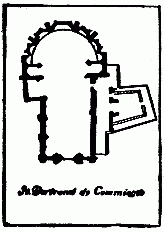
ST. BERTRAND DE COMMINGES
First monastery here, VIth century
Present cathedral mainly XIIth to XIVth centuries
First bishop, Suavis, VIth century
Monument to Bishop Hugh de Castellane, XIVth century
Length, 210 feet (?)
Width, 55 feet (?)
CATHEDRALE DE DAX
Main fabric, XIIIth century
Reconstructed, XVIIIth century
NOTRE DAME DE DIE
A bishopric in 1285, and from 1672 until 1801
Porch, XIth century
Romanesque fragments in "Porte Rouge," XIth century
Restored and rebuilt, XVIIth century
Length of nave, 270 feet
Width of nave, 76 feet
CATHEDRALE D'EAUZE
Town destroyed, Xth century
Gothic church (not, however, the former cathedral), XVth century
STE. EULALIE D'ELNE
Cathedral rebuilt from a former structure, XVth century
Cloister, XVth century
NOTRE DAME D'EMBRUN
North porch and peristyle, XIIth century
Romanesque tower rebuilt, XIVth century
The "Tour Brune" XIth century
High-altar, XVIIIth century
Painted triptych, 1518
Coloured glass, XVth century
Organ and gallery, XVIth century
NOTRE DAME DE GRENOBLE
Foundations of choir, XIth century
Tabernacle, XVth century
Tomb of Abbé Chissé, 1407
Former episcopal palace, XIth century
Present episcopal palace, on same site, XVth century
Eglise St André, XIIIth century
"La Grande Chartreuse," founded by St. Bruno, 1084
"La Grande Chartreuse," enlarged, XVIth to XVIIth centuries
Monks expelled, 1816 and 1902
ST. LOUIS DE LA ROCHELLE
City besieged unsuccessfully, 1573
City besieged and fell, XVIIth century
Huguenots held the city from 1557 to 1629
Present cathedral dates from 1735
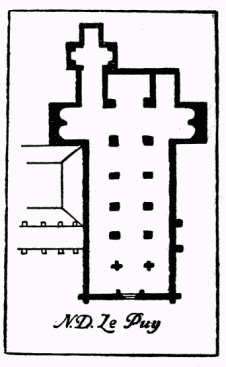
NOTRE DAME DE LE PUY
First bishop, St. Georges, IIId century
Primitive cathedral, Vth century
West façade of present edifice, XIIth century
Choir, Xth century
Virgin of Le Puy, 50 feet in height
Aguille de St. Michel, 250 feet in height, 50 feet in circumference at top, 500 feet at base
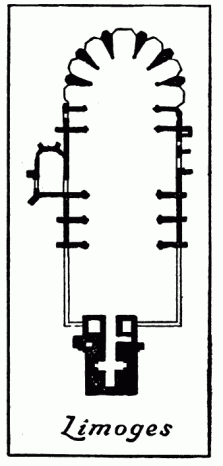
ST. ETIENNE DE LIMOGES
Nave, XVth and XVIth centuries
Romanesque portion of nave, XIth century
Lower portion of tower, XIth century
Clocher, XIIIth century
Choir, XIIIth century
Transepts, XIVth and XVth centuries
Choir-screen, 1543
Coloured glass, XVth and XIXth centuries
Tomb of Bishop Brun, 1349; de la Porte, 1325; Langeac, 1541
Crypt, XIth century
Height of clocher, 240 feet
Enamels of reredos, XVIIth century
ST. FULCRAN DE LODEVE
City converted to Christianity, 323
Earliest portion of cathedral, Xth century
Main portion of fabric, XIIth century
Cathedral completed, XVIth century
Tomb of Bishop de la Panse, 1658
Height of nave, 80 feet
CATHEDRALE DE LUCON
Ancient abbey, VIIth century
First bishop appointed, 1317
Richelieu bishop here, 1616-1624
Main fabric of cathedral dates from XIIth to XVIIth centuries
Fabric restored, 1853
Cloister of episcopal palace, XVth century
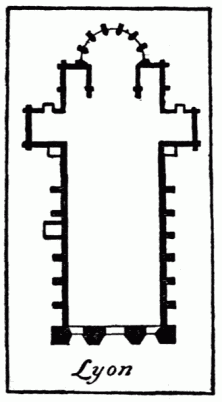
ST. JEAN DE LYON
Bridge across Saône, Xth century
Earliest portions of cathedral, 1180
Concile générale of the Church held at Lyons, 1245 and 1274
Portail, XVth century
Glass of choir, XIIIth and XIVth centuries
Great bourdon, 1662
Weight of great bourdon, 10,000 kilos
Chapelle des Bourbons, XVth century
Astronomical clock, XVIth and XVIIth centuries
STE. MARIE MAJEURE DE MARSEILLES
First bishop, St. Lasare, Ist century
Ancient cathedral built upon the ruins of a temple to Diana, XIth century
New cathedral begun, 1852
Practically completed, 1893
Length, 460 feet
Height of central dome, 197 feet
ST. JEAN DE MAURIENNE
Relique of St. Jean Baptiste, first brought here in VIth century
Cloister, 1452
ST. PIERRE DE MENDE
First bishop, Xth century
Main fabric of cathedral, XIVth century
Restoration, XVIIth century
Towers, XVIth century
Organ-case, 1640
Height of western towers, 203 and 276 feet
ST. PIERRE DE MONTPELLIER
Bishopric removed here from Maguelonne, 1536
Pope Urban V. consecrated present cathedral in a former Benedictine abbey, 1364
Length of nave, 181 feet
Width of nave, 49 feet
Length of choir, 43 feet
Width of choir, 39 feet
NOTRE DAME DE MOULINS
Towers and west front, XIXth century
Choir and nave, 1465-1507
Coloured glass, XVth and XVIth centuries
Choir restoration completed, 1885
Sepulchre, XVIth century
Height of western spires, 312 feet
Château of Ducs de Bourbon (facing the cathedral) XIVth century
ST. JUST DE NARBONNE
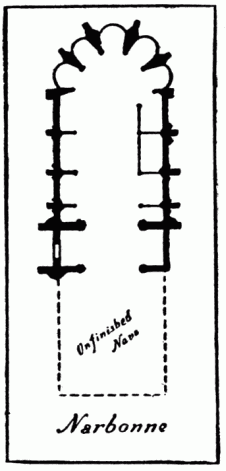
Choir begun, 1272-1330
Choir rebuilt, XVIIIth century
Remains of cloister, XIVth and XVth century
Towers, XVth century
Tombs of bishops, XIVth to XVIth centuries
Organ buffet, 1741
Height of choir vault, 120 (127?) feet
ST. CASTOR DE NIMES
St. Felix the first bishop, IVth century
St. Castor as bishop, 1030
Cathedral damaged by wars of XVIth and XVIIth centuries
Length of grande axe of Arena, 420 feet
Capacity of Arena, 80,000 persons
STE. MARIE D'OLORON
Earliest portions, XIth century
Completed, XVth century
Length of nave, 150 feet
Width of nave, 106 feet
NOTRE DAME D'ORANGE
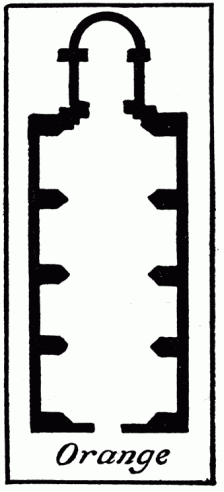
Oldest portions, 1085
Nave, 1085-1126
CATHEDRALE DE PAMIERS
Clocher, XIVth century
Nave rebuilt, XVIIth century
Ancient Abbey of St. Antoine, XIth century
First bishop, Bernard Saisset, 1297
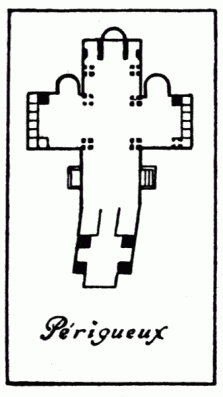
ST. FRONT DE PERIGUEUX
Primitive monastery founded, VIth century
Cathedral dates from 984-1047
Cathedral rebuilt, XIIth century
Cathedral restored, XIXth century
Pulpit in carved wood, XVIIth
Confessionals, Xth or XIth century
Paintings in vaulting, XIth century
Length of nave, 197 feet
Height of pillars of nave, 44 feet
Height of cupola of clocher, 217 feet
Height of great arches in interior, 65 feet
ST. JEAN DE PERPIGNAN
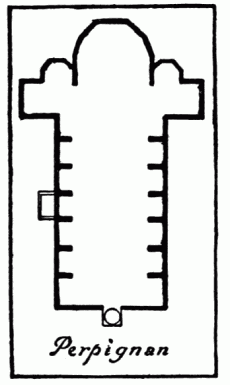
Tower, XIVth century
Rétable, XIV century
Altar-screen, XIVth century
Bishop's tomb, 1695
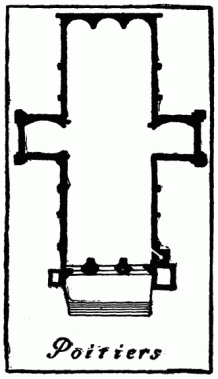
ST. PIERRE DE POITIERS
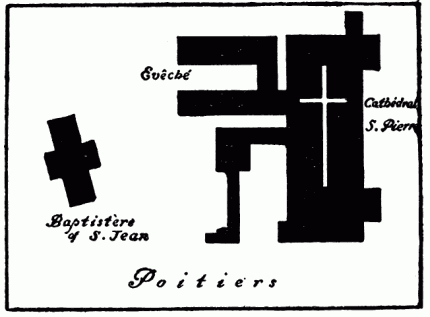
Eglise St. Hilaire, Xth and XIth centuries
Baptistère, IVth to XIIth centuries
St. Radegonde, XIth and XIIth centuries
Cathedral begun, 1162
High-altar dedicated, 1199
Choir completed, 1250
Western doorway, XVth century
Coloured glass, XIIIth and XVIIIth centuries
NOTRE DAME DE RODEZ
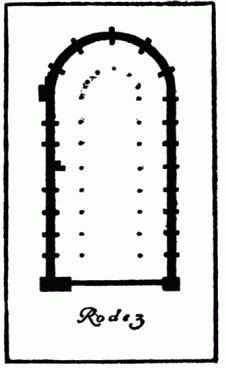
Dates chiefly from 1275
Choir, XIVth century
Nave, XVth century
Cross-vaults, tribune, sacristy door, and façade, from about 1535
Clôture of choir designed by Cusset
Terrace to episcopal palace designed by Philandrier, 1550
Episcopal palace itself dates, in the main, from XVIIth century
Rose window of façade is the most notable in France south of the Loire, excepting Poitiers
ST. PIERRE DE SAINTES
Eglise St. Eutrope, 1081-1096
Primitive cathedral, 1117
Cathedral rebuilt, 1585
First two bays of transept, XIIth century
Nave completed, XVth century
Vaulting of choir and nave, XVth to XVIIth centuries
Height of flamboyant tower (XIVth century), 236 feet
CATHEDRALE DE SARLAT
Benedictine abbey dates from VIIIth century
Cathedral mainly of XIth and XIIth centuries
Sepulchral chapel, XIIth century
CATHEDRALE DE SION
First bishop, St. Théodule, IVth century
Choir of Eglise Ste. Catherine, Xth or XIth century
Bishop of Sion sent as papal legate to Winchester, 1070
Main body of cathedral, XVth century
ST. PIERRE DE ST. CLAUDE
Abbey founded by St. Claude, Vth century
Bishopric founded by Jos. de Madet, 1742
Bishopric suppressed, 1790
Bishopric revived again, 1821
Main fabric of cathedral, XIVth century
Cathedral restored, XVIIIth century
Length, 200 feet (approx.)
Width, 85 feet "
Height, 85 feet "
ST. ODILON DE ST. FLOUR
Bishopric founded, 1318
Present cathedral begun, 1375
" " dedicated, 1496
" " completed, 1556
Episcopal palace, 1800
Château de St. Flour, 1000
ST. LISIER OR COUSERANS
Former cathedral, XIIth and XIIIth centuries
Bishop's palace, XVIIth century
STE. MARIE MAJEURE DE TOULON
Main body of fabric, XIth and XIIth centuries
Façade, XVIIth century
Length of nave, 160 feet
Width of nave, 35 feet
ST. ETIENNE DE TOULOUSE
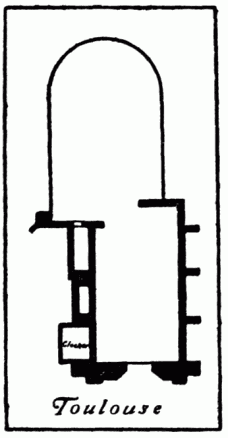
Nave, XIIIth century
Tower, XVth and XVIth century
Choir, 1275-1502
Bishopric founded, IIId century
Archbishopric founded, 1327
Width of nave, 62 feet
ST PAUL TROIS CHATEAUX
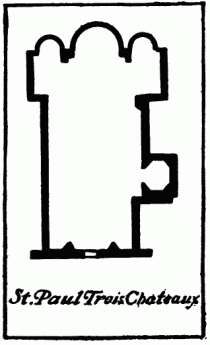
Chapel to St. Restuit first erected here, IVth century
Town devastated by the Vandals, Vth century
" " " " Saracens, 736
" " " " Protestants, XIVth century
" " " " Catholics, XIVth century
Former cathedral, XIth and XIIth centuries
CATHEDRALE DE TULLE
Benedictine foundation, VIIth century
Cloister, VIIth century (?)
Bishopric founded, 1317
Romanesque and transition nave, XIIth century
ST. THEODORIT D'UZES
Inhabitants of the town, including the bishop, mostly became Protestant, XVIth century
Cathedral rebuilt and restored, XVIIth and XVIIIth centuries
Tour Fénestrelle, XIIIth century
Organ-case, XVIIth century
Height of the "Tour Fénestrelle," 130 feet
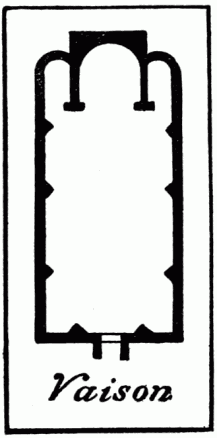
CATHEDRALE DE VAISON
Cloister, XIth century
Eglise de St. Quinin, VIIth century
ST. APOLLINAIRE DE VALENCE
Cathedral rebuilt and reconsecrated by Urban II., XIth century
Reconstructed, 1604
Bishopric founded, IVth century
Foundations laid, XIIth century
Cenotaph to Pius VI., 1799
Height of tower, 187 feet
CATHEDRALE DE VABRES
Principally, XIVth century
Rebuilt and reconstructed, and clocher added, XVIIIth century
NOTRE DAME DE VENCE
Fabric of various eras, VIth, Xth, XIIth, and XVth centuries
Rétable, XVIth century
Choir-stalls, XVth century
ST. MAURICE DE VIENNE
Bishopric dates from IId century
St. Crescent, first bishop, 118
Cathedral begun, 1052
Reconstructed, 1515
Coloured glass, in part, XIVth century
Tomb of Cardinal de Montmorin, XVIth century
Metropolitan privileges of Vienne confirmed by Pope Paschal II., 1099
CATHEDRALE DE VIVIERS
Choir, XIVth century
Tower, XIVth and XVth centuries
INDEX
Abbey of Cluny, 59, 61. Abbey of Montmajour, 230. Acre, 56. Adelbert, Count of Périgueux, 38. Adour, River, 417. Agde, 53, 358, 359. Agde, Cathédrale de, 358-360, 520. Agen, 42, 429. Agen, St. Caprais de, 429, 431, 520. Agout, River, 471. Aigues-Mortes, 228, 319, 320. Aire, St. Jean Baptiste de, 469, 470, 521. Aix, 36, 230, 283, 293, 323, 324. Aix St. Jean de Malte, 324. Aix, St. Sauveur de, 323-327, 521. Ajaccio, 47. Alais, 249-251. Alais, St. Jean de, 249-251, 521. Alberoni, Cardinal, 240. Albi, 27, 41, 53, 54, 61, 95, 98, 274. Albi, Ste. Cécile de, 363, 482-489, 522. Albigenses, The, 365, 485, 486. Alet, 42. Alet, St. Pierre de, 350, 351, 522. Amantius, 330. Amiens, 60, 62. Andorra, Republic of, 373. Angers, Château at, 66. Angers, St Maurice d', 97. Angoulême, 55, 61, 73, 120, 124. Angoulême, St. Pierre de, 73, 120-125, 523. Anjou, 45, 71. Anjou, Duke of, 40, 44. Anjou, Henry Plantagenet of, 39. Anjou (La Trinité), 56. Annecy, 252-254, 256. Annecy, St. Pierre de, 252-254, 523. Antibes, 330, 339, 341. Aosti, 268. Apt, 289-291. Apt, St. Castor de, 523. Aquitaine, 38, 62. Aquitanians, The, 38. Aquitanian architecture, 54, 55, 66. Arc de Triomphe (Saintes), 115. Architecture, Church, 50-56. Ariosto, 235. Arles, 28, 33, 61, 217, 228-235, 283, 293. Arles, Archbishop of, 46. Arles, St. Trophime de, 37, 202, 228-235, 524. Arnaud, Bishop, 354. Auch, St. Marie de, 432-438, 524. Auch, College of, 438. Augustus, 221. Autun, Bishop of (Talleyrand-Périgord), 46. Auvergne, 29, 62, 72-74. Auzon, 221. Avignon, 33, 41, 53, 54, 241. Avignon, Papal Palace at, 377, 485. Avignon, Notre Dame des Doms, 204-220, 525. Avignon, Ruf d', 36. Baptistère of St. Siffrein de Carpentras, 222. Baptistère, The (Poitiers), 95, 96, 101. Basilique de Notre Dame de Fourvière, 185. Bayonne, 28, 57, 373, 387, 405-407, 410, 411. Bayonne, Notre Dame de, 405-410, 525. Bazas, St. Jean de, 411, 412, 526. Bazin, René, 229, 235. Bearn, Province of, 395, 406. Beauvais, Lucien de, 37. Becket, Thomas à, 111. Belley, 267. Belley, Cathédrale de, 526. Benedict XII., Pope, 211, 216. Bénigne, 171. Berengarius II., 371. Berri, 71, 72. Besançon, 267, 274. Besançon, Lin de, 36. Béthanie, Lazare de, 36. Bézard, 431. Béziers, 53, 363-365. Béziers, Bishop of, 365. Béziers, St. Nazaire de, 363-367, 526. Bichi, Alexandri, 224. Bishops of Carpentras, 221. Bishop of Ypres, 48. "Black Prince," The, 418, 453. Blois, Château at, 66. Breakspeare, 230. Bretagne, Slabs in, 64. Bridge of St. Bénezet, 219. Bordeaux, 57, 384, 387, 396, 397, 401. Bordeaux, St. André de, 94, 396-401, 526. Bossuet, Bishop, 420. Bourassé, Abbé, 83, 89, 328, 354, 433. Bourbons, The, 126, 127. 130. Bourg, 277-279. Bourg, Notre Dame de, 277-279, 526. Bourges, 41, 62. Bovet, François, 281. Boyan, Bishop, 247. Buti, Bishop Laurent, 224. Cæsar, 171. Cahors, 42, 44, 425, 428. Cahors, St. Etienne de, 425-428, 527. Cairène type of mosque, 55. Calixtus II., 189. Canal du Midi, 367. Canova, 194, 334. Capet, Hugh, 38, 39. Carcassonne, 28, 53, 319, 449-457. Carcassonne, St. Nazaire de, 57, 319, 449-460, 527. Carpentras, 221-226. Carpentras, St. Siffrein de, 221-225, 528. Carton, Dominique de, 224. Castres, 42, 471. Castres, Sts. Benoit et Vincent de, 471-473, 528. Cathédrale d'Agde, 358-360, 520. Cathédrale de Belley, 526. Cathédrale de Chambéry, 255-257, 529. Cathédrale de Condom, 420, 421. Cathédrale de Dax, 530. Cathédrale d'Eauze, 531. Cathédrale de Lectoure, 402-404. Cathédrale de Luçon, 85, 86, 533. Cathédrale de Montauban, 422-424. Cathédrale de Pamiers, 461-463, 536. Cathédrale de Sarlat, 540. Cathédrale de Sion, 302-304, 540. Cathedral of St. Michel, Carcassonne, 451, 452. Cathédrale de Tulle, 118, 119, 542. Cathédrale de Vabres, 543. Cathédrale de Vaison, 226, 227, 543. Cathedrale de Viviers, 195, 196, 544. Cavaillon, 226. Cavaillon, St. Veran de, 200-203, 528. Cevennes, 30, 72, 76-79, 136. Chalons, Simon de, 247. Chalons-sur-Saône, St. Etienne de, 170-173, 529. Chambéry, 28, 253, 255-257, 264, 267, 270. Chambéry, Cathédrale de, 529. Chapelle des Innocents, Agen, 431. Charente, River, 115. Charlemagne, 58, 59, 214. Charles V., 40, 45, 323. Charles VIII., 65. Charles the Great, 304. Charterhouse, near Grenoble, 62. Chartres, 60, 62, 232. Chartres, Aventin de, 37. Chartreuse, La Grande, 48, 162, 531. Chavannes, Puvis de, 102, 342. Chissé, Archbishop, 260. Chrysaphius, Bishop, 281. Church of St. Saturnin (Toulouse), 440-444. Church of the Jacobins (Toulouse), 440, 441, 443, 444. Clairvaux, 62. Clement V., Pope, 33, 211, 398, 400. Clement VI., 219, Clermont-Ferrand, 29, 33, 52, 57, 73, 74. Clermont-Ferrand, Notre Dame de, 144-151, 530. Clermont (St. Austremoine), 37. Cluny, Abbey of, 51, 59. Coligny, 121. Comminges, 464. Comminges, Roger de, 496. Comminges, St. Bertrande, 62, 464-468, 530. Comté de Nice, 256. Condom, 42. Condom, Cathédrale de, 420, 421. Conflans, Oger de, 271. Conseil, Michel, 256. Constantin, Palais de, 230. Corsica, Diocese of, 47. Coucy, Chateau at, 66. Coulon, 291. Danté, 134. Daudet, 165. Dauphiné, 30, 161, 162, 297, 298. Dax, 495. Dax, Cathédrale de, 530. Delta of Rhône, 168. D'Entrevaux, 280. De Sade, Laura, 204, 207, 208. Deveria, 250. Dié, Notre Dame de, 287, 288, 531. Digne, 281, 283-286. Dijon, 171. Dijon, St. Bénigne of, 63. Dioceses of Church in France, 39, 40. Diocese of Corsica, 47. Domninus, 259. Dordogne, 29. Duclaux, Madame, 25, 229, 235. Ducs de Sabron, Tomb of, 290. Duke of Anjou, 40, 44. Dumas, Jean, 433. Durance, River, 162, 292. Dürer, Albrecht, 325. Eauze, 495, 496. Eauze, Cathédrale de, 531. Edward I., 400. Edwards, Miss M. E. B., 24. Eglise de Brou, 277. Eglise des Cordeliers, 207. Eglise de Grasse, 339, 340. Eglise de la Grande Chartreuse, 263. Eglise de St André, 260, 351. Eglise de St. Claire, 208. Eglise de St. Pol, 75. Eglise de Souillac, 55. Eglise Notre Dame du Port, 145. Eglise St Nizier, 179. Eglise St. Quinin, 227. Eleanor of Poitou and Guienne, 39. Elne, 369, 372, 373. Elne, Ste. Eulalia de, 372-374, 532. Emaux de Limoges, 104-107. Embrun, 230, 283, 285, 292-295, 300. Embrun, Notre Dame de, 292-295, 531. Escurial of Dauphiné, 62. Espérandieu, 348. Etats du Languedoc, 251. Eusèbe, 300. Evreaux, Taurin d', 37. Farel, Guillaume, 298. "Félibrage," The, 204, 218. Fénelon, 438. Fère-Alais, Marquis de la, 251. Fergusson, 99. Flanders, 30. "Fountain of Vauclause," 221. François I., 65, 120, 124, 354. Freeman, Professor, 95, 99. Fréjus, 330, 335, 336. Fréjus, St. Etienne de, 335-338. Froissart, 417. Gap, 296-299. Gap, Demêtre de, 36. Gap, Notre Dame de l'Assomption de, 296, 299. Gard, 29. Gard, Notre Dame de la, 346, 347. Garonne, River, 44, 388, 389. Gascogne, 390. Geneva, 252. Geraldi, Hugo, 427. Gervais, 365. Ghirlandajo, 133. Glandève, 280. Gosse, Edmund, 29. Gothic architecture, 60-65. Grasse, 330, 339. Grasse, Eglise de, 339, 340. Grasse, Felix, 24, 384. Gregory XI., Pope, 213. Grenoble, 28, 258-264. Grenoble, Notre Dame de, 258-264, 531. Guienne, 41, 389, 390. Guienne, Eleanor of, 39. Hamerton, Philip Gilbert, 159, 160, 170. Henri IV., 353, 406, 416. Honoré, 334. Hôtel d'Aquitaine (Poitiers), 102. Humbert, Archbishop, 180. Humbert, Count, 271. Ingres, 423, 424. Innocent IV., 201. Innocent VI., 225. Issiore, 75. Jaffa, 56. Jalabert, 250. James, Henry, 25. Janvier, Thomas, 26. Joanna of Naples, 209. John XXII., Pope, 41, 216, 428. Jordaens, 401. L'Abbaye de Maillezais, 81. Lackland, John, 40. La Cathédrale (Poitiers), 96. La Chaise Dieu, 62, 75. Lac Leman, 252. L'Eglise de la Sède Tarbes, 417-419. "La Grande Chartreuse," 48, 162, 531. Lake of Annecy, 252. La Madeleine, Aix, 324. Lamartine, 176. Languedoc, 32, 40, 44, 390, 391. La Rochelle, 73, 82, 83. La Rochelle, St. Louis de, 82-84, 532. La Trinité at Anjou, 56. Laura, Tomb of, 33. Lavaur, 497, 498. Lectoure, 402. Lectoure, Cathédrale de, 402-404. Les Arènes, 240. Lescar, 413. Lescar, Notre Dame de, 413-416. Lesdiguières, Duc de, 298. Les Frères du Pont, 220. Le Puy, 61, 134-136, 327. Le Puy, Notre Dame de, 97, 134-143, 532. Limoges, 57, 79, 80, 104, 105. Limoges (St. Martial), 37. Limoges, St. Etienne de, 104-111, 532. Limousin, 71, 72. Lodève, 246. Lodève, St. Fulcran de, 152-155, 533. Loire valley, 30. Lombardy, 33. Lombez, 496. Lot, 44. Loudin, Noel, 110. Louis IV., 240. Louis VII., 39. Louis XI., 295. Louis XIII., 353. Louis XIV., 210, 224. Louis XV., 210. Louis Napoleon, 397. Lozère, 28. Luçon, 42. Luçon, Cathédrale de, 85, 86, 533. Lyon, 28, 177, 178, 259, 267, 273. Lyon, St. Jean de, 177-185, 533. Macon, St. Vincent de, 174-176. Madet, Joseph de, 273. Maguelonne, 353, 354. Maillezais, 42. Maillezais, L'Abbaye de, 81. Maine, Henry Plantagenet of, 39. Maison Carée, The, 240. Mansard, 290. Marseilles, 36, 314, 318, 342. Marseilles, Ste. Marie-Majeure de, 318, 342-349, 534. Maurienne, 269-271. Maurienne, St. Jean de, 256, 269-271, 534. Memmi, Simone (of Sienna), 211, 216. Mende, 42, 246, 490, 492. Mende in Lozère, 27. Mende, St. Pierre de, 490-494, 534. Mérimée, Prosper, 26, 30, 224. Metz, Clement de, 36. Midi, The, 383-395. Midi, Canal du, 386. Mignard, 250, 282, 290. Mimat, Mont, 494. Mirabeau, 46. Mirepoix, 501. Mirepoix, St. Maurice de, 501. Mistral, Frederic, 163, 165, 218, 228. Modane, 270. Mognon, 84. Moles, Arnaud de, 436. Monastery of La Grande Chartreuse, 260. Montauban, 422. Montauban, Cathédrale de, 422-424. Mont de la Baume, 282. Mont Doré-le-Bains, 74. Monte Carlo, 213. Montfort, Simon de, 455, 459. Montmajour, Abbey of, 230. Montpellier, 40, 352-354. Montpellier, St. Pierre de, 352-357, 534. Mont St. Guillaume, 295. Morin, Abbé, 36, 37. Moulins, Notre Dame de, 126-133, 534. Nadaud, Gustave, 455-457. Naples, Joanna of, 209. Naples, Kingdom of, 45. Napoleon, 27, 210, 240. Narbonne, 42, 53, 54, 241, 375, 376. Narbonne, St. Just de, 375-379, 535. Narbonne (St. Paul), 37. Nero, Reign of, 36. Neiges, Notre Dame des, 223. Nice, St. Reparata de, 328-331. Nîmes, 28, 33, 40, 61, 218, 228, 229, 236-242. Nîmes, St. Castor de, 236-244, 535. Notre Dame de l'Assomption de Gap, 296-299. Notre Dame de Bayonne, 405-410, 525. Notre Dame de Bourg, 277-279, 526. Notre Dame de Clermont-Ferrand, 144-151, 530. Notre Dame de Dié, 287, 288, 531. Notre Dame de Doms d'Avignon, 204-220, 525. Notre Dame d'Embrun, 292-295, 531. Notre Dame de la Gard, 346, 347. Notre Dame de la Grande (Poitiers), 95. Notre Dame de Grenoble, 258-264, 531. Notre Dame de Le Puy, 97, 134-143, 532. Notre Dame de Lescar, 413-416. Notre Dame de Moulins, 126-133, 534. Notre Dame des Neiges, 223. Notre Dame d'Orange, 197-199, 536. Notre Dame de Rodez, 363, 474-481, 539. Notre Dame et St. Castor d'Apt, 289-291. Notre Dame de Vence, 300, 301, 544. Notre Dame du Port, 57. Noyon, 60. Obreri, Peter, 212. Oloron, 498, 536. Oloron, Ste. Marie d', 498, 536. Orange, 28, 33, 61, 225, 229. Orange, Notre Dame d', 197-199, 536. Orb, River, 366, 367. Order of St. Bruno, 260, 261, 263. Palais de Justice (Poitiers), 102. Palais des Papes, 54, 209. Palais du Constantin, 230. Palissy, Bernard, 117. Pamiers, 461. Pamiers, Cathédrale de, 461-463, 536. Paris, 29, 37, 46, 62, 232, 270. Parrocel, 290. Pascal, Blaise, 150, 151, 160. Paschal II., 189. Pas de Calais, 30. Pause, Plantavit de la, 154. Périgueux, 55-57, 61. Périgueux, St. Front de, 56, 87-91, 97, 537. Perpignan, 28, 368, 369, 373. Perpignan, St. Jean de, 368-371, 537. Petrarch, 204, 207-209, 211, 213, 221, 264. Peyer, Roger, 242. Philippe-Auguste, 40. Philippe-le-Bel, 41. Piedmont, 270. Pierrefonds, Château at, 66. Pius VI., 194. Pius, Pope, 210. Plantagenet, Henry (of Maine and Anjou), 39. Poitiers, 42, 73, 95-97, 327. Poitiers, Notre Dame de la Grande, 95. Poitiers (St. Hilaire), 61. Poitiers, St. Pierre de, 92-101, 538. Poitou, 71-73. Poitou, Eleanor of, 39. Polignac, Château de, 75, 76, 135, 143. Port Royal, 45. Provence, 32, 62, 163-167, 313. Provençal architecture, 54, 55, 57, 66. Ptolemy, 159. Puy, Bertrand du, 422. Puy de Dôme, 29, 73, 74. Puy, Notre Dame de la, 97, 134-143, 532. Pyrenees, The, 393-395. Religious movements in France, 23-48. René, King, 323, 326. Révoil, Henri, 348. Rheims, 60, 62, 229. Rheims, Sixte de, 37. Rhône valley, 28. Richelieu, Cardinal, 85. Rienzi, 211. Rieux, 497. Riez, 280, 281. Riom, 73. Riviera, The, 313-320. Rochefort, 73. Rocher des Doms, 213. Rodez, 29, 42, 274. Rodez, Notre Dame de, 363, 474-481, 539. Rouen, 60. Rouen, Nicaise de, 37. Rouen (St. Ouen), 52. Rousillon, 368, 369, 372. Rousseau, 256. Rovère, Bishop de la, 492. Rubens, 340. Ruskin, 63. St. Albans in Hertfordshire, 230. St. André de Bordeaux, 94, 396-401, 526. St. Ansone, 121. St. Apollinaire de Valence, 190-194, 543. St. Armand, 474, 481. St. Armentaire, 339, 341. St. Astier, Armand de, 119. St. Aubin, 226. St. Auspice, 289. St. Austinde, 433, 435. St. Austremoine, 37, 150. St. Ayrald, 271. St. Bénezet, 219. St. Bénigne of Dijon, 63. St. Benoit de Castres, 471-473, 528. St. Bertrand de Comminges, 62, 464-468, 530. St. Bruno, Monks of, 260-263. St. Caprais d'Agen, 429, 431, 520. St. Castor d'Apt, 523. St. Castor de Nîmes, 236-244, 535. Ste. Catherine, Church of, 303. St. Cécile d'Albi, 363, 482-489, 522. St. Clair, 489. Ste. Clara de Mont Falcone, 217. St. Claude, 272-274. St. Claude, St. Pierre de, 272-274, 540. St. Crescent, 37, 186, 296. St. Demetrius, 296. St. Denis, The bishop of, 37. St. Denis, 51. St. Domnin, 285. St. Emilien, 253. Ste. Estelle, 218. St. Etienne, 230. St. Etienne d'Auxerre, 407. St. Etienne de Cahors, 425-428, 527. St. Etienne de Chalons-sur-Saône, 170-173, 529. St. Etienne de Fréjus, 335-338. St. Etienne de Limoges, 104-111, 532. St. Etienne de Toulouse, 439-448, 541. St. Eulalie d'Elne, 372-374, 531. St. Eustache, 268. St. Eutrope (Saintes), 115-117. St. Felix, 241. St. Flour, St. Odilon de, 112-114, 540. St. François de Sales, 253. St. Fraterne, 280. St. Front de Périgueux, 56, 87-91, 97, 537. St. Fulcran de Lodève, 152-155, 533. St. Gatien (Tours), 37. St. Genialis, 201. St. Georges, 137. St. Gilles, 232. St. Hilaire, 61, 95, 96. St. Honorat des Alyscamps, 231. St. Jean d'Alais, 249-251, 521. St. Jean-Baptiste d'Aire, 469, 470, 521. St. Jean de Bazas, 411, 412, 526. St. Jean de Lyon, 177-185, 533. St. Jean-de-Malte, Aix, 324. St. Jean de Maurienne, 256, 269-271, 534. St. Jean de Perpignan, 368-371, 537. Ste. Jeanne de Chantal, 253. St. Jerome de Digne, 281, 283-286. St. Julian, 413. St. Juste de Narbonne, 375-379, 535. St. Lizier, 499, 540. St. Lizier, Eglise de, 499, 500, 540. St. Louis de La Rochelle, 82-84, 532. St. Marcellin, 285. St. Marc's at Venice, 56, 87-89, 346, 425. Ste. Marie d'Auch, 432-438, 524. Ste. Marie d'Oloron, 498, 536. Ste. Marie Majeure de Marseilles, 318, 342-349, 534. Ste. Marie Majeure de Toulon, 332-334, 541. St. Mars, 287. Ste. Marthe, 134. St. Martial, 37, 107. St. Martin (Tours), 61. St. Maurice, 304. St. Maurice d'Angers, 97. St. Maurice de Mirepoix, 501. St. Maurice de Vienne, 179, 184, 186-189, 193, 544. St. Maxine, 324. St. Michel, 142. St. Nazaire de Beziers, 363-367, 526. St. Nazaire de Carcassonne, 57, 319, 449-460, 527. St. Nectaire, 73, 74, 92. St. Odilon de St. Flour, 112-114, 540. St. Ouen de Rouen, 52. St. Papoul, 496, 497. St. Paul (Narbonne), 37. St. Paul Trois Châteaux, 305-309, 542. St. Phérade, 430. St. Pierre d'Alet, 350, 351, 522. St. Pierre d'Angoulême, 73, 120-125, 523. St. Pierre d'Annecy, 252-254, 523. St. Pierre de Mende, 490-494, 534. St. Pierre de Montpellier, 352-357, 534. St. Pierre de Poitiers, 92-101, 538. St. Pierre de Saintes, 115-117, 539. St. Pierre de St. Claude, 272-274, 540. St. Pons, 42. St. Pons de Tomiers, 500, 501. St. Pothin, 179. St. Privat, 491, 494. St. Prosper, 281. St. Radegonde (Poitiers), 95-98. St. Rémy, 235. St. Reparata de Nice, 328-331. St. Restuit, 305. St. Saturnin (Toulouse), 37. St. Sauveur d'Aix, 323-327, 521. St. Siffrein de Carpentras, 221-225, 528. St. Taurin, 433. St. Théodorit d'Uzès, 245-248, 542. St. Théodule, 303. St. Thomas, 134. St. Trophime, 230, 232. St. Trophime d'Arles, 37, 202, 228-235, 524. St. Valentin, 221. St. Valère (Trèves), 37. St. Venuste, 359. St. Véran, 301. St. Véran de Cavaillon, 200-203, 528. St. Vincent de Macon, 174-176. St. Vincent de Paul, Statue of, 285. St. Virgil, 230. Saintes, Eutrope de, 37. Saisset, Bernard, 463. Saône, River, 170, 174, 181. Sarlat, 42, 500. Sarlat, Cathédrale de, 540. Savoie, 30, 252, 256, 271. Scott, Sir Walter, 51, 58. Senez, 280. Senlis, 60. Sens, Savinien de, 37. Sévigné, Madame de, 392. Sion, Cathédrale de, 302-304, 540. Sisteron, 281. Sterne, 126, 184. Stevenson, R. L., 23, 30, 135, 249. Strasbourg, 51. Suavis, 464. Suger, Abbot, 51. Talleyrand-Périgord (Bishop of Autun), 46. Tarascon, Castle at, 66. Tarasque, The, 134. Tarbes, 417. 418. Tarbes, L'Eglise de la Sède, 417-419. Tarentaise, 256, 268, 270. Tarn, River, 422. Thevenot, 113. Toulon, 330, 332. Toulon, St. Marie Majeure de, 332-334, 541. Toulouse, 42, 439-441. Toulouse, Musée of, 441, 447. Toulouse, St. Etienne de, 439-448, 541. Toulouse, St. Saturnin, 37. "Tour Fenestrelle," 247. Touraine, 29, 71, 72. Tours, 29. Tours (St. Gatien), 37. Tours (St. Martin), 61. Treaty of Tolentino, 210. Trèves (St. Valère), 37. Tricastin, 305, 306. Trinity Church, Boston, 141, 346. Tulle, Cathédrale de, 118, 119, 542. Tuscany, 33. Unigenitus, Bull, 45. Urban, Pope, 33. Urban II., 145, 149, 150, 191, 458. Urban V., 354. Uzès, 245-248. Uzès, St. Theodorit de, 245-248, 542. Vabres, 42, 499. Vabres, Cathédrale de, 543. Vaison, 226, 227. Vaison, Cathédrale de, 226, 227, 543. Valence, 29. Valence, St. Apollinaire de, 190-194, 543. Vaucluse, 208. Vaudoyer, Léon, 348. Vehens, Raimond de, 112. Venasque, 222. Vence, 300, 301. Vence, Notre Dame de, 300, 301, 544. Vendée, La, 72. Veronese, Alex., 401. Veyrie, Réne de la, 85. Veyrier, 334. Vic, Dominique de, 434. Vienne, 29, 61, 229, 253, 259, 273, 296. Vienne, St. Maurice, 179, 184, 186-189, 193, 544. Villeneuve-les-Avignon, 213. Villeneuve, Raimond de, 339. Viollet-le-Duc, 88, 131, 146, 377, 442, 452, 455. Viviers, Cathédrale de, 195, 196, 544. Voltaire, 273. Werner, Archbishop, 51. Westminster Cathedral, London, 345. William of Wykeham (England), 51. William, Duke of Normandy, 39. Wykeham, William of, 51. Young, Arthur, 24, 208, 256, 273, 464. Ypres, Bishop of, 48.