Front matter
Reading edition
The images of this ebook may be viewed larger by clicking on them. All efforts have been made to reproduce this book as printed. Besides the obvious typographical errors, no attempt has been made to correct or equalize the punctuation or spelling of the English or the French of the original book. (note of etext transcriber)
THE CATHEDRALS OF SOUTHERN FRANCE
The Cathedral Series
The following, each 1 vol., library 12mo, cloth, gilt top profusely illustrated. $2.50
The Cathedrals of Northern France BY FRANCIS MILTOUN
The Cathedrals of Southern France BY FRANCIS MILTOUN
The Cathedrals of England BY MARY J. TABER
The following, each 1 vol., library 12mo, cloth, gilt top, profusely illustrated. Net, $2.00
The Cathedrals and Churches of the Rhine BY FRANCIS MILTOUN
The Cathedrals of Northern Spain BY CHARLES RUDY
L. C. PAGE & COMPANY New England Building, Boston, Mass.
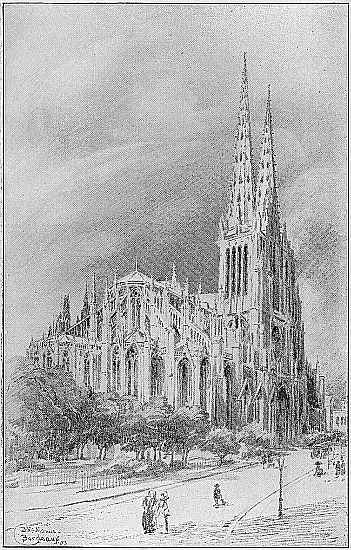

THE CATHEDRALS OF SOUTHERN FRANCE
By FRANCIS MILTOUN
AUTHOR OF "THE CATHEDRALS OF NORTHERN FRANCE," "THE CATHEDRALS OF SOUTHERN FRANCE," "DICKENS' LONDON," ETC., WITH NINETY ILLUSTRA- TIONS, PLANS, AND DIAGRAMS,
By BLANCHE McMANUS

BOSTON L. C. Page and Company MDCCCCV
Copyright, 1904 By L. C. Page & Company (INCORPORATED) —— All rights reserved Published August, 1904 Third Impression Colonial Press Electrotyped and Printed by C. H. Simonds & Co. Boston, Mass., U. S. A.
CONTENTS
PAGE
Introduction 11
Part I. Southern France in General
I.The Charm of Southern France23
II.The Church in Gaul34
III.The Church Architecture of Southern France50
Part II. South of the Loire
I.Introductory71
II.L'Abbaye de Maillezais81
III.St. Louis de la Rochelle82
IV.Cathédrale de Luçon85
V.St. Front de Périgueux87
VI.St. Pierre de Poitiers92
VII.St. Etienne de Limoges104
VIII.St. Odilon de St. Flour112
IX.St. Pierre de Saintes115
X.Cathédrale de Tulle118
XI.St. Pierre d'Angoulême120
XII.Notre Dame de Moulins126
XIII.Notre Dame de le Puy134
XIV.Notre Dame de Clermont-Ferrand144
XV.St. Fulcran de Lodève152
Part III. The Rhone Valley
I.Introductory159
II.St. Etienne de Chalons-sur-Saône170
III.St. Vincent de Macon174
IV.St. Jean de Lyon177
V.St. Maurice de Vienne186
VI.St. Apollinaire de Valence190
VII.Cathédrale de Viviers195
VIII.Notre Dame d'Orange197
IX.St. Véran de Cavaillon200
X.Notre Dame des Doms d'Avignon204
XI.St. Siffrein de Carpentras221
XII.Cathédrale de Vaison226
XIII.St. Trophime d'Arles228
XIV.St. Castor de Nîmes236
XV.St. Théodorit d'Uzès245
XVI.St. Jean d'Alais249
XVII.St. Pierre d'Annecy252
XVIII.Cathédrale de Chambéry255
XIX.Notre Dame de Grenoble258
XX.Belley and Aoste267
XXI.St. Jean de Maurienne269
XXII.St. Pierre de St. Claude272
XXIII.Notre Dame de Bourg277
XXIV.Glandève, Senez, Riez, Sisteron280
XXV.St. Jerome de Digne283
XXVI.Notre Dame de Die287
XXVII.Notre Dame et St. Castor d'Apt289
XXVIII.Notre Dame d'Embrun292
XXIX.Notre Dame de l'Assomption de Gap296
XXX.Notre Dame de Vence300
XXXI.Cathédrale de Sion302
XXII.St. Paul Troix Château305
Part IV. The Mediterranean Coast
I.Introductory313
II.St. Sauveur d'Aix323
III.St. Reparata de Nice328
IV.Ste. Marie Majeure de Toulon332
V.St. Etienne de Fréjus335
VI.Église de Grasse339
VII.Antibes341
VIII.Ste. Marie Majeure de Marseilles342
IX.St. Pierre d'Alet350
X.St. Pierre de Montpellier352
XI.Cathédrale d'Agde358
XII.St. Nazaire de Béziers363
XIII.St. Jean de Perpignan368
XIV.Ste. Eulalia d'Elne372
XV.St. Just de Narbonne375
Part V. the Valley of the Garonne
I.Introductory383
II.St. André de Bordeaux396
III.Cathédrale de Lectoure402
IV.Notre Dame de Bayonne405
V.St. Jean de Bazas411
VI.Notre Dame de Lescar413
VII.L'Eglise de la Sède: Tarbes417
VIII.Cathédrale de Condom420
IX.Cathédrale de Montauban422
X.St. Etienne de Cahors425
XI.St. Caprias d'Agen429
XII.Ste. Marie d'Auch432
XIII.St. Etienne de Toulouse439
XIV.St. Nazaire de Carcassone449
XV.Cathédrale de Pamiers461
XVI.St. Bertrand de Comminges464
XVII.St. Jean-Baptiste d'Aire469
XVIII.Sts. Benoit et Vincent de Castres471
XIX.Notre Dame de Rodez474
XX.Ste. Cécile d'Albi482
XXI.St. Pierre de Mende490
XXII.Other Old-Time Cathedrals in and about the Basin of the Garonne 495
Appendices
I.Sketch Map Showing the Usual Geographical Divisions of France503
II.A Historical Table of the Dioceses of the South of France up to the beginning of the nineteenth century504
III.The Classification of Architectural Styles in France according to De Caumont's "Abécédaire d'Architecture Religieuse"510
IV.A Chronology of Architectural Styles in France511
V.Leading Forms of Early Cathedral Constructions513
VI.The Disposition of the Parts of a Tenth-Century Church as defined by Violet-le-Duc 514
VII.A Brief Definitive Gazetteer of the Natural and Geological Divisions Included in the Ancient Provinces and Present-Day Departments of Southern France, together with the local names by which the pays et pagi are commonly known516
VIII.Sketch Map of the Bishoprics and Archbishoprics of the South of France at the Present Day519
IX.Dimensions and Chronology520
Index545
LIST OF ILLUSTRATIONS
PAGE
St. André de BordeauxFrontispiece
The Concordat (From Napoleon's Tomb)43
St. Louis de La Rochelle82
Cathédrale de Luçon85
St. Front de Périgueux87
Detail of the Interior of St. Front de Périgueux90
Poitiers93
St. Etienne de Limoges105
Reliquary of Thomas à Becket111
Cathédrale de Tullefacing118
St. Pierre d'Angoulêmefacing120
Notre Dame de Moulinsfacing126
Notre Dame de Le Puyfacing134
Le Puy138
The Black Virgin, Le Puy143
Notre Dame de Clermont-Ferrandfacing144
St. Vincent de Maconfacing174
St. Jean de Lyonfacing176
St. Apollinaire de Valence190
St. Véran de Cavaillon200
Notre Dame des Doms d'Avignon205
Villeneuve-les-Avignonfacing212
Notre Dame des Doms d'Avignonfacing218
St. Trophime d'Arles228
St. Trophime d'Arlesfacing228
Cloisters, St. Trophime d'Arles233
St. Castor de Nîmes236
St. Castor de Nîmes237
St. Théodorit d'Uzès245
Cathédrale de Chambéry255
Notre Dame de Grenoble258
St. Bruno261
Belley265
St. Jean de Maurienne269
St. Pierre de St. Claudefacing272
Notre Dame de Bourg275
Notre Dame de Sisteronfacing280
St. Jerome de Digne283
Notre Dame d'Embrun292
The Ramparts of Aigues-Mortes320
St. Sauveur d'Aix321
Detail of Doorway of the Archbishop's Palace, Fréjus338
Eglise de Grasse339
Marseilles343
The Old Cathedral, Marseilles345
St. Pierre de Montpellierfacing352
Cathédrale d'Agde358
St. Nazaire de Béziers361
St. Jean de Perpignan368
Ste. Eulalia d'Elne372
St. Just de Narbonnefacing374
Cloister of St. Just de Narbonnefacing378
Notre Dame de Bayonnefacing404
Eglise de la Sède, Tarbes417
St. Etienne de Cahorsfacing424
Ste. Marie d'Auchfacing432
St. Etienne de Toulousefacing438
Nave of St. Etienne de Toulouse445
St. Nazaire de Carcassonnefacing448
The Old Cité de Carcassonne before and after the Restoration451
Two Capitals of Pillars in St. Nazaire de Carcassonne;
and the Rude Stone Carving of Carcas454
St. Nazaire de Carcassonnefacing454
Cathédrale de Pamiers461
St. Bertrand de Commingesfacing464
St. Jean-Baptiste d'Aire469
Sts. Benoit et Vincent de Castresfacing470
Notre Dame de Rodezfacing474
Choir-Stalls, Rodez480
Ste. Cécile d'Albifacing482
St. Pierre de Mendefacing490
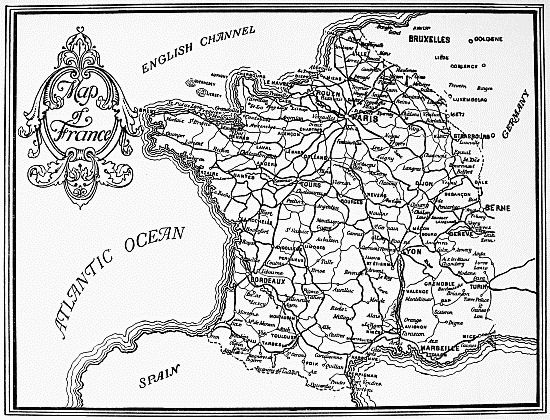
Sketch Map of France503
Medallion510
Leading Forms of Early Cathedral Constructions513
Plan of a Tenth Century Church514
Sketch Map of the Bishoprics and Archbishoprics of the
South of France at the Present Day519
St. Caprias d'Agen (diagram)520
Baptistery of St. Sauveur d'Aix (diagram)521
Ste. Cécile d'Albi (diagram)522
St. Pierre d'Angoulême (diagram)523
St. Trophime d'Arles (diagram)524
Notre Dame des Doms d'Avignon (diagram)525
St. Etienne de Cahors (diagram)527
St. Veran de Cavaillon (diagram)528
Cathédrale de Chambéry (diagram)529
Notre Dame de Clermont-Ferrand (diagram)530
St. Bertrand de Comminges (diagram)530
Notre Dame de Le Puy (diagram)532
St. Etienne de Limoges (diagram)532
St. Jean de Lyon (diagram)533
St. Just de Narbonne (diagram)535
Notre Dame d'Orange (diagram)536
St. Front de Périgueux (diagram)537
St. Jean de Perpignan (diagram)537
St. Pierre de Poitiers (diagrams)538
Notre Dame de Rodez (diagram)539
St. Etienne de Toulouse (diagram)541
St. Paul Trois Châteaux (diagram)542
Cathédrale de Vaison (diagram)543
The Cathedrals of Southern France
INTRODUCTION
TOO often—it is a half-acknowledged delusion, however—one meets with what appears to be a theory: that a book of travel must necessarily be a series of dull, discursive, and entirely uncorroborated opinions of one who may not be even an intelligent observer. This is mere intellectual pretence. Even a humble author—so long as he be an honest one—may well be allowed to claim with Mr. Howells the right to be serious, or the reverse, "with his material as he finds it;" and that "something personally experienced can only be realized on the spot where it was lived." This, says he, is "the prime use of travel, and the attempt to create the reader a partner in the enterprise" ... must be the excuse, then, for putting one's observations on paper.
He rightly says, too, that nothing of perilous adventure is to-day any more like to happen "in Florence than in Fitchburg."
A "literary tour," a "cathedral tour," or an "architectural tour," requires a formula wherein the author must be wary of making questionable estimates; but he may, with regard to generalities,—or details, for that matter,—state his opinion plainly; but he should state also his reasons. With respect to church architecture no average reader, any more than the average observer, willingly enters the arena of intellectual combat, but rather is satisfied—as he should be, unless he is a Freeman, a Gonse, or a Corroyer—with an ampler radius which shall command even a juster, though no less truthful, view.
Not from one book or from ten, in one year or a score can this be had. The field is vast and the immensity of it all only dawns upon one the deeper he gets into his subject. A dictionary of architecture, a compendium or gazetteer of geography, or even the unwieldy mass of fact tightly held in the fastnesses of the Encyclopædia Britannica will not tell one—in either a long or a short while—all the facts concerning the cathedrals of France.
Some will consider that in this book are made many apparently trifling assertions; but it is claimed that they are pertinent and again are expressive of an emotion which mayhap always arises of the same mood.
Notre Dame at Rodez is a "warm, mouse-coloured cathedral;" St. Cécile d'Albi is at once "a fortress and a church," and the once royal city of Aigues-Mortes is to-day but "a shelter for a few hundred pallid, shaking mortals."
Such expressions are figurative, but, so far as words can put it, they are the concentrated result of observation.
These observations do not aspire to be considered "improving," though it is asserted that they are informative.
Description of all kinds is an art which requires considerable forethought in order to be even readable. And of all subjects, art and architecture are perhaps the most difficult to treat in a manner which shall not arouse an intolerant criticism.
Perhaps some credit will be attained for the attempts herein made to present in a pleasing manner many of the charms of the ecclesiastical architecture of southern France, where a more elaborate and erudite work would fail of its object. As Lady Montagu has said in her "Letters,"—"We travellers are in very hard circumstances. If we say nothing new, we are dull, and have observed nothing. If we tell any new thing, we are laughed at as fabulous and romantic."
This book is intended as a contribution to travel literature—or, if the reader like, to that special class of book which appeals largely to the traveller.
Most lovers of art and literature are lovers of churches; indeed, the world is yearly containing more and more of this class. The art expression of a people, of France in particular, has most often first found its outlet in church-building and decoration. Some other countries have degenerated sadly from the idea.
In recent times the Anglo-Saxon has mostly built his churches,—on what he is pleased to think are "improved lines,"—that, more than anything else, resemble, in their interiors, playhouses, and in their exteriors, cotton factories and breweries.
This seemingly bitter view is advanced simply because the writer believes that it is the church-members, using the term in its broad sense, who are responsible for the many outrageously unseemly church-buildings which are yearly being erected; not the architects—who have failings enough of their own to answer for.
It is said that a certain great architect of recent times was responsible for more bad architecture than any man who had lived before or since. Not because he produced such himself, but because his feeble imitators, without his knowledge, his training, or his ambition, not only sought to follow in his footsteps, but remained a long way in the rear, and stumbled by the way.
This man built churches. He built one, Trinity Church, in Boston, U. S. A., which will remain, as long as its stones endure, an entirely successful transplantation of an exotic from another land. In London a new Roman Catholic cathedral has recently been erected after the Byzantine manner, and so unexpectedly successful was it in plan and execution that its author was "medalled" by the Royal Academy; whatever that dubious honour may be worth.
Both these great men are dead, and aside from these two great examples, and possibly the Roman Catholic cathedral, and the yet unachieved cathedral of St. John the Divine, in New York City, where, in an English-speaking land, has there been built, in recent times, a religious edifice of the first rank worthy to be classed with these two old-world and new-world examples?
They do these things better in France: Viollet-le-Duc completed St. Ouen at Rouen and the cathedral at Clermont-Ferrand, in most acceptable manner. So, too, was the treatment of the cathedral at Moulins-sur-Allier—although none of these examples are among the noblest or the most magnificent in France. They have, however, been completed successfully, and in the true spirit of the original.
To know the shops and boulevards of Paris does not necessarily presume a knowledge of France. This point is mentioned here from the fact that many have claimed a familiarity with the cathedrals of France; when to all practical purposes, they might as well have begun and ended with the observation that Notre Dame de Paris stands on an island in the middle of the Seine.
The author would not carp at the critics of the first volume of this series, which appeared last season. Far from it. They were, almost without exception, most generous. At least they granted, unqualifiedly, the reason for being for the volume which was put forth bearing the title: "Cathedrals of Northern France."
The seeming magnitude of the undertaking first came upon the author and artist while preparing the first volume for the press. This was made the more apparent when, on a certain occasion, just previous to the appearance of the book, the author made mention thereof to a friend who did know Paris—better perhaps than most English or American writers; at least he ought to have known it better.
When this friend heard of the inception of this book on French cathedrals, he marvelled at the fact that there should be a demand for such; said that the subject had already been overdone; and much more of the same sort; and that only yesterday a certain Miss—— had sent him an "author's copy" of a book which recounted the results of a journey which she and her mother had recently made in what she sentimentally called "Romantic Touraine."
Therein were treated at least a good half-dozen cathedrals; which, supplementing the always useful Baedeker or Joanne, and a handbook of Notre Dame at Paris and another of Rouen, covered—thought the author's friend at least—quite a representative share of the cathedrals of France.
This only substantiates the contention made in the foreword to the first volume: that there were doubtless many with a true appreciation and love for great churches who would be glad to know more of them, and have the ways—if not the means—smoothed in order to make a visit thereto the more simplified and agreeable. Too often—the preface continued—the tourist, alone or personally conducted in droves, was whirled rapidly onward by express-train to some more popularly or fashionably famous spot, where, for a previously stipulated sum, he might partake of a more lurid series of amusements than a mere dull round of churches.
"Cities, like individuals, have," says Arthur Symons, "a personality and individuality quite like human beings."
This is undoubtedly true of churches as well, and the sympathetic observer—the enthusiastic lover of churches for their peculiarities, none the less than their general excellencies—is the only person who will derive the maximum amount of pleasure and profit from an intimacy therewith.
Whether a great church is interesting because of its antiquity, its history, or its artistic beauties matters little to the enthusiast. He will drink his fill of what offers. Occasionally, he will find a combination of two—or possibly all—of these ingredients; when his joy will be great.
Herein are catalogued as many of the attributes of the cathedrals of the south of France—and the records of religious or civil life which have surrounded them in the past—as space and opportunity for observation have permitted.
More the most sanguine and capable of authors could not promise, and while in no sense does the volume presume to supply exhaustive information, it is claimed that all of the churches included within the classification of cathedrals—those of the present and those of a past day—are to be found mentioned herein, the chief facts of their history recorded, and their notable features catalogued.