PART III The Rhône Valley
Reading edition
I INTRODUCTORY
The knowledge of the geographer Ptolemy, who wrote in the second century with regard to the Rhône, was not so greatly at fault as with respect to other topographical features, such as coasts and boundaries.
Perhaps the fact that Gaul had for so long been under Roman dominion had somewhat to do with this.
He gives, therefore, a tolerably correct account as to this mighty river, placing its sources in the Alps, and tracing its flow through the lake Lemannus (Leman) to Lugdunum (Lyon); whence, turning sharply to the southward, it enters the Mediterranean south of Arles. Likewise, he correctly adds that the upper river is joined with the combined flow of the Doubs and Saône, but commits the error of describing their source to be also in the Alps.
Philip Gilbert Hamerton, who knew these parts well,—his home was near Autun,—has described the confluence of the Saône and Rhône thus:
"The width and depth of the two rivers are equal, but the swift-flowing Rhône discharges twice the volume of water of the slow-running Saône. They also differ remarkably in colour. The Saône is emerald-green and the Rhône blue-green. Here the minor river loses its name and character, and, by an unusual process, the slowest and most navigable stream in Europe joins the swiftest and least navigable. The Flumen Araris ceases and becomes the Rhodanus."
The volume of water which yearly courses down the Rhône is perhaps greater than would first appear, when, at certain seasons of the year, one sees a somewhat thin film of water gliding over a wide expanse of yellow sand and shingle.
Throughout, however, it is of generous width and at times rises in a true torrential manner: this when the spring freshets and melting Alpine snows are directed thither toward their natural outlet to the sea. "Rivers," said Blaise Pascal, "are the roads that move." Along the great river valleys of the Rhône, the Loire, the Seine, and the Rhine were made the first Roman roads, the prototypes of the present-day means of communication.
The development of civilization and the arts along these great pathways was rapid and extensive. Two of them, at least, gave birth to architectural styles quite differing from other neighbouring types: the Romain-Germanique—bordering along the Rhine and extending to Alsace and the Vosges; and the Romain-Bourguignon, which followed the valley of the Rhône from Bourgogne to the Mediterranean and the Italian frontier, including all Provence.
The true source of the Rhône is in the Pennine Alps, where, in consort with three other streams, the Aar, the Reuss, and the Ticino, it rises in a cloven valley close to the lake of Brienz, amid that huge jumble of mountain-tops, which differs so greatly from the popular conception of a mountain range.
Dauphiné and Savoie are to-day comparatively unknown by parlour-car travellers. Dauphiné, with its great historical associations, the wealth and beauty of its architecture, the magnificence of its scenery, has always had great attractions for the historian, the archæologist, and the scholar; to the tourist, however, even to the French tourist, it remained for many years a terra incognita. Yet no country could present the traveller with a more wonderful succession of ever-changing scenery, such a rich variety of landscape, ranging from verdant plain to mountain glacier, from the gay and picturesque to the sublime and terrible. Planted in the very heart of the French Alps, rising terrace above terrace from the lowlands of the Rhône to the most stupendous heights, Dauphiné may with reason claim to be the worthy rival of Switzerland.
The romantic associations of "La Grande Chartreuse"; of the charming valley towns of Sion and Aoste, famed alike in the history of Church and State; and of the more splendidly appointed cities of Grenoble and Chambéry, will make a new leaf in the books of most peoples' experiences.
The rivers Durance, Isère, and Drôme drain the region into the more ample basin of the Rhône, and the first of the three—for sheer beauty and romantic picturesqueness—will perhaps rank first in all the world.
The chief associations of the Rhône valley with the Church are centred around Lyon, Vienne, Avignon, and Arles. The associations of history—a splendid and a varied past—stand foremost at Orange, Nîmes, Aix, and Marseilles. It is not possible to deal here with the many pays et pagi of the basin of the Rhône.
Of all, Provence—that golden land—stands foremost and compels attention. One might praise it ad infinitum in all its splendid attributes and its glorious past, but one could not then do it justice; better far that one should sum it up in two words—"Mistral's world."
The popes and the troubadours combined to cast a glamour over the "fair land of Provence" which is irresistible. Here were architectural monuments, arches, bridges, aqueducts, and arenas as great and as splendid as the world has ever known. Aix-en-Provence, in King René's time, was the gayest capital of Europe, and the influence of its arts and literature spread to all parts.
To the south came first the Visigoths, then the conflicting and repelling Ostrogoths; between them soon to supplant the Gallo-Roman cultivation which had here grown so vigorously.
It was as late as the sixth century when the Ostrogoths held the brilliant sunlit city of Arles; when follows a history—applicable as well to most of all southern France—of many dreary centuries of discordant races, of varying religious faiths, and adherence now to one lord and master, and then to another.
Monuments of various eras remain; so numerously that one can rebuild for themselves much that has disappeared for ever: palaces as at Avignon, castles as at Tarascon and Beaucaire, and walled cities as at Aigues-Morte. What limitless suggestion is in the thought of the assembled throngs who peopled the tiers of the arenas and theatres of Arles and Nîmes in days gone by. The sensation is mostly to be derived, however, from thought and conjecture. The painful and nullifying "spectacles" and "courses des taureaux," which periodically hold forth to-day in these noble arenas, are mere travesties on their splendid functions of the past. Much more satisfying—and withal more artistic—are the theatrical representations in that magnificent outdoor theatre at Orange; where so recently as the autumn of 1903 was given a grand representation of dramatic art, with Madame Bernhardt, Coquelin, and others of the galaxy which grace the French stage to-day, taking part therein.
Provençal literature is a vast and varied subject, and the women of Arles—the true Arlesians of the poet and romancer—are astonishingly beautiful. Each of these subjects—to do them justice—would require much ink and paper. Daudet, in "Tartarin," has these opening words, as if no others were necessary in order to lead the way into a new world: "It was September and it was Provence." Frederic Mistral, in "Mirèio," has written the great modern epic of Provence, which depicts the life as well as the literature of the ancient troubadours. The "Fountain of Vaucluse" will carry one back still further in the ancient Provençal atmosphere; to the days of Petrarch and Laura, and the "little fish of Sorgues."
What the Romance language really was, authorities—if they be authorities—differ. Hence it were perhaps well that no attempt should be made here to define what others have failed to place, beyond this observation, which is gathered from a source now lost to recollection, but dating from a century ago at least:
"The southern or Romance language, the tongue of all the people who obeyed Charlemagne in the south of Europe, proceeded from the parent-vitiated Latin.
"The Provençaux assert, and the Spaniards deny, that the Spanish tongue is derived from the original Romance, though neither the Italians nor the French are willing to owe much to it as a parent, in spite of the fact that Petrarch eulogized it, and the troubadours as well.
"The Toulousans roundly assert that the Provençal is the root of all other dialects whatever (vide Cazeneuve). Most Spanish writers on the other hand insist that the Provençal is derived from the Spanish (vide Coleccion de Poesias Castellanas; Madrid, 1779)."
At all events the idiom, from whatever it may have sprung, took root, propagated and flourished in the land of the Provençal troubadours.
Whatever may have been the real extent of the influences which went out from Provence, it is certain that the marriage of Robert with Constance—daughter of the first Count of Provence, about the year 1000—was the period of a great change in manners and customs throughout the kingdom. Some even have asserted that this princess brought in her train the troubadours who spread the taste for poetry and its accompaniments throughout the north of France.
The "Provence rose," so celebrated in legend and literature, can hardly be dismissed without a word; though, in truth, the casual traveller will hardly know of its existence, unless he may have a sweet recollection of some rural maid, who, with sleeves carefully rolled up, stood before her favourite rose-tree, tenderly examining it, and driving away a buzzing fly or a droning wasp.
These firstlings of the season are tended with great pride. The distinctive "rose of Provence" is smaller, redder, and more elastic and concentric than the centifoliæ of the north, and for this reason, likely, it appears the more charming to the eye of the native of the north, who, if we are to believe the romanticists, is made a child again by the mere contemplation of this lovely flower.
The glory of this rich red "Provence rose" is in dispute between Provence and Provins, the ancient capital of La Brie; but the weight of the argument appears to favour the former.
Below Arles and Nîmes the Rhône broadens out into a many-fingered estuary, and mingles its Alpine flood with the blue waters of the Mediterranean.
The delta has been formed by the activity and energy of the river itself, from the fourth century—when it is known that Arles lay sixteen miles from the sea—till to-day, when it is something like thirty. This ceaseless carrying and filling has resulted in a new coast-line, which not only has changed the topography of the region considerably, but may be supposed to have actually worked to the commercial disadvantage of the country round about.
The annual prolongation of the shores—the reclaimed water-front—is about one hundred and sixty-four feet, hence some considerable gain is accounted for, but whether to the nation or the "squatter" statistics do not say.
The delta of the Rhône has been described by an expansive French writer as: "Something quite separate from the rest of France. It is a wedge of Greece and of the East thrust into Gaul. It came north a hundred (or more) years ago and killed the Monarchy. It caught the value in, and created the great war-song of the Republic."
There is a deal of subtlety in these few lines, and they are given here because of their truth and applicability.
II ST. ETIENNE DE CHALONS-SUR-SAÔNE
"The cathedral at Chalons," says Philip Gilbert Hamerton,—who knew the entire region of the Saône better perhaps than any other Anglo-Saxon,—"has twin towers, which, in the evening, at a distance, recall Notre Dame (at Paris), and there are domes, too, as in the capital."
An imaginative description surely, and one that is doubtless not without truth were one able to first come upon this riverside city of mid-France in the twilight, and by boat from the upper river.
Chalons is an ideally situated city, with a placidness which the slow current of the Saône does not disturb. But its cathedral! It is no more like its Parisian compeer than it is like the Pyramids of Egypt.
In the first place, the cathedral towers are a weak, effeminate imitation of a prototype which itself must have been far removed from Notre Dame, and they have been bolstered and battened in a shameful fashion.
The cathedral at Chalons is about the most ancient-looking possession of the city, which in other respects is quite modern, and, aside from its charming situation and general attractiveness, takes no rank whatever as a centre of ancient or mediæval art.
Its examples of Gallic architecture are not traceable to-day, and of Roman remains it possesses none. As a Gallic stronghold,—it was never more than that,—it appealed to Cæsar merely as a base from which to advance or retreat, and its history at this time is not great or abundant.
A Roman wall is supposed to have existed, but its remains are not traceable to-day, though tradition has it that a quantity of its stones were transported by the monk Bénigne for the rotunda which he built at Dijon.
The city's era of great prosperity was the fifteenth and sixteenth centuries, when its fortifications were built up anew, its cathedral finished, and fourteen churches held forth.
From this high estate it has sadly fallen, and there is only its decrepit cathedral, rebuilt after a seventeenth-century fire, and two churches—one of them modern—to uphold its ecclesiastical dignity.
The towers of the cathedral are of the seventeenth century, but the so-called "Deanery Tower" is more ancient, and suggestive of much that is militant and very little that is churchly.
The interior has been restored, not wholly with success, but yet not wholly spoiled.
In plan and arrangement it is a simple and severe church, but acceptable enough when one contemplates changes made elsewhere. Here are to be seen no debased copies of Greek or Roman orders; which is something to be thankful for.
The arches of the nave and choir are strong and bold, but not of great spread. The height of the nave, part of which has come down from the thirteenth century, is ninety feet at least.
There are well-carved capitals to the pillars of the nave, and the coloured glass of the windows of triforium and clerestory is rich without rising to great beauty.
In general the style is decidedly a mélange, though the cathedral is entitled to rank as a Gothic example. Its length is 350 feet.
The maître-autel is one of the most elegant in France.
Modern improvement has cleared away much that was picturesque, but around the cathedral are still left a few gabled houses, which serve to preserve something of the mediæval setting which once held it.
The courtyard and its dependencies at the base of the "Deanery Tower" are the chief artistic features. They appeal far more strongly than any general accessory of the cathedral itself, and suggest that they once must have been the components of a cloister.
The see was founded in the fifth century as a suffragan of Lyon.
III ST. VINCENT DE MACON
The Mastieo of the Romans was not the Macon of to-day, though, by evolution, or corruption, or whatever the process may have been, the name has come down to us as referring to the same place. The former city did not border the river, but was seated on a height overlooking the Saône, which flows by the doors of the present city of Macon.
Its site is endowed with most of the attributes included in the definition of "commanding," and, though not grandly situated, is, from any riverside view-point, attractive and pleasing.
When it comes to the polygonal towers of its olden cathedral, this charming and pleasing view changes to that of one which is curious and interesting. The cathedral of St. Vincent is a battered old ruin, and no amount of restoration and rebuilding will ever endow it with any more deserving qualities.
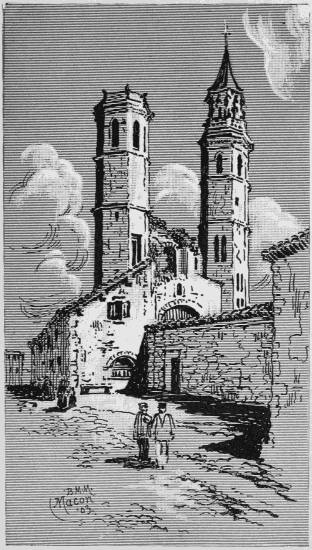

The Revolution was responsible for its having withered away, as it was also for the abolishment of the see of Macon.
The towers stand to-day—lowered somewhat from their former proportions—gaunt and grim, and the rich Burgundian narthen, which lay between, has been converted—not restored, mark you—into an inferior sort of chapel.
The destruction that fell upon various parts of this old church might as well have been more sweeping and razed it to the ground entirely. The effect could not have been more disheartening.
Macon formerly had twelve churches. Now it has three—if we include this poor fragment of its one-time cathedral. Between the Revolution and the coronation of Napoleon I. the city was possessed of no place of worship.
Macon became an episcopal see, with Placide as its first bishop, in the sixth century. It was suppressed in 1790.
The bridge which crosses the river to the suburb of St. Laurent is credited as being the finest work of its kind crossing the Saône. Hamerton has said that "its massive arches and piers, wedge-shaped to meet the wind, are pleasant to contemplate after numerous festoons of wire carrying a roadway of planks." This bridge was formerly surmounted, at either end, with a castellated gateway, but, like many of these accessories elsewhere, they have disappeared.
The famous bridge at Cahors (shown elsewhere in this book) is the best example of such a bridge still existing in France.
As a "cathedral city," Macon will not take a high rank. The "great man" of Macon was Lamartine. His birthplace is shown to visitors, but its present appearance does not suggest the splendid appointments of its description in that worthy's memoirs.
Macon is the entrepôt of the abundant and excellent vin du Bourgogne, and the strictly popular repute of the city rests entirely on this fact.

IV ST. JEAN DE LYON
The Lyonnais is the name given to that region lying somewhat to the westward of the city of Lyon. It is divided into three distinct parts, le Lyonnais proper, le Forez, and le Beaujolais. Its chief appellation comes from that of its chief city, which in turn is more than vague as to its etymology: Lugdunum we know, of course, and we can trace its evolution even unto the Anglicized Lyons, but when philologists, antiquarians, and "pedants of mere pretence" ask us to choose between le corbeau—lougon, un eminence—dounon, lone—an arm of a river, and dun the Celtic word for height, we are amazed, and are willing enough to leave the solving of the problem to those who will find a greater pleasure therein.
Lyon is a widely-spread city, of magnificent proportions and pleasing aspect, situated as it is on the banks of two majestic, though characteristically different rivers, the Rhône and the Saône.
In many respects it is an ideally laid-out city, and the scene from the heights of Fourvière at night, when the city is brilliant with many-lighted workshops, is a wonderfully near approach to fairy-land.
Whether the remarkable symmetry of the city's streets and plan is the result of the genius of a past day, or of the modern progressive spirit, is in some doubt. Certainly it must originally have been a delightfully planned city, and the spirit of modernity—though great—has not by any means wholly eradicated its whilom charm of another day.
It may be remarked here that about the only navigable portion of the none too placid Rhône is found from here to Avignon and Arles, to which points, in summer at least, steam-craft—of sorts—carry passengers with expedition and economy—down-stream; the journey up-river will amaze one by the potency of the flood of this torrential stream—so different from the slow-going Saône.
The present diocese, of which the see of Lyon is the head, comprehends the Department of the Rhône et Loire. It is known under the double vocable of Lyon et Vienne, and is the outgrowth of the more ancient ecclesiastical province of Vienne, whose archiepiscopal dignity was domiciled in St. Maurice.
It was in the second century that St. Pothin, an Asiatic Greek, came to the ancient province of Lyon as archbishop. The title carried with it that of primate of all Gaul: hence the importance of the see, from the earliest times, may be inferred.
The architectural remains upon which is built the flamboyant Gothic church of St. Nizier are supposed to be those of the primitive cathedral in which St. Pothin and St. Irenæus celebrated the holy rites. The claim is made, of course, not without a show of justification therefor, but it is a far cry from the second century of our era to this late day; and the sacristan's words are not convincing, in view of the doubts which many non-local experts have cast upon the assertion. The present Église St. Nizier is furthermore dedicated to a churchman who lived as late as the sixth century.
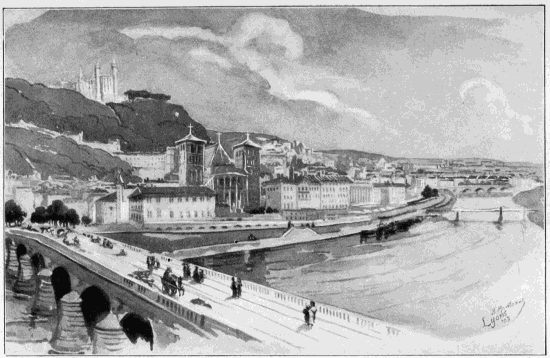
The present cathedral of St. Jean dates from the early years of the twelfth century, but there remains to-day another work closely allied with episcopal affairs—the stone bridge which spans the Saône, and which was built some two hundred years before the present cathedral by Archbishop Humbert.
Though a bridge across a river is an essentially practical and utile thing, it is, perhaps, in a way, as worthy a work for a generous and masterful prelate as church-building itself. Certainly this was the case with Humbert's bridge, he having designed the structure, superintended its erection, and assumed the expense thereof. It is recorded that this worthy churchman gained many adherents for the faith, so it may be assumed that he builded as well as he knew.
St. Jean de Lyon dates from 1180, and presents many architectural anomalies in its constructive elements, though the all-pervading Gothic is in the ascendant. From this height downward, through various interpolations, are seen suggestions of many varieties and styles of church-building. There is, too, an intimation of a motif essentially pagan if one attempts to explain the vagaries of some of the ornamentation of the unusual septagonal Lombard choir. This is further inferred when it is known that a former temple to Augustus stood on the same site. If this be so, the reasoning is complete, and the classical ornament here is of a very early date.
The fabric of the cathedral is, in the main, of a warm-coloured freestone, not unlike dark marble, but without its brilliancy and surface. It comes from the heights of Fourvière,—on whose haunches the cathedral sits,—and by virtue of the act of foundation it may be quarried at any time, free of all cost, for use by the Church.
The situation of this cathedral is most attractive; indeed its greatest charm may be said to be its situation, so very picturesquely disposed is it, with the Quai de l'Archevêché between it and the river Saône.
The choir itself—after allowing for the interpolation of the early non-Christian fragments—is the most consistently pleasing portion. It presents in general a fairly pure, early Gothic design. Curiously enough, this choir sits below the level of the nave and presents, in the interior view, an unusual effect of amplitude.
With the nave of the thirteenth and fourteenth centuries, the style becomes more mixed—localized, one may say—if only consistent details might be traced. At any rate, the style grows perceptibly heavier and more involved, without the simplicity of pre-Gothic work. Finally, as one comes to the heavily capped towers, there is little of grace and beauty left.
In detail, at least, if not in general, St. Jean runs quite the whole scale of mediæval architectural style—from the pure Romanesque to the definite, if rather mixed, Gothic.
Of the later elements, the most remarkable is the fifteenth-century Bourbon chapel, built by Cardinal Charles and his brother Pierre. This chapel presents the usual richness and luxuriance of its time. If all things are considered, it is the chief feature of interest within the walls.
The west front has triple portals, reminiscent, as to dimensions, of Amiens, though by no means so grandly peopled with statues; the heavy, stunted towers, too, are not unlike those of Amiens. These twin towers are of a decidedly heavy order, and are not beautiful, either as distinct features or as a component of the ensemble. Quite in keeping also are the chief decorations of the façade, which are principally a series of superimposed medallions, depicting, variously, the signs of the zodiac, scenes from the life of St. Jean, and yet others suggesting scenes and incidents from Genesis, with an admixture of heraldic symbolism which is here quite meaningless and singularly inappropriate, while still other entablatures present scenes illustrating the "Legend of St. Nicholas" and "The Law of Aristotle."
The general effect of the exterior, the façade in particular, is very dark, and except in a bright sunlight—which is usual—is indeed gloomy. In all probability, this is due to the discolouring of the soft stone of which the cathedral is built, as the same effect is scarcely to be remarked in the interior.
In a tower on the south side—much lower, and not so clumsily built up as the twin towers—hangs one of the greatest bourdons in France. It was cast in 1662, and weighs ten thousand kilos.
Another curiosity of a like nature is to be seen in the interior, an astronomical clock—known to Mr. Tristram as "that great clock of Lippius of Basle." Possessed of a crowing cock and the usual toy-book attributes, this great clock is a source of perennial pride to the native and the makers of guide-books. Sterne, too, it would appear, waxed unduly enthusiastic over this really ingenious thing of wheels and cogs. He said: "I never understood the least of mechanism. I declare I was never able yet to comprehend the principles of a squirrel-cage or a knife-grinder's wheel, yet I will go see this wonderful clock the first thing I do." When he did see it, he quaintly observed that "it was all out of joint."
The rather crude coloured glass—though it is precious glass, for it dates from the thirteenth century, in part—sets off bountifully an interior which would otherwise appear somewhat austere.
In the nave is a marble pulpit which has been carved with more than usual skill. It ranks with that in St. Maurice, at Vienne, as one of the most beautiful in France.
The cathedral possesses two reliques of real importance in the crosses which are placed to the left and right of the high-altar. These are conserved by a unique custom, in memory of an attempt made by a concile génêral of the church, held in Lyon in 1274, to reconcile the Latin and Greek forms of religion.
The sacristy, in which the bountiful, though not historic, trésor is kept, is in the south transept.
Among the archives of the cathedral there are, says a local antiquary, documents of a testamentary nature, which provided the means for the up-keep of the fabric without expense to the church, until well into the eighteenth century.
On the apex of the height which rises above the cathedral is the Basilique de Notre Dame de Fourvière—"one of those places of pilgrimage, the most venerated in all the world," says a confident French writer. This may be so; it overlooks ground which has long been hallowed by the Church, to a far greater degree than many other parts, but, like so many places of pilgrimage of a modern day, its nondescript religious edifice is enough to make the church-lover willingly pass it by. The site is that of the ancient Forum Vetus of the Romans, and as such is more appealing to most than as a place of pilgrimage.
V ST. MAURICE DE VIENNE
"At the feet of seven mountains; on the banks of a large river; an antique city and a cité neuve."
—François Ponsard.
Though widowed to-day of its bishop's throne, Vienne enjoys with Lyon the distinction of having its name attached to an episcopal see. The ancient archbishopric ruled over what was known as the Province of Vienne, which, if not more ancient than that of Lyon, dates from the same century—the second of our Christian era—and probably from a few years anterior, as it is known that St. Crescent, the first prelate of the diocese, was firmly established here as early as 118 a. d. In any event, it was one of the earliest centres of Christianity north of the Alps.
To-day, being merged with the diocese of Lyon, Vienne is seldom credited as being a cathedral city. Locally the claim is very strongly made, but the Mediterranean tourist never finds this out, unless, perchance, he "drops off" from the railway in order to make acquaintance with that remarkable Roman temple to Augustus, of which he may have heard.
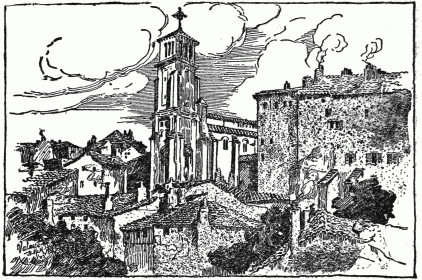
Then he will learn from the habitants that by far their greatest respect and pride are for their ancienne Cathédrale de St. Maurice, which sits boldly upon a terrace dominating the course of the river Rhône.
In many respects St. Maurice de Vienne will strike the student and lover of architecture as being one of the most lively and appealing edifices of its kind. The Lombard origin of many of its features is without question; notably the delightful gallery on the north side, with its supporting columns of many grotesque shapes.
Again the parapet and terrace which precede this church, the ground-plan, and some of the elevations are pure Lombard in motive.
There are no transepts and no ancient chapels at the eastern termination; the windows running down to the pavement. This, however, does not make for an appearance at all outré—quite the reverse is the case. The general effect of the entire internal distribution of parts, with its fine approach from the nave to the sanctuary and choir, is exceedingly notable.
Of the remains of the edifice, which was erected on the foundations of a still earlier church, in 1052 (reconstructed in 1515), we have those of the primitive, but rich, ornamentation of the façade as the most interesting and appealing.
The north doorway, too, indicates in its curious bas-reliefs, of the twelfth or thirteenth centuries, a luxuriance which in the north—in the Romanesque churches at least—came only with later centuries.
There are few accessories of note to be seen in the choir or chapels: a painting of St. Maurice by Desgoffés, a small quantity of fourteenth-century glass, the mausoleum of Cardinal de Montmorin, a sixteenth-century tomb, and, in one of the chapels, some modern glass of more than usual brilliance.
The pulpit is notable, and, with that in St. Jean de Lyon, ranks as one of the most elaborate in France.
For the rest, one's admiration for St. Maurice de Vienne must rest on the glorious antiquity of the city, as a centre of civilizing and Christianizing influence.
When Pope Paschal II. (1099-1118) confirmed the metropolitan privileges of Vienne, and sent the pallium to its archbishop, he assigned to him as suffragans the bishops of Grenoble, Valence, Dié, Viviers, Geneva, and St. Jean de Maurienne, and conferred upon him the honorary office of primate over Monstiers in Tarentaise. Still later, Calixtus II. (1119-24) favoured the archbishopric still further by not only confirming the privileges which had gone before, but investing the archbishop with the still higher dignity of the office of primate over the seven ecclesiastical Provinces of Vienne, Bourges, Bordeaux, Auch, Narbonne, Aix, and Embrun.
VI ST. APOLLINAIRE DE VALENCE
Valence, the Valentia of the Romans, is variously supposed to be situated in southeastern France, Provence, and the Cevennes. For this reason it will be difficult for the traveller to locate his guide-book reference thereto.
It is, however, located in the Rhône valley on the very banks of that turgid river, and it seems inexplicable that the makers of the red-covered couriers do not place it more definitely; particularly in that it is historically so important a centre.
The most that can usually be garnered by the curious is that it is "well built in parts, and that those parts only are of interest to the traveller." As a matter of fact, they are nothing of the sort; and the boulevards, of which so much is made, are really very insignificant; so, too, are the cafés and restaurants, to which far more space is usually given than to the claim of Valence as an early centre of Christianity.
Valence is not a great centre of population, and is appealing by reason of its charming situation, in a sort of amphitheatre, before which runs the swift-flowing Rhône. There is no great squalor, but there is a picturesqueness and charm which is wholly dispelled in the newer quarters, of which the guide-books speak.
There is, moreover, in the cathedral of St. Apollinaire, a small but highly interesting "Romanesque-Auvergnian" cathedral; rebuilt and reconsecrated by Urban II., in the eleventh century, and again reconstructed, on an entirely new plan, in 1604. Besides this curious church there is a "Protestant temple," which occupies the former chapel of the ancient Abbey of St. Rufus, that should have a singularly appealing interest for English-speaking folk.
The préfecture occupies another portion of the abbey, which in its various disintegrated parts is worthy of more than passing consideration.
The bishopric was founded here at Valence in the fourth century—when Emelien became the first bishop. The see endures to-day as a suffragan of Avignon; whereas formerly it owed obedience to Vienne (now Lyon et Vienne).
The ancient cathedral of St. Apollinaire is almost wholly conceived and executed in what has come to be known as the Lombard style.
The main body of the church is preceded on the west by an extravagant rectangular tower, beneath which is the portal or entrance; if, as in the present instance, the comprehensive meaning of the word suggests something more splendid than a mere doorway.
There has been remarked before now that there is a suggestion of the Corinthian order in the columns of both the inside and outside of the church. This is a true enough detail of Lombard forms as it was of the Roman style, which in turn was borrowed from the Greeks. In later times the neo-classical details of the late Renaissance period produced quite a different effect, and were in no way comparable to the use of this detail in the Lombard and Romanesque churches.
In St. Apollinaire, too, are to be remarked the unusual arch formed of a rounded trefoil. This is found in both the towers, and is also seen in St. Maurice at Vienne, but not again until the country far to the northward and eastward is reached, where they are more frequent, therefore their use here may be considered simply as an interpolation brought from some other soil, rather than an original conception of the local builder.
Here also is seen the unusual combination of an angular pointed arch in conjunction with the round-headed Lombard variety. This, in alternation for a considerable space, on the south side of the cathedral. It is a feature perhaps not worth mentioning, except from the fact that both the trefoil and wedge-pointed arch are singularly unbeautiful and little in keeping with an otherwise purely southern structure.
The aisles of St. Apollinaire, like those of Notre Dame de la Grande at Poitiers, and many other Lombardic churches, are singularly narrow, which of course appears to lengthen them out interminably.
If any distinctive style can be given this small but interesting cathedral, it may well be called the style of Lyonnaise.
It dates from the twelfth century as to its foundations, but was rebuilt on practically a new ground-plan in 1604.
To-day it is cruciform after the late elongated style, with lengthy transepts and lofty aisles.
The chief feature to be observed of its exterior is its heavy square tower (187 feet) of four stories. It is not beautiful, and was rebuilt in the middle nineteenth century, but it is imposing and groups satisfactorily enough with the ensemble round about. Beneath this tower is a fine porch worked in Crussol marble.
There is no triforium or clerestory. In the choir is a cenotaph in white marble to Pius VI., who was exiled in Valence, and who died here in 1799. It is surmounted by a bust by Canova, whose work it has become the fashion to admire sedulously.
VII CATHÉDRALE DE VIVIERS
The bishopric of Viviers is a suffragan of Avignon, and is possessed of a tiny cathedral church, which, in spite of its diminutive proportions, overtops quite all the other buildings of this ancient capital of the Vivarais.
The city is a most picturesque setting for any shrine, with the narrow, tortuous streets—though slummy ones—winding to the cliff-top on which the city sits high above the waters of the Rhône.
The choir of this cathedral is the only portion which warrants remark. It is of the fourteenth century, and has no aisles. It is in the accepted Gothic style, but this again is coerced by the Romanesque flanking tower, which, to all intents and purposes, when viewed from afar, might well be taken for a later Renaissance work.
A nearer view dissects this tower into really beautiful parts. The base is square, but above—in an addition of the fifteenth century—it blooms forth into an octagon of quite original proportions.
In the choir are some Gobelin tapestries and paintings by Mignard; otherwise there are no artistic attributes to be remarked.
VIII NOTRE DAME D'ORANGE
The independent principality of Orange (which had existed since the eleventh century), with the papal State of Avignon, the tiny Comté Venaissin, and a small part of Provence were welded into the Department of Vaucluse in the redistribution of political divisions under Napoleon I. The house of Nassau retains to-day the honorary title of Princes of Orange, borne by the heir apparent to the throne of Holland. More anciently the city was known as the Roman Arausio, and is yet famous for its remarkable Roman remains, the chief of which are its triumphal arch and theatre—one of the largest and most magnificent, if not actually the largest, of its era.
The history of the church at Orange is far more interesting and notable than that of its rather lame apology for a cathedral of rank. The see succumbed in 1790 in favour of Avignon, an archbishopric, and Valence, one of its suffragans.
The persecution and oppression of the Protestants of Orange and Dauphiné are well-recorded facts of history.
A supposedly liberal and tolerant maker of guide-books (in English) has given inhabitants of Orange a hard reputation by classing them as a "ferocious people." This rather unfair method of estimating their latter-day characteristics is based upon the fact that over three hundred perished here by the guillotine during the first three months of the Revolution. It were better had he told us something of the architectural treasures of this ville de l'art célèbre. He does mention the chief, also that "the town has many mosquitoes," but, as for churches, he says not a word.
The first bishop was St. Luce, who was settled here in the fourth century, at the same time that St. Ruff came to Avignon.
As a bishopric, Orange was under the control of St. Trophime's successors at Arles.
Notre Dame d'Orange is a work of little architectural pretence, though its antiquity is great as to certain portions of its walls. The oldest portion dates from 1085, though there is little to distinguish it from the more modern additions and reparations, and is in no way suggestive of the splendour with which the ancient Roman theatre and arch were endowed.
The chief attribute to be remarked is the extreme width of nave, which dates from 1085 to 1126. The cathedral itself, however, is not an architectural example of any appealing interest whatever, and pales utterly before the magnificent and splendid preservations of secular Roman times.
Since, however, Orange is a city reminiscent of so early a period of Christianity as the fourth century, it is to be presumed that other Christian edifices of note may have at one time existed: if so, no very vivid history of them appears to have been left behind, and certainly no such tangible expressions of the art of church-building as are seen in the neighbouring cities of the Rhône valley.
IX ST. VÉRAN DE CAVAILLON
"It is the plain of Cavaillon which is the market-garden of Avignon; from whence come the panniers of vegetables and fruits, the buissons d'artichauts, and the melons of 'high reputation.'"
Such is the rather free paraphrase of a most charmingly expressed observation on this Provençal land of plenty, written by an eighteenth-century Frenchman.
If it was true in those days, it is no less true to-day, and, though this book is more concerned with churches than with potagerie, the observation is made that this fact may have had not a little to do with the early foundation of the church, here in a plenteous region, where it was more likely to prosper than in an impoverished land.
The bishopric was founded in the fifth century by St. Genialis, and it endured constantly until the suppression in 1790.
All interest in Cavaillon, in spite of its other not inconsiderable claims, will be centred around its ancient cathedral of St. Véran, immediately one comes into contact therewith.
The present structure is built upon a very ancient foundation; some have said that the primitive church was of the seventh century. This present cathedral was consecrated by Pope Innocent IV. in person, in 1259, and for that reason possesses a considerable interest which it would otherwise lack.
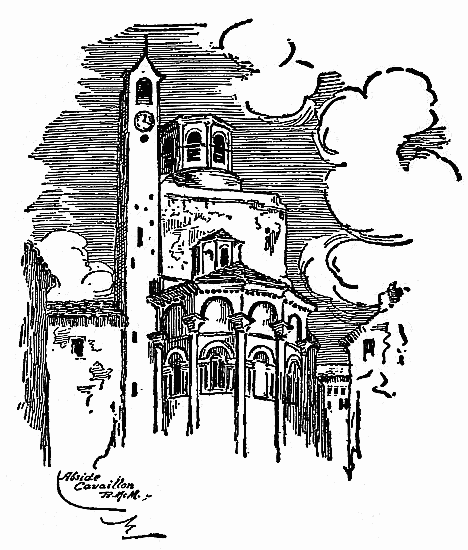
Externally the most remarkable feature is the arrangement and decoration of the apside—there is hardly enough of it to come within the classification of the chevet. Here the quintuple flanks, or sustaining walls, are framed each with a pair of columns, of graceful enough proportions in themselves, but possessed of inordinately heavy capitals.
An octagonal cupola, an unusual, and in this case a not very beautiful feature, crowns the centre of the nave. In reality it serves the purpose of a lantern, and allows a dubious light to trickle through into the interior, which is singularly gloomy.
To the right of the nave is a curiously attenuated clocher, which bears a clock-face of minute proportions, and holds a clanging bourdon, which, judging from its voice, must be as proportionately large as the clock-face is small.
Beneath this tower is a doorway leading from the nave to the cloister, a beautiful work dating from a much earlier period than the church itself.
This cloister is not unlike that of St. Trophime at Arles, and, while plain and simple in its general plan of rounded arches and vaulting, is beautifully worked in stone, and admirably preserved. In spite of its severity, there is no suggestion of crudity, and there is an elegance and richness in its sculptured columns and capitals which is unusual in ecclesiastical work of the time.
The interior of this church is quite as interesting as the exterior. There is an ample, though aisleless, nave, which, though singularly dark and gloomy, suggests a vastness which is perhaps really not justified by the actual state of affairs.
A very curious arrangement is that the supporting wall-pillars—in this case a sort of buttress, like those of the apside—serve to frame or enclose a series of deep-vaulted side chapels. The effect of this is that all of the flow of light, which might enter by the lower range of windows, is practically cut off from the nave. What refulgence there is—and it is not by any means of the dazzling variety—comes in through the before-mentioned octagon and the upper windows of the nave.
In a chapel—the gift of Philippe de Cabassole, a friend of Petrarch's—is a funeral monument which will even more forcibly recall the name and association of the poet. It is a seventeenth-century tomb of Bishop Jean de Sade, a descendant of the famous Laura, whose ashes formerly lay in the Église des Cordeliers at Avignon, but which were, it is to be feared, scattered to the winds by the Revolutionary fury.
At the summit of Mont St. Jacques, which rises high above the town, is the ancient Ermitage de St. Véran; a place of local pilgrimage, but not otherwise greatly celebrated.
X NOTRE DAME DES DOMS D'AVIGNON
It would be difficult to say with precision whether Avignon were more closely connected in the average mind with the former papal splendour, with Petrarch and his Laura, or with the famous Félibrage.
Avignon literally reeks with sentimental associations of a most healthy kind. No probable line of thought suggested by Avignon's historied and romantic past will intimate even the mawkish, the sordid, or the banal. It is, in almost limitless suggestion, the city of France above all others in which to linger and drink in the life of its past and present to one's fullest capacities.
For the "literary pilgrim," first and foremost will be Avignon's association with Petrarch, or rather he with it. For this reason it shall be disposed of immediately, though not in one word, or ten; that would be impossible.
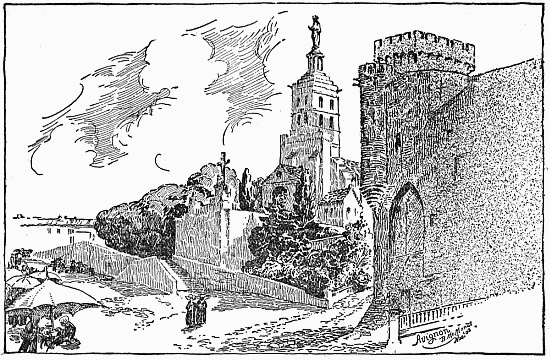
Notre Dame des Doms d'Avignon
"'The grave of Laura!' said I. 'Indeed, my dear sir, I am obliged to you for having mentioned it,'" were the words with which the local bookseller was addressed by an eighteenth-century traveller. "'Otherwise one might have gone away, to their everlasting sorrow and shame, without having seen this curiosity of your city.'"
The same record of travel describes the guardian of this shrine as "a converted Jew, who, from one year's end to another, has but two duties to perform, which he most punctually attends to. The one to take care of the grave of Laura, and to show it to strangers, the other to give them information respecting all the curiosities. Before his conversion, he stood at the corner by the Hôtel de Ville offering lottery tickets to passers-by, and asking, till he was hoarse, if they had anything to sell. Not a soul took the least notice of him. His beard proved a detriment in all his speculations. Now that he has become a Christian, it is wonderful how everything thrives with him."
At the very end of the Rue des Lices will be found the last remains of the Église des Cordeliers—reduced at the Revolution to a mere tower and its walls. Here may be seen the spot where was the tomb of Laura de Sade. Arthur Young, writing just before the Revolution, described it as below; though since that time still other changes have taken place, with the result that "Laura's Grave" is little more than a memory to-day, and a vague one at that.
"The grave is nothing but a stone in the pavement, with a figure engraved on it already partly effaced, surrounded by an inscription in Gothic letters, and another on the wall adjoining, with the armorial bearings of the De Sade family."
To-day nothing but the site—the location—of the tomb is still there, the before-mentioned details having entirely disappeared. The vault was apparently broken open at the Revolution, and its ashes scattered. It was here at Avignon, in the Église de St. Claire, as Petrarch himself has recorded, that he first met Laura de Sade.
The present mood is an appropriate one in which to continue the Petrarchian pilgrimage countryward—to the famous Vaucluse. Here Petrarch came as a boy, in 1313, and, if one chooses, he may have his déjeuner at the Hôtel Pétrarque et Laure; not the same, of course, of which Petrarch wrote in praise of its fish of Sorgues; but you will have them as a course at lunch nevertheless. Here, too, the famed Fontaine first comes to light and air; and above it hangs "Petrarch's Castle," which is not Petrarch's castle, nor ever was. It belonged originally to the bishops of Cavaillon, but it is possible that Petrarch was a guest there at various times, as we know he was at the more magnificent Palais des Papes at Avignon.
This château of the bishops hangs perilously on a brow which rises high above the torrential Fontaine, and, if sentiment will not allow of its being otherwise ignored, it is permissible to visit it, if one is so inclined. No special hardship is involved, and no great adventure is likely to result from this journey countryward. Tourists have been known to do the thing before "just to get a few snapshots of the fountain."
As to why the palace of the popes came into being at Avignon is a question which suggests the possibilities of the making of a big book.
The popes came to Avignon at the time of the Italian partition, on the strength of having acquired a grant of the city from Joanna of Naples, for which they were supposed to give eighty thousand golden crowns. They never paid the bill, however; from which fact it would appear that financial juggling was born at a much earlier period than has hitherto been supposed.
Seven popes reigned here, from 1305 to 1370; when, on the termination of the Schism, it became the residence of a papal legate. Subsequently Louis XIV. seized the city, in revenge for an alleged affront to his ambassador, and Louis XV. also held it for ten years.
The curious fact is here recalled that, by the treaty of Tolentino (12th February, 1797), the papal power at Rome conceded formally for the first time—to Napoleon I.—their ancient territory of Avignon. On the terms of this treaty alone was Pope Pius allowed to remain nominal master of even shreds of the patrimony of St. Peter.
The significant events of Avignon's history are too great in purport and number to be even catalogued here, but the magnificent papal residence, from its very magnitude and luxuriance, compels attention as one of the great architectural glories, not only of France, but of all Europe as well.
Here sat, for the major portion of the fourteenth century, the papal court of Avignon; which the uncharitable have called a synonym for profligacy, veniality, and luxurious degeneracy. Here, of course, were held the conclaves by which the popes of that century were elected; significantly they were all Frenchmen, which would seem to point to the fact of corruption of some sort, if nothing more.
Rienzi, the last of the tribunes, was a prisoner within the walls of this great papal stronghold, and Simone Memmi of Sienna was brought therefrom to decorate the walls of the popes' private chapel; Petrarch was persona grata here, and many other notables were frequenters of its hospitality.
The palace walls rise to a height of nearly ninety feet, and its battlemented towers add another fifty; from which one may infer that its stability was great; an effect which is still further sustained when the great thickness of its sustaining walls is remarked, and the infrequent piercings of windows and doorways.
This vast edifice was commenced by Pope Clement V. in the early years of the thirteenth century, but nothing more than the foundations of his work were left, when Benedict XII., thirty years later, gave the work into the hands of Peter Obreri—who must have been the Viollet-le-Duc of his time.
Revolution's destroying power played its part here, as generally throughout France, in defacing shrines, monuments, and edifices, civil and ecclesiastical, with little regard for sentiment and absolutely none for reason.
The mob attacked the papal palace with results more disastrous than the accumulated debasement of preceding centuries. The later régime, which turned the magnificent halls of this fortress-like palace into a mere barracks—as it is to-day—was quite as iconoclastic in its temperament.
One may realize here, to the full, just how far a great and noble achievement of the art and devotion of a past age may sink. The ancient papal palace at Avignon—the former seat of the power of the Roman Catholic religion—has become a mere barracks! To contemplate it is more sad even than to see a great church turned into a stable or an abattoir—as can yet be seen in France.
In its plan this magnificent building preserves its outlines, but its splendour of embellishment has very nearly been eradicated, as may be observed if one will crave entrance of the military incumbent.
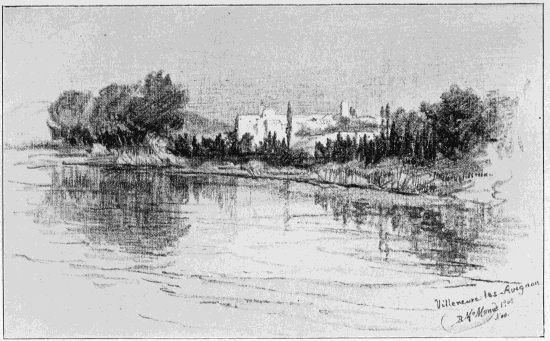

In 1376 Pope Gregory XI. left Avignon for Rome,—after him came the two anti-popes,—and thus ended what Petrarch has called "L'Empia Babilonia."
The cathedral of Notre Dame des Doms pales perceptibly before the splendid dimensions of the papal palace, which formerly encompassed a church of its own of much more artistic worth.
In one respect only does the cathedral lend a desirable note to the ensemble. This, by reason of its commanding situation—at the apex of the Rocher des Doms—and by the gilded statue of the Virgin which surmounts the tower, and supplies just the right quality of colour and life to a structure which would be otherwise far from brilliant.
From the opposite bank of the Rhône—from Villeneuve-les-Avignon—the view of the parent city, the papal residence, the cathedral, and that unusual southern attribute, the beffroi, all combine in a most glorious picture of a superb beauty; quite rivalling—though in a far different manner—that "plague spot of immorality,"—Monte Carlo, which is mostly thought to hold the palm for the sheer beauty of natural situation.
The cathedral is chiefly of the twelfth century, though even a near-by exterior view does not suggest any of the Gothic tendencies of that era. It is more like the heavy bungling style which came in with the Renaissance; but it is not that either, hence it must be classed as a unique variety, though of the period when the transition from the Romanesque to Gothic was making inroads elsewhere.
It has been said that the structure dates in part from the time of Charlemagne, but, if so, the usual splendid appointments of the true Charlemagnian manner are sadly lacking. There may be constructive foundations of the eleventh century, but they are in no way distinctive, and certainly lend no liveliness to a building which must ever be ranked as unworthy of the splendid environment.
As a church of cathedral rank, it is a tiny edifice when compared with the glorious northern ground-plans: it is not much more than two hundred feet in length, and has a width which must be considerably less than fifty feet.
The entrance, at the top of a long, winding stair which rises from the street-level of the Place du Palais to the platform of the rock, is essentially pagan in its aspect; indeed it is said to have previously formed the portal of a pagan temple which at one time stood upon the site. If this be so, this great doorway—for it is far larger in its proportions than any other detail—is the most ancient of all the interior or exterior features.
The high pediment and roof may be pointed Gothic, or it may not; at any rate, it is in but the very rudimentary stage. Authorities do not agree; which carries the suggestion still further that the cathedral at Avignon is of itself a queer, hybrid thing in its style, and with not a tithe of the interest possessed by its more magnificent neighbour.
The western tower, while not of great proportions, is rather more massive than the proportions of the church body can well carry. What decoration it possesses carries the pagan suggestion still further, with its superimposed fluted pillars and Corinthian columns.
The gloomy interior is depressing in the extreme, and whatever attributes of interest that it has are largely discounted by their unattractive setting.
There are a number of old paintings, which, though they are not the work of artists of fame, might possibly prove to be of creditable workmanship, could one but see them through the gloom. In the before-mentioned porch are some frescoes by Simone Memmi, executed by him in the fourteenth century, when he came from Sienna to do the decorations in the palace.
The side chapels are all of the fourteenth century; that of St. Joseph, now forming the antechamber of the sacristy, contains a noteworthy Gothic tomb and monument of Pope John XXII. It is much mutilated to-day, and is only interesting because of the personality connected therewith. The custodian or caretaker is in this case a most persistently voluble person, who will give the visitor little peace unless he stands by and hears her story through, or flees the place,—which is preferable.
The niches of this highly florid Gothic tomb were despoiled of their statues at the Revolution, and the recumbent effigy of the Pope has been greatly disfigured. A much simpler monument, and one quite as interesting, to another Pope, Benedict XII.,—he who was responsible for the magnificence of the papal palace,—is in a chapel in the north aisle of the nave, but the cicerone has apparently no pride in this particular shrine.
An ancient (pagan?) altar is preserved in the nave. It is not beautiful, but it is undoubtedly very ancient and likewise very curious.
The chief accessory of interest for all will doubtless prove to be the twelfth-century papal throne. It is of a pure white marble, rather cold to contemplate, but livened here and there with superimposed gold ornament. What decoration there is, chiefly figures representing the bull of St. Luke and the lion of St. Mark, is simple and severe, as befitted papal dignity. To-day it serves the archbishop of the diocese as his throne of dignity, and must inspire that worthy with ambitious hopes.
The chapter of the cathedral at Avignon—as we learn from history—wears purple, in company with cardinals and kings, at all celebrations of the High Mass of Clara de Falkenstein. From a well-worn vellum quarto in the library at Avignon one may read the legend which recounts the connection of Ste. Clara de Mont Falcone with the mystery of the Holy Trinity; from which circumstance the honour and dignity of the purple has been granted to the prelates of the cathedral.
No mention of Avignon, or of Arles, or of Nîmes could well be made without a reference to the revival of Provençal literature brought about by the famous "Félibrage," that brotherhood founded by seven poets, of whom Frederic Mistral is the most popularly known.
The subject is too vast, and too vastly interesting to be slighted here, so perforce mere mention must suffice.
The word Félibre was suggested by Mistral, who found it in an old hymn. Its etymology is uncertain, but possibly it is from the Greek, meaning "a lover of the beautiful."
The original number of the Félibres was seven, and they first met on the fête-day of Ste. Estelle; in whose honour they adopted the seven-pointed star as their emblem. Significantly, the number seven has much to do with the Félibres and Avignon alike. The enthusiastic Félibre tells of Avignon's seven churches, its seven gates, seven colleges, seven hospitals, and seven popes—who reigned at Avignon for seven decades; and further that the word Félibre has seven letters, as, also, has the name of Mistral, one of its seven founders—who took seven years in writing his epics.
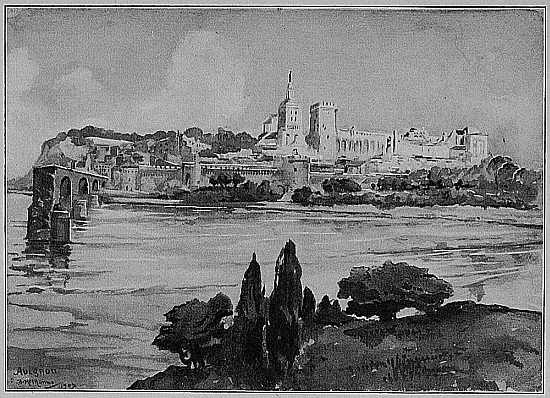

The machicolated walls, towers, and gateways of Avignon, which protected the city in mediæval times, and—history tells us—sheltered twice as many souls as now, are in a remarkable state of preservation and completeness, and rank foremost among the masterworks of fortification of their time. This outer wall, or enceinte, was built at the instigation of Clement VI., in 1349, and was the work of but fourteen years.
A hideously decorated building opposite the papal palace—now the Conservatoire de Musique—was formerly the papal mint.
The ruined bridge of St. Bénezet, built in the twelfth century, is a remarkable example of the engineering skill of the time. Surmounting the four remaining arches—still perfect as to their configuration—is a tiny chapel dedicated to St. Nicholas, which formerly contained reliques of St. Bénezet.
The extraordinary circumstance which led up to the building of this bridge seems legendary, to say the least.
It is recorded that St. Bénezet, its founder, who was a mere shepherd, became inspired by God to undertake this great work. The inspiration must likewise have brought with it not a little of the uncommon skill of the bridge-builder, and, considering the extent and scope of the projected work, something of the spirit of benefaction as well.
The foundation was laid in 1171, and it was completed, after seventeen years of labour, in 1188.
On this bridge, near the entrance to the city, was erected a hospital of religious persons, who were denominated Les Frères du Pont, their offices being to preserve the fabric, and to afford succour to all manner of travellers.
The boldness and utility of this undertaking,—it being the only means of communication between Avignon and the French territory beyond the Rhône,—as well as the permanency assured to it by the annexing of a religious foundation, cannot fail to grant to the memory of its holy founder something more than a due share of veneration on behalf of his genius and perspicacity.
XI ST. SIFFREIN DE CARPENTRAS
The tiny city of Carpentras, most picturesquely situated on the equally diminutive river Auzon which enters the Rhône between Orange and Avignon, was a Roman colony under Augustus, and a bishopric under St. Valentin in the third century.
A suffragan of Avignon, the papal city, the see was suppressed in 1790.
The Bishops of Carpentras, it would appear, were a romantic and luxury-loving line of prelates, though this perhaps is aught against their more devout virtues.
They had a magnificent palace overhanging the famous "Fountain of Vaucluse," and repaired thither in mediæval times for the relaxation which they evidently much appreciated. They must have been veritable patrons of literature and the arts, as Petrarch and his fellows-in-art were frequently of their household.
The ancient cathedral of St. Siffrein is dedicated to a former bishop of Carpentras, who died in the sixth century.
As this church now stands, its stones are mainly of the early sixteenth century. The west façade is entirely without character, and is pierced at the pavement with a gross central doorway flanked by two others; poor copies of the Greco-Romain style, which, in many of its original forms, was certainly more pleasing than here. Each of these smaller doorways have for their jambs two beautifully toned columns of red jasper, from a baptistère of which there are still extensive remains at Venasque near by.
This baptistère, by the way, and its neighbouring Romanesque and Gothic church, is quite worth the energy of making the journey countryward, eleven kilometres from Carpentras, to see.
It is nominally of the tenth century, but is built up from fragments of a former Temple to Venus, and its situation amid the rocks and tree-clad hilltops of the Nesque valley is most agreeable.
The portal on the south side—though, for a fact, it hardly merits the dignity of such a classification—is most ornately sculptured. A figure of the Virgin, in the doorway, it locally known as Notre Dame des Neiges.
Much iconographic symbolism is to be found in this doorway, capable of various plausible explanations which shall not be attempted here.
It must suffice to say that nowhere in this neighbourhood, indeed possibly not south of the Loire, is so varied and elaborate a collection of symbolical stone-carving to be seen.
There is no regularly completed tower to St. Siffrein, but a still unachieved tenth-century clocher in embryo attaches itself on the south.
The interior presents the general effect of Gothic, and, though of late construction, is rather of the primitive order.
There are no aisles, but one single nave, very wide and very high, while the apse is very narrow, with lateral chapels.
Against the western wall are placed four paintings; not worthy of remark, perhaps, except for their great size. They are of the seventeenth or eighteenth century. A private corridor, or gallery, leads from this end of the church to the episcopal palace, presumably for the sole use of the bishops and their guests. The third chapel on the right is profusely decorated and contains a valuable painting by Dominique de Carton. Another contains a statue of the Virgin, of the time of Louis XIV., and is very beautiful.
A tomb of Bishop Laurent Buti (d. 1710) is set against the wall, where the apse adjoins the nave.
Rearward on the high-altar is a fine painting by an unknown artist of the Italian school.
The old-time cathedral of St. Siffrein was plainly not of the poverty-stricken class, as evinced by the various accessories and details of ornamentation mentioned above. It had, moreover, in conjunction with it, a most magnificent and truly palatial episcopal residence, built by a former cardinal-bishop, Alexandri Bichi, in 1640. To-day it serves the functions of the Palais de Justice and a prison; in the latter instance certainly a fall from its hitherto high estate. Built about by this ancient residence of the prelates of the Church is also yet to be seen, in much if not quite all of its pristine glory, a Gallo-Romain arc de Triomphe of considerable proportions and much beauty of outline and ornament.
As to period, Prosper Mérimée, to whom the preservation of the ancient monuments of France is largely due, has said that it is contemporary with its compeer at Orange (first or second century).
The Porte d'Orange, in the Grande Rue, is the only relique left at Carpentras of the ancient city ramparts built in the fourteenth century by Pope Innocent VI.
XII CATHÉDRALE DE VAISON
The Provençal town of Vaison, like Carpentras and Cavaillon, is really of the basin of the Rhône, rather than of the region of the snow-crowned Alps which form its background. It is of little interest to-day as a cathedral city, though the see dates from a foundation of the fourth century, by St. Aubin, until the suppression of 1790.
Its former cathedral is hardly the equal of many others which have supported episcopal dignity, but it has a few accessories and attributes which make it notable.
Its nave is finely vaulted, and there is an eleventh-century cloister, which flanks the main body of the church on the left, which would be remarked under any circumstances.
The cloister, though practically a ruin,—but a well preserved one,—shows in its construction many beautiful Gallo-Romain and early Gothic columns which are exceedingly beautiful in their proportions. In this cloister, also, are some fragments of early Christian tombs, which will offer unlimited suggestion to the archæologist, but which to the lover of art and architecture are quite unappealing.
The Église St. Quinin is a conglomerate edifice which has been built up, in part, from a former church which stood on the same site in the seventh century. It is by no means a great architectural achievement as it stands to-day, but is highly interesting because of its antiquity. In the cathedral the chief article of real artistic value is a bénitier, made from the capital of a luxurious Corinthian column. One has seen sun-dials and drinking-fountains made from pedestals and sarcophagi before—and the effect has not been pleasing, and smacks not only of vandalism, but of a debased ideal of art, but this column-top, which has been transformed into a bénitier, cannot be despised.
The bête-noir of all this region, and of Vaison in particular,—if one is to believe local sentiment,—is the high sweeping wind, which at certain seasons blows in a tempestuous manner. The habitant used to say that "le mistral, le Parlement, et Durance sont les trois fléaux de Provence."
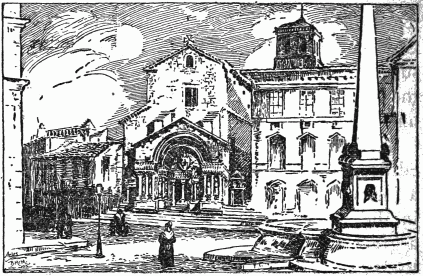
XIII ST. TROPHIME D'ARLES
"In all the world that which interests me most is La Fleur des 'Glais' ... It is a fine plant.... It is the same as the Fleurs des Lis d'Or of the arms of France and of Provence."
—Frederic Mistral.
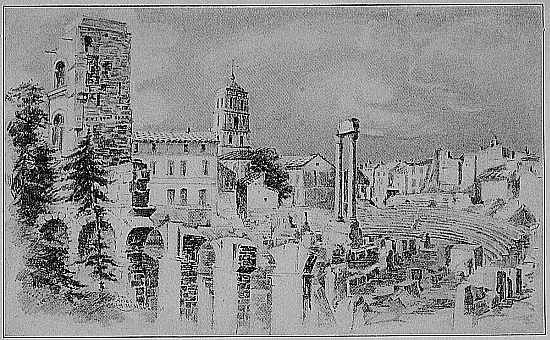

Two French writers of repute have recently expressed their admiration of the marvellous country, and the contiguous cities, lying about the mouth of the Rhône; among which are Nîmes, Aigues-Mortes, and—of far greater interest and charm—Arles. Their opinions, perhaps, do not differ very greatly from those of most travellers, but both Madame Duclaux, in "The Fields of France," and René Bazin, in his Récits de la Plaine et de la Montagne, give no palm, one to the other, with respect to their feeling for "the mysterious charm of Arles."
It is significant that in this region, from Vienne on the north to Arles and Nîmes in the south, are found such a remarkable series of Roman remains as to warrant the statement by a French antiquarian that "in Rome itself are no such temples as at Vienne and Nîmes, no theatres so splendidly preserved as that at Orange,—nor so large as that of Arles,—and that the magnificent ruined colosseum on the Tiber in no wise has the perfections of its compeer at Nîmes, nor has any triumphal arch the splendid decorations of that at Reims in the champagne country."
With these facts in view it is well to recall that many non-Christian influences asserted themselves from time to time, and overshadowed for a temporary period those which were more closely identified with the growth of the Church. The Commission des Monuments Historiques catalogue sixteen notable monuments in Arles which are cared for by them: the Amphitheatre, the remains of the Forum,—now built into the façade of the Hôtel du Nord,—the remains of the Palais de Constantin, the Abbey of Montmajour, and the one-time cathedral of St. Trophime, and its cloister—to particularize but a few.
To-day, as anciently, the ecclesiastical province is known as that of Aix, Arles, and Embrun. Arles, however, for a time took its place as an archbishopric, though to-day it joins hands again with Aix and Embrun; thus, while enjoying the distinction of being ranked as an archbishopric, its episcopal residence is at Aix.
It was at Arles that the first, and only, English pope—Adrian Breakspeare—first entered a monastic community, after having been refused admission to the great establishment at St. Albans in Hertfordshire, his native place. Here, by the utmost diligence, he acquired the foundation of that great learning which resulted in his being so suddenly proclaimed the wearer of the tiara, in 1154.
St. Trophime came to Arles in the first century, and became the first bishop of the diocese. The first church edifice on this site was consecrated in 606 by St. Virgil, under the vocable of St. Etienne. In 1152 the present church was built over the remains of St. Trophime, which were brought thither from St. Honorat des Alyscamps. So far as the main body of the church is concerned, it was completed by the end of the twelfth century, and only in its interior is shown the development of the early ogival style.
The structure was added to in 1430, when the Gothic choir was extended eastward.
The aisles are diminutively narrow, and the window piercings throughout are exceedingly small; all of which makes for a lack of brilliancy and gloom, which may be likened to the average crypt. The only radiance which ever penetrates this gloomy interior comes at high noon, when the refulgence of a Mediterranean sun glances through a series of long lancets, and casts those purple shadows which artists love. Then, and then only, does the cathedral of St. Trophime offer any inducement to linger within its non-impressive walls.
The exterior view is, too, dull and gloomy—what there is of it to be seen from the Place Royale. By far the most lively view is that obtained from across the ruins of the magnificent Roman theatre just at the rear. Here the time-resisting qualities of secular Roman buildings combine with the cathedral to present a bright, sunny, and appealing picture indeed.
St. Trophime is in no sense an unworthy architectural expression. As a Provençal type of the Romanesque,—which it is mostly,—it must be judged as quite apart from the Gothic which has crept in to but a slight extent.
The western portal is very beautiful, and, with cloister, as interesting and elaborate as one could wish.
It is the generality of an unimposing plan, a none too graceful tower and its uninteresting interior, that qualifies the richness of its more luxurious details.
The portal of the west façade greatly resembles another at St. Gilles, near by. It is a profusely ornamented doorway with richly foliaged stone carving and elaborate bas-reliefs.
The tympanum of the doorway contains the figure of a bishop in sacerdotal costume, doubtless St. Trophime, flanked by winged angels and lions. The sculptures here date perhaps from the period contemporary with the best work at Paris and Chartres,—well on into the Middle Ages,—when sculpture had not developed or perfected its style, but was rather a bad copy of the antique. This will be notably apparent when the stiffness and crudeness of the proportions of the figures are taken into consideration.
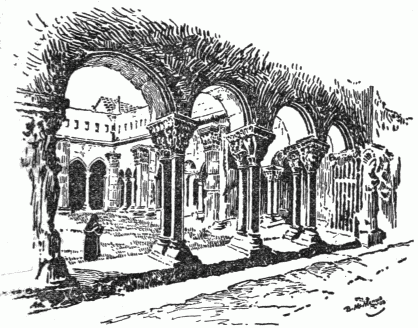
Cloisters, St. Trophime d'Arles
The wonderful cloister of St. Trophime is, on the east side, of Romanesque workmanship, with barrel vaulting, and dates from 1120. On the west it is of the transition style of a century later, while on the north the vaulting springs boldly into the Gothic of that period—well on toward 1400.
The capitals of the pillars of this cloistered courtyard are most diverse, and picture in delicately carved stone such scenes of Bible history and legend as the unbelief of St. Thomas, Ste. Marthe and the Tarasque, etc. It is a curious mélange of the vagaries of the stone carver of the Middle Ages,—these curiously and elaborately carved capitals,—but on the whole the ensemble is one of rare beauty, in spite of non-Christian and pagan accessories. These show at least how far superior the classical work of that time was to the later Renaissance.
The cemetery of Arles, locally known as Les Alyscamps, literally teems with mediæval and ancient funeral monuments; though many, of course, have been removed, and many have suffered the ravages of time, to say nothing of the Revolutionary period. One portion was the old pagan burial-ground, and another—marked off with crosses—was reserved for Christian burial.
It must have been accounted most holy ground, as the dead were brought thither for burial from many distant cities.
Danté mentions it in the "Inferno," Canto IX.:
"Just as at Arles where the Rhône is stagnant
The sepulchres make all the ground unequal."
Ariosto, in "Orlando Furioso," remarks it thus:
"Many sepulchres are in this land."
St. Rémy, a few leagues to the northeast of Arles, is described by all writers as wonderfully impressive and appealing to all who come within its spell;—though the guide-books all say that it is a place without importance.
René Bazin has this to say: "St. Rémy, ce n'est pas beau, ce St. Rémy." Madame Duclaux apostrophizes thus: "We fall at once in love with St. Rémy." With this preponderance of modern opinion we throw in our lot as to the charms of St. Rémy; and so it will be with most, whether with regard to its charming environment or its historical monuments, its arch, or its funeral memorials. One will only come away from this charming petite ville with the idea that, in spite of its five thousand present-day inhabitants, it is something more than a modern shrine which has been erected over a collection of ancient relics. The little city breathes the very atmosphere of mediævalism.
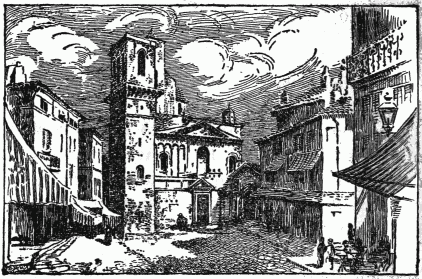
XIV ST. CASTOR DE NÎMES
Like its neighbouring Roman cities, Nîmes lives mostly in the glorious past.
In attempting to realize—if only in imagination—the civilization of a past age, one is bound to bear always in mind the motif which caused any great art expression to take place.
Here at Nîmes the church builder had much that was magnificent to emulate, leaving style apart from the question.
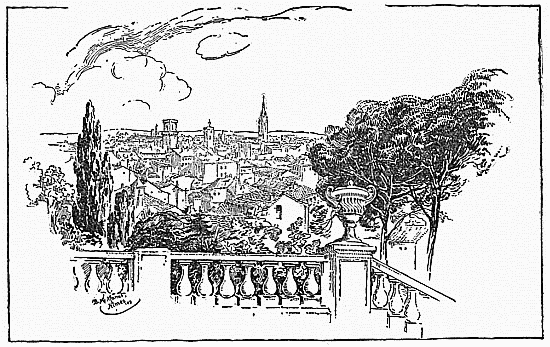
St. Castor de Nîmes
He might, when he planned the cathedral of St. Castor, have avowed his intention of reaching, if possible, the grace and symmetry of the Maison Carée; the splendour of the temple of Diana; the majesty of the Tour Magna; the grandeur of the arena; or possibly in some measure a blend of all these ambitious results.
Instead, he built meanly and sordidly, though mainly by cause of poverty.
The Church of the Middle Ages, though come to great power and influence, was not possessed of the fabulous wealth of the vainglorious Roman, who gratified his senses and beautified his surroundings by a lavish expenditure of means, acquired often in a none too honest fashion.
The imperative need of the soul was for a house of worship of some sort, and in some measure relative to the rank of the prelate who was to guard their religious life. This took shape in the early part of the eleventh century, when the cathedral of St. Castor was built.
Of the varied and superlative attractions of the city one is attempted to enlarge unduly; until the thought comes that there is the making of a book itself to be fashioned out of a reconsideration of the splendid monuments which still exist in this city of celebrated art. To enumerate them all even would be an impossibility here.
The tiny building known as the Maison Carée is of that greatness which is not excelled by the "Divine Comedy" in literature, the "Venus of Milo" in sculpture, or the "Transfiguration" in painting.
The delicacy and beauty of its Corinthian columns are the more apparent when viewed in conjunction with the pseudo-classical portico of mathematical clumsiness of the modern theatre opposite.
This theatre is a dreadful caricature of the deathless work of the Greeks, while the perfect example of Greco-Romain architecture—the Maison Carée—will endure as long as its walls stand as the fullest expression of that sense of divine proportion and magique harmonie which the Romans inherited from the Greeks. Cardinal Alberoni called it "a gem which should be set in gold," and both Louis Quatorze and Napoleon had schemes for lifting it bodily from the ground and reëstablishing it at Paris.
Les Arènes of Nîmes is an unparalleled work of its class, and in far better preservation than any other extant. It stands, welcoming the stranger, at the very gateway of the city, its grand axe extending off, in arcaded perspective, over four hundred and twenty feet, with room inside for thirty thousand souls.
These Romans wrought on a magnificent scale, and here, as elsewhere, they have left evidences of their skill which are manifestly of the non-decaying order.
The Commission des Monuments Historiques lists in all at Nîmes nine of these historical monuments over which the paternal care of the Ministère de l'Instruction Publique et des Beaux Arts ever hangs.
As if the only really fine element in the Cathedral of St. Castor were the façade, with its remarkable frieze of events of Bible history, the Commission has singled it out for especial care, which in truth it deserves, far and away above any other specific feature of this church.
Christianity came early to Nîmes; or, at least, the bishopric was founded here, with St. Felix as its first bishop, in the fourth century. At this time the diocese was a suffragan of Narbonne, whilst to-day its allegiance is to the archiepiscopal throne at Avignon.
The cathedral of St. Castor was erected in 1030, restored in the thirteenth century, and suffered greatly in the wars of the sixteenth and seventeenth centuries.
These depredations have been—in part—made good, but in the main it is a rather gaunt and painful fabric, and one which is unlooked for amid so magnificent neighbours.
It has been said by Roger Peyer—who has written a most enticing monograph on Nîmes—"that without prejudice we can say that the churches constructed in the city dans nos jours are far in advance of the cathedral." This is unquestionably true; for, if we except the very ancient façade, with its interesting sculptured frieze, there is little to impress the cathedral upon the mind except its contrast with its surrounding architectural peers.
The main plan, with its flanking north-westerly square tower, is reminiscent of hundreds of parish churches yet to be seen in Italy; while its portal is but a mere classical doorway, too mean even to be classed as a detail of any rank whatever.
The façade has undergone some breaking-out and stopping-up of windows during the past decade; for what purpose it is hard to realize, as the effect is neither enhanced nor the reverse.
A gaunt supporting buttress, or what not, flanks the tower on the south and adds, yet further, to the incongruity of the ensemble.
In fine, its decorations are a curious mixture of a more or less pure round-headed Roman style of window and doorway, with later Renaissance and pseudo-classical interpolations.
With the interior the edifice takes on more of an interesting character, though even here it is not remarkable as to beauty or grace.
The nave is broad, aisleless, and bare, but presents an air of grandeur which is perhaps not otherwise justified; an effect which is doubtless wholly produced by a certain cheerfulness of aspect, which comes from the fact that it has been restored—or at least thoroughly furbished up—in recent times.
The large Roman nave, erected, it has been said, from the remains of a former temple of Augustus, has small chapels, without windows, beyond its pillars in place of the usual side aisles.
Above is a fine gallery or tribune, which also surrounds the choir.
The modern mural paintings—the product of the Restoration period—give an air of splendour and elegance, after the manner of the Italian churches, to an appreciably greater extent than is commonly seen in France.
In the third chapel on the left is an altar-table made of an early Christian sarcophagus; a questionable practice perhaps, but forming an otherwise beautiful, though crude, accessory.
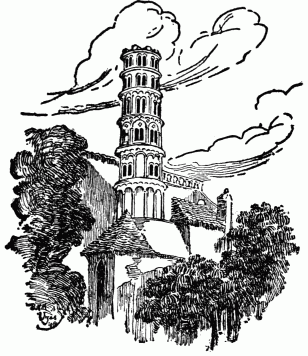
XV ST. THÉODORIT D'UZÈS
The ancient diocese of Uzès formerly included that region lying between the Ardèche, the Rhône, and the Gardon, its length and breadth being perhaps equal—fourteen ancient leagues. As a bishopric, it endured from the middle of the fifth century nearly to the beginning of the nineteenth.
In ancient Gallic records its cathedral was reckoned as some miles from the present site of the town, but as no other remains than those of St. Théodorit are known to-day, it is improbable that any references in mediæval history refer to another structure.
This church is now no longer a cathedral, the see having been suppressed in 1790.
The bishop here, as at Lodève and Mende, was the count of the town, and the bishop and duke each possessed their castles and had their respective spheres of jurisdiction, which, says an old-time chronicler, "often occasioned many disputes." Obviously!
In the sixteenth century most of the inhabitants embraced the Reformation after the example of their bishop, who, with all his chapter, publicly turned Protestant and "sent for a minister to Geneva."
What remains of the cathedral to-day is reminiscent of a highly interesting mediæval foundation, though its general aspect is distinctly modern. Such rebuilding and restoration as it underwent, in the seventeenth and eighteenth centuries, made of it practically a new edifice.
The one feature of mark, which stands alone as the representative of mediæval times, is the charming tower which flanks the main body of the church on the right.
It is known as the "Tour Fenestrelle" and is of the thirteenth century. It would be a notable accessory to any great church, and is of seven stories in height, each dwindling in size from the one below, forming a veritable campanile. Its height is 130 feet.
The interior attractions of this minor church are greater than might be supposed. There is a low gallery with a superb series of wrought-iron grilles, a fine tomb in marble—to Bishop Boyan—and in the transept two paintings by Simon de Chalons—a "Resurrection" and a "Raising of Lazarus."
The inevitable obtrusive organ-case is of the seventeenth century, and like all of its kind is a parasitical abomination, clinging precariously to the western wall.
The sacristy is an extensive suite of rooms which contain throughout a deep-toned and mellow oaken wainscot.
For the rest, the lines of this church follow the conventionality of its time. Its proportions, while not great, are good, and there is no marked luxuriance of ornament or any exceeding grace in the entire structure, if we except the detached tower before mentioned.
The situation of the town is most picturesque; not daintily pretty, but of a certain dignified order, which is the more satisfying.
The ancient château, called Le Duché, is the real architectural treat of the place.
XVI ST. JEAN D'ALAIS
Alais is an ancient city, but greatly modernized; moreover it does not take a supreme rank as a cathedral city, from the fact that it held a bishop's throne for but a hundred years. Alais was a bishopric only from 1694 to 1790.
The cathedral of St. Jean is an imposing structure of that obtrusive variety of architectural art known as "Louis Quinze," and is unworthy of the distinction once bestowed upon it.
Perhaps it is due to the fact that the Cevenole country was so largely and aggressively Protestant that the see of Alais did not endure. Robert Louis Stevenson tells of a stranger he met in these mountain parts—that he was a Catholic, "and made no shame of it. No shame of it! The phrase is a piece of natural statistics; for it is the language of one of a minority.... Ireland is still Catholic; the Cevennes still Protestant. Outdoor rustics have not many ideas, but such as they have are hardy plants and thrive flourishingly in persecution."
Built about in the façade of this unfeeling structure are some remains of a twelfth-century church, but they are not of sufficient bulk or excellence to warrant remark.
An advancing porch stands before this west façade and is surmounted by a massive tower in a poor Gothic style.
The vast interior, like the exterior, is entirely without distinction, though gaudily decorated. There are some good pictures, which, as works of art, are a decided advance over any other attributes of this church—an "Assumption," attributed to Mignard, in the chapel of the Virgin; in the left transept, a "Virgin" by Deveria; and in the right transept an "Annunciation" by Jalabert.
Alais is by no means a dull place. It is busy with industry, is prosperous, and possesses on a minute scale all the distractions of a great city. It is modern to the very core, so far as appearances go. It has its Boulevard Victor Hugo, its Boulevard Gambetta, and its Lycée Dumas. The Hôpital St. Louis—which has a curious doubly twisted staircase—is of the eighteenth century; a bust of the Marquis de la Fère-Alais, the Cevenole poet, is of the nineteenth; a monument of bronze, to the glory of Pasteur, dates from 1896; and various other bronze and stone memorials about the city all date and perpetuate the name and fame of eighteenth and nineteenth-century notables.
The Musée—another recent creation—occupies the former episcopal residence, of eighteenth-century construction.
The Hôtel de Ville is quite the most charming building of the city. It has fine halls and corridors, and an ample bibliothèque. Its present-day Salle du Conseil was the ancient chamber of the États du Languedoc.
XVII ST. PIERRE D'ANNECY
The Savoian city of Annecy was formerly the ancient capital of the Genevois.
Its past history is more closely allied with other political events than those which emanated from within the kingdom of France; and its ecclesiastical allegiance was intimately related with Geneva, from whence the episcopal seat was removed in 1535.
In reality the Christian activities of Annecy had but little to do with the Church in France, Savoie only having been ceded to France in 1860. Formerly it belonged to the ducs de Savoie and the kings of Sardinia.
Annecy is a most interesting city, and possesses many, if not quite all, of the attractions of Geneva itself, including the Lake of Annecy, which is quite as romantically picturesque as Lac Leman, though its proportions are not nearly so great.
The city's interest for the lover of religious associations is perhaps greater than for the lover of church architecture alone, but, as the two must perforce go hand in hand the greater part of the way, Annecy will be found to rank high in the annals of the history and art of the religious life of the past.
In the chapel of the Visitation, belonging to the convent of the same name, are buried St. François de Sales (d. 1622) and Ste. Jeanne de Chantal (d. 1641). The chapel is architecturally of no importance, but the marble ornament and sculptures and the rich paintings are interesting.
The ancient chapel of the Visitation—the convent of the first monastery founded by St. Francis and Ste. Jeanne—immediately adjoins the cathedral.
Christianity first came to Annecy in the fourth century, with St. Emilien. For long after its foundation the see was a suffragan of the ancient ecclesiastical province of Vienne. To-day it is a suffragan of Chambéry.
The rather ordinary cathedral of St. Pierre has no great interest as an architectural type, and is possessed of no embellishments of a rank sufficiently high to warrant remark. It dates only from the sixteenth century, and is quite unconvincing as to any art expression which its builders may have possessed.
The episcopal palace (1784) adjoins the cathedral on the south.
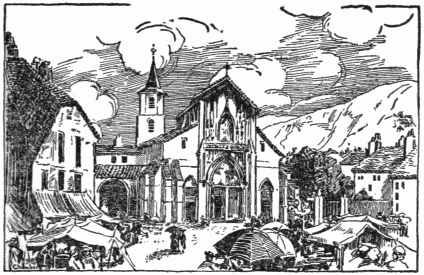
XVIII CATHÉDRALE DE CHAMBÉRY
The city of Chambéry in the eighteenth century must have been a veritable hotbed of aristocracy. A French writer of that day has indeed stated that it is "the winter residence of all the aristocracy of Savoie; ... with twenty thousand francs one could live en grand seigneur; ... a country gentleman, with an income of a hundred and twenty louis d'or a year, would as a matter of course take up his abode in the town for the winter."
To-day such a basis upon which to make an estimate of the value of Chambéry as a place of residence would be, it is to be feared, misleading.
Arthur Young closes his observations upon the agricultural prospects of Savoie with the bold statement that: "On this day, left Chambéry much dissatisfied,—for the want of knowing more of it."
Rousseau knew it better, much better. "S'il est une petite ville au monde où l'on goûte la douceur de la vie dans un commerce agréable et sûr, c'est Chambéry."
Savoie and the Comté de Nice were annexed to France only as late as 1860, and from them were formed the departments of Savoie, Haute-Savoie, and the Alpes-Maritimes.
Chambéry is to-day an archbishopric, with suffragans at Annecy, Tarentaise, and St. Jean de Maurienne. Formerly conditions were reversed, and Chambéry was merely a bishopric in the province de Tarentaise. Its first bishop, Michel Conseil, came in office, however, only in 1780.
The cathedral is of the fourteenth century, in the pointed style, and as a work of art is distinctly of a minor class.
The principal detail of note is a western portal which somewhat approaches good Gothic, but in the main, both inside and out, the church has no remarkable features, if we except some modern glass, which is better in colour than most late work of its kind.
As if to counteract any additional charm which this glass might otherwise lend to the interior, we find a series of flamboyant traceries over the major portion of the side walls and vaulting. These are garish and in every way unpleasing, and the interior effect, like that of the exterior, places the cathedral at Chambéry far down the scale among great churches.
Decidedly the architectural embellishments of Chambéry lie not in its cathedral.
The chapel of the ancient château, dating in part from the thirteenth century, but mainly of the Gothic-Renaissance period, is far and away the most splendid architectural monument of its class to be seen here.
La Grande Chartreuse is equally accessible from either Chambéry or Grenoble, and should not be neglected when one is attempting to familiarize himself with these parts.
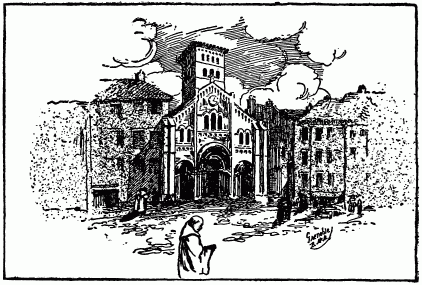
XIX NOTRE DAME DE GRENOBLE
It is an open question as to whether Grenoble is not possessed of the most admirable and impressive situation of any cathedral city of France.
At all events it has the attribute of a unique background in the massif de la Chartreuse, and the range of snow-clad Alps, which rise so abruptly as to directly screen and shelter the city from all other parts lying north and east. Furthermore this natural windbreak, coupled with the altitude of the city itself, makes for a bright and sunny, and withal bracing, atmosphere which many professed tourist and health resorts lack.
Grenoble is in all respects "a most pleasant city," and one which contains much of interest for all sorts and conditions of pilgrims.
Anciently Grenoble was a bishopric in the diocese of the Province of Vienne, to whose archbishop the see was at that time subordinate. Its foundation was during the third century, and its first prelate was one Domninus.
In the redistribution of dioceses Grenoble became a suffragan of Lyon et Vienne, which is its status to-day.
As might naturally be inferred, in the case of so old a foundation, its present-day cathedral of Notre Dame partakes also of early origin.
This it does, to a small degree only, with respect to certain of the foundations of the choir. These date from the eleventh century, while succeeding eras, of a mixed and none too pure an architectural style, culminate in presenting a singularly unconvincing and cold church edifice.
The "pointed" tabernacle, which is the chief interior feature, is of the middle fifteenth century, and indeed the general effect is that of the late Middle Ages, if not actually suggestive of still later modernity.
The tomb of Archbishop Chissé, dating from 1407, is the cathedral's chief monumental shrine.
To the left of the cathedral is the ancient bishop's palace; still used as such. It occupies the site of an eleventh-century episcopal residence, but the structure itself is probably not earlier than the fifteenth century.
In the Église de St. André, a thirteenth-century structure, is a tomb of more than usual sentimental and historical interest: that of Bayard. It will be found in the transept.
No mention of Grenoble could well ignore the famous monastery of La Grande Chartreuse.
Mostly, it is to be feared, the monastery is associated in mundane minds with that subtle and luxurious liqueur which has been brewed by the white-robed monks of St. Bruno for ages past; and was until quite recently, when the establishment was broken up by government decree and the real formula of this sparkling liqueur departed with the migrating monks.
The opinion is ventured, however, that up to the time of their expulsion (in 1902), the monks of St. Bruno combined solitude, austerity, devotion, and charity of a most practical kind with a lucrative commerce in their distilled product after a successful manner not equalled by any religious community before or since.
S. Bruno
The Order of St. Bruno has weathered many storms, and, during the Terror, was driven from its home and dispersed by brutal and riotous soldiery. In 1816 a remnant returned, escorted, it is said, by a throng of fifty thousand people.
The cardinal rule of the Carthusians is abstemiousness from all meat-eating; which, however, in consideration of their calm, regular life, and a diet in which fish plays an important part, is apparently conducive to that longevity which most of us desire.
It is related that a certain Dominican pope wished to diminish the severity of St. Bruno's regulations, but was met by a delegation of Carthusians, whose doyen owned to one hundred and twenty years, and whose youngest member was of the ripe age of ninety. The amiable pontiff, not having, apparently, an argument left, accordingly withdrew his edict.
Of all these great Charterhouses spread throughout France, La Grande Chartreuse was the most inspiring and interesting; not only from the structure itself, but by reason of its commanding and romantic situation amid the forest-clad heights of the Savoyan Alps.