PART V Eastern Castile
Reading edition
I
VALLADOLID
The origin of Valladolid is lost in the shadows of the distant past. As it was the capital of a vast kingdom, it was thought necessary, as in the case of Madrid, to place its foundation prior to the Roman invasion; the attempt failed, however, and though Roman ruins have been found in the vicinity, nothing is positively known about the city's history prior to the eleventh century.
When Sancho II. fought against his sister locked up in Zamora, he offered her Vallisoletum in exchange for the powerful fortress she had inherited from her father. In vain, and the town seated on the Pisuerga is not mentioned again in historical documents until 1074, when Alfonso VI. handed it over, with several other villages, to Pedro Ansurez, who made it his capital, raised the church (Santa Maria la Mayor) to a suffragan of Palencia, and laid the first foundations of its future greatness. In 1208 the family of Ansurez died out, and the villa reverted to the crown; from then until the reign of Philip IV. Valladolid was doubtless one of the most important cities in Castile, and the capital of all the Spains, from the reign of Ferdinand and Isabel to that of Philip III.
Consequently, the history of Valladolid from the thirteenth to the sixteenth century is that of Spain.
In Valladolid, Peter the Cruel, after three days' marriage, forsook his bride, Doña Blanca de Bourbon, and returned to the arms of his mistress Maria; several years later he committed most of his terrible crimes within the limits of the town. Here Maria de Molina upheld her son's right to the throne during his minority, and in Valladolid also, after her son's death, the same widow fought for her grandson against the intrigues of uncles and cousins.
Isabel and Alfonso fought in Valladolid against the proclamation of their niece, Juana, the illegitimate daughter of Henry IV., as heiress to the throne; the citizens upheld the Catholic princess's claims, and it is not surprising that when the princess became queen—the greatest Spain ever had—she made Valladolid her capital, in gratitude to the loyalty of its inhabitants.
In Valladolid, Columbus obtained the royal permission to sail westwards in 1492, and, upon his last return from America, he died in the selfsame city in 1506; here also Berruguete, the sculptor, created many of his chefs-d'œuvres and the immortal Cervantes appeared before the law courts and wrote the second part of his "Quixote."
Unlucky Juana la Loca (Jane the Mad) and her husband Felipe el Hermoso (Philip the Handsome) reigned here after the death of Isabel the Catholic, and fifty years later, when Philip II. returned from England to ascend the Spanish throne, he settled in Valladolid, until his religious fanaticism or craze obliged him to move to a city nearer the Escorial. Then he fixed upon Madrid as his court. Being a religious man, nevertheless, and conscious of a certain love for Valladolid, his natal town, he had the suffragan church erected to a cathedral in 1595, appointing Don Bartolomé de la Plaza to be its first bishop. At the same time, he ordered Juan de Herrero, the severe architect of the Escorial, to draw the plans and commence the building of the new edifice.
The growing importance of Madrid, and the final establishment in the last named city of all the honours which belonged to Valladolid, threw the city seated on the Pisuerga into the shade, and its star of fortune slowly waned. But not to such a degree as that of Salamanca or Burgos, for to-day, of all the old cities of Castile, the only one which has a life of its own, and a commercial and industrial personality, is Valladolid, the one-time capital of all the Spains, and now the seat of an archbishopric. It began by usurping the dignity of Burgos; then it rose to greater heights of fame than its rival, thanks to the discovery of America, and finally it lost its prestige when Madrid was crowned the unica villa.
The general appearance of the city is peculiarly Spanish, especially as regards the prolific use of brick in the construction of churches and edifices in general. It is presumable that the Arabs were possessors of the town before the Christian conquest, though no documental proofs are at hand. The etymology of the city's name, Medinat-el-Walid, is purely Arabic, Walid being the name of a Moorish general.
If the cathedral church was erected as late as the sixteenth century, it must not be supposed that the town lacked parish churches. On the contrary, there is barely a city in Spain with more religious edifices of all kinds, and the greater part of them of far more architectural merit than the cathedral itself. The astonishing number of convents is remarkable; many of them date from the twelfth and thirteenth centuries, and are, consequently, Romanesque with a good deal of Byzantine taste about them, or else they belong to the period of Transition. Taken all in all, they are really the only architectural attractions to be discovered in the city to-day. The traditions which explain the foundation of some of these are among the most characteristic in Valladolid, and a thread of Oriental romance is more predominant among them than elsewhere. A good example of one of these explains the foundation of the large convent of the Mercedes.
Doña Leonor was the wife of one Acuña, a fearless (?) knight. The King of Portugal unluckily fell in love with Doña Leonor, and, wishing to marry her, had her previous marriage annulled and placed her on his throne. Acuña fled from Portugal and came to Valladolid, where, with unparalleled sarcasm, he wore a badge on his hat proclaiming his dishonour.
Both Acuña and the King of Portugal died, and Doña Leonor, whose morals were none too edifying, fell in love with a certain Zuñiguez; the daughter of these two was handed over to the care of a knight, Fernan by name, and Doña Leonor ordered him to found a convent, upon her death, and lock up her daughter within its walls; the mother was doubtless only too anxious to have her daughter escape the ills of this life. Unluckily she counted without the person principally concerned, namely, the daughter, for the latter fell secretly in love with her keeper's nephew. She thought he was her cousin, however, for it appears she was passed off as Fernan's daughter. Upon her mother's death she learnt her real origin, and wedded her lover. In gratitude for her non-relationship with her husband, she founded the convent her mother had ordered, but she herself remained without its walls!
The least that can be said about the cathedral of Valladolid, the better. Doubtless there are many people who consider the building a marvel of beauty. As a specimen of Juan de Herrero's severe and majestic style, it is second to no other building excepting only that great masterwork, the Escorial, and perhaps parts of the Pillar at Saragosse. But as an art monument, where beauty and not Greco-Roman effects are sought, it is a failure.
The original plan of the building was a rectangle, 411 feet long by 204 wide, divided in its length by a nave and two aisles, and in its width by a broad transept situated exactly half-way between the apse and the foot of the church. The form was thus that of a Greek cross; each angle of the building was to be surmounted by a tower, and the croisée by an immense cupola or dome. (Compare with the new cathedral in Salamanca.) The lateral walls of the aisles were to contain symmetrical chapels, as was also the apse.
From the foregoing it will be seen that symmetry and the Greco-Roman straight horizontal line were to replace the ogival arch and the generally vertical, soaring effect of Gothic buildings.
The architect died before his monument was completed, and Churriguera, the most anti-artistic artist that ever breathed,—according to the author's personal opinion,—was called upon to finish the edifice: his trade-mark covers almost the entire western front, where the second body shows the defects into which Herrero's severe style degenerated soon after his death.
Of the four towers and the cupola which were to render the capitol of Valladolid "second in grandeur to none excepting St. Peter's at Rome," only one tower was erected: it fell down in 1841, and is being reërected at the present time.
In the interior the same disparity is everywhere visible, as well as in the unfinished state of the temple. Greek columns are prevalent, and, contrasting with their simplicity, the high altar, as grotesque a body as ever was placed in a holy cathedral, attracts the eye of the vulgar with something of the same feeling as a blood-and-thunder melodrama. Needless to say, the art connoisseur flees therefrom.
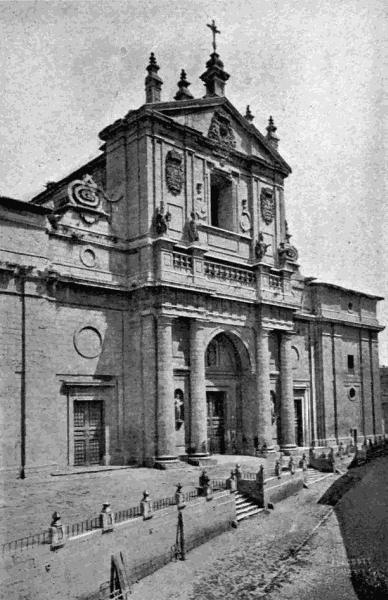
WESTERN FRONT OF VALLADOLID CATHEDRAL
To the rear of the building the remains of the Romanesque Church of Santa Maria la Mayor are still to be seen; what a difference between the rigid, anti-artistic conception of Herrero, ridiculized by Churriguera, and left but half-completed by successive generations of moneyless believers, and the simple but elegant features of the old collegiate church, with its tower still standing, a Byzantine recuerdo of the thirteenth century.
II
AVILA
To the west of Madrid, in the very heart of the Sierra de Gredos, lies Avila, another of the interesting cities of Castile, whose time-old mansions and palaces, built of a gray granite, lend a solemn and almost repulsively melancholic air to the city.
Perhaps more than any other town, Avila is characteristic of the middle ages, of the continual strife between the noblemen, the Church, and the common people. The houses of the aristocrats are castles rather than palaces, with no artistic decoration to hide their bare nakedness; the cathedral is really a fortress, and not only apparently so, as in Salamanca and Toro, for its very apse is embedded in the city walls, of which it forms a part, a battlemented, turreted, and warlike projection, sure of having to bear the brunt of an attack in case of a siege.
Like the general aspect of the city is also the character of the inhabitant, and it is but drawing it mildly to state that Avila's sons were ever foremost in battle and strife. Kings in their minority were brought hither by prudent mothers who relied more upon the city's walls than upon the promises of noblemen in Valladolid and Burgos; this trust was never misplaced. In the conquest of Extremadura and of Andalusia, also, the Avilese troops, headed by daring warrior-prelates, played a most important part, and, as a frontier fortress, together with Segovia, against Aragon to the east, it managed to keep away from Castilian territory the ambitions of the monarchs of the rival kingdom.
Avela of the Romans was a garrison town, the walls of which were partly thrown down by the Western Goths upon their arrival in the peninsula. Previously, San Segundo, one of the disciples of the Apostles who had visited Bética (Andalusia), preached the True Word in Avila, and was created its first bishop—in the first century. During the terrible persecution of the Christians under the reign of Trajanus, one San Vicente and his two sisters, Sabina and Cristeta, escaped from Portugal and came to Avila, hoping to be hospitably received. All in vain; their heads were smashed between stones, and their bodies left to rot in the streets. An immense serpent emerged from the city walls and kept guard over the three saintly corpses. The first to approach was a Jew, drawn hither by curiosity; he was immediately enveloped by the reptile's body. On the point of being strangled, he pronounced the word, "Jesus"—and the serpent released him. So grateful was the Jew at being delivered from death that he turned Christian and erected a church in honour of San Vicente, Sabina, and Cristeta, and had them buried within its walls.
This church subsisted throughout the dark ages of the Moorish invasion until at last Fernando I. removed the saintly remains to Leon in the eleventh century. The church was then destroyed, and, it is believed, the present cathedral was built on the same spot.
The Moors, calling the city Abila, used it as one of the fortresses defending Toledo on the north against the continual Christian raids; with varying success they held it until the end of the eleventh century, when it finally fell into the hands of the Christians, and was repopulated a short time before Salamanca toward the end of the same century.
During the centuries of Moorish dominion the see had fallen into the completest oblivion, no mention being made of any bishops of Avila; the ecclesiastical dignity was reëstablished immediately after the final conquest of the region to the north of the Sierra of Guaderrama, and though documents are lacking as to who was the first prelate de modernis, it is generally believed to have been one Jeronimo, toward the end of the eleventh century.
The city grew rapidly in strength; settlers came from the north—from Castile and Leon—and from the east, from Aragon; they travelled to their new home in bullock-carts containing household furniture, agricultural and war implements, wives, and children.
In the subsequent history of Spain Avila played an important part, and many a stirring event took place within its walls. It was besieged by the Aragonese Alfonso el Batallador, whose army advanced to the attack behind its prisoners, sons of Avila. Brothers, fathers, and relatives were thus obliged to fire upon their own kin if they wished to save their city. The same king, it is said, killed his hostages by having their heads cut off and boiled in oil, as though severed heads were capable of feeling the delightful sensation of seething oil!
Of all the traditions as numerous here as elsewhere, the prettiest and most improbable is doubtless that of Nalvillos, a typical chevalier of romance, who fell desperately in love with a beautiful Moorish princess and wedded her. She pined, however, for a lover whom in her youth she had promised to wed, and though her husband erected palaces and bought slaves for her, she escaped with her sweetheart. Nalvillos followed the couple to where they lay retired in a castle, and it was surrounded by him and his trusty followers. The hero himself, disguised as a seller of curative herbs, entered the apartment where his wife was waiting for her lover's return, and made himself known. The former's return, however, cut matters short, and Nalvillos was obliged to hide himself. The Moorish girl was true to her love, and told her sweetheart where the Christian was hiding; brought out of his retreat, he was on the point of being killed when he asked permission to blow a last blast on his bugle—a wish that was readily conceded by the magnanimous lover. The result? The princess and her sweetheart were burnt to death by the flames ignited by Nalvillos's soldiers. The Christian warrior was, of course, able to escape.
In 1455 the effigy of Henry IV. was dethroned in Avila by the prelates of Toledo and other cities, and by an assembly of noblemen who felt that feudalism was dying out, and were anxious to strike a last blow at the weak king whom they considered was their enemy.
The effigy was placed on a throne; the Archbishop of Toledo harangued the multitude which, silent and scowling, was kept away from the throne by a goodly number of obedient mercenary soldiers. Then the prelate tore off the mock crown, another of the conspirators the sceptre, another the royal garments, and so on, each accompanying his act by an ignominious curse. At last the effigy was torn from the throne and trampled under the feet of the soldiers. Alfonso, a boy of eleven, stepped on the dais and was proclaimed king. His hand was kissed by the humble (!) prelates and noblemen, who swore allegiance, an oath they had not the slightest intention of keeping, and did not keep, either.
Philip III.'s decree expelling Moors from Spain, was, as in the case of Plasencia, the coup de grace given to the city's importance; half the population was obliged to leave, and Avila never recovered her lost importance and influence. To-day, with only about ten thousand inhabitants, thrown in the background by Madrid, it manages to keep alive and nothing more.
The date when the erection of the cathedral church of Avila was begun is utterly unknown. According to a pious legend, it was founded by the third bishop, Don Pedro, who, being anxious to erect a temple worthy of his dignity, undertook a long pilgrimage to foreign countries in search of arms, and returned to his see in 1091. Sixteen years later, according to the same tradition, the present cathedral was essentially completed, a bold statement that cannot be accepted because in manifest contradiction with the build of the church.
According to Señor Quadrado, the oldest part of the building, the apse, was probably erected toward the end of the twelfth century. It is a massive, almost windowless, semicircular body, its bare walls unsupported by buttresses, and every inch of it like the corner-tower of a castle wall, crenelated and flat-topped.
The same author opines that the transept, a handsome, broad, and airy ogival nave, dates from the fourteenth century, whereas the western front of the church is of a much more recent date.
Be that as it may, the fact is that the cathedral of Avila, seen from the east, west, or north, is a fortress building, a huge, unwieldy and anti-artistic composition of Romanesque, Gothic, and other elements. The western front, with its heavy tower to the north, and the lack of such to the south, appears more gloomy than ever on account of the obscure colour of the stone; the façade above the portal is of one of the most peculiar of artistic conceptions ever imagined; above the first body or the pointed arch which crowns the portal comes the second body, divided from the former by a straight line, which supports eight columns flanking seven niches; on the top of this unlucky part comes an ogival window. The whole façade is narrow—one door—and high. The effect is disastrous: an unnecessary contortion or misplacement of vertical, horizontal, slanting, and circular lines.
The tower is flanked at the angles by two rims of stone, the edges of which are cut into bolas (balls). If this shows certain Mudejar taste, so, also, do the geometrical designs carved in relief against a background, as seen in the arabesques above the upper windows.
The northern portal, excepting the upper arch, which is but slightly curved and almost horizontal, and weighs down the ogival arches, is far better as regards the artist's conception of beauty; the stone carving is also of a better class.
Returning to the interior of the building, preferably by the transept, the handsomest part of the church, the spectator perceives a double ambulatory behind the high altar; the latter, as well as the choir, is low, and a fine view is obtained of the ensemble. The central nave, almost twice as high and little broader than the aisles, is crowned by a double triforium of Gothic elegance.
Seen from the transept, it would appear as though there were four aisles on the west side instead of two, a peculiar deception produced by the lateral opening of the last chapels, exactly similar in construction to the arch which crowns the intersection of the aisles and transept.
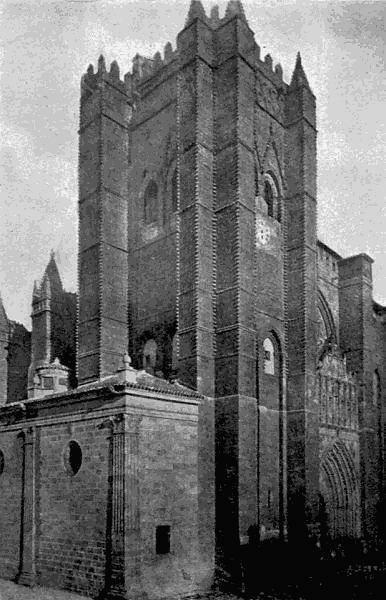
TOWER OF AVILA CATHEDRAL
In the northern and southern extremity of the transept two handsome rosaces, above a row of lancet windows, let in the outside light through stained panes.
The impression produced by the interior of the cathedral is greatly superior to that received from without. In the latter case curiosity is about the only sentiment felt by the spectator, whereas within the temple does not lack a simple beauty and mystery.
As regards sculptural details, the best are doubtless the low reliefs to be seen to the rear of the choir, as well as several sepulchres, of which the best—and one of the best Renaissance monuments of its kind in Spain—is that of the Bishop Alfonso Tostado in the ambulatory. The retablo of the high altar is also a magnificent piece of work of the second half of the fifteenth century and the beginning of the sixteenth.
III
SEGOVIA
Avila's twin sister, Segovia, retains its old Celtiberian name; it retains, also, the undeniable proofs of Roman domination in its far-famed aqueduct and in its amphitheatre.
According to the popular tradition, San Hierateo, the disciple of St. Paul, was the first bishop in the first century, but probably the see was not erected until about 527, when it is first mentioned in a Tolesian document; the name of the first bishop (historical) is Peter, who was present at the third Council in Toledo (589).
The local saint is one San Fruto, who, upon the approach of the Saracen hosts, gathered together a handful of fugitives and retired to the mountains; his brother Valentine and his sister Engracia (of Aragonese fame?) died martyrs to their belief. San Fruto, on the other hand, lived the life of a hermit in the mountains and wrought many miracles, such as splitting open a rock with his jack-knife, etc. The most miraculous of his deeds was the proof he gave to the Moors of the genuineness of the Catholic religion: on a tray of oats he placed the host and offered it to a mule, which, instead of munching oats and host, fell on its knees, and perhaps even crossed itself!
Disputed by Arabs and Christians, like all Castilian towns, Segovia lagged along until it fell definitely into the hands of the latter. A Christian colony seems, nevertheless, to have lived in the town during the Arab dominion, because the documents of the time speak of a Bishop Ilderedo in 940.
The exact year of the repopulation of Segovia is not known, but doubtless it was a decade or so prior to either that of Salamanca or Avila.
Neither was the warlike spirit of the inhabitants inferior to that of their brethren in the last named cities. It was due to their bravery that Madrid fell into the hands of the Christians toward 1110, for, arriving late at the besieging camp, the king, who was present, told them that if they wished to pass the night comfortably, there was but one place, namely, the city itself. Without a moment's hesitation the daring warriors dashed at the walls of Madrid, and, scaling them, took a tower, where they passed the night at their ease, and to their monarch's great astonishment.
In 1115, the first bishop de modernis, Don Pedro, was consecrated, and the cathedral was begun at about the same time. Several of the successive prelates were battling warriors rather than spiritual shepherds, and fought with energy and success against the infidel in Andalusia. One, Don Gutierre Girón, even found his death in the terrible defeat of the Christian arms at Alarcon.
The event which brought the greatest fame to Segovia was the erection of its celebrated Alcázar, or castle, the finest specimen of military architecture in Spain. Every city had its citadel, it is true, but none were so strong and invulnerable as that of Segovia, and in the stormy days of Castilian history the monarchs found a safe retreat from the attacks of unscrupulous noblemen behind its walls.
Until 1530 the old cathedral stood at the back of the Alcázar, but in a revolution of the Comuneros against Charles-Quint, the infuriated mob, anxious to seize the castle, tore down the temple and used its stones, beams, stalls, and railings as a means to scale the high walls of the fortress. Their efforts were in vain, for an army came to the relief of the castle from Valladolid; a general pardon was, nevertheless, granted to the population by the monarch, who was too far off to care much what his Spanish subjects did. After the storm was over, the hot-headed citizens found themselves with a bishop and a chapter, but without a church or means wherewith to erect a new one.
The struggles between city and fortress were numerous, and were the cause, in a great measure, of the town's decadence. Upon one occasion, Isabel the Catholic infringed upon the citizens' rights by making a gift of some of the feudal villages to a court favourite. The day after the news of this infringement reached the city, by a common accord the citizens "dressed in black, did not amuse themselves, nor put on clean linen; neither did they sweep the house steps, nor light the lamps at night; neither did they buy nor sell, and what is more, they boxed their children's ears so that they should for ever remember the day." So great were the public signs of grief that it has been said that "never did a republic wear deeper mourning for the loss of its liberties."
The end of the matter was that the queen in her famous testament revoked her gift and returned the villages to the city.
The old cathedral was torn down in November, 1520, and it was not until June, 1525, that the bishop, who had made a patriotic appeal to all Spaniards in behalf of the church funds, laid the first stone of the new edifice. Thirty years later the building was consecrated.
Nowhere else can a church be found which is a more thorough expression of a city's fervour and enthusiasm. It was as though the sacrilegious act of the enraged mob reacted on the penitent minds of the calmed citizens, for rich and poor alike gave their alms to the cathedral chapter. Jewels were sold, donations came from abroad, feudal lords gave whole villages to the church, and the poor men, the workmen, and the peasants gave their pennies. Daily processions arrived at Santa Clara, then used as cathedral church, from all parts of the diocese. To-day they were composed of tradesmen, of Zünfte, who gave their offerings of a few pounds; to-morrow a village would bring in a cartload of stone, of mortar, of wood, etc. On holidays and Sundays the repentant citizens, instead of amusing themselves at the dance or bull-fight, carted materials for their new cathedral's erection, and all this they did of their own free will.
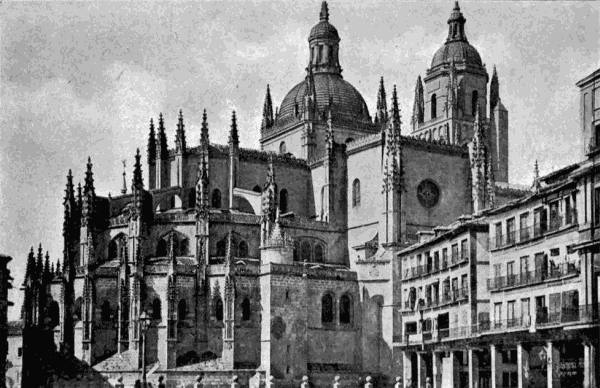
SEGOVIA CATHEDRAL
The act of consecrating the finished building constituted a grand holiday. The long aqueduct was illuminated from top to bottom, as was also the cathedral tower, and every house in the city. During a week the holiday-making lasted with open-air amusements for the poor and banquets for the rich.
The date of the construction of the new building was contemporaneous with that of Salamanca, and the architect was, to a certain extent, the same. It is not strange, therefore, that both should resemble each other in their general disposition. What is more, the construction in both churches was begun at the foot (west), and not in the east, as is generally the case. The oldest part of the building is consequently the western front, classic in its outline, but showing among its ogival details both the symmetry and triangular pediment of Renaissance art. The tower, higher than that of Sevilla, and broader than that of Toledo, is simple in its structure; it is Byzantine, and does not lack a certain cachet of elegance; the first body is surmounted by a dome, upon which rises the second,—smaller, and also crowned by a cupola. The tower was twice struck by lightning and partly ruined in 1620; it was rebuilt in 1825, and a lightning conductor replaced the cross of the spire.
Though consecrated, as has been said, in 1558, the new temple was by no means finished: the transept and the eastern end were still to be built. The latter was finished prior to 1580, and in 1615 the Renaissance dome which surmounts the croisée was erected by an artist-architect, who evidently was incapable of giving it a true Gothic appearance.
The apse, with its three harmonizing étages corresponding to the chapels, aisles, and nave, and flanked by leaning buttresses ornamented with delicate pinnacles, is Gothic in its details; the ensemble is, nevertheless, Renaissance, thanks to a perfect symmetry painfully pronounced by naked horizontal lines—so contradictory to the spirit of true ogival. Less regularity and a greater profusion of buttresses, and above all of flying buttresses, would have been more agreeable, but the times had changed and new tastes had entered the country.
Neither does the broad transept, its façade,—either southern or northern,—and the cupola join, as it were, the eastern and the western half of the building; on the contrary, it distinctly separates them, not to the building's advantage.
The interior is gay rather than solemn: the general disposition of the parts is as customary in a Gothic church of the Transition (Renaissance). The nave and transept are of the same width; the lateral chapels, running along the exterior walls of the aisles, are symmetrical, as in Salamanca; the ambulatory separates the high altar from the apse and its seven chapels.
The pavement of the church is of black and white marble slabs, like that of Toledo, for instance; as for the stained windows, they are numerous, and those in the older part of the building of good (Flemish?) workmanship and of a rich colour, which heightens the happy expression of the whole building.
The cloister is the oldest part of the building, having pertained to the previous cathedral. After the latter's destruction, and the successful erection of the new temple, the cloister was transported stone by stone from its old emplacement to where it now stands. It is a handsome and richly decorated Gothic building, containing many tombs, among them those of the architects of the cathedral and of Maria del Salto. This Mary was a certain Jewess, who, condemned to death, and thrown over the Peña Grajera, invoked the aid of the Virgin, and was saved.
Another tomb is that of Prince Don Pedro, son of Enrique II., who fell out of a window of the Alcázar. His nurse, according to the tradition, threw herself out of the window after her charge, and together they were picked up, one locked in the arms of the other.
IV
MADRID-ALCALÁ
Though Madrid was proclaimed the capital of Spain in the sixteenth century, it was not until 1850 that its collegiate church of San Isidro was raised to an episcopal see.
The appointment met with a storm of disapproval in the neighbouring town of Alcalá de Henares, the citizens claiming the erection of the ecclesiastical throne in their own collegiate, instead of in Madrid. Their reasons were purely historical, as will be seen later on, whereas the capital lacked both history and ecclesiastical significance.
To pacify the inhabitants of Alcalá, and at the same time to raise Madrid to the rank of a city, the following arrangement was made: the newly created see was to be called Madrid-Alcalá; the bishop was to possess two cathedral churches, and both towns were to be cities.
Such is the state of affairs at present. The recent governmental closure of the old cathedral in Alcalá has deprived the partisans of the double see of one of their chief arguments, namely, the possession of a worthy temple, unique in the world as regards its organization. Consequently, it is generally stated that the title of Madrid-Alcalá will die out with the present bishop, and that the next will simply be the Bishop of Madrid.
Madrid
The city of Madrid is new and uninteresting; it is an overgrown village, with no buildings worthy of the capital of a kingdom. From an architectural point of view, the royal palace, majestic and imposing, though decidedly poor in style, is about the only edifice that can be admired.
In history, Madrid plays a most unimportant part until the times of Philip II., the black-browed monarch who, intent upon erecting his mausoleum in the Escorial, proclaimed Madrid to be the only capital. That was in 1560; previously Magerit had been an Arab fortress to the north of Toledo, and the first in the region now called Castilla la Nueva (New Castile), to distinguish it from Old Castile, which lies to the north of the mountain chain.
Most likely Magerit had been founded by the Moors, though, as soon as it had become the capital of Spain, its inhabitants, who were only too eager to lend their town a history it did not possess, invented a series of traditions and legends more ridiculous than veracious.
On the slopes of the last hill, descending to the Manzanares, and beside the present royal palace, the Christian conquerors of the Arab fortress in the twelfth century discovered an effigy of the Virgin, in an almudena or storehouse. This was the starting-point for the traditions of the twelfth-century monks who discovered (?) that this effigy had been placed where it was found by St. James, according to some, and by the Virgin herself, according to others; what is more, they even established a series of bishops in Magerit previous to the Arab invasion.
No foundations are of course at hand for such fabulous inventions, and if the effigy really were found in the almudena, it must have been placed there by the Moors themselves, who most likely had taken it as their booty when sacking a church or convent to the north.
The patron saint of Madrid is one Isidro, not to be confounded with San Isidoro of Leon. The former was a farmer or labourer, who, with his wife, lived a quiet and unpretentious life in the vicinity of Madrid, on the opposite banks of the Manzanares, where a chapel was erected to his memory sometime in the seventeenth century. Of the many miracles this saint is supposed to have wrought, not one differs from the usual deeds attributed to holy individuals. Being a farmer, his voice called forth water from the parched land, and angels helped his oxen to plough the fields.
Save the effigy of the Virgin de la Almudena, and the life of San Isidro, Madrid has no ecclesiastical history,—the Virgin de la Atocha has been forgotten, but she is only a duplicate of her sister virgin. Convents and monasteries are of course as numerous as elsewhere in Spain; brick parish churches of a decided Spanish-Oriental appearance rear their cupolas skyward in almost every street, the largest among them being San Francisco el Grande, which, with San Antonio de la Florida (containing several handsome paintings by Goya), is the only temple worth visiting.
As regards a cathedral building, there is, in the lower part of the city, a large stone church dedicated to San Isidro; it serves the stead of a cathedral church until a new building, begun about 1885, will have been completed.
This new building, the cathedral properly speaking, is to be a tenth wonder; it is to be constructed in granite, and its foundations stand beside the royal palace in the very spot where the Virgin de la Almudena was found, and where, until 1869, a church enclosed the sacred effigy; the new building is to be dedicated to the same deity.
Unluckily, the erection of the new cathedral proceeds but slowly; so far only the basement stones have been laid and the crypt finished. The funds for its erection are entirely dependent upon alms, but, as the religious fervour which incited the inhabitants of Segovia in the sixteenth century is almost dead to-day, it is an open question whether the cathedral of Madrid will ever be finished.
The temporary cathedral of San Isidro was erected in the seventeenth century; its two clumsy towers are unfinished, its western front, between the towers, is severe; four columns support the balcony, behind which the cupola, which crowns the croisée, peeps forth.
Inside there is nothing worthy of interest to be admired except some pictures, one of them painted by the Divino Morales. The nave is light, but the chapels are so dark that almost nothing can be seen in their interior.
This church, until the expulsion of the Jesuits, was the temple of their order, dedicated to St. Peter and St. Paul; adjoining it a Jesuit school was erected, which has been incorporated in the government colleges.
Alcalá de Henares
About twenty miles to the east of Madrid lies the one-time glorious university city of Alcalá, famous above all things for having been the cradle of Cervantes, and the hearth, if not the home, of Cardinal Cisneros.
Its history and its decadence are of the saddest; the latter serves in many respects as an adequate symbol of Spain's own tremendous downfall.
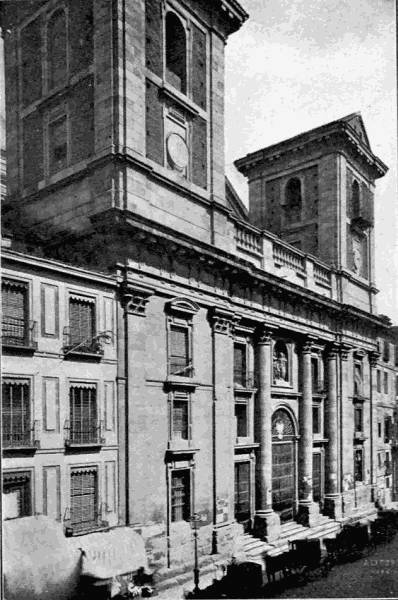
SAN ISIDRO, MADRID
The Romans founded Alcalá; it was their Complutum, of which some few remains have been discovered in the vicinity of the modern city. Yet, notwithstanding this lack of substantial evidence, the inhabitants of the region still proudly call themselves Complutenses.
When the West Goths were rulers of the peninsula, the Roman monuments must have been completely destroyed, for all traces of the strategic stronghold were effaced from the map of Spain. The invading Arabs, possessing to a certain degree both Roman military instinct and foresight, built a fortress on the spot where the State Archives Building stands to-day. This castle was used by them as one of Toledo's northern defences against the warlike Christian kings.
In the twelfth century the fortress fell into the hands of the Christians; in the succeeding centuries it was strongly rebuilt by the cardinal-archbishops of Toledo, who used it both as their palace and as their stronghold.
Outside the bastioned and turreted walls of the castle, the new-born city grew up under its protecting shadows. Known by the Arabic name of its fortress (Al-Kalá), it was successively baptized Alcalá de San Justo, Alcalá de Fenares, and since the sixteenth century, Alcalá de Henares (heno, old Spanish feno, meaning hay). Protected by such powerful arms as those of the princes of the Church, it grew up to be a second Toledo, a city of church spires and convent walls, but of which only a reduced number stand to-day to point back to the religious fervour of the middle ages.
The world-spread fame acquired by Alcalá in the fifteenth century was due to the patronage of Cardinal Cisneros, who built the university, at one time one of the most celebrated in Europe, and to-day a mere skeleton of architectural beauty.
The same prelate raised San Justo to a suffragan church; its chapter was composed only of learned professors of the university, as were also its canons; Leon X. gave it the enviable title of La Magistral, the Learned, which points it out as unique in the Christian world. The Polyglot Bible, published in the sixteenth century, and famous in all Europe, was worked out by these scholars under Cisneros's direction, and the favoured city outshone the newly built Madrid twenty miles away, and rivalled Salamanca in learning, and Toledo in worldly and religious splendour.
Madrid grew greater and greater as years went by, and consequently Alcalá de Henares dwindled away to the shadow of a name. The university, the just pride of the Complutenses, was removed to the capital; the cathedral, for lack of proper care, became an untimely ruin; the episcopal palace was confiscated by the state, which, besides repairing it, filled its seventy odd halls with rows upon rows of dusty documents and governmental papers.
To-day the city drags along a weary, inactive existence: soldiers from the barracks and long-robed priests from the church fill the streets, and are as numerous as the civil inhabitants, if not more so; convents and cloisters of nuns, either grass-grown ruins or else sombre grated and barred edifices, are to be met with at every step.
Strangers visit the place hurriedly in the morning and return to Madrid in the afternoon; they buy a tin box of sugar almonds (the city's specialty), carelessly examine the university and the archiepiscopal palace, gaze unmoved at some Cervantes relics, and at the façade of the cathedral. Besides, they are told that in such and such a house the immortal author of Don Quixote was born, which is a base, though comprehensible, invention, because no such house exists to-day.
That is all; perchance in crossing the city's only square, the traveller notices that it can boast of no fewer than three names, doubtless with a view to hide its glaring nakedness. These three names are Plaza de Cervantes, Plaza Mayor, and Plaza de la Constitución, of which the latter is spread out boldly across the town hall and seems to invoke the remembrance of the ephemeral efforts of the republic in 1869.
In the third century after the birth of Christ, two infants, Justo and Pastor, preached the True Word to the unbelieving Roman rulers of Complutum. The result was not in the least surprising: the two infants lost their baby heads for the trouble they had taken in trying to trouble warriors.
But the Vatican remembered them, and canonized Pastor and Justo. Hundreds of churches, sown by the blood of martyrs, grew up in all corners of the peninsula to commemorate pagan cruelty, and to induce all men to follow the examples set by the two babes.
No one knew, however, where the mortal remains of Justo and Pastor were lying. In the fourth century their resting-place was miraculously revealed to one Austurio, Archbishop of Toledo, who had them removed to his cathedral. They did not stay long in the primate city, for the invasion of the Moors obliged all True Believers to hide Church relics. Thus, Justo and Pastor wandered forth again from village to village, running away from the infidels until they reposed temporarily in the cathedral of Huesca in the north of Aragon.
In Alcalá their memory was kept alive in the parish church dedicated to them. But as the city grew, it was deemed preferable to build a solid temple worthy of the saintly pair, and Carillo, Archbishop of Toledo, had the old church pulled down and began the erection of a larger edifice. This took place in the middle of the fifteenth century, when Ximenez de Cisneros, who ruled the fate of Spain and its church, gave it the ecclesiastical constitution previously mentioned.
Fifty years later the weary bodies of the two infants were brought back in triumph to their native town amid the rejoicings and admiration of the people, and were placed in the cathedral of San Justo, then a collegiate church of Toledo.
A few years ago the cathedral church of San Justo was denounced by the state architect and closed. To-day it is a dreary ruin, with tufts of grass growing among the battlements. The chapter, depriving the hoary building of its high altar, its precious relics and paintings, its stalls and other accessories, installed the cathedral in the Jesuit temple, an insignificant building in the other extremity of the town. Recently the abandoned ruin has been declared a national monument, which means that the state is obliged to undertake its restoration.
La Magistral is a brick building of imposing simplicity and severity in its general outlines. Its decorative elements are ogival, but of true Spanish nakedness and lack of elegance. Though Renaissance principles have not entered into the composition, as might have been supposed, considering the date of the erection, nevertheless, the lack of flying buttresses, the scarcity of windows, the undecorated angles of the western front, the barren walls, and flat-topped, though slightly sloping, roofs prove that the "simple and severe style" is latent in the minds of artists.
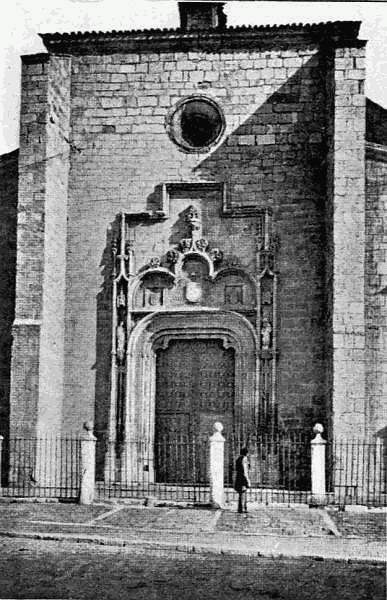
ALCALÁ DE HENARES CATHEDRAL
The apse is well developed, and the croisée surmounted by a cupola; the tower which flanks the western front is massive; it is decorated with blind arches and ogival arabesques.
The ground plan of the building is Latin Cruciform; the aisles are but slightly lower than the nave and join in the apse behind the high altar in an ambulatory walk. The crypt, reached by two Renaissance doors in the trasaltar, is spacious, and contains the bodies of San Justo and San Pastor.
The general impression produced on the mind of the tourist is sadness. The severity of the structure is heightened by the absence of any distracting decorative elements, excepting the fine Mudejar ceiling to the left upon entering.
In the reigning shadows of this deserted temple, two magnificent tombs stand in solitude and silence. They are those of Carillo and Cardinal Cisneros, the latter one of the greatest sons of Spain and one of her most contradictory geniuses. His sepulchre is a gorgeous marble monument of Renaissance style, surrounded by a massive bronze grille of excellent workmanship, a marvel of Spanish metal art of the sixteenth century. The other sepulchre is simple in its ogival decorations, and the prostrate effigy of Carillo is among the best to be admired by the tourist in Iberia.
Carillo's life was that of a restless, ambitious, and worldly man. When he died, he was buried in the Convent of San Juan de Dios, where his illegitimate son had been buried before him, "for," said the archbishop-father, "if in life my robes separated me from my son, in death we shall be united."
But he reckoned without his host, or rather his successor, the man whose remains now lie beside his own in the shadows of the great ruin. "For," said Cisneros, "the Church must separate man from his sin even in death." So he ordered the son to be left in the convent, and the father to be brought to the temple he had begun to erect.
V
SIGÜENZA
The origin of the fortress admirably situated to the north of Guadalajara was doubtless Moorish, though in the vicinity is Villavieja, where the Romans had established a town on the transverse road from Cadiz to Tarragon, and called by them Seguncia, or Segoncia.
When the Christian religion first appeared in Spain, it is believed that Sigüenza, or Segoncia, possessed an episcopal see; nothing is positively known, however, of the early bishops, until Protogenes signed the third Council of Toledo in 589.
It is believed that in the reign of Alfonso VI., he who conquered Toledo and the region to the south of Valladolid and as far east as Aragon, Sigüenza was repopulated, though no mention is made of the place in the earlier chronicles of the time. All that is known is that a bishop was immediately appointed by Alfonso VII. to the vacancy which had lasted for over two hundred years, during which Sigüenza had been one of the provincial capitals of the Kingdom of Toledo. The first known bishop was Don Bernardo.
The history of the town was never of the most brilliant. In the times of Alfonso VII. and his immediate successors it gained certain importance as a frontier stronghold, as a check to the growing ambitions of the royal house of Aragon. But after the union of Castile and Aragon, its importance gradually dwindled; to-day, if it were not for the bishopric, it would be one historic village more on the map of Spain.
In the reign of Peter the Cruel, its castle—considered with that of Segovia to be the strongest in Castile—was used for some time as the prison palace for that most unhappy princess, Doña Blanca, who, married to his Catholic Majesty, had been deposed on the third day of the wedding by the heartless and passionate lover of the Padilla. She was at first shut up in Toledo, but the king did not consider the Alcázar strong enough. So she was sent off to Sigüenza, where it is popularly believed, though documents deny it, that she died, or was put to death.
The city belonged to the bishop; it was his feudal property, and passed down to his successors in the see. Of the doings of these prelate-warriors, the first, Don Bernardo, was doubtless the most striking personality, lord of a thousand armed vassals and of three hundred horse, who fought with the emperor in almost all the great battles in Andalusia. It is even believed he died wielding the naked sword, and that his remains were brought back to the town of which he had been the first and undisputed lord.
The strong castle which crowns the city did not possess, as was generally the case, an alcalde, or governor; it was the episcopal palace or residence, a circumstance which proves beyond a doubt the double significance of the bishop: a spiritual leader and military personage, more influential and wealthy than any prelate in Spain, excepting the Archbishops of Toledo and Santiago.
During the French invasion in the beginning of the nineteenth century, Sigüenza had already lost its political significance. The invaders occupied the castle, and, as was their custom, threw documents and archives into the fire, to make room for themselves, and to spend the winter comfortably.
Consequently, the notices we have of the cathedral church are but scarce. The fourth bishop was Jocelyn, an Englishman who had come over with Eleanor, Henry II.'s daughter, and married to the King of Castile. He (the bishop) was not a whit less warlike than his predecessors had been; he helped the king to win the town of Cuenca, and when he died on the battle-field, only his right arm was carried back to the see, to the chapel of St. Thomas of Canterbury, which the dead prelate had founded in the new cathedral, and it was buried beneath a stone which bears the following inscription:
"Hic est inclusa Jocelini præsulis ulna."
From the above we can conclude that the cathedral must have been begun previous to the Englishman's coming to Spain, that is, in the beginning of the twelfth century. Doubtless the vaulting was not closed until at least one hundred years later; nevertheless, it is one of the unique and at the same time one of the handsomest Spanish monuments of the Transition period.
The city of Sigüenza, situated on the slopes of a hill crowned by the castle, is a village rather than a town; there are, however, fewer spots in Spain that are more picturesque in their old age, and there is a certain uniformity in the architecture that reminds one of German towns; this is not at all characteristic of Spain, where so many styles mix and mingle until hardly distinguishable from each other.
The Transition style—between the strong Romanesque and the airy ogival—is the city's cachet, printed with particular care on the handsome cathedral which stands on the slope of the hill to the north of the castle.
Two massive square towers, crenelated at the top and pierced by a few round-headed windows, flank the western front. The three portals are massive Romanesque without floral or sculptural decoration of any kind; the central door is larger and surmounted by a large though primitive rosace. The height of the aisles and nave is indicated by three ogival arches cut in relief on the façade; here already the mixture of both styles, of the round-arched Romanesque and the pointed Gothic, is clearly visible—as it is also in the windows of the aisles, which are Romanesque, and of the nave, which are ogival—in the buttresses, which are leaning on the lower body, and flying in the upper story, uniting the exterior of the clerestory with that of the aisles. (Compare with apse of the cathedral of Lugo.)
The portal of the southern arm of the transept is an ugly addition, more modern and completely out of harmony with the rest. The rosace above the door is one of the handsomest of the Transition period in Spain, and the stained glass is both rich and mellow.
The interior shows the same harmonious mixture of the stronger and more solemn old style, and the graceful lightness of the newer. But the hesitancy in the mind of the architect is also evident, especially in the vaulting, which is timidly arched.
The original plan of the church was, doubtless, purely Romanesque: Roman cruciform with a three-lobed apse, the central one much longer so as to contain the high altar.
In the sixteenth century, however, an ambulatory was constructed behind the high altar, joining the two aisles, and the high altar was removed to the east of the transept.
What a pity that the huge choir, placed in the centre of the church, should so completely obstruct the view of the ensemble of the nave and aisles, separated by massive Byzantine arches between the solid pillars, which, in their turn, support the nascent ogival vaulting of the high nave! Were it, as well as the grotesque trascoro—of the unhappiest artistic taste—anywhere but in the centre of the church, what a splendid view would be obtained of the long, narrow, and high aisles and nave in which the old and the new were moulded together in perfect harmony, instead of fighting each other and clashing together, as happened in so many Spanish cathedral churches!
One of the most richly decorated parts of the church is the sacristy, a small room entirely covered with medallions and sculptural designs of the greatest variety of subjects. Though of Arabian taste (Mudejar), no Moorish elements have entered into the composition, and consequently it is one of the very finest, if not the very best specimen, of Christian Arab decoration.
VI
CUENCA
To the east of Toledo, and to the north of the plains of La Mancha, Cuenca sits on its steep hill surrounded by mountains; a high stone bridge, spanning a green valley and the rushing river, joined the city to a mountain plateau; to-day the mediæval bridge has been replaced by an iron one, which contrasts harshly with the somnolent aspect of the landscape.
Never was a city founded in a more picturesque spot. It almost resembles Göschenen in Switzerland, with the difference that whereas in the last named village a white-washed church rears its spire skyward, in Cuenca a large cathedral, rich in decorative accessories, and yet sombre and severe in its wealth, occupies the most prominent place in the town.
Of the origin of the city nothing is known. In the tenth and the eleventh centuries Conca was an impregnable Arab fortress. In 1176 the united armies of Castile and Aragon, commanded by two sovereigns, Alfonso VIII. of Castile and Alfonso II. of Aragon, laid siege to the fortress, and after nine months' patience, the Alcázar surrendered. According to the popular tradition, it was won by treachery: one Martin Alhaxa, a captive and a shepherd by trade, introduced the Christians disguised with sheepskins into the city through a postern gate.
As the conquest of Cuenca had cost the King of Castile such trouble (his Aragonese partner had not waited to see the end of the siege), and as he was fully conscious of its importance as a strategical outpost against Aragon to the north and against the Moors to the south and east, he laid special stress on the city's being strongly fortified; he also gave special privileges to such Christians as would repopulate, or rather populate, the nascent town. A few years later Pone Lucio III. raised the church to an episcopal see, appointing Juan Yañez, a Tolesian Muzarab, to be its first bishop (1183).
Unlike Sigüenza, a feudal possession of the bishop, Cuenca belonged exclusively to the monarch of Castile; the castle was consequently held in the sovereign's name by a governor,—at one time there were even four who governed simultaneously. Between these governors and the inhabitants of the city, fights were numerous, especially during the first half of the fifteenth century, the darkest and most ignoble period of Castilian history.
The story is told of one Doña Inez de Barrientos, granddaughter of a bishop on her mother's side, and of a governor on that of her father. It appears that her husband had been murdered by some of the wealthiest citizens of the town. Feigning joy at her spouse's death, the widow invited the murderers to her house to a banquet, when, "después de opípara cena (after an excellent dinner), they passed from the lethargy of drunkenness to the sleep of eternity, assassinated by hidden servants." The following morning their bodies hung from the windows of the palace, and provoked not anger but silent dread and shivers among the terror-stricken inhabitants.
With the Inquisition, the siege by the English in 1706, the invasion of the French in 1808, Cuenca rapidly lost all importance and even political significance. To-day it is one of the many picturesque ruins that offer but little interest to the art traveller, for even its old age is degenerated, and the monuments of the thirteenth, fourteenth, and fifteenth centuries have one and all been spoilt by the hand of time, and by the less grasping hand of restauradores—or architect-repairers.
The Byzantine character, the Arab taste of the primitive inhabitants, has also been lost. Who would think, upon examining the cathedral, that it had served once upon a time as the principal Arab mosque? Entirely rebuilt, as were most of the primitive Arab houses, it has lost all traces of the early founders, more so than in other cities where the Arabs remained but a few years.
The patron saint of Cuenca is San Julian, one of the cathedral's first bishops, who led a saintly life, giving all he had and taking nothing that was not his, and who retired from his see to live the humble life of a basket-maker, seated with willow branches beneath the arches of the high bridge, and preaching saintly words to teamsters and mule-drivers as they approached the city, until his death in 1207.
In the same century the Arab mosque was torn down and the new cathedral begun. It is a primitive ogival (Spanish) temple of the thirteenth century, with smatterings of Romanesque-Byzantine. Unlike the cathedral of Sigüenza, it is neither elegant, harmonious, nor of great architectural value; its wealth lies chiefly in the chapels, in the doors which lead to the cloister, in the sacristy, and in the elegant high altar.
The cloister door is perhaps one of the finest details of the cathedral church: decorated in the plateresque style general in Spain in the sixteenth century, it offers one of the finest examples of said style to be found anywhere, and though utterly different in ornamentation to the sacristy of Sigüenza, it nevertheless resembles it in the general composition.
The nave, exceedingly high, is decorated by a blind triforium of ogival arches; the aisles are sombre and lower than the nave. On the other hand, the transept, broad and simple, is similar to the nave and as long as the width of the church, including the lateral chapels. The croisée is surmounted by a cimborio, insignificant in comparison to those of Salamanca, Zamora, and Toro.
The northern and southern extremities of the transept differ from each other as regard style. The southern has an ogival portal surmounted by a rosace; the northern, one that is plateresque, the rounded arch, delicately decorated, reposing on Corinthian columns.
The eastern end of the church has been greatly modified—as is clearly seen by the mixture of fifteenth-century styles, and not to the advantage of the ensemble. Byzantine pillars, and even horseshoe arches, mingle with Gothic elements.
Of the chapels, the greater number are richly decorated, not only with sepulchres and sepulchral works, but with paintings, some of them by well-known masters.
Taken all in all, the cathedral of Cuenca does not inspire any of the sentiments peculiar to religious temples. Not the worst cathedral in Spain, by any means, neither as regards size nor majesty, it nevertheless lacks conviction, as though the artist who traced the primitive plan miscalculated its final appearance. The additions, due to necessity or to the ruinous state of some of the parts, were luckless, as are generally all those undertaken at a posterior date.
The decorative wealth of the chapels, which is really astonishing in so small a town, the luxurious display of grotesque elements, the presence of a fairly good transparente, as well as the rich leaf-decoration of Byzantine pillars and plateresque arches, give a peculiar cachet to this church which is not to be found elsewhere.
The same can be said of the city and of the inhabitant. In the words of an authority, "Cuenca is national, it is Spanish, it is a typical rural town." Yet, it is so typical, that no other city resembles it.
VII
TOLEDO
A forest of spires and alminar towers rising from a roof-covered hill to pierce the distant azure sky; a ruined cemetery surrounded on three sides by the rushing Tago as it cuts out a foaming path through foothills, and stretching away on the fourth toward the snow-capped Sierra de Gredo in the distance, beyond the fruitful prairies and the intervening plains of New Castile.
Such is Toledo, the famous, the wonderful, the legend-spun primate city of all the Spains, the former wealthy capital of the Spanish Empire!
Madrid usurped all her civic honours under the reign of Philip II., he who lost the Armada and built the Escorial. Since then Toledo, like Alcalá de Henares, Segovia, and Burgos, has dragged along a forlorn existence, frozen in winter and scorched in summer, and visited at all times of the year by gaping tourists of all nationalities.
Even the approach to the city from the mile distant station is peculiarly characteristic. Seated in an old and shaky omnibus, pulled by four thrashed mules, and followed along the dusty road by racing beggars, who whine their would-be French, "Un p'it sou, mouchieur," with surprising alacrity and a melancholy smile in their big black eyes, the visitor is driven sharply around a bluff, when suddenly Toledo, the mysterious, comes into sight, crowning the opposite hill.
At a canter the mules cross the bridge of Alcántara and pass beneath the gateway of the same name, a ponderous structure still guarding the time-rusty city as it did centuries ago when Toledo was the Gothic metropolis. Up the winding road, beneath the solemn and fire-devastated walls of the Alcázar, the visitor is hurriedly driven along; he disappears from the burning sunlight into a gloomy labyrinth of ill-paved streets to emerge a few minutes later in the principal square.
A shoal of yelling, gesticulating interpreters literally grab at the tourist, and in ten seconds exhaust their vocabulary of foreign words. At last one walks triumphantly off beside the newcomer, while the others, with a depreciative shrug of the shoulders and extinguishing their volcanic outburst of energy, loiter around the square smoking cigarettes.
It does not take the visitor long to notice that he is in a great archæological museum. The streets are crooked and narrow, so narrow that the tiny patch of sky above seems more brilliant than ever and farther away, while on each side are gloomy houses with but few windows, and monstrous, nail-studded doors. At every turn a church rears its head, and the cheerless spirit of a palace glares with a sadly vacant stare from behind wrought-iron rejas and a complicated stone-carved blazon. Rarely is the door opened; when it is, the passer catches a glimpse of a sun-bathed courtyard, gorgeously alive with light and many flowers. The effect produced by the sudden contrast between the joyless street and the sunny garden, whose existence was never dreamt of, is delightful and never to be forgotten; from Théophile Gautier, who had been in Northern Africa, land of Mohammedan harems, it wrung the piquant exclamation: "The Moors have been here!"
Every stick, stone, mound, house, lantern, and what not has its legend. In this humble posada, Cervantes, whose ancestral castle is on yonder bluff overlooking the Tago, wrote his "Ilustre Fregona." The family history of yonder fortress-palace inspired Zorilla's romantic pen, and a thousand and one other objects recall the past,—the past that is Toledo's present and doubtless will have to be her future.
Gone are the days when Tolaitola was a peerless jewel, for which Moors and Christians fought, until at last the Believers of the True Faith drove back the Arabs who fled southward from whence they had emerged. Long closed are also the famous smithies, where swords—Tolesian blades they were then called—were hammered so supple that they could bend like a watchspring, so strong they could cleave an anvil, and so sharp they could cut an eiderdown pillow in twain without displacing a feather.
Distant, moreover, are the nights of capa y espada and of miracles wrought by the Virgin; dwindled away to a meagre shadow is the princely magnificence of the primate prelates of all the Spains, of those spiritual princes who neither asked the Pope's advice nor received orders from St. Peter at Rome. Besides, of the two hundred thousand souls proud to be called sons of Toledo in the days of Charles-Quint, but seventeen thousand inhabitants remain to-day to guard the nation's great city-museum, unsullied as yet by progress and modern civilization, by immense advertisements and those other necessities of daily life in other climes.
The city's history explains the mixture of architectural styles and the bizarre modifications introduced in Gothic, Byzantine, or Arab structures.
Legends accuse Toledo of having been mysteriously founded long before the birth of Rome on her seven hills. To us, however, it first appears in history as a Roman stronghold, capital of one of Hispania's provinces.
St. James, as has been seen, roamed across this peninsula; he came to Toledo. So delighted was he with the site and the people—saith the tradition—that he ordained that the city on the Tago should contain the primate church of all the Spains.
The vanquished Romans withdrew, leaving to posterity but feeble ruins to the north of the city; the West Goths built the threatening city walls which still are standing, and, having turned Christians, their King Recaredo was baptized in the river's waters, and Toledo became the flourishing capital of the Visigothic kingdom (512 A.D.).
The Moors, in their northward march, conquered both the Church and the state. Legends hover around the sudden apparition of Berber hordes in Andalusia, and accuse Rodrigo, the last King of the Goths, of having outraged Florinda, a beautiful girl whom he saw, from his palace window, bathing herself in a marble bath near the Tago,—the bath is still shown to this day,—and with whom he fell in love. The father, Count Julian, Governor of Ceuta, called in the Moors to aid him in his righteous work of vengeance, and, as often happens in similar cases, the allies lost no time in becoming the masters and the conquerors.
Nearly four hundred years did the Arabs remain in their beloved Tolaitola; the traces of their occupancy are everywhere visible: in the streets and in the patios, in fanciful arabesques, and above all in Santa Maria la Blanca.
The Spaniards returned and brought Christianity back with them. They erected an immense cathedral and turned mosques into chapels without altering the Oriental form.
Jews, Arabs, and Christians lived peacefully together during the four following centuries. Together they created the Mudejar style tower of San Tomas and the Puerta de Sol. Pure Gothic was transformed, rendered even more insubstantial and lighter, thanks to Oriental decorative motives. In San Juan de los Reyes, the Mudejar style left a unique specimen of what it might have developed into had it not been murdered by the Renaissance fresh from Italy, where Aragonese troops had conquered the kingdom of the Two Sicilies.
With the first Philips—and even earlier—foreign workmen came over to Toledo in shoals from Germany, France, Flanders, and Italy. They also had their way, more so than in any other Spanish city, and their tastes helped to weld together that incongruous mass of architectural styles which is Toledo's alone of all cities. Granada may have its Alhambra, and Cordoba its mosque; Leon its cathedral and Segovia its Alcázar, but none of them is so luxuriously rich in complex grandeur and in the excellent—and yet frequently grotesque—confusion of all those art waves which flooded Spain. In this respect Toledo is unique in Spain, unique in the world. Can we wonder at her being called a museum?
The Alcázar, which overlooks the rushing Tago, is a symbol of Toledo's past. It was successively burnt and rebuilt; its four façades, here stern and forbidding, there grotesque and worthless, differ from each other as much as the centuries in which they were built. The eastern façade dates from the eleventh, the western from the fifteenth, and the other two from the sixteenth and seventeenth centuries.
But other arts than those purely architectural are richly represented in Toledo. For Spain's capital in the days following upon the fall of Granada was a centre of industrial arts, where both foreign and national workmen, heathen, Jews, and Christians mixed, wrought such wonders as have forced their way into museums the world over; besides, Tolesian sculptors are among Spain's most famous.
As regards painting, one artist's life is wrapped up in that of the wonderful city on the Tago; many of his masterworks are to be seen in Toledo's churches and in the provincial museum. I refer to Domenico Theotocopuli, he who was considered a madman because he was a genius, and who has been called el Greco when really he ought to have been called el Toledano.
If Toledo is the nation's architectural museum, the city's cathedral, the huge imposing Gothic structure, is, beyond a doubt, an incomparable art museum. Centuries of sculptors carved marble and berroqueña; armies of artisans wrought marvels in cloths, metals, precious stones, glass, and wood, and a host of painters, both foreign and national, from Goya and Ribera to the Greco and Rubens, painted religious compositions for the sacristy and chapels.
Consequently, and besides the architectural beauty of the primate church of Spain, what interests perhaps more keenly than the study of the cathedral's skeleton, is the study of the ensemble, of that wealth of decorative designs and of priceless art objects for which the temple is above all renowned.
Previous to the coming of the Moors in the eighth century, a humble cathedral stood where the magnificent church now lifts its three-hundred-foot tower in the summer sky. It had been built in the sixth century and dedicated to the Virgin, who had appeared in the selfsame spot to San Ildefonso, when the latter, ardent and vehement, had defended her Immaculate Honour before a body of skeptics.
The Moors tore down or modified the cathedral, and erected their principal mosque in its stead. When, three hundred years later, they surrendered their Tolaitola to Alfonso VI. (1085), they stipulated for the retention of their mezquita, a clause the king, who had but little time to lose squabbling, was only too glad to allow.
The following year, however, King Alfonso went off on a campaign, leaving his wife Doña Constanza and the Archbishop Don Bernardo to look after the city in his absence. No sooner was his back turned, when, one fine morning, Don Bernardo arrived with a motley crowd of goodly Christians in front of the mosque. He knocked in the principal door, and, entering, threw out into the street the sacred objects of the Islam cult. Then the Christians proceeded to set up an altar, a crucifix, and an image of the Virgin; the archbishop hallowed his work, and in an hour was the smiling possessor of his see. Strange to say, Don Bernardo was no Spaniard, but a worthy Frenchman.
The news of this outrage upon his honour brought Alfonso rushing back to Toledo, vowing to revenge himself upon those who had seemingly made him break his royal word; on the way he was met by a committee of the Arab inhabitants, who, clever enough to understand that the sovereign would reinstate the mosque, but would ever after look upon them as the cause of his rupture with his wife and his friend the prelate, asked the king to pardon the evil-doers, stating that they renounced voluntarily their mosque, knowing as they did that the other conditions of the surrender would be sacredly adhered to by his Majesty.
Thanks to this noble (cunning) attitude on the part of the outraged Moors, the latter were able to live at peace within the walls of Toledo well into the seventeenth century.
Toward the beginning of the thirteenth century Fernando el Santo was King of Castile, and his capital was the city on the Tago. The growing nation was strong and full of ambition, while the coming of the Cluny monks and Flemish and German artisans had brought Northern Gothic across the frontiers. So it occurred to the sovereign and his people to erect a primate cathedral of Christian Spain worthy of its name. In 1227 the first stone was laid by the pious warrior-king. The cathedral's outline was traced: a Roman cruciform Gothic structure of five aisles and a bold transept; two flanking towers,—of which only the northern has been constructed, the other having been substituted by a cupola of decided Byzantine or Oriental taste,—and a noble western façade of three immense doors surmounted by a circular rosace thirty feet wide.
The size of the building was in itself a guarantee that it would be one of the largest in the world, being four hundred feet long by two hundred broad, and one hundred feet high at the intersection of transept and nave.
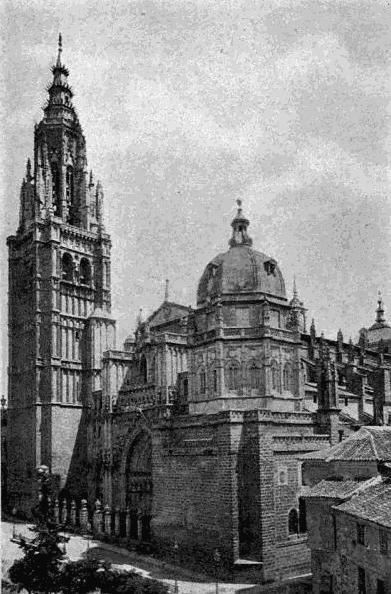
TOLEDO CATHEDRAL
It took 250 years for the cathedral to be built, and even then it was not really completed until toward the middle of the eighteenth century. In the meantime the nation had risen to its climax of power and wealth, and showered riches and jewels upon its great cathedral. Columbus returned from America, and the first gold he brought was handed over to the archbishop; foreign artisans—especially Flemish and German—arrived by hundreds, and were employed by Talavera, Cisneros, and Mendoza, in the decoration of the church. Unluckily, additions were made: the pointed arches of the façade were surmounted by a rectangular body which had nothing in common with the principle set down when the cathedral was to have been purely ogival.
The interior of the church was also enlarged, especially the high altar, the base of which was doubled in size. The retablo of painted wood was erected toward the end of the fifteenth century, as well as many of the chapels, which are built into the walls of the building, and are as different in style as the saints to whom they are dedicated.
As time went on, and the rich continued sending their jewels and relics to the cathedral, the Treasury Room, with its pictures by Rubens, Dürer, Titian, etc., and with its sagrario,—a carved image of Our Lady, crowning an admirably chiselled cone of silver and jewels, and covered over with the richest cloths woven in gold, silver, silk, and precious stones,—was gradually filled with hoarded wealth. Even to-day, when Spain has apparently reached the very low ebb of her glory, the cathedral of Toledo remains almost intact as the only living representative of the grandeur of the Church and of the arts it fostered in the sixteenth century.
Almost up to the beginning of the nineteenth century the building was continually being enlarged, modified, and repaired. Six hundred years since the first stone had been laid! What vicissitudes had not the country seen—and how many art waves had swept over the peninsula!
Gothic is traceable throughout the building: here it is flamboyant, there rayonnant. Here the gold and red of Mudejar ceilings are exquisitely represented, as in the chapter-room; there Moorish influence in azulejos (multicoloured glazed tiles) and in decorative designs is to be seen, such as in the horseshoe arches of the triforium in the chapel of the high altar. Renaissance details are not lacking, nor the severe plateresque taste (in the grilles of the choir and high altar), and neither did the grotesque style avoid Spain's great cathedral, for there is the double ambulatory behind the high altar, that is to say, the transparente, a circular chapel of the most gorgeous ultra-decoration to be found anywhere in Spain.
Signs of decadence are unluckily to be observed in the cathedral to-day. The same care is no longer taken to repair fallen bits of carved stone; pigeon-lamps that burn little oil replace the huge bronze lamps of other days, and no new additions are being made. The cathedral's apogee has been reached; from now on it will either remain intact for centuries, or else it will gradually crumble away.
Seen from the exterior, the cathedral does not impress to such an extent as it might. Houses are built up around it, and the small square to the south and west is too insignificant to permit a good view of the ensemble.
Nevertheless, the spectator who is standing near the western façade, either craning his neck skyward or else examining the seventy odd statues which compose the huge portal of the principal entrance, is overawed at the immensity of the edifice in front of him, as well as amazed at the amount of work necessary for the decorating of the portal.
The Puerta de los Leones, or the southern entrance giving access to the transept, is perhaps of a more careful workmanship as regards the sculptural decoration. The door itself, studded on the outside with nails and covered over with a sheet of bronze of the most exquisite workmanship in relief, is a chef-d'œuvre of metal-stamping of the sixteenth century, whilst the wood-carving on the interior is among the finest in the cathedral.
The effect produced on the spectator within the building is totally different. The height and length of the aisles, which are buried in shadows,—for the light which enters illuminates rather the chapels which are built into the walls between the flying buttresses,—astonishes; the factura is severe and beautiful in its grand simplicity.
Not so the chapels, which are decorated in all manner of styles, and ornamented in all degrees of lavishness. The largest is the Muzarab chapel beneath the dome which substitutes the missing tower; except the dome, this chapel, where the old Gothic Rite (as opposed to the Gregorian Rite) is sung every day in the year, is constructed in pure Gothic; it contains a beautiful Italian mosaic of the Virgin as well as frescoes illustrating Cardinal Cisneros's African wars, when the battling prelate thought it was his duty to bear the crucifix and Spanish rights into Morocco as his royal masters had carried them into Granada.
The remaining chapels, some of them of impressive though generally complex structure, will have to be omitted here. So also the sacristy with its wonderful picture by the Greco, and the chapter-room with the portraits of all the archbishops, the elegant carved door, and the well-preserved Mudejar ceiling, etc. And we pass on to the central nave, and stand beneath the croisée. To the east the high altar, to the west the choir, claim the greater part of our attention. For it is here that the people centred their gifts.
The objects used on the altar-table are of gold, silver, jasper, and agate; the monstrance in the central niche of the altar-piece is also of silver, and the garments worn by the effigy are woven in gold, silk, and precious stones. The two immense grilles which close off the high altar and the eastern end of the choir are of iron, tin, and copper, gilded and silvered, having been covered over with black paint in the nineteenth century so as to escape the greedy eyes—and hands!—of the French soldiery. The workmanship of these two rejas is of the most sober Spanish classic or plateresque period, and though the black has not as yet been taken off, the silver and gold peep forth here and there, and show what a brilliancy must have radiated from these elegantly decorated bars and cross-bars in the eighteenth century.
The three tiers of choir stalls, carved in walnut, are among the very finest in Spain, both as regards the accomplished craftsmanship and the astonishing variety in the composition. The two organs, opposite each other and attaining the very height of the nave, are the best in the peninsula, whilst the designs of the marble pavement, red and white in the high altar, and black and white in the choir, only add to the luxurious effect produced by statues, pulpits, and other accessories, either brilliantly coloured, or else wrought in polished metal or stone.
The altar-piece itself, slightly concave in shape, is the largest, if not the best, of its kind. It is composed of pyramidically superimposed niches flanked by gilded columns and occupied by statues of painted and gilded wood. The effect from a distance is dazzling,—the reds, blues, and gold mingle together and produce a multicoloured mass reaching to the height of the nave; on closer examination, the workmanship is seen to be both coarse and naïve,—primitive as compared to the more finished retablos of Burgos, Astorga, etc.
To conclude: The visitor who, standing between the choir and the high altar of the cathedral, looks at both, stands, as it were, in the presence of an immense riddle. He cannot classify: there is no purity of one style, but a medley of hundreds of styles, pure in themselves, it is true, but not in the ensemble. Besides, the personality of each has been lost or drowned, either by ultra-decoration or by juxtaposition. A collective value is thus obtained which cannot be pulled to pieces, for then it would lose all its significance as an art unity—a complex art unity, in this case peculiar to Spain.
Neither is repose, meditation, or frank admiration to be gleaned from such a gigantic potpourri of art wonders, but rather a feeling—as far as we Northerners are concerned—of amazement, of stupor, and of an utter impossibility to understand such a luxurious display of idolatry rather than of faith, of scenic effect rather than of discreet prayer.
But then, it may just be this idolatry and love of scenic effect which produces in the Spaniard what we have called religious awe. We feel it in a long-aisled Gothic temple; the Spaniard feels it when standing beneath the croisée of his cathedral churches.
The whole matter is a question of race.
THE END.
Appendices
I
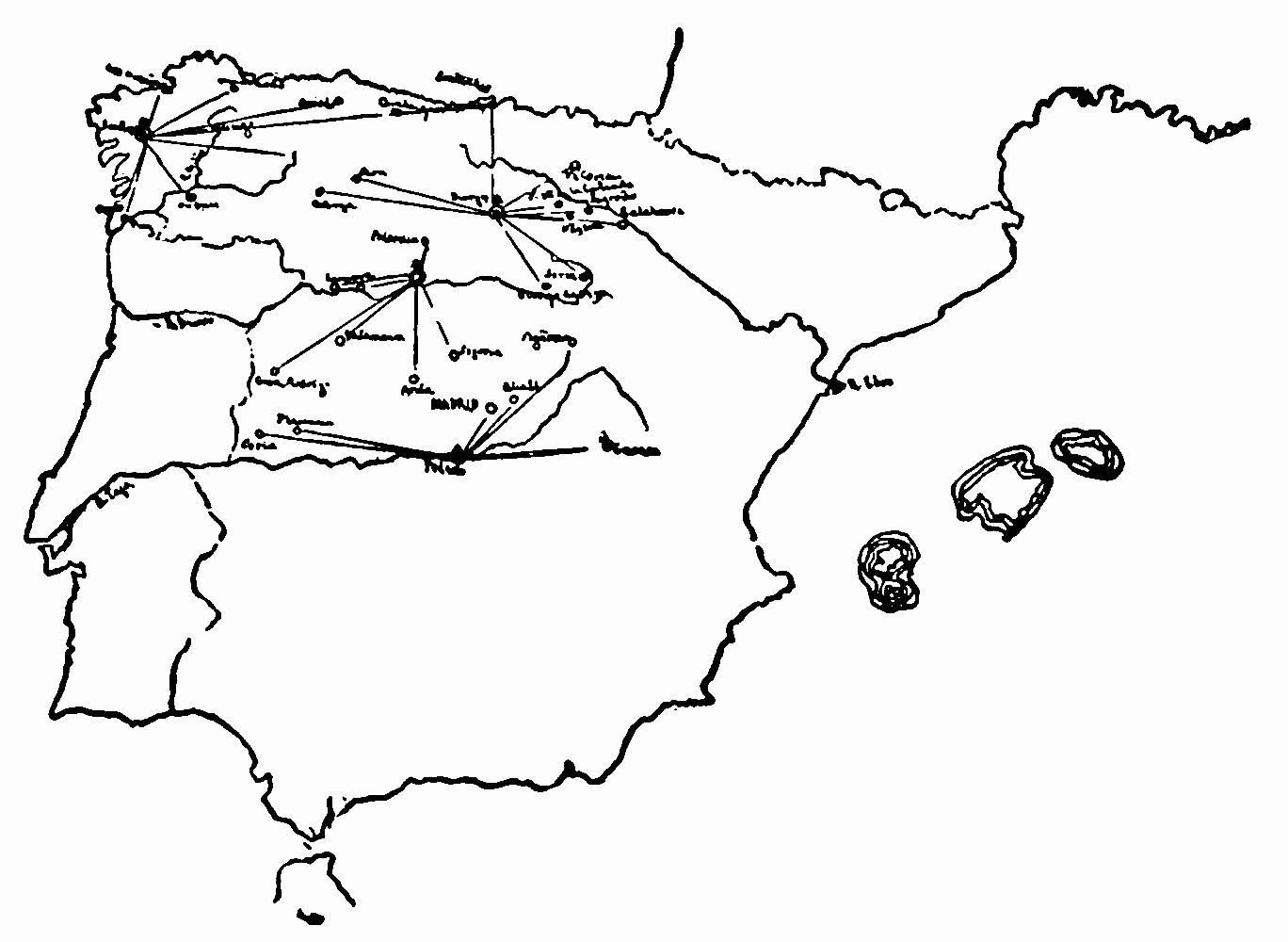
Archbishoprics and Bishoprics of Northern Spain
II
Dimensions and Chronology
ASTORGA
See dedicated to Saviour and San Toribio.
Legendary (?) erection of see, 1st century (oldest in peninsula).
First historical bishop, Dominiciano, 347 A. D.
During Arab invasion see was being continually destroyed and rebuilt.
1069, first cathedral (on record) was erected.
1120, second cathedral was erected.
XIIIth century, third cathedral was erected.
1471, fourth (present) cathedral was begun; terminated XVIth century.
XVth and XVIth century ogival; imitation of that of Leon.
Chief attractions: Northern front, plateresque retablo.
AVILA
Dedicated to San Salvador.
First bishop (legendary?), San Segundo, in Ist century.
See destroyed during Arab invasion.
First bishop after Reconquest, Jeronimo in XIth century.
Date of foundation and erection unknown.
Legendary foundation, 1091; finished in 1105 (?).
Late XIIth century Spanish Gothic fortress church.
Apse XIIth century; transept XIVth century.
Western front XVth century; tower late XIVth century.
Width of transept and of nave, 30 feet.
Width of aisles, 25 feet.
Chief attractions: Exterior of apse, nave and transept with rose windows, tomb of Bishop Tostada.
BURGOS
See dedicated to the Holy Mary and Son.
Bishopric erected, 1075; archbishopric, 1085.
First bishop, Don Simón; first archbishop, Gomez II.
Present cathedral begun, 1221.
First holy mass celebrated in altar-chapel, 1230.
Building terminated 300 years later (1521).
XIIIth-XIVth century Spanish ogival.
Length (excluding Chapel of Condestable), 273 feet.
Length of transept, 195 feet; width, 32 feet.
Height of lantern crowning croisée, 162 feet.
Height of western front, 47 feet.
Height of towers, 273 feet; width at base, 19 feet.
Width of nave, 31 feet; of aisles, 19 feet.
Chief attractions: The ensemble, interior decoration, lantern on croisée, the Chapel of the Condestable, choir, high altar, etc. (With that of Toledo, the richest cathedral in Spain.)
CALAHORRA
See dedicated to San Emeterio and San Celedonio, martyrs.
Bishopric erected Vth century; first bishop, Silvano.
Daring Arab invasion see removed to Oviedo (750).
Removed to Alava in IXth century; in Xth century, to Nájera.
In 1030, moved again to Calahorra; first bishop, Don Sancho.
Since XIXth century, one bishop appointed to double see Calahorra-Santo Domingo de la Calzada.
This double see to be removed to Logroño.
Cathedral begun in XIIth century; terminated in XIVth century.
XIIIth century Gothic (body of church only).
Western front of a much later date.
Chief attraction: Choir-stalls.
CIUDAD RODRIGO
See dedicated to the Virgin and Child.
Origin of bishopric in Calabria under Romans (legendary?).
Foundation of city in 1150; erection of see, 1170.
First bishop, Domingo, 1170.
See nominally suppressed in 1870; in reality the suppression has not taken place as yet.
Cathedral church begun toward 1160.
XIIth century Romanesque-Gothic edifice.
Tower and western front date from XVIIIth century.
Lady-chapel from XVIth century.
Building suffered considerably from French in 1808.
Chief attractions: Romanesque narthex, cloister, choir-stalls, Romanesque doors leading into transept.
CORIA
See dedicated to Santa Maria.
Date of erection, 338.
First known bishop, Laquinto, in 589.
During Moorish domination the bishopric entirely destroyed.
See reëstablished toward beginning XIIIth century.
Cathedral church begun in 1120.
Terminated in XVIth century.
Is an unimportant village church rather than a cathedral.
One aisle, 150 feet long, 52 feet wide, 84 feet high.
Chief attractions: Paseo, or cloister walk; in lady-chapel, sepulchre of XVIth century.
CUENCA
See dedicated to the Virgin.
Erected in 1183.
First bishop, Juan Yañez.
XIIIth century ogival church greatly deteriorated, in a ruinous state.
Tower which stood on western end fell down recently.
Length of building, 312 feet; width, 140 feet.
Chief attractions: Cloister door, chapels.
LEON
See dedicated to San Froilan and Santa Maria de la Blanca.
Date of erection not known.
First known bishop, Basilides, 252 A.D.
During Arab invasion, see existed on and off.
First stone of present cathedral laid in 1199.
The building did not begin until 1250; terminated end of XIVth century.
XIIth century French ogival.
Vaulting above croisée fell down in 1631.
Southern front rebuilt in 1694.
Whole cathedral partly ruined in 1743.
Closed to public by government in 1850.
Reopened in 1901.
Total length, 300 feet; width, 130 feet; height of nave, 100 feet.
Height of northern tower, 211 feet; of southern, 221 feet.
Length of each side of cloister, 97 feet.
Chief attractions: The ensemble, windows, choir-stalls, cloister.
LOGROÑO
See dedicated to the Holy Virgin.
Compare Calahorra.
Santa Maria raised to collegiate church in 1435.
Old building torn down in same year, excepting some few remains.
Present church begun in 1435; not terminated yet.
Enlargements being introduced at the present date.
Belongs to Spanish-Grotesque.
Chief attractions: Western front, trascoro, towers.
LUGO
See dedicated to the Mother and Child.
Bishopric erected in Vth century; first bishop, Agrestio, in 433.
Cathedral began in 1129; completed in 1177.
XIIth century Galician Romanesque spoilt by posterior additions.
Building greatly reformed in XVIth to XVIIIth centuries.
Chief attractions: The ensemble (interior), western portal, exterior of apse.
MADRID-ALCALÁ
See erected in 1850.
MADRID
Temporary cathedral dedicated to San Isidro.
Seventeenth century building of no art merit.
New cathedral dedicated to the Virgen de la Almudena.
In course of construction; begun in 1885.
ALCALÁ
Dedicated to Santos Justo and Pastor; called la Magistral.
In a ruinous state; closed, and see temporarily removed to Jesuit temple.
Constructed in XVth century, and raised to suffragan in same century.
Severe and naked (gloomy) Spanish-Gothic.
Interior of building cannot be visited.
MONDOÑEDO
See dedicated to the Virgin.
Bishopric removed here from Ribadeo, late XIIth century.
First (or second) bishop, Don Martin, about 1219.
Foundation of cathedral dates probably from XIIth century.
XIIIth century Galician Romanesque structure.
Greatly spoilt by posterior additions.
Ambulatory dates from XVth or XVIth century.
Rectangular in form; 120 feet long by 71 wide.
Height of nave, 45 feet; of aisles, 28 feet.
ORENSE
See dedicated to St. Martin of Tours and St. Mary Mother.
Bishopric erected previous to IVth century (?).
Erection of present building begun late XIIth century.
Probably terminated late XIIIth century.
XIIIth century, Galician Romanesque with pronounced ogival mixture.
Chief attractions: Portico del Paraiso, western portal, decoration of the interior.
OSMA
See dedicated to San Pedro de Osma.
Legendary (?) erection of see in 91 A. D.
First bishop, San Astorgio.
First historical bishop, Juan I, in 589.
Destruction of see during Arab invasion.
See restored, 1100; first bishop, San Pedro de Osma.
XIIth century cathedral destroyed in XIIIth century, excepting a few chapels.
Erection of new cathedral begun in 1232; terminated, beginning XIVth century.
XIIIth century Romanesque-Gothic (not pure).
Ambulatory introduced in XVIIth century.
Chief attractions: Retablo, reliefs of trasaltar.
OVIEDO
See dedicated to the Mother and Child.
Bishopric erected, 812; first bishop, Adulfo.
Until XIIth century cathedral was a basilica; destroyed.
Romanesque edifice erected in XIIth century; destroyed 1380.
Present edifice begun 1380; completed 1550.
XVth century ogival (French?).
Decoration of the interior terminated XVIIth century.
Tower and spire, XVIth century.
Camara Santa dates from XIIth century; a remnant of the early Romanesque edifice.
Total length, 218 feet; width, 72 feet.
Height of nave, 65 feet; of aisles, 33 feet.
Height of tower, 267 feet.
Chief attractions: Flèche, decoration of the interior, rosaces in apse, Gothic retablo, cloister, Camara Santa.
PALENCIA
See dedicated to Mother and Child and San Antolin, martyr.
Date of erection unknown; IId or IIId century.
One of the earliest bishops, San Toribio.
During the Arab invasion city and see completely destroyed.
First bishop after Reconquest, Bernardo, in 1035.
XVth century florid Gothic building.
Erection begun in 1321.
Eastern end finished prior to 1400.
Century later western end begun on larger scale.
Temple completed in 1550.
Total length, 405 feet.
Width (at transept), 160 feet.
Height (of nave), 95 feet.
Chief attractions: The ensemble (interior and exterior), Bishop's Door, choir-stalls, trascoro.
PLASENCIA
Dedicated to the Holy Virgin.
Erection of see 12 years after foundation city (1190).
First bishop, Domingo; second, Adam; both were warrior prelates.
Old cathedral (few remains left) commenced in beginning XIVth century.
Partially destroyed to make room for—
New cathedral, commenced in 1498.
XVIth century Renaissance-Gothic edifice.
Ultra-decorated and ornamented in later centuries.
Chief attractions: Choir-stalls, western entrance, decorative motives, sepulchres.
SALAMANCA
Bishopric existed in Vth century. First known bishop, Eleuterio (589).
VIIIth century, devoid of notices concerning see.
Xth century, 7 bishops mentioned—living in Leon or Oviedo.
XIth century, no news, even name of city forgotten.
First bishop de modernis, Jeronimo of Valencia (1102).
Old cathedral still standing; city possesses therefore two cathedrals.
OLD CATHEDRAL
Dedicated to St. Mary (Santa Maria de la Sede).
In 1152 already in construction; not finished in 1299.
XIIth or XIIIth century, Castilian Romanesque with ogival mixture.
Nave, 33 feet wide, 190 feet long, 60 feet high.
Aisles, 20 feet wide, 180 feet long, 40 feet high.
Thickness of walls, 10 feet.
Part of cathedral demolished to make room for new in 1513.
Chief attractions: Cimborio, central apsidal chapel, and retablo.
NEW CATHEDRAL
Dedicated to the Mother and Saviour.
Begun in 1513; not completed until XVIIIth century.
Originally Late Gothic building. Plateresque, Herrera and grotesque additions.
Compare churches of Valladolid and Segovia.
Rectangular in shape; 378 feet long, 181 feet wide.
Height of nave, 130 feet; that of aisles, 88 feet.
Width of nave, 50 feet; of aisles, 37 feet.
Length (and width) of chapels, 28 feet; height, 54 feet.
Height of tower, 320 feet.
Chief attractions: Western façade, decorative wealth, ensemble.
SANTANDER
See dedicated to San Emeterio, martyr, and to the Virgin.
Monastical church of San Emeterio raised to collegiate in XIIIth century.
Bishopric erected in 1775.
Cathedral church built in XIIIth century.
Chief attraction: Crypt, fount.
SANTIAGO
See dedicated to St. James, patron saint of Spain.
Bishopric erected previous to 842; first bishop, Sisnando.
Archbishopric erected XIIth century; first archbishop, Diego Galmirez.
Cathedral church begun, 1078; terminated, 1211.
XIIth century Romanesque building.
Exterior suffered grotesque and plateresque repairs, XVIIth century.
Cloister dates from 1530.
Length, 305 feet; width (at transept), 204 feet.
Height of nave, 78 feet; of aisles, 23 feet; of cupola, 107 feet; of tower (de la Trinidad), 260 feet; of western towers, 227 feet.
Length of each side of cloister, 114 feet; width, 19 feet.
Chief attractions: The ensemble (interior), Portico de la Gloria, crypt, cloister, southern portal.
SANTO DOMINGO DE LA CALZADA
See dedicated to Santo Domingo de la Calzada.
Bishopric dates from 1227.
Compare Calahorra.
Cathedral church begun toward 1150.
Terminated, 1250.
XIIth-XIIIth century Romanesque-Gothic structure.
Chief attraction: The retablo, XVth and XVIth sepulchres.
SEGOVIA
See dedicated to San Fruto and the Virgin.
First bishop (legendary?), San Hierateo, in Ist century.
See known to have existed in 527.
First historical bishop, Peter (589).
During Arab invasion only one bishop mentioned, Ilderedo, 940.
First bishop after the Reconquest, Don Pedro, in 1115.
First stone of present cathedral laid, 1525.
Cathedral consecrated, 1558; finished in 1580.
Cupola erected in 1615.
Gothic-Renaissance building.
Tower struck by lightning and partly ruined, 1620.
Rebuilt (tower) in 1825.
Total length, 341 feet; width, 156 feet.
Height of dome, 218 feet.
Width of nave and transept, 44 feet; aisles, 33 feet.
Chief attractions: Old cloister, apse, tower.
SIGÜENZA
See dedicated to Mother and Child.
First known bishop, Protogenes, in VIth century.
During Arab invasion no mention is made of see.
First bishop after Reconquest, Bernardo (1195).
Fourth bishop an Englishman, Jocelyn.
Date of erection of the cathedral unknown.
Probably XIIth or XIIIth century Romanesque-Gothic edifice.
Ambulatory added in XVIth century.
Length of building, 313 feet; width, 112 feet.
Height of nave, 68 feet; of aisles, 63 feet.
Circumference of central pillar, 50 feet.
Chief attractions: Western front, sacristy, rose window in southern transept arm.
SORIA
See to be moved here from Osma.
Church dedicated to St. Mary.
Raised to suffragan of Osma in XIIth century.
XVIth century, Gothic-plateresque building.
XIIth century, western front; Castilian Romanesque.
XIIth century, Romanesque cloister.
Chief attractions: Western front, cloister.
TOLEDO
See dedicated to the Virgin Mother and her Apparition to San Ildefonso.
Bishopric erected prior to 513 A. D.
One of first bishops is San Ildefonso.
During Arab domination see remains vacant.
First archbishop, Don Bernardo (1085).
Primate cathedral of all the Spains since XVth century.
First stone of present building laid in 1227.
Church completed in 1493.
Additions, repairs, etc., dating from XVIth-XVIIIth century.
Length, 404 feet; width, 204 feet; height of tower, 298 feet.
Height of nave, 98 feet.
Height of principal door, 20 feet; width, 7 feet.
Diameter of rose window in western front, 30 feet.
Chief attractions: The ensemble, decorative and industrial accessories, chapter-room, sacristy, paintings, bell-tower, etc. (The richest cathedral in Spain.)
TORO
Collegiate Church dedicated to St. Mary.
Existence of bishopric cannot be proven, though believed to have been erected during first decade of Reconquest in Xth century.
Is definitely made a suffragan of Zamora in XVIth century.
Cathedral—or collegiate—erected end of XIIth or beginning of XIIIth century.
Castilian Romanesque building.
Chief attractions: Military aspect of building, height of walls, massive cimborio.
TUY
See dedicated to the Virgin Mary.
Bishopric erected in VIth century.
Cathedral erected in first half XIIth century.
Suffered greatly from earthquakes, especially in 1755.
XIIth century Galician Romanesque in spoilt conditions.
Western porch or narthex dates from XVth century.