Front matter (continued 4)
Reading edition
These outlines are not imaginative, but real. We have been acquainted with the plan since its inception; and of late have been anxiously watching for the good news.
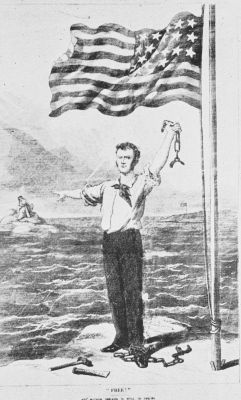
A CARTOON FROM THE IRISH WORLD, SEPTEMBER 2, 1876
There was never an enterprise so large and so terribly dangerous carried out more admirably. It will be remembered of Irish patriots that they never forget their suffering brothers. The prisoners who have escaped are humble men, most of them private soldiers. But the PRINCIPLE was at stake—and for this they have been released. England will now begin to realize that she has made a mistake that will follow her to her death-bed, in making Ireland so implacable and daring an enemy. This is only an earnest of what will come when the clouds of war are over her. The men who sent the Catalpa to Australia are just the men to send out a hundred Catalpas to wipe British commerce from the face of the sea.—Pilot, June 17, 1876.
LESSONS FROM THE PRISONERS' ESCAPE
The well-planned and boldly executed rescue of the Irish political prisoners from the penal colony of Western Australia contains lessons worth noting by those who desire to perpetuate Irish nationality. A nation that cultivates the evil weed of Distrust will never become strong or great. Cohesion is the principle of power, and the people that cannot stand by each other for a common cause, under common leaders, are no stronger than a ball of sand, to be scattered at a touch.
Heretofore the curse of Ireland has been the impossibility of union. Party hated party; class distrusted class. Rich men were called traitors because they, having something to lose, refused to enter on every wild plan of revolution without considering the probabilities. Poor men were too easily led by demagogues. The man who spake loudest, who boasted most, became the idol of the hour. When the opportunity offered, he sold the people he had so easily deceived, and scorned them for their credulity. There are plenty of "successful men" of this class—such as Judge Keogh, who a few years ago called God to witness that he would never desert the People's Cause, but who, when made a judge, was the first to lay a ruthless hand and an insulting tongue on the religion and nationality of his country.
With such an experience Irishmen have grown distrustful to such a degree that the danger from their doubt is greater than from their deception. Better a thousand times to be deceived than to lose faith in your brother's honesty and patriotism.
The CURE of this national disease is coming—for the CAUSE of it is plain. Distrust has grown from disappointment; and this has been the result of a bad selection of men. Ireland has hitherto trusted the TALKERS rather than the DOERS. She has given her vote to the noisy demagogues who tickled her ear, and has turned from the men who appealed to her common-sense. For twenty-five years past—with the exception of the abortive Fenian movement—the Irish people have acted as if green flags, denunciation of England, and poetic sun-burstry were enough to establish Ireland's claim to national independence.
We trust and believe that a change for the better is coming. Ireland is beginning to see that the men who are able to do something for themselves, the men of judgment and prevision in their own affairs, are likely to bring the best intelligence into national deliberations. Hereafter it will not be a recommendation for an Irish politician that he has failed to make a decent living at everything else.
The rescue of the political prisoners proves that the Irishmen who talk least can do most. It proves also that distrust is not chronic in the Irish people—that they can stake great issues on the faith of single men—when they have selected them for their capacity and intelligence instead of their braggadocio.
Another and most valuable lesson from the rescue has a bearing on the English army. The thousands of Irishmen in the ranks knew that those men were kept in prison BECAUSE THEY HAD BEEN SOLDIERS. It seemed, too, for two or three years past, that those men had been forgotten. The leaders of the movement were free; and no one seemed to care for the poor fellows whose very names were unknown. The soldiers in the army knew that of all the Irish prisoners of '66 and '67, there were none who risked more or who would have been more valuable than a trained dragoon, the indispensable artilleryman, and the steady linesman. To see their comrades forgotten and left to rot in their dungeons was enough to make the Irishmen of the army abjure their nationality and accept the English dominion in Ireland.
This has been averted by the rescue. The soldiers in the English army will read the news with a deeper thrill than any other Irishmen. It has a larger meaning to them than to others. "Now," they will say, "now, at last, we are a part of the Irish people. Our red coats do not separate us from our countrymen; and if we suffer for their cause they will be true as steel to us in the day of trial."
It is full time that Irish nationality should take intelligent position. All shades of Irish politics can agree in mutual respect; they are all shades of green. One party may desire more than another, and believe it possible of attainment. But they should not hate the others that think differently. The Home Rulers are as honest as the Fenians, and as intelligent. One should say to the other: "We travel the same road; but when you stop, we go farther. If we succeed, you can join us; if we fail, we shall return to you for support." This is true nationality; and when this spirit grows among the Irish people, there cannot be a doubt of the result.—Pilot, June 24, 1876.
THE RESCUED PRISONERS
GRAND RECEPTION IN BOSTON
On the 1st inst., a grand entertainment was given in Music Hall for the benefit of the released prisoners, who were present. The immense hall was crowded; nearly every seat on floor and galleries was filled. The stage was fitted up with a handsome proscenium, the Sheil Literary Institute playing the patriotic drama of Robert Emmet. The greatest credit is due to the management committee. Polite ushers were in attendance, and not the least hitch occurred in the whole evening's entertainment. The address was delivered by John E. Fitzgerald, Esq., who was greeted with thundering applause. He pictured in graphic words the condition of Ireland for centuries; while Poland and other struggling nationalities had been wiped from the map, the intense individualism of the Irish as a nation had preserved them. The movement for which these gallant fellows had suffered was the embodiment of the national idea. (Applause.)
The more pacific and undefinable agitation known as the Home Rule movement was by no means final—as England well knew. It was a step toward something fuller,—toward the only consummation that will ever satisfy Irishmen,—complete separation. (Great applause.) The sentiment of Henry Grattan was still vivid,—that no one but the Irish people had a right to legislate for Ireland. Mr. Fitzgerald dwelt eloquently on the devotion of the Nationalists to their imprisoned brethren. He spoke in the highest praise of the efforts of those by whom this last brilliant exploit was accomplished with so much wisdom and secrecy. He said that the sum of $30,000 had been contributed in this country in its aid, and though the object of the contribution was so widely known, the secrecy was maintained until its accomplishment. He hoped that a generous and substantial testimonial would be presented to Captain Anthony, the brave man who had risked and accomplished so much in their behalf. Mr. A. O'Dowd recited Meagher's "Sword Speech" in impressive style. A song, "Cead Mille Failthe," by Mr. E. Fitzwilliam, was sung by the composer, and pleased the audience so well that an encore was given, in response to which Mr. Fitzwilliam sang another of his compositions, entitled, "The Irishman's Version of One Hundred Years Ago," which was also generously applauded. Miss Annie Irish, a well-known vocalist, sang two songs in acceptable style; and Mr. Sheehan, who was warmly received, received an encore, to which he responded in his usual excellent manner.
The drama by the Sheil Literary Institute was, as usual with that body, well played, and gave great pleasure to the immense and patriotic audience. Before its performance there were loud requests for "Captain Anthony" to come forward, but that brave fellow, who sat in the audience with Captain Hathaway, of New Bedford, was too modest to make his appearance.
At the close of the drama the demand for the appearance of the rescued prisoners was imperious, and had to be gratified, though it was intended by the committee that the men should not be paraded. But the call was so strong and kindly that the bronzed men appeared on the stage, and were introduced by Mr. Fitzgerald. The greeting they received will never be forgotten. It was plain how deep a chord their suffering and escape has struck in the Irish heart. They numbered six, though Mr. Wilson, one of the rescued men, was not present; his place was filled by Mr. William Foley, the ex-prisoner who arrived in this country about two months ago.
The entertainment was a complete success; and, besides its value as a patriotic safety-valve, it will add a considerable sum to the testimonial to be presented to the ex-prisoners, to enable them to begin life in this new country under fair circumstances.—Pilot, September 9, 1876.
THE RESCUED PRISONERS
RECEPTION TO JOHN J. BRESLIN
A large audience assembled in Boston Theatre on the evening of Sunday, the 24th inst., to tender a public reception to Mr. John J. Breslin, the chief agent in the rescue of the Fenian prisoners from Australia. The reception was under the management of the United Irish Brotherhood, and the committee of arrangements deserves the greatest credit.
Charles F. Donnelly, Esq., presided on the occasion, and among others on the platform were Captain Anthony, City Marshal Hathaway, of New Bedford, Alderman O'Brien, Thomas Riley, Esq., and a large number of prominent and respectable citizens.
Mr. Donnelly, in an eloquent address, reminded his audience that the turmoil of a political campaign did not prevent them from assembling to do honor to brave men. Could they say that the spirit of the knights and saints of old was dead? Did it not survive in the act of the brave men there present? A year ago, and the escape of the political prisoners would have been deemed an impossibility; it had been undertaken and executed by Mr. Breslin, who set out to rescue from bondage, ten thousand miles away, men whom he had never seen, men whose only crime was loving their country, perhaps not wisely, but too well,—if an Irishman could love his country too well. But the age of chivalry had been revived even in this hard, practical age by a generous Yankee captain. (Loud applause.) Many morals might be drawn from this event, but he would select one,—it was this: that when an Irishman and a Yankee combine to carry out an undertaking, they can do it in spite of the whole power of the British Empire.
Mr. Donnelly then stated that he had received a letter from Wendell Phillips regretting his inability to attend, and expressing sympathy with the objects of the meeting. A telegram of similar import was read from General Butler, which concluded thus: "A prominent Massachusetts politician says that Fenianism should be crowded out of politics. Fenianism is the love of one's native land. I hope it may never be crushed out of the heart of any citizen of this country."
Alderman O'Brien, the next speaker, said that when coming there he had no intention of making a speech. He came there in common with his fellow-citizens to extend to these brave men a cordial welcome, and to show them that he felt as he spoke, he would shake hands with them all. He was followed by Thomas Riley, Esq., who began by likening the cause of Ireland to that patriotic society whose birth antedated that of George III., and which still lived on. The spirit of Irish liberty was not dead, as was proved by their presence there that night to do honor to a man and an act. The achievement of Mr. Breslin was worthy of the annals of an earlier era. Ireland's history was one of oppression. An Englishman had once charged that the Irish were "an unpolished nation;" to which a native of Ireland replied, "It ought not to be so, for we have received hard rubs enough to be polished long ago." It was acts like Mr. Breslin's that kept alive the spirit of liberty. Plantagenet and Tudor, and Stuart and Cromwell, all had dealt Ireland crushing blows, all had waded through seas of Irish gore; yet all their dynasties had perished off the face of the earth, and the spirit of Irish liberty still survived. The worst of the Roman Emperors was Julian, yet he sent no Christian to the cross or the wild beasts, he merely banned and barred Christian education, for he well knew that without education a nation relapsed into the depths of barbarism. England had done the same; in her savage, barbarous penal code she had proscribed education and educators, but Ireland still clung to the light of liberty. She listened to the sound of the battle of freedom in the West, and her sons caught the flame, and Flood, and Grattan, and the Volunteers raised her to nationhood, and crowned her with the star of freedom. She had lost that eminence, but the spirit burned again in the immortal O'Connell; it still survived the golden-mouthed Father Burke. The speaker paid a touching tribute to the memory of John Mitchel, and denounced England as championing the iniquity of the age, of upholding dead and rotten Turkey and her butcheries, and that the hour of retribution had arrived, if Russia would only advance. If England lost her temper in the threatened European complication, Ireland would be her "beetle of mortality." During his eloquent address Mr. Riley was frequently applauded.
Captain Hathaway, who succeeded him, said he was not an Irishman, but that was not his fault. He detailed the facts already published as to the inception of the plan of escape, how Mr. Devoy had approached him with a letter from his (Mr. H.'s) friend, Mr. John Boyle O'Reilly, and the consequent chartering of the Catalpa.
Captain Anthony, who divided attention with Mr. Breslin as the lion of the night, succeeded, and was greeted with a storm of applause, to which that man of deeds, not words, responded by two modest bows.
Mr. John J. Breslin, who was enthusiastically received, then addressed the audience. He said that parliamentary action, prayers, and petitions had all failed to move the bowels of compassion of the British government in behalf of the prisoners, for the reason said government had no bowels. Mr. John Devoy, well and honorably known in '65, in 1873 began to actively agitate the plan of escape, and had, in the fall of 1874, raised funds sufficient to warrant him to make the attempt. The funds were raised in various ways; one of John Mitchel's last lectures was given for the purpose. Mr. Devoy placed himself in communication with a gentleman whose high literary abilities and rare poetic talents had raised him to a prominent position among the journalists of the day; by whom he (Mr. Devoy) was introduced to Captain Hathaway, of New Bedford, through whom the Catalpa was obtained. Mr. Breslin gave a clear, concise, and detailed account of his proceeding from first to last in carrying out the details of the escape. Most of this has already appeared in our columns. His description of the face of the country, cities, geology, and flora of Western Australia was particularly good, and show both scholarship and observation on his part. Alluding to the sandy nature of the soil, he related the following anecdote: An inhabitant meeting a "new chum," told him it was a fine country. "It is," said the latter, "so mighty fine that most of it would pass through a sieve."
At the close of Mr. Breslin's address, the chairman announced the meeting adjourned. Before and after the proceedings, Mr. Breslin, who is of commanding presence and courteous demeanor, was surrounded by groups of enthusiastic countrymen, each eager to express admiration and sympathy.—Pilot, September 30, 1876.
WHY DON'T ENGLAND DEMAND THE PRISONERS?
Mr. Gladstone is an able man, watchful and jealous of the honor of England. He has written a pamphlet of great power on the Turkish atrocities in Bulgaria, in which he says that Turkey should be excluded from Bosnia, Herzegovina, and Bulgaria, as a power unfit to rule civilized and Christian people. He says that the English government should lead in accomplishing this result,—"to redeem by these measures the honor of the British name, which in the deplorable events of the year has been more generally compromised than I have known it in any former period." That is true; the past two or three years have torn away more of England's prestige than all her previous history. She has fallen into decay so fast that she has not made a single effort to reassert herself as a Great Power. When Russia broke the Black Sea Treaty, England growled, but backed down. She sees the Czar laying railways to Northern Asia, and she hears the tramp of his legions already on the border of Hindostan; but she fears to stir a finger. When her Prime Minister, Disraeli, last year made an assertion that irritated Prussia, and that iron empire frowned, the fearful minister hastened to eat his words before the face of Bismarck. When the Fenian prisoners—men whom she persisted in calling "criminals"—were taken from her in defiance of all her laws, she dare not demand them from the United States. Why? Because the root of her greatness is split—the germ of her strength is rotten. Beside her heart she has the disease that will sooner or later strike her down. She has maltreated, misgoverned, scorned, derided the island and the people of Ireland, until oppression has generated in their hearts the terrible political mania of national hatred. God forbid that we should exult in such a feeling; but no one who knows Ireland and Irishmen can deny its existence. England, to save herself, to possess the land, has driven the Irish people over the world; but wherever they went they carried with them the bitter memory of their wrongs and hates. She has strengthened the world against herself. She is powerless and contemptible; if she were to-day to demand the return of the Fenian prisoners, the people of all nations would shout in derision, and the United States would answer with a particular sneer. It is well for Mr. Gladstone to say that her honor is waning. But he has only seen the beginning of the end. The haughty and truculent country must eat the leek till its heart is sick.—Pilot, September 16, 1876.
JAMES REYNOLDS, THE TREASURER
James Reynolds, of New Haven, Conn., familiarly known as "Catalpa Jim," was born in County Cavan, Ireland, on October 20, 1831. His ancestry dates back over fourteen hundred years to the noble sept MacRaghnaill, which the Irish historians tell us was a branch of the tribe called Conmaie, whose founder was Conmacrie, third son of Fergus MacRoigh, by Meive, the celebrated queen of Connaught, in the first century of the Christian era.
He was but sixteen years of age when, during the memorable famine that peopled the cemeteries of Ireland, he bade adieu to his native heath and sailed away to the distant shores of America, bearing with him a freight of precious memories that were to bear fruit in after years of patriotic endeavor. On his arrival in this country he at once apprenticed himself to learn the brass-founding trade, and in 1850 he settled in Connecticut, where he has since made his home. For twenty-eight years he has been a resident of New Haven, where he has received repeated political honors at the hands of his fellow citizens. For several years he has been at the head of the town government as town agent; the only Irishman who has ever been elevated to this position in a city where Puritanic influences and prejudices have not yet wholly passed away. In addition to his municipal duties, Mr. Reynolds has for years conducted a lucrative and somewhat extensive business as a brass-founder.
He early espoused the cause of his country and brought to its service all the energies of an active and impulsive nature. When, in the years following the rebellion, Irish patriotism was directed in a movement against England through her colonies in America, we find him foremost among those whose financial resources flowed freely into the common treasury. Not when his practical mind told him that not here lay the channel to Irish freedom did he close his purse-strings; not even when a prudent judgment convinced him that here lay a waste of Irish blood and human treasures did he say nay to the appeal for funds. It was enough for him to know that even one blow was struck at England, one thrust was made in the great cause of Irish freedom. James Reynolds never believed that the liberation of Ireland was to be effected through the conquest of Canada. His strong native sense and sagacious foresight taught him the folly of such a hope, yet, when the movement was inaugurated, he entered into it heart and soul, with all the enthusiasm of his noble nature, hopeful that even one blow might be struck at the shackles that bound his country.
But it was in the Catalpa movement that his great patriotism found its highest opportunity, and the name of James Reynolds gained the imperishable splendor of immortal fame. The history of that memorable expedition is still fresh in the memory of Irishmen; how the little bark with its gallant crew sailed into Australian waters and bore away its precious freight, bringing to freedom and glory those patriots who were expiating in exile their efforts for Ireland; bidding bold defiance to the British man-of-war who gave her chase, and riding safely into the harbor of New York,—all these details are still green in the Irish memory. And while the fame of this daring rescue shall last; while the name of Catalpa shall wake and fan the fires of Irish enthusiasm, so long will the name of James Reynolds be held in fond and loving remembrance. For it was he who mortgaged his home, who placed a chattel upon his household goods, who beggared himself for the time, that the sinews might be forthcoming to inaugurate and sustain the expedition. Other choice spirits lent him their counsels and their fortunes, but James Reynolds gave his all that the Catalpa rescue might be consummated. True, the success of the expedition recompensed him in a measure for his financial sacrifices; it brought back some of the little fortune he freely gave in the cause, but his chief reward, the glory of his great heart and the pride of his noble life, is the memory which he treasures, which his children and his children's children will carry in their hearts, that his sacrifices were not in vain,—that they brought humiliation to England, liberty and happiness to the rescued patriots, and eternal fame and glory to Ireland.
When the Land League movement was inaugurated, he at once actively interested himself, and was one of the leading delegates at its first national convention. He has been a member of the succeeding ones, and has acted a number of times on the committee on resolutions. He was for several years a member of the executive council, the committee of seven, and was state delegate of the League for Connecticut. He enthused much of his own enthusiasm into the movement, and during his administration the League in the Nutmeg State was to the front in point of numbers and the character and influence of its work.
James Reynolds is a pure, unselfish patriot; around his name breathes a lustre undimmed by a single thought of personal ambition, the faintest breath of self-interest or individual aggrandizement. Other men have given greater intellectual gifts to the service of Ireland; others have told her wrongs with a sublimer magic of eloquence, and waked the sympathies of men in the sweep of their mighty oratory; and still others, perhaps, have braved a larger measure of personal danger; but none has devoted his whole energies, his entire worldly fortune, with a loftier patriotism, a more generous spirit of sacrifice, than James Reynolds has for the little isle that gave him birth.
Personally he is a man of genial temperament, frank, guileless, and companionable, unaffected in manner and speech, open-handed and generous; a man whose friendships are firm and lasting; a citizen whose activities are always beneficial.—The Irish-American Weekly, Lincoln, Neb., March 20, 1892.
The Riverside Press CAMBRIDGE, MASSACHUSETTS, U.S.A. ELECTROTYPED AND PRINTED BY H.O. HOUGHTON AND CO.