Front matter (continued 3)
Reading edition
It must here be explained how the prisoners were able to get away so successfully. Their good conduct and length of imprisonment had entitled them to the rank of constable, which afforded the opportunity for communication with each other. Wilson and Harrington worked in the same party at the construction of harbor works in Freemantle. Hogan was a painter by trade, and on this morning was employed in painting the house of Mr. Fauntleroy, outside the prison walls. Cranston was employed in the stores, and as messenger occasionally. Darragh was clerk and attendant to the Church of England chaplain, and enjoyed facilities for communication with the other prisoners. This morning he took Hassett with him to plant potatoes in the garden of Mr. Broomhole, clerk of works in the convict department.
It fortunately happened that on the morning of April 17 all the political prisoners were at work outside the prison wall. Cranston walked out as if going to deliver a message. He overtook the working party and told the warden he had been sent to take Wilson and Harrington to move some furniture in the governor's house, which was the nearest point to the meeting place. He exhibited a key, and the warden directed the two men to go with Cranston.
Darragh and Hassett started as if for work in the same direction, and Hogan made an excuse to the warden to leave his work for a moment, and joined them.
"There was one incident of this daring enterprise which completed its dramatic intensity," writes James Jeffrey Roche. "The soldier convicts in Freemantle numbered one more than those who were rescued. That one was purposely left behind because of an act of treachery which he had attempted against his fellows ten long years before. He was tried with the others, by court-martial, and found guilty of treason; but before his sentence received the approval of the commander-in-chief he had offered to divulge the names of certain of his comrades not yet arrested, though implicated in the Fenian conspiracy. His offer was not accepted. The government punished him for his treason, and his comrades, half a score of years afterward, punished him more cruelly for the treason which he had contemplated against them."
The two traps, followed by King, made a quick journey to Rockingham. Mr. Somers, the proprietor of the hotel, stood in the door as the traps passed, but suspected nothing, inasmuch as he knew Breslin and Desmond, and the prison garb of the other men was concealed by their long coats. As the men drove up, he shouted:—
"What time will the Georgette be at the timber jetty?"
"Is the Georgette coming here?" shouted Breslin.
"Yes. She's due now."
Here was alarming news. The presence of the Georgette would ruin all. The horses were driven to a gallop. At half past ten the party approached the beach and saw Brennan making signals to them to hasten.
CHAPTER XXIII
IN THE OPEN BOAT
Captain Anthony walked up and down the beach throughout the long night, while his crew slept in the warm sand. He knew that the fate of the expedition, disastrous or successful, depended upon the developments of the ensuing day, and he was impatient to know the fate which awaited him. Twice during the night he roused the men to haul the boat farther up the beach, as the tide was rising. They responded sleepily and then dropped asleep again in careless sailor fashion.
As daylight approached, the captain was surprised and alarmed to find he was near a timber station. It had been unnoticed on the previous visit. Soon after sunrise, a gang of men put in an appearance and commenced carting lumber to a jetty not more than half a mile away.
He knew his presence must be discovered, and it was not long before one of the men from the jetty was seen approaching.
"What's going on?" asked the man, as he came up.
Captain Anthony told him he was bound to Freemantle for an anchor, to replace one which was lost. The man grinned at this.
"Lad," said he, "you've hooked it (ran away) from some ship, and I advise you to get out. This is no place to lay."
Then Anthony told him he was master of a ship, but the man was not to be convinced.
"I believe you're after Kenneth Brown," he said.
Brown was a man who was at that time under arrest for the murder of his wife.
Captain Anthony concluded it was useless to attempt a further explanation, and asked the man if he would tell him the best way to get out with his boat.
"I'm an ex-prisoner myself," said the man, "and I knew you were after somebody." He seemed disposed to assist the captain, to the relief of the latter, for if he had started to join his companions, Anthony would have been alarmed to an extent which might have made it necessary to resort to desperate means for his detention.
The visitor then told the captain that he must be very sure and keep close to Garden Island. There was a dangerous reef farther out, and it would be sure destruction to the boat to attempt to go out that way.
"But that's the way I came," said the captain. As he looked out, he saw the breakers making white water on the coral reef. He must have been carried completely over it by the blind rollers the previous night. He now realized that his escape had been providential.
Then the man said, in reply to questions, that he was getting a cargo of timber ready for the Georgette.
"When is the Georgette coming?" asked the captain with eagerness.
"Why, she's coming now," he replied. "You can see her smoke."
There in the offing the captain saw the smoke of the steamer, and he began to realize that the situation was growing critically perilous.
At this moment there was a rattle of wheels, and Captain Anthony saw a two-wheeled trap, drawn by a horse on the gallop, coming up the beach toward him.
Brennan was driving, and he had the luggage of the party. He had lost his way, and had led his horse through the brush until he reached the beach. There he saw the men and the boat and drove his horse on the run toward them.
"Who is that man?" asked Brennan, as he came up and saw the stranger.
"He's a prisoner here and working on that jetty," replied the captain.
"We must shoot him," said Brennan.
"There will be no shooting yet," said the captain. "Where are the others?"
"Close behind," said Brennan, and he commenced unloading valises and bags belonging to Breslin, King, and Desmond.
Next King came up on horseback. The situation was explained to him, and he rode back to urge his comrades on.
Meanwhile the boat's crew sat huddled in the sand, apprehensive at the proceedings. The captain ordered them to push the boat into the water, each man to stand by the side of the boat, abreast his thwart. When he gave the order, he instructed them to shove the boat off as quickly as possible, to take the oars and pull. He cautioned them not to be afraid, whatever happened, at which the poor fellows looked at each other in consternation.
After an interval of fifteen minutes, which seemed much longer, a rattling of wheels and clatter of hoofs was heard, and Desmond and Breslin drove up with the prisoners, their horses quite exhausted.
As the prisoners jumped from the traps, their long linen coats blew open, showing their convict suits, with the unusual accompaniments of English belts, each containing two six-shooters. They seized rifles from the carriages, and with their arms full of cartridges made a rush for the boat.
At this the crew stood paralyzed, for they thought they were about to be attacked. One Malay drew a sheath knife and the others seized buckets, raised oars, and prepared to resist the men who were closing in upon them. This move was so unexpected that it was fortunate that an attack was averted, but a loud order from the captain in various languages at his command quieted the men. It was subsequently learned that the theory of the crew was that Captain Anthony had been smuggling and that the arrivals were government officials. The crew had determined to fight if necessary, to prevent the arrest of the captain.
At length the boat was afloat. The prisoners had been ordered to stow themselves as closely as possible in the bottom of the boat. Breslin, King, and Desmond sat in the stern and Captain Anthony took a position on top of the stern sheet, with the steering oar.
After some splashing the men began to pull with enthusiasm to the accompaniment of a running stream of rallying cries from the captain of "Pull as if you were pulling for a whale," "Come down, Mopsy," "Pull, Tobey, pull," "Come down, you big Lewis," "Pull, Tobey, pull," "Give them the stroke, Mr. Sylvia," "What do you say, men," "Come down altogether," "Pull away, my men, pull away."
Now the wind was beginning to breeze up from the west, blowing straight on shore. On the beach stood the timber-worker from the jetty, dumfounded at the spectacle, with the six horses, wandering about the shore. The boat was no more than a half mile from the beach when a squad of eight mounted policemen drove up. The flight had been discovered.
With the police were a number of "trackers," aboriginal bushmen who play the rôle of human blood-hounds. They wore short bokas, or cloaks of kangaroo skin, with belts of twisted fur around their naked bodies. These natives are attached to the prisons to follow the trail of absconding convicts, and they are wonderfully adept in running down a prisoner.
The police were armed with carbines and might have shot some of the men in the boat, but fortunately they did not fire. They watched the boat a while and then took the horses and led them toward the timber station.
Breslin had prepared a note to the governor which he fastened to a float and posted by the ocean mail. As the wind and tide were setting ashore, it undoubtedly reached its destination. The letter was as follows—
Rockingham, April 17, 1876.
To His Excellency the British Governor of Western Australia.
This is to certify that I have this day released from the clemency of Her Most Gracious Majesty Victoria, Queen of Great Britain, etc., etc., six Irishmen, condemned to imprisonment for life by the enlightened and magnanimous government of Great Britain for having been guilty of the atrocious and unpardonable crimes known to the unenlightened portion of mankind as "love of country" and "hatred of tyranny;" for this act of "Irish assurance" my birth and blood being my full and sufficient warrant. Allow me to add that
In taking my leave now, I've only to say A few cells I've emptied (a sell in its way); I've the honor and pleasure to bid you good-day, From all future acquaintance, excuse me, I pray.
In the service of my country, John J. Breslin.
CHAPTER XXIV
AN AWFUL NIGHT
It was five o'clock in the afternoon when the rowboat went through the passage, and as Captain Anthony saw the menacing reef upon which the water was foaming and breaking, it seemed impossible that he had gone over it the night before.
Now the little boat was riding on lengthened seas which were rolling in from the ocean with increasing violence. The wind was blasty, but hauled a little in the boat's favor, so that Captain Anthony ordered the little sail set and told his companions if he could head in the way he was now going, the ship should be raised in an hour.
The fury of the wind and sea now poured upon the boat, and darkness was coming on, when the Catalpa was raised ahead. Captain Anthony knew that the little boat would not be visible to the ship and that the latter would stand off shore as soon as it became thick.
The sky grew blacker and the sea grew steadily heavier. The boat began to jump and jar until it seemed that she might lose her spar or mast step. The seas commenced to comb and break across the stern, or, running the length of the boat, would tumble in, soaking the men and threatening to swamp the little craft. Captain Anthony felt that his salvation lay in reaching the ship that night.
The sixteen men were directed to take a place on the weather gunwale, and the man in charge of the sheet was ordered to take a turn about the thwart and not to slacken an inch. A crisis had arrived, and any risk was preferable to a night on the ocean in such a storm as was imminent. The boat leaped forward at a spanking rate, and the spray flew like feathers; and the water rose in mimic mountains, crowned with white foam which the wind blew in mist from summit to summit. Miles away the Catalpa was seen, barely discernible at moments when she rose on the crest of a larger wave than common, thrusting her bows into the air, surrounded by foam, and apparently ready to take flight from the sea.
Then, with a crash, the mast went over the side, breaking close to the thwart. The boat nearly capsized to windward, but the captain threw her head to the wind and the magnificent efforts of the crew kept her afloat. Monstrous seas now rolled into her, threatening to overwhelm the craft. She was almost water-logged, and shipped water over bow and stern alternately, as she rose and fell. The crew bailed vehemently and desperately. The rescued men were very sick, and lay in the bottom of the boat, a wretched heap of miserable humanity.
The boat was relieved of some of the water, and the wreck hauled in. Oars were shipped, but rowing accomplished nothing more than holding the boat on her course, and almost in despair the men saw the Catalpa tack offshore.
The gale increased in violence as night wore on, and the men were completely worn out. The seas dashed over them, and their strength was taxed to exhaustion in bailing quickly lest the next sea might tumble in and wreck the boat. After the mast went, Captain Anthony took the midship oar, lashed on the jib, and stuck it up. The sheet was hauled aft, and the centreboard lowered, which steadied the boat and kept steerageway on her. The phosphorescence afforded a spectacle which Captain Anthony had never witnessed in equal degree, but it only made the wild scene more terrifying and awful.
For hours the seas continued to hurl themselves across the boat, while the men cast out the sea with bailers improvised from water kegs, the heads of which were knocked out.
Little was said, but occasionally one of the rescued men would ask "Captain, do you think we will float through the night?" The captain would cheerily reply, "Oh, yes, I've been out on many a worse night;" but he has since confessed that he would not have given a cent for the lives of the entire company. Under other circumstances the danger would have been much less. But the boat was overloaded, the gunwales being within two inches of the water, and she was nearly unmanageable. To run back to Garden Island meant capture.
The crew had eaten nothing but a little dry hard-bread since the noon of the day previous, and were painfully athirst. The provisions and water in the boat had been washed overboard. Captain Anthony was on his knees on top of the stern sheets steering, and often the seas rose to his armpits. The men were groaning, and it was so dark that the captain could not see his crew. No word was spoken excepting repeated orders to bail.
Late in the night, when the captain had decided that the boat must swamp before long, the gale subsided somewhat. Daylight was welcome after the awful night. The sea had now gone down, and there was prospect of a fair day. The seas came aboard less frequently, and courage and hope returned.
At sunrise every one was overjoyed to see the ship standing in toward the land. Oars were once more shipped, and with the sail drawing good progress was made.
CHAPTER XXV
A RACE WITH THE GUARD-BOAT
About an hour after sunrise the Georgette was seen coming out of Freemantle. The men knew she was searching for them, and she seemed to be heading directly for the little boat. The sail was taken down, oars shipped, and the men lay down, one on top of the other, so that nothing showed above the rail. The steamer passed within a half mile of the boat and Captain Anthony could plainly see an officer on the bridge with glasses, scanning the shore. The boat must have appeared like a log and been mistaken for a piece of floating timber, if it was seen by the men on the Georgette, for she steamed by and went out to the Catalpa.
The anxious men in the boat feared she would remain by the Catalpa and prevent them from going aboard, but the Georgette steamed up the coast after a while and swung in toward Garden Island, passing the whaleboat once more, but at a safe distance.
Oars were once more manned. Mr. Smith on the Catalpa had not sighted the boat yet, for the background of high land interfered. The men pulled for two hours, when it was seen that there was a lighter alongside the ship, and it was at first surmised that it was a fishing vessel. Captain Desmond looked intently and then exclaimed:—
"My God! There's the guard-boat, filled with police. Pass out those rifles."
The guard-boat was large, with two mutton-leg sails, and there were thirty or forty men aboard. Affairs in the whaleboat assumed a belligerent aspect. Rifles were distributed, wet cartridges drawn from revolvers and replaced with fresh, and the prisoners swore they would fight until the last man was killed.
At Desmond's cry the appearance of exhaustion vanished. Every man was alert. The crew put new vigor into the stroke of the oars. When about two and a half miles from the Catalpa, the lookout at the masthead evidently raised the whaleboat, for the Catalpa suddenly bore down with all sail set. The police evidently suspected something, for the officers ran up the sail-hoops on the mast and started after the ship, with three or four men at the sweeps to hasten her progress.
Now it was a question whether the guard-boat would intercept the small boat before the ship was reached. If this was done, there would be a fatal conflict. The rescued men tried to help at the oars, but their efforts were a detriment, and they were ordered to lie in the bottom of the boat, that they might not hamper the crew. There they lay, and hugged their rifles grimly.
There were moments of suspense, but at length it was seen that the whaleboat would reach the Catalpa. As soon as he was within hailing distance Captain Anthony shouted to Mr. Smith:—
"Hoist the ensign!"
The ensign was already bent, and one of the men jumped to the halyards and ran it to the peak.
Mr. Smith had men at the braces and managed the vessel superbly. As the boat slammed alongside, everything was thrown hard aback. The men grabbed the boat tackle and swung the forward tackle to Mr. Sylvia and the after to Captain Anthony.
The captain secured it, and, turning to order the men aboard ship, found he was alone in the boat. The prisoners had gone up the sideboards by the grip rope, with rifles and revolvers in their hands. The boat was hoisted on the davits, and as the captain stepped over the rail the guard-boat swept across the bow.
The rescued men knew the officers, and they crowded to the rail in great glee, waving their rifles and shouting salutations and farewells, calling the officers by name. The guard knew that it was useless for them to attempt to board the vessel. The officer in command accepted the result gracefully, and, giving a military salute, said "Good-morning, captain." "Good-morning," replied Captain Anthony, and the guard-boat kept off toward the shore.
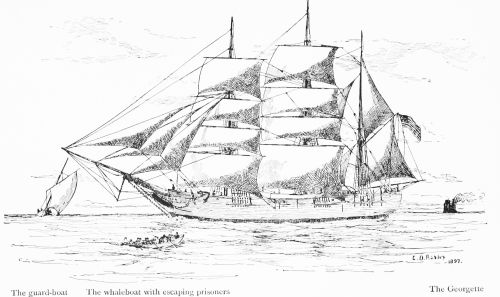
The guard-boat The whaleboat with escaping prisoners The Georgette THE RACE FOR THE CATALPA
There were wild scenes on board the whaleship in the next hour. The rescued men were in a state of exaltation, and cheered the captain, the crew, and everybody connected with the enterprise. If Captain Anthony, Mr. Breslin, and the others had been reprieved from a death sentence they would have felt no greater joy and contentment. Captain Anthony and Breslin complimented Mate Smith, and the former called the steward.
"Get up the best dinner the ship can afford," he said. "We're hungry."
The steward succeeded admirably. There were canned chickens and lobsters, boiled potatoes, canned fruits, tea and coffee, and it was the most memorable dinner in the lifetime of the men who assembled. Messrs. Breslin, Desmond, and King dined with the captain, and the rescued men ate in the steerage.
Mr. Smith related that when the Georgette came alongside that morning, the captain of the English steamer asked where the boat was which was missing from the cranes. The mate replied that the captain had gone ashore. "What for?" was asked. "I don't know anything about it," said Mr. Smith. "Can I come aboard?" asked the officer. "Not by a damned sight," was Mr. Smith's reply. It was the theory of the Georgette's officers that the gale had been so violent that the small boat must have returned to land, so, leaving the guard-boat alongside, she ran in under the shore to cut off the whaleboat if possible.
After dinner Captain Anthony directed Mr. Smith to let the boat's crew go below and stay as long as the men wished.
That night the wind died out, and the topsails hung supinely from the yards, the air which breathed occasionally from the land being unable to shake the heavy canvas. The captain gave up his room to Mr. Breslin, and Desmond and King were assigned to rooms in the forward cabin.
Captain Anthony lay down on a four-foot lounge, instructing Mr. Smith to work off shore if possible, but the ship did not move her own length during the entire night.
CHAPTER XXVI
OVERHAULED BY THE GEORGETTE
At daybreak Captain Anthony was called by Mr. Smith, who announced that the Georgette was approaching. Breslin was summoned, and the men hastened on deck.
As the steamer came nearer, it was seen that she had a regiment of soldiers aboard. The Georgette was a four hundred ton vessel, twice as big as the Catalpa. On her upper deck a big gun was mounted, and the soldiery were assembled on the main deck, a forest of bayonets glistening in the morning sun.
It was a show which was calculated to intimidate the men on the little whaleship, but no one on the Catalpa faltered. The captain ordered the ensign hoisted to the masthead, and mounted the poop deck.
It was seen that Colonel Harvest, heavy laden in the gorgeous trappings of a British army officer, was in charge of the deck. At one moment, when the colonel's attention was elsewhere, Captain O'Grady waved his hat at his whilom companion on a recent trip, and Captain Anthony waved his hand in response.
The next salutation was a solid shot fired across the bow of the Catalpa. As it ricocheted along, the water flew as high as the masthead. Meanwhile the ship was rolling helplessly, for there was no wind. As the yards bowed to meet the water, her sails flapped and yards creaked. But now a faint breeze filled the sails, and the Catalpa began to make some headway. When she was abeam the Georgette, Colonel Harvest shouted:—
"Heave to!"
"What for?" screamed Captain Anthony in reply.
"You have escaped prisoners aboard that ship."
"You're mistaken," said Captain Anthony. "There are no prisoners aboard this ship. They're all free men."
The Georgette had a whaleboat on the davits, and the men on the whaleship assumed it was for boarding purposes. Breslin collected the rescued men together, and they determined to resist. While the above colloquy was in progress, Mr. Smith had fitted out the company with cutting spades, whaling guns, and heavy pieces of iron and logs of wood with which to sink the boat if it came alongside.
"I see the men aboard the ship now," yelled Colonel Harvest.
"You're mistaken, sir," returned Captain Anthony. "Get up, men, and show yourselves."
The men walked to the rail. "You can see for yourself they are my crew," said the captain.
"I have telegraphed the American government, and have orders to seize you," was the colonel's next announcement.
Captain Anthony knew this was impossible and made no reply.
"Are you going to heave to?" asked the colonel.
"No, sir," replied Captain Anthony firmly.
The Georgette was on the lee of the Catalpa. The wind was freshening and the Georgette was steaming to keep up.
"Don't you know you have violated the colonial laws?" asked Colonel Harvest.
"No, sir," answered Captain Anthony; at which the colonel seemed greatly enraged.
"I'll give you fifteen minutes in which to heave to," said he, "and I'll blow your masts out unless you do so. I have the means to do it."
He pointed to the gun, which the soldiers were swabbing, preparatory to reloading.
"This ship is sailing under the American flag and she is on the high seas. If you fire on me, I warn you that you are firing on the American flag." This was Captain Anthony's reply.
The vessels were now about eighteen miles offshore. On the tack upon which she was sailing the Catalpa was running inshore. Captain Anthony feared it was the trick to decoy him into Australian waters, and decided to go about on the other tack. He consulted with Mr. Smith whether it was advisable to tack or wear ship, his fear of the former course being that the vessel might get "in irons" and lose her headway, and in the confusion the Georgette might shoot alongside.
So it was decided to wear. When the Catalpa's crew hauled up the clews of the mainsail, hauled down the head of the spanker, and let the gafftopsail run down, the officers on the Georgette evidently thought the Catalpa proposed to haul back, and the steamer was stopped.
Then Captain Anthony put the wheel up, and the vessel swung off quickly and headed straight for the Georgette, going before the wind. The captain of the steamer construed this as an attempt to run him down. He rang the jingle-bell and went ahead at full speed, but when the Catalpa swung by him, her flying jibboom just cleared the steamer's rigging. The ship's sails filled on the other tack and the Catalpa headed offshore.
The Georgette again steamed under the bark's lee. Colonel Harvest once more asked the captain if he proposed to "heave to," and the captain once more replied that he did not. The steamer followed for an hour, Colonel Harvest walking the bridge. Then the Georgette stopped. It was now four o'clock in the afternoon. The wind was fair and fresh, and constantly increasing.
When the Catalpa was some distance away, Captain Anthony called to the rescued men, "Boys, take a good look at her. Probably you'll never see her again." When the vessels were a few miles apart, the Georgette steamed back towards Freemantle, leaving a grateful and thankful party behind.
"When the English commander gave the order to his stokers to slack down the fires, a veritable feu d'enfer, the battle ended," said the "Kilkenny Journal," in describing the incident. "But it was a terrible affray, and while the firing lasted there was a tremendous expenditure of coals. Every credit is due the Georgette. She steered off in magnificent style. As it turned a stern lookout upon its foe, the banner of Britain displayed its folds, and the blazoned lion, shimmering in the sun, seemed to make a gesture of defiance with his tail, by curving it between his heels."
And the Catalpa sailed serenely on, and the star-spangled banner floated bravely in the breeze.
CHAPTER XXVII
BOUND HOME
That night the Catalpa took a squall from the eastward which developed into a gale, and the bark ran before it under two lower topsails and a foresail. In forty-eight hours the vessel was four hundred miles off the coast.
This led the leaders of the rescue to appreciate their extreme good fortune, for if the gale had arisen the night the Catalpa left Bunbury, Captain Anthony and his crew would not have been waiting on the beach at Rockingham to receive the fleeing prisoners. The police, closely following, would have rearrested the men, Breslin and his followers would have been arrested, and disaster would have been the result of the year of anxiety and the expenditure of a fortune contributed largely by men who gave at considerable sacrifice. England would have been exultant at having captured the man who released Stephens, and the Clan-na-Gael would have suffered bitterly from the ignominy.
The day after the storm, April 19, Captain Anthony had two casks of clothing hoisted on deck. They were the best "slops" (the whaleman's vernacular for clothes and supplies) ever put aboard a whaling vessel. The casks' heads were taken out, and Captain Anthony said to the men, "Go in and help yourselves. Take all you care for, and you'll need the thickest, for you'll see some cold weather before you reach America." Each man selected at least two suits of clothing, as well as a large supply of underclothes.
The rigging-pen between decks was knocked down and two tiers of berths were built, one for each of the rescued men, from the lumber bought at Teneriffe. They were amply supplied with bedding, seats and tables were built, and a boy from the forecastle was assigned to attend the men.
The vessel was kept well to the northward, to take advantage of the southeast trade-winds, which were taken in lat. 24°. Then fresh and fair winds wafted the vessel across the Indian Ocean. At times the old Catalpa logged two hundred miles a day, although she was not regarded as a fast sailor.
The men were given the freedom of the ship and thoroughly enjoyed the liberty which had been restored to them. Mr. Breslin wrote a song which the men were wont to sing as they lay on the decks on warm evenings. These were the words:—
"Right across the Indian Ocean, while the trade-wind follows fast, Speeds our ship with gentle motion; fear and chains behind us cast. Rolling home! rolling home! rolling home across the sea; Rolling home to bright Columbia; home to friends and liberty. "Through the waters blue and bright, through dark wave and hissing foam, Ever onward, with delight, we are sailing still for home. O'er our pathway, in the sunshine, flies the wide-winged albatross, O'er our topmast, in the moonlight, hangs the starry Southern Cross. "By the stormy cape now flying, with a full and flowing sail, See the daylight round us dying on the black breast of the gale! See the lightning flash above us and the dark surge roll below! Here's a health to those who love us! Here's defiance to the foe! "Now the wide Atlantic clearing with our good ship speeding free, The dull 'Cape of Storms' we're leaving far to eastward on our lee. And as homeward through the waters the old Catalpa goes, Ho! you fellows at the masthead, let us hear once more, "She blows." "Next by lonely St. Helena, with a steady wind we glide By the rock-built, sea-girt prison, where the gallant Frenchman died, With the flying fish and porpoise sporting 'round us in the wave, With the starry flag of freedom floating o'er us bright and brave. "Past 'The Line,' and now the dipper hangs glittering in the sky. Onward still! In the blue water, see, the gulf weed passing by. Homeward! Homeward to Columbia, blow you, steady breezes, blow, 'Till we hear it, from the masthead, the joyful cry, "Land ho!"
Mr. Farnham, the second mate, died suddenly of heart disease on the 8th of May, and was buried at sea the following day. He had been a faithful man, and there was sincere sorrow throughout the ship's company.
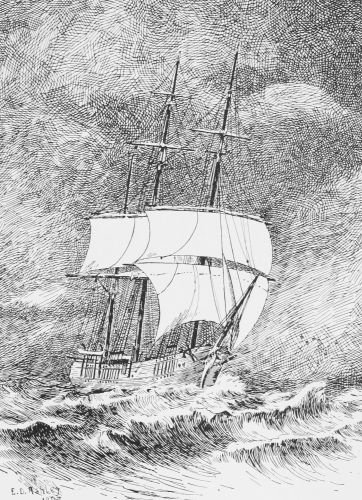
THE CATALPA HOMEWARD BOUND Running before a Gale
Captain Anthony made his course for the south end of Madagascar, and stood well inshore in rounding the cape, across the Agulhas Banks, to receive the advantage of the current which sets into the Atlantic Ocean. Here severe winter weather was encountered. Then the "trades" were welcomed once more, and the Catalpa sailed on with a fleet of twenty-one merchant vessels, all following the same course.
Naturally the bark gave St. Helena a wide berth, since the neighborhood of a British possession was to be avoided. Subsequently it was learned that an English warship awaited the Catalpa at this point. There is an English naval station at Ascension, and Captain Anthony was likewise shy of a near approach to the island.
On July 10 the Catalpa crossed the equator into the North Atlantic on long. 31° west. "You're almost American citizens now," remarked the captain to the men on this day.
Sperm whales were seen occasionally, and the boats were twice lowered, but the men were impatient to proceed, and little loitering was indulged.
After running out of the northeast trades, Captain Anthony proposed to Mr. Breslin that the vessel should make a business of cruising for whale for a while. "Now is just the season," said he, "for whaling on the Western Grounds. We are well enough fitted, excepting that we lack small stores, and we have plenty of money to buy from other vessels. I know the whaling grounds, and by hauling up to the northward we are almost certain to pick up a few hundred barrels of oil, and the voyage can be made as successful financially as it has been in other respects." Mr. Breslin agreed to this, and the course was made north by east. The men noticed the change in direction, and pleaded that they might be put ashore without any delay, and after a day or two it was decided to yield to their wishes; orders were given to keep her off, and the bark was once more homeward bound.
In the height of a savage gale the Catalpa passed Bermuda, and a few days later the lead showed that the vessel was approaching the coast. Then a pilot came aboard, and he was greatly surprised to find the destination to be New York, inasmuch as the vessel was a whaleship. But Captain Anthony and Mr. Breslin had agreed that this was the best place to land the men. Sandy Hook was eighty miles away. At six P.M. an ocean tug was spoken, which offered to tow the vessel into New York harbor for $250, but after considerable dickering the price was reduced to $90, and it was accepted.
CHAPTER XXVIII
A CORDIAL RECEPTION
Meanwhile the story of the rescue had been telegraphed to New York, and reporters swarmed aboard at quarantine, which was reached at midnight. Captain Anthony did not know what the situation might be or how much it would be wise for him to tell, and the reception of the newspaper men was one of the most arduous experiences of the voyage. But their editions were waiting, and they could not delay long. At two o'clock on the morning of August 19, 1876, the Catalpa anchored off Castle Garden.
Captain Anthony and Mr. Breslin went ashore at sunrise in one of the boats and first went to the hotel of O'Donovan Rossa, which was a headquarters for men affiliating with the Clan-na-Gael. The first person whom they met in the office, singularly enough, was a man who was a prisoner in Australia at the time of the rescue, but who was subsequently released and arrived in this country by steamer. He received the rescuers with enthusiasm. Various leaders were summoned, and the captain and Mr. Breslin were warmly welcomed.
Later in the morning Captain Anthony went to the barge office and secured a permit to land his passengers. When he returned to the Catalpa she was surrounded by small boats, for the morning newspapers had told of her presence in port, and there was much curiosity to see her.
"Men," said Captain Anthony, as he stepped on the deck, "I have a permit for you to go ashore, and you are at liberty to go when you please."
"God bless you, captain, you've saved our lives," said Darragh, and in a few minutes the company left in the shore boat, in high spirits.
Meanwhile Captain Anthony had communicated with Mr. Richardson, and he was instructed to leave the vessel in New York and return home, for his friends were anxious to see him. The local branch of the Clan-na-Gael, with representatives of other Irish societies, had been meeting nightly, arranging a reception to the gallant rescuer, and he was received at the train by thousands of people on the Sunday morning of his return.
They were shocked at the changed appearance of the captain. When he left New Bedford, sixteen months before, he weighed 160 pounds and his hair was black as coal. The months of worry and intense excitement had worn upon him to such an extent that his weight was now reduced to 123 pounds and his hair was sprinkled with gray.
A few days after Captain Anthony arrived home, the following circular reached the office of the chief of police in New Bedford:—
POLICE DEPARTMENT.
Chief Office, Perth, Western Australia, April 18, 1876.
James Darragh, 9707, life sentence, 2d March, 1866, aged 42, Fenian, absconded from Freemantle, 8.30 A.M., April 17, 1876.
Martin Hogan, 9767, sentence, life, August 21, 1866, aged 37, Fenian, absconded as above.
Michael Harrington, 9757, life sentence, July 7, 1866, 48 years, Fenian, absconded as above.
Thomas Hassett, 9758, life sentence, June 26, 1866, Fenian, absconded, etc.
Robert Cranston, 9702, life sentence, June 26, 1866, Fenian, absconded, etc.
James Wilson, 9915, life sentence, Aug. 20, 1866, age 40, absconded, etc.
N.B.—Martin Hogan's marks include the letter D on his left side; so do those of Michael Harrington, Thomas Hassett, and James Wilson.
Sir,—I beg to inform you that on the 17th instant the imperial convicts named in the margin absconded from the convict settlement at Freemantle, in this colony, and escaped from the colony in the American whaling bark Catalpa, G. Anthony master. This bark is from New Bedford, Massachusetts, U.S.A. The convicts were taken from the shore in a whaleboat belonging to the Catalpa, manned by Captain Anthony and six of the crew. The abettors were Collins, Jones, and Johnson.
I attach the description of each of the absconders, and have to request that you will be good enough to furnish me with any particulars you may be able to gather concerning them.
I have the honor to be, sir,
Your obedient servant, M.A. Smith, Supt. of Police.
To the Officer in charge of the Police Department, } New Bedford, Massachusetts, U.S.A. }
It was addressed to "The Officer in charge of Police Department, New Bedford, Massachusetts, United States, America."
Now Captain Henry C. Hathaway was at this time chief of police, and in view of the fact that he had been rather intimately connected with the enterprise, it may be believed that he was not unduly zealous in assisting the Australian authorities.
The Catalpa, in charge of a pilot, sailed to New Bedford. The scene on her return was very different from that at her departure. She arrived at the old whaling port on the afternoon of August 24th. She was sighted as she came into the bay, and the news of her approach attracted thousands of people to the wharves. A salute of seventy guns was fired as the bark sailed up the river, and when she was made fast to the dock, men and women swarmed aboard and carried away everything which was not too large for souvenirs.
On the following evening a reception was tendered Captain Anthony at Liberty Hall, and the auditorium was crowded with cheering, enthusiastic people. The stage was decorated with the American flag and the flag of Ireland. John McCullough called the meeting to order, and the officers were as follows:—
President.—Dr. Stephen W. Hayes.
Vice-Presidents.—John McCullough, Michael F. Kennedy, Hugh J. McDonald, Neil Gallagher, John F. Edgerton, James Carroll, Jeremiah Donohue, Michael Murphy, John Sweeney, William Morrissey, Edmund Fogarty, James Clary, Michael F. McCullough, Antone L. Sylvia, Patrick Cannavan, James Sherry, John Agnew, John Welch.
Secretaries.—Patrick Haley, Peter O'Connell, and John Green.
John Boyle O'Reilly was present, and Captain Anthony was the guest of honor. Mr. Smith, the Catalpa's mate, and Thomas Hassett, one of the rescued men, were also present.
Dr. Hayes expressed his gratitude that the political prisoners were now in the land of the free, where the flag which protected them on the Catalpa would continue to protect them as long as it waved.
O'Reilly's address on this occasion was one of his most eloquent efforts, and it is to be regretted that it is not preserved in its entirety. The summaries which were printed in the newspapers do him very inadequate justice.
He said that it was with no ordinary feelings that he had come. He owed to New Bedford no ordinary debt, and he would gladly have come a thousand miles to do honor to New Bedford whalemen. Seven years of liberty, wife, children, and a happy home in a free country were his debt of gratitude, and when the close of his sentence came, in 1886, his debt to New Bedford might be grown too heavy to bear.
They were there, he said, to do honor to Captain Anthony, to show their gratitude to the man who had done a brave and wonderful deed. The self-sacrifice and unfailing devotion of him who had taken his life in his hand and beached his whaleboat on the penal colony, defying its fearful laws, defying the gallows and the chain-gang, in order to keep faith with the men who had placed their trust in him,—this is almost beyond belief in our selfish and commonplace time.
There were sides to this question worth looking at, he continued. To Irishmen it was significant in manifold ways, one of which was that these men, being soldiers, could not be left in prison without demoralizing the Irishmen in the English army, who would not forget that their comrades had been forsaken and left to die in confinement, when the civilian leaders of the movement had been set free. But the spirit that prompted their release was larger and nobler than this, and its beauty could be appreciated by all men, partaking as it did of the universal instinct of humanity to love their race and their native land.
England said that the rescue was a lawless and disgraceful filibustering raid. Not so, said Mr. O'Reilly. If these men were criminals, the rescue would be criminal. But they were political offenders against England, not against law, or order, or religion. They had lain in prison for ten years, with millions of their countrymen asking their release, imploring England, against their will to beg, to set these men at liberty. Had England done so it would have partially disarmed Ireland. A generous act by England would be reciprocated instantly by millions of the warmest hearts in the world. But she was blind, as of old; blind and arrogant and cruel. She would not release the men; she scorned to give Ireland an answer. She called the prisoners cowardly criminals, not political offenders.
After the ship sailed and there was a long time when no tidings came, O'Reilly said that doubts and fears came, as they were sure to do; but Captain Hathaway said once and always of Captain Anthony: "The man who engaged to do this will keep that engagement, or he won't come out of the penal colony."
After describing some of his own experiences in Australia, Mr. O'Reilly pointed to the bronzed and worn face of Mr. Hassett, one of the rescued prisoners, and said: "Look at that man sitting there. Six years ago he escaped from his prison in the penal colony and fled into the bush, living there like a wild beast for a whole year, hunted from district to district, in a blind but manful attempt to win his liberty. When England said the rescue was illegal, America could answer, as the anti-slavery men answered when they attacked the Constitution, as England herself answered in the cause of Poland: 'We have acted from a higher law than your written constitution and treatise,—the law of God and humanity.' It was in obedience to this supreme law that Captain Anthony rescued the prisoners, and pointed his finger at the Stars and Stripes, when the English commander threatened to fire on his ship.
"The Irishman," concluded Mr. O'Reilly, "who could forget what the Stars and Stripes have done for his countrymen deserves that in time of need that flag shall forget him."
Then Mr. Hassett described the bravery of Captain Anthony, and pictured him as he held the steering oar on the night of the gale, risking his life for the men. He could never amply express his gratitude to Captain Anthony, he said, and he was sure that New Bedford never produced a braver sailor.
Meanwhile there were similar demonstrations throughout the country. At San Francisco a mass meeting of Irish citizens passed resolutions of sympathy for the prisoners and took steps for increasing the relief fund which had been started.
The Robert Emmet Association of Troy, N.Y., fired a salute in honor of the safe arrival of the Catalpan six. At Woonsocket the wildest enthusiasm prevailed; meetings were held and salutes fired. The Emmet Skirmishing Club of Sillery Cove, Quebec, held a congratulatory meeting, and the Shamrock Benevolent Society of St. Louis, one of the largest Irish Catholic societies in the West, adopted resolutions of honor to Captain Anthony.
The news of the rescue had been slow in reaching England, and as late as May 22 a debate was in progress in Parliament on the release of the political prisoners in Australia. Disraeli was the first lord of the Treasury, and he had been asked to advise her Majesty to extend her royal mercy to the prisoners who were suffering punishment from offenses in breach of their allegiance.
In a speech Disraeli said the men sent to Australia were "at this moment enjoying a state of existence which their friends in this house are quite prepared to accept." The Irish members shouted "No." But Mr. Disraeli was right and the Irish members were wrong, for the men were on the deck of an American vessel as he spoke, free from English authority.
On the morning after Disraeli's speech Boucicault wrote a letter to the "London Telegraph" which was read with much interest. He wrote:—
The reply made by Mr. Disraeli last night to the 134 members who pleaded for the amnesty of the Irish prisoners should not be regarded as wholly unsatisfactory. His speech was in the gentle spirit of an apology, formed of excuses for the delay of the Government in acceding to the wishes of the people of Ireland. But the manner of this fluent and eloquent speaker was exceedingly hopeful. He hesitated, wandered, halted, lost his way, and turned about in distress. A leading member observed in my hearing that he had never seen him so confused. He said there were only fifteen prisoners; that two of them could not be regarded as political offenders, because in the act of rebellion they had shed blood, and therefore were ordinary murderers. (He did not add they were no more entitled to consideration than Oliver Cromwell, whose statue graces the House.) Then turning to the thirteen prisoners—of these six were imprisoned in England and seven in Western Australia—these men, he assured the House, were so comfortable where they were, so happy, so well off, that really their liberation would be a misfortune to them, rather than a boon.
It is a rule in literary composition that, when a substantive expresses vigorously the full scope and meaning of an idea, we weaken its effect by the addition of an adjective. So would any remark, or even a note of admiration detract from the rule of this astounding proposition. It should be left alone in a space of silence. The lameness and impotency of the speaker made an eloquent impression on the House, for the lameness seemed that of one who declined to trample on the prostrate, and the impotency was that of a kind and just man who could not find words to frame a cruel sentence.
Your obedient servant, Dion Boucicault.
London, May 23.
The rescue was the subject of very savage comment in the English newspapers, and some of the editorials are reprinted in the Appendix.
Invitations to attend various functions in honor of the rescue poured in upon Captain Anthony, and he found himself a hero with the Irish people throughout the world, a position in which he stands to-day, for the debt has never been forgotten. That the valiant deed still lives in the memory, it may be said that ten thousand people in Philadelphia greeted the captain last summer, on the occasion of the presentation to the Clan-na-Gael societies of the flag which flew over the Catalpa on the day when the British were defied. Here is the story printed in the "Philadelphia Times" on the date of August 6, 1895:—
The green flag of Ireland, entwined with the Stars and Stripes, floated proudly over the main entrance to the Rising Sun Park yesterday and gave greeting to ten thousand people who joined in the annual Clan-na-Gael celebration. The multitude came from all sections of the city, and all the suburban towns and the adjoining counties sent large contingents of Clan-na-Gael sympathizers. The management made every possible provision for the entertainment of those present, and spared neither expense nor time in making the celebration a success, giving big prizes to the field and track athletes from many sections of the Union and from Canada who took part in the sporting events.
The grounds were decorated possibly on a more elaborate scale than on any former occasion. Exclusive of what the track and field provided in the way of amusement, there were pastimes for the younger and older folks, such as tenpin alleys, merry-go-rounds, baseball, and swings. There were several bands of music, one for those who occupied seats on the pavilion from which the track and field sports could be seen, and two others on the dancing platform.
The great feature of the day's exercises, and that which attracted the most attention, were the introduction of Captain George S. Anthony and the presentation by him to the Clan-na-Gaels of the flag which floated from the masthead of the whaling bark Catalpa, which had on board the political prisoners rescued from the penal settlement of Western Australia, when it was overtaken by a British gunboat. Captain Anthony presented the flag from a temporary platform erected on the tracks, and after it had been accepted in behalf of the Clan-na-Gael the scene was one of great enthusiasm. Luke Dillon, president of the Irish American Club, introduced Captain Anthony, and almost simultaneously the old Stars and Stripes were unfurled to the breeze and the band seated on the grand stand played the "Star-Spangled Banner." About four thousand people joined in singing the anthem, and the Clan-na-Gael Guards fired two volleys as a salute.
On the platform were seated State Senator James C. Vaughn, of Scranton; Michael J. Breslin, a brother of John J. Breslin, who had charge of the land part of the Catalpa expedition; Martin Hogan, of New York, Thomas Darragh, and Robert Cranston, three of the rescued prisoners; Dr. William Carroll, William Francis Roantree, John Devoy, J.J. Thompson, Major Fitzpatrick, of Trenton, N.J.; Michael Gribbel, of Jersey City; Bernard Masterson, Eugene Buckley, and Michael J. Gribble, of Pittsburgh.
Captain Anthony, in presenting the flag, said:—
"Twenty years ago you came to me with a request to aid you in restoring to freedom some soldiers of liberty confined in England's penal colony of Western Australia. Your story of their sufferings touched my heart, and I pledged my word as an American sailor to aid in the good work to the best of my ability.
"You intrusted me with the command of the bark Catalpa. I took her to the West Australia coast, and when the gallant Breslin and his trusty men had effected the rescue of their friends I brought the party safely in the ship's boat to the Catalpa and placed them on board under the shelter of the American flag. When on the high seas the commander of an armed British steamer fired a solid shot across the Catalpa's bows, demanded the surrender of the rescued men, and threatened to blow out the masts of my vessel, if I failed to comply with his demands, I refused, and told the British commander that if he fired on the American flag on the high seas he must take the consequences. He then withdrew, and I took your friends to New York, where I landed them in safety.
"The flag which floated over the Catalpa on that April day in 1876—the Stars and Stripes which protected the liberated men and their rescuers—I have preserved and cherished for twenty years as a sacred relic. I would fain keep it and hand it down to my children as a family heirloom, but I am confident it will be safe in the keeping of those who were associated with me in an enterprise of which we have all reason to be proud. Your countrymen have ever been loyal to the flag of the United States and ever ready to shed their blood in its defense. I, therefore, present you with this flag of the Catalpa as a memento of our common share in a good work well done and a token of the sympathy of all true Americans with the cause of liberty in Ireland. I know you will cherish it as I do, and that if the interests of that flag should ever again demand it your countrymen will be among the first to rally to its defense?"
When Captain Anthony finished his address he was the recipient of many beautiful bouquets.
John Devoy, who had been delegated by the Clan-na-Gael to accept the colors, was unable to do so because of sickness, and Michael J. Ryan, who acted in his place, read the speech which Mr. Devoy had prepared:—
"Captain Anthony, old friend and comrade, I accept this flag on behalf of the organization which fitted out the Catalpa, selected you as her commander, and which shared with you the credit for the work of humanity which she was the chief instrument in accomplishing. I accept it with pride as a memento of a noble deed, and I promise you it shall be cherished by us while life is left us, and handed down to future generations, who will love and cherish it as well. It is the flag of our adopted country, under which Irishmen have fought side by side with native Americans on every battlefield where the interests and the honor of that flag were at stake, from Bunker Hill to Appomattox. It is the flag which symbolizes the highest development of human liberty on this earth, and in the future, as in the past, the race to which we, to whom you present this flag, belong, will stand shoulder to shoulder with yours in its defense and in the maintenance of its proud and glorious record.
"You recall to our minds to-day memories of events in which native Americans and Irishmen were closely associated; in which Irish enthusiasm and Yankee coolness, grit, and skill in seamanship effected a combination that won a decisive victory for humanity over the forces of oppression. The battle of human freedom has not yet been won, and the combination of which you formed such an important part may serve as an example worthy of imitation and enlargement in the future.
"Your part in that work was noble and disinterested throughout. I went to New Bedford twenty years ago, knowing not a soul in the city, bearing a letter of introduction from John Boyle O'Reilly to Henry C. Hathaway, who has done noble work in aiding the poet-patriot to escape from the Western Australian prison to the land of the free. He entered heartily into the project with which the Clan-na-Gael had intrusted me, and introduced me to you and your father-in-law, Mr. Richardson. Without any promise of reward for your services, or compensation for the risks you would run, you undertook to carry out the work of liberation. You sailed away to the southern seas, you carried out the work you pledged yourself to accomplish, you incurred new risks which had not been asked of you, you defied the British commander who threatened to fire on the Stars and Stripes, and brought the six Irishmen rescued from a British prison in safety to America. In all this you bore yourself proudly and gallantly, like a true American sailor, and you placed the Irish people under heavy obligations to you.
"Our chief regret to-day is that the man most closely associated with you in the rescue, John J. Breslin, the man who commanded the land force of the expedition, and to whose skill and courage its success was wholly due, is not here to receive this flag from your hands. As he has gone to his last account, the honor of taking his place has been assigned to me, although I was only concerned in the management of the American end of the enterprise. Many of those who took part in the rescue and two of the men to whom you helped to give liberty are here to do you honor and to thank you in the name of the Irish race for the gallant feat you accomplished nineteen years ago and for your generous gift of this historic flag. Others still are in their graves, while some live too far away to participate in this day's proceedings, which recall an event of which we are all proud.
"Captain Anthony, in the name of the Clan-na-Gael, I thank you for the Catalpa's flag, and wish you a long and happy life."
CHAPTER XXIX
SETTLEMENT OF THE VOYAGE
In February, 1877, Mr. Devoy, with James Reynolds, went to New Bedford and made a liberal settlement with the crew. An average was taken of the catch of oil by the vessels which sailed the same season with the Catalpa, several of which had made "big cuts." The settlement with the men was on this basis.
The Catalpa was presented to Captain Anthony, Mr. Richardson, and Henry C. Hathaway, but her value was not great. She was eventually sold and altered into a coal barge, coming to an ignominious end at Belize, British Honduras, where she was condemned.
Captain Anthony's occupation was now gone, since it would be unsafe for him to enter an English port. He was for a while an officer of the New Bedford police force, but was appointed an inspector in the New Bedford custom-house in President Cleveland's first term, a position which he has since held.
Gallant John Breslin died in New York on November 18, 1888, with the name of his country upon his lips. To the last he believed that revolution was the only remedy for Ireland's wrongs. The announcement of his death drew tears from Irish eyes the world over, for his burning love of country, his chivalry and unparalleled bravery had touched the hearts of Erin's sons and daughters. Clan-na-Gael societies telegraphed their sorrow, and John Devoy and all the Catalpan leaders hastened to New York to be present at the funeral exercises.
"Out of all the incidents of the so-called 'Fenian movement,'" said the "Pilot," "the most brilliantly daring have been two rescues of prisoners, namely, that of the chief organizer, James Stephens, from Richmond Prison, Dublin, in 1865, and of the six military prisoners from Western Australia last April. These two rescues are in many ways remarkable. Unlike almost every other enterprise of Fenianism, they have been completely successful; and when completed have been commented on in the same way, as 'well done.' Every other attempt or proposal has fallen through or ended with loss. The rescue of Kelley and Deasy from the police van in Manchester was successful so far as the release of the prisoners went; but it was bought with the lives of Allen, Larkin, and O'Brien, and the nine years' misery of Condon. The proposed attack on Chester Castle was discovered and prevented by the English government. The seizure of Pigeon House Fort, with its armory, at Dublin, never emerged from the stage of dreamland. The attempt to blow up Clerkenwell Prison, London, to release Richard Burke, was a disastrous failure, by which nothing was accomplished, by which many suffered, the lives of several poor working people were sacrificed, and the wretched lodging-house homes of others destroyed.
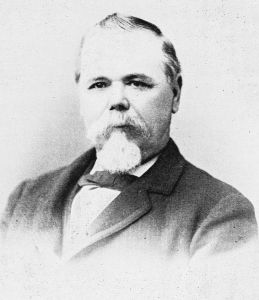
JAMES REYNOLDS Treasurer of the Rescue Committee
"But the rescue of James Stephens, even while the government was gloating over his capture, was as unexpected and thorough as if the man had vanished in smoke. No one suffered from it,—at least from English law,—no one was arrested; neither the government nor the public ever knew how or by whom it was accomplished. The man or men who did the work claimed no recompense either of money or notoriety. Two thousand pounds reward failed to elicit the slightest clew. The thing was cleverly, cleanly, bravely done, and those who knew of it knew how to keep the secret.
"The rescue of the six military prisoners from the penal colony of West Australia was performed in a similar manner as to daring, silence, and complete success. Looking back on it, no one can say that aught was forgotten or left to chance. With admirable deliberation every inch of the train was laid, every sporadic interest was attended to, and the eventful rescue was carried out to the prearranged letter with scientific precision. As in the escape of Stephens, no trail remained; no one left in the trap; no price paid in human life or suffering. It was a clean thing from beginning to end; it was 'well done.'"
The total expense of the expedition was about $30,000, and a fund was raised in addition to give the rescued men a start in the new life which had been vouchsafed to them.
APPENDIX
[London Telegraph.]
Closely following upon the recent debate in the House of Commons on the Fenian prisoners, still held most justly in durance, come particulars from Western Australia of the escape of the half dozen jail-birds who, while they were in captivity, excited so much sympathy among Irish rebels and their abettors. Every Englishman knew that this sympathy was misplaced, and, as a matter of fact, it turns out that it was the very mildness of the captivity of the Hibernians in an Australian penal settlement which made their escape so easy.
[After telling how the rescue was effected, the "Telegraph" continued:]
So the English cruiser had to return to Freemantle as empty as it left, and the skipper of the Catalpa, who was evidently, like most Yankee mariners, an accomplished sea lawyer, sailed off in triumph, laughing at our scrupulous obedience to international law. This is a humiliating result, and it is not easy to see who most deserves blame,—the sleepy warder who allowed all the men to give him the slip and sounded no alarm in time to overtake them on their long carriage drive, or the authorities at Rockingham, who permitted the Catalpa to get outside the territorial limit before stopping her. Nor is it clear what is the next step to be taken. If the American vessel took on board the convicts in Australia, that is in British waters, we presume that we can insist on their rendition and on redress in some shape for a violation of our sovereignty. We can readily conceive what would have happened if an English vessel in the harbor of say Norfolk, Va., had received Confederate prisoners on board, and had sailed off, daring pursuit or arrest. Thus our government may be excused for being firm and peremptory in calling attention to whatever violation of law the Yankee whaler may have committed. On the other hand, there is the consideration that the enterprising skipper of the Catalpa has, without meaning it, done us a good turn; he has rid us of an expensive nuisance. The United States are welcome to any number of disloyal, turbulent, plotting conspirators, to all their silly machinations. If these are transferred to British soil, we shall know how to deal with them,—as we have shown already.
[Melbourne Argus.]
The news from Western Australia confirms the suspicion that a grave international outrage was committed in the escape of the Fenian prisoners from Freemantle. They were actually taken away while wearing the convict garb by the master of an American ship, who dispatched a boat ashore for that purpose. It is impossible to suppose that a man did not know very well what he was doing, and his proceedings are precisely as if a French boat were to run to the hill of Portland and take away as many convicts from there as could crowd into her. The imperial authorities are bound to take cognizance of the episode, and to demand a substantial redress. We shall be told, no doubt, that the escaped convicts are political refugees, and attention may be called to the fact that Communist convicts frequently arrive in Australia without the permission of their gaolers. But the attempt at a parallel will deceive no one. The Communists arrive here without any aid on our part. They build boats and take their chance, and if the Fenians had found their way to America, their case would be very different from what it is. Rochefort and his companions came over, it is true, in a British bark; but, though the complicity of the captain was suspected, it was never proved. But with the Catalpa there is evidence of a plot; there is testimony that the American master took his boat to an unsuspected spot, and that he made special exertions to ship the men. The ship was on the high seas, it is true, and outside of British jurisdiction, but the master and his boat went to the shore, and for a felonious purpose, and that constitutes the breach of the law of nations. The offense is too serious, too glaring, to be overlooked, and we presume that important communications will speedily pass between the governments of Westminster and Washington.
[Melbourne Advocate.]
The correspondence will be voluminous, but very courteous on both sides, and, after being long drawn out, it will terminate in friendly assurances; for it would never do that first cousins, bound together by common interests, and in whose hands the great destinies of the English-speaking race rest, should seriously quarrel over the fate of a half dozen unfortunate Irishmen. The Slidell and Mason business was a little more serious, and there was no quarrel over it. The cabinet of Westminster will have a strong case for Washington in this Fenian business, but Washington is not without a case against Westminster; for its demand for the unconditional extradition of an American criminal has been refused by the English government. Washington, besides, will be apt to say that these escaped Fenians were political prisoners, and though Great Britain may maintain the contrary, European opinion will be decidedly against her view of the case. Something will also be said about Communist convicts being sheltered on British soil, and after all that can be urged on each side has been said, the whole affair will taper down to an indivisible and invisible point, or, to use a more homely phrase, it will end in smoke.
THE RESCUED PRISONERS
On the 12th inst., William Foley, one of the Irish political prisoners recently confined in Western Australia, arrived in New York from Queenstown, on the steamship Wisconsin. When the news of the escape of the prisoners came last week, it was thought that Foley was among the number, but it now appears that his sentence expired last January, and he sailed from Perth, Western Australia, on the 16th of that month for London. From London he proceeded to Dublin, and after spending a fortnight there went to his home in Tipperary, but finding none of his friends there except one uncle, a very old man, he went to Cork, where he remained about ten days, when he started for New York. The following is the substance of Foley's story, given to a "New York Herald" reporter by the gentleman who received it:—
Toward the end of last November two gentlemen arrived in Western Australia, and, knowing the means, at once placed themselves in communication with the prisoners, and commenced to thoroughly survey the ground on which they were to work. Foley, being on ticket-of-leave at the time, and having just got out of the hospital, where he had been suffering from heart disease, was introduced to one of them by a friend, and on the stranger giving certain information which showed what his mission was, an understanding was arrived at. A great deal of delicate work had to be done, and every precaution taken to avoid attracting the attention of the authorities, but up to the last moment of Foley's stay in the colony not the least suspicion was aroused. The two agents each followed a legitimate occupation, and acted in every way as if going to make their home in Western Australia, or bent solely on making lasting business connections with the colony, and so discreet were their movements and conduct that no one dreamed that they were anything but what they appeared to be. "I asked no questions," said Foley, "and they told me nothing which I had not a right to know."
Toward the close of the spring of last year all the prisoners not on ticket-of-leave, and two of the men who had tickets-of-leave, were sent in from the various gangs in which they had been working through the bush and lodged in the principal convict station at Freemantle. Their names were James Wilson, Martin Hogan, Thomas Hassett, Thomas Darragh, Michael Harrington, Robert Cranston, and James Kelley, life-sentenced men, and Thomas Delaney and James McCoy, whose tickets-of-leave were revoked. These were all, with the exception of Wilson, engaged in constructing a reservoir within the prison of Freemantle, which is situated on the hill, intended to supply water to the shipping in the harbor. Wilson was training a horse for the doctor of the prison, and this employment enabled him to go out of the prison several times each day, and gave him many facilities for perfecting the plan of escape. Many disappointments occurred, however, owing to unforeseen accidents, and one golden opportunity was lost through failing to connect with a certain ship. The ability of the agents was tested to the utmost and the patience of the expectant prisoners was sorely tried. Still nothing occurred to arouse the suspicion of the prison officials and no one connected with the attempt lost heart. Two days before Foley took his departure he had an interview with Wilson, and on the former asking him how he should correspond with him, Wilson said, "Don't write to us any more; I am confident we shall all follow you soon." When taking his leave two days later neither could speak, but could only exchange a silent but hearty shake of the hand. This was on January 16. Foley took his passage on a sailing vessel for London, and after a voyage of ninety-four days arrived in that city.
Though he could not feel sure that all had escaped, Foley expressed the greatest confidence in the safety of those who had got on board the American ship. The Georgette, which was sent in pursuit of the Catalpa, according to the statements of the Sydney papers, telegraphed here from San Francisco, is only a small screw steamer, built on the Clyde, about two hundred tons burthen, which is employed in carrying the mails from Champion Bay, the most northern settlement in West Australia, to King George's Sound, which is the most southerly point at which vessels call in the same colony, and she is manned by only ten men at the most,—ordinary sailors who never saw any service. In Perth and Freemantle there are not more than thirty policemen at any time, and if all of these went on board the Georgette the released soldiers and their friends could make short work of them in a hand-to-hand fight. The only artillery in the colony is in Perth—four old nine-pounders belonging to a company of volunteers, the members of which live scattered through the surrounding country and could not be got together at a short notice. There are about forty retired soldiers living in the neighborhood of Perth, but they are all old men, and could not be collected at any shorter notice than the volunteers.
It would take some time to unlimber the guns, get the Georgette ready and prepare for a pursuit, and the point on the coast selected for a rendezvous, according to arrangements made previous to Foley's departure, is about twenty-five miles from Freemantle. Everything considered, it would take several days to enable the Georgette to start in pursuit, and by that time the Catalpa, or any other vessel on which they might be, would be beyond her reach. Then the Georgette could not be provisioned for a long cruise, nor could the police force nor the pensioners be spared from the colony for any length of time, and there was no ship of war at all in the neighborhood. Altogether the chances of the recapture of the prisoners by the Georgette appear to be very remote, even if she would risk boarding an American ship on the high seas. Boats had been already secured when Foley left, to accommodate all the prisoners and convey them out to sea so that they might not get on board any ship in British waters. "The news," said Foley, "seems too good to be true; it is so short a time since I saw them within the prison walls, and all I can say is, God speed them on their way, and may God bless the Yankee captain who took them aboard."
Foley is thirty-eight years of age, and enlisted in 1853 in the Bombay Horse Artillery, under the East India Company, and served all through the Sepoy rebellion. In 1859 he returned to England, and soon after reënlisted in the Fifth Dragoon Guards, in which regiment he remained until his arrest for Fenianism in February, 1866. He is a simple, quiet man, but known by his comrades to be a man of indomitable courage. Before his imprisonment he was a man of magnificent physique, being six feet in height and splendidly proportioned. At present he is reduced considerably, through the terrible ordeal through which he has passed, and very little of that soldier's strut so characteristic of British cavalrymen can be noticed in him.—Pilot, June 24, 1876.
CAPTAIN ANTHONY OF THE CATALPA
The remarkable story printed in this week's "Pilot," from the pen of the chief agent in the rescue of the prisoners, makes it clear that the captain of the whaling bark Catalpa is a man of extraordinary nerve and integrity. Captain George S. Anthony is a young man, scarcely thirty years of age; a silent, unassuming sailor. There is nothing in his appearance, except, perhaps, the steadiness of the deeply-sunken dark eye, to tell that in a moment of pending danger that would frighten brave men this one would take his life in his hand, and, with his usual quiet air, steer into the very jaws of destruction.
When the Catalpa lay off the coast of the penal colony, at the appointed place for the rescue, Captain Anthony did not, as he might have done, send one of his officers in command of the boat that was to land on the dangerous coast. With a picked crew of his whalemen, the captain took the steering-oar himself. When he had reached the shore, a man who had been watching the incoming boat informed him that he had passed over a terrible danger; that right in the line he had crossed lay a fatal reef, over which no boat had ever before sailed in safety. Had this information not been given, it is almost certain that the entire boat's crew, with the rescued prisoners, would have been lost, for Captain Anthony would certainly have sailed out as he had entered, and in that event the bones of the brave fellows would now be whitening on the ledges of the reef. When the escaped prisoners arrived, and the frail boat again put to sea, the firm hand of the captain still held the steering-oar. The night came down, the wind rose, and the water lashed over the deep-laden boat. They could not see the ship's lights, but steered blindly into the darkness. There was no choice of roads. Behind them was the chain-gang for the rescuers and the gallows for the absconders. The morning came, and the drenched and weary men, instead of a bark, saw a gunboat in pursuit. They were grateful then for the rising waves, in the troughs of which their little boat escaped the watchful eyes of the pursuit. The trained skill of the seaman was here invaluable. He knew that a boat might escape being seen from the deck of a ship, though only a short distance away. He lowered his sail, and got into the wake of the gunboat, the point where they would be least likely to look. And when the gunboat steamed away, and the smaller police-cutter hove in sight and bore straight down on the whaleboat, trying to cut them off from the ship, Captain Anthony shouted encouragement to his tired men, calling them by name, using all the whaleman's arts to urge his hands in the last spurt before the whale is struck—till he saw that they had distanced the cutter by a few terrible yards, and were safe alongside the Catalpa. For thirty hours Captain Anthony had held the steering-oar of his whaleboat.
It is a splendid story of endurance and devotion to duty. The brave man had undertaken to rescue these prisoners, and he held to his engagement with a manly faith that neither danger nor death could appall. To the rescued he was not bound by ties of race or nationality; but he knew they were political prisoners, cruelly held in bondage; and the seaman's heart, made generous by intercourse with foreign lands, felt deeply the bond of humanity, regardless of Celtic or Anglo-Saxon promptings.
It must not be forgotten that by this achievement Captain Anthony has destroyed his career as a whaleman. He has placed himself beyond the pale of every British harbor in the world. He can no more follow his profession in the South Sea or in the Indian Ocean, for nearly every port at which the whaleships get supplies are possessions of the British Crown. By this one act, done for Irishmen, Captain Anthony has literally thrown away the years and experience that have made him one of the best whalemen in New Bedford.
The Irish people of America should not forget this, nor allow such a debt to remain against their name. Captain Anthony should get such a testimonial as will put him beyond the necessity of ever going to sea again. Unless this be done, the brave man has ruined his future in the interests of a selfish and ungrateful people. If the masses of our people would contribute each a mite—ten cents apiece—enough would be done. At the meetings of Irish societies throughout the country, subscriptions of this kind might be raised; and local treasurers could be appointed to receive contributions. All subscriptions sent to "The Pilot" will be acknowledged. There is not an Irish man or woman in America who could not give something, no matter how small, to such an object; and we trust that no time will be lost in setting the movement in practical operation.—Pilot, September 2, 1876.
ESCAPE OF THE IRISH PRISONERS
... Business was almost entirely suspended, and the imposing Masonic ceremony of laying the foundation stone of the new Freemasons' Hall, which was to take place at four o'clock, was almost forgotten, and attracted but little if any attention. In the course of the afternoon, His Excellency, accompanied by the Colonial Secretary, drove down, and after consultation with the Superintendent of Water Police, the Comptroller-General, and other officials, and the agent for the Georgette, it was decided to dispatch the Georgette again to the Catalpa, with a view to intercept the boat, or to demand the surrender of the prisoners from the captain, if they were on board. The pensioners and police were again embarked, a twelve-pounder field-piece was shipped and fixed in the gangway; provisions were put on board, and a fatigue-party of pensioners were engaged in coaling—thirty tons being put on board in a short time. By eleven o'clock arrangements were completed, and the Georgette steamed away from the jetty. Not a few, both on board and on shore, but gave way to gloomy forebodings as to the result of this second visit to the ship. Certainly, the arrangements made by the authorities warranted those who were not acquainted with international law, or aware of his excellency's instructions, in concluding that the governor had determined upon resorting to force, if necessary, to capture the fugitives. By early morning the Georgette was outside of Rottnest, and at daylight sighted the ship bearing S.S.E. under full sail. The Georgette hereupon hoisted her pennant and the ensign, and all hands were put under arms. As the Georgette did not gain upon the ship, and the wind was freshening, a gun was fired under the vessel's stern,—and she then run up the American flag. She took no further notice of the signal, and the Georgette, under full steam and all sail, gave chase. As the ship did not attempt to shorten sail or take any notice of the signal, when the Georgette had steamed to within a quarter of a mile of her a gun was fired across her bow, and the captain of the ship then got into the quarter-boat....
WHAT THE AUSTRALIAN PRESS SAYS
The comments of the Western Australian papers will be interesting to the readers of "The Pilot." "The Perth Inquirer" of the 26th of April says: "It seems humiliating that a Yankee with a half dozen colored men should be able to come into our waters and carry off six of the most determined of the Fenian convicts,—all of them military prisoners,—and then to laugh at us for allowing them to be taken away without an effort to secure them. But international law must be observed, and, doubtless, the Home Government will seek and obtain redress for this outrage. It is evident that Collins came to this colony with ample means as the agent of the American Fenian Brotherhood, and that Jones, Johnson, and Taylor were co-workers in furthering the escape of the prisoners. Immediately the Catalpa arrived in Bunbury, Collins proceeded there, and doubtless interviewed Captain Anthony, who shortly afterwards came to Freemantle under the plea of securing fresh charts, but in reality to reconnoitre the coast. The Catalpa appears to have cleared out of Bunbury on the 28th of March, when a ticket-of-leave man named Smith was found stowed away and taken by the police. She must have returned to Bunbury, and again cleared out finally on the 15th instant. It would appear that there was a desire to obtain correct legal information on international law, for about the time of Captain Anthony's visit to Freemantle, Johnson called upon Mr. Howell, the solicitor in Perth, and asked several questions as to the limit of neutral waters, from which we infer that the captain knew what he was about when he told Mr. Stone that his flag protected him where he then was."
TOO BAD TO BE LAUGHED AT BY THE YANKEES
The "Freemantle Herald," of April 22, said:—
"The early return of the steamer gave rise to every kind of conjecture, and as her approach was watched from the shore, wagers were freely made as to the cause of her early return. Many declared that the Catalpa, warned of the steps the governor was taking by the previous visit of the Georgette, had attacked her and beaten her off. Others laid bets that, overawed by the determination of force on board the Georgette, the captain of the Catalpa had quietly surrendered the runaways. As is usual in such cases, the sequel showed that neither was right. When the true condition of affairs became known, there were some manifestations of indignation at the colony having been fooled by a Yankee skipper. The pensioners and police felt that they had been taking part in a very silly farce, and had been laughed at by the Yankees at sea and the public on shore, and sincerely hoped that instructions would be given to go out again and take the prisoners by force. The governor, however, who throughout had acted with most commendable energy and prudence, was not to be led into committing a breach of international law to gratify a feeling of resentment at the cool effrontery of the Yankee, directed that the armed parties on board the Georgette should be dismissed, and the vessel returned to the agent, with his excellency's thanks for the readiness with which the vessel had been placed at his disposal, and for the hearty manner in which both the agent, Mr. McCleery, the captain, Mr. M. O'Grady, and all concerned, had coöperated with him in the matter; at the same time expressing his approbation of the conduct of Mr. Stone. These instructions were carried out, and in a short time the crowds dispersed, and the town elapsed into its normal condition of quietude, having suffered three days of the most intense excitement ever experienced in its history."—Pilot, August 12, 1876.
HOW THE IRISH PRISONERS ESCAPED
The following letter has been received by Mrs. O'Reilly, John Street, Kilkenny, from her son, Rev. John O'Reilly, who is at present in Freemantle, Western Australia. Father O'Reilly, following in the footsteps of many ardent young missionaries, left home and friends to pursue his sacred calling in the region of the Southern Cross. We can easily understand what his feelings were when the mail steamer returned to her moorings after her fruitless pursuit of the whaler bearing away the escaped prisoners:—
Freemantle, W.A., April 18, 1876.
My dear Mother,—You owe to the accidental detention of the mail steamer the letter which I am now writing. The cause of the delay is an event which will probably excite so much attention in the Old Country and America, that it will form the principal if not the sole topic of my note.
You are aware before now that Western Australia is a convict colony. Hither were sent some seven or eight years ago a number of the prisoners sentenced to penal servitude on the occasion of the Fenian disturbances a little before that date. These were gradually released, and at the beginning of the present month only eight remained in confinement in Western Australia. All eight had been soldiers. The prisoners of the establishment work in various gangs throughout the town, and the Fenians were distributed at different points with the rest. Amongst the prisoners some are chosen to fill offices of trust in connection with the prison arrangements, and are called constables. One of the Fenians was a constable, and by delivering pretended orders to the warders in charge of the working parties, he was enabled to get six of the Fenians together when occasion required.
The occasion came yesterday. At nine o'clock he withdrew these whom he required from under the warders in charge. The six prisoners assembled at a spot just outside Freemantle. Two carriages, with two horses each, were in readiness. They got in, and away they go.
I must retrace my steps a little. Towards the end of last year a gentleman represented as from one of the neighboring colonies arrived here. He put up at the best hotel at the port, and has since mixed with the best society. He went by the name of Mr. Collins. His business here was always an enigma to the residents, but it was supposed by some that he had come here with a view of seeing his way to the opening of some business. Another person lately arrived here too, named Jones, a Yankee; but as he worked at a trade no one noticed him. Now it appears these two persons were the chief actors in the plot. They arranged the details of the flight, and awaited the fugitives with carriages at the place of rendezvous yesterday.
The party drove to a spot sixteen miles or so from Freemantle, where they were seen to enter a boat evidently belonging to a whaler in the offing.
Yesterday, port and metropolis were in a state of intense excitement. The government chartered an only steamer, a peaceful mail boat, put on board a guard of pensioners and police,—we have no soldiers in the colony,—and sent it in pursuit. A little before the steamer an open boat manned with water police had started on the trail of the runaways.
To-day, at four, the steamer returned. A crowd had assembled on the jetty to see her come in; I was amongst the number; she did not bring the prisoners; she reported having been alongside the whaler. The captain and one boat's crew were absent. The authorities in the steamer requested to go on board, but were refused permission. As the vessel lay in neutral waters, they could not use force to attain their desires.
The water police boat is still in chase of the missing ship's boat, but I doubt if they will come up with her. Under cover of the darkness of the night—and it threatens to be dark indeed—the absent crew, with the fugitives, will make the ship; and even if the police crew found them, and there was a fight, as there would be pretty sure to be, if a forced capture were attempted, it is very doubtful who would be the victors. Against the fifteen water police, there would be the six prisoners, their two accomplices, and the boat's crew.
The whistle is sounding its warning, and my letter must hurry to the post. With kindest love to all, believe me,
Your affectionate son, J. O'Reilly.
—Pilot, June 24, 1876.
THE ESCAPE OF THE POLITICAL PRISONERS
"There was a torchlight procession in Dublin on Saturday night, June 10, in celebration of the escape of the political convicts from West Australia, and Disraeli was burned in effigy." So runs the latest telegram from Ireland, and the news is fully significant. Ireland knows the meaning of the escape, and will act on it. It was planned and carried out by her sons in America; and this fact will intensify the national spirit of the Old Country, and make her feel that she is beginning to reap the harvest of her motherhood.
The first news of the escape of the Irish prisoners appeared last week in the following dispatch:—
"London, June 6. A dispatch from Melbourne, Australia, states that all the political prisoners confined in Western Australia have escaped on the American whaleship Catalpa."
About the same time the SS. Colima from Sydney, Australia, reached San Francisco with news to the same effect, but adding that the ocean cable from Australia to Java had been cut on April 27, immediately before the escape.
Two weeks ago the English Prime Minister scornfully refused to release those prisoners at the earnest request of Ireland. It was in his hands then to render this escape meaningless, and to make Irishmen believe that they had better wait for the slow course of English justice. But the old spirit of domineering insolence was too strong in the British House of Commons. To show mercy to Ireland would be a confession of weakness; they determined to refuse the Irish petition, and at their own haughty will select the time to release the prisoners.
But Ireland has had satisfaction this time. At the moment that Disraeli was jauntily telling the House that he would not release the prisoners, they were on board a Yankee ship, free as air, thousands of miles from an English chain or an English dungeon. Ireland laughs at England at home; and all America joins in our jeer across the Atlantic.
It is the beginning of a new order of things in Irish national movements. Heretofore England could buy informers and perpetuate the distrust of each other which has been the curse of Irishmen. The reins of agitation have been too often given into inferior hands, and inferior intelligence has too long dominated Irish councils.
The escape of the prisoners from Western Australia is the best proof that Irishmen can manage the most dangerous and difficult enterprises, and keep their own counsel in a way unknown almost to any other nation. The plan of this escape was completed nearly two years ago. Every portion of the gigantic scheme was worked out in the United States. The machinery was set in motion here, eighteen months ago, which recently struck such an alarming note in the penal colony. When the freed men are landed safe in America or some other country, the plan of the escape may be published. Until then we shall only say that nothing was left to chance, that no expense was spared, and that brave men were ready to risk liberty and life itself to make the attempt a success.
To one devoted man, more than to any other, the whole affair is creditable. He it was who, with the pitiful letters received from the prisoners in his hand, excited the sympathy of Irish conventions and individual men. He neglected his business in New York to attend to the prisoners. He told those who helped the object that they would have to trust him, that the secret must not be generally known. They did trust him, for they had reason to know his purity as a patriot. The event proves the truth and devotedness of the man. We have asked him for permission to publish his name; but he will not allow us till the men are absolutely safe. To another man, an American friend, the gratitude of the Irish people is also due.