APPENDIX.
Reading edition
Note A.—(Page 5.) FOUNDATION OF ELY ABBEY.
Ely Abbey was founded by Ætheldreda in A.D. 673. She was the first Abbess. Her right of rule over the Isle of Ely itself was derived from her husband, Tonbert, a prince of the Gyrvii or Fen people. This monastery rose to great importance—passed through various vicissitudes—incident to the times of invasion and conflict—was heroically defended at various periods—submitted to the power of Duke William, was converted into a Bishopric in 1109—Hervey being its first prelate—and shared the fate of other monastic houses in the reign of Henry VIII., when its revenue amounted to about £13,000 per year, at the present value of money.[259]
Note B.—(Page 5.) THE LEGEND OF S. LUCY.
Saint Lucia was a native of Syracuse; her hand was sought in marriage by a young nobleman whose suit she refused, whereupon her lover complained that her beautiful eyes haunted him day and night; she cut them out and sent them to him, begging to be allowed to persue her religious aspirations unmolested, hence she is often represented with the balls of her eyes laid on a dish; perhaps her eyes were defaced or plucked out—though her present “Acts” make no mention of any such circumstance. In many places her intercession was particularly implored for distemper of the eyes, (for, as a recompense for this self abnegation, Heaven restored her eyes making them more beautiful than before).
Her chief offence may have been that she bestowed the whole of her large wealth on the poor instead of sharing it with her suitor who accused her to the governor of professing Christianity and in consequence she suffered in the Diocletian persecution. She appears to have died in prison, of wounds, on 13th December, 304, A.D. In the 6th century she was honoured at Rome among the most illustrious virgins whose triumphs the church celebrates, as appears from the Sacramentary of St. Gregory, Bede, and others. Her festival was kept in England, till the change of religion, as a holiday of the second rank on which no work but tillage or the like was allowed. Her body remained at Syracuse for many years. She is often represented with a palm branch in one hand and a burning lamp in the other, expressive of her name which means Light, in Greek, λύκη. “Notes Ecclesiological and Historical on the Holy Days,” London, 1864, also “Lives of the Saints,” by Rev. Alban Butler.
THE GROUND PLAN OF THE AREA OF SPALDING MONASTERY.
(From the “Monasticon.”)
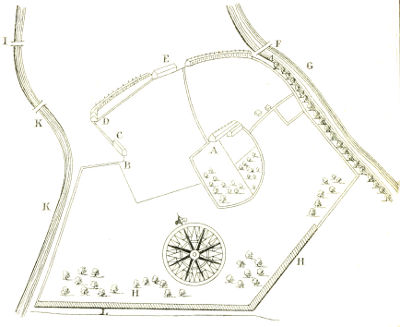
A—Situs Abbatæ (the Site of the Abbey).
B—Clavicularium (the Gate House).
C—Horreum (the Store-house or Barn).
D—Turris (the Tower).
E—Forum Mercatorium (the Market).
F—Pons Altus (the High Bridge).
G—Welland Flumen (the River Welland).
H—Fossa (a Trench).
I—Pons Irinus (the Lily Bridge).
K—Aqua vocata Westload (the Stream called the Westlode).
L—Strata S. Thomæ (S. Thomas’s Causey).
Note C.—(Pages 5, 45, 57.) OVIN’S CROSS AT ELY.
When the British Archæological Association met in Congress at Wisbech (Aug., 1878,) the subject of the Inscription of this cross became a matter of discussion. Mr. W. de Gray Birch, Hon. Sec., has since produced a paper on this inscription. Mr. Birch supposed the inscription to have been originally metrical, and that the form given at page 57 of this book suffered by a blunder of the stonecutter, and perhaps from some manipulation of recent times. Mr. Birch inclines to read—
“Trine! tuam lucem da, Deus, et requiem.”
The reader will find this subject elaborately discussed in Vol. 35 of Journal of British Archæological Association, pages 388-396.
Note D.—(Page 7.) SPALDING PRIORY.
The Priory of Spalding was commenced in 1052 by Thorold, brother of Godiva. It was dedicated to SS. Mary and Nicholas and consisted at first of a prior and five monks, drawn from Crowland.
This cell was endowed with the manor of Spalding. Lucia, countess of Chester, the heiress to the property of Thorold the founder, married Ivo Taille-Bois the nephew of William the Conqueror.
Of his dealings with the priory we have already learnt in the text. The privileges of Spalding were granted to the convent of Angiers. Lucia appears to have outlived Ivo—in fact, had three husbands and after the death of Ralph the third one, gave a fresh confirmation of the liberties of Spalding to the monks of Angiers in 1129.
Gough says, “Here were buried Ivo Taille-Bois in 1104 and his wife Lucia in 1141.” See plan facing page 481.
Note E.—(Pages 16, 17.) ARCHBISHOP PARKER’S SALT-VAT.
This “Salt-vat” is of silver gilt and elaborately ornate; but it is not known whether it was of English or foreign manufacture. A copy has been made for South Kensington Museum. The authorities of Corpus Christi College, Cambridge, permitted the editor of this book to see the original and to make a copy of the inscription which is as follows:—
MATTHÆVS: ARCHIEP[=V]S:
CANTVARIENSIS: DEDIT
COLLEGIO: CORPORIS
CHRISTI: CANTABRIGIÆ:
PRIMO: SEPTEMBRIS:
ANNO: D[=N]I: 1570
Note F.—(Page 20.) ABBEY OF S. ALBAN.
Saint Alban, the proto-martyr, suffered death in the Diocletian persecution in 303 A.D.
King Offa is said to have exhumed the body, placed it in a magnificent shrine, and established monks to watch over it in 793; but Bede says that a church was established where the martyrdom took place in 731 A.D.; and Offa is believed to have designed a nobler church which perhaps was not completed by him, but by Eadmer, the 9th Saxon Abbat, and this church existed at the time of the Norman conquest.
Paul of Caen, appointed by Lancfranc in 1077 “pulled down the Saxon building and constructed the church entirely anew of stones and tiles taken from the ancient Roman city of Verulam, a great portion of which had been collected by the two last Saxon Abbots.” (Frithric, mentioned in note on page 20, being one of them.)
This, then, was substantially the same church which has been restored in these modern times and which became the Cathedral of the new diocese of S. Albans in 1877, when Dr. Claughton was enthroned as Bishop.
The reader will find valuable information in
1. A History of the Abbey of S. Alban, by Dr. Nicholson.
2. Report on the Lady Chapel of S. Alban, by Sir Gilbert Scott.
3. The Restoration of the Abbey of S. Alban, by J. Chapple, 1874.
4. The Restoration of the Abbey Church of S. Alban, 1876.
5. A short History of the Abbey Church of S. Alban, by J. Chapple, 1882.
Note G.—(Page 59). CROWLAND ABBEY.
Crowland Abbey was founded by Æthelbald in 716, according to a promise made to the hermit Guthlac who lived there in seclusion for 15 years.
The reader will find an account of this recluse in Ordericus who followed what was written by bishop Felix. Ordericus says that the name of Guthlac signified “the gift of war,” and that he belonged to a tribe called Guthlacingas. Gudlacus is the spelling in William of Malmesbury.
Ordericus gives his own account of the building of Crowland Abbey as he learnt it on the spot.
Æthelbald sent for Kenulph, a monk of Evesham, and granted to him the whole island of Crowland, for the purpose of congregating and supporting a society of monks exempting it for ever from all secular payments and services. Dugdale’s Monasticon.
Note H.—(Page 61.) RAMSEY ABBEY.
Ramsey Abbey was founded by St. Oswald and Æthelwine of East-Anglia, in 969.[260] The Abbey was dedicated to SS. Mary and Benedict and was occupied by the order of “Black Monks.” It became richly endowed to the annual value of about £18000 of present money.
Note I.—(Page 61.) THORNEY ABBEY.
Thorney.—This spot appears to have been selected for the establishing of a religious house at the time that Wulphere and his kin went to the consecration of the church at Peterborough.[261] Abbot Saxulf requested of that Mercian king a grant of Thorney, saying—“There is an island here which is called Ancarig, and my desire is that we build a minster there to the glory of S. Mary, so that those may dwell therein who wish to lead a life of peace and rest.”
Thus it would seem that in 662 A.D. this fen island (Thorney now) was “Ancarig,” or “Hermit’s isle,”[262] and how long before we know not. Hermits—we suppose—developed into monks. Keltic Christians may have chosen a life of seclusion, and to some of them Thorney may have been a hermitage.
Ancarig seems allied to the Saxon words, “Ancer,” a hermit or recluse; and “ig,” an island.
But there are similar elements in the Welsh language, as “Ancr,” a hermit; and “Unig,” lonely, out of the way;—(also “ing,” narrow or confined.)
Therefore, “Ancarig” may have been so named—may have been a hermitage—in what are called old British times, i.e. prior either to the Roman conquest or the Saxon supremacy. The derivation was probably quite independent of the Greek forms, ana and choreo, from which our modern word, Anchorite, is supposed to come.
Thorney, in common with other monasteries, suffered during the Danish invasions, but revived in the peaceful reign of Ædgar.
Athelwold, bishop of Winchester, established himself at Thorney about 964, and according to William of Malmesbury he gained possession of land sufficient to maintain himself and 12 monks (Iccircoque nontantum terrarum illuc, quantum alibi congessit; sed quantum sibi et. XII. monachis sat esset.)
To effect this he is said to have cleared the land of the thorns and brambles.
The following lines are from Novæ Arundines or New Marsh-Melodies, by H. Hailstone, M.A. Palmer, Cambridge. 1885.
Thorney Abbey.
Ah! mute is Thorney’s matin bell,
And hushed the holy singing
That rose from out the hermits’ cell,
In tuneful numbers ringing!
Delightsome was that isle of yore,
Where apples without measure
Did bloom, and Phœbus panted o’er
The vineyard’s purple treasure!
Beneath the bosom of the eyot
In pleasing holts embower’d,
The tippet-grebes did congregate,
The snow-white heron tower’d.
Now all their water-ways are dry;
Then sit we ’twixt the setting
Of yon bright orb that gilds the sky,
And Cynthia’s crystal fretting.
Behold how Ceres’ lap is full:
O may no fortune fickle
The bounteous goddess’ gifts annul,
Or stint the golden sickle!
Note J.—(Page 67.) KING’S LYNN IN THE 18TH CENTURY.
“This beautiful and large Town standeth towards the Mouth of the Great Ouse.”
“The Goodness of its Situation affords a great Advantage to Traffick and Commerce, having a commodious large Harbour, capable of containing two hundred Sail of Ships, and several navigable Rivers falling into it from Eight several Counties by which means divers Capital Cities and Towns therein, viz.: Peterborough, Ely, Stamford, Bedford, St. Ives, Huntingdon, St. Neots, Northampton, Cambridge, St. Edmund’s Bury, Thetford, etc., are served with all sorts of heavy Commodities, as Coal from Newcastle, Salt from Lymington, Deals, Firr-timber, all sorts of Iron, Wines, etc., Imported hither from beyond the Sea; and from these parts great Quantities of Wheat, Rye, Oats, Cole-seed, Barley, etc., are brought down these Rivers, whereby a great foreign and inland Trade is maintained, the Breed of Sea-men increased, and the Customs and Revenues of the Town very much advanced.”
But Lynn, as a port, seems then to have been declining, in comparative importance, for Mackerell says on p. 188:—
“The Port is reckon’d Commodious, but the Trade of the Northern Coast is almost ruin’d by the Southern and Western having ingrossed it to their own great Advantage.”—History and Antiquities of King’s Lynn, by B. Mackerell, Gent., London, 1738.
Note K.—(Pages 74, 409.)* THE CAMP OF REFUGE SURRENDERED. (From Historia Eliensis, lib. sec.)
109. “Quod monachi Elyensis clementiam regis adierunt et de atrocitate itineris exercitus et equorum ejus.
“Monachi igitur de Ely cognoscentes mala quæ in regno fiebant et in ecclesiarum rebus pervasionem fieri et diminutionem ab extermina (externa; E) gente graviter doluerunt, magnificentiam templi Domini reminiscentes, et loci sancti sibi tale discrimen imminere veriti sunt, flentes unanimiter auxilium de cœlo et suæ in æternum patrocinantis Christi sponsæ dilectæ Ætheldredæ præsidium adesse poscebant. Et divina inspirante clementia salubre demum ineuntes consilium ad regem mittere constituunt, illius flagitare misericordiam et pacem. Invaluerat enim fames ut supra retulimus, per totam regionem atque istic innumeris milibus hostilis collegii etiam horrea servata Egypti tantam inopiam non supplerent. Nam (deest) reliquiæ ciborum in loco jam fuerant exaustæ, eo quod septimus erat annus ex quo seditionem adversus novum regem commoverunt, frumenti copia sufficere nulla diu poterat, furto enim vel rapto vesci monachorum ordini minime licuit. Et convocatis ad se primoribus qui urbem et aquarum exitus muniunt, ipsos inde abigere atque Normannorum catervis fore tradendos si consiliis eorum abnuant. His territi mox verbis, piguit eos gravissimi incepti ejus felicem exitum tum nequaquam sperant, prælia existimantes levia si his malis conferatur. Urgebat eos fames valida, intus pavor angebat nimius, nec ad comportandum rapinas egredi nisi in manu valida audebant, enses Normanorum plus omni periculo metuentes. Et arepto itinere in Warewich vico famoso reverenter regem cum debita supplicatione monachi requirunt, se suaque omnia ejus clementiæ commendantes. Stetit itaque abbas Elyensis Thurstanus cum suis monachis coram rege magno Willelmo, orans et deprecans per misericordiam Dei ut averteret iram furoris sui ab eis et a civitate sua, spondens per omnia deinceps fidele obsequium, et consistente satraparum caterva, optimum reputavit dicens, ‘majestatem illius tolerare supra se, cum jus regni a Deo sit illi concessum. Verum et si dignanter (dignatur) eis attendat, finem laborum suorum haud dubitanter assequi posse, et ingressum insulæ citius optinere proponit; si tantum pro Deo et suæ animæ salute praedia et bona per suos de loco abstracta restitui faceret.’ Et spopondit rex.”
Note L.—(Page 216.) PETERBOROUGH ABBEY.
Peterborough Abbey takes precedence of all Fen monasteries. It was founded in 660, and Æthelred obtained for it, special and important privileges, from Pope Agatho, in 680—and these were enjoyed for nearly a thousand years.[263] Peterborough was not erected into a Bishopric till after the dissolution; Henry the 8th conferred this privilege—perhaps in honour of his wife Katherine, whose remains still lie in the north aisle of the cathedral, under a large slab bearing a very shabby inscription, which no one, up to the present, seems to have thought of improving to the memory of an injured Queen. The inscription is as follows:—
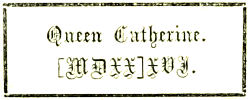
Queen Catherine. [MDXX]XVI.
The letters in brackets are worn off, but the date was evidently 1536, as the Queen died in January of that year.
This inscription is engraved on a thin brass plate, about 7 inches long and 3 inches broad;—now (March, 1880,) much worn.
This is not the original plate, which was rather larger than the present one.
Since the above note was penned the central tower of the cathedral has been rebuilt from the foundation,—the transepts have been thoroughly renovated, and the choir is to undergo considerable alteration. (April, 1887.)
When the latter part of the work of restoration has been sufficiently advanced, attention will be given to the tomb of Katherine. Dean Perowne intends to have this tomb opened, and then to decide what memorial of that Queen may be most appropriate. The Katherines of England have been invited to subscribe to this desirable object, and many have already responded.
Note M.—(Page 217.) THE GIFT OF BRAND.
“Whilst he was a monk he gave to the monastery many lands as in Muscham, Schotter, Scalthorp, Yolthorp, Messingham, Malmston, Cletham, Hibaldstow, Rachevildthorp, Holme, Riseby, Walcot, Normanby, Althorp, these joyning with him, Askylus, Syricus, and Sivortus, who procured from king Edward a confirmation of these lands to the Church.
Brand enjoyed not long his government, but in November, Anno 1069, which was the third of king William, he died.”—Gunton’s History of the Church of Peterborough.
Note N.—(Page 466.) KNUT’S VISIT TO ELY.
The fen waters being frozen over, Knut travels to Ely in a sledge, under the guidance of Brithmer. The king there celebrates the feast of the Purification.—“Ad hanc igitur solempnitatem ipsum regem aliquotiens præ nimio gelu et glacie inibi contigit non posse pervenire, usquequaque paludibus et aquis gelatis, sed sic a bonitatis suæ studio rex non mutatur, licet nimium gemens et anxius fuisset; in Domino Deo confisus, super mare de Saham, cum non cessaret vehemens pruina, usque in Ely trahere se in vehiculo desuper glaciem cogitavit, sed, siquis eum præcederet, securius et minus pavide asperum iter perficere, nec differre asseruit. Casu enim astitit ibi vir magnus et incompositus ex insula quidam Brihtmerus Budde, pro densitate sic cognominatus, in multitudine, et ante regem se progredi spopondit. Nec mora, rex festinus in vehiculo secutus est, admirantibus cunctis illum tantam audatiam præsumpsisse. Quo perveniens cum gaudio solempnitatem ex more illic celebravit.”—(Liber Eliensis, lib. 2, p. 203.)
FENLAND BIBLIOGRAPHY.
The following Works relate to the History and Geography of the Fen-district, (Those marked thus † apply entirely to the district.)
Anon. †The Visitor’s Guide to and History of Crowland Abbey with an appendix on the Triangular Bridge, and a Plan of the Abbey. Crowland, 1839.
Anon. †History of Stamford. Published by J. Drakard. 4to. Stamford, 1822.
Armstrong, Col. J. †History of the Ancient and Present state of the Navigation of the Port of King’s Lynn, &c. 1725.
Babington, C. C. †Ancient Cambridgeshire; an account of Roman and other ancient roads, &c.
Babington, C. C. Cambridge Antiquarian Society’s Publications, No. 3.
Benedict of Peterboro’ †Gesta Regis Henrici Secundi (1162-92) edited by William Stubbs, M.A., &c. London, 1867.
Bentham, J. †The History and Antiquities of the Conventual and Cathedral Church at Ely, from the foundation of the monastery A.D. 673 to the year 1771. 4to Cambridge, 1771.
Birch, W. de Gray Memorials of St. Guthlac. 8vo. Wisbech, 1881.
Birch, W. de Gray he Chronicles of Croyland Abbey, by Ingulph. 8vo. Wisbech, 1883.
Boyne, William Tokens of the 17th century. London, 1858.
Brittan, J. The Beauties of England and Wales. 1801.
Britton, John †History of Peterborough Cathedral.
Brogden, J. E. Lincolnshire Provincial Words.
[Calver, Capt. E. K., R.N. †Chart of the Wash from Skegness to Blakeney. Published at the Admiralty, January, 1873.]
Camden, William Britannia (1607 A.D.) Translation by Richard Gough, F.A. and R.G.S. 3 vols., fol. London, 1789.
Cammack, T. †On the Antiquities of Spalding. Proc. Lincolnsh. Arch. Soc. London, 1851.
Clarke, J. A. †Fen Sketches. Sm. 8vo. Wisbech, 1851.
Creasey History of New and Old Sleaford. 8vo. Sleaford, 1825.
Dugdale, Sir W. History of Imbanking and Draining of Rivers, Fens, and Marshes. Fol. London, 1722.
Dugdale, Sir W. The Monasticon.
Elstobb, W. †An Historical Account of the Great Level of the Fens. 8vo. Lynn, 1793.
English, H. S. Crowland and Burgh. 1871.
Evans, John Ancient Stone Implements of Great Britain. 8vo. London, 1872.
Evans, John Ancient British Coins.
Forby, Robert Vocabulary of East-Anglia. London, 1839.
Freeman, E. A. History of the Norman Conquest. 6 vols. 8vo. Oxford, 1870.
Freeman, E. A. “Lindum Colonia,” a paper in Macmillan’s Magazine, for 1875.
Gunton, Rev. Prebendary. †The History of the Church of Peterborough. Set forth by Symon Patrick, D.D., Dean of Peterboro’. Printed for Richard Chiswell at the Rose and Crown in St. Paul’s Churchyard, 1686.
Heathcote, J. M. †Reminiscences of Fen and Mere. 8vo. London, 1876.
Henry of Huntingdon. History of the English. Translation in Bohn’s series.
Ingulphus †Chronicle of the Abbey of Croyland. Translated by H. T. Riley, B.A. London, 1854.
Jenyns, Rev. L. †Observation in Meteorology in Cambs. 8vo. Van Voorst, 1858.
Kemble, J. M. The Saxons in England. London, 1849.
Kingsley, Canon †Hereward the Wake. Macmillan, London.
Leland Collectanea ex libro Hugonis Monachi Petroburgensis.
Lubbock Pre-historic Times.
Mackerell, B. †History and Antiquities of the flourishing Corporation of King’s Lynn. London, 1738.
Marshall, W. †On some ancient Court Rolls of the Manor of Littleport. Cambridge Antiquarian Society’s Communications, vol. IV.
Marshall, W. On an ancient Canoe found imbedded in the Fen Peat near Magdalen Bend on the river Ouse. Ditto, vol. IV., 1878.
Marrat, W. The History of Lincolnshire. 3 vols. 4to. Boston, 1814-16.
Michel, Francisque Chroniques Anglo-Normandes. 3 vols. Rouen, 1836.
Miller, S. H., and Skertchly, S. B. J. †The Fenland, Past and Present. 8vo. Wisbech, 1878.
Miller, S. H. (Editor.) Fenland Meteorological Circular, 1874 to 1877. 2 vols. Wisbech.
Miller, S. H. “The Great Fen.” English Illustrated Magazine. Macmillan, 1885.
Miller, S. H. “Alleged Idolatry in the Fens.” Cambridge Antiquarian Society, 1886-7.
Nall, J. G. Glossary of the Dialect and Provincialisms of East-Anglia. Longmans, 1866.
Nevinson, Rev C., M.A. History of Stamford. Demy 8vo. Johnson, Stamford, 1879.
Oldfield †History of Wainfleet.
Oliphant, T. L. K. The Sources of Standard English. London, 1873.
Oliver, Dr. G. †Religious Houses on the Witham. 1846.
Ordericus Vitalis The Original Text (published in 1838 by the French Historical Society, and edited by August le Provost. Translation of above by T. Forester, M.A. Bohn’s series, 1853.)
Richards, W. †The History of Lynn, civil, ecclesiastical, &c. 2 vols. 8vo. London, 1812.
Stewart, Rev. D. J. (Editor.) †Liber Eliensis, ad fidem codicam variorum. London, 1848.
Skertchly, S. B. J. †The Geology of the Fenland. (Memoir of the Geological Survey.) London, 1877.
Stukely, William Itinerarium Curiosum. 2 vols, fol., 1724.
Stukely, William Palæographica Britannica. 3 numbers, 4to., Stamford, 1746 and 1752.
Thierry, J. N. A. History of the Norman Conquest. English Edition, Bohn, 1856.
Thompson, P. †History and Antiquities of Boston. 4to. London, 1856.
Trollope, Rev. E. †Hereward the Saxon Patriot. Paper read before the Associated Architectural Societies at Bourne in June, 1861.
Turner, Sharon History of the Anglo-Saxons. London, 1799.
Vermuyden, Sir C. †Discourse touching the drainage of the great Fennes. An Appendix in Wells’ History of the Bedford Level.
Walker, N., and Craddock, T. †The History of Wisbech and the Fens. 8vo. Wisbech, 1849.
Warner, Rev. R. H. Legends of St. Chad. 8vo. Wisbech, 1870.
Warner, Rev. R. H. History of Thorney Abbey. 8vo. Wisbech, 1879.
Watson, H. †Historical Account of Wisbech. 1827.
Wells, S. †History of the Drainage of the Bedford Level. 2 vols. 8vo. London, 1830.
Wheeler, W. H. †History of the Fens of South Lincolnshire. 8vo. Boston, 1868.
William of Malmesbury De Gestis Pontificum Anglorum. Edited by N. E. S. A. Hamilton. London, 1870.
Wise, John Ramsey Abbey, its rise and fall. Huntingdon, 1881.
Wright, Thomas †Gesta Herewardi Saxonis. Appendix in Geoffrey Gaimar’s Anglo-Norman Metrical Chronicle. Caxton Society’s Publications. London, 1850.
(Various Authors) Fen and Marshland Churches. 3 vols. 4to., Wisbech, 1873-6. Report of British Archæological Society’s visit in 1878. Vol. 35.
[1]
[2]
[3]
[4]
[5]
[6]
[7]
[8]
[9]
[10]
[11]
[12]
[13]
[14]
[15]
[16]
[17]
[18]
[19]
[20]
[21]
[22]
[23]
[24]
[25]
[26]
[27]
[28]
[29]
[30]
[31]
[32]
[33]
[34]
[35]
[36]
[37]
[38]
[39]
[40]
[41]
[42]
[43]
[44]
[45]
[46]
[47]
[48]
[49]
[50]
[51]
[52]
[53]
[54]
[55]
[56]
[57]
[58]
[59]
[60]
[61]
[62]
[63]
[64]
[65]
[66]
[67]
[68]
[69]
[70]
[71]
[72]
[73]
[74]
[75]
[76]
[77]
[78]
[79]
[80]
[81]
[82]
[83]
[84]
[85]
[86]
[87]
[88]
[89]
[90]
[91]
[92]
[93]
[94]
[95]
[96]
[97]
[98]
[99]
[100]
[101]
[102]
[103]
[104]
[105]
[106]
[107]
[108]
[109]
[110]
[111]
[112]
[113]
[114]
[115]
[116]
[117]
[118]
[119]
[120]
[121]
[122]
[123]
[124]
[125]
[126]
[127]
[128]
[129]
[130]
[131]
[132]
[133]
[134]
[135]
[136]
[137]
[138]
[139]
[140]
[141]
[142]
[143]
[144]
[145]
[146]
[147]
[148]
[149]
[150]
[151]
[152]
[153]
[154]
[155]
[156]
[157]
[158]
[159]
[160]
[161]
[162]
[163]
[164]
[165]
[166]
[167]
[168]
[169]
[170]
[171]
[172]
[173]
[174]
[175]
[176]
[177]
[178]
[179]
[180]
[181]
[182]
[183]
[184]
[185]
[186]
[187]
[188]
[189]
[190]
[191]
[192]
[193]
[194]
[195]
[196]
[197]
[198]
[199]
[200]
[201]
[202]
[203]
[204]
[205]
[206]
[207]
[208]
[209]
[210]
[211]
[212]
[213]
[214]
[215]
[216]
[217]
[218]
[219]
[220]
[221]
[222]
[223]
[224]
[225]
[226]
[227]
[228]
[229]
[230]
[231]
[232]
[233]
[234]
[235]
[236]
[237]
[238]
[239]
[240]
[241]
[242]
[243]
[244]
[245]
[246]
[247]
[248]
[249]
[250]
[251]
[252]
[253]
[254]
[255]
[256]
[257]
[258]
[259]
[260]
[261]
[262]
[263]
Royal 8vo., 650 pp., cloth, published at 31/6; the remaining
stock offered at 20/-, nett.
THE FENLAND:
PAST AND PRESENT:
ITS
HISTORY—GEOGRAPHY—GEOLOGY—NATURAL
HISTORY—SCENERY—ANTIQUITIES—CLIMATOLOGY—DRAINAGE—AGRICULTURAL
PRODUCE & SANITARY CONDITION,
BY
SAMUEL H. MILLER, F.R.A.S., F.M.S.,
Gold Medalist and Foreign Member of the Society of Arts
and Sciences of Utrecht;
AND
SYDNEY B. J. SKERTCHLY, F.G.S.,
Her Majesty’s Geological Survey.
The ILLUSTRATIONS include a beautiful Coloured Chromo-Lithograph from a picture kindly painted for this work, by E. Ellis, Esq.; Two Fac-simile Sketches of Crowland Abbey and Bridge, from the pencil of E. W. Cooke, Esq., R.A.; Copper-plate Engravings; several fine Views Engraved on Wood by Whymper and others; besides a Map of the Fenland, Geological Sections, and other Diagrams.
OPINIONS OF THE PRESS.
“There is no more interesting part of England than the Fenland.”—Daily News.
“An exhaustive account of the great English Fen District.”—Graphic.
“A complete History of the Fenland worthy of the subject.”—Standard.
“An interesting study for the antiquary, geographer, and economist.”—Saturday Review.
“The stories of the Saxon and Danish Conquests are well told.”—Nature.
“A thorough scientific description of the entire region.”—Illustrated London News.
MEMORIALS of SAINT GUTHLAC of CROWLAND.
Collected from the Original Manuscripts, and Edited by Walter de Gray Birch, F.S.A.L., of British Museum.
100 copies only printed and each numbered. (Very scarce.)
THE CHRONICLES OF CROWLAND ABBEY.
By Ingulph, Edited from the Unique Manuscript in the British Museum, by Walter de Gray Birch, F.S.A.
100 copies only printed and each numbered. Price 12/-.
WISBECH: LEACH AND SON.
In Three Volumes. Uniformly bound in cloth, £3/16.
Each Volume complete and sold separately.
Also the Three Volumes in one, half-roan, £3/3.
THE
FEN & MARSHLAND CHURCHES,
With Historical and Architectural Descriptive Notes.
The First Series, price 21/-, dedicated (by permission) to the Hon. and Right Rev. the Lord Bishop of Norwich and the late Right Rev. the Lord Bishop of Ely, contains 15 Photographs, including the Churches of
Walsoken, Walton, Emneth, Wisbech, Walpole, Terrington,
Tilney and Leverington;
With Descriptions by the Rev. John Davies, M.A., the Rev. E. E. Blencowe, B.A., the late Rev. J. W. Berryman, B.A., the late very Rev. the Dean of Chester, the Rev. C. R. Manning, M.A., and the Rev. A. W. Roper, B.A.
The Second Series, price 25/-, dedicated (by permission) to the Hon. and Right Rev. the Lord Bishop of Norwich and the late Right Rev. the Lord Bishop of Ely, contains 17 Photographs, including the Churches of
Elm, Ely Cathedral, (6 views), St. Margaret, Lynn; St. Nicholas, Lynn;
Upwell, Outwell, Terrington St. John, Thorney and Whittlesey;
With Descriptions by E. M. Beloe, Esq., the Rev. W. E. Dickson, M.A., the Rev. C. R. Manning, M.A., the late Rev. E. Swann, M.A., the Rev. W. D. Sweeting, M.A., the late Rev. W. G. Townley, M.A., the Rev. R. H. Warner, M.A., and the late Rev. Henry Wright, M.A.
The Third Series, price 30/-, dedicated (by permission) to the Right Rev. the Lord Bishop of London (late Bishop of Lincoln), and the late Right Rev. the Lord Bishop of Lincoln, contains 15 Photographs, including the Churches of
Boston, Crowland, Gedney, Holbeach, Moulton, Spalding,
Sutton St. Mary, Weston, and Whaplode;
With Descriptions by the late Rev. H. L. Bennett, M.A., the Rev. G. B. Blenkin, M.A., the Rev. J. R. Jackson, M.A., the Rev. E. Moore, M.A., and the Rev. R. Rogers, M.A.
In addition to the Photographic Illustrations, this Volume contains Ground Plans of each of the Churches in this series.
Demy 8vo., cloth 7/6.
THE
HISTORY OF THORNEY ABBEY,
CAMBRIDGESHIRE,
FROM ITS FOUNDATION TO ITS DISSOLUTION,
TOGETHER WITH
SOME NOTICE OF THE MODERN PARISH,
AND
BAPTISMAL REGISTER OF THE FRENCH COLONY 1658-1724,
COMPILED FROM PRINTED RECORDS AND UNEDITED MANUSCRIPTS,
By REV. R. HYETT WARNER, M.A.,
Vicar of Almeley, Herefordshire, sometime Curate of Thorney.
LONDON: SIMPKIN, MARSHALL & CO.
WISBECH: LEACH & SON.