COMPOSITION BY THE MONOTYPE MACHINE By Paul Nathan
Reading edition
Though for more than half a century machines adapted for the setting of type have been in use, it is only within a few years that the average printer of books has been enabled to avail himself of the services of a mechanical substitute for the hand compositor. The fact seems to be that despite the ingenuity that was brought to bear upon the problem, the pioneer inventors were satisfied to obtain speed, with its resultant economy, at the expense of the quality of the finished product. Thus, until comparatively recently, machine composition was debarred from the establishments of the makers of fine books, and found its chief field of activity in the office of newspaper publishers and others to whom a technically perfect output was not essential so long as a distinct saving of time and labor could be assured. Thanks, however, to persistent effort on the part of those inventors who would not be satisfied until a machine was evolved which should equal in its output the work of the hand compositor, the problem has been triumphantly solved, and to-day the very finest examples of the printed book owe their being to the mechanical type-setter.
The claim is made for one of these machines, the monotype, that, so far from lowering the standard of composition, its introduction into the offices of the leading book printers of the world has had the contrary effect, and that it is only the work of the most skilful hand compositor which can at every point be compared with that turned out by the machine. The fact that the type for some recent books of the very highest class, so-called "editions de luxe," has been cast and set by the monotype machine would seem to afford justification for this claim, extravagant as at first glance it may appear.
The monotype machine is, to use a Hibernicism, two machines, which, though quite separate and unrelated, are yet mutually interdependent and necessary the one to the other. One of these is the composing machine, or keyboard, the other the caster, or type-founder. To begin with the former: this is in appearance not unlike a large typewriter standing upon an iron pedestal, the keyboard which forms its principal feature having two hundred and twenty-five keys corresponding to as many different characters. This keyboard is generally placed in some such position in the printing office as conduces to the health and comfort of the operator, for there is no more noise or disagreeable consequence attendant on its operation than in the case of the familiar typewriter, which it so markedly resembles.
It has been said that the machines are interdependent; yet they are entirely independent as to time and place. The keyboard, as a matter of fact, acts as a sort of go-between betwixt the operator and the casting-machine, setting the latter the task it has to perform and indicating to it the precise manner of its performance. A roll of paper, which as the keyboard is operated continuously unwinds and is rewound, forms the actual means of communication between the two machines. The operator, as he (or she, for in increasing numbers women are being trained as monotype operators) sits facing the keyboard, has before him, conveniently hanging from an adjustable arm, the "copy" that has to be set in type. As he reads it he manipulates the keys precisely as does an operator on a typewriter, but each key as it is depressed, in place of writing a letter, punches certain round holes in the roll of paper. Enough keys are depressed to form a word, then one is touched to form a space, and so on until just before the end of the line is reached (the length of this line, or the "measure," as it is termed, has at the outset been determined upon by the setting of an indicator) a bell rings, and the operator knows that he must prepare to finish the line with a completed word or syllable and then proceed to justify it. "Justification," as it is termed, is perhaps the most difficult function of either the hand or the machine compositor. On the deftness with which this function is discharged depends almost entirely the typographic excellence of the printed page. To justify is to so increase the distance between the words by the introduction of type-metal "spaces" as to enable the characters to exactly fill the line. To make these spaces as nearly equal as possible is the aim of every good printer, and in proportion as he succeeds in his endeavor the printed page will please the eye and be free from those irregularities of "white space," which detract from its legibility as well as from its artistic appearance.
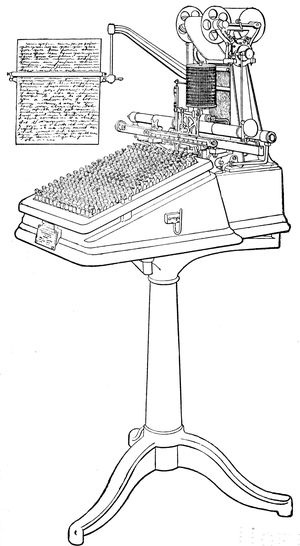
The Monotype Keyboard.
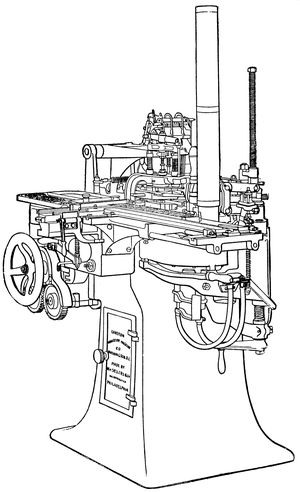
The Monotype Caster.
That the monotype should not only "justify" each line automatically, but justify with a mathematical exactness impossible of attainment by the more or less rough-and-ready methods of the most careful human type-setter is at first thought a little bewildering. The fact remains, however, that it does so, and another triumph is to be recorded for man's "instruments of precision."
Monotype justification is effected as follows: an ingenious registering device waits, as it were, on all the movements of the operator, with the result that when he has approached as close to the end of the line as he dare go, he has merely to glance at a cylindrical dial in front of him. The pointer on this dial signifies to him which of the "justifying keys" he must depress. He touches them in accordance therewith, and the line is justified, or rather it will be justified when, as will be seen later on, the casting machine takes up its part of the work. That is the outward manifestation; it remains to be seen in what manner the machine accomplishes its task. Firstly, the machine automatically notes the exact width of the space left over at the line's end; then, also automatically, it records the number of spaces between the words already set which form the incompleted line; finally, it divides the residuary space into as many parts as there are word-spaces, and allots to each of these one of the parts. Thus if there is one-tenth of an inch to spare at the end of the line and ten word-spaces, then one-hundredth of an inch added to each of these spaces will justify the line with mathematical accuracy. But the machine will do something more wonderful than this. It will separately justify separate parts of the same line. The utility of this is comprehended when it is pointed out that when the "copy" to be set consists of what is technically termed "tabular" matter, the various columns of figures or so forth composing it are not composed vertically but horizontally and so each section must of necessity be justified separately.
Should the compositor be required to "over-run illustrations," as the term goes, in other words to leave a space in which the "block" for a cut may be inserted, so that it may have type all around it or on one side of it only, the machine offers no difficulty at all. All that the operator has to do in this case is to carry the composition of each line as far as necessary and then complete it with a row of "quads," or spaces. Thus, when the composition is cast by the casting-machine the space into which the block is to fit is occupied by a square of "quads." These have only to be lifted out, the block inserted, and the trick is done.
We will then imagine that the operator has finished his task. Of the bank of two hundred and twenty-five keys in front of him (the equivalent of a full "font" of type, with figures, italics, and symbols complete), he has depressed in turn those necessary to spell out the words of his copy, he has put a space between the words he has justified in accordance with the dictates of the justifying dial, has arranged the spaces for the insertion of blocks or illustrations, and as the result of his labors he has merely a roll of perforated paper not unlike that which operates the now familiar pianola or piano-player. Yet this roll of paper is the informing spirit, as it were, of the machine. Its production is the only portion of the work of the monotype for which a human directing agency is necessary, every other function being purely automatic.
The roll of perforated ribbon is lifted off the keyboard and put in place on the casting-and setting-machine. As it is swiftly unwound it delivers to the casting-machine the message with which the operator has charged it. Through the perforations he has made compressed air is forced. Now, as has been explained, the holes correspond to the characters or typographic symbols of the "copy," and the jet of air forced through them sets in motion the machinery, which controls what is known as the "matrix-case," a rectangular metal frame about five inches square, which contains two hundred and twenty-five matrices, or little blocks of hardened copper, each one of which is a mould corresponding to a character on the keyboard. This frame is mounted horizontally on a slide, which by an ingenious mechanical movement brings any one of the two hundred and twenty-five matrices over what is termed the mould. The particular matrix thus placed in position is determined by those particular holes punched in the paper ribbon at the keyboard, through which the compressed air is at that precise moment being forced.
The mould referred to is closed by the matrix, a jet of molten metal is forced in, and in an instant the type is cast, its face being formed by the matrix, its body or shank by the mould. The cast type is ejected and takes its place in the galley, to be followed by another and that by yet others in their regular rotation. It must, however, be pointed out that the composition emerges from the machine hind part foremost and upside down as it were. This enables the justification holes, which were originally punched at the end and not at the beginning of each line, to direct the proper casting of the spaces in the lines to which they correspond.
It will be seen, therefore, that the casting portion of the monotype machine is actually automatic. It performs all its operations without human assistance or direction. Occasionally it will stop of its own accord and refuse to work, but this merely means that it has found something amiss with the perforated instructions, a mistake as to the length of a line or so forth, and it refuses to continue until the workman in charge of it puts the error right, then it starts on again and continues on its even course, casting letters and spaces and punctuation marks, and arranging them first in words, then in lines, next in paragraphs, and finally in a column on the galley.
The casting-machine works at so high a rate of speed (casting from one hundred and forty to one hundred and fifty characters per minute) that it can in its output keep well ahead of the operator on the keyboard. This, however, so far from being an inconvenience or leading to any loss of time, is an advantage, for four casting-machines, which can easily be looked after by one man and a boy, can cope with the work of five keyboard operators, or if all are engaged on the same character of composition two casters can attend to the output of three keyboards. This suggests a reference to the facilities offered by the machine for the production of matter composed in various faces of type. The machine casts practically all sizes in general use from five-point, or "pearl," to fourteen point, or "English." Owing to the number of characters included in the matrix-case, it can at the same time set upper and lower case, small capitals, and upper and lower case italics, or any similar combination of two or even three different faced alphabets. To change from one complete set of matrices to another is a simple operation, performed in about a minute of time, while the changing of mould, which insures a corresponding change in the size of the "body" of the type, takes about ten minutes.
To return, however, to the perforated roll of paper, which it must be imagined has passed entirely through the casting-machine and has been automatically re-rolled. Its present function has come to an end, and it is now lifted out of its position on the machine and placed away for future reference in a drawer or cabinet. This is a by no means unimportant feature of the Monotype, for it is thus no longer necessary to preserve the heavy, cumbrous, and expensive "plates" of a book in anticipation of a second edition being called for at some future time. As a matter of fact, indeed, "plates," or electrotypes of monotyped matter, are by no means a necessity. Many thousand impressions can with safety be printed from the types themselves, and these latter at the conclusion of the job can be remelted and new type cast from the resultant metal. The paper rolls, occupying but a few square inches of space, can be kept, and when the time arrives may be passed through the casting-machine again, to supply a new printing surface identical in every respect with the original.
But the galley of monotyped composition has been waiting during this digression. It is lifted off the machine by the attendant and a rough proof pulled, which is corrected by the proof-reader. The advantage of the individual types is then apparent, for the composition is corrected and otherwise handled precisely as would be the case had the matter been set entirely by hand. Indeed, the operation consumes even less time, for the discarded characters, instead of being placed back carefully in their proper compartments in the case for future use, are merely thrown aside by the corrector, to find their way eventually into the melting pot. It may be added, however, that the Monotype itself furnishes the types used in the correction of its matter—"sorts," as they are termed by the printer. These are cast by the machine during the times when it is not employed upon more important work.
Indeed, an attachment has recently been added to the machine, whereby its use as a type-caster is still further extended. As has been mentioned, the machine casts and composes type of any sized face, from five to fourteen point. With, however, the attachment referred to, it can now cast for the use of the hand compositor complete fonts of type up to and including thirty-six point in size, so that an entire book, title-page included, nowadays often owes its typographical "dress" to the ingenious machine known as "The Lanston Monotype."[Back to Contents]