THE STORY IN A RAILWAY LOCOMOTIVE
Reading edition
One of the Most Powerful Locomotives in the World
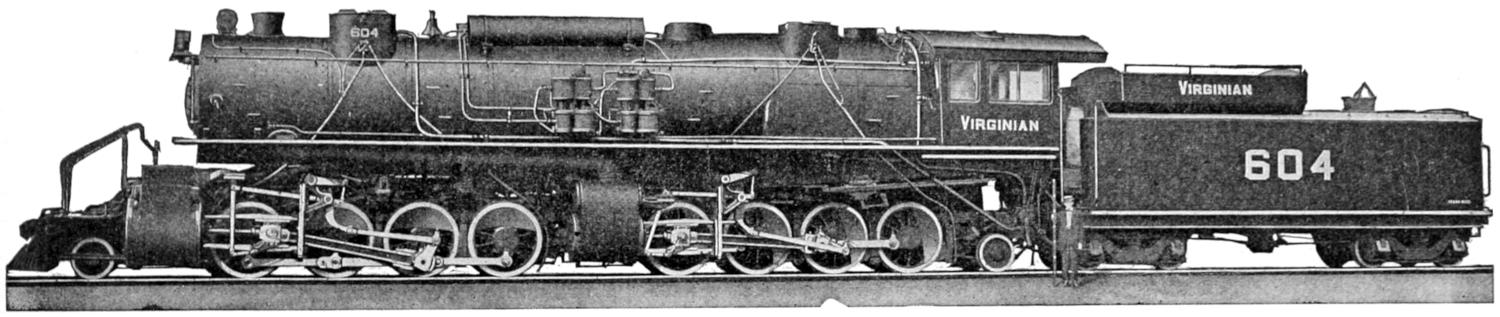
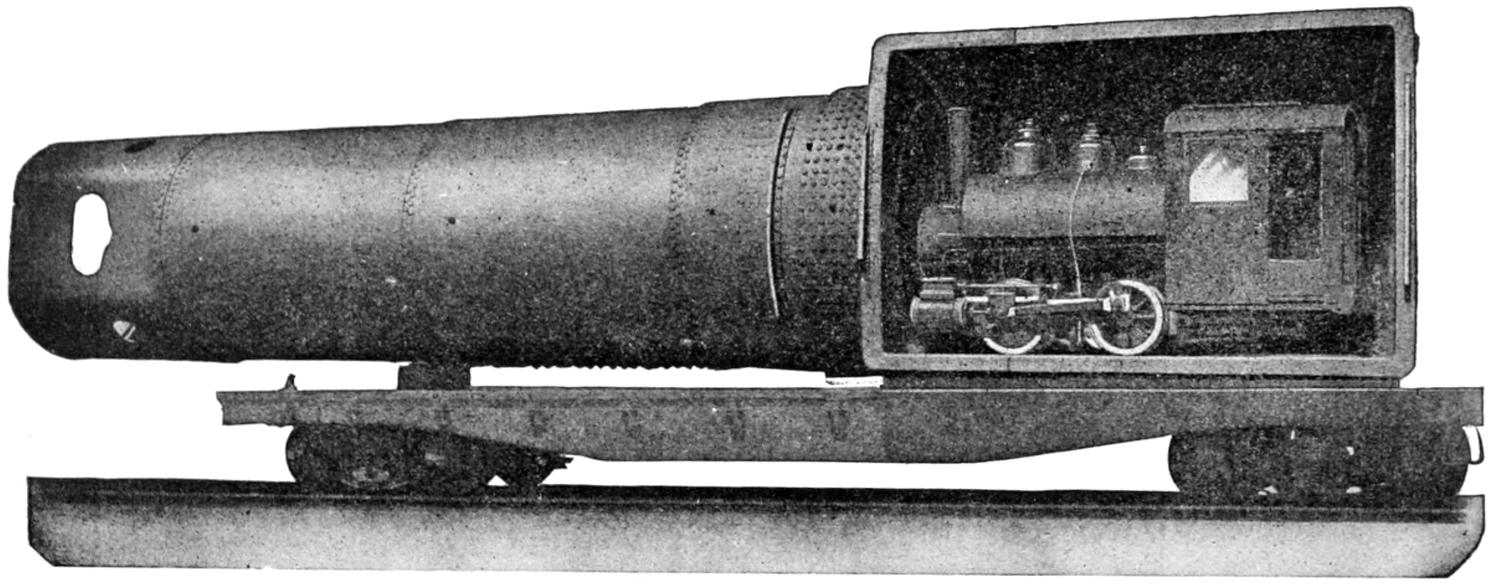
BOILER OF ARTICULATE COMPOUND LOCOMOTIVE.
The wonder of our railroad systems to-day is the growth of the locomotive. The necessity for economy in hauling long freight trains has led to the development of this type of engine. Some idea of its size can be had from the second picture, which shows the boiler and firebox of the locomotive shown in the first picture. The firebox is so large that an ordinary narrow-gauge locomotive of the old style can be comfortably stored in it.
Loaded Weights
On driving wheels 475,000 lbs.
On truck wheels 30,000 lbs.
On trailing wheels 35,000 lbs.
Total of engine 540,000 lbs.
Total of tender 212,000 lbs.
Wheel Base
Driving, rigid 15 ft. 6 ins.
Total of engine 57 ft. 4 ins.
Total of engine and tender 91 ft. 5³⁄₁₆ ins.
Cylinders
Diameter H.P. 28 ins., L. P. 44 ins.
Stroke of piston 32 ins.
Wheels
Diameter of driving wheels, outside 56 ins.
Diameter of truck wheels 30 ins.
Diameter of trailing wheels 30 ins.
Diameter of tender wheels 33 ins.
CYLINDERS BIG ENOUGH FOR MEN TO SIT DOWN IN
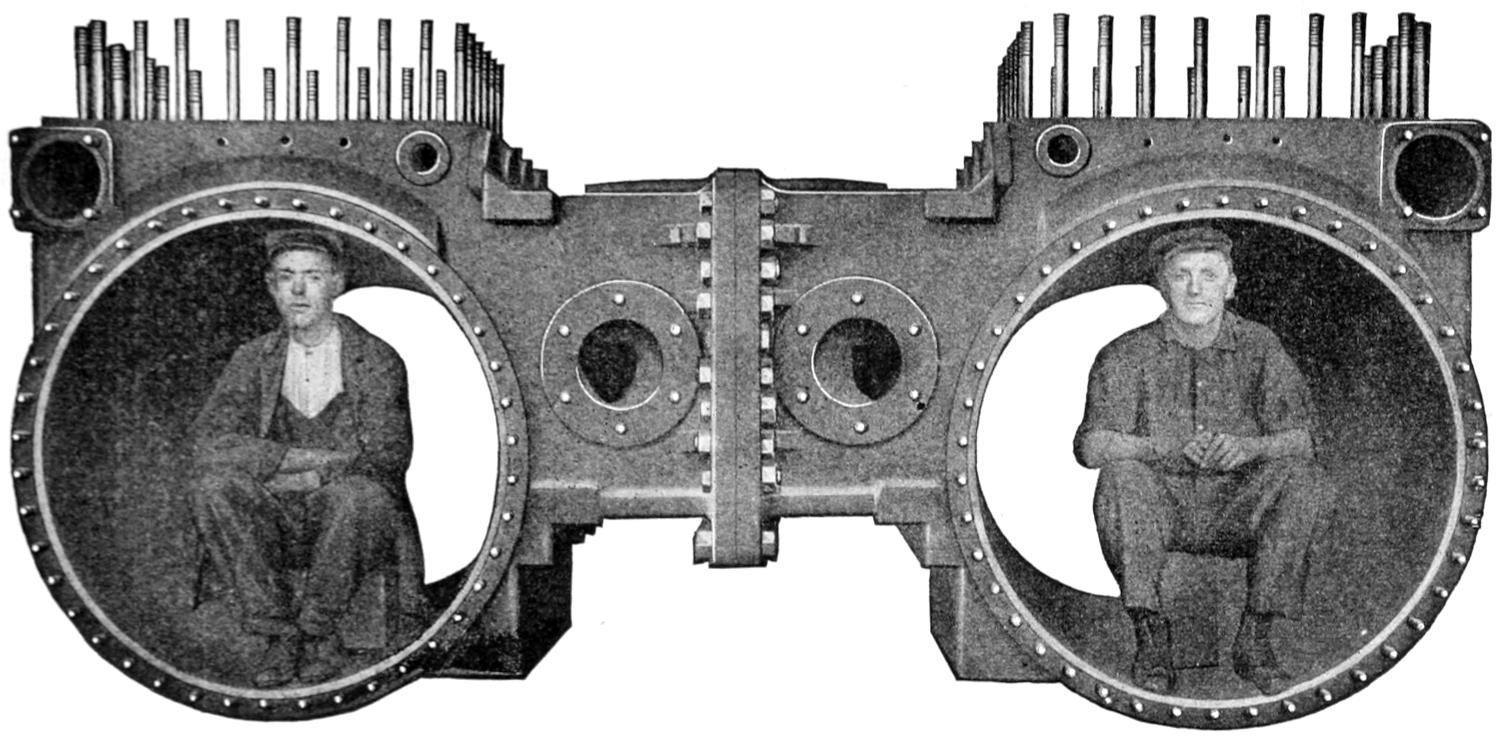
LOW PRESSURE CYLINDERS OF ARTICULATED COMPOUND LOCOMOTIVE.
In the picture we see the cylinders of the locomotive shown on the previous page. Some idea of their size can be had from the fact that a good-sized man can sit comfortably in each of them.
Boiler
Type Ex. Wagon Top
Working pres. per sq. in. 200 lbs.
Outside diam. at front end 100 ins.
Outside diam. at back end 112 ins.
Length firebox inside 173¹⁄₁₆ ins.
Length firebox, actual, inside 132 ins.
Width of firebox inside 108¹⁄₄ ins.
No. and diam. of tubes 334, 2¹⁄₄ ins.
No. and diam. of flues 48, 5¹⁄₂ ins.
Length of tubes 24 ft. 0 ins.
Combust. chamber length 39¹⁄₁₆ ins.
Grate area 99.2 sq. ft.
Heating Surface
Tubes and flues 6462 sq. ft.
Water tubes 67 sq. ft.
Firebox 380 sq. ft.
Total 6909 sq. ft.
Superheating surface 1311 sq. ft.
Clearance Limitations
Extreme height 16 ft. 5¹⁄₈ ins.
Extreme width 11 ft. 8¹⁄₂ ins.
Length over all 99 ft. 9⁵⁄₈ ins.
Maximum Tractive Power
Working compound 115,000 lbs.
Working simple 138,000 lbs.
Factor of adhesion (working compound) 4.13
Factor of adhesion (working simple) 3.44
Tender Capacity
Water 12,000 gals.
Fuel 16 tons
THE LOCOMOTIVE ENGINEER’S WORKROOM
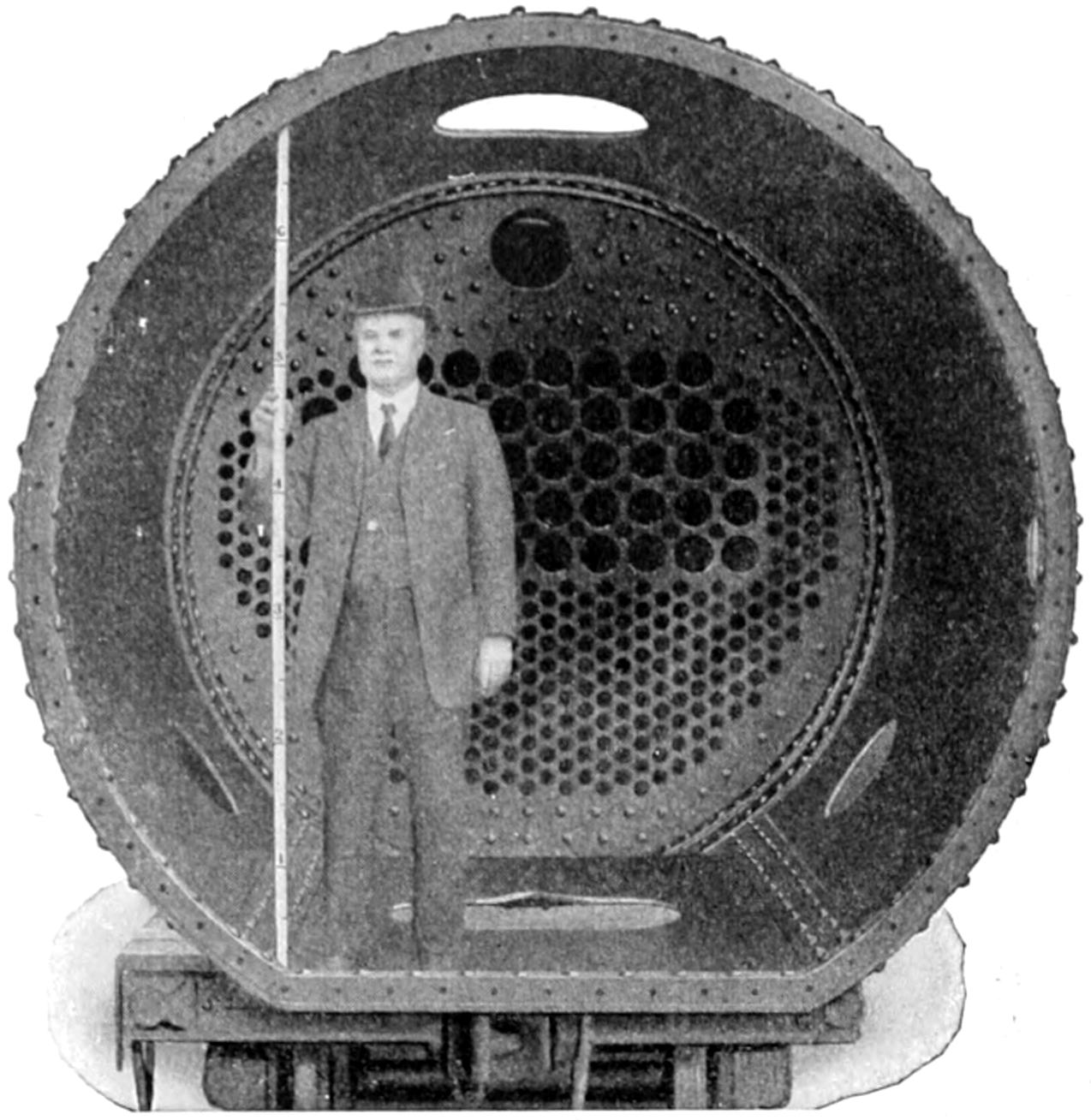
Here is a picture of one end of the boiler of this giant locomotive. It would take a man more than seven feet high to bump his head in the middle of it while standing on his feet.
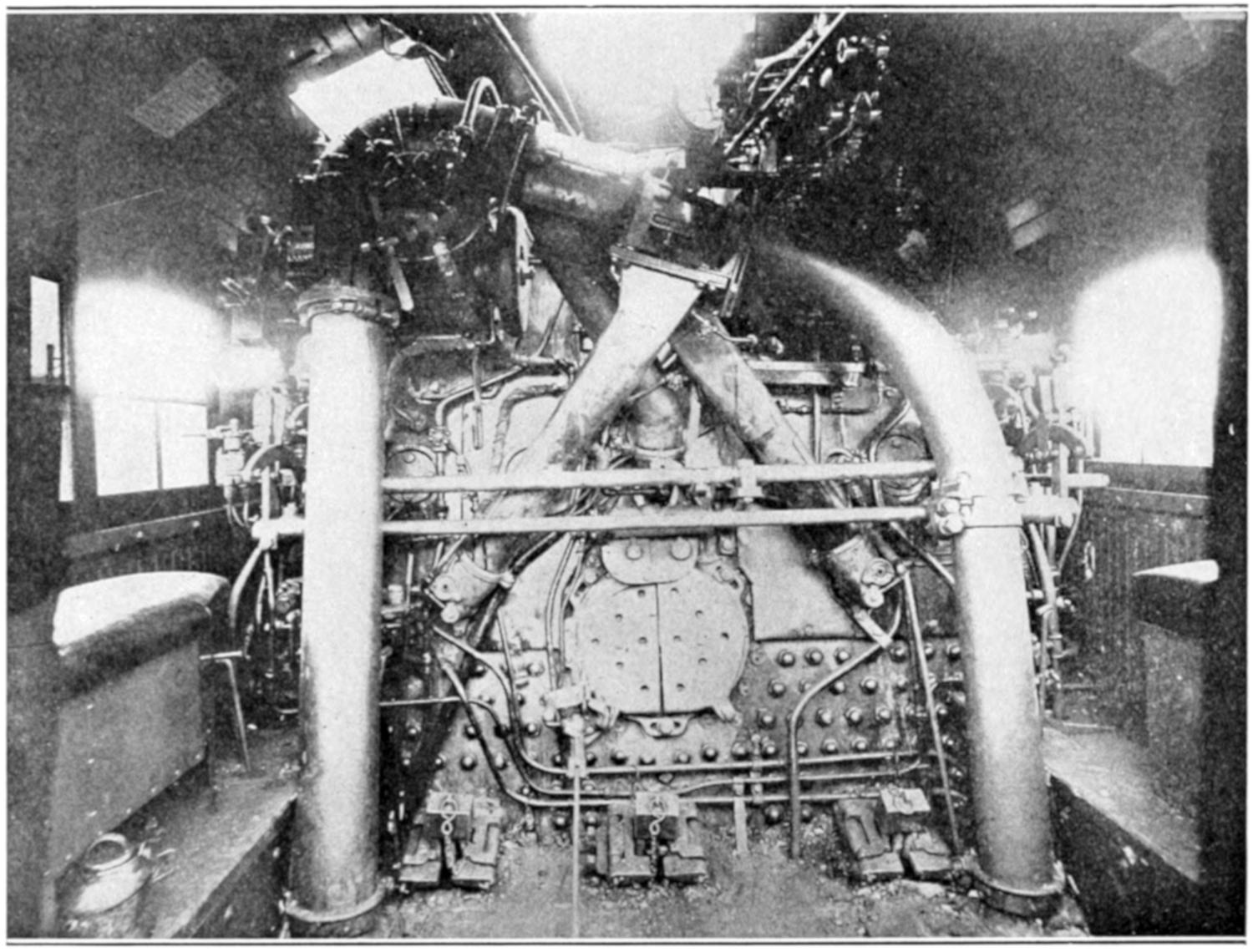
This shows a picture of the engineer’s cab of one of these great railroad machines. We are accustomed to see the levers and other machinery for operating the engine right in the back of the engine cab. Over or near the firebox. Upon looking closely we find that the operating machinery is at the side of the locomotive and far forward in the cab. In fact there is a complete set of operating machinery on both sides of the cab, so that the engineer can run the engine from whatever side he happens to be on. This is very necessary, particularly in switching. Near the end of the cab where the engineer used to sit you will notice a peculiar pipe-like arrangement. This is not for operating the engine, but is the automatic stoker, which is fully explained in the next picture. An engine of this size will require seven tons of coal per hour.
A MACHINE WHICH DOES THE WORK OF FOUR FIREMEN
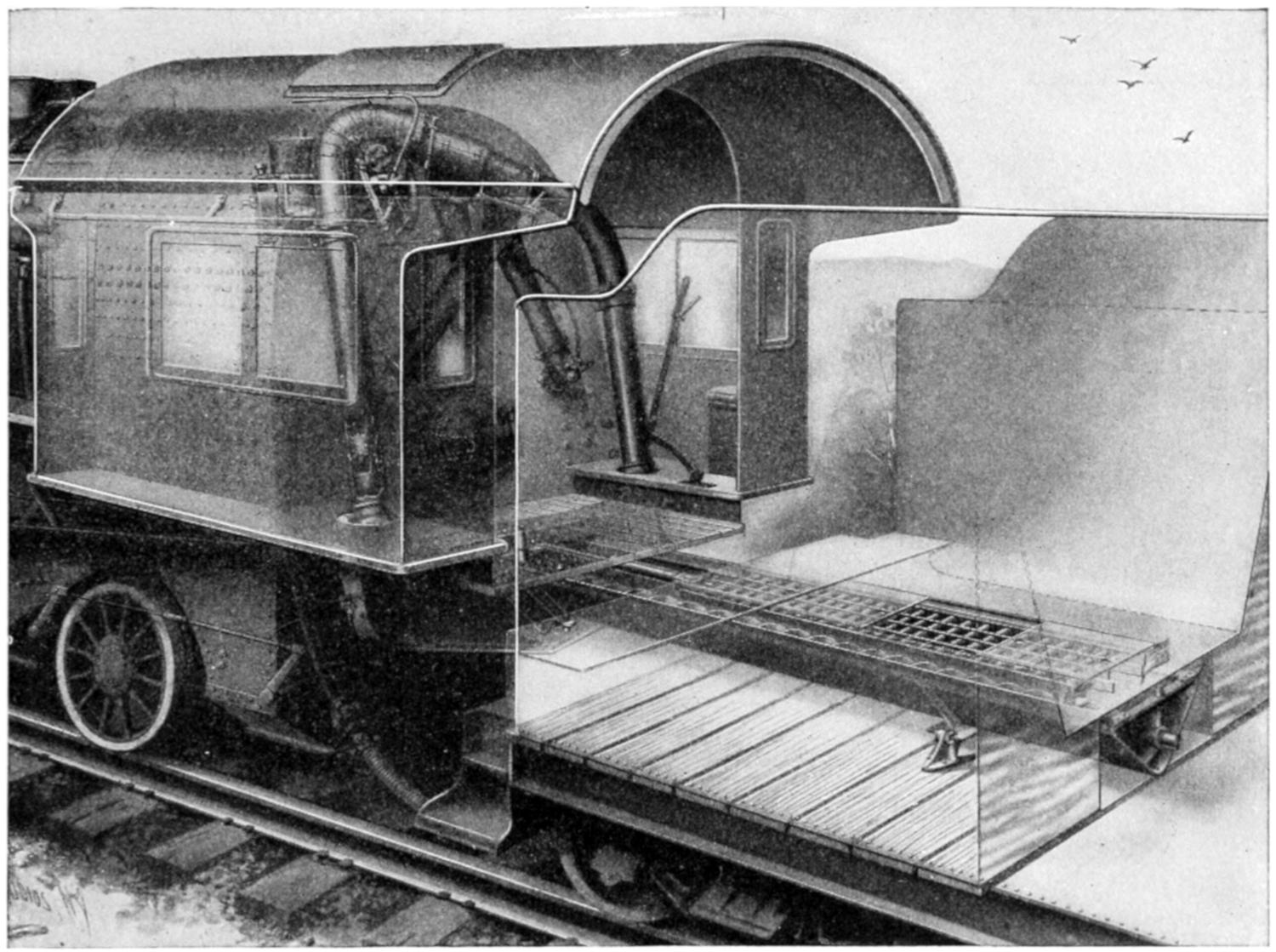
When these large locomotives were first used it was found that no one fireman could shovel in enough coal to keep the steam up. It would require three or four firemen working constantly to shovel enough coal to keep this engine going. Man’s inventive genius came to the front, however, and now we have an automatic fireman, so to speak. Instead of shoveling coal on one of these engines the fireman merely operates a lever. This is a picture of the Sweet locomotive stoker installed in a railroad engine. This machine automatically conveys coal from the tender to the locomotive, raises it by an elevator to a point above the fire door, dumps it into the firebox and spreads it evenly over the grate.
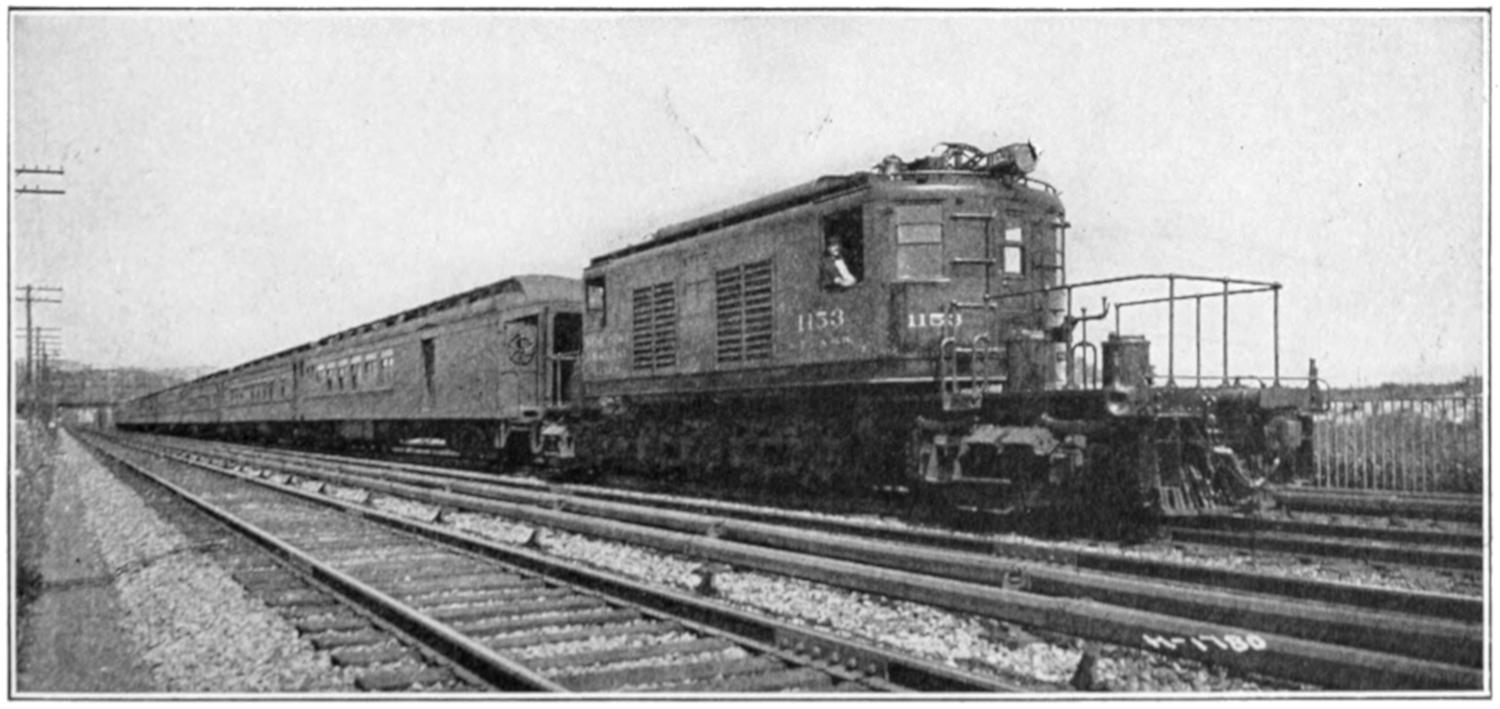
This is the new type of electric locomotive being used by the New York Central system
HOW A FAST TRAIN TAKES WATER WITHOUT STOPPING
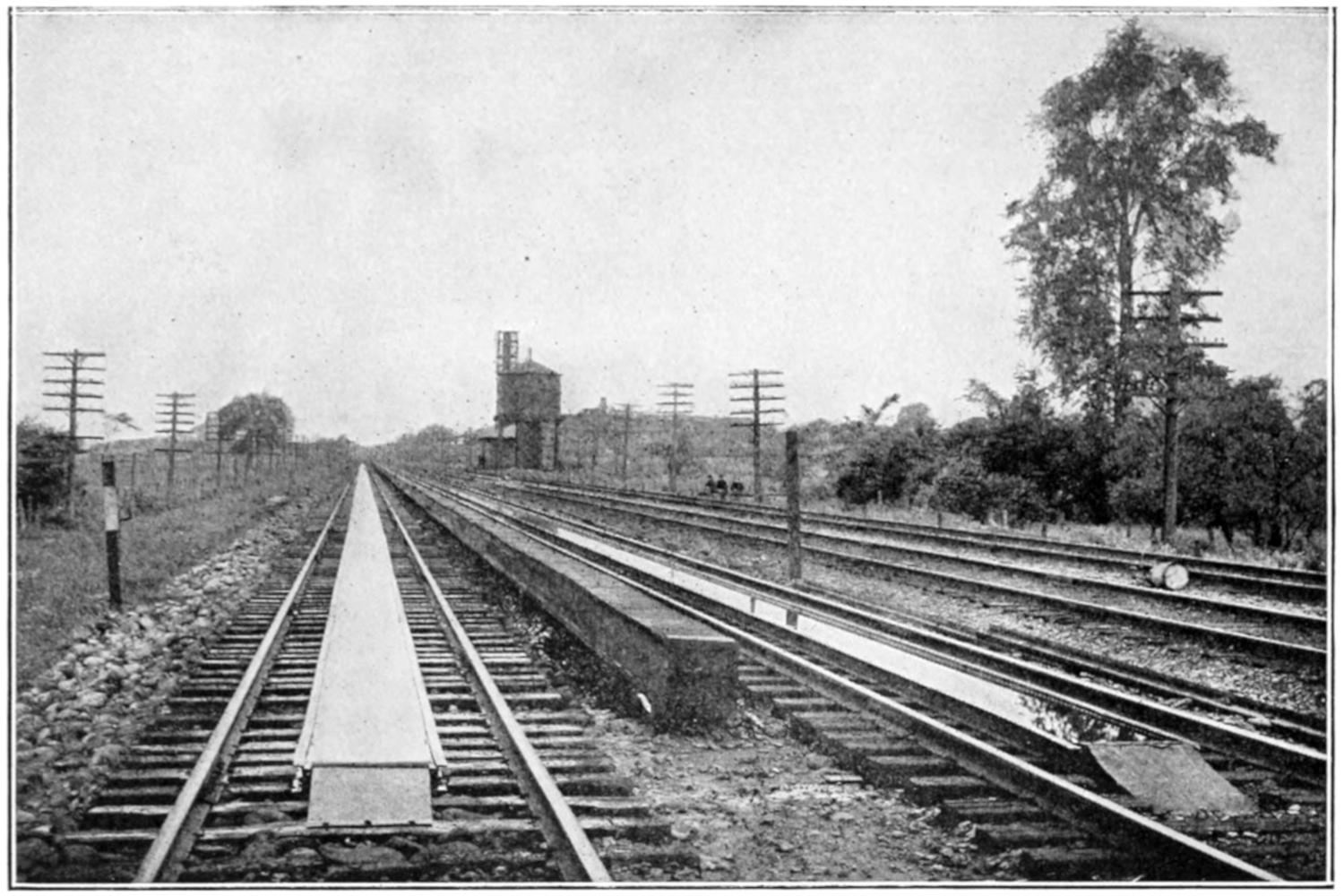
The fast express trains haven’t time to stop and take water from the tank at the side of the railroad as in former days. This picture shows a tank built between the tracks which enables the engineer to fill his boilers without slackening speed. When approaching this tank the engineer simply lowers a tube into the water, the end of which is a scoop. The moving engine thus forces the water up into the tube, from which it runs into the boiler.
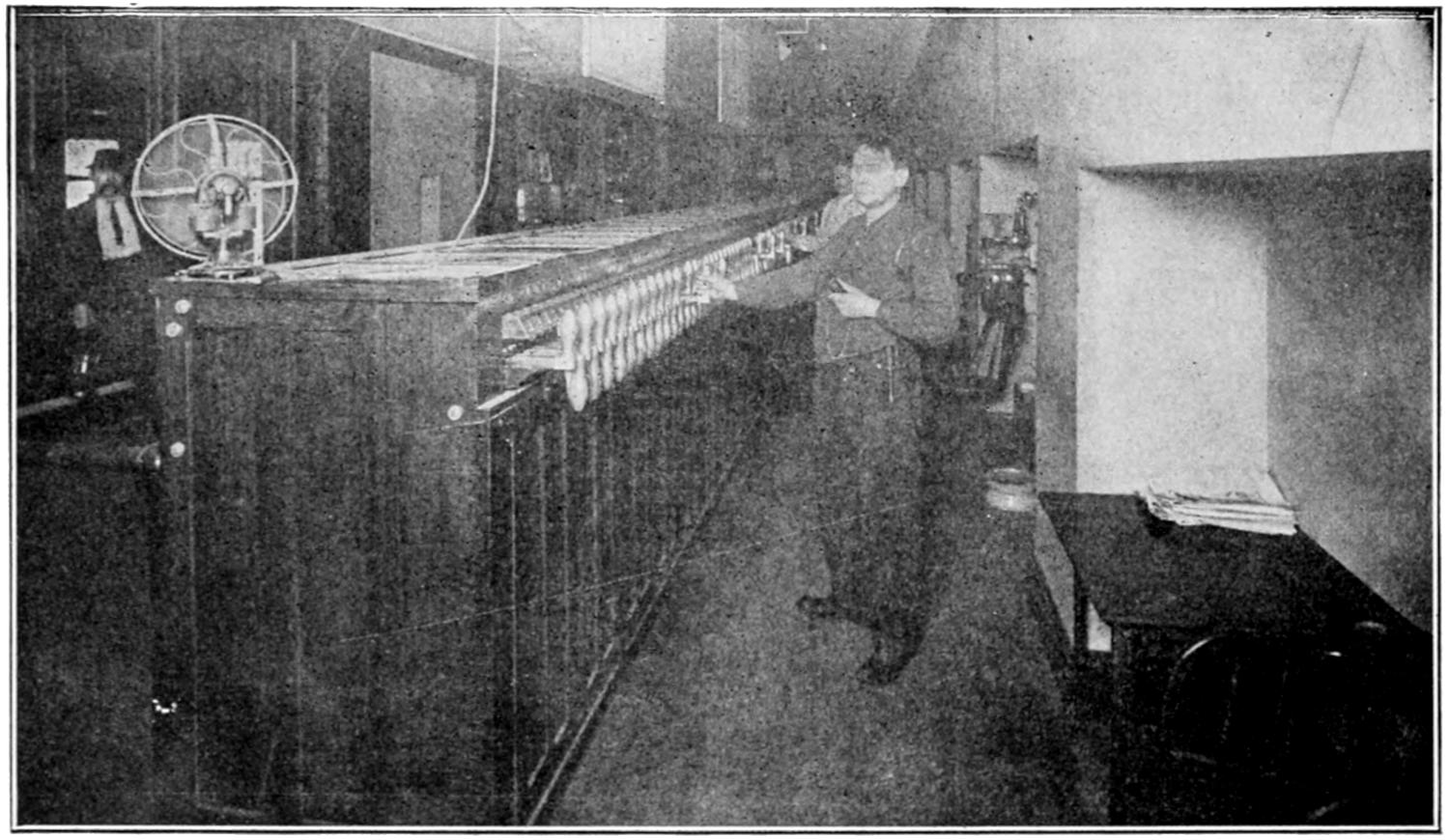
This is an improved signal tower from which switches are operated. If you were ever in a signal tower you will not recognize this as one, for you are used to seeing a room full of levers which the tower man had to pull hard when he wished to throw a switch. By the old way the end of the lever was attached to a wire which was connected with the switch. The wire running through pipes, when the operator pulled the lever the switch was pulled shut by the pull on the wire. In this new plan the switch is controlled by electricity, and the operator has merely to pull out a plug as shown in the picture, which is much easier than operating a lever.
WHAT MAKES A WIRELESS MESSAGE GO
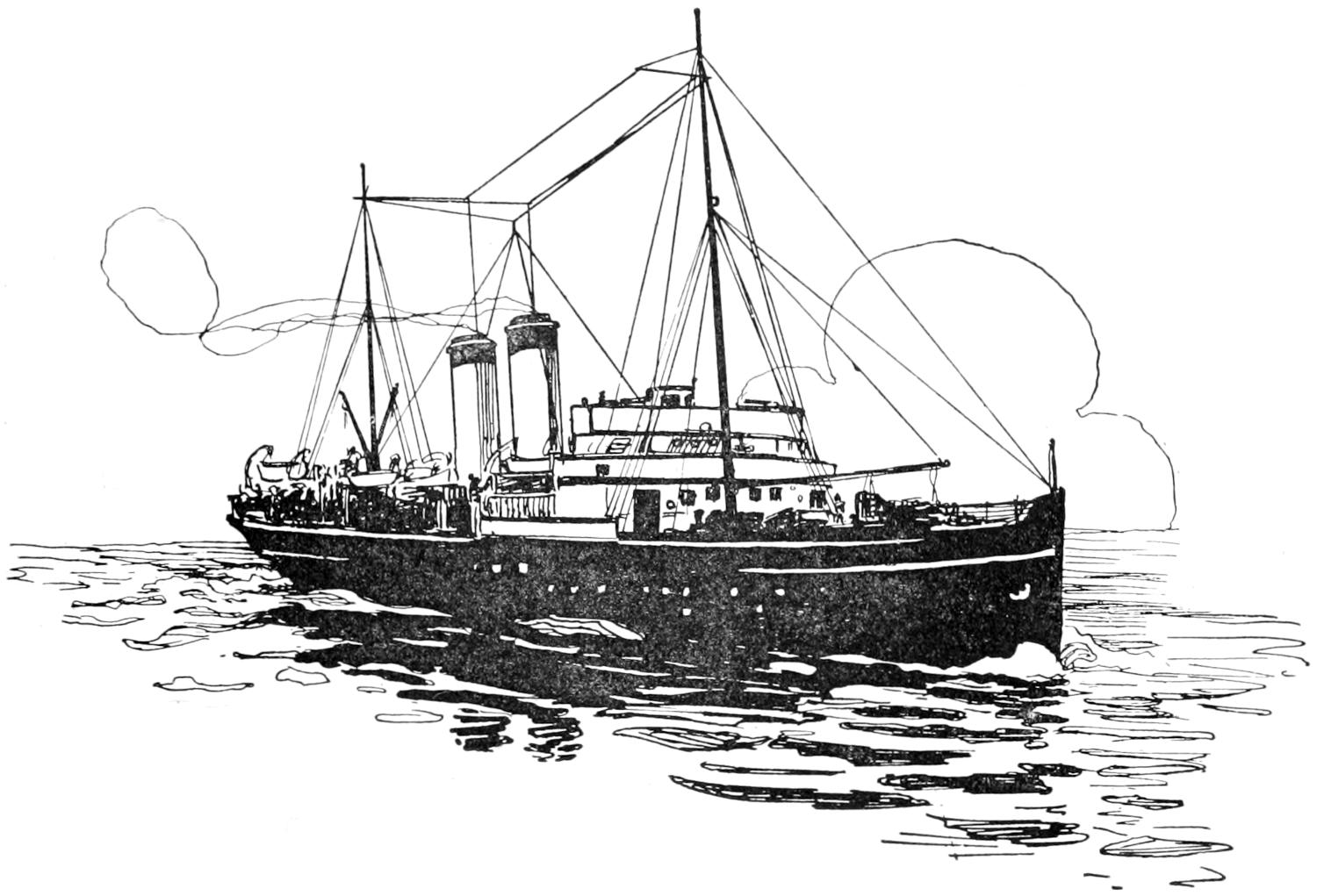
Sketch showing arrangement of aerial on ship equipped with the Marconi Direction Finder, an instrument which tells the sea captain the exact points of the compass from which wireless distress signals are being sent and enables ships to avoid collisions in fog.