How Does an Elevator Go Up and Down?
Reading edition
Ordinarily, when we think of an elevator we think merely of the cage or car in which we ride up or down. But the car is really only the part which makes the elevator of service to man, and from the standpoint of the machinery, is a relatively unimportant part of the equipment.
There are two principal types of elevators used to-day; the hydraulic, which is worked by water under pressure, and the electric, which is worked by electricity through an electric motor. The latter type, because of the tendency towards the general use of electricity in recent years, has largely superseded the hydraulic, and, as when you think of elevators you probably have in mind those you have seen in some huge skyscraper, we shall look at one of these.
What are the Principal Parts of an Elevator?
The most advanced type of elevator to-day is called a Gearless Traction Elevator. In this elevator the principal parts are a motor, a grooved wheel on the motor shaft called a driving sheave and a brake, all mounted on one cast-iron bed-plate; a number of cables of equal length which pass over the driving sheave and thence around another grooved wheel called an idler sheave, located just below the driving sheave, and to one end of which is attached the car or cage, and to the other end a weight called a counterweight; also a controller which governs the flow of electric current into the motor and thereby the speed, starts and stops of the elevator car. Although the controller, motor, brake and sheaves are usually placed way at the top of the building out of our sight, they are really very important parts of the elevator.
The cage or car in which we ride is held in place by tracks built upright in the elevator shaft, and the counterweight at one side of the shaft travels up and down along two separate upright tracks. When the car goes up the counterweight on the other end of the cables goes down an equal distance. The counterweight is used to balance the load of the car and to make it easier for the motor to move the car.
Electricity is the power that makes the car go up or down. The operator in the car moves a master switch—in one direction if he wishes to go up, in the other direction if he wishes to go down. This master switch sets the electro-magnetic switches of the controller at the top of the hatchway into action, electrically, and the controller in turn allows the electric current to flow into the motor. The motor then begins to revolve, gradually at first, and then faster, turning the driving sheave with which it is directly connected. As this driving sheave revolves, the cables passing over it are set in motion, and the car and counterweight to which they are attached begin to move.
THE PRINCIPAL PARTS OF AN ELEVATOR
Why Does Not the Car Fall?
Of course, the question of safety is a very important one in any elevator, and you wonder what would happen if the cables broke. You think of this especially when you are going up in one of the big skyscrapers—where the elevators sometimes travel to a height of 700 feet. It can be truthfully said that on every modern elevator there are safety devices which should make it practically impossible to have a serious accident, due to the fall of the car. Every elevator is equipped with wedging or clamping devices which automatically grip the rails in case the car goes too fast either up or down. These gripping devices can be adjusted to work at any speed that is desired above the regular speed. It is not at all probable that all the cables will break at once, because there are usually six of these, and any one of them is strong enough to hold the car if the others break; but even if they all should break the gripping devices on the rails will operate and hold the car safely, just as soon as it starts down at great speed.
Suppose that the car should descend at full speed, but not sufficiently fast to work the rail-gripping devices, it would be brought to a gradual rest at the bottom of the hatchway, because of the oil-cushion buffer against which it would strike. This is a remarkable invention, with a plunger working in oil in such a way that a car striking it at full speed will come to rest so gradually that there is scarcely any shock. You have perhaps seen a clever juggler on the stage throw an ordinary hen’s egg high into the air and catch it in a china dish without cracking it He does it by putting the dish under the falling egg just at the right moment, and bringing the dish down with the egg at just the right speed, so that eventually he has the egg in the dish without cracking it. The trick is in calculating the rate of speed of the falling egg accurately and adjusting the insertion of the dish under the falling egg to a nicety. The oil-cushion buffer in the modern elevator works in very much the same way.
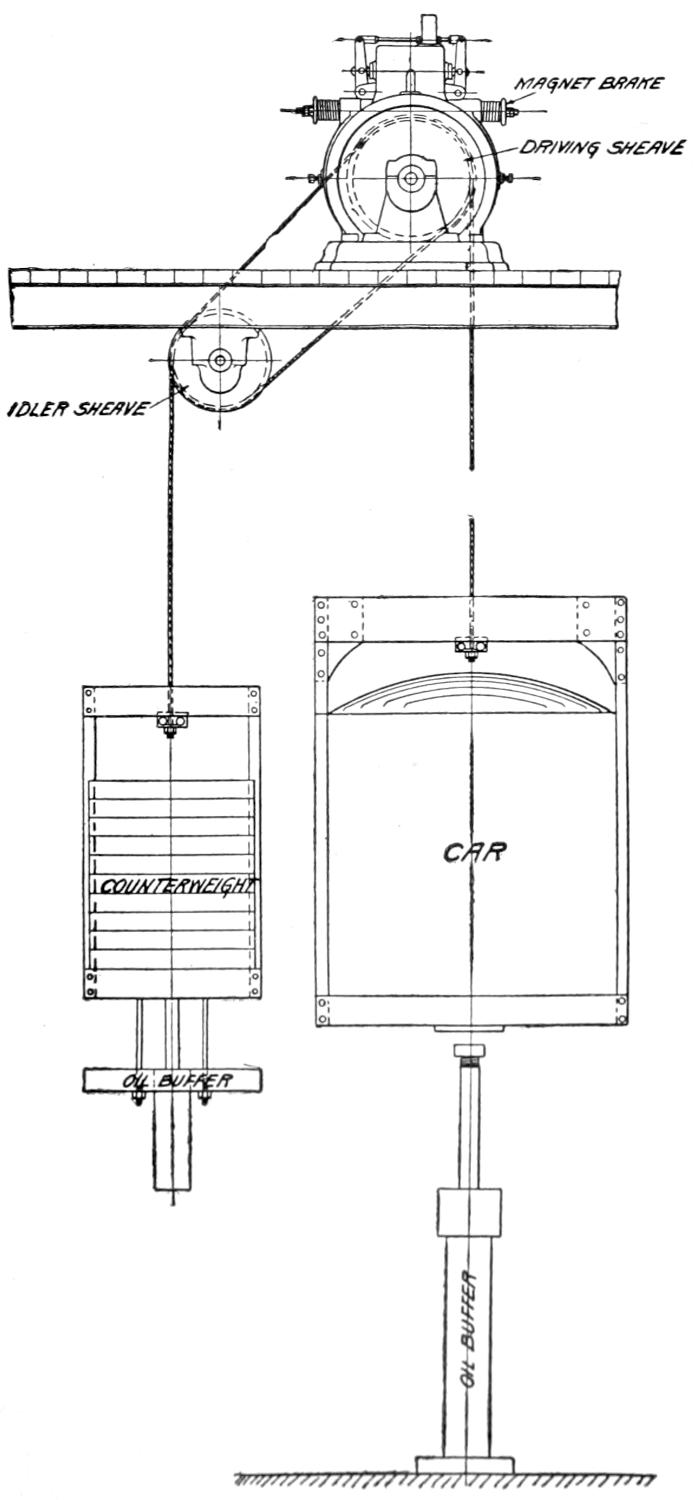
GENERAL ARRANGEMENT OF ROPING FOR GEARLESS TRACTION ELEVATOR INSTALLATION.
If it were not for the genius which has made possible these new types of elevators we could not have the high buildings. The elevators in the Woolworth Building are the latest type in modern elevator construction. In this one building alone there are 29 elevators, and when you are told that the electric elevators in the United States installed by a single company represent a total of 525,000 horse-power, you will have some idea of the power required to operate elevators all over the country.