Volume 8 — HASAN OF BASSORAH.[5]
Richard Francis Burton translation · Edition 2
HASAN OF BASSORAH.[5]
There was once of days of yore and in ages and times long gone before, a merchant, who dwelt in the land of Bassorah and who owned two sons and wealth galore. But in due time Allah, the All-hearing the All-knowing, decreed that he should be admitted to the mercy of the Most High; so he died, and his two sons laid him out and buried him, after which they divided his gardens and estates equally between them and of his portion each one opened a shop.[6] Presently the elder son, Hasan hight, a youth of passing beauty and loveliness, symmetry and perfect grace, betook himself to the company of lewd folk, women and low boys, frolicking with them in gardens and feasting them with meat and wine for months together and occupying himself not with his business like as his father had done, for that he exulted in the abundance of his good. After some time he had wasted all his ready money, so he sold all his father’s lands and houses and played the wastrel until there remained in his hand nothing, neither little nor muchel, nor was one of his comrades left who knew him. He abode thus anhungred, he and his widowed mother, three days, and on the fourth day, as he walked along, unknowing whither to wend, there met him a man of his father’s friends, who questioned him of his case. He told him what had befallen him and the other said, “O my son, I have a brother who is a goldsmith; an thou wilt, thou shalt be with him and learn his craft and become skilled therein.” Hasan consented and accompanied him to his brother, to whom he commended him, saying, “In very sooth this is my son; do thou 8teach him for my sake.” So Hasan abode with the goldsmith and busied himself with the craft; and Allah opened to him the door of gain and in due course he set up shop for himself. One day, as he sat in his booth in the bazar, there came up to him an ’Ajamí, a foreigner, a Persian, with a great white beard and a white turband[7] on his head, having the semblance of a merchant who, after saluting him, looked at his handiwork and examined it knowingly. It pleased him and he shook his head, saying, “By Allah, thou art a cunning goldsmith! What may be thy name?” “Hasan,” replied the other, shortly.[8] The Persian continued to look at his wares, whilst Hasan read in an old book[9] he hent in hand and the folk were taken up with his beauty and loveliness and symmetry and perfect grace, till the hour of mid-afternoon prayer, when the shop became clear of people and the Persian accosted the young man, saying, “O my son, thou art a comely youth! What book is that? Thou hast no sire and I have no son, and I know an art, than which there is no goodlier in the world.”——And Shahrazad perceived the dawn of day and ceased saying her permitted say.
Now when it was the Seven Hundred and Seventy-ninth Night,
She said, It hath reached me, O auspicious King, that the Persian accosted the young man saying, “O my son, thou art a comely youth! Thou hast no sire and I have no son, and I know an art than which there is no goodlier in the world. Many have sought of me instruction therein, but I consented not to instruct any of them in it; yet hath my soul consented that I teach it to thee, for thy love hath gotten hold upon my heart and I will make thee my son and set up between thee and poverty a barrier, so shalt thou be quit of this handicraft and toil no more with hammer and anvil,[10] charcoal and fire.” Hasan asked, “O my lord and when 9wilt thou teach me this?”; and the Persian answered, “To-morrow, Inshallah, I will come to thee betimes and make thee in thy presence fine gold of this copper.” Whereupon Hasan rejoiced and sat talking with the Persian till nightfall, when he took leave of him and going in to his mother, saluted her with the salam and ate with her; but he was dazed, without memory or reason, for that the stranger’s words had gotten hold upon his heart. So she questioned him and he told her what had passed between himself and the Persian, which when she heard, her heart fluttered and she strained him to her bosom, saying, “O my son, beware of hearkening to the talk of the folk, and especially of the Persians, and obey them not in aught; for they are sharpers and tricksters, who profess the art of alchemy[11] and swindle people and take their money and devour it in vain.” Replied Hasan, “O my mother, we are paupers and have nothing he may covet, that he should put a cheat on us. Indeed, this Persian is a right worthy Shaykh and the signs of virtue are manifest on him; Allah hath inclined his heart to me and he hath adopted me to son.” She was silent in her chagrin, and he passed the night without sleep, his heart being full of what the Persian had said to him; nor did slumber visit him for the excess of his joy therein. But when morning morrowed, he rose and taking the keys, opened the shop, whereupon behold, the Persian accosted him. Hasan stood up to him and would have kissed his hands; but he forbade him from this and suffered it not, saying, “O Hasan, set on the crucible and apply the bellows.”[12] So he did as the stranger bade him and lighted the charcoal. Then said the Persian, “O my son, hast thou any copper?” and he replied, “I have a broken platter.” So he bade him work the shears[13] and cut it into bittocks and cast it into the crucible and blow up the fire with the bellows, till the copper became liquid, when he put hand to turband and took 10therefrom a folded paper and opening it, sprinkled thereout into the pot about half a drachm of somewhat like yellow Kohl or eye-powder.[14] Then he bade Hasan blow upon it with the bellows, and he did so, till the contents of the crucible became a lump of gold.[15] When the youth saw this, he was stupefied and at his wits’ end for the joy he felt and taking the ingot from the crucible handled it and tried it with the file and found it pure gold of the finest quality: whereupon his reason fled and he was dazed with excess of delight and bent over the Persian’s hand to kiss it. But he forbade him, saying, “Art thou married?” and when the youth replied “No!” he said, “Carry this ingot to the market and sell it and take the price in haste and speak not.” So Hasan went down into the market and gave the bar to the broker, who took it and rubbed it upon the touchstone and found it pure gold. So they opened the biddings at ten thousand dirhams and the merchants bid against one another for it up to fifteen thousand dirhams,[16] at which price he sold it and taking the money, went home and told his mother all that had passed, saying, “O my mother, I have learnt this art and mystery.” But she laughed at him, saying, “There is no Majesty and there is no Might save in Allah, the Glorious, the Great!”——And Shahrazad perceived the dawn of day and ceased to say her permitted say.
Now when it was the Seven Hundred and Eightieth Night,
She continued, It hath reached me, O auspicious King, that when Hasan the goldsmith told his mother what he had done with the Ajami and cried, “I have learnt this art and mystery,” she laughed at him, saying, “There is no Majesty and there is no Might save in Allah, the Glorious, the Great!”; and she was silent for vexation. Then of his ignorance, he took a metal mortar and returning to the shop, laid it before the Persian, who was still sitting there and who asked him, “O my son, what wilt thou do with this mortar?” Hasan answered, “Let us put it in the fire, and make of it lumps of gold.” The Persian laughed and rejoined, 11“O my son, art thou Jinn-mad that thou wouldst go down into the market with two ingots of gold in one day? Knowest thou not that the folk would suspect us and our lives would be lost? Now, O my son, an I teach thee this craft, thou must practise it but once in each twelvemonth; for that will suffice thee from year to year.” Cried Hasan, “True, O my lord,” and sitting down in his open shop, set on the crucible and cast more charcoal on the fire. Quoth the Persian, “What wilt thou, O my son?”; and quoth Hasan, “Teach me this craft.” “There is no Majesty and there is no Might save in Allah, the Glorious, the Great!” exclaimed the Persian, laughing; “Verily, O my son, thou art little of wit and in nowise fitted for this noble craft. Did ever any during all his life learn this art on the beaten way or in the bazars? If we busy ourselves with it here, the folk will say of us, These practise alchemy; and the magistrates will hear of us, and we shall lose our lives.[17] Wherefore, O my son, an thou desire to learn this mystery forthright, come thou with me to my house.” So Hasan barred his shop and went with that Ajami; but by the way he remembered his mother’s words and thinking in himself a thousand thoughts he stood still, with bowed head. The Persian turned and seeing him thus standing laughed and said to him, “Art thou mad? What! I in my heart purpose thee good and thou misdoubtest I will harm thee!” presently adding, “But, if thou fear to go with me to my house, I will go with thee to thine and teach thee there.” Hasan replied, “’Tis well, O uncle,” and the Persian rejoined, “Go thou before me.” So Hasan led the way to his own house, and entering, told his mother of the Persian’s coming, for he had left him standing at the door. She ordered the house for them and when she had made an end of furnishing and adorning it, her son bade her go to one of the neighbours’ lodgings. So she left her home to them and wended her way, whereupon Hasan brought in the Persian, who entered after asking leave. Then he took in hand a dish and going to the market, returned with food, which he set before the Persian, saying, “Eat, O my lord, that between us there may be bread and salt and may Almighty Allah do vengeance upon the traitor to bread and salt!” The Persian replied with a smile, “True, O my son! Who knoweth the virtue 12and worth of bread and salt?”[18] Then he came forward and ate with Hasan, till they were satisfied; after which the Ajami said, “O my son Hasan, bring us somewhat of sweetmeats.” So Hasan went to the market, rejoicing in his words, and returned with ten saucers[19] of sweetmeats, of which they both ate and the Persian said, “May Allah abundantly requite thee, O my son! It is the like of thee with whom folk company and to whom they discover their secrets and teach what may profit him!”[20] Then said he, “O Hasan bring the gear.” But hardly did Hasan hear these words than he went forth like a colt let out to grass in spring-tide, and hastening to the shop, fetched the apparatus and set it before the Persian, who pulled out a piece of paper and said, “O Hasan, by the bond of bread and salt, wert thou not dearer to me than my son, I would not let thee into the mysteries of this art, for I have none of the Elixir[21] left save what is in this paper; but by and by I will compound the simples whereof it is composed and will make it before thee. Know, O my son Hasan, that to every ten pounds of copper thou must set half a drachm of that which is in this paper, and the whole ten will presently become unalloyed virgin gold;” presently adding, “O my son, O Hasan, there are in this paper three ounces,[22] Egyptian measure, and when it is spent, I will make thee other and more.” Hasan took the packet and finding therein a yellow powder, finer than the first, said to the Persian, “O my lord, what is the name of this substance and where is it found and how is it made?” But he laughed, longing to get hold of the youth, and replied, “Of what dost thou question? Indeed thou art a froward boy! Do thy work and hold thy peace.” So Hasan arose and fetching a brass platter from the house, shore it in shreds and threw it into the melting-pot; then 13he scattered on it a little of the powder from the paper and it became a lump of pure gold. When he saw this, he joyed with exceeding joy and was filled with amazement and could think of nothing save the gold; but, whilst he was occupied with taking up the lumps of metal from the melting-pot, the Persian pulled out of his turband in haste a packet of Cretan Bhang, which if an elephant smelt, he would sleep from night to night, and cutting off a little thereof, put it in a piece of the sweetmeat. Then said he, “O Hasan, thou art become my very son and dearer to me than soul and wealth, and I have a daughter whose like never have eyes beheld for beauty and loveliness, symmetry and perfect grace. Now I see that thou befittest none but her and she none but thee; wherefore, if it be Allah’s will, I will marry thee to her.” Replied Hasan, “I am thy servant and whatso good thou dost with me will be a deposit with the Almighty!” and the Persian rejoined, “O my son, have fair patience and fair shall betide thee.” Therewith he gave him the piece of sweetmeat and he took it and kissing his hand, put it in his mouth, knowing not what was hidden for him in the after time for only the Lord of Futurity knoweth the Future. But hardly had he swallowed it, when he fell down, head foregoing heels, and was lost to the world; whereupon the Persian, seeing him in such calamitous case, rejoiced exceedingly and cried, “Thou has fallen into my snares, O gallows-carrion, O dog of the Arabs! This many a year have I sought thee and now I have found thee, O Hasan!”——And Shahrazad perceived the dawn of day and ceased saying her permitted say.
Now when it was the Seven Hundred and Eighty-first Night,
She pursued, It hath reached me, O auspicious King, that when Hasan the goldsmith ate the bit of sweetmeat given to him by the Ajami and fell fainting to the ground, the Persian rejoiced exceedingly and cried, “This many a year have I sought thee and now I have found thee!” Then he girt himself and pinioned Hasan’s arms and binding his feet to his hands laid him in a chest, which he emptied to that end and locked it upon him. Moreover, he cleared another chest and laying therein all Hasan’s valuables, together with the piece of the first gold-lump and the second ingot which he had made locked it with a padlock. Then he ran to the market and fetching a porter, took up the two chests and made off with them to a place within sight of the city, where he set them 14down on the sea-shore, hard by a vessel at anchor there. Now this craft had been freighted and fitted out by the Persian and her master was awaiting him; so, when the crew saw him, they came to him and bore the two chests on board. Then the Persian called out to the Rais or Captain, saying, “Up and let us be off, for I have done my desire and won my wish.” So the skipper sang out to the sailors, saying, “Weigh anchor and set sail!” And the ship put out to sea with a fair wind. So far concerning the Persian; but as regards Hasan’s mother, she awaited him till supper-time but heard neither sound nor news of him; so she went to the house and finding it thrown open, entered and saw none therein and missed the two chests and their valuables; wherefore she knew that her son was lost and that doom had overtaken him; and she buffeted her face and rent her raiment crying out and wailing and saying, “Alas, my son, ah! Alas, the fruit of my vitals, ah!” And she recited these couplets:—
My patience fails me and grows anxiety; ✿ And with your absence growth of grief I see.
By Allah, Patience went what time ye went! ✿ Loss of all Hope how suffer patiently?
When lost my loved one how can’ joy I sleep? ✿ Who shall enjoy such life of low degree?
Thou’rt gone and, desolating house and home, ✿ Hast fouled the fount erst flowed from foulness free:
Thou wast my fame, my grace ’mid folk, my stay; ✿ Mine aid wast thou in all adversity!
Perish the day, when from mine eyes they bore ✿ My friend, till sight I thy return to me!
And she ceased not to weep and wail till the dawn, when the neighbours came in to her and asked her of her son, and she told them what had befallen him with the Persian, assured that she should never, never see him again. Then she went round about the house, weeping, and wending she espied two lines written upon the wall; so she sent for a scholar, who read them to her; and they were these:—
Leyla’s phantom came by night, when drowsiness had overcome me, towards morning while my companions were sleeping in the desert,
But when we awoke to behold the nightly phantom, I saw the air vacant and the place of visitation was distant.[23]
15When Hasan’s mother heard these lines, she shrieked and said, “Yes, O my son! Indeed, the house is desolate and the visitation-place is distant!” Then the neighbours took leave of her and after they had prayed that she might be vouchsafed patience and speedy reunion with her son went away; but she ceased not to weep all watches of the night and tides of the day and she built amiddlemost the house a tomb whereon she let write Hasan’s name and the date of his loss, and thenceforward she quitted it not, but made a habit of incessantly biding thereby night and day. Such was her case; but touching her son Hasan and the Ajami, this Persian was a Magian, who hated Moslems with exceeding hatred and destroyed all who fell into his power. He was a lewd and filthy villain, a hankerer after alchemy, an astrologer and a hunter of hidden hoards, such an one as he of whom quoth the poet:—
A dog, dog-fathered, by dog-grandsire bred; ✿ No good in dog from dog race issued:
E’en for a gnat no resting-place gives he ✿ Who is composed of seed by all men shed.[24]
The name of this accursed was Bahrám the Guebre, and he was wont, every year, to take a Moslem and cut his throat for his own purposes. So, when he had carried out his plot against Hasan the goldsmith, they sailed on from dawn till dark, when the ship made fast to the shore for the night, and at sunrise, when they set sail again, Bahram bade his black slaves and white servants bring him the chest wherein were Hasan. They did so, and he opened it and taking out the young man, made him sniff up vinegar and blew a powder into his nostrils. Hasan sneezed and vomited the Bhang; then, opening his eyes, he looked about him right and left and found himself amiddleward the sea on aboard a ship in full sail, and saw the Persian sitting by him; wherefore he knew that the accursed Magian had put a cheat on him and that he had fallen into the very peril against which his mother had warned him. So he spake the saying which shall never shame the sayer, to wit, “There is no Majesty and there is no Might save in Allah, the Glorious, the Great! Verily, we are Allah’s and unto Him we are returning! O my God, be Thou gracious to me in Thine appointment and give me patience to endure this Thine 16affliction, O Lord of the three Worlds!” Then he turned to the Persian and bespoke him softly, saying, “O my father, what fashion is this and where is the covenant of bread and salt and the oath thou swarest to me?” But Bahram stared at him and replied, “O dog, knoweth the like of me bond of bread and salt? I have slain of youths like thee a thousand, save one, and thou shalt make up the thousand.” And he cried out at him and Hasan was silent, knowing that the Fate-shaft had shot him.——And Shahrazad perceived the dawn of day and ceased to say her permitted say.
Now when it was the Seven Hundred and Eighty-second Night,
She resumed, It hath reached me, O auspicious King, that when Hasan beheld himself fallen into the hands of the damned Persian he bespoke him softly but gained naught thereby for the Ajami cried out at him in wrath, so he was silent, knowing that the Fate-shaft had shot him. Then the accursed bade loose his pinion-bonds and they gave him a little water to drink, whilst the Magian laughed and said, “By the virtue of the Fire and the Light and the Shade and the Heat, methought not thou wouldst fall into my nets! But the Fire empowered me over thee and helped me to lay hold upon thee, that I might win my wish and return and make thee a sacrifice[25], to her[26] so she may accept of me.” Quoth Hasan, “Thou hast foully betrayed bread and salt”; whereupon the Magus raised his hand and dealt him such a buffet that he fell and, biting the deck with his fore-teeth, swooned away, whilst the tears trickled down his cheeks. Then the Guebre bade his servants light him a fire and Hasan said, “What wilt thou do with it?” Replied the Magian, “This is the Fire, lady of light and sparkles bright! This it is I worship, and if thou wilt worship her even as I, verily I will give thee half my monies and marry thee to my maiden daughter.” Thereupon Hasan cried angrily at him, “Woe to thee! Thou art a miscreant Magian who to Fire dost pray in lieu of the King of Omnipotent sway, Creator of Night and Day; 17and this is naught but a calamity among creeds!” At this the Magian was wroth and said to him, “Wilt thou not then conform with me, O dog of the Arabs, and enter my faith?” But Hasan consented not to this: so the accursed Guebre arose and prostrating himself to the fire, bade his pages throw him flat on his face. They did so, and he beat him with a hide whip of plaited thongs[27] till his flanks were laid open, whilst he cried aloud for aid but none aided him, and besought protection, but none protected him. Then he raised his eyes to the All-powerful King and sought of Him succour in the name of the Chosen Prophet. And indeed patience failed him; his tears ran down his cheeks, like rain, and he repeated these couplets twain:—
In patience, O my God, Thy doom forecast ✿ I’ll bear, an thereby come Thy grace at last:
They’ve dealt us wrong, transgressed and ordered ill; ✿ Haply Thy Grace shall pardon what is past.
Then the Magian bade his negro-slaves raise him to a sitting posture and bring him somewhat of meat and drink. So they sat food before him; but he consented not to eat or drink; and Bahram ceased not to torment him day and night during the whole voyage, whilst Hasan took patience and humbled himself in supplication before Almighty Allah to whom belong Honour and Glory; whereby the Guebre’s heart was hardened against him. They ceased not to sail the sea three months, during which time Hasan was continually tortured till Allah Almighty sent forth upon them a foul wind and the sea grew black and rose against the ship, by reason of the fierce gale; whereupon quoth the captain and crew,[28] “By Allah, this is all on account of yonder youth, who hath been these three months in torture with this Magian. Indeed, this is not allowed of God the Most High.” Then they rose against the Magian and slew his servants and all who were with him; which when he saw, he made sure of death and feared for himself. So he loosed Hasan from his bonds and pulling off the ragged clothes the youth had on, clad him in others; and made excuses to him and promised to teach him the craft and restore 18him to his native land, saying, “O my son, return me not evil for that I have done with thee.” Quoth Hasan, “How can I ever rely upon thee again?”; and quoth Bahram, “O my son, but for sin, there were no pardon. Indeed, I did all these doings with thee, but to try thy patience, and thou knowest that the case is altogether in the hands of Allah.” So the crew and captain rejoiced in Hasan’s release, and he called down blessings on them and praised the Almighty and thanked Him. With this the wind was stilled and the sky cleared and with a fair breeze they continued their voyage. Then said Hasan to Bahram, “O Master,[29] whither wendest thou?” Replied the Magian, “O my son, I am bound for the Mountain of Clouds, where is the Elixir which we use in alchemy.” And the Guebre swore to him by the Fire and the Light that he had no longer any cause to fear him. So Hasan’s heart was set at ease and rejoicing at the Persian’s words, he continued to eat and drink and sleep with the Magian, who clad him in his own raiment. They ceased not sailing on other three months, when the ship came to anchor off a long shoreline of many-coloured pebbles, white and yellow and sky-blue and black and every other hue, and the Magian sprang up and said, “O Hasan, come, let us go ashore for we have reached the place of our wish and will.” So Hasan rose and landed with Bahram, after the Persian had commended his goods to the captain’s care. They walked on inland, till they were far enough from the ship to be out of sight, when Bahram sat down and taking from his pocket a kettle-drum[30] of copper and a silken strap, worked in gold with characts, beat the drum with the strap, until there arose a cloud of dust from the further side of the waste. Hasan marvelled at the Magian’s doings and was afraid of him: he repented of having come ashore with him and his colour changed. But Bahram looked at him and said, “What aileth thee, O my son? By the truth of the Fire and the Light, thou hast naught to fear from me; and, were it not that my wish may never be won save by thy means, I had not brought thee ashore. So rejoice in all good; for yonder cloud of dust is the dust of somewhat we 19will mount and which will aid us to cut across this wold and make easy to us the hardships thereof.”——And Shahrazad perceived the dawn of day and ceased saying her permitted say.
Now when it was the Seven Hundred and Eighty-third Night,
She continued, It hath reached me, O auspicious King, that the Persian said to Hasan, “In very sooth yonder dust-cloud is the cloud of something we will mount and which will aid us to cut across this wold and will make easy to us the hardships thereof.” Presently the dust lifted off three she-dromedaries, one of which Bahram mounted and Hasan another. Then they loaded their victual on the third and fared on seven days, till they came to a wide champaign and, descending into its midst, they saw a dome vaulted upon four pilasters of red gold; so they alighted and entering thereunder, ate and drank and took their rest. Anon Hasan chanced to glance aside and seeing from afar a something lofty said to the Magian, “What is that, O nuncle?” Bahram replied, “’Tis a palace,” and quoth Hasan, “Wilt thou not go thither, that we may enter and there repose ourselves and solace ourselves with inspecting it?” But the Persian was wroth and said, “Name not to me yonder palace; for therein dwelleth a foe, with whom there befel me somewhat whereof this is no time to tell thee.” Then he beat the kettle-drum and up came the dromedaries, and they mounted and fared on other seven days. On the eighth day, the Magian said, “O Hasan, what seest thou?” Hasan replied, “I see clouds and mists twixt east and west.” Quoth Bahram, “That is neither clouds nor mists, but a vast mountain and a lofty whereon the clouds split,[31] and there are no clouds above it, for its exceeding height and surpassing elevation. Yon mount is my goal and thereon is the need we seek. ’Tis for that I brought thee hither, for my wish may not be won save at thy hands.” Hasan hearing this gave his life up for lost and said to the Magian, “By the right of that thou worshippest and by the faith wherein thou believest, I conjure thee to tell me what is the object wherefor thou hast brought me!” Bahram replied, “The art of alchemy may not be accomplished save by means of a herb which groweth 20in the place where the clouds pass and whereon they split. Such a site is yonder mountain upon whose head the herb groweth and I purpose to send thee up thither to fetch it; and when we have it, I will show thee the secret of this craft which thou desirest to learn.” Hasan answered, in his fear, “’Tis well, O my master;” and indeed he despaired of life and wept for his parting from his parent and people and patrial stead repenting him of having gainsaid his mother and reciting these two couplets:—
Consider but thy Lord, His work shall bring ✿ Comfort to thee, with quick relief and near:
Despair not when thou sufferest sorest bane: ✿ In bane how many blessed boons appear!
They ceased not faring on till they came to the foot-hills of that mountain where they halted; and Hasan saw thereon a palace and asked Bahram, “What be yonder palace?”; whereto he answered, “’Tis the abode of the Jann and Ghuls and Satans.” Then the Magian alighted and making Hasan also dismount from his dromedary kissed his head and said to him, “Bear me no ill will anent that I did with thee, for I will keep guard over thee in thine ascent to the palace; and I conjure thee not to trick and cheat me of aught thou shalt bring therefrom; and I and thou will share equally therein.” And Hasan replied, “To hear is to obey.” Then Bahram opened a bag and taking out a handmill and a sufficiency of wheat, ground the grain and kneaded three round cakes of the flour; after which he lighted a fire and baked the bannocks. Then he took out the copper kettle-drum and beat it with the broidered strap, whereupon up came the dromedaries. He chose out one and said, “Hearken, O my son, O Hasan, to what I am about to enjoin on thee;” and Hasan replied, “’Tis well.” Bahram continued, “Lie down on this skin and I will sew thee up therein and lay thee on the ground; whereupon the Rakham birds[32] will come to thee and carry thee up to the mountain-top. Take this knife with thee; and, when thou feelest that the birds have done flying and have set thee down, slit open therewith the skin and come forth. The vultures will then take fright at thee and fly away; whereupon do thou look down from the mountain head and speak to me, and I will tell thee what to 21do.” So he sewed him up in the skin, placing therein three cakes and a leathern bottle full of water, and withdrew to a distance. Presently a vulture pounced upon him and taking him up, flew away with him to the mountain-top and there set him down. As soon as Hasan felt himself on the ground, he slit the skin and coming forth, called out to the Magian, who hearing his speech rejoiced and danced for excess of joy, saying to him, “Look behind thee and tell me what thou seest.” Hasan looked and seeing many rotten bones and much wood, told Bahram, who said to him, “This be what we need and seek. Make six bundles of the wood and throw them down to me, for this is wherewithal we do alchemy.” So he threw him the six bundles and when he had gotten them into his power he said to Hasan, “O gallows bird, I have won my wish of thee; and now, if thou wilt, thou mayst abide on this mountain, or cast thyself down to the earth and perish.” So saying, he left him[33] and went away, and Hasan exclaimed, “There is no Majesty and there is no Might save in Allah, the Glorious, the Great! This hound hath played the traitor with me.” And he sat bemoaning himself and reciting these couplets:—
When God upon a man possessed of reasoning, Hearing and sight His will in aught to pass would bring,
He stops his ears and blinds his eyes and draws his wit, From him, as one draws out the hairs to paste that cling;
Till, His decrees fulfilled, He gives him back His wit, That therewithal he may receive admonishing.
So say thou not of aught that haps, “How happened it?” For Fate and fortune fixed do order everything.[34]
——And Shahrazad perceived the dawn of day and ceased to say her permitted say.
Now when it was the Seven Hundred and Eighty-fourth Night,
She pursued, It hath reached me, O auspicious King, that when the Magian sent Hasan to the mountain-top and made him throw 22down all he required he presently reviled him and left him and wended his ways and the youth exclaimed, “There is no Majesty and there is no Might save in Allah, the Glorious, the Great! This damned hound hath played the traitor.” Then he rose to his feet and looked right and left, after which he walked on along the mountain top, in mind making certain of death. He fared on thus till he came to the counterslope of the mountain, along which he saw a dark-blue sea, dashing with billows clashing and yeasting waves each as it were a lofty mount. So he sat down and repeated what he might of the Koran and besought Allah the Most High to ease him of his troubles, or by death or by deliverance from such strait. Then he recited for himself the funeral-prayer[35] and cast himself down into the main; but, the waves bore him up by Allah’s grace, so that he reached the water unhurt, and the angel in whose charge is the sea watched over him, so that the billows bore him safe to land, by the decree of the Most High. Thereupon he rejoiced and praised Almighty Allah and thanked Him; after which he walked on in quest of something to eat, for stress of hunger, and came presently to the place where he had halted with the Magian, Bahram. Then he fared on awhile, till behold, he caught sight of a great palace, rising high in air, and knew it for that of which he had questioned the Persian and he had replied, “Therein dwelleth a foe of mine.” Hasan said to himself, “By Allah, needs must I enter yonder palace; perchance relief awaiteth me there.” So coming to it and finding the gate open, he entered the vestibule, where he saw seated on a bench two girls like twin moons with a chess-cloth before them and they were at play. One of them raised her head to him and cried out for joy saying, “By Allah, here is a son of Adam, and methinks ’tis he whom Bahram the Magian brought hither this year!” So Hasan hearing her words cast himself at their feet and wept with sore weeping and said, “Yes, O my ladies, by Allah, I am indeed that unhappy.” Then said the younger damsel to her elder sister, “Bear witness against me,[36] O my sister, that this is my brother by covenant of Allah and that I will die for his death and live for his life and joy for his joy and mourn for his mourning.” So 23saying, she rose and embraced him and kissed him and presently taking him by the hand and her sister with her, led him into the palace, where she did off his ragged clothes and brought him a suit of Kings’ raiment wherewith she arrayed him. Moreover, she made ready all manner viands[37] and set them before him, and sat and ate with him, she and her sister. Then said they to him, “Tell us thy tale with yonder dog, the wicked, the wizard, from the time of thy falling into his hands to that of thy freeing thee from him; and after we will tell thee all that hath passed between us and him, so thou mayst be on thy guard against him an thou see him again.” Hearing these words and finding himself thus kindly received, Hasan took heart of grace and reason returned to him and he related to them all that had befallen him with the Magian from first to last. Then they asked, “Didst thou ask him of this palace?”; and he answered, “Yes, but he said:—Name it not to me; for it belongeth to Ghuls and Satans.” At this, the two damsels waxed wroth with exceeding wrath and said, “Did that Miscreant style us Ghuls and Satans?” And Hasan answered, “Yes.” Cried the younger sister, “By Allah, I will assuredly do him die with the foulest death and make him to lack the wind of the world!” Quoth Hasan, “And how wilt thou get at him, to kill him, for he is a crafty magician?”; and quoth she, “He is in a garden by name Al-Mushayyad,[38] and there is no help but that I slay him before long.” Then said her sister, “Sooth spake Hasan in everything he hath recounted to us of this cur; but now tell him our tale, that all of it may abide in his memory.” So the younger said to him, “Know, O my brother, that we are the daughters of a King of the mightiest Kings of the Jann, having Marids for troops and guards and servants, and Almighty Allah blessed him with seven daughters by one wife; but of his folly such jealousy and stiff-neckedness and pride beyond compare gat hold upon him that he would not 24give us in marriage to any one and, summoning his Wazirs and Emirs, he said to them:—Can ye tell me of any place untrodden by the tread of men and Jinn and abounding in trees and fruits and rills? And quoth they, What wilt thou therewith, O King of the Age? And quoth he, I desire there to lodge my seven daughters. Answered they, O King, the place for them is the Castle of the Mountain of Clouds, built by an Ifrit of the rebellious Jinn, who revolted from the covenant of our lord Solomon, on whom be the Peace! Since his destruction, none hath dwelt there, nor man nor Jinni, for ’tis cut off[39] and none may win to it. And the Castle is girt about with trees and fruits and rills, and the water running around it is sweeter than honey and colder than snow: none who is afflicted with leprosy or elephantiasis[40] or what not else drinketh thereof but he is healed forthright. Hearing this our father sent us hither, with an escort of his troops and guards and provided us with all that we need here. When he is minded to ride to us he beateth a kettle-drum, whereupon all his hosts present themselves before him and he chooseth whom he shall ride and dismisseth the rest; but, when he desireth that we shall visit him, he commandeth his followers, the enchanters, to fetch us and carry us to the presence; so he may solace himself with our society and we accomplish our desire of him; after which they again carry us back hither. Our five other sisters are gone a-hunting in our desert, wherein are wild beasts past compt or calculation and, it being our turn to do this we two abode at home, to make ready for them food. Indeed, we had besought Allah (extolled and exalted be He!) to vouchsafe us a son of Adam to cheer us with his company and praised be He 25who hath brought thee to us! So be of good cheer and keep thine eyes cool and clear, for no harm shall befal thee.” Hasan rejoiced and said, “Alhamdolillah, laud to the Lord who guideth us into the path of deliverance and inclineth hearts to us!” Then his sister[41] rose and taking him by the hand, led him into a private chamber, where she brought out to him linen and furniture that no mortal can avail unto. Presently, the other damsels returned from hunting and birding and their sisters acquainted them with Hasan’s case; whereupon they rejoiced in him and going into him in his chamber, saluted him with the salam and gave him joy of his safety. Then he abode with them in all the solace of life and its joyance, riding out with them to the chase and taking his pleasure with them whilst they entreated him courteously and cheered him with converse, till his sadness ceased from him and he recovered health and strength and his body waxed stout and fat, by dint of fair treatment and pleasant time among the seven moons in that fair palace with its gardens and flowers; for indeed he led the delightsomest of lives with the damsels who delighted in him and he yet more in them. And they used to give him drink of the honey-dew of their lips,[42] these beauties with the high bosoms, adorned with grace and loveliness, the perfection of brilliancy and in shape very symmetry. Moreover the youngest Princess told her sisters how Bahram the Magian had made them of the Ghuls and Demons and Satans,[43] and they sware that they would surely slay him. Next year the accursed Guebre again made his appearance, having with him a handsome young Moslem, as he were the moon, bound hand and foot and tormented with grievous tortures, and alighted with him below the palace-walls. Now Hasan was sitting under the trees by the side of the stream; and when he espied Bahram, his heart fluttered,[44] his hue changed 26and he smote hand upon hand.——And Shahrazad perceived the dawn of day and ceased saying her permitted say.
Now when it was the Seven Hundred and Eighty-fifth Night,
She resumed, It hath reached me, O auspicious King, that when Hasan the goldsmith saw the Magian, his heart fluttered, his hue changed and he smote hand upon hand. Then he said to the Princesses, “O my sisters, help me to the slaughter of this accursed, for here he is come back and in your grasp, and he leadeth with him captive a young Moslem of the sons of the notables, whom he is torturing with all manner grievous torments. Lief would I kill him and console my heart of him; and, by delivering the young Moslem from his mischief and restoring him to his country and kith and kin and friends, fain would I lay up merit for the world to come, by taking my wreak of him.[45] This will be an almsdeed from you and ye will reap the reward thereof from Almighty Allah.” “We hear and we obey Allah and thee, O our brother, O Hasan,” replied they and binding chin-veils, armed themselves and slung on their swords: after which they brought Hasan a steed of the best and equipped him in panoply and weaponed him with goodly weapons. Then they all sallied out and found the Magian who had slaughtered and skinned a camel ill-using the young Moslem, and saying to him, “Sit thee in this hide.” So Hasan came behind him, without his knowledge, and cried out at him till he was dazed and amazed. Then he came up to him, saying, “Hold thy hand, O accursed! O enemy of Allah and foe of the Moslems! O dog! O traitor! O thou that flame dost obey! O thou that walkest in the wicked ones’ ways, worshipping the fire and the light and swearing by the shade and the heat!” Herewith the Magian turned and seeing Hasan, thought to wheedle him and said to him, “O my son, how diddest thou escape and who brought thee down to earth?” Hasan replied, “He delivered me, who hath appointed the taking of thy life to be at my hand, and I will torture thee even as thou 27torturest me the whole way long. O miscreant, O atheist,[46] thou hast fallen into the twist and the way thou hast missed; and neither mother shall avail thee nor brother, nor friend nor solemn covenant shall assist thee; for thou saidst, O accursed, Whoso betrayeth bread and salt, may Allah do vengeance upon him! And thou hast broken the bond of bread and salt; wherefore the Almighty hath thrown thee into my grasp, and far is thy chance of escape from me.” Rejoined Bahram, “By Allah, O my son, O Hasan, thou art dearer to me than my sprite and the light of mine eyes!” But Hasan stepped up to him and hastily smote him between the shoulders, that the sword issued gleaming from his throat-tendons and Allah hurried his soul to the fire, and abiding-place dire. Then Hasan took the Magian’s bag and opened it, then having taken out the kettle-drum he struck it with the strap, whereupon up came the dromedaries like lightning. So he unbound the youth from his bonds and setting him on one of the camels, loaded him another with victual and water,[47] saying, “Wend whither thou wilt.” So he departed, after Almighty Allah had thus delivered him from his strait at the hands of Hasan. When the damsels saw their brother slay the Magian they joyed in him with exceeding joy and gat round him, marvelling at his valour and prowess;[48] and thanked him for his deed and gave him joy of his safety, saying, “O Hasan thou hast done a deed, whereby thou hast healed the burning of him that thirsteth for vengeance and pleased the King of Omnipotence!” Then they returned to the palace, and he abode with them, eating and drinking and laughing and making merry; and indeed his sojourn with them was joyous to him and he forgot his mother;[49] but while he led with them this goodly life one day, behold, there arose from the further side of the desert a great cloud of dust that darkened the welkin and made towards them. When the Princesses saw this, they said to him, “Rise, O Hasan, run to thy chamber and conceal thyself; or an thou wilt, go down into the garden and hide thyself among the 28trees and vines; but fear not, for no harm shall befal thee.” So he arose and entering his chamber, locked the door upon himself, and lay lurking in the palace. Presently the dust opened out and showed beneath it a great and conquering host, as it were a surging sea, coming from the King, the father of the damsels. Now when the troops reached the castle, the Princesses received them with all honour and hospitably entertained them three days; after which they questioned them of their case and tidings and they replied saying, “We come from the King in quest of you.” They asked, “And what would the King with us?”; and the officers answered, “One of the Kings maketh a marriage festival, and your father would have you be present thereat and take your pleasure therewith.” The damsels enquired, “And how long shall we be absent from our place?”; and they rejoined, “The time to come and go, and to sojourn may be two months.” So the Princesses arose and going in to the palace sought Hasan, acquainted him with the case and said to him, “Verily this place is thy place and our house is thy house; so be of good cheer and keep thine eyes cool and clear and feel nor grief nor fear, for none can come at thee here; but keep a good heart and a glad mind, till we return to thee. The keys of our chambers we leave with thee; but, O our brother, we beseech thee, by the bond of brotherhood, in very deed not to open such a door, for thou hast no need thereto.” Then they farewelled him and fared forth with the troops, leaving Hasan alone in the palace. It was not long before his breast grew straitened and his patience shortened: solitude and sadness were heavy on him and he sorrowed for his severance from them with passing chagrin. The palace for all its vastness, waxed small to him and finding himself sad and solitary, he bethought him of the damsels and their pleasant converse and recited these couplets:—
The wide plain is narrowed before these eyes ✿ And the landscape troubles this heart of mine.
Since my friends went forth, by the loss of them ✿ Joy fled and these eyelids rail floods of brine:
Sleep shunned these eyeballs for parting woe ✿ And my mind is worn with sore pain and pine:
Would I wot an Time shall rejoin our lots ✿ And the joys of love with night-talk combine.
——And Shahrazad perceived the dawn of day and ceased to say her permitted say.
29
Now when it was the Seven Hundred and Eighty-sixth Night,
She said, It hath reached me, O auspicious King, that after the departure of the damsels, Hasan sat in the palace sad and solitary and his breast was straitened by severance. He used to ride forth a-hunting by himself in the wold and bring back the game and slaughter it and eat thereof alone: but melancholy and disquiet redoubled on him, by reason of his loneliness. So he arose and went round about the palace and explored its every part; he opened the Princesses’ apartments and found therein riches and treasures fit to ravish the beholder’s reason; but he delighted not in aught thereof, by reason of their absence. His heart was fired by thinking of the door they had charged him not to approach or open on any account and he said in himself, “My sister had never enjoined me not to open this door, except there were behind it somewhat whereof she would have none to know; but, by Allah, I will arise and open it and see what is within, though within it were sudden death!” Then he took the key and, opening the door,[50] saw therein no treasure but he espied a vaulted and winding staircase of Yamani onyx at the upper end of the chamber. So he mounted the stair, which brought him out upon the terrace-roof of the palace, whence he looked down upon the gardens and vergiers, full of trees and fruits and beasts and birds warbling praises of Allah, the One, the All-powerful; and said in himself “This is that they forbade to me.” He gazed upon these pleasaunces and saw beyond a surging sea, dashing with clashing billows, and he ceased not to explore the palace right and left, till he ended at a pavilion builded with alternate courses, two bricks of gold and one of silver and jacinth and emerald and supported by four columns. And in the centre he saw a sitting-room paved and lined with a mosaic of all manner precious stones such as rubies and emeralds and balasses and other jewels of sorts; and in its midst stood a basin[51] brimful of water, over 30which was a trellis-work of sandal-wood and aloes-wood reticulated with rods of red gold and wands of emerald and set with various kinds of jewels and fine pearls, each sized as a pigeon’s egg. The trellis was covered with a climbing vine, bearing grapes like rubies, and beside the basin stood a throne of lign-aloes latticed with red gold, inlaid with great pearls and comprising vari-coloured gems of every sort and precious minerals, each kind fronting each and symmetrically disposed. About it the birds warbled with sweet tongues and various voices celebrating the praises of Allah the Most High: brief, it was a palace such as nor Cæsar nor Chosroës ever owned; but Hasan saw therein none of the creatures of Allah, whereat he marvelled and said in himself, “I wonder to which of the Kings this place pertaineth, or is it Many-Columned Iram whereof they tell, for who among mortals can avail to the like of this?” And indeed he was amazed at the spectacle and sat down in the pavilion and cast glances around him marvelling at the beauty of its ordinance and at the lustre of the pearls and jewels and the curious works which therein were, no less than at the gardens and orchards aforesaid and at the birds that hymned the praises of Allah, the One, the Almighty; and he abode pondering the traces of him whom the Most High had enabled to rear that structure, for indeed He is muchel of might.[52] And presently, behold, he espied ten birds[53] 31flying towards the pavilion from the heart of the desert and knew that they were making the palace and bound for the basin, to drink of its waters: so he hid himself, for fear they should see him and take flight. They lighted on a great tree and a goodly and circled round about it; and he saw amongst them a bird of marvel-beauty, the goodliest of them all, and the nine stood around it and did it service; and Hasan marvelled to see it peck them with its bill and lord it over them while they fled from it. He stood gazing at them from afar as they entered the pavilion and perched on the couch; after which each bird rent open its neck-skin with its claws and issued out of it; and lo! it was but a garment of feathers, and there came forth therefrom ten virgins, maids whose beauty shamed the brilliancy of the moon. They all doffed their clothes and plunging into the basin, washed and fell to playing and sporting one with other; whilst the chief bird of them lifted up the rest and ducked them down, and they fled from her and dared not put forth their hands to her. When Hasan beheld her thus he took leave of his right reason and his sense was enslaved, so he knew that the Princesses had not forbidden him to open the door save because of this; for he fell passionately in love with her, for what he saw of her beauty and loveliness, symmetry and perfect grace, as she played and sported and splashed the others with the water. He stood looking upon them whilst they saw him not, with eye gazing and heart burning and soul[54] to evil prompting; and he sighed to be with them and wept for longing, because of the beauty and loveliness of the chief damsel. His mind was amazed at her charms and his heart taken in the net of her love; lowe was loosed in his heart for her sake and there waxed on him a flame, whose sparks might not be quenched, and desire, whose signs might not be hidden. Presently, they came up out of that basin, whilst Hasan marvelled at their beauty and loveliness and the tokens of inner gifts in the elegance of their movements. Then he cast a glance at the chief damsel who stood mother-naked and there was manifest to him what was between her thighs 32a goodly rounded dome on pillars borne, like a bowl of silver or crystal, which recalled to him the saying of the poet:[55]—
When I took up her shift and discovered the terrace-roof of her kaze, I found it as strait as my humour or eke my worldly ways:
So I thrust it, incontinent, in, halfway, and she heaved a sigh. “For what dost thou sigh?” quoth I. “For the rest of it sure,” she says.
Then coming out of the water they all put on their dresses and ornaments, and the chief maiden donned a green dress,[56] wherein she surpassed for loveliness all the fair ones of the world and the lustre of her face outshone the resplendent full moons: she excelled the branches with the grace of her bending gait and confounded the wit with apprehension of disdain; and indeed she was as saith the poet:[57]—
A maiden ’twas, the dresser’s art had decked with cunning sleight;
The sun thou ’d’st say had robbed her cheek and shone with borrowed light.
She came to us apparelled fair in under vest of green,
Like as the ripe pomegranate hides beneath its leafy screen;
And when we asked her what might be the name of what she wore,
She answered in a quaint reply that double meaning bore:
The desert’s heart we penetrate in such apparel dressed,
And Pierce-heart therefore is the name by which we call the vest.
——And Shahrazad perceived the dawn of day and ceased saying her permitted say.
Now when it was the Seven Hundred and Eighty-seventh Night,
She continued, It hath reached me, O auspicious King, that when Hasan saw the damsels issue forth the basin, the chief maiden robbed his reason with her beauty and loveliness compelling him to recite the couplets forequoted. And after dressing they sat talking and laughing, whilst he stood gazing on them, drowned in the sea of his love, burning in the flames of passion and wandering in the Wady of his melancholy thought. And he said to himself, 33“By Allah, my sister forbade me not to open the door, but for cause of these maidens and for fear lest I should fall in love with one of them! How, O Hasan shalt thou woo and win them? How bring down a bird flying in the vasty firmament? By Allah thou hast cast thyself into a bottomless sea and snared thyself in a net whence there is no escape! I shall die desolate and none shall wot of my death.” And he continued to gaze on the charms of the chief damsel, who was the lovliest creature Allah had made in her day, and indeed she outdid in beauty all human beings. She had a mouth magical as Solomon’s seal and hair blacker than the night of estrangement to the love-despairing man; her brow was bright as the crescent moon of the Feast of Ramazán[58] and her eyes were like eyes wherewith gazelles scan; she had a polished nose straight as a cane and cheeks like blood-red anemones of Nu’uman, lips like coralline and teeth like strung pearls in carcanets of gold virgin to man, and a neck like an ingot of silver, above a shape like a wand of Bán: her middle was full of folds, a dimpled plain such as enforceth the distracted lover to magnify Allah and extol His might and main, and her navel[59] an ounce of musk, sweetest of savour could contain: she had thighs great and plump, like marble columns twain or bolsters stuffed with down from ostrich ta’en, and between them a somewhat, as it were a hummock great of span or a hare with ears back lain while terrace-roof and pilasters completed the plan; and indeed she surpassed the bough of the myrobalan with her beauty and symmetry, and the Indian rattan, for she was even as saith of them the poet whom love did unman:[60]—
Her lip-dews rival honey-sweets, that sweet virginity; ✿ Keener than Hindí scymitar the glance she casts at thee:
She shames the bending bough of Bán with graceful movement slow ✿ And as she smiles her teeth appear with leven’s brilliancy:
34When I compared with rose a-bloom the tintage of her cheeks, ✿ She laughed in scorn and cried, “Whoso compares with rosery
My hue and breasts granados terms, is there no shame in him? ✿ How should pomegranates bear on bough such fruit in form or blee?
Now by my beauty and mine eyes and heart and eke by Heaven ✿ Of favours mine and by the Hell of my un-clemency,
They say ‘She is a garden-rose in very pride of bloom’; ✿ And yet no rose can ape my cheek nor branch my symmetry!
If any garden own a thing which unto me is like, ✿ What then is that he comes to crave of me and only me?”
They ceased not to laugh and play, whilst Hasan stood still a-watching them, forgetting meat and drink, till near the hour of mid-afternoon prayer, when the beauty, the chief damsel, said to her mates, “O Kings’ daughters, it waxeth late and our land is afar and we are weary of this stead. Come, therefore, let us depart to our own place.” So they all arose and donned their feather vests, and becoming birds as they were before, flew away all together, with the chief lady in their midst. Then, Hasan, despairing of their return, would have arisen and gone down into the palace but could not move or even stand; wherefore the tears ran down his cheeks and passion was sore on him and he recited these couplets:—
May God deny me boon of troth if I ✿ After your absence sweets of slumber know:
Yea; since that sev’rance never close mine eyes, ✿ Nor rest repose me since departed you!
’Twould seem as though you saw me in your sleep; ✿ Would Heaven the dreams of sleep were real-true!
Indeed I dote on sleep though needed not, ✿ For sleep may bring me that dear form to view.
Then Hasan walked on, little by little, heeding not the way he went, till he reached the foot of the stairs, whence he dragged himself to his own chamber; then he entered and shutting the door, lay sick eating not nor drinking and drowned in the sea of his solitude. He spent the night thus, weeping and bemoaning himself, till the morning, and when it morrowed he repeated these couplets:—
The birds took flight at eve and winged their way; ✿ And sinless he who died of Love’s death-blow.
I’ll keep my love-tale secret while I can ✿ But, an desire prevail, its needs must show:
Night brought me nightly vision, bright as dawn; ✿ While nights of my desire lack morning-glow.
35I mourn for them[61] while they heart-freest sleep ✿ And winds of love on me their plaything blow:
Free I bestow my tears, my wealth, my heart ✿ My wit, my sprite:—most gain who most bestow!
The worst of woes and banes is enmity ✿ Beautiful maidens deal us to our woe.
Favour they say’s forbidden to the fair ✿ And shedding lovers’ blood their laws allow;
That naught can love-sicks do but lavish soul, ✿ And stake in love-play life on single throw:[62]
I cry in longing ardour for my love: ✿ Lover can only weep and wail Love-lowe.
When the sun rose he opened the door, went forth of the chamber and mounted to the stead where he was before: then he sat down facing the pavilion and awaited the return of the birds till nightfall; but they returned not; wherefore he wept till he fell to the ground in a fainting-fit. When he came to after his swoon, he dragged himself down the stairs to his chamber; and indeed, the darkness was come and straitened upon him was the whole world and he ceased not to weep and wail himself through the livelong night, till the day broke and the sun rained over hill and dale its rays serene. He ate not nor drank nor slept, nor was there any rest for him; but by day he was distracted and by night distressed, with sleeplessness delirious and drunken with melancholy thought and excess of love-longing. And he repeated the verses of the love-distraught poet:—
O thou who shamest sun in morning sheen ✿ The branch confounding, yet with nescience blest;
Would Heaven I wot an Time shall bring return ✿ And quench the fires which flame unmanifest,—
Bring us together in a close embrace, ✿ Thy cheek upon my cheek, thy breast abreast!
Who saith, In Love dwells sweetness? when in Love ✿ Are bitterer days than Aloë’s[63] bitterest.
36——And Shahrazad perceived the dawn of day and ceased to say her permitted say.
Now when it was the Seven Hundred and Eighty-eighth Night,
She pursued, It hath reached me, O auspicious King, that when Hasan the goldsmith felt love redouble upon him, he recited those lines; and, as he abode thus in the stress of his love-distraction, alone and finding none to cheer him with company, behold, there arose a dust-cloud from the desert, wherefore he ran down and hid himself knowing that the Princesses who owned the castle had returned. Before long, the troops halted and dismounted round the palace and the seven damsels alighted and entering, put off their arms and armour of war. As for the youngest, she stayed not to doff her weapons and gear, but went straight to Hasan’s chamber, where finding him not, she sought for him, till she lighted on him in one of the sleeping closets hidden, feeble and thin, with shrunken body and wasted bones and indeed his colour was changed and his eyes sunken in his face for lack of food and drink and for much weeping, by reason of his love and longing for the young lady. When she saw him in this plight, she was confounded and lost her wits; but presently she questioned him of his case and what had befallen him, saying, “Tell me what aileth thee, O my brother, that I may contrive to do away thine affliction, and I will be thy ransom!”[64] Whereupon he wept with sore weeping and by way of reply he began reciting:—
Lover, when parted from the thing he loves, ✿ Has naught save weary woe and bane to bear.
Inside is sickness, outside living lowe, ✿ His first is fancy and his last despair.
When his sister heard this, she marvelled at his eloquence and loquent speech and his readiness at answering her in verse and said to him, “O my brother, when didst thou fall into this thy case and what hath betided thee, that I find thee speaking in song and shedding tears that throng? Allah upon thee, O my brother, 37and by the honest love which is between us, tell me what aileth thee and discover to me thy secret, nor conceal from me aught of that which hath befallen thee in our absence; for my breast is straitened and my life is troubled because of thee.” He sighed and railed tears like rain, after which he said, “I fear, O my sister, if I tell thee, that thou wilt not aid me to win my wish but wilt leave me to die wretchedly in mine anguish.” She replied, “No, by Allah, O my brother, I will not abandon thee, though it cost me my life!” So he told her all that had befallen him, and that the cause of his distress and affliction was the passion he had conceived for the young lady whom he had seen when he opened the forbidden door; and how he had not tasted meat nor drink for ten days past. Then he wept with sore weeping and recited these couplets:—
Restore my heart as ’twas within my breast, ✿ Let mine eyes sleep again, then fly fro’ me.
Deem ye the nights have had the might to change ✿ Love’s vow? Who changeth may he never be!
His sister wept for his weeping and was moved to ruth for his case and pitied his strangerhood; so she said to him, “O my brother, be of good cheer and keep thine eyes cool and clear, for I will venture being and risk existence to content thee and devise thee a device wherewith, though it cost me my dear life and all I hold dear, thou mayst get possession of her and accomplish thy desire, if such be the will of Allah Almighty. But I charge thee, O my brother, keep the matter secret from my sisterhood and discover not thy case to any one of them, lest my life be lost with thy life. An they question thee of opening the forbidden door, reply to them:—I opened it not; no, never; but I was troubled at heart for your absence and by my loneliness here and yearning for you.”[65] And he answered, “Yes: this is the right rede.” So he kissed her head and his heart was comforted and his bosom broadened. He had been nigh upon death for excess of affright, for he had gone in fear of her by reason of his having opened the door; but now his life and soul returned to him. Then he sought of her somewhat of food and after serving it she left him, and went in to her sisters, weeping and mourning for 38him. They questioned her of her case and she told them how she was heavy at heart for her brother, because he was sick and for ten days no food had found way into his stomach. So they asked the cause of his sickness and she answered, “The reason was our severance from him and our leaving him desolate; for these days we have been absent from him were longer to him than a thousand years and scant blame to him, seeing he is a stranger, and solitary and we left him alone, with none to company with him or hearten his heart; more by token that he is but a youth and may be he called to mind his family and his mother, who is a woman in years, and bethought him that she weepeth for him all whiles of the day and watches of the night, ever mourning his loss; and we used to solace him with our society and divert him from thinking of her.” When her sisters heard these words they wept in the stress of their distress for him and said, “Wa’lláhi—’fore Allah, he is not to blame!” Then they went out to the army and dismissed it, after which they went in to Hasan and saluted him with the salam. When they saw his charms changed with yellow colour and shrunken body, they wept for very pity and sat by his side and comforted him and cheered him with converse, relating to him all they had seen by the way of wonders and rarities and what had befallen the bridegroom with the bride. They abode with him thus a whole month, tendering him and caressing him with words sweeter than syrup; but every day sickness was added to his sickness, which when they saw, they bewept him with sore weeping, and the youngest wept even more than the rest. At the end of this time, the Princesses having made up their minds to ride forth a-hunting and a-birding invited their sister to accompany them but she said, “By Allah, O my sisters, I cannot go forth with you, whilst my brother is in this plight, nor indeed till he be restored to health and there cease from him that which is with him of affliction. Rather will I sit with him and comfort him.” They thanked her for her kindness and said to her, “Allah will requite thee all thou dost with this stranger.” Then they left her with him in the palace and rode forth taking with them twenty days’ victual;——And Shahrazad perceived the dawn of day and ceased saying her permitted say.
39
Now when it was the Seven Hundred and Eighty-ninth Night,
She resumed, It hath reached me, O auspicious King, that the Princesses mounted and rode forth a-hunting and a-birding, after leaving in the palace their youngest sister sitting by Hasan’s side; and as soon as the damsel knew that they had covered a long distance from home, she went in to him and said, “O my brother, come, show me the place where thou sawest the maidens.” He rejoiced in her words, making sure of winning his wish, and replied, “Bismillah! On my head!” Then he essayed to rise and show her the place, but could not walk; so she took him up in her arms, holding him to her bosom between her breasts; and, opening the staircase-door, carried him to the top of the palace, and he showed her the pavilion where he had seen the girls and the basin of water, wherein they had bathed. Then she said to him, “Set forth to me, O my brother, their case and how they came.” So he described to her whatso he had seen of them and especially the girl of whom he was enamoured; but hearing these words she knew her and her cheeks paled and her case changed. Quoth he, “O my sister, what aileth thee to wax wan and be troubled?”; and quoth she, “O my brother, know thou that this young lady is the daughter of a Sovran of the Jann, of one of the most puissant of their Kings and her father had dominion over men and Jinn and wizards and cohens and tribal chiefs and guards and countries and cities and islands galore and hath immense wealth in store. Our father is a Viceroy and one of his vassals and none can avail against him, for the multitude of his many and the extent of his empire and the muchness of his monies. He hath assigned to his offspring, the daughters thou sawest, a tract of country, a whole year’s journey in length and breadth, a region girt about with a great river and a deep; and thereto none may attain, nor man nor Jann. He hath an army of women, smiters with swords and lungers with lances, five-and-twenty thousand in number, each of whom, whenas she mounteth steed and donneth battle-gear, eveneth a thousand knights of the bravest. Moreover, he hath seven daughters, who in valour and prowess equal and even excel their sisters,[66] and he hath made the eldest of them, the 40damsel whom thou sawest,[67] queen over the country aforesaid and who is the wisest of her sisters and in valour and horsemanship and craft and skill and magic excels all the folk of her dominions. The girls who companied with her are the ladies of her court and guards and grandees of her empire, and the plumed skins wherewith they fly are the handiwork of enchanters of the Jann. Now an thou wouldst get possession of this queen and wed this jewel seld-seen and enjoy her beauty and loveliness and grace, do thou pay heed to my words and keep them in thy memory. They resort to this place on the first day of every month; and thou must take seat here and watch for them; and when thou seest them coming hide thee near the pavilion sitting where thou mayst see them, without being seen of them, and beware, again beware lest thou show thyself, or we shall all lose our lives. When they doff their dress note which is the feather-suit of her whom thou lovest and take it, and it only, for this it is that carrieth her to her country, and when thou hast mastered it, thou hast mastered her. And beware lest she wile thee, saying:—O thou who hast robbed my raiment, restore it to me, because here am I in thine hands and at thy mercy! For, an thou give it her, she will kill thee and break down over us palace and pavilion and slay our sire: know, then, thy case and how thou shalt act. When her companions see that her feather-suit is stolen, they will take flight and leave her to thee, and beware lest thou show thyself to them, but wait till they have flown away and she despaireth of them: whereupon do thou go in to her and hale her by the hair of her head[68] and drag her to thee; which being done, she will be at thy mercy. And I rede thee discover not to her that thou hast taken the feather-suit, but keep it with care; for, so long as thou hast it in hold, she is thy prisoner and in thy power, seeing that she cannot fly to her country save with it. And lastly carry her down to thy chamber where she will be thine.” When Hasan heard her words his heart became at ease, his trouble ceased and affliction left him; so he rose to his feet and kissing his sister’s head, went down from the terrace with her into the palace, where they slept that night. He medicined 41himself till morning morrowed; and when the sun rose, he sprang up and opened the staircase-door and ascending to the flat roof sat there till supper-tide when his sister brought him up somewhat of meat and drink and a change of clothes and he slept. And thus they continued doing, day by day until the end of the month. When he saw the new moon, he rejoiced and began to watch for the birds, and while he was thus, behold, up they came, like lightning. As soon as he espied them, he hid himself where he could watch them, unwatched by them, and they lighted down one and all of them, and putting off their clothes, descended into the basin. All this took place near the stead where Hasan lay concealed, and as soon as he caught sight of the girl he loved, he arose and crept under cover, little by little, towards the dresses, and Allah veiled him so that none marked his approach for they were laughing and playing with one another, till he laid hand on the dress. Now when they had made an end of their diversion, they came forth of the basin and each of them slipped on her feather-suit. But the damsel he loved sought for her plumage that she might put it on, but found it not; whereupon she shrieked and beat her cheeks and rent her raiment. Her sisterhood[69] came to her and asked what ailed her, and she told them that her feather-suit was missing; wherefore they wept and shrieked and buffeted their faces: and they were confounded, wotting not the cause of this, and knew not what to do. Presently the night overtook them and they feared to abide with her lest that which had befallen her should befal them also; so they farewelled her and flying away left her alone upon the terrace-roof of the palace, by the pavilion basin.——And Shahrazad perceived the dawn of day and ceased to say her permitted say.
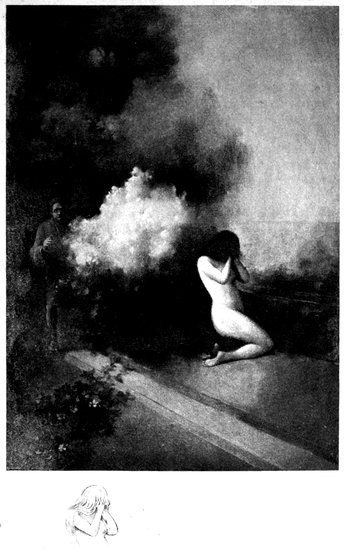
Now when it was the Seven Hundred and Ninetieth Night,
She said, It hath reached me, O auspicious King, that when Hasan had carried off the girls plumery, she sought it but found it not and her sisterhood flew away leaving her alone. When they were out of sight, Hasan gave ear to her and heard her say, “O who hast taken my dress and stripped me, I beseech thee to restore it to me and cover my shame, so may Allah never make thee taste of my 42tribulation!” But when Hasan heard her speak thus, with speech sweeter than syrup, his love for her redoubled, passion got the mastery of his reason and he had not patience to endure from her. So springing up from his hiding-place, he rushed upon her and laying hold of her by the hair dragged her to him and carried her down to the basement of the palace and set her in his own chamber, where he threw over her a silken cloak[70] and left her weeping and biting her hands. Then he shut the door upon her and going to his sister, informed her how he had made prize of his lover and carried her to his sleeping-closet, “And there,” quoth he, “she is now sitting, weeping and biting her hands.” When his Sister heard this, she rose forthright and betook herself to the chamber, where she found the captive weeping and mourning. So she kissed ground before her and saluted her with the salam and the young lady said to her, “O King’s daughter, do folk like you do such foul deed with the daughters of Kings? Thou knowest that my father is a mighty Sovran and that all the liege lords of the Jinn stand in awe of him and fear his majesty: for that there are with him magicians and sages and Cohens and Satans and Marids, such as none may cope withal, and under his hand are folk whose number none knoweth save Allah. How then doth it become you, O daughters of Kings, to harbour mortal men with you and disclose to them our case and yours? Else how should this man, a stranger, come at us?” Hasan’s sister made reply, “O King’s daughter, in very sooth this human is perfect in nobleness and purposeth thee no villainy; but he loveth thee, and women were not made save for men. Did he not love thee, he had not fallen sick for thy sake and well-nigh given up the ghost for desire of thee.” And she told her the whole tale how Hasan had seen her bathing in the basin with her attendants, and fallen in love with her, and none had pleased him but she, for the rest were all her handmaids, and none had availed to put forth a hand to her. When the Princess heard this, she despaired of deliverance and presently Hasan’s sister went forth and brought her a costly dress, wherein she robed her. Then she set before her somewhat of meat and drink and ate with her and heartened her heart and soothed her sorrows. And she ceased not to speak her fair with soft and pleasant words, saying, “Have pity on him who saw thee once and became as one slain by thy love;” and continued to 43console her and caress her, quoting fair says and pleasant instances. But she wept till daybreak, when her trouble subsided and she left shedding tears, knowing that she had fallen into the net and that there was no deliverance for her. Then said she to Hasan’s sister, “O King’s daughter, with this my strangerhood and severance from my country and sisterhood which Allah wrote upon my brow, patience becometh me to support what my Lord hath foreordained.” Therewith the youngest Princess assigned her a chamber in the palace, than which there was none goodlier and ceased not to sit with her and console her and solace her heart, till she was satisfied with her lot and her bosom was broadened and she laughed and there ceased from her what trouble and oppression possessed her, by reason of her separation from her people and country and sisterhood and parents. Thereupon Hasan’s sister repaired to him, and said, “Arise, go in to her in her chamber and kiss her hands and feet.[71]” So he went in to her and did this and bussed her between the eyes, saying, “O Princess of fair ones and life of sprites and beholder’s delight, be easy of heart, for I took thee only that I might be thy bondsman till the Day of Doom, and this my sister will be thy servant; for I, O my lady, desire naught but to take thee to wife, after the law of Allah and the practice of His Apostle, and whenas thou wilt, I will journey with thee to my country and carry thee to Baghdad-city and abide with thee there: moreover, I will buy thee handmaidens and negro chattels; and I have a mother, of the best of women, who will do thee service. There is no goodlier land than our land; everything therein is better than elsewhere and its folk are a pleasant people and bright of face.” Now as he bespake her thus and strave to comfort her, what while she answered him not a syllable, lo! there came a knocking at the palace-gate. So Hasan went out to see who was at the door and found there the six Princesses, who had returned from hunting and birding, whereat he rejoiced and went to meet them and welcomed them. They wished him safety and health and he wished them the like; after which they dismounted and going each to her chamber doffed their soiled clothes and donned fine linen. Then they came forth and demanded the game, for they had taken a store of gazelles and wild cows, hares and lions, hyænas, and others; so their suite brought out some thereof for 44butchering, keeping the rest by them in the palace, and Hasan girt himself and fell to slaughtering for them in due form,[72] whilst they sported and made merry, joying with great joy to see him standing amongst them hale and hearty once more. When they had made an end of slaughtering, they sat down and addressed themselves to get ready somewhat for breaking their fast, and Hasan, coming up to the eldest Princess, kissed her head and on like wise did he with the rest, one after other. Whereupon said they to him, “Indeed, thou humblest thyself to us passing measure, O our brother, and we marvel at the excess of the affection thou showest us. But Allah forfend that thou shouldst do this thing, which it behoveth us rather to do with thee, seeing thou art a man and therefor worthier than we, who are of the Jinn.[73]” Thereupon his eyes brimmed with tears and he wept sore; so they said to him, “What causeth thee to weep? Indeed, thou troublest our pleasant lives with thy weeping this day. ’Twould seem thou longest after thy mother and native land. An things be so, we will equip thee and carry thee to thy home and thy friends.” He replied, “By Allah, I desire not to part from you!” Then they asked, “Which of us hath vexed thee, that thou art thus troubled?” But he was ashamed to say, “Naught troubleth me save love of the damsel,” lest they should deny and disavow him: so he was silent and would tell them nothing of his case. Then his sister came forward and said to them, “He hath caught a bird from the air and would have you help him to tame her.” Whereupon they all turned to him and cried, “We are at thy service every one of us and whatsoever thou seekest that will we do: but tell us thy tale and conceal from us naught of thy case.” So he said to his sister, “Do thou tell them, for I am ashamed before them nor can I face them with these words.”——And Shahrazad perceived the dawn of day and ceased saying her permitted say.
45
Now when it was the Seven Hundred and Ninety-first Night,
She said, It hath reached me, O auspicious King, that Hasan said to his sister, “Do thou tell them my tale, for before them I stand abashed nor can I face them with these words.” So she said to them, “O my sisters, when we went away and left alone this unhappy one, the palace was straitened upon him and he feared lest some one should come in to him, for ye know that the sons of Adam are light of wits. So, he opened the door of the staircase leading to the roof, of his loneliness and trouble, and sat there, looking upon the Wady and watching the gate, in his fear lest any should come thither. One day, as he sat thus, suddenly he saw ten birds approach him, making for the palace, and they lighted down on the brink of the basin which is in the pavilion-terrace. He watched these birds and saw, amongst them, one goodlier than the rest, which pecked the others and flouted them, whilst none of them dared not put out a claw to it. Presently, they set their nails to their neck-collars and, rending their feather-suits, came forth therefrom and became damsels, each and every, like the moon on fullest night. Then they doffed their dress and plunging into the water, fell to playing with one another, whilst the chief damsel ducked the others, who dared not lay a finger on her and she was fairest of favour and most famous of form and most feateous of finery. They ceased not to be in this case till near the hour of mid-afternoon prayer, when they came forth of the basin and, donning their feather-shifts, flew away home. Thereupon he waxed distracted, with a heart afire for love of the chief damsel and repenting him that he had not stolen her plumery. Wherefore he fell sick and abode on the palace-roof expecting her return and abstaining from meat and drink and sleep, and he ceased not to be so till the new moon showed, when behold, they again made their appearance according to custom and doffing their dresses went down into the basin. So he stole the chief damsel’s feather-suit, knowing that she could not fly save therewith, hiding himself carefully lest they sight him and slay him. Then he waited till the rest had flown away, when he arose and seizing the damsel, carried her down from the terrace into the castle.” Her sisters asked, “Where is she?”; and she answered, “She is with him in such a chamber.” Quoth they, “Describe her to us, O 46our sister:” so quoth she, “She is fairer than the moon on the night of fullness and her face is sheenier than the sun; the dew of her lips is sweeter than honey and her shape is straighter and slenderer than the cane; one with eyes black as night and brow flower-white; a bosom jewel-bright, breasts like pomegranates twain and cheeks like apples twain, a waist with dimples overlain, a navel like a casket of ivory full of musk in grain, and legs like columns of alabastrine vein. She ravisheth all hearts with Nature-kohl’d eyne, and a waist slender-fine and hips of heaviest design and speech that heals all pain and pine: she is goodly of shape and sweet of smile, as she were the moon in fullest sheen and shine.” When the Princesses heard these praises, they turned to Hasan and said to him, “Show her to us.” So he arose with them, all love-distraught, and carrying them to the chamber wherein was the captive damsel, opened the door and entered, preceding the seven Princesses. Now when they saw her and noted her loveliness, they kissed the ground between her hands, marvelling at the fairness of her favour and the significance which showed her inner gifts, and said to her, “By Allah, O daughter of the Sovran Supreme, this is indeed a mighty matter: and haddest thou heard tell of this mortal among women thou haddest marvelled at him all thy days. Indeed, he loveth thee with passionate love; yet, O King’s daughter, he seeketh not lewdness, but desireth thee only in the way of lawful wedlock. Had we known that maids can do without men, we had impeached him from his intent, albeit he sent thee no messenger, but came to thee in person; and he telleth us he hath burnt the feather dress; else had we taken it from him.” Then one of them agreed with the Princess and becoming her deputy in the matter of the wedding contract, performed the marriage ceremony between them, whilst Hasan clapped palms with her, laying his hand in hers, and she wedded him to the damsel by consent; after which they celebrated her bridal feast, as beseemeth Kings’ daughters, and brought Hasan in to her. So he rose and rent the veil and oped the gate and pierced the forge[74] and brake the seal, whereupon affection for her waxed in him and he redoubled in love and longing for her. Then, since he had gotten that which he sought, he gave himself joy and improvised these couplets:—
47Thy shape’s temptation, eyes as Houri’s fain ✿ And sheddeth Beauty’s sheen[75] that radiance rare:
My glance portrayed thy glorious portraiture: ✿ Rubies one-half and gems the third part were:
Musk made a fifth: a sixth was ambergris ✿ The sixth a pearl but pearl without compare.
Eve never bare a daughter evening thee ✿ Nor breathes thy like in Khuld’s[76] celestial air.
An thou would torture me ’tis wont of Love ✿ And if thou pardon ’tis thy choice I swear:
Then, O world bright’ner and O end of wish! ✿ Loss of thy charms who could in patience bear?
——And Shahrazad perceived the dawn of day and ceased to say her permitted say.
Now when it was the Seven Hundred and Ninety-second Night,
She continued, It hath reached me, O auspicious King, that when Hasan went in unto the King’s daughter and did away her maidenhead, he enjoyed her with exceeding joy and affection for her waxed in him and he redoubled in love-longing for her; so he recited the lines aforesaid. Now the Princesses were standing at the door and when they heard his verses, they said to her, “O King’s daughter, hearest thou the words of this mortal? How canst thou blame us, seeing that he maketh poetry for love of thee and indeed he hath so done a thousand times.[77]” When she heard this she rejoiced and was glad and felt happy and Hasan abode with her forty[78] days in all solace and delight, joyance and happiest plight, whilst the damsels renewed festivities for him every day and overwhelmed him with bounty and presents and rarities; and the King’s daughter became reconciled to her sojourn amongst them and forgot her kith and kin. At the end of the forty days, Hasan saw in a dream, one night, his mother mourning for him and indeed her bones were wasted and her body had waxed shrunken and her complexion had yellowed and her favour had 48changed the while he was in excellent case. When she saw him in this state, she said to him, “O my son, O Hasan, how is it that thou livest thy worldly life at thine ease and forgettest me? Look at my plight since thy loss! I do not forget thee, nor will my tongue cease to name thy name till I die; and I have made thee a tomb in my house, that I may never forget thee. Would Heaven I knew[79] if I shall live, O my son, to see thee by my side and if we shall ever again foregather as we were.” Thereupon Hasan awoke from sleep, weeping and wailing, the tears railed down his cheeks like rain and he became mournful and melancholy; his tears dried not nor did sleep visit him, but he had no rest, and no patience was left to him. When he arose, the Princesses came in to him and gave him good-morrow and made merry with him as was their wont; but he paid no heed to them; so they asked his wife concerning his case and she said, “I ken not.” Quoth they, “Question him of his condition.” So she went up to him and said, “What aileth thee, O my lord?” Whereupon he moaned and groaned and told her what he had seen in his dream and repeated these two couplets:—