Chapter II · MAN’S FIRST WEAPONS—THE STONE AND THE STICK. THE EARLIEST AGES OF WEAPONS. THE AGES OF WOOD, OF BONE, AND OF HORN.
Reading edition
What, then, was Man’s first weapon? He was born speechless and helpless, inferior to the beasts of the field. He grew up armed, but badly armed. His muscles may have been stronger than they are now; his poor uneducated fisticuff, however, could not have compared with the kick of an ass. As we see from the prognathous jaw, he could bite, and his teeth were doubtless excellent[49]; still, the size and shape of the maxilla rendered it an arm inferior to the hyæna’s and even to the dog’s. He scratched and tore, as women still do; but his nails could hardly have been more dangerous than the claws of the minor felines.
He had, however, the hand, the most perfect of all prehensile contrivances, and Necessity compelled him to use it. The stone, his first ‘weapon,’ properly so called, would serve him in two ways—as a missile, and as a percussive instrument. Our savage progenitor, who in days long before the dawn of history, contracted the extensor and relaxed the flexor muscles of his arm when flinging into air what he picked up from the ground, was unconsciously lengthening his reach and taking the first step in the art and science of ballistics. His descendants would acquire extraordinary skill in stone-throwing, and universal practice would again make perfect. Diodorus of Sicily (b.c. 44),[50] who so admirably copied Herodotus, says that the Libyans ‘use neither Swords, spears, nor other weapons; but only three darts and stones in certain leather budgets, wherewith they fight in pursuing and retreating.’ The Wánshi (Guanches) Libyan or Berber peoples of the Canarian Archipelago, according to Cà da Mosto (a.d. 1505), confirmed by many, including George Glas,[51] were expert stone-throwers. They fought their duels ‘in the public place, where the combatants mounted upon two stones placed at the opposite sides of it, each stone being flat at top and about half a yard in diameter. On these they stood fast without moving their feet, till each had thrown three round stones at his antagonist. Though they were good marksmen, yet they generally avoided those missive weapons by the agile writhing of their bodies. Then arming themselves with sharp flints (obsidian?) in their left hands, and cudgels or clubs in their right, they fell on, beating and cutting each other till they were tired.’ An instance is mentioned in which a Guanche brought down with a single throw a large palm-frond, whose mid-rib was capable of resisting the stroke of an axe. Kolben, who wrote about a century and a half ago, gives the following account of the ape-like gestures of the Khoi-Khoi or Hottentots[52]:—‘The most surprising strokes of their dexterity are seen in their throwing of a stone. They hit a mark to a miracle of exactness, though it be a hundred paces distant and no bigger than a halfpenny. I have beheld them at this exercise with the highest pleasure and astonishment, and was never weary of the spectacle. I still expected after repeated successes, that the stone would err; but I expected in vain. Still went the stone right to the mark, and my pleasure and astonishment were redoubled. You could imagine that the stone was not destined to err, or that you were not destined to see it. But a Hottentot’s unerring hand in this exercise is not the only wonder of the scene; you would be equally struck perhaps with the manner in which he takes his aim. He stands, not still with a lift-up arm and a steady staring eye upon the mark, as we do; but is in constant motion, skipping from one side to another, suddenly stooping, suddenly rising; now bending on this side, now on that; his eyes, hands, and feet are in constant action, and you would think that he was playing the fool, and minding anything else than his aim; when on a sudden, away goes the stone with a fury, right to the heart of the mark, as if some invisible power had directed it.’
Nearer home the modern Syrians still preserve their old dexterity: I have often heard the tale, and have no reason to doubt its truth, of a brown bear (Ursus syriacus) being killed in the Libanus by a blow between the eyes.[53] When the Arab Bedawin are on the raid and do not wish to use their matchlocks, they attack at night, and ‘rain stones’ upon the victim. The latter vainly discharges his ammunition against the shadows flitting ghost-like among the rocks; and, when his fire is drawn, the murderers rush in and finish their work. The use of the stone amongst the wild tribes of Asia, Africa, and America is almost universal. In Europe, the practice is confined to schoolboys; but the wild Irish, by beginning early, become adepts in it when adults. As a rule, the shepherd is everywhere a skilful stone-thrower.
Turner makes the ‘Kawas’ of Tanna, New Hebrides, a stone as long as, and twice as thick as, an ordinary counting-house ruler: it is thrown with great precision for a distance of twenty yards. The same author mentions stones rounded like a cannon-ball, among the people of Savage Island and Eromanga. Commander Byron notices the stones made into missiles by the Disappointment Islanders. Beechey, whose party was attacked by the Easter Islanders, says that the weapons, cast with force and accuracy, knocked several of the seamen under the boat-thwarts. Crantz tells us that Eskimo children are taught stone-throwing at a mark as soon as they can use their hands. The late Sir R. Schomburg describes a singular custom amongst the Demarara Indians. When a child enters boyhood he is given a hard round stone which he is to hand-rub till it becomes smooth, and he often reaches manhood before the task is done. Observers have suggested that the only use of the practice is a ‘lesson in perseverance, which quality, in the opinion of many people, is best inculcated by engaging the minds of youths in matters that are devoid of any other incentive in the way of practical utility or interest.’
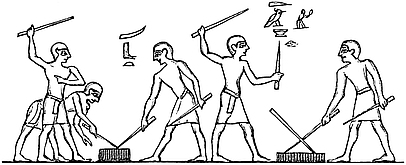
Fig. 13.—Ancient Egyptians Throwing Knives.
In more civilised times the knife, as a missile, would take the place of the stone. We find that the ancient Egyptians[54] practised at a wooden block, and the German Helden (champions), seated on settles, duelled by casting three knives each, to be parried with the shield. The modern Spaniards begin to learn when children the art of throwing the facon[55], cuchillo or clasp-knife. The reapers of the Roman Campagna, mere barbarians once civilised, also ‘chuck’ the sickle with a surprising precision.
THE BOW.
The habit of stone-throwing would presently lead to the invention of the sling, which Meyrick considers,[56] strange to say, the ‘earliest and simplest weapon of antiquity.’ The rudest form of this pastoral weapon used only on open plains, a ball and cord, was followed by the various complications of string- or thong-sling, cup-sling, and stick-sling. The latter, a split stick which held the stone till the moment of discharge, may have been the primitive arm: Lepsius shows an Egyptian using such a sling and provided with a reserve heap of pebbles. Nilsson suggests that David was thus weaponed when Goliath addressed him, ‘Am I a dog that thou comest to me with staves?’—that is, with the shepherd’s staff turned into a sling. And this form survived longest in the Roman ‘fustibulus,’ which the moderns corrupted to ‘fustibale’[57]: the latter, with its wooden handle, was used in Europe during the twelfth century, and was employed in delivering hand-grenades till the sixteenth. The primitive ball-and-cord, known to the ancient Egyptians, is still preserved in the Bolas of the South American Gaucho. A simultaneously invented missile would be the hurling or throwing-stick and its modification, the Boomerang, of which I have still to speak. The application of elasticity and resilience being now well known, would suggest the rudest form of the bow[58] and arrow. This invention, next in importance (though longo intervallo) to fire-making and fire-feeding, is the first crucial evidence of the distinction between the human weapon and the bestial arm. Nilsson and many others hold the invention to have been instinctive and common to all peoples; and we cannot wonder that it was made the invention of demi-gods—Nimrod, Scythes[59] the son of Jupiter, or Perses son of Perseus.[60] The missile arm at once showed man and beast separated by an extensive difference of degree, if not of kind, and it has played the most notable part, perhaps, of all weapons in the annals of humanity or inhumanity. It led to the Greek gastrapheta, the Roman arcubalista (crossbow[61]); to the palintonon or balista, and the arblast (an enlarged species of the arcus, intended for throwing darts of giant size); to the Belagerungs-balister, a fixed form; to the catapult, enthytonon, tormentum, scorpion or onager,[62] and to other formidable forms of classical artillery which preceded the ‘cheap and nasty’ invention of chemical explosives.
THE CLUB.
So much for the Hand-stone as the forefather of missiles and of ballistic science. Held in the fist it would give momentum, weight and velocity, force and bruising power, to the blow. Thus it was the forerunner of the club, straight and curved; the flail, the bâton ferré, the ‘morning star,’ the ‘holy-water sprinkler,’ and a host of similar weapons[63] that added another and a harder joint to man’s arm. Clubs—which in practice are aimed at the head, whereas the spear is mostly directed at the body[64]—would be easily made by pulling up a straight young tree, or by tearing down a branch from the parent trunk and stripping it of twigs and leaves. The club of Australia, a continent to which we look for original forms, has the branching rootlets trimmed to serve as spikes; moreover, the terminal bulge has been developed in order to stop or parry the assailant’s weapon. In fact the swell, ball, lozenge, or mushroom-head was the first germ of the Australasian shield. The next step would be to fashion the ragged staff with fire, with friction, and with flint knives, shells or other scrapers, into a cutting as well as a crushing instrument; and here we have one of the many origins of the Sword and of its diminutives, the dagger and the knife. Pointed at the end, it would become the lance and spear, the spud, spade, and palstave, the pilum, the dart, the javelin, and the assagai.
Not a few authorities contend that the earliest weapons, the most constant in all ages and continuous in all countries, were the spear and the axe. The first would be a development of the pointed hand-celt[65]; the latter of the leaf-formed or almond-shaped tool. But firstly, these would be mostly confined to countries with a well-developed Stone Age[66]; and secondly, the conversion of the hand-stone into an arme d’hast would assuredly be later than the club and the sharpened stick or stake.
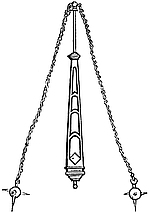
Fig. 14.—Japanese War-Flail.
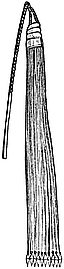
Fig. 15.—Turkish War-Flail.

Fig. 16.—Morning Star.
Herodotus, the father of ancient history in its modern form, a travelled student and a great genius, whose prose poem—for such it is—has proved incomparably more useful to us than any works of his successors, when describing a rock-sculpture of Sesostris-Ramses (ii. 106) makes him carry in his right hand a spear (Egyptian), and in his left a bow (Lybian or Ethiopian). Hence some writers on Hoplology have held that he considered these to be the oldest of weapons. But the ancients did not study prehistoric man beyond confounding human bones with those of extinct mammals. Augustus Cæsar was an early collector, according to Suetonius (in ‘August.’ c. xxii.). ‘Sua vero ... excoluit rebusque vetustate ac raritate notabilibus; qualia sunt Capræis immanum belluarum ferarumque membra prægrandia, quæ dicuntur gigantum ossa et arma heroum.’[67] The Emperor (whom the late Louis Napoleon so much resembled, even in the matter of wearing hidden armour[68]) preferred these curiosities to statues and pictures. The ancients also, like Marco Polo and too many of the moderns, spoke of the world generally after studying a very small part in particular. The Halicarnassian here evidently alludes to an epoch which had made notable advances upon the Quaternary Congener of the Simiads. We must return to a much earlier age. Lucretius, whose penetrating genius had a peculiar introvision, wrote like a modern scientist:—
Arma antiqua manus, ungues dentesque fuerunt, Et lapides et item sylvarum fragmina rami; Posterius ferri vis est, ærisque reperta, Sed prius æris erat, quam ferri cognitus usus.[69]
Gentleman Horace is almost equally correct:—
Quum prorepserunt primis animalia terris, Mutum et turpe pecus, glandem atque cubilia propter Unguibus et pugnis, dein fustibus, atque ita porro Pugnabant armis quæ post fabricaverat usus.[70]
How refreshing is the excellent anthropology of these pagans after the marvel-myths of man’s Creation propounded by the so-called ‘revealed’ religions.
THE ‘AGES.’
For the better distribution of the subject I shall here retain the obsolete and otherwise inadmissible, because misleading, terms—Age of Stone, Age of Bronze, Age of Iron.[71] From the earliest times all the metals were employed, without distinction, for weapons offensive and defensive: besides which, the three epochs intermingle in all countries, and overlap one another; they are, in fact, mostly simultaneous rather than successive. As a modern writer says, like the three principal colours of the rainbow, these three stages of civilisation shade off the one into the other; and yet their succession, as far as Western Europe[72] is concerned, appears to be equally well defined with that of the prismatic colours, though the proportion of the spectrum may vary in different countries. And, as a confusion of ideas would be created, especially when treating of the North European Sword, by neglecting this superficial method of classification, I shall retain it while proceeding to consider the development of the White Arm under their highly conventional limits.
I must, moreover, remark that the ternary division, besides having no absolute chronological signification, and refusing to furnish any but comparative dates, is insufficient. Concomitant with, and possibly anterior to, the so-called Stone Age, wood, bone, teeth, and horn were extensively used; and the use has continued deep into the metal ages. Throughout the lower valley of the River of the Amazons, where stone is totally wanting, primitive peoples must have armed themselves with another material. The hard and heavy trees, both of the Temperates and the Tropics, supplied a valuable material which could be treated simply by the use of fire, and without metal or even stone. Ramusio speaks of a sago-wood (Nibong or Caryota urens) made into short lances by the Sumatrans: ‘One end is sharpened and charred in the fire, and when thus prepared it will pierce any armour much better than iron would do.’[73] The weapon would be fashioned by the patient labour of days and weeks, by burying in hot ashes, by steaming and smoking, by charring and friction, by scraping with shells and the teeth of rodents, and by polishing with a variety of materials: for instance, with the rasping and shagreen-like skin of many fishes, notably the ray; with rough-coated grasses, and with the leaves of the various ‘sandpaper-trees’ which are hispid as a cat’s tongue. And the first step in advance would be dressing with silex, obsidian, and other cutting stones, and finishing with pumice or with the mushroom-shaped corallines. I shall reserve for the next chapter a description of the sabre de bois, unjustly associated in the popular saying with the pistolet de paille.
THE ‘BONE AGE.’
Bone, which includes teeth, presented to savage man a hard and durable material for improving his coarse wooden weapons. Teledamus or Telegonus, son of Circe and founder of Tusculum[74] and Præneste, according to tradition slew his father, Ulysses, with a lance-head of fish bone—aculeum marinæ belluæ. The teeth of the Squalus and other gigantum ossa or megatherian remains supplied points for the earliest projectiles, and added piercing power to the blow of the club. That a Bone Age may be traced throughout the world,[75] and that the phrase a ‘bone- and stone-using people’ is correct, was proved by the Weltausstellung of Vienna (1873), whose splendid collection found an able describer in Prof. A. Woldrich.[76] The caves of venerable Moustier (Département Dordogne), of Belgium, and of Lherm (Département Arriège) contributed many jawbones of the cave bear (Ursus spelæus); the ascending ramus of the inferior maxilla had been cut away to make a convenient grip, and the strong corner-teeth formed an implement or an instrument, a tool or a weapon. The caves of Peggau in Steiermark (Styria), of Palkau in Moravia, and the Pfahlbauten[77] or Pile-villages of Olmütz, produced a number of bone articles and remnants of the cave bear. These rude implements remind us of the weapon used to such good effect by the Biblical Samson, the Hebrew type of Hercules, the strong man, the slayer of monsters, and the Sun-god (Shamsún).[78]

Fig. 17.—Deer-Horn Arrow-Head. (S. America.)
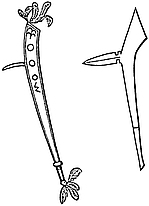
Fig. 18—Horn War Clubs with Metal Points.

Fig. 19.—Double Spear and Shield.

Fig. 20.—Spine of Diodon.
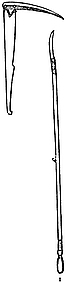
Fig. 21.—1. Walrus Tooth used as Spear Point; 2. Tomahawk of Walrus Tooth.
The wilder tribes of Cambodia convert the bony horn of the sword-fish into a spear head, with which they confidently attack the rhinoceros.[79] At Kotzebue Sound Captain Beechey found lances made of a wooden staff ending in a walrus-tooth; and this defence was also adapted to a tomahawk-point. The New Guinea tribes tip their arrows with the teeth of the saw-fish and the spines of the globe-fish (Diodon and Triodon). The horny style of the Malaccan king-crab (Limulus), a Crustacean sometimes reaching two feet in length, is also made into an arrow-pile.[80] The Australians of King George’s Sound arm their spears with the acute barbules of fishes; and the natives of S. Salvador, when discovered by Columbus, pointed their lances with fish-teeth. The Greenlander’s ‘nuguit’ (fig. 23) is mentioned by Crantz as armed with the narwhal’s horn, and the wooden handle is carved in relief with two human figures. By its side is another spear (fig. 24) with a beam in narwhal-shape, the foreshaft being composed of a similar ivory, inserted into the snout so as to represent the natural defence. Here we see the association in the maker’s mind between the animal from which the weapon is derived and the purpose of destruction for which it is chiefly used. It also illustrates the well-nigh universal practice amongst savages of making their weapons to imitate animate forms. The reason may be a superstition which still remains to be explained.
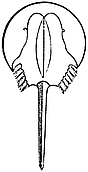
Fig. 22.—Sting of Malaccan Limulus Crab.

Fig. 23.—Tue Greenland Nuguit.

Fig. 24.—Narwhal Shaft and Metal Blade.
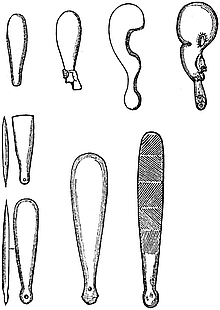
Fig. 25.—Jade Pattu-Pattus.
Foreshafts and heads of bone are still applied to the arrows of the South African Bushmans. They alternate with wood, chert, and metal throughout the North American continent, from Eskimo-land to California. A notable resemblance has been traced between the bone-club of the Nootka Sound ‘Indians,’ and the jade Pattu-Pattu or Meri of New Zealand. Hence it has been suspected that this short, flat weapon, oval or leaf-shaped, and made to hold in the hand, as if it were a stone celt, was originally an imitation of the os humeri. Like the celt, also, is the stone club found by Colonel A. Lane Fox in the bed of the Bawn river, north Ireland.[81]
The long bones of animals, with the walls of marrow-holes obliquely cut and exposing the hollow, were fastened upon sticks and poles, forming formidable darts and spears. The shape thus suggests the bamboo arrow-heads of the North Americans, whose cavity also served to carry poison.[82] They would, moreover, easily be fashioned by fracture, and by friction upon a hard and rough-grained substance, into Swords and daggers. The Fenni, or Finns, of Tacitus (‘Germ.’ c. 46), having no iron, used bone-pointed arrows. The Innuits, or Eskimos, of Greenland and other parts of the outer north, form with the ribs of whales their shuttles as well as their Swords. In ‘Flint Chips’ we find that the ancient Mexicans had bone-daggers. Wilde[83] gives a unique specimen of such a weapon found in the bed of the River Boyne ‘in hard blue clay, four feet under sand, along with some stone spear-heads.’ Formed out of the leg-bone of one of the large ruminants, it measures ten and a sixth inches long, the rough handle being only two and a half inches[84]; the blade is smooth, and wrought to a very fine point. This skeyne (the Irish ‘scjan’[85]) looks like a little model of a metal cut-and-thrust blade (fig. 27). Equally interesting is the knife-blade (fig. 29) found with many other specimens of manufactured bone in the Ballinderry ‘Crannog’[86] (county Westmeath): the total length is eight inches, and the handle is highly decorated. Other bone knives are mentioned in the ‘Catalogue’ (pp. 262–63). Bone prepared for making handles, and even ferules, for Swords and daggers is also referred to (p. 267): the material, being easily worked and tolerably durable, has, indeed, never fallen into disuse. In the shape of ivory,[87] walrus-tusk, and hippopotamus-tooth it is an article of luxury extensively used in the present day for the hafts of weapons and domestic implements. Lastly, bone served as a base to carry mere trenchant substances. The museum of Professor Sven Nilsson[88] shows (fig. 31) a smooth, sharp-pointed splinter, some six inches long, grooved in each side to about a quarter of an inch deep. In each of these grooves, fixed by means of cement, was a row of sharp-edged and slightly curved bits of flint. A similar implement (fig. 30) is represented in the illustrated catalogue of the Museum of Copenhagen. Of this contrivance I shall speak at length when treating of the wooden Sword.[89]
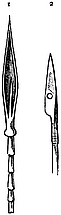
Fig. 26.—1. Bone Arrow-point for Poison; 2. Iron Arrow-head for Poison. (S. America.)

Fig. 27.—Wilde’s Dagger.

Fig. 28.—Hollow Bone for Poison.

Fig. 29.—Bone Knife.

Fig. 30.—Bone Arrow-Point armed with Flint Flakes.

Fig. 31.
‘AGES’ BEFORE THE ‘STONE AGE.’
While bone was extensively used by primitive Man, horn was the succedaneum in places where it was plentiful. The Swiss lake-dwellings have yielded stag’s horn and wooden hafts or helves, with bored holes and sockets; borers, awls or drills; mullers, rubbers, and various other instruments. The caverns of the Reindeer period in the south of France are not less rich. Stag-horn axes are common in Scandinavia, and one preserved by the Stockholm Museum bears the spirited outline of a deer. Beads, buttons, and other ornaments are found in England. This material, when taken from the old stag, is of greater density than osseous matter and of almost stony hardness, as the cancellated structure contains carbonate of lime; moreover it was easily worked by fire and steam.
THE ‘HORN-AGE.’
Diodorus (iii. cap. 15) describes the Ichthyophagi as using antelopes’ horns in their fishing, ‘for need teacheth all things.’ The earliest mention of a horn-arm is by Homer (‘Iliad,’ ii. 827, and iv. 105), who describes Pandarus, the Lycian, son of Lycaon, using a bow made of the six-spans-long[90] spoils of the ‘nimble mountain-goat.’ The weapon may have retained the original form. The early Greek types were either simple or composite. The Persians[91] preferred, and till lately used, wood and horn, stained, varnished, and adorned as much as possible. Duarte Barbosa[92] describes the Turkish bow at Hormuz Island as ‘made of buffalo-horn and stiff wood painted with gold and very pretty colours.’ The ‘Hornboge’ occurs in the ‘Nibelungenlied,’ and the Hungarians appeared in Europe with horn-bows and poisoned arrows.
The bows of the Sioux and Yutahs are of horn, backed with a strip of raw hide to increase the spring. The Blackfoot bow is made from the horn of the mountain-sheep (Catlin), and the Shoshone of the Rocky Mountains shape it by heating and wetting the horn, which is combined with wood (Schoolcraft). The Eskimos of Polar America, where nothing but drift-timber is procurable, are compelled to build their weapons with several bits of wood, horn, and bone, bent into form by smoking or steaming.
Admirable bows of buffalo-horn—small, but throwing far, and strong—are still made in the Indus-valley about Multan. For this use the horns are cut, scraped, thinned to increase elasticity; joined at the bases by wooden splints, pegs, or nails, and made to adhere by glue and sinews. Man would soon learn to sharpen his wooden shafts with horn-points, the spoils of his prey. Hence the ancient Egyptians applied horn to their light arrows of reed.[93] The Christy collection contains an arrow from South America (?) armed with a pile of deer-horn. The Melville Peninsula, being scant of materials, uses as arrow-piles the horns of a musk-ox (ovibos, more ovis than bos), and the thinned defences of the reindeer strengthened by sinews. Antelope-horns are still used as lance-points by the Nubians, the Shilluks, and the Denkas of the Upper Nile; by the Jibbus of Central Africa, and by the tribes of the southern continent.[94] The ‘Bantu’ or Kafir races, Zulus and others, make their kiri (kerry) either of wood or of rhinoceros-horn. It varies from a foot to a yard long, and is capped by a knob as large as a hen’s egg or a man’s fist: hence it is called ‘knob-stick’ or ‘throw-stick.’ The Ga-ne-u-ga-o-dus-ha (deer-horn war-club) of the Iroquois ended in a point of about four inches long; since the people had intercourse with Europeans they have learned to substitute metal. The form suggests that the martel-de-fer of Persia and India, used by Europe during the fifteenth and sixteenth centuries, was derived from a weapon of this kind: suitable points for arming it have been found in England and Ireland. The Dublin Museum (case 21, Petrie) contains an antler of the red deer converted into a thrusting weapon. The Jumbiyah (crooked dagger) of the Arabs, the Khanjar[95] of Persia and India, whence the Iberian Alfânge (El-Khanjar) and our silly ‘hanger,’ shows by form and point that it was originally the half of a buffalo-horn split longitudinally. The modern weapon, with metal blade and ivory handle, has one side of the latter flat, betraying its origin by retaining a peculiarity no longer required. The same is the case when the whole Jumbiyah is, as often happens, made of metal[96] (fig. 6, p. 10).
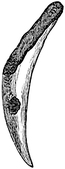
Fig. 32.—Harpoon Head.
The sufficiency of horn for the slender wants of uncivilised communities was admirably illustrated by the discovery of a Pfahlbau, or crannog, some three miles south of Laibach, the capital of Carniola, and a little north of the Brunnsdorf village. The site is a low mountain-girt basin, formerly a lake or broad of the Lai-cum-Sava river, and still flooded after heavy rains. Surface-finds were picked up in 1854–55, and regular explorations began in July 1875.[97] During that year two hundred articles were dug up. The material was chiefly stag-horn, tines, and beams, the latter often cut at the burr or antler-crown. The chief objects—many of them artistic as those of the French ‘Reindeer epoch’—were hatchets, hammers, needles, spindles, and punches of horn and split bone; fish-hooks, pincers, and skin-scrapers of hog’s tusks; with ornaments set in bone, and teeth bored for stringing. Many of these articles showed signs of the saw-kerf or notch which had probably been cut with sanded fibre acting like a file. There were harpoon-heads of peculiar shape, supposed to be unpierced whistles, the hole not having been bored through[98]: evidently they were made to ‘unship’ when striking the Welsen (Siluri) of the old lake, some of which must have been six feet long. The wooden foreshaft, joined by a string to its head, acted as float, and betrayed the position of the prey. This is the third stage of the harpoon: the first would be merely a heavy, pointed stick, and the second a spear with barbs. There were six horn Dolche (daggers), and one peculiar article, an edge of polished stone set in a horn-handle: the latter shows at once the abundance of game, and the value and rarity of the mineral, which probably belonged only to the rich. The eight stone implements were of palæolithic type; the few metal articles—a leaf-shaped sword-blade, a rude knife, lance-heads, arrow-piles, needles, and bodkins—were chiefly copper, five only being bronze; and the pottery corresponds with that of the neolithic period in the museums of Copenhagen and Stockholm. Thus the find, like several in Switzerland, showed a great preponderance of horns, bones, and teeth during a transitional age when the rest of Europe was using polished stone and metal.[99]
Prehistoric finds are still common in the Laibacher moorground (1882). Lauerza, a hamlet on the edge of the swamp, supplied (Nov. 7) a large stone-axe (Steinbeil), pierced and polished, of the quartzose conglomerate common in the adjacent highlands. This article was exceptional, most of the stone implements being palæolithic. At Aussergoritz appeared remnants of pottery and Roman tiles, a broken hairpin of bronze, a spear of Roman type, and a ‘palstab,’[100] also of bronze: the latter is the normal chisel-shaped hatchet with the flanges turned over for fitting to the handle; it measures 16·5 cent. long by 3·5 of diameter at the lower part. The sands of Grosscup also yielded sundry fine bronze armlets of Etruscan make found upon embedded skeletons. All the finds have been deposited in the Provincial Museum at Laibach.
The use of horn, like that of bone, has survived to the present day, and still appears in the handles of knives, daggers, and swords. It is of many varieties, and it fetches different prices according to the texture, the markings, and other mînutiæ known to the trade.[101]