Subfamily II. CEPHALOPHINÆ.
Reading edition
General Characters.—Size medium or small. Muzzle naked. Large anteorbital glands present, more or less elongated. Tail medium. False hoofs present. No knee-brushes[10]. Mammæ 4.
Skull with large anteorbital fossæ, and with the frontal bones projecting backwards between the parietals, the horns (where 4, the posterior pair) placed on the tips of the projections. Molar teeth square and low-crowned.
Horns 2 (exceptionally 4), short, straight; generally present in both sexes, but those of the female more slender and smoother than those of the male.
Range of Subfamily. Africa and India, not extending over the intermediate regions of Arabia and Persia.
This Subfamily contains two genera, as follows:—
1. Cephalophus. African; with two horns only, and with the opening of the anteorbital glands forming a long naked line on the sides of the muzzle. Females generally horned.
2. Tetraceros. Indian; with four horns, at least in the typical variety, and with the opening of the anteorbital glands forming a deep slit in the sides of the muzzle. Females hornless.
Genus I. CEPHALOPHUS.
Type.
Cephalophus, H. Sm. Griff. An. K. v. p. 344 (1827) C. sylviculturix.
Cephalolophus (emend.), Wagner, Giebel, and others C. sylviculturix.
Sylvicapra, Ogilb. P. Z. S. 1836, p. 138 C. grimmi.
Grimmia, Laurill. Dict. Univ. d’H. N. i. p. 623 (1839) C. rufilatus.
Cephalophorus, Gray, List Mamm. B. M. p. 162 (1843) C. grimmi.
Guevei, Gray, Cat. Ung. B. M. p. 86 (1853) C. maxwelli.
Terpone, Gray, P. Z. S. 1871, p. 592 C. sylviculturix.
Potamotragus, Gray, Cat. Rum. B. M. p. 24 (1872) C. sylviculturix.
Size medium or small; build generally thick and clumsy; naked muzzle large; anteorbital glands opening into a row of pores, which form a long naked line on each side of the muzzle; crown of head tufted, so that the horns are often quite hidden in the hairs; tail short or medium, not heavily tufted; mammæ four; lateral hoofs well developed.
Skull with large lachrymal fossæ, but no fissure at the base of the nasals, and no large pits above or beneath the eyes; auditory bullæ divided by a septum; upper molar teeth short and broad; in the larger species with an additional column on the inner side.
Horns two, generally present in both sexes, short and spike-like, placed very far back on the head, on the ends of the posteriorly extended frontals; directed straight backwards nearly in the line of the profile, not twisted or curved; their bases often roughened or angulated.
Distribution. Africa south of the Sahara.
This genus, although large, and with species ranging in size from that of a small donkey down to that of a hare, is yet a very uniform and natural one, and shows remarkably little diversity among its members in essential characters. To sportsmen in general the majority of the species are little known, partly owing to their being too small to afford any sport and with but poor horns for trophies, but mainly owing to their inhabiting thick bush, so that they are hardly ever seen. One species, however, the common S. African Duiker, the popular name of which we have extended to all the members of the genus, is well known to every sportsman who has visited that country, both on account of its extreme abundance in most localities, and of its inhabiting more open districts than its congeners, the Bush-Duikers. It has allies in Abyssinia and Senegal, and the three have together been separated by some authors as a distinct genus, bat this separation we are not at present prepared to endorse.
Considering, then, all the Duikers as forming but one genus, we may distinguish them according to the following synopsis, although, as three or four of the species are known from very insufficient materials, we may expect that the characters will require some modification hereafter.
From the localities appended it will be seen that the large majority of the species are West African in habitat, the great tropical forest which covers so much of that part of Africa being apparently especially suited to their bush-loving habits.
A. Horns, when present, pointed directly backwards, in a line with, or below the line of, the nasal profile; generally present in the female. Ears moderate or short, rounded, their length much less than the distance from the eye to the nose. General colour fulvous, red, grey, or black, generally marked or striped. (Bush-Duikers.)
a. Size large: hind foot (without hoof) more than 11 in.; basal length of skull more than 9·5.
a1. General colour blackish, with a yellowish lumbar stripe.—W. Africa. 19. C. sylvicultrix.
b1. General colour of body grey, of head and neck black.—W. Africa. 20. C. jentinki.
b. Size medium or small: hind foot less than 10 in.; basal length of skull less than 8·5.
a1. General ground-colour fulvous, rufous, or chestnut.
a2. Back not transversely striped. No heel-tufts.
a3. Colour quite uniform, no mesial dark markings on the face or elsewhere.
a4. Size larger; hind foot (?hoof included) 9·5 in.—E. Africa. 21. C. spadix.
b4. Size smaller; hind foot without hoof 7·5 in.—S.E. Africa. 22. C. natalensis.
b3. Mesial dark markings present either on face or on back or on both.
a4. Darker markings shining black or brown.
a5. Back uniform rufous, no dorsal stripe.
a6. Ground-colour pale bay, lighter below; chin white; hoofs normal.—E. Africa 23. C. harveyi.
b6. Ground-colour dark chestnut above and below; hoofs elongated.—W.Africa 24. C. nigrifrons.
b5. Back with a black dorsal stripe continued on to the tail.—All W. Africa.
a6. Tail black and white; back of hams red or white.
a7. Centre line of face decidedly darker than flanks. Dorsal line from nape.
a8. Sternal region and back of hams white. Tail tufted at tip 25. C. leucogaster.
b8. Sternal region and back of hams as dark as or darker than the body. Tail evenly haired, not tufted 26. C. dorsalis.
b7. Face uniformly rufous yellow, like the flanks. Dorsal line from withers 27. C. ogilbyi.
b6. Tail nearly wholly black; back of hams also black. 28. C. callipygus.
b4. Darker markings bluish grey.—W. Africa. 29. C. rufilatus.
b2. Back transversely banded. Heels with tufts.—W. Africa. 30. C. doriae.
b1. General colour smoky brown or blackish.
a2. Size larger; hind foot 8·25. Face more rufous than body.—W. Africa 31. C. niger.
b2. Size smaller; hind foot less than 7·5 in. Face like back.
a3. Legs greyish brown, like body.
a4. Rump not particoloured.—Sierra Leone. 32. C. maxwelli.
b4. Rump particoloured.
a5. Belly usually lighter than back; female horned.—Cameroons; Zanzibar 33. C. melanorheus.
b5. Belly not or little lighter than back; female hornless.—Uganda 34. C. æquatorialis.
b3. Legs rufous; rump not particoloured.—S.E. Africa. 35. C. monticola.
B. Horns, when present, slanting upwards at a sharp angle above the nasal profile; females normally hornless. Ears long, pointed, their length equal to or exceeding the distance from the eye to the rhinarium. General colour yellow or greyish; no darker markings on the body, but a brown nasal patch present. (True Duikers.)
a. Size smaller: hind foot less than 9 in.; basal length of skull less than 5·5.
a1. Colour bright yellow.—W. Africa 36. C. coronatus.
b1. Colour grizzled greyish brown.—Abyssinia 37. C. abyssinicus.
b. Size larger: hind foot more than 9·5 in.; basal length of skull more than 6·0.—Southern Africa 38. C. grimmi[11].
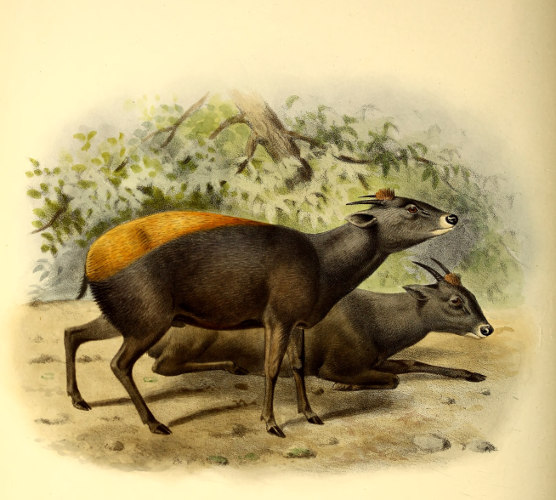
THE BOOK OF ANTELOPES, PL. XIII.
J. G. Keulemans del.
J. Smit lith.
Hanhart imp.
The Yellow-backed Duiker.
CEPHALOPHUS SYLVICULTRIX.
Published by R. H. Porter.
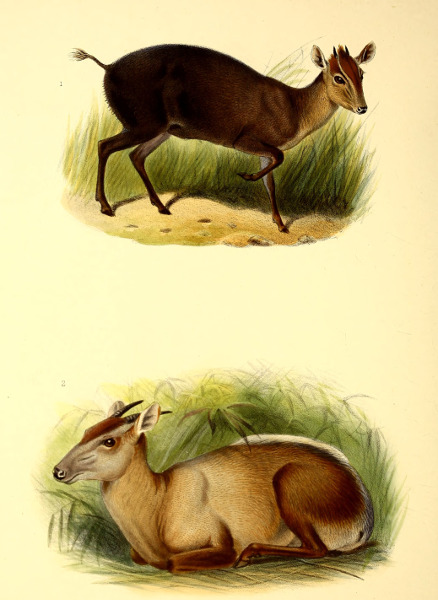
THE BOOK OF ANTELOPES, PL. XIV.
Smit lith.
Hanhart imp.
Fig. 1. The Black Duiker.
CEPHALOPHUS NIGER.
Fig. 2. The Yellow-backed Duiker.
CEPHALOPHUS SYLVICULTRIX.
Published by R. H. Porter.
19. THE YELLOW-BACKED DUIKER. CEPHALOPHUS SYLVICULTRIX (Afz.). [PLATES XIII. and XIV. Fig. 2.]
Antilope silvicultrix, Afzelius, N. Act. Ups. vii. p. 265, pi. viii. (animal) (1815) (Sierra Leone); Goldf. Schreb. Säug. v. p. 1238 (1818); Desm. Mamm. ii. p. 462 (1822); Less. Man. Mamm. p. 378 (1827); Fisch. Syn. Mamm. p. 457 (1829); Waterh. Cat. Mamm. Mus. Z. S. (2) p. 41 (1838).
Antilope (Cephalophus) sylvicultrix, Ham. Sm. Griff. Cuv. An. K. iv. p. 258, plate (♂), v. p. 344 (1827); Less. H. N. Mamm. (Compl. Buff, x.) p. 293 (1836); Gerv. Dict. Sci. Nat. Supp. i. p. 262 (1840); Less. N. Tabl. R. A., Mamm. p. 178 (1842); Wagn. Schr. Säug. Supp. iv. p. 446 (1844), v. p. 422 (1855); Gieb. Säug. p. 322 (1859).
Cephalophus sylvicultrix, A. Sm. S.-Afr. Quart. Journ. ii. p. 214 (1834); Gray, Ann. Mag. N. H. (1) xviii. p. 165 (1846); id. Knowsl. Men. p. 10, pi. xxiii. fig. 3 (1850); id. P.Z.S. 1850, p. 122; Turner, P.Z.S. 1850, p. 170; Gray, Cat. Ung. B. M. p. 83 (1852); Temm. Esq. Zool. Guin. pp. 194 & 233 (1853); Gerr. Cat. Bones Mamm. B. M. p. 236 (1862); Fitz. SB. Wien, lix. pt. 1, p. 166 (1869); Scl. P. Z. S. 1870, p. 220 (Zool. Soc. Viv.); Gray, P. Z. S. 1871, p. 595, fig. 4 (skull); id. Cat. Rum. B. M. p. 26 (1872); id. Hand-l. Rum. B. M. p. 94 (1873); Scl. List An. Z. S. (8) p. 147 (1883); Jent. N. L. M. x. p. 20 (1887) (Liberia); Büttik. Reisebilder, ii. p. 376 (1890); Flow. & Lyd. Mamm. p. 338 (1891); Matsch. MT. deutsch. Schutz-geb. vi. p. 81 (1893) (Togo).
Antilope (Grimmia) sylvicultrix, Laurill. Dict. Univ. d’H. N. i. p. 624 (1839).
Sylvicapra sylvicultrix, Sund. Pecora, K. Vet.-Ak. Hand-l. 1844, p. 190 (1846); id. ibid. Hornschuch’s Transl., Arch. Skand. Beitr. ii. p. 143; Reprint, p. 67 (1848).
Cephalolophus sylvicultor, Thos. P. Z. S. 1892, p. 416; Ward, Horn Meas. p. 77 (1892); Lyd. Horns and Hoofs, p. 213 (1893).
Cephalophus punctulatus, Gray, Knowsl. Men. tab. viii. fig. 1 (1850).
Cephalophus longiceps, Gray, P. Z. S. 1865, p. 204, fig. (skull) (Gaboon); Bocage, J. Sci. Lisb. ii. p. 220 (1869).
Terpone longiceps, Gray, P. Z. S. 1871, p. 592; id. Cat. Rum. B. M. p. 24 (1872); id. Hand-l. Rum. B. M. p. 93 (1873).
Cephalophus melanoprymnus, Gray, P. Z. S. 1871, p. 594, pi. xliv. (animal), figs. 2, 3 (skull) (jr.) (Gaboon).
Potamotragus melanoprymnus, Gray, Cat. Rum. B. M. p. 25 (1872); id. Hand-l. Rum. B. M. p. 94 (1873).
Cephalophus ruficrista, Bocage, P. Z. S. 1878, p. 744.
Vernacular Names:—Bush-Goat of English at Sierra Leone (Afzelius); Mbimbi in Longobondo (Pechuel-Loesche, fide Matschie).
Size large; form stout and heavy. Ears short, broad, and rounded, their length much less than the distance from eye to muzzle. Fur very short on the fore-quarters, longer on the hind back, but in adults worn off and showing the whitish underfur or naked skin round the base of the tail. General colour all over, of face, body above and below, and of limbs, dark blackish brown. Crest orange or rufous, little developed in youth, and again wearing off in old age. Muzzle, cheeks and chin, and extreme tips of ear whitish. Lumbar region with a broad pale yellowish mesial stripe running from the middle of the back on to the loins.
In extreme youth the hairs of the posterior half of the body are all tipped with white, except just along what becomes afterwards the pale lumbar stripe, where they have long blackish tips, entirely hiding the white; and the caudal region, afterwards whitish and partly naked, is clothed with long black hairs.
Skull, in proportion to the size of the animal, delicate, slender, and elongate. Muzzle slender, tapering, not laterally swollen between the premolars and the anteorbital fossa. Anteorbital fossæ of medium depth. Mesial notch of palate surpassing anteriorly the lateral ones by about half an inch, these latter comparatively deep and V-shaped.
Horns long and tapering, lying back in or below the line of the nasal profile, rather bowed downwards terminally. Divergent, slender, evenly tapering, but little roughened at base; those of male and female almost precisely alike, except that the latter are slightly smaller. Length (♂) 6·4 inches; basal diameter going about 5 or 5½ times in the length.
Dimensions:—♀. Height at shoulder 34 inches, ear 4, hind foot 13·5.
Skull (♂): basal length 10·3 inches, greatest breadth 4·9, muzzle to orbit 6·5.
Hab. West Coast of Africa, from Liberia to Angola.
We commence our history of this numerous group of Antelopes, for which we adopt the term “Duiker” (i.e. “Diver”), originally given by the Boers of the Cape to C. grimmi, as a vernacular name, with two species readily distinguishable from the remainder by their greater size, but not apparently otherwise divergent in structure. These are the Yellow-backed Duiker and Jentink’s Duiker.
The eminent Swedish naturalist, Adam Afzelius, a pupil of Linnæus, and subsequently editor of his master’s autobiography, resided for two years (1792–94) on the West Coast of Africa, as botanist to the Sierra Leone Company. Amongst numerous papers embracing the results of his researches on the West-African fauna and flora, he published in 1815, in the ‘Nova Acta’ of the Royal Society of Sciences of Upsala, a learned treatise on Antelopes generally, and specially upon those of Guinea. In the course of this memoir he described and figured for the first time the present species, calling it Antilope silvicultrix, as being the “Bush-Goat” of the colonists. Afzelius speaks of it as not uncommon in the hills round Sierra Leone, particularly in the districts adjoining the rivers Pongas and Quia. Here it is not met with among the rocks, but inhabits the lower tracts of the bush, either solitary or, in the rutting-season, in pairs, and occasionally in small herds. It hides itself in the bush by daytime, but comes out in the early morning to feed in the open spaces, where the hunters lie in wait for it. Its flesh is stated to be much esteemed as food, although it has a strong musky scent, particularly at certain seasons of the year.
After Afzelius subsequent authors were for many years content to copy his notes and description, and we get no further information on the subject till we come to 1850, when the species was figured in the ‘Knowsley Menagerie’ by Waterhouse Hawkins from specimens living in that magnificent collection. In this set of drawings it appears twice—first on plate viii. fig. 1 (erroneously named Cephalophus punctulatus), which seems to have been taken from a young individual of this Antelope; and secondly on plate xxiii. fig. 3, as Cephalophus sylvicultrix, in which the adult, or at any rate a more advanced stage, is represented. At the date of the sale of the Knowsley Menagerie in 1851 it does not seem that any specimens of this Antelope were left in the collection; but a young example, no doubt one of those that died in the Menagerie, had been presented by Lord Derby to the Zoological Society of London, whence it subsequently passed into the collection of the British Museum. From the labels on this and other specimens we learn that they were obtained by Whitfield, a well-known collector formerly in the employment of Lord Derby, at Sierra Leone.
Little further information respecting this species is available until 1870, when the Zoological Society, on March 24th, purchased a single living example of it from Cross of Liverpool, as recorded in the Society’s ‘Proceedings’ (P. Z. S. 1870, p. 220). This animal, however, did not live long in the Society’s Menagerie, as it died on the 14th July of the same year. Its body was disposed of to Mr. E. Gerrard, jr., by whom it was stuffed and sold to the Melbourne Museum.
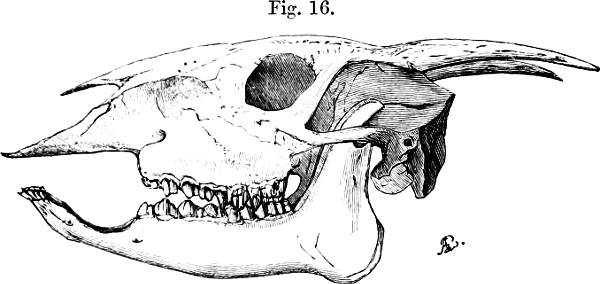
Fig. 16.
Skull of Cephalophus sylvicultrix, ad.
(P. Z. S. 1865, p. 205.)
The only modern authority that speaks of this Antelope is Mr. Büttikofer, of the Leyden Museum, who made two zoological voyages to Liberia in 1880 and 1886. In Dr. Jentink’s list of the Liberian mammals obtained by Mr. Büttikofer and his fellow collectors in Liberia (Notes Leyden Mus. vol. x. p. 20) it is recorded that Cephalophus sylvicultrix is said to occur sparingly on the Jackson and Mahfa rivers in that country, but to be more common on the Manna and Solyman rivers. But Mr. Büttikofer, in spite of all his efforts, did not succeed in obtaining specimens.
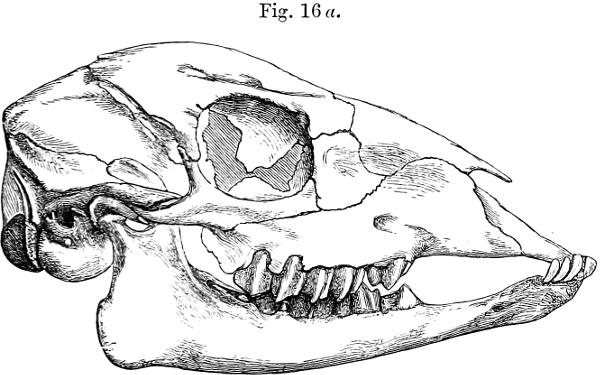
Fig. 16 a.
Skull of Cephaloplms sylvicultrix, jr.
(P. Z. S. 1871, p. 594.)
Although, as already stated, originally discovered in Sierra Leone, the Yellow-backed Duiker seems to have a somewhat extended distribution along the western coast of Africa, reaching altogether from Liberia to the Congo. A pair of mounted specimens and a skeleton in the British Museum were transmitted from Fantee by the native collector Aubinn. The same collection also contains skins from Lagos, procured by Sir Alfred Moloney, and two skulls and a skin from Gaboon, brought to England by Mr. DuChaillu on his return from his celebrated gorilla-hunting expedition. Upon one of these skulls in 1865, Dr. Gray established his Cephalophus longiceps, and upon the second skull and the skin which accompanied it, in 1871, the same author based his C. melanoprymnus. Thomas has shown (P. Z. S. 1892, p. 416) that both these names are merely synonyms of, C. sylmcultrix[12]. We may add we have as yet no information as to the range of this species into the interior, except that Herr Matschie has recorded its occurrence in Togoland; but it must be explained that our knowledge of the distribution of West-African mammals is still woefully deficient. As the same gentleman informs us, there is, besides several skins from Togoland, a stuffed example in the Berlin Museum sent by Herr Pechuel-Loesche from Longobondo.
Our illustration of this species on Plate XIII. is copied from a watercolour drawing taken in April 1894 by Keulemans, from a fine male specimen living in the Zoological Gardens of Rotterdam. As this animal was received from the Congo in June 1891 (presented by Heer A. de Bloeme) it must be necessarily quite adult. Mr. Keulemans’ notes on it are as follows:—“Head dark grey; neck grey, shading into brownish and becoming blackish near the shoulders; hairs of neck and head very short and glossy; general colour dark brown, with a bluish gloss, getting blacker on the buttocks, where the hairs are long; tail short and black; large plaque on the back and buttocks and tuft between the horns brownish ochre.” Our second figure (Plate XIV. fig. 2), which was prepared by Mr. Smit under Sir Victor Brooke’s directions, probably represents a young male of this species; but we do not know for certain from what specimen it was taken. The figure of Gray’s C. melanoprymnus in the Zoological Society’s ‘Proceedings’ for 1871 (pl. xliv.) was drawn from a still younger animal, probably of about the same stage as the figure of “C. punctulatus” in the ‘Knowsley Menagerie.’ It will be observed how greatly the colour of the back varies in these specimens of different ages.
May, 1895.
THE BOOK OF ANTELOPES, PL. XV.
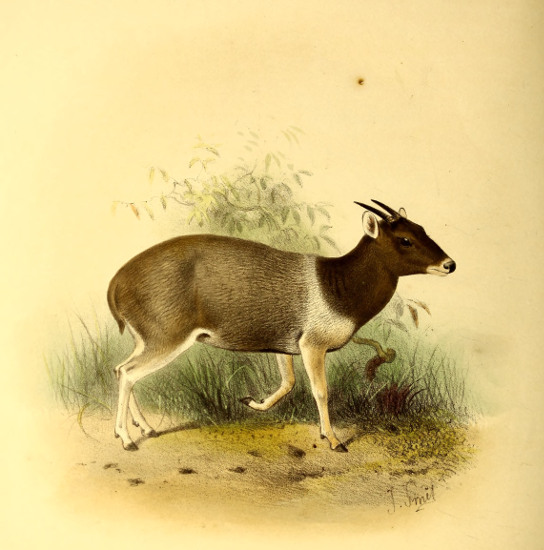
Smit del. et lith.
Hanhart imp.
Jentink’s Duiker
CEPHALOPHUS JENTINKI.
Published by R. H. Porter.
20. JENTINK’S DUIKER. CEPHALOPHUS JENTINKI, Thos. [PLATE XV.]
Antilope (Terpone) longiceps, Jent. N. L. M. vii. p. 272, pl. x. (animal) (1885) (nec Gray).
Terpone longiceps, Jent. N. L. M. x. p. 19, pl. i. (horns, ♀) (1887); id. Cat. Mamm. Leyd. Mus. (Mus. Pays-Bas, xi.) p. 158 (1892); Büttik. Reiseb. a. Liberia, ii. p. 374 (1890).
Cephalophus jentinki, Thos. P. Z. S. 1892, p. 417; Lyd. Horns and Hoofs, p. 213 (1893).
Size large, though smaller than C. sylvicultrix; form stout. Ears short, broad, and rounded. Colour of head, ears, neck all round as far back as the withers, throat, and a narrow sternal line deep uniform black; of body above and beneath coarsely grizzled grey, the hairs ringed with black and white. Lips and chin, a line all round the fore-quarters separating the black from the grey, axillæ, groins, fore and hind legs whitish; a rather darker mark running across the outer side of the forearm.
Skull much longer in proportion to the size of the animal than in C. sylvicultrix, agreeing, in fact, precisely in size with that of the larger species. In other respects also it agrees so closely with that of C. sylvicultrix that, had the external characters not been known, the two species would have been hardly supposed to be different. Such differences as there are, however, have been fully pointed out in Thomas’s monograph.
Horns long, tapering, placed in the line of the nasal profile, divergent as in C. sylvicultrix, those of female 6·1 inches long, base not specially thickened, basal diameter going about 5½ times in the length.
Dimensions:—♀. Height at withers 30 inches, ear 4, hind foot 12.
Skull (♀): basal length 10·5 inches, greatest breadth 5, muzzle to orbit 6·5
Hab. Liberia.
The present Duiker nearly equals the preceding species in size, but, as will be seen by the Plate, is immediately distinguishable by marked differences in colour, its black head and neck rendering it very conspicuous. Its discovery is due to Mr. F. X. Stampfli, a naturalist who made two expeditions to Liberia, in 1884 and 1886, to collect specimens for the Leyden Museum. In the first of these he was alone; in the second he was accompanied by Mr. Büttikofer, the well-known Conservator of that institution.
The Black-headed Duiker was first described by Dr. Jentink, the Director of the Leyden Museum, in 1885, from a single female specimen procured near Schieffelinsville, on the Junk River, by Stampfli in the preceding year. Unfortunately Dr. Jentink referred the specimen to C. longiceps of Gray, a species based on a skull brought home from Gaboon by Mr. DuChaillu. In doing this he was perfectly justified, on account of the extraordinarily close resemblance of its skull to that of C. longiceps. But Thomas subsequently showed that DuChaillu’s Gaboon skull (as already mentioned above) is undoubtedly referable to the nearly allied C. sylvicultrix. Under these circumstances it became necessary to give another scientific name to the present species, and Thomas selected the appropriate term jentinki; as it was Dr. Jentink’s “carefulness, led astray by Dr. Gray’s serious mistakes,” that had “caused him to make the venial error just referred to.”
During his second expedition, in 1887, Mr. Stampfli procured two more examples of this Antelope on the Farmington River. Like the first, both these were females, and, as we are told by Dr. Jentink, do not differ in colour from the typical specimen. Mr. Stampfli’s notes on this Antelope are as follows:—
“A little below Schieffelinsville, in the triangle between the Junk River on one side and its two confluents, the Du Queah and Farmington Rivers, on the other, a wooded eminence called ‘Sharp Hill’ rises in the middle of the marshes, to which, according to the testimony of the natives, these animals are restricted. As in the dry season the marshes cannot be traversed in canoes, and yet are not sufficiently dry to be passed on foot, these Antelopes can only be obtained in the rainy season, and it is said to be quite an exception for a specimen to be procured except during that period.”
In the second volume of Mr. Büttikofer’s ‘Reisebilder aus Liberia,’ which contains a complete account of the explorations and discoveries of himself and his companions in that country, will be found some additional details on this Antelope. Mr. Büttikofer calls particular attention to the large size of the inguinal glands between the belly and the thigh in this Antelope. They are so large that they will easily contain a lemon. These are said to be fat-glands, from which the beast extracts fat with its muzzle to lubricate its short, shining, hairy coat. Mr. Büttikofer also says that this Antelope, although only obtained from Sharp Hill, certainly occurs in other parts of Liberia.
Our figure of this Bush-Duiker (Plate XV.) has been prepared by Mr. Smit from the mounted specimen in the British Museum, which is the type of the species. It is one of the three specimens obtained in Liberia by Mr. Stampfli, the other two remaining at Leyden. We believe that these are the only three specimens of this rare Antelope existing in any European museum.
May, 1895.
21. ABBOTT’S DUIKER. CEPHALOPHUS SPADIX, True.
Cephalophus spadix, True, Pr. U.S. Nat. Mus. xiii. p. 227 (1890); id. op. cit. xv. p. 473, pl. lxxviii. (animal), pl. lxxix. (skull) (1892); Thos. P. Z. S. 1892, p. 418; Lyd. Horns and Hoofs, p. 209 (1893); Jackson, in Badm. Libr. Big Game Shooting, i. p. 285 (1894).
Size comparatively large. General colour dusky chestnut-brown without spots or bands, and not lighter on the belly. Forehead dusky brown, like body; chin and throat pale greyish brown. Hairs of crest chestnut-red at the base, and tipped with black: mingled with them are some hairs which are dusky throughout, and others pure white. Anterior surfaces of the legs somewhat lighter than the posterior surfaces. Tail dusky, except at the tip, where there are a few pure white hairs.
Skull elongate; muzzle slender; frontal region strongly convex.
Horns “directed backwards, and lying below the plane of the upper surface of the skull”; those of male 4½ inches long; slender, straight, not thickened at the base in front.
Dimensions:—♂. Head and body 38 inches, ear 4¼, hind foot (hoof to hock) 9½.
Skull: basal length, from occipital condyle, 8·5 inches; greatest breadth 4; nasals, length 3·7.
This description has been compiled from Mr. True’s two notices and from his figures of the animal and its skull, as we have not as yet had any opportunity of seeing examples of the species, of which no specimen has come to Europe.
Hab. East Africa, Mount Kilimanjaro, at high elevations (Abbott).
We now proceed to consider the smaller Duikers of the section with horns slanting backwards. These are generally of a rufous colour, varied by more or less intense dark markings on the face and dorsal line, only C. doriæ, which we place by itself, having the back transversely barred.
Sir John Willoughby’s volume on ‘East Africa and its Big Game’ gives an excellent account of the adventures of himself and a party of friends during a shooting-expedition to the hunting-grounds of Kilimanjaro and its neighbourhood, and of the great variety and enormous quantity of the larger mammals to be met with, a few years ago, in that district. In an appendix to the volume, contributed by Mr. H. C. V. Hunter, F.Z.S., is added a systematic account of the principal mammals met with on the plains round Kilimanjaro and on the mountain itself, amongst which we find recorded such splendid Antelopes as the Eland, Koodoo, Oryx, Hartebeest, Gnu, Pallah, Waterbuck, Reedbuck, and three kinds of Gazelle. At the close of the list Mr. Hunter notes the occurrence, high up on Kilimanjaro, of a species of Cephalophus “of a dark red colour, much larger than the Common Duiker (C. grimmi). A male of this probably new Antelope, it is stated, had been killed by Dr. Abbott.” This, so far as we know, is the first published mention of the species of which we now speak as Abbott’s Duiker.
Dr. W. L. Abbott, who is thus alluded to, is an American naturalist and explorer who passed nearly two years, in 1888 and 1889, collecting objects of natural history in the district of Kilimanjaro. On his return to America Dr. Abbott presented his whole collection to the National Museum, which is under the charge of the Smithsonian Institution at Washington. Mr. Frederick W. True, the Curator of the Department of Mammals, to whom was assigned the task of describing the collection, speaks of it as “one of high scientific value.” “The specimens,” he says, “have been prepared with much care, the skins being almost invariably accompanied by the skulls, and furnished with labels giving the locality and date of capture, the sex, and other data.” It included altogether about ninety skins and an equal number of skulls representing some thirty-eight species. Amongst these was a single male example of the present Antelope, no doubt the specimen alluded to by Mr. Hunter which is stated to have been killed at a high altitude on Kilimanjaro. As there is no specimen of this Antelope available for our use, we have, as already stated, extracted the more essential characteristics from Mr. True’s two accounts.
Mr. True was of opinion that C. spadix is closely allied to C. niger, and even possibly identical with it. We think, however, that its nearest relatives are probably C. natalensis and C. harveyi, from which it is at once distinguishable by its larger size.
May, 1895.
THE BOOK OF ANTELOPES, PL. XVI.
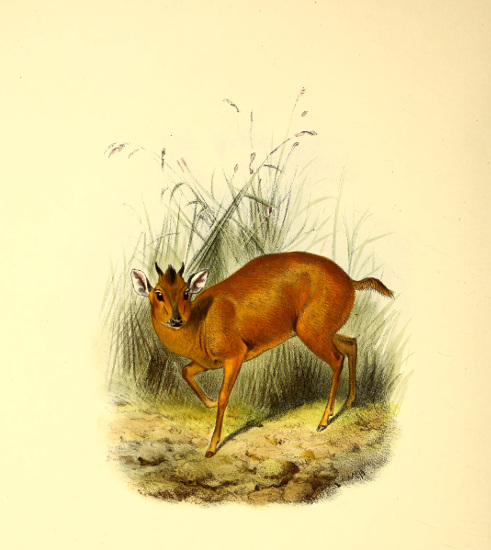
Wolf del. Smit lith.
Hanhart imp.
The Natal Duiker
CEPHALOPHUS NATALENSIS
Published by R. H. Porter.
22. THE NATAL DUIKER. CEPHALOPHUS NATALENSIS, A. Smith. [PLATE XVI.]
Cephalophus natalensis, A. Smith, S. Afr. Quart. Journ. ii. p. 217 (1834); id. III. Zool. S. Afr., Mamm. t. xxxii. (1841); Gray, Ann. Mag. N. H. (1) xviii. p. 166 (1846); id. Knowsl. Men. p. 10 (1850); id. P. Z. S. 1850, p. 123; Turner, P. Z. S. 1850 p. 170; Gray, Cat. Ung. B. M. p. 85, pl. x. fig. 1 (skull) (1852); Gerr. Cat. Bones Mamm. B. M. p. 236 (1862); Blyth, Cat. Mamm. As. Soc. p. 168 (1863); Fitz. SB. Wien, lix. pt. 1, p. 166 (1869); Gray, P. Z. S. 1871, p. 598; id. Cat. Rum. B. M. p. 27 (1872); id. Hand-l. Rum. p. 96 (1873); Drummond, Large Game S. Afr. p. 391 (1875); Scl. List Anim. Z. S. (8) p. 146 (1883); Scl. f. Cat. Mamm. Calc. Mus. ii. p. 168 (1891); Jent. Cat. Mamm. Leyd. Mus. (Mus. Pays-Bas, xi.) p. 162 (1892); Thos. P. Z. S. 1892, p. 419; Nicolls & Egl. Sportsm. S. Afr. p. 23, pl. i. fig. 2 (head) (1892); Ward, Horn Meas. p. 77 (1892); Lyd. Horns and Hoofs, p. 209 (1893).
Cephalophorus natalensis, Gray, List Mamm. B. M. p. 163 (1843).
Sylvicapra natalensis, Sund. Pecora, K. Vet.-Ak. Hand-l. 1844, p. 190 (1846); id. Hornschuch’s Transl., Arch. Skand. Beitr. ii. p. 142; Reprint, p. 66 (1848).
Antilope (Cephalolophus) natalensis, Wagn. Schr. Säug. Supp. iv. p. 453 (1844), v. p. 426 (1855); Gieb. Säug. p. 321 (1859).
Vernacular Names:—Incumbi of Swazis and Mangule of Shangaans (Rendall); Roode-bok of Dutch.
Size rather small. Form slender. Colour bright rufous chestnut all over, without marks or stripes of any kind, except that there is a faintly marked red superciliary line. Back of neck greyish brown. Chin and throat whitish. Tail slender, rufous at base; brown, tipped with white, at its extremity.
Horns set parallel to nasal profile; those of male conical, much thickened at their bases; their greatest basal diameter going about three times into their length; length about 3 inches in an old specimen: those of female similar, but smaller and more sharply pointed, 1·5 inch in length.
Skull—frontal region roughened and convex; anteorbital fossæ of medium depth; edge of median posterior palatal notch but little anterior (about ¼ inch) to the lateral notches.
Dimensions:—♀. Height at withers 17 inches, length of ear 2·5, hind foot 7·6.
Skull ♂: basal length 5·6 inches, greatest breadth 2·8, orbit to muzzle 3·15.
Hab. Natal, Transvaal, and Mashonaland.
The Natal Duiker, which is perhaps a southern representative of the next species, is, like it, of a nearly uniform bright bay colour, rather paler below, and with some inconspicuous darker markings on the vertical crest. Our figure of this species (Plate XVI.) was put on the stone by Mr. Smit from a sketch prepared by Mr. Wolf, and was probably taken from one of the specimens in the British Museum; but of this, we regret to say, there is no certain record.
The discovery of the Natal Duiker is due to Sir Andrew Smith, who met with it in the forests of Natal and first described it in 1834 in one of his articles on African Zoology published in the ‘South African Quarterly Journal.’ Sir Andrew afterwards figured it in the volume of Mammals of his ‘Illustrations of South African Zoology,’ where the following notes are given on its habits:—“Both C. cæruleus [= C. monticola, nob.] and C. natalensis inhabit the African forests; the former towards the Cape of Good Hope, the latter to the eastward about and beyond Port Natal. They both feed partly upon the grass which occurs among the underwood, and partly upon the young leaves and shoots of the brushwood and small trees which exist in the situations they inhabit; and to obtain the latter they may occasionally be seen scrambling among shrubs, or ascending the stems of sloping trees, so as to reach what they cannot attain while they are on the ground.”
Beyond a reference to its name in various lists and catalogues, we find little more recorded concerning this Antelope until modern days, when several experienced observers have mentioned it. In his ‘Rough Notes on the Game and Natural History of South and South-east Africa,’ published in 1875, the Hon. W. H. Drummond mentions the “Red-buck,” as he calls it, as one of the two species of Cephalophus that inhabit the jungles of Natal, the other being “the Blue-buck” (Cephalophus monticola). Of these, Mr. Drummond says the Red-buck “is the larger and also the least common. It is, as its name denotes, of a light yellowish-red colour, mingled with grey on the lower parts, and its chief peculiarity is a tuft of hair growing out of the forehead, which gives a curious appearance to the hornless does, while it partially conceals the small horns of the bucks. Its flesh is anything but good, and it is difficult to shoot, from the tremendous rushes it makes when disturbed. So fast and heedlessly does it run, that I once saw a buck, that had passed me while I was loading, entangle itself in a mass of creepers, from which, despite its struggles, it was unable to escape until I released it with the help of my knife. It was quite uninjured, and I kept it in confinement for some weeks, but, like most Antelopes when caught full-grown, it ultimately pined away and died.”
Messrs. Nicolls and Eglington, in their ‘Sportsman in South Africa’ (1892), tell us that this Antelope is found only in Zululand, Natal, and the southern portions of Swaziland, but is everywhere very scarce. It is, however, stated on good authority to have been found recently in South-eastern Mashonaland. In habits, these authors say, it resembles the Common Duiker, except that it chooses dense forest as a residence.
So far as we know, but one specimen of the Natal Duiker has ever been brought to Europe alive. This was a male which was purchased in 1880 (March 14th), by the Zoological Society of London, of Mr. Charles Jamrach, for the sum of £6 10s., and lived some months in the Menagerie.
Besides the skin of an adult female of this species, received from Sir Andrew Smith as the type of C. natalensis, there is a mounted pair in the National Museum, collected by Dr. A. Krauss, and received in exchange from the Stuttgart Museum. There are also skins of adults of both sexes and accompanying skulls in the same collection from the Transvaal, obtained by Dr. Percy Rendall, C.M.Z.S., in 1893 and 1894. Dr. Rendall has kindly favoured us with the following notes upon the present species of Duiker:—
“The local Colonial name for this Antelope is the ‘Lesser Red-buck.’ To the Swazis it is the ‘Incumbi,’ and to the Shangaans the ‘Mangule.’
“Its occurrence I found confined to a very limited area, i.e. the slopes of the Makongwa Mountains, which are locally termed ‘Moodie’s Concession,’ in the Barberton portion of the Transvaal, adjoining Swaziland. Here it was not uncommon in places; its resorts being always the wooded creeks or ‘dongas,’ where there is dense cover.
“Its habits are so skulking that it is extremely hard to procure specimens, even when the hunter is aware of its existence in a particular locality. Nothing but a well organized beat with natives and dogs will make these animals break cover from the bush and long grass they frequent.
“I never heard of one being seen or shot in the open, and their spoor and droppings are only seen just on the outskirts of the cover, where they feed at night.
“The way in which they double and dodge the dogs and beaters in full cry is inimitable, and to an onlooker is most entertaining. Their vitality is wonderful, and their power of endurance before dogs considerable, especially considering their comparatively small size. There is little difference between the respective weights of the sexes when adult, as I was surprised to find when I put them into the scale.
“The female is always horned, and in two specimens that I dissected each was found to be carrying a quarter-grown (hairless) fœtus, in the month of April. A wounded animal that I saw pulled down by a dog gave vent to a prolonged squeal, not unlike a rabbit or hare does under similar circumstances, though fainter in volume.
“The long tuft of hair around and between the horns is always more marked in the male, and practically masks the horns. The flesh is not appreciated by a European palate, though the reverse is the case with the Swazis, as I have noticed.
“Measurements taken of three Adult Specimens, 15th April, 1894.
1. (♂.) 2. (♀.) 3. (♀.)
in. in. in.
Height at shoulder 17¾ 18 16¾
Circumference of barrel behind shoulder 18¾ 18¼ 17¼
Point of shoulder to nose 12¼ 14 12¾
Circumference of neck 10 9¼ 9¼
Nose to tail 36¼ 38 39¼
Weight 26 lbs. 27½ lbs. 25½ lbs.”
May, 1895.
THE BOOK OF ANTELOPES, PL. XVII.
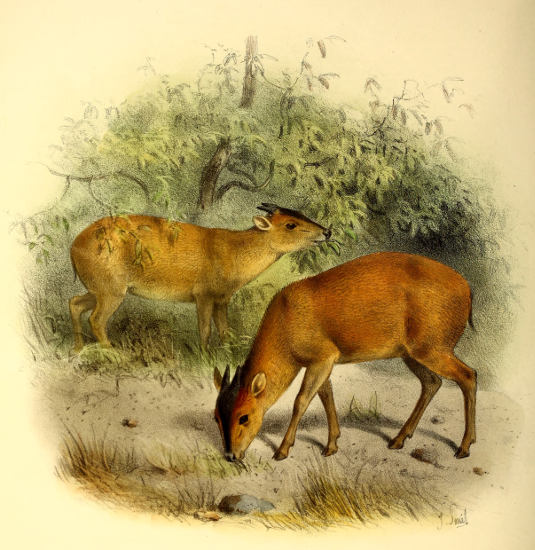
J. Smit del et lith.
Hanhart imp.
Harvey’s Duiker.
CEPHALOPHUS HARVEYI.
Published by R. H. Porter.
23. HARVEY’S DUIKER. CEPHALOPHUS HARVEYI, Thos. [PLATE XVII.]
Cephalolophus natalensis, Noack, Humboldt, v. pt. 9, p. 6, fig. 5 (animal) (1886); Thos. P. Z. S. 1892, p. 419 (in part, nec A. Smith).
Cephalophus nigrifrons, True, Pr. U. S. Nat. Mus. xv. p. 476 (1892) (Taveta) (nec Gray).
Cephalophus harveyi, Thos. Ann. Mag. N. H. (6) xi. p. 48 (1893); Lyd. Horns and Hoofs, p. 210 (1893); Jackson, Badm. Libr. Big Game Shooting, i. pp. 167, 285, 308 (1894); Thos. Ann. Mus. Genov. (2) xv. p. 6 (1895) (Somali).
Size and general coloration almost exactly as in C. natalensis, but with a brown or blackish blaze on the face as in C. nigrifrons, extending from the nasals to the occiput, and expanding on the forehead. Feet slender; hoofs not specially elongated.
Skull much roughened and swollen in the frontal region; muzzle rather short and conical; median notch of palate but little deeper than the lateral ones.
Horns (♂) conical, very thick at the base, their greatest basal diameter going barely two and a half times in their length, which in an old individual is 3·1 inches.
Dimensions:—Skull, basal length 5·9 inches, greatest breadth 3, muzzle to orbit 3·3.
Hab. British East Africa (Kilimanjaro district) and Southern Somaliland.
In Harvey’s Duiker we have a third species of the smaller-sized section of this group of Duikers which, although, like the two preceding, of nearly uniform colour as regards the body, has a distinct black blaze on the face, in which character it resembles C. nigrifrons of the West Coast of Africa. So closely allied, however, are all the Duikers of the present section that, as will be seen from our list of synonyms, Harvey’s Duiker was associated first of all with C. natalensis and afterwards with C. nigrifrons, before it was recognized by Thomas as having good claims to constitute an independent species. Thomas took his characters, which were published in the ‘Annals of Natural History’ in 1893, from a head obtained by Mr. F. J. Jackson in the Kilimanjaro district some years ago, and subsequently presented to the British Museum. In his chapter on “Game Districts and Routes,” in the first volume of ‘Big Game Shooting,’ we find that Mr. Jackson has mentioned the present species as met with along with the elephant in the dense and almost impenetrable forests near Taveta. At Mr. Jackson’s suggestion Thomas appropriately dedicated the present species to Sir Robert Harvey, whose repeated expeditions to East Africa have made us so well acquainted with the animals of that district.
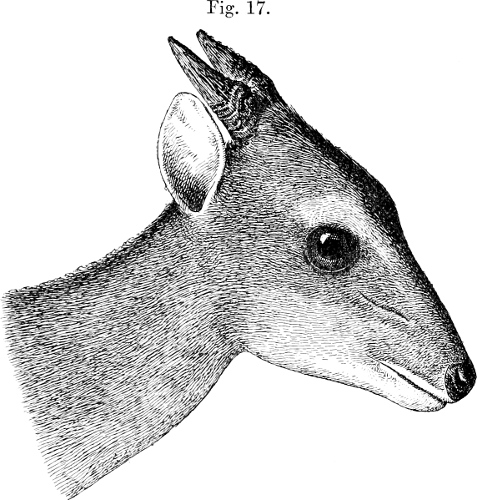
Fig. 17.
Head of Harvey’s Duiker.
(From Mr. Jackson’s specimen.)
On re-examining the specimens at the British Museum, Thomas discovered that a skin obtained many years ago by Sir John Kirk near Malindi, on the coast of British East Africa, and previously referred erroneously to C. natalensis (owing to its having lost the fur off its face), likewise belongs to this species, which, as Mr. Jackson has informed us, does occur in a patch of forest about one day south-west of Malindi.
There can be little doubt also that the Black-fronted Antelope obtained by Dr. W. L. Abbott near Taveta during his expedition of 1888–89, of which we have already spoken, and now in the National Museum of the United States at Washington, should be referred to C. harveyi. Mr. True provisionally determined it as C. nigrifrons, not having specimens of that Antelope from the western coast to compare it with, and has given us an excellent description of it in his memoir on Dr. Abbott’s mammals.
More recently, again, this species has been obtained by Capt. Bottego in South Somaliland, as mentioned in Thomas’s report on the mammals presented by that sportsman to the Museo Civico at Genoa.
Our figure of Harvey’s Duiker (Plate XVII.) has been prepared by Mr. Smit from Sir John Kirk’s specimen in the British Museum, the head in the same collection obtained by Mr. Jackson having been used where Sir John Kirk’s specimen is imperfect.
May, 1895.
THE BOOK OF ANTELOPES, PL. XVIII.
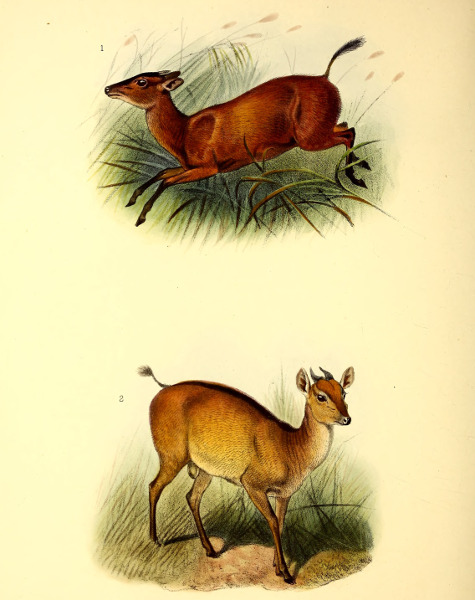
Smit lith.
Hanhart imp.
Fig. 1. The Black-fronted Duiker.
CEPHALOPHUS NIGRIFRONS.
Fig. 2. Ogilby’s Duiker.
CEPHALOPHUS OGILBYI.
Published by R. H. Porter.
24. THE BLACK-FRONTED DUIKER. CEPHALOPHUS NIGRIFRONS, Gray. [PLATE XVIII. Fig. 1.]
Cephalophus nigrifrons, Gray, P. Z. S. 1871, p. 578, fig. 6 (skull), pl. xlvi. (animal); id. Cat. Rum. B. M. p. 27 (1872); id. Hand-l. Rum. B. M. p. 96 (1873); Peters, MB. Ak. Berl. 1876, p. 482 (Cameroons); Scl. List Anim. Z. S. (8) p. 147 (1883); Thos. P. Z. S. 1892, p. 419; Lyd. Horns and Hoofs, p. 210 (1893).
Cephalophus aureus, Gray, Ann. Mag. N. H. (4) xii. p. 42 (1873) (jr.); id. Hand-l. Rum. B. M. p. 95 (1873).
Vernacular Name:—Ngolo in the Cameroons (Buchholz).
Size medium. Colour of body rich chestnut, scarcely or not at all paler below. Centre of face and crest deep black, contrasting markedly with the rufous superciliary streaks. Nape browner. Feet and tip of tail blackish, a few white hairs in the terminal tuft of the latter. Hoofs apparently longer in proportion than usual; lower edge of the posterior outer hoof 1·57 inch in length.
Horns, judging only from the cores, decidedly short, and but little expanded at their base; the cores in an adult male about 1·9 inch long. Their set parallel to, and a little below, the level of the nasal profile.
Skull with the frontal region decidedly convex. Muzzle rather narrow and elongated. Anteorbital fossæ of medium depth. Median posterior palatine notch some distance (⅓ inch in type) in front of the level of the lateral notches.
Dimensions:—♂. Approximate height at withers 19 inches, ear 2·3, hind foot 9·2.
Skull: basal length 6·3 inches, greatest breadth 3·1, muzzle to orbit 3·6.
Hab. Coast of Western Africa from Cameroons to Gaboon.
Although the great wood-region of Western Africa has been repeatedly visited by naturalists since the days of Afzelius in the last century, and many collections have been formed there, very little has been recorded respecting the habits of the mammals of this part of the continent. The reason of this, no doubt, is mainly the impenetrable nature of the forests and bush which cover the whole country and which allow much fewer observations to be made upon the habits and peculiarities of the animals than in the more open and easily traversed districts of the Ethiopian Region. Of the present and several other species of this genus of Antelopes, for example, we shall see that very little information can be given except what results from the examination of their skins and skulls brought home as specimens for our museums.
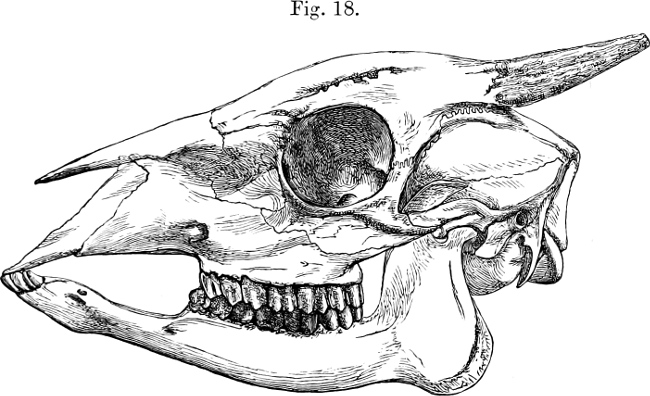
Fig. 18.
Skull of Cephalophus nigrifrons.
(P. Z. S. 1871, p. 598.)
Like Harvey’s Duiker of Eastern Africa, the Black-fronted Duiker, which is its representative and close ally in the great western wood-region, carries a coat of a nearly uniform chestnut. Like C. harveyi, also, it has a distinct black blaze down the centre of the face, whence the appropriate name C. nigrifrons has been bestowed on it. Its distinctions from Harvey’s Duiker, as pointed out by Thomas, are that it is of a much more uniform colour all over and hardly paler below, while in the last-named species the cheeks, sides of the neck, and throat are of a pale bay, and the chin is white as in C. natalensis. Its most striking characteristic is, however, the fact that its hoofs are very much longer than is usual in the genus, an elongation which is probably due to its inhabiting marshy and boggy regions, where its long hoofs would prevent its sinking so deeply as it otherwise would into the muddy soil.
The typical specimens of this Duiker formed part of the collection made by Mr. DuChaillu during his celebrated visit to the Gaboon in 1856 and the following years, the greater part of which were ultimately acquired by the British Museum. On reference to the ‘Explorations and Adventures in Equatorial Africa’ of DuChaillu we can find no reference to it, unless, as is probable, it is alluded to as one of the “four species of Gazelle not yet determined,” which are enumerated in the appendix. When, however, DuChaillu’s specimens came under the experienced eye of the late Dr. Gray, on the occasion of his preparing a monograph of the genus Cephalophus (subsequently published in the Zoological Society’s ‘Proceedings’ for 1871), it was quickly discovered that amongst them was a representative of a new and distinct species of the present genus, which was described and figured as C. nigrifrons. In a subsequent communication to the ‘Annals of Natural History’ in 1871, Dr. Gray described a specimen of what he believed to be another new species of Cephalophus under the name of C. aureus. On this occasion he tells us that the specimens, both of his C. nigrifrons and of his C. aureus, “had been sent home from Africa by Mr. DuChaillu as materials for stuffing out the skin of a specimen” of a larger Antelope (Tragelaphus euryceros). We believe it to be the fact that, as Sclater was assured by the late Dr. Gray, he described four new species of Antelopes from skins found in the interior of this Tragelaphus when it was unstuffed for the purpose of being remounted for the collection of the British Museum. As regards the so-called C. aureus, however, a close examination of the typical specimen, made by Thomas in 1892, convinced him that it was a very young animal and was probably only an immature individual of the present species. We may observe, however, that its body is far brighter and more fulvous than that of the adult, that the withers and shoulders are browner, and that the caudal tuft is more abundantly mixed with white.
In 1882, as recorded in the eighth edition of their ‘List of Animals,’ the Zoological Society acquired by purchase of Mr. Cross, of Liverpool, a living specimen of the Black-fronted Antelope, which lived for about three months in the Menagerie. Of this it can only be said that, like most of the smaller Antelopes (if we except the Gazelles), it was shy and inoffensive in its disposition.
The existence of C. nigrifrons in the Cameroons has been recorded by Peters, who published in 1876 an account of the collection of Mammals made by Dr. Reinhold Buchholz in this and other localities in Western Africa. Buchholz, when at the Cameroons, obtained a specimen of the Black-fronted Duiker from the natives who had captured it alive when swimming across a river. He remarks on the prominent appearance of the inguinal glands, and says that the horns are very short and conical, and almost covered by the frontal hairs. The native name of these Cephalophi in the Cameroons is said to be “Ngolo.”
Our figure of this Bush-Duiker (Plate XVIII. fig. 1) was prepared by Mr. Smit under the direction of the late Sir Victor Brooke. It was probably taken from the specimen in the British Museum, but of this we are not quite sure.
May, 1895.
25. THE WHITE-BELLIED DUIKER. CEPHALOPHUS LEUCOGASTER, Gray.
Cephalophus leucogaster, Gray, Ann. Mag. N. H. (4) xii. p. 43 (1873); Thos. P. Z. S. 1892, p. 420; Lyd. Horns and Hoofs, p. 211 (1893).
Size medium. General colour dull chestnut-rufous, with a black dorsal band. Face rufous, darker down the centre; crest mixed rufous and black. Nape browner. Dorsal stripe commencing in front of the withers, not pure black, but grizzled with rufous, and not at all sharply defined laterally; posteriorly, however, on the tail it becomes abruptly very narrow and sharply defined, not covering the whole breadth of the tail, but bordered on each side with rufous or white. End of tail with a large mixed black and white tuft. Under surface of body from chin to anus, inner sides of forearms and hips, and also a line passing down the anterior side of the metatarsi, whitish or pure white; no trace of a darker sternal patch. Posterior faces of buttocks also pure white, very different from the deep chestnut of this part in C. dorsalis.
Horns of type (apparently ♀) conical, sharply pointed.
Skull, so far as can be gathered from a young and very imperfect example, with a slender narrow muzzle like that of C. dorsalis castaneus, quite unlike the short conical one of C. d. typicus.
Dimensions of the type (an immature specimen):—Height at withers 15 inches, ear 2·5, hind foot 7·9.
Hab. Gaboon.
The White-bellied Duiker is another discovery of Dr. Gray’s, made, as in the case related in the former article, on a specimen obtained from the interior of a stuffed example of Tragelaphus euryceros, received from Mr. DuChaillu. We may therefore fairly put down the locality of the specimen as Gaboon, to which district of Western Africa both of Mr. DuChaillu’s great journeys were confined. As in the former case also, the present species was described in the ‘Annals of Natural History’ for 1873, in a supplementary paper to Dr. Gray’s revision of the species of the present genus published in 1871. To what extent, however, the present is different from the allied species must remain uncertain until further specimens have been obtained, which, so far as we are aware, has not yet been the case.
The typical example of Cephalophus leucogaster is probably a female and is quite immature, with the milk-molars still in position and the third molar still below the bone, and it is difficult to arrive at a definite conclusion from such a specimen. At the same time, as Thomas has shown in his article on the genus Cephalophus, published in 1892, it is not possible, in the present state of our knowledge, to refer the specimen to any described species. The black dorsal band distinguishes it from C. nigrifrons and other preceding species, and the white hams and under surface from all the forms of the next following species—C. dorsalis—to which, perhaps, it most closely approximates. On the whole, therefore, we can at present only say that C. leucogaster has been established on a young specimen of a species of which the adult form is not yet known to us.
May, 1895.
THE BOOK OF ANTELOPES. PL. XIX.
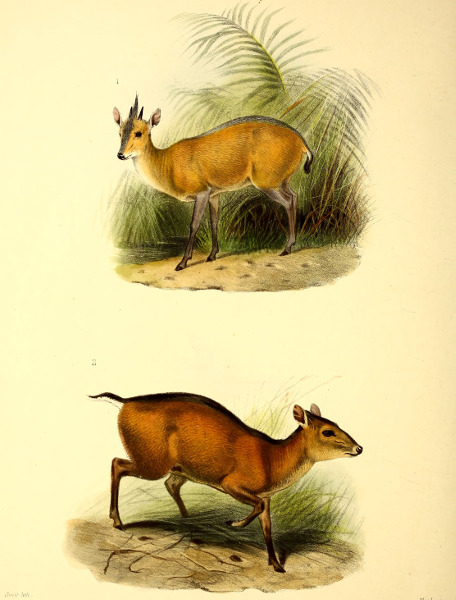
Smit lith.
Hanhart imp.
Fig. 1. The Red-flanked Duiker.
CEPHALOPHUS RUFILATUS.
Fig. 2. The Bay Duiker.
CEPHALOPHUS DORSALIS
Published by R. H. Porter.
26. THE BAY DUIKER. CEPHALOPHUS DORSALIS, Gray. [PLATE XIX. Fig. 2.]
Subspecies a. C. d. typicus.
Cephalophus dorsalis, Gray, Ann. Mag. N. H. (1) xviii. p. 165 (1846); id. List Ost. Sp. B. M. p. 146 (1847); id. Knowsl. Men. p. 10, pl. vii. (animal) (1850); id. P. Z. S. 1850, p. 123; id. Cat. Ung. B. M. p. 84 (1852); Temm. Esq. Zool. Guin. pp. 194, 218 (1853); Scl. P. Z. S. 1869, p. 594, pl. xlvi.; Murie, P. Z. S. 1869, p. 595 (anatomy); Fitz. SB. Wien, lix. pt. 1, p. 166 (1869); Gray, P. Z. S. 1871, p. 597, pl. xlv. (animal); id. Cat. Rum. B. M. p. 27 (1872); id. Hand-l. Rum. B. M. p. 96 (1873); Scl. List Anim. Z. S. (8) p. 147 (1883); Jent. N. L. M. x. p. 20 (1887) (Liberia); id. Cat. Ost. Leyd. Mus. (Mus. Pays-Bas, ix.) p. 132 (1887); Büttikofer, Reisebild. Liberia, ii. p. 377 (1890); Jent. Cat. Mamm. Leyd. Mus. (Mus. Pays-Bas, xi.) p. 162 (1892); Thos. P. Z. S. 1892, p. 420; Matsch. Mitth. deutsch. Schutz-geb. vi. p. 81 (1893); Lyd. Horns and Hoofs, p. 211 (1893).
Antilope (Cephalophus) dorsalis, Wagn. Schr. Säug. Suppl. v. p. 424 (1855).
Cephalophus dorsalis typicus, Thos. l. s. c.
Cephalophus badius, Gray, Cat. Ung. B. M. p. 84 (1852); Gerr. Cat. Bones Mamm. B. M. p. 236 (1862); Gray, P. Z. S. 1871, p. 595; id. Cat. Rum. B. M. p. 26 (1872); id. Hand-l. Rum. B. M. p. 94 (1873).
Cephalophus breviceps, Gray, P. Z. S. 1866, p. 202, pl. xx. (animal).
Subspecies b. C. d. castaneus.
Cephalophus dorsalis castaneus, Thos. P. Z. S. 1892, p. 421.
Subspecies a. C. d. typicus.
Size medium. Ears extremely short and broad. General colour bright chestnut-rufous, with a dark mesial stripe running from the nose to the tail, only interrupted at the crest, which is sometimes rufous. Centre line of face brown; superciliary streaks bright rufous. Crest variable, either black, mixed black and rufous, or wholly rufous. Dorsal stripe becoming absolutely black on the back, sometimes sharply defined throughout, sometimes broadening out on the withers into an ill-defined band passing down the shoulders towards the fore legs. Under surface, inner sides of limbs, and back of hams rufous like the sides; a black or blackish longitudinal patch present in the sternal region. Fore limbs brown, from the shoulder downwards, hind limbs from just above the heel. Tail black above throughout, the black covering nearly the whole breadth of the tail, white beneath terminally.
Horns placed about in the same straight line as the nasal profile, those of male about 2·8 inches long, slender, tapering, not thickened or roughened basally, the basal diameter going nearly five times in the length.
Skull with a remarkably short conical muzzle, the distance from the anterior rim of the orbit to the muzzle less than the zygomatic breadth. Anteorbital fossæ of medium depth. Mesial notch of palate about ⅕ inch in advance of the lateral ones.
Dimensions:—♀ (not fully adult). Height at withers 15 inches, ear 1·8, hind foot 6·7.
Skull: basal length (c.) 5·5 inches, greatest breadth 3·2, orbit to muzzle 3.
Hab. West Africa, from Sierra Leone to the Gold Coast, replaced in the Cameroons by C. d. castaneus.
Subspecies b. C. d. castaneus.
Rather larger than C. d. typicus, and ears apparently rather longer. Colour deep chestnut all over, the dorsal line deep black, the metacarpals and metatarsals brown. Superciliary stripe chestnut, indistinct, far less bright than in C. d. typicus, and the general colour of the head darker and duller.
Skull with the muzzle of the ordinary slender elongate shape, the distance from the anterior edge of the orbit to the muzzle exceeding the zygomatic breadth. Teeth decidedly larger than in the typical form.
Dimensions of the type, an immature female:—Height at withers 19 inches, ear 2·4, hind foot 8.
Skull: basal length (c.) 6 inches, greatest breadth 3·3, orbit to muzzle 3·5.
This subspecies is based on a female specimen referred by Gray[13] to “Cephalophus badius”; its skull has been figured by him under that name. Thomas has, however, shown that the skull of this specimen differs so much from that of typical C. dorsalis that, in spite of its external resemblance, it should be looked upon as representing a distinct subspecies; and this view we have accepted in the present work. Additional specimens will, however, be needed before its position can be satisfactorily determined. For the present, therefore, we publish all that is known about it, and trust that further specimens from different localities will clear up the precise relationship it bears to the true C. dorsalis, and also to its close ally C. leucogaster.
Hab. Cameroons.
The Bay Duiker, as this Antelope has long been called, is better known than the species which we have last spoken of and appears to have a wider distribution. At the same time it varies a good deal in the colour of its fur, both according to age and in the various localities in which it is found. Gray, who was an habitual species-maker, has, as was pointed out by Sclater in 1869, described it under three different names, based on age-changes and on slight variations in colour.
Commencing in 1846, Gray established his Cephalophus dorsalis on a specimen in the British Museum, which had been brought to this country alive by Mr. Whitfield from Sierra Leone and had died in the Surrey Zoological Gardens. In 1850 he figured the same species in the ‘Knowsley Menagerie’ from a drawing made by Waterhouse Hawkins. This drawing was probably taken from living specimens in the Knowsley Collection, also procured by Whitfield, who was a collector employed by Lord Derby. In 1852 Dr. Gray seems to have come to the conclusion that the animal figured in the ‘Knowsley Menagerie’ was not the same as the true Cephalophus dorsalis originally described from Mr. Whitfield’s specimen, and, accordingly, in his list of Ungulata Furcipeda in the British Museum, named the former Cephalophus badius, retaining the name Cephalophus dorsalis for the latter. Dr. Gray, however, did not state exactly how the two species are to be distinguished, and he afterwards united them under one heading. The typical specimen of C. breviceps was described when alive in the Zoological Gardens, and, as noticed by Gray himself, “assumed all the appearance, as it grew up, of C. badius”
As recorded by Temminck in his ‘Esquisses Zoologiques sur la Côte de Guinée,’ the well-known Dutch collector Pel met with this Antelope in Ashantee and Sierra Leone, where he states that it is found, although somewhat rarely, in the littoral forests, showing itself only at night. Two other collectors from Holland, Büttikofer and Stampfli, obtained specimens of this species on the Junk River in Liberia, which were likewise transmitted to the Leyden Museum.
Examples of this species in the British Museum were procured in Fantee by the native collector Aubinn; and we may therefore state confidently that the typical form of C. dorsalis inhabits the whole coast-region of Western Africa from Liberia to the mouth of the Niger.
When, however, we pass southwards of the delta of the Niger and arrive at the higher ground of the Cameroons the typical C. dorsalis seems to be replaced by a slightly different local form, which Thomas in 1892 characterized as a subspecies, C. dorsalis castaneus. This Antelope is rather larger than the typical form and the ears are apparently rather larger. The chestnut superciliary stripe is indistinct, far less bright than in the typical form, and the general colour of the head is darker and duller. The typical specimen of this subspecies, which is in the collection of the British Museum, is a female obtained by Crossley in the Cameroons. Besides the colour-differences just mentioned the form of the skull, which is figured in the ‘Hand-list of Ruminants’ as that of C. badius (op. cit. pl. xxx. fig. 1), is likewise peculiar. But further specimens and more information are necessary before we can decide whether it will be advisable to give the Cameroons animal the full rank of a species.
We have already mentioned the existence of a living specimen of this Duiker in the Derby Menagerie. Living specimens of it have also been received on more than one occasion by the Zoological Society of London. In 1861 an example was purchased of a dealer in Liverpool and lived more than two years in the Society’s Gardens. A second specimen, quite immature on its arrival, was purchased in February 1866 and was shortly afterwards described by Gray as Cephalophus breviceps. This was a female, and, being placed in the same compartment of the Gazelle-sheds as a male of the allied species C. rufilatus, bred with it when adult. It produced a young one in January, 1869, and died soon afterwards. A third specimen of the same Antelope was brought home from the Gold Coast and presented to the Society by Mr. C. B. Mosse, Staff-Surgeon, R.N., in October, 1869. This specimen was figured in the Zoological Society’s ‘Proceedings’ for that year (op. cit. pi. xlvi.). Mr. Mosse presented another from the same district in 1874. Since that period six other specimens of this Antelope have been acquired at different dates.
May, 1895.
27. OGILBY’S DUIKER. CEPHALOPHUS OGILBYI, Waterh. [PLATE XVIII. Fig. 2.]
Antilope ogilbyi, Waterh. P. Z. S. 1838, p. 60, 1842, p. 129 (Fernando Po); id. Ann. Mag. N. H. (1) ii. p. 472 (1839), xii. p. 57 (1843); Fraser, Zool. Typ. pi. xix. (animal) (1849).
Cephalophorus ogilbyi, Gray, Ann. Mag. N. H. x. p. 267 (1842); id. List Mamm. B. M. p. 163 (1843).
Antilope (Tragelaphus) ogilbyi, Less. N. Tabl. R. A., Mamm. p. 181 (1842).
Antilope (Cephalophus) ogilbyi, Wagn. Schr. Säug. Suppl. iv. p. 446 (1844), v. p. 423 (1855).
Cephalophus ogilbyi, Gray, Ann. Mag. N. H. (1) xviii. p. 165 (1846); id. Knowsl. Men. p. 10, pl. viii. fig. 2 (1850); id. P. Z. S. 1850, p. 122; id. Cat. Ung. B. M. p. 83 (1852); Temm. Esq. Zool. Guin. pp. 194, 217 (1853); Gerr. Cat. Bones Mamm. B. M. p. 236 (1862); Fitz. SB. Wien, lix. pt. 1, p. 167 (1869); Gray, P. Z. S. 1871, p. 595; id. Cat. Rum. B. M. p. 26 (1872); id. Hand-l. Rum. B. M. p. 98 (1873); Jent. N. L. M. x. p. 20 (1887) (Liberia); Büttikofer, Reisebild. Liberia, ii. p. 377 (1890); Matsch. Arch. f. Nat. 1891, pt. i. p. 353 (Cameroons); Jent. Cat. Mamm. Leyd. Mus. (Mus. Pays-Bas, xi.) p. 162 (1892); Thos. P. Z. S. 1892, p. 422; Lyd. Horns and Hoofs, p. 211 (1893); Matsch. MT. deutsch. Schutz-geb. vi. p. 81 (1893).
Sylvicapra ogilbyi, Sund. Pecora, K. Vet.-Ak. Hand-l. 1844, p. 191 (1846); id. Hornschuch’s Transl., Arch. Skand. Beitr. ii. p. 143; Reprint, p. 67 (1848).
Size medium. General colour bright orange, becoming rather more rufous on the hindquarters. Nose brown, but otherwise the face is of the same colour as the body. Nape and sides of neck brown or blackish, but the hairs here so thin and short that the skin shows through and the general colour is but little affected. Hinder back with a marked black central dorsal streak, commencing vaguely at the withers, becoming narrower and more sharply defined posteriorly, and running on to the tail. Limbs dull yellowish, except on the phalanges, where they are brown or black.
Horns in the direct line of the nasal profile; those of male about four inches long, conical, slightly incurved, much broadened basally, their greatest basal diameter going 2½ or 3 times in their length. Female about an inch and a half in length, conical, smooth, broad at base, pointed terminally, their length not twice their basal diameter.
Skull with a very considerable convexity in the frontal region. Anteorbital fossæ shallow. Posterior palate with the three notches, median and two lateral, all at about the same level.
Dimensions:—♂. Height at withers 22 inches, ear 3, hind foot 9·4.
Skull (♂, not fully adult): basal length 7·2 inches, greatest breadth 3·5, muzzle to orbit 4·4.
Hab. Coast of West Africa, from Liberia to the Cameroons.
Ogilby’s Duiker, which we now proceed to consider, is closely allied to the last species, and like it is of a generally rufous colour with a black dorsal stripe, but it is immediately distinguishable by its pale yellowish face and flanks. It was first described by Waterhouse, as long ago as 1838, from specimens presented to the Zoological Society’s Museum by Mr. George Knapp, who had received them from the island of Fernando Po, and was named after William Ogilby, formerly Secretary to the Society and a great authority upon the Ruminant Mammals. When the Zoological Society’s Museum was broken up the typical specimen passed into the British Museum, where it now is. About ten years afterwards Ogilby’s Duiker was figured by Fraser in his ‘Zoologia Typica,’ probably from the typical specimen. Fraser, who had visited Fernando Po himself, states that this Antelope is extremely common in that island and is much esteemed by the natives as an article of food. In his conjecture that its range “is confined to that island,” he was no doubt in error, as we have several trustworthy notices of its occurrence elsewhere.
Specimens of the present species are recorded by Dr. Jentink as having been procured on the Du Queah and Farmington Rivers in Liberia by Büttikofer and Stampfli. These are in the Leyden Museum, as is also a female specimen from Ashantee. In his ‘Reisebilder aus Liberia’ Büttikofer tells us that the present species is common in the Liberian forests.
In the Cameroons the present species has been met with by the German collectors Preuss and Morgan, as recorded by Herr Matschie, and in Togoland, on the same authority, by Kling and Büttner. Thus there can be little doubt that Ogilby’s Duiker ranges along the woody littoral of Western Africa from Liberia to the Cameroons.
Ogilby’s Duiker having been figured by Waterhouse Hawkins in the ‘Knowsley Menagerie’ it is probable that one or more living specimens of it were exhibited in that splendid collection, but we can find no record of examples of it ever having been received alive by the Zoological Society of London.
Our figure of this species (Plate XVIII. fig. 2) was prepared by Mr. Smit, under Sir Victor Brooke’s directions, probably from specimens in the British Museum, but of this we have no certain evidence.
May, 1895.
28. PETERS’S DUIKER. CEPHALOPHUS CALLIPYGUS, Pet.
Cephalophus callipygus, Pet. MB. Ak. Berl. 1876, p. 483, pls. iii. & iv. (animal and skull); Thos. P. Z. S. 1892, p. 422; Lyd. Horns and Hoofs, p. 211 (1893).
Vernacular Name:—Mbindi in Mpongwe language, Gaboon (Buchholz).
Size about that of C. dorsalis. General colour of body yellowish brown, becoming more rufous posteriorly. Forehead and crest rich rufous. Chin and throat white, rest of under surface yellowish grey. Back with a broad black dorsal band commencing behind the withers, broadening posteriorly, and involving the whole of the hams and backs of the hind legs down to the heels, and also the tail, with the exception of the extreme tip beneath, where the hairs are white-tipped. On the sides of the thighs, edging the black, the general body-colour becomes rich rufous.
Horns short, directed backwards, lying below the level of the nasal profile.
Dimensions:—♀. “Total length to tip of tail 46 inches, tail 8, ear 2·7.”
Skull (taken from figure, and therefore only approximate): basal length 6·4 inches, anterior edge of orbit to muzzle (more or less decreased by perspective) 3·8.
The description is compiled from Dr. Peters’s description and figure of this striking species, of which no specimen has come to England.
Hab. Gaboon.
The present Duiker, although evidently belonging to the same group as the preceding species, and probably most nearly allied to C. dorsalis, is separated by prominent well-marked characters, combining a brownish body and dark dorsal stripe with bright rufous markings on the forehead and haunches, which render it easily distinguishable.
Peters’s Duiker was described in 1876 by the great zoologist after whom we have fashioned its English name, from a single specimen obtained by the late Professor Dr. Reinhold Buchholz during his sojourn in Western Africa, and transmitted to the Berlin Museum. In his notes upon this species Peters informs us that the specimen described, which is an adult female, was brought to Buchholz alive in Gaboon on the 18th August, 1874, and lived two days in captivity. Buchholz stated that the name of this Antelope in the Mpongwe dialect was “Mbindi” and noted that the iris was brown, the muffle blackish, and that the animal was provided with large purse-like inguinal glands, like other species of the genus.
Peters has given a good coloured figure of the specimen in the ‘Monatsbericht’ of the Royal Prussian Academy of Sciences, in which his memoir on Buchholz’s mammals is published, and likewise an excellent figure of its skull of the natural size.
We are not aware that any other museum has been fortunate enough to obtain specimens of this rare Antelope.
May, 1895.
29. THE RED-FLANKED DUIKER. CEPHALOPHUS RUFILATUS, Gray. [PLATE XIX. Fig. 1.]
Le Grimm, F. Cuv. H. N. Mamm. (fol.) ii. livr. xxvii. (♂) (1821).
Antilope grimmia, Desm. N. Dict. d’H. N. (2) ii. p. 191 (1816) (nec Pall.); id. Mamm. ii. p. 464 (1822); Less. Man. Mamm. p. 379 (1827); H. Sm. Cuv. An. K. iv. p. 266, v. p. 347 (1827); Fisch. Syn. Mamm. p. 468 (1829); Less. Hist. Nat. Mamm. (Compl. Buff.) x. p. 294 (1836); Gerv. Dict. Sci. Nat. Suppl. i. p. 262 (1840); Less. N. Tabl. R. A., Mamm. p. 178 (1842); Wagn. Schr. Säug. Suppl. iv. p. 451 (1844); Schinz, Syn. Mamm. ii. p. 418 (1845); Gieb. Säug. p. 321 (1859).
Cephalophus grimmia, A. Sm. S. Afr. Quart. J. ii. p. 216 (1834).
Antilope (Grimmia) grimmia, Laurill. Dict. Univ. d’H. N. i. p. 623 (1839).
Sylvicapra grimmia, Sund. Pecora, K. Vet.-Ak. Hand-l. 1844, p. 190 (1846); id. Hornschuch’s Transl., Arch. Skand. Beitr. ii. p. 142; id. Reprint, p. 66 (1848).
Cephalophus rufilatus, Gray, Ann. Mag. N. H. (1) xviii. p. 166 (1846); id. List Ost. Sp. B. M. p. 56 (1847); id. Knowsl. Men. p. 10, pls. vi. & ix. (animal) (1850); id. P. Z. S. 1850, p. 123; Turner, P. Z. S. 1850, p. 170; Gray, Cat. Ung. B. M. p. 85 (1852); Temm. Esq. Zool. Guin. pp. 194, 221 (1853); Gerr. Cat. Bones Mamm. B. M. p. 236 (1862); Fitz. SB. Wien, lix. pt. 1, p. 166 (1869); Gray, P. Z. S. 1871, p. 597, fig. 5 (skull); id. Cat. Rum. B. M. p. 26 (1872); id. Hand-l. Rum. B. M. p. 95 (1873); Scl. List An. Z. S. (8) p. 147 (1883); Jent. Cat. Ost. Leyd. Mus. (Mus. Pays-Bas, ix.) p. 132 (1887); id. Cat. Mamm. Leyd. Mus. (op. cit. xi.) p. 162 (1892); Thos. P. Z. S. 1892, p. 423; Matsch. MT. deutsch. Schutz-geb. p. 81 (1893); Lyd. Horns and Hoofs, p. 211 (1893).
Antilope (Cephalolophus) rufilatus, Wagn. Schr. Säug. Supp. v. p. 425 (1855).
Cephalophus rufilatus cuvieri, Fitz. SB. Wien, lix. pt. 1, p. 166 (1869).
Vernacular Name:—Coquetoon on the Gambia (Whitfield).
Size small; form slender. General colour partly bright yellowish rufous, and partly a peculiar bluish grey; the former colour covering the sides of the face, the whole of the neck, the shoulders, flanks, rump, and belly, while the latter prevails on the middle line of the nose, on the forehead, occiput, back of ears, centre of back from withers to rump, and all four limbs, from the elbows and middles of lower legs downwards. Crest long, blackish. Tail rufous above basally, black terminally.
Horns placed in the same line as the nasal profile; those of male short, conical, pointed (but no adult wild specimen is available for description); those of female rudimentary, mere low rounded knobs, hardly projecting above the skin of the head.
Skull with a long and slender muzzle. Anteorbital fossæ remarkably deep, more so than in any other species. Mesial palatal notch about a quarter of an inch anterior to the lateral ones.
Dimensions:—♂. Height at withers 14 inches, ear 2·3, hind foot 7.
Skull (♀): basal length 5·2, greatest breadth 2·6, orbit to muzzle 2·9.
It is difficult to say to which of the other species this peculiar little animal is most nearly allied, especially in the absence of wild-killed male specimens with fully developed horns.
Hab. West Africa, from Gambia to the Niger.
The ninth and last species of the group of Bay Duikers, though agreeing with the preceding species in its generally rufous coat, is distinguishable by its smaller size and lighter colour. The front and dorsal stripe are of a peculiar bluish grey instead of being black, and the whole of the flanks and sides are of a light yellowish rufous.
The Red-flanked Duiker, as we propose to call it, appears to have been confounded by Desmarest, Lesson, Gervais, and other French systematists with the Antilope grimmia of Pallas, which is C. coronatus—both they and the latter ignoring the fact that the name “grimmia” properly belongs to the Common Duiker, C. grimmi, of the Cape. This confusion was first properly cleared up by Dr. Gray, as early as 1846, but it is only quite recently that the correct names for the three species have come into general use. Desmarest, in his article on “Antilope” published in 1816 in the ‘Nouveau Dictionnaire d’Histoire Naturelle,’ was the first describer of the present animal under the name of Antilope grimmia; and in 1821 F. Cuvier, in his ‘Histoire Naturelle des Mammifères,’ gave a figure of it, from a specimen from Senegal, then living in the Jardin des Plantes, under the name of ‘Le Grimm.’
In 1846, in an article published in the ‘Annals and Magazine of Natural History,’ the late Dr. Gray first distinguished the present species from the “Grimm,” and proposed to call it by the appropriate name Cephalophus rufilatus. Dr. Gray based his description upon a pair in the Derby Museum, and on a young female in the British Museum which had been presented to that collection by Lord Derby. This last specimen, which may now be seen mounted in the Mammal-Gallery of the National Collection, was obtained on the Gambia by Lord Derby’s collector, Whitfield. The two types in the Derby Museum are stated to have been obtained at Sierra Leone.
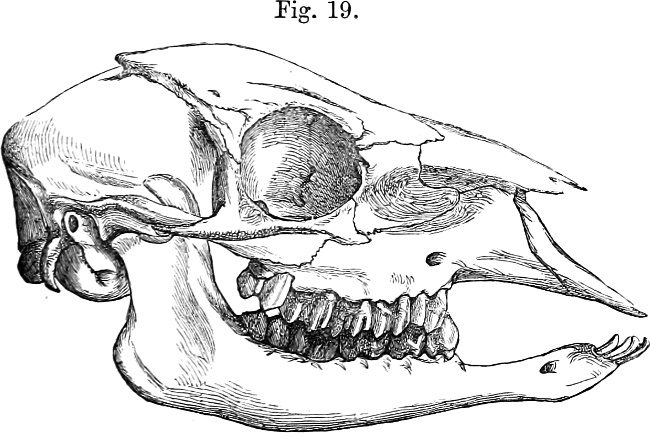
Fig. 19.
Skull of Cephalophus rufilatus, jr.
(P. Z. S. 1871, p. 597.)
In the ‘Gleanings from the Knowsley Menagerie’ are contained two figures of this animal: plate vi. fig. 3 gives a full-sized figure of what is apparently a female of this species, and plate ix. represents the heads of both sexes. Both of these plates are marked as drawn by Waterhouse Hawkins from specimens living at Knowsley in 1843. Several specimens of the Coquetoon, as this Antelope is sometimes called, have also been received by the Zoological Society, but have not proved to be long-lived in this country. The first recorded specimen was obtained in 1861, and others were subsequently acquired in 1867, 1879, and 1880. These were all obtained from dealers and had no definite localities attached to them. But we are able to supply some indications of the range of this species from museum specimens. In the British Museum, besides Whitfield’s stuffed specimen from the Gambia already alluded to, there is the skull of an adult animal from the same locality obtained by Sir Gilbert Carter, and a young skull, which has probably been correctly referred to this species from the Niger, obtained by Surgeon Baikie. In the Leyden Museum, as we find by Dr. Jentink’s Catalogue, there is an adult female specimen procured at Dabocrom, in Ashantee, by the collector Pel, and an adult male from Sierra Leone received from the Bremen Museum. In reference to Pel’s specimen, Temminck has informed us that this species is rare on the Guinea coast, but more common in the forests of Sierra Leone. We also find this species recorded by Herr Matschie as one of the Antelopes met with by the collectors of the Berlin Museum in the German Protectorate of Togoland. We may therefore conclude that the Red-flanked Duiker inhabits the whole coast-land of Western Africa between the British Settlement of Gambia and the River Niger.
Our figure of this species (Plate XIX. fig. 1) was prepared under Sir Victor Brooke’s direction, very probably from one of the specimens in the Liverpool Museum.
May, 1895.
THE BOOK OF ANTELOPES, PL. XX.
Smit del. et lith.
Hanhart imp.
The Banded Duiker.
CEPHALOPHUS DORIÆ.
Published by R. H. Porter.
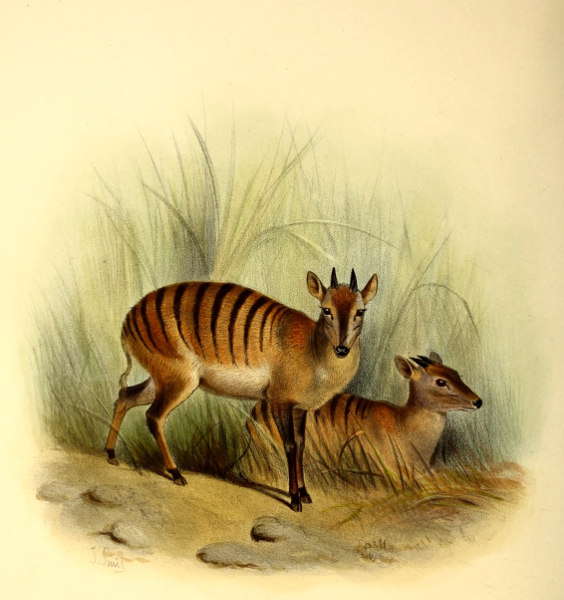
30. THE BANDED DUIKER. CEPHALOPHUS DORIÆ (Ogilb.). [PLATE XX.]
Antilope (?), Benn. P. Z. S. 1832, p. 122.
Antilope doria, Ogilb. P. Z. S. 1836, p. 121; Waterh. Cat. Mamm. Mus. Z. S. (2) p. 42 (1838); Wagn. Schr. Säug., Suppl. iv. p. 444 (1844); Fraser, Zool. Typ. pl. xviii. (animal) (1849).
Antilope zebrata[14],“Robert, Echo du Monde Savant, 1836”; Gerv. Dict. Sci. Nat., Suppl. i. p. 267 (1840); id. Hist. Nat. Mamm. ii. p. 202 (1855).
Antilope zebra, Gray, Ann. Mag. N. H. i. p. 27 (1838); Less. N. Tabl. R. A., Mamm. p. 176 (1842).
Cephalophorus zebra, Gray, List Mamm. B. M. p. 163 (1843).
Damalis (?) zebra, Gray, Knowsl. Men. p. 22 (1850); id. P. Z. S. 1850, p. 142; id. Cat. Ung. B. M. p. 129 (1852); id. Cat. Rum. B. M. p. 45 (1872).
Cephalophus doria, Jent. N. L. M. vii. p. 270, pl. ix. (skull, ♀) (1885) (Liberia); id. op. cit. x. p. 21, pls. ii. (animal), iii. (skull, ♂) (1887); id. Cat. Ost. Leyd. Mus. (Mus. Pays-Bas, ix.) p. 133 (1887); Büttikofer, Reisebild. Liberia, ii. p. 377, pl. xxix. (animal) (1890); Jent. Cat. Mamm. Leyd. Mus. (op. cit. xi.) p. 164 (1892).
Cephalophus doriæ, Thos. P. Z. S. 1892, p. 424; Ward, Horn Meas. p. 77 (1892); Lyd. Horns and Hoofs, p. 211 (1893).
Vernacular Name:—Mountain-deer of Liberians (Büttikofer).
Size small. General colour pale rufous, broadly banded with black. Face, ears, neck, and shoulders rufous or chestnut, except the nasal region, which is blackish. Back from withers to rump pale rufous, conspicuously banded transversely with deep shining black. Under surface from chin to anus pale rufous, slightly paler than the ground-colour between the bands. Limbs rufous, but with broad black patches on the outer surfaces of the forearms and lower legs, and with the phalanges black all round. Heels with large glandular tufts of black hair on their postero-inferior surfaces. Tail rufous, more or less mixed with black above, white below.
Horns short, in the same line as the nasal profile, in the male barely two inches long, conical, tapering, sharply pointed, their greatest basal diameter going about 2½ times in their length; in the female less than one inch in an adult, smoother than in the male, but otherwise similar in character.
Skull stoutly built. Nasal region broad, flat, parallel-sided. Anteorbital fossæ very shallow. Frontal region not specially swollen. Horn-cores so pressed downwards and backwards as to cause marked depressions behind and below them on the parietals. Palate with its three posterior notches about level.
Dimensions:—♂. Height at withers 16 inches, ear 2·9, hind foot 6·8 (in a female, rather older, 7·3).
Skull: basal length 5·8 inches, greatest breadth 2·8, orbit to muzzle 3·4.
Hab. Interior of West Coast of Africa, from Liberia to Sierra Leone.
The flat skins of this Antelope, so remarkable for their transverse black bands, first attracted the attention of naturalists in 1832, when they were brought before the Committee of Science and Correspondence of the Zoological Society of London by Mr. E. T. Bennett, then Secretary of the Society. Mr. Bennett considered them as belonging “not improbably” to some species of Antelope, to which, however, he did not venture to give a name. They were supposed by Gould (then the Zoological Society’s taxidermist), who had obtained them, to have been received from Algoa Bay; but there is no doubt that this was an error, and that these flat skins, some of which are even now occasionally brought to this country, are from Sierra Leone and the adjoining districts of Western Africa.
For some years this subject appears to have slept, but was revived in 1836 by Mr. Ogilby, who, in the course of some remarks upon the preserved specimens of Antelopes in the Zoological Society’s Museum, took the opportunity of assuring his hearers that the skins described by Mr. Bennett belonged to a “real Antelope” and that he hoped shortly to “have an opportunity of describing it in detail under the name of Antelope doria.”
Some two years later the late Dr. Gray proposed the name “Antilope zebra” for the same animal, based upon a skin received by the British Museum from Sierra Leone. Gray recognized it as being evidently the same as that previously described by Bennett, and gave no reason for proposing to alter its name.
About the same time similar imperfect flat skins attracted the attention of M. Robert, of Paris, who shortly described them in a communication to the ‘Echo du Monde Savant’ of 1836 under the name Antilope zebrata. But there is no doubt, we think, that “doria” was the first published specific appellation of this Antelope, and ought to be adopted. “Doria” is stated by Gray (Cat. Ung. p. 129) to have been the Christian name of Mr. Ogilby’s wife.
In his ‘List of Specimens of Mammals in the British Museum,’ published in 1843, Gray assigned this species to the genus Cephalophorus, i.e. Cephalophus. In his subsequent Catalogues he transferred it to the genus Damalis (i.e. Damaliscus),“on account of the dark mark on the outside of the limb.”
From the flat skins in the British Museum and the Zoological Society’s collection, Fraser, in 1849, gave a partly imaginative figure of this Antelope in his ‘Zoologia Typica.’
It was more than 50 years after the imperfect description of this problematical Antelope from the flat skins before science obtained correct information as to its proper characters and position in the system.
During the celebrated expedition of the naturalists of the Leyden Museum to Liberia in 1879 and following years Mr. Büttikofer first obtained perfect specimens of this Duiker on the St. Paul’s River. These were described by Dr. Jentink in the seventh volume of the ‘Notes from the Leyden Museum’ in 1885, and a figure was given of the skull. In the succeeding volume of the ‘Notes’ Dr. Jentink gave fuller particulars respecting this welcome rediscovery, and informed us that, as shown by the series of specimens collected by Mr. Büttikofer and his fellow travellers, this Antelope is not uncommon in certain parts of Liberia. The “Mountain-deer,” as the Americanized Liberians call it, does not occur in the coast-district, but is found in the mountainous terrain of the interior. Dr. Jentink gave coloured illustrations of the male, female, and young of this Antelope, together with representations of the skull of the adult male, the skull figured in the previous volume having been that of a female.
In the second volume of his ‘Reisebilder aus Liberia,’ published in 1890, Mr. Büttikofer tells us that he first saw a living example of this species in the forest near Soforeh Place, and recognized it, with much delight, as the “Mountain-deer” of which he had heard so much spoken. Here he captured a young one alive, and subsequently found the skull of the mother, which was wounded but not obtained on that occasion. In his second expedition to Liberia, Mr. Büttikofer and his companions procured a full series of examples of this beautiful species. Mr. Büttikofer remarks that the weight of a full-grown example of this animal ranges from 40 to 50 lbs., and that a specially remarkable development in its structure is that of the hairs on the hind edge of the tarsus, which form a sort of brush.
Our figure of this Antelope (Plate XX.) has been prepared by Mr. Smit from a stuffed specimen of an adult male in the British Museum obtained on the Du Queah River in Liberia during Mr. Büttikofer’s second expedition. In the same collection there is a skin of an adult female from the same locality, and the skeletons of both these animals. The flat skins which were the types of the specific terms “doria” of Ogilby and “zebra” of Gray are likewise in the National Collection.
August, 1895.
31. THE BLACK DUIKER. CEPHALOPHUS NIGER, Gray. [PLATE XIV. Fig. 1.]
Cephalophus niger, Gray, Ann. Mag. N. H. (1) xviii. p. 165 (1846); id. List Ost. B.M. p. 57 (1847); id. Knowsl. Men. p. 10, pl. vii. (animal) (1850); id. P. Z. S. 1850, p. 123; id. Cat. Ung. B. M. p. 84 (1852); Gerr. Cat. Bones Mamm. B. M. p. 236 (1862); Fitz. SB. Wien, lix. pt. 1, p. 166 (1869); Gray, P. Z. S. 1871, p. 597; id. Cat. Rum. B. M. p. 27 (1872); id. Hand-l. Rum. p. 96 (1873); Jent. Cat. Ost. Leyd. Mus. (Mus. Pays-Bas, ix.) p. 132 (1887); id. N. L. M. x. p. 20 (1887) (Liberia); Büttikofer, Reisebild. Liberia, ii. p. 376 (1890); Jent. Cat. Mamm. Leyd. Mus. (Mus. Pays-Bas, xi.) p. 162 (1892); Thos. P. Z. S. 1892, p. 425; Matach. Mittheil. deutsch. Schutzgebiet, vi. p. 81 (1893); Lyd. Horns and Hoofs, p. 212 (1893).
Antilope pluto, Temm. Esq. Zool. Guin. pp. 194,214 (1853); Wagn. Schr. Säug., Suppl. v. p. 422 (1855).
Vernacular Name:—Bush-Goat of Liberian Negroes (Büttikofer).
Size medium. Colour of body uniform dark smoky brown or black, becoming darker on the rump and limbs; paler on the throat and chest. Face fulvous, darkening into rich rufous on the crest; the centre of the forehead sometimes brown or black. Ears black haired externally, rufous internally. Tail black above, but with a whitish terminal tuft.
Skull long and narrow. Forehead swollen; anteorbital fossæ rather shallow; mesial notch of palate about ¼ inch in advance of lateral ones.
Horns, in male, “straight, rough at their base, smooth and pointed at their extremity, 3–3½ inches in length” (Temminck, l.c.): in female short, barely an inch in length, blunt and rounded, not expanded basally.
Dimensions:—(♂). Approximate height at withers 18 inches, length of hind foot 8·3, of ear 2·8.
Skull (♀): basal length (c.) 6·8, greatest breadth 3·3, anterior edge of orbit to muzzle 4·2.
Hab. West Coast of Africa, from Liberia to the Gold Coast.
The well-known field-naturalist Pel, one of the many excellent collectors employed from time to time by the Leyden Museum, was the discoverer of this Duiker, of which he transmitted specimens home from the Guinea coast about the year 1843. Shortly afterwards the British Museum acquired one of Pel’s specimens from Leyden under the MS. name “Antilope niger.” This was described by Gray in 1846 as the type of a new species, “The Black Bush-buck (Cephalophus niger).” Gray added to his description that there was then living in the Knowsley Menagerie a “Bush-buck” which was probably of the same species; and on turning to the pictures in the ‘Gleanings from the Derby Menagerie’ we find what is doubtless the animal referred to, figured upon a plate (vii. fig. 2) which is initialed by Waterhouse Hawkins as having been drawn in 1846. So far as we know, this is the only individual of this Antelope that has ever been brought to Europe alive.
Although Gray had taken the name which he received with this animal from the Leyden Museum and had employed it throughout in his catalogues, Temminck, the then Director of that great establishment, when he published his ‘Esquisses Zoologiques sur la Côte de Guiné’ in 1855, was not content to adopt it. He considered it “too vague,” as having been already applied to other species of Antelopes, and proposed to change it to Cephalophus pluto. Temminck informs us that this species is widely distributed on the coast of Guinea and is very common in the forests near the Dutch factories in that district, particularly in Ashantee, near Chama and Dabacrom.
In the adjoining republic of Liberia, to the west of the Gold Coast, Mr. Büttikofer and his colleagues Sala and Stampfli obtained many specimens of this Duiker during their expeditions of 1879 and 1886. Dr. Jentink, in cataloguing their results, gives various localities in which it was met with—viz. at St. Paul’s River, Schieffelinsville, Junk River, Du Queah River, and Farmington River. The Liberian naturalists remark that the flesh of this Antelope has a remarkably strong bitter flavour, which they never observed in any other species of the group. This peculiarity is probably caused by some special food to which it is addicted.
In his ‘Reisebilder aus Liberia’ Mr. Büttikofer informs us that the Black Duiker, known to the Liberians under the name of the Bush-Goat, is one of the commonest species of the group in that republic. Like all other members of the genus, it is exclusively an inhabitant of the high forests and bushy woods, coming out at night into the savannahs and plantations to get its food. Mr. Büttikofer repeats his statements as regards the unsavoury character of its flesh, and states that even the natives, who are by no means particular, in many cases refuse to eat it.
Besides the immature female obtained by Pel, which forms the type of Cephalophus niger, the National Collection possesses skins of an adult female from Fantee and of a young individual from the Ankober River in Ashantee, both obtained by the native collector Aubinn.
Our coloured figure of the Black Duiker (Plate XIV. fig. 1) was prepared by Mr. Smit under the direction of the late Sir Victor Brooke. It was probably taken from the mounted specimen in the British Museum, but of this we have no certain record.
August, 1895.
THE BOOK OF ANTELOPES, PL. XXI.
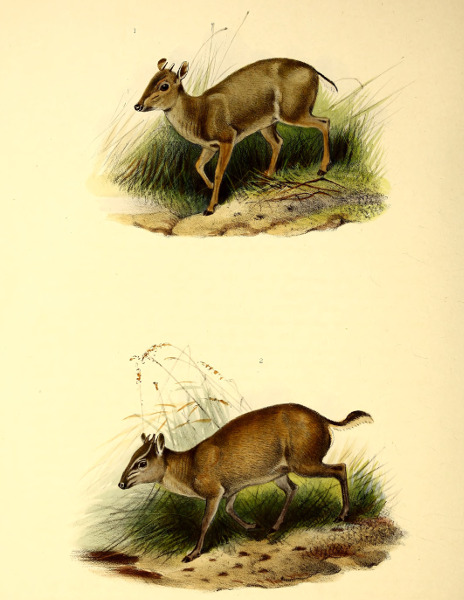
Wolf del. Smit lith.
Hanhart imp.
Fig 1. The Blue Duiker.
CEPHALOPHUS MONTICOLA.
Fig 2. Maxwell’s Duiker.
CEPHALOPHUS MAXWELLI.
Published by R. H. Porter.
32. MAXWELL’S DUIKER. CEPHALOPHUS MAXWELLI, H. Sm. [PLATE XXI. Fig. 2.]
Guévei (Ant. pygmæa), F. Cuv. H. N. Mamm. (fol.) iii. livr. lxi. (animal, ♀) (1826) (Senegal).
Antilope (Cephalophus) maxwelli, H. Sm. Griff. An. K. iv. p. 267, v. p. 347 (1827); Less. H. N. Mamm. (Compl. Buff., x.) p. 294 (1836); id. N. Tabl. R. A., Mamm. p. 178 (1842); Gieb. Zeitschr. ges. Nat. xxxv. p. 43 (1870).
Antilope (Cephalophus) philantomba, H. Sm. Griff. Cuv. An. K. v. p. 349 (1827); Og. P. Z. S. 1836, p. 121; Less. H. N. Mamm. (Compl. Buff. x.) p. 295 (1836); Waterh. Cat. Mamm. Mus. Z. S. (2) p. 41 (1838); Less. N. Tabl. R. A., Mamm. p. 178 (1842); Schinz, Syn. Mamm. ii. p. 422 (1845).
Cephalophus maxwelli, A. Sm. S. Afr. Quart. Journ. ii. p. 216 (1834); Gray, Ann. Mag. N. H. (1) xviii. p. 166 (1846); id. List Ost. B. M. p. 146 (1847); id. Knowsl. Men. p. 11, pl. xi. A (animal) (1850); id. P. Z. S. 1850, p. 124; id. Cat. Ung. B. M. p. 86 (1852); Temm. Esq. Zool. Guin. pp. 194, 223 (1853); Gerr. Cat. Bones Mamm. B. M. p. 237 (1862); Scl. P. Z. S. 1868, p. 625; Murie, P. Z. S. 1869, p. 595 (anat. ♀); Gray, P. Z. S. 1871, p. 600, fig. 8 (skull); id. Cat. Rum. B. M. p. 28 (1872); id. Hand-l. Rum. B. M. p. 97 (1873); Garrod, P. Z. S. 1877, p. 4 (anat.); Scl. List An. Z. S. (8) p. 146 (1883); Flow. & Gars. Cat. Ost. Coll. Surg. ii. p. 269 (1884); Jent. N. L. M. x. p. 21 (1887) (Liberia); id. Cat. Ost. Leyd. Mus. (Mus. Pays-Bas, ix.) p. 133 (1887); Büttikofer, Reisebild. Liberia, ii. p. 379 (1890); Jent. Cat. Mamm. Leyd. Mus. (op. cit. xi.) p. 163 (1892); Thos. P. Z. S. 1892, p. 425; Lyd. Horns and Hoofs, p. 212 (1893); Matsch. MT. deutsch. Schutz-geb. vi. p. 81 (1893); id. SB. Ges. nat. Freund. 1893, p. 256 (1894) (distribution).
Cephalophus philantomba, A. Sm. S.-Afr. Quart. Journ. ii. p. 217 (1834).
Antilope frederici, Laurill. Dict. Univ. d’H. N. i. p. 623 (1839); Less. N. Tabl. R. A., Mamm. p. 178 (1842); Wagn. Schr. Säug., Suppl. iv. p. 454 (1844); Gieb. Säug. p. 321 (1859).
Cephalophus punctulatus, Gray, Ann. Mag. N. H. (1) xviii. p. 167 (1846); id. Knowsl. Men. p. 11 (but not pl. viii. fig. 1, which is C. sylvicultrix) (1850); id. P. Z. S. 1850, p. 125; id. Cat. Ung. B. M. p. 88 (1852); Temm. Esq. Zool. Guin. pp. 194, 236 (1853); Fitz. SB. Wien, lix. pt. 1, p. 166 (1869); Gray, P. Z. S. 1871, p. 600; id. Cat. Rum. B. M. p. 29 (1872); id. Hand-l. Rum. B. M. p. 98 (1873).
Sylvicapra philantomba et S.frederici, Sund. Pecora, K. Vet.-Ak. Hand-l. 1844, p. 190 (1846); id. Hornschuch’s Transl., Arch. Skand. Beitr. p. 142; Reprint, p. 66 (1848).
Cephalophus whitfieldi, Gray, Knowsl. Men. p. 11, pl. xi. fig 2 (1850); id. P. Z. S. 1850, p. 125; id. Cat. Ung. B.M. p. 88 (1852); Fitz. SB. Wien, lix. pt. 1, p. 166 (1869); Gray, P. Z. S. 1871, p. 599; id. Cat. Rum. B.M. p. 28 (1872); id. Hand-l. Rum. B. M. p. 97 (1873).
Antilope (Cephalolophus) maxwelli, punctulatus, et whitfieldi, Wagn. Schr. Säug., Suppl. v. pp. 427–429 (1855).
Cephalophus fredcrici, Fitz. SB. Wien, lix. pt. 1, p. 166 (1869).
Vernacular Name:—Fulintongue of Liberians (Büttikofer).
Size considerably smaller than in the previous species. Colour uniform slaty brown, becoming paler below and on the inner sides of the limbs. Superciliary streaks whitish. Ears small, rounded, behind dark brown. Rump and backs of the hams uniform with body, except that just at the base of the tail on each side, and on the top of the proximal half of the tail itself, the colour is rather darker. Rest of tail above brown, beneath whitish; limbs externally like body.
Horns set up at a slight angle above the nasal profile, but not nearly so much as in C. grimmi: those of male short (about 2 inches long), thick at base; their greatest basal diameter going about 2½ times in their length; of female, according to Temminck, exceedingly small, and indeed they are entirely absent in the only specimen available to us, but this is not fully adult.
Skull broad and strong. Muzzle rather narrow. Anteorbital fossæ rather shallow. Mesial notch of palate only about ⅙ inch in advance of the lateral ones.
Dimensions:—♀. Height at withers 14 inches, ear 2, hind foot 6·7.
Skull (♂): basal length 4·7 inches, greatest breadth 2·5, anterior edge of orbit to muzzle 2·7.
This species shows a certain tendency to the peculiar coloration of the rump characteristic of C. melanorheus; the colour-contrasts of black and white of the latter, however, are in this case only dark brown and light brown respectively.
Hab. Coast of West Africa from Gambia to the Gold Coast.
This Duiker, which is of considerably smaller dimensions than the two previous species, and of a nearly uniform slaty-brown colour, is likewise a West-African species, but seems to have a rather more extended range along the coast. Whether it is really the Guévei of A damson and Buffon is, to say the least of it, very doubtful, but it is probably the species figured under that name by F. Cuvier in 1826 from a specimen from Senegal then living in the Jardin des Plantes. Cuvier referred this specimen to the Antilope pygmæa of former authors, but, as we know from Sir Victor Brooke’s excellent article on this subject (P. Z. S. 1872, p. 637), that specific name properly belongs to the Royal Antelope of Western Africa, of which we shall give an account in a subsequent part of this work.
In 1827, in his volume on the order Ruminantia in ‘Griffith’s Animal Kingdom,’ Major Hamilton Smith described a female of this species which had been brought home from Sierra Leone by Col. Charles Maxwell and dedicated it to that gentleman as Antilope maxwelli. In a subsequent volume of the same work, containing a synopsis of the species of mammals, Hamilton Smith not only repeated the description, but added, as apparently different, a description of another young specimen from the same country, and classed it as a different species under the name Antilope philantomba. Under this last designation also this Antelope is mentioned by Ogilby in the ‘Proceedings’ of the Zoological Society for 1836, where he gives some particulars respecting two females which had lived for some time in the Society’s Gardens.