Subfamily I. BUBALIDINÆ. (continued 2)
Reading edition
Skull comparatively small, with an unusually long nasal region; the nasal bones very long and narrow. Basal length (♀) 13·3 inches, greatest breadth 5·2, muzzle to orbit 9·5.
Horns as in the Korrigum, but shorter and slenderer; those of a female 16·4 inches in length.
Hab. British East-African coast, from the River Juba to the River Sabaki, and extending thence into Uganda and Uniamwezi.
The “Topi,” as we propose to designate another local representative of the Korrigum, from the native name given to it by the Swahili, has been known for some years to the sportsmen who have visited British and German East Africa as an abundant Antelope in certain districts, and has been generally called by them the “Senegal Antelope,” from being supposed to be the same as the “Korrigum.” But, as Herr Matschie first pointed out, it differs from the typical Senegal form in the absence of the black band on the inner side of the thigh, in the front legs being black down to the hoofs, and in the restriction of the black on the hinder flanks to the hips.
So far as we know, Sir John Kirk, then Consul-General at Zanzibar, was the first to obtain examples of this fine Antelope on the East Coast. Sir John has kindly supplied us with the following notes on this species:—
“The ‘Tope,’ or Senegal Antelope, was very common on the maritime plain of Formosa Bay when I first went to Zanzibar in 1866; before I left, in 1886, it had become rather rare near the coast. On the maritime plain it used to be seen in numerous herds of from 5 to 20. The herds of Tope generally kept alone, but you would see the herds of Gazella granti grazing near by. I am, however, not satisfied that this Gazelle was the real Gazella granti, for the horns seem to show a permanent difference of sweep.
“However, to return to the Tope, I may say that I shot it again on the south bank of the River Juba.
“The River Sabaki (near Malindi) is, so far as I know, the southern limit of the species on the coast; I have little doubt that further inland it may be met with further south, just as you find the Oryx, the Vulturine Guinea-fowl, and other species (which never occur south of the River Sabaki on the coast), to be common if you go inland, and in a latitude far south of Malindi, such as at Mpwapwa in Usagara.
“The Tope was at one time so common near Witu, and in the district about Lamu, as to supply a considerable number of hides that were exported from Zanzibar.”
In 1885 Mr. F. J. Jackson obtained examples of this Antelope near Lamu, and transmitted to Lord Walsingham a head, which Sclater exhibited at one of the Zoological Society’s meetings in 1886. During his subsequent stay in British East Africa and on his journey to Uganda Mr. Jackson again met with this Antelope, and tells us (‘Big Game Shooting,’ vol. i. p. 291) that it is the “commonest species in the Galla country, and ranges from the coast right away N.E. to Uganda, passing round to the north of Mount Kenia, but is not known either in Leikipia or south of Lake Baringo.”
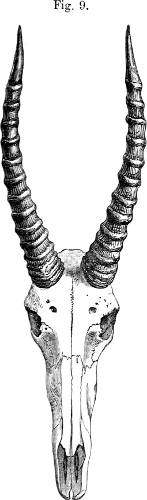
Fig. 9.
Skull of Damaliscus jimela, from Lamu.
(P. Z. S. 1890, p. 356.)
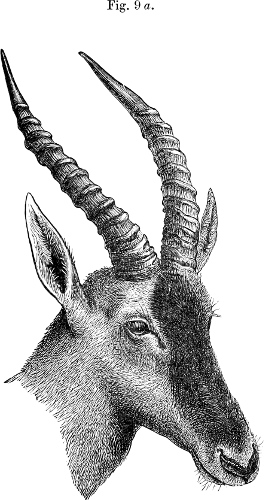
Fig. 9 a.
Head of Damaliscus jimela, from Malindi.
(P. Z. S. 1890, p. 355.)
In 1890 Sclater exhibited at one of the meetings of the Zoological Society a head of this Antelope obtained near Malindi by Commander Montgomerie, R.N.
At that time Sclater did not distinguish between this species and the two allied forms, and referred them all three to Damalis senegalensis, which he believed to extend from Senegal to the east coast.
Mr. Ernest Gedge, the companion of Mr. Jackson in his Uganda expedition, has favoured us with the following interesting notes on this Antelope:—
“Though the Topee ranges over a very wide extent of the country in the sphere of British East Africa, it is met with in no great numbers between the coast and the Victoria Lake. The nearest point to the coast-line at which I have seen and obtained specimens was a short distance north of Kikumbuliu, on the borders of the Kiboko River. In this district it is only occasionally met with, and is generally found in company with Hartebeest. Further north, in the vast plains amongst the stony hills of Turquel and Karamojo, and round the bases of Mts. Elgon and Lekakisera, it is fairly common, scattered in twos and threes amongst the herds of Hartebeest. Further northwards, in the countries lying to the west and north of Uganda proper, and indeed throughout the whole district bordering the Victoria Nyanza in this direction, it is very common, and on one occasion when traversing a plain of considerable extent in the district of Buddu I encountered several fine herds of this Antelope. It differs very little from the Hartebeest in its general habits, and, like them, it is usually shy and difficult to approach. It is easily distinguished from the latter species by the rich dark bluish-brown coat, the smaller head, and the shape of its horns, which have, on more than one occasion, caused it to be mistaken for the Sable Antelope (Hippotragus niger). It appears to be equally at home in swampy localities as on the dry open plains, though it shows a certain partiality for those districts which afford some cover.”
Passing now to German East Africa, we find that this Antelope, according to Herr Matschie, was met with by Böhm in Uniamwezi, south of Lake Victoria. Here it is the “Jimela” of the natives, which term Herr Matschie has adopted as its specific designation. In a recent letter, however, Herr Matschie tells Sclater that the specimens of this Antelope lately obtained by Herr Oscar Neumann in Kavirondo and other localities west of Lake Victoria, and by Lieut. Werther on the Rovana Steppe near Speke Gulf, more nearly resemble D. korrigum of the West Coast, but it seems to us hardly possible that the western form should extend so far.
It is certain, however, that we have much more to learn concerning the distribution of this Antelope and its allied forms before the question of their specific relations and the areas which they respectively occupy can be deemed settled.
Besides the skull from the Juba, received from Sir John Kirk, the British Museum possesses a mounted specimen of the adult male of this Antelope obtained by Mr. Jackson in the Kilimanjaro district in 1893, and a flat skin procured by the same gentleman near Malindi.
January, 1895.
THE BOOK OF ANTELOPES, PL. VIII
Wolf del. Smit lith.
Hanhart imp.
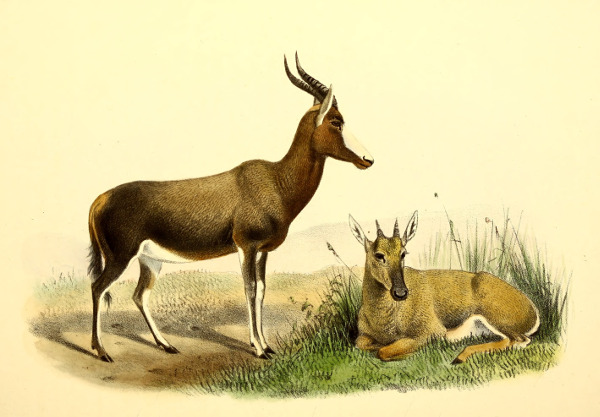
The Bontebok.
DAMALISCUS PYGARGUS.
Published by R. H. Porter.
13. THE BONTEBOK. DAMALISCUS PYGARGUS (Pall.). [PLATE VIII.]
Antilope dorcas, Pall. Misc. Zool. p. 6 (1766) (nec Capra dorcas, L.).
Antilope pygarga, Pall. Spic. Zool. fasc. i. p. 10 (1767), fasc. xii. p. 15 (1777); Erxl. Syst. R. A. p. 287 (1777); Zimm. Geogr. Gesch. ii. p. 119 (1780); Gatt. Brev. Zool. i. p. 82 (1780); Schreb. Säug. pl. cclxxiii. (1784); Bodd. Elench. Anim. p. 143 (1785); Gmel. Linn. S. N. i. p. 187 (1788); Kerr, Linn. An. K. p. 311 (1792); Donnd. Zool. Beytr. p. 628 (1792); Bechst. Uebers. vierf. Thiere, i. p. 87, ii. p. 644 (1800); Shaw, Gen. Zool. ii. pt. 2, p. 352 (1801); Turt. Linn. S. N. i. p. 113 (1802); Desm. N. Dict. d’H. N. (1) xxiv. tabl. p. 33 (1804); G. Cuv. Dict. Sci. Nat. ii. p. 233 (1804); Licht. Mag. nat. Freund. Berl. vi. p. 166 (1814); G. Fisch. Zoogn. iii. p. 435 (1814); Afzel. N. Act. Upsal. vii. p. 220 (1815); Desm. N. Dict. d’H. N. (2) ii. p. 186 (1816); Goldf. in Schreb. Säug. v. p. 1187 (1820); Schinz, Cuv. Thierr. i. p. 388 (1821); Desm. Mamm. ii. p. 456 (1822); Desmoul. Dict. Class. d’H. N. i. p. 443 (1822); Burch. List Quadr. pres. to B. M. p. 5 (1825) (Swellendam); Less. Man. Mamm. p. 373 (1827); Smuts, Enum. Mamm. Cap. p. 73 (1832); Waterh. Cat. Mamm. Mus. Z. S. (2) p. 41 (1838); Wagn. Schr. Säug. Suppl. iv. p. 412 (1844), v. p. 447 (1855); Schinz, Syn. Mamm. ii. p. 402 (1845).
Capra cervicapra, Müll. Naturs. i. p.414 (1773) (nec L.).
Antilope grisea, Bodd. Elench. Anim. p. 139 (1785).
Capra scripta, Thunb. Resa, ii. p. 50 (1789); Engl. Transl. ii. p. 44 (1793) (nec Antilope scripta, Pall.).
Antilope maculata, Thunb. Mém. Ac. Pétersb. iii. p. 315 (1811).
Cerophorus (Gazella) pygarga, Blainv. Bull. Soc. Philom. 1816, p. 75.
Cemas pygargus, Oken, Lehrb. Naturgesch. iii. pt. 2, p. 738 (1816).
Antilope personata, Woods, Zool. Journ. v. p. 2 (1835) (young).
Gazella pygarga, Harr. Wild Anim. S. Afr. (fol.) pl. xvii. (animal) (1840); Gray, List Mamm. B. M. p. 161 (1843).
Damalis pygarga, Gray, Ann. Mag. N. H. (1) xviii. p. 233 (1846); id. List Ost. B. M. p. 59 (1847); id. P. Z. S. 1850, p. 141; id. Knowsl. Men. p. 21, pl. xx. fig. 3 (young), pl. xxii. figs. 2 & 3 (adult) (1850); id. Cat. Ung. B. M. p. 127 (1852); Layard, Cat. S. Afr. Mus. p. 77 (1861); Gerr. Cat. Bones Mamm. B. M. p. 244 (1862); Fitz. SB. Wien, lix. pt. 1, p. 181 (1869); Layard, P. Z. S. 1871, p. 625, footnote (scarcity); Gray, Cat. Rum. B. M. p. 45, pl. iii. fig. 6 (skull) (1872); id. Hand-l. Rum. B. M. p. 116 (1873); Jent. Cat. Ost. Leyd. Mus. (Mus. Pays-Bas, ix.) p. 140 (1887); id. Cat. Mamm. Leyd. Mus. (op. cit. xi.) p. 171 (1892); Nicolls & Egl. Sportsm. S. Afr. p. 32, pl. vii. fig. 27 (head) (1892).
Bubalis pygarga, Sund. Pecora, K. Vet.-Ak. Hand-l. 1844, p. 209 (1846); id. ibid. Hornschuch’s Transl., Arch. Skand. Beitr. ii. p. 159; Reprint, p. 84 (1848); Temm. Esq. Zool. Guin. p. 195 (1852); Brehm, Thierl. iii. p. 217 (1880); Ward, Horn Meas. p. 69 (1892); Lyd. Horns and Hoofs, p. 202 (1893).
Alcelaphus pygargus, Scl. List Anim. Z. S. (8) p. 150 (1883); Flow. & Gars. Cat. Ost. Coll. Surg. p. 273 (1884); Bryden, Kloof and Karroo, p. 295 (1889); Flow. & Lyd. Mamm. p. 335 (1891).
White-faced Antelope, Penn. Hist. of Quad. i. p. 82.
Vernacular Name:—Bontebok of Dutch and English colonists.
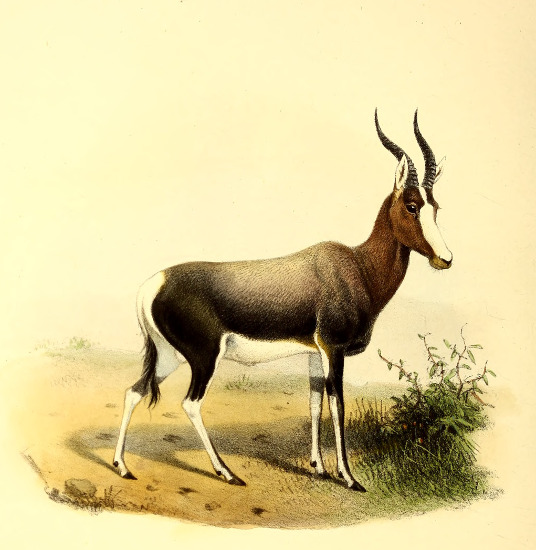
Height at withers about 40 inches. Ground-colour of body, as seen on the anterior half of the back, rufous fawn. Crown, sides of face and neck, flanks, thighs, and the anterior half of the rump darkened nearly or quite to black, which colour also runs down the limbs to the knee and hock, where it passes as a dark ring right round the limbs. Face with a large strongly contrasted blaze of pure white, which covers the whole breadth of its upper surface on the muzzle, but is much narrower above the eyes, where it runs up to the bases of the horns. In the young the facial blaze is simply brown. Posterior half of rump, base of tail, belly, and lower limbs also white. Terminal half of tail, which reaches just to the hock, black-crested.
Hairs of face reversed upwards to horns. No glandular suborbital brushes.
Skull narrow and lightly built, its measurements about as in the next species.
Horns somewhat like those of D. korrigum and its allies, but their bases more compressed and twisted inwards towards each other in front; above they curve evenly backwards and outwards, their terminal five or six inches again gently recurved upwards. Their ridges are 15 or 16 in number, very prominent in front, less so on the sides and behind; their substance is quite black. In length they attain 15 or 16 inches, with a basal circumference of about 6.
Hab. Cape Colony, south of Vaal River (now nearly extinct).
The “Bontebok,” or “Pied Goat,” of the Dutch colonists of the Cape, was amongst the earliest Antelopes known to science. In his first essay on the genus Antilope, published in 1766, Pallas described it as Antilope dorcas, having confounded it with the Dorcas of Ælian. But in his second essay upon the same group, issued in the following year, he selected for it the very appropriate name pygarga, by which it has been generally known ever since. The Bontebok and Blessbok together constitute a distinct section of the present genus, readily known from their congeners by their smaller stature and conspicuous white faces.
Lichtenstein, in his celebrated memoir on the genus Antilope, published at Berlin in 1814, made Antilope pygarga the tenth species of the genus, and gave original particulars of it from specimens which he had himself obtained during his visit to South Africa. He states, however, that this animal is the Blessbok, and not the Bontebok, of the Cape; and there can be no doubt that both these names have been applied to it, though the former term is now by general consent restricted to the next following species, Damaliscus albifrons. For example, Smuts, in his ‘Enumeratio Mammalium Capensium,’ gives both “Bontebok” and “Blessbok” as the colonial names of the present species. In fact these animals were never correctly discriminated till Harris gave figures and descriptions of them in his ‘Portraits of the Game and Wild Animals of Southern Africa,’ published in 1840.
Harris tells us that in his time the Bontebok was “common” in the interior of the Cape Colony, and was also found in one valley near Cape Agulhas. On the plains lying south of the Vaal River he visited the headquarters of the Bontebok, where “thousands upon thousands were seen and numbers were daily slain.” They were frequently seen congregated on the salt-flats, near the stagnant pools of brackish water, licking up the crystallized efflorescence.
Thirty years later a very different tale was told of the Bontebok, which by that date had become nearly extinct except in one isolated spot. Mr. E. L. Layard (P. Z. S. 1871, p. 625) gives the following account of this animal at that period:—“The Bontebok is very nearly exterminated, and, but for the fostering care of Messrs. Breda and Van der Byl, would be quite so in a couple of years.
“They are now confined to one spot in the extreme south of the continent of South Africa, to a portion of the country called the ‘Strand Veldt.’ It is an extensive flat, bordered by the sea on the south-west, south, and south-east, and by a range of undulating country or low hills rising to the Caledon Ranges and Zwart Bergen on the northern side. It is, in fact, the nearest plateau to the L’Agulhas Bank, and is called ‘Cape L’Agulhas.’ The whole of this country belongs chiefly to the families of Breda and Van der Byl; and they preserve the animals as much as they can. A Government permit is also required to shoot them, which must be visa’d by the magistrate at Bredasdorp, the name of the village on this range of land.
“They are, however, poached and destroyed by one or two small holders, who have patches of land surrounded by the large properties, and who refuse all offers of purchase, and plant corn on purpose to tempt the animals into it, and then at night shoot them. They roam in herds of about eight or ten, or twenty; but sometimes fine old bucks are found solitary. They are usually shot from a cart, which they will suffer to approach them, or from horseback. If wounded and approached they will charge desperately; and I have heard of a Hottentot being killed by them thus.”
Messrs. Nicolls and Eglington in their ‘Sportsman in South Africa,’ which contains the most recent account of the Antelopes of the Colony, tell us that the Bontebok can no longer “be considered as a part of the wild game of the country,” as it now exists only on Van der Byl’s farm (as mentioned by Mr. Layard) and has become totally extinct elsewhere.
Mr. H. A. Bryden, a well-known authority upon the game of the Cape, tells us the same story. One of the last resorts of this Antelope was the Bontebok Flats, to the north of the present Queenstown district, where a few of these Antelopes existed up to 1851. It appears certain, however, that except in the farm above mentioned, where a few have been carefully preserved for many years, the Bontebok is, at the present time, an extinct animal.
The Bontebok was amongst the many splendid Antelopes that were to be seen in the celebrated Knowsley Menagerie, and which bred in that establishment. The young is figured in one of Waterhouse Hawkins’s large plates in the ‘Gleanings,’ and the adult pair in another plate along with the Blessbok.
At the dispersal of the Knowsley collection in 1851 a pair of adult Bonteboks were purchased by Mr. D. W. Mitchell, then Secretary, for the Zoological Society of London, whilst another pair, bred at Knowsley, were sold to Prince Demidoff.
In August 1871 two females of this Antelope were brought home alive by the Captain of one of the Cape mail-steamers, and purchased by the Zoological Society for £50. So far as I know, these were the last Bonteboks ever brought to Europe.
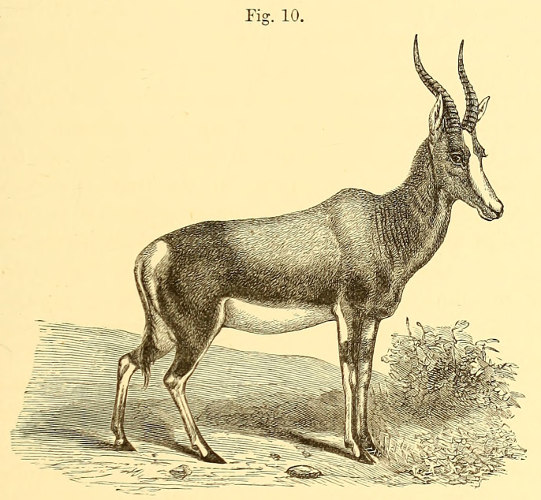
Fig. 10.
Damaliscus pygargus.
In the National Collection, we regret to say, the Bontebok is only represented by a single stuffed specimen—a male, received in 1839 from Dr. Smuts. There are also several skulls and horns of this Antelope, but none of them are of recent date. We fear it will now be a matter of some difficulty to obtain fresh specimens of this once so abundant Antelope.
The coloured illustration of the Bontebok (Plate VIII.) and the woodcut (fig. 10) were both prepared under Sir Victor Brooke’s directions. The plate was lithographed by Smit from one of Mr. Wolf’s sketches.
January, 1895.
THE BOOK OF ANTELOPES. PL. IX.
Wolf del Smit lith
Hanhart imp.
The Blessbok
DAMALISCUS ALBIFRONS
Published by R. H. Porter.
14. THE BLESSBOK. DAMALISCUS ALBIFRONS (Burch.). [PLATE IX.]
Antilope albifrons, Burch. Travels, ii. p. 335 (1824); Wagn. Schr. Säug. Supp. iv. p. 413 (1844), v. p. 448 (1855).
Gazella albifrons, Harris, Wild Anim. S. Afr. (fol.) pl. xxi. (animal) (1840).
Damalis albifrons, Gray, Ann. Mag. N. H. (1) xviii. p. 233 (1846); id. P.Z. S. 1850, p. 141; id. Knowsl. Men. p. 22, pl. xxii. fig. 1 (animal) (1850); id. Cat. Ung. B. M. p. 129 (1852); id. Cat. Rum. B. M. p. 45 (1872); id. Hand-l. Rum. B. M. p. 116 (1873); Layard, Cat. S. Afr. Mus. p. 77 (1861); Fitz. SB. Wien, lix. pt. 1, p. 181 (1869); Drummond, Large Game S. Afr. p. 425 (1875); Nicolls & Egl. Sportsm. S. Afr. p. 31, pl. iii. fig. 9 (head) (1892); Jent. Cat. Mamm. Leyd. Mus. (Mus. Pays-Bas, xi.) p. 171 (1892).
Bubalis albifrons, Sund. Pecora, K. Vet.-Ak. Hand-l. 1844, p. 210 (1846); id. ibid. Hornschuch’s Transl., Arch. Skand. Beitr. ii. p. 159; Reprint, p. 84 (1848); Temm. Esq. Zool. Guin. p. 195 (1853); Brehm, Thierl. iii. p. 217 (1880); Ward, Horn Meas. p. 68 (1892); Lyd. Horns and Hoofs, p. 202 (1893).
Alcelaphus albifrons, Buckley, P. Z. S. 1876, pp. 286, 292 (distribution); Scl. List Anim. Z. S. (8) p. 149 (1883); Bryden, Kloof and Karroo, p. 295 (1889); Flow. & Lyd. Mamm. p. 335 (1891).
Vernacular Names:—Blessbok of Dutch and English colonists; Nunni of Bechuana natives (Harris); Inoni of Kaffirs (Drummond); Inoni or Inpemfu of Zulus (Rendall).
Similar to D. pygargus in nearly every respect; but the rufous ground-colour is much more widely extended, owing to the parts which are black in that animal being here scarcely darker than the rest. White blaze on face divided into two parts by a narrow line between the eyes. Posterior half of rump not prominently white, a small area only round the base of the tail slightly paler than the rest.
Skull and horns as in D. pygargus, except that the latter are of a more or less whitish colour.
Skull-measurements of a male:—basal length 11·5 inches, greatest breadth 5·1, muzzle to orbit 8·3.
Hab. Northern plains of Cape Colony, Orange Free State, Transvaal, and Bechuana-land (now nearly extinct).
The Blessbok, so called from the white blaze on its forehead (“bles” in Dutch), is of exactly the same form and general appearance as the Bontebok, so that these two close allies have often been confounded together. But the present species is at once distinguishable by the absence of the broad anal white disk above the tail, which ornaments the Bontebok, and by the paler colour of the sides and flanks.
Whether Burchell, whose scientific term “albifrons” has been universally adopted for the Blessbok, really intended to affix that name to the present species or to the Bontebok, is, to say the best of it, very doubtful. As we have already stated, both the vernacular names “Blessbok” and “Bontebok” were occasionally applied by the Boers to Damaliscus pygargus, and therefore, although Burchell expressly invented his name “albifrons” for what he called the “Blessbok,” he equally intended by that term to designate the long-known Bontebok, from which he did not distinguish the Blessbok. It so happened, however, that this was done in reference to a specimen of the latter, so that his name has been rightly retained for it. As we have pointed out in the previous article, these two near allies were first correctly discriminated by Harris, and it is therefore in any case wise to abide by his decision as to their proper names, both scientific and vernacular. Indeed Harris’s lead on this difficult question has been generally followed.
In Harris’s days, 1836–37, the Blessbok inhabited “the elevated tracts to the eastward of the Colony known as the Bontebok Flats,” and was found on the great plains south of the Vaal River in “astounding herds.” Here it was that his first introduction to this splendid Antelope took place. Harris gives us a graphic account of how he lost himself in the wilderness when engaged in the pursuit of these herds and barely escaped with his life.
“The absence of fuel shortly obliged us to continue our march over a succession of salt-pans, upon which numerous great herds of Blessboks were busily licking the crystallized efflorescence. Alarmed at the approach of our cavalcade, vast troops of them were continually sweeping past against the wind, carrying their broad white noses close to the ground like a pack of harriers in full cry. Having never obtained any specimens of this species, and our stock of provisions, moreover, grievously requiring to be recruited, I mounted Breslar, my favourite Rosinante, and, little heeding whither I sped, dashed into the very thick of the Antelopes. The pine-apple hill bearing east about five miles, must, I concluded, prove a never-failing landmark to direct my return to the road, which, however faint it had become, could still readily be distinguished by a practised eye. Dealing death around, I thus continued to scour the ensanguined plain, and to use my pleasure with the herd before me, which had in the meantime increased from hundreds to thousands—reinforcements still pouring in from all directions when, crying ‘hold, enough,’ I stayed my hand from slaughter, and having divested some of the primest of their brilliant party-coloured robes, I packed the spolia on my horse, and, well satisfied with my performance, set out to rejoin the waggons. But ah! vainly was it that I sought for them. Cantering to and fro between the string of frosted salt-pans and the little hill, which, floating in the sea of mirage that environed it, seemed as though poised in the sky, again and again I strained my eyes for the road. The monotony of the landscape baffled all attempts at recognition, and my search proved utterly fruitless. Every feature of the scene was precisely the same—the table mountains were completely obscured by the midday haze—and in the constant recurrence of similar forms, I lost the points of the compass, and at last became totally bewildered.”
In fact it took Harris on this occasion nearly three days and three nights wandering before he managed to rejoin his waggons.
At the present time these mighty herds have altogether vanished. So late as 1861 Mr. E. L. Layard wrote that the Blessbok was “still found in considerable herds on the north-eastern border of Colony.” But in 1889 Mr. Bryden (‘Kloof and Karroo’) tells us that this Antelope had become quite extinct within the limits of Capeland. Messrs. Nicolls and Eglington, however, inform us that the Blessbok is still to be found on some farms in the Transvaal, and in one or two spots in the Orange Free State. “Previous to Sir Charles Warren’s Expedition in 1884 they were fairly common on the open flats in Southern Bechuanaland, particularly in the neighbourhood of Groot Choiang, and also in the district of Rhamathlabama, a few miles north of Mafeking. They are now practically extinct there, an occasional troop only straying into that district from the preserved farms in the Transvaal.”
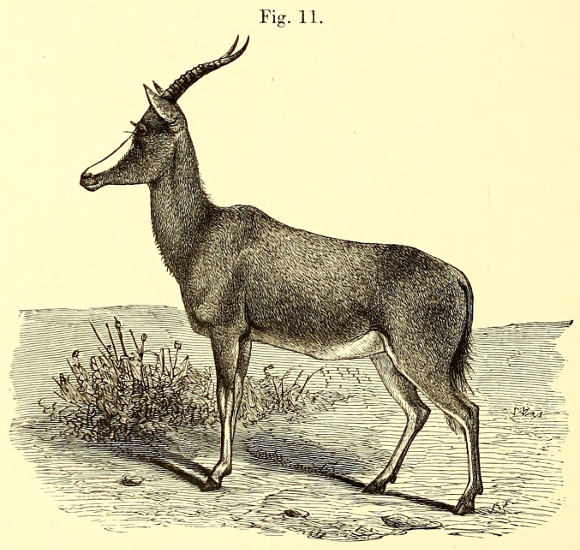
Fig. 11.
Damaliscus albifrons.
Of the Blessbok, so far as I know, Lord Derby never procured for the Knowsley Menagerie but a single female, which was figured by Waterhouse Hawkins on the same plate of the ‘Gleanings’ as the Bonteboks. At the sale of the Knowsley Menagerie in August 1851, this animal was purchased by Mr. Westermann for the Zoological Society of Amsterdam. In 1861 the Zoological Society of London received, as a present from Sir George Grey, then Governor of the Cape Colony, a single female of this Antelope along with other valuable animals. A male of the same species was obtained by purchase in 1862 and a female about two years later. These animals throve and bred in the Society’s Gardens, and young ones were born in 1866, 1869, and 1870. But in the absence of fresh importations the whole stock was lost, and no Blessboks have been exhibited in the Society’s Gardens since 1880, when a single specimen was received “on deposit.” In many of the continental gardens also Blessboks were formerly to be seen, but of late years they have become extremely scarce; although we are informed that there are still solitary examples living at Berlin, Antwerp, and Amsterdam, and Mr. Reiche kindly tells us that he imported three females from the Transvaal this summer.
In the National Collection at the British Museum the Blessbok, we regret to say, is even more imperfectly represented than the Bontebok. Besides a mounted female specimen in bad condition there are only a few frontlets of this species, so that additional specimens of this beautiful Antelope, before it becomes quite extinct, would be specially acceptable.
The drawing of this Antelope (Plate IX.) and the woodcut now given (p. 82) were both prepared under Sir Victor Brooke’s directions. The Plate was engraved by Smit from one of Mr. Wolf’s sketches.
January, 1895.
THE BOOK OF ANTELOPES. PL. X.
Wolf del. Smit lith.
Hanhart imp.
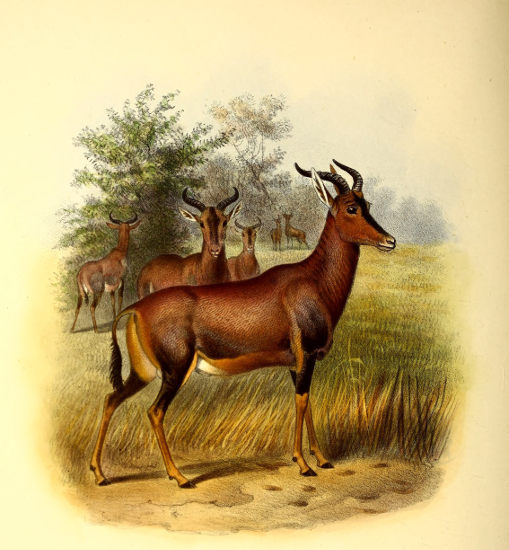
The Sassaby.
DAMALISCUS LUNATUS.
Published by R. H. Porter.
15. THE SASSABY. DAMALISCUS LUNATUS (Burch.). [PLATE X.]
Sasayby, Daniell, Afr. Sketch, pl. 18 (1820).
Antilope lunata, Burchell, Travels, ii. p. 334 (1824); id. List Quadr. pres. to B. M. p. 5 (1825) (Makkwarin R., Orange Free State); Fisch. Syn. Mamm. p. 642 (1830); Wagn. Schr. Säug. Supp. iv. p. 471 (1844), v. p. 446 (1855); Schinz, Syn. Mamm. ii. p. 444 (1845); Gieb. Säug. p. 298 (1859).
Damalis lunata, Ham. Sm. Griff. Cuv. An. K. iv. p. 352, plate (copied from Daniell), v. p. 364 (1827); Smuts, Enum. Mamm. Cap. p. 89 (1832); Gray, Ann. Mag. N. H. (1) xviii. p. 233 (1846); id. List Ost. B. M. p. 59 (1847); id. P. Z. S. 1850, p. 140; id. Knowsl. Men. p. 21 (1850); id. Cat. Ung. B. M. p. 125 (1852); Gerr. Cat. Bones Mamm. B. M. p. 244 (1862); Fitz. SB. Wien, lix. pt. 1, p. 180 (1869); Gray, Cat. Rum. B. M. p. 45 (1872); id. Hand-l. Rum. B. M. p. 115 (1873); Jent. Cat. Ost. Leyd. Mus. (Mus. Pays-Bas, ix.) p. 139 (1887); id. Cat. Mamm. Leyd. Mus. (op. cit. xi.) p. 171 (1892); Nicolls & Egl. Sportsm. S. Afr. p. 33, pl. vi. fig. 19 (head) (1892).
Acronotus lunatus, A. Sm. S. Afr. Quart. Journ. ii. p. 222 (1834); Harr. Wild An. S. Afr. pl. viii. (1840); Gray, List Mamm. B. M. p. 157 (1843); id. List Ost. B. M. p. 59 (1847).
Bubalus lunatus, A. Sm. Ill. Zool. S. Afr. pl. xxxi. (animal) (1841).
Bubalis lunata, Sund. Pecora, K. Vet.-Ak. Hand-l. 1844, p. 209 (1846); id. ibid. Hornschuch’s Transl., Arch. Skand. Beitr. ii. p. 159; Reprint, p. 83 (1848); Temm. Esq. Zool. Guin. p. 195 (1853); Drummond, Large Game S. Afr. p. 426 (1875); Ward, Horn Meas. p. 66 (1892); Lyd. Horns and Hoofs, p. 202 (1893); Selous, P. Z. S. 1893, p. 1 (hybrid with B. caama).
Alcelaphus lunatus, Buckley, P. Z. S. 1876, p. 285 (distribution); Selous, P. Z. S. 1881, p. 764; id. Hunter’s Wanderings S. Afr. p. 225 (1881); Flow. & Gars. Cat. Ost. Coll. Surg. p. 273 (1884).
Vernacular Names:—Bastard Hartebeest of Cape colonists; Sassaybe (Tsess[=e]be) of Bechuanas, now Anglicized into Sassăby by sportsmen generally; Incolomo and Incomazan of Matabili; Inkweko of Masubias; Unchuru of Makubas; Inyundo of Makalakas; Luchu or Lechu of Masaras (Selous); Myunzi of Zulus (Rendall).
Size large; height at withers nearly 4 feet. General colour dark chestnut-rufous; front of face, outer sides of shoulders, and hips black. Chin and end of muzzle paler than cheeks. Belly purplish rufous, the groins and back of horns only white. Limbs with the dark colour of shoulders and hips passing round them just above knees and hocks; below these the legs are all reddish brown. Tail with its tuft reaching to the hock, its base like the back, its crested terminal half black.
Face-hairs reversed up to horns. No glandular suborbital brushes.
Skull-measurements of an adult male:—basal length 14·9 inches, greatest breadth 6·2, muzzle to orbit 10·8.
Horns cylindrical, evenly curved, starting outwards and backwards, gradually turning inwards and backwards. There is also a slight lyration of the horns, so that both points and bases are directed a little upwards, the general lunate curve being thereby disturbed. Good male horns attain a length of 14 or 15 inches, with a basal circumference of 7 or 8.
Hab. S.E. Africa, north of the Orange River up to the Zambesi, and westward to the district of Lake Ngami.
The Sassaby is a fine large Antelope well known to the sportsmen of South-east Africa. Though it certainly belongs to this group, it is rather isolated by the peculiar form of the horns, which somewhat resemble those of the Tora. It nearest allies are no doubt the Blessbok and Bontebok, which, however, it considerably exceeds in stature, being nearly as big as a Hartebeest.
The first discovery of the Sassaby is due to the researches of the celebrated African traveller, Dr. William J. Burchell. On the 10th of July, 1812, when on the Makkwárin River, in what is now the Orange Free State, Burchell’s hunters obtained a single specimen of an Antelope which was at once recognized as “new,” and was subsequently described in the second volume of the author’s ‘Travels’ (published in 1824), as the “Crescent-horned Antelope, Antilope lunata” Burchell states that it seemed to be an extremely scarce animal, as he never met with it again during the whole of his journeyings, the fact being that he had only just entered within the southern boundary of the range of this species. Burchell’s typical specimen, or rather portions of it, viz. the frontlet and horns, is still in the National Collection, to which he presented it.
Between the period of the discovery of the Sassaby by Burchell and the publication of its description this Antelope attracted the attention of another observer, Samuel Daniell, an artist who accompanied Dr. Somerville on two expeditions into the interior of the Cape Colony early in the present century. One of the copperplates engraved by William Daniell from the drawings made by his deceased brother Samuel, and published in 1820, gives a good representation of this species, which is stated in the accompanying letterpress to be “an Antelope, heretofore not described, found in the Booshwana country.” But no further particulars are given of it.
Hamilton-Smith, in his volume on the Ruminants, published in Griffith’s Translation of Cuvier’s ‘Règne Animal,’ correctly brought together Daniell’s “Sassaby” and Burchell’s Antilope lunata under one head and added a copy of Daniell’s figure.
Except in the quotations of its names by various systematists we find little more recorded of the Sassaby until 1840, when Capt. W. Cornwallis Harris gave an excellent account of it in his beautiful work on the ‘Game and Wild Animals of Southern Africa.’ This experienced sportsman and artist devoted one of his life-like plates to the representation of this Antelope, with which he had made himself well acquainted. “The Sassaybe,” he tells us, “like its congener, the Hartebeest, delights in the neighbourhood of hills, frequenting the open country with island-looking mimosa-groves, as well as the patches of scraggy forest that skirt the foot of many of the superior mountain ranges, which, however, neither species ever ascends. Among the parks of mokaala trees about the Cashan and Kurichane mountains we constantly saw them.” The painted skins of the Sassaby were in those days, Harris tells us, “in great request amongst the savages for kobos or leathern mantles, as well on account of their brilliant colours as from their extreme suppleness.” In this article of dress, Harris tells us, "the shining black tail, opened and squeezed flat, was usually fastened on so as to depend like a queue from the back of the neck, and the universal admiration in which this elegant appendage was held rendered its wearer the subject of many a quarrel.”
Very shortly after the publication of Harris’s ‘Portraits,’ Dr. Andrew Smith published his scientific account of the Sassaby in one of the numbers of his ‘Illustrations of the Zoology of South Africa.’ After an accurate description Dr. Smith well remarks that “between the appearances of the horns of the Sassaby and the Caama there are such marked differences, that we must at once conclude that no valid importance ought to be attached either to the form or direction of horns in the grouping of species. The subocular glands also differ materially in these two animals: in the Caama they are covered with short hair, similar to that of the other parts of the face; in the Sassaby they are without covering. In the Caama, the last portion of the tail is completely encircled with hair; in the Sassaby the sides and upper surface only are so furnished, the under surface being bare. In general appearance the two animals present a strong resemblance to each other.” Dr. Smith adds the following note on the habits of this species:—
“While B. caama seems to prefer the open grassy plains for its feeding-places, the Sassaby apparently delights to resort to situations in the vicinity of wood, or to such as are actually wooded, and in districts of the latter description large herds are often observed feeding among the dense brushwood without apparent concern. All the individuals we saw near to Latakoo were vigilant in watching our motions, and apparently little disposed to trust themselves within our reach; while those, again, on the other side of Kurrichane were comparatively tame, and though they did not actually resist our approach, yet they often continued in the situations in which we discovered them, until they were quite within the range of our guns; and even after being fired at they only retreated slowly, and rarely without frequently turning round as they retired to watch our movements. Their retreat, after each examination of the kind mentioned, was commonly preceded by some significant springs or strange gesticulations, such as are often made by common domestic cattle when they are put to flight by any object which excites their alarm. In point of manners, both the Sassaby and the Hartebeest show a considerable resemblance to the bovine tribe, and, except the Gnu, more so than any of the other Antelopes.”
Coming to more modern times, Mr. T. E. Buckley, in his excellent article on the “Geographical Distribution of South-African Mammals,” read before the Zoological Society of London in 1876, gives us the subjoined notes of his experience of this species:—“Although, in Harris’s time, the Sassaybe appears to have been common on the plains, at the present day it is essentially a bush-loving animal. According to Dr. A. Smith the Sassabye was rarely known to advance to the south of Latakoo; at present its southern limit appears to be the Amaswazi country; along the Limpopo it is very common, and continues so into the Matabili country up to the Zambesi. The old males do not seem to associate with the females; nor do they appear so common, as out of nearly a dozen obtained by us only two were males, and one of these was immature. We observed very young calves in October. The Sassabye runs with a peculiar gait, reminding one of a rocking-horse; its shoulders are very high, sloping away to the rump; it does not seem to be a very shy animal.”
Five years later the experienced African hunter and naturalist, Mr. F. C. Selous, in the same Journal, gives us the following notes on this Antelope:—“In travelling up the centre of South Africa, the first place in which the Sassaby is to be met with now-a-days is in the neighbourhood of the Marico River, a tributary of the Limpopo; and from there it is found throughout Central South Africa wherever I have been, south of the Zambesi, in all those parts of the country that are suitable to its habits. I say south of the Zambesi, because during my journey through the Manica country to the north of that river in 1877–78, although the terrain appeared well suited to its habits and requirements, I saw none of these Antelopes. I have heard, however, from the natives that they are very common in the neighbourhood of Sesheke.
“This Antelope is never found in hilly country or in thick jungle, but frequents the open downs that are quite free from bush, or else open forest-country in which treeless glades are to be met with. On the Mababe Flat at the end of the dry season large herds of these animals congregate together, and I have often seen, I am sure, several hundreds of them at once. They are, without exception, the fleetest and most enduring Antelope in South Africa. In 1879 all the Tsessebe and Blue Wildebeest cows calved on the northern bank of the Chobe during the first week in September, whilst on the Mababe Flat, only about one degree further south, the same animals did not calve before the first week in November.”
Mr. Bertram L. Sclater, R.E., who was at Beira for a week in April 1892, on his way home from Nyasaland, informs us that he was told in that town that the Sassaby is one of the commonest Antelopes on the banks of the Lower Pungwe, and that he was shown several frontlets of this species said to have been obtained between Beira and Chimoio. So far as we know, this is the furthest northern locality recorded for this species, which, as shown by Mr. Selous, does not appear to be found anywhere north of the Zambesi.
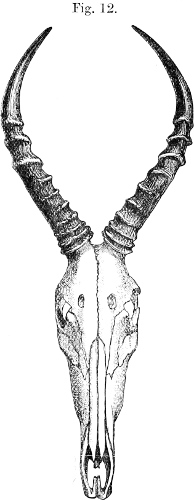
Fig. 12.
Head of supposed hybrid between Damaliscus lunatus and Bubalis caama.
(P. Z. S. 1893, p. 2.)
At a meeting of the Zoological Society of London in January 1893 Mr. Selous made another interesting communication on this Antelope, exhibiting a skull which he believed to be that of a hybrid between it and the Hartebeest. This curious animal was shot in 1890 on the Tati River, Matabeleland, by Cornelius van Rooyen, a well-known Boer hunter. While this skull, which is now in the British Museum, closely resembles that of the Hartebeest, its horns partake of the characters of both the supposed parents. They stand nearly straight up from the skull as in the Hartebeest, but are slightly lunate in form and ringed as in the Sassaby. Mr. Selous was informed that the general colour of its skin was precisely that of the Sassaby, but that it carried the comparatively large bushy tail of the Hartebeest. As hybrids amongst the larger mammals are excessively rare in a wild state, this occurrence is well worthy of record, and we have to thank the Zoological Society for kindly permitting us to use their woodcut to illustrate it.
Besides the typical frontlet of this species in the British Museum, already mentioned, there are a mounted pair in the Gallery obtained by Dr. Andrew Smith, and skeletons of both sexes made from specimens shot on the Manyame River, Mashonaland, by Mr. Selous.
The Sassaby is rarely seen in captivity. So far as we know, the only specimens ever brought alive to Europe are two females imported by Mr. C. Reiche, of Alfeld, from the Transvaal in 1888. One of these was sold to the Amsterdam Gardens (where Sclater inspected it in April 1889), and the other to the Antwerp Gardens.
Our figure of this species (Plate X.) was put on the stone by Mr. Smit from a sketch made for Sir Victor Brooke by Mr. Wolf.
January, 1895.
GENUS III. CONNOCHÆTES.
Type.
Connochætes, Licht. Mag. nat. Freund. Berl. vi. p. 152 (1814) C. gnu.
Cemas, Oken, Lehrb. Naturgesch. iii. Zool. pt. ii. p. 727 (1816) C. gnu.
Catoblepas, Ham. Sm. Griff. Cuv. An. K. iv. p. 366 (1827) C. gnu.
Gorgon, Gray, P. Z. S. 1850, p. 139 C. taurinus.
Butragus, Bly. apud Gray, Cat. Rum. B. M. p. 43 (1872) C. taurinus.
Size large, form thick and clumsy; the withers not disproportionately higher than the rump; head massive, with a broad and bristly muzzle; face with a large median tuft of thick black hairs uniting the suborbital tufts; nostrils widely separated, hairy within; neck maned; hoofs narrow; tail with its tuft reaching nearly to the ground, long-haired throughout; mammæ four.
Colour grey, brown, or black, the long hairs of the dorsal and throat manes and of the tail generally black, sometimes white.
Skull broad and heavy, not specially elongated; ends of premaxillæ expanded.
Horns present in both sexes; thickened and expanded at their bases; starting outwards or downwards for their proximal halves, their points abruptly curved upwards.
Range of the Genus. South and East Africa.
This genus, that of the curious and eccentric-looking animals known as Gnus, contains two very different sections, almost worthy of being considered distinct genera. One of these consists of two closely allied forms, the Brindled and White-maned Gnu, and the other of the White-tailed or “Common” Gnu, the most peculiar and specialized of all. Their differences may be summarized as follows:—
A. Hairs of facial tuft pointing downwards. Horns directed first outwards and then upwards. Tail black.
a. Throat-mane black 1. C. taurinus.
b. Throat-mane whitish 2. C. albojubatus.
B. Hairs of facial tuft pointing upwards. Horns directed first downwards, and then recurved upwards. Tail white 3. C. gnu.
THE BOOK OF ANTELOPES, PL. XI.
Wolf del. Smit lith.
Hanhart imp.
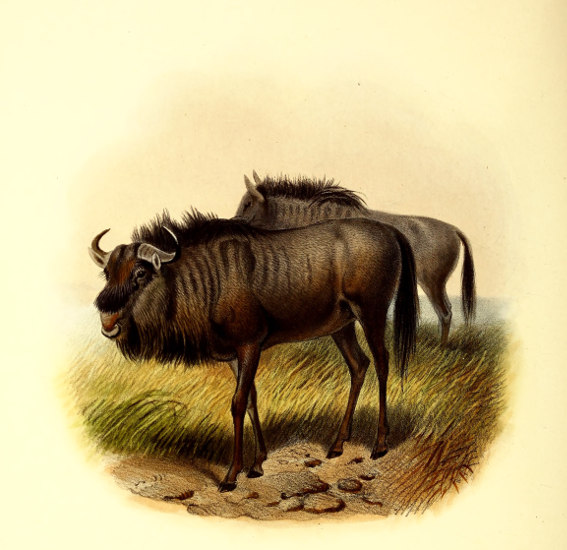
The Brindled Gnu.
CONNOCHÆTES TAURINUS.
Published by R. H. Porter
16. THE BRINDLED GNU. CONNOCHÆTES TAURINUS (Burch.). [PLATE XI.]
Antilope gnu, var., Licht. Mag. nat. Freund. Berlin, vi. p. 166 (?).
Kokoon, Daniell, Afr. Scenery, p. 37 (1820).
Antilope taurina, Burchell, Travels, ii. p. 278 (1824); id. List Quadr. pres. to B. M. p. 7 (1825) (Maadji Mts.); Fisch. Syn. Mamm. p. 476 (1829); Schinz, Syn. Mamm. ii. p. 447 (1845); Gieb. Säug. p. 299 (1859).
Catoblepas taurinus, Ham. Sm. Griff. Cuv. An. K. iv. p. 369, v. p. 368 (1827); Fisch. Syn. Mamm. p. 642 (1830); Smuts, Enum. Mamm. Cap. p. 94 (1832); A. Sm. S. Afr. Quart. J. ii. p. 233 (1834); Less. Compl. Buff. x. p. 305 (1836); Gray, List Mamm. B. M. p. 154 (1843); Sund. Pecora, K. Vet.-Ak. Hand-l. 1844, p. 205 (1846); id. ibid. Hornschuch’s Transl., Arch. Skand. Beitr. ii. p. 156; Reprint, p. 80 (1848); A. Sm. Ill. Zool. S. Afr. pl. xxxviii. (♀ & yg.) (1849) Fitz. SB. Wien, lix. pt. 1, p. 182 (1869); Brehm, Thierl. iii. p. 290, fig. (animal) (1880).
Catoblepas gorgon, Ham. Sm. Griff. Cuv. An. K. iv. p. 371, v. p. 369 (1827); Fisch. Syn. Mamm. p. 643 (1830); A. Sm. S. Afr. Quart. J. ii. p. 233 (1834); Less. Compl. Buff. x. p. 306 (1836); Harris, Wild Anim. S. Afr. pl. iv. (1840); Gray, List Mamm. B. M. p. 154 (1843); id. Ann. Mag. N. H. (1) xviii. p. 232 (1846); id. P. Z. S. 1850, p. 139; id. Knowsl. Men. p. 20 (1850); Temm. Esq. Zool. Guin. p. 195 (1853); Sclater, P. Z. S. 1864, p. 103 (Uzaramo, Speke); Kirk, P. Z. S. 1864, p. 660 (Zambesia); Fitz. loc. cit.; Drummond, Large Game S. Afr. p. 425 (1875); Selous, P. Z. S. 1881, p. 764 (distribution); id. Hunter’s Wanderings S. Afr. p. 226 (1881); Bryden, Kloof and Karroo, p. 293 (1889).
Antilope gorgon, Wagn. Schr. Säug. Supp. iv. p. 474 (1844), v. p. 448 (1855); Schinz, Syn. Mamm. ii. p. 446 (1845); Peters, Säug. Mozamb. p. 192 (1852).
Connochætes gorgon, Gray, Cat. Ung. B. M. p. 121 (1852); Gerr. Cat. Bones Mamm. B. M. p. 243 (1862).
Gorgon fasciatus, Gray, Cat. Rum. B. M. p. 43 (1872); id. Hand-l. Rum. B. M. p. 114 (1873).
“Butragus corniculatus, Blyth, MS.,” Gray, Cat. Rum. B. M. p. 43 (1872).
Connochætes gnu, Hunter, in Willoughby’s East Africa, p. 288.
Connochætes taurinus, Scl. List An. Z. S. (8) p. 150 (1883); Flow. & Gars. Cat. Ost. Coll. Surg. p. 275 (1884); Jent. Cat. Ost. Leyd. Mus. (Mus. Pays-Bas, ix.) p. 139 (1887); Crawshay, P. Z. S. 1890, p. 663 (Nyasa); Flow. & Lyd. Mamm. p. 336 (1891); Nicolls & Egl. Sportsm. S. Afr. p. 47, pl. iii. fig. 8 (head) (1892); Ward, Horn Meas. p. 72, fig. (horns) (1892); Jent. Cat. Mamm. Leyd. Mus. (Mus. Pays-Bas, xi.) p. 170 (1892); Lyd. Horns and Hoofs, p. 205, fig. 42 (head) (1893).
Catoblepas reichei, Noack, Zool. Anz. 1893, p. 153 (Upper Limpopo).
Vernacular Names:—Blue Wildebeest of English colonists (Selous); Bastard or Blauw Wildebeeste of Dutch colonists (Harris); Kokoong of Bachapins (Burchell); Kokoon of Bechuanas (Harris); Nyumbo in Zambesia (Peters & Kirk); Kaop and Baas of Namaquas and Hottentots (Harris); Imbutuma of Kaffirs (Drummond); Ink[=o]ne-kn[=o]e of Matabilis; Ee-vumba of Makalakas; Numbo of Masubias; Minyumbwe of Batongas; Unzozo of Makubas (Selous); Ink[=o]ne-k[=o]ne of Swazis (Rendall).
Height at withers about 48 inches.
Fur short and close, with peculiar vertical lines of differently directed hairs on the sides of the neck and body, whence the epithet “Brindled.” General colour dull grey, lighter and more tinged with rufous on the rump and limbs. Face (except a paler area between the eyes), chin, dorsal and throat manes deep black. Tail long, its vertebræ almost reaching to the hock; its upper surface coloured like the rump, its under surface and the long tuft black.
Lower part of face and lacrymal region heavily tufted, the hairs directed downwards; the short ones of the terminal inch on the tip of the muzzle, however, pointed upwards.
Skull large and heavy, with a long muzzle. That of an old male measures as follows:—basal length 18·1 inches, greatest breadth 7·7, muzzle to orbit 13·3.
Horns placed so that the hinder edge of their palm is little more than level with the back of the skull; the palm itself comparatively low, smooth, small in comparison with the enormous palm of C. gnu. Beyond the palm the basal two-thirds of the horn points directly outwards, while the ends are curved upwards, forwards, and inwards. A fine pair of horns will measure 26 or 28 inches between the outer sides of the curves of the two horns.
Hab. Eastern Africa, from the Vaal River northwards through Zambesia, Nyasaland, and German East Africa to the north of Kilimanjaro.
The Brindled Gnu, although, as it seems, previously observed by Lichtenstein in Bechuanaland, was first actually obtained by the celebrated African traveller Burchell, who went far into the interior of the country in 1811 and 1812. In June of the latter year, when encamped at the great Khosi Fountain in Bechuanaland, as he tells us in the second volume of his ‘Travels,’ an example of a “new species of Antelope” was brought in by his hunters. Being well acquainted with the White-tailed Gnu of the Cape Colony, Burchell at once recognized it as a second species of that genus. Burchell pointed out its differences from its southern representative very clearly, and added a scientific Latin diagnosis in a footnote. He called it Antilope taurina, because its horns resembled those of an Ox more than those of any other Antelope. The half-bred Hottentots, he observes, give it the name of the Bastaard Wildebeest, while the Bechuanas call it Kokūn or Kokūng. Altogether Burchell obtained five specimens of this Antelope, one of which (a female), shot in the following October near the Maadji Mountains, was, as we learn from his "List of Quadrupeds,” presented to the British Museum in 1817, and seems to have formed the basis of his technical description.
Two years previous to the actual publication of Burchell’s description, however, the Brindled Gnu had been figured in Daniell’s ‘Sketches of African Scenery’ under the name of the “Kokoon.”
In 1827 Major Charles Hamilton-Smith, F.R.S., in Griffith’s edition of Cuvier’s ‘Animal Kingdom,’ besides recognizing C. gnu and C. taurina, added a presumed third species of the genus, which he based on a specimen then exhibited in the "Museum of the Missionary Society of London." It is quite clear, however, from the description and figure that Hamilton-Smith’s C. gorgon is identical with Burchell’s previously described Antilope taurina, and that the latter term should take precedence, although many naturalists have preferred to use Hamilton-Smith’s name for this species.
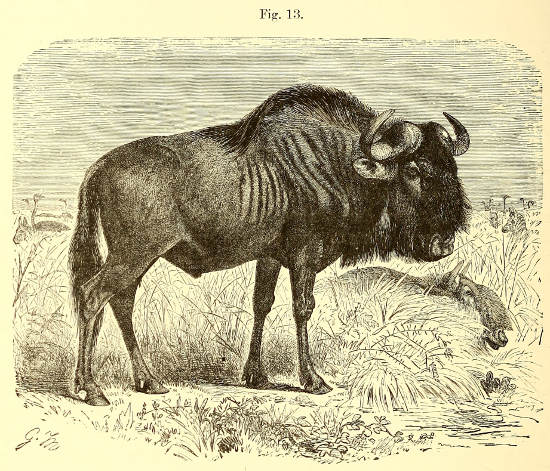
Fig. 13.
Adult Brindled Gnu.
(Roy. Nat. Hist. vol. ii. p. 314.)
In 1836 and 1837 the celebrated artist and sportsman, Cornwallis Harris, met with the Brindled Gnu on the plains of what is now the Orange Free State in “countless numbers.” “Instantly after crossing the Orange River,” he tells us, “the Kokoon or Brindled Gnu usurps the place of the White-tailed species, and, although herds of the former may actually be seen grazing on the northern bank, not a single individual has ever been known to pass the barrier.... By the Dutch Boers the present species is termed the Bastaard or Blauw Wilde Beest: throughout the country of the Bechuanas, as far as the Tropic, it is recognized as the Kokoon, and the Hottentot tribes designate it the Kaop or Baas, both of which terms, signifying master, refer, in all probability, to its bold and terrific bearing. When excited by the appearance of any suspicious object, or aroused by any unusual noise, the Kokoon is wont to appear much more grim and ferocious than it actually proves—not unfrequently approaching with an air of defiance, as if resolved to do battle with the hunter, but decamping on the first exhibition of hostility on his part. On being pursued, the herd bring their aquiline noses low between their knees, and flourishing their streaming black tails, tear away in long regular files at a furious gallop, wheeling curiously about at a distance of two or three hundred yards, advancing boldly towards the danger, tossing their shaggy heads in a threatening manner—presently making a sudden stop, presenting an impenetrable front of horns, and staring wildly at the object of their mistrust.... When engaged in grazing they have an extremely dull and clumsy appearance, and at a little distance might often be mistaken for wild buffaloes; but their manner is sportive—at one moment standing to gaze at nothing, and at the next scampering over the plain without any apparent object in view, making grotesque curvets and plunges, with their preposterous Bonassus-looking heads held down between the fore legs.”
In his valuable ‘Illustrations of South-African Zoology,’ Sir Andrew Smith gives an excellent account of this species (published in August 1842), accompanied by an indifferent figure of the female and young. Sir Andrew justly observes that this and the Common Gnu are two of the most interesting and extraordinary quadrupeds which occur in South Africa. “When either the one or other of those animals, especially under excitement, stands in front of an observer, with the head and anterior parts of the body only distinctly visible, the idea of its strong resemblance to a small ox immediately arises. When, again, its body and posterior parts are the portions most conspicuously in view, the likeness to a horse is remarkable; but when its limbs only are taken in review, it presents a strong similarity to the more typical Antelopes.”
At the time when these observations were made both the Gnus, according to Sir Andrew Smith, inhabited, in enormous multitudes, the grassy plains to the northward of the Vaal River, and after the fall of the summer rains were in the habit of advancing simultaneously in large herds as far as the southern branches of the Orange River. But on reaching the latter stream singularly enough the Brindled Gnu ceased to advance, and the Common Gnu alone passed into the Cape Colony. The appearance of the latter to the south of the Orange River was the signal for hunters of all denominations to prepare for the chase, and though the yearly slaughter was very great the herds in those days never ceased to renew their periodical visitations. Strongly expressed as are the views of both Andrew Smith and Harris as to the line of demarcation between the two species of Gnu, there seems to be some doubt as to their correctness. An excellent recent authority, Mr. H. A. Bryden (‘Kloof and Karroo’), tells us that the Brindled Gnu was in former days certainly a “denizen, albeit a rare one, south of the Orange River,” and gives us Gordon-Cumming as an authority. Gordon-Cumming asserts (‘Hunter’s Life in South Africa,’ p. 148) that he met with the Brindled Gnu in the Karroo country west of Colesberg, in what is now the Hopetown division of the Cape Colony. But Mr. Bryden admits that it has now for many years been extinct in that district. In the Transvaal, also, he tells us, the Boers have, of late years, played sad havoc with this singular Antelope, not long ago found in countless thousands on the plains of that Republic.
Messrs. Nicolls and Eglington, in their ‘Sportsman in South Africa,’ tell us the same story. Writing in 1892, they state that, except in some of the northern districts along the Crocodile River, the Brindled Gnu is now extremely scarce in the Transvaal, and practically extinct in the Orange Free State. But it is still met with in Bechuanaland, and is fairly plentiful along the edges of the Great Kalahari Desert. “In the Lake Ngami district, on both banks of the Botletle River, and from thence right up to the Chobe and Zambesi, it is quite common in suitable localities, and, at the present time, large troops may be seen on the Ma-Chara-Chara and Mababe Flats, and in the country surrounding the great salt-pans of Makari-Kari, through which the main road passes to the Victoria Falls.”
So much for the occurrence of this species in the South and South-west of Africa, past and present. But we must now trace its distribution to the north; for it is an extraordinary fact that the Brindled Gnu, instead of being confined, like its sister species, to a small part of South Africa, extends up along the eastern coast certainly as far as Kilimanjaro, and perhaps even into Sennaar, where reports of the occurrence of a Gnu-like Antelope were made to Heuglin. It is, however, possible that some of these northern Gnus may belong to the White-maned species, which we shall presently mention.
Beginning from the Limpopo, Mr. Selous tells us that the Brindled Gnu is found all over this portion of South-eastern Africa up to the Zambesi, in districts suitable to its habits—that is, “in open downs devoid of bush and in open glades in the forest,” but not in hilly countries. Peters and Sir John Kirk both enroll it among the mammals of Zambesia, the latter author stating that at the time of his visit it was “very abundant in considerable herds in the Batoka country, also near Lake Shirwa, and at Shupanga on the Zambesi.” As to its present existence in the Shiré Highlands, Mr. B. L. Sclater, R.E., sends us the following notes.—“In November 1891, while travelling between Zomba and Milanji, I was shooting in the marshes on the west bank of the Tochila. I saw a Gnu and tried to stalk it, but it was right in the open and I could not get near it. My head man, a Swahili, said it was a Gnu (Nyumbo), and he was well acquainted with that animal. Again, in 1892, at Midima, to the south of the Tochila, I obtained a tail of a Gnu from a native, who told me that formerly there was a large herd of them on these plains, but that he thought they were now all killed. I believe that Mr. Sharpe has met with the Gnu on the plains to the west of the Upper Shiré, between Matope and the sources of the Lesungwi River.”
As regards the more northern portion of the British Central African Protectorate, Mr. Crawshay tells us that the Gnu is apparently unknown to the natives round the northern half of Lake Nyasa, and is not met with anywhere in the immediate neighbourhood of the Lake, though found a little to the south-east, and also, he believes, to the south-west.
In 1864 Speke met with the Brindled Gnu in large herds in Khutu, on the western borders of Uzaramo, close to the Kingani River, where it inhabits the “park-like lands adjoining the stream.”
Later on Sir John Kirk obtained heads of it in the same district, and has favoured us with the following notes on its occurrence in this part of German East Africa:—
“As regards the Brindled Gnu in East Africa, I may say that, although familiar with this animal on the Upper Zambezi near the Victoria Falls, where they were common in 1860, I have only since shot them in Ukami, to the west of Dar-es-salam, and on the River Wami inland from Bagomoyo. In the plains and on the rolling ground between the River Rufiji and the River Wami they used to be common. I have shot them within ten miles of the coast, and I believe that they extend back to the foot of the mountains.
“As I was not then acquainted with the species or variety lately found by Jackson, I cannot from memory express any opinion as to the identity of these animals, further than that they seemed to me identical with the Brindled Gnus I had killed years previously near the Victoria Falls and Sesheke on the Upper Zambezi.
“In East Africa, near the coast, in the places above-named where I found this Antelope, it never occurs in numbers, but is often associated as an attendant on other game, especially upon Lichtenstein’s Hartebeest. It often causes annoyance to the sportsman by giving warning of his approach to the other Antelopes.
“I believe this Gnu suffered from the recent cattle-disease which during the last four years has decimated the Buffalo, the Giraffe, the Eland, and many other kinds of game, not affecting, however, the Rhinoceros, and certain other animals. This disease seems to have killed off different classes of animals in different localities, attacking universally, wherever it appeared, the cattle of the natives.
“Thousands of hides of cattle that have died of this plague have been freely imported into Europe and America; the disease has travelled from Somali-land to Nyasa-land, and yet we do not know its nature. Some say it is anthrax, others that it is pleuro-pneumonia; but whether it is a disease that can be communicated by the dried hides of the diseased animals has not been ascertained. In Somali-land and Masai-land it has worked itself out, and it may stop short of the Cape Colony and not cross the Zambezi; but in the meantime it has decimated the African Game, and left its mark by changing the whole life of the pastoral peoples who depended on their cattle alone."
In British East Africa the Brindled Gnu (here called by the Swahilis “Nyumbo”) is well-known to the sportsmen who have visited the happy hunting-grounds of Kilimanjaro. Sir John Willoughby and his friends found it principally to the north-east of the mountain “in large herds.” Mr. F. J. Jackson (‘Big Game Shooting’) tells us it is more plentiful in the Useri district to the north-east of Kilimanjaro, and on the Athi plains to the north and west of Machakós, than anywhere else. In the latter place, on August 5, 1890, he and his companions “saw an enormous herd of 1500”; but this was “quite unusual, as they are rarely found in herds of more than from twenty to sixty.” But it is possible that some of Mr. Jackson’s observations may refer to the following species, as when he wrote them he did not distinguish the two animals.
Mr. Jackson gives the following advice to the Gnu-hunter:—“Wildebeests are amongst the most difficult beasts to stalk, owing to the open nature of the country in which they are found, and will probably try the sportsman’s patience more than any other Antelope. They will stand gazing at him, and will sometimes allow him to get within a range of 200 yards, if he pretends to walk past them, though in reality closing in upon them in a semicircle; but directly he stops to take a shot they will shake their heads in the most defiant way, and with a few snorts and flicks of their mule-like tails, kick up their heels and caper off jauntily. As they will, as a rule, pull up a short way off, the sportsman will have the annoyance of again adopting the same tactics, with probably like results, until he might almost believe that the Wildebeest is enjoying itself at his expense. He should, however, avoid risking a long shot (the Wildebeest is an extremely tough brute, and will go for miles when wounded in such a way as would soon bring other game to a standstill), since after two or three fruitless attempts if no shot is fired its suspicions will become allayed, and it will probably stand sufficiently long to give him a good chance.”
The Brindled Gnu is not so commonly met with in Zoological Gardens as the White-tailed species. It is generally considered to be a rarer animal in the market, and the dealers ask a larger price for it. We are informed that a pair of Brindled Gnus bred in the Zoological Gardens at Breslau in 1886 or 1887. The only specimen ever received by the Zoological Society, so far as we can make out, was a female purchased in 1859. In the continental Gardens it has been better represented, and the collections at Antwerp, Amsterdam, and Berlin usually contain specimens of this Antelope. These have been, in many cases, obtained from Mr. Reiche, of Alfeld, who has received several examples of this Gnu among his recent importations of living animals from the Transvaal.
In the British Museum the Brindled Gnu is represented by one of Burchell’s typical examples, as already mentioned, and by an adult male received from Sir Andrew Smith. Both these are mounted specimens. There are likewise a skeleton, obtained by Mr. Selous in Mashonaland in 1885, and a set of skulls and horns in the same collection.
Our Plate of this animal was put on the stone by Mr. Smit from a sketch made by Mr. Wolf. For the use of the woodcut (fig. 13, p. 98), drawn by the celebrated German artist Mützel, we are indebted to the kindness of Messrs. Warne and Co., by whom it has been used in their ‘Royal Natural History’ (vol. ii. p. 314).
January, 1895.
17. THE WHITE-BEARDED GNU. CONNOCHÆTES ALBOJUBATUS, Thos.
Catoblepas sp. inc., Hengl. Ant. u. Buff. N.O.-Afr., N. Act. Leop. xxx. pt. ii. p. 24 (1868) (Sennaar)?
Connochætes gnu, Hunter, in Willoughby’s E. Afr. p. 288 (1889)?
Connochaætes taurinus albojubatus, Thos. Ann. Mag. N. H. (6) ix. p. 388 (1892); Ward, Horn Meas. p. 75, fig. (head and skull) (1892).
Connochætes taurina, Lugard, E. Afr. i. p. 540, pl. p. 530 (animal) (1893).
Similar in size and coloration to C. taurinus, except that the general tone is paler, especially on the cheeks and rump, and the throat-mane instead of being black is of a dirty yellowish-white colour. A few whitish hairs are also intermixed with the black of the dorsal mane.
The skull is shorter and broader than in C. taurinus, especially in the region of the muzzle, and the horns are placed further back on the head, so that the palm surpasses the back of the skull posteriorly by nearly half its breadth. The palm is also more tipped up behind away from the skull, and is much knobbier, on which account the hinder edge of the horns forms a more serpentine curve.
The dimensions of the typical skull are as follows:—basal length 16 inches, greatest breadth 7·6, muzzle to eye 12·1.
Hab. East Africa, Athi plains, Ukambani, north of Kilimanjaro, and west side of Victoria Nyanza.
As we have already stated, this form, although otherwise agreeing in nearly every point with the Brindled Gnu, is readily distinguishable by its white mane, white jaw-tufts, and the generally paler colour. But whether we ought to classify it as a separate species, or as a subspecies, or only as a variety of the Brindled Gnu future researches only can decide. We know as yet too little of its exact range and mode of occurrence to be able to settle this question, nor is there a sufficient series of specimens available. If it should be found hereafter that beyond a certain boundary in Eastern Africa all the Gnus met with are of the White-bearded form, and that along this line of junction there are transitional forms between this and the ordinary Brindled Gnu, we should do well to allow it merely subspecific rank. If, on the other hand, it shall be found that the White-bearded Gnu occurs side by side with the Brindled Gnu without mixing or interbreeding with that animal, we shall have to count it as a full species.
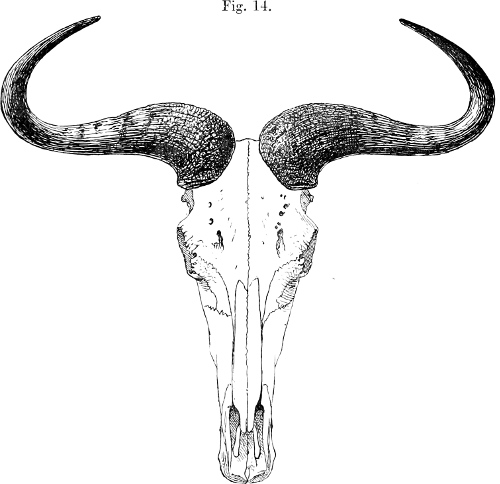
Fig. 14.
Skull of Connochætes albojubatus, ♂.
Thomas, in 1892, based his Connochætes taurinus albojubatus on a head in Mr. F. J. Jackson’s collection, at that time under the care of Messrs. Rowland Ward and Co., but since kindly presented by Mr. Jackson to the National Collection. Thomas, from erroneous information, gave the locality as “Uganda,” but we have since ascertained that this and another specimen, still in Mr. Jackson’s possession, were obtained on the Athi plains north of Kilimanjaro. Mr. Gedge assures us that no Gnus at all were met with by Mr. Jackson and himself in Uganda.
Mr. Gedge has kindly supplied the following notes on his experiences with the Gnus of British East Africa:—
“Both the Blue Wildebeeste and Jackson’s Wildebeeste are found in British East Africa, and are to be met with in great numbers on the Athi plains north of Ukambani. Of the two, the blue variety is, perhaps, more usually met with, though I would remark that on my upward journey to Uganda, in December 1892, I only encountered a few solitary specimens of the Blue form in a part where they are generally seen in hundreds, whereas on my downward journey, in the month of August of the following year, the same locality was entirely tenanted by Jackson’s Wildebeeste, which on this occasion were so tame that I was able to literally walk right in amongst them and knock them down with a small Winchester. This was really the one and only occasion that I have met with this latter variety in any great numbers. On the other hand, the Blue Wildebeeste will be found more or less commonly distributed over the Leikipia and Mau plateaux. It probably ranges over a very wide extent of country to the northwards, though I cannot remember having seen any Wildebeestes at all north of Lake Baringo. At the same time its non-appearance on the occasion of my visit may doubtless very easily be accounted for by the excessive dryness of the country at that time, and the consequent lack of pasturage. Similarly, I have never seen Gnus anywhere near the Victoria Lake, though possibly other travellers may have done so. The Gnu is an uncouth and ungainly beast in appearance, and, as a rule, will not allow itself to be easily approached. As the open character of the country which it usually frequents more or less precludes any idea of being able to stalk it successfully, the method which I adopted, and which I found answered best, was to walk along quietly parallel to the herd, gradually edging inwards. On such occasions their natural curiosity would often allow a shot to be obtained at a distance of from a hundred and fifty to two hundred yards. Being tough and hard to kill, Gnus must be struck accurately by a weapon with a high degree of penetration. As an illustration of their great vitality, I would mention that on one occasion I had the misfortune to break both the fore legs of one just above the fetlock, and that in spite of these crippling wounds the poor beast was able to cover a distance of nearly half a mile on its stumps before I came sufficiently near to administer the coup-de-grâce. This was in spite of the fact that, in addition to this severe injury, it had received two other solid express bullets in its body, one of which was afterwards discovered to have penetrated the base of the heart. When alarmed the Gnu usually runs but a short distance at a time, at a stiff ungainly gallop, whisking its tail round in the most comical fashion. It then stops and turns to inspect the object of its alarm, at the same time uttering a few snorts. Having satisfied itself of the approaching danger, it will again gallop off and pursue the same tactics several times if unmolested. It is a very harmless and inoffensive animal in spite of its ferocious aspect.”
As regards the Gnus of German East Africa there is the same difficulty. Herr Matschie has kindly sent to Sclater the following notes on this subject:—
“At Berlin we have received from Oscar Neumann several skins and skulls, young and old, of the Gnu [procured during his recent journey northwards from Irangi up the east side of Lake Victoria].
“All of these have white neck-manes and chin-bunches and brownish heads and manes, but in some cases the latter are mixed with white, and the tails are of a similar colour. The body is dirty greyish brown, without a trace of bluish. One old bull shows vertical stripes on the front of the body, the hairs having been worn short.
“The localities are—between Ngera and Irangi; Mount Guerui; Mgogo, north of the Manyara Lake; and further on as far as Ngare Dobasch, where they cease.
“Neumann writes that on Mount Guerui and farther along he observed the two varieties living apart. On the Guerui he saw at the same time a herd of light-coloured Gnus, and a herd varying from bluish black to black, but no transitional forms.”
From Mgogo, Neumann writes:—“By the six skins which I obtained [these skins have not yet arrived in Berlin] I hope to prove that there are two species, or, at any rate, varieties of Gnus—one lilac-black grey, and the other bright yellowish brown. On the Mangoto natron-swamp they kept apart. Here in Mgogo the black form predominates, so that it seems to be the more northern. Of two young examples of about the same age, judging from their horns, one has a black forehead, and the other has two white spots in front of the eyes.
“Von Höhnel and Count Teleki found only grey-black Gnus on Mount Maeru, but these had the neck-manes striped with white and black. On the Naschiri Lake, Teleki first met with a pure white-maned specimen.”
The woodcut of the skull of this Antelope (fig. 14, p. 106) is taken from one of Mr. Jackson’s specimens in the British Museum.
January, 1895.
THE BOOK OF ANTELOPES, PL. XII.
J. Smit del & lith.
Hanhart imp.
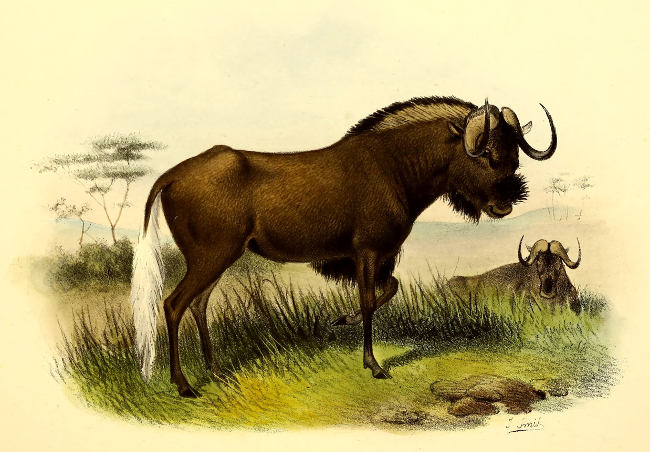
The White-tailed Gnu.
CONNOCHÆTES GNU.
Published by R. H. Porter.
18. THE WHITE-TAILED GNU. CONNOCHÆTES GNU (Zimm.). [PLATE XII.]
Bos gnou, Zimm. Spec. Zool. Geogr. p. 372 (1777).
Antilope gnou, Zimm. Geogr. Gesch. ii. p. 102 (1780); Bodd. Elench. Anim. p. 138 (1785); Schr. Säug. pl. cclxxx. (animal) (1787).
Antilope gnu, Gmel. Linn. Syst. Nat. i. p. 189 (1788); Kerr, Linn. An. K. p. 315 (1792); Donnd. Zool. Beytr. p. 634 (1792); Link, Beytr. Nat. i. pt. 2, p. 100 (1795); Bechst. Uebers. vierf. Thiere, i. p. 64 (1799), ii. p. 641 (1800); Shaw, Gen. Zool. ii. pt. 2, p. 357, pl. 196 (1801); Turt. Linn. Syst. Nat. i. p. 114 (1802); Desm. N. Dict. d’H. N. (1) ix. p. 516 (1803); G. Cuv. Diet. Sci. Nat. ii. p. 247 (1804); Ill. Prodr. Syst. Mamm. p. 106 (1811); Licht. Mag. nat. Freund. Berl. vi. p. 165 (1814); G. Fisch. Zoogn. iii. p. 418 (1814); Afzel. N. Act. Ups. vii. p. 219 (1815); Desm. N. Dict. d’H. N. (2) ii. p. 201 (1816); Goldf. in Schreb. Säug. v. p. 1165 (1820); F. Cuv. H. N. Mamm. (fol.) i. livr. xvi. (animal) (1820); Schinz, Cuv. Thierr. i. p. 399 (1821); Desmoul. Dict. Class. d’H. N. i. p. 447 (1822); Burchell, List Quadr. pres. to B. M. p. 7 (1823); Less. Man. Mamm. p. 385 (1827); Fisch. Syn. Mamm. p. 475 (1829); Waterh. Cat. Mamm. Mus. Z. S. (2) p. 41 (1838); Oken, Allgem. Naturgesch. vii. p. 1400 (1838); Wagn. Schr. Säug. Supp. iv. p. 473 (1844), v. p. 448 (1855); Schinz, Syn. Mamm. ii. p. 445 (1845); Gieb. Säug. p. 299 (1859).
Antilope capensis, Gatt. Brev. Zool. i. p. 80 (1780).
Bos gnu, Thunb. Mém. Ac. Pétersb. iii. p. 318 (1811).
Cerophorus (Boselaphus) gnu, Blainv. Bull. Soc. Philom. 1816, p. 75.
Cemas gnu, Oken, Lehrb. Naturgesch. iii. pt. 2, p. 728 (1816).
Antilope (Boselaphus) gnu, Desm. Mamm. ii. p. 472 (1822).
Catoblepas gnu, Ham. Sm. Griff. Cuv. An. K. iv. p. 367, v. p. 368 (1827); Smuts, En. Mamm. Cap. p. 93 (1832); A. Sm. S.-Afr. Quart. Journ. ii. p. 224 (1834); Less. Compl. Buff. x. p. 305 (1836); Harr. Wild Anim. S. Afr. pl. i. (animal) (1840);
Gray, List Mamm. B. M. p. 154 (1843); id. Ann. Mag. N. H. (1) xviii. p. 232 (1846); id. List Ost. B. M. p. 59 (1847); Sund. Pecora, K. Vet.-Ak. Hand-l. 1844, p. 205 (1846); id. ibid. Hornschuch’s Transl., Arch. Skand. Beitr. ii. p. 156; Reprint, p. 80 (1848); Gray, Knowsl. Men. p. 19 (1850); id. P. Z. S. 1850, p. 138; Temm. Esq. Zool. Guin. p. 195 (1853); Fitz. SB. Wien, lix. pt. 1, p. 182 (1869); Murie, P. Z. S. 1870, p. 475; Drummond, Large Game S. Afr. p. 425 (1875); Buckley, P. Z. S. 1876, pp. 286, 292 (distribution); Brehm, Thierl. iii. p. 287 (fig. animal) (1880); Blaauw, Bull. Soc. Acclim. (4) iii. p. 494 (1886) (breeding in Holland); id. P. Z. S. 1889, p. 2, figs. A-D (growth of horns); Bryden, Kloof and Karroo, p. 293 (1889).
Catoblepas operculatus, Brookes, Cat. Mus. p. 64 (1828).
Bos connochætes, Forst. Descr. Anim. p. 392 (1844).
Connochætes gnu, Gray, Cat. Ung. B. M. p. 119 (1852); Gerr. Cat. Bones Mamm. B. M. p. 243 (1862); Gray, Ann. Mag. N. H. (4) iv. p. 291 (fig. of young horns) (1869); id. Cat. Rum. B. M. p. 43 (1872); id. Hand-l. Rum. p. 113 (1873); Scl. List Anim. Z. S. (8) p. 150 (1883); Huet, Bull. Soc. Acclim. (3) ix. p. 678, x. p. 95 (1883) (breeding in Paris); Flow. & Gars. Cat. Ost. Coll. Surg. p. 274 (1884); Jent. Cat. Ost. Leyd. Mus. (Mus. Pays-Bas, ix.) p. 138 (1887); W. Scl. Cat. Mamm. Calc. Mus. ii. p. 170 (1891); Flow. & Lyd. Mamm. p. 336, fig. 139 (animal) (1891); Ward, Horn Meas. p. 74 (1892); Nicolls & Egl. Sportsm. S. Afr. p. 48, pl. vii. fig. 25 (head) (1892); Jent. Cat. Mamm. Leyd. Mus. (Mus. Pays-Bas, xi.) p. 170 (1892); Lyd. Horns and Hoofs, p. 205 (1893).
Vernacular Names:—Gnu, White-tailed Gnu, or Black Wildebeest of English Cape colonists; Zwart Wildebeest of Dutch colonists; Inkonkone of Kaffirs (Drummond); Imbutuma of Zulus (Rendall).
Size rather less than in C. taurinus. General colour dark brown or blackish, the upwardly-directed facial tuft, the long hairs of the nape, throat, and chest black. Tail very long; its thick tuft reaching nearly to the ground; its colour white, except just at the base, where it is like the back.
Skull shorter than in C. taurinus, but lengthened above, owing to the horn-bases being prolonged backwards to support the enormous palms of the horns, beyond the level of the occiput. Nasals short and broad.
Measurements:—basal length 15·5 inches, greatest breadth 6·4, muzzle to orbit 9·3.
Horns with very large longitudinally developed palms, frequently attaining 8 inches in their greatest diameter. Proximal half of horn directed downwards, outwards, and forwards, then rapidly recurved, the end, which is about 10 or 12 inches in length, pointing nearly vertically upwards. Measured from the top of the palm outside the curves to the tip, good horns attain from 24 to 26 inches.
Hab. South Africa, south of the Limpopo.
The extraordinary form of the Gnu quickly attracted the notice of the early Dutch settlers at the Cape. They called it the “Wilde-Beest” supposing it to be a wild form of the domestic cattle, whilst the native name was stated to be Gnou or Gnu. As early as 1776 a living specimen of the Gnu appears to have reached Amsterdam, and was described by Allamand[8], whose account of it was copied by Buffon in the Supplement to his ‘Histoire Naturelle,’ and by Vosmaer[9]. In 1777 Zimmermann latinized the native name, and used it specifically as gnou. This term was softened by Gmelin into gnu, and thus modified has been generally adopted as the specific name of this Antelope.
The older authors described the Gnu as lively, active, and petulant, trotting, ambling, and galloping with great swiftness; the males bellowing somewhat like a bull, the young ones having a “nasal murmur.” “They are sportive, and when alarmed always commence by playing with each other, striking sideways with their horns; but this lasts only for a moment, and the whole troop soon flies away across the desert with amazing speed.” By the year 1820 the Gnu appears to have been driven far from the neighbourhood of Cape Town, and even at that period not to have been found nearer than the Karroo district.
Sir Andrew Smith, whose expedition into the interior took place in 1834, 1835, and 1836, gives the grassy plains north of the Vaal River as the ordinary habitation of the Gnu at that epoch. After the fall of the summer rains the present species, he tells us, leaving its congener, the Brindled Gnu, behind, passes the Orange River into the Cape Colony. Here it becomes the prey of the hunters of all sorts who at this season turn out every year to track and slaughter the advancing herds.
Cornwallis Harris, who visited the Cape Colony shortly afterwards, tells us nearly the same story. He likewise found the Gnu, to the illustration of which he devotes the first plate of his great artistic work on the ‘Game-Animals of South Africa,’ abundant in the open plains of the Vaal River, and still to be met with even in some parts of the Colony. The hunt of the Wildebeest, Harris tells us, “forms a favourite diversion of the Dutch colonists, and occupies a very large portion of the apparently valueless time of the trek-boors, or nomad farmers, who graze their overgrown flocks and herds on the verdant meadows lying beyond the borders of the sterile colony. The carcase of a full-grown Wildebeest, even when ‘broken,’ forms a fair load for a pack-horse; the flesh, which is very insipid and usually quite destitute of fat, resembling very coarse beef in quality. A joint is therefore never dressed by the good vrow without having first been garnished with huge lumps of sheep’s-tail fat,—a sine quâ non in Dutch cookery,—dexterously thrust with the point of the thumb into perforations carved for their reception. This done, it is placed in the iron oven, with abundance of lard, and literally baked to rags! On account of its leanness, however, it is generally cut into strips, and converted into ‘biltong,’ by being dried in the sun. The silky tail of the Gnoo, which is in great demand for making chowries, forms an article of export; and the hide, when brayed, is employed by the colonists for riems, or thongs, with which to harness oxen in the team, and indeed for every purpose to which hempen rope, twine, and string are usually applied in other countries.”
At the present time, we fear, the White-tailed Gnu affords neither sport nor food to the Boer hunter. Modern authorities assure us that this Antelope, formerly found in such vast numbers on the plains of the interior, now only remains upon one or two farms in the north of the Cape Colony in Victoria West. So late as from 1850 to 1857 it was still fairly abundant between Colesberg and Hanover, but has now perished in this district. Moreover, as this species has never been known to exist beyond the Limpopo, there is not the slightest chance of its being found anywhere further north.
The White-tailed Gnu is an apt subject for domestication. Cornwallis Harris tells us that “when captured young it may easily be reared by hand upon cow’s milk, and may readily be induced to herd with cattle upon the farm, going out to the pasture, and returning with them, and exhibiting little inclination to reclaim its pristine liberty.” It has thus happened that specimens of it have been brought to Europe from an early period. We have already mentioned that one was living at Amsterdam in 1776, and others, no doubt, were introduced subsequently. In the Knowsley Menagerie both the White-tailed and Brindled Gnus found a place, and the young of both the species were figured from life by Waterhouse Hawkins, as we know from the series of magnificent drawings of the animals in the Knowsley Menagerie issued in 1850.
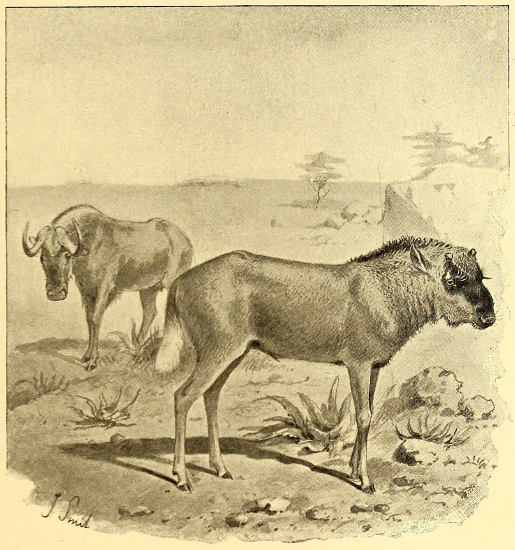
Fig. 15.
Young White-tailed Gnu (five months old).
(Zool. Soc. Gard. 1894.)
At the Knowsley auction in 1851 only a pair of the present species were put up for sale. They were purchased by a dealer for Wombwell’s Menagerie at the price of £283 10s.
The Zoological Society seems to have acquired examples of the White-tailed Gnu as early as 1830, and this animal has remained represented in the collection, except for a few short intervals, ever since. Unfortunately, however, the Society was never successful in getting a breeding pair together until about two years ago, when a fine young male and two females were purchased of Mr. C. Reiche, of Alfeld. These have thriven well in the Antelope-House, and the first young Gnu was born on the 7th of March last. It grew fast and at the present time it is nearly as large as its parents.
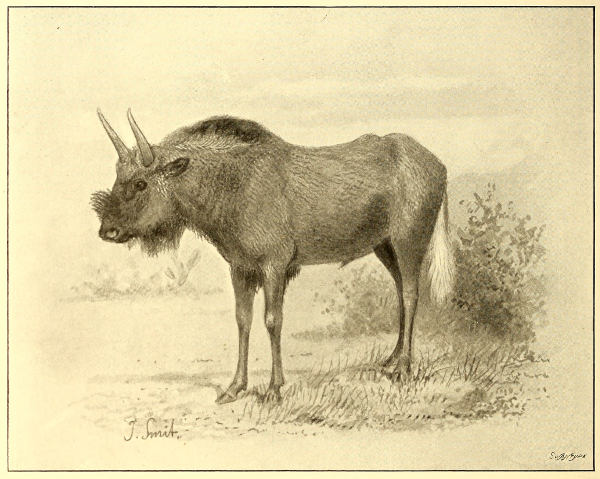
Fig. 15 a.
Young White-tailed Gnu (eight months old).
(Zool. Soc. Gard. 1894.)
The accompanying drawings by Mr. Smit (figs. 15 and 15 a) show this animal at the respective ages of five months and eight months.
The most successful results, however, in breeding the White-tailed Gnu have been obtained by Mr. F. E. Blaauw, Secretary to the Royal Zoological Society of Amsterdam, in his park at Westerveld, near Hilversum, in North Holland, on which he has been kind enough to furnish us with the following information:—Mr. Blaauw purchased his first pair of Gnus in 1886 from the Jardin d’Acclimatation at Paris. They arrived in winter and were kept in a covered shed without artificial warmth until the following spring, when they were turned out to a grass enclosure of about eight acres, well sheltered by plantations, and with a shed divided into compartments in one corner. The Gnus and their descendants have been kept in this enclosure ever since. In winter they are usually confined inside the house and fed on hay and oats, because the young ones are frequently born in winter and require a certain amount of protection. In the summer the Gnus never enter the shed, and subsist entirely by grazing.
Treated in this fashion the Gnus in Mr. Blaauw’s possession have succeeded in a wonderful way. From the single pair originally purchased and the two young females first born, no less than fourteen young Gnus have been successfully reared, and only two have been lost, having been born in the open field during severe frost.
Mr. Blaauw’s present herd consists of the original pair purchased in 1886, two adult females (the offspring of this pair born in 1886 and 1887), and two young ones born in May and June of the present year.
Mr. Blaauw has ascertained by frequent observation that the period of gestation in the White-tailed Gnu varies from 8¼ to 8½ months. Only a single young one has ever been produced at a birth. The female suckles her young for seven or eight months, but it commences to eat grass when about a week old.
In the ‘Proceedings’ of the Zoological Society of London, Mr. Blaauw has published an article on the development of the horns of the young Gnu, two of the figures of which we are enabled to reproduce here by the kind permission of that Society. The first figure (15 b) represents the first stage of the horns, in which they are perfectly straight and more or less divergent; the second figure (15 c) represents the horns when the animal is about 19 months old. The former straight portion has now become the terminal half, and the basal portion, though not yet quite fully developed, inclines downwards and outwards. The bases of the horns are still far apart, and there is a wide piece of hairy scalp between them. In the adult stage (as shown in Plate XII.) the basal ends of the horns become enormously swollen (especially in the male) and nearly meet together in the middle line. It should be further remarked that these swollen basal portions, which are smooth at first, become excessively corrugated and more highly developed when the animals get old.
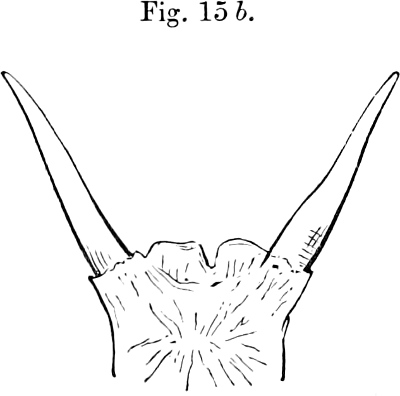
Fig. 15 b.
Horns of young Gnu (11 weeks old).
(P. Z. S. 1889, p. 2.)
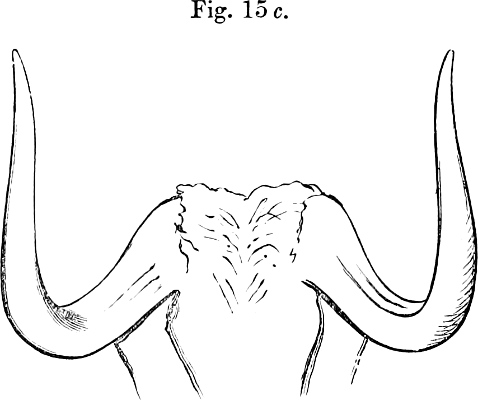
Fig. 15 c.
Horns of young Gnu (19 months old).
(P. Z. S. 1889, p. 3.)
The females of the Gnu, according to Mr. Blaauw’s observation, are very prolific. They begin to breed before they are two years old, and bear a calf regularly nearly every fifteen months. They seem to stand the damp and cold of the Dutch climate without the slightest difficulty. It would even appear that they are specially suitable to domestication, as the animals born in captivity exceed on an average the size of those freshly imported from South Africa.
The White-tailed Gnu is only represented in the National Collection at the British Museum by a single immature female, mounted, and not now in good condition, besides several skulls and horns. A good wild-killed specimen of it, were it possible to obtain such an animal, would be, therefore, very acceptable.
January, 1895.