Subfamily II. CEPHALOPHINÆ. (continued 2)
Reading edition
At about this date also there were several examples of the “Philantomba” as it is commonly called in Zoological Gardens, living in the Derby Menagerie at Knowsley. In Waterhouse Hawkins’s drawings of the animals in this splendid collection, which were subsequently edited by Gray, Maxwell’s Duiker appears to have been mentioned under three different names—first as C. maxwelli (plate xi. a), secondly as C. punctulatus (p. 11), and thirdly as C. whitfieldi (plate xi. fig. 2). So far as we can tell all these names must refer to the present species, which seems to vary considerably between youth and age.
Many living specimens of this Duiker have also been received by the Zoological Society of London, besides those mentioned by Mr. Ogilby. Although in nature shy and retiring it does well in captivity, and becomes very tame when petted. It has frequently bred in the Society’s Menagerie, and specimens are registered as having been born there in 1867, 1871, 1872, 1873, and 1874. It is also well known in several of the Zoological Gardens on the Continent. Of late years there have been many examples of this little Antelope in the Zoological Gardens at Amsterdam, and there are at present two males in that Collection.
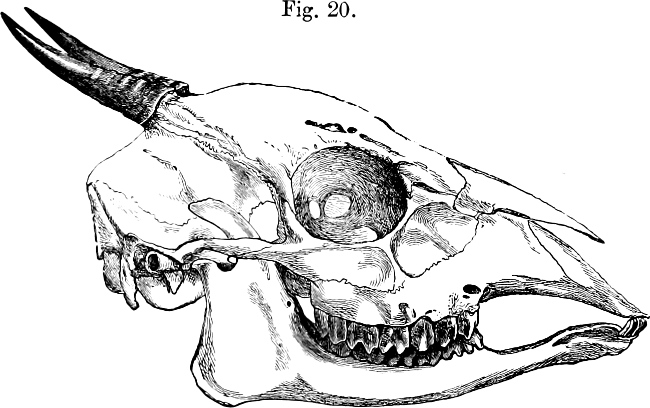
Fig. 20.
Skull of Cephalophus maxwelli.
(P. Z. S. 1871, p. 600.)
It has been stated by some authors that the female of this species is hornless, but of those in the Zoological Society’s Collection it is certain that both males and females have carried horns, though these appendages are usually rather smaller in the latter sex. As regards the specimens in the Zoological Gardens at Amsterdam, Mr. F. E. Blaauw likewise assures us that all the females have had horns, sometimes larger and sometimes smaller. We therefore regard the absence of horns in adult females of this species as an exceptional occurrence.
Maxwell’s Duiker appears to extend from Senegal and Gambia all along the West Coast of Africa to the mouths of the Niger. From Senegal, as already mentioned, it has been received in Paris, and from the Gambia living specimens were brought by Whitfield for the Derby Menagerie. From Sierra Leone there is a specimen in the British Museum presented by Colonel Sabine, R.E., which is the type of Cephalophus punctulatus. In Liberia, Mr. Büttikofer tells us, Maxwell’s Duiker is unquestionably the commonest species. It is known to the Liberians under the name of “Fulintongue,” of which no doubt “Philantomba” is a corruption. Mr. Büttikofer tells us that it lives in small troops in the bush, but is very shy and difficult for the hunter to approach, so that it is generally captured in snares. Proceeding farther westwards we find that specimens of this Antelope have been transmitted to the Leyden Museum from Dabacrom, on the Gold Coast, by Pel, and to the British Museum from Fantee by the native collector Aubinn. As we are kindly informed by Herr Matschie, there are examples of this species in the Berlin Museum collected in Togo-land by Herr Baumann.
Our figure of this Antelope (Plate XXI. fig. 2) was prepared by Mr. Smit many years ago under the directions of Sir Victor Brooke. It was probably taken from one of the specimens in the British Museum, but we have unfortunately no certain knowledge on this subject
August, 1895.
33. THE BLACK-RUMPED DUIKER. CEPHALOPHUS MELANORHEUS, Gray.
Subspecies a. C. melanorheus typicus.
Cephalophus melanorheus, Gray, Ann. Mag. N. H. (1) xviii. p. 167 (1846); id. Knowsl. Men. p. 11, pl. x. (1850); id. P. Z. S. 1850, p. 125; id. Cat. Ung. B. M. p. 88 (1852); Temm. Esq. Zool. Guin. pp. 194, 236 (1853); Fitz. SB. Wien, lix. pt. 1, p. 166 (1869); Gray, P. Z. S. 1871, p. 600; id. Cat. Rum. B. M. p. 28 (1872); id. Hand-l. Rum. B. M. p. 98 (1873); Peters, Monatsb. Ac. Berl. 1876, p. 482 (Gaboon); Matsch. Arch. f. Nat. 1891, pt. 1, pp. 353, 354; Thos. P. Z. S. 1892, p. 426; Lyd. Horns and Hoofs, p. 212 (1893).
Antilope (Cephalolophus) melanorheus, Wagn. Schr. Säug., Suppl. v. p. 428 (1855).
Cephalophus anchietæ, Bocage, P. Z. S. 1878, p. 743 (Angola).
Cephalophus maxwelli, Noack, Zool. JB., Syst. iv. p. 121 (1889) (Banana, Congo) (nec H. Sm.).
Subspecies b. C. melanorheus sundevalli.
Sylvicapra pygmæa, var., Sund. Pecora, K. Vet.-Ak. Hand-l. 1845, p. 321 (1847); id. Hornschuch’s Transl., Arch. Skand. Beitr. ii. p. 313; Reprint, p. 133 (1848).
Cephalophus pygmæus sundevalli, Fitz. SB. Wien, lix. pt. 1, p. 166 (1869) (ex Sund.).
Vernacular Name:—“Nshiri” at Dongila, Gaboon (Buchholz).
Similar in all respects to C. maxwelli, except that it is rather smaller, and that the brown colour of the back darkens to black on and at each side of the base of the tail, below which there is an abrupt change to white on the backs of the hams. Female with horns.
Horns short, but almost as long in the female as in the male, placed in the same straight line as the nasal profile, slightly incurved: those of male about 1½ inch long, their basal diameter going about 2½ times in the length; those of female about 1¼ inch long, basal diameter going about 3 times in the length.
Dimensions:—Height much as in C. monticola, length of ear 1·6 inch, hind foot 6·1.
Skull (♂): basal length (c.) 4·6 inches, greatest breadth 2·4, anterior edge of orbit to muzzle 2·5.
Hab. Africa south and east of the Niger, extending from the Cameroons to Angola and eastwards to the coast opposite Zanzibar.
To the east and south of the Niger Delta, Maxwell’s Duiker appears to be represented by the present species, which, as we have explained above, is of the same size and closely resembles it in most particulars.
The Black-rumped Duiker was first described by Gray in an article on new species of this group, published in the ‘Annals and Magazine of Natural History’ for 1846, from specimens in the British Museum, transmitted from Fernando Po by James Thompson, one of Lord Derby’s collectors. Shortly afterwards it was figured in the ‘Knowsley Menagerie ’ by Waterhouse Hawkins from living specimens brought home by the same traveller.
We will now endeavour to give some idea of the range of this still imperfectly-known species. Beginning on the north, we find skins of it in the British Museum obtained in the wooded district of Cameroons and transmitted to the British Museum by the late Captain Burton and by Crossley, besides the typical specimens received from Fernando Po, which were probably originally obtained from the adjoining mainland. Herr Matschie, in an article on the Mammals of the Cameroons, published in 1891, likewise records the occurrence of this species in the Wuté district of that country, as testified by a skull sent to Berlin by Lieut. Morgen. From Gaboon there is a skin of an adult male in the British Museum, obtained by Mr. DuChaillu, and a specimen in the Berlin Museum procured by Buchholtz. To the south of the Congo this Duiker has been obtained at Capangombé in Angola by the well-known Portuguese collector Anchieta. M. de Bocage in 1878 based a new species on these specimens and proposed to dedicate it to M. d’Anchieta, having been misled by the indifferent figure and imperfect description of C. melanorheus given in the ‘Knowsley Menagerie.’ But there appears to be no reasonable doubt that they may be properly referred to C. melanorheus.
How far the Black-rumped Duiker extends over the forests of the Congo basin is, as yet, quite uncertain. The authorities of the Congo Free State have, up to the present time, persistently neglected to obtain any accurate information of the zoology of the great region which they have occupied. The little we know of the animals of this wide area is based upon fragmentary specimens obtained by passing explorers. It is very probable, however, that C. melanorheus may range over nearly the whole of the great woody basin of the Congo and its tributaries. But when we come to the eastern slope of Africa, from various parts of which specimens referred to this species have been received, we meet, as Sundevall has pointed out, with a slightly different form, which for the present it is proposed to regard as a subspecies (following Fitzinger) as Cephalophus melanorheus sundevalli.
The fact is that, as regards these small Duikers, a far better series from the various points of their range must be rendered accessible before we can come to any accurate determination as to their systematic arrangement and distribution. Herr Matschie informs us that some specimens received in Berlin from Dar-es-Salaam, in German East Africa, rather more resemble C. monticola than C. melanorheus; so here is another riddle yet unsolved.
August, 1895.
34. THE UGANDA DUIKER. CEPHALOPHUS ÆQUATORIALIS, Matsch.
Antilope grimmia, Schweinf. Herz. v. Afrika, i. p. 267 (fig. of head), ii. p. 535 (1874).
Cephalolophus æquatorialis, Matsch. SB. Ges. nat. Freund. 1892, p. 112 (Chagwè); Scott-Elliot, P. Z. S. 1895, p. 341.
Cephalophus æquinoctialis, Lyd. Horns and Hoofs, p. 209 (1893).
Vernacular Name:—“Mtelaganya” in Uganda (O. Neumann).
Similar to C. melanorheus in almost all respects, but the under surface only little lighter than the upper, and the female, at least in all the three specimens known, entirely without horns.
Dimensions (from Matschie):—“Height at shoulder 10–12 inches, height on rump 12–13.”
Skull (♀): basal length 4·14 inches, greatest breadth 2·16, muzzle to orbit 2·34.
Horns of a male 1¼ inch long, half an inch thick at the base (Matschie).
Hab. Uganda.
The representative of the Black-rumped Duiker in Uganda has recently been separated by Herr Matschie from C. melanorheus under the name of C. æguatorialis on account of its darker belly, which is stated to be of a bright isabella-brown colour, “nearly of the tint which Mr. Ridgway, in his ‘Nomenclature of Colours’ (tab. iii. no. 21), calls écru drab, and scarcely lighter in colour than the back.” The species was based upon five specimens obtained by Stuhlmann in Chagwè, Uganda, in the month of December. Dr. Stuhlmann’s note is that this Antelope lives in the forests of Uganda, and that its skins are brought in numbers to the market at Mengo. A living example of this species, we are informed by Herr Matschie, was in 1892 in the Zoological Garden of Berlin.
On examining two skins of adult females of what we suppose to be the same Antelope, obtained by Capt. W. H. Williams in Uganda, and presented to the British Museum in April 1893, we do not find the character, assumed by Herr Matschie as distinctive of the species, to be quite constant. The bellies of the two specimens just referred to are scarcely darker than in West-African specimens of C. melanorheus. Moreover, two examples of the latter species from Cameroons, collected together, differ markedly in the coloration of their bellies. We should therefore not have been inclined to admit C. æquatorialis as a distinct species were it not for the fact that the perfect skull of one of the specimens in the British Museum shows no traces of horns. This is also stated to be the case in two female specimens in the Berlin Museum upon which Herr Matschie established the species. In C. melanorheus, as already stated, the horns are always present in both sexes. Under these circumstances it is better to keep C. æquatorialis, provisionally at least, as distinct, until further information is obtained.
Mr. Scott Elliot during his recent adventurous journey to Mount Ruwenzori obtained a single specimen (now in the British Museum) of this Duiker in Uganda, and has favoured us with the following note upon it:—
“The Cephalophus of which I brought home the skin was obtained from some natives at Kampala, Uganda, in February 1894. It was a female. I believe it was found on the highlands bordering Lake Victoria Nyanza, at an elevation of from 3900 to 4100 feet.”
August, 1895.
35. THE BLUE DUIKER. CEPHALOPHUS MONTICOLA (Thunb.). [PLATE XXI. Fig. 1.]
Capra monticola, Thunb. Resa, ii. p. 66 (1789); id. Engl. Transl. ii. p. 58 (1793).
Antilope monticola, Thunb. Mém. Ac. Pétersb. iii. p. 314 (1811); Afz. N. Act. Ups. vii. p. 220 (1815).
Antilope pygmæa, Schinz, Cuv. Thierr. i. p. 393 (1821); Burchell, List Quadr. pres. to B. M. p. 6 (1825) (Uitenhage); Licht. Darst. d. Säug. pl. xvi. fig. 1 (animal) (1828); Fischer, Syn. Mamm. p. 469 (1829); Smuts, Enum. Mamm. Cap. p. 86 (1832); Waterh. Cat. Mamm. Mus. Z. S. (2) p. 41 (1838); Laurill. Dict. Univ. d’H. N. i. p. 623 (1839); Wagn. Schr. Säug. Suppl., iv. p. 452 (1844), v. p. 429 (1855); Schinz, Syn. Mamm. ii. p. 417 (1845); Pet. Säug. Mozamb. p. 184 (1854); Gieb. Säug. p. 322 (1859).
Antilope (Cephalophus) cærula, Ham. Sm. Griff. An. K. iv. p. 268, v. p. 348 (1827); Less. H. N. Mamm. (Compl. Buff.) x. p. 294 (1836); id. N. Tabl. R. A., Mamm. p. 178 (1842); Schinz, Syn. Mamm. ii. p. 422 (1845).
Antilope (Cephalophus) perpusilla, Ham. Sm. Griff. An. K. iv. p. 269, v. p. 348 (1827); A. Sm. S. Afr. Quart. J. ii. p. 217 (1834); Less. H. N. Mamm. (Compl. Buff.) x. p. 294 (1836); id. N. Tabl. R. A., Mamm. p. 178 (1842).
Cephalophus cæruleus, A. Sm. S. Afr. Quart. J. ii. p. 216 (1834); Harr. W. Anim. S. Afr. (fol.) pl. xxvi. fig. 2 (animal) (1840); Jent. Cat. Ost. Leyd. Mus. (Mus. Pays-Bas, ix.) p. 133 (1887); id. Cat. Mamm. Leyd. Mus. (op. cit. xi.) p. 163 (1892).
Tragelaphus pygmæus, Rüpp. Verz. Senck. Mus. p. 37 (1842).
Cephalophus cæruleus, Gray, List Mamm. B. M. p. 163 (1843).
Antilope minuta, Forst. Descr. Anim. p. 383 (1844).
Sylvicapra pygmæa, Sund. Pecora, K. Vet.-Ak. Hand-l. 1844, p. 190 (1846); id. Hornschuch’s Transl., Arch. Skand. Beitr. p. 142; Reprint, p. 66 (1848).
Cephalophus monticola, Gray, Ann. & Mag. N. H. (1) xviii. p. 167 (1846); id. Knowsl.
Men. p. 11 (1850); id. P. Z. S. 1850, p. 124; Turner, P. Z. S. 1850, p. 170; Blyth, Cat. Mus. As. Soc. p. 168 (1863); Bocage, P. Z. S. 1878, p. 743 (Benguella); Thos. P. Z. S. 1892, p. 427; Nicolls & Egl. Sportsm. S. Afr. p. 29, pl. iv. fig. 11 (head) (1892); Lyd. Horns and Hoofs, p. 207 (1893); Rendall, P. Z. S. 1895, p. 361 (Transvaal).
Cephalophus pygmæus, Gray, Cat. Ung. B. M. p. 87 (1852); Scl. P. Z. S. 1861, p. 209; Gerr. Cat. Bones Mamm. B. M. p. 237 (1862); Fitz. SB. Wien, lix. pt. 1, p. 166 (1869); Gray, P. Z. S. 1871, p. 599; id. Cat. Rum. B. M. p. 28 (1872); Gray, Hand-l. Rum. B. M. p. 97 (1873); Garrod, P. Z. S. 1877, p. 4 (anatomy); Scl. List Anim. Z. S. (8) p. 146 (1883); Jent. Cat. Ost. Leyd. Mus. (Mus. Pays-Bas, ix.) p. 153 (1887); id. Cat. Mamm. Leyd. Mus. (op. cit. xi.) p. 164 (1892); Bryden, Kloof and Karroo, p. 301 (1889).
Cephalophus bicolor, Gray, P. Z. S. 1862, p. 263, pl. xxiv. (animal); id. P. Z. S. 1871, p. 600; id. Cat. Rum. B. M. p. 29 (1872); id. Hand-l. Rum. B. M. p. 98 (1873).
Cephalophus pygmæus caffer, Fitz. SB. Wien, lix. pt. 1, p. 166 (1869).
Cephalophus maxwelli, Crawshay, P. Z. S. 1890, p. 661 (Nyasaland).
Vernacular Names:—Numitji, Blaauw-bokje, and Kleine Blaauw-bok of Dutch colonists (Burchell); Petee of Natal colonists (Selous); Lumsa of Achikundas in Zambesia (Crawshay); Impiti of Zulus; Inhlingwaan of Shangaans (Rendall).
Size and characters of horns as in C. melanorheus. Colour as in C. maxwelli, except that the legs from the elbows and knees downwards are bright rufous.
Dimensions:—♀. Height at withers 13 inches, ear 1·6, hind foot 6·1.
Skull: basal length 4·3, greatest breadth 2·2, anterior edge of orbit to muzzle 2·4.
Hab. South Africa, wooded districts of the Cape Colony, extending westwards to Benguela and eastwards to Nyasaland.
The Blue Duiker, or “Blaauw-bok,” as the colonists of the Cape call it, is one of the oldest known Antelopes of South Africa, and still exists, although nowhere plentiful, in the wooded districts of the Colony. There has been much diversity of opinion as to the specific name by which this animal should be correctly called, but we believe we are right in adopting the term monticola given to it by Thunberg as long ago as 1789. Thunberg was a distinguished naturalist and traveller of the last century, and a favourite disciple of Linnæus. During his travels to the Cape, Ceylon, Java, and Japan he amassed a rich harvest of plants and animals, which were described in the narrative of his journey, and in the memoirs of various scientific societies.
Another term used by many authors for this Antelope is pygmæa. But the true Copra pygmæa of Linnæus, as has been shown by the late Sir Victor Brooke, refers to a different Antelope—the little Royal Antelope of West Africa. The remaining terms, such as cærulea, perpusilla, and minuta, which have been applied to this species, are all ante-dated by Thunberg’s term monticola.
The Blue-buck, Messrs. Nicolls and Eglington tell us, is now found only in the coast districts of the Cape Colony, and occasionally in Natal, being nowhere plentiful. It is solitary in its habits and keeps to the dense bush and forest, from which it is with difficulty dislodged. When pursued by dogs it darts across from cover to cover with surprising celerity. These authors add that this Antelope emits a nasty musky odour and that its flesh is not particularly good.
How far the Blue Duiker extends beyond the limits of the Cape Colony is, as yet, a matter of considerable uncertainty, these small Duikers, owing to their close similarity, being still in a state of much confusion. According to M. Du Bocage, as recorded in the Zoological Society’s ‘Proceedings’ for 1878, this species is found in Benguela and Loando, far up the west coast. On the east coast Peters obtained specimens near Mozambique, Quillemane, and Inambane, and in Boror, which, in his ‘Reise nach Mossambique,’ he refers to the present species. 1
North of the Zambesi in Nyasaland either the Blue Duiker or a closely allied species is found, of which Mr. Crawshay speaks as follows:—
“This little Antelope, or at any rate a species of Blue-buck very closely resembling it, appears to be common in parts of the Nyasa country, especially in the densely wooded slopes of mountains; and though I cannot claim to have come across any in life, I have yet seen a good number of their skins—notably among the Anyika of Chombi and the adjoining mountains, where they are said to be plentiful. On the thickly wooded mountainous slopes between Bandawe and Syiska they are also said to exist, and again in some of the hills about Cape Maclear; but everywhere natives speak of them as being shy and very difficult to bring to bag in the thick covert where they are generally found.”
In 1862 the late Dr. Gray described and figured in the Zoological Society’s ‘Proceedings,’ under the name of Cephalophus bicolor, what appears to be merely a piebald variety of the present species. The specimen was obtained by Mr. John Dunn in the Ungozy Forest of Zululand. It is in the British Museum. There are also in the National Collection specimens of this Antelope obtained by Burchell at Galgebosch, near Uitenhage, in the Cape Colony.
Many specimens of the “Blau-bok,"” as it is called in the Zoological Society’s Catalogues, have been captured and brought alive to this country and exhibited in the Society’s Gardens. A male was presented by Sir George Grey, then Governor of the Cape, in 1861, and another by H.R.H. the Duke of Edinburgh in 1866. Other specimens of both sexes were received in 1871, 1874, 1882, and subsequent years. In every case, as we are informed by the Head Keeper and Superintendent, the females carried horns as well as the males.
Our figure of this species (Plate XXI. fig. 1) was drawn by Mr. Smit under the superintendence of the late Sir Victor Brooke. We can find no record of from what specimen it was taken.
August, 1895.
THE BOOK OF ANTELOPES, PL. XXII.
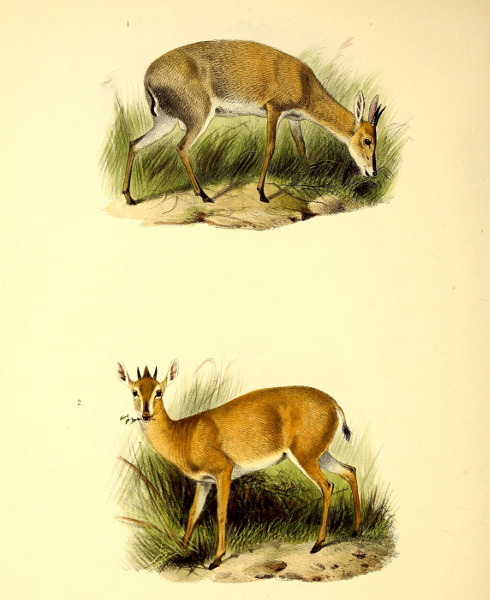
Wolf del. Smit lith.
Hanhart imp.
Fig. 1.The Abyssinian Duiker.
CEPHALOPHUS ABYSSINICUS.
Fig. 2. The Crowned Duiker.
CEPHALOPHUS CORONATUS.
Published by R. H. Porter.
36. THE CROWNED DUIKER. CEPHALOPHUS CORONATUS, Gray. [PLATE XXII. Fig. 2.]
Antilope grimmia, Pall. Misc. Zool. p. 12 (1766) (nec Capra grimmia, Linn.); id. Spic. Zool. i. p. 15 (1767), xii. p. 18 (1777); Müll. Natursyst., Suppl. p. 55 (1776); Erxl. Syst. R. A. p. 276 (1777); Zimm. Spec. Zool. geogr. p. 540 (1777); id. Geogr. Gesch. p. 111 (1780); Gatt. Brev. Zool. i. p. 80 (1780); Herm. Tab. Affin. Anim. p. 107 (1783); Bodd. Elench. An. p. 140 (1785); Gmel. Linn. S. N. i. p. 191 (1785); Schreb. Säug. pl. cclx. (animal) (1785); Kerr, Linn. An. K. p. 318 (1792); Donnd. Zool. Beytr. i. p. 641 (1792); Link, Beytr. Nat. ii. p. 99 (1795); Bechst. Uebers. vierf. Th. ii. p. 642 (1800); Shaw, Gen. Zool. ii. pt. 2, p. 324 (1801); Turt. Linn. Syst. Nat. i. p. 115 (1802); Desm. N. Dict. d’H. (1) x. p. 158 (1803), xxiv. Tabl. p. 32 (1804); G. Cuv. Dict. Sci. Nat. ii. p. 240 (1804); Ill. Prodr. Syst. Mamm. p. 106 (1811); G. Fisch. Zoogn. iii. p. 424 (1814); Afzel. N. Act. Ups. vii. p. 220 (1815); Goldf. Schr. Säug. v. p. 1230 (1818); Schinz, Cuv. Thierr. i. p. 393 (1821); Forst. Descr. Anim. p. 384 (1844).
Antilope (Gazella) grimmia, Licht. Mag. nat. Freund. Berl. vi. p. 177 (1814).
Cerophorus (Cervicapra) grimmia, Blainv. Bull. Soc. Philom. 1816, p. 75.
Cephalophus grimmia, Jard. Nat. Libr. (1) vii. p. 227, pl. xxxii. (1842).
Cephalophus coronatus, Gray, Ann. Mag. N. H. (1) x. p. 266 (1842); id. op. cit. xviii. p. 164 (1846); id. List Ost. B. M. p. 57 (1847); id. Knowsl. Men. p. 9, pl. vi. (animal) (1850); id. P. Z. S. 1850, p. 122; id. Cat. Ung. B. M. p. 82 (1852); Temm. Esq. Zool. Guin. pp. 194, 236 (1853); Gerr. Cat. Bones Mamm. B. M. p. 236 (1862); Gray, P. Z. S. 1871, p. 599, fig. 7 (skull, yg.); id. Cat. Rum. B. M. p. 28 (1872); id. Hand-l. Rum. B. M. p. 96 (1873); Thos. P. Z. S. 1892, p. 427; Lyd. Horns and Hoofs, p. 212 (1893).
Sylvicapra coronata, Sund. Pecora, K. Vet.-Ak. Hand-l. 1844, p. 191 (1846); id. Hornschuch’s Transl., Arch. Skand. Beitr. ii. p. 143; Reprint, p. 67 (1848); Fitz. SB. Wien, lix. pt. 1, p. 168 (1869).
Antilope (Cephalophus) coronatus, Wagn. Schr. Säug. Suppl. iv. p. 421 (1852).
Sylvicapra grimmia, Fitz. SB. Wien, lix. pt. 1, p. 168 (1869).
Grimmia grimmia, Jent. Cat. Ost. Leyd. Mus. (Mus. Pays-Bas, ix.) p. 138 (1887).
Size probably, in adult animals, about equal to that of C. abyssinicus; form slender. Colour uniformly light yellow all over, except a small streak on the nasal region, the tip of the tail, and the metacarpus and metatarsus, all of which are black. The yellow hairs of the body finely grizzled with black.
Horns, skull, and teeth of adult not yet known. In the type skull, that of a half-grown animal, the anteorbital fossæ are of moderate depth, and the mesial notch on the palate is nearly half an inch in advance of the lateral ones.
Dimensions of type, immature ♂:—Height at withers 16 inches, ear 3, hind foot 8·1.
Hab. West Africa.
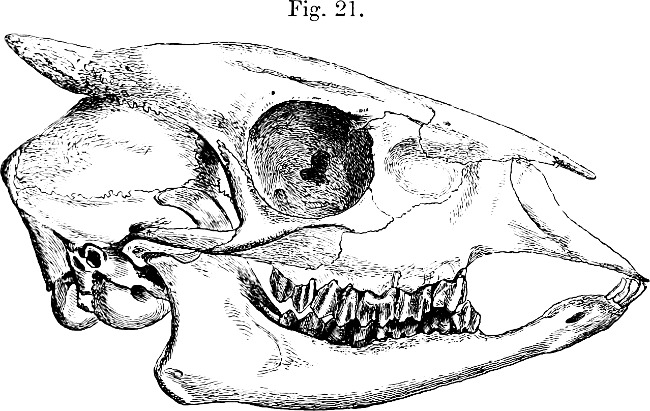
Fig. 21.
Skull of Cephalophus coronatus.
(P.Z.S. 1871, p. 599.)
The Crowned Duiker is a species established by Gray in 1842 upon specimens brought by Whitfield, Lord Derby’s collector, from the Gambia. The typical specimen in the British Museum appears to be immature, as are likewise other examples obtained in its company, and perfectly adult specimens of this obscure species are much required. Along with the skins Whitfield brought home a single adult female for the Derby Menagerie. This was figured in 1842 in two positions by Waterhouse Hawkins on the sixth plate of the ‘Gleanings.’ In the text of the ‘Knowsley Menagerie’ we are told that Whitfield’s name for it was the “Coquetoon,” but in the plate the native name of the present species is given as “Sinani,” while that of “Coquetoon” is assigned to C. rufilatus figured in its company, and this vernacular name has certainly been more generally applied to the latter species.
We suppose that the Antelope described by Pallas as Antilope grimmia from living specimens brought from the Guinea Coast may probably have belonged to this species, as may also many references of the older authors to an Antilope grimmia from Western Africa. But the true Capra grimmia of Linnæus, as we shall presently show, refers to another species.
We cannot find that any modern authority refers to fresh examples of this Antelope, and from the immaturity of the available specimens, to which we have already referred, we are quite unable to come to any definite conclusion as to its relationship. In its general appearance, however, the Crowned Duiker has a certain amount of resemblance to C. abyssinicus and C. grimmi, and we therefore place it provisionally in its present position.
The accompanying figure (Plate XXII. fig. 2), probably representing the male of this species, was drawn by Mr. Smit for the late Sir Victor Brooke, but we are unable to say from what specimen it was prepared.
August, 1895.
37. THE ABYSSINIAN DUIKER. CEPHALOPHUS ABYSSINICUS, Thos. [PLATE XXII. Fig. 1.]
Antilope madoqua, Rüpp. N. Wirb. Abyss., Säug. p. 22, pl. vii. fig. 2 (animal) (1830) (description and figure, but not references to Bruce, Lichtenstein, and others, which refer to Madoqua saltiana), nec A. madoka, H. Sm.; Schinz, Syn. Mamm. ii. p. 423 (1845); Wagn. Schr. Säug. Suppl. v. p. 422 (1855).
Tragelaphus madoqua, Rüpp. Verz. Senck. Mus. p. 37 (1842).
Sylvicapra madoqua, Sund. Pecora, K. Vet.-Ak. Hand-l. 1844, p. 190 (1846); id. Hornschuch’s Transl., Arch. Skand. Beitr. ii. p. 142; Reprint, p. 66 (1848); Fitz. SB. Wien, lix. pt. 1, p. 168 (1869).
Cephalophus madoqua, Gray, Knowsl. Men. p. 9 (1850); id. P. Z. S. 1871, p. 122; id. Cat. Ung. B. M. p. 82 (1852); Temm. Esq. Zool. Guin. p. 194 (1853); Blanf. Zool. Abyss. p. 267 (1870); Gray, P. Z. S. 1871, p. 598; Heugl. Reise N.O.-Afr. ii. p. 108 (1877); Scl. f. Cat. Mamm. Calc. Mus. ii. p. 168 (1891).
Grimmia madoqua, Gray, Cat. Rum. B. M. p. 24 (1872); id. Hand-l. Rum. B. M. p. 93 (1873); Jent. Cat. Ost. Leyd. Mus. (Mus. Pays-Bas, ix.) p. 132 (1887); id. Cat. Mamm. Leyd. Mus. (op. cit. xi.) p. 161 (1892).
Cephalophus abyssinicus, Thos. P. Z. S. 1892, p. 427; Lyd. Horns and Hoofs, p. 209 (1893).
Vernacular Names:—Madoqua of Abyssinians; Danido in Massowa (Rüppell); Orna of Geez; Midáqua of Amharas; Qalbadu and Dedanid in Tigré (Heuglin).
Size about one-third smaller than that of C. grimmi. Ears elongated, about equal to the distance between the anterior canthus and the rhinarium. Colour grizzled yellowish grey, with rufous face, brown nasal mark, and brown feet, just as in the grizzled varieties of C. grimmi, of which it is obviously the Abyssinian representative.
Horns (♂) set up at an angle above the line of the nasal profile, but not so markedly as in C. grimmi, 3 inches long, evenly tapering, their basal diameter going nearly 5 times in their length.
Skull, besides being actually smaller, shorter and broader in proportion than in C. grimmi. Distance between orbit and muzzle only just about equal to the zygomatic breadth. Anteorbital fossæ of medium depth. Mesial notch of palate about ⅓ inch in advance of the lateral ones.
Dimensions:—♂. Height at withers 18 inches, ear 3·5, hind foot 8·7.
Skull: basal length 5·2 inches, greatest breadth 2·98, anterior rim of orbit to muzzle 2·91.
Hab. Highlands of Abyssinia.
Dr. Edouard Rüppell, the renowned zoological explorer of Abyssinia and subsequently Director of the Senckenbergian Museum at Frankfort-on-the-Main, was the discoverer of this Antelope as well as of many other scarce and little-known animals of that wild country. Unfortunately, however, Rüppell fancied that his Antelope was the same as one previously met with by Bruce in Abyssinia, and named in Bruce’s ‘Travels’ “Madoqua.” This was possibly the case, but, as has been recently shown by Thomas, Hamilton Smith had already assigned the name Antilope madoka (based on the same native name) to another species—Salt’s Antelope, Madoqua saltiana. It therefore became necessary to change the name, and Thomas proposed to call the present species Cephalophus abyssinicus.
In his ‘Neue Wirbelthiere,’ after a careful description of this Antelope, Rüppell tells us that it is only found in the mountainous provinces of Abyssinia, where the vegetation consists principally of bush, and in such parts of them as rise from five to eight thousand feet above the sea-level. Rüppell met with it first at Galla on the mountain-chain west of Massowa. Afterwards he found it common on the mountains and valleys of the “Kulla,” where it is always met with in pairs and is difficult to shoot on account of its traversing the bush so quickly. Its Abyssinian native name, Rüppell tells us, is "Madoqua," which, however, as already stated, has likewise been applied to another species—Salt’s Antelope.
The only more recent traveller, so far as we know, that has met with the Abyssinian Duiker in its native wilds is Dr. W. T. Blanford, F.R.S., who accompanied, as Naturalist, the British Abyssinian Expedition from Massowa to Magdala in 1867–68 and subsequently published an excellent volume containing the results of his observations on the geology and zoology of that country. Dr. Blanford tells us that this Bush-Antelope is not rare on the highlands of Abyssinia at elevations of from 7000 to 8000 feet. He usually saw it solitary in the bushes and small clearings and obtained two bucks, one at Dildi, the other at Dongolo, of which he gives us the dimensions. These specimens (as is recorded by Mr. W. L. Sclater in his ‘Catalogue’) are now in the India Museum, Calcutta.
The British Museum contains a single adult male specimen of this species mounted (together with its skull), upon which Thomas based the name abyssinicus.
Our figure of this species (Plate XXII. fig. 1) was prepared by Mr. Smit under the directions of the late Sir Victor Brooke, but from what specimen we are unable to say.
August, 1895.
THE BOOK OF ANTELOPES, PL. XXIII.
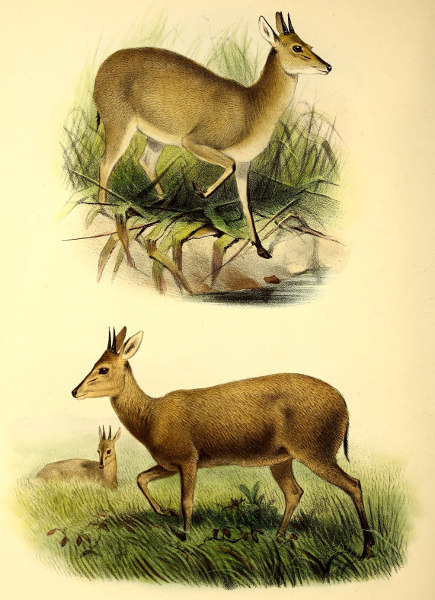
Wolf del. Smit lith.
Hanhart imp.
The Common Duiker.
CEPHALOPHUS GRIMMI.
Published by R. H. Porter.
38. THE COMMON DUIKER. CEPHALOPHUS GRIMMI (Linn.). [PLATE XXIII.]
Capra sylvestris africana, Grimm, Misc. Cur. Acad. Nat. Cur. Decas ii. Ann. iv. 1685, p. 131 (1686).
Capra grimmia, Linn. Syst. Nat. (10) i. p. 70 (1758).
Moschus grimmia, Linn. op. cit. (12) i. p. 92 (1766).
Antilope nictitans, Thunb. Mém. Ac. Pétersb. p. 312 (1811).
Cemas cana, Oken, Lehrb. Naturgesch. iii. pt. 2, p. 743 (1816).
Antilope mergens, Desm. N. Dict. d’H. N. (2) ii. p. 193 (1816); id. Mamm. ii. p. 463 (1822); Desmoul. Dict. Class. d’H. N. i. p. 446 (1822); Burch. Travels, i. p. 187 (1822); id. List Quadr. pres. to B. M. p. 6 (1825) (Zwartwater Poort); H. Sm. Griff. An. K. iv. p. 264, v. p. 346 (1827); Less. Man. Mamm. p. 378 (1827); Licht. Darst. Säug. pl. xi. (1828); Fisch. Syn. Mamm. p. 467 (1829); Smuts, Enum. Mamm. Cap. p. 84 (1832); Less. H. N. Mamm. (Compl. Buff.) x. p. 294 (1836); Waterh. Cat. Mamm. Mus. Z. S. (2) p. 41 (1838); Gerv. Dict. Sci. Nat. Suppl. i. p. 262 (1840); Less. N. Tabl. R. A., Mamm. p. 178 (1842); Wagn. Schr. Säug. Suppl. iv. p. 447 (1844), v. p. 418 (1855); Schinz, Syn. Mamm. ii. p. 446 (1845); Gieb. Säug. p. 320 (1859).
Antilope (Cephalophus) platous, H. Sm. Griff. An. K. iv. p. 260, v. p. 344 (1827).
Antilope (Cephalophus) burchelli and ptox, H. Sm. op. cit. iv. pp. 262, 265, v. pp. 345, 347 (1827); Less. H. N. Mamm. (Compl. Buff.) x. pp. 293, 294 (1836); id. N. Tabl. R. A., Mamm. p. 178 (1842).
Cephalophus platous and ptox, A. Sm. S. Afr. Quart. J. ii. pp. 214, 215 (1834).
Cephalophus burchelli, A. Sm. op. cit. p. 215 (1834); Gray, Cat. Ung. B. M. p. 81 (1852); Gerr. Cat. Bones Mamm. B. M. p. 236 (1862); Scl. P. Z. S. 1868, p. 625.
Cephalophus mergens, A. Sm. op. cit. p. 215 (1834); Harris, Wild An. S. Afr. (fol.) pl. xv. fig. 2 (animal) (1840); Gray, Ann. Mag. N. H. (1) xviii. p. 163 (1846);
id. List Ost. B. M. p. 57 (1847); Turner, P. Z. S. 1850, p. 170; Temm. Esq. Zool. Guin. p. 194 (1853); Scl. P. Z. S. 1868, p. 625; Schmidt, P. Z. S. 1880, p. 307 (length of life); Brehm, Thierl. iii. p. 253 (1880); Selous, P. Z. S. 1881, p. 763 (distribution); id. Hunter’s Wanderings S. Afr. p. 223 (1881); Scl. List Anim. Z. S. (8) p. 147 (1883); Flow. & Gars. Cat. Ost. Coll. Surg. ii. p. 270 (1884); Mairet, Bull. Soc. Acclim. p. 238 (1887); Hunter, in Willoughby’s E. Afr. p. 290 (1889) (Kilimanjaro); Noack, Zool. JB. Syst. iv. p. 114 (1889) (Banana, Congo); Scl. f. Cat. Mamm. Calc. Mus. ii. p. 167 (1891).
Antilope (Cephalophus) platyotis, Less. H. N. Mamm. (Compl. Buff.) x. p. 293 (1836).
Antilope (Grimmia) mergens, Laurill. Dict. Univ. d’H. N. i. p. 624 (1839).
Tragelaphus mergens, Rüpp. Verzeichn. Senck. Mus. p. 37 (1842).
Cephalophus mergens, burchelli, and campbelliæ, Gray, List Mamm. B. M. p. 162 (1843).
Antilope ptox and burchelli, Schinz, Syn. Mamm. ii. pp. 417, 420 (1845).
Sylvicapra mergens, Sund. Pecora, K. Vet.-Ak. Hand-l. 1844, p. 190 (1846); id. Hornschuch’s Transl., Arch. Skand. Beitr. ii. p. 142; Reprint, p. 66 (1848); Fitz. SB. Wien, lix. pt. 1, p. 167 (1869).
Cephalophus campbelliæ, Gray, Ann. Mag. N. H. (1) xviii. p. 164 (1846); id. Knowsl. Men. p. 9 (1850); id. P. Z. S. 1850, p. 121; id. Cat. Ung. B. M. p. 80 (1852); Temm. Esq. Zool. Guin. p. 194 (1853); Gerr. Cat. Bones Mamm. B. M. p. 237 (1862).
Cephalophus grimmia, Gray, Knowsl. Men. p. 8, pls. i., ii. (animal) (1850); id. Cat. Ung. B. M. p. 78 (1852); Gerr. Cat. Bones Mamm. B. M. p. 237 (1862); Blyth, Cat. Mamm. As. Soc. p. 167 (1863); Buckley, P. Z. S. 1876, p. 283, 1877, p. 453 (distribution).
Antilope altifrons and ocularis, Pet. Säug. Mozamb. pp. 184–186, pls. xxxvii., xxxviii., xxxix., xli. fig. 1, xlii. fig. 1 (animal & skull, ♂ ♀) (1852); Wagn. Schr. Säug. Suppl. v. pp. 418–420 (1855).
Cephalophus altifrons, Temm. Esq. Zool. Guin. p. 194 (1853); Fitz. SB. Wien, lix. pt. 1, p. 166 (1869).
Cephalophus ocularis, Temm. Esq. Zool. Guin. p. 194 (1853); Kirk, P. Z. S. 1864, p. 656; Crawshay, P. Z. S. 1890, p. 661; Lyd. Horns and Hoofs, p. 208 (1893).
Antilope (Cephalolophus) campbelliæ, Wagn. Schr. Säug. Supp. v. p. 419 (1855).
Sylvicapra mergens, caffra, campbelliæ, and ocularis, Fitz. SB. Wien, lix. pt. 1, pp. 167, 168 (1869).
Grimmia nictitans, irrorata, splendidula, burchelli, and campbelliæ, Gray, P. Z. S. 1871, pp. 589, 592, fig. 1 (skull); id Cat. Rum. B. M. pp. 22–24 (1872); id. Hand-1. Rum. B.M. pp.92, 93 (1873).
Cephalophus grimmius, Bocage, P. Z. S. 1878, p. 743 (Angola).
Grimmia ocularis, Jent. Cat. Ost. Leyd. Mus. (Mus. Pays-Bas, ix.) p. 132 (1887); id. Cat. Mamm. Leyd. Mus. (op. cit. xi.) p. 161 (1892).
Grimmia mergens, Jent. Cat. Ost. Leyd. Mus. (Mus. Pays-Bas, ix.) p. 132 (1887); id. Cat. Mamm. Leyd. Mus. (op. cit. xi.) p. 161 (1892); id. N. L. M. xv. p. 265 (1893) (Cunene R.).
Cephalophus grimmii, Thos. P. Z. S. 1892, p. 428; Ward, Horn Meas. p. 76 (1892); Nicolls & Egl. Sportsm. S. Afr. p. 27, pl. vii. fig. 26 (head) (1892); Lyd. Horns & Hoofs, p. 207 (1893); Thos. P. Z. S. 1893, p. 504 (Nyasa); Jackson in Badm. Big Game Shooting, i. pp. 285, 308 (1894) (E. Africa).
Cephalophus grimmia flavescens, Lorenz, Ann. Mus. Wien, ix. p. 60, 1895 (Victoria Falls of Zambezi).
Vernacular Names:—Duiker and Duiker-bok of Dutch and English colonists (Thunberg, Burchell, &c.); Puti of Bechuanas; Impunzi or Impuzi of Matabili [also of Zulus and Swazis (Rendall)]; Pembgee of Makalakas; Unsa of Masubias and Makubas; Insea of Batongas; Goowah of Masaras (Selous); Nyassa in Sena (Peters); Insa of Anyanja; Gwapi of Ajawa; Nyiska of Atonga; Yisya of Ahenga (Crawshay); Ngruvu of E. African Swahilis (Jackson).
Size medium; form much more delicate and slender than in any of the species hitherto considered. Ears long, longer than the distance from the anterior canthus to the tip of the nose, their tip narrow and pointed. General colour of body pale greyish brown, sometimes with a yellowish tinge, but very variable in tone; more or less grizzled, owing to the hairs being annulated with yellowish and brown. Face rufous or yellowish, with a deep brown longitudinal patch on the nasal region, rarely extending upwards to the bases of the horns. Throat and belly like back. Chin, inner sides of fore arms and of thighs, and underside of tail whitish or pure white. Front of fore legs with a brownish line running down them to the hoofs. Metapodials brown. Tail black above and white below, but the base above is commonly coloured like the back.
Horns normally present only in male. These (see fig. 22, p. 207) are set up at a considerable angle to the line of the nasal profile, slender, tapering, attaining to about 5 inches in length, their bases roughened but not markedly thickened, their greatest basal diameter going about 6 or 7 times in their length.
Skull long and narrow. Anteorbital fossæ of medium depth, their border above generally rounded, not sharply ridged. Muzzle long, the distance from the anterior edge of the orbit to the gnathion much exceeding the greatest zygomatic breadth. Mesial notch of palate extending some way in front of the lateral ones.
Dimensions:—♂. Height at withers 23 inches, ear 4·3, hind foot 10·3.
Skull: basal length 7·2 inches, greatest breadth 3·3, anterior rim of orbit to muzzle 4·4.
Hab. South Africa, extending on the west northwards to Angola and on the east up to British East Africa and Somaliland.
The little Antelope called at the Cape the “Duiker” or “Diver,” not from its going into the water, but from its “diving” so quickly into the bushes when alarmed, has been more or less perfectly known to the naturalists of Europe for the past 200 years. Described by Grimm in 1686 as the Capra sylvestris africana it was dedicated to that naturalist by Linnæus, when he adopted the binomial system, as the Capra or Moschus grimmia. This term, slightly modified in accordance with modern usage, we propose to adopt as its specific name. Other early names bestowed upon it were Antilope nictitans by Thunberg, of whose travels to the Cape we have already spoken, and Antilope mergens by Blainville, while various appellations, which are specified in our synonymy, were given to this species and its varieties by Andrew Smith, Hamilton Smith, Gray, and Fitzinger.
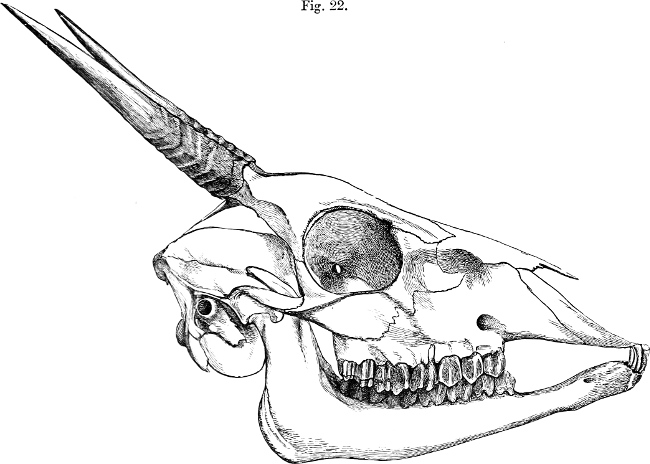
Fig. 22.
Skull of Cephalophus grimmi.
(P.Z.S. 1871, p. 591.)
In his important work on the ‘Game and Wild Animals of Southern Africa,’ as they existed in 1836 and 1837, Cornwallis Harris figures the “Duiker” as a companion of the Pallah and speaks of it as common throughout the Cape Colony, especially towards the sea-coast, among the bushes and brush-wood. This experienced observer states that every female specimen of the Duiker that he had seen possessed short horns, nearly, if not totally obscured by the tuft on the head; this, we shall see, is contrary to the observations of some other writers. From the text of Harris’s volume we extract his lively account of the Duiker and its habits:—“The smaller Antelope, delineated in the annexed plate, is a denizen of the same locale as the Pallah; and although claiming from its diminutive stature an extremely limited portion of attention, was yet never neglected when accident placed it in our way. The pair which furnished the originals of this portrait were on my own shoulders borne three miles to the waggons from one of the central steppes of the Cashan mountains, whither, having gone out alone, I killed the buck as he sat on a projecting ledge—knocking over his disconsolate relict with the second barrel as she stood gazing in mute amazement at her mate’s death-struggles. The pasterns of this robust and sturdy little animal, which are singularly rigid, have the appearance of being encased in Blucher’s, or ancle boots; two other of its most remarkable features being the long suborbital slit that traverses the whole length of its Roman features, and the pencilled toupet of bright fulvous hair arising from the forehead, neither of which occur in any other Antelopes. Writers have noticed three distinct species of the Duiker, but the peculiarities in the horns that have led to this division are so trivial that I should rather feel disposed to place them to the score of age, disease, or accident, few specimens being exactly alike. The animal is extremely common in many parts of the Cape Colony, and on the outskirts of the deep forests which border the sea-coast especially. Here on my return from the interior, I killed several—and found it even more abundant than beyond the boundary. Occurring either singly or in pairs, the little dwarf is usually found crouching amid the shelter of bushy localities, and the dexterity with which it seeks to foil its pursuers among the intricacies of these, has gained for it the Dutch soubriquet in which it rejoices. Aroused from its snug form, the ‘Artful Dodger’ clears with one vigorous and elastic bound the nearest bush, and diving low on the other side among the heather and brushwood, continues alternately leaping and plunging whilst it flies straight as a dart to the nearest thicket—before seeking an asylum in which, and not unfrequently also during its retreat, it rises like the hare upon its hinder legs, and having thus reconnoitred the foe above the intervening vegetation, wheels with an impatient sneeze to the right about, and proceeds ducking and bounding as before.
“The approved Colonial mode of hunting the Duiker-bok is with dogs—and whilst thus topping the covert, or darting from one copse to another, the little wretch, despite of all its dodging and artifice, is easily slain with a hatful of buckshot discharged from a piece of ordnance of such calibre, that four fingers might be introduced without much squeezing! Like the rest of the Cape venison, the flesh is utterly destitute of fat, a deficiency which the thrifty Dutch housewife seeks to remedy with her usual skill by calling in the aid of a sheep’s tail. The animal is often to be seen running tame about the farm-houses, but it never ceases, even in a domestic state, to take the note of alarm from the least sound to which it has been unaccustomed—thunder invariably causing it to fly to the nearest shelter in order to hide itself away.”
As regards the Duiker in the Cape Colony at the present time, we are assured by Messrs. Nicolls and Eglington that it is still, next to the Steinbuck, the most common and widely distributed of the smaller Antelopes, being found sometimes in pairs, but more frequently singly in every suitable locality from Table Bay to the Zambezi. As a rule, these observers tell us, the Duikers of Cape Colony and Griqualand West are smaller and lighter in colour than those found further north. In certain portions of the Kalihari Desert they are very common, and attain their largest size, some specimens obtained by these gentlemen having measured 28 inches at the shoulder.
The Common Duiker no doubt extends far up the west coast of Africa. Although not mentioned by Andersson or Bains as occurring in Damaraland, it has been recorded by M. Du Bocage as having been obtained by Anchieta in Angola, and there are specimens in the British Museum from the same country transmitted by Gabriel, upon which Gray established his species Grimmia splendidula. But along the eastern side of Africa the range of this little Antelope, or of slightly representative forms, which at present we are quite unable to distinguish, is much more extensive. The Duiker is found throughout the Transvaal, and the great hunter Mr. F. C. Selous informs us that during his extensive journeyings north and south of the Zambezi, except in districts devoid of bush or covered by steep rocky hills, he has always met with this Antelope. According to this experienced observer, individuals, though shot in the same district, vary much in colour, some skins being of a greenish tinge and others of a reddish brown, while specimens from the borders of the Kalihari have less white upon the belly than others. Contrary to Cornwallis Harris and other testimony, Mr. Selous states that the females are almost always hornless, though he had met with three examples of this sex bearing horns. On the Zambezi and elsewhere in Mozambique Peters met with specimens of this Antelope, which he described and figured in his ‘Reise’ as new species under the names Antilope altifrons and A. ocularis. These names are now generally regarded as synonymous with Cephalophus grimmi. A third name, without any mention of the other two, has recently been added from the same region by Dr. Lorenz, and this we are equally unable to recognize as valid.
Throughout Nyasaland, as we are assured by Mr. R. Crawshay (P.Z.S. 1890, p. 661) the Duiker is very generally met with, except on the bare open plains or in very steep rocky country. Like Mr. Selous, Mr. Crawshay notices the variation in colour of this Antelope, which ranges from a reddish brown, not unfrequently tinged with green, to almost a dark red, while in some specimens the belly is more conspicuous for whiteness than in others.
North of Nyasaland the Duiker appears to extend across German East Africa into British East Africa, where it is well known to the sportsmen of the Kilimanjaro district. Mr. F. J. Jackson, in ‘Big Game Shooting,’ tells us that it is found throughout British East Africa, and extends as far west as Kavirondo. Herr Oscar Neumann informs us that he has obtained it in Uganda. At Taveta it frequents the low stony hills covered with long grass and short scrub. On the coast it is found in open bush country and also in low scrub and grass. A skin in the British Museum is stated to have been obtained as high up as 10,000 feet on Kilimanjaro. Until recently we have believed the northern range of the Duiker not to extend beyond British East Africa; but quite lately Mr. F. Gillett, who accompanied Dr. Donaldson Smith during the first part of his adventurous expedition through Somali-land towards Lake Rudolph, has met with the Duiker on the confines of Galla-land. Mr. Gillett has favoured us with the following notes on this species:—
“I killed three specimens of this Antelope on November 1st and 2nd, 1894; they consisted of a full-grown male and female and a young female. I only came across this species in a small area of country about 20 miles long by 10 wide, at an elevation of about 7000 feet. I found them living singly. The country consisted of long grass with clumps of bushes with plenty of water. It was not timid of man’s presence, because my men saw it quite close to the Abyssinian encampment, where during the day there were always crowds of people moving about; besides which the country must have been densely populated not many years ago, signs of extensive cultivation being visible. But it hides away in the bushes, and when disturbed does not usually wait to make your acquaintance. The Galla name for it is ‘Kompee.’ The horns of the male lay back on the skull and measured 4 in. in length by 2⅛ in circumference. The tips of the feet were black for about 2 inches. The old female had a fœtus in her. The young female measured 26 in. from anus to tip of nose and 17 in. the height at shoulder. A great number of them were seen in this place by Dr. Smith and Mr. Dodson, though the three I shot were the only ones I came across. One of my camelmen recognized it at once, saying he had often seen it in the Barterri country west of the Gadabursi country, where it is numerous and called Kodobo. It has not been killed there, to his knowledge, by any European. Harar, he said, was three days from the Barterri country; but he has never heard of it there or anywhere but in his own country, which he says is exactly similar to where I found these. I killed them at a place called Sheik Mahomet in the Galla country: long. about 40° 28′ 0″, lat. about 7° 15′ 0″.”
The Common Duiker is not unfrequently brought alive to this country, and examples may be seen in most of the European Zoological Gardens. On reference to our Zoological Society’s catalogue it will be found that examples of the Duiker-bok were received in 1867, 1872, and 1876. Since that period the register of the Society shows that as many as eleven examples have been received up to the end of last year. These have been of both sexes, and, according to the testimony of the keepers, most of, if not all, the females have carried short horns. But the Duiker-bok does not thrive in captivity in this country, and most of the specimens acquired have been short-lived.
Our two illustrations of the Common Duiker (Plate XXIII.) were prepared by Mr. Smit under the direction of the late Sir Victor Brooke. The lower figure represents the more uniformly-coloured and typical form; the upper shows the variety which has been called ocularis and is known by its more rufous head, whitish eye-stripe, and much paler inferior surface.
August, 1895.
Genus II. TETRACEROS.
Type.
Tetraceros, Hardwicke, Trans. Linn. Soc. xiv. p. 524 (1825) T. quadricornis.
Size small; build slender; anteorbital glands large, oval, opening into a short deep slit on each side of the muzzle; crown not tufted; tail short; mammæ four.
Skull with large lacrymal fossæ; upper molar teeth without additional columns.
Horns normally four, the posterior, which correspond to the ordinary pair found in Cephalophus, placed as in that genus and similar in character, but directed more vertically upwards; anterior pair placed on the front part of the frontals, level with the front of the orbit, much shorter than the posterior pair, and often entirely absent. Female hornless.
Distribution. Peninsula of India.
This genus, the Indian representative of Cephalophus, contains only the Four-horned Antelope and its two-horned subspecies. The latter we follow Mr. Blanford, the latest and best authority on the subject, in considering as not specifically separable; but we have some hesitation in doing so, and have treated it as at any rate deserving the position of a recognizable subspecies.
THE BOOK OF ANTELOPES, PL. XXIV.
Wolf del. Smit lith.
Hanhart imp.
The Four-horned Antelope.
TETRACEROS QUADRICORNIS.
Published by R. H. Porter.
39. THE FOUR-HORNED ANTELOPE. TETRACEROS QUADRICORNIS (Blainv.). [PLATE XXIV.]
Subspecies T. q. typicus.
Cerophorus (Cervicapra) quadricornis, Blainv. Bull. Soc. Philom. 1816, pp. 75, 78; id. Journ. Phys., Aug. 1818, pl. fig. 3 (skull); id. Oken’s Isis, 1819, p. 1095, pl. fig. 3 (skull).
Antilope quadricornis, Desm. N. Dict. d’H. N. (2) ii. p. 193 (1816); Schinz, Cuv. Thierr. i. p. 395 (1821); Desm. Mamm. ii. p. 466 (1822); Goldf. Schreb. Säug. v. p. 1243 (1824); Less. Man. Mamm. p. 281 (1827); Fisch. Syn. Mamm. p. 471 (1829); Waterh. Cat. Mamm. Mus. Z. S. (2) p. 42 (1838).
Antilope (Tetraceros) quadricornis, H. Sm. Griff. An. K. iv. p. 256, v. p. 845 (1827); Less. H. N. Mamm. (Compl. Buff.) x. p. 292 (1836); Gerv. Dict. Sci. Nat. Suppl. i. p. 262 (1840); Less. N. Tabl. R. A., Mamm. p. 178 (1842); Wagn. Schr. Säug. Suppl. iv. p. 439 (1844), v. p. 410 (1855); Gieb. Säug. p. 323 (1859).
Antilope (Grimmia) quadricornis, Laurill. Dict. Univ. d’H. N. i. p. 624 (1839).
Tetraceros quadricornis, Gray, List Mamm. B. M. p. 159 (1843); id. Cat. Hodgson Coll. (1) p. 26 (1846); Sund. Pecora, K. Vet.-Ak. Hand-l. 1844, p. 189 (1846); id. Hornschuch’s Transl., Arch. Skand. Beitr. ii. p. 141; Reprint, p. 65 (1848); Gray, List Ost. B. M. p. 57 (1847); id. Knowsl. Men. p. 6 (1850); Blyth, J. A. S. B. xvi. pt. 2, p. 879 (1847), et xvii. pt. 1, p. 561 (1848); id. Cat. Mamm. Mus. Asiat. Soc. p. 165 (1863); Gray, P. Z. S. 1850, p. 117; Turner, P. Z. S. 1850, p. 170; Horsf. Cat. Mamm. Ind. Mus. p. 167 (1851); Gray, Cat. Ung. B. M. p. 68, pl. ix. fig. 1 (skull) (1852); Adams, P. Z. S. 1858, p. 522 (Dehra Doon); Gerrard, Cat. Bones Mamm. B. M. p. 234 (1862); Gray, Cat. Hodgs. Coll. (2) p. 13 (1863); Jerd. Mamm. Ind. p. 274 (1867); Blanf. J. A. S. B. xxxvi. p. 196 (1868); Fitz. SB. Wien, lix. pt. 1, p. 169 (1869); McMaster, Notes on Jerdon’s Mamm. of
India, p. 126 (1870); Gray, Cat. Rum. B. M. p. 18 (1872); id. Hand-l. Rum. B. M. p. 89 (1873); Kinloch, Large Game Shooting, ser. 2, p. 54 (with plate) (1876); Brehm, Thierl. iii. p. 252, figure (animal) (1880); Scl. List An. Z. S. (8) p. 148 (1883); Weldon, P. Z. S. 1884, p. 2 (placentation); Murray, Zool. Sind, p. 55 (1884); Flow. & Gars. Cat. Ost. Coll. Surg. ii. p. 270 (1884); Jent. Cat. Ost. Leyd. Mus. (Mus. Pays-Bas, ix.) p. 130 (1887); Flow. & Lyd. Mamm. p. 338 (1891); Blanf. Mamm. Brit. Ind. p. 519 (1891); Scl. f. Cat. Mamm. Calc. Mus. ii. p. 168 (1891); Jent. Cat. Mamm. Leyd. Mus. (Mus. Pays-Bas, xi.) p. 159 (1892); Ward, Horn Meas. p. 78 (1892); Lyd. Horns and Hoofs, p. 149 (1893).
Tchicara, F. Cuv. H. N. Mamm. fol. iii. livr. xliv. (animal, ♂) (1824).
Antilope chickara, Hardw. Trans. Linn. Soc. xiv. p. 520, pls. xv. (♂), xvi. (♀) (1825); Hills, op. cit. xv. p. 501, pl. xix. (♂) (1827); Less. Man. Mamm. p. 381 (1827); Fisch. Syn. Mamm. p. 471 (1829); Hodgs. J. A. S. B. i. p. 346 (1832); id. P. Z. S. 1834, p. 99; Kaup, Thierr. i. p. 179 (1835); Less. H. N. Mamm. (Compl. Buff.) x. p. 292 (1836); Schinz, Syn. Mamm. ii. p. 424 (1845).
Tetracerus chickara, Hodgs. J. A. S. B. x. pt. 2, p. 913 (1841).
Tetraceros chickara, Jard. Nat. Libr. (1) vii. p. 224 (1842); Blyth, J. A. S. B. xi. p. 451.
“Tetraceros striaticornis, Leach,” Brookes, Cat. Mus. p. 64 (1828); Gray, Cat. Ung. B. M. p. 68 (1852), et auct. al.
Biche des Mariannes, Cervus latipes, F. Cuv. H. N. Mamm. fol. iv. livr. lxv. (animal, ♀) (1832); apud Sund. Pecora, K. Vet.-Ak. Hand-l. 1844, p. 189 (1846).
Cervus (Styloceros) latipes, Less. N. Tabl. R. A., Mamm. p. 174 (1842).
Antilope tetracornis, Hodgs. J. A. S. B. iv. p. 525 (1835), v. p. 242 (1836).
Tetraceros chickara, quadricornis, iodes, and paccerois, Hodgs. Calc. Journ. N. H. viii. pp. 89, 90, pl. iv. (animals & skulls) (1847).
Subspecies T. q. subquadricornutus.
Antilope sub-4-cornutus, Elliot, Madr. Journ. x. p. 225, pl. iv. fig. 2 (head) (1839) (Dharwar, S. Bombay).
Tetraceros subquadricornutus, Hodgs. Calc. Journ. N. H. viii. p. 89 (1847); Gray, Knowsl. Men. p. 7 (1850); id. P. Z. S. 1850, p. 117; id. Cat. Ung. B. M. p. 70 (1852); Gerr. Cat. Bones Mamm. B. M. p. 235 (1862); Fitz. SB. Wien, lix. pt. 1, p. 170 (1869); Gray, Cat. Rum. B. M. p. 19 (1872); id. Hand-1. Rum. B. M. p. 89 (1873); Scl. P. Z. S. 1875, p. 527; Garrod, P. Z. S. 1877, p. 4 (anatomy); Scl. List An. Z. S. (8) p. 148 (1883).
Tetraceros subquadricornis, Gray, List Mamm. B. M. p. 159 (1843); Turner, P. Z. S. 1850, p. 170.
Vernacular Names:—Chousingha, Chouka, or Doda, Hindi; Benkra or Bekra, Mahratti; Bhokra, Phokra, Guzerati; Bhirki at Saugor; Bhir, Gond; Bhirul, Bheel; Kotari in Chutia Nagpur; Kurus, Gonds of Bastar; Konda-gori, Telugu; Kond-guri, Kaulla-kuri, Canarese; Jangli Bakri in the Deccan (Blanford). The Southern Indian names may be taken as referring to subsp. subquadricornutus.
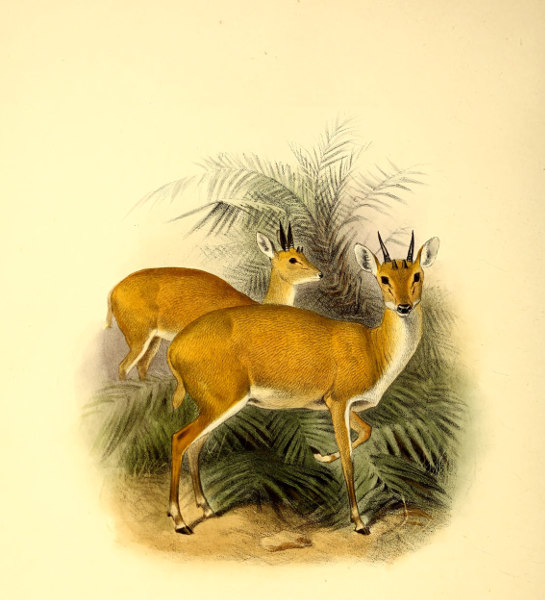
Height at withers about 25 inches. General colour dull rufous brown, whitish below, the line of demarcation on both sides not sharply defined. Muzzle, outer side of ears, and a line down the front of the limbs blackish brown. Outer sides of fetlocks whitish.
Skull and horns as described above (p. 213). Dimensions of an adult male skull: basal length 6·5 inches, greatest breadth 3·2, muzzle to orbit 3·65.
Horns straight, or the posterior pair slightly curving forwards; the latter are from two to three times the length of the anterior pair. Mr. Blanford states that the anterior are usually from 1 to 1½ inch long, while the posterior are from 3 to 4 inches; while the best head recorded by Mr. R. Ward, from the collection of Sir E. Loder, has a front horn of 2½, a back one 4⅜ inches.
The subspecies T. q. subquadricornutus is similar in all respects to the typical form, with the exception that the anterior horns are either entirely absent, or are represented merely by small horny knobs, which often fall off and leave a black callous patch.
Hab. Peninsula of India, south of the Himalayas (in suitable localities).
The Four-horned Antelope, the single representative of the genus Tetraceros, is the only member of this subfamily of Antelopes found in Asia, and in its present distribution is confined to India south of the Himalayas. This species was first named by the French zoologist De Blainville, in course of a memoir read before the Société Philomathique of Paris in 1816. It was based upon a skull which he appears to have seen in London in the Museum of the Royal College of Surgeons. For several years little more was known of this animal, but in 1824 it was figured by Geoffroy St.-Hilaire and F. Cuvier in their ‘Histoire Naturelle des Mammifères,’ from a drawing (accompanied by notes) forwarded to them by Duvaucel, a well-known French naturalist who was then in India. In the meantime Major-General Thomas Hardwicke, a name well known in Indian zoology, who had become well acquainted with the animal during his residence in India, had described it in a memoir read before the Linnean Society in 1823. Owing to the delay in the publication of Hardwicke’s paper, which was printed in the fourteenth volume of the Linnaean Society’s ‘Transactions,’ the description and figure of this animal in the ‘Histoire Naturelle des Mammifères’ appeared first, as is stated by Hardwicke in an addendum to his memoir. Hardwicke declared that Duvaucel’s figure and notes had been taken from a drawing which that naturalist saw in Hardwicke’s possession when he visited the Major-General at Dum-dum in 1822. Hardwicke states that on that occasion Duvaucel also saw specimens of both sexes of this animal, which were then alive in his possession, and suggests that Duvaucel’s imperfect notes were also drawn up on this occasion. As this seems a very probable explanation of what took place, I think that we must allow that our countryman Hardwicke was the first to recognize this species, although it is unfortunate that he gave it the name of Antilope chickara, as that vernacular name is, throughout all India, applied to the Indian Gazelle.
In 1839 Sir Walter (then Mr.) Elliot, in his Catalogue of the Mammals of the Southern Mahratta country, published in the ‘Madras Journal’ for that year, proposed, rather hesitatingly, to separate the form of this Antelope which occurs in that district under the name subquadricornutus, from the fact that the anterior pair of horns are in some cases not developed at all, and in other cases only occur as small projections on the skull. But Blyth, one of our leading authorities upon Indian mammals, after discussing this question, came to the conclusion that the specimens forwarded to Calcutta by Mr. Elliot did not differ specifically from the common Bengal form, the fact being that in this Antelope the development of the front horns is very variable, and that in many cases these organs appear to be reduced to mere tubercles, or to be altogether absent. Blyth allowed that this reduction of the front horns is more general in specimens from the southern districts of India, although individuals with fully developed front horns are likewise occasionally found in that part of its range. Blyth also subsequently stated that he had seen horns of both the supposed species which had been obtained in the same district near Midnapore (see J. A. S. B. xvi. pt. 2, p. 879).
A figure of the head of the Four-horned Antelope is given by General Kinloch in his useful work on ‘Large Game Shooting in Thibet and the North-West.’ His account of this species is as follows:—“Four-horned Antelopes are generally found alone, or frequently in pairs; they conceal themselves in long grass or among low bushes, and somewhat resemble hares in their habits. They are seldom to be seen out feeding, but usually jump up at the feet of the hunter and bound away at a great pace. I have observed that they generally make their appearance when least expected, and I do not recollect ever meeting with one among the Sewaliks when I have been actually hunting for them.”
In 1847 Hodgson, the well-known naturalist of Nepal, in a paper published in the ‘Calcutta Journal of Natural History,’ went even further than Sir Walter Elliot and proposed to make five species of this Antelope. These species appear to have been founded upon individual variations only and have not met with acceptance in any quarter.
Referring to Mr. W. L. Sclater’s ‘Catalogue of the Specimens of Mammals in the Indian Museum, Calcutta’ (part ii., 1891), we find a good series of specimens of the Four-horned Antelope registered as being preserved in that Institution. But only one species is recognized from all parts of India, and the specimens are all entered under Tetraceros quadricornis.
In his excellent ‘Manual of the Mammals of British India’ Dr. W. T. Blanford describes the range of this Antelope as follows:—“The Four-horned Antelope is found all along the base of the Himalayas from the Punjab to Nepal. It also occurs in most parts of the Peninsula where the country is wooded and hilly, but not in dense jungle, but is not found in the Gangetic plain nor on the Malabar coast in the Madras Presidency. It is said by Mr. Murray to be met with in Sind. It is common in the wooded parts of Rajputana, throughout the Bombay Presidency, the Central Provinces, and the northern parts of Madras; it is less abundant to the eastward in Chhattisgarh, Chutia Nagpur, Bengal, and Orissa, and to the southward in Mysore, but it occurs in the latter State occasionally, and has been observed on the Nilgiri and Palni hills. It is unknown in Ceylon and east of the Bay of Bengal.”
The experienced sportsman Mr. J. D. Inverarity of Bombay writes of this species as follows:—“This is a forest-antelope, living entirely in the jungle. It is not gregarious, but is met with either alone or in pairs. The female brings forth one or two young, and occasionally the two old and two young ones may be seen together. Though not forming a special object of pursuit, a shot at the ‘Baikrie,’ as it is generally called on the Bombay side of India, is often got when out stalking other game. If you see one before it sees you it is fairly easy to stalk it; but it more often happens that they see you first, when they will not admit of approach. On three or four occasions they have stood stupidly looking at me as I walked in full view slowly towards them, and have allowed me to get within 20 yards before bolting. This only occurs when one does not want to shoot them. Forsyth says that the females are more numerous than the bucks, and bear the same proportion to each other as the does and bucks of the black buck. At one time I thought the same myself, but further experience has made me sure that this is not the fact, and that bucks are nearly, if not quite, as numerous as does. The female is hornless. The male has four horns; the posterior and larger pair in a good specimen will be four inches long or a little more. One-and-a-half inches is a good length for the anterior horns and is not often exceeded. In some heads the anterior horns are absent, though the bony knobs are covered with a callous black skin.”
The Four-horned Antelope is not unfrequently brought alive to Europe, but cannot be said to accommodate itself very readily to our northern climate. In 1868 a single specimen was received by the Zoological Society of London as a present from the Babu Rajendra Mullick, of Calcutta. In 1881 a pair of the typical form were acquired by purchase, and bred in the Regent’s Park in the following spring. A female calf was born on February 28th, 1882.
In 1875 three examples of the subspecies (or variety) without the anterior horns were obtained by purchase. Several examples of this same form have been received of late years, but have not thriven in the Society’s Gardens. At the present time there is only a single female left in the Collection.
Our figure of this Antelope (Plate XXIV.) was lithographed by Smit from a sketch of Mr. Wolf’s. It represents an adult male of the typical subspecies in two positions.
August, 1895.