Chapter XXVI · Practical Experiences of Alfalfa Growers in the United States of America (continued 2)
Reading edition
NEW MEXICO
Thomas J. Clark, Grant county.—I have had 15 years’ experience with alfalfa on first and second bottom land with gravel soil, dry to within four feet of water, which is reached at a depth of 15 feet. I irrigate from the Gila river, and my alfalfa, which is 14 years old, is as good to-day as at any time since it was sown. The seed is sown as turnip seed is. I plow the land thoroughly, harrow it over smoothly, then sow the seed in March, and harrow lightly once. Then the water is turned on, and the ground will remain moist until the seeds sprout. After the alfalfa is six inches high, I cut it to make it spread and destroy all the large weeds; and there may be two cuttings of hay that same season. Water will not injure the plant unless it stands on it in low places. Stagnant water standing on the plant, or mineral water so near the surface that the roots reach it, will kill the plant, but it is not liable to injury from winter frost. After the first season there are three or four crops, the first being usually chosen for seed and not irrigated. For hay it is cut when in full bloom, and, if the sun is shining, should cure 24 hours if in June, or 20 in July or August, before raking, and then 30 hours in the cock. It must be thoroughly cured before stacking, and then will not mold. The most convenient bales weigh 90 to 100 pounds, and the cost of preparing them is $2 a ton. The total cost of hay in the stack is about $3 a ton, and the average yield about three tons to the acre each year. When the burs turn brown the seed is harvested, and when well cured should be stacked in a dry place. An average yield is 500 to 600 pounds to the acre, and it sells for $4 a bushel. The hay makes excellent feed for farm animals, keeping them in good condition the year around without grain. The alfalfa pasturage is better for swine and cattle than clover, and yields more largely; sheep may be kept on it to advantage also. A good acre will keep five grown hogs in excellent condition, but will not make them fat. If they are taken up in October and fed about 40 days on grain, they will be marketable. Cattle on the pasture sometimes bloat, but I have had 100 head of cows and calves on mine for two months, and have had no trouble. The irrigated alfalfa is better than that grown on land that requires no water. The straw is about equal to oat straw, but not half so good as the alfalfa hay. To rid land of the plant requires a strong team and a sharp 10-inch plow. The roots rot at once after plowing, and the land is well fertilized for other crops. In my opinion, alfalfa is the best forage plant known in this western country. It is most easily raised, produces the largest yield, commands the best price, and can be planted at any time from March to September. Land seeded to it is the most valuable, and the farmer who has plenty of it is the most prosperous. Farming here cannot be a success without it, and I take pleasure in recommending it to my brother farmers. It will lie dormant all summer if it is dry, and with fall rains revive and make good pasture. It is the earliest plant up in the spring, and the last to stay green in the fall. In other words, it is the best of all.
Hartman & Weil, San Miguel county.—We have been dealers in alfalfa hay for eight years, and have some small fields of our own. This is on both bottom and upland. In the bottom, the subsoil is sand and bowlders; on the upland, stiff bluish clay, and in some places blue limestone. Well water is reached on the bottom land at a depth of 8 to 10 feet, through soil moist all the way; on the upland, it is necessary to dig 60 to 100 feet, and, beginning two or four feet from the surface, the ground is dry. When seed is planted in the spring, the soil should be well pulverized, moist, and warm, that the seed may germinate quickly. It should not be put in deeper than 11⁄2 inches, and may be planted in May or June, or any time in the spring after the soil becomes warm. In our climate, it is best to sow about 30 pounds of good seed to the acre, besides just enough oats to shade the ground and protect the young alfalfa from the hot sun. Once well started, it will kill out all weeds, and does not winterkill here. We irrigate from streams. Alfalfa should not be irrigated when quite young, for, if the small plant is covered with soil, when watered, it will not come up again, but, after it gets a good start, it is not easily killed. There should be about two irrigations to each crop harvested, or ordinarily, six in a season. The heavier the stand the more water is needed. We have three cuttings, yielding about 3,000 pounds of cured hay per acre per cutting. When the plant is fairly well in bloom, it is cut, and is best when cured under large sheds or in the shade. If left until dry where cut, the foliage will fall off and pulverize. It is best to stack in narrow ricks, as it is liable to heat if put in large stacks, and it should be salted liberally when stacked. The last cutting is preferred for seed, which is mowed when most of the pods are well matured; in this case only two crops should be cut during the year. The straw makes good feed for stock in winter, having about half the value of the hay. Each irrigation costs about 50 cents per acre, and the total cost of hay in the stack is about $3.50 per ton. Baling costs $1.25 per ton, with 50 cents additional for wire. The common yield of seed is 6 to 10 bushels from the acre. “Reeves” clover huller will thresh about 12 bushels per hour. The price of hay, baled, in New Mexico has averaged about $8 per ton for the past eight years and seed for the same time about $5 per bushel. Our experience indicates that alfalfa hay is a more nutritious food for farm animals than either clover or timothy. We have found nothing better to feed cattle for market; it makes good, solid beef, and they take on fat very fast. The pasturage is excellent for swine, horses, and cattle. If overfed, animals will sometimes bloat on rank alfalfa, especially if unaccustomed to it. About the third year from seeding, the plant has acquired its best yield. It is difficult to rid land of it, as plowing under is sometimes beneficial, making it come up thicker than before. Success with it on high prairies depends upon the precipitation during the growing season. We think four inches of rainfall during the time of its growth would make a fair crop of hay; or 8 to 12 inches from May to September, for two or three cuttings.
NEW YORK
Isaac Zoller, Montgomery county, writes in a recent article in American Agriculturist:—“In the spring of 1889, I sowed my first ten acres of alfalfa. The field was reseeded for the second time in April, 1905. I now have 25 acres. The land was plowed in the fall after being manured. In the spring, generally during the last two weeks of April, the surface for five or six inches is made extra fine and 25 to 30 pounds of the best seed are sown with three pecks of oats as a nurse crop. By June 1 the oats are cut three inches above ground and again every four weeks during the first season. The following June during the third week the first crop is cut, usually yielding about three tons. The second cutting generally comes during the last week in July when 11⁄2 tons is an average. By September, the third cutting is made, but I generally let sheep browse it, but not very close or after it is frozen. The season of 1905 it was cut and allowed to wilt, raked with a side delivery rake, allowed to lie a couple of hours, then rolled over with the rake and drawn to the barn. Formerly I used to shock it and allow it to sweat, but this is too much work. I feed it to sheep and find it equal, if not superior to Red clover. To be at its best it must be cut when about one-tenth of the blossoms are out. The soil in which my alfalfa grows is a heavy, clay loam and rolling, but is underdrained. The soil here is apt to heave three or four inches during winter and injure clover. But where properly drained, this does not occur on alfalfa fields. I am certain alfalfa can be more extensively and economically grown here.”
H. B. Fullerton, Long Island.—As an experiment, an acre of scrub-oak, waste land was cleared and the brush and stumps burned in November, 1905. About 2,000 pounds of wood ashes were applied and turned under at once. In April about ten tons of manure was applied so that each quarter acre would have about 2,500 pounds. Three weeks later 400 pounds of kainit were applied and ten days later 200 pounds of Canada wood ashes. Since the soil, when tested, still showed acidity, about 400 pounds more of ashes were spread, chiefly because of its high percentage of vegetable lime, 40 per cent. The lime of ashes on Long Island soils is considered superior to that of stone or shells. Early in June the test acre, being considered ready, was finally prepared and sown to alfalfa in two directions crosswise over each quarter acre. In less than a week the plants appeared evenly on all four plots. Showery weather continued from before seeding until well into June. One of the quarter acre plots sown with a dressing of 150 pounds of soil from an old alfalfa field at Fayetteville, N. Y., early took the lead in color and vigor and about six weeks from sowing could be readily distinguished at a distance by the richness of its foliage. It was also in flower before the other plots, one of which was uninoculated, the other two sown with inoculated seed. Unfavorable weather prevented cutting until mid-August when all four plots were cut, the few large weeds were removed and the alfalfa weighed. The plot inoculated with alfalfa soil yielded 1673 green pounds which cured to 701 dry; the uninoculated plot yielded 726 green and 313 dry, the other two plots sown with inoculated seed 416 and 377 pounds green or 189 and 168 pounds dry respectively. These results point favorably to inoculating the soil from old alfalfa fields.
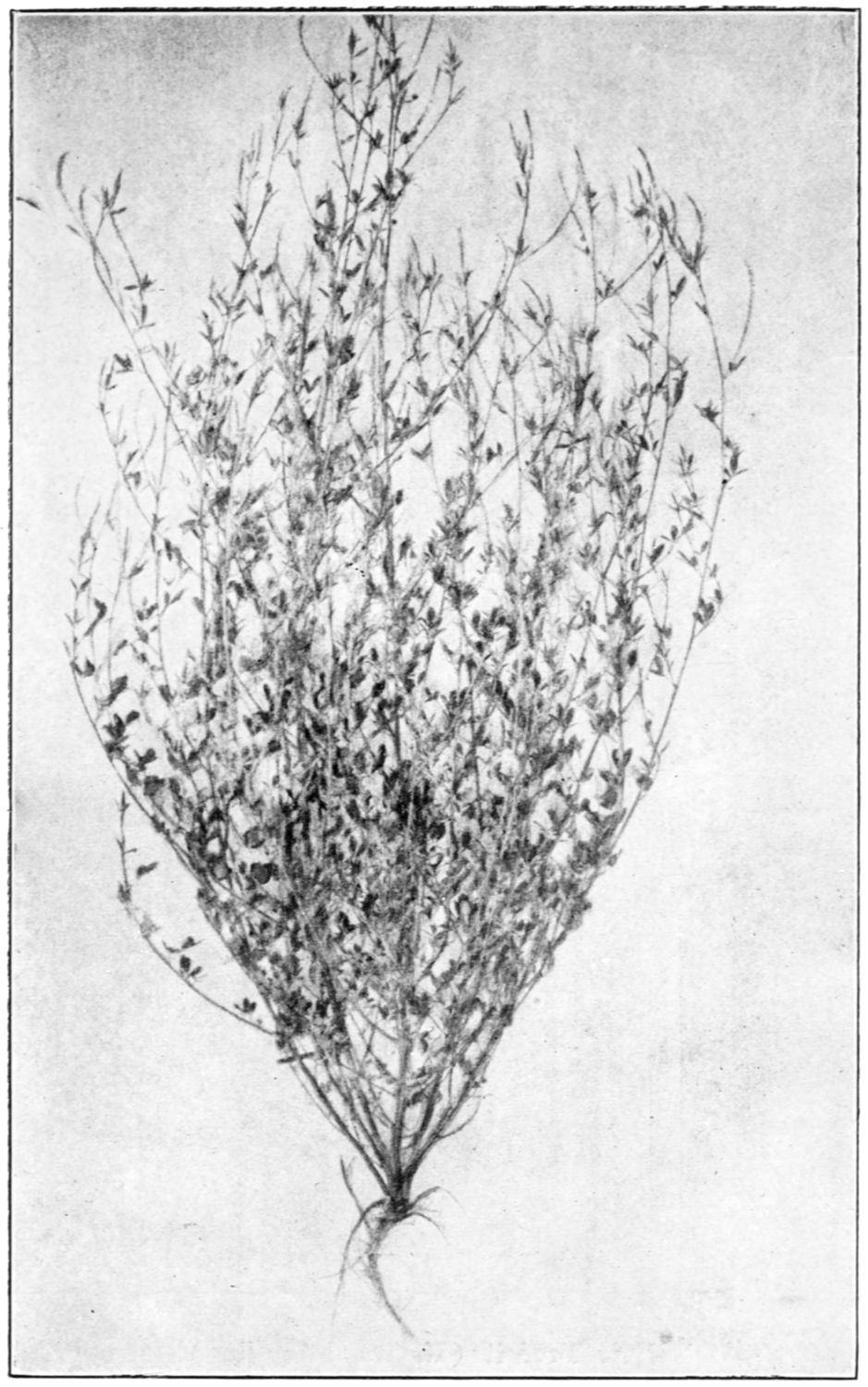
Sweet Clover (Melilotus alba.)
The seed of Sweet clover is an occasional adulterant of alfalfa. The plant is much taller than any of the species of Medicago. The flowers are white and borne in rows on elongated flower stems
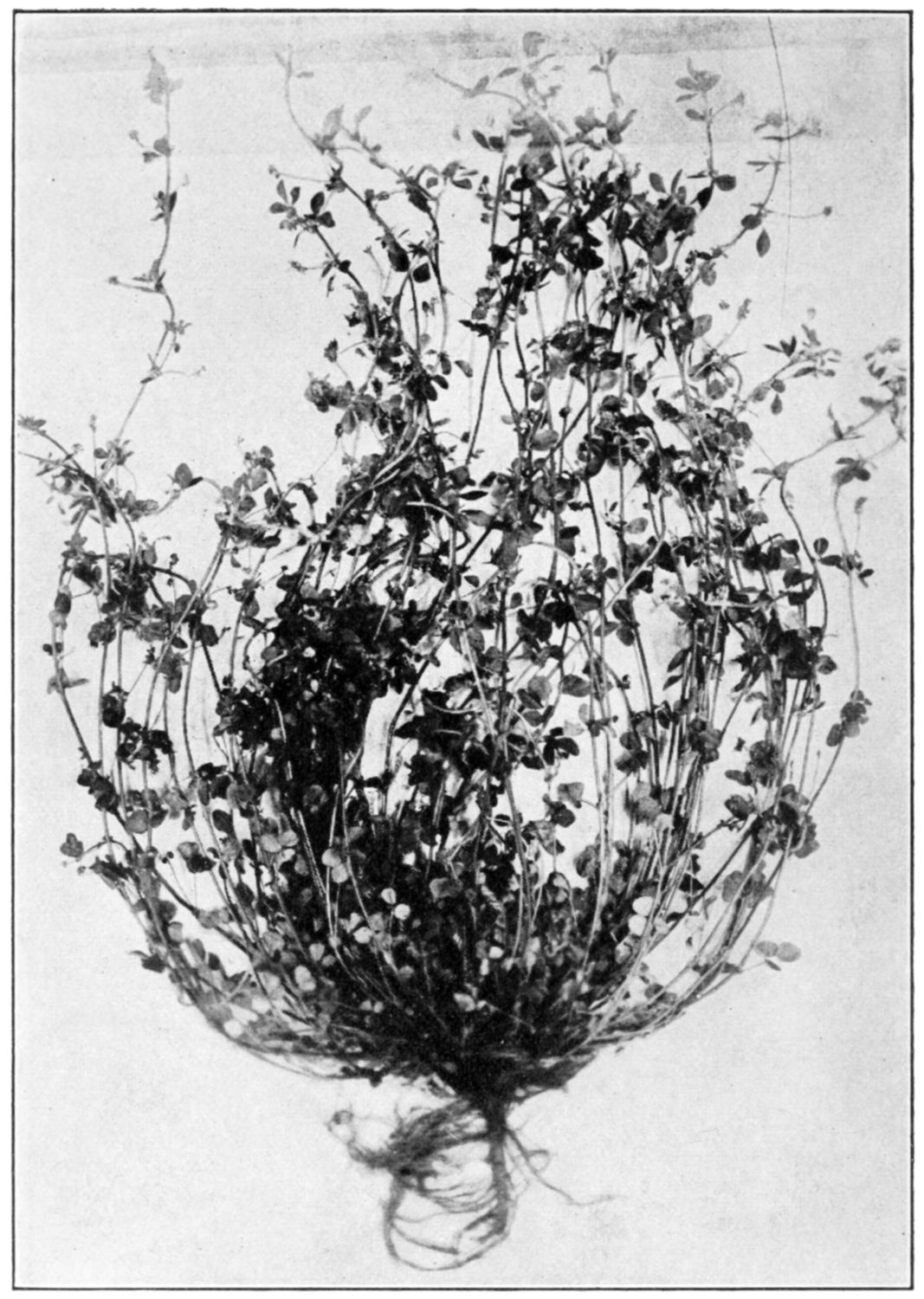
Yellow Trefoil (Medicago lupulina.)
A common adulterant of alfalfa. The leaflets are broader and more clover-like than alfalfa. The flowers are yellow and sparsely scattered in small, hop-like clusters at tips of long flower stems
NORTH CAROLINA
Dr. B. W. Kilgore, Director North Carolina experiment station.—Alfalfa has been grown in a small way in this state, particularly in the section around Hillsboro, for 75 to 100 years. The soil there has become well inoculated and there are some small areas of good alfalfa grown there. There has been for a number of years past considerable interest in the production of this crop, but its cultivation has not been very successful. On our experiment farms in different sections of the state it has done reasonably well, and there have been put out quite a large number of small areas during the last few years, which give hopes of success with the crop. When some further details regarding the time and method for seeding and treatment, especially to prevent crab grass and weeds from getting the upper hand of the crop during the summer have been worked out, we believe that alfalfa will be grown to quite a large extent and be a most valuable addition to our present forage crops.
NORTH DAKOTA
Prof. J. H. Shepperd, Dean of the North Dakota Agricultural college.—Alfalfa has not been given a thorough trial by the people of North Dakota, but the results secured by the experiment station indicate that it is capable of producing paying crops here. It will yield two or more tons of hay per acre annually and will, when sown on well drained land, continue to live from year to year as it does in old alfalfa districts. A little growth should be allowed to stand through the winter season to protect the roots by catching a covering of snow over the entire field. Our people are thoroughly awakened and encouraged by the results secured at the experiment station, and its growth is likely to soon be a common practice in the state.
OHIO
Prof. Charles E. Thorne, Director Ohio experiment station.—Numerous attempts were made during the latter half of the nineteenth century to grow alfalfa in Ohio, but so far as the knowledge of the writer goes, that of Joseph E. Wing of Mechanicsburg was the first that could be pronounced a decided success. Mr. Wing had seen the plant growing in the arid region of the West, and was fortunately able to make his initial experiments on the soil formed from the decomposing limestone gravels of Champaign county, a soil possessing three of the indispensable requisites for alfalfa culture. Plenty of lime, plenty of humus and good drainage. Other farmers during recent years have attempted the culture of this plant, and where experiments have been conducted upon suitable soils and carried out with sufficient care and persistence, they have been successful. Thus far the most promising alfalfa fields in the state are to be found either in such localities as those of Mr. Wing, namely upon the soils underlaid with limestone gravel which are found over the western half of the state, or upon such of the river bottom lands of the state as are above overflow and are underlaid with gravel, giving natural drainage. The experience of Ohio growers of alfalfa has demonstrated the following points: (1) Alfalfa must have lime. If the soil is naturally deficient in this substance it must be added artificially. (2) Alfalfa must have humus. It is idle to attempt to grow it upon a soil which has been worn so thin that it will not grow a good crop of corn. Such soils must be manured before they will successfully produce alfalfa. In this respect it is very different from the plant which it so closely resembles in habit of growth, Sweet clover. (3) Alfalfa will not grow with wet feet, yet it is a great consumer of water, and the soil must be of such a character as to hold large stores of water without being water logged. Hence the value of bottom lands naturally underdrained by strata of gravel a few feet below the surface. (4) When lime, humus and drainage are supplied, the bacterial organisms through which atmospheric nitrogen is assimilated will gradually appear upon the alfalfa roots, but their growth may be hastened by inoculating the land with soil from a field in which alfalfa or Sweet clover has previously grown. The experiment station has been most successful in getting a stand of alfalfa where the land was thoroughly prepared in the spring and then harrowed every week or ten days until July or August. The seed was then sown and harrowed in. By this means the weed seeds were germinated and destroyed before the alfalfa was sown.
OKLAHOMA
Agricultural experiment station: Bul. 71, by Prof. F. C. Burtis and L. A. Moorhouse.—This crop is being grown in every county in Oklahoma and in some sections, a fair acreage is present. From many fields as large yields are obtained as are produced any place else in the United States without irrigation. On the uplands in Oklahoma, as elsewhere, the returns vary. Where the subsoil is hard and impervious, the yields are quite meager under unfavorable climatic conditions and the crop needs considerable nursing such as disking and harrowing, to keep the crab grass from taking the field in a few years. On these upland soils with the hardpan subsoils which grow cowpeas to perfection, the farmer who is not willing to inform himself about proper methods and to give his alfalfa fields much attention and care, should grow cowpeas instead. But as has been indicated before, alfalfa is being grown on such soil successfully and profitably, but only in small areas.
The soil of the experiment station farm at Stillwater, on which the following yields of alfalfa were obtained is a clay loam underlaid by a very stiff, impervious subsoil of a hardpan nature.
Yields of Field F, containing about four acres; cured hay for the season.
1902—1.76 tons hay per acre in 5 cuttings.
1903—1.23 tons hay per acre in 5 cuttings.
1904—3.13 tons hay per acre in 4 cuttings.
1905—3.13 tons hay per acre in 5 cuttings.
Average for four years, 2.31 tons of hay per acre.
In the spring of 1904 the field received an application of barnyard manure at the rate of 15 tons per acre. Every season, the field was disked from three to four times and harrowed. During 1903 and 1904, web worms damaged the crop.
Yields of Plats 1, 2, 3, and 4, Field E. The plats are on similar soil to that of Field F and have been handled about the same as that field. The yield is given for all the plats together.
1902—2.67 tons hay per acre.
1903—3.27 tons hay per acre.
1904—3.31 tons hay per acre.
Average for three years, 3.08 tons of hay per acre.
Yield of Field H, containing about five acres:
1902—4.20 tons hay per acre in 5 cuttings.
1903—2.88 tons hay per acre in 5 cuttings.
1904—2.12 tons hay per acre in 5 cuttings.
1905—2.27 tons hay per acre in 5 cuttings.
Average for four years 2.69 tons per acre.
Barnyard manure was applied to this field in 1900-’01, and it was given the same treatment as was received by the fields previously mentioned. Other results will be given in a later bulletin, but those cited give a fair idea of what may be expected on upland where the subsoil is a hardpan. The hay from all the fields mentioned above, obtained in the last two or three cuttings, contained varying amounts of crab grass, so the yields given are not all alfalfa. Since the above results were obtained, some good bottom land has been acquired by the experiment station and alfalfa has already been seeded on some of it. In a few years, yields that will look better when compared with those of our best alfalfa growers can probably be reported. The following summary will be helpful.
1. Alfalfa is a great and valuable crop for Oklahoma, where there are as good alfalfa soils as are found in the world and as good yields are produced as anywhere.
2. The acreage of alfalfa should be greatly increased in Oklahoma. There are but few farms here that do not contain a few acres at least that will grow the crop profitably.
3. Select the best soil on the farm for the first trial, and try only a few acres at first.
4. Decide a year or two in advance of seeding time what field is to be seeded to alfalfa, and follow the best methods of cropping and preparation known.
5. Buy only the very best seed. Get a sample and test it before buying and purchase your seed a year before you expect to sow it unless you are sure you can get good seed just when you want it.
6. Twenty pounds of good seed to the acre is plenty and as low as twelve pounds is all that is used by many.
7. Seed either with the drill or by broadcasting. Conditions must be right for either to succeed.
8. Fall seeding and spring seeding are both followed in Oklahoma with good success. If the conditions are not right at seeding time, or turn out unfavorable after seeding, or while the plants are small, either may fail.
9. As a rule fall seeding is preferable in Oklahoma, particularly on the less adapted soils.
10. Take due care in harvesting the hay that half its value is not lost at that time.
11. Don’t give up trying to raise the crop because you fail in your first attempt or even if the failure continues to the second and third attempts. Successful alfalfa raisers have stated that in instances they have failed as many as five times in getting certain fields started to alfalfa, and after they did get the field seeded, the returns from it would justify reseeding ten times if necessary.
OREGON
George W. Dunn, Jackson county.—For eight years I have grown 60 acres of alfalfa on bottom land with granite loam soil, gravelly and sandy. The plant does not grow well unless the soil is deep and well drained, and will not grow where there is a clay subsoil or stagnant water. Well water is reached at a depth of 10 to 12 feet, and the soil, unless cultivated or irrigated, becomes dry and hard in the summer. As soon as the heavy frosts in the spring are over, seed may be put in, after thorough, deep plowing and pulverizing. I always sow broadcast, 20 to 25 pounds to the acre, then harrow in and clod-mash or roll. Water for irrigation is obtained from streams, and it should be applied as quickly as possible, the best way being to flood the whole field for a few days, and then take all the water off, as standing water will kill the plant quicker than anything else. The quantity of water needed the first and later years does not seem to differ materially. As soon as the young alfalfa is high enough, it should be mowed. This kills the weeds, and gives better chance for growth. Then I cut for hay, but it does not pay much the first year. If land is well drained, the plant lives through the winter easily, and by the second or third year is at its best. In ground adapted to its growth, it is almost everlasting, unless killed by gophers or hogs. After the first season, there are three or four cuttings, averaging each from one to three tons to the acre. For hay, I cut as soon as it begins to bloom freely, ordinarily raking the next day, and cocking the third, in this dry atmosphere. The stack does not shed water well, and the best plan is to put in a good barn. The hay bales well, and the size of bale is simply a matter of opinion or convenience, there being no difference in the keeping quality. The second crop is the one for seed, as the first always contains more or less foul stuff, and the third will not mature seed. I dispose of hay at from $4 to $10 a ton—the same price as other hay in the same market—and it is in great demand for milch cows. The seed costs me from 10 to 16 cents a pound. The straw makes good feed, but of course is not so good as the hay. For feeding farm animals, alfalfa is superior to clover or timothy. We produce as fine beef here, by feeding alfalfa alone, as can be done in Kansas or elsewhere by feeding ordinary hay and corn. The pasturage is profitable and satisfactory for horses and sheep, and for hogs it is unsurpassed—they will grow and fatten on it without other food. Cattle on the pasture sometimes bloat, but not when they are used to it, or when it is dry. I keep about 150 head, and in eight years have lost but two. The roots will grow to, but not into, water, and thrive in deep gravelly or sandy soil. The plant sends down a large, straight taproot, which, as it approaches water, branches and spreads out into numerous small rootlets.
PENNSYLVANIA
Prof. George C. Watson, Pennsylvania experiment station.—The experiment station has received many letters requesting information pertaining to the growth and cultivation of alfalfa. From these communications it has been learned that many farmers have attempted to grow alfalfa on land that is not at all well suited for this purpose, and consequently, many failures have resulted. The first attempts to grow alfalfa were made wholly by spring seeding, which, in most instances, has proved quite unsatisfactory. As alfalfa starts slowly and exists as a small plant for a considerable length of time, the weeds have an abundant opportunity to germinate and outgrow the more delicate alfalfa plants. Whatever conditions favor the growth of weeds, particularly in the early part of the growing season, materially increase the risk of failure with alfalfa. Largely on account of the weeds and grass, late in summer or fall seeding has been most satisfactory. While a drouth at this time may seriously interfere with germination, yet the injury from insufficient moisture is not likely to be so great as that from a rank growth of weeds earlier in the season. Land that has been cultivated for a few weeks during the summer may be sown to alfalfa in August or September with comparatively little danger from annual weeds, which are so troublesome in spring seeding. Land that is infested with noxious perennial weeds and grass would not, of course, be in suitable condition for seeding after a few weeks of cultivation, no matter how thorough it may be. The most tenacious grasses and weeds, like Canada thistles and quack grass, should be given at least a few months of thorough cultivation before seeding. Experiments indicate that alfalfa will not survive continued alternate freezing and thawing if the soil contains very much moisture. Land that is at all inclined to “heave” is not suited for the growth of this crop. The soil of the station farm, upon which most of these experiments have been made, is a porous limestone clay underlaid with limestone rocks which afford abundant drainage through the fissures. Notwithstanding the fact that the soil is naturally well drained, in some places it seems to hold too much water to afford a most congenial home for alfalfa. This crop will endure severe freezing, provided the soil is sufficiently dry so that it has no tendency to “heave.” Land upon which clover will “heave” undoubtedly contains too much moisture for alfalfa. It seems to be able to endure the rigors of winter better than clover, provided the moisture conditions are favorable.
RHODE ISLAND
Dr. H. J. Wheeler, Director Rhode Island experiment station.—Alfalfa culture in Rhode Island is a very uncertain undertaking. A few persons have occasionally met with some success, but the majority of experiments have been failures because: (1) Most of the soil in this state is too deficient in carbonate of lime to enable alfalfa to succeed even if other conditions are favorable. (2) It is occasionally almost destroyed by clover leaf spot. (3) The general culture of alfalfa in this state cannot be made successful even if all of the conditions aside from the climate are made favorable. Farther north where the snow falls before the ground freezes and remains until the opening of spring, this plant can be grown successfully. Farther south where the changes are less severe, the same is true. In Colorado and other places where irrigation is practiced, if it is desired to get rid of a field of alfalfa, the ground is flooded after it is frozen and the freezing of water over the surface accomplishes what is desired. In Rhode Island it not infrequently happens that we have in winter a considerable fall of snow. A warm southeasterly rain may fall which transforms it very shortly to slush. In a few hours the temperature may drop to zero or below. Sometimes rain which falls freezes over the surface, forming a solid coating. These conditions in this state destroy the alfalfa just as the flooding does it in the West, and while alfalfa may be carried successfully through the winter, if the season is favorable, I believe the chances are too great to make it a promising crop. Last winter we carried some through successfully and have done so once or twice before, but my advice to Rhode Island farmers is to grow the clovers, soy beans, and possibly cowpeas rather than attempt to embark in growing alfalfa until it has been definitely shown by experiment that the climate and other conditions can be successfully combated.
SOUTH CAROLINA
Prof. C. L. Newman, Agriculturist South Carolina experiment station.—We have, to some extent, had remarkable success with alfalfa. On the old exposition grounds at Charleston, over six tons of cured hay were cut last year on one acre. This year one cutting afforded 4.15 pounds of cured hay. In the upper portion of the state, alfalfa is grown with considerably greater difficulty. At Anderson, the county seat of Anderson county, there is an alfalfa field that was sown 65 years ago and it still affords some return.
SOUTH DAKOTA
Prof. James W. Wilson, Director South Dakota experiment station.—Experience shows that a good stand of alfalfa can be secured, if ordinary care be exercised in preparing the seedbed. It is not a plant that does well when sowed on the native prairie sod after disking. On the college farm during the spring of 1904 a small area of native sod was disked five times; part was sowed to alfalfa and part to clover. The next spring only a few scattering plants of alfalfa could be found, while a fair stand of clover was secured. Good results have been obtained with both the Turkestan and the American varieties. Neither has winterkilled during the time, and the yield per acre in each case has been good. A field sowed to Turkestan alfalfa in 1899 at Highmore Forage testing station still produces good yields. The quantity of seed to sow per acre depends largely on the way it is sowed, requiring more if broadcast than when drilled. We suggest 20 pounds when drilled and 25 pounds when sown broadcast. The time to sow depends upon the condition of tilth. Contrary to what is sometimes supposed, alfalfa does not require a wet soil, but one that is well drained, with a loose subsoil. The plants will stand cutting several times during the first year. This method should be resorted to when sown on a field badly infested with weeds, in order to secure a stand of alfalfa. In 1902 a field rented by the college farm, which had been cropped for several years and become foul with mustard, was sowed to alfalfa. It was cut three times during the growing season, and the result was that in 1903 there was practically no mustard to be seen, but a first class stand of alfalfa was obtained.
George E. McEathron of Beadle county writes: “I consider alfalfa and clover culture practicable in this locality. I do not think it necessary to inoculate soil for these crops in South Dakota. After the first year I cut my alfalfa fields three times and secured an average yield of five tons to the acre. I have never allowed seed to mature, always cutting for hay. No trouble from winterkilling has been noticed.”
O. S. Jones of Lake county writes: “I began raising alfalfa on my place two miles west of Madison five years ago. The soil is a dark loam with some sand in it, lays level and has a sand and gravel subsoil. Water is obtained at a depth of eight to ten feet. I have used both the Turkestan and the common alfalfa, and I consider the latter the better for my land, as it grows ranker, with more leaf and better color than the former. I have had the best success in sowing about the first of May, without a nurse crop. On one four-acre piece seeded three years ago, I pastured 150 to 175 head of hogs and spring pigs for two months this year and also cut between 15 and 16 tons of hay in two cuttings. I sowed 12 acres this year in two six-acre fields, that have been pastured, continually, with 175 head of hogs and pigs and ten head of young cattle since early in July, and a great deal of it matured seed. I could have cut these pieces in August with profit had I so desired, and then had plenty of growth to have kept the stock in pasture, changing pastures each week.”
N. O. P. Synoground of Brown county writes: “I consider alfalfa and clover culture practicable in this locality. I also consider the Turkestan variety superior to the home-grown varieties. Cut the field twice the first year and received four tons per acre. I have never cut any for seed. These crops have not winterkilled here.”
TENNESSEE
Prof. H. A. Morgan, Director Tennessee experiment station.—Alfalfa has been known in Tennessee for many years, but not until the general failure of Red clover, due to one or more species of Colletotrichum, and the search for substitutes for Red clover, were any serious efforts made to grow alfalfa in this state. On alluvial land along the Mississippi river in west Tennessee, in what is known as the Central Basin section of middle Tennessee, and on the richer lands of east Tennessee, alfalfa has been grown very successfully, and each year large areas are being sown to this clover. Mr. L. Donaldson, of Lake county, gives the following relative to the preparation of soil, etc., for alfalfa in the alluvial area of west Tennessee: “The land is plowed deep with large moldboard breaking plows in September or about the first of March. It is then harrowed until thoroughly pulverized, and either about October 10 or April 1, two gallons of seed are sown, by machine or by hand. The harrow is used for covering the seed. We have no more trouble with the crop after seeding. The plants germinate and take root rapidly. I have known alfalfa roots to reach a length of two feet from the last of March to June 25. We frequently cut the crop five times per year.” George Campbell Brown of Maury county states that he has sown alfalfa in March using spring barley as nurse crop, and in September with success. Land sown to alfalfa in 1901 yielded four cuttings per year in 1902, 1903, and 1904, averaging from 16 to 18 tons per acre in the three years. Mr. Brown uses soil for inoculating, and believes he has gotten well-defined results from nitro-culture sent out by United States department of agriculture. At the experiment station at Knoxville, alfalfa has been successfully grown for many years. Heavy applications of farmyard manure and the use of 300 pounds of acid phosphate and 25 bushels of lime per acre invariably insures large yields of alfalfa. Crab grass, Panicum sanguinale, in summer and chickweed, Stellaria media, in winter are enemies to alfalfa in this latitude. These pests should be gotten rid of by the use of clean culture crops preparatory to the sowing of alfalfa. With plenty of stable manure, lime, and phosphorous, artificial inoculation seems unnecessary. Any soil of over a few feet deep may be prepared so as to grow profitable crops of alfalfa. This preparation is much more expensive on some soils than others.
TEXAS
Prof. B. C. Pittuck, Agriculturist of the Texas experiment station.—Alfalfa should receive the attention of farmers in every section of Texas where conditions are in any way favorable to its growth. At present prices, after it is once established, a yield of one ton of hay per acre will afford a good profit, while yields of four and six tons, which are not unusual on favorable soils, make the investment exceedingly profitable. The present demand is much greater than the supply and bids fair to increase in greater proportion during the coming year. Its increasing popularity with the farmer is based upon sound business principles, as its value does not consist solely in its market price, but in its value as food for his stock and food for his soil. It will furnish green pasturage and hay of the best quality without materially impoverishing the soil. Many farmers refrain from planting alfalfa because some neighbor, far or near, planted on land apparently similar to theirs, and it died of the disease commonly known as cotton root rot. It would be far better for each farmer to test his own land, for alfalfa may be affected by this fungus at one place and entirely unaffected on ground only a few rods away. The value of an alfalfa meadow is such as to warrant a farmer in giving considerable time, labor and study to the plant, before deciding that natural conditions prohibit him from successfully growing it.
UTAH
Aaron F. Farr, Jr., Cache county.—Fifteen years ago, when I began raising alfalfa, I had 40 acres, and for the past eight years I have had about 135 acres, all on heavy clay soil, containing considerable salt, and underlaid with very stiff, white clay. The soil is dry on top, but below a depth of 21⁄2 feet is damp, and salty water is found at a depth of eight feet. Small grain was raised on the new land for one or two years, after which the ground was plowed in the fall, and again in the spring, harrowed, and well pulverized. Seed was put in, 12 pounds to the acre, two inches deep, with a press drill. The time for sowing is about the same as for corn, in April or May. If there is plenty of water, it is well to sow the alfalfa with oats, and then cut for hay the first season. Some of my land is irrigated, by flooding, three times in the season, by means of a large canal from the river. The more water is used, the more alfalfa there will be, but the hay from unirrigated land is less sappy than that which has been watered. The plant is not liable to winterkill here, and on sandy loam and gravel soils the full yield is attained the second year, while, on heavy soils, it requires three or four years. I have some that is 20 years old, and cannot say how long it will yet continue vigorous. There is difficulty in ridding land of the plant, unless it is flooded in the winter time. We have usually two cuttings each season, with an average yield for each of about two tons to the acre, although some parts of the land yield four tons at each cutting. I have found it more profitable to raise seed than hay, and for this purpose I prefer the second cutting, using the self-rake, allowing the alfalfa to lie in small piles until dry, then hauling, stacking, and threshing, the same as wheat. The hay lies about 22 hours in the swath, 24 hours in the windrow, and one or two days in the cock, after which it is stacked in large ricks with a horse fork. If properly cured, it will not mold or heat, as it will if damp. On land valued at $30 an acre, the cost of the alfalfa, in the stack, is about $1.50 a ton. The cost of baling is about $2 a ton, the popular weight for bales being about 100 pounds. An average yield of seed is from 300 to 500 pounds to the acre. Threshers take one-sixth toll, and can thresh about 100 bushels in a day. The common machinery saves only about two-thirds of the seed. A bushel of seed weighs more than 60 pounds, and we put 175 pounds in a two-bushel seamless sack. The average selling price of the seed is about $3.50 a bushel. I have one piece of land, containing 60 acres, not irrigated, valued at $30 an acre, from which, for ten years, I have cut one crop of hay, and one of seed, and realized an annual net profit of $1000 cash. As compared with clover and timothy for feeding farm animals, my opinion is that alfalfa will fatten quicker, but will not go so far. The pasturage is profitable and satisfactory for horses and sheep; for hogs, one acre of it is as good as 21⁄2 of Red clover, and for cattle, one acre is as good as two of clover, provided the land is dry. On wet land, the clover is better for cattle, and, as to bloating, the danger is just the same from the two plants. In my opinion, the plant will do well on side-hills, where the drainage is good, if the land is plowed deep, and the seed drilled in two inches deep and rolled with a heavy roller. Once started, the plant lives almost forever, on any soil, unless the wrong kind of a winter strikes it. I have an alfalfa root, taken up in digging a well, that is 21 feet long. The roots of alfalfa are sure to find the water, if anywhere at all within reasonable reach.
John Jones, Utah county.—I have raised alfalfa 20 years, and now have 250 acres, mostly on sandy loam upland; have some on bottom land, where it grows too rank for seed. The subsoil is light clay, with water from 15 to 20 feet from the surface. On land with hardpan subsoil, it declines after a few years, unless irrigated often. In digging for water, we find the subsoil begins to get dry at about 18 inches, and continues quite dry for 8 or 10 feet; then moisture increases until water is reached. We prepare ground by plowing in the fall, drag very fine in the spring, and sow as early as the season will permit, in order to catch the spring rains, using 20 to 25 pounds of seed per acre. Our first cutting is made about June 20, and is a little weedy, but there are fewer weeds in later cuttings. We get about two tons the first cutting, if the stand is good, and about the same the other cuttings that year; have no trouble here about winterkilling; standing water is injurious to the plant. Here alfalfa on uplands is watered three or four times each season; some land needs only one or two floodings, while other lower lands have no irrigation. After getting a good start from the seed, we begin watering about May 1, from small mountain streams. The first year requires water about every week; after that, once a month is sufficient. For hay, we begin cutting with the first bloom, obtaining 2 to 21⁄2 tons from the first cutting, about 2 the second, and from 1 to 11⁄4 the third cutting; let it lie about two days before hauling to stack, being careful not to stack too green. For seed, begin cutting when seed is ripe, the second crop being considered best. The grasshoppers have been troubling the second crop to some extent, and we have on that account been cutting the first crop for seed, using a reaper and separating with a threshing machine. On a basis of 7 per cent interest on $30 per acre with five tons of hay per acre each year, it has cost about $1.55 per ton to raise alfalfa. We estimate $1 per ton for cutting and stacking, and 60 cents per acre for water tax. It costs $2.25 per ton for baling, 100 to 125-pound bale, the size having no effect as to the keeping of properly cured hay. From 8 to 10 bushels is a fair average seed yield, the cost of threshing and cleaning being about 40 cents per bushel. Baled hay is worth (free on board) about $6.50, and loose, about $4 per ton; seed sells for about 7 cents per pound. Alfalfa hay is preferable to timothy or clover, ton for ton, for feeding without grain; with grain, our liverymen prefer timothy. We find alfalfa with grain equal to timothy for draft horses, but for drivers, timothy is preferred. Alfalfa is considered better than clover by our hog raisers; it makes good pasturage for horses, and is better than Red clover for cattle. If cattle are kept continually on the alfalfa, they are not very likely to bloat; the trouble arises from turning hungry animals on it. We use a gag, made of a stick about three inches in diameter, to force the mouth open, but sometimes have to make an opening in the paunch with a knife. Irrigation seems to improve the quantity without increasing the quality. The early cut hay has at least 20 per cent more value than the straw from the seed crop; we have had very good results from feeding the straw, as it always contains more or less seed. Alfalfa sown on clay soil, with hardpan subsoil, gradually dies out after two or three years; also when water is near the surface; when the roots reach water too near by, the plant dies. Sown on good sandy loam, it reaches its best yield about the second year; on heavier soils, about the third year. We have alfalfa 20 years old, as vigorous and good to yield as when started. It is preferable to clover for turning under, as the large roots make more manure, and the tops are much heavier. We grow alfalfa on our uplands without irrigation, but it requires two or three years to get a start; the first year, it makes a growth of 8 or 10 inches, and wilts; second year, it grows a little taller, thickens up somewhat, and then, apparently, dies; the third year, it gains in height and strength, and yields a good crop, or even two crops, according to the subsoil. If the subsoil is hardpan, I would not predict the result as worth the effort. I do not see how Utah would get along without alfalfa. I have 100 acres, from which are cut from 2 to 21⁄2 tons of hay per acre, and from 800 to 1300 bushels of seed each year, and it has not been irrigated for 15 years. Last year the seed yield was 968 bushels, and the grasshoppers damaged it considerably; the seed brought 10 cents per pound on the track here. We make good beef from the hay alone, and have done so on the threshed straw.
VERMONT
Prof. J. L. Hill, Director Vermont experiment station, in Bulletin No. 114 says that popular interest in the question of alfalfa culture was never so great in Vermont as it is today. The result of 56 trials at as many Vermont points are summarized: as, permanent successes, 12; temporary successes, ten; success at outset, eight; seeming success, five; questionable, seven; failure, 14. Thirty-six per cent of the trials may fairly be said to have been a success, and 68 per cent of these were located in the Champlain valley. Only 10 of the 56 alfalfa growers appear to have sown more than an acre. It should be noted that success with a fraction of an acre does not of necessity imply that an equal degree of success would be attained with plantings on larger areas. The preeminence of the Champlain valley in alfalfa growing seems to be due to the character of the farming in that section and to the nature of its soil. Failures may generally be ascribed to one or more of several unfavorable soil or weather conditions, to weeds, to disease, or to seed which either is inferior or from an unsuitable source. There seems to be a sufficient proportion of successes in the state to justify the encouragement of further trials. It is equally clear, however, that anyone planting alfalfa for the first time should not only give careful heed to the needs of the plant and to the methods of culture outlined later, but should begin by experimenting in a small way. The most significant thing developed by the analysis of the returns to date is that the crop seems to succeed best in the Champlain valley. Why is this? Probably one factor, not apparent on the surface, is that the men who have succeeded in Addison county are largely sheep breeders who value the crop so highly in their special industry that they are willing to give more attention to its culture than are the dairy farmers. It should be recalled in this connection, however, that the evidence reviewed indicates practical success with alfalfa at Plattsburgh and in adjacent Canadian territory. Without pressing the matter to a definite conclusion, we consider two things to be at least strongly suggested and worthy to be borne in mind in connection with further experiments in alfalfa culture: (1) The chances of permanent success with it are probably better in Vermont than they are farther south and east in New England. This may be in part attributable to soil conditions and in part to climate, the latter being associated with greater remoteness from the seashore. (2) In Vermont the chance of success in its culture seem to be greater in the Champlain valley than elsewhere. The reasons suggested in the above may apply in explanation of this. The nature of the geological formations is also worthy of consideration. It seems not unlikely that the relative richness of the soil of this region in lime and potash and its other chemical and physical characters make it especially favorable to alfalfa growing.
VIRGINIA
Prof. Andrew M. Soule, Director Virginia experiment station.—In Bulletin No. 154 from this station we summarize as follows: Alfalfa is being grown with success in various parts of Virginia and the indications are that it will do well in humid climates, providing the soil is brought into suitable condition for its growth. Alfalfa has many useful qualities. It yields from three to five tons of cured hay in a year, and remains on the land for a long period of time when once well established. It grows best on deep, open, porous soils well supplied with vegetable matter. The roots of alfalfa are from five to 15 feet in length, enabling it to draw much of its food from the subsoil. It thus enriches the land for succeeding crops and opens it up to the action of air and water. Land intended for alfalfa should be made very rich by plowing under legumes or applying farmyard manure. In addition, from 200 to 400 pounds of acid phosphate, Thomas slag or bone meal, with 100 pounds of muriate of potash, should be applied per acre. If the land is acid, which may be determined by testing with blue litmus paper, an application of 25 bushels of lime should be made. It is generally best to use the unslaked lime, which may be applied with a manure spreader, a grain drill or broadcasted over the land and covered with a harrow. Land intended for alfalfa should be carefully cultivated in hoed crops or summer fallowed so as to destroy weeds, the worst enemy of alfalfa during the early stages of its growth. Alfalfa may be seeded either fall or spring. When fall sown it can be cut for hay the next summer, whereas, the spring sown crop should be clipped several times during the first season and left to mulch the ground. Alfalfa seed is sometimes infested with dodder, which grows as a parasite on the plant. The orange-yellow threadlike appearance of dodder gives warning of its presence, and it can be easily destroyed by cutting and burning if taken at the outset. Alfalfa is frequently attacked by leaf spot in the eastern states. The disease is easily recognized as its name indicates, and persistent clipping will generally eradicate it. The amount of seed to sow varies, but 20 pounds will answer as a rule. Alfalfa should be cut for hay when coming into bloom, as it yields more nutrients per acre at that time, and succeeding crops yield better. Alfalfa is not more difficult to make into hay than is Red clover. It may also be pastured to advantage, though there is some danger of bloat, and, owing to the high feeding value of the hay, it is doubtful whether it would be good practice to graze it in the East, except with hogs. Alfalfa being a legume has the power of assimilating atmospheric nitrogen under certain conditions. It is thus a soil improver. Farmers cannot afford to purchase nitrogen when they can gather it from the air through the action of leguminous plants. Alfalfa often fails, even though all the physical conditions seem favorable, because the bacteria which live in the nodules on its roots are not present in the soil. This deficiency may be supplied by getting soil from an old alfalfa field or from fields where Sweet clover or Bur clover previously grew with success, or by means of artificial cultures. The Virginia experiment station, realizing the importance of alfalfa to Virginia farmers and the difficulty of securing inoculated soil at a reasonable cost, has undertaken the preparation of pure cultures which it is distributing at a cost of 25 cents per acre. Soil inoculation through artificial cultures is still in its experimental stages, but it seems wise that Virginia farmers should be given an opportunity to test these cultures at a moderate cost and determine once for all their real value under field conditions. The high feeding value of alfalfa has long been recognized. It is admirably adapted to the needs of all classes of live stock. It has been fed with profit to horses, cattle, sheep and swine. It can be so utilized as to largely take the place of wheat bran and other expensive concentrates. The plats of alfalfa seeded in the spring of 1904, both on the station farm and on Brush mountain, show the importance of soil inoculation and the advantages of using lime and phosphates on land intended for this crop. From a general review of the situation it appears that there is no reason why alfalfa, under good management, should not succeed in many parts of Virginia.
WASHINGTON
F. M. Lowden, Walla Walla county.—In 22 years I have had experience with from 1 to 400 acres of alfalfa, on bottom, second bottom, and upland, with clay, sand and loam soils, with subsoil of hardpan and strong alkali from 18 to 20 inches below the surface, and water at depth of 18 to 20 feet. The soil is seldom moist all the way down, the dry soil beginning five to eight feet below the surface and ending within two or three feet of the water. After plowing deep and harrowing well, I sow in the spring, late enough to miss frost, 25 to 30 pounds to the acre; then cover, in light soil from one to two inches, and in clay soil less. During the first season it should be mowed so that the weeds cannot choke it out, and then there will be about a ton of hay to the acre to be cut in August. I irrigate with water from streams thoroughly in the spring and after each cutting, using enough water to soak the ground for a few days. New land requires more water than old, but the quantity needed is about the same every year. At three years the plant attains its best yields, and with proper care will not need reseeding. There are usually three cuttings each season, with an average of 11⁄2 tons to the acre, and I have known five cuttings. It is mowed for hay when it commences to bloom, and for seed any time before the frost comes, the second crop being best for the latter use. The seed is mowed, threshed and dried as any other clover is. The hay should lie before raking until it is thoroughly wilted, then cure in cock two or three days. We stack in ricks 16 to 18 feet wide and any desired height or length. The hay will not heat if well cured before stacking. On land valued at $40 an acre, the cost of hay in the stack is about $1.50, and to bale this costs $2 a ton. The yield of seed is 5 to 10 bushels to the acre, and it sells for $4.50 to $7.50 a bushel, while hay brings $4, formerly $8. For threshing, a clover huller is better than the common machine. The alfalfa straw is of double the value of any other straw for feeding. The hay grown without irrigation is not so rank as that which is watered, and is consequently more valuable as a feed; any is better than timothy, and equal to clover for cattle, but the seed must form in it to make it valuable for working horses. After cutting three crops in a season, I usually use the field in the fall for pasturing cattle, and it furnishes nearly double the feed that Red clover will, acre for acre. For hogs the pasturage is much better than clover, and I sow with blue grass and clover, on rich ground. For horses and sheep the pasturage is better than clover, but causes bloat in the same way. It is difficult to plow up alfalfa, but continued cultivation will rid land of it when desired.
Oscar Drumheller, Walla Walla county.—Have grown alfalfa for six years, and now have 150 acres, part on bottom, some on clay, and a part on slightly sandy soil; subsoil is a thin layer of hardpan; below that a sort of gumbo, and underneath that a white clay. Abundant water is found at 10 to 18 feet, moist soil reaching to the water. Our land requires no special preparation for alfalfa; manure is spread on weak spots; we sow 20 pounds of seed broadcast, about May 1st, and harrow once to cover. Some cut it the first year; some years the crop is not worth touching for either hay or seed; there is no trouble here from winterkilling. We never irrigate. The first cutting yields about three tons, the second, about two and one-half tons, the third, about two tons, and the fourth, one ton. For hay, cutting should begin when in full bloom; we never cut for seed, but the first crop is best. The season must govern the time for curing, whether two days or 10; it will heat and mold if not dry before stacking; no choice in size of stacks. On land worth $40 per acre, it costs about $1.50 per ton to grow and put alfalfa in the stack; baling costs $1.50 to $2 per ton, the bales weighing 150 pounds. Alfalfa hay sold for $12 per ton in 1890, and is now selling for $2.50; seed sells for 10 to 12 cents per pound. For cattle, alfalfa hay leads all others; for work animals, it is a little “washy,” but we use nothing else; for pasturing hogs, one acre of alfalfa is worth two of clover, and it is found satisfactory for horses and sheep; alfalfa will pasture more cattle than clover, but is more productive of bloat, especially on windy days. The best remedy for bloat is to get the foreparts of the animal on high ground and splash cold water on its back; when all else fails, apply the knife to the left side. We prefer unirrigated hay, which seems firmer and less “washy.” Alfalfa reaches its best yields about the third year, and will last 20 years; it is not difficult to kill; it is similar to Red clover for turning under for green manure. All cattle here are fed on alfalfa hay alone. I have fed cattle in open yards in December, January, and February, and made them gain 160 pounds per steer in three months. If beef on the Pacific coast would bring 3 cents, there would be no better investment than alfalfa. In 1892, we sold hay for $60 per acre; to-day it will not sell for a third of that.
WEST VIRGINIA
Prof. J. H. Stewart, Director West Virginia experiment station.—Very little alfalfa is grown in West Virginia. Within the past four or five years some stimulus has been given it by current publications, etc., but extensive growth has not obtained as yet. The attempts to grow it on our small farm at the experiment station have in fact been failures. However, there are a few small tracts that have done well in portions of the state. Hon. T. B. Davis of Mineral county and E. W. McNeil of Hardy county are persons who have been successful. I am frank to say, however, that the experiences and practice thus far in this state have not proven it to be a dependable crop.
WISCONSIN
Prof. R. A. More, Agronomist Wisconsin experiment station.—Alfalfa is receiving great attention in Wisconsin and dairymen have been quick to perceive its value. Through the efforts of the experiment station, alfalfa seed has been disseminated in every county in the state and crops have been grown which were highly satisfactory. Experiments at the station show that as much protein can be secured from one acre of alfalfa as from three acres of clover, nine acres of timothy or 12 of Brome grass. In this experiment four cuttings of alfalfa were secured, two cuttings of clover and one cutting each of timothy and Brome grass. Alfalfa seed should have its viability tested before the seed is purchased. Seed that does not give a germination test of 90 per cent or above should be rejected. We advise selecting high, well-drained land inclined to be rolling. A clay loam on a gravelly subsoil is best suited for growths of alfalfa. Sow in spring as soon as ground works well, putting on about twice the cultivation necessary for cereal crops. Where land is inclined to be weedy, sow three pecks of barley per acre as a nurse crop. If ground is free from weeds, sow alfalfa seed without nurse crop, using at least 20 pounds of seed per acre. Several hundred members of the Wisconsin experiment association have been carrying on tests with alfalfa since 1903, and practically all have succeeded in getting good fields started. Bacteria-laden soil has been shipped to members of the experiment association, who are making tests, with directions for scattering on a small plot, in order to get the proper bacteria established in the soil. The sowing of some alfalfa seed with clover for the purpose of getting a few alfalfa plants established as bacteria distributers has been followed with good success. These lands when later sown to alfalfa result in good catches. Alfalfa should be cut when one-tenth is in blossom, and not later than the first week in September. We look for greatly increased acreage from year to year as our farmers learn the value of this great forage plant.
W. D. Hoard, Editor Hoard’s Dairyman.—It is now twelve years since the editor of the Dairyman commenced the practical study of alfalfa. A good deal of experience as well as observation of the practices of others has come to him in that time. He does not feel that he has exhausted the subject by any means, but there are a few things which he believes to be well settled principles. They may be enumerated as follows:
1. The richer the soil the better.
2. A carefully prepared seed bed. Too much pains cannot be had here.
3. Good seed; every farmer should test the seed he expects to sow. A great amount of failure has come from weak, infertile seed.
4. Side hills where the rain or melted snow in March will readily run off and thus prevent an ice cap from sudden freezing is much the preferable location.
5. Cutting it each time as soon as the first blossoms appear will always bring a stronger succeeding growth for the next crop.
6. Never pasture it unless you wish to weaken it so it will break up more easily the next spring.
7. Always cure it in the cock with hay caps if possible. The quality of the hay is greatly superior to that which is cured in the sun or windrow.
The nutritive quality and value of alfalfa as well as clover may be greatly lessened and the owner not be aware of it, by allowing too much sunshine on the hay. To throw away the feeding value of any food by unwise methods of handling or curing is very poor economy. For this reason farmers should make a closer study than they do as to the right time of cutting alfalfa and clover and the right way of curing it. Too many farmers look only at the labor involved. They want to do it quick. Hence they wait before cutting till the stalks are overripe so they will dry quickly and then they use hay loaders that will take up the hay in the swath overdried and the goodness evaporated out of it by the action of the sun. All this time they are never giving a moment’s thought to the great question: “What kind of food is this going to make for my cows next winter?” The best of study and care should be given to this matter of curing alfalfa and clover. Nicely cured clover is worth half as much as bran as a milk producing food, and alfalfa is worth fully as much. We have demonstrated in our own stables that with 35 pounds of corn ensilage and 10 pounds of nice alfalfa hay a day, we can save half of the grain ration that would be necessary if we fed other hay.
8. As a renewer and renovator of fertility we know of nothing that will equal alfalfa. The present year is proving that in Wisconsin most convincingly. Nearly all of the old alfalfa, as well as clover seeding, was killed by an ice storm in March. That compelled the farmers to plow up these old fields and plant them to corn, potatoes or some sowed crop. The greater growth of crops on these old alfalfa fields is universally noticed. The farmers of the country have not half begun to know the wonderful value of the alfalfa plant. For just this reason they should not be discouraged in trying to grow it.
Dr. A. S. Alexander, Wisconsin experiment station.—After all that has been written and said in favor of the more general cultivation of alfalfa, it seems strange to find much prejudice and ignorance still existing among farmers relative to the merits of this magnificent forage plant. When we ask a farmer why he has not seeded an area of land to alfalfa he almost invariably answers by another question; viz., “Do you think I can make it catch?” And it is this doubt so generally existent that keeps down the area of alfalfa, and hence the profits of many a man who could make it a wonderful success.
To our mind there has been too much alleged scientific talk relative to “nitrification,” “root nodules” and “soil inoculation” for alfalfa; so much of it, in fact, as a fad, that the average farmer has become possessed of the erroneous idea that it requires a deeply scientific knowledge of the subject and much trouble of various sorts to secure a stand of alfalfa. For this reason many a man has dismissed the subject from his mind and deemed it best to think most of the simple things within his ken, but in so doing he has missed some of the greatest boons and blessings possible in his business. Alfalfa will grow on most any good land that will produce clover and that is in no way waterlogged. There is little mystery in its successful cultivation, and the “tricks” of the business are easily learned from the literature mentioned. We believe it to be one of the very finest of forage plants and a grand adjunct in the feeding of hogs; a crop in fact that is bound to become common and that should at once be given far more general attention than is now the case. It is neither difficult to obtain a catch nor make the crop a success if the farmer will but try and in starting follow the simple instructions now published by many of the agricultural experiment stations.
WYOMING
Asil T. Wilson, Fremont county.—For six years I have been raising alfalfa on first-bench upland, a gravelly loam, with a cement subsoil of a lime nature. Water is found at 40 feet; moist soil is encountered at a depth of 12 feet from the surface, and continues until water is reached. A depth of one inch for seeding is best. Sow in early spring. If alfalfa and timothy are sown together, sow 20 pounds of the former to 6 of the latter; if alone, 20 pounds of alfalfa. No weeds will trouble; cut either crop for hay; the first crop for seed. Watering after the last cutting will cause alfalfa to winterkill. Irrigate as early as possible, if dry, and whenever getting dry, also about five days before cutting; the soil being moist after cutting, the next crop will start up quickly. The larger the quantity of water used the better if it runs off quickly. We obtain water from a stream. After the first year I cut twice, obtaining two tons each cutting. I cut for hay just as it comes into bloom, as it is not so woody and more leaves are saved. The first cutting is preferable for seed. When cutting for seed, wait until the curls get well filled and black; put it into cocks and thresh when dry. Alfalfa hay should be cut one day and raked the next; then cock, and let it stand two or three days before stacking; by so doing all the leaves are saved, and it cures in the cock so there is no danger of molding in the stack. My alfalfa in stack costs $1 per ton, from land valued at $5 per acre. Irrigation costs 20 cents per acre. Baling costs $3 per ton, 150 pounds in bale. Seed yields six bushels per acre; threshing costs $1 per bushel. Prices for hay have ranged from $5 to $10 per ton, and $7 per bushel for seed. Alfalfa hay is equal to clover or timothy for farm animals. For swine pasturage it is better than clover; one acre will pasture 10 head of swine, gaining one pound per head each day. For horses and sheep it is good, and as good for cattle as clover, but dangerous, as they bloat and die. The best yields on upland are from three to five years after seeding; and, if watered at proper intervals, it will last 20 years. There is no difficulty in ridding land of alfalfa; plow it late in the fall, level it down and mark it, then water, and let it freeze up in winter. Alfalfa for green manure is as good or better than Red clover. Without plenty of rain, I would not recommend growing alfalfa in any locality. Seed raised from alfalfa thin on the ground is best.
John H. Gordon, Laramie county.—During the past 10 years, I have had from 10 to 200 acres of alfalfa on second bottom and upland, with sandy loam from two inches to six feet deep, and below this soft rock, water being found at depths of 20 to 200 feet. I plow or break the soil the first year, and raise a crop of wheat or oats; the second year plow deep, sow about half a crop of oats, and when this is well harrowed, sow 20 pounds of alfalfa seed and cover it about two inches deep. To get the best results, this seeding is done about April 1st, and there is no trouble here with weeds. In cutting the grain, the alfalfa is cut off too, but it does not grow tall enough for hay the first year. The plant does not winterkill, and reaches its full yields by the third or fourth year; I have found no necessity for reseeding any of my land. We irrigate from streams, the quantity of water used depending on the season. There are generally three applications of water, about six inches each time. After the first two or three years, only about half the quantity used at first will be needed. After the first year I cut twice, and obtain about 11⁄2 tons to the acre each time. The first crop is best for seed, and is harvested when the top bolls are dead ripe, raked the day after cutting, bunched for two days and then stacked, to be threshed with the common threshing machinery, putting through twice. Five bushels to the acre is a common yield of seed, and the cleaning and threshing cost 50 to 75 cents a bushel. The hay is cut when the greater part is in bloom, allowed to lie about a day before raking, cured about three days, and then stacked, 14 to 16 feet wide, 60 feet long, and 20 feet high. It does not seem to heat or mold here. The total cost in the stack is about $1.50 a ton, and baling, in 100-pound bales, costs $2 a ton. Selling price of loose hay in this section is $5 a ton, and the seed, 10 to 12 cents per pound in the market. The straw is worth about as much as the hay for feed. I am well satisfied with the general results of growing alfalfa here, and am now preparing 200 acres for seeding. Where it will grow well, it is the best forage plant ever discovered, being good feed for cattle, hogs, sheep, fowls, and, in fact, all animals on the farm, while as a fertilizer it cannot be surpassed. But one cannot do anything with it if there is not sufficient moisture to raise wheat or oats.