INDEX.
J. Buchan (John Buchan) Telfer translation
The Names in parenthesis are those employed by Schiltberger.
Abel’s offering, 65
Abhase (Abkas), an unhealthy country, 43, 178
Abhases, the, are of the Greek Church, 78; dress and customs, 43, 178
Aboubekr (Abubach), the caliph, 67
—— (Aububachir), son of Miran Shah, 33, 134, 135
Abraham, 56, 60, 71, 76, 194, 195
Adam’s grave, 60, 65; created in God’s image, 71
Adana (Adalia) taken by Bajazet, 19, 123
Adrianople (Adranopoli), a city in Greece, 6, 39
Ahmed (Mirachamat), the amir, 10
—— ben Oweis (king of Babylon), 7, 113; quits Babylon, 24, 130; is beheaded, 32, 135, 160
Aidin (Edein), 40
Aintab (Anthap), 22; pillaged by Timour, 127–128
Akhlat, 126
Ak-kerman (Asparseri), 101, 244–245
Aksheher, 21, 118
Aktam (Achtum), 32, 134
Aleppo (Hallapp), taken by Timour, 22, 127, 128
Alexander the Great, legends of, 79, 226, 216
Alexandria, described, 62; Italians at, 62; mirror of, 63, 215; taken by king of Cyprus and his allies, 62, 64, 214
(Allenklaisser), a great giant, 64, 216
Ali (Aly), the caliph, a persecutor of Christians, 44; and giant, 65; chief over all Mahomedans, 67
Ali Koutchava’s revolt at Ispahan, 27, 133
Alindsha (Aluitze), 24, 130, 44, 160, 136
Amasserah, Amastris (Sant Masicia), 100, 243
Anconitans, in Egypt, 214
Angora (Angarus, Augury), besieged by White Tatars, 18; battle of, 21, 117; a city of Turkey, 40
Ani, the ancient capital of Armenia, 126
Anjak (Origens), 34, 136–138
Ann’s, St., well, 58
Annas the high priest, house of, 59, 203
(Antioch) Nisibis, 44, 160
Arabia, gold of, 26, 46, 64, 67
Ararat, 44, 231
Arjish (Agrich), 38
Armenia (Ermenia), 26, 86
—— Greater, 7, 117, 61, 89
—— Lesser, 20, 31, 43, 61, 86, 117
Armenian Church, 87, 90, 91–96, 238, 242
Armenians, at Angora, 40; at Caffa, 49; are favoured by Mahomedans, 73; friendly to Germans, 86, 234; their conversion to Christianity, 87, 235; in Cyprus, 88; enemies of the Greeks, 96; are brave and clever, 98; in Cilicia and Syria, 117
Arnauts (Arnaw), are of the Greek church, 78, 222
Astara (Strana), 34, 136
Astrabad (Strawba), 44, 160
Astrahan, Hadjy-tarkhan (Haitzicherchen), 49, 172, 136, 139, 141, 142, 154
Babel, tower of (Marburtirudt), 46, 167
Babylon, 24, 33, 46, 52, 86, 88, 89, 187
—— New, 47
Badakshan (Walaschoen), 46, 166–167
Baghdad (Wadach, Waydat), 46, 167, 52, 191, 157, 168; see Babylon
Baïram, the, 70, 221
Bajazet (Weyasat, Weyasit), at Nicopolis, 2, 3, 108, 109; slaughter and distribution of prisoners, 4, 7, 112, 113, 115, 116; invades duchy of Pettau, 6; besieges Konieh, 8; occupies Karaman, 10; takes Samsoun, 12, 14; occupies Sebaste, 18; takes Malatia, 18; Adana, 19; succours Faradj, 19, 124; conquers Lesser Armenia, 20, 125; capture at Angora, and death, 21, 126; besieges Constantinople, 80, 231
Balsam in Egypt, 60, 61, 207–208, 92
Baptism in Greek Church, 82, 83; in Armenian Church, 92; in river Jordan, 205; place of the Saviour’s, 205
Barkok (Warchloch, Marochloch), 19, 124, 51, 182, 113
Barley planted over Babylon, 24
Batou, 137, 173
Batoum, 153
Battle, of Nicopolis, 2, 4, 107–112; Konieh, 7, 8; Angora, 21; Delhi, 25, 130, 132; Karabagh, 31, 134; Aktam, 32, 134
Bavaria (Payren), 1, 38
Beard, never cut by Walachians, 38; forbidden to Mahomedans to cut the, 71; not shaven by Greek priests, 83; not shaven by Armenian priests, 92
Beasts, wild, in Siberia, 35; Badakshan, 46; Babylon, 47, 168; Bolgar, 49, 174
Behesna (Wehessum), 22, 127–128, 123
Beshtamak (Bestan), 49, 138–139
Bethlehem (Bethlaem, Bethlahen), 35, 51, 185, 87, 236
Bishop’s see, at Joulad, 34, 139; Makou, 44, 159; Caffa, 49; Sary Kerman or Cherson, 177
Bistan (Bestan, capital of Kourdistan), 43, 152
Blood of horses, as food, 48
Bolgar (Bolar), a city, 49, 174, 139, 141, 142, 173
Bolgara (Walher), a country, 36
Borrak (Waroch), 37, 142
Bosphorus, the, 79, 226
Boucicault, Marshal (Hanns Putzokardo), 4, 107, 111, 112, 231
Bourhan uddin (Wurthanadin) defeated by a son of Bajazet, 10; is executed by Kara Yelek, 16, 121, 114, 120
Boursbai (Malleckchafcharff, Balmander), 51, 182–191; his letter to Shah Rokh, 184, 187
Bread, not eaten in Siberia, 36; made of millet, 41; not eaten in Jagataï, 47; nor in Great Tatary, 48
Breslau (Bressla), 102
Broussa (Wursa, Wurssa), 6, 10, 34, 40
Buddhism, 140
Bulgaria (Pulgrey), 2, 39, 78, 89
—— Eastern, 107, 120
—— Western, 107
—— Central, 13
Bulgarians, are of the Greek Church, 78
Burgundy (Burguny), Duke of; see Comte de Nevers.
Burial or disposal of the dead, in Siberia, 36; Circassia, 50; by Mahomedans, 69; Greeks, 83; Greek priests, 84, 233; Armenians, 94, 95; Armenian priests, 94, 240
Burzelland (Zwürtzenland), 38, 144
Caffa, 49, 176, 79, 99
Caiphas, house of, 203
Cairo (Miser, Alkenier, Kayr), 23, 50, 181–182, 60, 64, 87
Caliph (Calypha), the, 98
Calvary, Mount (Calvarie), 57
Camels, at Adana, 19, 123; India, 25, 132; milk and flesh as food, 48
(Capadocie), 51, 52, 184, 186
Capernaum, 185
(Carthago) Kairvan?, 51, 184
Caspian Sea (White Sea), 45; sea of Ghel, 160
Castle of the Sparrow-hawk, 41–43, 149
Catalans, in Egypt, 214
Caucasus, forest of the, 52, 186
Chaldæa (Kalda), 46, 167
Chateaumorant (Centumaranto), a prisoner at Nicopolis, 4, 111; defends Constantinople, 231 (Chebakh) Kepek?, a vassal of Timour, 26
China (Chetey, Cetey), 28, 133
Christians, at Samsoun, 13; Joulad, 34, 138; Caffa, 49, 176, 99; on the Jordan, 60; in Malabar, 61, 211–212; conversion of, to Mahomedanism, 74, 222; on the Nile, 190; in Egypt, 190; of St. Thomas, 211–212
“Christians of the girdle”, 190
Christmas in the Armenian Church, 93
Church, of the Holy Sepulchre, 57, 198, 60; of St. Sophia, 80, 231, 101
Churches at Jerusalem, 58–60, 196, 197–203
Churches in Armenia, building of, 94
Circassia (Starchas, Zerckchas), 50, 99
Circassians (Ischerkas), slave dealers, 50, 178, 179; are of the Greek Church, 78; Tcherkess and Zikhes, 177
Citadel on Mount Sion, 59, 203
Coins, of the Golden Horde, 139, 141, 142; of Jagataï, 170; of the khan Uzbek, 173; of the Bolgars, 174
Constantine, the emperor, 80, 83, 84, 89
Constantine, ancient city of, 151
Constantinople (Stampol, Istimboli), 4, 39, 52, 79, 80, 83, 84, 96, 100, 101, 119, 231
Conversion of Christians to Mahomedanism, 74, 222
Corn in Kiptchak (Ephepstzach), 49
Cotton grown in Ghilan, 44
Couriers in Egypt, 52–53; in Russia, 192
Court ceremonials in Egypt, 52, 54, 192
Cracow (Krackow), 101
Croatia (Windischy land), 6, 113
Cross, shining, at Angora, 40
Cyprus I. (Zypern, Zyperen), 19, 62, 64, 88; John, king of, captured by the Egyptians, 187
Damascus (Damaschk, Tamaschen), siege of, 22; destruction of the great mosque, 23, 128–129
Daniel the prophet, where buried, 59
Danube R. (Tunaw), 2, 4, 38, 39, 79, 101
Dardanelles (Hellespant and Poges for Boghaz), 79
Darial pass, the, 89
D’Artois, Philippe, Comte d’Eu, 109
Date-plum, the, 47, 168
David, King, where buried, 59
Day (They), the, 74, 221
Dead, prayers for the, in Armenian Church, 94
Death, by cutting in two parts, 19; burial alive, 20, 125, 22; hanging, 24; trampling under the hoofs of horses, 28, 133; strangulation, 33; sawing in two parts, 51, 183; impalement, 51; poisoning, 154; breaking on the wheel, 183
Delhi (Dily), besieged by Timour, 26, 131; capital of Lesser India, 47
Denisly (Donguslu), 40, 148
De Noillac, Philibert, grand-master of Rhodes, 109, 110
Derbent, 34, 136
Desert, at the end of the earth, 35; of Arabia, 46, 54
Despot of Servia, 3, 111
—— of the Morea, 228
Devlett byrdy (Doblabardi), 37, 142
Divorce in Armenia, 94, 241
Dobroudja, the, 110
Dogs, in Siberia, 35; where they are eaten, 35
Dokouz Khatoum, protectress of Christians, 157
Don R. (Tena), 49
Dragons, in the desert of Arabia, 46; at Rome, 90–91
Dyarbekr (Hamunt, capital of Black Turkey), 43, 152
(Edigi); see Ydegou
Eger, 102
Egypt, 50, 61
Elephants, at battle of Angora, 21; in India, routed by camels, 25, 132; in Lesser India, 47
Elias, his burial-place, 52; chapel on Horeb, 55; a prophet of the Mahomedans, 188
Emperor, the Greek, 101
—— the Roman, 95, 240
Enoch, his burial-place, 52; a prophet of the Mahomedans, 188
Ephesus (Asia), 40, 146
Epiphany, the, in the Armenian Church, 93
Erivan (Erban), 33, 136
Ersingan (Ersinggan), taken by Bajazet, 21; capital of Lesser Armenia, 43; a kingdom of Armenia, 86
Esaias, the prophet, 59
Ethiopia, 209
Eucharist, the, in Syrian Church, 78; in Greek Church, 81, 232; in Armenian Church, 91–92, 238, 240
Euphrates R., 43, 151, 46, 61, 209, 117, 168, 186
Eve, the grave of, 60
Faradj (Joseph, Jusuphda), 19, 124, 51, 122
Fasting, among Mahomedans, 70; in the Greek Church, 82, 83, 232; in the Armenian Church, 93, 239
Felt, raising to the White, 48, 172
Female, warriors in Great Tatary, 37; debauchery in Egypt, 52, 191
Fictions, battle of serpents and vipers, 12; Timour lies uneasy in his grave, 30; castle of the sparrow-hawk, 41–42; (Phiradamschyech), a tercentenarian, 45, 162; destruction of mirror at Alexandria, 63, 215; the giant’s shin-bone, 64, 216; the Bosphorus, a cutting by Alexander the Great, 79, 226; the emperor Constantine, 83; Tiridates is turned into a pig, 88, 236; Tiridates, the dragon and unicorn, 90; the forty Armenian knights, 96–98
Fire worship, 65
Fish, exported from Tana, 49, 175; in the R. Jordan, 60
Florentines, in Egypt, 214
Fortress, of Alindsha, 24, 44; Gallipoli, 39; Kilia, 101; See these names
Frioul (Frigaul), 89
Frisingen, 102
Furs, articles of commerce, at Bolgar, 174; Saraï, 174; Astrahan, 174
Gabriel the archangel, 57
Gaetans, in Egypt, 214
Galata (Kalathan), 79, 225
(Galgarien); see Khozary Galilee, Mt., 59, 204
Galleys, in Danube, 4, 38; sea of Azoff, 49; of Cyprus, 63
Gallipoli (Karipoli, Chalipoli), 6, 112, 39
Ganges, R. (Rison), 61, 210
Genoa, 49, 79
Genoese, at Samsoun, 13, 119; Alexandria, 62, 214; Galata, 79; relations with Persia, 154; secure the silk of Ghilan, 160; in Crimea, 189; at defence of Constantinople, 231
Georgia (Gursey, Kursi), a kingdom, 34, 43
Georgians (Gorchillas, Kurtzi), are Christians and warlike, 43; are of the Greek Church, 78
Gharny (Kirna), 44, 158
Ghilan, 44, 160
Giant, story of a, 64, 216–219
Ginger, in Malabar, 62
Giraffe (surnasa), in Lesser India, 47, 169
Gold, of India, 26; Arabia, 26; in river Ganges, 61, 210
Golden Horde; see Great Tatary
Gori, 43, 153
Gospel, the (Evangely), 77; not read in Armenia, 96, 241
Gothia (Sudi), 50
Goths (Kuthia) are of the Greek Church, 78
Grass poisoned, 23
Greece, 6, 39, 96
Greek Church, 78, 81–85, 231–232, 233
Greeks, in Lazistan, 43; Caffa, 49; Gothia, 50
(Greiff, Hannsen), executed after Nicopolis, 5
Hair, never cut by Walachians, 38; not cut by Armenian priests, 92
(Hamunt) Kara Amid; see Dyarbekr
(Hanns, burgrave of Nuremberg), 3
Hebron (Ebron), 56, 195–196, 60
Herat (Herren, Hore), 30, 45, 161
Herman (of Cily), 3
Hermanstadt (Hermenstat), 38
Hermon (Germoni), 52, 185
Herod, house of, 58, 202
Hillah, 187
Hippodrome at Constantinople, 79, 228
(Hoder of Hungary), 7
Holy Fire, the, 57, 198–200
Holy Places, the, 57–60, 198–206; when possessed by the Mahomedans, 60, 207
Holy Sepulchre, the, 57–60, 198–200
Holy Trinity, the, rejected by the Greeks, 81; accepted by the Armenians, 87
Horeb (Oreb), 55
Hormuz I (Hognus) 45, 164
Hormuzd, worship of, 150
Horse flesh, the food of Tatars, 48
Horses, in Siberia, 35
Hospitals, at Broussa, 40; at Jerusalem, 58, 201
Houlakou’s tomb at Meragha, 157
Houses, in Adrianople, 39; Broussa, 40; Herat, 45; Caffa, 49; Cairo, 50, 182
Hungarians, the, 3
Hungary (Ungern, Ungeren), 1–2, 6, 38, 39, 89
Ibraila (Ubereil), 38
Imbros I (Lempric), 80, 230
Impalement in Egypt, 51
Incense, employed in Armenia, 96; of Arabia and India, 96
India, Greater, 45, 46;
—— Lesser, 24–26, 130, 47
(Indian Sea), 47
Indus, R., 209
Iron cage, the, 126
Iron gate (Temurtapit), on the Danube, 2, 39; Darial pass, 89; Derbent, 34, 136; Khorasan, 25, 131, 136
Isaac, 60, 195
Ispahan (Hisspahan), occupied by Timour, and Ali Koutchava’s revolt, 27, 133, 45
Italy, 87, 101
Italians, at Samsoun, 13; Caffa, 49; Alexandria, 62
Jacob, grave of, 60, 195
Jacobites, in Syria, 78, 190; their chapel at Jerusalem, 200, 225
Jagataï (Zakatay), 47, 170
Jakam (Zechem), 51, 183
Jalal uddin (Segelalladin), 37, 141, 158
Janibek, 154, 173
Janyk (Genyck, Tcyenick, Zegnikch), province of, 12, 41
Jambolouk (Inbu) Tatars, the, 50, 180
Jehangir (Zychanger), 32, 134
Jengiz Khan, 113, 166
Jericho, valley of, 60, 206
Jerusalem (Kurtzitalil), 51, 56, 57–60, 198, 93
Jews, at Caffa, 49, 176; Jerusalem, 60
Jihoun, R., 186
Jordan, R., 51, 57, 59, 60, 205, 206
Josophat, valley of, 52
Joulad (Setzulet, Zulat), 34, 138, 49
Justinian, statue of, at Constantinople, 80, 228–230
Kaffa; see Caffa Kais or Keis I (Kaff), 46, 165
Kaisarieh (Gaissaria), 16, 41
Kaïtak (Kayat) Tatars, the, 50, 179
Kaliakra (Kallacercka), 39, 145
Karabagh (Scharabach, Karawag), 31, 134, 86, 234
Karaman, at war with Bajazet, 7; his capture and execution, 8, 118;
—— conquest of, by Bajazet, 7–10; a country in Great Turkey, 40;
—— (Laranda), the capital of Karaman, 7, 118, 40
Karamora, Black River, 210
Kara Yelek (Otman), 14–18, 120, 20, 114, 154
Kara Youssouf (Joseph), 30, 32, 33, 134, 154
Kars (Kray), 33, 136
Kashan (Kaffer), 34
(Kaylamer) Kalamila?, 52, 188
Kedron, R., 59, 203
Keghart monastery, 159
Kemakh (Kamach), 43, 150
(Kennan) Kermian?, 40
Kepek (Tchebackh), a ruler of the Golden Horde, 37, 141
Kerak, in Arabia, 217
Kerasous (Kureson), 41, 148, 43
Kerym byrdy (Kerumberdin), 37, 142
Khan, the, of White Tatary, 16; of Chetey, 28
Kharput (Kayburt), 43, 150
Khelat (Gelat), 44, 158
Khorasan (Horossen), a kingdom of Persia, 30, 45, 161
Khozary (Galgarien), 52, 189
Khwarezm (Horosaman), 49, 172
Kiankary (Wegureisari), 40, 148
Kilia (Gily), 101
(King-sultan); see Mamelouk sultan
(Kings of Great Tartaria), 36–37, 140–143
Kiptchak (Distihipschach, Ephepstzach), 37, 49, 189
Kirman (Kerman), 45, 163
Kishm I (Keschon), 45, 164
Knitted shoes, worn in Ghilan, 44
(Kocken), in Danube, 38, 144; at Tana, 49; Black Sea, 100
Kohrasar (Karasser), 43, 151
(Koldigen), 57, 197
Konieh (Konia), 7–9, 40
Koran (Alkoray, Alkoran), the, 67, 76
Kour, R. (Chur, Tygris), 86, 234
Kourdistan (Churten, Churt), 31, 43, 152
Koutahieh (Kachey), 40
Kronstadt or Cronstadt; Brassova (Bassaw), 38, 144
(Kuchler, Ulrich), killed at Nicopolis, 4
Kyrkyer (Karckeri), 49, 176, 224
(Lambe), Quilon?, 61, 212
Landshut (Landzhut), 102
Lapis lazuli, in the church of St. Sophia, 80
Lazistan (Lasia), 43, 150
League, a, defined by the author, 46, 167
Leah (Lia), the grave of, 60
Lemburg (Limburgch), 101
Lemon (liuon), the, employed in Malabar against serpents, 62; history of, 213; employed in Ceylon against leeches, 213–214
Lezghistan (Lochinschan), 34, 136
Lightning, death by, courted in Circassia, 50, 178
Lions, in Babylon, 47; Lesser India, 47
Lombardy (Lamparten), 89
Lord’s prayer, in Armenian, 102; Tatar, 102
Lucca (Lickcha), 34
Magnesia (Maganasa), 40, 147
(Mäg), Mahhy? destructor of gods, a title of Boursbaï, 52, 187
Mahomedans, their sects, 65, 73–74, 221; at prayer, 67–68; neglect of prayer, how punished, 69; places for worship, 69, 220; burial of the dead, 69; fasting, 70; call to prayer, 70; festivals, 70–71, 221; grief for the dead, 72; wine forbidden and the reason why, 72; good custom in trade, 73; estimate of the Saviour, 75–76; of Christianity, 76–78
Mahomet, 44; his tomb, 54, 71; birth and appearance of, 65, 219–220, 78; becomes Caliph, 67; doctrine and laws, 67–75; held the Caucasus in veneration, 186
Makou (Meya), 44, 159
Malabar (Lambor), where pepper grows, 61, 211
Malahidah sect, the; see the Day Malatia (Malathea), 18, 122–123
Mamelouk sultans, captives sent to, by Bajazet, 7, 113; their succession, 51, 182; court ceremonials, 52, 54, 192; couriers, 52, 192; pigeon service, 53, 192
Mamre (Mambertal), 56, 194
(Manstzusch), 99, 143
(Mansur), a brother of Aboubekr, 33, 135
Mardin (Merdin), 43, 154
Mare’s milk drank fasting, 48
Marriage customs, of the Yasses and Georgians, 85, 234; Armenians, 95
Mary Magdalen, 58;
—— Cleophas, 58
Massanderan, 26, 29, 44
Meat, raw, eaten by Tatars, 48
Medina (Madina), 71
Mehdy, the, or celestial judge, Shyite belief of him, 186; Sunnite belief, 187
Meisen (Neichsen), 102
Menagerie at Babylon, 47, 168
Meragha (Maragara), 44, 157
Mile, an Italian, defined by the author, 46, 167
Milk of mares and camels for food, 48
Millet, in Siberia, 36; Sinope, 41; Great Tatary, 48
Mingrelia (Magrill, Megrellen), 43, 153, 99
Mingrelians, are of the Greek Church, 43, 78
Mintash or Mantash (Mathas), 51, 183
Miracle, at Samsoun, 12; by St. Demetrius, 39, 146; at Angora, 40; Sinaï, 55, 193; the Withered tree, 56; Holy Sepulchre, 57, 199; St. Ann’s well, 58, 202; walls of Constantinople, 84; by St. Gregory, 88–90; St. Silvester, 88; St. John the Evangelist, 147
Miran Shah (Mirenschach), 30, 32, 133, 134, 114
Mirror at Alexandria, 62–63, 215
Mirtcha, John (Werterwaywod), voyevoda of Wallachia, 2, 110, 145
Miszr Khodja (Miseri), 32, 134
Mitrovitz (Mittrotz), 6
Mocenigo, Giovanni, 110
Mohammed, the descendant of Ali, 186
(Molwa), an infidel priest, 65, 219
Mongols, the (Mugal), 50, 179, 114, 126
Moses, 54–56, 76
Mosque at Damascus, described, 22, 128; destroyed, 23, 129
Mouhammed, son of Bajazet, defeats Bourhan uddin, 10; is ruler of Sebaste, 18, 121
Mouravieff, M. Andréy, 147
Nahitchevan (Nachson), 44, 156
Nazareth, 52, 56, 185
Neapolitans, in Egypt, 214
Nestorians, 140, 157, 158, 162, 190
Nevers, Comte de (Duke of Burguny), at Nicopolis, 3, 111; a prisoner, 4, 111, 113; intercedes for several nobles, 5, 112; at Gallipoli and Broussa, 6–7, 112
Nicopolis, siege and battle of, 2–4, 107–112, 100
Nile, R. (Nilus), 61, 62, 169
Nisibis (Antioch), 44, 160
Noah, 44
“None”, Nono, ruler in Badakshan, 166
Olives, Mt. of, 59
Oljaïtou, tomb of, 132
Omar, the caliph, 67
(Origens); see Anjak Orsova, 107
Ossets, Alans (Yassen, Aff), are of the Greek Church, 78; marriage customs, 85, 234; history, 223–224
Ostriches, in Lesser India, 47
Othman, the caliph, 67
Oulou Mohammed (Machmet), 37, 142
Ourjenj (Orden), 49, 172, 154
Ormi, the Ur of Jordanus Catalani, 157–158
Ourroum Kaleh (Hrumkula), 22, 127–128
Oxus, R. (Edil), 49, 172
Palaces at Constantinople, 79, 228
Paradise, 43, 61, 209, 186
Parrots, in Lesser India, 47
Pearls, at Kishm I, 45
Pelicans, in Arabia, 54, 193
(Pentznawer, Wernher), killed at Nicopolis, 4
Pera, 79, 225
Pergri, 126
Persia, 26, 30, 34, 43, 44, 45, 61, 89
—— King of, 7, 114
Pepper, cultivation of, at Malabar, 61, 62
Pettau (Petaw), Duchy of, 6
(Phiradamschyech), a tercentenarian, 45, 161–162
Pigeons, carrier, in Egypt, and their training, 53, 192
Pilate, house of, 58, 202
Pirates in Black Sea, 100
Pisans, in Egypt, 214
Poland (Polan), 102
Pope, the, 63, 81
Poti (Kathon, Bothan), 43, 153, 99
Poulad (Polet), 37, 141
Prayers for the dead, in the Armenian Church, 94
Preachers, Order of, 44, 159
Precious stones, at Hormuz, 46; Badakshan, 46, 166; in the Ganges, 61, 210
Prester John, 52, 189, 57, 58, 140, 191
Quilon? (Lambe), 61, 212
Rahova, 2, 108
Raw meat as food, 48
Rebecca’s grave, 60
Regensburg, 102
Relics, of St. Catherine, 55; St. John Chrysostom, 58, 202; St. Stephen, 58, 202; St. Nicholas, 147; St. Clement, 177; St. Joachim, 202
Resht (Ress), 44, 160
Rey (Rei), 44, 155
Rhinosceros? in Badakshan, 167
Rhodes, knights of, Smyrna their possession, 147; at taking of Alexandria, 214; at defence of Constantinople, 231
Rice, grown in Ghilan, 44
Richartinger, Leonard (Lienhart), the author’s master, 1; unhorsed at Nicopolis, 3; killed in that battle, 4
Rivers that flow out of Paradise, 61, 209–210
Robbers, in Circassia, 50, 178
Roman Catholics, at Makou, 44; Caffa, 49
(Rom) Asia Minor, 51, 52
Rome, 63, 81, 89, 91
(Rumany) Abyssinia?, 52, 190
Russia (Rewschen), 50, 89
Russia (Reissen), White, the Lesser, 101, 245
Russians (Rivssen), are of the Greek Church, 78, 137
(Sadurmelickh), 37, 144
St. Ann, 58
St. Auxentius (Aurencius), 93, 239
St. Basil, 41, 148
St. Bartholomew (Bartlome), 87, 235
St. Catherine, 54–56, 193–194
St. Clement, 50, 177
St. Constantine, 83
St. Demetrius (Sanctiniter), 39, 146
St. George (Jörig), patron saint of Georgia, 34
St. Gregory, the “Illuminator”, 87–93, 235–238
St. Helena, 197
St. James the Less, 59, 206
—— the Greater, 93, 239
St. Joachim, 202
St. John the Baptist, 58, 201, 205
St. John the Evangelist, 40, 147, 58
St. John Chrysostom, 58, 202
St. Nicholas, 40, 147
St. Rhipsime (Susanna), 87, 236
St. Sergius (Zerlichis), 93, 239
St. Silvester, 87–90, 237
St. Stephen (Steffan), 58, 200, 59, 202, 203
St. Thaddeus (Thaten), 87, 235, 160
St. Thomas, 211–212
Salonica (Salonikch), 39, 145
Samarkand (Semerchant), 28, 33, 47, 154
Samsoun (Samson), 12, 119, 14, 41, 79
Saracens, 51, 137
Sarah, the grave of, 60
Saraï (Sarei), 49, 173, 139, 141
Saraï, New, 173
Saraï-Banou, 137
Saros (Seres), 39
Saroukhan (Serochon), 40
Sary Kerman (Serucherman), 50, 176–177
Savages, in Siberia, 35, 139
Save, R. (Saw), 6
Saviour, the, 35, 52, 185, 56, 75–78, 83, 84
Saxony, 102
(Schenisis) Shems uddin?, 40
Schiltberger, Johann, addresses the reader, 1; at battle of Nicopolis, is made a prisoner and bound with a cord, 2–4; his life is spared, 5; suffers from wounds, 7; his duty as runner to Bajazet, 7; attempts to escape, 10–12; sent to the relief of Sebaste, 17; sent to Egypt, 19; becomes Timour’s prisoner, 21; is subject to Shah Rokh and Miran Shah, 30–31; passes into the hands of Aboubekr, 33; sent into Great Tatary, 33; enumerates the countries he visited, 38–50; is three months at Gallipoli, 39; at the siege of Constantinople, 80; spends three months at Constantinople, 81; is in the service of “Manstzusch”, 99; effects his escape, 99; voyage to Constantinople, 100; enters that city, and is taken before the Emperor, 101; returns to his home, 101–102
Schliemann, Dr., 228
(Schyackin), 51, 183
Scorpions, in Badakshan, 167
Scutari (Skuter), 79
Sea, the Black, 13, 41, 49, 50, 79, 99, 101;
—— (the Dead,) 59, 204;
—— (the Great) or Black, 79;
—— (the Indian), 47;
—— (the Red,) 54, 193;
—— (the White), or Caspian, 45, 161;
—— (the White), 39
Sea monsters, in the Tigris, 47
Sects, Mahomedan, 65, 73–74
Serpents, at Samsoun, 12; Badakshan, 46; Desert of Arabia, 46; near the Tigris, 47; in Malabar, 62
Servia (Iriseh), Stephen, prince of, 3, 111, 109
Shabran, (Samabram), 34, 135
Shabran-tchaï, 135
Shahinshah (Schachister), 27
Shah Rokh (Scharock), 30–31, 86, 234, 126
Shaubek, in Arabia, 217
Sheeraz (Schiras), 45, 162–163
Shekis, the, 161
Sheky (Scheckhy), 44, 161
Shemahà (Schomachy), 45
Schirwan (Schuruan), 34, 45
Shishman (Schuffmanes), 13, 120, 107
Shoeless, Order of the, 34, 139
Shurky (Scherch), 23, 129
Shvishtov (Schiltaw), 2, 108–110
Shyites (Raphak), at Rey, 44, 156; destructors of mosque at Damascus, 129; their place of pilgrimage, 187
Siberia (Ibissibur), a country, described, 34–36, 139
Sibir or Isker (Ibissibur), a city, 49, 174; residence of the Shaïbani Khans, 174
Siege, of Nicopolis, 2, 170–109; Konieh, 8–9; Samsoun, 12; Sebaste, by Kara Yelek, 15; Malatia, 18; Sebaste by Timour, 20, 125; Aleppo, 22; Ain-tab, 22; Behesna, 22; Damascus, 22; Babylon, 24; Delhi, 26; Ispahan, 27; Alindsha, 44, 160, 130; Constantinople, 80, 231, 226
Sigismund, King of Hungary; appeals to Christendom, and invades Bulgaria, 1–2; occupies Widdin, 2; Rahova, 2; besieges Nicopolis, 2; at battle of Nicopolis, 2–4, 107, 109; flight, 3–4, 110, 113; passes the Dardanelles, 6
Silesia (Slesy), 102
Silk, at Astara, 34; Lezghistan, 34; Shirwan, 34, 45; Resht, 44; Sheky, 44
Silvester, Pope, 87–91
Simontornya (Synüher), Stephen, 5, 112
Sinaï (Muntagi), 52, 54–56, 193–194
Sindjar, 154
Sinope (Zepun, Synopp), 41, 100, 120
Sion, Mount, 59, 202–203
Sis (Syos, Siss), a kingdom of Armenia, 86; taken by Egypt, 87, 235, 126
Sivas, or Siwas (Sebast, Tamastk, Damastchk), 10, 118, 15–18, 20, 124–125, 41
Sledges, in Siberia, 35
Smyrna (Ismira), 40, 147
Snakes, in Siberia, 35
Solkhat (Vulchat), capital of Kiptchak, 49, 175
Solomon, temple of, 58, 59
—— tomb of, 59, 203
Soukhoum Kaleh (Zuchtun), 43, 152–153
Souleiman, son of Bajazet; spares the author’s life, 5; intercedes for re-captured prisoners, 12; goes to the relief of Sebaste, 17, 121; defeats the (White Tartars), 19
Souleiman Shah (Suleymanschach), a counsellor of Timour, 25
Soultanyà (Soltania), 26, 132, 44
Soutchava (Sedschoff), 101
Spices, at Damascus, 24; Kais I, 46; Malabar, 62
Sracimir, John (Hannsen of Bodem), 5, 112, 107
(Stainer, little), killed at Nicopolis, 4
Storks, near the Tigris, 47
Strength, feats of, by Aboubekr, 33; (Sadurmelickh), 37
(Sygun), or Zikhes; see Circassians Syhoun, R., 186
Syria, 22, 57
Syrians, at Caffa, 49; are Jacobites, 78, 224
Tabreez (Thaures), a kingdom of Persia, 30, 32; chief city of all Persia, 44, 154
Taharten (Tarathan), 21, 125, 126
Takavor (Takchauer), the Armenian for king, 90, 238
Takfour, title of Greek emperor, 188, 238
Tamerlane; see Timour
Tana (Alathena), now Azoff, 49, 175, 79, 138
Tartars or Tatars?, 171–172
Tatars, White, besiege Angora, 18; vanquished by Souleiman, 19; desert Bajazet at Angora, 21, 117
Tatary, Great, 33, 48, 170; khans of, 36–37, 140–143; customs in, 48, 172; steppes of, 50
Tatary, White, 7, 114–116
Tchadibek khan (Sedichbechan), 36, 140
Tchekre (Zeggra), 33–37, 139, 99, 142
Tell el-faras (Talapharum), 52, 185
Terek R. (Edil), 34, 137
Ternovo (Ternau), 13, 120, 39, 108
(That) Mourtadd? Crimean Goths so called, 50, 176
Tiflis (Tiffliss), a kingdom of Armenia, 86, 126
Tigris R. (Schatt), 47, 168, 61, 209, 186
Timour, at Sebaste, 20, 125; at Angora, 21; Broussa, 21; campaign in Syria, 22, 125, 127; besieges Damascus, 23, 128–129; destroys “Babylon”, 24; invades Lesser India, 24–26, 130–131; expedition to Masanderan, 27; besieges Ispahan, and his treachery there, 27, 133; expedition to China, 28, 133; illness and death, 29, 133; lies uneasy in his grave, 30; his sons, 30, 133; his capital, 33; cruelties, at Sebaste, 20, 125; Aleppo, 22, 127; Damascus, 23, 128; Ispahan, 27–28, 133
Timour Tash, 118, 123
Tirgovisht (Türckisch), 38
Tiridates (Derthatt), king of Armenia, 87–91, 236–237, 159;
—— throne of, 159
Toktamish, 115, 138, 140, 154
Towers of human heads, at Damascus, 23; Ispahan, 27
Transylvania (Sybenbürgen), 38
Trebizond (Trabessanda), a kingdom, 41, 79, 150
Troy (Troya), its ruins, 79, 226–228
Turkey, Black, 43
Turkey, Great, 40
Turkomans of the White Sheep, 152
Turks, Ottoman, 114
Tuscany (Duschkan), 89
Tzaref, 173
(Ugine), the, Ung Kut? 36, 139–140
Unicorns, in Badakshan, 46, 166–167; at Rome, 90–91
Velvet, made at Venice, 34; Lucca, 34
Venetians, in Egypt, 62, 214; at Gallipoli, 112; at Salonica, 146; relations with Persia, 154; secure the silk of Ghilan, 160; at Tana, 175; Galata, 225; defence of Constantinople, 231
Vineyards, at Trebizond, 41; Lazistan, 43; Kohrasar, 43, 151; Crimea (Gothia), 50
Venice, 34, 49
Vipers, at Samsoun, 12; from the Black Sea, 13
Virgin, in the Castle of the Sparrow-hawk, 41–43; 9000 carried away captives by Timour, 20
Virgin’s castles or towers, 149
Virgin Mary, 52, 185, 57, 58, 75, 76, 93
Volga R., 136, 173
Walachia (Walachy, Walchi), 2, 38, 89, 101
—— Greater, 38;
—— Lesser, 38, 101
Walachians, are Christians, 38; never cut their hair or beard, 38; are of the Greek Church, 78
Walls of Constantinople, 84, 232, 101, 244
Warlike people, in (Black Turkey), 43; Georgia, 43; Jagataï, 47; Great Tatary, 48
Water poisoned, 23
Widdin or Widin (Bodem), 2, 107, 39
Wine, not drunk in Great Tatary, 48; why forbidden to Mahomedans, 72
Withered Tree, Lord of the, 52, 189; virtue of the, 56, 194–195
Ydegou, (Edigi), 34–37, 140–141, 143, 176
Zacharias, 59, 206
(Zuspillen) Sicily?, 51, 184
T. RICHARDS, PRINTER, 37, GREAT QUEEN STREET.
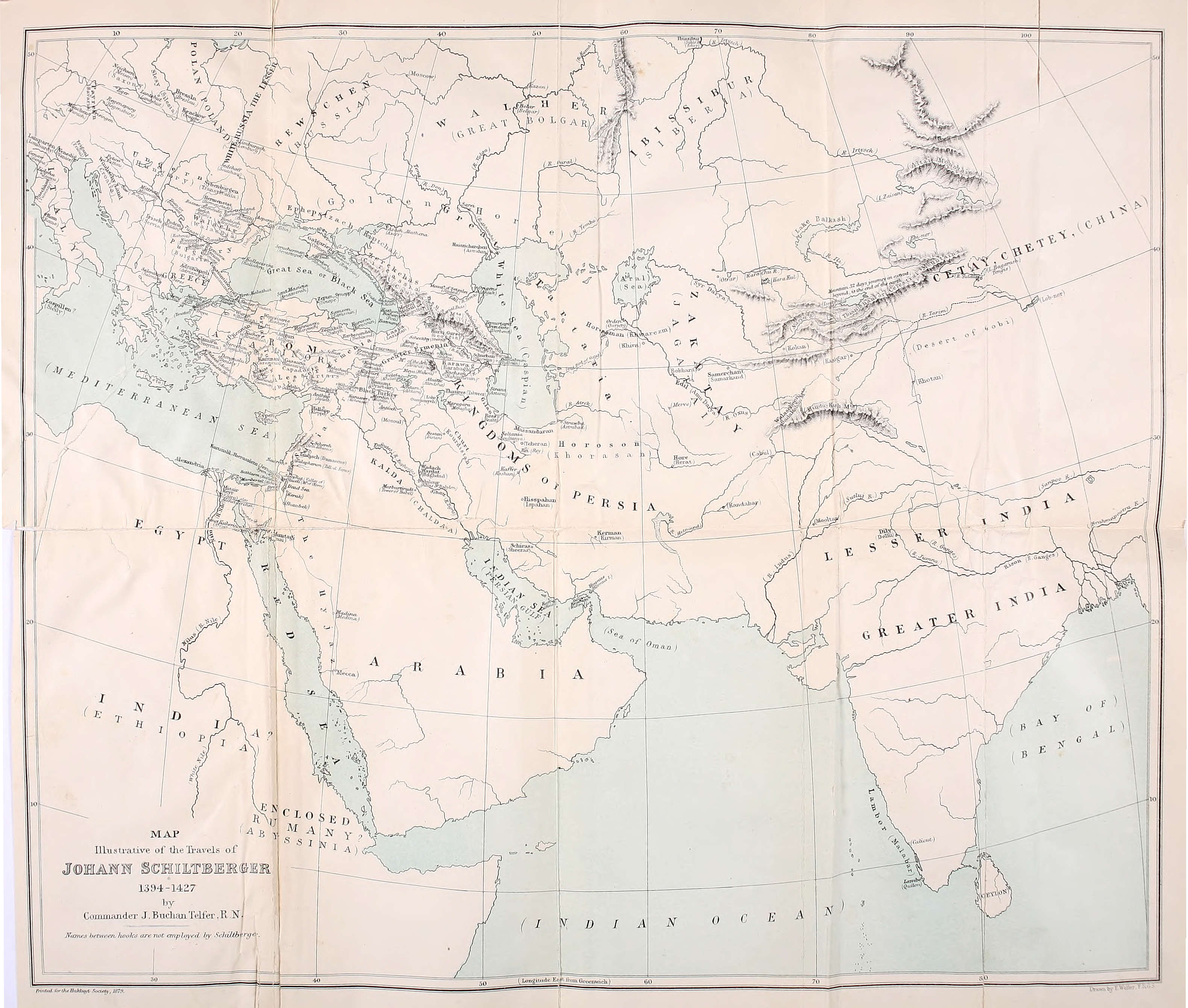
MAP Illustrative of the Travels of Johann Schiltberger 1394-1427 by Commander J. Buchan Telfer. R N. Names between hooks are not employed by Schiltberger.

REPORT FOR 1879.
The Council of the Hakluyt Society have pleasure in being able to report to the Members that their numbers are increasing, and that the funds are in a satisfactory state. The number of effective Members of the Society is now 240.
The attention of the Council has been given to an arrangement which will facilitate the completion of sets of volumes by old Members, and the acquisition of back volumes which they may desire to possess by new Members who may not wish to purchase complete sets. The whole series can now be purchased at the rate of 8s. 6d. a volume; namely, for £24 4s. 6d., the price increasing at the rate of 8s. 6d. as each new volume is added. The same rule applies when a Member requires any portion of the series equal to, or exceeding, a quarter of the whole number of volumes. When a Member requires a single back volume, or any number less than a quarter of the whole series, he may, with the consent of the Council, be supplied at the rate of 10s. each volume.
Since the last Report the following volume has been issued to Members:—
The Hawkins’ Voyages, during the reigns of Henry VIII, Queen Elizabeth, and James I. Edited, with an Introduction, by Clements R. Markham, C.B., F.R.S.
And the following volume is nearly ready for issue:—
The Bondage and Travels of Johann Schiltberger, from his Capture at the Battle of Nicopolis in 1396,
to his Escape and Return to Europe in 1427. Translated and edited by Commander Buchan Telfer, R.N.
Three volumes are in the hands of the printer, namely:—
The Third Volume of the Commentaries of Afonso Dalboquerque. Translated and edited by Walter de Gray Birch, Esq.
The Voyages of John Davis, and his Works on Navigation. Edited by Captain A. H. Markham, R.N.
The Natural History of the Western Indies, by Father Joachim Acosta. Edited by Clements R. Markham, C.B., F.R.S.
Besides the above volumes, which will meet the just demands of the Fellows up to the end of the present year, several other works have been undertaken by editors.
These are:—
Rosmital’s Embassy to England, Spain, etc., in 1466. Edited by R. E. Graves, Esq.
The Journal of the Pilot Gallego, and other Documents relating to the Voyages of Mendaña. Translated and edited by W. A. Tyssen Amherst, Esq.
Narrative of the Portuguese Embassy to Abyssinia in 1520, by Father Francisco Alvarez. Translated and edited by Lord Stanley of Alderley.
A Manuscript History of Bermuda in the British Museum (Sloane, 750). Edited by Lieutenant-General Sir J. Henry Lefroy, K.C.M.G., C.B.
Voyages of Jan Huigen van Linschoten to the East Indies. Edited by Arthur Burnell, Esq., Phil.D.
The Journal of the Jesuit Desideri, during his Mission to Tibet; from the original Manuscript. To be translated and edited by C. E. D. Black, Esq.
The following six Members retire from the Council:—
E. A. Bond, Esq. Admiral Sir Richard Collinson, K.C.B. Augustus W. Franks, Esq. W. E. Frere, Esq., C.M.G. J. Winter Jones, Esq. Sir Charles Nicholson, Bart.
Of these the three first are recommended for re-election, and the names of the following are proposed for election:—
The Earl of Ducie, F.R.S. E. H. Bunbury, Esq. Major-General Sir H. Thuillier, C.S.I., F.R.S.
Statement of the Accounts of the Society from May 1877, to June 1879.
£s.d. £s.d.
Balance left at the Bankers (May 1877)654150Mr. Richards for printing337106
Received by Bankers, May 1877, to June 187962026Messrs. Wyman15190
Mr. Quaritch for a copy of Acosta500
Signor de Gubernatis for the manuscript of Desideri4000
Mr. Coote for transcriptions1047
Mr. Muller for the Barents map1000
Petty cash1000
Cheque books046
—————
428187
Balance at the Bankers8511811
————— —————
£1280176£1280176
————— —————