THE BLUE RAIDER
Reading edition
Cover
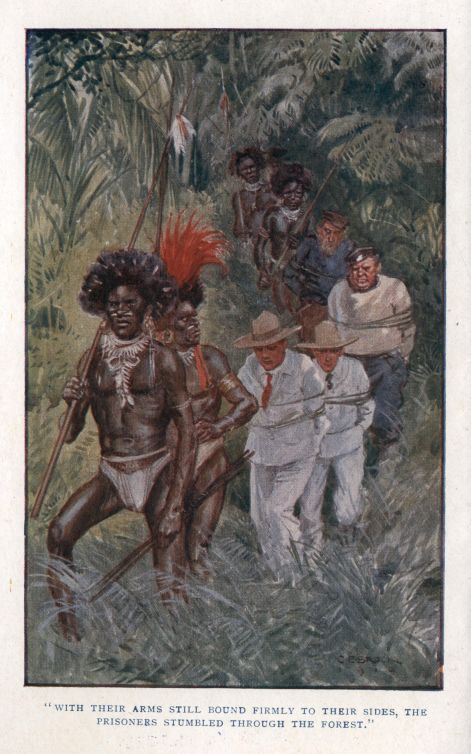
"WITH THEIR ARMS STILL BOUND FIRMLY TO THEIR SIDES, THE PRISONERS STUMBLED THROUGH THE FOREST."
THE BLUE RAIDER
A TALE OF ADVENTURE IN THE SOUTHERN SEAS
BY
HERBERT STRANG
ILLUSTRATED BY C. E. BROCK
HUMPHREY MILFORD OXFORD UNIVERSITY PRESS LONDON, EDINBURGH, GLASGOW TORONTO, MELBOURNE, CAPE TOWN, BOMBAY 1920
HERBERT STRANG
Complete List of Stories
ADVENTURES OF DICK TREVANION, THE ADVENTURES OF HARRY ROCHESTER, THE A GENTLEMAN AT ARMS A HERO OF LIÉGE AIR PATROL, THE AIR SCOUT, THE BARCLAY OF THE GUIDES BLUE RAIDER, THE BOYS OF THE LIGHT BRIGADE BROWN OF MOUKDEN BURTON OF THE FLYING CORPS CARRY ON CRUISE OF THE GYRO-CAR, THE FIGHTING WITH FRENCH FLYING BOAT, THE FRANK FORESTER HUMPHREY BOLD JACK HARDY KING OF THE AIR KOBO LORD OF THE SEAS MOTOR SCOUT, THE OLD MAN OF THE MOUNTAIN, THE ONE OF CLIVE'S HEROES PALM TREE ISLAND ROB THE RANGER ROUND THE WORLD IN SEVEN DAYS SAMBA SETTLERS AND SCOUTS SULTAN JIM SWIFT AND SURE THROUGH THE ENEMY'S LINES TOM BURNABY TOM WILLOUGHBY'S SCOUTS WITH DRAKE ON THE SPANISH MAIN WITH HAIG ON THE SOMME
CONTENTS
A BEACH IN NEW GUINEA
THE DRUMS
THE CHIMNEY
MR. HAAN
IN THE TOILS
THE TOTEM
REMINISCENCES
A RECONNAISSANCE
COMPLICATIONS
THE CAST OF THE DIE
THE ORDEAL OF EPHRAIM MEEK
THE LEDGE
A FORCED LANDING
AN INTERLUDE
DUK-DUK
FLIGHT
THE ATTACK ON THE VILLAGE
THE AVALANCHE
AT ARM'S LENGTH
THE LAST RAID
JUSTICE
LIST OF ILLUSTRATIONS
Frontispiece in Colour
'With their arms still bound firmly to their sides, the prisoners stumbled through the forest.' (See page 97.)
'Come up and have a look at this, Meek'
'Now 's the time!'
Up and up, foot by foot, arrows whizzing and clicking
'Feel better?'
'The Raider!'
A score of dusky natives burst into the ring
Grinson marched in at the head of a procession
'Who says I ain't tattooed?'
With every step the descent became steeper
Kafulu sprang upon Meek from behind
The German flung a pail of water over the unconscious Meek
Noiselessly on his stocking soles tip-toed after the German
One of the Germans raised his revolver, but before he could fire, Hoole launched the spear at him
The leader of the dancers was just approaching when there was a roar, and the whirring propeller set up a hurricane which caught at his dress
Grinson let out a bellow like the blast of a fog-horn, and sprang from the trees, followed by a horde of natives
Grinson gave the boulder a shove in the desired direction
With a thunderous crash it struck the side of the vessel a few feet below the rail
Quickly they set their ladders against the barricade, and began to swarm up
CHAPTER I
A BEACH IN NEW GUINEA
''Tis a matter of twenty-five years since I was in a fix like this 'ere,' said the boatswain, ruminatively, turning a quid in his cheek. 'Ephraim, me lad, you can bear me out?'
'I can't rightly say as I can, Mr. Grinson,' said Ephraim, in his husky voice, 'but I 'll try.'
The boatswain threw a leg over the stern-post of the much-battered ship's boat that lay listed over just beyond the breakers of a rough sea, and cast a glance at the two young men who stood, with hands in pockets, gazing up at the cliffs. Their backs were towards him; they had either not heard, or were disinclined to notice what he had said.
'Ay, 'twas twenty-six year ago,' he resumed, in a voice like the note of an organ pipe. 'We was working between Brisbane and the Solomons, blackbirding and what not; 'twas before your time, young gents, but----'
'What's that you 're saying?' demanded one of the two whose backs he had addressed.
'I was saying, sir, as how I was in a fix like this 'ere twenty-seven year ago, or it may be twenty-eight: Ephraim's got the head for figures. We was working between Brisbane and the Carolines--a tight little schooner she was, light on her heels. You can bear me out, Ephraim?'
'If so be 'twas the same craft, light and tight she was,' Ephraim agreed.
'Well, a tidal wave come along and pitched her clean on to a beach like as this might be--not a beach as you could respect, with bathing-boxes and a promenade, but a narrow strip of a beach, a reg'lar fraud of a beach, under cliffs as high as a church...'
'Say, Grinson, get a move on,' drawled the second of the two younger men. 'What about your beach? How does it help us, anyway?'
'Well, look at the difference, sir. There we was: schooner gone to pieces, a score of us cast ashore, three of us white men, the rest Kanakas. 'Tis thirty years since, but the recollection of them awful days gives me the 'orrors. My two white mates--the Kanakas ate 'em, being 'ungry. I drops a veil over that 'orrible tragedy. Being about a yard less in the waist than I am to-day, I was nimble as a monkey, and went up those cliffs like greased lightning, broke off chunks of rock weighing anything up to half a ton, and pitched 'em down on the Kanakas scrambling up after me, panting for my gore. For three days and nights I kept 'em at bay, and my arms got so used to flinging down rocks that when I was rescued by a boat's crew from a Dutch schooner they kept on a-working regular as a pendulum, and they had to put me in a strait jacket till I was run down. You can bear me out, Ephraim, me lad?'
'I can't exactly remember all them particlers, Mr. Grinson, but truth 's truth, and 'tis true ye 've led a wonderful life, and stranger things have happened to ye--that I will say on my oath.'
'You were one of the two that were eaten, I suppose?' said the young man who had first spoken, eyeing Ephraim with a quizzical smile.
'Gee! That's the part Grinson dropped a veil over,' said the other. 'What's the moral of your pretty fairy story, Grinson?'
'Moral, sir? 'Tis plain.' He opened his brass tobacco-box, and deliberately twisted up another quid. Then he said impressively: 'Dog don't eat dog; otherways we 're all white men, and there 's no Kanakas.'
Phil Trentham laughed, a little ruefully.
'We may have to eat each other yet,' he said. Then, waving his arms towards the cliffs, he added: 'The prospect doesn't please--what do you make of it?'
The situation in which the four men found themselves had certainly no element of cheerfulness. They were the sole survivors from a tramp steamer which, on the previous day, had fallen a prey to a German raider. After a night's tossing in their small open boat, they had been cast up on this unknown shore, and when they examined the craft, marvelled that they escaped with their lives. Collision with a rock that just peeped above the breakers some fifty yards out had stove, in her garboard-strakes, a hole through which a man might creep. Luckily, the bag of ship's biscuits, which, with a keg of water, formed their whole stock of provisions, had not been washed out or injured.
But what of the future? The narrow strip of sandy beach on which they had been thrown stretched along the foot of high precipitous cliffs that showed a concave arc to the sea. At each horn a rocky headland jutted far out, its base washed high by the waves. The cliffs were rugged and appeared unscalable, even with the aid of the tufts of vegetation that sprouted here and there from fissures in their weather-beaten face. It seemed that they were shut in between the cliffs and the sea, penned between the headlands, confined to this strip of sand, perhaps two miles long, from which there was apparently no landward exit. Their boat was unseaworthy; there was no way of escape by land or sea.
Phil Trentham, working copra on a remote island of the South Pacific, had learnt of the outbreak of war some months after the event, and taken passage on the first steamer that called, intending to land at the nearest port and thence to make his way to some centre of enlistment. Among the few passengers he had chummed up with a young fellow about his own age--one Gordon P. Hoole, who hailed from Cincinnati, had plenty of money, and was touring the Pacific Islands in tramp steamers for amusement. Each was in his twentieth year, stood about five feet ten, and wore a suit of ducks and a cowboy hat; there the likeness between them ended. Trentham was fair, Hoole dark. The former had full ruddy cheeks, broad shoulders, and massive arms and calves; the latter was lean and rather sallow, more wiry than muscular. Trentham parted his hair; Hoole's rose erect from his brow like a short thick thatch. Both had firm lips and jaws, and their eyes, unlike in colour, were keen with intelligence and quick with humour.
Their two companions in misfortune presented an odd contrast to them and to each other. Josiah Grinson, forty-eight years of age, was five feet six in height, immensely broad, with a girth of nearly sixty inches, arms as thick as an average man's legs, and legs like an elephant's. His broad, deeply bronzed face, in the midst of which a small nose, over a long clean upper lip, looked strangely disproportionate, was fringed with a thick mass of wiry black hair. Little eyes of steely blue gazed out upon the world with a hard unwinking stare. He wore a dirty white sweater, much-patched blue trousers, and long boots. His big voice was somewhat monotonous in intonation, and he had been known to doze in the middle of a sentence, wake up and continue without a flaw in the construction.
Ephraim Meek, who had been mate to Grinson's boatswain for about a quarter of a century, was a head taller, but lost the advantage of his inches through a forward stoop of his gaunt frame. Where Grinson was convex Meek was concave. His hollow cheeks were covered with straggling, mouse-coloured hair; his long thin nose made him look more inquisitive than he really was; his faded grey eyes, slightly asquint, seemed to be drawn as by a magnet to the countenance of his superior. Meek was a whole-hearted admirer of the boatswain, and their long association was marred by only one thing--a perpetual struggle between Meek's personal devotion and his conscientious regard for veracity. No one knew what pangs Grinson's frequent appeals to 'Ephraim, me lad,' to 'bear him out' cost the anxious man. But he had always managed to satisfy the boatswain without undue violence to his own scruples, and Grinson had never felt the strain.
'What do I make of it?' repeated Hoole. 'Nix!'
'Where do you suppose we are, Grinson?' asked Trentham.
'I ain't good at supposing, sir, but I know we 're somewheres on the north coast of New Guinea,' Grinson replied. 'Which I mean to say it's inhabited by cannibals, and I was nearly eat once myself. 'Twas twenty or maybe twenty-one years ago, when----'
'By and by, Grinson,' interrupted Trentham. 'It's a gruesome story, no doubt, and we 'll fumigate it with our last go-to-bed pipe.'
'Just so,' Hoole put in. 'I guess we 'd better explore. It don't feel good on this beach.'
'Certainly. To save time we 'd better split up. You take Grinson and go one way; I 'll go the other with Meek. Whoever sees a way up the cliffs, signal to the others.'
They paired off, and walked in opposite directions along the sand. A line of seaweed some thirty feet from the cliffs indicated high-water mark, and relieved them of any fear of being engulfed by the tide.
Trentham and Meek had struck off to the west, and as they went along they scanned the rugged face of the cliffs for a place where it would be possible to scale them. For nearly half a mile they roamed on in silence; Meek was one of those persons who do not invite conversation. Then, however, the seaman came to a halt.
'I wouldn't swear to it, sir,' he said in his deprecating way, 'but if you 'll slew your eyes a point or two off the cliffs, I do believe you 'll see the stump of a mast.'
He raised his lank hand and pointed.
'That won't help us much,' said Trentham, looking towards a pocket of sand some distance above high-water mark, and surrounded by straggling bushes. 'We can't sail off in a wreck.'
'That's true as gospel, sir, but it came into my mind, like, that where there 's a mast there 's a hull, and p'r'aps it 'll give us a doss-house for the night.'
'It 'll be choked with sand. Still, we 'll have a look at it.'
They walked towards the spot where four or five feet of a jagged mast stood up apparently from the embedding sand. As they emerged from the surrounding bushes they discovered parts of the bulwarks projecting a few inches above a mound of silted-up sand, a little higher than their heads. Clambering up the easiest slope, and stepping over the rotting woodwork, Trentham gave a low whistle of surprise.
'Come up and have a look at this, Meek,' he said to the man standing in his bent-kneed attitude below.
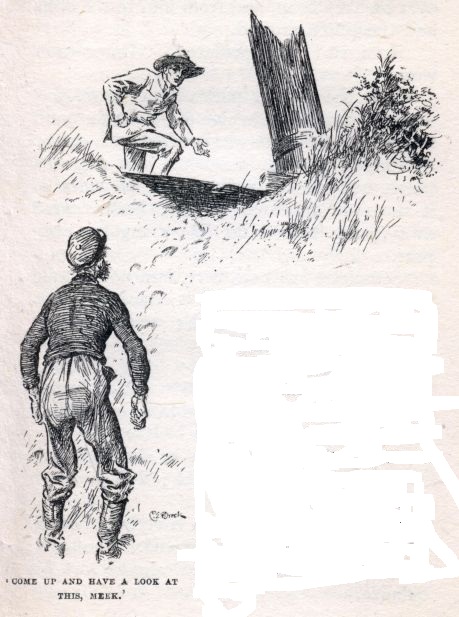
'COME UP AND HAVE A LOOK AT THIS, MEEK.'
Meek came to his side, and drew his fingers through his thin whiskers as he contemplated the scene before him. Then he turned his eyes on Trentham, and from him to the cliffs and the beach around.
'Rum, sir!' he ejaculated. 'Uncommon rum!'
While the greater part of the vessel was deep in sand, a certain area of the deck around the base of the mast was covered with only a thin layer, through which the iron ring of a hatch was clearly visible. On all sides of it the sand appeared to have been cleared away, and heaped up like a regular rampart.
'Some one has been here, and not so long ago,' said Trentham. 'It's certainly queer. See if you can lift the hatch; we may as well go below.'
Meek hesitated.
'If so be there 's cannibals----' he began.
'Nonsense! They wouldn't be stifling under hatches.'
'Or maybe dead corpses or skellingtons.'
'Come, pull up the hatch; I 'll go down first.'
Brushing away the thin covering of sand, Meek seized the ring and heaved. The hatch came up so easily that he almost lost his balance.
'The stairway 's quite sound,' said Trentham, peering into the depths. 'Stand by!'
He stepped upon the companion, and descended. In a few seconds Meek heard the striking of a match, and Trentham's voice ringing out of the vault.
'Come down, Meek; there are no skeletons.'
Meek looked around timorously, sighed, and went slowly down the ladder. Trentham had just struck another match, and was holding it aloft. The flame disclosed a small cabin, the floor space almost filled with a massive table and three chairs of antique make, all of dark oak. Upon the table lay an old sextant, a long leather-bound telescope, a large mug of silver-gilt, heavily chased, a silver spoon, and several smaller objects. On the wall hung a large engraved portrait in a carved oak frame, representing a stout, hook-nosed, heavily wigged gentleman in eighteenth century costume, with a sash across the shoulder and many stars and decorations on the breast.
Meek breathed heavily. The match went out.
'I can't afford to use all my matches,' said Trentham. 'Run up and cut a branch from a bush; that'll serve for a torch for the present. And signal to the others.'
'I don't hardly like to say it, sir, but I 'm afeard as my weak voice won't reach so far.'
'My good man, you 've got long arms. Wave 'em about. Climb up the mast. Use your gumption!'
Meek mounted to the deck, and Trentham smiled as he heard a husky voice shouting, 'Ahoy!' After some minutes the man returned with a thick dry branch.
'I give a hail, sir, and flung my arms about frantic, and Mr. Grinson, he seed me. I can't say he heard me, not being sure. He 've a wonderful voice himself--wonderful, and I heard him answer as clear as a bell.'
'That's all right!' said Trentham, lighting the branch. 'We 've made a discovery, Meek.'
'Seemingly, sir. I 'm fair mazed, and that's the truth of it. Who might be the old soldier yonder, and what's he wear that thing on his head for? He ain't a sea captain, that I 'll swear, and I wonder at any sailor-man sticking up a soldier's picture in his cabin.'
'You 're quite right, Meek,' replied Trentham, who had been scrutinising the portrait. 'The old soldier, as you call him, is a king.'
'You don't say so, sir! Where's his crown, then?'
'Ah, I wonder where! The poor man lost his crown and his head too. It's Louis XVI., King of France a hundred years ago and more. Here it is in French, below the engraving: "Engraved after the portrait by Champfleury." We 're in a French vessel, Meek--the ship of some French explorer, no doubt, who was wrecked here goodness knows how many years ago.'
Meek looked around again, and slightly shivered.
'I wonder what they did with the bones?' he murmured.
'What bones?'
'The cannibals, I mean, sir, when they 'd eat the captain and crew.'
'You 've a ghastly imagination, Meek. A question more to the point is, how it happens that these things remain here, so well preserved. There 's very little sand on the floor, as you see; any one would think that somebody comes here now and then to tidy up. Would your cannibals do that, do you think?'
'I wouldn't like to say, sir. I 'll ask Mr. Grinson; he knows 'em, being nearly eat himself. But I don't know who 'd have a good word for cannibals.'
'At any rate, they aren't thieves. This mug, for instance, is silver gilt, and of some value; here 's a coat-of-arms engraved on it, and it must have been polished not very long ago. Yes, it has been rubbed with sand; look at the slight scratches. I 'm beginning to think rather well of your cannibals.'
'Touch wood, sir,' said Meek earnestly. 'I wouldn't say a thing like that, not till I knowed. And as for thieves--well, if a man's bad enough to eat another man, he 's bad enough to be a thief, and if he ain't a thief, 'tis because he don't know the vally of things. Ignorance is a terrible unfortunate calamity.'
A sonorous bellow from above caused Meek to jump.
'There, now!' he said. 'My head 's full of cannibals, and 'tis Mr. Grinson. We 're down below!' he called.
'Is the place afire?' asked Grinson, sniffing, as he bent his head over the hatchway. 'I thought 'twas Mr. Trentham smoking when I seed the smoke, but I see you 're disinfecting the cabin, sir, and I don't wonder. This 'ere wreck must have been collecting germs a good few years.'
'Come down, Grinson,' said Trentham. 'Where 's Mr. Hoole?'
'Taking a look up the chimbley, sir.'
'What chimney?'
'Well, that's what he called it; for myself I 'd call it a crack.' He came ponderously down the ladder. 'Jiminy! Ephraim, me lad, you never tidied up so quick in your life before.'
'I can't truthfully say as I tidied up, Mr. Grinson,' said Meek. ''Tis uncommon tidy for a cabin, that's a fact.'
'Picters, too! The master o' this 'ere ship must have been a rum cove!'
'He was a Frenchman, Mr. Trentham says.'
'That accounts for it. I remember a French captain----'
The chimney, Grinson,' Trentham interrupted. 'You haven't explained----'
'True, sir; it was took out of my mind, seeing things what I didn't expect. As we come along, sir, Mr. Hoole he says: "Ain't that a chimbley?" "Where?" says I, not seeing no pot nor cowl. "There!" says he, and he points to what I 'd call a long crack in the cliff.'
'Where is it?'
'About half a cable length astern, sir. Mr. Hoole went to have a look at it. Here he is!'
'Phew! That torch of yours is rather a stinker!' said Hoole, springing lightly down the ladder. 'My! This is interesting, Trentham. I wondered where the path led.'
'You 've found a path?'
'Sure! Didn't you see it?'
'No. The fact is, Meek and I were so much taken up with the wreck that we forgot everything else. But we didn't see any footprints in the sand.'
'There are none about here, except yours. The path is way back a few yards. I caught sight of a narrow fissure in the cliff, what we call a chimney in the Rockies. I pushed through the undergrowth to take a keek at it, and came upon distinct signs of a beaten track, leading straight to the chimney. That's barely wide enough to admit a man; Grinson would stick, I guess; but 'tis surely used as a passage. There are notches cut in the cliff at regular intervals.'
'Then we can get away?'
'Sure! All but Grinson, that is. We 'd have to leave him behind.'
'Don't say so, sir,' said Meek. 'Mr. Grinson 's not so fat as he was--not by a long way. I 'm afeard if he stays, I must stay too.'
'Thank 'ee, Ephraim, me lad,' said Grinson warmly. 'But Mr. Hoole is pulling my leg. You take him too serious; he 's a gentleman as will have his joke. He wouldn' go for to desert two poor seamen.'
'I never could understand a joke--never!' said Meek. ''Tis a misfortune, but so I was born.'
Hoole and Trentham, meanwhile, had been examining the relics and discussing the bearing of their discoveries on the situation.
'It's quite clear that the wreck is visited,' said Trentham.
'By natives, of course. Why? How often? It doesn't matter much, except that if we saw them, we might get a notion as to whether we could safely go among them and get their help. You are sure the chimney is climbable?'
'Certain. The notches are deep, and you could set your back against the opposite wall and climb without using your hands.'
'I 'll have a look at it. Then we had better go back to our boat, get some grub, and talk things over. It's too late to go in for further adventures to-day.'
'That's so. Say, I 'd leave the hatch off for a while. The place reeks--it would give us away.'
'Right! We 'll clear out. The men can keep guard above while we 're examining that chimney.'
CHAPTER II
THE DRUMS
An hour later they were seated in the boat, nibbling biscuits and taking turns to sip at the water in their keg.
'Now that we 've proved that Grinson can just squeeze into the chimney,' said Hoole, 'I guess we had better climb to-morrow and take a look round. But what then? What do you know about this blamed island, Grinson?'
'Not as much as you could stuff into a pipe, in a manner of speaking,' said Grinson. 'A few years ago I spent a couple of weeks in Moresby and round about--you can bear me out, Ephraim, me lad--and I know no more than what I picked up there. That's on the south-east: we 're on the north, on what's German ground, or was; and by all that's said, the Germans never took much trouble to do more than hoist their flag. They 've got a port somewhere, but whether we 're east of it or west of it, I don't know no more than the dead.'
'So when we climb, we shan't know which way to go,' said Trentham. 'Yet our only chance is to make along the coast till we reach some white settlement, unless we could manage to attract attention on some passing ship. You don't know what the natives are like hereabout?'
'No, sir. They do say there 's little chaps about two feet high in the forests, but I never seed 'em. The folks on the coast ain't so little, and down Moresby way they 've learnt to behave decent; but I reckon they 're pretty wild in other parts, and I know some of 'em are 'orrid cannibals, 'cos I was nearly eat myself once. We was lying becalmed off the Dutch coast, away in the west of this 'ere island, and some of us had gone ashore for water, and----'
'What's that noise?' exclaimed Hoole, springing up.
A faint purring sound came to their ears.
'It's uncommonly like an aeroplane engine,' said Trentham. 'It would be rather fun to be taken off in an aeroplane.'
'Never in life!' said Meek mournfully. 'It 'ud turn my weak head.'
'Your head will be quite safe, Meek,' said Trentham. 'The only aeroplane that's likely to be in these latitudes is the one that scouted for the German raider. Our poor captain guessed what was coming when he saw the thing, and three hours afterwards they got us, and he was dead.'
'There it is!' cried Hoole, pointing sea-ward.
They were just able to discern the machine, little more than a speck, flying along from west to east. In a few minutes it had disappeared.
'Flying after other game,' said Trentham. 'You were saying, Grinson?'
'And I got parted from the rest, through chasing a butterfly, which I was always a stoodent of nature. I had just nabbed a lovely pink 'un with gold spots, when a crowd of naked savages surrounded me, their faces hidjous with paint, and their spears pointing at me like the spokes of a wheel. Not having my pistol with me, I couldn't shoot 'em all down one after another, so I offered 'em the butterfly, then a brass button, and one or two other little things I had about me, which any decent nigger would 'a been thankful for. But no! Nothing but my gore would satisfy 'em, or rather my fat, for I was in them days twice the size I am now. You can bear me out, Ephraim, me lad?'
'I wouldn't be sure 'twas exactly twice, Mr. Grinson, but not far short--a pound or so under, p'r'aps.'
'I thought my last hour was come, and it came on me sudden that I hadn't made my will----'
'There 's a smudge of smoke far out,' cried Hoole. 'If we get on a rock and wave our shirts, somebody 'll see us.'
They looked eagerly out to sea. A steamer, just distinguishable on the horizon, was proceeding in the same direction as the aeroplane they had noticed a few minutes before. Grinson put up his hands to shade his eyes as he gazed.
'If I had a pair of glasses, or that there telescope in the wreck! Ah! I may be wrong, but I believe 'tis that ruffian of a pirate as sunk our craft yesterday. Seems to me we 'd better keep our shirts on our backs, sir.'
'I dare say you 're right,' said Hoole. 'For my part I 'd rather try my luck with cannibals than with those Germans again.'
'Which I agree with you, sir,' said Grinson. 'With luck, or I may say gumption, you can escape from cannibals, like I did.'
'Ah, yes. How did you get out of that ring of spears?'
The boatswain took such pleasure in retailing his yarns that the two young men gave him plenty of rope.
'I was fair upset at not having made my will, thinking of how the lawyers would fight over my remains, in a manner of speaking. So I takes out my pocket-book and my fountain pen, and with a steady hand I begins to write. It shows what comes of a man doing his dooty. Them cannibals was struck all of a heap when they seed black water oozing out of a stick. They lowered the points of their spears, and, instead of being a circle, they formed up three deep behind me, looking over my shoulder. It come into my head they took me for a medicine-man, and the dawn of a great hope lit up my pearly eyes.'
'Where did you get that, Grinson?' asked Hoole.
'What, sir?'
'That about "pearly eyes" and the rest.'
'Oh, that! It took my fancy in a nice little story called Lord Lyle's Revenge as a kind lady once give me, and I 've never forgot it. Well, as I was saying, I set to droring a portrait of the ugliest mug among 'em--fuzzy hair, nose bones and all--they a-watching me all the time with bated breath; and when I 'd put in the finishing stroke, blest if every man Jack of 'em didn't begin to quarrel about whose photo it was. Never did you hear such a hullabaloo. Fixing of 'em with my eagle eye, I waved 'em back like as if I was shooing geese, took a pin from my weskit and stuck the portrait on a tree, and told 'em to fight it out who was the ugliest of 'em, 'cos he was the owner. The cannibals made a rush for the tree, every one of 'em trying to prevent the rest from getting the picture, and I lit my pipe and walked away as steady as a bobby on dooty. You can bear me out, Ephraim, me lad?'
'Wonderful steady you was, Mr. Grinson, and the bottle of rum empty too. I couldn't have walked so steady. The other chaps said as how you 'd been taking a nap, but I never believed 'em.'
'Never go napping on dooty, Ephraim; which I mean to say we 'll have to take watch and watch to-night, gentlemen. What with cannibals and them big hermit crabs and other vermin, 'twouldn't be safe for us all to have our peepers shut.'
'Very true, Grinson,' said Trentham. 'The boat's rather exposed: you had better choose a spot on the beach where we can shelter for the night. There are some rocks yonder that look promising. Then we 'll arrange about watching.'
Grinson and Meek went off together; the others meanwhile strolled up and down, discussing plans for the morrow.
'We 're so badly off,' said Trentham. 'You 've luckily got your revolver; any spare cartridges?'
'A score or so.'
'I 've only a penknife, worse luck. Grinson has a long knife, and Meek, no doubt, has a knife of some sort; but three knives and a revolver won't enable us to put up much of a fight if we really do come across any cannibals.'
'And I guess that fountain pens and pocket books won't be much good. We couldn't patch up the boat?'
'Without tools? Besides, I shouldn't care to risk a voyage. We may have a chance of reaching some settlement overland, and I dare say could pick up some food; but on the sea we might drift for weeks, even if we could exist on our few biscuits and little water.'
'Well, old man, we 'll get what sleep we can and try the chimney in the morning. The sky promises fair weather, anyway; did you ever see such a splendid sunset?'
They were facing west, and beyond the headland the sun, a gorgeous ball of fire, was casting a blood-red glow on the scarcely rippling sea. On the cliffs the leaves of the palms were edged with crimson, and flickered like flames as they were gently stirred by the breeze. The two friends stood side by side, silently watching the magnificent panorama. Suddenly Hoole caught Trentham by the arm, and pulled him down behind a rock.
'My sakes!' he exclaimed under his breath. 'D' you see people moving between the wreck and the cliff?'
Trentham took off his hat and peered cautiously over the rocks.
'You 're right,' he said. 'It's not easy to make 'em out; they 're in the shadow of the headland; we 're a good mile away, I fancy. They can't see us at present, but we had better warn the others; the sun as it moves round will strike us presently.'
They returned to the spot which Grinson had selected for their camping place--a space of clear sand protected on one side by a group of rocks and on the other by a clump of bushes spreading from the base of the cliffs. Meek had already brought up their scanty stores from the boat; Grinson had stripped off his jersey and shirt.
'If you 'll take my advice, gentlemen,' he said, 'you 'll swill the sticky off--you 'll sleep all the better for it. Bathing all in I wouldn't advise, in case of sharks.'
'Shall we get any sleep, I wonder?' said Trentham. 'There are men on the beach, Grinson.'
'Men, sir?'
'Cannibals!' murmured Meek.
'We saw figures moving between the wreck and the cliff.'
'Holy poker!' exclaimed the boatswain, rapidly drawing on his shirt. Trentham noticed momentarily the figure of a bird tattooed on his upper left arm. 'Hope they don't come this way.'
'Why shouldn't we take the bull by the horns and go their way?' said Hoole. 'I 'll tackle 'em, if you like. You don't know but we 'd make friends of them.'
'Not by no manner of means, sir, I beg you,' said Grinson. 'The New Guinea savages are the fiercest in creation; Ephraim can bear me out; cunning as the devil, and that treacherous. The tales I could tell! But I wouldn't freeze your blood, not for the world; all I say is, keep out of their clutches.'
'Where can we hide, if so be they come this way?' faltered Meek.
'There 's nothing to bring them along this bare beach,' said Trentham. 'They won't see us if we remain here; I doubt whether they 'll even see the boat. No doubt they 'll be gone by the morning.'
'Just so,' said Hoole. 'Still, we 've got to meet them some time, probably----'
'Better by daylight, sir,' said Grinson. 'Wild beasts and savages are always most fearsome at night. I say, lay low.'
'As low as you can,' Meek added.
The glow of sunset faded, and in the deepening shade the figures were no longer visible. The four men sat in their shelter, talking in undertones, none of them disposed to sleep. For a while only the slow tumbling surf bore a murmurous counterpoint to their voices. All at once a dull boom struck upon their ears. It was not the explosive boom of a gun, but a deep prolonged note. Soon it was followed by a similar sound, at a slightly higher pitch, and the two notes alternated at regular intervals.
'Drums, by the powers!' ejaculated Grinson. ''Tis a dance, or a feast, or both.'
'A mighty slow dance,' said Hoole. 'I 'd fall asleep between the steps.'
But even as he spoke the sounds became louder and more rapid, and presently in the midst of the now continuous booming a voice was heard, chanting in monotone. Into this broke a deeper growling note as from many voices in unison, and after the song and accompaniment had continued for some time with ever-increasing vigour and volume, they came to a sudden end in a short series of strident barks, half smothered by the clamour of the drums.
The four men had risen, and leaning on the rocks, with their faces towards the sounds, had listened to the strange chorus.
'It's extraordinarily thrilling,' said Trentham. 'I 'd never have believed that drums could make such music.'
'It trickles down my spine,' Hoole confessed. 'And they 're pretty nearly a mile away. What must it be on the spot? Say, if they start again, shall we creep along and see?'
'I 'm game. Look! They 've lit a fire. There's some ceremony on hand--not a thing to be missed.'
'Which means a feast, sir,' said Grinson. 'If you ask me, I say don't go. It 'll turn your blood.'
'Special if 'tis a man they eat,' said Meek.
'You two stay home; Mr. Trentham and I will go,' said Hoole. 'The rocks and scrub will give plenty of cover; besides, the feasters will be busy. We 'll be unseen spectators in the gallery.'
Heedless of the further expostulations of the seamen, Trentham and Hoole set off, and keeping well under the shadow of the cliffs, tramped rapidly towards the growing blaze. As they drew nearer to it, they moved with greater caution, careful not to come directly within the glow. The drums recommenced their slow tapping, and when the white men arrived at a spot where, screened by the bushes, they could see unseen, the dance had just begun.
The fire was kindled on a clear space between the wreck and the vegetation that clothed the foot of the cliffs. Beyond it, nearer the vessel, about twenty natives were stamping in time with the two drums, placed at one end of the line. They were men of average height, well built, but rather thin in the legs, wearing fantastic head-dresses, bone or coral necklaces and armlets, and scanty loin-cloths. The watchers were at once struck by certain differences in the types of feature. All the savages were a dull black in colour, except where they had painted their skins white or red, but while the majority had wide bridgeless noses and frizzy hair, there were some whose noses were arched, and whose hair, though curled, was neither stiff nor bushy. Every face was disfigured by a long skewer of bone passed through the nose.
The dance was disappointing. The men did little more than stamp up and down, swaying a little now and then, stepping a pace or two forward or backward, shaking their spears, and emitting a grunt. There was no excitement, no crescendo of martial fury.
'A very tame performance!' whispered Hoole.
But Trentham was no longer watching the dance. Beyond the dancers, only occasionally visible as they moved, there was something that had fixed his attention. He could not quite determine what it was, but a suspicion was troubling him. Between the swaying figures there appeared, now and again, a whitish object partially obscured by bush, and barely within the circle of light from the fire. It was motionless, but the fugitive glimpses that Trentham caught of it made him more and more uneasy.
'You see that white thing?' he whispered, taking Hoole by the arm.
'Yep! What of it?'
Trentham pressed his arm more closely. The dancers had moved a little farther apart, and for the first time the object behind them was completely outlined.
'By gum, it's a man!' murmured Hoole.
'And a white man!' added Trentham. 'I was afraid so.'
CHAPTER III
THE CHIMNEY
Noiselessly the two spectators slipped away through the bushes. Startled by the discovery of a white man, whose very stillness declared him a prisoner in bonds among these dancing savages, they felt the need of talking freely, unrestrained by precautions against being overheard. They hurried along at the base of the cliffs until they were out of earshot, then sat on a low rock where they could still see all that went on around the fire.
'Can it be that planter fellow on the Berenisa? What was his name?' said Trentham.
'You mean Grimshaw; he was the only man besides ourselves who wore ducks. I don't know. Grimshaw was a small man; the prisoner seemed a big fellow. I couldn't see his face.'
'Nor I. Whoever it is, I 'm afraid his number 's up.'
'I didn't take much stock of Grinson's yarns about cannibals, but it appears he 's right. The niggers would hardly bring their prisoner down the chimney for the fun of it, or the trouble of taking him up again.'
'Did you see a cooking-pot?'
'No, I was too busy watching the dancers to look around.'
'We 'll have to get him away.'
'Whew! That's a tall proposition, Trentham.'
'Confoundedly; but we can't stand off and see a white man cut up! Hang it all, Hoole, it's too horrible to think about!'
'Ghastly. Yet remember where we are. We might get him loose, but what then? They 'd hunt us over this strip of beach, and we 've proved pretty well there 's nowhere to hide.'
'Our only chance is to get him up the chimney.'
'My dear man!'
'It may be out of the frying-pan into the fire, if there are more of the savages on top, but down below his fate is certain, whereas----'
'But there 's the climbing. I 've done some in the Rockies, but I guess you 're a tenderfoot at mountaineering, and as for the seamen----'
'If they can scramble up rigging, they ought to be able to manage that chimney. I 'm sure I could. And really, there 's no time to lose. They 're still drumming and dancing, but who knows when they 'll feel hungry? We had better bring up the others at once.'
They got up, and hastened towards their camping-place.
'It's the first step that costs,' remarked Hoole. 'How to get him away with the firelight full on him. It's a ticklish stunt.'
'We can but try--we must try! Hullo! Here 's Grinson.'
The two seamen stepped towards them from the shelter of a bush.
'We came to meet you, sir,' Grinson began.
'Hush, Grinson!' said Trentham. 'Muffle that organ-pipe of yours. The savages have got a white man.'
'Never!' exclaimed Meek, in husky astonishment.
'He 's lying tied to a bush there, apparently,' Trentham went on. 'A man dressed in white.'
'Mr. Grimshaw! How did they get him?' said Grinson. 'He must have been cast ashore.'
'We don't think it's he, but it may be. Anyhow, we must try to rescue him.'
'Save us, sir! We 'll only go into the pot too. It will be like taking a bone from a dog, only worse.'
'Worse ain't the word for it,' said Meek. 'And you 'd go first, Mr. Grinson, being a man of flesh.'
'Tough, Ephraim--uncommon tough, me lad. Any nigger of sense would rather have something young and juicy, like Mr. Trentham. I remember once----'
'Not now, Grinson,' Trentham interposed. 'We must make up our minds; there 's no time for recollections.'
'Plenty of time, sir. These 'ere cannibals never start cooking till the moon 's high aloft, and she 's only just peeping above the skyline.'
'That's a relief, if you 're right----'
'I can bear him out, sir,' said Meek.
'It gives us more time to make our plans. Our idea is, Grinson, if we get the prisoner away, to climb up that crack in the cliff; there's no safety below. There may be danger above, of course; it's a choice between two evils. We meant to try our luck to-morrow, you know; we only anticipate by a few hours, and though climbing will be more difficult in the darkness than it would be in the light, you and Meek are used to clambering up the rigging at all hours and in all weathers----'
'Say no more about that, sir. We 'd back ourselves against cats.'
'Or monkeys,' suggested Meek.
'You 've got no tail, Ephraim. 'Tis not the climbing as I 've any fear about, sir; 'tis first the bonfire, second what's up top, third and last--there ain't no third, now I come to think of it.'
'The second we 've agreed to chance. The first--well, the only thing is to work round the savages and get between them and the chimney; then one of us must creep or crawl as close to them as he can, and watch his opportunity. There's no need for more than one.'
'That's my stunt,' said Hoole.
'Not at all. It's between you and me; we 're younger and quicker on our pins than the others; but why you should have the most risky part of the job----'
'The reason 's as clear as daylight. The quickest climber ought to go last. I allow that Grinson and Meek are probably more spry than I am in climbing; but in any case they 're ruled out. You 've never climbed a chimney--I have. I think that fixes it.'
'But the prisoner. It's unlikely he can climb quickly, and the last man couldn't go faster than he.'
'You ought to have been a lawyer, Trentham. But I have you yet. The last man may have to hold the savages off while the prisoner, slow by hypothesis, does his climb. Then speed will be vital when he climbs himself--see?'
'Axing your pardon, sir, and speaking like a father, as you may say,' said Grinson, 'there 's only one way of settling a little difference so 's to satisfy both parties. I 've seed many a quarrel nipped in the bud----'
'A quarrel, you juggins!' cried Trentham. 'There 's no quarrel!'
'Just so, sir--that's what I said. It's a difference, and a difference can't never grow to be a quarrel if you just toss for it.'
'There 's our Solomon!' said Hoole. 'Spin up, Trentham!'
The rising moon gave light enough. Trentham spun a shilling.
'Heads!' Hoole called.
'Tails it is! That's settled!'
''Tis fate: you can't go agen it,' murmured Meek.
'Those fellows must be pretty tired, drumming away like that,' said Trentham. 'But we had better make a start, Grinson. I think we ought to take our biscuits and water: they 'll last us a day or two, and we don't know what chances of getting food there 'll be on the cliff. You and Meek fetch them along. We 'll wait for you here.'
'They took it well,' said Hoole, when the men had gone. 'I was afraid Meek would jib.'
'Meek 's all right,' responded Trentham. 'The British sailor-man has his weak points, but he 's not a funk.'
He began to stride up and down with his hands in his pockets. Hoole watched him for half a minute or so, then said:
'You 'd better take my revolver.'
'Why in the world?' said Trentham, swinging round on him.
'It may be useful--last resource, you know.'
'If we can't do without that---- Why, man, a shot would absolutely dish us, would be heard for miles, and bring up every cannibal there is. This job has got to be done quietly.'
'I reckon there 'll be a pretty big row when they miss their supper. Well, if you won't take it, remember I 've got it, anyway.'
Some fifteen minutes later the four men, in single file, were stealing along the inner edge of the beach, close against the cliffs. Trentham, who was leading, took a zigzag course for the sake of cover from the scattered rocks and patches of vegetation. The seamen in the rear had slung the provisions about their shoulders with lashings from the boat, and on their account Trentham set a slower pace than his anxiety to be in time would otherwise have commended. The fire was burning more brightly, whiffs of acrid smoke were borne on the breeze, and the moon, about ten days old, appeared to have reached its greatest altitude, and was accentuating every irregularity on the face of the cliffs.
As they drew nearer to the fire, Trentham moved still more slowly, picking his way with care. Now and then some small animal, with a whisk and a rustle, scurried away in the undergrowth. Once Meek, who bore the keg, tripped over what he declared was a monster crab, and fell forward, the keg hitting a rock with a sharp crack. The rest halted and held their breath; had the sound been heard by the savages? The monotonous drumming continued unbroken, and they went on.
Between the fire and the cleft that was their destination, grew the tangled vegetation in which Hoole had discovered the track of footsteps. It grew higher than their heads, and they were able to enter it without much risk of being observed. A few whispered words were exchanged between Trentham and Hoole, then the latter led the seamen towards the chimney, which stretched upwards like a black streak in the moonlit precipice, while Trentham struck to the left, and crept cautiously towards the outer edge of the bushes, where he could look out upon the festive scene.
His heart seemed to be making more noise than the drums. His lips were dry. The skin of his face felt tight. 'Nerves!' he thought, with angry impatience. It was strange how, without the slightest consciousness of fear, his mental realisation of all that was at stake thus affected his body. Taking a grip of himself, he went forward and peered through the stiff crinkled foliage. For a few moments he saw nothing but the glare of the fire; then, as he gathered self-command, he was able to take in details which he had missed at his view a short while before.
The dancers were still swaying to and fro. At one side, crouched on the sand, were two men holding in one hand an object like a huge dice-box, and with the other beating a skin, as he supposed, stretched across the circular end. At the other side, near the fire, stood two iron cooking-pots. Beyond, in the same place, lay the motionless white figure. Everything was clearly illuminated by the flames, and Trentham wondered, with a feeling of despair, how it would be possible to approach the prisoner unseen.
A few minutes after his arrival, the dance and the drumming came to an abrupt end. In the ensuing silence he heard the wash of the waves beyond the wreck, and a strange squealing grunt which, until then, had been drowned by the deep tones of the drums and the barking cries of the men. One of the savages, who wore a tall feathered headdress, glanced up at the moon, and said a few words to the others. All of them squatted on the sand except two, who went to the bush, some twenty yards away, to which the prisoner was bound. Trentham's blood ran cold. He wished he had brought Hoole's revolver, for it seemed that nothing else could save the helpless man, and he was on the point of shouting for Hoole, when a piercing squeal, such as no human being ever uttered, gave him at once a shock and a sense of relief. Next moment the savages returned towards the fire, one of them carrying the body of a small pig.
Trentham almost laughed as the tension of the last few moments was relaxed. The men were not cannibals after all! He looked on as in a dream while one of the men cut up the animal, and the other raked over the fire with a spear. But with reflection his former anxiety came back. Why had the savages brought their prisoner here? To leave him to be drowned? But he was far above high-water mark. Were they reserving him as the bonne bouche of their feast?
One of the cooking-pots was placed over the fire, and the dismembered pig was thrown into it. Beyond, the savages squatted in a half-circle, talking. Their leader raised an arm towards the moon, and then jerked it in the direction of the prisoner. The gestures made things clear to Trentham. The moon had not gained an altitude which cannibal superstition required for the slaying of a man.
Trentham felt himself flush with hope. The savages had their faces towards him, their backs towards the prisoner. The raking of the fire had dulled the flames, and the cooking-pot partly obscured the glowing embers. There was still time.
He crept through the bushes until he had almost encircled the space upon which the savages had built their fire. Then, however, a gap of clear sand, twenty or thirty yards wide, separated him from the bush where the prisoner lay. Was it possible to cross that gap undiscovered? No friendly cloud obscured the moon; if one of the savages chanced to turn, he could not fail to see the moving figure.
Trentham looked around him. There was no cover on that stretch of sand--no bush, no bank of seaweed, no wave-cast log. But the surface was a little uneven; the winds had blown up slight mounds and hollowed shallow troughs. White-clad as he was, the white was stained and toned by water and exposure, he might perhaps crawl through the depressions without attracting attention. But it must be at a snail's pace, inch by inch, flat as a worm.
He lay on all-fours, waited a moment or two, then started on his laborious progress. The mounds seemed higher, the troughs deeper, now that he was on their level, and the yielding sand helped to cover him, though at the same time it made movement difficult. Inch by inch he crawled on, stopping at every yard to listen; he dared not raise his head to look. The savages were still jabbering. Every now and then the dull glow of the fire was brightened by a flicker, at which he lay still as a log, moving on again when the transient flame had died down.
Thus, after exertion more exhausting than if he had run a mile, he came round to the rear of the bush to which the prisoner was bound. The foliage was thin and withered. Raising himself on his knees, he saw that he could easily reach through the branches and cut the man's bonds. Would his sudden action alarm the prisoner--perhaps cause him to cry out? The man, as he could see now, had been placed face downwards, and was tied to the central stem. He was very still. Perhaps rescue was already too late. But no! As Trentham gazed, he discerned a slight movement of the head; it was as though the prisoner sought easier breathing. The moonlight revealed a bald crown and heavily bearded cheeks; it was certainly not Grimshaw, the planter who had been Trentham's fellow-passenger on the Berenisa.
Trentham was still undecided whether to risk a preliminary warning, when the movements of the savages showed that the critical moment had come. The cooking-pot had been removed from the embers and set before the leader, who plunged his hand into it, took out a small joint, and with a hollow, wailing cry flung it into the air in the direction of the moon, the other men chanting a weird chorus. Then they sprang up, gathered about the pot, and began to eat, with horrid sounds of gobbling.
'Now 's the time!' thought Trentham. Stretching forward the hand in which he held his open knife, he cut through the tendrils about the prisoner's arms and feet, and the longer strands which attached him to the bush, whispering a single word of caution. For a few moments the man lay almost as still as before, but Trentham saw that he was stretching his limbs and raising his head to look towards the fire, from which there came now only the faintest gleam. Then slowly, almost imperceptibly, he crawled backward through the bush. Trentham rose to his feet. When the man reached him, he took him by the hand and helped him to rise, then led him with cautious steps, under cover of the bush, down the beach towards the spot where the wreck in its sandy bed stood up slightly from its surroundings.
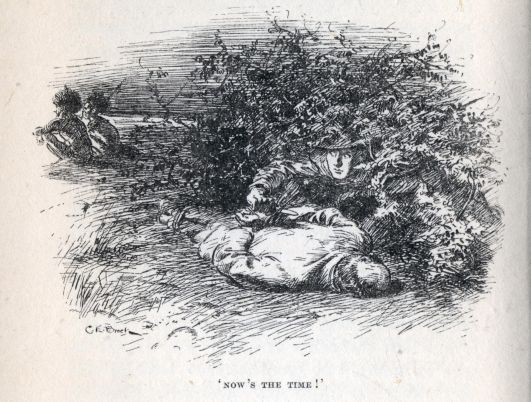
'NOW 'S THE TIME!'
Edging round this, the two men crouched below the level of the savages' heads, and in silence, one step at a time, moved along parallel with the sea-line, until they arrived at the outlying edge of the bushes which stretched up towards the foot of the chimney. Here they rose erect and quickened their pace. They were half-way to the cliffs when there was a sound of crackling. Looking over his shoulder, Trentham saw one of the savages in the act of throwing more fuel upon the fire, which suddenly broke into a bright flame. Immediately afterwards the air rang with a blood-curdling yell, and the whole troop of savages rushed towards the bush where they had left their prisoner, and swept round it in the direction of the sea.
Trentham hurried on. Panting heavily, the prisoner followed on his heels. At the foot of the chimney Hoole was waiting.
'The men are up--all's clear,' he said, flashing a look at the stranger, whose face was pallid and ghastly in the moonlight. 'Guess he 's about done,' he thought, and wondered whether his strength would hold out. 'You go first, Trentham; I 'll cover the rear.'
Trentham entered the narrow fissure, set a foot in the lowest notch, and, levering his back against the opposite wall, began to climb. The stranger, who had spoken no word, followed with nervous haste, so quickly that at the second step his head touched Trentham's boot.
'Steady! Steady!' Hoole called up in a loud whisper. 'One slip, and you 're done!'
The man paid no heed. He seemed to feel that he was on the verge of exhaustion, and must attain that giddy height while there was yet time. Hoole watched him anxiously; it would hardly be safe to follow until the man had reached the top, yet the savages were returning. He heard their yells of rage, and presently caught sight of them running up the beach in a scattered line. A few moments later a ferocious shriek proclaimed that one of them at least had espied the men climbing.
'I must chance it,' thought Hoole. 'He 's a heavy chap--if he falls.'
With the speed acquired in mountaineering, he was soon on the heels of the rescued prisoner, whose quick pants alarmed him. About sixty feet from the base the man gave a long gasp and stopped. Hoole stuck his feet firmly, bent his head, and presented an arched back. At that moment he heard a sharp whizzing sound. The man grunted, and began to climb again. Hoole followed. Something flew with a hiss past his ear, and clicked against the wall.
'Arrows!' he thought. 'I wonder what their range is.'
Up and up, foot by foot, arrows whizzing and clicking, the savages yelling with ever-increasing fury, and audible through it all the laboured breathing of the man above. Then the shooting suddenly ceased; one tremendous yell, then silence. Hoole guessed that the savages had begun to climb. But he was now a hundred feet above them; if the stranger's strength held out, they would never recover the start. Their bare feet made no sound as they clambered up; the fissure was too narrow for him to see them. Once more the stranger stopped for breath, and when Hoole stopped also, a shout of triumph, immensely loud in the narrow passage, announced that the savages were gaining. The sound seemed to give their victim new strength; he clambered more quickly than before. Presently Hoole heard Trentham's voice quietly giving encouragement. Then, looking up, he saw the man hauled over the edge, and five seconds later his shoulders were grasped by Grinson's brawny hands, and he lay among thick grass.
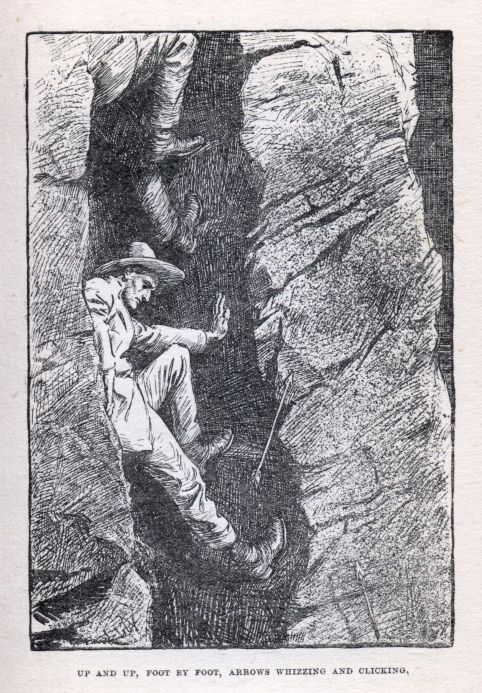
UP AND UP, FOOT BY FOOT, ARROWS WHIZZING AND CLICKING.
'Just saved your bacon, mister,' he said to the man beside him.
The stranger brushed the sweat from his pallid brow with his sleeve, uttered an inarticulate grunt, then fell backwards fainting.
'Batten down, Ephraim, me lad!' cried Grinson.
The seamen had turned to good account the hour they had spent alone on the cliff top. With ready resource they had cut down pliant branches from the surrounding trees, torn up saplings by the roots, and begun to construct a hurdle large enough to cover the opening. It was unfinished, but as soon as Hoole had reached the top they threw it across the gap, and hastily piled upon it the material still unused. The leading native, arriving half a minute later, found his egress blocked by this criss-cross of trunks and branches, which yielded only slightly to the butting of his head. Meanwhile, Hoole and Trentham were tearing down more branches, and casting them upon the heap, which quickly grew to such a size that Goliath himself could not have raised it.
From beneath it rose the muffled cries of the savages. Then all was silent.
CHAPTER IV
MR. HAAN
'Sprinkle a little water on his face, Meek,' said Trentham, indicating the rescued prisoner, who lay unconscious where he had fallen. 'Only a little--we have none to spare.'
'Tickle his nose,' suggested Hoole. 'Trentham, I 'll take a look round; we may be on the edge of a hornets' nest.'
'Don't lose yourself, man. In fact, you 'd better not go out of sight. It mayn't be safe to call to each other.'
The rays of the moon, now high over the sea, lit up their immediate surroundings. From the cliff edge to an irregular row of palms a few yards back, low-growing plants carpeted the ground. On one side of the chimney they were trodden down, and a faintly marked track was discernible until it disappeared among the trees. No sound broke the stillness except the wash of the surf two hundred feet below, and an occasional deep booming note from some distant spot in the forest, which Trentham identified as the call of the cassowary.
'"Saved his bacon!" Mr. Hoole said: 'tis a true word,' remarked Grinson. 'Which I mean to say, you saved him from being turned into bacon, sir--or ham. He 'd have cut up very well.'
He stood at Trentham's side, looking down at the man whom Meek was trying to restore to consciousness--a brawny figure, clad in duck trousers and a white flannel shirt, with a linen collar and a blue tie. His features were heavy, his skin was deeply browned. The crown of his head was almost entirely bald, but a thick growth of short brown hair clothed his lips, cheeks, and chin.
'The very picter of Captain Lew Summers as once I sailed with,' Grinson went on. 'How 'd he get in this mess, sir?'
'I don't know,' replied Trentham. 'He hasn't said a word.'
He thought he saw the man's eyelids flicker.
'He 's coming to, sir,' said Meek, from the ground.
'Lift his head, Ephraim,' said Grinson. 'I 'm speckylating whether his first word 'll be a curse or a blessing.'
The man slowly opened his eyes, but it seemed to Trentham, watching him intently, that he had more command over himself than might have been expected in a man recovering from a swoon. He glanced from Meek to Grinson, then to Trentham, and raising himself on his elbows looked along the track that led among the trees.
'Feel better?' asked Trentham.
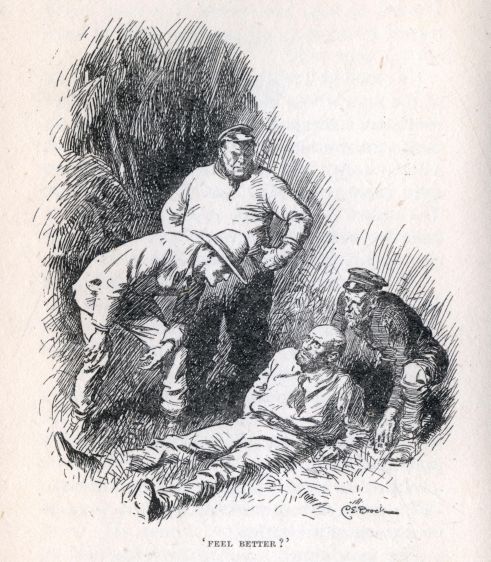
'FEEL BETTER?'
For a moment he did not reply; then slowly and with a curiously thick utterance, he said:--
'Yes. You save me? Dank you.
'Not at all. Couldn't leave a white man in the hands of niggers, you know. Can you get up?'
'I dink so.' With Trentham's assistance he struggled to his feet. 'Yes. Widout you I am killed--and eat! Ach!'
'You are not an Englishman?'
'Dutch. Mate of a trade schooner dat was wrecked up de coast.'
'And the rest of the crew?'
'Dead--dead; all but me. I swim strong.'
Grinson glanced at the Dutchman's trousers, then at Meek.
'Yes, but what good?' the man went on. 'De niggers capture me. Widout you, my friend--Ach! Dey make me climb down; at de height of de moon'--(he shuddered). 'Yes, I know dem, widout you I am killed and eat. I dank you.'
'Well, it was uncommonly lucky we happened to be hereabouts,' said Trentham. 'We were in a ticklish situation ourselves.'
'Wrecked?'
The moonlight glinted on a pair of very keen eyes.
'No, we were sunk by a German raider. The boat we got away in, four of us, only escaped a shell by a hair's breadth. Did you sight the ruffians?'
'No. My schooner was wrecked up de coast. You escaped a shell! Wonderful! And you go, where?'
'We don't know. We only got ashore yesterday, and couldn't find a way up the cliffs till we discovered this crack.'
'I help you. Yes, it is a pleasure to do something for dem what save me. Dis coast, I know it a little. I was here before, since ten years, when I come wid expedition for search of--of copper. You listen to me; I show you. You go to Friedrich Wilhelmshafen; it is de German port----'
'Axing your pardon, mister,' Grinson interposed, 'you been a long voyage, surely. There ain't no German ports in New Guinea nowadays, and I lay that port have got a new name that don't break your jaw to say.'
The stranger turned his eyes on Grinson for a moment, then went on:
'It is a long way--a journey of eight or ten days. I show you. Dere is needed great care. De niggers--cannibals--you see dem. Always must we watch, and wid luck--I say wid luck--we do not fall into deir hands. Dey have villages along de coast--de coast is very dangerous, and we must go drough de forest.'
'Aren't there villages in the forest?' asked Trentham.
'In de mountains, yes,' said the Dutchman, waving an arm towards the interior. 'De coast and de mountains, dey must we avoid equally.'
'And the niggers on the beach there--where is their village?'
'On de coast somewhere, I know not where. Dey carry me far from de place where I was wrecked--five days.'
'I 'm glad of that. I mean I 'm glad we aren't near their place; it gives us a better chance. Ah! here 's the fourth of our party.'
Hoole had just reappeared at the edge of forest. 'My name is Trentham, by the way; my friend yonder is Mr. Hoole; these friends of ours, men of your own calling, are Mr. Grinson and Mr. Meek.'
'Yes. My name is Haan--H-a-a-n.'
Wondering why he had spelled the name, Trentham turned to Hoole, who had just come up.
'I followed the track some distance,' said Hoole. 'Nothing doing, except that a fiendish leech dropped on me from a tree, I suppose, and did himself rather well, confound him!' He showed his wrist. 'The beast has opened a vein, and I knew nothing about it until I got back into the moonlight and wondered how on earth I 'd cut my wrist. But there 's no sign of natives.'
Meek heaved a sign of satisfaction. Having introduced the Dutchman and explained his plight, Trentham went on:
'I think we had better get out of this at once. We haven't heard a sound from below, which suggests--doesn't it?--that the savages know another way up, probably far away. The track must lead to their village, so we 'll avoid that. Mr. Haan knows something of the country, and has offered to guide us to--what is it?'
'Friedrich Wilhelmshafen,' said Haan.
'A reg'lar tongue-twister, sir,' said Grinson. 'But it 'll change its name, like a woman, for better--couldn't be for worse!'
'Do we strike east or west?' asked Hoole.
'East,' replied Haan. 'I dink we should go an hour or two while the moon is up, den rest till morning.'
'Are there any beasts of the earth that do go forth and seek their prey by night?' asked Meek.
'Not in dis country,' the Dutchman answered. 'Dere are no dangerous beasts except de cannibals, and dey will not walk when the moon is down. We go, den; I show de way.'
Haan gazed into the sky, then went to the brink of the cliff and looked out to sea and along the coast in both directions.
'I take my bearings,' he said, returning. 'Now we start.'
He struck off almost at right angles to the native track, but instead of entering the forest strode along at a moderate pace just outside its edge, at an average distance of thirty feet from the cliff. The rest followed him in single file, Trentham leading, Meek bringing up the rear. They had taken only a few steps when Grinson halted until Meek reached his side.
'Trousers!' he said in a falsetto whisper.
'What did you say, Mr. Grinson?' asked Meek, dropping his voice to match.
'Trousers, Ephraim--the Dutchman's. Didn't you notice 'em?'
'Well, he do have a pair, as is only decent, but I can't truthfully say as I noticed anything partickler about their rig.'
'Where are your eyes, Ephraim? I 'm surprised at you! He said he swam ashore.'
'True. "I swim strong," was his words, and I can believe it, his arms and legs being such.'
'D' you believe he took his trousers off, then? S'pose he did--wouldn't they show? If you 'd used your eyes, Ephraim, me lad, you 'd 'a seen as there weren't no sign of sea-water on them trousers. 'Tis my belief they 've never been near water since they left the washtub.'
Meek looked in a puzzled way into the boatswain's eyes. Grinson winked, jerked his arm in the direction of the Dutchman, then, edging a little closer to Meek, put his head over his mouth, and whispered:
'Cut the painter.'
'What painter?'
'Hopped the twig, as they say in the dear old New Cut where I was born. Deserted, Ephraim.'
'Never!' Meek ejaculated. 'What for would he desert in a land of cannibals?'
'What do men desert for? Anything--nothing! You mind that time Ben Scruddles hooked it at Noo York? What for?'
'Well, 'twas a long time ago, and I don't rightly remember, but I 'd say 'twas because Ben didn't like the skipper's red hair.'
'Might 'a been part of it, but the main thing was that Ben was just tired--tired o' the skipper, tired o' reg'lar hours and ever-lasting dooty, tired of every blessed thing--like a horse as jibs and swears he won't pull the blessed cart another blessed inch. Anything for a change. I lay my life the Dutchman got it bad, and fancied a change. Cannibals is nothing when you feel like that; I 've felt like it myself.'
They had lagged while talking, and Hoole, looking over his shoulder, called:
'Now, men, keep up! We don't want to lose you. The moon 's going down.'
'Ay, ay, sir!' replied Grinson, in his usual bellow. 'Ephraim was talking, and he never could do two things at wunst.'
Haan meanwhile had trudged steadily on, making his path through the undergrowth that skirted the forest. The rankness of the vegetation and the uneven surface of the ground made progress very slow. It seemed to Trentham easier going near the cliff edge, where the plants were less tall; but when he made the suggestion, Haan at once rejected it.
'We go safer out of sight from de sea,' he said.
Only the swishing of their feet, a rustle as some small animal was disturbed, now and then a squeal from among the trees, broke the deep silence of the tropical night. The air was chill, but walking kept the men pleasantly warm. Gradually the moon stole down the sky behind them, and when it had disappeared Haan called a halt.
'Now we rest,' he said. 'In morning we go into de forest, until we see a hill; seamen call it Mushroom Hill, because it look like one when dey see it from de sea. When we see it, we go quicker.'
The sailors dropped their burdens, and beat down the vegetation over a space some twelve feet square. Here they all stretched themselves, and made a frugal supper. Haan helped himself to biscuits more often than Grinson liked. For a while the boatswain said nothing; at last, however, drawing the mouth of the bag together, he ventured:
'Beg pardon, sir--'twas eight days, I think you said, to the port we 're making for?'
'Yes, eight or nine,' replied Haan.
Grinson pressed down the loose end of the bag, and, exhibiting the bulk, said:
'Biscuits won't last three, Mr. Trentham, and short rations at that.'
'We get food in de forest--plenty,' said Haan.
'I 'm glad to hear that,' said Trentham. 'This one bag was all that we had time to snatch up when we took to the boat. The old piracy was gentlemanly compared with the new. As a seaman, Mr. Haan, you must feel pretty much disgusted at the dirty tricks the Germans are playing.'
'It is war,' said Haan, with a shrug. 'De ways of war, like everyding else, dey change.'
'They do indeed!' cried Trentham. 'In the old days you could fight and then shake hands; but I 'm hanged if anybody will ever want to shake hands with a German after all this devilry!'
'That's sure!' said Hoole. 'Take me for one. I 'm a citizen of the United States, and war 's not precisely our trade; but after what I 've seen, I 'm going to take a hand, if any one will have me--and I get clear of this New Guinea.'
'And I was on my way to join up,' added Trentham. 'The Raider has only made me extra keen.'
Haan grunted, and changed the subject by suggesting that they should take turns in watching through the remaining hours of the night. They were not near a village, he thought, but it was as well to adopt precautions in a land where enemies might lurk in every bush. Trentham proposed that the seamen, having loads to carry, should be let off, and it was in fact arranged that the guard should be shared by Hoole, Haan, and himself. Each would have about an hour's duty.
They were not disturbed. As soon as dawn streaked the sky they were afoot. Haan, after a preliminary scanning of the sea and as much of the coastline as was visible, plunged among the trees, followed in single file by the rest. Birds chattered with shrill cries from tree and bush, and in the half light shadowy forms darted up the trunks. Under foot all was damp; moisture dripped from every leaf, and the air was full of the odour of rotting vegetation.
'Hadn't we better stick to the cliff?' asked Trentham, dismayed at the prospect of hours of toilsome march in such an atmosphere and with twining plants clogging their steps.
'De coast winds--we save miles and miles,' said Haan briefly.
Trentham could only defer to his guide's judgment, but he felt anxious, ill at ease. He took little heed of the strange scenes through which he was passing--the graceful palms, the fantastic screw pines, trees propped on aerial roots, trees surrounded by natural buttresses springing from the trunk twenty feet above the ground. He had no eye for the orchids festooned from tree to tree, or the gorgeous blooms that hung from branches high above his head. Many-hued parrots, white cockatoos, birds of paradise, tree kangaroos, all were barely noticed, so much preoccupied was he with troublous thought. How could Haan find his way through the trackless forest? What defence had they against the natives whom they were sure to meet sooner or later? Could they survive a week's travelling and camping in an atmosphere so fetid and unhealthy?
But he kept his thoughts to himself, and even gave a reassuring nod to Grinson, when the boatswain murmured that he saw no sign of food.
'Mr. Haan told us he had been in these parts before,' he said. 'We must trust him.'
As they penetrated deeper into the forest the undergrowth became more and more dense, and the order of their going was sometimes altered, each seeking his own path. It usually happened that Haan assumed his place as leader very quickly; but once, when Trentham and Hoole together had forced their way through a mass of tangled vegetation, they found that they had lost touch with him. To their surprise, they had emerged into a comparatively clear space, beyond which they caught sight of the sea, a dark motionless plain under a leaden sky. The beach was hidden from them, but in front and to the left stretched the rugged contours of the cliffs, while to the right, behind the trees, rose the tops of lofty hills.
They were about to call for Haan, when Hoole's eye was arrested by a cloud of smoke rising from beyond the edge of the cliff.
'By gum, Trentham!' he exclaimed. 'Is there a steamer below there? Let's have a look!'
They went a few paces forward, and had just caught sight of a number of dark figures moving up and down what appeared to be a steep slope, perhaps a mile away, near the cloud, when Haan came panting up behind them, and unceremoniously pulled them back.
'Shust in time!' he said in a husky whisper, rapidly, with every sign of agitation. 'Vy--vy--vy did you leave me? You vill ruin every zing!'
'Sorry!' said Trentham, as the man continued to draw them back. 'What's the matter?'
'Shust in time!' repeated the Dutchman, as if to himself; then, aloud, and with his former slow, careful utterance: 'Dere, between us and dat place, is de village of dose niggers what capture me.'
'That accounts for the smoke,' remarked Hoole. 'We 've escaped making a bad bloomer, seemingly.'
'My word, shust in time!' said Haan. 'If I had not come! Dose niggers--you saw dem--wild men, noding can tame dem, cannibals, ferocious--if dey had seen us, dere would soon be noding of us but our bones. Never, never leave me again!'
'It was quite accidental, Mr. Haan,' said Trentham. 'The bush was so thick----'
'Yes, yes,' said the man impatiently, 'but we gain no time going separate. I lead, you follow--remember dat!'
Trentham was inclined to resent a certain peremptoriness in the Dutchman's tone, but, catching Hoole's eye, he held his peace.
'He 's a bit unstrung,' whispered Hoole, as they returned to the spot where Haan had left the seamen, 'and I don't wonder. He doesn't want to fall into their clutches a second time.'
Haan quickly recovered his equanimity, and for nearly two hours they plodded on through the forest, keeping, apparently, the coast behind them. Then suddenly, through a break in the trees, the expected landmark loomed up on their left hand.
'Dat is Mushroom Hill,' said Haan. 'We now go quicker. We go round de hill on de north side, and go quicker still--and safer. De niggers on de oder side are not so fierce; dey do not eat men. Why? Dey are nearer Friedrich Wilhelmshafen, and dey have felt de weight of de German hand.'
'Poor devils!' said Trentham involuntarily, and surprised a strange look that gleamed for an instant in the Dutchman's eyes.
'Say, how far away is that hill of yours, Mr. Haan?' asked Hoole.
'Forty miles. We take dree days.'
'Well, I guess we 'll take a little food first. We shall have to rely on our biscuits; we haven't happened on any orchards yet.'
'Plenty bread-fruit yonder,' said Haan, waving his arm towards the hill, 'and coco-palms, and pawpaws. Yes, we eat our lunch and rest. De sun is bursting drough; it will be very hot. Last night we sleep little. A nap--forty vinks you call it--will refresh us, den we go stronger.'
'A capital idea!' said Trentham. 'I say, Mr. Haan, it was lucky you found us when you did.'
'Yes,' said Haan drily. 'But we must still be on guard. We must not all sleep togeder.'
'Of course not. We 'll take turns again--we three. Let the men off. They have the hardest job, though their loads will be lighter when we start again. I 'll take first watch, then you, Hoole. Mr. Haan must be more tired than we two.'
'It is no matter,' remarked Haan, 'and I am used to a hard life. I can stand fatigue better than you two young gentlemen. But certainly I can sleep wid pleasure. Two hours--dat will give forty minutes each. Yes; and I haf no watch; de niggers strip off my coat. You wake me, Mr. Hoole, and lend me your watch, so I wake you; and I give you no more dan forty minutes--not one second.'
He laughed in a clumsily roguish way. They cleared a space and sat down to their meal of biscuits and water. Haan was the first to throw himself on his back, his bald head shaded by the spreading candelabra-like branches of a screw pine. The rest were not slaw to follow his example, except Trentham, who sat on the keg, and lit a cigarette to keep himself awake.
Eighty minutes later Hoole, having completed his spell of watching, touched Haan lightly on the shoulder. The man did not stir. He tickled his ear with a spray of some feathery plant; Haan slept on.
'I 'll give him another five minutes,' thought Hoole, yawning.
At the end of that time, by dint of poking Haan in the ribs and pinching his nose, he succeeded in waking the Dutchman.
'Awfully sorry!' he said, 'but I can scarcely keep my eyes open. Here 's my watch; be sure and not let me oversleep.'
Haan got up. His movements were slow and clumsy, but his eyes were keen and alert.
'Forty minutes, Mr. Hoole,' he said with a smile. 'Not a second more.'
He did not sit on the keg as Hoole and Trentham had done, but posted himself a few paces from the rest of the party, at a spot where the ground rose slightly. Hoole, just before he closed his eyes, saw the stout figure pacing slowly up and down.
Rather more than two hours afterwards Meek, in his sleep, threw out his left leg, and dealt Grinson, who lay at his side, a smart kick on the shin.
'Belay, there!' shouted Grinson, starting up. 'What swab--what dirty lubber----'
''Twas a nightmare, Mr. Grinson,' said Meek penitently. 'I dreamt as a kangaroo was a-coming to peck me, and----'
'Peck you! A goose might----'
He paused and looked around. Hoole and Trentham were a few yards away, fast asleep. Haan was not in sight.
'Whose watch is this, Ephraim?' asked Grinson.
'I can't rightly say, but seeing as the two gentlemen be asleep, I can't help thinking 'tis the Dutchman's.'
Grinson got up.
'If so be he was a landsman,' he said, 'he might be doing a beat like a bobby; but a seaman ought to know better.'
He walked to the left, then to the right, followed by Meek.
'Can't see the chap, nor hear him. What d' you make of it, Ephraim?'
'He can't have fell overboard--must have strayed. Give him a hail with your powerful voice, Mr. Grinson. Save us all! I forgot the cannibals! Don't holler, for mercy's sake!'
'I nearly did, but you 're right, Ephraim. I 'll report to the skipper, which I mean Mr. Trentham.'
'Eh--what? The Dutchman absent from his post?' said Trentham sleepily, when Grinson had roused him. 'Hoole, wake up!'
'Sure I haven't been asleep forty minutes yet,' said Hoole. 'And I gave Haan five minutes extra.'
'Where is Haan?'
'Where is he? He was over there.'
'Grinson says he 's missing.'
'Missing! But----' He felt for his watch. 'What's the time? I lent him my watch.'
'Ten past four.'
'What?'
Trentham showed him his watch.
'Ten past four! It was two when I gave it him! What the deuce----'
He stopped, and stared blankly at Trentham.
'What did I say, Ephraim, me lad?' said Grinson, in what he intended for a whisper.
'What's that, Grinson?' demanded Trentham. 'What did you say?'
'Well, sir, as we come along, Meek and me was saying a few things about the Dutchman's trousers, and seeing as they 'd no mark of being in sea-water, it come into my head that he didn't get ashore swimming. And from that--which I know the little ways o' seamen--I somehow couldn't help guessing that he might 'a got restless like, and hopped the twig.'
'Deserted his ship, sir,' explained Meek.
'Got a bit wild like, and gone a-roaming,' added Grinson. 'Seemingly he's got it again.'
'Nonsense!' exclaimed Trentham. 'He isn't an ass!'
'Guess we 'd better look for him,' said Hoole. 'He 's got my watch.'
CHAPTER V
IN THE TOILS
Trentham looked round. Mushroom Hill reared its strange form into the sky on their left hand--forty miles away, Haan had said. Between it and them stretched unbroken forest, an undulating sea of green. There was forest on their right, in front, behind.
'It's like looking for the proverbial needle in the bundle of hay,' he said.
'But we might track him through the undergrowth,' suggested Hoole. 'He couldn't pass without leaving traces--a big fellow, with big boots.'
'Yes; a solid-looking fellow, too; not the kind of man to do anything so mad as Grinson suggests.'
'Ah, sir, 'tis them as are the worst when the feeling gets a hold,' said Grinson. 'There was once a messmate o' mine, Job Grindle by name----'
'Really we must lose no time,' Trentham interrupted. 'The sun will be down in two hours or less. He was on that side, Hoole? Then let us start from there, and all keep together.'
They examined the slight eminence where Hoole had last seen the Dutchman. The plants were beaten down over a space of a few yards, where the man had walked to and fro; but beyond this narrow area there was no sign of footsteps in any direction.
'Very odd,' said Trentham. 'He must have gone back the way we came.'
They retraced their steps towards the clearly marked track of their course through the forest.
''Tis my belief the cannibals come up and cotched him again,' said Meek.
'But they must have passed us before they reached him,' said Trentham. 'He would have sung out.'
'And even if they took him by surprise a big fellow like him wouldn't have been overpowered without a struggle,' added Hoole. 'There 's no sign of it. And they would hardly have been satisfied with one victim when they might have had five. I guess Grinson is right, after all. Now let us look at the proposition from that point of view. Say that Haan was seized with the roaming fever--that is, was more or less mad. There's a deal of cunning in madmen, and he 'd naturally try to cover up his tracks. He would expect us to go back over our course, so that's the very way he wouldn't go. What do you say?'
'It sounds reasonable, but where are his tracks? How could he cover them?'
'Let's go back to where I last saw him. I have an idea.'
Retracing their steps to the rising ground, they examined once more the few yards which Haan had trodden. Beyond this clear space trees of various species grew somewhat thickly together. Hoole went up to them and began to look closely at the trunks.
'Ah, maybe he 's sitting up aloft a-grinning at us,' said Grinson, peering up into the foliage--'for a joke, like.'
'I never could understand a joke,' murmured Meek.
'Here you are,' cried Hoole, laying his hand on a twisted and knobby trunk. 'He shinned up here.'
There were on the bark scratches that might have been made by nails in a heavy sole. But Haan was not discoverable amid the leaves above.
'The madman!' exclaimed Trentham.
'With a madman's cunning,' said Hoole. 'Clearly he wanted to throw us off, and he deserves to be left to his fate. But, of course, we can't leave him to his fate. I suppose he went from tree to tree, and then dropped to earth again when he thought he had done us. It would be a hopeless job to attempt to track him through the foliage; but we know the direction in which he went, and I dare say we 'll find his traces not far away. Let us go on; scatter a little; the forest isn't thick hereabouts, and we can see each other a few yards apart. If we don't find him by nightfall, we shall simply have to give it up, camp for the night, and then make tracks for Mushroom Hill.'
Following his suggestion, they went forward in a line, looking up into the foliage, and closely examining the undergrowth for signs of its having been trampled down. Every now and then they stopped to listen; they dared not shout, but Hoole sometimes ventured upon a low whistle.
After they had progressed slowly for about half an hour, Meek suddenly sniffed, and caught Grinson by the arm.
'Summat burning, Mr. Grinson,' he said.
'Well, you 've a long nose, Ephraim. You 're right, me lad; I smell it myself.' He coughed lightly to attract the attention of Trentham, a few yards on his right. The four men grouped themselves. Hoole took out his revolver. They stood in silence, listening, looking in the direction from which the smell of burning came. There was no sound of crackling, no sign of smoke, and after a minute or two they went forward cautiously.
Soon they halted in astonishment. They had come upon a stretch of blackened undergrowth, upon which lay a few trees that bore the mark of an axe; others, still erect, were black for many feet from their base. The air was full of the smell of burnt wood.
'Surely the madman didn't set fire to the trees?' said Trentham.
'This wasn't done to-day,' said Hoole, touching a blackened trunk. 'It's not hot. But it wasn't long ago. Look here; the remains of a ladder.'
He had picked up at the foot of a tree what was clearly the charred remnant of a ladder of bamboo.
'Bless my eyes, sir, 'tis a village,' said Grinson. 'When I was at Moresby some years ago they showed me a photograph of one--a tree village, the little houses perched up aloft, and ladders to get to 'em. There 's been a fire, that's clear.'
'And no fire-engine,' said Meek. 'A terrible calamity, to be sure.'
Hoole had gone a few steps ahead.
'Here 's the sea,' he called. 'We 're on the edge of a cliff. And by Jove! Trentham, look here!'
The others went forward and joined him. They looked down upon a narrow ravine--a steep valley such as is called a chine in the South of England. At the foot of the thickly wooded banks a stream flowed out into a small bay almost landlocked by high cliffs. And in the middle of the bay lay a vessel--a long blue shape with a single funnel.
'The Raider!' ejaculated Grinson with an oath.
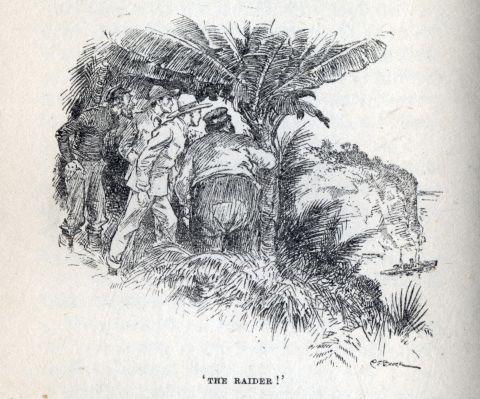
'THE RAIDER!'
'I guess you 're right,' said Hoole quietly. 'And there 's that cloud of smoke we saw in the distance this morning.'
A slight dark cloud was rising above the cliff near the vessel. It did not proceed from the Raider's funnel. Was it possible that a consort of hers lay beyond the point?
The four men, standing just within the forest verge, gazed for a few moments in silence at this unexpected scene. Then Trentham turned.
'We had better get back--to where we can see Mushroom Hill,' he said, a grave note in his voice.
'And give up Haan?' said Hoole.
'And give up Haan. Haan may go hang. Let us go at once; it 'll be dark soon.'
They retraced their steps through the burnt village, Hoole and Trentham walking side by side, the two seamen following.
'I wondered why the fellow spelt his name to us; you remember? H-a-a-n,' said Trentham. 'It's clear as daylight now. He 's a German; was on that raider; a petty officer, I suppose; his name 's Hahn.'
Hoole whistled under his breath.
'They played some devilry with the natives, I suppose,' Trentham went on; 'burnt their village, very likely; Hahn strayed and got collared--and we saved one of the ruffians who sunk us!'
'And he 's got away and rejoined--with my watch!' cried Hoole. 'What an almighty fool I was! And I gave him five minutes' extra sleep! That stings, Trentham, and will till my dying day.'
'He beat us: in slimness the Hun always will. I haven't a doubt he was playing tricks with us all the time. His Mushroom Hill--faugh!'
'You mean?'
'I mean that I don't believe that's our way at all. He reckoned on our getting hopelessly lost--starving--falling into the hands of the savages.'
'Well, for my part, I 'd as soon fall into their hands as the Germans'. You don't think he 'll send the Huns after us, then?'
'Not he! I don't suppose he 'll mention us, thinking us well out of the way. He 'll probably pitch some tall yarn about his clever escape from the cannibals--very likely write a book about it. Upon my word, Hoole, after what we know----'
'Well, I reckon we 're done pretty brown, but I 'm not inclined to give him best. We 'll get to Friedrich What-do-you-call-it in spite of him, and not by Mushroom Hill either. We 'll stick to the coast--confound him! He was so precious careful to keep us away from it.'
'We can only try; it's a ticklish affair, Hoole.'
'I know it is, old son. The food question.'
'Don't worry about that. Where there are men there must be food.'
'That's true; but I 'd rather find the food where there weren't men, if the men are like those dancing hoodlums on the beach. One thing; the Hun's frightfulness has probably scared away all the natives from these parts, so we 'll be able to rest in peace to-night and start afresh in the morning.'
'I hope so. We had better camp where Hahn left us; I 'll tell the men there.'
They went on over their former tracks. A wind was rising, and the foliage overhead rustled like the hissing of breakers on a shingly beach. Conversation ceased; each was busy with his own uneasy thoughts. The rays of the setting sun filtered through the trees from behind them, and presently they came in sight of the open space where Hahn had deserted them. And then the two young men suddenly halted; Trentham wheeled round and put his fingers over his lips in sight of the seamen.
In the middle of the clearing, just where Grinson had lain, a dark, naked figure was stooping and closely examining the ground. He had his back to them, but a moment after they had stopped he sprang up suddenly and turned towards them, his head raised like that of a wild animal that scents danger. For a few moments he stood motionless in the full glow of the sunlight--a tall lithe figure, like a statue in bronze. His right hand clutched a spear.
The watchers had time to notice his well-proportioned form; his colour, lighter than that of the natives they had already seen; a grace of bearing that gave him an indefinable distinction; then he was gone, as if by magic. Where he had been he was no longer; it was as if he had dissolved like Pepper's ghost.
After waiting a little, Hoole stole forward to reconnoitre. The space was vacant; there was no sign of savages lurking among the surrounding trees. He returned to the others.
'No one there,' he said under his breath.
'D' you think he saw us?' asked Trentham.
'No. I couldn't see you from the edge. But he was uneasy.'
'So am I! We had better avoid that spot. I 'd rather not meet any more natives just yet! We had better go rather deeply into the forest, and perch up in trees for the night. There 's only about half an hour of daylight left; we shall probably be pretty safe in the dark. In daylight--well, we shall have to look out.'