THE BLUE RAIDER (continued 4)
Reading edition
'A little more to the left!' he shouted to Grinson, realising that nothing was now to be gained by silence.
'Ay, ay, sir!' roared the seaman, shoving a knobby rock in the desired direction.
Trentham held his breath as he watched its flight. Before he was prepared for it there was a thunderous crash; the boulder had struck the side of the vessel a few feet below the rail, within twenty feet of the bows, passing clean through the plates, and leaving a huge rent. Almost immediately afterwards another boulder crashed through the deck slightly abaft the funnel. There was an instant rush of steam; apparently it had smashed through one of the boilers.
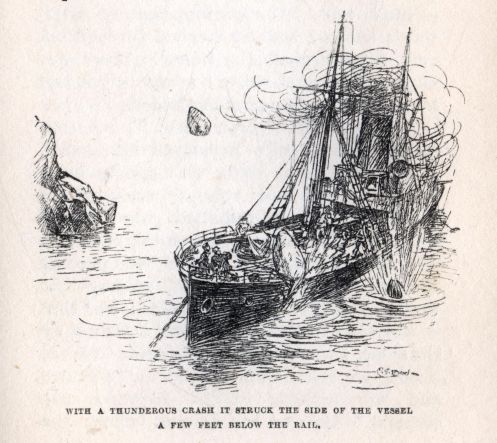
WITH A THUNDEROUS CRASH IT STRUCK THE SIDE OF THE VESSEL A FEW FEET BELOW THE RAIL.
Among the crew surprise had become consternation, and now developed into panic. Men rushed from below and sprang overboard. Others were running wildly about the deck. The captain had gone forward with one of his officers to see the extent of the damage there. Water was pouring through the side. Trentham, judging that the vessel was at any rate disabled, and that it was time to be gone, turned to climb up the slope, and wriggled hastily aside to avoid a boulder which had swerved in its course and was hurtling in his direction. He stopped to throw a last glimpse below; the boulder which he had so narrowly escaped carried away the donkey-engine, and ricochetted from the deck into the sea.
'Well done!' he cried, and ran to assist Grinson to topple over one of the large rocks which had supported the rope on the night of Meek's release.
'That's riddled 'em!' shouted Grinson, as the noise of shattered metal rose from below.
'She can't get away!' panted Trentham. 'They 're coming up the cliff; we must run for it.'
Collecting the men, he dashed up the few remaining yards of the slope and headed them into the forest just as a German seaman came in sight near the end of the ledge.
'"Shust in time!" Trousers, my son,' chuckled Grinson. 'We give her a good battering, sir?'
'Cut open her side, broke a boiler, and drowned the donkey-engine. What more I don't know; but she 's crippled.'
'My cripes! What a tale to tell my Ephraim! I only wish the lad could 'a seen it hisself.'
CHAPTER XIX
AT ARM'S LENGTH
Within the mazes of the forest the little party had no fear of pursuit, and they marched rapidly homeward with the alacrity of men conscious of success. They had gone only a few miles when Trentham heard the unmistakable purring of the seaplane's engine. At that spot the trees formed a canopy overhead through which the sky could scarcely be seen; but at his bidding Lafoa ordered one of the natives to climb a lofty trunk and discover if possible in what direction the machine was flying. The sound had long been inaudible when the man came to the ground again and reported that the strange bird had not soared within sight.
They pushed oh, and were met some little distance from the village by Hoole himself.
'Been scalp-hunting?' he said with a smile.
'No; playing bowls. But what's your news?' asked Trentham. 'Ours will keep.'
'Well, I guess it might be worse. I made Wilhelmshafen, and had to run the gauntlet of a score or so of rifles. It seems they 'd heard a thing or two about the seaplane, and had already reported to one of your warships that's cruising somewhere east. I didn't dare land till I 'd dropped a note telling 'em who I was. There's no warship within miles; but as soon as they had heard my story they rose to the occasion; they 're some sports. The only vessel they had around was a tramp; she might make ten knots in the ordinary way, but could be speeded up to twelve, perhaps, by frantic stoking; so the engineer said. The skipper started coaling at once; he had her cleared of everything that could be spared, and the crew volunteered to a man.'
'But, my dear fellow, a tramp! She 'd no more offensive weapon, I suppose, than a hose.'
'That's correct; but, of course, the skipper had no notion of fighting the Raider. His idea was to steal up along the coast and lie doggo while his men came across country and got you away. At the same time he did what was possible by way of armament. There was a number of machine-guns on shore, left by the Germans when they hauled down their flag to the Australians. He put them aboard, and some Australian gunners were keen to join in this stunt, along with a crowd of young fellows who swore they were all crack shots, and a trader or two. Altogether there are between thirty and forty men coming along. She wasn't ready, of course, when I left; but with good luck she 'll lie off the shore eastward by sunrise to-morrow. Stealing up through the night she 's a good chance of escaping notice, and unless the Raider makes an early morning trip you 'll get away without trouble. Of course, if she is spotted--well, we know what the Raider's guns can do.'
'The tramp has only to keep out of range; the Raider 's crippled.'
'You don't say! Did she run aground?'
Trentham related the morning's events.
'Bully!' cried Hoole. 'Say, what's to prevent our making a good bag of Germans? You think the Raider will sink?'
'There can't be much question of that. They had carried most of their arms on board, and probably those went down with the vessel; the men would waste their time trying to save her. But there were some armed men still on shore, and they might rescue a certain number of rifles before the ship went down. As I came along I tried to decide what I 'd do myself in the Germans' place. They are marooned; they must guess that you flew off for help, and expect to have to deal with some sort of force. The question is, will they surrender or fight?'
'Well, I don't know the inside of a German's mind, so I can't say; but I know what I 'd do. I wouldn't surrender without a fight; and if I saw the odds against me, I 'd make tracks inland, live on the country, and hold out. The Germans are so cocksure of winning the war that I guess they 'll do that.'
'I came to the same conclusion. It's not as if they were traders; they 're naval men, and I can't imagine their giving in tamely. Well, then, we shall have to prepare for a fight.'
'How do you mean?
'They 've lost the greater part of their provisions, and will have to replace them. What better chance than to quarter themselves by main force on the nearest village, which is our friend Flanso's, and compel the people to provide for them? Incidentally also take vengeance for the smashing of their vessel. We can't leave Flanso in the lurch.'
'I guess you 're right. Some of those young fellows at Wilhelmshafen were spoiling for a fight, and were real disgruntled when the skipper showed 'em they 'd have no chance against a well-armed raider. They 'll be ready enough to take a hand in beating off the Germans if they attack the village.'
'If they arrive in time. We may have to face the music before they get here, and I don't much like the prospect. Thanks to Grinson, we did very well against Hahn's handful this morning, but it will be quite another thing to deal with fifty or sixty, perhaps more, a good proportion armed with rifles. Your revolver ammunition is all spent; we 've got the revolvers of the two prisoners, that's all.'
'I brought three revolvers along and a few rounds of cartridges; very little good they 'll be against two or three score rifles. We 'll be back of the wall, of course, which is something to the good.'
'By the way, we heard your seaplane. Where is it?'
'Away yonder. I came down on that pond the Germans failed to strike. I guess they heard her too, and may waste time trying to find her, which will give us a chance to set our defences in order. Say, shall we get along?'
They hurried on. The natives of their party had preceded them, and were surrounded by groups of excited villagers to whom they were expounding the method by which the white men had destroyed the enemy's vessel. A noisy throng followed Trentham and his friends to the gate of the inner enclosure, and when they had disappeared, started a victory dance up and down the broad path.
Lafoa's aid was once more enlisted by Trentham in explaining the situation to the chief. More intelligent than his subjects outside, Flanso was under no illusion about the danger that threatened his village. His own experiences while in the hands of the Germans left him in no doubt as to the fate in store for his people if the enemy got the better of them, and he was ready to accept Trentham's suggestion that all but the fighting men should be at once sent away southward into the forest, where they would be at least out of harm's way until the issue was determined. But when he consulted some of his counsellors he at once encountered the strenuous opposition of the medicine-man, who had not forgiven Hoole for having made him cut so sorry a figure at the duk-duk dance. He protested that the new danger threatening the village was due to the stupidity of the white men. Why had they destroyed the blue vessel, and prevented the enemy from going away? They were already responsible for the destruction of the wreck that had been preserved and cherished by the chief's forefathers from the beginning of the world. They had prevented the human sacrifice customary at the inauguration of a new chief. They were meddlers, and all the misfortunes that had befallen the village were due to them.
Such was the gist of the medicine-man's harangue, though these few sentences by no means represent the torrent of words which poured from his lips. Nor could any one but a cinematograph operator properly depict the extraordinary grimaces of his features and the violent gestures with which he emphasised his denunciations. His right hand wielded a heavy nail-studded mace, and as his excitement grew he stepped, or rather danced, nearer to the group of white men, twirling the mace, tossing it in the air, striking the ground with it. Ignorant though they were of his language, the white men could not mistake the purport of his speech, and two of them noticed with some anxiety that he was making an impression on some members of his native audience. Grinson, however, felt nothing but amusement. A broad grin spread over his face as he listened and watched, and the more excited the medicine-man became the more pleasure the seaman took in the performance, giving utterance now and then to his sentiments with sundry ejaculations and cat-calls.
At last a sudden change came over his expression. The medicine-man in his frenzy had drawn very near to Hoole, and to give point to one of his statements he thrust his mace forward at the full length of his arm, so that Hoole only escaped a blow by stepping quickly back. It was uncertain whether the man had intended to attack him, but the suspicion was too much for Grinson. His lips snapped together; with a great roar he hurled himself at the orator, struck the mace from his hand, and caught him round the waist and hoisted him above his head. The sinews of the seaman's arms cracked; for some seconds he held the native aloft, as if hesitating whether to cast him to the ground. Terrified into silence, the man wriggled; the spectators looked on open-mouthed. Grinson grew purple with exertion; then he laughed. Gradually he lowered his arms, stretched to full length, and gently laid the man at Hoole's feet.
'Windbag!' he muttered, passing his hand across his sweating brow, then setting his arms akimbo and looking down at the still figure.
Gasps of amazement broke from the natives. The medicine-man lay for half a minute; when Grinson stooped and picked up the fallen mace he closed his eyes as if expecting a blow.
'A very neat little bobby's bludgeon, sir,' said Grinson, sticking the mace under his arm. 'Move on, there!'
The medicine-man opened his eyes, and seeing that Grinson had turned aside he crawled slowly away, rose to his feet, and sidled into his hut.
The colloquy he had interrupted was resumed. So great was the impression made by Grinson's display of strength that the natives were ready to agree to anything the white men proposed. It was arranged that the non-combatants should be sent away; a number of huts and trees near the wall on the outside should be razed, provisions brought into the inner enclosure. A few weak spots in the wall were strengthened, and by nightfall everything that was possible had been done to prepare for attack. Scouts meanwhile had been sent out in the direction from which attack might be expected. These were withdrawn as soon as it became dark, and the whole able-bodied population was brought within the wall.
Trentham recognised the futility of attempting any definite tactical measures with a rabble of undisciplined natives.
'They must fight in their own way, if there is to be a fight,' he said to Hoole. 'Let alone the impossibility of giving orders with only one interpreter, we should only worry them by trying to lick them into shape. We must rely on their common sense.'
'Just so. It's up to them to keep the enemy out, and that's all that matters. A word as to not exposing themselves--that's all we can do, except set 'em a good example.'
'As to that, you 'd be useful here, old man; but I fancy you 'd be even more useful if you went off in the seaplane and guided the steamer into the cove. With the Raider sunk, she could quite well run in and land her crew on the Germans' beach; they 'd get here quicker then than if they landed at a spot we don't know the way from.'
'Well, I guess we 'll wait and see,' said Hoole. 'We 'll take turns to do sentry-go through the night. If nothing happens, I 'll very likely take a run out in the morning. The tramp won't be far away then, anyhow.'
CHAPTER XX
THE LAST RAID
'Ephraim, have you made your will, me lad?' asked Grinson, sitting in the hut with Meek in the early hours of the morning.
'Never did I think of such a thing, Mr. Grinson,' replied Meek. ''Tis only lords and skippers as make wills.'
'That 's where you 're wrong, me lad. Specially now. For why? 'Cos 'tis the dooty of every man to make his will afore going into action.'
'S'pose he ain't got nothing to leave, and no widders nor orphans to purvide for?'
'It don't make no difference. Besides, every man's got something. Lord Admiral Nelson, as you 've heard of, had a glass eye, and 'tis said he left it to his footman, as he once caught nicking, to remind him that there 's always an Eye beholding of the evil and the good, besides his heart to the country.'
'Well, I never!'
'Not but what there 's a mighty big risk in making your will. There was once a chap I knowed as made his will and died next day--fell off a ladder, he did, and his mates said he might 'a been alive to this day only for the will. Likewise a skipper I once sailed with left his craft to be sold and divided among the crew; uncommon skipper he was; and she went down next voyage, and not insured. Ah! 'tis a solemn thought, making your will.'
'What put making wills and such into your head just now, Mr. Grinson?'
'Well, it's like this. The gentlemen expects what you may call a battle royal afore the day 's out, and you 've got to look at it sensible. We come all right out o' that scrap yesterday, but 'twas only Trousers and a few more, and we took 'em by surprise, d' ye see? Things will be different if all them Germans come up together; the odds ain't even, Ephraim.'
'True. I can bear ye out in that, Mr. Grinson. I don't hold with fighting--not with guns.'
'No more do I, 'cos I never shot a gun in my life. But this 'ere truncheon of old ugly mug's is as good as a gun, if it gets a chance; which I mean to say firing off guns ain't fighting at all, to my way of thinking. Darbies or sticks--that 's all right; the best man wins; but with guns--why, any little mean feller as would give you best if you looked at him may do you in from a distance, hiding behind a haystack, p'r'aps, or up a tree. No, Ephraim, that ain't fighting, not by a long chalk.'
'And have you made your own will, Mr. Grinson?'
'No, I ain't, and I 'm sorry for you, me lad, for I meant to leave you my old parrot as sits on his perch in Mother Perkins's parlour. You remember Mother Perkins, what said she 'd be glad to mind the bird, 'cos his language was so beautiful and reminded her of me?'
'Ah! I wish I could speak like you, Mr. Grinson, but there--I never could do it, not if I tried ever so. But you don't think you 're going to be killed?'
'Well, you see, I 'm twice as broad as you, and so the chances is against me, with guns. It's only fair, after all, 'cos in a real fight I could take on two, p'r'aps more; I should say more, with this 'ere truncheon. I ain't got no presentiments, Ephraim; but what is to be is, and in case they knock a hole in me I do hereby declare and pronounce as my old parrot is to belong to you and no one else, and so you 'll tell Mother Perkins.'
'I don't like to think of it, Mr. Grinson, but if so be as you 're killed and I ain't, I 'll look after that bird as if 'twas you, and think of you whenever it speaks.'
'Only if it speaks decent, Ephraim. I won't deny it picked up a few unholy words afore I bought it, and they come out sometimes; you can't help it.'
The seamen, though they had recently returned from sentry-go, were wakeful, and talked on till morning, exchanging reminiscences of their years of comradeship. At sunrise they joined Trentham and Hoole, and were allotted posts within the walls, if the Germans should attack. Scouts had already been sent out into the forest, to keep watch in the direction from which the enemy was likely to come.
During the night the position had been thoroughly discussed between Trentham and Hoole. The latter, though reluctant to leave his friend to bear the brunt of any fighting that might take place, at last agreed that probably the best service that he could render was to hasten the arrival of the steamer. About nine o'clock he set off with two natives for the lake where he had left the seaplane. Little more than two hours later Trentham heard the hum of the engine. The seaplane passed over the village, going eastward and skimming the tree-tops. From the signs made by Hoole, Trentham understood that the Germans were on their way, and this preliminary intimation was confirmed soon after noon, when the scouts came running in. Their report that a great host of the bad men was approaching aroused great excitement among the natives, who, proud of their easy victory on the previous day, showed little sign of understanding the nature of the ordeal they were to pass through. Some of them were for sallying out and meeting the Germans in the forest; but Flanso had intelligence enough to perceive the danger of breaking up his force, and at Trentham's suggestion he concentrated the greater number of his men near the gate, where the enemy's main attack was likely to be made. A few were stationed at other points along the circuit of the wall, to give notice if surprise attacks were attempted elsewhere than in front.
Trentham had persuaded the chief to place under Grinson's command about a score of the men whom he had led on the day before. His leadership then, and his subsequent display of muscular strength in dealing with the medicine-man, had won their admiration; and the fact that he bore their totem mark on his shoulder was a great factor in inspiring them with confidence. Even without Lafoa's assistance Grinson seemed to be able to make them understand his wishes.
'You had better hold your men in reserve, Grinson,' said Trentham. 'Put them in a central position--about the chief's house, say; and keep them out of the fight until they can come in with decisive effect.'
'For the knock-out, as you may say, sir,' Grinson replied. 'I understand. But begging your pardon, I ain't to remain in a state of absolution if I see a chance--you don't mean that, sir?'
'Not at all,' answered Trentham, who was by this time able to understand the seaman's sometimes recondite phraseology. 'All I mean is that I don't want you to take part in every scrimmage, but only when you see the rest of us hard pressed. Where 's your revolver, by the way?'
'I give it to Ephraim, sir.'
'But he had one; we have five altogether now.'
'True, sir; but the long and short is that I feel much more at home with this 'ere truncheon or knuckle-duster. With the pistol I might miss, not being used to such things; but with this'--he lifted it, eyeing it with affection--'with this I can be sure, by the feel.'
'Is Meek a good shot?'
'He couldn't hit a hay-stack, sir; but, talking between our two selves, we thought Ephraim was the man to keep his eye on you and be ready to give you another pistol when the fust is empty. I don't mind saying 'twas my idea, 'cos Ephraim ain't quite hisself yet arter that night on the ledge, only he 's got such a spirit that nothing would 'a kept him out of it if so be he didn't believe he was more useful otherways, and he believes that now, though I won't answer for how long it will last.'
The simple dispositions that were alone possible had barely been made when Trentham, looking out over the wall beside the gate, saw a man bearing a white flag advancing unaccompanied along the broad central path through the village. In a few seconds he recognised the square, solid face of Hahn. The German, who appeared to be unarmed, halted beyond range of revolver shots, and waving his flag, shouted:
'Hi, hi! Somevon speak.'
'What do you want, Hahn?' Trentham called.
'I speak for Captain Holzbach, of ze Imperial German Navy,' said Hahn. 'Ze captain bresent his gompliments and say zat he admire very much ze clever vay his ship is sunk, and zink ze vite men shall now be friendly, because we must all remain on zis island until ze var end. He vish to buy food, and say if ze savages come out and sell, he pay good price, and zey shall be safe.'
Trentham was under no illusion as to the German's good will; but wishing to temporise, partly with a view to the avoidance of further fighting, partly to allow for the arrival of the expected help, he replied:
'On behalf of the chief of this village I am willing to strike a bargain. If you, Hahn, and three other officers will come inside, unarmed, as hostages, a sufficient supply of provisions shall be sent out to you, on condition that you leave this part of the country, and engage not to molest the people.'
Whatever Hahn may have expected, it was clear that he was surprised at the terms offered. After a slight hesitation he said:
'It is not right zat German officers shall place zemselves in ze hands of savages, vat eat men.'
'But I am not a savage, and I guarantee that you shall not be eaten. You have good reason for being sure of that, Hahn.'
The German appeared to be annoyed at the allusion to his rescue from the dancing party on the beach.
'It is absurd!' he cried. 'Ze dignity of German officers vill not permit zem to do vat you say.'
'Then I am afraid that you must repeat to your captain that we cannot trade with him.'
'You know vat you do? Of us zere are fifty or sixty, viz rifles. You zink savages viz spears any good? Ve are not hard; but if it is var, zen----'
'Threats are useless, Hahn,' Trentham interrupted. 'We know your idea of war. I have nothing more to say. You have my terms: you had better consult your superior officer.'
The German glared, turned on his heel, and walked away. The breathless silence which had held the natives during the colloquy was broken by shouts of triumph; but Trentham sent Lafoa to explain matters to the chief, and asked him to keep his men in readiness for the assault which could not long be delayed. It was clear to him that Hahn's mission had been intended to lead to the opening of the gate and the division of the garrison. He had no doubt that if the natives had been decoyed outside their wall, the Germans would have rushed the place.
For some time after Hahn's departure there was no sign of hostilities. Then the Germans could be heard shouting to one another in the forest north of the village, and with the voices mingled the sound of wood-cutting. None of the enemy came in sight, and Trentham could only conjecture the nature of their operations.
Nearly two hours passed. The natives grew more and more noisy and restless. They could not understand why they were still cooped up in the enclosure. At length, however, after a brief cessation of all sounds in the forest, there was a sudden whistle, followed by the sharp crack of rifles, and from the trees facing the northern side of the village the Germans rushed forward in open order, on a front of nearly a quarter of a mile. The defenders, as Trentham had ordered, remained out of sight. He himself watched the enemy through a loophole in the log wall.
They were variously armed. Some had rifles with bayonets; others cutlasses, others axes. Some carried roughly constructed ladders. As they drew nearer, Trentham noticed that these last, as well as the officers at different parts of the line, were armed with rifles. They came on steadily and silently until they were almost within effective bow-shot; then they halted, the officers collected and consulted together. It appeared that they were somewhat at a loss how to proceed against an enemy whom they could not see, and whose defences they had no means of battering down. The pause was of short duration. Another volley was fired, with the intention doubtless of overawing the natives rather than of doing effective damage. A few men behind the walls were slightly injured by splinters; none were incapacitated, and all, with a self-restraint that Trentham had not expected, remained quietly at their posts until the enemy should come to close quarters.
After discharging their rifles, the Germans surged forward again, moving very rapidly, but maintaining a regular line. Trentham wondered why they were spread out so widely instead of concentrating on a limited section of the wall. In a few moments he saw through their plan. It had been desired to weaken the defence by compelling the natives to man a longer stretch of the wall than was the actual object of attack. The Germans suddenly contracted their front, no doubt calculating to reach the wall a few invaluable seconds before the defenders could mass at the threatened section.
They were now within range of the natives' weapons, and in close order presented a target which even Grinson, despite his want of skill with the spear, could hardly have missed. Obeying a preconcerted signal from Trentham, Flanso at last gave his panting warriors the word they had eagerly awaited. They sprang on to the platform that lined the foot of the wall, and was just high enough to bring their heads a few inches above the top. A shower of arrows and spears burst upon the advancing enemy. Many of them fell, but the rush was not stayed. There was no answer from their rifles; their orders evidently were to force their way into the defences with cold steel. Another flight of arrows equally failed to check them. With disciplined energy they swept forward to the wall, and having reached it were in comparative safety from the weapons of the men within. Quickly they set their ladders against the barricade and began to swarm up with the agility of seamen. Where there were no ladders they mounted on one another's backs. They gained the top, and then began a furious struggle, so confused that Trentham was never able to give a clear account of it.
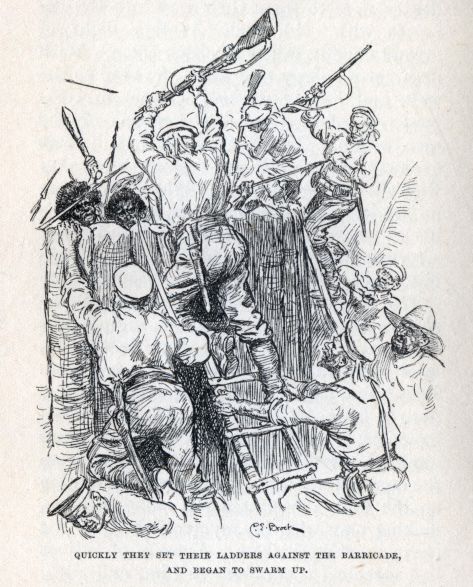
QUICKLY THEY SET THEIR LADDERS AGAINST THE BARRICADE, AND BEGAN TO SWARM UP.
The Germans had the advantage of discipline, the higher position, and better weapons. The natives on the other hand, were more numerous, but lacked cohesion. They plied their spears manfully, but these were a poor defence against clubbed rifles, bayonets, swords, revolvers. Only their numbers saved them from utter defeat from the moment when the enemy gained a footing on the wall. Trentham ran along the line, making play with his revolver wherever the Germans were thickest. A group of natives had attached themselves to him, and when he had disposed of two or three of the enemy with rapid shots, the Papuans took advantage of the Germans' momentary bafflement and with their spears cleared a few feet of the wall.
But he could not be everywhere at once. While he had been engaged at this spot, some fifty yards beyond, the Germans, having beaten off the natives who had tried to thrust them from the wall, had jumped down, and were pressing forward over the bodies of the fallen towards the centre of the enclosure. Trentham and Flanso had marked the danger at the same moment. With a resonant shout the latter dashed towards the enemy at the head of a body of picked men, and the Germans, outnumbered and unable to withstand the fury of his onset, fell stubbornly back. Satisfied that Flanso could hold his own for a time, Trentham dashed on to another point where half a dozen Germans in line were driving back with their bayonets the few survivors of the natives who had been unable to hold the wall. At this moment he was somewhat perturbed at hearing shouts and firing from a distant quarter which he had not known to be attacked. He had no time to find out what was happening there, but hoped that Grinson had been on the alert. On the point of plunging into the fray, he found that he had emptied both the revolvers he had brought with him. He snatched up a spear, but as he rose from stooping Meek's tremulous voice sounded in his ear.
'Mr. Grinson said I was to bring 'em, sir.'
The man thrust two revolvers into his hands, then took the spear and followed him.
The natives were falling back before the serried bayonets. From the wall behind Germans were leaping one after another as fast as they could climb the ladders on the other side. One of them, pausing on the top, fired his rifle point-blank at Trentham, but a comrade climbing after him jostled him at the critical moment; the shot flew wide, and, unknown to Trentham, struck Meek, who fell heavily near the foot of the wall. With a couple of shots Trentham disposed of the man who had fired at him and another who had just descended; then he turned to help the natives whom the pitiless bayonets were demoralising.
At this moment Hahn, with bayonet outstretched, came heavily towards him from the side. Trentham flashed a shot at him, and as he stumbled past, hard hit, wrenched the rifle from his grasp and hurried on. Coming upon the Germans from the rear, he shot down one after another; the natives, cheered by his presence, rallied, and flinging themselves on the survivors, disposed of them with their spears and sent reeling back others who had just sprung from the wall.
But other Germans were swarming over on each side. At three or four points little groups had found their footing and were more than holding their own, while others, astride on the top, were firing on the defenders and strewing the ground with their victims. Trentham saw with sinking heart that the natives were everywhere giving way and falling back towards the chief's house. The Germans on the flank farthest from him were beginning to form up in line, with the evident intention of carrying all before them in a final charge. Fully occupied in helping his immediate followers to repel a swarm of Germans who were pouring over the wall in his neighbourhood, Trentham saw the imminence of total defeat which he now felt powerless to avert.
Facing the wall, he suddenly heard, above the general din of the conflict, the deep bellow of Grinson's war-cry. He turned quickly and saw the seaman, with his sleeves turned up, wielding his huge mace, and followed by a score of yelling natives, charging along at the foot of the wall. Swinging his mighty weapon as easily as if it had been a walking-cane, Grinson fell upon the flank of the Germans who were preparing to charge. Now he plied the mace in wide sweeps that cleared a path as a sickle through grain; now he gave point with the massive studded head; now he swung it over his head like a blacksmith's hammer. Revolvers were flashed at him, but he hurled himself along unscathed. The Germans on the wall dared not fire at him for fear of hitting their own men. And Trentham was amazed to see, close behind him, the hideous figure of the medicine-man, advancing with grotesque leaps and whirling his arms with extraordinary contortions.
The enemy huddled together, some still fighting, others merely seeking to escape from this human battering-ram. They began to retire in Trentham's direction; the natives in their front, taking heart, closed in; and Trentham, feeling that at this critical moment he might leave the wall unguarded, led his men to meet the discomfited enemy. Taken thus in front and on both flanks, so crowded together that those of them who had firearms were unable to use them, the Germans became a disorganised mob. Heedless of the shouts of their officers, of whom one or two had entered the enclosure, while the others were either on the wall or outside, they sought safety in flight. Many of them were cut down before they gained the wall. The rest clambered over, abandoning their weapons that impeded them, and fled helter-skelter into the forest, pursued by the natives led by Flanso himself.
Grinson sat down with his mace across his knees, wiped his streaming brow, and looked with a sort of amused curiosity at sundry gashes and stabs on his arm.
'Might 'a been worse, sir,' he said. 'Would you believe it? Ugly mug has stuck to me like a brother. Which it proves, if you want a man to love you, just knock him down. But where's my Ephraim, sir? What's become o' the lad?'
CHAPTER XXI
JUSTICE
Some twenty minutes after the flight of the Germans two figures appeared at the farther end of the village, and walked quickly up the central path. Trentham, sitting just outside the gate, waved his hand and started to meet them. Hoole flourished his hat in reply, and turned to speak to the man accompanying him.
'Let me name to you Captain Rolfe, of the Wanda, old man,' said Hoole, when Trentham joined them.
'Pleased to meet you, sir,' said the seaman, clasping Trentham's hand in a crushing grip. 'We 're in at the death, and that's about all we can say for ourselves. You carry off the honours, sir.'
'Thanks, captain,' said Trentham. 'It was my friend Josiah Grinson who dealt the finishing stroke; I 'll introduce him to you presently.'
'The boatswain bold, as they say in the song,' added Hoole.
'Mr. Hoole has told me about him,' said the captain, 'and I 'll be glad to give him a berth.'
'You must take Meek too,' said Trentham with a smile. 'They 've been together twenty-five years or so, and I 'm sure nothing will part them now. At the present moment Grinson is acting as nurse. Meek was unlucky enough to get hit; not seriously, I 'm glad to say; but he wasn't in very good condition, and appears to have fainted from loss of blood. Grinson found him on the field, and after an explosive moment he carried him off to our hut. Grinson is a big burly fellow, with a heart as tender as a woman's.'
'A mixture you 'll often find among sailormen, if I may say so,' said the captain. 'But Grinson mustn't have all the credit, you know, Mr. Trentham. That dodge of yours with the Raider----'
'Is she sunk?' asked Trentham.
'Sunk by the stern; all below water except a bit of her fore deck and her funnel. But she can be salved, and there 'll be something to share out, or I 'm a Dutchman.'
'You came into the cove?'
'I did, sir, and anchored within half a cable's length of the Raider. A couple of Germans on shore flung up their hands at once, and we marched up under Mr. Hoole's lead without delay. You 're surprised to see no more of us, but the fact is, we met the Germans running for their lives. They were glad enough to surrender, for these savages don't know the meaning of mercy, and I 'm afraid they had already killed a number of them before we came on the scene. However, my ship's company--the queerest mixture I ever commanded--are marching the rest of them down to the cove, and as I 've plenty of cargo space on board, I gave 'em orders to drop them into the hold; by this time to-morrow we 'll hand 'em over in proper form as prisoners of war. I take it you 're ready to come with us?'
'Quite, I can assure you. But I think we ought to bury the German dead first. These people are cannibals.'
'Burying 's no good; they 'd dig 'em up as soon as our backs were turned. We can't give them seamen's burial, the sea being so far away. The only thing left is to burn them; certainly we couldn't leave them for a cannibal feast. And we had better set about it while most of the savages are away; there 'll be less trouble. Oh! here we are. A most uncommon native village. A few photographers will take a trip out here when your story is known. That's Grinson, I suppose. Who 's the fellow with him?'
Grinson was walking towards the hut, accompanied by the medicine-man carrying water in a huge banana stalk. Trentham laughed.
'That's the village doctor,' he said. 'A thorn in our flesh until Grinson tamed him by a sort of strong man exhibition. Now he 'll follow Grinson like a dog.'
'Natural philosophy,' said Hoole. 'The Germans will be the better for a dose of the same physic. It's a low order of intelligence that admits no superiority but brute force, and I guess you must deal with people as you find 'em. Ahoy, Grinson! How 's Meek?'
'Doing well, sir,' roared Grinson. He came towards the three men, the medicine-man trotting behind, and said in a confidential whisper, 'You must humour poor Ephraim a bit, gentlemen. He 's got it fair fixed in his mind as there 's no justice in this world, and nothing 'll shake him.'
'Why?' asked Trentham.
''Cos he was knocked out afore he began to fight. I never knowed Ephraim so obstropolous. He 'll hardly speak civil to me; says I kep' him out of it on purpose, a-holding revolvers as any funk could 'a done; and then, when he 'd picked up a spear in spite o' me, blest if he wasn't spun round directly afore he had a chanst. I told him wounds is honourable, and he rounded on me; "Honour be deed," says he, most unusual language for Ephraim; "they never give me a chanst; there's no justice in this world, not a morsel." Humour him, gents, if you 'll be so kind, and I dare say with time he 'll be the same lad again.'
Twelve hours later, under a brilliant moon, the little tramp Wanda puffed out of the cove on her voyage eastward. Trentham, the centre of an interested group, was relating in detail the story of the past weeks. Some distance away, sitting on the deck with his back against a coil of rope, Grinson, in tones much subdued, talked to Meek, slung in a hammock before him.
'Yes, Ephraim, Mr. Hoole came out in his true colours at last, just afore he flew away, which I mean to say he's true blue, and not a deceiving coat o' paint like that there Raider, though I own he did take us in, but no great sin. He 's a inventor, Ephraim; invented something as 'll make them airyplanes terrible engines o' mischief, and when I said as how there was enough mischief in the world----'
'There 's no justice in it.'
'I was coming to that. When I said as how there was enough mischief in this wicked world, he laughed, he did, and said what he 'd invented would do for sewing machines when the war 's over. Now ain't there justice in that? Look at it straight, Ephraim, me lad. The Germans must be beat, or what's the good of anythink? Well, then, this notion o' Mr. Hoole's will help to beat 'em; Mr. Trentham says it's certain. Well, then, it's a good thing, and good things didn't oughter be wasted, so when the war 's over he just reverses the engine, as you may say, and then it's sewing machines what 'll make shirts and other peaceful things. Ain't there justice in that?'
'I never had a chanst.'
'No, and I feel for you; I wouldn't like it myself. But there 's more justice. By what Cap'n Rolfe says, they 're calling for hands for the Royal Navy, and I 'm going to sign on, and in course you 'll sign on too. Well, now, s'pose you 'd got your chanst, and been killed, like Trousers--'cos a savage speared him arter Mr. Trentham made him helpless--you might a' been killed; then you wouldn't have got my poll parrot, and you wouldn't 'a been alive to sign on with me, and no chanst then o' beating the Germans and making 'em sick o' themselves, and medals and all. Look at it straight, Ephraim, and you 'll see 'tis all justice, to say nothing of merciful Providence.'
'I don't rightly see as I can bear you out, Mr. Grinson,' said Meek sleepily.
'But you will, Ephraim, you will, me lad.... He 's going off, sir,' Grinson whispered as Trentham came up. 'Gripes! what a job I 've had! But he 'll be all right in the morning.'
Trentham won the Military Cross at the Battle of the Somme; Hoole was on the point of starting for Berlin when the armistice was broached; Grinson and Meek have hunted submarines in an armed trawler. Meek has been led to trace the hand of what he calls Justice from the moment when the Blue Raider sank the Berenisa to the moment when, following somewhat sheepishly his more self-assured companion, he shambled through the courtyard of Buckingham Palace to receive his medal from the hand of the King.
Printed by T. and A. CONSTABLE, Printers to His Majesty at the Edinburgh University Press
――――
A Select List of Booths for Young People: Published by Humphrey Milford, Oxford University Press
Stories of the Great War
Crown 8vo, with Illustrations in Colour.
By HERBERT STRANG
Tom Willoughby's Scouts: A Story of the Fight for East Africa. Fighting with French With Haig on the Somme The Blue Raider: A Story of Adventure in the Southern Seat. A Hero of Liege Frank Forester: A Story of the Campaign in Mesopotamia. Through the Enemy's Lines Carry On! Burton of the Flying Corps
By CAPTAIN CHARLES GILSON
On Secret Service: A Story of Espionage. In Arms for Russia
By JOHN FINBARR
At All Risks
By JOSEPH BOWES
The Young Anzacs The Anzac War Trail The Aussie Crusaders
Books about the Great War
Scouting Thrills: A Book of Actual Experiences on the Western Front.
By Capt. G. B. McKEAN, V.C., M.C. With Foreword by Lieut.-Gen. Sir R. E. W. TURNER, V.C., K.C.B., K.C.M.G., D.S.O.
The Empire in Arms
Edited by HERBERT STRANG. A book descriptive of the British Army and Navy, and the Colonial and Native Forces of the Empire, giving detailed information of the personnel, the weapons and the work of all the Services. With numerous illustrations. Crown 410, cloth.
Heroes of the Flying Corps
By C. GRAHAME-WHITE and HARRY HARPER.
Books for Boys
By HERBERT STRANG
"Boys who read Mr. Strang's works have not merely the advantage of perusing enthralling and wholesome tales, but they are also absorbing sound and trustworthy information of the men and times about which they are reading."--DAILY TELEGRAPH.
A Gentleman-at-Arms
A Story of Elizabethan Days. Eight plates in Colour by CYRUS CUNEO, and thirty-eight line drawings by T. H. ROBINSON.
This book is unique in literature for boys. It relates the adventurous career of an Elizabethan gentleman, in a style carefully modelled on the simple prose of the century which produced the Authorised Version of the Bible No previous writer for boys has ever attempted a similar achievement Apart from its romantic and exciting incidents, this story has great value by reason of its historical and geographical information, and its exceptional style!
Sultan Jim
Empire Builder. Coloured illustrations by CYRUS CUNEO.
Asia and Australia have been the scene of Mr. Strang's most recent romances of Empire. In this book he turns to Africa, where the colonising activity of rival powers is raising problems of the greatest interest and importance. The presence of a young Englishman in one of the debatable lands at a time of upheaval and international rivalry enables him to uphold the interests of the Empire against formidable opposition. The story is brimful of adventure, and its moral is that of patriotic self-sacrifice.
"Father Christmas brings many good things in his train, but it is doubtful if he brings anything better in its own way than a new story by Mr. Herbert Strang. The multitude of his youthful readers are likely to find their most insatiable thirst for adventure satisfied by this new volume."--Bookman.
The Air Patrol
A Story of the North-West Frontier. Illustrated in Colour by CYRUS CUNEO.
In this book Mr. Strang looks ahead--and other books have already proved him a prophet of surprising skill--to a time when there is a great Mongolian Empire whose army sweeps down on to the North-West Frontier of India. His two heroes luckily have an aeroplane, and with the help of a few Pathan miners they hold a pass in the Hindu Kush against a swarm of Mongols, long enough to prevent the cutting of the communications of the Indian army operating in Afghanistan. The qualities which marked Mr. Strang's last long story, "The Air Scout," and won extraordinarily high commendation from Lord Roberts, Lord Curzon, and others, as well as from the Spectator and other great journals, are again strikingly displayed; and the combination of thrilling adventure with an Imperial problem and excellent writing, adds one more to this author's long list of successes.
"An exceptionally good book, written moreover in excellent style."--Times.
"The 'Air Patrol' is really a masterpiece."--Morning Post.
The Air-Scout
A Story of National Defence. Illustrated in Colour by W. R. S. STOTT.
The problems of National Defence are being discussed with more and more care and attention, not only in Great Britain, but also in all parts of the Empire. In this story Mr. Strang imagines a Chinese descent upon Australia, and carries his hero through a series of exciting adventures, in which the value of national spirit, organisation, and discipline is exemplified. The important part which the aeroplane will play in warfare is recognised, and the thousands of readers who have delighted in the author's previous stories of aviation will find this new book after their own heart.
LORD ROBERTS writes: "It is capital reading, and should interest more than boys. Your forecast is so good that I can only hope the future may not bring to Australia such a struggle as the one you so graphically describe."
LORD CURZON writes: "I have read with great pleasure your book, 'The Air-Scout.' It seems to me to be a capital story, full of life and movement: and further, it preaches the best of all secular gospels, patriotism and co-operation."
"We congratulate Mr. Strang on this fine book--one of the best fighting stories we bare road."--Morning Post.
Rob the Ranger
A Story of the Fight for Canada. Illustrated in Colour by W. H. MARGETSON, and three Maps.
Rob Somers, son of an English settler in New York State, sets out with Lone Pete, a trapper, in pursuit of an Indian raiding party which has destroyed his home and carried off his younger brother. He is captured and taken to Quebec, where he finds his brother, and escapes with him in the dead of the winter, in company with a little band of New Englanders. They are pursued over snow and ice, and in a log hut beside Lake Champlain maintain a desperate struggle against a larger force of French, Indians, and half-breeds, ultimately reaching Fort Edward in safety.
One of Clive's Heroes
A Story of the Fight for India. Illustrated in Colour, and Maps.
Desmond Burke goes out to India to seek his fortune, and is sold by a false friend of his, one Marmaduke Diggle, to the famous Pirate of Gheria. But he escapes, runs away with one of the Pirate's own vessels, and meets Colonel Clive, whom he assists to capture the Pirate's stronghold. His subsequent adventures on the other side of India--how he saves a valuable cargo of his friend, Mr. Merriman, assists Clive in his fights against Sirajuddaula, and rescues Mr. Merriman's wife and daughter from the clutches of Diggle--are told with great spirit and humour.
"An absorbing story.... The narrative not only thrills, but also weaves skilfully out of fact and fiction a clear impression of our tierce struggle for India."--Athaeneum.
Samba
A Story of the Congo. Illustrated in Colour.
The first work of fiction in which the cause of the hapless Congo native is championed.
"It was an excellent idea on the part of Mr. Herbert Strang to write a story about the treatment of the natives in the Congo Free State.... Mr. Strang has a big following among English boys, and anything he chooses to write is sure to receive their appreciative attention."--Standard.
"Mr. Herbert Strang has written not a few admirable books for boys, but none likely to make a more profound impression than his new story of this year."--Scotsman.
Barclay of the Guides
A Story of the Indian Mutiny. Illustrated in Colour by CYRUS CUNEO. With Maps.
Of all our Native Indian regiments the Guides have probably the most glorious traditions. They were among the few who remained true to their salt during the trying days of the great Mutiny, vying in gallantry and devotion with our best British regiments. The story tells how James Barclay, after a strange career in Afghanistan, becomes associated with this famous regiment, and though young in years, bears a man's part in the great march to Delhi, the capture of the royal city, and the suppression of the Mutiny.
With Drake on the Spanish Main
Illustrated in Colour by ARCHIBALD WEBB. With Maps.
A rousing story of adventure by sea and land. The hero, Dennis Hazelrig, is cast ashore on an island in the Spanish Main, the sole survivor of a band of adventurers from Plymouth. He lives for some time with no companion but a spider monkey, but by a series of remarkable incidents he gathers about him a numerous band of escaped slaves and prisoners, English, French and native; captures a Spanish fort; fights a Spanish galleon; meets Francis Drake, and accompanies him in his famous adventures on the Isthmus of Panama; and finally reaches England the possessor of much treasure. The author has, as usual, devoted much pains to characterisation, and every boy will delight in Amos Turnpenny, Tom Copstone, and other bold men of Devon, and in Mirandola, the monkey.
Palm Tree Island
Illustrated in Colour by ARCHIBALD WEBB.
In this story two boys are left on a volcanic island in the South Seas, destitute of everything but their clothes. The story relates how they provided themselves with food and shelter, with tools and weapons; how they fought with wild dogs and sea monsters; and how, when they have settled down to a comfortable life under the shadow of the volcano, their peace is disturbed by the advent of savages and a crew of mutinous Englishmen. The savages are driven away; the mutineers are subdued through the boys' ingenuity; and they ultimately sail away in a vessel of their own construction. In no other book has the author more admirably blended amusement with instruction. "Written so well that there Is not a dull page in the book."--The World.
Herbert Strang's Romances of Modern Invention
Bach of the following stories is concerned with some particular discovery of Modern Science, such as the aeroplane and the submarine, which it made use of in the working out of the plot; and the heroes of these adventures, who face dangers that were unknown in olden times, cannot fail to make a strong appeal to boys of to-day.
The Flying Boat
Illustrated in Colour.
The flying boat is a logical development of the hydroplane. At a sufficiently high speed, the hydroplane leaves the water and becomes a hydro-aeroplane. The possession of such a machine gives the hero of the story (the scene of which is laid in China) opportunities of highly exciting adventures, and incidentally the chance of rescuing an old chum who has fallen into the hands of Chinese revolutionaries.
"The book is alive with vigorous action from cover to cover. 'The Flying Boat' is a rattling good story."--Bookman.
The Motor Scout
A Story of Adventure in South America. Illustrated in Colour by CYRUS CUNEO.
In the interest aroused by the solution of the problem of flying, the motor bicycle has been entirely overlooked by story-writers. Happily Mr. Herbert Strang has now thought of making it the pivot of a story, the scene of which is one of the Latin States of South America. Mr. Strang tells the story of an Irish boy who is living in this State just at the time when one of the periodical revolutions breaks out. He is forced to take sides, and with the help of his motor-cycle is able to assist his friends, but not without running risks unknown to scouts provided with less novel means of traversing the country. "A really fine story, full of life, and one that any boy can enjoy."--Outlook.
Round the World in Seven Days
The Story of an Aeroplane. Illustrated in Colour by A. C. MICHAEL.
"This is a book which any boy would revel in, and which people who are no longer boys will read with equally breathless interest."--Educational News.
The Cruise of the Gyro-Car
Illustrated in Colour by A. C. MICHAEL.
(The Gyro-Car, which is a road vehicle or a boat at pleasure, is the logical outcome of the gyroscope applied to the bicycle.)
Swift and Sure
The Story of a Hydroplane. Illustrated in Colour by J. FINNEMORE.
"It is one of the most exciting of this season's works for boys, every page containing a thrill, and no boy will leave it to a second sitting if he can help it."--Teacher.
King of the Air
or, To Morocco on an Aeroplane. Illustrated in Colour by W. E. WEBSTER.
"One of the best boys' stories we have ever read."--Morning Leader.
"The best book of its kind now in existence."--Manchester Guardian.
Lord of the Seas
The Story of a Submarine. Illustrated in Colour by C. FLEMING WILLIAMS.
"The excitement lasts from cover to cover."--Manchester Courier.
BOOKS FOR BOYS
By CLAUDE GRAHAME-WHITE AND HARRY HARPER
Heroes of the Air
Illustrated in Colour by CYRUS CUNEO; also from photographs.
This book deals with the labours and exploits of those who have played an Important part in bringing about the conquest of the air. It not only contains personal memoirs of the men themselves, but traces the progress of aerial flight from the early gliders to the aeroplanes of to-day. The story of the experiments of those who first essayed to fly--the problems that long baffled them and the difficulties they overcame--together with the accounts of the daring feats of modern aviators, make a stirring narrative, and carry the history of heroism and endurance a stage further forward.
"This will prove a great attraction to a multitude of readers who wish to read of deeds of great daring and very narrow escapes."--Nation.
With the Airmen
Illustrated in Colour by CYRUS CUNEO, and with numerous black-and-white illustrations and diagrams.
Mr. Grahame-White has not only repeatedly proved his skill and daring as a pilot, but the well-known type of biplane bearing his name shows that he is in the forefront of designers and constructors. With his practical and technical knowledge is combined the somewhat rare ability to impart his knowledge in a form acceptable to boys, as he has already shown in his "Heroes of the Air." This time he has written a vade mecum for the young aeroplanist, who is conducted to the aerodrome and initiated into all the mysteries of flying. The structure of the aeroplane, the uses of the different parts, the propulsive mechanism, the steering apparatus, the work at a flying school, the causes of accidents, and the future of the aeroplane are all dealt with.
"It is surely one of the most entertaining books on a technical subject that have ever appeared, as well as one of the most instructive and comprehensive."--Nation.
By CAPTAIN CHARLES GILSON
The Sword of Freedom
A Story of the English Revolution. Illustrated in Colour by FRANK GILLETT, R.I.
"The Sword of Freedom" deals with a critical period of English History: the downfall of the House of Stuart. In his grasp of the political situation in this country before the coming of William of Orange, as well as in his descriptions of contemporary life and manners, Captain Gilson shows himself to be not merely a recorder of stirring events, but an historian of no mean order. At the same time the story is exciting enough to please the most exacting, and the adventures of Sir Richard Vyse, who is arrested for complicity in the plot to bring over the Prince of Orange, and confined in the Tower, from which he makes a daring escape, will be followed with breathless interest.
"It is a most spirited tale and holds the reader from start to finish."--Guardian.
The Spy
A Story of the Peninsular War. Illustrated in Colour by CYRUS CUNEO.
To the work of story-writing Captain Gilson brings a remarkable combination of talents: an unrivalled knowledge of military history, an imagination that never flags, a dramatic literary style, and a keen sense of humour. These qualities are seen to perfection in "The Spy." The hero, Sir Jeffery Jones, Bart., when a boy of sixteen, secures a commission in a famous foot regiment, then under orders to sail for Portugal under the command of Sir Arthur Wellesley. His first encounter with the enemy takes place before he is fifty miles from home, for on the road to London he pursues and comes near to capturing a spy in the pay of Bonaparte. Several times subsequently the paths of the two cross, and eventually Sir Jeffery is the means of thwarting the Frenchman's schemes. He takes part in much of the fighting in the Peninsula, and, at the storming of Badajoz and elsewhere, renders his country good service.
"Every boy who loves tales of war and perilous enterprise--and what boy does not?--will read 'The Spy' with unqualified enjoyment."--Bookman.
The Lost Empire
A Tale of Many Lands. Illustrated in Colour by CYRUS CUNEO. With Map.
This is the story of a middy who was taken prisoner by the French at the time of the Revolution. While in Paris he obtained possession of Napoleon's plans for the capture of India, and, after many adventures, was the means of frustrating that ambitious scheme.
The Lost Column
A Story of the Boxer Rebellion. Illustrated in Colour by CYRUS CUNEO.
At the outbreak of the great Boxer Rebellion in China, Gerald Wood, the hero of this story, was living with his mother and brother at Milton Towers, just outside Tientsin. When the storm broke and Tientsin was cut off from the rest of the world, the occupants of Milton Towers made a gallant defence, but were compelled by force of numbers to retire into the town. Then Gerald determined to go in quest of the relief column under Admiral Seymour. He carried his life in his hands, and on more than one occasion came within an ace of losing it; but he managed to reach his goal in safety, and was warmly commended by the Admiral on his achievement.
The Pirate Aeroplane
Illustrated in Colour by C. CLARK, R.I.
The heroes of this story, during a tour in an entirely unknown region of Africa, light upon a race of people directly descended from the Ancient Egyptians. This race--the Asmalians--has lived isolated from other communities. The scientific importance of this discovery is apparent to the travellers, and they are enthusiastic to know more of these strange people; but suddenly they find themselves in the midst of exciting adventures owing to the appearance of a pirate aeroplane--of a thoroughly up-to-date model--whose owner has learnt of a vast store of gold in the Asmalians' city. They throw in their lot with the people, and are able in the end to frustrate the plans of the freebooter.
"The story is a riot of adventure. There is the groundwork of a complete new novel on every page."--Manchester Guardian.
The Lost Island
Illustrated in Colour by CYRUS CUNEO.
A rousing story of adventure in the little-explored regions of Central Asia and in the South Seas. The prologue describes how Thomas Gaythorne obtained access to a Lama monastery, where he rendered the monks such great service that they bestowed upon him a gem of priceless value known as Gautama's Eye. Soon after leaving the monastery he was attacked and robbed, and only narrowly escaped with his life. "The Lost Island" describes the attempt of one of Thomas Gaythorne's descendants to re-discover the missing gem; and he passes through some remarkable adventures before he succeeds in this quest.
The Race Round the World
An Account of the Contest for the £100,000 Prize offered by the Combined Newspaper League. Coloured Illustrations by CYRUS CUNEO, and a map of the route of The Swallow.
Old Silas Agge has invented a new motor spirit, far more potent than petrol, and with this secret in his possession he has no doubt that he will win the £100,000 offered by a Newspaper League to the winner of the Aeroplane Race round the World. But a foreigner, with whom Silas has had business relations, succeeds in obtaining, first, the design of the aeroplane which the old man has built, and next, a sufficient quantity of the new spirit to carry him round the world. The race thus becomes a duel between these two rivals. Guy Kingston, a daring young aviator and nephew to Silas, pilots his uncle's aeroplane, and at every stage of the race finds himself matched against an unscrupulous adversary. The story of the race is exciting from beginning to end. Readers of Captain Gilson's earlier books will be particularly happy in renewing acquaintance with Mr. Wang, the great Chinese detective.
"Suggestive of Jules Verne in his most ambitious and fantastic vein."--Athenaeum.
"Boys will like it, and they will want to read it more than once."--Scotsman.
SCHOOL STORIES BY DESMOND COKE
The Bending of a Twig
Illustrated in Colour by H. M. BROCK.
When "The Bending of a Twig" was first published it was hailed by competent critics as the finest school story that had appeared since "Tom Brown." It is a vivid picture of life in a modern public school. The hero, Lycidas Marsh, enters Shrewsbury without having previously been to a preparatory school, drawing his ideas of school life from his imagination and a number of school stories he has read. How Lycidas finds his true level in this new world and worthily maintains the Salopian tradition is the theme of this most entrancing book.
"A real, live school story that carries conviction in every line."--Standard.
"Mr. Desmond Coke has given us one of the best accounts of public school life that we possess.... Among books of its kind 'The Bending of a Twig' deserves to become a classic."--Outlook.
The School Across the Road
Illustrated in Colour by H. M. BROCK.
The incidents of this story arise out of the uniting of two schools--"Warner's" and "Corunna"--under the name of "Winton," a name which the head master fondly hopes will become known far and wide as a great seat of learning. Unfortunately for the head master's ambition, however, the two sets of boys--hitherto rivals and enemies, now schoolfellows--do not take kindly to one another. Warner's men of might are discredited in the new school; Henderson, lately head boy, finds himself a mere nobody; while the inoffensive Dove is exalted and made prefect by reason of his attainments in class work. There is discord and insurrection and talk of expulsion, and the feud drags on until the rival factions have an opportunity of uniting against a common enemy. Then, in the enthusiasm aroused by the overthrow of a neighbouring agricultural college, the bitterness between them dies away, and the future of Winton is assured.
"This tale is told with a remarkable spirit, and all the boys are real, everyday characters drawn without exaggeration."--British Weekly.
The House Prefect
Illustrated in Colour by H. M. BROCK.
This story of the life at Seiton, a great English public school, mainly revolves around the trouble in which Bob Manders, new-made house prefect, finds himself, owing to a former alliance with the two wild spirits whom, in the interests of the house, it is now his chief task to suppress. In particular does the spirited exploit with which it opens--the whitewashing by night of a town statue and the smashing of certain school property--raise itself against him, next term, when he has been set in authority. His two former friends persist in still regarding him as an ally, bound to them by their common secret; and, in a sense, he is attracted to their enterprises, for in becoming prefect he does not cease to be a boy. It is a great duel this, fought in the studies, the dormitories, upon the field.
"Quite one of the books of the season. Mr. Desmond Coke has proved himself a master."--World.
"Quite the best school story of the year."--Morning Leader.
By A. C. CURTIS
The Voyage of the "Sesame"
A Story of the Arctic. Illustrated in Colour.
The Trevelyan brothers receive from a dying sailor a rough chart of a locality where much gold is to be found in the Arctic regions. They set out in quest of it, but do not have things all their own way, for some rival treasure-seekers have got wind of the enterprise, and endeavour to secure the gold for themselves. There is a race between the two expeditions, and fighting takes place, but the crew of the Sesame are victorious, and after enduring great hardships amongst the ice, reach home safely with the gold on board.
The Good Sword Belgarde
or, How De Burgh held Dover. Coloured Illustrations by W. H. C. GROOME.
This is the story of Arnold Gyffard and John Wotton, pages to Sir Philip Daubeney, in the days when Prince Lewis the Lion invaded England and strove to win it from King John. It tells of their journey to Dover through a country swarming with foreign troops, and of many desperate fights by the way. In one of these Arnold wins from a French knight the good sword Belgarde, which he uses to such good purpose as to make his name feared. Then follows the great siege of Dover, full of exciting incidents, when by his gallant defence Hubert de Burgh keeps the key to England out of the Frenchman's grasp.
By FRANK H. MASON, R.B.A.
A Book of British Ships
Written and Illustrated by FRANK H. MASON, R.B.A.
The aim of this book is to present, in a form that will readily appeal to boys, a comprehensive account of British shipping, both naval and mercantile, and to trace its development from the old wooden walls of Nelson's time down to the Dreadnoughts and high-speed ocean liners of to-day. All kinds of British ships, from the battleship to the trawler, are dealt with, and the characteristic points of each type of vessel are explained.
By GEORGE SURREY
Mid Clash of Swords
A Story of the Sack of Rome. Coloured Illustrations by T. C. DUGDALE.
Wilfrid Salkeld, a young Englishman, enters the employ of Giuliano de Medici, the virtual ruler of Florence, whom he serves with a zeal that that faint-hearted man does not deserve; he meets Giovanni the Invincible; and makes friends with the great Benvenuto Cellini. He has many a fierce tussle with German mercenaries and Italian robbers, as well as with those whose jealousy he arouses by his superior skill in arms.
A Northumbrian in Arms
A Story of the Time of Hereward the Wake. Illustrated in Colour by J. FINNEMORE.
Harold Ulfsson, companion of Hereward the Wake and conqueror of the Wessex Champion in a great wrestling bout, is outlawed by the influence of a Norman knight, whose enmity he has aroused, and goes north to serve under Earl Siward of Northumbria in the war against Macbeth, the Scottish usurper. He assists in defeating an attack by a band of coast-raiders, takes their ship, and discovering that his father has been slain and his land seized by his enemy, follows him into Wales. He fights with Griffith the Welsh King, kills his enemy in a desperate conflict amidst the hills, and, gaining the friendship of Harold, Earl of Wessex, his outlawry is removed and his lands restored to him.
By Rev. J. R. HOWDEN, B.D.
Locomotives of the World
Containing sixteen plates in Colour.
Many of the most up-to-date types of locomotives used on railways throughout the world are illustrated and described in this volume. The coloured plates have been made from actual photographs, and show the peculiar features of some truly remarkable engines. These peculiarities are fully explained in the text, written by the Rev. J. R. Howden, author of "The Boy's Book of Locomotives," etc.
By JOSEPH BOWES
The New-Chums
A Story of Adventure in Australia. Illustrated in Colour.
The "New-Chums" is a capital story of rough-and-tumble adventure in the "Territory," as the little-known northern region of the Australian continent is called. Mr. Bowes knows this region thoroughly, and much of the "New-Chums" is evidently based upon personal experience. His knowledge of the aborigines, too, is extensive, and he is able to describe their mode of life, their customs and curious beliefs in detail. They figure largely in this story, for the two heroes, after suffering shipwreck, fall into the hands of natives, who spare their lives and treat them with rough kindness. The boys pass through many strange experiences in company with the tribe, and have some exciting adventures before they find their way back to their own people.
Comrades
Illustrated in Colour by CYRUS CUNEO.
This book describes the adventures of three boys in the northern territory of Australia, whither they go with their uncle to gain health and acquire experience of farming and stock-raising. The life that awaits them is interesting and varied. They go on expeditions in search of natural history specimens, and assist in rounding-up cattle. Their great opportunity of adventure presents itself when a party of natives drive off a considerable number of cattle. The boys start in pursuit, and go through some dangerous scouting operations before they return successful.
By WILLIAM J. MARX
For the Admiral
Illustrated in Colour by ARCHIBALD WEBB.
The brave Huguenot Admiral Coligny is one of the heroes of French history. Edmond le Blanc, the son of a Huguenot gentleman, undertakes to convey a secret letter of warning to Coligny, and the adventures he meets with on the way lead to his accepting service in the Huguenot army. He shares in the hard fighting that took place in the neighbourhood of La Rochelle, does excellent work in scouting for the Admiral, and is everywhere that danger calls, along with his friend Roger Braund, a young Englishman who has come over to help the cause with a band of free-lances.
This story won the £100 prize offered by the Bookman for the best story for boys.
THE ROMANCE SERIES
The Romance of the King's Navy
By EDWARD FRASER. New Edition, with Illustrations in Colour by N. SOTHEBY PITCHER.
"The Romance of the King's Navy" is intended to give boys of to-day an idea of some of the notable events that have happened under the White Ensign within the past few years. There is no other book of the kind in existence. It begins with incidents afloat during the Crimean War, when their grandfathers were boys themselves, and brings the story down to a year or two ago, with the startling adventure at Spithead of Submarine 64. One chapter tells the exciting story of "How the Navy's V.C.'s have been won," the deeds of the various heroes being brought all together here in one connected narrative for the first time.
"Mr. Fraser knows his facts well, and has set them out is an extremely interesting and attractive way."--Westminster Gazette.
The Romance of the King's Army
By A. B. TUCKER.
A companion volume to "The Romance of the King's Navy," telling again in glowing language the most inspiring incidents in the glorious history of our land forces. The charge of the 21st Lancers at Omdurman, the capture of the Dargai heights, the saving of the guns at Maiwand, are a few of the great stories of heroism and devotion that appear in this stirring volume.
"We cannot too highly commend this beautiful volume as a prize-book for schoolboys of all classes."--School Guardian.
The Romance of Every Day
By LILIAN QUILLER-COUCH.
Here is a bookful of romance and heroism; true stories of men, women, and children in early centuries and modern times who took the opportunities which came into their everyday lives and found themselves heroes and heroines; civilians who, without beat of drum or smoke of battle, without special training or words of encouragement, performed deeds worthy to be written in letters of gold.
"These stories are bound to encourage and inspire young readers to perform heroic actions."--Bristol Daily Mercury.
The Romance of the Merchant Venturers
By E. E. SPEIGHT and R. MORTON NANCE.
Britain's Sea Story
By E. E. SPEIGHT and E. MORTON NANCE. New Edition, Illustrated in Colour by H. SANDHAM.
These two books are full of true tales as exciting as any to be found in the story books, and at every few pages there is a fine illustration, in colour or black and white, of one of the stirring incidents described in the text.
By MEREDITH FLETCHER
The Pretenders
With Coloured Illustrations by HAROLD C. EARNSHAW.
A tale of twin-brothers at Daneborough School. Tommy Durrant (the narrator) has been a boarder for about a year, when Peter arrives upon the scene as a day-boy. The latter's ill-health has prevented him joining the school before, and, being a harum-scarum youngster, his vagaries plunge Tommy into hot water straight away. The following week, unaware of all the mischief he has made, the newcomer, who lives with an aunt, urges his twin to change places one night for a spree. Tommy rashly consents, and his experiences while pretending to be Peter prove both unexpected and exciting.
"Mr. Meredith Fletcher is extremely happy in his delineation of school life."--People's Journal.
The Complete Scout
Edited by MORLEY ADAMS, with numerous Illustrations and Diagrams.
This is a book intended primarily for boy scouts, but it also possesses an interest for all boys who like out-of-door amusements and scouting games. It contains many articles by different writers on the various pursuits and branches of study that scouts are more particularly interested in, such as wood-craft, tracking, the weather, and so on, and the book should form a sort of cyclopedia for many thousands of boys who hail Baden-Powell as Chief Scout.
By D. H. PARRY
Kit of the Carabineers
or, A Soldier of Marlborough's. Illustrated in Colour by ARCHIBALD WEBB.
This story tells how Kit Dawnay comes under the notice of the Duke of Marlborough while the latter is on a visit to Kit's uncle, Sir Jasper Dawnay, an irritable, miserly old man, suspected, moreover with good reason, of harbouring Jacobite plotters and of being himself favourable to the cause of the exiled Stuarts.
Kit, instructed by the Duke, is able to frustrate a scheme for the assassination of King William as he rides to Hampton Court, and the King, in return for Kit's service, gives him a cornet's commission in the King's Carabineers. He goes with the army to Flanders, takes part in the siege of Liege; accompanies Marlborough on those famous forced marches across Europe, whereby the great leader completely hoodwinked the enemy; and is present at the battle of Blenheim, where he wins distinction.
"The story bristles with dramatic incident, and the thrilling adventures which overtake the young hero, Kit Dawnay, are enough to keep one breathless with excitement."--Bookman.
By W. H. G. KINGSTON
Hurricane Hurry
Coloured Illustrations by ARCHIBALD WEBB.
This is one of W. H. G. Kingston's best books in the sense that it has an atmosphere of reality about it, and reads like the narrative of one who has actually passed through all the experiences described; and this is no mere illusion, for the author states in his preface that the material from which the story was built up was put into his hands by a well-known naval officer, who afterwards rote to the position of admiral. Mr. Hurry enters the navy as midshipman a few years before the outbreak of the American War of Independence, and during that war he distinguishes himself both on land and sea.
Will Weatherhelm
Coloured Illustrations by ARCHIBALD WEBB.
A splendid tale of the sea, full of incident and adventure, and a first-rate account of the sailor's life afloat in the days of the press-gang and the old wooden walls.. The author reveals his own ardent love of the sea and all that pertains to it, and this story embodies a true ideal of patriotic service.
By G. A. HENTY
In Times of Peril
A Story of India. Illustrated in Colour by T. C. DUGDALE.
Major Warrener and his children are stationed at Sandynugghur when news arrives that the native troops at Meerut have mutinied and murdered all the Europeans there and are marching upon Delhi. Almost immediately the Major's house is attacked and his family flee for their lives. The Major himself and some of his companions are taken prisoners, but only for a short time, for his sons, Ned and Dick, disguising themselves as Sepoys, are able to rescue them. The party after an anxious time fall in with a body of English troops who are on the way to relieve Delhi. Dick and Ned are in Cawnpore when the Europeans are attacked, but they escape by swimming instead of trusting themselves in boats. They take part in the storming of Delhi, which had been taken by the natives, and in the relief of Lucknow. The end of the Mutiny finds the whole family once more united.
Edited by HERBERT STRANG
Early Days in Canada Pioneers in Canada Early Days in Australia Pioneers in Australia Early Days in India Duty and Danger in India
Each book contains eight plates in Colour.
The story of the discovery, conquest, settlement, and peaceful development of the great countries which now form part of the British Empire, is full of interest and romance. In this series of books the story is told in a number of extracts from the writings of historians, biographers, and travellers whose works are nut easily accessible to the general reader. Each volume is complete in itself and gives a vivid picture of the progress of the particular country with which it deals.
BOOKS FOR BOYS AND GIRLS
HERBERT STRANG'S LIBRARY
This is a new series of standard books for boys and girls, comprising the great works of history, fiction, biography, travel, science, and poetry with which every boy and girl should be familiar, edited by Mr. HERBERT STRANG.
Each volume is prefaced by a short introduction, giving a biographical account of the author, or such information concerning the book itself as may be useful and interesting to young readers. Notes, maps, and plans are given where necessary.
The text of the books, many of which were not written primarily for children, is carefully edited both in regard to matters that are inherently unsuitable for their reading, and to passages that do not conform to modern standards of taste. In these and other respects the Editor will exercise a wide discretion.
The Library is illustrated with colour plates, reproduced by three-colour process from designs by H. M. BROCK, JAMES DURDEN, A. WEBB, and other well-known artists.
The following volumes are now ready:--
Adventures in the Rifle Brigade By Sir John Kincaid Westward Ho! By Charles Kingsley The Life of Wellington By W. H. Maxwell The Boy's Country Book By William Howitt Mungo Park's Travels The Coral Island By R. M. Ballantyne True Blue By W. H. G. Kingston Little Women By Louisa Alcott Good Wives By Louisa Alcott Tales from Hans Andersen Stories from Grimm Tom Brown's Schooldays By Thomas Hughes The Life of Nelson By Robert Southey Quentin Durward By Sir Walter Scott A Book of Golden Deeds By Charlotte M. Yonge A Wonder Book By Nathaniel Hawthorne What Katy Did By Susan Coolidge What Katy Did at School By Susan Coolidge What Katy Did Next By Susan Coolidge Ivanhoe By Sir Walter Scott Curiosities of Natural History By Frank Buckland Captain Cook's Voyages The Heroes By Charles Kingsley Robinson Crusoe By Daniel Defoe Tales from Shakespeare By Charles and Mary Lamb Peter the Whaler By W. H. G. Kingston Queechy By Elizabeth Wetherell The Wide Wide World By Elizabeth Wetherell Tanglewood Tales By Nathaniel Hawthorne The Life of Columbus By Washington Irving Battles of the Peninsular War By Sir William Napier Midshipman Easy By Captain Marryat
Books for Girls
By CHRISTINA GOWANS WHYTE
Uncle Hilary's Nieces
Illustrated in Colour by JAMES BURDEN.
Until the death of their father, the course of life of Uncle Hilary's nieces had run smooth; but then the current of misfortune came upon them, carried them, with their mother and brothers, to London, and established them in a flat. Here, under the guardianship of Uncle Hilary, they enter into the spirit of their new situation; and when it comes to a question of ways and means, prove that they have both courage and resource. Thus Bertha secretly takes a position as stock-keeper to a fashionable dressmaker; Milly tries to write, and has the satisfaction of seeing her name in print; Edward takes up architecture and becomes engrossed in the study of "cupboards and kitchen sinks"; while all the rest contribute as well to the maintenance of the household as to the interest of the story.
"We have seldom read a prettier story than ... 'Uncle Hilary's Nieces.' ... It is a daintily woven plot clothed in a style that has already commended itself to many readers, and is bound to make more friends."--Daily News.
The Five Macleods
Illustrated in Colour by JAMES DURDEN.
The modern Louisa Alcott! That is the title that critics in England and America have bestowed on Miss Christina Gowans Whyte, whose "Story-Book Girls" they declare to be the best girls' story since "Little Women." Like the Leightons and the Howards, the Macleods are another of those delightful families whose doings, as described by Miss Whyte, make such entertaining reading. Each of the five Macleods possesses an individuality of her own. Elspeth is the eldest--sixteen, with her hair "very nearly up"--and her lovable nature makes her a favourite with every one; she is followed, in point of age, by the would-be masterful Winifred (otherwise Winks) and the independent Lil; while little Babs and Dorothy bring up the rear.
"Altogether a most charming story for girls."--Schoolmaster.
Nina's Career
Illustrated in Colour by JAMES BURDEN.
"Nina's Career" tells delightfully of a large family of girls and boys, children of Sir Christopher Howard. Friends of the Howards are Nina Wentworth, who lives with three aunts, and Gertrude Mannering. Gertrude is conscious of always missing in her life that which makes the lives of the Howards so joyous and full. They may have "careers"; she must go to Court and through the wearying treadmill of the rich girls. The Howards get engaged, marry, go into hospitals, study in art schools; and in the end Gertrude also achieves happiness.
"We have been so badly in need of writers for girls who shall be in sympathy with the modern standard of intelligence, that we are grateful for the advent of Miss Whyte, who has not inaptly been described as the new Miss Alcott."--Outlook.
The Story-Book Girls
Illustrated in Colour by JAMES BURDEN.
This story won the £100 prize in the Bookman competition. The Leightons are a charming family. There is Mabel, the beauty, her nature, strength and sweetness mingled; and Jean, the downright, blunt, uncompromising; and Elma, the sympathetic, who champions everybody, and has a weakness for long words. And there is Cuthbert, too, the clever brother. Cuthbert is responsible for a good deal, for he saves Adelaide Maud from an accident, and brings the Story-Book Girls into the story. Every girl who reads this book will become acquainted with some of the realest, truest, best people in recent fiction.
"It is not too much to say that Miss Whyte has opened a new era in the history of girls' literature.... The writing, distinguished in itself, is enlivened by an all-pervading sense of humour."--Manchester Courier.
By J. M. WHITFELD
Tom who was Rachel
A Story of Australian Life. Illustrated in Colour by N. TENISON.
This is a story of Colonial life by an author who is new to English readers. In writing about Australia Miss Whitfeld is, in a very literal sense, at home; and no one can read her book without coming to the conclusion that she is equally so in drawing pen portraits of children. Her work possesses all the vigour and freshness that one usually associates with the Colonies, and at the same time preserves the best traditions of Louisa Alcott. In "Tom who was Rachel" the author has described a large family of children living on an up-country station; and the story presents a faithful picture of the everyday life of the bush. Rachel (otherwise Miss Thompson, abbreviated to "Miss Tom," afterwards to "Tom") is the children's step-sister; and it is her influence for good over the wilder elements in their nature that provides the real motive of a story for which all English boys and girls will feel grateful.
Gladys and Jack
An Australian Story for Girls. Coloured Illustrations by N. TENISON.
Gladys and Jack are sister and brother, and, up to the point when the story opens, they have been the best of friends. Then, however, certain influences begin to work in the mind of Gladys, as the result of which a coolness springs up between her and her brother. Gladys puts on a superior air, and adopts a severely proper attitude towards Jack. Gladys has been in society, has come to be regarded as a beauty, and has been made a fuss of; consequently she becomes self-conscious. She goes to spend a holiday up-country, and here, too, her icily-regular line of conduct seems bound to bring her into conflict with her free-and-easy-going cousins. After some trying experiences, Gladys finds herself In a position which enables her, for the time being, to forget her own troubles, and exert all her strength on behalf of the rest. She comes worthily through the ordeal, earns the affection of her cousins, and Jack rejoices in the recovery of a lost sister.
"We have a large number of characters all clearly differentiated, plenty of incident, and much sparkling dialogue."--Morning Post.
The Colters
An Australian Story for Girls. Illustrated in Colour by GEORGE SOPER.
This book deals with a merry family of Australian boys and girls. There are a good many of them, and to each one Miss Whitfeld has imparted a distinct individuality. There is Hector, the eldest, manly and straightforward, and Matt, the plain-spoken, his younger brother. Ruby, quiet and gentle, with an aptitude for versifying, is well contrasted with her headstrong, impulsive cousin Effie. The author seizes upon the everyday occurrences of domestic life, turning them to good account; and she draws a charming picture of a family, united in heart, while differing very much in habit and temperament.
By ELSIE J. OXENHAM
Mistress Nanciebel
Illustrated in Colour by JAMES BURDEN.
This is a story of the Restoration. Nanciebel's father, Sir John Seymour, had so incurred the displeasure of King Charles by his persistent opposition to the threatened war against the Dutch, that he was sent out of the country. Nothing would dissuade Nanciebel from accompanying him, so they sailed away together and were duly landed on a desolate shore, which they afterwards discovered to be a part of Wales. Here, by perseverance and much hard toil, John o' Peace made a new home for his family, in which enterprise he owed not a little to the presence and constant help of Nanciebel, who is the embodiment of youthful optimism and womanly tenderness.
"A charming book for girls."--Evening Standard.
A NEW ALBUM FOR GIRLS
My Schooldays
An album in which girls can keep a record of their schooldays. In order that the entries may be neat and methodical, certain pages have been allotted to various different subjects, such as Addresses, Friends, Books, Matches, Birthdays, Concerts, Holidays, Theatricals, Presents, Prizes and Certificates, and so on. The 'album is beautifully decorated throughout.
By MRS. HERBERT STRANG
The Girl Crusoes
A Story of Three Girls in the South Seas. With Colour Illustrations by N. TENISON.
It is a common experience that young girls prefer stories written for their brothers to those written for themselves. They have the same love of adventure, the same admiration for brave and heroic deeds, as boys; and in these days of women travellers and explorers there are countless instances of women displaying a courage and endurance in all respects equal to that of the other sex. Recognizing this, Mrs. Herbert Strang has written a story of adventure in which three English girls of the present day are the central figures, and in which the girl reader will find as much excitement and amusement as any boy's book could furnish.
By WINIFRED M. LETTS
The Quest of the Blue Rose
Illustrated in Colour by JAMES DURDEN.
After the death of her mother, Sylvia Sherwood has to make her own way in the world as a telegraph clerk. The world she finds herself in is a girls' hostel in a big northern city. For a while she can only see the uncongenial side of her surroundings; but when she has made a friend and found herself a niche, she begins to realise that though the Blue Rose may not be for her finding, there are still wild roses in every hedge. In the end, however, Sylvia, contented at last with her hard-working, humdrum life, finds herself the successful writer of a book of children's poems.
"Miss Letts has written a most entertaining work, which should become very popular. The humour is never forced, and the pathetic scenes are written with true feeling."--School Guardian.
Bridget of All Work
Illustrated in Colour by JAMES BURDEN.
The scene of the greater part of this story is laid in Lancashire, and the author has chosen her heroine from among those who know what it is to feel the pinch of want and strive loyally to combat it. There is a charm about Bridget Joy, moving about her kitchen, keeping a light heart under the most depressing surroundings. Girl though she is, it is her arm that encircles and protects those who should in other circumstances have been her guardians, and her brave heart that enables the word Home to retain its sweetness for those who are dependent on her.
"Miss Letts has written a story for which elder girls will be grateful, so simple and winning is it; and we recognise in the author's work a sense of character and ease of style which ought to ensure its popularity."--Globe.
By ANGELA BRAZIL
A Terrible Tomboy
New Edition. With Coloured Illustrations by N. TENISON.
Peggy Vaughan, daughter of a country gentleman living on the Welsh border, is much too high-spirited to avoid getting continually into scrapes. She nearly gets drowned while birds'-nesting, scandalises the over-prim daughters of rich up-starts by her carelessness in matters of dress and etiquette, gets lost with her small brother while exploring caves, smokes out wild bees, and acts generally more like a boy than a girl. Naturally enough her father and school mistresses find her very difficult to manage, but her good humour and kindness of heart make it impossible to be angry with her for long. At the end of the story, when the family have become too poor to remain any longer in their old home, she makes a discovery which enables them to stay there.
By E. L. HAVERFIELD
Sylvia's Victory
Illustrated in Colour by JAMES BURDEN.