THE BLUE RAIDER (continued 3)
Reading edition
There were whispered explanations and instructions. Grinson, in spite of his anxiety for Meek, was a little daunted by the difficulties of the plan unfolded to him. The exact position of the prisoners on the ledge was unknown. A sentry would certainly be on guard. An incautious movement, the accidental disturbance of a stone, a misjudgment of distance in the dark, might involve not only the failure of the scheme, but death to its authors. Trentham did not minimise the dangers; they had all been canvassed by Hoole and himself; indeed, he was prepared to find that some factor which he had been unable to take into account would render his plan unworkable.
'But we are not going to attempt the impossible, Grinson,' he said. 'We shall first discover what 's possible, and then--well, you 're not the man to jib at a risk.'
'True, sir, and Ephraim is worth it. I 'll say no more.'
They waited until the sinking moon gave just light enough to see the two rocks which Trentham and Hoole had marked on their previous visit; then they stole down the slope among the boulders. For greater security the white men had removed their boots. On reaching the furthermost of the boulders they halted again. Trentham placed the log of wood across the gap between the two rocks, and got Grinson to loop the loose end of the rope under his armpits. When the moon had wholly disappeared below the hills behind, and the face of the cliff was dark, he crawled inch by inch down the bare slope, and peeped cautiously over the edge.
The cove, the beach, the ledge--all were now within his range of vision. His eyes were first attracted by lights below. There was a glimmering lamp on the Raider's deck forward; the deck appeared to be unoccupied, and no lights shone from the portholes. All three sheds were illuminated, and from the murmur of voices Trentham guessed that the Germans were at their evening meal. No one was moving on the beach. Then he noticed a slight intermittent glow some distance away on his right; behind it a face was momentarily lit up. Without doubt it proceeded from the pipe of the sentry on the ledge. Trentham recalled the position as he had seen it from the other side of the cove when he made his first reconnaissance. The sentry was evidently posted at the inner end of the ledge, where one path led to the beach, another wound round the cliff. These were the only avenues of escape; the other end of the ledge was blocked. The fact that the sentry was smoking argued that discipline was less strict here than it would have been on board ship; probably vigilance also was less rigid. What had the Germans to fear from their cowed slaves, and the natives of the village they had terrorised?
Withdrawing his eyes from this extremity of the ledge, Trentham could just distinguish the outlines of baskets laid against the cliff wall. Then he started, and felt his pulses quicken. Surely that pallid object below him, a little to his left, was a man's face. He closed his eyes, and reopening them after a few moments found that he could see more clearly. Beyond doubt a white man was standing close against the wall. His attitude was peculiarly rigid. The explanation flashed upon Trentham; Meek was tied up.
Trentham looked up and down the ledge for the native prisoners. Black though they were, he expected to be able to discover them, even in the darkness, by some movement or sound. He was as much perplexed as surprised at discerning no sign of them. Where, then, were they kept?
Meek, however, was his first concern. How long had the seaman been tied up? Was he conscious, and able to assist in his release? It was impossible to tell. Wriggling along the edge of the slope until he was exactly over Meek's position, Trentham took a short peg from his pocket, drove it into the soil, and attached to it a thin line of fibre which he had brought with him. Then, holding the line, he crawled carefully up the slope, and rejoined his party.
In a few whispered words he related the extent of his discoveries.
'Better 'n we could expect, sir,' murmured Grinson, with a long breath of relief. 'If the look-out is smoking----'
'Yes,' interrupted Trentham, 'but we mustn't rely too much on that. He may be relieved at any minute; we can't tell. We must get to work while the men are still feeding. Ready, Hoole?'
'Sure!' was the reply.
Following the guiding line, of which Grinson now held the upper end, the two men crept down the slope. Grinson understood that the line would be used to signal how to deal with the thicker rope, which was coiled round the log laid across the two rocks. When they reached the edge, Trentham transferred the coil of rope from his own arms to those of Hoole, who was to descend first on to the ledge. They were both conscious that this was a critical moment. A fall of earth as the rope strained over the edge could hardly fail to arouse the sentry. A man issuing from one of the sheds might notice, even in the dark, the white clothes of the climber, stained though they were. The first misfortune might be avoided with care; the second was at the mercy of chance.
Hoole felt with his hand for a hard smooth spot upon the edge, over which the rope might pass without risk of displacing earth. Then he peered along the ledge from end to end. The sentry was still smoking; no one was visible but Meek. Sounds of talking came from the shed, punctuated by the regular recurring swish of the surf.
'Good luck!' Trentham whispered.
Hoole gave three jerks on the thin line he carried, then slid over the edge. The rope tightened under his armpits; the natives above slowly paid it out. He sank out of sight, and it seemed an age to Trentham before two jerks signalled that he had reached the ledge. A few seconds later a single jerk indicated that the rope might be drawn up. When it came over the edge, Trentham instantly passed the loop over his shoulders, repeated the signal for lowering, and in half a minute was standing beside Hoole, close against the cliff wall.
Both were panting with excitement. No fresh sound was added to those they had already heard; their descent had been unperceived.
Each went at once about the task previously agreed on. Hoole took a few paces towards the sentry, and revolver in hand, stood on guard, while Trentham, with quick, silent cuts of his knife, released the half-unconscious seaman.
'Not a word, Meek,' whispered Trentham, as he placed the loop under the man's shoulders. 'Grinson is waiting for you above.'
He jerked on the line. Meek slowly ascended, and his clothes being dark, his form could scarcely be distinguished against the cliff. He had only just disappeared over the edge when a light was suddenly thrown on the beach by the opening of the door of one of the sheds. There was a burst of louder talking, and a group of seamen issued forth, and ambled down to a dinghy lying a few yards above the surf. Hoole and Trentham slipped silently down, and lay flat against the wall. They heard the scrape of the boat as it was hauled over the sand, the clatter of boots as the men climbed into it, then the rattle of oars in the rowlocks. The men were boarding the Raider; from her deck they might see movements on the ledge. Was this to be the end of the adventure?
For a few minutes the voices of the Germans rose from the vessel; then they ceased, and Hoole, raising his head cautiously, saw that the deck was clear.
'Now for the sentry!' he whispered.
Foreseeing that the native prisoners, when they should be discovered and released, might hail their deliverance with shouts of joy, Trentham had arranged with Grinson that Lafoa, the interpreter, should be lowered to the ledge when he gave the signal. But he had not expected any difficulty in finding the prisoners' whereabouts. The presence of the sentry showed that they were somewhere on the ledge, and he felt some anxiety lest they were near the German, and would be disturbed as Hoole went forward to deal with him. For this reason, when Hoole was about to grope his way along the ledge, Trentham detained him by a whisper, and signalled to Grinson by means of the line. A minute later he heard a sound above as the Papuan came dangling down at the end of the rope--a sound so slight that it could not have been heard by the sentry amid the rustle of the surf. He caught Lafoa about the body, released him from the rope, and then, in the briefest sentences of which pidgin English is capable, instructed him in the part he was to play presently.
Hoole started, stealing along inch by inch under the cliff wall, taking advantage of its inequalities and of the baskets which were ranged in line against it. He had gone forward only about a dozen yards, however, when Trentham, who could just distinguish his form, saw him halt, crouching low. The sentry's pipe was still emitting its glow at regular intervals as the man puffed. It was clear that he had not been disturbed, and Trentham, wondering why Hoole had stopped, stole forward to join him, carrying the rope with which Meek had been bound.
The American was lying almost flat, peering between the bars of a wooden grating that covered a hole in the cliff.
'Listen!' he whispered, as Trentham came up behind him.
And then Trentham heard, from behind the grating, sounds of deep breathing, as of many men asleep. Nothing could be seen in the pitch blackness within; but the two men concluded that they had found the place in which the natives were confined. Worn out by long hours of fatiguing work to which they were unused, the prisoners, no doubt, were sleeping the heavy sleep of exhaustion.
Hoole was about to go forward, when he was arrested by a sound some distance ahead. He dropped flat again, and taking up handfuls of coal dust, rubbed it all over his clothes. Trentham followed his example. They now identified the sound as footsteps; in a few moments they heard a voice, then a tapping.
'Sentry being relieved; knocking out his pipe,' Hoole whispered.
They lay watching, listening, with their hearts in their mouths. Would the Germans come to look at the man they had tied up? Or would the relieving sentry be satisfied by his comrade's report that all was well, and take up his post without investigation? If both should come along the ledge together, it was hopeless to expect that they could be silenced without one or other having time to give the alarm. They might even see the white clothes, in spite of the coating of coal dust, before they came within reach. A single shout would arouse the Germans below, and all would be over.
The footsteps drew nearer; two voices were heard. The new sentry exchanged a few words with his comrade; then the heavy boots of the latter rang on the path leading downwards to the beach. The risk was halved! A match was struck; the newcomer lit his pipe, and for a minute or two paced up and down a short stretch of the ledge. Hoole hoped that he would soon tire of this, and sit, as his comrade presumably had done, smoking placidly, dreaming perhaps of a little cottage somewhere in the Fatherland.
But presently the slow footsteps approached. The scent of tobacco smoke touched the nostrils of the waiting men. The sentry was coming to look at his prisoner. Trentham and Hoole crawled back silently a few yards, and effaced themselves as well as they could behind the baskets. The German came slowly on, humming between his closed lips. He reached the tunnel, and stood at the grating for a few moments; the watchers saw the reflection of his glowing pipe on his face as he pressed it close against the bars. Humming again, he sauntered on towards the post where Meek had been tied, walking outside the line of baskets, and passing the hidden men within a couple of yards.
Now was the critical moment. Feeling that the whole success of the enterprise hung on the next few seconds, Hoole pulled himself together, got to his feet, and noiselessly on his stocking soles tip-toed after the German. From below came the restless murmur of the surf. Hoole's footsteps could not have been heard, yet the German, perhaps moved by that strange sense one has of being followed, was on the point of turning round, when a hard fist caught him with the force of a sledge-hammer behind his right ear, and he fell like a log. Trentham, who had followed stealthily, instantly dashed forward, and before the stunned man regained consciousness he was bound hand and foot with the rope that had tortured Meek, and a gag, torn from Hoole's coat, was firmly wedged between his teeth.
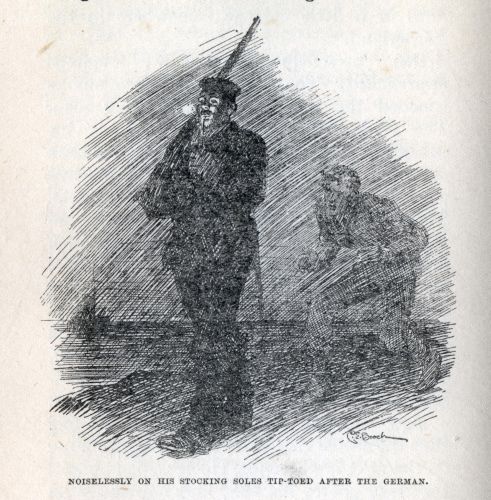
NOISELESSLY ON HIS STOCKING SOLES TIP-TOED AFTER THE GERMAN.
Leaving him where he lay, the two men summoned Lafoa to join them, and led him to the tunnel. Groping over the grating, Hoole discovered the wooden bolt with which it was fastened, quietly removed the cover, and signed to Lafoa to go in.
There was another moment of tense anxiety. Grunts, ejaculations, the stir of movement, were heard from the depths of the tunnel. Something fell with a sharp crack--a pick which one of the men had displaced. At the mouth of the tunnel it sounded like a pistol shot, and Hoole and Trentham swung round and looked apprehensively towards the beach. All was still, there. No doubt the wash of the sea was loud enough to smother the single sharp sound at a distance.
It was evident that Lafoa had intelligently grasped his instructions, for the natives, as they filed out, though their movements were quick and urgent, made scarcely a sound. In a long string they followed Trentham to the spot where the rope dangled over the wall of the ledge. Trentham found that his hands were trembling as he slid the rope over the shoulders of the first man. If only he could have multiplied the rope! Each ascent would take at least half a minute. How many men were there? What might not happen before they were all in safety above? One by one he looped them, saw them rise, caught the descending rope. Hoole, who had counted them out, came up to them and whispered 'Thirty-four.' More than a quarter of an hour must elapse before the last man had ascended, and some of those at the end of the line were showing signs of restlessness, grunting, sighing, clicking with their tongues. Moment by moment Trentham expected some of them to whoop with excitement. 'Make all fella no talkee!' he whispered to Lafoa, and the man went along the line muttering fierce threats.
The thirty-fourth man had gone. Lafoa followed him, then Hoole. Not a sound had been heard from below but the murmur of the sea and the muffled voices of the men in the sheds. With intense relief, and the feeling that fortune could hardly betray them now, Trentham looped himself and signalled to be hoisted. He was barely half way to the top when a sharp clatter above made his blood run cold. Crack followed crack, then for a second there were a number of dull thuds, and finally, a tremendous crash on the ledge below, waking echoes around the cove. One of the natives, in climbing among the boulders, had displaced a large rock.
The doors of the sheds were burst open. Lights shone across the cove. Men came rushing out, calling to one another, to the sentry above, to the men on the Raider. 'Faster! Faster!' Trentham cried inwardly, as he was jerked upward. He was just over the edge when a blinding light swept across the face of the cliff. The searchlight's beams fell full upon Trentham's white-clad form. Slipping out of the loop, he scrambled on hands and knees up the sloping ascent towards the boulders. Below him there was a sputtering rattle, and he felt himself splashed with earth and stones as the rain of machine-gun bullets pecked at the cliff. Something hot stung his leg; he crawled faster; in another moment his shoulders were grasped by sinewy hands, and Grinson and Hoole between them lugged him over the brink and behind the protecting boulders.
'Thanks be for all mercies!' panted Grinson. 'And as for that clumsy lubber that kicked down the rock----'
'Shoo!' whistled Hoole, 'it's time, sure, to cut and run!'
CHAPTER XIII
A FORCED LANDING
'For goodness' sake keep them quiet!' gasped Trentham, clambering up among the boulders to the top of the slope. The native prisoners, hysterical in their joy, were laughing and shouting and smacking their thighs.
'Say, Lafoa,' said Hoole, 'tell that chief of yours to stop the hullabaloo. Black fella no talkee this time.'
Flanso gathered his men together, and reduced the hubbub somewhat. Meanwhile Trentham had gained the top.
'We must get out of reach at once,' he said. 'The searchlight's no good to them now, nor the machine-gun; but if these fellows make such a row the Germans will track us.'
'We make for the village?' asked Hoole.
'Not directly; the Germans are sure to put men on the paths. But I fancy they won't risk a regular pursuit in the dark, and if we get away from the coast and avoid the direct route to the village, we shall at any rate not run into them. How 's Meek?'
'Just alive, sir, that's all I can say,' replied Grinson. 'What they 've been doing to him----'
'Can he walk?' Trentham interrupted.
'Says he ain't got no feeling in his legs. But what's the odds? I 'll heave him across my back. Lucky you 're lean, Ephraim, me lad!'
'Come, let's start at once. Where's Lafoa?'
He explained his plan to the interpreter, who imparted it to the young chief, and the whole party moved off silently into the forest, Grinson mounting Meek pickaback.
Trentham's inferences as to the actions of the enemy were better justified than he knew. All the Germans with the exception of Hahn had been thrown into a state of utter consternation by the discovery that Meek was not the only white man in their neighbourhood. Hahn, professing himself to be as much surprised as the rest, had discreetly held his tongue. Consequently the commander, ignorant of the number of the rescuers, had contented himself with posting parties of the crew on the paths which the fugitives must cross to regain their village, postponing organised pursuit until the morning.
It was slow going in the darkness. Several of the natives who had been longest enslaved were weak from overwork, ill-treatment, and confinement. The stronger among them, eager to press on, were restrained by fear of the dark and the necessity of helping the weaker. Hoole noticed that Trentham was limping.
'Hurt your leg?' he asked.
'Got a bullet, I think, but it's nothing.'
'Shucks! Let me have a look at it right now. You might bleed to death.'
He knelt down and groped for the wound.
'The bullet has ploughed up a bit of your calf,' he said in a minute or two. 'Lucky it's no worse. Wait half a second while I tie it up; then I guess you can go on till we strike some water.'
They went on, struggling over rough country amid thick bush and trees. Even the natives were at a loss in the darkness. They could not choose a definite direction, and it seemed obvious to the white men that some of them would soon collapse. Grinson was panting under his load, light though it was, but steadfastly refused to allow the others to take turns with him. At length, coming to a patch of open ground, Trentham called a halt.
'We ought to be pretty safe now,' he said, 'and had better camp here till the morning. With daylight some of the natives will be able to take their bearings.'
They lay down on the rough grass, already wet with dew.
'How d' you feel, Ephraim?' asked Grinson, bending over the seaman.
'I felt worse when I had typhoid,' said Meek faintly. 'What a lot of trouble I do give you, Mr. Grinson--a lot of trouble. And I ain't said a word of thanks to the gentlemen.'
'Don't bother about that,' said Trentham. 'Get to sleep if you can.'
'Ay, go to sleep at once, Ephraim; d' ye hear, me lad?' said Grinson.
'I 'll try, Mr. Grinson, and if so be I dream horrors----'
'Dream! What's dreams? Why, many's the times I 've been drownded in my sleep. Dreams make me laugh. (I 'll get him off, sir,' he whispered to Trentham. 'A yarn of mine has done it afore now!) I remember once I dreamed as how I 'd got into a Salvation meeting; they was singing a hymn, but the man as played the trumpet--why, somehow the trumpet turned into a beer bottle, and I found I was playing the trumpet myself. They all come up and thanked me afterwards for my beautiful music, and then all of a sudden I was left alone, and couldn't find my hat. While I was hunting for it, that there trumpet fellow rushed in and pushed a rolled-up parcel into my hand. "Very good hat!" says he, and when I opened it, bless you, 'twas nothing but a tea-cosy.... He 's off now, sir. What have those devils been doing to my Ephraim?'
'We 'll hear all about it to-morrow. You had better sleep yourself, Grinson. Tell yourself a yarn.'
'No, sir; that's not my way. I counts over the number of sweethearts I 've had, and by the time I 've got to the third or fourth I 'm dead off; they was so dull.'
It was a comfortless night on the open ground, with neither fires nor wraps to defend them against the chill air. Either Hoole or Trentham was always on guard, together with relays of the natives. By the exertion of his authority Flanso kept his men fairly quiet; but the white men were on thorns lest even the subdued murmurs of voices should reach the ears of possible scouts.
At dawn the party was marshalled. It had been arranged that the weaker men among the natives should make for the village by a round-about route, in charge of Grinson and Meek, and led by Lafoa. Trentham and Hoole intended to wait a while with Flanso and the rest, and then to scout more directly eastward in order to keep watch on the Germans.
They were just about to start when the natives pricked up their ears, and Flanso managed to make the white men understand that they were alarmed by a noise in the air. A few seconds later Hoole declared that he heard the seaplane's engines. Trentham signed to the natives to take cover in the surrounding bush, and with Hoole posted himself at the edge of the forest, where he might hope to escape observation. Presently the seaplane soared over the clearing, a few hundred feet above the ground, and after circling once or twice made off south-eastwards in the direction of the village.
'They won't see our men in the forest,' remarked Trentham, 'but we had better start. If they drop a bomb on the village, there 'll be a frightful panic.'
They hurried among the trees to re-form their party, but found that the natives, scared by the noise of this aerial monster, had disappeared. Only one man remained, Flanso himself, armed with a spear taken from one of those who had accompanied the white men from the village. Under his guidance they set off rapidly.
It was perhaps a quarter of an hour later that Hoole caught sight of a native among the trees on his left hand, and thinking it was one of the missing men, shouted to him. The man at once dashed away, uttering a shrill cry.
'Kafulu!' cried Flanso excitedly, and was on the point of springing after the traitor when a shot rang out, and a number of Germans came into view almost directly in front of them. The three men instantly darted away to the right, pursued by more shots, and ran until they were out of breath.
'We 've outrun them,' said Trentham; 'must have gone twice as fast as they, burdened with their rifles. I must rest a bit; my leg is rather groggy.'
There was no sound of pursuit. Presently they moved on again, but had not gone far before they once more heard the hum of the seaplane, apparently approaching from the south. Screened by the trees, they did not check their march until Hoole suddenly exclaimed:
'Say, Trentham, that machine 's sure in difficulties.'
'Is it? How do you know?'
'Listen!' returned Hoole with a smile.
The humming was intermittent, spasmodic, and presently ceased altogether.
'They 're coming down,' said Hoole, 'and not far away. Let 's have a look at it.'
'Better push on,' said Trentham.
'But it 'll do us good if the machine crashes. I 'd be glad to know it's out of action. Come on!'
They turned in the direction in which the sound was last heard. Through the close-growing trees it was impossible to see far, and Trentham privately thought the search a waste of time; but after only a few minutes' walk they came to the edge of an open space sloping down to a stream some twenty feet wide.
'It will be hereabout,' said Hoole, detaining the others at the top of the slope. 'But I guess this trickle isn't wide enough to float it. Let us separate, and scout along the line of bushes here, up and down stream.'
In a few minutes Flanso, who had gone northward, returned to the others, and told them by signs that he had discovered the machine. Creeping back with him, they came to a bend in the stream, and there discovered the seaplane, resting partly on two small trees, partly on a bed of rushes, and awkwardly tilted. The two airmen had left their seats, and were talking together on the bank, apparently consulting a compass. Every now and again they glanced apprehensively into the bush on both sides. Then they returned to the seaplane, walked round it, put their shoulders against the fuselage, and tried to lift it. One of them took out his revolver, and was on the point of firing it into the air, when his companion hastily interposed. The two men had a brief altercation. Finally the one who had been about to fire appeared to yield to the other's warning, and they both sat down on the shelving bank, discussing the position over again.
Sheltered by the dense vegetation above the watercourse, Trentham and his companions had watched their movements with interest. The tenor of their discussion was easily divined. The seaplane could not be salved without help, but they hesitated to leave it, fearful of its being discovered by the natives, with whom, as they now knew, were white men. If they parted company, which was to return to the cove? The one left would be less able to defend himself and the machine. A revolver shot might have brought assistance from the Germans; on the other hand, it might attract a horde of cannibals. What were they to do?
As they sat on the bank, they were sideways to the three men watching them only a few feet above.
'Let's rush them!' whispered Hoole suddenly.
He seized Flanso's spear, pushed his revolver into Trentham's hand, and before the latter could utter a word, either in assent or in remonstrance, the American was half-way down the slope. Trentham had no choice but to back him up, and he dashed after his friend with scarcely a moment's delay.
The Germans heard the sound of Hoole's movements through the bush, turned their heads and sprang up. One of them raised his revolver to fire, but Hoole, now only three or four yards away, launched his spear. His sudden action flurried the German's aim, his shot flew wide, and the next moment he fell back, cursing, and tearing the spear from his shoulder. His companion, seeing Trentham rushing at him with levelled revolver, hesitated a moment, and caught sight of Flanso swooping down immediately behind the Englishman.
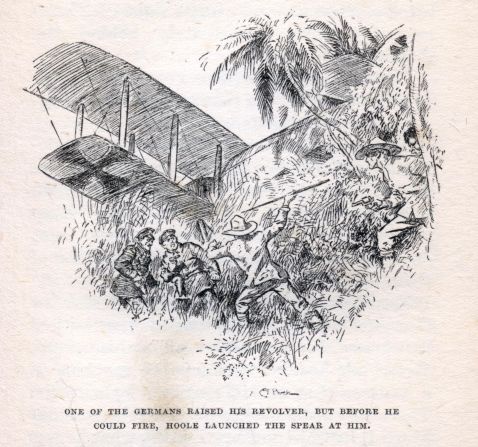
ONE OF THE GERMANS RAISED HIS REVOLVER, BUT BEFORE HE COULD FIRE, HOOLE LAUNCHED THE SPEAR AT HIM.
'Hands up!' cried Trentham, taking advantage of the man's momentary hesitation.
Up went his hands.
'Guess we 'll borrow your revolvers, gentlemen,' said Hoole, picking up the weapon dropped by the wounded man. Trentham took the other man's from his belt. 'Keep your eye on them, Trentham,' Hoole went on, 'while I kind of size up this machine of theirs.'
Trentham and Flanso stood guard over the Germans while the unwounded man bathed his comrade's arm and bound up his wound. Meanwhile Hoole examined the seaplane in a manner that took Trentham by surprise. There was a sureness, a purposefulness about him; he seemed to know exactly what he was looking for. Indeed, he pulled the engine about, as Trentham afterwards told him, as if he were its maker. A very few minutes' inspection sufficed to make him wise, as he put it.
'Not much wrong,' he said, coming over to Trentham and smiling. 'I guess I can put it right. But we 'll want help to get it on to the stream--yonder there, where it widens. Shall we start for home?'
'And these gentlemen will come as our prisoners?'
'Sure. We haven't any coal for them to dig, but they can start on yams.'
'Ve are officers; it is not correct for officers to vork,' said one of the Germans.
'Say, is that so? You 're a lazy lot? Well now! And yet you 'll make a chief dig coal for you--a chief who 's as big a man here as your Kaiser in Berlin. Well, you surprise me! Come along, Trentham. Let's hurry.'
'How far are we from the coast?' asked Trentham of the Germans as they started.
'Eight or nine mile,' was the surly response.
'Bully!' exclaimed Hoole. 'With luck we 'll have time to salve the machine before it's found. Step along, Flanso!'
'Ze niggers vere ve go--are zey cannibals?' asked one of the Germans anxiously.
'Yes,' replied Trentham. 'They nearly ate us. They mistook us for Germans.'
The prisoners asked no more questions.
Soon after leaving the seaplane, Hoole pointed out why it had come down in this part of the forest. The stream widened into a small lake, on which, when their engine failed, the Germans had tried to alight. Unable to reach it, they had been forced to come down on the bank of the stream.
Flanso scouted ahead, every now and then stopping to listen for signs of the Germans. Once, when they were rounding a spur where the vegetation was thin, Trentham clapped his hand over the mouth of one of the Germans just as he was about to shout.
'We 'll have to gag this fellow, Hoole,' he said.
'Sure. Another rag from my coat. And look you here, you officers, if you make a sound, barring a natural grunt, we 'll leave you to our friend Flanso. See?'
'The native yonder,' explained Trentham. 'You had him on your ledge, you know.'
The threat was enough. For the rest of the march the Germans were docility itself.
CHAPTER XIV
AN INTERLUDE
At the entrance to the village the returning party found Grinson alone, standing in the middle of the path, his knife in his right hand, a spear in his left, and a dozen other spears on the ground beside him. Neither Meek nor any of the natives was to be seen.
'What's the meaning of this, Grinson?' asked Trentham.
'Ignorance, sir--just ignorance, poor heathens!' replied the boatswain, cocking his thumb towards the village. 'That there airy plane sailed over a while ago, and the savages all did a bunk, screeching like one o'clock, though I roared myself black in the face telling 'em 'twas only a sort o' bird. 'Twas no good; like as I 've seed cows and sheep bolt with their tails up from a railway train. They was scared stiff, there 's no mistake; and I 'spect they 're hiding their heads somewhere.'
'And Meek?'
'I sent Ephraim straight into our hut, sir, and seeing as how the whole place was left undefended, like, I took up my station here. Germans, sir?' he added in a whisper, winking towards the prisoners.
'Yes; their machine came down. We 'll leave them in your charge, as we want to take a gang back to bring in the machine. You had no trouble on the way home?'
'Not a bit, sir, except that they 've no notion whatever of the proper way of marching--more like a lot of colts they was; but there, I hadn't the heart to correct 'em, they was so uncommon pleased to be free again.'
The party had not interrupted their march. Grinson had picked up his spears and fallen in step beside Trentham. As they passed along the path, from behind the huts and the midst of the plantations native heads appeared one by one, and when the timorous people recognised their young chief they came bounding out with yells of delight, until by the time the inner enclosure was reached the whole population had joined the procession. At the gate the patricians were assembled, headed by the temporary chief. They welcomed Flanso with some show of dignity, and conducted him to the chief's house, bowing low as he entered the doorway. The two prisoners were placed under guard in an empty hut, and then Trentham hurried after Flanso, and with the aid of the interpreter explained the course of action which had been arranged between himself and Hoole during the homeward march.
Trentham found himself contending with the natives' absolute incomprehension of the value of time. Flanso was already occupied in discussing with his elders the details of his approaching installation. No western monarch could have been more deeply absorbed in the ceremonies that were to inaugurate his reign. The hardships from which he had been rescued, the dangers that still threatened him and his people, seemed to have vanished from his mind, and it was only by dint of patience and pertinacity that Trentham succeeded in capturing his attention.
He pointed out that the Germans, enraged at the loss of their prisoners, would certainly seek to regain them, and also to wreak vengeance upon the community; nor would their animus be lessened when they discovered that their airmen had fallen into the enemy's hands.
'Chief say Toitsche fella no belongina find out that,' said the interpreter, after an interruption from Flanso. 'Black fella belongina eat white fella chop-chop.'
'Tell chief what he say all belongina gammon,' cried Trentham, and proceeded to explain as well as he could from the slender resources of pidgin English that the Germans might be valuable at least as hostages. It took some time to get this theory understood and accepted; then it was an equally long and difficult task to persuade him that the seaplane would be of any value to him. What was the good of it? It only frightened his people. To fetch it involved the risk of falling into the power of the Germans. Trentham managed to make him understand that the loss of the machine would greatly cripple the enemy's operations; and further, that if Hoole succeeded in repairing it, it might be used to bring help from friendly white men, who would eat up the Germans, and deliver the natives for ever from them. Flanso was rather impressed by these statements, though he said that his people would probably prefer to eat up all the Germans themselves; and Trentham realised the danger of employing metaphorical language. Ultimately he brought Flanso to concede his request--to despatch a party of able-bodied men to transport the seaplane from its present position to the village.
'I feel utterly done up,' he said, mopping his brow, when he returned to the others. 'Jabbering pidgin English for an hour is worse than penal servitude. And it's such frightful loss of time; the Germans may have discovered the machine by now.'
'Don't worry,' said Hoole. 'It was flying so low that I guess they couldn't have seen it come down, and when they miss it they may hunt for it for a day or two in the forest and not find it, except by a fluke. I don't figure out that they 'll have all the luck. Anyway, choose your men, and I 'll take 'em out; you 've done your share of the business. I 'll take Grinson, he 's a hefty man, and may have a notion or two.'
Fortunately the chief's obstinacy had no counterpart among the Papuans outside the enclosure. The released prisoners had done nothing since their return except relate over and over again the details of their sufferings and the manner of their escape. Their friends listened awestruck to the tale, and gasped as they heard of the dangling rope, the lightning which had gleamed upon the cliff, the crackling thunder, the strange stones that flew singing through the air; and they looked with wondering admiration upon the white men who had saved their fellows, not only from the tyrants who had enslaved them, but even from the powers of nature which those tyrants had at command. Trentham and Hoole thus found themselves to be regarded with veneration, and when the interpreter, prompted by Trentham, explained that the white men required the services of twenty strong men to bring in the great sea-bird which was another part of the enemy's magic, there was no lack of volunteers eager to undertake the work. Another score were selected as scouts, and when these understood that the object to be carried was bulky, and could not easily be conveyed through thick forest, they announced that they knew a way less obstructed by vegetation, which would be more convenient, though less direct.
Under their guidance the party reached the stream some distance above the spot where the seaplane lay. Feeling their way cautiously along the bank, they came at length in sight of the machine, which to all appearance remained exactly as it had been left. Hoole took the precaution to post a screen of scouts around the position to give warning if the enemy should approach, then he sent Grinson to detach the wings. A handy man, like all British seamen, Grinson soon accomplished his task, with the aid of tools discovered among the airmen's outfit. Within a shorter space of time than Hoole had deemed possible the work was finished. The wings were entrusted to two men apiece; the body of the machine was hoisted on the shoulders of the rest of the party; and although they met with considerable difficulties at rough and steep places on the return journey, once being saved from catastrophe only by the succour of Grinson's sturdy muscles, they bore their burden without mishap to the village, and carried it up the central path amid the joyous shouts of the populace. Some of the men, now that the strange bird was evidently helpless, showed their bravery by casting their spears at it, and their dexterity by failing to hit any of the bearers. At this Hoole fairly lost his temper, and rushed among the throng, smiting them right and left with his fists. This unusual mode of correction was effectual. The men who were sent spinning picked themselves up with an air of surprise, while their comrades shouted with laughter, in which the culprits themselves by and by joined. For safety's sake Hoole had the machine carried into the inner enclosure, where it was inspected with more decorum and shyness by the patricians, and with contempt by the medicine-man, who demonstrated his assurance by stroking the petrol tank and afterwards licking his greasy fingers. The grimaces he made were so much like those he was accustomed to display for professional purposes that his discomfort passed unnoticed except by the white men.
Trentham came out of his hut rubbing his eyes.
'Yes, I 've been asleep,' he said, in answer to Hoole's inquiring look. 'A pretty warden of the camp I should make. But the fact is, these people are hopeless. I tried to make them understand that the Germans might be upon us at any minute--no good! They appear to be entirely taken up with some sort of mumbo-jumbo, and can't attend to anything else. So I simply gave in, trusting that if the Germans did appear the people would be scared into reasonableness. The wall, of course, is proof against anything less than a four-pounder.'
'Well, I guess you did right,' said Hoole, 'and after thirty odd hours without it, a little sleep would comfort me some. As to the Germans, I 'm pretty sure they 'll do a bit of reconnoitring before they attack. The surprise of those two airmen wasn't put on; it's clear that Hahn said nothing about us, and they 'll be wondering how many there are of us. And so, my son, we must persuade Flanso to keep some scouts out with their eyes lifting. With proper notice we could put up some sort of defence. But I hope we 'll get away before it comes to that.'
'You can repair the machine, then?'
'I reckon I can, if I can get hold of a forge. But I 'm dead tired, so I 'll turn in, if you 'll keep your eyes open a while. So long!'
That evening, as the four men sat together once more in their hut, the two younger drew from Meek the story which he had already related to Grinson on the way home. It was a very colourless narrative--a recital of the cold facts in the fewest possible words, without a touch of passion or indignation. Grinson, however, was not the man to leave his mate's story unadorned.
'He 's an 'ero, gentlemen, that's what Ephraim is!' he declared. 'If ever he gets back to the old country, I lay the name of Ephraim Meek--ay, and his picter too--will be in all the newspapers. I 'll see to that. And the cinemas too; by gosh, I hear 'em now, the cheers of the little kiddies and the sobs of the women and gals when they see Ephraim tied up, like that chap as defied the lightning, bidding of them German ruffians to do their worst; he 'd never dig coal for them, not him! P'r'aps one of you young gentlemen will make a pome out of it, like that one about "the boy stood on the burning deck," you remember, or one I used to know years ago when I went to school, about a British Tommy. I don't rightly recollect it, but 'twas a Tommy in some heathen land as wouldn't bob his head to an idol, or thing of the sort, though they killed him for it. 'Twud be a shame if Ephraim wasn't put into some pome too--an 'ero like him!'
'I ain't got the figger of an 'ero, Mr. Grinson,' said Meek. 'Now if it was you--a-going off singing to be eat--that 'ud made a picter. I couldn't sing if 'twas me--I 'm sure I couldn't.'
'Why, that was only like a sheep bleating on the way to the slaughter-house--'eroes don't baa. Ain't I right, gentlemen?'
'What do you say, Hoole?' said Trentham, feeling somewhat at a loss.
'Well,' drawled Hoole, 'I guess heroes ain't cheap, anyway, and I 'm proud to know two, that's sure.'
CHAPTER XV
DUK-DUK
Trentham took turns with Hoole and Grinson to keep watch through the night, leaving Meek to the recuperative force of sleep. No untoward incident disturbed the hours of darkness, but there was a good deal of noise in the village, the men chattering incessantly.
'Reminds me of the meetings of our old Urban District Council,' remarked Grinson once, when Hoole relieved him. 'Fust one, then another, then all together--and nothing settled after all.'
'I guess they 're fixing something,' replied Hoole. 'In my country there 's a good deal of clack when we elect a new president. It's a new chief here, you know.'
'Which it means a coronation, p'r'aps, or a beano of some sort, sir. Well, we 'll see, if we live long enough. Good night, sir.'
Hoole had taken the precaution to have the seaplane placed near the hut. In the morning, as soon as it was light, he made a more thorough examination of the machine than had been possible before.
'What precisely is wrong with it?' asked Trentham.
'Luckily not much,' said Hoole. 'These Huns are no sports or they 'd have risked the few miles back to the cove. A couple of flying wires are broken--that 's nothing--but see here, the water jacket round this cylinder is cracked; the water (for cooling purposes, of course) will all run out, and cause the engine to overheat. That's why they came down, though, as I said, I 'd have risked it; all the same, it wouldn't be safe to risk a flight of any length, and the thing must be repaired. The mischief is, we 've got no solder, and you can't mend a crack in metal without that, or something equivalent.'
'But you said, when you first saw it, that it could be repaired.'
'Well, yes, I did; forgetting for the moment where we are. You haven't seen anything in the shape of a forge anywhere around, have you?'
'No, but I suppose they must have one, or they couldn't make their spears. I 'll ask the interpreter.'
But the word forge was unknown to the interpreter, and Trentham's effort to explain in pantomime, by blowing an imaginary pair of bellows, proved fruitless.
'Well, I 'll go and look around,' said Hoole. 'And meanwhile, old son, don't you think you 'd better persuade the chief to send out some scouts? If the Germans do have a notion to attack us, five minutes' warning would give us time to get every one inside the wall.'
'I 'll try. He may be more amiable than he was last night.'
Hoole perambulated the village for some time before he discovered what he sought. At last, however, within a narrow enclosure behind the huts, he noticed a young man sitting on a frame-like chair, and vigorously working two long sticks up and down. A low fence prevented Hoole from seeing the object of these energetic movements, but a little smoke and an acrid smell like that which comes from a blacksmith's forge drew him nearer, and looking over the fence, his eyes gleamed at what he saw.
In front of the native stood two long cylinders of bamboo, about three feet high. From a hole in the base of each ran a thin bamboo pipe; the two pipes converged and met at a small heap of glowing charcoal, which burnt more brightly with each thrust of the sticks as the native worked them alternately up and down in the cylinders. Hoole jumped over the fence, and eagerly examined this primitive forge. At the lower end of each of the sticks was fastened a huge bunch of feathers, resembling a mop; and these, pumped up and down, caused a considerable draught, by means of which the smith blew his fire to a heat sufficient to soften iron.
'Eureka!' cried Hoole, exulting.
He dashed back to the chief's enclosure, got his permission to have the forge brought within the wall, and in half an hour was busily engaged in the preliminary work of repairing the water jacket.
'It will be done by this evening,' he explained to Trentham. 'To-morrow I 'll be off to Wilhelmshafen or any other old place where I can find a white man, and then----'
'There 's enough petrol?'
'Enough for the flight out; I 'll get more when I land. Say, though, we shall have to take the machine to the sea. She can't run off, has only floats. That's a pity--waste of time, not to speak of the risk of coming up against the Germans.'
'But there 's an opportunity of getting the machine carried to the sea without a special journey. I 've heard some news while you were away. It appears that some sort of ceremony inaugurating the new chief is to take place at our old wreck to-night. All these Frenchified men are going with him in procession, with a certain number of the other fellows. We must get him to let his men carry the 'plane at the same time.'
'They go down the chimney?'
'Yes; it's the nearest way.'
'The narrow way that leads to destruction! How on earth are we to get the machine down there?'
'With ropes, man. We 've tested the quality of their ropes already, and the women work so uncommonly fast that they 'll have new ropes the right length in plenty of time. I 'll go and see the chief about it at once. He 's very much preoccupied, and vastly self-important, but he allowed me to send out scouts, as you suggested, and I dare say I can talk him over.'
Flanso was quite willing that the seaplane should form part of his procession. His vanity appeared to be flattered; he was as much pleased as a Lord Mayor of London who has secured some novelty for his show. But when the carriers had been chosen, an unforeseen difficulty arose. The medicine-man, whose office gave him access to the chief at all times, strutted into Flanso's house, where the elders of the community were discussing the details of the approaching ceremony, and vigorously protested against the seaplane being allowed to leave the village. In a vehement oration he declared that the strange bird must have some connection with the totem of the tribe, and that while it remained with them the village would be safe from hostile attack. Some of the elders backed him up, and Flanso, torn between his own superstitions and his sense of loyalty to the white men who had rescued him, sought relief from his perplexities by sending for Trentham, and putting the case before him.
Trentham had sufficient diplomacy to conceal his amusement, and also a certain irritation at the threat to his scheme.
'Tell chief,' he said to the interpreter, 'medicine-man fella he savvy lot. Big bird belongina totem all right; all same big bird he fly long way, bring back lot of white fella; they fight bad white fella this side, eat bad white fella all up.'
At this moment, unluckily, one of the scouts returned with the report that the big ship no longer lay in the cove, and that all the white fellas had disappeared. Grinning with triumph, the medicine-man instantly claimed that this fact proved his case; the loss of the big bird had evidently rendered the enemy helpless, and there was nothing further to be feared from them. Trentham, surprised as he was at the departure of the Raider, and suspecting that the Germans were probably setting a trap, strained his vocabulary of pidgin to the utmost to counteract the medicine-man's arguments, and ultimately prevailed on the chief to abide by the promise he had given. The medicine-man and his supporters were patently annoyed. They left the hut in undisguised ill-humour, and Trentham had an uneasy feeling that they would still give trouble.
The procession was to start soon after sunset, so that it might reach the wreck in time for the ceremony to take place at the height of the moon. It was late in the afternoon before Hoole had completed his repairs, and after making a good meal the four white men were sitting in their tent, awaiting the moment for starting.
'What's up, Trentham?' asked Hoole. 'You look very sick.'
'I 've been thinking we 're mugs, that's all,' said Trentham. 'With the chief and all his fighting men away, and us too, what defence has the village if the Germans take it into their heads to attack?'
'Gee! I 've been so busy that I hadn't given it a thought. But the Germans are out for slaves; they won't find any able-bodied men here.'
'That's true; but you saw what they did to that village in the forest. They 're capable of burning the whole place down, and shooting the women and children, from sheer revenge and spite. Hadn't we better wait till the chief returns before we start on our own scheme?'
For a few moments Hoole pondered in silence.
'The Raider has gone,' he said at length. 'This means that there can't be many Germans left behind; for, of course, they haven't all gone. If the natives didn't see any, it's because they 're still searching in the woods for the seaplane. Is it likely that the few left will attack? There is a risk, I admit, and my proposition is that you remain here with Meek and give an eye to things, while I take Grinson to fix on the planes and see me off. The sooner I get help the better, and the opportunity seems too good to be missed. What do you say?'
'Very well. I should have liked to see the ceremony, but--we simply can't leave the most helpless of the people to the Huns' tender mercies. What in the world is this?'
At this exclamation the others, whose backs were towards the gate, turned about. Through the gate was filing an extraordinary procession.
'By cripes!' said Grinson. 'Is it Jack in the Green, or Guy Fawkes Guy?'
A line of a dozen uncouth figures was slowly approaching. Above legs bared to the thighs bulged a mass of leaves nine or ten feet in circumference, crowned by a headdress like a candle extinguisher, from which rose a pole, fantastically coloured, four or five feet in height, with tufts of feathers and leaves at the top. Except the legs, no part of the human form could be seen.
These strange figures came slowly across the enclosure, until they reached the seaplane, the chief and all his men watching them in dead silence. Encircling the machine, they stooped until the leaves touched the ground; then, at a harsh cry from their leader, they leapt into the air and began to dance; their leafy clothing rustled; the poles wobbled and swayed; their legs bent and straightened; and as they swung round and round the seaplane they uttered shrill cries ever increasing in intensity. The white men looked on in amazement. What was the meaning of these antics? Flanso and his men seemed to be impressed. Trentham beckoned to the interpreter.
'What all this?' he asked.
'This duk-duk,' replied the man in an awed whisper.
'Duk-duk! What is duk-duk?'
'Big medicine. Duk-duk dance; that say big bird no go away; white fella all belongina afraid.'
Hoole whistled.
'That's the stunt, is it? By gosh, Trentham, it must be that old medicine-man thinking he 'll scare us stiff. He 's gotten a kind of affection for the machine. Well, Grinson, come along with me.'
He rose slowly, walked towards the seaplane, dodging between two of the dancers, and got into the seat behind the engine. Grinson had followed him.
'Just go to the propeller, Grinson,' he said, 'and swing it round five or six times when I give you the wink.'
The dancers had drawn closer to the machine, yelling more shrilly than ever. Hoole watched them with a smile as they circled round. Suddenly he gave the sign; Grinson caught the propeller, and with a heave of his brawny arm swung it about. Hoole nodded to him to step aside. The leader of the dance was just approaching, when there was a roar; Hoole had started the engine, and the propeller whizzed round with ever-increasing velocity. The dancer stopped short; before he could collect himself or retreat the air set in motion by the whirring propeller smote him with hurricane force, stripping the leaves from his body, and whirling his headdress, pole and all, across the enclosure. There stood revealed the lean, naked form of the medicine-man. He threw up his hands as if to defend his face from the blast; then, with a yell of fury, he sprinted to the gate, followed by the rest of the dancers.
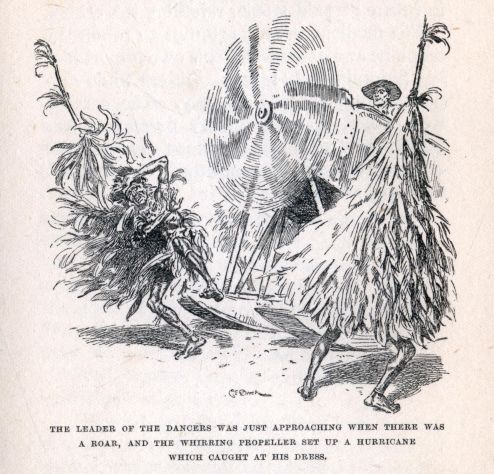
THE LEADER OF THE DANCERS WAS JUST APPROACHING WHEN THERE WAS A ROAR, AND THE WHIRRING PROPELLER SET UP A HURRICANE WHICH CAUGHT AT HIS DRESS.
A great roar of laughter burst from the spectators, hitherto silent, and from the crowd which had gathered outside.
'I guess the duk-duk won't quack so loud in future!' said Hoole, rejoining the others.
The medicine-man's attempt to retain the seaplane and demonstrate his own importance had ignominiously failed. His erstwhile supporters had no more to say. The carriers were called up; the chief's procession was formed, and when the red moon rested on the horizon they set forth solemnly towards the ancestral wreck.
CHAPTER XVI
FLIGHT
'I don't think nothing of this 'ere percession, sir--nothing at all,' said Grinson, tramping beside Hoole. 'It ain't my idea of a percession--not by a long chalk. I 've seed hundreds of Lord Mayor's Shows, and King George a-going to be crowned. They was somethink like--everybody moving like clockwork, 'cept the horses, and they did their best. But these 'ere cannibals ain't got a notion o' keeping step. Look at 'em! What's the good of their drums, I 'd like to know? Why don't they tap out the left-right, as you may say, so 's they will march proper?'
'Well, I guess they 're children of nature,' said Hoole with a smile.
'Brought up very bad, then, that's all I can say, sir. I 'm glad I 'm not a child of nature, but of respectable parents, and uncles and aunts the same. My old Aunt Maria, now, she was real respectable, and no mistake. I used to go and see her when I was a nipper. Fust thing she 'd do, she 'd wipe me nose. It ain't much of a nose--not like Ephraim's--p'r'aps he didn't have his wiped so often, so it growed better.... Why, save us, sir--did you hear that?'
Both the men turned round. From the rear of the procession came the cry of a white man in mortal peril. The moonlight, striking along the leafy avenue through which they were passing, revealed the hideously painted faces of the Papuans, some of whom were carrying live pigs for the feast on the shore. Again rose the startling cry. The two men, stepping among the trees to avoid hindering the march, walked back quickly, and presently saw, among the black faces, the pale, terrified features of the German prisoners, whom rough hands were dragging along at the tail of the procession. An explanation of their presence flashed upon Hoole. Baulked of their human prey before, the cannibals had determined that this time the custom of their tribe should be followed. The inauguration of their chief should not pass without its human sacrifice.
'Hi, you blackguards! What about my goose?' cried Grinson, and was rushing to the rescue when Hoole detained him.
'It's no use tackling these hobos,' said the latter. 'They 'd fly at you like dogs. Keep pace with them; I 'll run on and talk to the chief.'
Hoole sprinted up the line, past the Papuans, carrying food and cooking-pots, past the drummers and the men who bore the seaplane, past spearmen and dancers, and the retinue of patricians who followed immediately behind Flanso. Laying a hand on the chief's arm, he remembered that the interpreter had been left in the village, and wondered nervously how he was to make Flanso understand. To speak in English would be useless; he knew but a word or two of the native language. Suddenly he remembered the chief's remote French extraction, and the impression made on his father by Trentham's use of French. Could that be turned to account? To explain in French what he desired was beyond him, even if Flanso could understand a continuous speech; what alternative was there? Perhaps if he could remember some French--a French poem, say--and declaim it with appropriate gestures, it might produce the moral effect which was the first necessity at the moment. Hoole was a good elocutionist and amateur actor. Racking his memory for things learnt at school, he could recall but one poem, a song of Béranger's that had taken his fancy. He posted himself at the head of the procession, and facing Flanso, spread his arms to signify that no further advance was to be made. Impressed by his determined mien, the natives halted. And then Hoole, raising himself to his full height, began to recite:
'Il était un roi d'Yvetot,
Peu connu dans l'histoire.'
Rolling the r, he pointed dramatically to the moon,
'Se levant tard, se couchant tôt,
Dormant fort bien sans gloire.'
Here he shot out his right hand towards the village. The natives gasped.
'Et couronné par Jeanneton
D'un simple bonnet de coton:
Oh! Oh! Oh! Oh! Ah! Ah! Ah! Ah!
Quel bon petit roi c'était là!
La, la!'
He accompanied the refrain with a rhythmical clapping of hands; then, without waiting for the mystic effect to dissipate itself, he grasped the chief by the arm, and led him back along the halted line to the spot where the Germans stood paralysed in the hands of their captors. French, he feared, would hardly serve him now; but he pointed to the prisoners, and repeated 'Pas manger; pas manger!' in a fiercely authoritative voice, winding up with 'En arrière!' and pointing towards the village, from which they had come but a quarter of a mile. Then, stepping firmly up to the group of Papuans, he seized the arm of a big man who clutched one of the Germans, and with a dexterous twist forced him to relax his hold. The men snarled, but Flanso, who by this time had apprehended what the white man was driving at, sternly ordered the prisoners to be released.
'You must take them back, Grinson,' Hoole said. 'Their hands are tied; I 'll fasten them to you so that they can't get away. Take them back and hand them over to Mr. Trentham; then catch us up. Bring Lafoa back with you.'
'Ay, ay, sir. I 'll take a spear, case of accident. And I won't be long behind you.'
Hoole, sweating at every pore, as he afterwards said, gave an off-hand indication of approval to Flanso, and the march was resumed.
It was a slow and wearisome journey through the forest, and Grinson, accompanied by the interpreter, caught up the procession before it had advanced another mile. Many times the bearers of the seaplane had to rest; in some places trees and shrubs had to be cut down to allow its passage, and Hoole had many an anxious moment, fearing that the wires would be bent or broken through the carelessness of his inexperienced carriers. But the edge of the cliff was reached without serious mishap, and in a much shorter time than he had believed to be possible. The route chosen by Flanso was in fact shorter by many miles than that by which Hahn had led the party weeks before.
The covering over the top of the chimney had been removed, and Flanso and his men nimbly climbed down one by one. Hoole allowed all to descend except the carriers, Grinson, and the interpreter; then he set to work to ensure the safe lowering of the machine and its detached planes. With the interpreter's aid he got the men to make a stout platform of saplings extending some feet beyond the edge of the cliff, with a hole at the chimney top. The body of the machine was secured to two stout ropes which were carried round trees. Hoole had a third rope with a sling in which to put his feet, and this he tied firmly to a trunk.
'Now, Grinson,' he said, 'you will be in charge here, and woe betide you if you fail me! I 'm going to let myself down into the chimney. When I give the word, lift the machine gently over the cliff and lower away; I 'll keep an eye on it and fend it off the rocks. That's all clear?'
'As clear as good beer, sir, and I only wish I had some, I 'm that dry. Ephraim says there 's----'
'Oh, hang Ephraim! Stand by!'
He swung himself into the chimney and shouted 'Lower away.'
'The next ten minutes,' he told Trentham afterwards, 'were an age--an epoch. I heard Grinson yo-hoing to the natives above; he never stopped for a moment. How he managed to control those savages I don't know. Down came the machine, and there was I, swinging on the rope, clinging with one hand while I guided the machine with the other. Once it dropped suddenly on one side, and I feared the whole caboodle would crash to the ground; but Grinson bellowed like a hurricane, the thing righted itself, and my heart was banging against my ribs like a steam hammer. Well, we got the fuselage down at last; the planes were a simpler proposition, and by and by Grinson joined me on the beach, as proud as a peacock. "I done that in fust-rate style, sir," says he with a broad grin. "You can bear me out, sir."'
Hoole was so much occupied in putting the machine together by the light of the moon that he saw little of the native ceremony. There was drumming and dancing; at one moment the chief, followed by a group of his men, marched solemnly to the wreck, and after tramping seven times round the broken mast, descended to the cabin. On his return he was welcomed with a frenzied shout. Then fires were lighted under the cooking-pots, the dance was kept up until the viands were ready, and the feast was prolonged until the moon had travelled half-way round the sky. Satiated, the natives flung themselves on the sand and slept.
'Well, sir,' said Grinson, sitting beside Hoole, close under the cliffs, 'all I can say is, it's a wonder to me how they could stow away so much boiled pork without mustard or a pint of beer.'
Morning dawned. Hoole had the seaplane carried down to the sea. The tide was rising; the sea was choppy; waves of considerable size were breaking on the beach.
'I hope she 's seaworthy, sir,' said Grinson, eyeing the machine anxiously.
'That we 'll soon discover,' replied Hoole. 'You know what you have to do. When I 've pumped up and sucked in, you 'll give the propeller half a dozen turns; then I 'll switch on, and you 'll skip away, or you 'll get a dose like the medicine-man.'
The whole body of natives was lined up on the beach, watching the white men with simple curiosity. Suddenly one of them gave a shout, and pointed out to sea.
'By the powers, sir, here's the Blue Raider,' cried Grinson.
The vessel had appeared round the western horn of the bay, and was standing in as close as possible to the shore.
'They must have seen us,' said Hoole. 'Rank bad luck! Think I 'd pass for one of the Germans, Grinson? They 're too far off to distinguish features.'
'You might, sir, though I 'm ashamed to say it; but what about me? I 'm a good deal too broad in the beam.'
'But you 're half in the water. I 'll try making signs, just to keep 'em quiet, for if they 're suspicious and get their guns on to me, I 'm a dead man, sure!'
Partly concealed by the overshadowing planes, Hoole waved his arms in imitation of the Morse signals. From the vessel, which had now hove to, a boat was lowered, and pulled towards the beach.
'Now, Grinson, I must cut,' said Hoole. 'I 'll start towards them; that will diddle them, I hope; and before they make up their minds I 'm an enemy, I guess I 'll be out of range. Ready?'
Grinson whirled the propeller; Hoole made contact and switched on, the engine started with a roar, and the seaplane glided forward in the direction of the approaching boat. Cries of wonder broke from the throng of natives as the strange bird rose into the air. When clear of the water it turned suddenly eastwards, and flew rapidly at a low altitude along the coast. The boat stopped. A signal was fired from the vessel in the offing. The seaplane continued on its eastward course. There was a loud report which sent the natives scurrying to the foot of the cliff, and a shell burst a few yards behind the seaplane. A few moments later a shell dropped on the beach, sending up a great shower of sand and rocks. The natives scattered, some making for the chimney, others taking cover among the rocks and undergrowth. Grinson stood for a while with arms akimbo at the edge of the beach, as though defying the gunners; then a crackle of rifle fire from the boat sent him too rushing for the chimney. He had only just reached it when a shell fell plump into the wreck, scattering its timbers far and wide. A howl of wrath and dismay burst from the natives, and they began to swarm up the chimney, full in view of the occupants of the boat, but concealed from the Raider by a bulge in the cliff. Bullets rained on the rocks, but the rolling of the boat rendered marksmanship difficult, and only one or two of the men suffered slight wounds as they climbed up. Grinson was the last to leave the beach. When he reached the summit he stood for a moment or two on the platform, gazing with a grim smile at the Raider.
'Blue you are, and well you may look it!' he cried. 'Row back, you lubbers; such darned bad shooting I never did see, and I 'll take my davy as your goose 'll soon be cooked. Mr. Hoole has gone to fetch the sauce. Ahoy, ugly mugs! Wait for me! I don't want to be marooned in this 'ere forest.'
And he set off at a trot to overtake the natives, who were already disappearing among the trees.
CHAPTER XVII
THE ATTACK ON THE VILLAGE
In the haste of their flight from the dangerous beach the natives had left drums, cooking-pots, and other impedimenta behind, and had now nothing but their weapons to carry. Marching light, they showed a most ungentlemanly want of consideration for Grinson. 'They 're no gentlemen, Ephraim, me lad, that's flat,' he said later (they had gone several miles before he overtook them), 'and me panting and sweating like any think! I must 'a lost five pounds, if an ounce.'
As soon as he had recovered breath, he took place by Flanso's side at the head of the procession, and quite unaware that he was transgressing etiquette, kept pace with the chief, conversing by the way.
'What I can't make out, Flanso, old man,' he said, 'is what this Mr. Hoole is--what he was brought up to, like. He 's only a nipper, so to speak it, 's far as years go, and by his own account he was just larking round these 'ere seas, with more money than wits, I 'd say. Well, then, what I want to know is, how does he know about these 'ere airyplanes or seaplanes, or whatever you call 'em, handles 'em as easy as I might handle a ship's boat, and no gammon? I know you don't understand a word of what I'm saying, matey, not being born such; but I 'm just letting off steam, d' ye see? In course I wouldn't say all this to the young gent's face, my manners being good as a general rule; but it ain't good to keep your thoughts bottled up, like, 'cos they might bust out sudden like the cork out of a bottle o' beer that's stood too near the fire, and then where 'd we be, Flanso, me boy?'
Flanso appeared to be gratified by the seaman's speech, and smiled amiably.
'You ain't half a bad-looking chap, Flanso, and if you 'd take that stick out of your nose and learn to wash yourself you 'd be quite handsome. 'Tis a strange world, and no mistake. There 's my Ephraim, a good lad as cleans hisself regular like a true Christian, and speaks English as well as I does myself, but nobody could say he 's a beauty; and then there 's you--'orrible dirty, speaks like a monkey, and yet got a face on you as would make your fortune if so be you went into the Guards.
'Things is arranged very rum, Flanso, and there 's no understanding of 'em. Them two Germans, now--they 're pretty enough with their blue eyes and flaxen hair, just the sort the girls go silly over; but their 'earts, Flanso--their 'earts is blacker than you, old man. Yet I don't know--p'r'aps--but what's the good o' spekylatin'? Things is a puzzle, and we ain't got the brains for to work it out.'
He shook his head, and fell into a reverie from which he was suddenly awakened by a distant rifle shot. Instantly he became the man of action again. He swung round, signed to the natives to halt, and put his fingers to his lips enjoining silence. Then he hastened down the line until he had discovered Lafoa.
'Here, you!' he said. 'You makee all fellas hold their jaw and come bunko arter me, see? Bad fellas fightee; we go see what's up. See?'
The interpreter nodded, and hurried to Flanso, who gave orders in his own tongue. It was clear that he looked to Grinson for leadership. More shots rang out ahead.
'That's a revolver,' murmured Grinson. 'Mr. Trentham! Spears. Bows and arrows.' He looked round at the natives. 'May be some good. Fust thing is to find out exactly what's what. Here, you, how far off--how muchee way--your village?'
The interpreter did not understand him. Grinson groaned.
'Well, makee all black fellas hidee in bushes, so no one can see. Savvy?'
This appeared clear, for the natives, at a word from Lafoa, scattered, and in a few moments were invisible.
'Now come alonga me,' continued Grinson. 'Flanso too. Come on!'
Flanso leading, they wormed their way stealthily through the forest growth. The sounds of conflict grew as they progressed. Presently they were conscious of the smell of burning, and thin trails of smoke were wafted among the trees. Coming to the outskirts of the village, they beheld several huts blazing. At first they saw no human being, but advancing cautiously through the thick bushes that spread behind the huts, they came upon a Papuan squatting on the ground and rocking himself with pain. A question from Flanso elicited an account of what had happened. An hour or two before, the outlying scouts had discovered a number of white men marching towards the village. They had hastened back with the news, and the white men in the village had ordered all the people to withdraw into the inner enclosure. The enemy had come upon them before they were all within the wall. Some of the people had been killed, some wounded, others had escaped into the forest. The huts had been fired, and the enemy had rushed towards the gate, but had hurriedly retreated before a shower of arrows and the fire-magic that met them. They had posted themselves among the trees, and a little while before had begun to shoot their hot stones over the wall.
Lafoa interpreted this as well as he could to Grinson, who, however, seemed to understand the position instinctively. He bade Lafoa hasten back to the men halting in the forest a quarter of a mile behind, and bring up all the young warriors. While the man was absent Grinson sat down at the foot of a tree, stretched out his legs, folded his arms, and pondered. There had not been time for the Raider to reach the cove and land her crew, therefore the attackers must be relatively few in number. They were armed with rifles; probably the rifles had bayonets; therefore, though few in number, they were much more than a match for a throng of untrained savages with no better weapons than bows and arrows and spears.
'Which I mean to say,' said Grinson to himself, 'that is if we don't come to close quarters, whereas and however 'tis numbers what tells in a rush, such as boarding a vessel when you 're close alongside and Admiral Nelson piped all hands to repel boarders--or t'other way about, for 'twas us what boarded the enemy, must 'a been, being British. That's one point settled, Flanso, old man; we 've got to board 'em, take 'em abaft, otherwise about the rump or stern, and lively too, not forgetting that Mr. Trentham is for'ard banging away with his revolver, and we stand a good chance of being bowled over in mistake, and apologies are no use, and it's our look-out, and no blame to anybody. Now I come to think of it, that point's fust and last, for if we rush 'em and don't win, why, then nothing matters no more, and we 're all booked for the pearly gates and no mistake. Things are getting pretty hot by the sound of it, and I 'm afraid that there revolver have give out, and--ah! here come the boarding party.'
Lafoa stole through the brushwood followed by twenty or thirty young men of the higher caste, all moving as silently as wild animals.
'Tell 'em to lay snug--otherwise doggo--while you and me and the chief go for'ard and do a bit of spying,' said Grinson.
He crept forward with the two men, and came presently to a spot among the trees where it was possible to get a fairly clear view of the fighting. A number of Germans were laying piles of brushwood at the foot of the wall; others were breaking holes in it, or enlarging slight gaps between the logs; others were bringing up more brushwood from the forest, while reports and flashes high up in some trees overlooking one side of the enclosure showed that snipers had been posted to pick off the garrison. For the moment none of the defenders were visible. Grinson guessed that Trentham, having exhausted or all but exhausted his ammunition, was reserving himself for the inrush which without firearms it was impossible to prevent.
'There 's Trousers!' thought Grinson, catching sight of Hahn, who appeared to be superintending operations. 'If I don't give him a dusting----'
He stole back to the waiting natives, whispering instructions to Lafoa on the way. Half a dozen men were told off to creep through the bush and deal with the snipers in the trees, Grinson judging that in the dense undergrowth a native with a bow and a spear should be a match for a white man in a tree, even though armed with a rifle. The rest of the men were ordered to follow him noiselessly to the edge of the clearing in front of the wall, and to dash at the enemy when he gave the word. The slight sounds of their movements were smothered by the reports of the rifles and the hacking at the wall.
On reaching the spot, Grinson perceived that the Germans were massing for a determined push. At the sound of Hahn's whistle they sprang on to the piles of brushwood and attempted to swarm up and over the wall. Grinson could just see Trentham above the top, swinging a huge native club. While he was looking, the pendulum swing of the weapon disposed of two Germans who had come within its formidable sweep. To right and left, however, several of the enemy had got a footing on the wall, in spite of the spears hurled by the older and weaker natives who alone had remained in the village.
Then Grinson let out a bellow like the blast of a fog-horn, and sprang from the shelter of the trees with a spear in each hand, followed by the horde of natives, yelling and screeching. The Germans turned in alarm to discover what was threatening them, dropped to their knees, and raised their rifles. Only a few of them fired; the rest, disconcerted by the shower of arrows and spears which the natives let fly at them as they ran, dropped their rifles and fled helter-skelter among the trees, Flanso leading his men in hot pursuit.
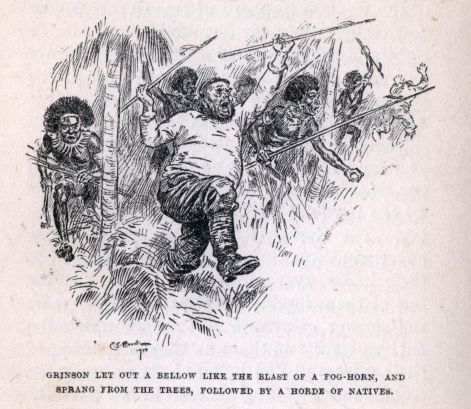
GRINSON LET OUT A BELLOW LIKE THE BLAST OF A FOG-HORN, AND SPRANG FROM THE TREES, FOLLOWED BY A HORDE OF NATIVES.
Grinson had made straight for Hahn, hurled one of his spears at him, which missed, and coming to close quarters, lunged at him with the other. But as he reached forward, a bullet from one of the snipers who had not yet been dislodged from his tree struck the boatswain on the arm. He spun round and fell on his face, just as Trentham, with Meek and a score of natives, came rushing out at the gate. Hahn had raised his revolver to shoot the fallen seaman, but catching sight of Trentham, he snapped an ill-aimed shot at him, then took to his heels and followed his men into the forest.
Trentham dispatched Lafoa to recall the natives, fearing that the Germans would rally and outmatch them in a running fight; then he returned to Grinson, who had sat up, and was trying to pull off his coat.
'Just a tickler, sir,' said the boatswain, grinning. 'I 'd a sort of feeling that I 'd be wounded in the house of my friends, as you may say, them being Bible words and all correct. Easy all! That's off. My goose is all right, praise be! Missed it by an inch, your lucky shot did, sir.'
'My shot? I didn't fire.'
'I 'm sure I beg your pardon, and won't say no more about it, though I 'd a notion you fired at Trousers and missed. This 'ere scratch won't spoil my beauty sleep, anyway. Mr. Hoole, sir? He got off like a bird, not but what they didn't have a go at him; the Raider, sir--most unfortunate, she come up just as we was getting ready for the kick-off, as you may say. The old wreck's blown to blazes, but no more harm done, and I lay Mr. Hoole by this time have got somewhere, though where that may be remains to be seen.'
'Thankful I am as you 're not killed, Mr. Grinson,' said Meek, who had come up from behind.
'Same to you, Ephraim, me lad. The only fly in my gizzard is that Trousers has got off; but we 'll dust him yet, Ephraim. No, I don't want no help; I 'm sound on my pins, and my arm don't hurt so bad as vaccination. What I would like is a pint o' beer, but I might as well cry for the moon. Things is a great puzzle, Ephraim!'
CHAPTER XVIII
THE AVALANCHE
'What I'd like to know, sir,' said Grinson, as they re-entered the enclosure, 'what I 'd like to know is, why them Germans, Trousers and the rest, took it into their heads to try this little game when our backs was turned, meaning Mr. Hoole and me?'
'You think they wouldn't have tried it if they hadn't known you were away?' said Trentham, checking a smile.
'Well, sir, two 's two; you can't get over that. If the whole crew had come, 't 'ud 'a been different; but with the Raider away, Trousers hadn't got enough men for the job, unless he knew we were short-handed, and I don't see nohow he could have known that.'
'They must be desperately in want of coal, one would think. Or perhaps Hahn wanted to distinguish himself in the absence of his commander. It would have been a good stroke to recover the slaves, you know.'
'That's it, sir,' cried Grinson, slapping his thigh. 'Likewise and moreover he was riled with Ephraim what defied him, and so he folds his arms and scowls under his eyebrows and hisses through his clenched teeth, "I will have my revenge." I 've seed that on the stage many a time.'
'We 'll grant that Hahn is a villain; but I fancy they had a very practical object in making this raid. Perhaps they 've been unlucky on the sea lately, must have coal, and would rather get the natives to dig it than dig it themselves. In that case we may expect another attack. How far was the Raider away when you last saw her?'
'From fifteen to twenty sea-mile, sir. She 's back in harbour by this, I reckon.'
'Then I think we had better reconnoitre. I 'll have a word with Flanso; now that his ceremony is over, he 'll probably be able to attend to business. Be ready to come with me.'
The chief was at first disposed to regard the recent victory as decisive; but Trentham managed to convince him that a still more serious attack might have to be met, and induced him to take the needful measures of defence. It was arranged that at the first sign of danger the whole population of the village should be withdrawn into the inner enclosure, where they would have the protection of the wall. The object of the defence must be to hold the wall until help came. There was a possibility, of course, that Hoole might not succeed in his mission. The engine might fail; even if he reached a port there might be no force available for hunting the Raider. Trentham was not blind to the difficulties of the position; but it was essential to keep up a show of confidence, and to take all possible steps to hold the ground.
Less than an hour after Flanso's return Trentham set off with Grinson and half a dozen natives, among whom was Lafoa, for the cove. They marched cautiously, in case any of Hahn's party were still lingering in the forest; but the Germans had evidently been daunted and had returned to their base.
Trentham had decided to make for the spot where he had organised Meek's release. While affording a good post of observation, it was difficult of access from the beach, and even if discovered by the enemy he would have plenty of time to escape into the forest behind. He gave a wide berth to the sentry-box above the cove, crept round through almost impenetrable thickets, and had nearly reached the slope strewn with boulders when there came faintly on his ear the characteristic rattle of a donkey-engine.
'The Raider 's back in the cove, Grinson,' he said.
'Ay, ay, sir, and hoisting coal, seemingly.'
Bidding Grinson keep the natives under cover near the head of the slope, Trentham stole forward, dodging among the boulders, until he reached a point where he could peep over at the cove beneath without much risk of being detected. The Raider was anchored almost in the same position as when he had last seen her; smoke was pouring from her funnel. There was much activity both on deck and on the shore. The donkey-engine was lifting, not coal, but stores from the ship's boats lying under her side. Men were carrying boxes and bales from the shed to the shore. Everybody was moving with an air of bustle and haste. It was impossible to doubt that the vessel was about to leave the cove: the settlement was to be abandoned.
An hour or two earlier Trentham would have rejoiced to know that the Raider was departing. But at this moment he felt only annoyance, disappointment, positive anger. Within a few short hours Hoole, unless baulked by ill-luck, would guide a British vessel to the cove, and the Raider would meet a well-deserved fate. It seemed that the Germans had taken alarm on seeing their seaplane flying eastwards, obviously under other than German control. They had suspected the nature of its mission, and having a wholesome dread of what might befall them, had determined to forestall the inevitable. With all his heart Trentham wished that he could hold the vessel at her anchorage. But he could do nothing to interfere with the bustling preparations below. The Raider was getting up steam; the stores were being methodically hoisted and stowed; before very long the vessel would disappear round the horn of the cove, and he could only watch her impotently.
'Flanso's people won't be bothered any more; that's one good thing,' he thought, as he began to climb up the slope. Picking his way, he stumbled, and clutched at one of the boulders to maintain his footing. The rock swayed slightly. Trentham stood still for a moment, resting his hand on it. An observer would have noticed that his brow suddenly cleared, his eyes danced, a flush spread over his cheeks. Then with quick movements, yet careful to keep under cover, he clambered up and rejoined Grinson. There was a brief, rapid conversation between them. Grinson's broad face expressed in turn surprise, doubt, determination, glee. Lafoa was given an order. Then, while Trentham directed them from the cover of the trees, the others quickly rolled a number of the largest boulders to a part of the slope which, as nearly as he could gauge the position, was directly above the Raider. It was no easy matter to move unseen from the sheds. Some of the most promising of the boulders had to be neglected. But the noise below was great enough to smother the sounds of the men's swift movements, and they were not interrupted. Presently, over a space of more than a hundred yards, there were ranged in three orderly rows, each row being about twenty paces from the next, a collection of rocks of all shapes and sizes and weights, from knobs of a few pounds to boulders so heavy as to need the united efforts of several men to move them. One of these, indeed, almost escaped from the grasp of the three men handling it, and Trentham felt a cold thrill at the imminence of a premature descent. But Grinson's brawny arms arrested the monster in the nick of time, and he secured it temporarily by means of smaller rocks wedged between it and the earth. Blowing hard, he came to Trentham's side.
'"Shust in time!" as old Trousers would say, sir,' he remarked. 'All's ready, but I won't answer for what 'll happen when you say "go."'
'We must do our best and trust to luck.'
'That's not my meaning, sir. It's these 'ere ugly mugs. They 've had no drill, d' ye see. Might as well be horse marines, in a manner of speaking.'
'Not so bad as that, Grinson. They have done very well, so far. Lafoa seems to understand what is needed, and if you set them a good example, I dare say they 'll follow it. The Germans seem to have cleared up nearly everything, and we had better start operations. I 'll climb down to the left yonder, where I 'll be out of the way, but can observe results without being seen myself. I 'll give the signal by lifting my hand; the rest is with you and the natives.'
'Ay, ay, sir. It 'll be a bit of a "tamasha," as they say out east.'
Trentham clambered down the slope under cover of the boulders, until he gained the spot he had pointed out. Grinson and the natives posted themselves at equal intervals behind the first row of the displaced boulders. A boat filled with boxes of ammunition was putting off from the shore. All of the crew who were not already on board the vessel were moving down from the sheds; apparently their work was finished. Trentham gazed seawards; there was no sign of the seaplane or of any ship. He raised his hand. Grinson instantly gave a mighty shove to the huge boulder behind which he was standing, and it began to bump down the slope. The natives were not quite so prompt, but after only a few seconds' delay five other boulders of smaller bulk started forward. Four reached the brink almost together, the fifth rolled a few yards, then stopped. But a few moments later there were five resounding splashes in quick succession as the rocks plunged into the sea.
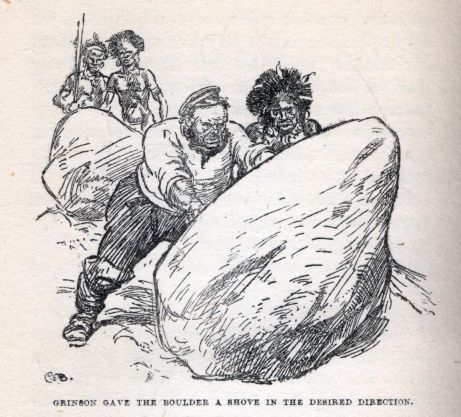
GRINSON GAVE THE BOULDER A SHOVE IN THE DESIRED DIRECTION.
Eagerly watching the result of his scheme, Trentham was disappointed to see that the missiles had fallen short of the Raider. But all work on the vessel ceased; a bale of goods that was being hoisted by the donkey-engine stopped half-way; the men on board gazed in surprise up the cliff, those in the boat stopped pulling. The angle of the slope was such that the men above were invisible; there was nothing to show that the fall of the boulders was not accidental.
Meanwhile, however, Grinson and his party had run up to the second row, and while the Germans were discussing the phenomenon another shower tumbled over the edge, one of the boulders falling plump on the bridge of the vessel, knocking away a portion of the rail, missing the captain by a foot or two, and crashing through the window of his cabin. Two went clean over the ship; the other two fell a little short of the port side, and threw a great volume of water into the half-empty boat. After a brief interval another set of boulders followed, and then another, until the missiles fell in a continuous shower. The captain roared an order; the grinding of the anchor chain was heard, and the men on shore, carrying rifles, rushed up the beach towards the winding path that led up the cliffs.
Trentham began to feel anxious. Very little damage had yet been done; the boulders varied greatly in shape and weight, and their trajectory after leaving the edge was equally various. Some rolled sideways; one, indeed, took an extraordinary tortuous course to the right, and struck the roof of the nearest hut, which was shivered into fragments. Those that had fallen nearest to the vessel were the larger rocks from the second row, and Trentham signalled to Grinson to deal with those remaining. He felt that the sands were running out; but there were still a few minutes before the Germans rushing up the steep and roundabout path could reach the head of the slope.