ERRATA. (continued 4)
Reading edition
When I received these notes from my friend, and had identified my bird with his description, I had never heard more than two notes in succession. Curiosity impelled me to visit their lofty solitudes often through the winter, and at length on the 3rd of February, when they were abundant, I heard three successive notes of different tones, proceed from the same bird; exactly like so many notes of a psalm, played in slow time. And about three weeks later, I find this note in my journal; I have at length heard the song of the Solitaire; the long clear notes, followed by many others of varying length, and different tones, but separated by pauses rather too long to make a piece of music, causing the whole to seem disjointed; but with much sweetness. If I may conjecture, these true melodies are peculiar to the nuptial season, and indicate that the period of incubation is either begun or near; a time that generally exerts much influence on the singing of birds.
From that time they filled the woods with their solemn music, until April; when they began to become scarce, and by the middle of May not one was to be heard or seen. I concluded that they were migratory, and had now departed from the island for the summer; but on mentioning the fact to Mr. Hill, he informed me about the beginning of June, that a friend of his who had travelled through the Coona-coonas a day or two before, (a district of the Blue Mountains, in which Mr. Purdie heard them in his botanical tour, and at the same season,) had heard them singing by scores. And he adds, “My Haytian notes relate to two visits to the mountains they inhabit in that neighbour island; the first was in August, the second in June; and they were there in the lofty pine forests in hundreds.” The curious fact of the total disappearance of the species from the Bluefields Peaks during the summer, while yet present in the island, leads me to conjecture, that they may be subject to the same instinct as influences migratory birds, but leading them to seek a colder climate, not in a northern latitude, but in a loftier elevation. The Peaks of Bluefields, though the highest land in the western part of the island, are not more than 2600 feet high, and therefore far less elevated than the ridges of the eastern end.
As far as I know, the food of the Solitaire is exclusively berries: I have never found an insect in the stomachs of many that I have dissected. Mr. Hill found in one, the berries of a mountain Rubus, like the blackberry. In the Autumn, I have detected those of the misseltoe, but more commonly those called glass-eye berries, from their constituting the chief food of the Merle of that name. In February, the pimento groves, which cover the mountain-brow are loaded with fruit, not soft and sweet and black, as when ripe, but hard and green, and in the very state in which it is picked to be dried for commerce. The temptation of these berries draws the Solitaires from their seclusion, and we not only hear their clear notes trilled from every part of the groves, but see them familiarly eating, at the edges of the pastures, and by the roadsides. It is worthy of remark that their companions in retirement, the Glass-eyes, accompany them also in these feeding excursions, and partake of the feast. I found the stomachs of both species at this season, loaded with the green pimento.
The two specimens which first came into my hands, early in October, manifested signs of a seasonal change of plumage. One had the head prettily covered with pale rusty spots, each feather being thus tipped: several of the body feathers were similarly tipped. This was moulting, and I perceived that it was the old feathers which were tipped, the new ones being uniformly grey, whence I infer the spotted character to be that of the summer dress, perhaps extending to all the clothing feathers. The other specimen exhibited the same peculiarity, but in a less degree.

[Audio content is not currently supported on your device. | MusicXML]
I have much pleasure in adding the following note contained in a letter from my friend, received since my arrival in England. Mr. Hill, having made some inquiries of a gentleman residing among the Blue Mountains, Andrew G. Johnston, Esq., received the following reply:—“I have no copy of my musical score of the Solitaire’s song. The bird now [July 27th] uses only its long breve notes and its octave, often out of tune, more often so than perfect. In the spring they are very numerous in the deep forests, and warble very prettily, somewhat like this:—
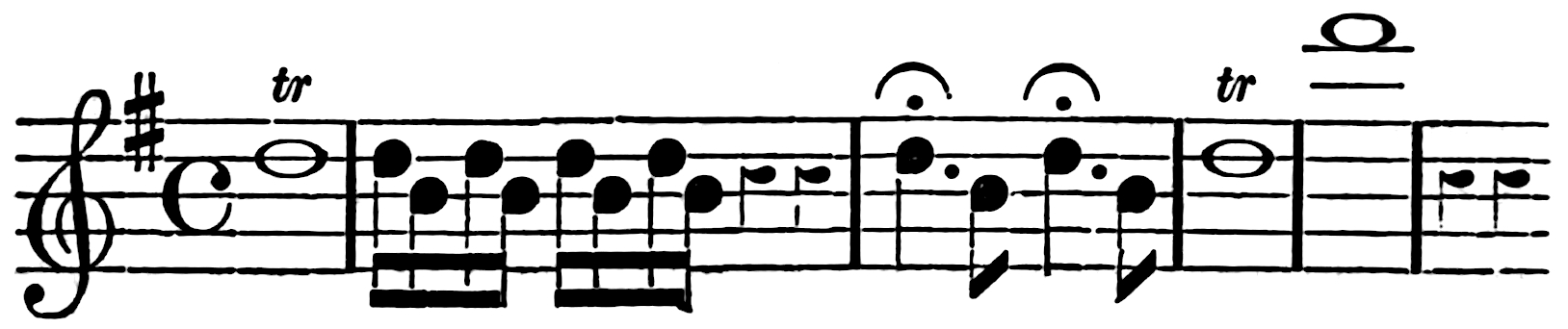
[Audio content is not currently supported on your device. | MusicXML]
sometimes thus—
[Audio content is not currently supported on your device. | MusicXML]
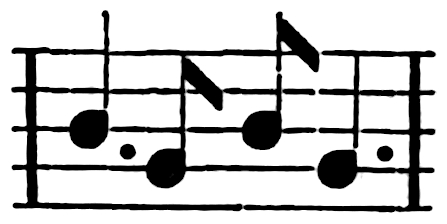
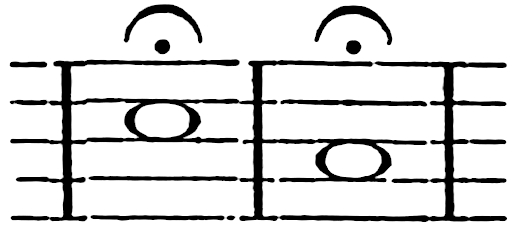
tr
tr
[Audio content is not currently supported on your device. | MusicXML]
The pointed crotchets are very sweet sounds, and seem to sound . I tried in vain to get one this spring, but I find the negroes know nothing about them. Hearing them one day singing, I asked two maroon-men who also listened, what birds they were. One said a grey speckled bird, mottled like a guinea-fowl: the other that it was black, and red about the rump and under the wings.” My conjectures on both points, are thus confirmed. I may add that the most common notes that I have heard are these.

Vieillot, who first described the species by the name of Muscicapa armillata, says that “it inhabits the Antilles, but is very rare in the greater islands.” His figure, pl. 42, is poor, both as regards form and colour. Mr. Swainson’s figure of Myiadestes genibarbis, (Nat. Lib. Flycatchers, pl. 13,) if meant for this species, is better as to colouring, but neither its form nor attitude is correct. Moreover, as he says, its body is not much larger than that of the robin, and mentions white lines on the black ear-coverts, it is with me a matter of doubt; especially as he speaks of the intimate resemblance which it bears to our common robin, “not merely in the red colour of the throat,” but in form; a resemblance certainly not discoverable in the living bird.
The figure in Mr. Gray’s Genera of Birds was drawn from one of the specimens procured by me in Jamaica, and is in winter plumage.
Fam.—CORVIDÆ.—(The Crows.)
BLACK-HEADED JAY.[58]
Cyanocorax pileatus.
Corvus pileatus, Ill.—Pl. col. 58.
This fine bird was brought to Mr. Hill, about the end of the year 1844, from the mountains of St. Andrews, by a negro who stated that he had caught it near Newcastle. Its wings were cut; which at once excited the suspicion that it had been a caged bird, but, on a moment’s examination, it was perceived that its perfect cleanness and the smoothness of its plumage decisively indicated a state of freedom and wildness. The man stated that having caught it alive in the garden of his cottage, which, (from the circumstance that the cottage-gardens, in the precipitous mountains, often run into narrow cliffs and corners, environed as if by enormous walls,) he might readily do, he had endeavoured to keep it alive, and had clipped both its wings for its detention. After a few days, however, it died, probably for want of proper food, and he brought it to Kingston, to dispose of it for a trifle.
I find by reference to Temminck, Pl. col., that this specimen, now in my possession, is a female; the male has the belly yellowish. His figure is also a female. He ascribes the species to Brazil and Paraguay.
JABBERING CROW.[59] Gabbling Crow.
Corvus Jamaicensis.
Cornix Jamaicensis, Briss.
Corvus Jamaicensis, Gmel.
In the wildest parts of the mountain regions of Jamaica, where the perilous path winds round a towering cone on the one hand, and on the other looks down into a deep and precipitous gully; or where a narrow track, choked up with tree-ferns on which the vertical sun looks only at noon-day, leads through the dark and damp forest to some lonely negro ground, the traveller is startled by the still wilder tones of the Jabbering Crow. So uncouth and yet so articulate, so varied in the inflexions of their tones, are these sounds, that the wondering stranger can with difficulty believe he is listening to the voice of a bird, but rather supposes he hears the harsh consonants, and deep guttural intonations of some savage language. All the Crows are garrulous, and several are capable of tolerable imitations of human speech, but the present is the only example I am aware of, in which the language of man is resembled by a bird in a state of nature. The resemblance, however, is rather general than particular; every one who hears it is struck with its likeness to speech, though he cannot detect any known words: it is the language of a foreigner. One cannot easily convey an idea of the sounds by writing; but the following fragments which the negroes have been able to catch from the learned bird’s own mouth, will give some notion of their character. “Walk fast, crāb! do buckra work.—Cuttacoo[60] better than wallet.” It must not be supposed that these words uniformly represent the sounds; these and similar combinations of harsh consonants and broad vowels, are varied ad infinitum, as are also the tones in which they are expressed. For myself, I have thought them ludicrously like the very peculiar voice of Punch in a puppet-show; others have fancied in them half-a dozen Welshmen quarrelling. These strange sounds are generally poured forth in sentences, of varying length, from the summit of some lofty tree, or in the course of the bird’s passage from one to another.
In some parts of the mountains they are not uncommon, though their loquacity would induce us to think them more numerous than they are, for we rarely see more than two or three at once. They are social, but not gregarious; and much of their time is spent in visiting successively the summits of those trees that tower above the rest of the forest, the Santa-Maria, the bread-nut, the broad-leaf, and the cotton-tree. As these visitations are often performed alone, I imagine that the gabbling cries are calls to their companions, especially as, if another comes within hearing, he is pretty sure to visit his clamorous brother, and enter into noisy conversation with him. After spending a few minutes on one tree, during which they do not, generally, change their position, otherwise than by walking deliberately along the branch, they both wing their way to the next station, not side by side, but one a little behind the other, both calling as they go. The bleached and bare limbs of a dry tree are always selected, when one of the requisite elevation is within range, as affording most fully that which they seem to delight in, an unobstructed prospect. Sometimes they do alight on lower trees, but then they are very wary and suspicious, so that it is a difficult matter to get within shot of one. When out of gun range, which they seem to estimate pretty accurately, they are much more careless of a passing stranger. Their flight is heavy and slow. They scarcely ever desert the solitudes of the mountains; two thousand feet is the lowest limit at which I have known them, with two exceptions. The one is that in certain lofty woods surrounding the extensive morass in Saltspring Pen, near Black river, I have heard the voices of these birds clamorously uttered, in the latter part of November. The other instance occurred behind Pedro Bluff, but little above the level of the sea, where I heard this bird in June.
The food of the Jabbering Crow is principally vegetable. Of several shot in autumn, the stomachs contained various berries, some fleshy, others farinaceous. The stomach is a muscular sac, but not a gizzard. Descending in the early months of the year to the ripening sour sops, on which it feeds, it is then much more approachable, but at the same time more silent. And about the same time, the seed of the bitter wood is ripe, which also attracts him. One of these trees is in the yard of a house at Content, where I occasionally sojourned; this was generally visited at dawn of day, and sometimes in the evening, by the Crows. I have been amused by the intelligence which they manifest in approaching it: a company of two or three will come into the neighbourhood, and alight with much clamour on some tree in the woods, a few rods distant; we hear no further sound, but presently one and another are seen stealing on silent wing to the bitter-wood, where they nibble the berries in all stillness and quiet. I could not help thinking that the noisy and ostentatious alighting on the first tree was but a feint to prevent suspicion, as if they should say, “Here we are, you see; this is the place that we frequent.” And this, I am informed, is not an accidental case, but a habit. The pimento also, which in its green state is eaten by so many of our birds, tempts the Jabbering Crow in February from his forest fastnesses, to the low but dense groves that clothe the mountain brows.
An intelligent person has informed me, that it will take advantage of a small bird’s being entangled in a withe, to kill and eat it; and that when a boy, amusing himself by setting springes for small birds, he has occasionally known them to be taken out of the springe by the Jabbering Crow. These statements, at least as far as the animal appetite is concerned, are in some measure confirmed by an experiment with one I had alive. One day in December, hearing a strange querulous sound proceeding from the top of the woods near me, I sent Sam to find the cause. He ascertained it to proceed from one of two Jabbering Crows, perched side by side on the top of a tree; the vociferous one being evidently young, though in full plumage, and capable of flight, for it was shivering its wings, while with open beak receiving something from the mouth of the other, doubtless its parent. He shot the old one, and slightly wounding it in the wing, brought it to the ground, where it ran so vigorously, that he had difficulty in securing it. It was rather formidable too; for it clutched his hand with its claws so forcibly, as to give pain; and afterwards, as I was holding it, it nipped my finger with the point of its powerful beak, and took the piece out. When turned into a room, it climbed about the various objects, by walking, and taking considerable jumps, striving to gain the highest elevation it could attain, where it sat, moody, but watchful. I presented to it the flesh of one side of the breast of a bird just skinned. He seized it greedily, and, after carrying it about a little, attempted to swallow it. In this he did not succeed without many efforts, as the piece was large: he several times tried to toss it while in his beak, and also drew it out by setting his foot on it, and took it in another position; but seemed to have no power of dividing it.
Robinson says, “They are great devourers of ripe plantains and bananas, and also rob the wild pigeons of their eggs and young. When tame, they are very droll and diverting, and as arrant thieves as our Jackdaws and Magpies, stealing knives, spoons, thimbles, &c., and hiding them. They abandon all such plantations as have the woods much cleared away from them, of which there have been many instances. They are often seen stooping down and drinking the water that is deposited in the bosom of the leaves of the largest wild pines. When employed in stealing plantains, they are said to be very silent, but at other times are the most loquacious, noisy animals breathing. I have been informed by some very creditable persons, that they will attack and destroy a yellow-snake; their method is to fly upon him one after another, and tearing away a mouthful of his skin and flesh, retreat. This they do with great nimbleness, and with impunity, till they have devoured the poor animal alive.” (MSS.)
Once in walking in a very lonely wood, I came suddenly on a Jabbering Crow sitting on a low tree just over my head; the bird was evidently startled, and in the surprise quite lost its presence of mind; for instead of making off with the usual clamour, it flew mute to another low tree a few yards off, where it sat peeping at me in silence, until I shot it.
I have never met with the nest; but a young friend, to whom I am indebted for several interesting facts, tells me, that about the beginning of last June, he was accustomed to see a pair on a very lofty cotton-tree, which he thought were nesting. He repeatedly saw them go and “lie down,” as he expressed it, in a large bunch of wild-pine, where they would remain for some time; and when one flew out, the other, which had been sitting on the same tree, would go and sit in the place. Usually the bird will leave its position on the slightest alarm, but when either of these was in its hollow, nothing would induce it to fly. He on one occasion fired thrice at the sitting bird, but she would not leave her place, and the situation was too lofty for the shot to reach her. The approach of the birds to the wild-pine was always perfectly silent and cautious; but they would dart out on any other bird flying near, and drive it away with clamour. On the whole, I have no doubt that this pair had a nest in the wild-pine.
The same young friend once witnessed a singular rencontre between two Jabbering Crows, and two Red-tail Buzzards, and in this case it is probable that parental solicitude gave the desperate courage. A single Hawk flying along was pounced upon by a Crow from a neighbouring tree, and a flying fight commenced, the Hawk thrusting forth his talons in endeavour to clutch, in which he once succeeded, and the Crow repeatedly striking his enemy forcibly with his sharp and powerful beak. Now and then each would rise perpendicularly and pounce down upon the other: this was principally but not solely, the manner of the Buzzard, the Crow usually striking his blow, and then retreating obliquely. After some time a second Hawk approached, which was attacked by another Crow; and now the melée went on in the same manner between the four combatants. The conflict lasted near ten minutes, and at length terminated in favour of the Crows, who fairly drove their opponents off the aerial field, pursuing them with pertinacity to a great distance. At the moment of my writing down this account, it was in a measure confirmed by my actually observing a Jabbering Crow pursuing with insult a Buzzard over the woods: it was strange to see, that after he had returned from the pursuit, he himself was attacked by a little Petchary, to whose superior prowess he was fain to yield, and flee in his turn.
In the latter part of May and early in June, which I presume to be the season of incubation, the singular chattering is almost relinquished for a much more monotonous cawing, somewhat like the note of the Rook, but uttered more pertinaciously, and more impatiently.
Robinson states that “they build their nest with slender twigs in the manner of Rooks on the tops of lofty trees, but not more than two nests on one tree. When they have young they will suffer nobody to take them, assaulting the bold invader with great courage and much clamour, fiercely buffeting his face with their wings, at the same time endeavouring to pluck out his eyes with their strong beaks.” He elsewhere states that “they are said to build in hollow trees.” (MSS.)
The flesh is not eaten; but having a curiosity to taste it, I had one broiled. The flesh of the breast was well-tasted and juicy, but so dark, tough, and coarse-grained, that I should readily have mistaken it for beef.
I found the tracheal muscles of this bird large and globose.
Fam.—STURNIDÆ.—(The Starlings.)
TINKLING GRAKLE.[61] Tin-tin.—Barbadoes Blackbird.
Quiscalus crassirostris.—Sw.
The appearance, voice, and habits of this bird had pretty well convinced me of its distinctness from Q. versicolor, before I was aware that Mr. Swainson had described it in “Two centenaries and a quarter,” p. 355. From the length of his specimen, it is probable the tail was not fully developed.
This is one of the first birds which a stranger notices: his conspicuous size and glossy plumage, his familiar business-like manners, and his very peculiar metallic cry, at once attract attention. Gregarious, but not associating in very great numbers to feed, they frequent pastures and open grounds in search of insects, not often hopping, (though I have seen one hop,) but walking with a swaggering gait, like rooks and crows. When on the ground their time is chiefly occupied in searching about among the roots of the grass. It is most amusing to stand where one is not observed, at a few yards’ distance from a Tinkling at work, and to watch the unremitted industry with which he labours. He marches rapidly to and fro, turning his head in all directions, peeping eagerly hither and thither, now turning one eye to a spot, now the other, ever and anon thrusting into the earth the beak, which is then forcibly opened to loosen the soil. He drags many morsels forth, which he quickly swallows, and searches for more. I suspect earthworms and various larvæ that live at the roots of grass are the objects of his research. Amidst his constant occupation, he does not omit, however, to keep an eye warily on any suspicious object. Only shew your person, and you see the singular-looking white eye turned up towards you; stir a step towards him, and away he flies, uttering his very peculiar cry, his long tail folded on itself, and resembling a vertical fan. As he sits on a tree, he will now and then elevate the fan-like tail, ruffle up the plumage, throw back the head, and with the beak wide open, utter two or three most singular notes, which I can compare to nothing but the sounds produced by repeatedly striking with force a piece of sonorous metal, relieved occasionally by the creaking of a schoolboy’s pencil upon a slate. “There are,” observes Mr. Hill, “two or three fine modulations, followed by a sudden break down into the harsh grating sounds of the ungreased wheels of a heavy-loaded truck.” It is to the first of these notes that the bird before us owes his local names of Tinkling, Tintin, Clinkling, and, among the Spaniards of St. Domingo, Chinchiling.
Like the Ani, the Tinkling feeds on the parasites of cattle. Walking among them, and mounting on their backs, they pick off the ticks that so sadly infest the poor beasts, who, as if appreciating the service, offer not the slightest molestation to their kind friends. I one day observed a Tinkling thus engaged in feeding her offspring. It was in the picturesque pasture of Peter’s Vale, where kine were numerous. Beneath the grateful shade of a spreading mango, in the heat of the day, a cow was peacefully ruminating. At her feet was the old Tinkling, walking round and looking up at her, with an intelligent eye. Presently she espied a tick upon the cow’s belly, and leaping up, seized it in her beak. Then marching to her sable offspring, who stood looking on a few yards off, she proceeded to deliver the savoury morsel into the throat of her son, who had gaped to the utmost stretch of his throat in eager expectation, even before his mother was near him. This done, she returned, and again walking round, scrutinized the animal’s body, but discovering nothing more, flew up on the cow’s back and commenced an investigation there. Just at this moment something alarmed her, and both mother and son flew to a distant tree. It was at the same time, and in the same pasture, that I observed a number of these birds collected in a large bastard-cedar that overhung a shallow pool; to which one and another were continually descending, and bathing with great apparent enjoyment; after which each flew to a sunny part of the tree, and fluttered and pecked, and ruffled its plumage, that it might dry smoothly and equally.
Mr. Hill has observed at Fort Dauphin, on the north side of St. Domingo, the Tinkling feeding in flocks of two hundred or more. The low grounds around the harbour, consisting of many shallow marly hollows are overflowed by the tide, after the prevalence of strong north winds, reducing them to marshes. Many marine mollusca, &c. congregating in these hollows, are left, by the water evaporating, to putrefy: the vicinity is hence very unhealthy, but hither the Tinklings resort in large flocks to feed on the decaying animal matters, with which the mud is filled. And in Jamaica, my friend has witnessed flocks of these birds equally numerous, winging their way, in March, towards Passage Fort, an embouchure subject to a similar inundation, on which they appeared to descend.
The food of our Grakle I believe to consist almost, if not quite exclusively, of insects, worms, &c. Yet I have seen one in March eating a Seville orange on the tree, tugging out large portions of the pulp, and swallowing them. But the stomach of this very specimen, which I shot in the act, was full of comminuted insects. As it was in the midst of very dry weather, the object may have been the quenching of its thirst. Robinson in describing the Corato, (Agave keratto) notices a fondness of this bird for its nectar, which may perhaps be similarly explained. He says of this magnificent plant, (MSS. I. 76.) “the flowering stem begins to rise about Christmas, and in the beginning of March, the flowers open. The Mocking-birds are fond of the honey found at the base of this flower; the Barbadoes Blackbirds are also fond of it, and between these birds happen great dissensions and bickerings. If the Blackbirds, which are naturally very loquacious, would fare well, and hold their tongues, they might feed unmolested. But their incessant chattering attracts the attention of the Mock-birds, who having at that time young ones, and being doubly jealous, assault the Blackbirds with great fierceness and vigour, soon obliging them to quit the plant, and hide themselves among the trees and bushes.”
Of two which I shot in January, the stomach of one presented a singular appearance, being stuffed with green herbage, like very fine grass, chopped excessively small. I had noticed several caterpillars among the mass, but it was not until I dispersed it in water, that I discovered it to consist of the contents of the caterpillars’ stomachs, expressed by the muscular action of the gizzard. There were no less than nineteen caterpillars, all smooth, and I think grass-eating kinds, some of which still contained portions of comminuted herbage. The stomach of the other contained about as many caterpillars, besides other larvæ, some spiders, a moth, and other insects.
Regularly at nightfall, during the summer, I used to see many parties of Tinklings fly over Bluefields, with the usual vociferation, and wend their way to a spreading cotton-tree near the seaside, where, I was informed, they slept; whence, as regularly one might see them, in the early morning, emerging and dispersing to their places of diurnal occupation. One evening I went down to watch their arrival and proceedings. About half-an-hour before sunset, they began to arrive in straggling parties, but did not proceed at once to their roosting place, but congregated in a clump of smaller trees, about one hundred and fifty yards from it, on the banks of Bluefields River, where they clamoured in all sorts of metallic tones with unceasing vociferation. Some parties from a distance, coming straight to the roost, suddenly altered their course, attracted by the calls of these intermediate settlers, and joined them, and some even returned to them, which had already passed the spot. A few, however, went on to their destination, and when once some were there, their numbers soon increased, for the calling now proceeded from both quarters. As the parties arrived, one or two single birds kept flying from one station to the other, backwards and forwards. At length the whole assembled number on the intermediate station rose as by common consent, and flew in an immense flock to the number of nearly two hundred, to the roosting place, darkening the air, and making a loud rushing with their united wings. Others went on to arrive, until between four and five hundred, (I could not count very accurately) had assembled. Long before this, however, I had found that the real roosting place was not the large cotton-tree, that this was but another station of congregation, for as the evening advanced, they began to leave this, and to perch on the fronds of four or five cocoa-nut palms that were growing in two lines, of which the cotton-tree was the angle. The nearest trees to this point were first chosen, and few chose the second, till the first was pretty well crowded, nor the third till the second was occupied, and finally the numbers on each cocoa-nut were in proportion to its proximity to the central point.
The taking of places was attended with much squabbling; the alighting of each new comer on a frond, causing it to swing so as greatly to discompose the sitters already in possession, and throw them off their balance; and hence each was received by his fellows with open beaks, and raised wings to prevent his landing. Still, many thrust themselves in among others, pecking right and left in self-defence. The highest horizontal fronds were most in demand, and many of these had at the close as many as ten or twelve birds each, sitting side by side in a sable row. When once the birds had left the cotton-tree, and selected their places on the palms, they did not return, but places were shifted continually. During the whole time their singular voices were in full cry, and could be heard at a great distance; some idea may be formed of the effect of the whole, by imagining two or three hundred small table bells of varying tones to be rung at the same time. By half-an-hour after sunset, the arrivals had pretty well ceased, and most of the birds were quietly settled for the night. I visited them on one or two subsequent evenings, but found no material difference in their proceedings.
As the Tinkling roosts in society, so does it build. The nests, to the number of twenty or thirty, are placed in a single tree, usually a hog-plum, (Spondias graveolens). One of these trees, chosen every year as a nesting tree, being on the property of a friend, a nest, one of fourteen then built, was brought down for my inspection. It consists of a deep, compact, and well-formed cup, the hollow of which is as large as a pint basin; the sides, about an inch and a half thick, formed of flexible stems of weeds, and stalks of guinea grass. It contained three eggs, measuring 1¹⁄₁₀ inch by ⁸⁄₁₀, of a dull pale blue-green, singularly marked with sinuated lines of black. I am assured that when the company have hatched their broods for the season, they tear away with their feet the nests, and scatter the materials; and that should any other bird have a nest on the same tree, it is mercilessly destroyed with the rest, regardless of the eggs or young which it may contain. The nests are placed on the forks of divergent branches, near the end of horizontal limbs, at a considerable elevation.
Mr. Hill informs me, on the authority of a friend from Barbadoes, that in that island a strange custom prevails among the children, of collecting these birds about Shrove Tuesday in every year, and bringing them into the towns, where they then play with them, and feed them with cockroaches. The origin or the object of this annual amusement my friend’s informant could not explain, having left that island when himself a child. The same gentleman has observed the Tinklings in Jamaica go to the lime trees, and descending beneath the trees pick up in their beaks the fallen fruits; then rising to a twig, each would take its lime in one foot, and gently rub it over its side beneath the wing, transfer it to the other foot, and rub the other side in the same way: the object here being doubtless the fine aromatic odour of the oil of the bruised rind communicated to the feathers. The observer has watched this proceeding by the hour together.
BANANA-BIRD.[62]
Icterus leucopteryx.
Oriolus icterus, Linn.
Oriolus Mexicanus, Leach.—Zool. Misc. i. pl. 2.
Icterus leucopteryx, Wagl.
This pretty bird is a general favourite; social and confiding in his manners, without being saucy, he frequents the fruit trees which are invariably planted around a Jamaican homestead. On an elevated twig he sits and cheers his mate with his clear, melodious song, which he trills forth with much energy. Sometimes his notes have considerable variety, and may properly be called a song; at others he whistles a quick repetition of two clear notes which much resemble the words Tom Paine>, Tom Paine, if we attempt to enunciate them in whistling. Again, it is a single note quickly repeated, as when we whistle to call a dog. Besides these, the Banana bird has other sounds, which are very deceiving, and seem the result of imitation.
Fruit is his principal diet; a ripe banana, or orange, a papaw, or a bunch of pimento, presents temptations to him; but perhaps still more acceptable are the various species of Anona, the sops and custard-apples, on whose soft and luscious pulp he delights to regale. A ripe sour-sop is sure to attract him, in common with the Blue Quits, with which he mingles. If the part exposed be decomposing, as is often the case, he may be seen tugging vigorously to pull off portions of this, which he throws from his beak with a jerk, seeking to arrive at a part more palatable. When thus engaged in feeding, and particularly when playfully pursuing the hen among the twigs, his bright yellow coat glows beautifully through the openings of the green leaves.
I have observed so frequently as to be worthy of notice, that when shot, the Banana bird grasps the twig on which he was sitting, so tenaciously as to hang from it, body downwards, until death at length relaxes the clasp.
The nest of this bird is an interesting structure; like that of the Baltimore of the Northern continent, it is a deep purse suspended from two parallel twigs, or from a fork. One before me is composed chiefly of the wiry fibres plucked from the fronds of the Palmetto-thatch, with some horse-hair interwoven. Sometimes, where thatch-threads are scarce, horse-hair alone is used, and the structure is particularly neat. But the more ordinary material is a vegetable substance, so closely resembling horse-hair, even on a minute inspection, that I have had difficulty in persuading intelligent persons that it was not actual hair, till I applied it to the flame of a candle, when it burnt without shrivelling. But I am very uncertain what the substance is; some say it is the Tillandsia usneoides or “Old man’s beard,” a very common tree-parasite, but it assuredly is not this; I have suspected it to be the fibrous stem of the Dodder, dried; a nest newly made, I observed to be of the bright buff hue of that plant, whence I presumed that the stems are sometimes taken in a recent, and even a growing state. A friend tells me, that he has, with much gratification, watched the process of building. The hairs or threads are procured one by one, and carried to the selected spot, where they are deposited in a loose heap. From this accumulated mass of material, the work is carried on, and progresses rapidly, when once begun. When a few threads are laid and interlaced for the base, the work becomes perceptible and interesting. Both birds work together; one taking a thread, and weaving-in one end, holds down the loose part with his beak; while his mate takes the ends of others projecting, and lays them tightly down over it, interweaving them with others. Other threads are crossed in the same manner, in every direction, until a slight but very compact purse is made, resembling a loose cloth. As it hangs, the texture is so thin, that a person below can discern the eggs or young within. Four eggs are laid, pointed at the less end: they are white, marked with a few angular scratches, and large spots of deep brown, and measure 1 inch by ⁷⁄₁₀. If an intruder attempt to rifle the nest when the young are there, both old birds fly round in excessive perturbation, and cry Tom Paine’s pick-a-ninny, with vociferous shrillness.
In March I have dissected females, which displayed a brilliance of plumage, in no wise inferior to that of the male.
I presume this to be the Watchy-picket of Sloane.
Mr. Hill has mentioned to me two other species of Icterus, both black, the one larger, the other smaller, which have been found in the mountains near Kingston. I think I once saw the former in Mount Edgecumbe.
BUTTER-BIRD.[63] Ortolan.—October Pink.—Ricebird.
Dolichonyx oryzivorus.
Emberiza oryzivora, Linn.—Aud. pl. 54.
Icterus agripennis, Bonap.
Dolichonyx oryzivorus, Sw.
In ordinary seasons this well-known bird arrives in vast numbers from the United States, in the month of October, and scattering over the lowland plains, and slopes of the sea-side hills, assembles in the guinea-grass fields, in flocks amounting to five hundred or more. The seed is then ripe, and the black throngs settle down upon it, so densely, that numbers may be killed at a random discharge. To procure the seed, the birds perch on the culm, but as the weight would bear down a single stalk, each grasps several culms in its foot, while it rifles the panicles. At this time, the males are dressed in the sober livery of the females. Early in November they depart for the southern continent, but during their brief stay they are in great request for the table. Dr. Chamberlaine only echoes the general estimation, when he says:—“The Butter-bird is a bonne bouche; it is but a mouthful, but a luscious and delightful one. Their note,” he adds, “during their migration hither, is simply ping, ping, ping:—what it may be in its native woods, I do not know. But wounded birds have been secured and kept in cages, and when placed in the same room with a Canary have soon acquired similar notes, and in time warble with equal strength and melody.” (Jam. Alm. 1840; p. 25.)
When the spring rains have set in, usually in the month of April, they again become our transient guests for a few days, on their northward migration, when the males are conspicuous in their nuptial dress. Other species of grass are now seeding, and the nutritive farinaceous grains of many neglected weeds afford them a supply during their brief sojourn.
Fam.—FRINGILLADÆ.—(The Finches.)
CASHEW-BIRD.[64] Mountain Bulfinch (Rob.)—Orange-bird.
Tanagra Zena.
Fringilla Zena, Linn.
Fringilla Bahamensis, Briss.
Tanagra multicolor, Vieill.
Spindalis bilineatus, Jard. and Selb.—Ill. Orn. n.s. pl. 9.
Though not very numerous, this beautiful bird is well-known, being conspicuous from his brilliant colours. He is spread over the country, from the mountains of the interior, to the plains of the coast. Rather social, though perhaps attracted by a common cause, the abundance of food;—we may sometimes see a dozen or more scattered over a large bully-tree, from the twigs of which they hang in all positions, while they pick the berries. Its flight is rapid, and performed in long undulations: during flight, a low sibilant note is uttered; but it is usually a silent bird.
About Spanish Town, it is called the Orange-bird, not from its feeding on oranges, but from the resemblance of its plump and glowing breast, to that beautiful fruit, as it sits among the dark green foliage. It is also called the Goldfinch.
I shot a male in September, and wounding him only in the breast, picked him up, more frightened than hurt. I carried him home in my handkerchief, and put him into a large cage, where he soon became quite a favourite. From the very first he was fearless and lively, found the use of the perches immediately, and did not flutter or beat himself against the sides, though persons stood close to the cage. This was large enough to allow him a short flight; and as there were several perches inserted at various heights and distances into the sides, he spent a great deal of his time in leaping from one to the other, seeming to enjoy it much. Seeing this, I put in one or two more, which were no sooner ready than he took notice of them, stretching himself towards them, cautiously at first, as if doubtful whether they would bear him; soon, however, he ventured boldly, and then took them regularly in his course. He always slept on the highest perch, with his head behind his wing. He was in full plumage, and his gay breast, and the fine contrasts of his striped head and wings, showed him off to advantage. I knew nothing that he would eat, save the berries of the bully-tree, none of which grew within a considerable distance. I first tried him with a few insects, and small earthworms, but he took no notice of these: then I gathered a few bunches of fiddle-wood berries, which I had no sooner stuck into his cage than I was pleased to see him hop towards them, and pick off the ripe ones with much relish and discrimination. I was informed that in a wild state, he sometimes eats the sour-sop; as I had none of this fruit at hand, I gave him pieces of a ripe custard-apple and of a guava. He immediately began to eat of each, plucking off portions of the pulp, and also taking up the fleshy ovaria of which the former is composed, which he chewed with his beak till the enclosed seed was pressed out. But all these were forsaken so soon as I presented to him bunches of ripe pimento, black and sweet. These he picked off greedily, masticating each in the beak, until the seeds, which I suppose, were too hotly aromatic for his taste, fell out. It was amusing to see the persevering efforts he made to obtain those berries, which happened to be a little beyond his reach. He would jump from perch to perch impatiently, gazing with outstretched neck at the tempting fruit, then jump, and look again; then reach forward to them, until in the endeavour, he would overbalance himself, and perform an involuntary somerset. Nothing daunted, however, he persevered until he ventured to do, what he had been several times on tiptoe to do, leap on the bunch itself; and this he continued to do, though with some failures, holding on in a scrambling way, now by a leaf, now by the berries themselves, until he had rifled the bunch of the ripest.
After I had kept him about a week, during which his liveliness and good temper had much attached him to me, though he made not the slightest effort at song, I took him out to cleanse the feathers of his breast from the dried blood that had flowed from his wound. I gently rubbed them with a soft wet sponge, but whether he took cold, or whether I irritated the wound, I know not; but on being returned to the cage, he instantly began to breathe asthmatically with open beak, apparently with pain; interrupted now and then by fits of coughing, which continued all night, and on the next morning he died. On dissection, I could not find that the shot had penetrated the chest, but they were imbedded in the muscles of the forearm, and had broken the scapula.
A nest, reported to be of the Cashew bird, was brought me on the 18th of June, taken from a pimento tree. It was a thick, circular mat, slightly concave, of a loose but soft texture, principally composed of cotton, decayed leaves, epidermis of weeds, slender stalks, and tendrils of passion-flower, intermingled, but scarcely interwoven. I think it probable that this had been sustained by a firmer framework; and that the person who took it merely tore out the soft lining as a bed on which the eggs might be carried. The child who brought it, could give no account of this. The eggs were two, long-oval, taper at the smaller end; 1¹⁄₁₀ inch by nearly ⁸⁄₁₀; white, sparingly dashed with irregular dusky spots, in a rude ring around the larger end. The embryo was at this time formed.
SCARLET TANAGER.
Pyranga rubra.
Tanagra rubra, Linn.—Aud. pl. 354.
Pyranga rubra, Vieill.
Of this gay-plumaged stranger, a male and female were seen in March of the present year, in that wild and magnificent gorge, called the Boca-guas, near Spanish Town. The brilliant appearance of the male, attracted the admiration of passers by, and he was at length shot, and brought to Mr. Hill.
About three weeks after this, a male, also in summer dress, occurred to my own observation, hopping about the small fruit-trees, on the banks of Bluefields River. He was very fearless, allowing me to sit and watch him within half-pistol-shot; now and then he flew down to the ground, by the side of the water, and remained a few moments peeping about; then he would fly up into a shrub, and presently be down again to drink; for the season was parched with drought. I watched him full half an hour, before he flew away.
Both these instances show that the Scarlet Tanager, occasionally at least, takes our lovely island, in his spring migration from Central America to the north. He certainly does not winter with us, having been until this season unknown to Mr. Hill, who for many years has paid close attention to the migrant birds. Yet D’Orbigny states, that it winters in Cuba; perhaps, however, but casually.
RED-THROATED BLUE TANAGER.[65] Orange-quit. Feather-tongue or Sour-sop bird.—(Rob. MSS.)
Tanagrella ruficollis.
Fringilla Martinicensis, Gmel.
Tanagra ruficollis, ibid.
Fringilla noctis, var. β. Lath.—Ind. Or.
? American Hedge-sparrow, fem. Edw. 122.
? Le pere noir, Buff. Pl. enl. 201. fig. 1.
The tongue of this species, pencilled and barbed at the tip, might give it a place among the Honey-suckers. It does not climb, however, nor cling by its feet, but perches. It is not a very common bird in the lowlands; but in the mountains I have found it rather plentiful. It frequents berry-bearing trees of various species, in small parties, with no very strong sociality; its only note is a single chirp, sharp and shrill. Towards the end of the year, when the dark and glossy foliage of the orange groves is relieved by the profuse golden fruit, reminding the beholder, of the fabled gardens of the Hesperides, this Tanager becomes numerous, hopping about the twigs, and pecking holes in the ripe fruit. Many are then readily caught by smearing the twigs in the vicinity of a half-eaten orange, with bird lime, or “gum,” as it is called, the inspissated milk that exudes from an unripe naseberry. Females seem to predominate in these foraging parties, in the proportion of two or three to one; unless the young males have the same livery as their mothers.
Near the Hallow-well at Content, on a bush whose glossy black berries have obtained for it the name of wild pimento, but which is better known as rod-wood, we found a nest of the Orange Quit, in June. It was a very deep cup, of a coarse texture, rather rudely formed of blades of grass, and the leaves of Olyra latifolia, interwoven with stalks of grass. It was built on a horizontal branch, at the divergence of two twigs, but did not embrace them. Four small eggs, ¹³⁄₂₀ inch by ⁵⁄₁₀, contained at that time embryos half matured: they were white, splashed with dull red, thinly, except at the larger end, where the spots were numerous and confluent. The male probably assists in incubation; for he was seen to emerge from the nest.
BLUE QUIT.[66]
Euphonia Jamaica.
Fringilla Jamaica, Linn.
Euphonia Jamaica, Desm.
Grey Grosbeak, Brown.—Ill. Zool. pl. 26.
A short stumpy bird, and rather inelegant from the shortness of its tail, the Blue Quit reminds me of the Nut-hatches. It is very common about homesteads, where it frequents fruit-trees, particularly the sops: it is, however, nowise infrequent in the woods, both on the mountains and in the lowlands. It hops busily about the twigs and fruits, picking in any position, back or belly, head or tail, uppermost. When the sour-sop is ripe, they flock to it in such numbers, that the tree appears covered with them: the negro children then set limed twigs for them, and I have had them brought to me thus as fast as they could be taken down. The boys cut diagonal notches into the bark of a naseberry tree, (Achras), or score an unripe fruit; a white milk exudes, so abundant as to drop quickly, and is caught on a leaf. At first it has the consistence of thin cream, but half an hour’s exposure thickens it, and gives it tenacity enough to be drawn into threads; when they consider it “ripe.” A twig smeared with this “gum,” is stuck into the half-eaten sour-sop or custard-apple, presenting a very inviting perch to the hungry birds. One soon hops on the fatal twig, and is in an instant fluttering helplessly, fast at the feet. Banana birds, Mocking birds, and Cashew birds are also taken in this way. The appearance of the intestinal viscera at such a season, is very singular, being distended with the white pulp throughout their length, perfectly visible from the transparency of the intestines. At first the stomach seems to be wanting, and this much surprised me; but the fact is, that organ is simply a thin membranous sac, or rather canal, differing in no apparent respect from the intestine, save in slightly increased capacity.
The musical powers of our little Blue Quit are considerable: it is a sweet and constant song-bird. It has various notes; frequently it chirps pertinaciously, like the Humming birds; at other times it utters a long “twee,” like the Chicken-Hawk; sometimes it delights in a soft warbling repetition of a single note; sometimes its voice is closely like the plaintive mewing of a kitten. But besides these it has a real song, sweet and musical. In March at Spanish Town, I heard two, apparently both males, warbling close together on a genip-tree opposite my window, very sweetly but hurriedly. When one flew to another twig the other presently followed. By and bye they ceased that melody, and one took to a strain consisting of about a dozen rapid repetitions of the same note, ending with one elevated note, with a jerking abruptness. This strain he repeated several times.
About the middle of April, a pair of Blue Quits built a nest on one of the topmost branches of a high fiddle wood in the yard of Bluefields house. The tree was much infested with that parasite called Old man’s beard, large bunches of which grew on most of the limbs and boughs, so numerously as to touch each other in long successions. Two of these contiguous bunches the birds had managed to separate, either by picking away portions, or by pushing them apart, so as to open a large hollow, and in this they built a very snug domed nest. It was globular in form, about as large as an infant’s head, with an opening in one side, composed of dry grass, the dried stems of the Tillandsia, tendrils of passion-flower, bits of rag, profusely intermixed with cotton and the down of plants; yet these soft substances were not used to line the structure, the grass only appearing in the inside. Perhaps it was not finished, for the birds were passing in and out, and thus betrayed its existence, for so identified was it in appearance with the bunches around, that but for this ingress and egress, and the little opening, I could not have detected it. I sent up a lad to examine it, but in so doing, he partially broke the branch, causing it to hang down; and this I presume awakened suspicion, for the birds deserted it, and in a few days I had it taken down. It was empty.
Mr. Hill has favoured me with the following interesting memorandum. “Feb. 5. 1838. Near the piazza of my house a cotton-bush has flung out its knots of white filaments. Hither come the birds at this season to gather materials for constructing their nests. The Blue Sparrow, a pretty little frugivorous bird that sings in our fruit trees, all the year round, its merry twittering song, has been busily engaged with his mate collecting bills-full of cotton. It did not seem to be a thing immediately settled that they should set to work and gather their materials at once. They had alighted on the tree as if they had very unexpectedly found what they were seeking. The male began to twitter a song of joy, dancing and jumping about, and the female, intermingling every now and then a chirp, frisked from stem to stem, and did very little more than survey the riches of the tree: at least she plucked now and then a bill-full of the filaments, and spreading it to flaunt to the wind tossed it away, as if she had been merely shewing that it every way answered the purpose in length and softness, and was in every respect the thing they wanted. At each of these displays of the kind and quality of the materials, the male intermingled his twittering song with a hoarse succession of notes, which were always the same, chu, chu, chu, chu, chwit; to which the female chirped two or three times in succession; then grasping another bill-full of cotton, tossed it away as before, and obtained from the male the same notes of attention and approval. At last they set to work in earnest, gathered a load of the materials drawn out as loosely as they could get it, and filling their bills, started away to the tree, wherever it was, in which they had determined to build their nest.”
TICHICRO.[67] Grass Pink, or Savanna bird.—Rob.
Coturniculus tixicrus.—Mihi.
Intermediate between C. Henslowi and C. passerinus, the Tichicro differs from the former in its unspotted breast, its nearly even tail, the secondaries considerably short of the primaries, the bill arched, the deep colour of the head and the coronal streak. From the latter, by the tail feathers being acute, by the third and fourth quills being longest, and by having more chestnut on the wings. In the admeasurements it differs from both.
This modest little bird is not common, except in certain localities; it is sometimes seen in open pastures, running on the ground, but more frequently in fields of guinea-grass. In a grass-piece at Peter’s Vale, it may be found at all times of the year, frequently rising from behind a tussock just before the traveller’s feet, flying a little way with feeble wing, and then sinking among the high grass, where it will remain, until one again come close to it, for it seems little inclined to flight. I have several times seen a single one by the sides of the road to Savanna-le-Mar, where it passes through the marshy flats of Paradise; and occasionally one frequents the pasture of Bluefields. I have never observed it on a tree, nor even on a bush, except on one occasion, early in March, when one was sitting on the log-wood fence at Paradise, warbling sweetly, and fearlessly continuing its song, though myself and two other persons stood looking at it within two or three yards. More frequently it utters its warbling chant sitting on a flat stone, or on the bare ground among the grass tufts. Its song is melodious, but simple; consisting of a few notes rapidly repeated in a single strain, pettichee, pettichee, pettichee, when it is silent for a moment, and begins again. This, as far as I am aware, is peculiar to the vernal season; at other times it has a singular call, as it skulks in its grassy coverts, cro-cro-tichicro, whence its provincial name.
I have been able to learn nothing of the nidification of this Sparrow; its small size, sombre plumage, and retiring habits have prevented its obtaining much notoriety; indeed it was unknown to Mr. Hill, until I happened to shoot one when in company with him at St. Thomas in the Vale. I suspect it makes its nest in the midst of a grass tuft, or on the ground among them; where it would be very unlikely to be met with, as these tufts are never cut, nor are they eaten down by stock to within eighteen inches of the ground.
One day in April, when the sun was pouring down his unmitigated rays, I observed a Tichicro walking towards a little rain-puddle in the middle of the road. Seeing me, however, it retired to the wayside, and did not fly away, though within a few feet of my horse, but stood looking wistfully at the puddle. I thought it had been going to drink, but as it began to ruffle its plumage and shake its wings, I saw that it had been bathing. I then rode on a few steps, leaving the pool clear, when it immediately ran to the edge, and walked into the shallow water, bending its legs and sitting down in it; then it immersed its head, and shook the water over its body, with the pretty action common to birds bathing. It seemed greatly to enjoy the relief from the heat, and only reluctantly left the water on the approach of another passenger.
The Tichicro is certainly a perennial inhabitant of the island, and seems confined to the lowland districts, or to hills of moderate elevation.
GOLDEN-CROWNED CANARY.[68]
Crithagra Brasiliensis.
Fringilla Brasiliensis, Spix.—Av. Bras. pl. 61.
This very beautiful Finch is rather common in the large park-like pastures of Mount Edgecumbe, Auchindown, Culloden, and Peter’s Vale, situated at the eastern extremity of Westmoreland. It is not at all shy, but hops about the grass, or flits to and fro among the pimento and orange trees, in parties of three or four, now and then sitting among the branches, and uttering a monotonous chip, chip, pertinaciously repeated by both sexes without variation. This is the only note I have heard from them.
These birds are believed in Jamaica to be the descendants of some pairs of the common Canary turned out. “A gentleman of the colony named Shakspeare,” observes Mr. Hill, “many years ago, touching at Madeira on his voyage to this island, is said to have procured several male and female Canaries, which he set at large in the fields about the rectory at Black River, where they have multiplied, and have become wild birds of the country. Many of our grasses produce farinaceous seeds, extremely nutritious, and supply quite a substitute for the canary-seed of the African islands. I presume our birds derive their intensity of colour from this sort of food. They are a beautiful variety of the natural stock. Of their song I have never been able to learn anything very distinct, except that heard in the thickets with other birds, it sounds neither loud nor thrilling, and can barely be recognised as that of the bird of the aviary. It is said to have lost all its versatility with its power. Though these imported Canaries have increased so much, as to be perceptibly common, they are confined to a very small range of country, being observed nowhere but in the neighbourhood of the place where the first colony was established. A friend writes me, between Bluefields and Black River.”
The evidence of the origin of these birds, seems thus very distinct; and yet the plumage is that never known to be assumed by the true Canary, while it agrees exactly with the Brazilian species, which, Spix says, “inhabits the fields of Minas Geraes, and is named Canary.” The plumage of the wild Canary, in its native islands, is said to be less vivid than that of caged specimens. It is possible that the Brazilian birds may have descended from imported birds; or, on the other hand, that the Madeira parents of ours may have been imported from Brazil thither; a case the more probable, from the fact of both being Portuguese colonies.
YELLOW-BACK FINCH.[69]
Spermophila anoxantha.—Mihi.
Though hitherto undescribed, this pretty species is not rare: among the dark green pimento groves of Mount Edgecumbe, it may be almost always met with, and the contrast of its black head and yellow back, renders it conspicuous. Various seeds and small berries afford it food; in April I have seen it eagerly picking off the little crimson berries of the fiddlewood, and swallowing them; and in autumn I have shot one engaged in feeding on the seeds of the prickly-yellow tree. Probably grass-seed forms a part of its nutriment; late in the year when the guinea-grass is ripe, I have observed them flitting about from tussock to tussock.
Its musical powers are but small. I have never heard any note proceed from it, but tsip, tsip, tseep, tēēsp, loud and shrill, repeated at short intervals, as it hops from twig to twig.
Early in June I found a nest of the Yellow-back. Over a gap leading out of a negro yard into the high road, at the back of Content cottage, hung down a dead limb of a large logwood, that was almost covered by bunches of Tillandsia usneoides. Just at the extremity of the depending twigs, not more than five feet from the ground, and in the very path frequented by the people and the animals, in the midst of a large cluster of the tillandsiæ, the Finch had constructed her nest. It was a neat dome, somewhat like the head-part of a cradle, formed of dried grass, with a few bits of white cotton interwoven, but profusely set on the outside with the tillandsia, the down of which gave it a very woolly appearance. It contained three eggs, white, splashed with dull red, having a tendency to form a crown round the large end. On this, as well as another occasion, the male was seen to enter the nest, as well as his mate, so that both probably assist in incubation. In the evening I went cautiously to the spot, and putting a gauze net suddenly before the nest, secured the female, which darted out into the net. Having identified her, I let her go, but in the morning, early, when I went again to the nest, there were no eggs within, but fragments of the shell of one lay on the ground at some little distance, which must have lain there sometime, for they were cleaned out by ants, and dry inside. Was this done by the female at finding the nest desecrated? or by the male, at not finding his mate? for on letting the bird go in the darkness, she in her fright flew in the opposite direction, and perhaps did not find the nest.
YELLOW FACE GRASS-QUIT.[70]
Spermophila olivacea.
Emberiza olivacea, Linn.
Fringilla lepida, Ibid.
Passerina olivacea, Vieill.
Spermophila olivacea, Sw.
Immediately behind the homestead of Bluefields, a lane, confined for a mile or two between dry-stone walls, leads to the road which winds in a zig-zag line to the top of the Bluefields ridge. This lane possesses many attractions. By the wall on each side grow trees, which afford grateful shade, and many of them load the evening air with dewy fragrance. Orange-trees, profusely planted, give out in spring gushes of odour from their waxen blossoms, and in autumn tempt the eye with their “golden fruitage.” The Pride of China, lovely in its graceful leaves and spikes of lilac blossoms, and not less sweet-scented than the orange; the pimento, dense and glossy, with another, but not inferior, character of beauty; are varied by the less showy, but still valuable, cedar and guazuma. The various species of echites trail their slender stems and open their brilliant flowers, along the top of the wall, and the pretty Banisteria displays its singular yellow blossoms, or scarlet berries at its foot; while near the top of the lane, tangled and matted masses of the night-blowing cereus depend from the trees, or sprawl over the walls, expanding their magnificent, sun-like flowers, only to “the noon of night.” Here and there huge black nests of termites look like barrels built into the wall, whose loose stones, grey with exposure, and discoloured with many-tinted lichens, afford a sombre relief to the numerous large-leafed arums that climb and cluster above them. To the left the mountain towers, dark and frowning; the view on the right is bounded by a row of little rounded hills, studded with trees and clumps of pimento. But between the traveller and either, extend the fields of guinea-grass, which are enclosed by these boundary walls. In the autumn, when the grass is grown tall, and the panicles of seed waving in the wind give it a hoary surface, the little Grass-quits, both of this and the following species, throng hither in numerous flocks, and perching in rows on the slender stalks, weigh them down, while they rifle them of the farinaceous seeds.
In March, I have found the stomach of the Yellow-face full of seeds of the common pasture grasses; and I have been struck with the enormous dilatation of the membranous craw, which, as in the Gallinaceæ, occupies the hollow of the furcula.
D’Orbigny, who has given a good figure of it, in Sagra’s Cuba, alludes to its prevalence in all the great Antilles. At the Havanna, he says it is frequently caged, being very docile, and readily learning to sing. I have never heard from it any other note than a quivering chirrup as it flits from bush to bush.
Mr. Hill has favoured me with the following note. “Nests of the Grass-bird are frequently brought to me, but without distinguishing between the yellow and the black-throated species. A nest in the garden, built in a Nerium oleander, by the latter, [in July,] enables me to set down a remark or two. I see no difference in the structure of the nests of the two species. They are both domed nests, made of pliable dry grass, and lined with horse-hair. This nest is built between the forks of the long vertical stems of the oleander, or South Sea rose. Three other vertical stems press it close, and the leaves quite canopy it over. The substratum of the nest, on which it may be said to be bedded, is a mass of long linen rags, wound in and round the forked branch. It is quite true that the Grass-bird very frequently selects a shrub, on which the wasps have built, fixing the entrance close to their cells. I saw a nest in this secure situation a few years ago; it was pointed out to me as illustrating a habit of the yellow-throated species.
“The Grass-birds remind me much of the European Sparrow. They are very social, have a strong predilection for the house-garden, and when feeding by half-dozens and dozens together, are very noisy. They have a peculiar shrill chirp; and in the season when the grasses are in seed, their diminutive bodies, for they are smaller than wrens, may be seen weighing down the culm of the grass, everywhere about.
“On one occasion, some twenty or thirty of the Yellow-throated Grass-bird constructed a mass of nests, within the wide crutch of a baobab tree, and lived in common.”
BLACK-FACE GRASS-QUIT.[71]
Spermophila bicolor.
Fringilla bicolor, Linn.
Chloris Bahamensis, Briss.
Both of these birds are permanent inhabitants of Jamaica; their habits are so similar, that the detailed history of one will apply to the other. Both are quite common, and familiar; and both are unmusical: the present is more silent than the former; yet in spring its note may be heard, as it makes its short flights, a single harsh guttural squeak, difficult to indicate by words, and difficult to imitate.
To the remarks of Mr. Hill’s in the preceding article, I will merely add the description of another nest of the Black-face, which in June was built between three contiguous stalks of maize, and an ear. It was a dome composed of slender stalks of grass and weeds woven into a globose form, flattened in front, on which side was the opening. The dried beard of the corn entered into the structure, and a small frond of fern, and a tendril or two of passion-flower adorned the entrance. Three eggs were laid, measuring ⁷⁄₁₀ by ½ inch; pointed; white, splashed with dull red, chiefly at the larger end, where confluent.
BAY-SIDED GRASS-QUIT.[72]
Spermophila adoxa.—Mihi.
Of this very plain and unpretending species, but a single specimen has fallen into my hands; which I shot on the 9th of August 1845, hopping with others about logwood trees at Grand Vale. It may be a female of an unrecorded species, but its fawn-coloured sides distinguish it from the females of the preceding two species, with which in other respects it well agrees, as they do still more with each other.
The name of Quit is applied without much discrimination by the negroes of Jamaica, to several small birds, such as the Banana Quit, which is a Creeper, and the Blue Quit, and Grass Quits which are finches; it is probably an African designation.
COTTON-TREE SPARROW.[73] Black Bulfinch, Rob.——Coffee-bird.
Pyrrhula violacea.
Loxia violacea, Linn.—Edw. Birds, pl. 82. female?
Pyrrhula auranticollis, Vieill. Gal Ois. pl. 55. male.
One of those gigantic and hoary cotton trees which are the pride of a Jamaican forest, or some other tree equally tall, is usually selected by this Bulfinch, for its abode. At the extremity of an immense horizontal limb, it builds a nest of rude materials, as large as a half-bushel measure, the opening being near the bottom. I have seen the bird enter this monstrous structure, but have had no opportunity of examining it. Dr. Robinson observes that “the Black Bulfinch builds a nest as big as a Blackbird’s cage, and by the artful contrivance of this little volatile, the whole has the simple appearance of a heap of trash, flung on some bough of a tree, as it were by accident, so that nobody would suppose it to be anything else.” And in another passage he records having found the nest at Negril, on the 22nd of April, 1761, at the summit of a Cabbage-palm, eighty-one feet high, which he had caused to be felled: “Among the spadices of this tree was fixed, how I cannot tell, the nest of the Black Bulfinch, made up of various matter; viz. old cane-trash fibres, silk-cotton, some dry leaves, and at the bottom many tendrils of climbing shrubs, and a very small species of epidendrum, or green wyth, common in this parish. In it I found one egg, about an inch long, in colour like that of a common duck, that is, of a sullied white.” (MSS. i. 72.)
Mr. Hill saw one building in a vale in Clarendon in August. It had begun a domed nest of dried grass, rather loosely interwoven, then about as large as a child’s head, but probably it would have been larger. It was in a fork of an outer limb of a logwood tree at the edge of a thicket, about seven feet from the ground. The bird went and came, bringing materials repeatedly, while my friend was watching it.
Sam maintains that he has repeatedly seen it enter large cumulative nests, on high cotton-trees, having exactly the same appearance as those of the Black Shrike, (p. 190,) and that he has heard them utter the same remarkable cry. The suspicion was obvious, considering that both birds are black, and nearly of one size, that he had confounded the one with the other. Yet against this, I may state, that he is perfectly familiar with both species, that he is accustomed to discriminating observations, and that he asserts that it was impossible for him to be mistaken in one of the cases. I would add, that notwithstanding colour and size, the appearance of the two birds is very different. Yet on the 16th of June, a lad brought me a nest of small size and cup-like form, which he named as the nest of the “Black Sparrow,” and described the bird which frequented the nest, and which he had driven from it when about to take it, as being wholly black, except the throat which was red; a description which will apply to no other than this. Moreover, the nest was placed on a coffee-tree, agreeing with the fact that in some districts the species is named “Coffee-bird.” It is a rather deep cup, about 2½ inches wide in the clear, made of very coarse materials, such as dried and half-decayed leaves of trees, the long broad leaves of rushes or flags, intermingled with stalks of grass and herbaceous weeds, and with slender roots: there is a slight lining of thatch-threads, and of blades of grass torn into narrow strips, and arranged circularly. From such materials, it may be supposed that the workmanship was loose and slovenly. Three eggs were found in it, of an elongated form, measuring 1 inch by ¹³⁄₂₀; of a pale glaucous white, thickly strewn with longitudinal dashes of pale reddish-brown, confluent at the larger end.
The Black Bulfinch is said to frequent coffee trees, for the purpose of feeding on the ripe berries. The stomachs of such as I have examined, contained farinaceous seeds, comminuted into a pudding-like mass.
It has a simple but rather sweet song, which may be imitated by rapidly pronouncing the syllables wis, wis, wis, wis, weē, the last much protracted. It can hardly be distinguished from the note of the Black Shrike. Early in the morning in spring, he delights in a rapid vibratory strain, which I can compare to nothing, for tone and duration, so well as to the sound produced by one turn of the key in winding up a musical snuff-box.
One day in April, as I was riding past the cliffs at Cave, on the road to Savanna-le-Mar, I observed two Cotton-tree Sparrows, whose motions arrested my attention. They were both males in adult plumage. One presented himself to the other, opening his beak to the utmost; when the other seized something in his mouth, and tugged at it; this action was repeated several times, but whatever was the object pulled at, it appeared pretty firmly attached to the lower mandible, and refused to come away. From the evident desire of the one operated on, I conjecture that it was an application for the removal of some extraneous object which had accidentally stuck into the flesh of the mouth, and gave pain or inconvenience. But if so, how interesting an instance of intelligence communicated; for intelligence, and combined action, there certainly was. At length the operator, having done what he could, flew off: but the poor unsuccessful patient, after a few seconds, followed him, and sought him again in the bush, while I rode on my way.
A male which I shot, and but slightly wounded, displayed much energy, and some ingenuity, in its persevering efforts to escape, in which, after being twice captured, it at length succeeded. When I attempted to seize it, it bit at me fiercely, and pinched my finger so forcibly as I could not have anticipated. The beak is very powerful, doubtless for the sake of opening or crushing hard seed-vessels.
I have dissected a female at the end of April, with eggs in the ovary as large as pigeon-shot, the plumage of which differed from that of the male, only in the black being not quite so bright. The name violacea, is a strange misnomer, as there is not the slightest tinge of violet.
Robinson has mentioned the prevalence of these birds on the Liguanea mountains, in a passage so interesting, that I quote it entire. “In ascending from Mr. Elletson’s estate called Merryman’s Hill, about four miles from Hope River plantation, after you get about a mile and a half beyond the said Merryman’s Hill, the air suddenly turns cool, and the plants and trees are entirely different from what you observed before, excepting two or three, which continue all the way up. There also you hear the Black Bulfinches first begin to whistle, which are continued all the way up to the top of the mountains; and, indeed, they are the only birds you hear, for there are hardly any Nightingales; but they have the Grey-eyed Thrush, whose notes are not much inferior in sweetness but longer. In these mountains hardly any cockroaches are seen, but a very small kind. The wood-ant, that destructive insect, is also a stranger to these mountains.” (MSS. iii. 131.) By the Grey-eyed Thrush, I suspect he means the Glass-eye: or else the White-eyed Flycatcher.
In the valuable drawings of the Doctor, he has one carefully executed, of a bird considerably larger than this, which he calls the Pied Bulfinch of the mountains, but which I have supposed to be the present bird in the partial albinism, to which all black birds seem subject. There are, however, some details which make this rather uncertain. The whole plumage, including the red gorge, (which is rather crimson than ferruginous) is studded with large white patches; beside which there is a large square spot of white, occupying the middle of the wing: the outmost two tail-feathers on each side are also white, and the forehead is pale yellow. Should it prove to be distinct, I propose for it the name of Pyrrhula Robinsonii.
To these Fringilladæ, I would add, on the authority of Mr. Hill, the Rose-breasted Grosbeak of Wilson, (Guiraca Ludoviciana, Sw.).
Order.—SCANSORES. (Climbers.)
Fam.—PSITTACIDÆ. (The Parrots.)
YELLOW-HEADED MACAW.[74]
? Ara tricolor, Le Vaill. pl. 5.
If this be not the Tricolor of Le Vaillant, which is the only Macaw I am aware of marked with a yellow nape, it is probably undescribed. The two descriptions do not, certainly, agree exactly; yet still I cannot but think the bird seen by Robinson, whose description I give below, to be this very rare species. Of the present specimen the Doctor says, “This bird I saw stuffed. The legs and tail were wanting. It seemed less than the common Red and Blue Macaw. By what I can judge from this sample, this bird has never yet either been figured or described. Sir Henry Moore, late Lieutenant Governor, often assured me that the Jamaica Macaw was very different from any he had ever seen. The subject now before us was shot [probably about 1765,] in the mountains of Hanover parish, about ten miles east of Lucea, by Mr. Odell.”
Latham has attributed Ara aracanga and ararauna to Jamaica; the former on the authority of Brisson.
The latter, Browne (Hist. Jam. 472,) expressly says he himself killed there. The Rev. Mr. Coward at present Curate of Highgate, near Spanish Town, informed me, that being in St. Elizabeth’s, in a plain at the foot of a chain of mountains dividing that parish from St. James, and consequently nearly in the medial line of the island, about 1842, one of the party called, “look! look!” and looking up, he saw two birds flying over-head, which he at once saw were parrots, but of very large size: and he was told that they were Macaws. On inquiring further of those resident in the neighbourhood, to whom the birds were familiar, he was informed that their plumage was blue and yellow. These were probably Ararauna.
A letter just received from Mr. Hill, who kindly assisted my inquiries on the subject, says;—“I have ascertained with unquestionable certainty, that Macaws are occasionally, if not constantly, denizens of our mountain forests. They are found exclusively in the central mountains westward of the island, and are observed on the skirt of the partially cleared country, at an elevation of 2500 or 3000 feet above the sea. They have been surprised in small companies feeding on the full-eared maize, while the grain was soft, milky, and sweet, and the very husk was sugary. Every description I have received of them, makes the species to be the Ara militaris, the Great Green Macaw of Mexico. The head is spoken of as red; the neck, shoulders, and underparts of a light and lively green; the greater wing-coverts and quills, blue; and the tail scarlet and blue on the upper surface, with the under plumage both of the wings and tail, a mass of intense orange yellow.
“Autumnal rains set in with westerly winds in the Gulf of Mexico, when the Ara is said to migrate from the mountain ranges on which it breeds on the continent, and not to return till the turn of the year. From our birds being found only in the western parts of the island, I suspect that they are casual visitors, coming to us at the end of the year. The ordinary Parrots wing high, but the Macaws are exceedingly high fliers, and the command of the continental and insular shores, could be no difficulty to birds of their powerful, though, usually, not long-sustained flight. When the October rains set in, storms and deluges from the mountains of the continent to the west of us, send myriad flocks of aquatic birds over to us, and it is extremely likely that these magnificent Parrots are driven to our shores, where they find in our genial mountains, the mild quietude of the upper summer woods of Mexico.
“A mountain district very remote, between Trelawney and St. Ann’s, here and there cleared and settled,—a peculiar country called the Black grounds, is said to be the never failing resort of these Mexican Macaws. I have been assured that several birds have been procured there. This is said to be nearly as far eastward as they have been found. Further westward, in the neighbourhood of the Accompong Maroons, young birds, bearing the evidence of being in the first year’s plumage, have been procured from hog-hunters. One specimen, purchased from them by Mr. White, the proprietor of Oxford estate, was for some time the admiration and talk of the country round. I have been informed by those who have noticed the bird on the wing, that although the Macaws are never seen but flying extremely high, their great size, and their splendid length of tail, brilliant with intense scarlet, and blue and yellow, strikingly attract attention, if their harsh scream, heard in the hushed mountain solitudes, does not betray them. They fly from one ridge to another, journeying in pairs, and have been followed by the eye till they have alighted on the loftiest of the forest trees, in their chosen resting places.”
YELLOW-BELLIED PARROQUET.[75]
Conurus flaviventer.
Psittacus æruginosus, var. Lath. Syn.
Aratinga flaviventer, Spix. Av. Br. t. 18. f. 1.
The large earthy nests accumulated by the duck-ants (Termites,) around the trunk or branches of trees, frequently afford the Parroquet a fit situation for her own domestic economy. Though easily cut by her strong beak, the thin arches and galleries of these insects are of sufficiently firm consistence to constitute a secure and strong abode. In the cavity formed by her own industry she lays four or five eggs, upon the chips and dust.
But the precaution of the poor bird in selecting a locality, and her perseverance in burrowing into so solid a structure, are not sufficient to ensure her safety or that of her young. The aperture by which she herself enters and departs, affords also a ready entrance to a subtle and voracious enemy, the Yellow Boa. A young friend of mine once observing a Parroquet enter into a hole in a large duck-ants’ nest, situated on a bastard-cedar, mounted to take her eggs or young. Arrived at the place, he cautiously inserted his hand, which presently came into contact with something smooth and soft. He guessed it might be the callow young, but hesitating to trust it, he descended, and proceeded to cut a stick, keeping his eye on the orifice, from which the old bird had not yet flown. Having again mounted, he thrust in the stick and forced off the whole upper part of the structure, disclosing to his utter discomfiture and terror, an enormous Yellow Snake, about whose jaws the feathers of the swallowed Parroquet were still adhering, while more of her plumage scattered in the nest revealed her unhappy fate. The serpent instantly darted down the tree, and the astonished youth, certainly not less terrified, also descended with precipitation, and ran as if for life from the scene.
The food of this species consists of various fruits and seeds. The fiddle-wood, burn-wood, fig, and pride of China, afford it plentiful and agreeable nutriment. It cuts into the plantains, both when green and ripe; and its fondness for the sweet and spicy berries of the pimento renders it the abhorrence of the planter. I have seen it on the top of a guava-tree holding something in its foot, which it cut to pieces with its beak and fed upon; probably the young fruit. When the prickly-yellow is in seed, the Parroquets come in flocks to eat of it; when they lose their wonted wariness. I have known them to resort to a large tree, overhanging the public road, day after day; the passing by of persons beneath causing little observation; generally, however, they would utter a screech or two, and then go on feeding. I have shot several individuals from this tree in succession, yet in a few minutes the flock would be there again.
Often when mortally wounded by a shot, the grasp of the climbing feet, by which the bird was hanging from the twigs, becomes convulsively tightened, and the falling body is seen suspended head downward; for some minutes, often longer, it thus remains, the wings now and then giving an ineffectual flutter, till at last one foot relaxes its hold, and then the other, and the bird falls heavily to the ground. They are often sought for the table, and I can speak from personal knowledge to their juiciness and flavour, especially in the pimento season.
The flight of these birds is swift and rushing; in mid air they have a habit of suddenly deviating from the straight line of their course, making a sharp doubling, and then pursuing the same direction as before. They go in flocks, usually above the trees, and utter harsh screams as they fly. The sexes are precisely alike in plumage.
BLACK-BILLED PARROT.[76]
Psittacus agilis.
Psittacus agilis, Gmel.—Le Vaill. Perr. 105.
? Psittacus æstivus, var. α. Lath. Syn.
?””var. δ. Ibid.
All the Parrots are gregarious, cunning, watchful, noisy, mischievous; and thus are like the Monkeys. This and the following species are so much alike in manners and general appearance, that a description of one applies nearly to the other. Flocks varying from half-a-dozen to twenty or thirty, fly hither and thither over the forest, screeching as they go, and all alight together on some tree covered with berries. Here they feast, but with caution; on a slight alarm one screams, and the whole flock is on the wing, vociferous if not musical; and brilliant if not beautiful; particularly when the sun shines on their green backs and crimsoned wings. They generally prefer lofty trees, except when, in June, the ripe yellow plantain tempts them to descend, or when the black berry shines upon the pimento. Of the latter, the flocks devour an immense quantity, and the former they destroy by cutting it to pieces with their powerful beaks, to get at the small seeds.
One day in January, when the pimento on the brow of Bluefields Mountain was about ready for picking, being full-sized, but yet green and hard, I observed large flocks of Black-bills and a few Parroquets, flying to and fro with voluble chatter, now alighting to feed on the hot aromatic berry, now flying off, and wheeling round to the same neighbourhood again. They were not at all shy, but, with unusual carelessness of our proximity, scarcely moved at the report of the gun which brought their companions to the ground. Of two which I shot on this occasion, I found the craws stuffed with the cotyledons of the seed alone, the most pungently aromatic part of the berry; the fleshy part having been, as I presume, shorn off by the beak and rejected. When alighted, as is often the case, on a dry branch, their emerald hue is conspicuous, and affords a fair mark for the gunner; but in a tree of full foliage, their colour proves an excellent concealment. They seem aware of this, and their sagacity prompts them frequently to rely on it for security. Often we hear their voices proceeding from a certain tree, or else have marked the descent of a flock upon it, but on proceeding to the spot, though the eye has not wandered from it, and we are therefore sure that they are there, we cannot discover an individual. We go close to the tree, but all is silent, and still as death; we institute a careful survey of every part with the eye, to detect the slightest motion, or the form of a bird among the leaves, but in vain; we begin to think that they have stolen off unperceived, but on throwing a stone into the tree, a dozen throats burst forth into cry, and as many green birds rush forth upon the wing.
The screaming of this and the following species differs from that of the Parroquet, so far as to be easily distinguished. That of the latter consists of a series of harsh screeches, of comparative length; that of the Parrots is less shrill, more broken into short and rapid articulations, forming series of varying length, separated by momentary pauses. It is, in fact, much more like a hurried chattering.
In some specimens, the patch of bright scarlet in the centre of the wing, is diminished to a slight tinge on the edge, or even entirely wanting. This is not a difference of sex, but probably of age.
I cannot well identify our Black-bill with Latham’s “Jamaica Black-billed Green Parrot;” he calls it var. α of Æstivus, which it surely is not; var. δ agrees in other particulars. Ours seems, as it were, made up of both descriptions.
YELLOW-BILLED PARROT.[77]
Psittacus leucocephalus.
Psittacus leucocephalus, Linn.—Pl. Enl. 549.
Psittacus collarius, (young?) Ibid.
The Yellow-bill is less common than either of the only two preceding, but its habits are the same. The same fruits supply it with food, but in addition, it divides the oranges, to procure the pips, and even cuts the acrid cashew-nut, to extract the kernel; which the others will not do.
The present and the preceding species build in holes in lofty trees; often a hollow bread-nut is chosen, and often the capacious and comfortable cavity chiselled out by the Woodpecker. Four eggs are usually laid; and when the green feathers begin to clothe the callow heads of the promising family, they are too often taken by some daring youth, who having watched the parent to her hole, climbs the giddy elevation. He feeds the young with ripe plantain or banana, till they approach maturity, and their appetites can digest plainer food; for when grown they will eat almost anything.
All the three species learn to speak, but the Parroquet is barely intelligible; the Black-bill is the most docile, but the beauty and superior size of the Yellow-bill causes it to be preferred for the cage. One in full plumage, and able to articulate with distinctness, usually fetches about twenty shillings in the towns.
Robinson, in enumerating the Jamaican Psittacidæ, distinguishing them from introduced specimens, mentions in addition to those I have given, “the Mountain Parroquet.” (MSS. ii. 88.)
Fam.—PICIDÆ.—(The Woodpeckers.)
YELLOW-BELLIED WOODPECKER.[78]
Picus varius.—Linn.
Aud pl. 190.
Four or five specimens of this beautiful Woodpecker, all females, occurred to us, in the months of December, January, and February; but at no other time was it seen. I have no doubt it is a winter migrant from the northern continent, where, however, Wilson states that it abides all the year. I have nothing to give of its history: its manners, as far as observed, were those common to the tribe; the stomachs of such as I dissected, contained wood-boring larvæ.
RADIOLATED WOODPECKER.[79]
Centurus radiolatus.—Wagl.
Edw. 244.
This species greatly resembles the Red-bellied Woodpecker of Wilson, (C. Carolinus,) from which it may be distinguished by the plumage of the rump and tail-coverts being barred as the back, and the tail being black, with the two middle feathers crossed by narrow bars of white on their inner vanes, and the outmost feathers spotted with white on the outer edge.
This is among the commonest of Jamaican birds, being abundant in all situations, from the shores to the summits of the mountains. His loud screams as he darts along from one dead tree to another, perpetually betray his proximity even before we see him. Like the rest of his tribe, his flight consists of a series of undulations, or rather a succession of arcs of a circle, performed by alternate strokes and closures of the wings. Though rapid and rushing in its character, it does not extend to long distances, nor does it appear capable of protraction, the wings having the shortness and hollowness which mark a subordinate power of flight. Occasionally he alights on a horizontal branch, but if so, it is lengthwise, not across, as other birds perch; neither does he stand up on the toes, elevating the tarsi, but squats down close to the wood, clinging rather than perching. Far more usually, however, he flies direct to the trunk, on whose perpendicular side he alights as suddenly as if he had been stuck there, and either commences rapping with his powerful beak, or hops upward till he finds a more promising scene of operations. If he wishes to descend, which he does but seldom, it is backward and in a diagonal direction; or sometimes he turns, so as to come down sideways, but it is never more than a short distance, and is performed so awkwardly, and in so scrambling a manner, as to indicate that he is not formed for descending.