Chapter II · (continued 2)
Reading edition
§ 10. Temples and Tombs: Megalithic Monuments
On the whole it seems reasonable to conclude that in Tonga the distinction between the original superhuman deities and the new human gods tended to be obliterated in the minds of the people. More and more, we may suppose, the deified spirits of dead men usurped the functions and assimilated themselves to the character of the ancient divinities. Yet between these two classes of worshipful beings Mariner draws an important distinction which we must not overlook. He says that these new human gods, these souls of deified nobles, "have no houses dedicated to them, but the proper places to invoke them are their graves, which are considered sacred, and are therefore as much respected as consecrated houses."[133] If this distinction is well founded, the consecrated house or temple, as we may call it, of an original god was quite different from the grave at which a new god, that is, a dead man or woman, was worshipped. But in spite of the high authority of Mariner it seems doubtful whether the distinction which he makes between the temples of the old gods and the tombs of the new ones was always recognised in practice, and whether the two were not apt to be confounded in the minds even of the natives. The temples of the gods, as we have seen, did not differ in shape and structure from the houses of men, and similar houses, as we shall see, were also built on the graves of kings and chiefs and even of common people. What was easier than to confuse the two classes of spirit-houses, the houses of gods and the houses of dead kings or chiefs, especially when the memory of these potentates had grown dim and their human personality had been forgotten? Certainly European observers have sometimes been in doubt as to whether places to which the natives paid religious reverence were temples or graves. In view of this ambiguity I propose to examine some of the descriptions which have been given by eye-witnesses of the sacred structures and enclosure which might be interpreted either as temples or tombs. The question has a double interest and importance, first, in its bearing on the theory, enunciated by Herbert Spencer, that temples are commonly, if not universally, derived from tombs,[134] and gods from dead men; and secondly, in its bearing on the question of the origin and meaning of megalithic monuments; for not a few of the tombs of Tongan kings and sacred chiefs are constructed in part of very large stones.
I will begin with the evidence of Captain Cook, an excellent observer and faithful witness. He paid two visits to the Tonga islands, a short one in 1773, and a longer one of between two and three months in 1777. Speaking of his first visit to Tongataboo in 1773, he writes as follows:
"After sitting here some time, and distributing some presents to those about us, we signified our desire to see the country. The chief immediately took the hint, and conducted us along a lane that led to an open green, on the one side of which was a house of worship built on a mount that had been raised by the hand of man, about sixteen or eighteen feet above the common level. It had an oblong figure, and was inclosed by a wall or parapet of stone, about three feet in height. From this wall the mount rose with a gentle slope, and was covered with a green turf. On the top of it stood the house, which had the same figure as the mount, about twenty feet in length, and fourteen or sixteen broad. As soon as we came before the place, every one seated himself on the green, about fifty or sixty yards from the front of the house. Presently came three elderly men; who seated themselves between us and it, and began a speech, which I understood to be a prayer, it being wholly directed to the house. This lasted about ten minutes; and then the priests, for such I took them to be, came and sat down along with us, when we made them presents of such things as were about us. Having then made signs to them that we wanted to view the premises, my friend Attago immediately got up, and going with us, without showing the least backwardness, gave us full liberty to examine every part of it.
"In the front were two stone steps leading to the top of the wall; from this the ascent to the house was easy, round which was a fine gravel walk. The house was built, in all respects, like to their common dwelling-houses; that is, with posts and rafters; and covered with palm thatch. The eaves came down within about three feet of the ground, which space was filled up with strong matting made of palm leaves, as a wall. The floor of the house was laid with fine gravel; except in the middle, where there was an oblong square of blue pebbles, raised about six inches higher than the floor. At one corner of the house stood an image rudely carved in wood, and on one side lay another; each about two feet in length. I, who had no intention to offend either them or their gods, did not so much as touch them, but asked Attago, as well as I could, if they were Eatuas, or gods. Whether he understood me or no, I cannot say; but he immediately turned them over and over, in as rough a manner as he would have done any other log of wood, which convinced me that they were not there as representatives of the Divinity. I was curious to know if the dead were interred there, and asked Attago several questions relative thereto; but I was not sure that he understood me; at least I did not understand the answers he made, well enough to satisfy my inquiries. For the reader must know, that at our first coming among these people, we hardly could understand a word they said. Even my Otaheitean youth, and the man on board the Adventure, were equally at a loss: but more of this by and by. Before we quitted the house we thought it necessary to make an offering at the altar. Accordingly we laid down upon the blue pebbles, some medals, nails, and several other things; which we had no sooner done than my friend Attago took them up, and put them in his pocket. The stones with which the walls were made that inclosed this mount, were some of them nine or ten feet by four, and about six inches thick. It is difficult to conceive how they can cut such stones out of the coral rocks.
"This mount stood in a kind of grove open only on the side which fronted the high road, and the green on which the people were seated. At this green or open place, was a junction of five roads, two or three of which appeared to be very public ones. The groves were composed of several sorts of trees. Among others was the Etoa tree, as it is called at Otaheite, of which are made clubs, etc., and a kind of low palm, which is very common in the northern parts of New Holland.
"After we had done examining this place of worship, which in their language is called a-fiat-tou-ca, we desired to return."[135]
A little farther on, still speaking of his first visit to Tonga, Captain Cook observes: "So little do we know of their religion, that I hardly dare mention it. The buildings called afiatoucas, before mentioned, are undoubtedly set apart for this purpose. Some of our gentlemen were of opinion, that they were merely burying-places. I can only say, from my own knowledge, that they are places to which particular persons directed set speeches, which I understood to be prayers, as hath been already related. Joining my opinion with that of others, I was inclined to think that they are set apart to be both temples and burying-places, as at Otaheite, or even in Europe. But I have no idea of the images being idols; not only from what I saw myself, but from Mr. Wales's informing me that they set one of them up, for him and others to shoot at."[136]
Thus Captain Cook and his party were divided in opinion as to whether the house on the mound, within its walled enclosure built of great stones, was a temple or a tomb. Captain Cook himself called it simply a "house of worship" and a "place of worship," but he inclined to the view that it was both a temple and a burying-place, and in this opinion he was probably right. The native name which he applied to it, afiatouca, means a burial-place; for it is doubtless equivalent to fytoca, a word which Mariner explains to mean "a burying-place, including the grave, the mount in which it is sunk, and a sort of shed over it."[137] Moreover, the oblong square of blue pebbles, which Captain Cook observed on the floor of the house on the mound, and which he regarded as the altar, speaks also in favour of the house being a tomb; for Mariner has described how the mourners brought white and black pebbles to the house which stood over the grave of King Finow, and how they "strewed the inside of the house with the white ones, and also the outside about the fytoca, as a decoration to it: the black pebbles they strewed only upon those white ones, which covered the ground directly over the body, to about the length and breadth of a man, in the form of a very eccentric ellipse. After this, the house over the fytoca," continues Mariner, "was closed up at both ends with a reed fencing, reaching from the eaves to the ground, and, at the front and back, with a sort of basket-work, made of the young branches of the cocoa-nut tree, split and interwoven in a very curious and ornamental way, to remain till the next burial, when they are to be taken down, and, after the conclusion of the ceremony, new ones are to be put up in like manner."[138] This description of the house over King Finow's grave agrees so closely with Captain Cook's description of the house in the afiatouca, that we may with much probability regard the latter as a tomb, and suppose that the "oblong square of blue pebbles," which Cook regarded as an altar and on which he laid down his offering, marked the place of the body in the grave: it was at once an altar and a tombstone.
On his second and more prolonged visit to the Tonga islands, Captain Cook expressed, with more confidence, his opinion that the fiatookas, as he calls them, were at once burial-grounds and places of worship. Thus he says: "Their morais or fiatookas (for they are called by both names, but mostly by the latter), are, as at Otaheite, and many other parts of the world, burying-grounds and places of worship; though some of them seemed to be only appropriated to the first purpose; but these were small, and, in every other respect, inferior to the others."[139] Again, in another passage he describes one of the more stately of these temple-tombs. He says: "Some of us, accompanied by a few of the king's attendants, and Omai as our interpreter, walked out to take a view of a fiatooka, or burying-place, which we had observed to be almost close by the house, and was much more extensive, and seemingly of more consequence, than any we had seen at the other islands. We were told, that it belonged to the king. It consisted of three pretty large houses, situated upon a rising ground, or rather just by the brink of it, with a small one, at some distance, all ranged longitudinally. The middle house of the three first, was by much the largest, and placed in a square, twenty-four paces by twenty-eight, raised about three feet. The other houses were placed on little mounts, raised artificially to the same height. The floors of these houses, as also the tops of the mounts round them, were covered with loose, fine pebbles, and the whole was inclosed by large flat stones of hard coral rock, properly hewn, placed on their edges; one of which stones measured twelve feet in length, two in breadth, and above one in thickness. One of the houses, contrary to what we had seen before, was open on one side; and within it were two rude, wooden busts of men; one near the entrance, and the other farther in. On inquiring of the natives, who had followed us to the ground, but durst not enter here, What these images were intended for? they made us as sensible as we could wish, that they were merely memorials of some chiefs who had been buried there, and not the representations of any deity. Such monuments, it should seem, are seldom raised; for these had probably been erected several ages ago. We were told, that the dead had been buried in each of these houses; but no marks of this appeared. In one of them, was the carved head of an Otaheite canoe, which had been driven ashore on their coast, and deposited here. At the foot of the rising ground was a large area, or grass-plot, with different trees planted about it; amongst which were several of those called etoa, very large. These, as they resemble the cypresses, had a fine effect in such a place. There was also a row of low palms near one of the houses, and behind it a ditch, in which lay a great number of old baskets."[140]
Between the departure of Cook and the arrival of Mariner the first Protestant missionaries were fortunate enough to witness the burial of a king of Tonga, by name Moomōoe. Their description of it and of the royal tomb entirely bears out the observations and conclusions of Captain Cook. The fiatooka or burial-ground, they tell us, "is situated on a spot of ground about four acres. A mount rises with a gentle slope about seven feet, and is about one hundred and twenty yards in circumference at the base; upon the top stands a house neatly made, which is about thirty feet long, and half that in width. The roof is thatched, and the sides and ends left open. In the middle of this house is the grave, the sides, ends, and bottom of which are of coral stone, with a cover of the same: the floor of the house is of small stones. The etoa and other trees grow round the fiatooka."[141] Into this grave, or rather stone vault, the missionaries saw the king's body lowered. The stone which covered the vault was eight feet long, four feet broad, and one foot thick. This massive stone was first raised and held in suspense by means of two great ropes, the ends of which were wound round two strong piles driven into the ground at the end of the house. The ropes were held by about two hundred men, who, when the king's body had been deposited in the grave, slowly lowered the great stone and covered the vault.[142] Some years later Mariner witnessed the funeral of another king of Tonga, Finow the First; and he similarly describes how the tomb was a large stone vault, sunk about ten feet deep in the ground, the covering stone of which was hoisted by the main strength of a hundred and fifty or two hundred men pulling at the two ends of a rope; when the bodies of the king and his daughter had been laid side by side in the vault the massive stone was lowered by the men with a great shout.[143] The number of the men required to raise and lower these great stones gives us some idea of their weight.
Thus far we have been dealing only with the tombs of the civil kings of Tonga. But far more stately and massive are the tombs of the sacred kings or pontiffs, the Tooitongas, which still exist and still excite the curiosity and admiration of European observers. The Tongan name for these tombs is langi, which properly means "sky," also "a band of singers"; but there appears to be no connexion between these different meanings of the word.[144] The tombs are situated in Tongataboo, not far from Mooa, the old capital of the island. They stand near the south-eastern shore of the lagoon, which, under the name of the Mooa Inlet, penetrates deeply into the northern side of Tongataboo. Beginning at the northern outskirts of the village of Labaha, they stretch inland for more than half a mile into the forest.[145] They are of various constructions and shapes. Some consist of a square enclosure, on the level of the ground, the boundary walls being formed of large stones; while at each corner of the square two high stones, rising above the wall, are placed upright at right angles to each other and in a line with their respective sides.[146] But apparently the more usual and characteristic type of tomb has the form of a truncated pyramid or oblong platform raised in a series of steps or terraces, which are built of massive blocks of coral. The number of steps or terraces seems to vary from one to four according to the height of the monument.[147] It is much to be regretted that no one has yet counted and mapped out these tombs and recorded the names of their royal or divine occupants, so far as they are remembered; but a trace of the religious awe which once invested this hallowed ground still avails to keep it inviolate. A proposal which Sir Basil Thomson made to clear away the forest and preserve the tombs was very coldly received; in the eyes of the natives, professing Christians as they are, it probably savoured of sacrilege. The ancient custom was to clear the ground about every new tomb, and after the interment to suffer the tropical undergrowth to swallow it up for ever. Nowadays no holy pontiffs are borne to their last resting-place in these hallowed shades; so the forest is never cleared, and nature is left free to run wild. In consequence the tombs are so overgrown and overshadowed that it is difficult to photograph them in the gloomy and tangled thicket. Great ifi trees[148] overhang them: banyan-trees have sprouted on the terraces and thrust their roots into every crevice, mantling the stones with a lacework of tendrils, which year by year rend huge blocks asunder, until the original form of the terrace is almost obliterated. Sir Basil Thomson followed the chain of tombs for about half a mile, but on each occasion his guides told him that there were other smaller tombs farther inland. The tombs increase in size and in importance as they near the shore of the lagoon, and to seven or eight of the larger ones the names of the occupants can be assigned; but the names of the sacred chiefs who sleep in the smaller tombs inland are quite forgotten. Some of them are mere enclosures of stones, not squared, but taken haphazard from the reef.[149]
The tombs were built in the lifetime of the sacred chiefs who were to lie in them, and their size accordingly affords a certain measure of the power and influence of the great men interred in them. Among the largest is the tomb which goes by the name of Telea, though it is said to contain no body, Telea himself being buried in the tomb next to it. We are told that, dissatisfied with the first sepulchre that was built for him, he replaced it by the other, which is also of great size. The most modern of the tombs is that of Laufilitonga, the last to bear the title of Tooitonga. He died a Christian about 1840 and was buried in the tomb of very inferior size which crowns the village cemetery. The most ancient cannot be dated; but that some are older than A.D. 1535 may be inferred from the tradition that Takalaua, a Tooitonga, was assassinated about that time because he was a tyrant who compelled his people to drag great stones from Liku, at the back of the island, to the burial ground at Mooa; the distance is about a mile and a half.[150]
Profile of the Steps.
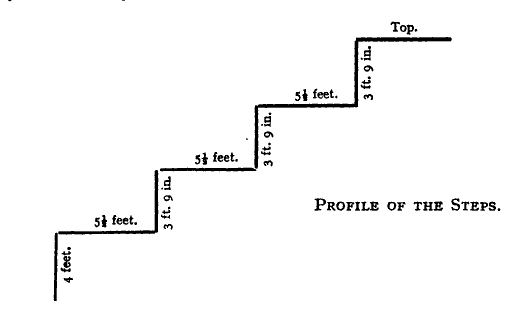
The first, so far as I know, to see and describe these remarkable tombs were the earliest missionaries to Tonga about the end of the eighteenth century. Speaking of the burial ground at Mooa, where lay interred the divine chiefs whose title was Tooitonga and whose family name was Futtafāihe or Fatafehi, the missionaries observe that "the fiatookas are remarkable. There lie the Futtafāihes for many generations, some vast and ruinous, which is the case with the largest; the house on the top of it is fallen, and the area and tomb itself overgrown with wood and weeds."[151] Later on they had the advantage of being conducted over the august cemetery by the Futtafāihe or Tooitonga of the day in person, who gave them some explanations concerning these sepulchres of his ancestors. To quote their description, they say that the tombs "lie ranged in a line eastward from his house, among a grove of trees, and are many in number, and of different constructions: some, in a square form, were not in the least raised above the level of the common ground; a row of large stones formed the sides, and at each corner two high stones were placed upright at right angles to each other, and in a line with their respective sides: others were such as the brethren describe that of Moomōoe to be: and a third sort were built square like the first; the largest of which was at the base one hundred and fifty-six feet by one hundred and forty; it had four steps from the bottom to the top, that run quite round the pile: one stone composed the height of each step, a part of it being sunk in the ground; and some of these stones in the wall of the lower are immensely large; one, which I measured, was twenty-four feet by twelve, and two feet thick; these Futtafāihe informed me were brought in double canoes from the island of Lefooga. They are coral stone, and are hewn into a tolerably good shape, both with respect to the straightness of their sides and flatness of their surfaces. They are now so hardened by the weather, that the great difficulty we had in breaking a specimen of one corner made it not easy to conjecture how the labour of hewing them at first had been effected; as, by the marks of antiquity which some of them bear, they must have been built long before Tasman showed the natives an iron tool. Besides the trees which grow on the top and sides of most of them, there are the etooa, and a variety of other trees about them; and these, together with the thousands of bats which hang on their branches, all contribute to the awful solemnity of those sepulchral mansions of the ancient chiefs. On our way back Futtafāihe told us that all the fiatookas we had seen were built by his ancestors, who also lay interred in them; and as there appeared no reason to doubt the truth of this, it proves that a supreme power in the government of the island must for many generations have been in the family of the Futtafāihes: for though there were many fiatookas in the island, the brethren, who had seen most of them, said they were not to be compared to these for magnitude, either in the pile or the stones which compose them."[152]
Some thirty years later the tombs of the Tooitongas were visited and described by the French explorer, J. Dumont d'Urville. His description is worth quoting. He says: "I directed my steps to the splendid faï-tokas of the Fata-Faïs. As these monuments are essentially taboo, in the absence of the Tooi-tonga no one looks after their upkeep, and they are now buried on every side among dark masses of trees and almost impenetrable thickets. Hence we had some difficulty in approaching them, and it was impossible for us to get a single general view of the whole of these structures, which must have a somewhat solemn effect when the ground is properly cleared.
"For the most part these mausoleums have the form of great rectangular spaces surrounded by enormous blocks of stone, of which some are as much as from fifteen to twenty feet long by six or eight broad and two feet thick. The most sumptuous of these monuments have four or five rows of steps, making up a total height of eighteen or twenty feet. The interior is filled up with shingle and fragments of unhewn coral. One of these faï-tokas, which I measured, was a hundred and eighty feet long by a hundred and twenty broad. At one of the upper angles I observed a block of considerable size with a deep cutting in it. I was told that it was the seat of the Tooi-tonga-fafine[153]; it was there that she sat to preside at the ceremony of the funeral of the Tooi-tonga.
"Some of these edifices were of an oval form, but they were much smaller. Each of them was surmounted by a small hut, which served as an oratory or house for the spirit of the dead; most of them have been destroyed by the lapse of time, and only traces of them are left scattered on the ground.
"The enormous blocks of coral employed in the construction of these monuments have all been brought by sea from Hifo to Mooa. They were got on the shore of the sea at Hifo, were hewn on the spot, and were transported in great canoes; then they were landed at Mooa and drawn on rollers to the place of their destination. These monuments are astonishing evidence of the patience which they must have demanded on the part of these islanders; they were ocular testimony to me of the high degree of civilisation which the natives had reached. Man must have risen to ideas of a much higher order than those of a simple savage before he would take so great pains for the single object of consecrating the memory of his chiefs.
"Such tombs are no longer built in Tongataboo: people content themselves with simple mounds surrounded by a row of posts or even an ordinary palisade. However, Singleton assured me that Finow the Younger had erected two great faï-tokas of stone in Vavao, one for the last Tooitonga, and one for his father."[154]
The Frenchman, De Sainson, who accompanied Dumont d'Urville on his visit to Tongataboo, has also described the tombs of the Tooitongas at Mooa from personal observation. I will quote his description: "It is in the heart of the forest that the ancient inhabitants of these countries, who idolized their Kings (Tooi-tongas), placed the tombs of that sacred race. These monuments of a more enterprising age still astonish the beholder by their mass and their extent. The fai-tokas, as these burial-places are called, are artificial eminences, on the top of which, in the form of a square, are three or four crosses of great granitic blocks arranged as steps, of which each block may be four or five feet high. If there is only a single step on the top of the mound, it is because only a single Tooi-tonga sleeps there in the grave; if the bones of a whole family are deposited in a common tomb, three or four steps, one above the other, mark their union in death. Some of these monuments which contain only a single body are arranged in an oval. I counted more than twelve of these immense structures, and yet we left a great many aside. I counted more than one stone between eight and fifteen feet long; and I conceived a high idea of those men of ancient days who erected over the remains of their kings these imperishable mausoleums, in an island based on coral, where it would be difficult to find a stone of two feet square. I imagined them to be very different from their effeminate descendants, those men of old who went in their canoes more than a hundred and fifty leagues to look for the enormous blocks of which these tombs are built, who cut them without the help of iron, and succeeded, by means unknown, in planting them on these hillocks, where by their own weight they are fixed for ever, like the Druidical monuments of Brittany, which one would say were dropped on earth rather by the magic of talismans than by the power of man.
"The present inhabitants of Tonga contemplate with a pious awe the fruit of the labours and patience of their forefathers, without dreaming for a moment of imitating them in their noble enterprises. A distant voyage affrights these degenerate scions of a hardy race, and the great canoes which still survive, sheltered under sheds very skilfully built, are little more than the useless encumbrance of chiefs grown languid in the long peace which has infected the whole people with habits of indolence.
"The most recent tombs consist of a small house enclosed on all sides, built on a rising ground, and shaded by a circle of mimosas, a tree sacred to the dead. Most of the illustrious graves are clustered together at Mafanga, a large village of which the whole territory is sacred on account of the hallowed relics which it contains. Along with the corpse they bury at the depth of a few inches small wooden effigies representing persons of both sexes. I had occasion to unearth a few of these little statues, and I remarked in them an astonishing feeling for artistic design."[155]
Some sixteen years later a Catholic missionary, living among the heathen population of Tongataboo, wrote thus: "Nothing equals the care which they take in the burial of their dead. As soon as a native has breathed his last, the neighbours are informed, and immediately all the women come to weep about the corpse. Here the men never weep. The body is kept thus for a day or two, during which they are busy building a tomb near the dwelling of the deceased's family. The sepulchral house is neat, built on an eminence, surrounded by a pretty fence of choice bamboos; the enclosure is planted with all kinds of odoriferous shrubs, especially evergreens. Finally, the monument is covered by a roof artistically constructed. For the tombs of kings and the greatest chiefs they go to distant islands to find huge stones to crown the grave. I have seen one twenty-four feet long by eight broad and at least eighteen inches thick. One of these tombs was built by the natives of Wallis Island, who brought the enormous blocks in immense canoes. It is wonderful for these peoples."[156]
Captain Erskine, who visited Tongataboo in 1849, says that "near the landing-place at the village of Holobeka, off which we were lying, we saw overshadowed with trees, one of the faitokas, or old burial-places of the country, which, although no longer 'tabu,' are still in some cases used as places of sepulture, and very carefully kept. This one was an oblong square platform a few feet high, surrounded by a stone wall, the interior being beautifully paved with coloured corals and gravel; the house or temple, which Captain Cook and others describe as occupying the centre, having been, I suppose, removed. I saw but one other of these monuments during our stay among the islands, the largest of which stands on several rows of steps, as described by all former visitors."[157]
Thomas West, who lived as a missionary in the Tongan islands from 1846 to 1855, tells us that "chiefs were usually interred in tombs, constructed of blocks of sandstone, cut from suitable localities by the seashore, where, at a little depth from the surface, layers of hard and durable sandstone are found, even on many of the coralline islands. In several of the ancient burial-places, similar stones, arranged in terraces, surround the whole enclosure. Some of these are of immense size, and seem to indicate the possession, on the part of former inhabitants, either of greater energy than the present race, or of better tools and appliances. The burial-places of the Tonguese are always surrounded by the most imposing foliage of the tropics, and placed in sequestered spots. A mound of earth is raised, of dimensions varying with the necessities of the place; and, whenever a grave is opened within the limits of this mound, it is always filled up with beautiful white sand, and never contains more than one body. No particle of clay or earthy mould is allowed to touch the remains of the dead. The sand is brought in baskets by the chief mourners, who sometimes sail or journey many miles to procure it; and each person pours the contents into the grave until it is sufficiently filled up. The top of the grave is, afterwards, carefully tended and decorated with black pebbles and red coral, arranged in various devices, which have a very pretty effect. Small houses are also placed over the tombs of the chiefs and gentry."[158]
In more recent years the tombs of the Tooitongas at Mooa have been visited by Sir Basil Thomson, who has described and discussed them.[159] From an anonymous pamphlet called The Wairarapa Wilderness, written by the passengers of the s.s. Wairarapa and published in 1884, Sir Basil Thomson quotes a passage containing a description of the tombs, with measurements which, he tells us, are accurate as far as they go. From it I will extract a few particulars. The writers inform us that the tombs are built of blocks of coral which vary in length and thickness; some of the largest they found to be from fifteen to eighteen feet long and from one and a half to two feet thick. The largest measured by them is twenty-two feet long and two feet thick and stands between seven and eight feet above the ground. This great stone, now split in two, is at the middle of the lowest step of one of the pyramidal tombs. The height of the steps varies much in the different pyramids; one step was found to be four feet high. The breadth of each step is three feet or more: it has been carefully levelled and covered with coral gravel. The stones fit very closely and are very regular at top and bottom throughout the tiers. The corners of one pyramid observed by the writers are formed of huge rectangular stones, which seem to have been put in position before they were finally faced. On the upper surface of the largest stone is a deep hollow about the size and shape of a large chestnut mortar. Sir Basil Thomson, who has examined this hollow, believes it to be a natural cavity which has been artificially smoothed by a workman. He suggests that it may have been lined with leaves and used as a bowl for brewing kava at the funeral ceremonies. On one mound the writers of the pamphlet remarked a large flat stone, some five and a half feet square; and in several of the tombs they noticed huge slabs of volcanic stone placed indiscriminately side by side with blocks of coral. The writers measured the bases of three of the tombs and found them to be about two chains (one hundred and thirty-two feet) long by a chain and a half (ninety-nine feet) broad; the base of a fourth was even larger.[160]
Surveying these various accounts of the tombs of the Tooitongas or sacred chiefs, we may perhaps conclude that, while the type of tomb varied in different cases, the most characteristic, and certainly the most remarkable, type was that of a stepped or terraced pyramid built of such large blocks of stone as to merit the name of megalithic monuments. So far as I have observed in the accounts given of them, this type of tomb was reserved exclusively for the sacred chiefs, the Tooitongas, whom the Tongans regarded as divine and as direct descendants of the gods. The civil kings, so far as appears, were not buried in these massive pyramids, but merely in stone vaults sunk in the summits of grassy mounds.
It is natural, with Sir Basil Thomson,[161] to compare the pyramids of the Tooitongas with the similar structures called morais or marais which are found in Tahiti and the Marquesas islands. Indeed, the very name morai was sometimes applied to them by the Tongans themselves, though more usually they called them fiatookas, which was simply the common word for burying-ground.[162] In Tahiti and the Marquesas islands these marais were in like manner truncated pyramids, rising in a series of steps or tiers, built of stones, some of which were large, but apparently not so large as in the corresponding Tongan edifices; for in describing one of the largest of the Tahitian morais or marais Cook mentions only one stone measuring as much as four feet seven inches in length by two feet four in breadth, though he found several three and a half feet long by two and a half feet broad. These dimensions can hardly compare with the size of the blocks in the tombs of the Tooitongas, some of which, as we have seen, measure fifteen, eighteen, and even twenty-two or twenty-four feet in length by eight or twelve feet in height. These Tahitian and Marquesan pyramids are commonly described as temples, and justly so, because the gods were worshipped there and human sacrifices were offered on them.[163] But they were also, like the similar structures in Tonga, used in certain cases for the burial of the dead, or at all events for the preservation of their embalmed bodies. Captain Cook seems even to have regarded the Tahitian morais primarily as burying-grounds and only secondarily as places of worship.[164] In the island of Huahine, one of the Society Islands, the sovereign chiefs were buried in a marai, where they lay, we are told, in more than Oriental state.[165] William Ellis, one of our best authorities on the religion of the Tahitians, tells us that "the family, district, or royal maraes were the general depositories of the bones of the departed, whose bodies had been embalmed, and whose skulls were sometimes preserved in the dwelling of the survivors. The marae or temple being sacred, and the bodies being under the guardianship of the gods, were in general considered secure when deposited there. This was not, however, always the case; and in times of war, the victors sometimes not only despoiled the temples of the vanquished, and bore away their idol, but robbed the sacred enclosure of the bones of celebrated individuals."[166] Moerenhout, another good authority on the Tahitian religion, informs us that the marais which belonged to individuals often served as cemeteries and were only the more respected on that account; but he says that in the public marais almost the only persons buried were the human victims offered in sacrifice, and sometimes the priests, who were laid face downwards in the grave, for the curious reason that otherwise the gaze of the dead men would blight the trees and cause the fruit to fall to the ground.[167]
In the Marquesas islands the morais appear to have been also used occasionally or even regularly as burial-places. Langsdorff, one of our earliest authorities on these islands, speaks of a morai simply as a place of burial.[168] He tells us that the mummified bodies of the dead were deposited on scaffolds in the morai or family burial-place, and that the people of neighbouring but hostile districts used to try to steal each other's dead from the morais, and deemed it a great triumph when they succeeded in the attempt. To defeat such attempts, when the inhabitants of a district expected to be attacked in force by their enemies, they were wont to remove their dead from the morai and bury them in the neighbourhood.[169] Again, in their monograph on the Marquesas islands, the French writers Vincendon-Dumoulin and Desgraz recognise only the mortuary aspect of the morais. They say: "The morais, funeral monuments where the bodies are deposited, are set up on a platform of stone, which is the base of all Nukahivan constructions. They are to be found scattered in the whole extent of the valleys; no particular condition seems to be required in the choice of the site. Near the shore of Taïohae is the morai which contains the remains of a brother of the atepeïou Patini, an uncle of Moana, who died some years ago, as they tell us."[170]
Thus to some extent, in function as well as in form, these pyramidical temples of Tahiti and the Marquesas islands corresponded to the megalithic monuments of the Tooitongas or sacred chiefs of Tonga; in fact, they were mausoleums as well as temples. We are not at liberty to assume, with one authority on the Polynesians, that they were mausoleums first and foremost, and that they only developed into temples at a later time.[171] It is possible, on the contrary, that from the outset they were temples dedicated to the worship of the high gods, and that the custom of depositing the dead in them was a later practice adopted for the sake of the protection which these holy places might be expected to afford against the efforts of enemies to carry off and desecrate the remains of the departed. Dr. Rivers propounded a theory that the custom of building these megalithic monuments in the form of pyramids was introduced into the Pacific by a people who brought with them a secret worship of the sun, and he apparently inclined to regard the monuments themselves as at least associated with that worship.[172] The theory can hardly apply to the megalithic monuments of the Tooitongas in Tongataboo; for the evidence which I have adduced seems to render it certain that these monuments were erected primarily as tombs to receive the bodies of the sacred chiefs. It is true that these tombs enjoyed a sacred character and were the scene of worship which justly entitles them to rank as temples; but so far as they were temples, they were devoted to the worship, not of the sun, but of the dead.
Thus our enquiry into the meaning and origin of these interesting monuments entirely confirms the view of the shrewd and observant Captain Cook that the fiatookas, as the Tongans called them, were both places of burial and places of worship.
Finally, the evidence which I have cited appears to render it highly probable that these imposing monuments were built, not by a prehistoric people, predecessors of the Tongans in the islands, but by the Tongans themselves; for not only do the people affirm that the tombs were erected by their ancestors, but they have definite traditions of some of the chiefs who built them, and are buried in them; and they still profess to remember some of the islands from which the huge stones were brought to Tongataboo in great double canoes.
That the graves of the great chiefs were, like temples, regarded by the people with religious reverence appears plainly from a statement of Mariner. He tells us that a place called Mafanga, in the western part of Tongataboo, being a piece of land about half a mile square, was consecrated ground. "In this spot," he says, "are the graves where the greatest chiefs from time immemorial have been buried, and the place is therefore considered sacred; it would be a sacrilege to fight here, and nobody can be prevented from landing: if the most inveterate enemies meet upon this ground, they must look upon each other as friends, under penalty of the displeasure of the gods, and consequently an untimely death, or some great misfortune. There are several of these consecrated places on different islands."[173] Thus the reverence paid to the tombs of the chiefs was like the reverence paid to the consecrated houses and enclosures of the gods; we have already seen what a sacrilege it was deemed to fight or to pursue an enemy within the consecrated enclosure of a god,[174] and we now learn that it was equally a sacrilege to fight within the ground that was hallowed by the graves of the chiefs.
Mariner has described for us the worship paid by the king and his chiefs to one of the sacred graves at Mafanga. One morning Finow the king, accompanied by several of his chiefs and their ministers (the matabooles), landed at Mafanga and immediately proceeded to his father's grave to perform a ceremony called toogi. Mariner attended the party and witnessed the ceremony. All who went to participate in it assumed the attire of mourners or suppliants, that is, they wore mats instead of their usual dress and they had wreaths, made of the leaves of the ifi tree, round their necks. They sat down before the grave, and the king and all of them beat their cheeks with their fists for about half a minute without speaking a word. One of the principal ministers (matabooles) then addressed the spirit of the king's father to the following effect: "Behold the man (meaning Finow, the king) who has come to Tonga to fight his enemies. Be pleased with him, and grant him thy protection. He comes to battle, hoping he is not doing wrong. He has always held Tooitonga in the highest respect, and has attended to all religious ceremonies with exactness." One of the attendants then went to the king and received from him a piece of kava root, which he laid down on the raised mount before the burial-place (fytoka). Several others, who had pieces of kava root in their bosoms, went up to the grave in like manner and deposited them there.[175]
Thus the king prayed to the spirit of his dead father at his grave and made an offering at the tomb. What more could he do to a god at his temple? And in general we are told that when a great blessing was desired, or a serious evil deprecated, if the people wished to enjoy health or beget children, to be successful at sea, or victorious in war, they would go to the burial grounds of their great chiefs, clean them up thoroughly, sprinkle the floor with sand, and lay down their offerings.[176] When Finow the king was dying, his friends carried him on a bier, not only to the temples of the great gods Tali-y-Toobo and Tooi-fooa-Bolotoo, where prayers for his recovery were offered; they bore him also to the grave of a chieftainess and invoked her spirit in like manner to pity and spare the expiring monarch.[177] Apparently they thought that the ghost of the chieftainess was quite as able as the great gods to heal the sick and restore the dying.
But on no occasion, perhaps, was the assimilation of dead men to gods so conspicuous as at the annual offering of first-fruits, which seems to have been the most impressive of all the yearly rites observed by the Tongans. The ceremony was observed once a year just before the yams in general had arrived at a state of maturity; the yams offered at it were of a kind which admitted of being planted sooner than the others, and which consequently, ripening earlier, were the first-fruits of the yam season. The object of the offering was to ensure the protection of the gods, that their favour might be extended to the welfare of the nation generally, and in particular to the productions of the earth, of which in Tonga yams are the most important. At this solemn ceremony the new yams, slung on poles, were brought from distant islands, carried in procession to the grave of the late Tooitonga, and deposited in front of it, their bearers sitting down beside them. Thereupon one of the ministers (matabooles) of the living Tooitonga arose, advanced, and sat down before the grave, a little in front of the men who had brought the yams. Next he addressed the gods generally, and afterwards particularly, mentioning the late Tooitonga and the names of several others. In doing so he returned thanks for their divine bounty in favouring the land with the prospect of a good harvest, and prayed that their beneficence might be continued in future. In this harvest thanksgiving the spirit of the dead Tooitonga seems to have ranked on an equality with the original or superhuman gods; indeed, in a sense he took precedence of them, since the offerings were presented at his grave. The first-fruits, we are told, were offered to the gods in the person of the divine chief Tooitonga.[178]
On the whole we may conclude that, however sharp a distinction was drawn in theory between the old gods, who had always been gods, and the new gods, who had once been men, the line which divided them in practice was wavering and blurred. The dead men and women were fast rising, if they had not already risen, to an equality with the ancient deities. We may even surmise that some of these old gods themselves were human beings, whose original humanity was forgotten.
The tombs of the kings and sacred chiefs may be described as megalithic monuments in so far as immense stones were often employed in the construction either of the enclosing walls or of the high steps which led up to the summit of the mound where the grave was dug. It is possible, and indeed probable, that great stones were similarly employed as ornaments or accessories of the consecrated houses or temples of the primary gods, but of such an employment I have met with no express notice among our authorities. So far as their descriptions allow us to judge, these megalithic monuments of the Tongans were purely sepulchral in character; they were dedicated only to the worship of the dead. But there exists at least one other remarkable megalithic monument in these islands of which the original meaning is quite uncertain, and of which consequently we cannot confidently say that it was erected for the sake of honouring or propitiating the spirits of the departed. The monument in question is situated near the eastern extremity of Tongataboo, at a distance of three or four hundred yards from the beach and facing towards the island of Eua. The land on which it stands was the private property of the Tooitongas, whose megalithic tombs are situated some eight or nine miles away to the west. In the intervening country, which is perfectly flat and partly covered with forest, partly under cultivation, there are said to be no other monuments or ruins. It is remarkable that this imposing monument, which naturally impresses the observer by its resemblance to the trilithons or gate-like structures of Stonehenge, should have apparently escaped the observation of Europeans down to the middle of the nineteenth century. It is not mentioned by Cook and Mariner, nor even by those who, like the first missionaries and Dumont d'Urville, described in some detail the tombs of the Tooitongas not many miles off. Perhaps the solitariness of the surrounding country may partly account for their ignorance and silence; for there are said to be few inhabitants in this part of the island and none at all in the immediate neighbourhood of the monument. It seems to have been first discovered by Mr. Philip Hervey of Sydney in 1850 or 1851, but his description of it was not published for some ten years. In August 1852 it was seen by Dr. Charles Forbes, Surgeon of H.M.S. Calliope, and his description of it was published by the Society of Antiquaries of London in the following year. In 1865 it was seen and briefly described by Mr. Foljambe of H.M.S. Curaçoa. Some twenty years later the passengers of the s.s. Wairarapa, on a yachting cruise from New Zealand, visited the spot and published an account of the structure. Still later Sir Basil Thomson examined the monument and discussed its history.[179]
The monument in question is a structure of the type known as a trilithon; that is, it is composed of three large stones, of which two stand upright, while the third rests horizontally on their tops. All three stones are monoliths of hardened coral, rough and much weathered on the surface, and precisely similar to the coral of the neighbouring reefs. Indeed, about halfway between the monument and the beach the coral rock is exposed in a hollow, from which it seems probable that the great blocks were hewn and brought to their present situation. The statement of Mr. Brenchley, that the stone of which the monument consists is not to be found elsewhere on the island, is erroneous. The uprights are quadrangular monoliths neatly squared. No measurements of the stones appear to be on record, but the two uprights are variously estimated to measure from fourteen to sixteen feet in height; their breadth or depth from front to back is variously given as from eight to ten or even twelve feet; but they seem to taper somewhat upwards, for the estimate which assigns twelve feet for the depth of the uprights at their base, mentions seven feet or probably more as their breadth at the top. The thickness of the uprights seems to be four feet. The space between them is variously stated at ten and twelve feet. The cross-stone, which rests on the two uprights, is reported to measure twenty-four feet in length, by four or five feet in depth, and two feet in thickness. Each of the uprights is estimated by Sir Basil Thomson to weigh not less than fifty tons. The tops of both are deeply mortised to receive the cross-stone, the ends of which are sunk into them instead of being laid flat on the top. The cross-stone lies east and west, so that the opening between the uprights faces north and south. On the upper surface of the cross-stone, and at about the middle of it, is a cup-like hollow, very carefully cut, about the size of a coco-nut shell. A large bowl of the same material is said to have formerly stood on the cross-stone, but the statement is not made by an eyewitness and is probably mistaken.[180]
The name which the natives give to this megalithic monument is Haamonga or Ho ha Mo-nga Maui, which is said to mean "Maui's burden." The name is explained by a story that the god or hero Maui brought the massive stones in a gigantic canoe from Uea (Wallis Island), where the great holes in the rock from which he quarried them may still be seen. From the canoe he bore them on his back to the spot where they now stand.[181] This story can hardly be thought to throw much light on the origin of the monument; for the natives are in the habit of referring the marvels which they do not understand to the action of the god or hero Maui, just as the ancient Greeks fathered many natural wonders on the deified hero Hercules.[182] But from Mateialona, Governor of Haapai and cousin of the King of Tonga, Sir Basil Thomson obtained a tradition of the origin of the stones which is at least free from the miraculous element and connects the monument with Tongan history. The account runs thus: "Concerning the Haamonga of Maui, they say forsooth that a Tui Tonga (the sacred line of chiefs), named Tui-ta-tui, erected it, and that he was so named because it was a time of assassination.[183] And they say that he had it built for him to sit upon during the Faikava (ceremony of brewing kava), when the people sat round him in a circle, and that the king so dreaded assassination that he had this lordly seat built for himself that he might sit out of the reach of his people. And this, they say, is the origin of the present custom of the Faikava, it being now forbidden for any one to sit behind the king." At such wassails the presiding chief sits at the apex of an oval. To this tradition Sir Basil Thomson adds: "Mr. Shirley Baker told me that he believed the Haamonga to have been erected as a fakamanatu (memorial) to the son of some Tui Tonga, a view that finds support in the fondness of Tongan chiefs for originality in the burial ceremonies of their near relations—witness Mariner's account of the funeral of Finau's daughter—but on the other hand native traditions generally have a kernel of truth, and the legend of Tui-ta-tui and its consequences finds an analogy in our own custom of guarding against an assassin's dagger at the drinking of the loving cup."[184] The tradition receives some confirmation from the bowl-like hollow on the upper surface of the cross-stone; for the hollow might have served as the king's drinking-cup to hold his kava at the customary wassails. Indeed, Mr. Philip Hervey, the first to examine the monument, describes the hollow in question as "a small cava bowl";[185] and after giving an account of the monument Mr. Brenchley adds: "Its history seems to be entirely unknown, but it is very natural to suppose from its form that it was connected with some ancient kava ceremonies."[186]
The tradition which connects the erection of the monument with the reign of a Tooitonga named Tui-ta-tui is further countenanced, if not confirmed, by a list of the Tooitongas, in which the name of Tui-ta-tui occurs as the eleventh in descent from the great god Tangaloa.[187] This Tui-ta-tui is believed to have reigned in the thirteenth or fourteenth century of our era.[188] From the size and style of the masonry Sir Basil Thomson is disposed to assign the monument to a later date. He points out that for the quarrying and mortising of stones that weigh some fifty tons apiece the craft of stone-cutting must have been fully developed; and from a comparison of the megalithic tombs of the Tooitongas which can be approximately dated, he infers that the craft of stone-cutting in Tonga reached its culmination at the end of the seventeenth century, though it was still practised down to the beginning of the nineteenth century; for Mariner tells us that in his time a professional class of masons was set apart for building the stone sepulchral vaults of chiefs.[189] Yet on the whole Sir Basil Thomson concludes that "when one is left to choose between a definite native tradition on the one hand and probability on the other for the assignment of a date, I would prefer the tradition. If the Tongans had invented the story as a mere expression for antiquity they would not have pitched upon Tui-ta-tui, about whom nothing else is recorded, in preference to Takalaua, Kau-ulu-fonua-fekai, or any of the kings who loom large in traditionary history. Whether the Haamonga was built for a throne or for a memorial, doubtless it is connected with the reign of Tui-ta-tui, who lived in the fourteenth century."[190]
As an alternative to the view that the hollow on the cross-stone was a kava bowl Dr. Rivers suggests that it "may have been destined to receive the skull and other bones of the dead, so often preserved in Polynesia."[191] The suggestion accords well with the opinion that the monument is a memorial of the dead, and it might be supported by the Samoan practice of severing a dead chief's head from his body and burying it separately, to save it from being dug up and desecrated by enemies in time of war.[192] However, Dr. Rivers is careful to add that such a practice is not recorded in Tonga and appears to be incompatible with the mode of sepulture which prevails there.
In this connexion another megalithic monument of the Tonga islands deserves to be considered, though it appears to have been commonly overlooked. It was observed by Captain Cook in the island of Lefooga (Lifuka). He says: "Near the south end of the island, and on the west side, we met with an artificial mount. From the size of some trees that were growing upon it, and from other appearances, I guessed that it had been raised in remote times. I judged it to be about forty feet high; and the diameter of its summit measured fifty feet. At the bottom of this mount stood a stone, which must have been hewn out of coral rock. It was four feet broad, two and a half thick, and fourteen high; and we were told by the natives present, that not above half its length appeared above ground. They called it Tangata Arekee;[193] and said, that it had been set up, and the mount raised, by some of their forefathers, in memory of one of their kings; but how long since, they could not tell."[194]
When we remember that Tongan kings were commonly buried in such mounds as Captain Cook here describes, and further that these mounds were commonly enclosed or faced with great blocks of hewn stone, we may be disposed to accept as reasonable and probable the explanation which the natives gave of this great monolith, which, if the reported measurements of it are correct, must have been no less than twenty-eight feet high. If it was indeed a memorial of a dead king, it might be thought to strengthen the view that the great trilithon was also set up as a monument to a deceased monarch or Tooitonga.
Another possible explanation of the trilithon is, as Sir Basil Thomson points out, that it served as a gateway to some sacred spot inland. But against this view he observes that he examined the bush for some distance in the neighbourhood without finding any trace of ruins or stones of any kind. He adds that the memory of sacred spots dies very hard in Tonga, and that the natives do not believe the trilithon to have been a gateway.[195]
It is natural to compare the trilithon of Tongataboo with the famous trilithons of Stonehenge, which it resembles in plan and to which it is comparable in size. The resemblance struck Dr. Charles Forbes, the first to publish a description of the monument based on personal observation. He says: "The route we pursued led us over a country perfectly level, with the exception of occasional mounds of earth, apparently artificial, and reminding one very much of the barrows of Wilts and Dorset, which idea is still more strongly impressed upon the mind on coming in sight of the monument, which bears a most striking resemblance to the larger gateway-looking stones at Stonehenge."[196] But at the same time, as Dr. Forbes did not fail to note, the Tongan trilithon differs in some respects from those of Stonehenge. In the first place the interval (ten or twelve feet) between the uprights of the Tongan trilithon appears to be much greater than the interval between the uprights of the trilithons at Stonehenge.[197] In the second place, the cross-stone of the Tongan trilithon is mortised much more deeply into the uprights than are the cross-stones at Stonehenge. For whereas at Stonehenge these cross-stones present the appearance of being laid flat on the top of the uprights, the cross-stone of the Tongan trilithon is sunk deeply into the uprights by means of mortises or grooves about two feet wide which are cut into the uprights, so that the top of the cross-stone is nearly flush with their tops, while its ends also are nearly flush with their outside surfaces.[198]
As the origin and purpose of Stonehenge are still unknown, its massive trilithons can hardly be cited to explain the similar monument of Tongataboo. The rival theories which see in Stonehenge a memorial of the dead and a temple of the sun[199] are equally applicable or inapplicable to the Tongan monument. In favour of the mortuary character of this solitary trilithon it might be urged that the Tongans were long accustomed to erect megalithic monuments, though of a different type, at the tombs of their sacred kings, which are situated not many miles away; but against this view it may be argued that there are no traces of burial or graves in the immediate neighbourhood, and that native tradition, not lightly to be set aside, assigns a different origin to the monument. Against the solar interpretation of the trilithon it may be alleged, first, that the monument faces north and south, not east and west, as it might be expected to do if it were a temple of the sun or a gateway leading into such a temple; second, that, while a circle of trilithons, as at Stonehenge, with an opening towards the sunrise may be plausibly interpreted as a temple of the sun, such an interpretation cannot so readily be applied to a solitary trilithon facing north and south; and, third, that no trace of sun-worship has been discovered in the Tonga islands. So far as I have observed, the Tongan pantheon is nowhere said to have included a sun-god, and the Tongans are nowhere reported to have paid any special respect to the sun. Savages in general, it may be added, appear to be very little addicted to sun-worship; it is for the most part among peoples at a much higher level of culture, such as the ancient Egyptians, Babylonians, and Peruvians, that solar worship becomes an important, or even the predominant, feature of the national faith.[200] Perhaps the impulse to it came rather from the meditations of priestly astronomers than from the random fancies of common men. Some depth of thought was needed to detect in the sun the source of all life on earth; the immutable regularity of the great luminary's movements failed to rouse the interest or to excite the fear of the savage, to whom the elements of the unusual, the uncertain, and the terrible are the principal incentives to wonder and awe, and hence to reflexion. We are all naturally more impressed by extraordinary than by ordinary events; the fine edge of the mind is dulled by familiarity in the one case and whetted by curiosity in the other.
Bearing in mind the numerous other stone monuments scattered widely over the islands of the Pacific, from the Carolines to Easter Island, Dr. Guillemard concludes that some race, with a different, if not a higher civilisation preceded the Polynesian race in its present homes, and to this earlier race he would apparently refer the erection of the trilithon in Tongataboo.[201] He may be right. Yet when we consider, first, the native tradition of the setting up of the trilithon by one of the sacred kings of Tonga; second, the practice of the Tongans of building megalithic tombs for these same sacred kings; and, third, the former existence in Tonga of a professional class of masons whose business it was to construct stone vaults for the burial of chiefs,[202] we may hesitate to resort to the hypothesis of an unknown people in order to explain the origin of a monument which the Tongans, as we know them, appear to have been quite capable of building for themselves.
§ 11. Rites of Burial and Mourning
The only mode of disposing of the dead which was practised in the Tonga islands seems to have been burial in the earth. So far as appears, the corpse was not doubled up, but laid at full length in the grave; at all events I have met with no mention of burying a corpse in a contracted posture; and Captain Cook says that "when a person dies, he is buried, after being wrapped up in mats and cloth, much after our manner." He adds that, while chiefs had the special burial-places called fiatookas appropriated to their use, common people were interred in no particular spot.[203] So far as I have observed, none of our authorities speak of a practice of embalming the dead or of giving the bodies any particular direction in the grave.
After a death the mourners testified their sorrow by dressing in old ragged mats and wearing green leaves of the ifi tree round their necks. Thus attired they would repair to the tomb, where, on entering the enclosure, they would pull off the green twigs from their necks and throw them away; then sitting down they would solemnly drink kava.[204] Further, they accompanied their cries and ejaculations of grief and despair by inflicting on their own bodies many grievous wounds and injuries. They burned circles and scars on their bodies, beat their teeth with stones, struck shark's teeth into their heads till the blood flowed in streams, and thrust spears into the inner part of the thigh, into their sides below the arm-pits, and through the cheeks into the mouth.[205] Women in wailing would cut off their fingers, and slit their noses, their ears, and their cheeks.[206] At the funerals of the kings especially the mourners indulged in frantic excesses of self-torture and mutilation. Of two such funerals we have the detailed descriptions of eye-witnesses who resided in the islands at a time when the natives were as yet practically unaffected by European influence. King Moomōoe died in April 1797, and the first missionaries to Tonga witnessed and described his funeral. They have told how, when the corpse was being carried in procession to a temporary house near the royal burial-ground (fiatooka), it was preceded by relatives of the deceased in the usual mourning garb, who cut their heads with shark's teeth till the blood streamed down their faces. A few days later, when the burial was to take place, the missionaries found about four thousand people assembled at the mound where the body was to be interred. In a few minutes they heard a great shouting and blowing of conch-shells, and soon after there appeared about a hundred men, armed with clubs and spears, who, rushing into the area, began to cut and mangle themselves in a most dreadful manner. Many struck their heads such violent blows with their clubs that the sound could be heard thirty or forty yards off, and they repeated them till the blood ran down in streams. Others, who had spears, thrust them through their thighs, arms, and cheeks, all the while calling on the deceased in a most affecting manner. A native of Fiji, who had been a servant of the late king, appeared quite frantic; he entered the area with fire in his hand, and having previously oiled his hair, he set it ablaze, and ran about with it all on flame. When they had satisfied or exhausted themselves with this manner of torment, they sat down, beat their faces with their fists, and then retired. A second party then inflicted on themselves the same cruelties. A third party next entered, shouting and blowing shells; four of the foremost held stones, which they used to knock out their teeth, while those who blew the shells employed them as knives with which they hacked their heads in a shocking manner. A man who had a spear pierced his arm with it just above the elbow, and with it sticking fast in his flesh ran about the area for some time. Another, who seemed to be a principal chief, acted as if quite bereft of his senses; he ran to every corner of the area, and at each station beat his head with a club till the blood flowed down on his shoulders. At this point the missionary, unable to bear the sight of these self-inflicted tortures, quitted the scene. When his colleagues visited the place some hours later in the afternoon, they found the natives of both sexes still at the dreadful work of cutting and mangling themselves. In the course of these proceedings a party of mourners entered the area, sixteen of whom had recently cut off their little fingers. They were followed by another party with clubs and spears, who battered and wounded themselves in the usual fashion, and also disfigured their faces with coco-nut husks, which they had fastened to the knuckles of both hands. The missionaries noticed that the mourners who were either related to the dead king or had held office under him, were the most cruel to themselves; some of them thrust two, three, and even four spears into their arms, and so danced round the area, while others broke off the spear-heads in their flesh.[207]
Similar scenes were witnessed some years later by Mariner at the death and burial of Finow, another king of Tonga; and the Englishman has described from personal observation how on this occasion the mourners cut and wounded their heads and bodies with clubs, stones, knives, or sharp shells. This they did on one or other of the malais[208] or ceremonial grounds in the presence of many spectators, vying apparently with each other in the effort to surpass the rest in this public manifestation of their sorrow for the death of the king and their respect for his memory. As one ran out into the middle of the ground he would cry, "Finow! I know well your mind; you have departed to Bolotoo, and left your people under suspicion that I, or some of those about you, were unfaithful; but where is the proof of infidelity? where is a single instance of disrespect?" Then, inflicting violent blows and deep cuts on his head with a club, stone, or knife, he would again exclaim at intervals, "Is this not a proof of my fidelity? does this not evince loyalty and attachment to the memory of the departed warrior?" Some more violent than others cut their heads to the skull with such heavy and repeated blows that they reeled and lost their reason for a time.[209] The king's successor, Finow the Second, not content with the usual instruments of torture, employed a saw for the purpose, striking his skull with the teeth so violently that he staggered for loss of blood; but this he did, not at the time of the burial and in presence of the multitude, but some weeks later at a more private ceremony of mourning before the grave.[210] At the public ceremony the late king's fishermen varied the usual breaking of heads and slashing of bodies by a peculiar form of self-torment. Instead of clubs they appropriately carried the paddles of canoes, with which they battered their heads in the orthodox style; but besides every man of them had three arrows stuck through each cheek in a slanting direction, so that, while the points pierced through the cheeks into the mouth, the other ends went over the shoulder and were kept in position by another arrow, the point of which was tied to the ends of the arrows passing over one shoulder, while the other end was tied to the ends of the other arrows which passed over the other shoulder. Thus each fisherman was decorated with a triangle of arrows, of which the apex consisted of six arrow-heads in his mouth, while the base dangled on his back. With this remarkable equipment they walked round the grave, beating their faces and heads with their paddles, or pinching up the skin of the breast and sticking a spear right through it.[211]
The grave of a chief's family was a vault paved with a single large stone, while the four walls were formed each of a single block. The vault was about eight feet long, six feet broad, and eight feet deep, and was covered at the top by one large stone.[212] So heavy was this covering stone that, as we have seen, from a hundred and fifty to two hundred men were required to lift and lower it.[213] Mariner estimated that the family vault in which King Finow was interred was large enough to hold thirty bodies. When the king's corpse was being deposited in it, Mariner saw two dry and perfectly preserved bodies lying in the vault, together with the bones of several others; and he was told by old men that the well-preserved bodies had been buried when they, his informants, were boys, which must have been upwards of forty years before; whereas the bodies of which nothing but the bones remained had been buried later. The natives attributed the exceptional preservation of the two to the better constitution of their former owners; Mariner, or more probably his editor, Dr. Martin, preferred to suppose that the difference was due to the kind or duration of the disease which had carried them off. Apparently the natives did not suggest that the bodies had been embalmed, which they would almost certainly have done if they had known of such a custom.[214] No sooner was the king's body deposited in the grave, and the great stone lowered over it, than certain ministers (matabooles) and warriors ran like men frantic round and round the burial-ground, exclaiming, "Alas! how great is our loss! Finow! you are departed; witness this proof of our love and loyalty!" At the same time they cut and bruised their own heads with clubs, knives, and axes in the usual fashion.[215] Afterwards the grave was filled up with earth and strewed with sand, which a company of women and men had brought for the purpose in baskets from a place at the back of the island; what remained of the sand was scattered over the sepulchral mound (fytoca), of which it was deemed a great embellishment. The inside of the burial-ground was then spread with mats made of coco-nut leaves.[216]
Meantime the company of mourners had been seated on the green before the burial-ground, still wearing their mourning garb of mats, with leaves of the ifi tree strung round their necks. They now arose and went to their homes, where they shaved their heads and burnt their cheeks with a lighted roll of bark-cloth, by applying it once upon each cheek-bone; next they rubbed the place with an astringent berry, which caused it to bleed, and afterwards they smeared the blood in a broad circle round the wound, giving themselves a very ghastly appearance. They repeated this friction with the berry every day, making the wound bleed afresh; and the men meanwhile neglected to shave and to oil themselves during the day, though they indulged in these comforts at night. Having burnt their cheeks and shaved their heads, they built for themselves small temporary huts, where they lived during the time of mourning, which lasted twenty days.[217]
The women who had become tabooed, that is, in a state of ceremonial pollution, by touching the king's dead body, remained constantly within the burial-ground for the twenty days of mourning, except when they retired to one of the temporary huts to eat,[218] or rather to be fed by others. For it was a rule that no ordinary person, man or woman, could touch a dead chief without being tabooed, that is ceremonially polluted, for ten lunar months, during which time he or she might not touch food with their own hands. But for chiefs the period of pollution was limited to three, four, or five months, according to the superiority of the dead chief. Only when the dead body which they had touched was that of the sacred chief, the Tooitonga, they were all tabooed for ten months, however high their rank; for example, the king's wife was tabooed for that length of time during the residence of Mariner, because she had touched the dead body of the Tooitonga. During the time that a person was tabooed, he might not feed himself with his own hands, but must be fed by somebody else: he might not even use a toothpick himself, but might guide another person's hand holding the toothpick. If he was hungry and had no one to feed him, he must go down on his hands and knees, and pick up his victuals with his mouth; and if he infringed any of these rules, it was firmly expected that he would swell up and die.[219] Captain Cook observed this custom in operation at Tongataboo. On one of his walks he met with a party of women at supper, and noticed that two of them were being fed by others. On asking the reason, he was answered taboo mattee, that is, "Death taboo." It was explained to him that one of the women had washed the dead body of a chief two months before, and that consequently she might not handle any food for five months. The other had performed the same office for the corpse of another person of inferior rank, and was now under the same restriction, but not for so long a time.[220] The tabooed women at Finow's grave were supplied with food by the new king, Finow the Second. The food was brought and placed on the ground at some distance from the grave, or else it was deposited before the temporary house to which the chief of the tabooed women retired to be fed. With the provisions was also sent every day a supply of torches to light up the burial-ground by night. The torches were held up by a woman of inferior rank, who, when she was tired, was relieved in her office by another. During the twenty days of mourning, if any one passed the burial-ground, he had to go at a slow pace, with his head bowed down, and his hands clasped before him; and if he carried a burden, he must lower it from his shoulder and carry it in his hands or on his bended arms; but if he could not do so conveniently, he had to make a circuit to avoid the grave.
Such were the regular observances at the death and burial of chiefs; they were not peculiar to the obsequies of Finow the king.[221]
The twentieth day of mourning concluded the ceremonies in honour of the deceased monarch. Early in the morning all his relations, together with the members of his household, and also the women who were tabooed on account of having touched his dead body in the process of oiling and preparing it, went to the back of the island to procure a quantity of flat pebbles, principally white, but a few black, which they brought back in baskets to the grave. There they strewed the inside of the house and the outside of the burial-ground (fytoca) with the white pebbles as a decoration; the black pebbles they laid only on the top of those white ones which covered the ground directly over the body, to about the length and breadth of a man, in the form of a very eccentric ellipse. After that, the house on the burial mound was closed up at both ends with a reed fencing, which reached from the eaves to the ground; while at the front and the back the house was closed with a sort of basket-work, made of the young branches of the coco-nut tree, split and interwoven in a very curious and ornamental way. These fences were to remain until the next burial, when they would be taken down and, after the conclusion of the ceremony, replaced by new ones of similar pattern. A large quantity of food and kava was now sent by the chiefs and the king to the public place (malai) in front of the burial mound, and these provisions were served out among the people in the usual way. The company then separated and repaired to their respective houses, to prepare for the dances and the grand wrestling-match, which were to conclude the funeral rites.[222]
During the intervals of the dances, which followed, several warriors and ministers (matabooles) ran before the grave, cutting and bruising their heads with axes, clubs, and so forth as proofs of fidelity to their late chief, the dead and buried King Finow. It was on this occasion that the deceased king's fishermen demonstrated their loyalty and attachment to his memory by the self-inflicted tortures which I have already described.[223] When these exhibitions of cruelty were over, the day's ceremonies, which altogether lasted about six hours, were terminated by a grand wrestling-match. That being over, the people dispersed to their respective houses or occupations, and the obsequies of Finow, king of the Tonga islands, came to an end.[224]
The wrestling-match which wound up the funeral honours paid to the departed monarch would seem not to have been an isolated case of athletic sports held at this particular funeral. Apparently it was a general custom in Tonga to conclude burial-rites with games of this kind. At least we may infer as much from an expression made use of by the first missionaries to Tongataboo. They say that the chief of their district, after taking to himself a wife in the morning went in the afternoon "to finish the funeral ceremonies for his brother, in celebrating the games usual on that occasion."[225] The practice, which is apt to seem to us incongruous, of holding games at a funeral, was observed by the Greeks in antiquity and by not a few other peoples in modern times.[226]
On the other hand the obsequies of the sacred or divine chief, the Tooitonga, differed in certain remarkable particulars from the posthumous honours generally paid to chiefs. It is true that his burial-place was of the same form as that of other chiefs, and that the mode of his interment did not differ essentially from theirs, except that it was customary to deposit some of his most valuable property with him in the grave, including his beads, whale's teeth, fine Samoan mats, and other articles. Hence the family burying-place of the Tooitongas in the island of Tongataboo, where the whole line of these pontiffs had been interred, must have become very rich in the course of time; for no native would dare to commit the sacrilege of stealing the treasures at the holy tomb.[227] However, the sacrifice of property to the dead seems not to have been, as Mariner supposed, peculiar to the funeral of the Tooitonga; for at the burial of King Moomōoe, in May 1797, the first missionaries saw files of women and men bringing bags of valuable articles, fine mats, and bales of cloth, which they deposited in the tomb expressly as a present for the dead.[228] Again, the mourning costume worn for the Tooitonga was the same as that for any chief, consisting of ragged old mats on the body and leaves of the ifi tree round the neck; but in the case of the Tooitonga the time of mourning was extended to four months, the mats being generally left off after three months, while the leaves were still retained for another month; and the female mourners remained within the burial-ground (fytoca, fiatooka) for about two months, instead of twenty days, only retiring occasionally to temporary houses in the neighbourhood to eat or for other necessary purposes.[229]
One very remarkable peculiarity in the mourning for a Tooitonga was that, though he ranked above the king and all other chiefs, the mourners strictly abstained from manifesting their grief by wounding their heads and cutting their bodies in the manner that was customary at the funerals of all other great men. Mariner was never able to learn the reason for this abstention.[230]
Other peculiar features in the obsequies of a Tooitonga were the following. In the afternoon of the day of burial, when the body of the Tooitonga was already within the burial-ground, almost every man, woman, and child, all dressed in the usual mourning garb, and all provided with torches, used to sit down about eighty yards from the grave; in the course of an hour a multitude of several thousands would thus assemble. One of the female mourners would then come forth from the burial-ground and call out to the people, saying, "Arise ye, and approach"; whereupon the people would get up, and advancing about forty yards would again sit down. Two men behind the grave now began to blow conch-shells, and six others, with large lighted torches, about six feet high, advanced from behind the burial-ground, descended the mound, and walked in single file several times between the burial-ground and the people, waving their flaming torches in the air. After that they began to ascend the mound, whereupon all the people rose up together and made a loud crashing noise by snapping their bolatas, which were pieces of the stem of a banana tree used to receive the ashes falling from lighted torches. Having done so, the people followed the torch-bearers in single file up the mound and walked in procession round about the tomb (fytoca). As they passed at the back of the tomb, they all, torch-bearers and people, deposited their extinguished torches on the ground; while the female mourners within thanked them for providing these things. Having thus marched round, the people returned to their places and sat down. Thereupon the master of the ceremonies came forward and ordered them to divide themselves into parties according to their districts; which being done he assigned to one party the duty of clearing away the bushes and grass from one side of the grave, and to another party a similar task in regard to another side of the grave, while a third party was charged to remove rubbish, and so forth. In this way the whole neighbourhood of the burial-ground was soon cleared, and when this was done, all the people returned to the temporary houses which, as mourners, they were bound to occupy.[231]
Soon after darkness had fallen, certain persons stationed at the grave began again to sound the conches, while others chanted a song, or rather recitative, partly in the Samoan dialect, partly in an unknown language, of which the natives could give no account. None of them understood the words, nor could they explain how their forefathers came to learn them. All that they knew was that the words had been handed down from father to son among the class of people whose business it was to direct burial ceremonies. According to Mariner, some of the words were Tongan, and he thought that the language was probably an old or corrupt form of Tongan, though he could make no sense out of it. Such traditional repetition of a litany in an unknown tongue is not uncommon among savages; it occurs, for instance, very frequently among some of the aboriginal tribes of Australia, where the chants or recitatives accompanying certain dances or ceremonies are often passed on from one tribe to another, the members of which perform the borrowed dance or ceremony and repeat by rote the borrowed chants or recitatives without understanding a word of them.[232]
While the conches were sounding and the voices of the singers broke the silence of night, about sixty men assembled before the grave, where they awaited further orders. When the chanting was over, and the notes of the conches had ceased to sound, one of the women mourners came forward, and sitting down outside the graveyard addressed the men thus: "Men! ye are gathered here to perform the duty imposed on you; bear up, and let not your exertions be wanting to accomplish the work." With these words she retired into the burial-ground. The men now approached the mound in the dark, and, in the words of Mariner, or his editor, performed their devotions to Cloacina, after which they withdrew. As soon as it was daylight the next morning, the women of the first rank, wives and daughters of the greatest chiefs, assembled with their female attendants, bringing baskets and shells wherewith to clear up the deposit of the preceding night; and in this ceremonious act of humility no lady of the highest rank refused to take her part. Some of the mourners in the burial-ground generally came out to assist, so that in a very little while the place was made perfectly clean. This deposit was repeated the fourteen following nights, and as punctually cleared away by sunrise every morning. No persons but the agents were allowed to be witnesses of these extraordinary ceremonies; at least it would have been considered highly indecorous and irreligious to pry upon them. On the sixteenth day, early in the morning, the same women again assembled, but now they were dressed in the finest bark-cloth and beautiful Samoan mats, decorated with ribbons and with wreaths of flowers round their necks; they also brought new baskets, ornamented with flowers, and little brooms very tastefully made. Thus equipped, they approached and acted as if they had the same task to perform as before, pretending to clear up the dirt, and to take it away in their baskets, though there was no dirt to remove. Then they returned to the capital and resumed their mourning dress of mats and leaves. Such were the rites performed during the fifteen days; every day the ceremony of the burning torches was also repeated.[233]
For one month from the day of burial, greater or less quantities of provisions were brought every day and shared out to the people. On the first day the quantity supplied was prodigious; but day by day the supply gradually diminished till on the last day it was reduced to very little.[234] Nevertheless the consumption or waste of food on such occasions was so great that to guard against a future dearth of provisions it was deemed necessary to lay a prohibition or taboo on the eating of hogs, fowls, and coco-nuts for a period of eight or ten months, though two or three plantations were exempted from this rigorous embargo, to the end that in the meantime hogs, fowls, and coco-nuts might be furnished for occasional religious rites, and that the higher order of chiefs might be able to partake of these victuals. At the end of the eight or ten months' fast the taboo was removed and permission to eat of the forbidden foods was granted by the king at a solemn ceremony. Immense quantities of yams having been collected and piled up in columns, and some three or four hundred hogs having been killed, the people assembled from all quarters at the king's malái or public place. Of the slaughtered hogs about twenty were deposited, along with a large quantity of yams, at the grave of the deceased Tooitonga. The rest of the provisions were shared out in definite proportions among the gods, the king, the divine chief (the living Tooitonga), the inferior chiefs, and the people, so that every man in the island of Tongataboo got at least a mouthful of pork and yam. The ceremony concluded with dancing, wrestling, and other sports, after which every person retired to his home with his portion of food to share it with his family. The hogs and yams deposited at the dead Tooitonga's grave were left lying till the pork stank and the yams were rotten, whereupon the living Tooitonga ordered that they should be distributed to all who chose to apply for a portion. In strict law they belonged to the principal chiefs, but as these persons were accustomed to feed on meat in a rather less advanced stage of decomposition they kindly waived their claims to the putrid pork and rotten yams in favour of the lower orders, who were less nice in their eating.[235]