ADDITIONAL DETAILS OF THE BASKET-LOADING PROCESS.
Reading edition
The point at which pollen enters the basket can best be determined by examining the corbiculæ of a bee shortly after it has reached a flower and before much pollen has been collected. Within each pollen basket of such a bee is found a small mass of pollen, which lies along the lower or distal margin of the basket. (See fig. 8, a.) It is in this position because it has been scraped from the planta of the opposite leg by the pecten comb and has been pushed upward past the entrance of the basket by the continued addition of more from below, propelled by the successive strokes of the auricle. Closer examination of the region between the pecten and the floor of the basket itself shows more pollen, which is on its way to join that already squeezed into the basket.
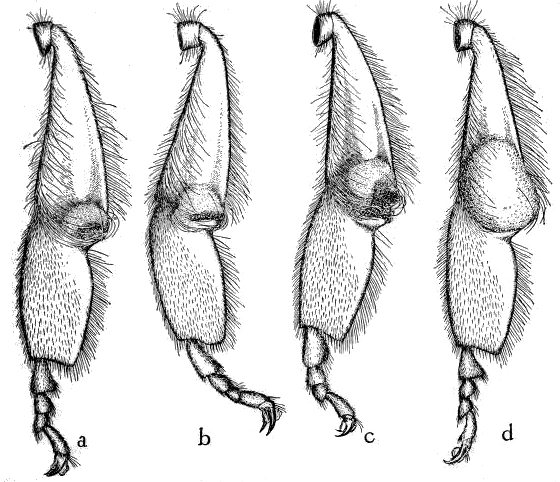
Fig. 8.—Camera drawings of the left hind legs of worker bees to show the manner in which pollen enters the basket. a, Shows a leg taken from a bee which is just beginning to collect. It had crawled over a few flowers and had flown in the air about five seconds at the time of capture. The pollen mass lies at the entrance of the basket, covering over the fine hairs which lie along this margin and the seven or eight short stiff spines which spring from the floor of the corbicula immediately above its lower edge. As yet the pollen has not come in contact with the one long hair which rises from the floor and arches over the entrance. The planta is extended, thus lowering the auricle; b, represents a slightly later stage, showing the increase of pollen. The planta is flexed, raising the auricle. The hairs which extend outward and upward from the lateral edge of the auricle press upon the lower and outer surface of the small pollen mass, retaining it and guiding it upward into the basket; c, d, represent slightly later stages in the successive processes by which additional pollen enters the basket. (Original.)
If the collecting bee is watched for a few moments the increase will readily be noted and the fact will be established that the accumulating mass is gradually working upward or proximally from the lower or distal edge of the corbicula and is slowly covering the floor of this receptacle. (See fig. 8, b, c, and d.) In many instances the successive contributions remain for a time fairly separate, the whole mass being marked by furrows transverse to the long axis of the tibia.
Sladen (1912, b) notes the interesting fact that in those rather exceptional cases when a bee gathers pollen from more than one species of flowers the resulting mass within the corbicula will show a stratification parallel to the distal end, a condition which could result only from the method of loading here indicated.
As the pollen within the basket increases in amount it bulges outward, and projects downward below the lower edge of the basket. It is held in position by the long hairs which fringe the lateral sides of the basket, and its shape is largely determined by the form of these hairs and the direction in which they extend. When the basket is fully loaded the mass of pollen extends laterally on both sides of the tibia, but projects much farther on the posterior side, for on this side the bounding row of hairs extends outward, while on the anterior edge the hairs are more curved, folding upward and over the basket. As the mass increases in thickness by additions from below it is held in position by these long hairs which edge the basket. They are pushed outward and many of them become partly embedded in the pollen as it is pushed up from below. When the pollen grains are small and the whole mass is well moistened the marks made by some of the hairs will be seen on the sides of the load. (See fig. 9, a.) These scratches are also transverse in direction and they show that the mass has been increased by additions of pollen pushed up from below.
Even a superficial examination of a heavily laden basket shows the fallacy of the supposition that the long lateral fringing hairs are used to comb out the pollen from the brushes of either the hind or middle legs by the crossing of these legs over the lateral edges of the baskets. They are far from sufficiently stiff to serve this purpose, and their position with relation to the completed load shows conclusively that they could not be used in the final stages of the loading process, for the pollen mass has completely covered many of them and its outer surface extends far beyond their ends. They serve merely to hold the pollen in place and to allow the load to project beyond the margins of the tibia.
The auricle plays a very essential part in the process of loading the basket. This structure comprises the whole of the flattened proximal surface of the planta, except the joint of articulation itself, and it extends outward in a posterior direction a little beyond the remaining plantar edge. The surface of the auricle is covered over with many blunt, short spines and its lateral margin is bounded by a row of short rather pliable hairs, branched at their ends. When the planta is flexed the auricle is raised and its surface approaches the distal end of the tibia, its inner edge slipping up along the pecten spines and its outer hairy edge projecting into the opening which leads to the pollen basket. (See fig. 8, b.) With each upward stroke of the auricle small masses of pollen which have been scraped from the plantar combs by the pecten are caught and compressed between the spiny surface of the auricle and the surface of the tibia above it. The pressure thus exerted forces the pasty pollen outward and upward, since it can not escape past the base of the pecten, and directs it into the entrance to the corbicula. The outward and upward slant of the auricular surface and the projecting hairs with which the outer edge of the auricle is supplied also aid in directing the pollen toward the basket. Sladen (1911) states that in this movement the weak wing of the auricle is forced backward, and thus allows the escape of pollen toward the basket entrance, but this appears both doubtful and unnecessary, since the angle of inclination of the auricular surface gives the pollen a natural outlet in the proper direction.
If the corbicula already contains a considerable amount of pollen the contributions which are added to it at each stroke of the auricle come in contact with that already deposited and form a part of this mass, which increases in amount by continued additions from below. If, however, the corbicula is empty and the process of loading is just beginning, the first small bits of pollen which enter the basket must be retained upon the floor of the chamber until a sufficient amount has accumulated to allow the long overcurving hairs to offer it effective support. The sticky consistency of the pollen renders it likely to retain contact with the basket, and certain structures near the entrance give additional support. Several small sharp spines, seven or eight in number, spring from the floor of the basket immediately within the entrance, and the entire lower edge of the corbicula is fringed with very small hairs which are branched at their ends. (See fig. 3.) One large hair also springs from the floor of the basket, somewhat back from the entrance, which may aid in holding the pollen, but it can not function in this manner until a considerable amount has been collected.
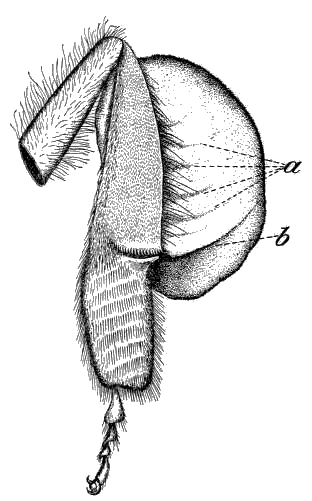
Fig. 9.—Inner surface of the right hind leg of a worker bee which bears a complete load of pollen, a, Scratches in the pollen mass caused by the pressure of the long projecting hairs of the basket upon the pollen mass as it has been pushed up from below; b, groove in the pollen mass made by the strokes of the auricle as the mass projects outward and backward from the basket. (Original.)
As the pollen mass increases in size and hangs downward and backward over the pecten and auricle it shows upon its inner and lower surface a deep groove which runs outward from the entrance to the basket. (See fig. 9, b.) This groove results from the continued impact of the outer end of the auricle upon the pollen mass. At each upward stroke of the auricle its outer point comes in contact with the stored pollen as soon as the mass begins to bulge backward from the basket.
Although the process is a rather delicate one, it is entirely possible so to manipulate the hind legs of a recently killed bee that the corbiculæ of the two legs receive loads of pollen in a manner similar to that above described. To accomplish this successfully the operator must keep the combs of the plantæ well supplied with moistened pollen. If the foot of first one leg and then the other is grasped with forceps and so guided that the pollen combs of one leg rasp over the pecten spines of the other, the pollen from the combs will be transferred to the corbiculæ. To continue the loading process in a proper manner, it is also necessary to flex the planta of each leg just after the pollen combs of the opposite leg have deposited pollen behind the pecten. By this action the auricle is raised, compressing the pollen which the pecten has secured, and forcing some upward into the corbicula. Bees' legs which have been loaded in this artificial manner show pollen masses in their corbiculæ which are entirely similar in appearance to those formed by the labors of the living bee. Moreover, by the above method of manipulation the pollen appears first at the bottom of the basket, along its lower margin, gradually extends upward along the floor of the chamber, comes in contact with the overhanging hairs, and is shaped by them in a natural manner. All attempts to load the baskets by other movements, such as crossing the hind legs and scraping the plantar combs over the lateral edges of the baskets, give results which are entirely different from those achieved by the living bee.