ACTION OF THE HIND LEGS.
Reading edition
The middle legs contribute the major portion of the pollen which reaches the hind legs, and all of it in cases where all of the pollen first reaches the bee in the region of the mouth. However, when much pollen falls upon the body of the bee the hind legs collect a little of it directly, for it falls upon their brushes and is collected upon them when these legs execute cleansing movements to remove it from the ventral surface and sides of the abdomen. All of the pollen which reaches the corbiculæ, with the exception of the small amount placed there by the middle legs when they pat down the pollen masses, passes first to the pollen combs of the plantæ.
When in the act of loading pollen from the plantar brushes to the corbiculæ the two hind legs hang beneath the abdomen with the tibio-femoral joints well drawn up toward the body. (See fig. 7.) The two plantæ lie close together with their inner surfaces nearly parallel to each other, but not quite, since they diverge slightly at their distal ends. The pollen combs of one leg are in contact with the pecten comb of the opposite leg. If pollen is to be transferred from the right planta to the left basket, the right planta is drawn upward in such a manner that the pollen combs of the right leg scrape over the pecten spines of the left. By this action some of the pollen is removed from the right plantar combs and is caught upon the outer surfaces of the pecten spines of the left leg.
This pollen now lies against the pecten and upon the flattened distal end of the left tibia. At this moment the planta of the left leg is flexed slightly, thus elevating the auricle and bringing the auricular surface into contact with the pollen which the pecten has just received. By this action the pollen is squeezed between the end of the tibia and the surface of the auricle and is forced upward against the distal end of the tibia and on outward into contact with the pollen mass accumulating in the corbicula. As this act, by which the left basket receives a small contribution of pollen, is being completed, the right leg is lowered and the pecten of this leg is brought into contact with the pollen combs of the left planta, over which they scrape as the left leg is raised, thus depositing pollen upon the lateral surfaces of the pecten spines of the right leg. (See fig. 7.)
Right and left baskets thus receive alternately successive contributions of pollen from the planta of the opposite leg. These loading movements are executed with great rapidity, the legs rising and falling with a pump-like motion. A very small amount of pollen is loaded at each stroke and many strokes are required to load the baskets completely.
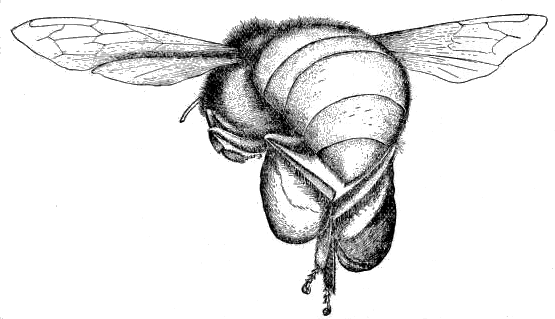
Fig. 7.—A bee upon the wing, showing the manner in which the hind legs are held during the basket-loading process. Pollen is being scraped by the pecten spines of the right leg from the pollen combs of the left hind planta. (Original.)
If one attempts to obtain, from the literature of apiculture and zoology, a knowledge of the method by which the pollen baskets themselves are loaded, he is immediately confused by the diversity of the accounts available. The average textbook of zoology follows closely Cheshire's (1886) description in which he says that "the legs are crossed, and the metatarsus naturally scrapes its comb face on the upper edge of the opposite tibia in the direction from the base of the combs toward their tips. These upper hairs * * * are nearly straight, and pass between the comb teeth. The pollen, as removed, is caught by the bent-over hairs, and secured. Each scrape adds to the mass, until the face of the joint is more than covered, and the hairs just embrace the pellet." Franz (1906) states that (translated) "the final loading of the baskets is accomplished by the crossing over of the hind-tarsal segments, which rub and press upon each other." Many other observers and textbook writers evidently believed that the hind legs were crossed in the loading process.
On the other hand, it is believed by some that the middle legs are directly instrumental in filling the baskets. This method is indicated in the following quotation from Fleischmann and Zander (1910) (translated):
The second pair of legs transfer the pollen to the hind legs, where it is heaped up in the pollen masses. The tibia of each hind leg is depressed on its outer side, and upon the edges of this depression stand two rows of stiff hairs which are bent over the groove. The brushes of the middle pair of legs rub over these hairs, liberating the pollen, which drops into the baskets.
A suggestion of the true method is given by Hommell (1906), though his statements are somewhat indefinite. After describing the method by which pollen is collected, moistened, and passed to the middle legs he states that (translated) "the middle legs place their loads upon the pollen combs of the hind legs. There the sticky pollen is kneaded and is pushed across the pincher (à traverse la pince), is broken up into little masses and accumulates within the corbicula. In accomplishing this, the legs cross and it is the tarsus of the right leg which pushes the pollen across the pincher of the left, and reciprocally. The middle legs never function directly in loading the baskets, though from time to time their sensitive extremities touch the accumulated mass, for the sake of giving assurance of its position and size."
The recent valuable papers of Sladen (1911, 1912, a, b, c, d, and e), who was the first to present a true explanation of the function of the abdominal scent gland of the bee, give accounts of the process by which the pollen baskets are charged, which are in close accord with the writer's ideas on this subject. It is a pleasure to be able to confirm most of Sladen's observations and conclusions, and weight is added to the probable correctness of the two descriptions and interpretations of this process by the fact that the writer's studies and the conclusion based upon them were made prior to the appearance of Sladen's papers and quite independent of them. His description of the basket-loading process itself is so similar to the writer's own that a complete quotation from him is unnecessary. A few differences of opinion will, however, be noted while discussing some of the movements which the process involves. As will later be noted, our ideas regarding the question of pollen moistening, collecting, and transference are somewhat different.