The Vanished Buffalo Herds of North America Kingly Race That Once Roamed a Continent Almost Wiped Out for "A Dollar a Hide"; Straggling Survivors Carefully Guarded By W. E. ANDERSON
Reading edition
About the year 1879 a party of Metis hunters came to the plains southwest of the present situation of Regina, Saskatchewan, to hunt buffalo. The party consisted of the father, a man then on the elderly side of middle age, but who had been in his youth a noted buffalo runner and Indian fighter; his wife, a heavy half-breed woman of some fifty years; and his daughter, a girl of about seventeen of a comely and attractive appearance.
The father, according to his custom, followed the chase on horseback, the old woman, seated amongst robes and camp baggage, drove the creaking Red river cart, whilst the young girl was in and out of the vehicle like an eager young spirit of the prairie.
That season there were very few carts which came to the plains after buffalo. The great herds that used to blacken the country to the rim of the horison had thundered away into the limbo of the lost, and all that was left of them was a few stragglers that still haunted some of the more remote valley bottoms.
The halfbreeds had strange and superstitious ideas about the passing of the buffalo. They could not believe that they had gone never to return. It was only yesterday that the plains were black with the shaggy herds. Their trails and wallows were still to be seen everywhere.
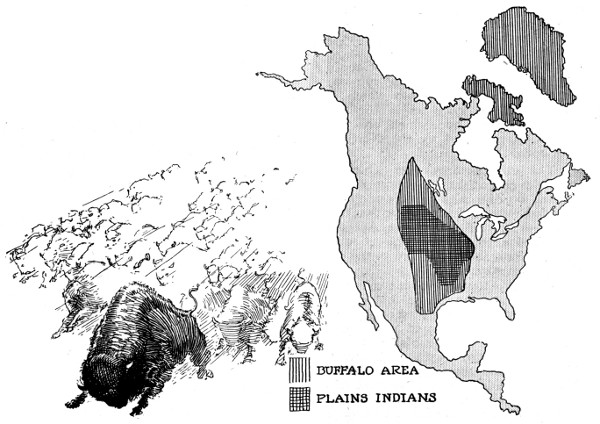
Our map diagram indicates the approximate distribution of the buffalo grounds prior to 1800; limitations, Mississippi River, Rocky Mountains, Gulf of Mexico and Great Slave Lake.
This particular Metis hunter believed that they had gone to some new pasturage, and that if they could be found the hunting would again be as good as in the days of yore.
So for a period of years he led his family up and down the plains. One season they wintered at Wood Mountain, another they wandered as far north as Ile a la Crosse, then again at the Milk River; but in all their wanderings they found none of the vanished herds.
One winter they came to Fort Edmonton, and there the mother who had suffered for years from goitre, and was doubtless wearied with much wandering, lay down and quietly died.
Towards the close of the winter there came to the Post a Touchwood Indian who had been in the Slave River country as a dog driver for a Hudson's Bay officer. He told the halfbreed hunter that in the northern country of the lakes and rivers he had heard strange tales of great herds of buffalo. He had actually seen some himself. They were larger than the old-time buffalo of the plains, and their coats were longer and silkier.
The old hunter brightened at the news. Here at last was the word of the missing herds; making a company of travel with an Iroquois river man, they penetrated through labyrinths of waterways to the region of the far north.
There is no doubt but that the old hunter had been misled by rumors of the herd of wood-buffalo which had existed for many years in the Slave River country, and which are today carefully protected by the Northwest Mounted Police patrol.
The original area over which the buffalo ranged began almost at tide-water on the Atlantic coast. It extended westward through a vast tract of dense forest, across the Alleghany mountains to the prairies along the Mississippi, and southward to the delta of that great stream.
Although the vast plains country of the west was the natural home of the species, where it flourished most abundantly, it also wandered south across Texas to the burning plains of north-eastern Mexico, westward across the Rocky mountains into New Mexico, Utah and Idaho, and northward across a vast treeless waste to the bleak and inhospitable shores of Great Slave and Hudson Bay.
Vast herds of bison seemed to clothe the prairies in a coat of brown. They roamed the country around the headwaters of the Qu'Appelle river in tens of thousands.
Catlin has given some idea of the enormous numbers of bison that were killed during the first half of the nineteenth century. In 1832 he stated that 150,000 to 200,000 robes were marketed annually, which meant a slaughter of 2,000,000 or perhaps 3,000,000 bison. So great was the destruction that he prophesied their extermination within eight or ten years.
The death knell was struck when the construction of the Union Pacific railway was begun at Omaha in 1866. Prior to the advent of the first transcontinental railway the difficulties of marketing the results of the slaughter served as a slight check on the rate of extermination. The destruction began in earnest in 1876 and was complete four years later. The facility for shipping out the hides over the new railways was the cause of the rapid disappearance of the buffalo.
In the United States, buffalo hunters grew prosperous shooting down the animals for "a dollar a hide."
While the accompanying map is approximately correct, the feeding ground was necessarily subject to food material. In such years, for instance, as the grasshoppers spread devastation over large tracts of the Northwest—when for miles and miles not a blade of grass could be seen—it is only reasonable to expect that the buffalo changed his regular stamping ground.
William T. Hornaday, the naturalist, estimated, January 1st, 1908, the number of wild bison in the Rocky Mountains at 25, and the number in Canada at 300. About 130 are captive in Europe, and 1116 in the United States, bringing the total number of pure bred bison up to 2047. A large herd is under the protection of the Canadian government in the park at Wainwright, Alberta. The more notable American herds are found in Corbin's game preserve, New Hampshire; in Oklahoma; in the Yellowstone national park; and on various private ranches in the western part of the United States.