H.B.C. Fur Trade Post on San Francisco Bay, 1824 Company Did Not Own Million Acres of California Land, as Reported, but Had Two Fur Posts and Farms, Closed in 1832-49. By C. H. FRENCH
Reading edition
NOTE.—In a leading Western Canadian newspaper we read: "It is not commonly known that at one time the Hudson's Bay Company owned a million acres of land in California surrounding the present site of the City of San Francisco. The importance of the great harbour now known as the Golden Gate was not recognized and the area was sold for one dollar an acre."
When in 1824, shortly after the amalgamation of H.B.C. with the Northwest Company, the fur brigades under Sir George Simpson swept to the verge of the Pacific, north, west and southwest, the flag of H.B.C. was carried far down the California coast. One new fur trading establishment was planted by the Company at the Golden Gate San Francisco Bay; another was erected at Umpqua, not many miles to the northward.
Up to 1820 the only fur post on the Pacific coast between Sitka, Alaska, and southern California was Fort George. This post had been first opened by Astor of New York, but was taken over by H.B.C. at the time of the amalgamation with the Nor'westers. Meanwhile it had been re-christened "Fort George" by Captain Black of H.M.S. "Raccoon" in 1813.
From Fort William at the head of the Great Lakes came Dr. John McLaughlin, James Douglas and John Work, ordered by the Company to Fort George to take charge of the newly created Western Department of the H.B.C. fur trade. Dr. McLaughlin was in charge, James Douglas was accountant and John Work was what might be termed an explorer.
Dr. McLaughlin was a versatile man, but leaned towards the development of farming and stockraising, while John Work's only interest was in fur trading.
In 1824 they arrived at Fort George and at once mapped out plans for development of their department.
It was decided to abandon Fort George because the farming possibilities of the neighbourhood were not so promising as those of the country further up the river. A new site was selected just below the Willamette River, and the construction of Fort Vancouver (Washington) was commenced.
At that time the whole territory was known as Oregon Territory. The country was also known as Columbia District, and when the boundary line between Canada and the United States was established, the part to the north of the line was named British Columbia District, and still retains this name in the Company's organization.
In order to stock the newly established farms, the Company sent men south for sheep, cattle and horses, and I believe that it was on this account that Posts were opened at Umpqua and San Francisco Bay in 1824 or 1825, and operated until 1832, when they were abandoned and there is nothing in the records to indicate that the Hudson's Bay Company ever afterwards claimed one foot of soil in or around San Francisco.
In fact, there is information that would make it appear that the San Francisco Bay Post alone was closed in 1832 and Umpqua not until a later date, as a letter written by Sir George Simpson to Captain J. Sheppard, R.N., dated 28th May, 1849, mentions Umpqua as being still in existence. Sir George said the names of Posts west of the mountains were at that time:
American Territory, South of 49°
Fort Colville,
Flat Head House,
Fort Okanagan,
Fort Nez Perces,
Fort Bois,
Fort Hall,
Fort Vancouver,
Fort Umpqua,
Fort George,
Fort Nisqually,
Cowlitz Farm.
British Territory, North of 49°
Victoria,
Simpson,
Langley,
Hope,
Kamloops,
Thomson,
Alexandria,
George,
Fraser,
St. James,
Connolly,
Kilmaurs (Babine),
McLeod,
Chilcotin.
Europeans employed at these posts numbered six hundred, besides hundreds of Indian laborers.
There were seven vessels employed in the service:
3 barques, carrying goods to and from Europe,
1 steam vessel
1 brig
1 schooner
1 sloop
In order to take care of the Russian American Company's and the H.B.C. Posts' requirements, large farms and dairies were necessary, and suitable land was plentiful between the Puget's Sound and the Columbia River. When the negotiations between the Hudson's Bay Company and the United States government were under way to settle the Oregon dispute, the Company claimed 160,000 acres of land as being farmed and grazed by them.
There has undoubtedly been a tendency on the part of historians and newspaper writers to confuse the Company's Oregon land claim with the lands at the H.B.C. San Francisco Bay post, but there is absolutely no connection.
H.B.C. Aided Wilderness Wanderer
The following letter of appreciation was recently received by the Company from J. P. Burns, an engineer who met with misfortune in the wilds of British Columbia:
"Because of a serious accident last fall I was compelled to call at one of your trading posts situated at the junction of the Dease river and Liard, run by Mr. F. J. Bass. Mr. Bass did all in his power for me at a time when I was almost destitute and in a very low state of health owing to a broken bone in my right foot and a bad wound on my right side. I wish you would thank Mr. Bass for his hospitality and hope and trust that the Hudson's Bay Company will long remain and prosper in regions where engineers and dogs struggle for life and civilization.
Yours faithfully, J. P. BURNS.
PAS MOUNTAIN POST NEWS
By ALEX HORNE
The excitement which always prevails during the breakup around this Reserve was perhaps of a more serious nature this Spring than previous years.
Usually the Carrot river on the banks of which the Post is situated, overflows every other second year or so, but this time the flood proved to be a record.
The ice broke up on the 23rd of April and started going out on the 26th. During that day it travelled well.
As it was the first breakup I had ever witnessed, the sight was most interesting and fascinating. Some of the blocks, I estimated, were perhaps ninety by thirty feet and eighteen to twenty inches thick. These huge blocks were to cause us a considerable amount of discomfort before the day was over.
Towards evening it was noticed that the ice was travelling very slowly on the east bend of the river. As the river flows directly south past the Post and then takes a turn east, our view for over a mile is fairly good. We watched with strained eyes and beating hearts, for already the water was rising. Ah! yes, it was only too true, there was a jam!
Soon the water was coming over in front of the house. Immediate action was necessary. Canoes had to be attended to, boards, posts, boxes and barrels moved to a place of safety.
Very soon the water was making a noise like a waterfall and sweeping everything before it. In a short time the sidewalk was trying to pilot its way through the garden gate. A cord of wood made an effort to follow suit but did not succeed. That night the roaring waters sang us to sleep.
All day the ice and driftwood kept going by. At 7 o'clock in the evening the Post was completely surrounded by water and a canoe was for the next few days to be our only mode of travelling.
Towards twilight the last of the ice and driftwood passed. We gave a sigh of relief and were about to retire when our attention was attracted by a noise in the bush on the opposite bank of the river; on looking, it was no little surprise to see a birch bark, and three Indians come into sight. From the conversation, we gathered that the country for miles around was under water.
Many cattle belonging to the Indians in this Reserve were drowned, also an old house was carried away and where it once stood we have now a small creek running from the river to a muskeg.
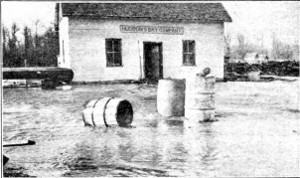
The Swirling Waters in Front of the Store.
STANLEY POST (SASK.) NOTES
The last of the freighters reached here on April 18th, on their return trip to Prince Albert, having delivered all the freight for Lac du Brochet Post at South Deer Lake. The season being late, they had to work night and day, under adverse weather conditions.
One big snowstorm lasted a day and a night, and the wind was terrible, the track being covered up a few moments after it had been opened. The rain and the soft weather we had in March formed a hard crust on the deep snow, which was very bad for the horses.—Thos. Bear, Post Manager.
Buying Everything in Sight By P. H. GODSELL, Fort Simpson
The article by Mr. Forbes in connection with the London Auction Sales calls to mind a rather amusing incident that occurred when I once attended a H.B.C. fur sale at College Hill, London.
Being young, I took a keen interest in everything, especially in the actions of the auctioneer.
I studied my catalogue and notes closely and when a lot would be called by the auctioneer invariably raised my head and looked him in the eye.
As I was leaving the sale room at the termination of the afternoon sale I passed Mr. Ingrams and Mr. Randall. They remarked that I must feel very well satisfied with my afternoon's business, as I should be the owner of almost every lot that was put up.
It was not until then that I learned that by even such a small sign as a direct look a lot would be knocked down by the broker, and that I had to all appearances bought everything in sight!
As They Were
We begin in this number publication of a series of "Youthful Portraits" depicting present-day H.B.C. employees as they appeared at a "tender age." It appears that considerable interest will be demonstrated by our readers in trying to discover familiar likenesses in these quaint old photographs.
McKay Post Manager Dies B. F. Cooper Served H.B.C. Thirty-Seven Years in North
B. F. Cooper, an old timer and Hudson's Bay fur trader, died at Fort McMurray, May 28th, after an illness of some weeks. Mr. Cooper was an Englishman, an old "blue-coat school" boy, brought up in London. Instead of moving in the limelight of politics Mr. Cooper chose the quiet and lasting work of pioneering on the frontier posts of the empire and for thirty-six years had been a trusted and faithful servant of the Hudson's Bay Company, in charge of the Fort McKay post.
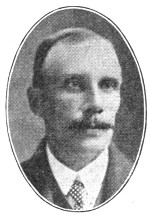
B. F. COOPER
A few weeks before his death, an urgent message was sent to Fort McMurray for medical help and immediately the Company chartered a motor boat to bring Mr. Cooper from McKay. He was given every possible care.
The funeral took place on Sunday, May 29th, in the little Presbyterian church at McMurray, the coffin being covered with the Hudson's Bay flag and borne by Hudson's Bay men, C. C. Sinclair, J. Cunningham, L. Lane, G. Petty, H. Porter, Captain McLeod, Ed. Jones and J. Sutherland. The little church was crowded with people who followed to the cemetery the remains of the respected old timer whose only relative present was a son of sixteen years. Mr. Cooper leaves a wife and seven children. His record with the Company follows:
DateCapacityPost
1884-1885 Clerk N.D. Office, Winnipeg
1885-1887 In charge Fort Ellice
1887-1895 In charge Touchwood Hills
1895-1899 Accountant Chipewyan
1899-1904 Clerk in charge Fond du Lac
1904-1905 Clerk Onion Lake
1905-1912 Clerk Fort Smith
1912-1914 Post Manager Chipewyan
1914-1921 Post Manager McKay
Tried for North Pole by Balloon H.B.C. Was on Lookout for Ill-Fated Andree Polar Party, 1896 By H. M. S. COTTER
While I was stationed at North West River Post on the Labrador coast in 1896, the government of Norway and Sweden sent out an arctic expedition in a polar balloon to make an attempt at reaching the North Pole.
The Company, anxious to lend a hand to the success of this scientific exploration to the top of the earth, despatched to its many far northern posts drawings of the balloon like the illustration shown, accompanied by the notice:
"In the summer of 1896 a balloon (an object like that shown on the drawing) may be seen floating in the air. This balloon will convey a party of three Swedish scientists who have been making explorations towards the North Pole by these means.
The Government of Sweden and Norway has requested that the explorers may receive all possible assistance. Natives should therefore be told that the balloon is not a dangerous thing, but merely a mode of conveyance in the air just as a ship is in the water.
Natives should be told to approach the people in it without fear and to give them all the help in their power.
If the balloon is seen only, the natives should be told to communicate the day and hour, the direction and time it was visible, and the direction of the wind.
If the people arrive, having lost the balloon, the natives to be told to give them all possible assistance.
It is requested that the travellers may be supplied with passport and all necessary official documents, the names being:
Mr. Solomon August Andree, aged 42; Dr. Nils Gustaf Ekholm, aged 48; Mr. Nils Strindberg, aged 24."
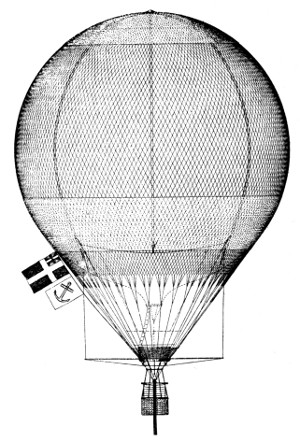
The Drawing of Andree's Polar Balloon.
According to instructions, I informed all the Indians to be on the lookout for the balloon.
Early one morning an Indian rushed into the store to say he had heard an awful "ringing of bells" away up in the heavens and was sure it was the balloon passing.
I could see or hear nothing, but the native persisted in his story. I told him it might have been Andree ringing the breakfast bell. I could only get him calmed down by giving him some tobacco. Probably that was all he was after.
Traces of Andree were said to have been found at Cape Mugford, Northern Labrador, but no positive proof was ever obtained.
Another story came from Ft. Churchill to the effect that an Eskimo had found some clothing supposed to have been from the balloon, but these were said to have been left behind by Mr. J. B. Tyrrell on one of his expeditions.