The "Lords of the North" in Annual Conclave Commissioned Officers of H.B.C. Met in Grand Councils to Formulate Annual Plans for Administration of Vast Fur Districts; a Typical Meeting in 1878 By J. BROWN
Reading edition
"Lords of the North" was the appellation sometimes applied to those intrepid Factors and Chief Factors of H.B.C. who for many years gathered in annual conclave at some central fort to arrange for the administration and provisioning of the great fur-trade districts.
Norway House, Fort Carlton on the Saskatchewan, Fort Garry on the Red and the "Stone Fort" were successively the meeting places of these ancient councils.
When the season's furs had been gathered and stoutly baled and marked with the cryptic signs which destined them for the far-away auction mart at London—when the shouting, chanting fur brigades of the north went swinging away down roaring watercourses to meet the sailing ships on the great Bay—just at this time the bearded chieftains of the inland districts mobilized their voluminous accounts, dried their goose quill pens and shot away in swift birchbarks to the grand council.
Some of these officers travelled a thousand miles; others, at more southerly stations had not far to go. But in any case their only carriers were the canoe, the York boat, the plodding oxen or the pony of the plains.
The council was not usually complete until early July. Then the grizzled veterans of the fur service sat down to "talk musquash" under the chairmanship of the Chief Commissioner, and in the space of a fortnight had deliberated upon the commerce and government of a wilderness empire and promulgated the specific orders that would control the victualing, the supply and the trade, the commercial, civic, industrial and religious life of the vast unplotted north country for another year.
Weighty problems of transport were solved at these historic meetings, so that the chain of H.B.C. communication might be unbroken; mail packets, freight and furs traversed the forest leagues and the expanse of mountain and prairie under "timetables" placed in effect by this council. And rare indeed was there instanced the loss of a package of merchandise or pelts—or even a letter—notwithstanding the extraordinary difficulties of travel, the storm and stress of climate.
Some idea of the plan under which the grand council operated may be conveyed by the following extracts from the minutes of a typical meeting of the Factors and Chief Factors held at Fort Carlton, beginning the first of July, 1878:
Minutes of Council, 1878
Memoranda having reference to a Meeting at Carlton called by the Chief Commissioner for the purpose of receiving advice and information regarding the Trade and Requirements of the Several Districts in Northern Department from the officers in charge of the same commencing on the 1st day of July, 1878, at which the undermentioned qualified Commissioned Officers were present by request:
Richard Hardisty, Chief Factor.
Lawrence Clarke, Chief Factor.
The following Factors, Chief Trader and Junior Chief Trader were also invited to attend:
Archibald McDonald, Factor.
Horace Belanger, Factor.
Wm. McKay, "C", Factor.
James McDougall, Chief Trader.
J. Ogden Grahame, Junior Chief Factor.
Article 1—That the appointments of Commissioned Officers for the current outfit be as follows, viz.:
McKenzie River—Julian S. Camsell, Factor; John Wilson, Junior Chief Trader; Charles F. Gaudet, Chief Trader.
Peace River—James McDougall, Chief Trader; Alexr. MacKenzie, "A" Junior Trader.
Athabasca—Rodk. McFarlane, Chief Factor: Henry J. Moberly, Chief Trader; John McAulay, Junior Chief Trader; William F. Gairdner, Junior Chief Trader.
English River—Ewen McDonald, Chief Trader.
Edmonton—Richard Hardisty, Chief Factor.
Saskatchewan—Lawrence Clarke, Chief Factor; Wm. McKay, "C" Factor.
Cumberland—Horace Belanger, Factor; Pierre Deschambeault, Senior Chief Trader.
Grand Rapids—Alexander Matheson, Chief Trader.
Norway House—Roderick Ross, Factor.
Island Lake—Cuthbert Sinclair, Junior Chief Trader.
York Factory—Joseph Fortescue, Factor.
Swan River—Archibald McDonald, Factor; William J. McLean, Junior Chief Trader.
Manitoba—Wm. Clarke, Junior Chief Trader.
Red River—John H. McTavish, Chief Factor; Wm. Flett, Chief Trader; Joseph J. Hargrave, Junior Chief Trader; Duncan Matheson, Junior Chief Trader; Alexr. Christie, Junior Chief Trader.
Lac la Pluie—Alexr. R. Lillie, Chief Trader; James B. McKenzie, "A" Junior Chief Trader.
General Service—George S. McTavish, Inspt. Chief Factor; J. Ogden Grahame, Junior Chief Trader.
Article 2—Winter Arrangements, 1878-9
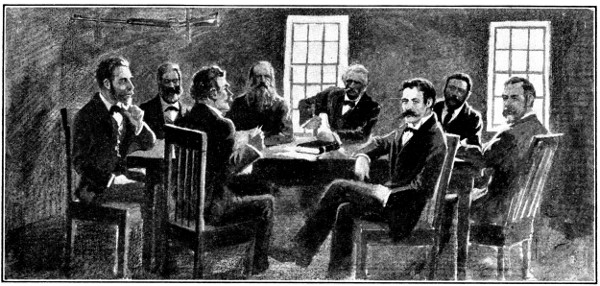
An H.B.C. Fur Trade Council at one of the north-central forts during the later years of the nineteenth century. The artist has here caught much of the facial likeness of such commissioned officers as McDougall, Camsell, McKay, McDonald, Livock and King, who were all present at the last council of the Company's fur trade Officers, held at Athabasca Landing, July, 1898.
ENGLISH RIVER
Isle a la Crosse—Ewen McDonald, Chief Trader; Walter B. West, Apprentice Clerk; Francois Maurice, Clerk.
Portage la Loche—Nicol Sinclair, Clerk; Pierre Laliberte, Clerk.
Green Lake—Scott W. Simpson, Clerk.
Outpost—Charles Lafleur, Interpreter.
Disposable—Fredk. S. Church, Apprentice Clerk.
Article 3—That 25 servants, including tradesmen and interpreters, and about 550 pieces of goods including winter allowances and servants' equipments constitute the current outfit of English River District, the goods to be conveyed inland via Carlton and Green Lake.
Article 4—That the appointments of Clerks and Postmasters, Summer 1879, be made by Chief Trader Ewen McDonald as he may deem expedient and that he be directed to superintend the transport of outfits and returns of A. & R. Districts between Green Lake and Portage la Loche.
Article 5—That the country-made articles for English River District for Outfit 1879 be provided at Fort Garry, Summer 1878.
Article 6—Winter Arrangements, 1878-9.
EDMONTON
Edmonton House—Richard Hardisty, Chief Factor; John Sinclair, Clerk; Frank Wilson, Clerk; Wm. Leslie Wood, Clerk.
Lac Ste. Anns—James Kirkness, Clerk.
Victoria—Wm. R. Brereton, Clerk.
Bow River—Angus Fraser, Interpreter.
White Fish Lake—Joseph Nooskeyah, Clerk.
Lesser Slave Lake—Harrison S. Young, Clerk; Charles Anderson, Interpreter.
Lac la Biche—Wm. E. Traill, Clerk.
Disposable—Joseph Favel, Pilot.
Article 7—That 8 engaged and 4 temporary servants with about 800 pieces of goods including winter allowances and servants' equipments constitute the current outfit for the Edmonton District, the goods to be conveyed from Fort Garry by steamers.
Article 8—That Chief Factor Richard Hardisty be instructed to assist Saskatchewan District with country produce required for general service as far as his means will admit.
Article 9—That Chief Factor Hardisty be authorized to make the necessary and proper arrangements for the summer business of the District, 1879, and to change the appointments of the clerks if he deem it necessary.
Article 10—That Chief Factor Hardisty be instructed to be prepared to forward to Lesser Slave Lake from 600 to 800 pieces of goods intended for the Peace River and Athabasca Outfit, 1879, as early as possible after the same shall have reached Edmonton and that he superintend the transport between Edmonton and Smoky River.
Article 11—That the following country produce be forwarded to Lesser Slave Lake from Edmonton for the Transport Service between that point and Smoky River:
20 bags flour.
30 bags pemmican, each 100 pounds.
50 whole buffalo skins.
Article 12—That the following supplies for New Caledonia Outfit 1879 be forwarded from Edmonton to Peace River for delivery at Hudson's Hope on or before the 10th September, 1879:
350 whole buffalo skins.
300 lbs. common pemmican.
20 lbs. sinews.
Article 13—That the country-made articles required for the trade of Edmonton District for Outfit 1879 be provided at Fort Garry, Summer 1878.
Article 14—Winter Arrangements, 1878-9
SASKATCHEWAN
Carlton House—L. Clarke, Chief Factor; George McCrum, Clerk; Jas. K. Simpson, Clerk; Angus McKay, Apprentice Clerk.
Fort Pitt—Wm. McKay, "C" Factor.
Cold Lake—Wm. McKay, "J" Clerk.
Turtle Lake—Daniel Villebrun, Interpreter.
Battleford—August H. Bastien, Postmaster.
Prince Albert—Philip Turner, Clerk; Colin McIntyre, Apprentice Clerk.
Fort a la Corne—George Goodfellow, Clerk.
Article 15—That Chief Factor Lawrence Clarke be authorized to make the necessary and proper arrangements for the summer business of the District season 1879, including the forwarding of the Outfit for the Districts north of Carlton and that he change the appointments of clerks in his District as he may deem necessary.
Article 16—That the following country produce be deposited at Cumberland House in the Spring of 1879 for the use of passing brigades and for the trade of that District:
200 bags common pemmican.
400 whole dressed buffalo skins.
50 large dressed moose skins.
8 leather tents, each 10 skins.
Article 17—That the following country produce be forwarded to Green Lake, Autumn 1878, or Spring of 1879, for transport service in English River District, Season 1879, viz:
250 bags common pemmican, each 100 lbs.
400 whole dressed buffalo skins.
50 large dressed moose skins.
8 leather tents, each 10 skins.
Article 18—That the following country produce be furnished by the Saskatchewan District, season 1878, for distribution 1879, among the Districts of Norway House, York Factory and Island Lake, and that the same be forwarded to Grand Rapids for that purpose:
300 bags common pemmican, each 100 lbs.
20 leather tents, each 10 or 12 skins.
600 whole buffalo skins.
400 half buffalo skins.
Article 19—That the country-made articles for the Saskatchewan District for Outfit 1879 be provided at Fort Garry, Summer 1878.
Article 20—That Chief Factor Clarke be instructed to comply with no additional requisitions for country produce of any kind except he is satisfied there may be a hitch in the transport for the want of them.
Article 21—Winter Arrangements, 1878-9.
CUMBERLAND
Cumberland House—Horace Belanger, Factor; Nicol McDougall, Clerk.
Le Pas—Charles Adams, Clerk; Robert Ballendine, Postmaster.
Moose Lake—John McDonald, "D" Clerk.
Pelican Narrows—John E. Stewart, Apprentice Clerk; Antoine Morin, "B" Interpreter.
Lac du Brochet—Pierre Deschambeault, Chief Trader; Pierre Morin, Postmaster.
Rapid River—Philip McDonald, Clerk; Angus McLeod, Interpreter.
Disposable—Joseph Hourston, Postmaster.
Article 22—That 20 servants and 700 pieces of goods, including Winter allowances and servants' equipments, constitute the current outfit for Cumberland District, the goods to be conveyed from Fort Garry by steamers.
Article 23—That Factor Belanger be authorized to make the necessary arrangements for the summer business of the District, Season 1879, and that he change the appointments of commissioned officers and clerks in his District as he may deem necessary.
Article 24—That Factor Belanger be instructed to forward to Norway House, Spring 1879, the following country produce, viz:
50 lbs. large snowshoe netting.
50 lbs. small snowshoe netting.
Article 25—That Factor Belanger take measures to have rendered at Portage la Loche, Summer 1879, on or about 25th July but not later than 1st August, 8 boat loads, each boat load to consist of 75 pieces of the Athabasca Outfit which will be landed from the Steamer "Northcote" at Cumberland, and that on the return trip the crews of the 8 boats be engaged to take in each boat not less than 50 packs furs and deliver the same at the Grand Rapid should the Steamer "Northcote" have ceased running.
Article 26—That the country-made articles for Cumberland District, Outfit 1879, be provided at Fort Garry, Summer 1878.
Article 27—Winter Arrangements, 1878-9.
GRAND RAPIDS
Grand Rapids—Alex. Matheson, Chief Trader; Colin Thompson, Apprentice Clerk.
Article 28—That Chief Trader Alexander Matheson be instructed to receive at the Grand Rapids all goods intended for the Northern Districts that may be sent there and have conveyed by the Steamer Northcote to Cumberland the goods intended for that District and 600 pieces of those intended for Athabasca District, sending to Carlton by the same steamer the goods intended for the Districts of Saskatchewan, English River, Edmonton, Peace River and McKenzie River as well as the remainder of those intended for "i."
Article 29—That the country-made articles for Grand Rapids District for Outfit 1879 be provided for at Fort Garry, Summer 1878.
Article 30—Summer Arrangements, 1878-9.
NORWAY HOUSE
Norway House—Roderick Ross, Factor; D. C. McTavish, Clerk; James Flett, "C" Apprentice Clerk; Walter Franklin, Apprentice Clerk.
Nelson River—Wm. Isbister, Clerk.
Berens River—James Flett, "B" Clerk.
Grand Rapids—John Moar, Postmaster.
Poplar River—Alex. Stout, Postmaster.
Disposable—John C. Sinclair, Postmaster.
Article 31—That 20 servants and 650 pieces of goods, including Winter allowances and servants' equipment, constitute the current outfit for Norway House District and that the outfit be conveyed from Fort Garry by steamer or otherwise as most convenient.
Article 32—That Factor Roderick Ross be instructed to forward per boats to the Grand Rapids, Summer 1879, any goods on depot at Norway House intended for the trade of the Northern Districts Outfit as early as navigation will permit and have brought back from there to Norway House any returns or country produce intended for the supply of Norway House, Island Lake or York Factory Districts or for shipment to England from the latter place.
Article 33—That Factor Ross be instructed to make arrangements with Factor Fortescue as to the number of boats requisite to bring up from the Factory any gunpowder or other articles intended for shipment inland and avail himself of the freight room downwards to forward to the Factory as large a portion as possible of the returns of Norway House District besides any castorum, buffalo tongues and quills received from other Districts for shipment to London, after providing for the country produce intended for Island Lake and York Factory.
Article 34—That the country-made articles for Norway House District for Outfit 1879 be provided at Fort Garry, Summer 1878.
Article 35—Winter and Summer Arrangements, 1878-9
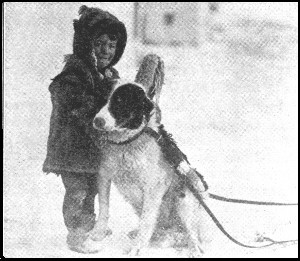
"Playmates of the North." This chubby lad, who seems to have the entire confidence of the lead dog of the team, is the son of Mr. John J. Loutit, post manager at Fort Chipewyan.
ISLAND LAKE
Oxford House—Cuthbert Sinclair, Junior Chief Trader.
Island Lake—Thos. M. Linklater, Clerk.
Article 36—That 8 servants and 320 pieces of goods constitute the current outfit for Island Lake District, the same to be conveyed from York Factory by the Oxford House boats and provided for in York Factory requisition.
Article 37—That the Island Lake boats make one round trip between Norway House and York Factory, Summer 1878, laden with such cargoes as the officers in charge of these Districts may have to go forward should they be required to do so.
Article 38—Winter and Summer Arrangements 1878-9
YORK FACTORY
York Factory—Joseph Fortescue, Factor; John K. McDonald, Clerk; A. O. T. Bennett, Apprentice Clerk; James Cowie, Apprentice Clerk; George Grieve, Postmaster.
Severn—John Taylor, Postmaster.
Trout Lake—James Tod, Clerk.
Churchill—John R. Spencer, Clerk.
Article 39—That 35 servants, including mechanics, constitute the summer and winter establishments of York Factory District and that the outfits and returns of the Posts of Severn and Trout Lake be transported in the usual manner and those of Churchill landed from and shipped in the annual vessel from London which is directed to call at Churchill on its way out to York Factory.
Article 40—That Factor Fortescue be instructed to have in readiness, Spring 1879, for shipment to Oxford House the outfit intended for the trade of Island Lake District, 1879, and that he direct Mr. Cuthbert Sinclair to send to York Factory by boats the returns of Island Lake District as early in the summer as possible providing at the same time a sufficient number of men and boats for the transport of the Outfit for 1879.
Article 41—That Factor Fortescue be instructed to forward to Norway House as opportunity offers the gunpowder and country-made articles on hand at York Factory (exclusive of beads, country-made articles, etc.) which are set aside for the Inland Districts.
Article 42—Winter Arrangements, 1878-9.
MANITOBA
Oak Point—Wm. Clark, Junior Chief Trader; Geo. F. Kinnaird, Apprentice Clerk.
Manitoba House—Isaac Cowie, Clerk.
Water Hen River—Alexr. Munro, Clerk.
Shoal River—Donald McDonald, "A" Clerk.
Fairford—An Interpreter.
Article 43—That Junior Chief Trader William Clark be authorized to make the necessary and proper arrangements for the summer business of the District, Season 1879, and change the disposal of the clerks if he may think it necessary.
Article 44—That 4 servants and 300 pieces of goods, including winter allowances and servants' equipments, constitute the current outfit of Manitoba District and be imported via St. Paul to Fort Garry and thence by carts to Oak Point.
Article 45—That the live stock on inventory in Manitoba District be priced at their market value in the District, less 331/3%
Article 46—That Junior Chief Trader William Clark be instructed to procure at Fairford and forward to Berens River for the use of Norway House District, Summer 1879:
20 fathoms birch bark for canoe bottoms.
20 fathoms birch bark for canoe sides.
Article 47—That the country-made articles for Manitoba District, Outfit 1879, be provided at Fort Garry, Summer 1878.
Article 48—Winter and Summer Arrangements, 1878-9
SWAN RIVER
Fort Ellice—Archibald McDonald, Factor; David Armit, Clerk; Hugh McBeath, Clerk.
Riding Mountain—James C. Andy, Clerk.
Qu'Appelle—Wm. J. McLean, Junior Chief Trader; George Dreyer, Postmaster.
Fort Pelly—Adam McBeath, Clerk; John Calder, Apprentice Clerk.
Touchwood Hills—Angus McBeath, Clerk; Thomas W. Lillie, Apprentice Clerk.
Egg Lake—Henry McKay, Clerk.
Article 49—That 10 servants and 800 pieces of goods, including winter allowances and servants' equipments, constitute the current outfit of Swan River District and be imported via St. Paul to Fort Garry and thence by carts to the District.
Article 50—That Factor Archibald McDonald be authorized to make the necessary and proper arrangements for the summer business of the District, season 1879, and change the disposal of clerks if he may think it is necessary.
(Note—Articles 51 to 107 of the Minutes are of a similar nature to the foregoing.)
LITTLE JOURNEYS TO FUR TRADE POSTS OF THE HUDSON'S BAY CO.
Hudson's Hope Post, B.C. By JOHN GREGG
The Post is situated at the head of navigation on the Peace river. From here to Vermillion there is good water for stern-wheelers and gasoline boats, for five hundred fifty miles.
Immediately to the west is the famous Rocky Mountain canyon, which makes a horseshoe of twenty-five miles; and from the head of the canyon to Finlay Forks there is another good stretch of water. The Peace river here cuts through the Butler range, the most easterly range of the Rockies.
The climate is excellent. In winter chinook winds break up the cold snaps. The extreme minimum last winter was 45 below on two nights. In summer, the maximum sometimes rises over 90. One peculiarity is that during winter there are no winds excepting the warm chinooks. The country generally is well wooded. Many streams are unexcelled for fly-fishing. At Moberly Lake (15 miles south) trout very often scale more than 35 pounds.
The "town" consists of the Honourable Company's buildings, postoffice, telegraph, police offices and the freighter. Close in are several homesteaders. There is also a meteorological station, deputy mining recorder's post and hydrometric station.
During the summer business is brisk, for usually there are government geological parties in the field, tourists passing through and trappers going outside to "blow in their wads." In winter things are somewhat dull, for there are not enough Indians to keep business steady. Then it is that the violin, gramophone and H.B.C. library are called on to relieve ennui in the evenings, for there is no theatre nearer than Edmonton.
For industrial possibilities, Hudson's Hope undoubtedly occupies a strategic position. It is known that extensive bodies of the hardest soft coal in the world are in the immediate vicinity, but owing to lack of transport facilities they have not been worked to any extent.
Some gold is found forty miles west on Branham Flat and a few outfits will be in this summer to work there.
A marvellous mountain of copper and silver was reported up north some two years ago, but for some reason or another nothing definite has transpired regarding it.
For the past three years government geologists have been examining the vicinity for oil possibilities and their reports have been so good as to lead one or two drilling outfits this way.
Although all grains and vegetables grow here to perfection the agricultural aspect of the country is not to be enthused over, for the arable land is along the river bank only. A cattle ranch has started on the south fork of the Halfway river.
It should be added that the river invariably opens for navigation the first week in May. This year the spring was early—bluebirds and robins on the 8th of April, geese on the 12th, with poplars in bud.