CONTENTS (continued 3)
Reading edition
According to Fred Schweder, Jr., a day’s movement of Caribou past the mouths of Little and Windy rivers during the fall migration generally does not commence before 10 a.m. and ends about 3 p.m. The explanation of such a phenomenon is none too obvious; and in any event, there were exceptions enough, though the general statement may hold true for the bulk of the migrants. As remarked in the section on Spring migration, the daily periods when the Caribou crossed the ice of Windy Bay were mainly from 10 to 11 a.m., from 2:30 to 5 p.m., and in the evening.
On August 27, about 5:50 p.m., a majority (say half a dozen) of a small band of Caribou were lying down on a slope near the mouth of Little River. They faced down wind to watch for enemies in that direction, while their noses would warn them of any approaching from the opposite direction. Their attitude was very much like that of Norway Reindeer figured by Seton (1929, 3: pls. 11, 15, 18).
Charles Schweder spoke of having seen whole herds lying down to rest, while none of the animals remained standing up on guard. He had noted one such herd of 600 or 700 along the Thlewiaza River in August. He further stated that when the Caribou lie down to rest and to chew the cud, they hold the head up. They may also sleep in this position. In the hard winter of 1944-45, when the snow was deep and the animals were tired and hungry, he came up to a resting herd. All but one of them got up and moved away. That one remained sleeping, head up and eyes closed; Charles walked up to within 10 feet and shot it. He has also seen resting Caribou lay their heads down on the side, but only for a few moments at a time.
References.—J. B. Tyrrell, 1892: 129; Jones, 1899: 359; Harper, 1949: 227; Banfield, 1951a: 23.
Organization of herds
The Barren Ground Caribou is a distinctly gregarious species. It goes in herds for at least the greater part of the year; this is especially true of the spring and autumn migration periods and of the winter months. We know comparatively little of the behavior of the does at fawning time in June; but probably there is a tendency toward solitariness on their part at that season. It is true that solitary Caribou may be met with at almost any season of the year; but this doubtless represents merely temporary rather than permanent segregation of such individuals. At the very end of the spring migration and at the beginning of the autumn migration, there may be, among the sparse southernmost elements of the population, a larger proportion of solitary animals.
While marching over the Barrens and feeding as they go, the smaller bands maintain a fairly loose organization, as apparently best suiting their needs. On the other hand, the huge herds of former times, such as the Tyrrells met on the upper Dubawnt in 1893 (J. B. Tyrrell, 1897: 49-50, pl. 1; J. W. Tyrrell, 1908: pls. facing pp. 80, 81; Seton, 1929, 3: pl. 22), obviously maintained very compact ranks. In my limited experience, the animals bunched more closely in crossing the rivers than was normally the case on land among feeding herds. While swimming, they would follow each other in files at minimum intervals; but in stepping across rapids they might extend these intervals somewhat.
When merely covering ground, without stopping to feed, or when following a trail through brush or along a narrow ridge, there is a strong tendency for the animals to go in a single file, or at least in a procession many times longer than wide. This was also apparent when they were crossing the ice of Windy Bay in June.
When Caribou flee from some source of alarm, a distinct tendency toward compact bunching may be observed. This may have been developed as a measure of protection from pursuing Wolves; the latter could naturally overcome a straggling or isolated individual more readily than one in a compact herd. The Caribou running away from the train in the “Little Barrens” south of Churchill very clearly demonstrated the tendency toward a close formation. (See also, in the section on Disposition, the account of a herd attacked by a hunter near Lake Charles.)
The larger herds of the autumn migration seemed to be generally composed of all sexes and ages; yet some sizable bands were made up chiefly of bucks on the one hand, or of does and fawns on the other hand. The rear guard of the spring migration and the vanguard of the autumn migration are generally composed of bucks, traveling either singly or in small bands; this state of affairs is looked upon as evidence that the majority of the bucks do not advance so far to the north in June and July as the does do.
The following are a few examples of the composition and leadership (or rear-guarding) of groups of Caribou. (Other examples are mentioned in the sections on Migration.) A band of about 20, after feeding for a time on the south bank of Windy River on June 16, moved off upstream, mostly in single file, with a patriarchal buck in the lead. The remainder of the band included several lesser bucks and various does and yearlings. On the following day a band of equal size, composed chiefly of bucks but including three hornless individuals (does?), was led by two of the bigger bucks. When a band of some 40 does and fawns approached Little River to cross it on August 25, a doe came first to the water’s edge to make a careful inspection. On the same day I remarked having noted several times that a buck brought up the rear of a band. On August 26 I noted that a distinct majority in the herds of the previous two or three days were does and fawns, although there were generally a few bucks present also. At this period I got the impression that the number of individuals in a band was frequently not far from 25. On August 28, when a band of 40 crossed the mouth of Little River, three or four bucks plunged in first, but a doe was almost even with them. At the Bear Slough, on September 3, a group consisted of two bucks, two does, and a fawn. On September 15 Fred Schweder, Jr., reported seeing about 100 Caribou, with not a buck among them. On September 24 about 15 does and fawns were resting or feeding quietly by Glacier Pond. On September 28 a band of six large bucks crossed the Camp Ridge. On October 1, an older and a younger buck appeared in the shoal waters of Duck Bay. On November 3, in the same locality, a band of about 50 was composed largely of does, but included a few fawns and a few well-antlered bucks. On November 11 five does were reported crossing the mouth of Windy River on the ice.
Charles Schweder remarked that the leader of a band is generally a doe; but sometimes it is a buck, or even a fawn. There is virtually no way of telling whether the same doe habitually leads a band. In the big migrant herds, bucks bring up the rear. Once in September, in a herd of about 100 animals, the front half was composed of does and fawns, the rear half of bucks. In the rutting season the does are naturally in the lead, the bucks following them.
References.—Hearne, 1795: 198; Richardson, “1825”: 329; Simpson, 1843: 277, 281, 381; J. Anderson, 1856: 24, and 1857: 324; Schwatka, 1885: 83; Pike, 1917 (1892): 49, 174, 204, 209; Dowling, 1893: 107; Stone and Cram, 1904: 52; Blanchet, 1925: 32-33, and 1926b: 48; Critchell-Bullock, 1930: 192-196; Hoare, 1930: 13, 33, 37; Kitto, 1930: 88; Mallet, 1930: 20-23; Jacobi, 1931: 190, 203-204; Hornby, 1934: 106; Birket-Smith, 1936: 112; Hamilton, 1939: 247; Clarke, 1940: 95; Downes, 1943: 256; Manning, 1943a: 52; Harper, 1949: 228, 229; Banfield, 1951a: 23-26.
Disposition
The Barren Ground Caribou comes close to holding the palm for unwariness among the larger land mammals of North America. It is fortunate that its range lies so far from the centers of civilization. It is scarcely conceivable that it could survive, as the White-tailed Deer does, in some of our most thickly settled areas. At the river crossings, where I watched the pageant of migration for day after day, some of the animals would come up to within a rod while I handled my cameras in the open, with no more cover than knee-high bushes and rocks (figs. 11, 14). Where else, among the larger creatures of the wilderness, could one find such a close approximation to a Garden-of-Eden existence? Until they detected the human scent, they would stare at me at such close quarters with little more concern than so many barnyard cattle. (For examples, see the section on Fall migration.) Moreover, there were occasions when they must have gotten my wind and still did not show panic. There is an obvious deficiency of eyesight or judgment, or both.
To account for their behavior on such occasions, I speculated as follows. The species has scarcely any predatory enemies save man, the Wolf, and (perhaps to some extent) the Wolverine. In their normal experience, any such enemy, if within close range, would be making an attack. Thus a questionable figure, not becoming evident to them until they are within close range, and then making no motion to attack, may be dismissed by them as something different and therefore harmless.
The attitude of unconcern has probably been developed in past generations through the habit of the Caribou of traveling in vast throngs. The threat of danger to a given individual in a herd of, say, 100,000 is practically negligible. From time immemorial the river crossings have represented a particular point of attack on the part of the natives. Yet when a large band of Caribou come to such a crossing, they may plunge in with little pause or hesitation. On the other hand, when a lone doe with her fawn approaches the river bank, she may be very circumspect, taking time to look carefully upstream and down, and across, before venturing into the water. I also saw another doe with a fawn exercise similar precaution, when she was merely the first of a band of 40 to reach the river’s edge. It is probably concern for her fawn that renders a doe more circumspect than a buck.
When Fred Schweder, Jr., was endeavoring to intercept a Wolf on September 6, a fullgrown buck came feeding around a tree within 10 feet of him. The animal winded Fred without apparently seeing him, and went back and forth uncertainly for about a minute; finally it moved off very slowly.
Stefánsson’s account (1913b) of his various adventures with Caribou near the Arctic coast of Mackenzie indicates a far wilder animal in that region than the one in Keewatin. It appeared a great deal easier for me, with no particular effort at caution, to get within photographic range (say a dozen feet to 50 yards) than for him to approach within rifle range (several hundred yards).
Even after being fired upon, a single animal or a band in the Nueltin Lake region will rarely put distance between themselves and a hunter with all possible dispatch, as an alert White-tailed Deer would, but will run hither and thither in confusion, with frequent pauses to display their befuddlement. On October 8 I was a distant and saddened spectator of a scene of slaughter. A hundred or more Caribou were resting or feeding quietly on a bare ridge south of Lake Charles. They were distributed in a narrow formation, 75-100 yards long and from one to several animals deep. A hunter, approaching close to the south end of the herd, began firing. With one accord they made toward the north, but very shortly executed a sharp turn and came back rapidly in the opposite direction, passing in a narrow, compact column within 30 feet of the hunter, who continued shooting. In 200 or 300 yards they paused and allowed the hunter to come up with them and resume shooting. The process was repeated over a distance of three miles; but the pursuer now and then circled ahead of the herd instead of following in its tracks. The final toll: 29 Caribou hit and 22 or 23 secured—virtually a quarter of the herd destroyed and most of it to be used for dog feed.
It is said that the attachment between a doe and its fawn is such that when one of them is killed, the hunter can approach within 50 feet of the surviving doe or within 20 feet of the surviving fawn. A fawn is apt to linger for days in the vicinity where its dam has been killed.
Charles Schweder has never seen fawns playing with each other or with their mothers; two or three times he has seen one frisking by itself—such as jumping about or running in a circle—but never for more than half a minute at a time. Seriousness of life for a Caribou seems confirmed from its infancy.
In the hard winter of 1944-45, when the Caribou were tired and hungry, Charles had the rare experience of driving his dogteam right through herds on Nueltin Lake; the animals merely moved aside enough to let him pass. In like vein Joe Chambers spoke of encountering such numbers of migrating Caribou on or near the “Little Barrens” south of Churchill in the spring of 1947 that his dogs “went wild” and he had to halt for a time; the animals came within about 100 yards of his team.
A Caribou bold enough to attack a man is very rarely heard of. Yet that was the experience of 15-year-old Anoteelik on September 8. Having run out of ammunition, he undertook to kill a 2-year-old buck with a rock in a patch of timber. (Possibly the animal had already been wounded with Anoteelik’s .22 rifle.) When the missile failed of its mark, the buck made for the boy, who escaped by climbing a tree. Perhaps this is the first case on record of a man or a boy (especially an Eskimo!) being treed by a Barren Ground Caribou. Jenness mentions (1922: 150) a case of an Eskimo being fatally gored by a Caribou on Victoria Island. Otherwise, under all general circumstances, and in contradistinction to the Bison, the Muskox, the Moose, and even the White-tailed Deer, the Caribou may be regarded as quite innocuous to man.
The restlessness so frequently exhibited by Caribou during the summer, in trotting rapidly over the Barrens or in feeding hurriedly here and there while constantly forging ahead (in contrast to the placidity of grazing sheep and cattle), may be attributed in large part to the relentless scourge of fly pests.
(See also Relations to man.)
References.—Lyon, 1824: 336-337; J. McLean, 1932 (1849): 359; Simpson, 1843: 207; Armstrong, 1857: 478-479, 481-482; Gilder, 1881: 78; Schwatka, 1885: 85; Pike, 1917 (1892): 51-52, 90; Whitney, 1896: 242; Hanbury, 1904: 85; Amundsen, 1908, 1: 103; Stefánsson, 1913b: 278, and 1921: 251; Hornaday, 1914, 2: 104; Jenness, 1922: 150; Blanchet, 1925: 34; Birket-Smith, 1929 (1): 106; Seton, 1929, 3: 105-107; Jacobi, 1931: 219, 220; Ingstad, 1933: 88, 293, 297; Downes, 1943: 236-237; Porsild, 1943: 389; Harper, 1949: 229-230; Banfield, 1951a: 22.
Senses
There is fairly general agreement on the Caribou’s keen sense of smell, good hearing, and less well-developed vision. But perhaps the last-mentioned attribute does not so much constitute poor eyesight as lack of perception or recognition. In other words, is it not possible that the animal is merely deficient in interpreting what it may see clearly enough?
References.—R. M. Anderson, 1913a: 8, and 1913b: 504; Stefánsson, 1913b: 164, 1914: 58, and 1921: 307; Blanchet, 1925: 34, and 1926b: 48; Birket-Smith, 1929 (1): 106; Seton, 1929, 3: 104; Murie, 1939: 245; Banfield, 1951a: 22.
Gaits
The three principal gaits of the Caribou are walking, trotting, and loping. The animal seems to be in such a constant hurry that trotting is fairly habitual. The speed of this gait varies with the urgency of the occasion; also, according to Stefánsson (1921: 248), with sex and age. When frightened by an enemy, a Caribou may start off with a loping gait, but it soon settles down to its space-consuming trot, which keeps it safely ahead of a Wolf in any brief chase. The initial leap takes all four feet off the ground at once (cf. Buchanan, 1920: 126). According to Charles Schweder, it is usually a single animal that reacts in this way; but he has seen as many as six together leaping into the air. Fred Schweder, Jr., has seen both bucks and does in this performance. My own observations covered two lone adults (at least one a buck) and a lone fawn. One of the former turned and took a step or so before making the leap. The fawn (at Simons’ Lake in October), after allowing a canoe to approach within 100 feet, started off twice in succession, and each time with an initial leap into the air before settling down to a trot.
Even a summer fawn is reputed to be able to outdistance a Wolf. Lyon (1824: 67) found a Caribou too fleet for a greyhound.
In trotting rapidly, a Caribou points its snout pretty straight to the front, thus tilting the antlers backward a little. This gait, with front legs stretching well out in front and hind legs thrust backward correspondingly, gives a very characteristic and distinctive stamp to the appearance of a fast-trotting Caribou. (Compare the sketches of trotting Norway Reindeer by Seton, 1929, 3: pls. 15, 18.) It is apparently quite different from any normal gait of the White-tailed Deer. A buck’s well-grown antlers are of such weight as apparently to force it to hold its head rather rigidly while going at speed. If its head swayed appreciably, the top-heavy antlers might tend to throw the animal off balance. In a trotting gait, the hind foot may be planted just beyond the spot where the front foot had rested. In walking, the print of the hind foot may be superimposed on that of the other (fig. 20). The white “spats” just above the hoofs show to fine advantage when the Caribou trots; they fairly twinkle. In a retreating animal the white rump-patch appears in marked contrast to the dark brown adjacent fur.
In stepping across a shallow rapid in peaceful surroundings, the rhythmic splashings of the water to the front and the sides of the alternately descending hoofs make a scene of rare charm. In moving through deeper water, where the bottom is rough, rocky, and slippery, the animals may pick their way quite slowly. When alarmed near the water’s edge from some such cause as detecting a human scent, they may make great splashing leaps into a river or bay, fairly enveloping themselves in huge clouds of spray. There can be few more spirited scenes of animal life in the North.
I have seen several of the animals running with open mouths, even when they had gone no more than a quarter of a mile from a point of alarm. Every now and then a Caribou will be seen limping—perhaps from wounds, perhaps because of a leg sprained in rough terrain.
References.—Lyon, 1824: 67; Osborn, 1865: 227; Russell, 1895: 50, and 1898: 90; Hanbury, 1904: 131; Nelson, 1916: 460; Buchanan, 1920: 126; Stefánsson, 1921: 248; Blanchet, 1925: 33, and 1926b: 47; Critchell-Bullock, 1930: 193; Sutton and Hamilton, 1932: 83; Ingstad, 1933: 87; Murie, 1939: 245; Downes, 1943: 236-237; Harper, 1949: 226, 229; Banfield, 1951a: 21.
Tracks
Caribou trails, resulting from the impact of countless hoofs on the same restricted courses for unnumbered years, have been discussed in the section on Ecology. The placing of the feet has been touched upon in the section on Gaits. The individual tracks remain to be considered.
Each of two foot-prints photographed in mud was approximately 4 inches (102 mm.) long and 4½ inches (114 mm.) wide. Another such photograph (fig. 19) shows tracks about 114 by 95 and 102 by 102 mm. The foot sketched by Seton (1929, 3: 129) is obviously a front foot, though not so labeled; the hoofs as drawn are approximately 89 and 93 mm. in length; the width of the foot is approximately 100 mm.
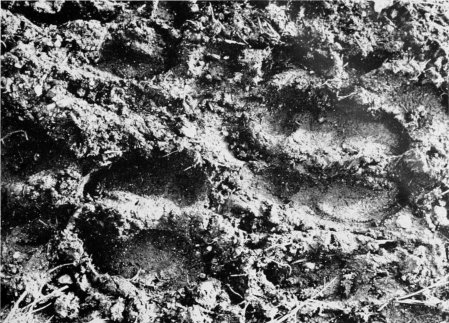
Fig. 19. Caribou tracks in mud; one about 114 by 95 mm.; another, 102 by 102 mm. Between Bear Slough and Eider Pond, September 3, 1947.
A track (fig. 20) photographed in 2-inch snow represents a hind foot-print superimposed upon a front foot-print in a walking gait; including the marks of the dew claws, it was approximately 6 inches (153 mm.) long and 5 inches (127 mm.) wide. The “square-toed” appearance is very characteristic.
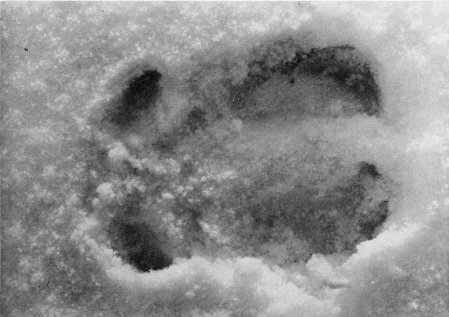
Fig. 20. Caribou track in 2-inch snow; hind foot superimposed on track of front foot. Combined track about 153 by 127 mm. Camp Ridge, October 29, 1947.
A front hoof is a little broader as well as longer than a hind hoof (fig. 24). The extreme and average lengths of the front hoofs in five of my adult male specimens are 80-92 (85.2); of the hind hoofs, 74-84.5 (79.8). In an adult doe a front hoof measures 77; a hind hoof, 72.
Reference.—Banfield, 1951a: 19.
Swimming
In their extensive and long-continued migrations over a territory composed in large part of lakes, ponds, and rivers, the Caribou have almost daily need, from June to October, of surmounting these barriers by swimming. The low temperature of the water seems to have no deterring effect on them. Yet it appears that some of the animals may fail in attempting the passages of wide waters. Charles Schweder spoke of finding a number of dead Caribou, including bucks as well as fawns, that had apparently succumbed in crossing a 4-mile-wide lake on the Thlewiaza River. (Or had they perhaps come to grief in some upstream rapid and finally been washed ashore on the lake?) Bones on the shore indicated that this sort of tragedy might be more or less of an annual occurrence. Perhaps some of the victims had been wounded or were otherwise in poor condition.
The buoyant, hollow hairs of a Caribou’s coat enable the swimming animal to keep almost the whole median dorsal line of its body perhaps 2 or 3 inches above the surface (figs. 9, 12). In a doe noticed on August 28 the lowest point on the top of the neck, just in front of the shoulders, was practically level with the surface, but elsewhere the dorsal line, from snout to tail, was out of the water. In both doe and fawn the head is held so high that the lower side of the snout at the tip does not touch the water; in the older bucks of the autumn, however, the weight of their antlers presses the head down until the lower side of the snout is frequently in contact with the water. The swimming position tilts the antlers backward until the basal portion is practically horizontal (figs. 9, 12). All ages and sexes, while swimming, hold the tail nearly erect; but the very tip (perhaps only the tuft of hairs) inclines toward the rear.
On October 30 tracks indicated that half a dozen Caribou had swum across Little River near its mouth, breaking through a 10-foot rim of ice on the near side. When a herd of 2,000 or 3,000 crossed Windy River during an October night about 1944, as reported by Charles Schweder, they broke three channels through the thin ice that covered the river.
Once Charles saw a buck cross the 100-yard-wide Nahiline Rapids on Kasmere River, where it drops about 40 feet in a quarter of a mile; yet the animal did not seem to be carried far downstream. When about 10 Caribou (mostly big bucks) crossed the Windy River at our camp on June 24, the last two, I noted, were pointing almost upstream in the 6- to 8-mile-per-hour current.
The usual formation in which a small number of Caribou cross a bay or a quiet stretch of river is a single file, but a larger band is likely to make the passage in several simultaneous files. The fawns, in particular, follow as closely as possible behind their mothers.
Although the Caribou are strong and speedy swimmers, the natives are able, in canoe or kayak, to overtake and spear them. In 1947 several fawns were speared in Windy Bay by Anoteelik.
Other notes on swimming may be found in the sections dealing with Migrations.
References.—Back, 1836: 367; Simpson, 1843: 76, 310; Rae, 1850: 27; Richardson, 1852: 290; Schwatka, 1885: 68, 71-72; W. J. McLean, 1901: 6; R. M. Anderson, 1913b: 503; Blanchet, 1925: 34; Birket-Smith, 1929 (1): 109-110; Seton, 1929, 3: 107; Hoare, 1930: 27, 31; Jacobi, 1931: 216; Clarke, 1940: 88-90; Downes, 1943: 256; Harper, 1949: 227, 229, 230; Banfield, 1951a: 21.
Shaking off moisture and insects
The long, dense fur of the Caribou holds so much moisture that when the animal emerges from swimming it endeavors to rid itself of the extra burden and cooling agency. This is effected to a large extent by a vigorous shaking of the body, head, and ears and a switching of the tail. The initial performance, lasting for perhaps a second or two, may be undertaken while the animal’s lower extremities are still in the water; and it is likely to be repeated from one to several times as it moves over the shore and ascends the adjacent ridge. The cloud of spray flying off is a sight to behold (fig. 9). The action is very much like that of a dog under similar circumstances. The fur may remain wet for a least 10 or 15 minutes after emergence from the water. In driving rain on September 5, I noticed an individual in a band of 20 Caribou shaking itself and sending the rain drops flying off in spray, just as when one emerges from the water.
The Caribou also go through a very similar but perhaps still more strenuous performance for the obvious purpose of shaking off flies (perhaps primarily the warble flies, Oedemagena). On August 20 a buck passing along a ridge in the Barrens agitated the hide on its body several times with considerable vigor. A young animal (fawn or yearling) thus shook itself on August 28 as it approached the far side of Little River. I got the distinct impression that the hide was shaken horizontally in the case of moisture, but vertically in the case of insects; for the present, however, this is best considered as just an impression, and not a statement of fact. The muscles that agitate the skin of the sides should be particularly well developed through frequent practice with water and flies during the warmer part of the year.
At the mouth of Little River, on August 30, I heard one of the Caribou in a large band “blow its nose,” so to speak, with vigor. The sound suggested that produced by a horse in vibrating its nostrils by forcefully expelling air through them. I suspect that the Caribou uses the same means, in an effort to fend off a nostril fly (Cephenemyia) bent on depositing its larvae.
Reference.—Harper, 1949: 230.
Signaling
Apparently the commonest method employed by the Caribou for indicating or communicating suspicion or alarm is erecting the stub of a tail to a vertical position. This brings its white under side into full view, as the silent flashing of a danger signal to other Caribou. However, a solitary animal will exhibit signaling behavior as well as one in a band. The tail remains erect, whether the animal stands to stare uneasily at a suspicious object or flees from it in alarm. The action is common to old and young of both sexes. It is so characteristic of a fleeing animal as to give significance to the expression, “high-tailing it.” In normal, unalarmed progress the tail extends backward in a drooping curve (figs. 11, 12).
I was not fortunate enough to detect any flashing of the white throat, as described by Preble (1902: 42).
Another silent signal is a most peculiar sprawling posture of the hind legs, attained by thrusting one of them well out to one side and setting the foot down. The legs are not then symmetrically placed; the one not moved obviously bears most of the weight of the hind quarters. I managed to film this stance in a buck standing on a sky-line on August 24 (cover). On September 9 another buck assumed the posture while looking over our camp from a ridge on the opposite side of Windy River. According to Charles Schweder, this is an expression of suspicion or alarm, designed to communicate the same feeling to other Caribou. When the others notice it, they stop and assume the same pose; it may be observed in does and even fawns. Charles added that the tail is erected at the same time—a very natural accompaniment, though I failed to notice it.
In all the literature on the Barren Ground Caribou, I have found just one reference to this posture, and that a distinctly fragmentary one:
“While [the Caribou are] thus circling around I have often been amused at the manner in which they carry one hind leg. A novice in the hunting field, after having fired a shot in their direction, would think that he had broken one hind leg of each member of the herd.” (A. J. Stone, 1900: 53.)
The author makes this observation just after mentioning a herd sighted near the shore of Franklin Bay. A virtually identical posture in the Norway Reindeer has been sketched by Seton (1929, 3: 112, pl. 18), who labels it “surprize.” An analogy to the posture of the Caribou might be found in a hand thrust out, with fingers spread, by a military scout as a signal of warning or caution to his fellow scouts. A sprawling leg is perhaps the nearest approximation to the human signal that a Caribou can attain.
As noted in the section on Gaits, an alarmed Caribou may set off by taking an initial leap into the air. According to Dugmore, such an act on the part of the Newfoundland Caribou plays an important role in its system of communications, not by means of sight or sound, but through the olfactory sense. He observes (1913: 89-90):
“For hours afterwards every Caribou, on arriving at the place where the frightened ones had jumped, has started violently, and has on nearly every occasion turned and run in a manner that showed every indication of fear, even though my presence was entirely unknown to them. My idea is that when the animal is suddenly frightened it expels a certain fluid from the glands in the foot, and that this fluid is a signal of alarm, a silent and invisible warning, but none the less so positive that none dare ignore it.”
As for the foot click—a presumptive means of communication (cf. Seton, 1929, 3: 69; Jacobi, 1931: 212-216)—I must confess that I was always so engrossed with photography whenever the Caribou were close at hand (up to within a dozen feet) that I had no thought of this phenomenon and did not detect it.
References.—Richardson, 1829: 242; A. J. Stone, 1900: 53; Preble, 1902: 42; Seton, 1929, 3: 105; Murie, 1939: 245; Harper, 1949: 230; Banfield, 1951a: 19, 27.
Food
The ground lichens (including the various species of Cladonia) in the Windy River area in 1947 did not seem, for the most part, to have a height of more than 2 or 3 inches. The average length of several local specimens of Cladonia is approximately 51 mm. This condition was in considerable contrast to the great spongy masses I had noted in the Tazin River basin, between Athabaska and Great Slave lakes, in 1914. I have no means of knowing whether the condition in Keewatin represented severe cropping by Caribou in past years and subsequent slow recovery, or whether it is a normal condition. According to Charles Schweder, the growth depends upon rain, and so varies from year to year. During the warmer months, from June to September, the local Caribou seemed to me to be feeding very largely on the higher vegetation, such as willow, dwarf birch, alder, and sedges. I had no definite evidence of their consuming lichens during that period. By early October the species of Cladonia seemed to have attained a somewhat fuller growth than they had exhibited several months previously. Perez-Llano discusses (1944: 29-30) the utilization by Reindeer of various lichens. Dix has reported (1951) on a collection of lichens from the Windy River area.
Some miscellaneous observations along Windy and Little rivers follow: June 16, 20 Caribou feeding apparently on patches of crowberry (Empetrum) and dwarf birch (Betula glandulosa) on a ridge; June 29, a Caribou feeding apparently on dwarf birches; June 30, a buck grazing in a sedge bog; August 26, several bucks browsing on willow tops (probably Salix planifolia) in a riverside thicket, and some does on dwarf birch and perhaps tall grass or low willow; August 27, numbers feeding largely on willow and dwarf birch; August 28 and 30, low alders, willow, and dwarf birches nibbled off. By early October the leaves of the three last-mentioned shrubs were no longer available, having dropped off. During the summer they had seemed to be preferred above the lichens. Cabot has remarked (1912: 46) on the fondness of Rangifer arcticus caboti for dwarf birch in Labrador.
Charles Schweder reported as follows on the food of Caribou. In summer they live chiefly upon leaves, especially those of dwarf birch, and to some extent upon “grass” (probably largely sedges). Toward the last of June a Caribou was killed with fat an inch thick on its haunches—perhaps the effect of recent feeding on the fresh green vegetation. In August and September the animals also eat mushrooms and get very fat on them; they seem to be especially fond of a certain red kind, which Charles has found in their stomachs. The Eskimos’ name for mushrooms signifies “deer food.” The Caribou feed upon dead “grass” (perhaps mostly sedges) in the fall, but not in the winter. Charles has seen them digging through 4 feet of snow to get at the reindeer lichens; but for the most part their winter feeding in this region is on the tops of the hills, which remain bare. They also eat tree lichens, especially in the winter time.
Charles has seen Caribou chew the cud while standing as well as while lying down. He once saw a buck thus occupied while standing on a hill for half a day in a breeze that kept the mosquitoes down.
Among the hundreds of Caribou observed at the river crossings and elsewhere, I do not recall seeing a single one pause to drink.
The Influence of food supply on distribution of the Barren Ground Caribou has been discussed in a previous section.
References.—Hearne, 1795: 317; Franklin, 1823: 242; Richardson, “1825”: 329, and 1829: 243; Godman, 1831, 2: 284; Richardson, in Back, 1836: 498, and 1861: 275; Murray, 1858: 202; B. R. Ross, 1861: 439; Kumlien, 1879: 54; J. B. Tyrrell, 1894: 441; Russell, 1898: 226; J. W. Tyrrell, 1908 (1898): 80; Lydekker, 1898: 49; Elliot, 1902: 276; Stone and Cram, 1904: 53; Buchanan, 1920: 105-106, 131; Hewitt, 1921: 61; Blanchet, 1925: 33; Seton, 1929, 3: 107-108; Kitto, 1930: 87; Jacobi, 1931: 223; Harper, 1932: 30; Sutton and Hamilton, 1932: 84; Weyer, 1932: 39; Hornby, 1934: 105; Murie, 1939: 245; Clarke, 1940: 106-107; G. M. Allen, 1942: 299; Soper, 1942: 143; Downes, 1943: 228; Porsild, 1943: 383; R. M. Anderson, 1948: 15; Manning, 1948: 26-28; Rand, 1948a: 212; Harper, 1949: 230; Banfield, 1951a: 11, 19-20, 28-29; Barnett, 1954: 106.
Scatology
The pellets of the Caribou are small, more or less blackish, very irregular in shape, somewhat compressed, and generally deposited in little piles, in which the individual components do not stand out very distinctly, being pressed against each other. They are quite unlike the oblong, curvilinear, comparatively symmetrical scats of the White-tailed Deer and the Moose. I did not observe, nor learn of, any particular seasonal variation in the shape or other characters.
References.—Sutton and Hamilton, 1932: 81; Manning, 1943a: 50.
Voice
My impression of the adult Caribou is that it is a comparatively silent animal during most of the year. At the rutting season, however, when the bucks do their fighting with a clash of antlers, their voice is heard, as Fred Schweder, Jr., informed me. It is about as loud as the fawn’s grunt, but a different sort of sound. Fred has also known a doe to call when its fawn was shot.
The only vocal sound that I heard from the Caribou was the grunt or bawling of the fawns on the fall migration, and only during the last week of August, when the “big movement” was under way. It was uttered chiefly at the river crossings, apparently as a result of the fawns’ anxiety lest they be separated from their mothers during the slight uncertainty or confusion of these passages, when a considerable number of animals were participating. It seemed to be a fair equivalent of a human child’s crying out: “Don’t leave me behind!” or “Where are you, mamma?” The grunt is very different from the bleating of a lamb or the bawling of a domestic calf. It is a surprisingly raucous or guttural, almost explosive, yet not very loud note, which I rendered at various times as gwuf, goff, gowk, or gorr. Perhaps the last rendering comes nearest to the actual sound. With one or two exceptions, I did not identify any individual uttering one of these grunts; but the Schweder boys, from their intimate knowledge of the species, assured me that this was the voice of the fawn. In one case the sound came rather definitely from a fawn that had become somewhat separated from its band in going up the adjacent ridge after crossing Little River. But for the most part the grunts seemed to come from swimming animals.
On August 30 another sort of sound—probably not a vocal one—seemed to come from one of the older animals among a large band crossing Little River. It was probably produced by a vigorous vibration of the nostrils. It is further discussed in the section on Shaking off moisture and insects.
It is rather astonishing that Seton, after seeing and studying many Caribou at close range in Mackenzie, should say no more about their voice than: “They snort a good deal and grunt a little” (1911: 210). In his later monographic account he practically ignores the topic, merely referring to the animals’ “sniffing, snorting” (1929, 3: 105).
References.—Lyon, 1824: 336; Pike, 1917 (1892): 89; Stone and Cram, 1904: 53; Seton, 1911: 210, and 1929, 3: 105; Hornaday, 1914, 2: 103; Critchell-Bullock, 1930: 193; Sutton and Hamilton, 1932: 84; Murie, 1939: 245; Downes, 1943: 226, 256-257; Harper, 1949: 230; Banfield, 1951a: 22.
Reproduction
By the time the rutting season arrived in mid-October, there were comparatively few Caribou left in the Windy River area. Consequently my information on the subject was derived mainly from Charles Schweder and Fred Schweder, Jr. Weeks before the scheduled season, there were certain manifestations of the sexual urge. For example, on September 5 about 20 Caribou were passing the Bear Slough. The band consisted mostly of does and fawns, but included several middle-aged bucks (with antlers much less than the maximum size) and possibly some younger bucks. Twice I saw one of the animals attempt to cover another, but driving rain and the compactness of the band prevented me from determining the sex or age of those involved. During a trip to the Kazan River, lasting from September 17 to October 1, Fred observed a good deal of fighting among the Caribou—obviously a prelude to the mating season. In Charles’ opinion, these early contests are not very much in earnest; the real fighting begins about October 15. On October 8 Charles and Fred referred to fighting that was going on among a herd of about 100 between Glacier Pond and Lake Charles. Perhaps less than a quarter of this herd were older bucks; the rest, younger bucks, does, and fawns.
In former years, while living at the “Old Post” on Red River, Charles used to go out and watch the fighting on a big open muskeg, about a mile square, where the Caribou would congregate practically every year at the rutting season, up to a thousand strong. They would stay for three or four days, then disappear. Nothing on the same scale had come to his notice in the vicinity of the Windy River post. At this season, when the animals are in large herds, the bucks utter their calls, as mentioned in the section on Voice. According to Fred, one sees in October a good many bucks with an antler broken off in the fighting. The break generally occurs at about the middle of the antler. On September 29 Charles reported a buck with a broken antler, which he interpreted as evidence of the beginning of the fighting season. During the rutting season he once shot a buck with a broken jaw, and another with an eye gone. The possible inference was that these injuries had been sustained in fighting. A buck secured on October 16 had apparently been wounded in fighting; there was pus in its neck, and it was considered unfit for eating. I heard nothing as to the possible use of hoofs in contests between bucks, as reported by Jacobi (1931: 233) for the Reindeer.
During the rutting season the herd is likely to be a large one, and to do little traveling. It is composed of fawns as well as adults. The bucks pursue the does, and sometimes chase each other. Charles thinks the young bucks keep away from the does at this time, being unable to fight the older bucks with larger antlers. Fred reports a proportion of about 10 bucks to 50 does in these herds—a probable indication of polygamy. He expressed the opinion that the bucks do not mate until 8-10 years old, and the does not until about four years old. However, he was basing his estimate of the age on the total number of points on the antlers—one point for each year; and on this basis the age was probably much overestimated. Earlier sexual maturity on the part of the doe might be another indication of polygamy in the species.
At the onset of this season, the bucks neglect their feeding to some extent; consequently those killed have stomachs only partly filled, instead of completely filled, as at other times. By mid-October their fat becomes tinted with reddish, and the whole flesh becomes so rank and musky that it is disdained not only by human beings but even by the Wolves. This condition seems to be considerably more pronounced in the Caribou than in the White-tailed Deer. The hunters forego eating the old bucks for a period of several weeks. Meanwhile the younger bucks, not engaged in mating, remain fit to eat. Hearne (1795: 69) reported the flesh of bucks as still unpalatable as late as December 30.
The rutting season is said to continue through October into November. The end of the period is uncertain, but it may coincide with the shedding of the antlers of the old bucks.
References.—Hearne, 1795: 72, 198-199; Richardson, “1825”: 327-328, 1829: 243, and 1861: 274; Pike, 1917 (1892): 48, 90; J. W. Tyrrell, 1908 (1898): 80; Hanbury, 1904: 73; Stone and Cram, 1904: 52; Blanchet, 1925: 33; Birket-Smith, 1929 (1): 51, 56; Seton, 1929, 3: 124-125; Jacobi, 1931: 232; Sutton and Hamilton, 1932: 81, 84-86; Weyer, 1932: 40; Ingstad, 1933: 158; Hornby, 1934: 105; Murie, 1939: 244; Manning, 1943a: 52; Banfield, 1951a: 10, 26, 31.
Fawns
Since the fawning takes place far to the north of the Nueltin Lake region, practically no local information concerning it was obtained. Charles Schweder stated that in the spring migration the pregnant does pass to an undetermined distance north of the upper Kazan River (below Ennadai Lake). Although the migration at Nueltin Lake continues throughout June, the rearguard is composed largely of bucks, and the comparatively few does accompanying them toward the last may be barren. Fisher (1821: 199) and Parry (1821: 183) report a small fawn of R. pearyi on Melville Island on June 2. Richardson states (“1825”: 329) that the young are born in May and June. There is evidently some geographical and individual variation in the time of birth (cf. Jacobi, 1931: 232). Apparently the gestation period in the Caribou covers approximately eight months or a little less. In the domesticated Reindeer it is 231 to 242 days, according to Jacobi (1931: 234); in the White-tailed Deer, 205 to 212 days, according to Seton (1929, 3: 258).
Fred Schweder, Jr., stated that he had never found more than a single unborn fawn in any one of the animals he had secured; yet he has seen as many as four fawns following a doe. Of course there is no proof that this individual was the actual mother of so many fawns; a stray or bereaved youngster might well endeavor to attach itself to a foster mother. On August 28, at Little River, I saw a doe being followed by two fawns. On September 16 Fred reported seeing three old does without fawns. Presumably most of the does do not bear young until they are two years old (cf. Jacobi, 1931: 235); thus many yearling does without family cares should be observed during the summer.
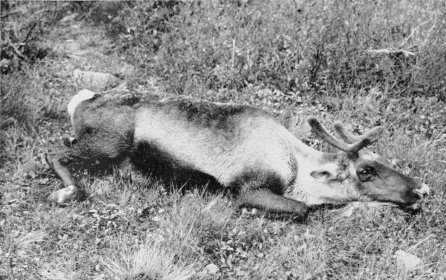
Fig. 21. A Caribou doe (specimen No. 1101). Mouth of Windy River, September 21, 1947.
On September 12 Charles Schweder stated that the does would soon be losing their milk; yet on occasion he has found them with milk as late as November (cf. Jacobi, 1931: 235). On September 21, when he secured a doe (fig. 21) that was accompanied by a fawn, I asked if he thought the latter was still nursing. By way of answer, he squeezed a couple of the doe’s mammae, and some milk exuded. Thus the mammary glands were still functioning at that date; they appeared well developed. By August 27, at an age of perhaps two and a half months, the fawns were browsing on their own account, and their teeth were well developed. Fred Schweder, Jr., then spoke of having seen fawns nursing four times during that month, the last occasion having been on the 25th. On the 27th I had the rare privilege of witnessing such a nursery rite across the mouth of Little River. The wilderness baby was so large that it was obliged to lower its forequarters very decidedly in order to reach the maternal font (from a lateral position). This attitude left its hind quarters thrust high and ludicrously into the air. I did not notice that it wriggled its tail as a bovine calf might have; but Charles Schweder spoke of having seen a fawn hold its tail erect while nursing. He also said that the bigger fawns kneel down with their front legs while so engaged. In his opinion, when a doe is killed in the autumn, its fawn does not go and join other Caribou, but lingers near the fatal spot until a Wolf or some other enemy overcomes it. For this reason it is his practice to secure the fawn also, if possible, when he takes the mother. On September 13 a fawn remained by its dead mother, permitting one of the hunters to approach within 30 feet and to throw rocks at it three times, finally taking it by that means. After a doe was killed on September 21, its fawn lingered in the vicinity for a day or two.
References.—Franklin, 1823: 242; Richardson, “1825”: 329; John Ross, 1835a: 432; Simpson, 1843: 277, 281, 381; J. McLean, 1932 (1849): 359; Armstrong, 1857: 477-478; Murray, 1858: 202; Osborn, 1865: 227; Nourse, 1884: 264-265; Pike, 1917 (1892): 204, 209; Dowling, 1893: 107: Russell, 1895: 51; R. M. Anderson, 1913b: 504-505; Hewitt, 1921: 62; Blanchet, 1926b: 47; Seton, 1929, 3: 124-125; Blanchet, 1930: 49, 53; Critchell-Bullock, 1930: 192, 193; Sutton and Hamilton, 1932: 86; Ingstad, 1933: 161; Clarke, 1940: 88-90; Gavin, 1945: 228; Banfield, 1951a: 26, 27; Scott, 1951: 179, 180; Barnett, 1954: 96.
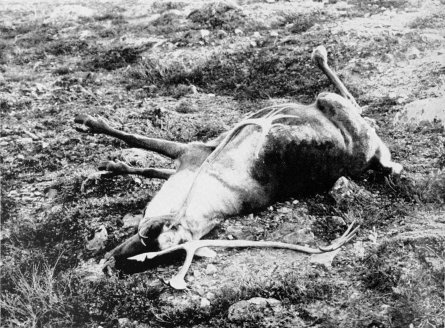
Fig. 22. A Caribou buck (specimen No. 1111). Mouth of Windy River, September 29, 1947.
Growth
During late August and early September the fawns probably averaged about 50 lb. in weight. (For the measurements of two specimens, see the section on Measurements.) Yet they varied so much in size that some appeared nearly twice as big as others. On September 7 an exceptionally small fawn was secured (estimated weight, 35 lb.) (fig. 23). Its coat was soft and woolly, representing an earlier stage than that seen in any of the other fawns of that season. It was molting into the next pelage, and its hide was unprime. It must have been born at an unusually late date. Fred Schweder, Jr., remarked that he sometimes sees this stage in the growth of fawns when the Caribou come down early from the north (about the first of August), but it seems remarkable that it should have been found in a September fawn. The present specimen has actually smaller measurements than one secured on August 2 at Artillery Lake (Seton, 1929, 3: 97). The collector reported that the parent doe appeared of ordinary size—not a particularly small or young one. The yearlings noted on the spring migration in May (south of Churchill) and in June (at Nueltin Lake) appeared roughly half the size of the adults.
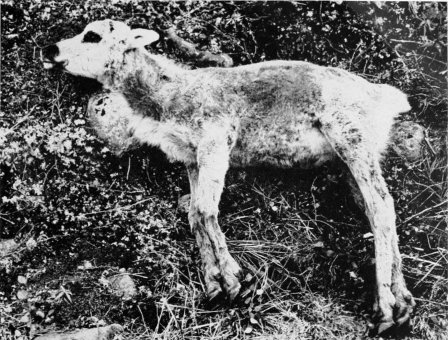
Fig. 23. A male Caribou fawn (specimen No. 1095), in its first, woolly pelage. Mouth of Windy River, September 7, 1947.
Evidently several years are required for the attainment of full growth. The younger adult bucks, with smaller antlers, are appreciably inferior in body size to the older bucks, with better developed antlers.
References.—Seton, 1929, 3: 97, 98; Banfield, 1951a: 30.
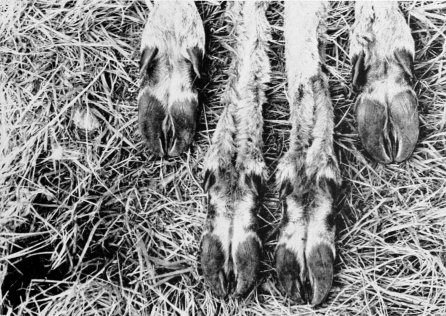
Fig. 24. Hoofs of a male Caribou fawn (specimen No. 1072); hind hoofs in the middle. Mouth of Windy River, August 21, 1947.
Antlers
In late August and early September antlers were already in evidence on the fawns, at an age of less than three months. They consisted of bony knobs, covered with skin, and were an inch or two long. I obtained no information as to when the fawns may shed the velvet or the antlers themselves. By analogy with the Reindeer (cf. Jacobi, 1931: 237), the fawns might be expected to drop their antlers in late winter.
When the adult Caribou return from the north in August, the antlers of all are still in the velvet. However, completely hornless does are not particularly uncommon at this season; in Charles Schweder’s opinion, some remain permanently in that condition. Hornless does are reported in various forms of Caribou or Reindeer in both hemispheres (Jacobi, 1931: 48). I saw also a few one-horned does on the autumn migration. In a single group of three adult does photographed at close range on August 28, one was hornless and another one-horned (fig. 11). A considerable proportion of my other photographs of Caribou groups at this season show one or more animals with a single antler or none. The hornless condition appears to be astonishingly more common in Keewatin than in regions farther west. Stefánsson, whose field operations were chiefly in northern Mackenzie and southwestern Franklin, remarks (1913b: 151) on having found, at any season when Caribou are normally horned, just three hornless animals among a thousand at whose killing he had been present. Murie (1935: 20) speaks of having observed only one hornless doe in Alaska, in September.
By late August the bucks’ antlers have attained nearly their full growth, though still in the velvet. The largest head of the season was obtained on August 22. Its measurements were: right antler, in straight line from base to tip of longest prong, 995; left antler, 980; distance between main tips of the two antlers, 620; brow tine, from base to upper tip, 335; to lower tip, 290. For the older bucks, the principal period for shedding the velvet is September 10 to 20, although Charles Schweder once observed a buck that had completed the process by September 1, and Fred secured one in that condition on September 6, 1947. In Alaska old bucks shed the velvet more or less regularly in September (Murie, 1935: 26). Sick or wounded animals are said to retain the velvet for an indefinite period. For example, a buck secured on September 29 had some velvet hanging in shreds from the tips of its antlers, and it was found to have been shot in the mouth sometime previously. The younger bucks and the does lose their velvet somewhat later than the older bucks (say toward the end of September). In a doe of September 21 (fig. 21) the antlers were covered with velvet and still had soft tips. A young buck of October 2 was just shedding the velvet.
Charles Schweder spoke of noting as many as 30-33 points on the antlers of old bucks. (He probably included the brow and the bez tines in this count.) He also referred to an exceptional set of antlers at Simons’ Lake with about 40 points; he had first noted it about 10 years previously, and it had doubtless been there for years before that. He had never been able to secure its equal. When I saw and photographed it in October (fig. 25), some of the points were broken off, so that an accurate count was impossible; but there must have been close to 40 originally, even without the brow tines, which were missing. The palmation was much broader than I have seen in any other Caribou.
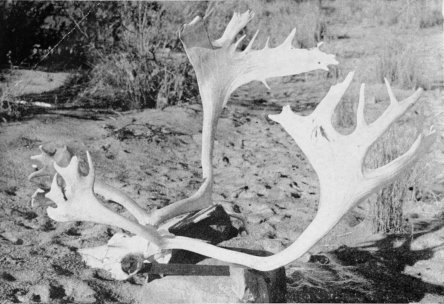
Fig. 25. Enormous set of old antlers of a Barren Ground Caribou, with exceptional palmation. (A 10.5-inch length of a steel rule visible.) Simons’ Lake, October 15, 1947.
The prong projecting backward at the angle of the main beam is by no means so uncommon in the animals of this region as a Chipewyan hunter seemed to indicate to Downes (1943: 227-228).
Charles Schweder found a pair of locked antlers about 1940 near Josie’s Bay. This was the only case of which he had any knowledge. An instance of locked antlers in Rangifer pearyi is mentioned by Peary (1907: 84).
There is marked variation in the dates of shedding the antlers, according to sex, age, and physiological condition of the individual. This has resulted in various conflicting statements in the literature. In the present region, the old bucks with 25 or more points are said to shed their antlers about the end of October or in November, at the close of the rutting season. (Fred Schweder, Jr., encountered a hornless buck as early as November 7, 1947.) The younger bucks, with 15 to 20 points, and the does retain their antlers till late May or June of the following year. A doe of June 3 and another of June 16 were still horned. In Alaska “the young bucks may carry their old antlers until late in April, while does carry theirs until the middle of May, some of them until June” (Murie, 1935: 26).
John Ingebrigtsen reported having seen two or three shallow lakes, between Churchill and (South?) Knife Lake, whose bottoms were fairly covered with caribou antlers. They were visible through clear ice. It appears probable that these lakes, while ice-covered, were favored resorts of large numbers of Caribou for their midday or nocturnal rests at a period when they were shedding their antlers (November for the old bucks, May or June for the does and young bucks).
It is natural that the season at which the new antlers of the Barren Ground Caribou begin to grow should vary greatly according to sex and age, just as the shedding of the antlers does; probably also, for the various forms of Rangifer, according to locality (cf. Jacobi, 1931: 237). On Southampton Island “the new antlers begin to appear in the males in March and April” (Sutton and Hamilton, 1932: 85). In Alaska Murie (1935: 24) “has found old bucks late in April with velvet knobs well begun.” Seton’s account (1929, 3: 102-103) of the seasonal change of antlers is not only meager but largely at variance with the information I assembled in Keewatin. Recently gathered information is supplied by Banfield (1951a: 17-18).
Measurements of the length of antlers in the velvet (right and left, respectively) were recorded as follows: adult male, June 18, 420, 440; adult male (figs. 3, 4), August 17, 1165, 1205; adult female (fig. 21), September 21, 220, 165.
Scratching or anointing of antlers in the velvet with a hind hoof was observed in an adult buck on June 16, and in a fawn on August 27.
While there is undoubtedly some correlation between the age of a Caribou and the number of points on its antlers, I am not aware that such a correlation has been worked out to a satisfactory degree. The Schweder brothers judged a Caribou’s years by the number of points on both antlers, yet freely admitted that they had limited confidence in such a criterion. Probably they would be nearer the actual facts if they counted the points on only one antler. The situation is complicated by the fact (if we are to credit Jacobi, 1931: 238) that bucks in other forms of Rangifer exhibit the best development of antlers at six to eight years.
References.—Hearne, 1795: 198-199; Franklin, 1823: 240-241; Lyon, 1824: 270; Richardson, “1825”: 327-328, and 1829: 241; Richardson, in Back, 1836: 499; Armstrong, 1857: 478; Murray, 1858: 199-206; B. R. Ross, 1861: 439; Osborn, 1865: 227; Pike, 1917 (1892): 49; J. B. Tyrrell, 1892: 128; Dowling, 1893: 107; Russell, 1895: 51, and 1898: 225; Whitney, 1896: 238-239; J. W. Tyrrell, 1908 (1898): 79-80; A. J. Stone, 1900: 53; W. J. McLean, 1901: 6; Elliot, 1902: 279-280; Hanbury, 1904: 95, 116, 133; Hornaday, 1904: 138; J. A. Allen, 1908a: 488; R. M. Anderson, 1913b: 505; Stefánsson, 1913b: 151; Buchanan, 1920: 126; Blanchet, 1925: 33, 1926b: 47-48, and 1930: 49; Birket-Smith, 1929 (1): 50, 89, 239-251; Seton, 1929, 3: 102-103; Critchell-Bullock, 1930: 192; Jacobi, 1931: 237; Sutton and Hamilton, 1932: 81-86; Ingstad, 1933: 159; Hornby, 1934: 105; Murie, 1935: 20, and 1939: 244; Clarke, 1940: 95; Downes, 1943: 228; Manning, 1943a: 52-53; Harper, 1949: 228; Banfield, 1951a: 17-18; Barnett, 1954: 104.
Rubbing trees
Charles Schweder gave the following account. The bucks hasten the shedding of the velvet in the autumn by rubbing their antlers on various trees—willow, spruce, or tamarack. The individual may complete the operation in possibly half a day. It is thought, however, that most of the velvet comes off at the first tree. The animals usually select a tree standing by itself rather than one in a thicket. It is usually a small tree—say 4 feet high and 1 inch in diameter. Perhaps a spruce is most often selected. Branches are broken and much of the bark is scraped off in the process. The velvet soon dries up, so that it is little noticed. Charles did not recall having seen any hanging in a tree.
The numbers of rubbing trees that I noticed at Simons’ Lake in mid-October indicated that Caribou must have been much more numerous there during the previous month than in the vicinity of the Windy River post. These trees were particularly in evidence on the outskirts of a spruce and tamarack thicket at the head of the lake. They were mostly tamaracks, with some black spruces. Of the two spruces shown in figure 26, the larger was about 4 feet high. Many of the young trees had been killed. The branches and the tops had been pretty generally broken off and were lying on the ground. Most of the damage was fresh, but some of it dated from previous years.
Reference.—Hanbury, 1904: 232.
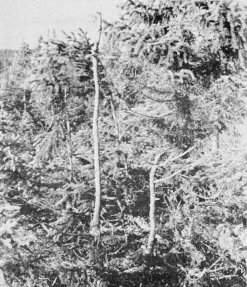
Fig. 26. Rubbing trees: two small black spruces (Picea mariana)—the larger 4 feet high—broken and barked by Caribou in rubbing velvet off the antlers. Simons’ Lake, October 18, 1947.
Morphology and Taxonomy
Pelage and molt
When the Caribou migrate northward through the Nueltin Lake region in May and June, they still retain their winter pelage. It is now worn and faded, and harsh as well, in contrast to the fresh, dark, soft autumn coat.
This stage is represented by an adult buck (No. 1046) of June 18. The general color above is Cream-Buff (capitalized color terms are derived from Ridgway, 1912), changing gradually to Isabella Color on sides of head and body; no distinct dark longitudinal stripe on lower sides (such as appears in summer and autumn pelage); tail Cream-Buff above, the rest Cartridge Buff; rump-patch varying from Cartridge Buff to Cream-Buff; tip of snout and chin dirty whitish; small area below nostrils near Mummy Brown; triangular area behind nostrils Cream-Buff; crown Cartridge Buff; ears Olive-Buff on outer surface, Cartridge Buff on inner surface; posterior venter Cartridge Buff; legs Isabella Color in front, remainder Cream-Buff; hoofs black, bordered above with Cartridge Buff hairs, forming a band ½-2 inches in width; antler velvet in this and other specimens Olive-Brown. The marked difference between the dark brownish and white pelage of the autumn and the Cream-Buff coat of early June presumably results from wear and fading, without molt. The does and the yearlings in June appear grayer than the adult bucks.
In another adult male (No. 1033), collected June 3, the darker part of the pelage is Buffy Brown rather than Cream-Buff.
The molt of the bucks begins in June but takes place chiefly in July, while the animals are somewhere to the north of the Nueltin Lake region. On their return in August they have largely completed their summer transformation in appearance. A buck of August 17 had just a little of the winter fur still clinging to its lower back; and another on August 20 was in similar condition. At this season the white mane is developed only on its lower portion (figs. 9, 10, 12), but by the end of September the white has spread upward over practically the whole neck (fig. 22), and in some cases over the shoulders.
In an adult male (No. 1144) of October 16, representing the pelage of the rutting season, the posterior crown is near Tilleul Buff, the anterior crown somewhat browner; sides of head and upper throat between Verona Brown and Buffy Brown; area about and between eyes somewhat darker; triangular area behind nostrils (apex extending halfway to eyes) and lower chin between Mummy Brown and Warm Blackish Brown; tip of snout and chin Cartridge Buff; ears pale creamy white on both surfaces; whole neck and shoulder mantle whitish, washed with Cartridge Buff, and changing gradually to the brownish of the sides of the head; long hairs along median ventral line of the neck tipped with Natal Brown; dorsal area, from shoulders to rump, Prout’s Brown; stripe on lower sides Mummy Brown, separated from dorsal area by an ill-defined lighter stripe, mixed with whitish hairs; top of tail slightly paler than back, the rest white; small rump-patch mostly white; chest Mummy Brown; mid-venter varying from Deep Olive-Buff anteriorly to Cream-Buff posteriorly; posterior venter white; forelegs near Bone Brown; hind legs between Mummy Brown and Olive-Brown, with a pale spot on the inner side of the heel (this spot noticeable also in doe and fawn); hoofs black, bordered above with whitish hairs. The hides of this specimen and of two other adult bucks (No. 1111, September 29, and No. 1132, October 16) were prime. The dark lateral stripe, which shows quite distinctly in summer and fall specimens of both sexes (figs. 7, 8, 10, 21, 22), from fawns (except very young ones) to adults, and which is also a prominent feature in Old World Reindeer (cf. Flerov, 1933), has been largely or wholly overlooked in some descriptions of Rangifer a. arcticus.
The summer molt occurs later in the does than in the bucks. Some of the former return toward the end of August while still retaining most of the winter pelage. Others exhibit remnants of it in patches, especially on the lower back; this was true even of an adult doe (No. 1101) secured as late as September 21 (fig. 21). Its hide, however, was prime. In this specimen the crown is near Verona Brown, with varying admixture of whitish hairs; sides of head Verona Brown; upper throat a little paler; a poorly defined area behind nostrils, and lower chin, Mummy Brown; tip of snout and chin Cartridge Buff; ears Drab, varying to Pale Olive-Buff, especially on inner surface; neck Drab dorsally, mixed with whitish hairs, the remainder Pale Olive-Buff; dorsal area, from shoulder to rump, Mars Brown; lateral stripe on lower sides Mars Brown, separated from dorsal area by a poorly defined but conspicuous area of Light Cinnamon-Drab; top of tail like back, the rest whitish, washed laterally with Pale Pinkish Buff; small rump-patch mostly white; chest Mummy Brown; venter Light Drab, becoming whitish in inguinal region; forelegs Natal Brown, slightly darker in front; hind legs Natal Brown, with a pale spot on the inner edge of the heel; hoofs black, bordered above with whitish “spats” varying from ½ to 1½ inches in width.
Another doe, secured on November 3 but not preserved, was apparently in long, full winter pelage, with whitish mane and shoulders. The dorsum generally was grayish; the top of the rump, buffy gray. The white rump-patch appeared to be more extensive, and to contain longer hairs, than in the doe of September 21; likewise the white “spats” appeared much more extensive.
As winter comes on, the fur of the Caribou grows longer and paler gray. One incipient stage of such a change from the summer coat began to be noticeable as early as September 13. A buck that came trotting down out of the Windy Hills on September 27 revealed the splendor of its new winter coat, with an amazing amount of creamy white, chiefly on the mane and shoulders. The long mane wears off during the winter, according to Charles Schweder. It looks best, he added, when the bucks start to fight in the fall. A yearling or large fawn on October 21 was distinctly creamy about the neck and shoulders. After describing a winter female from Wager River, Seton remarks (1929, 3: 98): “The general impression is of a creamy white animal, with a gray blanket on its back.”
For the first couple of months of its life the fawn wears a soft and woolly coat. An example was furnished by a male fawn (No. 1095; fig. 23) of September 7, which must have been born several weeks later than the average date. It was actually smaller and less developed than another male fawn collected on August 20. It was molting into the next pelage (described in the following paragraph), and its hide was unprime. The general color is Deep Brownish Drab; this is overlaid with longer hairs of Pale Olive-Buff on the median dorsal line of the neck, on the venter, and on part of the legs; a median stripe on the back near Hay’s Brown; no distinct lateral stripe; ears and posterior crown Cartridge Buff; forepart of crown Deep Brownish Drab; area above eye Cream-Buff; snout varying from Deep Brownish Drab above to Pale Gull Gray on sides; transverse band behind nostrils Dusky Brown; tip of snout whitish; tail Deep Brownish Drab above, pale creamy on sides, and white beneath; rump-patch whitish; chin anteriorly whitish, posteriorly Dusky Drab; throat whitish to Pale Gull Gray; lower part of legs, in front, Buffy Brown; hoofs black, bordered above with a very narrow (¼-inch) strip of whitish hairs. A very similar young fawn, taken on August 2, 1907, has been described by Seton (1929, 3: 98).
In a male fawn (No. 1072) collected on August 20 the general color is between Olive-Brown and Natal Brown; a paler longitudinal area separating the lateral stripe from the dorsal area; ears Clove Brown externally, pale creamy internally; transverse band behind nostrils Blackish Brown; tip of snout whitish; sides of head varying from Cream-Buff above eyes to Cartridge Buff below; tail Bone Brown above, white below; rump-patch whitish; legs Buffy Brown, darker in front; chin anteriorly whitish, posteriorly Hair Brown; throat Cartridge Buff; venter Light Drab; hoofs black, bordered above with a narrow (¼- to ½-inch) strip of whitish hairs.
References.—Franklin, 1823: 240-241; Richardson, 1829: 242; B. R. Ross, 1861: 439; Schwatka, 1885: 60-61; J. B. Tyrrell, 1892: 128; Russell, 1898: 91, 226; J. W. Tyrrell, 1908 (1898): 79; A. J. Stone, 1900: 52; Hanbury, 1904: 194; MacFarlane, 1905: 682-683; Blanchet, 1925: 33, and 1926b: 47; Seton, 1929, 3: 98-99, 104; Critchell-Bullock, 1930: 193; Jacobi, 1931: 236; Sutton and Hamilton, 1932: 81, 84-86; Murie, 1939: 244; Clarke, 1940: 89, 90; Downes, 1943: 226; Manning, 1943a: 53; Harper, 1949: 228, 229, 230; Banfield, 1951a: 15-17.
Albinism
In Rangifer arcticus arcticus this appears to be an exceptionally rare phenomenon. There are references to albinos by the following authors: Russell (1895: 51; 1898: 91, 226), Whitney (1896: 237), Boas (1901: 150, 501), MacFarlane (1905: 682-683), Ingstad (1933: 312), and Degerbøl (1935: 49, 51).
Foot-glands
I dissected out the glands from the hind feet of an adult male Caribou (No. 1046). Seton (1929, 3: 68) has discussed these structures in the Woodland Caribou and the Norwegian Reindeer; and Pocock (1911: 960-962, fig. 138B) and Jacobi (1931: 22, fig. 4), in the Reindeer. Many hairs had their base in the glands, and there was a fatty secretion on the hairs adjacent to the glands. I judged that the opening to the exterior extended in a more or less dorso-anterior direction. One of the suggested functions of these glands is anointing the velvet covering of the antlers. I was highly interested, therefore, in seeing an old buck on June 16 rub the tips of its growing antlers with each hind foot in turn. Meanwhile it inclined its antlers alternately to one side and backwards to place one of them at a time within convenient reach of the hind foot on that side. It seemed to rub its snout as well as the antler tips. In Charles Schweder’s experience this action was always carried out with the hind foot, not the forefoot. The latter contains a similar but smaller gland, according to Jacobi (1931: 22), while Pocock (1911: 960-961) gives contrary testimony. On August 27 I also saw a fawn rubbing a knob of its skin-covered antlers with a hind foot.
Another function of the foot-glands is suggested by an observation of Dugmore’s (1913: 89-90), which has been mentioned in the section on Signaling. I could not definitely connect any of the various occasions of panic that I observed, with scent from the foot-glands of preceding Caribou that had been frightened.
References.—Caton, 1881: 265; Pocock, 1911: 960-962; Seton, 1929, 3: 68, 105; Sutton and Hamilton, 1932: 84; Harper, 1949: 230.
Mastology
Very little seems to have been published on this subject. Jacobi (1931: 24) merely remarks that in the Reindeer the mammae number four, or occasionally six, but that the supernumerary ones are not functional. The four rudimentary mammae in a male fawn of arcticus (No. 1072) of August 20 seemed remarkable for their arrangement in a nearly straight transverse row—quite different from the more rectangular pattern in a domestic Cow or in a male Moose, as figured by Seton (1929, 3: 221). In an adult doe (No. 1101) of September 21 the anterior pair are about twice as far apart as the posterior pair; each of the mammae appears no more than a couple of inches from the one nearest to it. The arrangement in a two-year-old buck, as shown by Seton (1929, 3: 106), is approximately intermediate between linear and rectangular.
Fat
A Caribou (probably a buck) secured about the end of June was reported to have back fat half an inch thick—possibly resulting from the fresh green spring feed. In August, however, scarcely any fat was to be found on the animals; perhaps the annual renewal of pelage and the summer harassment by flies had been deterrents to the storage of fat. In September and early October the Caribou were in prime condition. On September 19 there was a fresh piece of back fat half an inch thick; two days later there was another piece three times as thick. In 1943 (a year of great mushroom growth) the animals were said to have become particularly fat. According to Charles Schweder, the doe never becomes so fat as the buck; one of September 21, still nursing, was just slightly fat. An adult buck of September 29 was recorded as “somewhat fat”; two of October 16 were “rather fat” and “quite fat.” Charles has seen as much as 3 inches of fat on a buck. The strips of back fat brought into camp on October 8 from several bucks weighed about 5 to 10 lb. apiece. Such fatness evidently prepares the bucks for the strain of the rutting season, when they neglect their feeding and become very poor and thin. This loss of fat occurs in about two weeks. The does also lose some fat at this season, but slowly. In some winters the Caribou remain fat, but in other winters they do not. In the latter case there may be deep snow that hinders their feeding. In the spring the Caribou become fat again, and they are in that condition when they arrive from the south in May.
The eagerness of the Eskimos and the Indians for fat results in their selection of the biggest bucks, which generally carry the most fat. Charles Schweder spoke of the tail of such an animal almost disappearing, apparently engulfed in fat! Besides its use in the native diet, the fat goes into the making of “Eskimo candles” (see section on Relations to man).
References.—Franklin, 1823: 240; Armstrong, 1857: 477-478; Whitney, 1896: 161; Elliot, 1902: 276; R. M. Anderson, in Stefánsson, 1913b: 505-506; Stefánsson, 1921: 231-234, 246-247, 252; Jenness, 1922: 48, 101, 248; Birket-Smith, 1929 (1): 48, 90; Seton, 1929, 3: 113-114; Critchell-Bullock, 1930: 193; Weyer, 1932: 40; Hornby, 1934: 105; Hamilton, 1939: 109; Downes, 1943: 228; Manning, 1943a: 53.
Body-Measurements and Weights
Columns
ANo.
BSex and age
CDate
DLength
ETail
FFoot
GEar from crown
HHeight at shoulder
IShoulder joint to hip joint
JCircumference of neck at base
KCircumference of body behind shoulders
LLength of front hoof
MLength of hind hoof
NEstimated weight (lbs.)
A B C D E F G H I J K L M N
1033 ♂ ad Jun 3 1820 160 516 130 1000 1000 81.5 78 140
1046 ♂ ad Jun 18 1880 190 546 137 1029 92 84.5
1065 ♂ ad Aug 17 1750 146 555 120 1080 1010 11853 80 74 200
1111 ♂ ad Sep 29 1710 155 532 129 1020 740 82.5 78 200
1132 ♂ ad Oct 16 1710 120 530 120 1002 975 200
1144 ♂ ad Oct 16 117 545 120 1110 90 84.5 200
Average of ♂ ♂ ad 1774 148 537 126 1080 995 740 1093 85.2 79.8 188
1101 ♀ ad Sep 21 1590 113 490 134 870 860 490 77 72 160
1095 ♂ juv Sep 7 960 90 360 85 620 525 290 610 49 45 35
1072 ♂ juv Aug 20 1150 125 423 89 750 645 60.5 55.5 50
3. After skinning.
Measurements of Skulls
Columns
ANo.
BSex and age
CDate
DCondylobasal length4
EZygomatic width
FInterorbital width
GLength of nasal
HMaxillary tooth-row
IMandibular tooth-row
A B C D E F G H I
1065 ♂ ad Aug 17 373 130 140 125 94 101
1144 ♂ ad Oct 16 356 135 140 122 82
1111 ♂ ad Sep 29 359 134 138 112 82
1046 ♂ ad Jun 18 374 131 135 121 97 104
1132 ♂ ad Oct 16 350 136 138 117 83 91
Average of ♂ ♂ ad 362.4 133.2 138.2 119.4 87.6 98.7
1101 ♀ ad Sep 21 324 117 121 101 85
1036 ♀ ad Sep — 118 120 83.5 79 83.5
1072 ♂ juv Aug 20 215 92 85 54
1095 ♂ juv Sep 7 189 85 77 42
4. Tip of premaxillary to posterior plane of condyles.
Measurements of Antlers
Columns
ANo.
BSex and age
CDate
DTotal length, right antler
ETotal length, left antler
FBrow antler, length
GBrow antler, width
HGreatest spread of beams (outside measurement)
ITotal number of points
A B C D E F G H I
1065 ♂ ad Aug 17 11655 12055 8755
1144 ♂ ad Oct 16 1200 1180 290 232 668 32
1111 ♂ ad Sep 29 1080 1080 279 235 655 32
1132 ♂ ad Oct 16 960 903 225 197 677 30
Average of last 3 1080 1054.3 264.7 221.3 666.7 31.3
5. Antlers in velvet. Unless otherwise specified, lengths of antlers were measured along the curve.
Measurements of Testes
Seasonal change in the size of testes in adult males is indicated by the following data: June 3, 30×18 mm.; June 18, 51×28.5; August 17, 50×35; September 29, 61×38; October 16, 60×40. Two male fawns: August 20, 18×7; September 7, 15×8.5.
References on measurements.—J. C. Ross, in John Ross, 1835b: xviii; J. A. Allen, 1910: 8; Seton, 1929, 3: 97; Sutton and Hamilton, 1932: 87; Flerov, 1934: 240; Murie, 1935: 75; Soper, 1944: 248; Banfield, 1951a: 30.
References on weight.—Parry, 1824: 305; Richardson, 1829: 241, and 1852: 290; Armstrong, 1857: 475, 498; Baird, 1857: 635; M’Clintock, 1860?: 184; Osborn, 1865: 227; Schwatka, 1885: 84-85; Collinson, 1889: 153; J. B. Tyrrell, 1892: 128; Whitney, 1896: 237; J. W. Tyrrell, 1908 (1898): 79; Jones, 1899: 329; Hornaday, 1904: 138, and 1914, 2: 104; J. A. Allen, 1910: 8; Seton, 1929, 3: 97-98; Critchell-Bullock, 1930: 55; Hornby, 1934: 105; Banfield, 1951a: 15, 30.
Geographical variation
The comparatively few specimens available indicate that different populations on the mainland, between Hudson Bay and the Mackenzie River, vary in size. Final judgment on the significance of this variation must await the accumulation of more and better material. The lack of topotypical material from the Fort Enterprise area, Mackenzie, is a particular handicap.
The extreme and average body measurements of five adult males from the Windy River area (see accompanying table) may be compared with those of three adult males, taken by R. M. Anderson, 1910 and 1912, at Langton and Darnley Bays (Nos. 34431, 34432, and 34435, Am. Mus. Nat. Hist.): length, 1980-2095 (2052); tail (two specimens), 152-165 (158.5); height at shoulder, 1066-1167 (1117); shoulder to hip (one specimen), 964. The average length of these specimens exceeds that of the Windy River specimens by 278 mm.; the average height at the shoulder, by 37 mm. The length of an adult male from Artillery Lake (J. A. Allen, 1910: 8) exceeds the Windy River average by 156 mm., and its shoulder height (Seton, 1929, 3: 97), by 10 mm., but the length of its hind foot, as recorded, is 17 mm. less than the Windy River average.
The measurements of four adult females, taken by Anderson, 1910 and 1911, at Langton Bay, Horton River, and Great Bear Lake (Nos. 34429, 34434, 34441, 34442, Am. Mus. Nat. Hist.) are: length, 1625-1815 (1736); height at shoulder, 825-1066 (968); shoulder to hip (one specimen), 863. The average length of these specimens exceeds that of a Windy River adult female by 146 mm.; the average height at the shoulder, by 98 mm. The length of an adult female from Aylmer Lake (J. A. Allen, 1910: 8) exceeds that of the Windy River specimen by 112 mm.; the length of its hind foot, by 18 mm.; and the height at the shoulder (Seton, 1929, 3: 97), by 43 mm.
Thus there appears to be a fairly uniform tendency toward greater body measurements from southwestern Keewatin to northwestern Mackenzie. The weight of Seton’s male from Artillery Lake (270¾ lb.) considerably exceeds the maximum (200 lb.) that I estimated for any of the Windy River males. Maximum measurements are furnished by winter specimens from the region of Langton and Darnley Bays.
The skulls of two adult males from Horton River and Artillery Lake (Nos. 34502 and 29031, Am. Mus. Nat. Hist.) measure, respectively: condylobasal length (tip of premaxillary to posterior plane of condyles), 381, 371; zygomatic width, 138, approximately 142; interorbital width, 143, 144; nasal, 126, 112; maxillary tooth-row, 87, 84; mandibular tooth-row (of No. 29031), 93. The rostral profile of the former is slightly convex; of the latter nearly flat. Comparison with Windy River adult males (see accompanying table) indicates a longer and a broader skull in the more northwesterly specimens. The measurements of the skulls of Southampton Island specimens as presented by Sutton and Hamilton (1932: 87), suggest a somewhat larger animal than the mainland form.
The left antler of an adult male from Horton River (No. 34502, Am. Mus. Nat. Hist.) measures: length, 1248; length of brow tine, 345; width of brow tine, 360; total points (both antlers), 16 + 14 = 30. The corresponding measurements of two sets of antlers from Fort Reliance in the American Museum of Natural History are: No. 121471 (left), 1242-285-108; (right), 1244-412-294; total points, 16 + 23 = 39; No. 121473 (left), 1312-360-290 (broken); (right), 1230 (approx.), brow tine a spike, not palmated; total points, approximately 19 + 13 = 32. The Fort Reliance specimens were selected by George G. Goodwin from a large number of old antlers lying about, and they are naturally above the average in size. The antlers of adult males from the Windy River area (see accompanying table) measure distinctly less than those just mentioned.
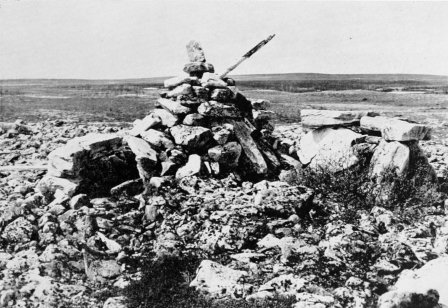
Fig. 27. Pile o’ Rocks, an ancient enclosure erected as a game lookout on the summit of a hill 1.5 miles NW. of the mouth of Windy River. June 30, 1947.
Anderson (1913b: 505) and Stefánsson (1913a: 106, and 1913b: 241, 276-277) have called attention to certain rather well-defined differences between the Caribou on both sides of Coronation Gulf and those elsewhere in northern Mackenzie. It may be assumed that the summer home of the former type is on Victoria Island. Many of these animals in former years crossed over to the mainland in the autumn after the freezing of Dolphin and Union Strait, Coronation Gulf, and Dease Strait made such a migration possible; and they recrossed to the island in the spring. During recent years this migration has greatly dwindled (Blanchet, 1930: 50; Birket-Smith, 1933: 93; Clarke, 1940: 98; Gavin, 1945: 227; Godsell, 1937: 288; Banfield, 1949: 481); consequently the Victoria Island population now seems to be largely confined to that island throughout the year. In the American Museum of Natural History I have examined several of Anderson’s specimens of 1911-1912 that are obviously of this form, and I should scarcely hesitate to give them nomenclatural recognition except for the fact that there has obviously been some confusion in the labeling of the specimens (after they reached the museum). Needless to say, a specimen selected as a type should bear unquestionable data.
During the winter there is some interchange of populations between Banks and Victoria islands across the frozen Prince of Wales Strait (Armstrong, 1857: 297, 336). The description that Armstrong gives (1857: 478), based ostensibly on Banks Island specimens, indicates that the animals of that island are very close to, if not identical with, Rangifer pearyi of the more northerly Arctic islands. Yet there is no known interchange of populations across the frozen McClure Strait or other wide sea channels in approximately latitude 74° N.
The Caribou of Boothia Peninsula and Somerset and Prince of Wales islands are said to be a small form (Wright, 1944: 195).
The Caribou of the Dubawnt River region, as far as may be judged from J. B. Tyrrell’s photographs (1897: pl. 1; Seton, 1929, 3: pl. 22), are indistinguishable from those of the Nueltin Lake region.
The Southampton Island antlers figured by Sutton and Hamilton (1932: pl. 8) are so strikingly different from all but one (No. 1132) of those that I noticed in southwestern Keewatin that I should be much inclined to regard them as representing a separate subspecies, provided they are typical of that island. In most of the bucks of the Windy River area the beams are deeply and fairly uniformly bowed, although there is a strong tendency for approximately the basal third to be nearly straight, with a pronounced forward bend just above it (cf. figs. 3, 4, 9, 10, 12, 22, 25). The bend at this point in the Southampton antlers is extremely slight by comparison. In mainland specimens the beam in cross-section is generally more or less round, with rarely any tendency toward flattening, such as may be seen in the Southampton set and in my No. 1132. Furthermore, I cannot recall in the mainland animals a single such pronounced zigzag effect as may be seen in the Southampton antlers. In extremely few of them does the bez tine originate at such a distance (apparently 8 inches or so) above the base, as in Sutton and Hamilton’s figure. The lack of palmation in the bez tines of their specimen is noteworthy.
There is a distinct likelihood that the isolated herd of Coats Island (Wright, 1944: 188; Banfield, 1949: 481), and also that of Salisbury Island in Hudson Strait (Grant, 1903: 189; Tweedsmuir, 1951: 37), may be distinct from the populations on the nearest large land bodies.
I have briefly examined a dozen or more heads (skulls with antlers) of the Labrador Barren Ground Caribou (R. a. caboti G. M. Allen) in the United States National Museum; they were collected by L. M. Turner in the 1880’s. Some of these antlers appear longer than any I saw in Keewatin. Furthermore, the tips of the bez tines in these specimens seem, on the average, more strongly incurved than in R. a. arcticus.
For the purpose of comparing the Barren Ground Caribou with the Western Woodland Caribou, Rangifer caribou sylvestris (Richardson), the following notes are offered on an adult male of the latter form in the United States Biological Surveys Collection (No. 235361; fig. 28). It was secured by a Cree Indian on Stony Mountain, about 27 miles south of Fort McMurray, Alberta, on October 21, 1920, and it was measured and prepared by myself. The general dorsal color is near Prout’s Brown, overlaid more or less with longer whitish hairs; outer surface of ears near Prout’s Brown, with an admixture of grayish white hairs; tip of snout, between nostrils and upper lip, Cartridge Buff; this area of more restricted extent than the similar patch in arcticus; neck creamy; longest hairs of throat fringe about 20 mm. (longer than in arcticus); no appreciable dark longitudinal stripe on lower sides, but an ill-defined lighter patch on the side behind the shoulder; rump-patch apparently less extensive than in R. a. arcticus; venter near Buffy Brown, posteriorly creamy; creamy white “spats” above hoofs ¼ to 1½ inches wide, not extending up hind leg as indicated by Seton (1929, 3: pl. 10). Length, 2025; tail, 225; foot, 625; front hoof, 109; hind hoof, 101; estimated weight, 300 lb. The Western Woodland Caribou is thus a distinctly larger animal than R. a. arcticus, with a noteworthy difference in the virtual absence of a light lateral stripe, setting off a darker stripe below it. The specific distinctness between the two animals seems abundantly clear.
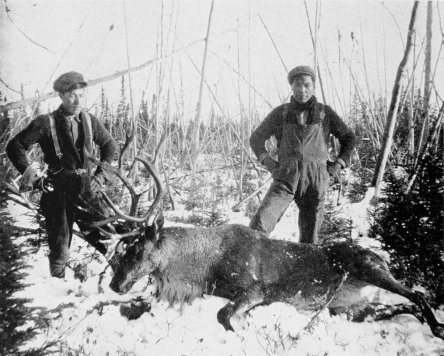
Fig. 28. Adult male Western Woodland Caribou (Rangifer caribou sylvestris) (No. 235361, U.S. Biol. Surveys Coll.). Stony Mountain, about 27 miles S. of Fort McMurray, Alberta, October 22, 1920. (U.S. Fish and Wildlife Service.)
References to general descriptions (including geographical variation).—Richardson, 1829: 239, 241-242; Armstrong, 1857: 478; Baird, 1857: 635; Caton, 1881: 105; Lydekker, 1898: 47-48, 1901: 38-40, and 1915: 254; Elliot, 1901: 37, and 1902: 281-282, 286-287; Preble, 1902: 42-43; Stone and Cram, 1904: 52; J. A. Allen, 1908a: 488; Millais, 1915: 261; Buchanan, 1920: 125-126; Anthony, 1928: 530-531; Seton, 1929, 3: 98-99; Jacobi, 1931: 78-80; Sutton and Hamilton, 1932: 88; Degerbøl, 1935: 48-51; R. M. Anderson, 1937: 103; Hamilton, 1939: 109; Murie, 1939: 239; G. M. Allen, 1942: 297-298; Wright, 1944: 195; Rand, 1948a: 211-212; Banfield, 1951a: 15-17; Mochi and Carter, 1953: text to pl. 9.
References to illustrations.—Parry, 1824: pl. facing p. 508; Richardson, 1829: 240; Caton, 1881: 207; Pike, 1917 (1892): pl. facing p. 89; J. B. Tyrrell, 1897: pl. 1; J. W. Tyrrell, 1908 (1898): pls. facing pp. 80, 81; Grant, 1903: 6th and 7th pls. following p. 196; J. A. Allen, 1908a: 500-503; Seton, 1911: 254, 256, 262, and pls. facing pp. 222, 224, 226, 228, 234; Buchanan, 1920: pl. facing p. 132; Hewitt, 1921: pls. 3, 5; Blanchet, 1926b: 47; Seton, 1929, 3: pls. 17, 21, 22, 23; Blanchet, 1930: 50; Sutton and Hamilton, 1932: pl. 8, fig. 4; Ingstad, 1933: pl. facing p. 178; Clarke, 1940: frontisp., 85, 87, 89; Harper, 1949: 224, 229; Banfield, 1951a: figs. 1, 2, 12-16, 20, 21, 23; Anonymous, 1952: 261, 263, 266, 267; Mochi and Carter, 1953: pl. 9; Barnett, 1954: 90-91, 103-105.
Literature Cited
Alcock, F. J.
1936. Geology of Lake Athabaska region, Saskatchewan. Canada Dept. Mines, Geol. Survey Mem. 196: [1]+41, 8 pl., 6 maps.
Allen, Glover M.
1942. Extinct and vanishing mammals of the Western Hemisphere with the marine species of all the oceans. [New York]: xv + 620, 1 pl., 24 fig.
Allen, J. A.
1908a. The Peary caribou (Rangifer pearyi Allen). Bull. Am. Mus. Nat. Hist. 24 (22): 487-504, 12 fig.
1908b. Note on the type locality of Rangifer arctica (Richardson). Bull. Am. Mus. Nat. Hist. 24 (29): 583-584.
1910. Mammals from the Athabaska-Mackenzie region of Canada. Bull. Am. Mus. Nat. Hist. 28 (2): 7-11.
Amundsen, Roald.
1908. The North West Passage. London: 1: xiii + 335, 23 pl., 45 fig., 2 maps; 2: ix + 397, 22 pl., 49 fig., 1 map.
Anderson, James.
1856. Letter from Chief Factor James Anderson, to Sir George Simpson, F.R.G.S., Governor in Chief of Rupert Land. Jour. Royal Geog. Soc. 26: 18-25.
1857. Extracts from Chief-Factor James Anderson’s Arctic journal. (Communicated by John Richardson.) Jour. Royal Geog. Soc. 27: 321-328.
Anderson, Rudolph Martin.
1913a. Arctic game notes. Am. Mus. Jour. 13 (1): 4-21, 21 fig.
1913b. Report on the natural history collections of the expedition. Mammals. In: Vilhjálmur Stefánsson, My life with the Eskimo: 436-527, 4 pl. New York.
1924. The present status and future prospects of the larger mammals of Canada. Scottish Geog. Mag. 40 (Nov.): 321-331.
1934a. Mammals of the Eastern Arctic and Hudson Bay. In: Canada’s Eastern Arctic: 67-108, 8 fig., 1 map. Dept. Interior, Ottawa.
1934b. The distribution, abundance, and economic importance of the game and fur-bearing mammals of western North America. Proc. Fifth Pacific Sci. Congress: 4055-4075, 17 maps.
1937. Mammals and birds of the western Arctic district, Northwest Territories, Canada. In: Canada’s western northland: 97-122, 4 fig., 1 map.
1938. The present status and distribution of the big game mammals of Canada. Trans. Third No. Am. Wildlife Conference: 390-406.
1947. Catalogue of Canadian Recent mammals. Nat. Mus. Canada Bull. 102: v + 238, 1 map, “1946.”
1948. A survey of Canadian mammals of the north. Prov. Quebec Assoc. Protection Fish and Game Ann. Rept. 1948: 9-16.
Anonymous.
1869. Biography of Robert Kennicott. Trans. Chicago Acad. Sci. 1: 133-226, 1 pl. (Contains extracts from his journals).
1952. Canada counts its caribou. Nat. Geog. Mag. 102 (2): 261-268, 12 fig., 1 map.
Anthony, H. E.
1928. Field book of North American mammals. New York—London: xxv + 625, 48 pl., 114 fig., 37 maps.
Armstrong, Alex.
1857. A personal narrative of the discovery of the North-West Passage. . . . London: xxiv + 616, 1 pl., 1 map.
Audubon, John James, and John Bachman.
1854. The quadrupeds of North America. Vol. 3. New York: v + 348, 55 pl.
Back, George.
1836. Narrative of the Arctic Land Expedition to the mouth of the Great Fish River, and along the shores of the Arctic Ocean, in the years 1833, 1834, and 1835. London: xi + 663, 16 pl., 2 maps. (Also a Philadelphia ed., 1836, with 456 pp.)
Bailey, Alfred M., and Russell W. Hendee.
1926. Notes on the mammals of northwestern Alaska. Jour. Mammalogy 7 (1): 9-28, 3 pl.
Baird, Spencer F.
1857. General report upon the zoology of the several Pacific railroad routes. Part 1. Mammals. Reports of Explorations and Surveys, . . . from the Mississippi River to the Pacific Ocean 8: xxi-xlviii, 1-757, 44 pl., 35 fig.
Banfield, A. W. F.
1949. The present status of North American caribou. Trans. Fourteenth No. Am. Wildlife Conference 1949: 477-491, 2 maps.
1950. Caribou investigation. Canadian Geog. Jour. 40 (1): 48-51, 5 fig.
1951a. The barren-ground caribou. Canada Dept. Resources and Development, Ottawa: vi + 56, 24 fig., 8 maps (Mimeographed.)
1951b. Notes on the mammals of the Mackenzie District, Northwest Territories. Arctic 4 (2): 112-121, 4 fig., 1 map.
1952. Report on caribou investigations in the Canadian Arctic, 1948-50. Polar Record 6 (44): 532-534. (Apparently a summary of Banfield, 1951a.)
1954. Preliminary investigation of the barren ground caribou. Part 1. Former and present distribution, migrations, and status. Part 2. Life history, ecology, and utilization. Canada Dept. Northern Affairs and National Resources, National Parks Branch, Canadian Wildlife Service, Wildlife Management Bull., ser. 1, 10A: [2]+79, 5 fig., 12 maps; 10B: [2]+112, 30 fig., 1 map. (Not seen until after the present report had gone to press.)
Barnett, Lincoln.
1954. The world we live in: part 10. The arctic barrens. Life 36 (23): 90-115, 33 fig., 1 map.
Beddard, Frank Evers.
1902. The Cambridge natural history. Vol. 10. Mammalia. London: xii + 605, 285 fig.
Bell, J. Macintosh.
1901a. Report on the topography and geology of Great Bear Lake and of a chain of lakes and streams thence to Great Slave Lake. Ann. Rept. Geol. Survey Canada 12 (n.s.) 1899, report C: 1-28.
1901b. Explorations in the Great Bear Lake region. Geog. Jour. 18 (3): 249-258, 6 fig.
Bell, Robert.
1881. Report on Hudson’s Bay and some of the lakes and rivers lying to the west of it. Geol. and Nat. Hist. Survey Canada Rept. Progress 1879-80: [6], 1C-113C, 8 pl., 1 map.
Bergman, Arvid M.
1917. Om renens oestrider. Entom. Tidskrift 38: 1-32, 113-146, 26 pl.
Birket-Smith, Kaj.
1929. The Caribou Eskimos. Material and social life and their cultural position. 1. Descriptive part. Rept. Fifth Thule Exped. 1921-24, 5: 1-306+[4], 116 fig., 1 map.
1933. Geographical notes on the Barren Grounds. Rept. Fifth Thule Exped. 1921-24, 1 (4): 1-128+[4], 43 fig., 4 maps.
1936. The Eskimos. New York: xiv + 250, 32 pl., 1 map.
Blanchet, G. H.
1925. An exploration into the northern plains north and east of Great Slave Lake, including the source of the Coppermine River. Canadian Field-Naturalist 38 (10): 183-187, “1924”; 39 (1): 12-16; (2): 30-34; (3): 52-54; 8 fig., 1925.
1926a. New light on forgotten trails in the far Northwest. Canadian Field-Naturalist 40 (4): 69-75; (5): 96-99; 5 fig., 2 maps.
1926b. Great Slave Lake area, Northwest Territories. Dept. Interior, North West Territories and Yukon Branch, Ottawa: 3-58, 25 fig., 1 map.
1927. Crossing a great divide. Bull. Geog. Soc. Philadelphia 25: 141-153, 4 fig., 1 map.
1930. Keewatin and northeastern Mackenzie. Dept. Interior, North West Territories and Yukon Branch, Ottawa: 1-78, 52 fig., 6 charts.