"A Marriage among the Mountains" (continued 4)
Reading edition
While the door remained open we could see a number of men moving inside, and in their midst the loosely dressed form of a woman. A white scarf floated among the darker drapery of cloaks and jaquetas.
The robbers appeared to have just arrived. We knew they could not have been there long. Those inside the hut were hurrying to and fro—some carrying torches that appeared recently ignited.
The party without had commenced kindling a fire, that soon blazed up, throwing its red glare athwart the grey pine-trees; a grove of which growing near the edge of the cliff flung its sable shadow over the dwelling.
The bivouackers were the inferior men of the band; for whom there was no accommodation inside.
We could bear voices, both inside and out; but the harsh hissing of the cascade, both above and below, hindered us from making anything of what was said.
We needed no words to give us an explanation of what we saw. It was intelligible without this. We had tracked the bandits to their den. They were in it—their victims along with them!
For the first time since starting on the uphill pursuit, we felt puzzled as to how we should act. My own impulses prompted me to spring forward, and bring the affair to an instant termination.
As far as regarded victory or defeat, I had no fear about the issue. Although Carrasco’s party and ours were nearly equal in numbers, I knew that in real strength—as in courage and equipment—we were as two to their one.
But even reversing the order, my men would not have shied from the contest; not if the enemy had been ten to our one.
For myself—with the motive I had, to move, and madden me,—odds never entered my thoughts.
As it was, we simply considered ourselves in the presence of vermin, that we could crush beneath the heels of our boots.
With such feeling of contempt for our antagonists, the impulse was to set upon them at once. My men only waited for the word.
I was prevented from giving it by a reflection. In destroying the vermin the game might be injured along with it? Mercedes and her sister—I thought only of Mercedes—might be wounded, perhaps killed in the conflict?
This fear was sufficient to restrain us. My comrades intuitively shared it with me; and I had no difficulty in keeping them in check.
For some time we stayed, crouching behind the trees, where we had first come within sight of the cabin.
Who could say what was best to be done? This was the inquiry that passed mechanically among us.
The sergeant had conceived an idea. He was an old veteran of the Texan wars—had served in the campaigns of Houston—and obtained a thorough knowledge of the Mexican character.
“Best way, capten,” said he, whispering close to my ear, “would be to besiege ’em, and make ’em come to tarms.”
“How?”
“Surround the place. It’s half surrounded already. We’ve only got to ‘filade’ the other half, and they’ll be complete caged.”
There was sense in the sergeant’s suggestion. I should at once have acceded to it, but for the thought—I need not say what. Time was the enemy I most dreaded. Just then an hour seemed eternity!
“No,” I rejoined, “we must attack them at once. If we leave them undisturbed till the morning, then our pursuit would be to no purpose. These ladies—”
“I kin understan you, capten. I didn’t mean to leave it till the mornin’. Let’s pounce upon ’em now—them that’s outside yonder! Lick that lot up first, and then summon the others to surrender. Seein’ their comrades taken, and theirselves surrounded—with ne’er a chance of escapin’—they’ll be only too glad to give up the weemen—ay, without rufflin’ a hair o’ their heads. Besides,” continued he, pointing to the summit of Ixticihuatl, seen distinctly from the spot, “talkin’ o’ mornin’, look yonder, capten!”
I directed my glance upwards. A roseate tint appeared upon the snow. It was the first kiss of the Aurora. Though still night where we lay, there were signs of morn upon the summit of the mountain. In less than twenty minutes there would be daylight around us!
The thought decided me to act according to the suggestion of the sergeant.
My commands, imparted in a low tone to the comrades that crouched behind me, were followed by a quick rush across the open ground, and the almost instantaneous capture of the fellows around the fire.
It might have been done without alarming their comrades inside, but for one of them discharging his carbine as we came up.
For him it proved an imprudent act. It was the last shot he ever fired. It hurt no one; but he himself dropped dead the instant after, riddled by the bullets of our revolvers.
The rest surrendered without further show of fight; and in a minute more were our prisoners.
The shots, of course, carried the surprise inside; but instead of the door being thrown open, we saw that it was quickly barricaded!
We discovered this on attempting to force it open, and also that it had been contrived with an eye to such contingency!
While occupied in front of it we were saluted with a volley from above; while the besieged brigands were seen over the parapet of the azotea.
Before we could answer the fire, their heads were “ducked;” and we were compelled to stand with guns undischarged, or send our shots idly into the air.
I felt that we were foiled. My comrades shared the thought. A rifleman lay, wounded, among our feet. A second had dropped upon his knees; while three or four others had been scathed by scattering shots.
We stood in a position completely exposed. To hack down the door would take time. Before it could be done, we might look for a second discharge from the housetop, with an uneven chance of returning it: for we now saw that the parapet was crenelled; rudely, it is true, but sufficient for the protection of its defenders.
We felt loth to retreat. There seemed a chance to shelter ourselves close to the wall; and some, yielding to instinct, had done so. But several heavy blocks of stone were hurled down from above—proving the position untenable.
There was no help for it but retreat to the cover of the trees; and this we did, taking our crippled comrades along with us.
We had lost but little time. The interval of indecision occupied only a few seconds; and, before the bandits had got their carbines ready for a fresh fusilade, we were safely sheltered against such “sharpshooters” as they.
Chapter Thirty Seven.
A Scoundrel Safely Screened.
Though for the time disconcerted, we had no thought of retreating. The unsuccessful assault but rendered my men more determined—besides still further embittering them against the despised foe.
Fortunately the wounds received by their comrades were not mortal, though it needed not this to provoke their vengeance. The situation of the two captives—now thoroughly comprehended by every one—was sufficient to check all thoughts of retiring from the strife—even had the enemy far outnumbered us.
As it was, we still believed that we had them in the trap, and it was only a question of time and strategy to bring the affair to a termination.
By withdrawing to the trees we had obtained a more advantageous position. It gave us a better chance of aiming at any object on the azotea; and as the sky was each instant becoming clearer, we could distinguish the loopholes along the parapet.
They were but rude holes—the ragged interstices between the logs—but good enough for the purpose for which they had evidently been left in the fabrication of the dwelling.
We expected to see faces behind them, or something we might fire at. We saw nothing—not so much as a hand!
The brigands had by this time discovered who were their assailants, and no doubt knew something of the skill of the American rifleman. Mistrusting it, they were keeping close—not even daring to look through the loopholes.
They were not far astray in their tactics—if such they were. Not a clear spot on the parapet that was not watched with eager eyes, and fingers ready to press upon the trigger.
For full five minutes did the inaction continue—five minutes that seemed fifty!
To me the delay was intolerable as some slow subtle torture. I was scheming how to put an end to it, when, to my astonishment, I saw a form rising above the parapet. It was that of a tall man, whose dark silhouette became outlined against the lighter background of the sky.
At a glance I recognised Carrasco!
I can scarcely tell what restrained me from sending a bullet through his body. Perhaps surprise at the unexpected apparition?
And my followers seemed to be influenced by a like feeling; since, along their whole line, not a trigger was touched!
The robber-chief must have calculated upon something of the kind, else he would not have so audaciously exposed himself.
He had also made a nice reckoning of the limits to which our surprise could be trusted. The time was short enough; but before we had recovered from it, we saw a white curtain drawn hastily before him, that concealed from our sight more than half of his person!
“A flag of truce!” thought we, as we lowered the muzzles of our guns.
In another instant we were undeceived—so far as to its being a flag. It was the white drapery of a woman’s dress—with a woman inside it! Despite the ambiguous light of the struggling dawn, I could see who the woman was.
Her appearance—quick and instantaneous—was evidently an act of compulsion—as if Carrasco had forced her into the position. I fancied I had seen his arm outstretched, as he hastily drew her in front of him.
Our rifles were instantly dropped to the “trail,” and my comrades uttered a simultaneous cry of “Shame!”
It was enough to challenge their indignation. A young and beautiful woman thus basely used for the shielding of a bandit’s body!
Many of them shivered at the thought of the murder they had been so near committing.
I experienced an emotion peculiar to myself—unknown to them—more painful than that they had been called upon to feel! since I knew the white shield to be Mercedes!
There was now enough of light to enable me to distinguish her features. It needed not this. The undulating outlines of her head, neck, and shoulders, like a cameo cut against the sky—were easily identified.
It was an image too firmly fixed in my memory, and too deeply engraven upon my heart, to be ever more mistaken.
I had just time to see that her dress was torn, her hair tossed, and hanging like a cloud about her shoulders—just time to note that she looked wan and woe-stricken—when the voice of Carrasco, rising above the sibillation of the torrent, summoned us to a parley.
“Caballeros!” he cried out, “in the darkness I have no chance to know who you are; but, from your mode of making approach, I take it you are our enemies. Furthermore, from the fact of your being armed with rifles, you should be Americanos! Am I right?”
I had not sufficiently recovered coolness to make reply. My eyes, my thoughts, were still fixed upon Mercedes.
“What else should we be?” answered the stage-driver by my side, “That same we air, an’ no mistake about it.”
“Why have you come here?”
“To capter the cussdest cut-throat in all Mexiko: for that same ye air, Mister Capting Carrasco.”
“Hola, amigo! You’ve made a mistake this time? You appear to take me for the noted Carrasco; and my people, no doubt, for a cuadrilla of salteadores? We’re nothing of the sort, I assure you. Only a band of honest patriotas; who, loving our country, have continued to fight for it—as you know, after our grand army has seen fit to forsake the field. Por Dios; señores Americanos! You’re not the men to blame us for that? Just now we acknowledge ourselves vanquished; though still only besieged. But as we have no supplies in our castle here—you will give me credit for some candour in confessing it?—moreover, as we believe it hopeless to hold out against you, we have made up our minds to capitulate. All we ask for ourselves is an honourable cartel of surrender.”
Surrender! The word fell sweet upon my ears—and for a particular reason. It promised safety for Mercedes.
“Come then, caballeros!” pursued the robber-chief; “state your terms; and let me entreat you not to be too exacting!”
For some seconds I refrained from making reply—partly astounded by the audacity of the robber—partly considering the answer that should be returned to him.
Had it been any other man I might have talked about terms. But it was the wretch Carrasco; and just then I remembered the deception practised upon me in Puebla. I thought of Francisco Moreno lying on his death-bed below, and of my artist friend, who, in all probability, had fallen by the same hand.
With the remembrance there sprang up in my mind, not only suspicion, but a fresh feeling of revenge; and by these, not prudence, was my answer inspired.
“Terms!” I shouted back, in a tone of undisguised scornfulness; “We make no terms with such as you. Surrender; and then trust to such mercy as may be shown you!”
“Mil demonios!” screamed the bandit, now for the first time recognising me. “Carajo! you, it is! You, my saintly friend, whose devotions I had the pleasure of witnessing, and the pain of disturbing, in the Cathedral of La Puebla! May I ask why I am honoured by this early call—in a mansion so remote from the ordinary walks of life?”
“Come, Captain Carrasco,” I replied, “if such be your title. I don’t intend to lose time in talking to you. I call upon you to surrender, and at once!”
“And suppose I don’t choose to take it in that way, what then?”
“You need expect no mercy.”
“From you, caballero, I have no idea of asking it?”
“You have need, then, unless you desire to die. You have no chance of escape—not the slightest. I tell it you in all seriousness, and without thought of triumph. My men are stationed, so as to command every path that leads from the place. They are all armed with rifles and revolvers.”
“Listen to reason!” I went on almost entreatingly, having now become convinced of the mistake I had made, in doing what might drive the brigand to desperation. “Give up your captives, and I promise to spare the lives both of yourself and your comrades.”
“Ay, Dios! how generous you are! Ha! Ha! Ha! Is that all you can promise, noble captain?”
“No—not all,” I answered, stung by the taunting speech. “Something more. If you reject the terms offered, I promise that in ten minutes from this time your soul will be in eternity, and your body hanging from the branch of yonder tree!”
I pointed to one of the pines that stood conspicuous on the cliff.
“What, so soon?” was the cool rejoinder. “It will take you more than ten minutes to force an entrance into this citadel of ours. Don’t mistake it for a jacalé. Though our fortress be of wood, it is stronger than you suppose, señor captain.”
“We can set fire to it!”
“Ah! you won’t do that. I’ve no fear of being burnt up, or smoked out, so long as I am in such goodly company.”
The sneer with which the speech was accompanied goaded me to frantic rage—at the same time that it made me feel my impotence to carry out the threat I had so boastingly pronounced.
“We shall not need to set the house on fire,” was my reply; “we shall get at you without that. My men are provided with axes. They are backwoodsmen, and know how to use them. It won’t take us ten minutes to break open your door.”
“Open it!” interrupted the robber, “and one half of you will never live to stride across the threshold. Those who do, will be witnesses to a scene which I know, noble captain, you won’t love to look upon.”
“What scene?” I involuntarily asked, as a horrid fancy flashed across my brain.
“A woman—a beautiful woman—with a poignard in her breast! By the Holy Virgin, you shall see that!”
I felt as if a dagger had been plunged into my own. I knew it was no idle vaunt. There was a terrible firmness in the tone of the brigand’s voice that told of his being in earnest.
“Let me take a shot at him,” whispered the sergeant by my side. “I think I can fetch him ’ithout touchin’ the gurl.”
“No—no!” I hastily answered, “Leave it to me. For your life, don’t fire—not yet!”
I stood trembling—uncertain what course to pursue. I had my own rifle in hand, and was considering whether I should not risk taking a shot at the ruffian. Under other circumstances I should have been confident enough of making a sure one; but just then I felt my nerves shaking through the throes of my excited heart. It was a terrible crisis. The sinews of Tell could not have been more severely tried, as he adjusted his arrow to the string.
The bandit seemed thoroughly to comprehend my hesitation.
There was something fiendishly exultant in the laugh with which he followed up his last speech.
“Now, señor Yankee!” he went on, without waiting for a reply. “I hope you are ready to accede to my request. If so, state your terms for our release; and remember! make them easy, or it will be impossible for us to accept them. I don’t wish to hurry you. As it’s a matter of some importance to both of us, and to her as well,”—I could see him nod towards Mercedes—“I beg you will take time to consider. Meanwhile, we shall retire, and patiently await your answer.”
Saying this, he receded from the parapet—as I supposed, still staying on the azotea.
The white shield was drawn back along with him: and once more Mercedes was out of sight—leaving me to fell fancies, more torturing than the sting of the tarantula.
Chapter Thirty Eight.
The Swing Bridge.
I stood for some time chafing, irresolute.
There seemed no help for it, but complying with the brigand’s request. The log cabin could not be successfully stormed without a fearful sacrifice of the lives of my men—which I was unwilling to make.
Not but that they were willing—one and all of them. Stung by the insulting tone of the robber-chief, they were ready to rush forward, defiant of death, and die in the act of obtaining vengeance.
The vile threat still ringing in their ears alone restrained them—as it did myself. No one doubted that the monster meant what he had said; and we knew that, if driven to desperation, he would carry out his atrocious design.
There was no alternative but to make terms with him—the best we could obtain.
Stepping back behind the trees, and summoning around me half a dozen of my most experienced men, we proceeded to discuss the points of capitulation.
No words were wasted. Tortured by the thought of that loved form still trembling in the loathsome embrace of the brigand, I lost no time in taking the opinions of my comrades.
As my voice ruled the council, they coincided with my own; which was: that the robbers should be permitted to leave the place without further molestation—their captives to remain with us.
To let these scoundrels escape, after having them so completely in our power, was a source of the bitterest chagrin to every one of our party It was like abandoning the object of our expedition. But, from the high tone taken by Carrasco, I could tell that less liberal terms would be rejected; and I was far from being confident of his compliance with these. I had a thought—shared by my comrades—that there was still something behind, and that another trick was intended to be played upon us. In the speeches addressed to us, there was an ambiguity we could ill understand. Despite his professed fearlessness, the robber-chief could not but be sensible of the danger he was in; and the sang froid displayed by him was scarcely reconcilable with the situation.
Perhaps at this moment he was in the act of perpetrating some piece of strategy—some villainous ruse?
We could not think what it might be, nor even that any was possible; and therefore no one gave speech to the vague suspicion, though all felt it. It was only as a presentiment—and for this reason remained unspoken.
It had the effect, however, of urging us to hasten our deliberations, and bring them to a more speedy conclusion.
The terms settled, I stepped once more to the front—with the intention of making them known to the enemy.
There was no one in sight; but I supposed that the bandit was still upon the housetop—crouching below the level of the parapet.
I shouted to attract his attention.
There was no response, save the echoes of my own voice, that reverberated in duplicate along the twin cliffs of the chasm.
I shouted a second time, louder than before.
Still only echoes—mingling with the cries of a caracara eagle, that soared scared-like into the air.
Again I put forth my voice—calling the robber by his name, and summoning him to listen to our proposal.
But there was no answer—not even a responding exclamation!
Outside the hut there was heard the hoarse roaring of the torrent, that rose continuously from below—above, the caracara still repeating its shrill screech; but inside there was only silence—ominous, deathlike, appalling!
I could bear the suspense no longer.
Directing one half of the men to keep their places—and cover our approach with their rifles—with the other half I started towards the dwelling.
With a rapid rush we reached it—coming to a stop in front of the doorway.
There was no need for such haste. We were permitted to make approach unmolested. No shout heard—not a shot fired—not a missile hurled from above!
We stayed not to give expression to our surprise. The door was instantly assailed; and, before the strokes of the Collin’s axe, soon gave way—going inside with a crash.
We entered in a confused crowd—unopposed, not caring for opposition. We did not expect it. Despite its improbability, we were more than half prepared to find the fortress forsaken.
And so did we find it. The bandits had gone off; and, O God, they had again carried their captives along with them!
There was no mystery about their disappearance. The mode by which they had made escape—as well as the way taken—was before our eyes the instant we entered the hut.
There was another doorway at the back—with a door upon it, standing slightly ajar.
Hastening across the floor, and drawing it wide open, I looked out.
At a glance everything was accounted for.
A swing bridge (puente-hamaca), constructed of llianas, with sticks laid across, extended over the chasm. One end was attached to the door post; the other to a tree standing out from the opposite cliff.
At its farther extremity were two men, engaged as if hammering upon an anvil. But instead of hammers their tools were machetés; and I saw they were hacking at the suspenders of the bridge.
They succeeded in completing their task—in spite of the shots fired to prevent them.
It was the last act of their lives. Both went headlong into the abyss below; but along with their bodies, went the bridge they had been so eager in destroying!
Mingling with their last cries came a peal of laughter from the opposite side of the chasm. It would have sounded fiendish enough without this. It was from the throat of Torreano Carrasco!
I saw him standing upon the cliff—near the point of a projecting rock. He was not using it as a screen. He was sheltered as before. Mercedes was still in front of him. His arm was around her waist. He was holding her in a hug!
Near at hand was her sister Dolores—shielding a second of the ruffians in a similar manner!
“Hola!” cried the robber-chief, intentionally restraining his laughter, and speaking in a tone of loud exultation. “Hola! mio amigo! Very clever of you to have made your way into my mountain mansion? And so quick you’ve been about opening the door? For all that, you see you are too late. Never mind. You can make your morning call upon some other occasion; when perhaps you may find me at home. Meanwhile I have some business with this lady—the Doña Mercedes Villa-Señor—that will carry us a little further up the mountain. Should you want to see her again, you may come after—if you can!”
Another peal of coarse laughter—in which his comrades, hidden behind the rocks, were heard to join—interrupted his taunting speech.
“Hasta luego!” he again cried out. “Good morning, noble captain! I leave you to your matins; while I go to enjoy a little stroll in company with the sweet Mercedes. Va con Dios—o’ si gusta V. al Demonio!” (Go with God, or to the Devil, if you like it better!)
At the close of this profane speech, he commenced making approach to the rock, taking Mercedes along with him.
Rifle in hand I watched his movements, with an earnestness I cannot describe. The feverish anxiety, with which the stalker regards the shifting of the stag, can give but a faint idea of that stirring within me.
I had hopes that the coward might become separated from the fair form he was using as a shield. Six inches would have satisfied me: for his last brutal innuendo proclaimed a terrible emergency; and with six inches of his carcase clear I should have risked the shot.
But, no! He did not allow me even this trifling chance. He seemed to divine my intent; and inch by inch, keeping her body straight between us—O God, to see her in that swarth embrace!—he sidled behind the stone!
The other followed his example, taking Dolores; and before another word could be spoken, both robbers and captives had passed out of sight!
The instant after, half a score of hats started suddenly out of the bushes, that skirted the edge of the cliff; and we were saluted by a volley from a like number of escopetas.
A rifleman, standing in the door by my side, threw up his arms with a shriek, and fell forward upon the stoup.
As I caught hold, to hinder him from going over the cliff, something hot came spurting against my cheek.
It was the life-blood of my comrade, who had been killed by the bullet of an escopeta.
I saw that I was dealing with a dead body; and desisted from the struggle to sustain it.
It glided from my grasp, and fell with a heavy plash upon the swift water below!
My men were by this time more than half mad. It needed not the death of their comrade to excite them to frantic action. The sight of the captive ladies; the disappointment caused by our being unable to rescue them—after supposing ourselves sure of it—and perhaps, as much as anything else, the trick that had been played upon them—rendered one and all thirsty for vengeance.
I need not say that I shared this thirst—so much that I no longer cared for consequences, and had lost even the perception of danger.
I stood upon the projecting doorstep; not looking after the body which had gone below, but across the chasm, in hopes of getting sight of a brigand. Any one now: since I knew there was not much chance of again seeing their chief.
I heeded not the stray shots that came hurtling around my head; and, in all likelihood, one would have consigned me to a fate, similar to what had befallen my comrade, had I been left to a much longer indulgence in my reckless mood.
But I was not. A strong arm seizing me from behind—it was that of my sergeant—drew me back within the cabin; whose thick wooden walls were proof against the bullets of either carbine, or escopeta.
Chapter Thirty Nine.
Guided by a Renegade.
For some seconds there was silence in our midst. It was the silence of men who have nothing to say to one another.
There was no need for any one to explain what had passed. All saw, and too clearly, that we had been chicaned; and that the wretched curs who had “sold” us, were as completely beyond our reach, as if twenty miles lay between us and them!
To be convinced of this, we had only to look down to the bottom of the barranca—sheer fifty feet, before the eye rested on the white froth flakes gliding below!
It was superfluous in Sam Brown to tell us, there was no crossing for a mile above or below. A glance at the twin cliffs, as they faced frowningly towards each other, seemed to say: that they had parted in anger, not soon to come together again!
A mile in either direction meant as much as ten—ay, twenty, upon an ordinary road. It meant the ruin of Mercedes!
“O God!” I exclaimed in my anguish, “is there no chance of our getting across?”
I was answered by the groaning of the torrent beneath my feet, and the maniac laugh of the eagle that soared majestically over my head—both seeming to mock the impuissance of man.
“A thousand dollars!” I shouted out, loud enough to be heard by the remotest of my followers, “a thousand dollars to the man who can show a way by which this chasm may be crossed!”
“Por dios, caballero!” replied a voice, coming from a quarter where it was not expected. “For the tenth part of that pretty sum I’d be willing to pledge my soul: more especially, if by so doing I can redeem my body.”
The words were in Spanish. I turned in the direction whence came the voice. I could see that it had proceeded from one of the prisoners, we had taken in the first attack.
The speaker declared himself by endeavouring to struggle to his feet, and making other gestures to attract our attention.
I hastened towards him, and gave an order for his limbs to be set free of their fastenings.
This was done.
“You know—?” I was about to ask.
“A way to get across the quebrada,” said the brigand, interrupting me, “if you’ll let me show it to you. I only stipulate—”
“Hang your stipulations!” interposed one of my men. “We’ll shoot you, if you don’t show it! Like a dog we’ll shoot you!”
The rude rebuke, with which I punished the interference of my over zealous follower, had its effect upon the bandolero. It secured me his confidence—while strengthening his treasonous intention.
“Señor capitan,” he said, “I perceive that you are a true caballero, and can be trusted with a secret. How much, then, for taking you across? I know you’re not in earnest about the thousand pesos. Say a hundred, and the thing’s done. I don’t bargain for my life. That, of course, will be part of the price I should claim for my services.”
“Your life, and a thousand dollars, if within ten minutes you take us to the other side!”
“Ten minutes!” answered the robber, reflectingly. “Ten! It’s but short time to do it in. Say twenty, señor capitan?”
“Twenty, then—if it must be.”
“Agreed! And don’t suppose that I’m going to earn the reward without some risk. Carrambo! I’m staking my life against it! Silencio, señores!” he continued in a commanding tone, “Hay Moros en la costa! I must listen a bit before it will be safe to proceed.”
We had released the brigand from his ropes, and conducted him inside the hut.
As soon as he had entered it, he stole cautiously to the back door; and, placing himself behind one of the jambs, remained for some seconds listening.
I had given orders that no one should make a noise. There was none heard except the hoarse cataract and the shrill caracara.
“Esta bue no!” he at length ejaculated. “The Moors are gone—the coast is clear.”
“It is?” I mechanically asked.
“Sin duda, señor. My camarados have taken their departure. If you wish to cross to the other side there will be no danger now.”
“We wish it! Quick! Show us the way!”
“Nos vamos!”
The bandit, stepping out upon the ledge—that served as a sort of sill to the back door of the cabin—knelt down upon it.
Misled by a former experience, I fancied he was going to offer up a prayer for the success of his treasonable enterprise!
I was undeceived, on seeing him glide gently over the edge.
I craned my head outward, and looked below.
He was already half-way down the cliff, suspended on the llianas that had formed the swing bridge.
He was still rapidly descending.
In another score of seconds he had reached the base of the barranca; where a narrow shelf of rock afforded him footing by the stream.
On touching it, he stopped, looked upwards, and called out:—
“Hola! señor capitan! I’ve forgotten to tell you, that I require assistance. I shall not be able to raise the puente-hamaca myself. You must give me one of your men; or else one of my old camarados!”
“I know what he means,” said the stage-driver, stepping forth as a volunteer, and stooping to take hold of the llianas. “Thar may be treezun in the skunk. I don’t think thar is. But if there shed be, cap’n, jest keep a look out acrosst the gulley, an’ give ’em plenty o’ lead. I know enough o’ your fellows, to feel sure they won’t make a meal-sieve o’ my carcass. Here goes for a bit o’ gymnasticks!”
Before I could make reply to this extraordinary speech, Sam Brown had disappeared below the level of the doorstep. When I next saw him, he was standing on the ledge below, with the froth of the cataract clouting up around his ankles!
Chapter Forty.
The Consummation.
Though by this time the sun was in the sky, it was still sombre darkness at the bottom of the barranca. I could barely distinguish the forms of Sam Brown and the brigand.
I was now convinced that the latter had no thought of treachery,—at least as regarded us; and with his treason to his old comrades we had nothing to do. That was an affair between him, and such conscience as he possessed.
For a second or two, both stage-driver and salteador were out of sight.
When I next set eyes upon them, they were upon the opposite side of the stream—climbing up the escarpment of the cliff, by a zigzag path that appeared to conduct to its summit.
A few minutes sufficed them for making the ascent; and then they appeared at the place where the two men had stood, while cutting down the bridge.
Shortly after I could see them hauling hand over hand—as if upon a rope; and looking below, I observed the puente-hamaca slowly ascending above the surface of the water.
Gently and gradually was it drawn up, till it hung like a hammock across the chasm—just as we had seen it on first looking out of the hut.
A short interval elapsed; and then the voice of the bandit was heard calling to us to come over.
“Vengan ustedes!” he cried, encouragingly. “You need have no fear. The puente is perfectly safe. If you cross quickly you may yet overtake—”
I waited to hear no more. Whether the man meant treason or not, I was determined to be on the other side; and, seizing hold of the sipo, which served as a sort of hand-rail, I scrambled across the chasm.
My comrades, agile as I, swarmed after me—two or three staying to keep guard over the captives already secured.
“Now, sir!” I said to the brigand, as soon as we had secured footing upon the opposite side, “You’ve earned your thousand dollars by showing us the way to get across. On the word of an American officer I promise it shall be paid you; and another like sum if you guide us to the spot where I can find Torreano Carrasco.”
I spoke with a serious air, and in a confidential tone—my confidence designed to tempt the cupidity of the brigand.
It was not misplaced. It produced the effect intended.
“Bueno!” replied he, with an assenting movement of the head; “It’s only a step from here,” he continued in a stage whisper. “Our captain thinks himself safe, because nobody—except one of ourselves—could have brought you over the quebrada. Nos vamos! In twenty minutes time you will see your Mercedes.”
My impatience to be off hindered me from questioning the guide about his last speech; though it struck me as singular, he should know aught of my relations with the captive of Carrasco. I had forgotten that the robber-chief had shouted across the chasm, loud enough to be heard by our prisoner.
“Forward!” was my hurried response, “Guide me to her, and you may make your own terms about money!”
What cared I for the vile dross, of which I had ten thousand dollars in my keeping? True, it was not my own. It belonged to Don Eusebio Villa-Señor. But had I not been intrusted with it for the ransom of his daughters? And was this not the way in which I was employing it?
The Mexican seemed to comprehend me, and with a clearness that left nothing misunderstood. Willingly he led the way; and with equal willingness was he followed by myself and comrades.
Our journey proved but a short one. After climbing a rocky ridge, we came within sight of a forest-covered tract—lying just under the line of the snow.
The guide pointed to it—saying that there we should find the man we were in search of. There was a rancho among the pines. On reaching it, we might make sure of seeing Carrasco!
This rancho was the “head-quarters” of the cuadrilla—the cabin on the cliff serving as a sort of outlying post, to be used only in cases of close pursuit. The salteadores had but halted there, to wait for the morning light—the more safely to make the passage of the swing bridge.
Their real rendezvous was the rancho—a large house in the heart of the pine-forest, where the renegade assured us we would find his chief, his comrades, and their captives.
“Lead on!” I cried, roused to renewed energy at thought of the last. “A hundred pesos for every minute spared. On! on!”
Without another word the Mexican struck off among the trees, the sergeant treading close upon his tracks.
It was now broad daylight; but in five minutes after we were again in twilight darkness.
We had entered the pine-forest, and were travelling among trees whose stems stood thickly around us, and whose leafy boughs, interlocking overhead, formed an umbrageous canopy scarcely penetrable by the sun.
The path led labyrinthine through the close-standing trunks, and still more deviously among those that had fallen.
Properly speaking there was no path; for our guide was conducting us by a route different from that usually taken by the salteadores. This was to secure us against the chance of an ambuscade.
Unless the robbers had taken the precaution to throw out sentinels, there was not much danger of our approach being perceived; and this their ci-devant comrade assured us was never done. He was confident that no picket would be placed: the salteadores considering themselves safe, after having crossed the quebrada.
Notwithstanding his assurance, we advanced with caution. It was not due to me—too excited to care—but to the sergeant.
The latter kept close to the traitor, holding a cocked pistol to his ear—with the determination to shoot him down, should he show the slightest sign of a second treason!
The stage-driver betrayed no such concern. Better acquainted with Mexican morals, he had full confidence in the fidelity of our guide; who had but one motive for being false, and two thousand for proving true.
“Let him alone!” he muttered to the suspicious sergeant. “Leave him to take his own way. I’ll go his bail for bringin’ us out in the right place. If thar be any fluke, it won’t be his fault. So long as he meets nobody to promise more than two thousand he’ll be true; an’ that bid ain’t like to be riz ’mong these here mountings. Leave the skunk to himself. He’ll take us whar we kin trap Carrasco.”
The conjecture of Sam Brown proved but partially true; though the renegade was not responsible for any part of its failure.
He did all in his power to earn the reward promised him, and in the end was paid it. He had only stipulated to take me into the presence of the robber-chief; and to the letter was this stipulation carried out.
Through his agency I was brought face to face with Torreano Carrasco, and my comrades hand to hand with his cuadrilla of salteadores.
Reader! I forbear to harrow your heart with a description of the conflict that followed. It was too sanguinary to be told to your gentle ear, as it is too sad a souvenir, even for my remembrance.
Suffice it to say, that one-third of the faithful followers who accompanied me in that expedition, slept their last sleep on the cold sides of Ixticihuatl—the dark pines singing over them their eternal requiem—that more than two-thirds of our outlawed antagonists were slain at the same time; and that the rest—including their chief,—contrived to make their escape across the mountain.
I cared not so much for that, so long as Mercedes remained safe—and to me. She did so, and I was satisfied.
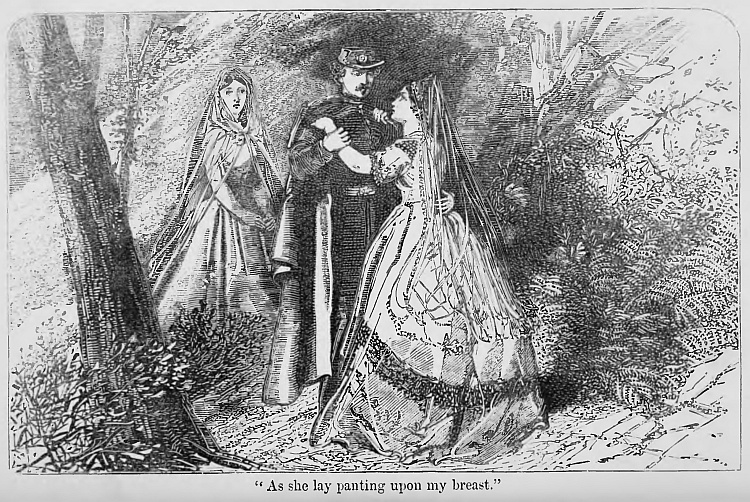
The bandoleros, taken by surprise, had no time either to conceal their captives, or hurry them out of the way. Each had enough to do in providing for his own safety; and at the very first rush into the rancho Mercedes became mine!
As she lay panting upon my breast, I felt like one who has long been in chase of some beautiful bird—fearing by a too close contact to ruffle its rich plumage—at length, enfolding it in his embrace, in the full faith of having a treasure from which he will never more be called upon to part!
It was the first time I had holden her in my arms—the first of our exchanging speech—and yet it seemed to both of us like the renewal of an old love, by some sinister chance long interrupted!
We talked, as if years had sanctified our affection; though a love like ours needs scarce an hour to carry it to the spring-tide of passion.
On the spot I called her Mercedes—my Mercedes; while she in return gave me the endearing title of “querido!”
It was no longer “Querido Francisco!”
It cast no shadow over my joy, that Francisco survived that terrible night; and, along with his Dolores, lived to complete the marriage commenced among the mountains, and so ruthlessly interrupted.
I had the pleasure of being present at the crowning scene of the ceremony. It came off in the Capital—in the quiet little church of the Capuchins—where Don Eusebio, instead of insisting upon his daughter becoming una novia del Cristo, gave his consent to her being the bride of Francisco Moreno.
The End.
|
Chapter 1
| |
Chapter 2
| |
Chapter 3
| |
Chapter 4
| |
Chapter 5
| |
Chapter 6
| |
Chapter 7
| |
Chapter 8
| |
Chapter 9
| |
Chapter 10
| |
Chapter 11
| |
Chapter 12
| |
Chapter 13
| |
Chapter 14
| |
Chapter 15
| |
Chapter 16
| |
Chapter 17
| |
Chapter 18
| |
Chapter 19
| |
Chapter 20
| |
Chapter 21
| |
Chapter 22
| |
Chapter 23
| |
Chapter 24
| |
Chapter 25
| |
Chapter 26
| |
Chapter 27
| |
Chapter 28
| |
Chapter 29
| |
Chapter 30
| |
Chapter 31
| |
Chapter 32
| |
Chapter 33
| |
Chapter 34
| |
Chapter 35
| |
Chapter 36
| |
Chapter 37
| |
Chapter 38
| |
Chapter 39
| |
Chapter 40
|