"A Marriage among the Mountains" (continued 2)
Reading edition
There were two or three of these gambling saloons, or “monté banks,” in La Puebla. More likely there were twenty; but two or three were grand establishments—frequented by the Poblanos of the better class; where gold doblones might be seen upon the green cloth as common as silver dollars. They were attachments to the grand Cafés, or Exchanges, that in Mexican cities take the place of our clubs—serving as places of rendezvous for the haciendados, and higher class of commerciantes.
One was much frequented by the officers of our army; though not exclusively by them. The Mexican gentlemen did not deny us their company over the monté table; and around it might be seen representatives of the Teutonic and Latinic races, in nearly equal proportions—with many a type between.
Though the natives were all in civilian costume, we knew that there were among them men who had once worn uniforms. In fact, some of them were our prisoners on parole; whom we had encountered, and captured, at the siege of Vera Cruz, or on the ensanguined summit of Cerro Gordo.
The poverty of these men was too conspicuous to escape observation. Their pay—scant at all times and often in arrears—was now stopped altogether; and how they contrived to live on parole, they and God alone can tell.
It was painful to note their contrivances for keeping up the appearance of gentility. A close inspection of their coats would show where the shoulder-straps and facings had been stripped off—to convert them into civilian garments; and the unfaded stripe, down the seams of their pantaloons, told where the gold lace had once gaily glittered.
They were usually provided with an ample cloth cloak; which in the streets effectually concealed the transformation. But in the hot saloons this could not well be worn; and a man standing behind, as they sat around the monté table, might look upon a pair of shoulders—now plain—that had been lately decorated with the epaulettes of a colonel, or even general!
Their ventures were usually of the most modest kind: beginning with a peseta, and graduating upwards, in proportion to the propitiousness of Fortune. When their luck was good, they gambled with doblones.
Otherwise, the peseta ended their play for the night; but, instead of retiring in despair, they would continue at the table; as though they took a pleasure in contemplating the gains of the more fortunate players, and the losses of the banker!
Chapter Thirteen.
A Pleasant Misconception.
There was one of these frequenters of the saloon in whom I felt a peculiar interest. Our acquaintance did not commence at the monté table. I first saw him in the Calle del Obispo, and, on the same night, in the Callecito de los Pajaros. His name was Francisco Moreno: the man who had crossed me in love and saved my life!
I had ample opportunity of studying his character, without referring to either incident of that night. I had the advantage of him: for, although I remembered him well, and with strange emotions, he had no recollection of me!
I had reasons for keeping my incognito.
Though we had become otherwise acquainted—and were upon such terms of comity, as two strangers who meet over a gaming table—I could learn very little about him—beyond the fact that he was, or had been, an officer in the Mexican army. My own observation told me as much as this. His bearing, with an occasional speech that escaped him, proclaimed the military man: for in this, as in other callings, there is a freemasonry: and the rajpoot of one land will easily recognise his caste in another.
He was one of the Mexican officers on parole; but we had reason to believe that there were many others among us—during our long interval of inaction—who had no business to be there. We were not very particular about spies; and, in truth, they might have come and gone—and they did come and go—with as much freedom as if no guard had been kept. Successes unexpected—almost astounding—a series of them—had taught us to despise even the secret machinations of our enemy. His scouts might have entered our camp, partaken of hospitality in our tents—even in the marquee of the commander-in-chief—and departed again with as much facility as a man might obtain an interview with his hatter or tailor!
No one thought of suspecting Francisco Moreno. No one gave heed to him, any more than to remark what a fine, noble-looking young fellow he was.
I alone made a particular study of him. I knew that he was more than noble-looking—that he was noble.
It maddened me to think he was the first; though I could scarce he grieved at his being the last. Had it not been so, I should not have lived to take note of it. I had strange fancies—sometimes not very creditable ones—about captain Moreno.
It was plain that he was poor; though not one of those who had converted the military tunic into a civilian’s coat. His dress, if threadbare, would pass muster as a correct costume. Nor did he put down pesetas upon the tapis vert. His stake was usually a peso—sometimes two—but never rising to the onza. The dollar lost, he would retire from the table. Winning, he would remain.
One night I observed a reversion of the rule. His stakes were being doubled at each draw of the cards; and yet he rose from his seat, and hastily took his departure from the place!
Many wondered at this. A man must be mad to leave such luck? It was like flinging the favours of Fortune back into her face.
I had a clearer comprehension of what had caused his defection from the gaming circle. I divined, that he was going to worship the goddess elsewhere, and under another title.
I had heard the cathedral clock strike ten—the hour when I had first seen him in the Calle del Obispo. It suggested the conjecture that he was going thither.
Had my own luck at the game been ten times greater than it was—and I was winning—I could not have stayed to take advantage of it.
I clutched at my stake, as soon as it was covered by the coin of the croupier; and, starting up from the table, followed Francisco Moreno from the saloon.
Whether my abrupt departure created as much surprise, as that of the Mexican, I never knew.
It may have done; but at that moment I was absolutely indifferent, either to the thing itself, or the conjectures that might arise respecting it.
I had but one thought in my mind; and that was to witness a second of those interviews—the first of which had lacerated my heart to its core!
I felt as the bird may feel, fluttering into the jaws of the envenomed reptile; as the moth that goes voluntarily to have its wings scorched by the candle!
There was a fascination in the thought of thus rushing upon ruin! Perhaps it was the knowledge, that my heart could not be reduced to a greater desolation than it already knew.
For the first time in four weeks I entered the Calle del Obispo.
Francisco was before me. I had correctly divined his intent. He had forsaken the smiles of Fortune to bask in those of Mercedes!
We took different sides of the street; he going silently along the façade of the Casa Villa-Señor; I skulking, thief-like, under the portal of the opposite house.
We were not kept waiting for as much as an instant. Scarce had we taken our respective stands, when the blind was drawn back, and a woman appeared in the window. Of course it was Mercedes.
“You are late, Francisco!” said she, in an undertone, and with the slightest accent of reproach. “The cathedral has tolled ten minutes ago! It is very cruel. You know how I am watched, and that every moment is so precious!”
Francisco stammered out some excuse, which appeared to satisfy her. I could see she was not exacting—by the easy grace with which she forgave him. Even this increased my anguish.
“Do you know, dearest, papa is more suspicious than ever! Even now I am afraid he will be coming this way. He has not yet retired to his bed; and never does till both sister and I have gone to ours.”
“Why don’t you give him a sleeping draught? Put poppy-seed in his chocolate. Do that, niña, and we might have a better chance of a little conversation at this hour. I never see you now, or only for a moment. It’s very tiresome to be kept apart in this fashion. I hope it is the same to you?”
“Do you doubt it? You do not? But what help for it? He is so much against you. I think some one has been telling him something bad about you. When we go to matins he always sends Tia Josefa along with us, and I’m sure she has instructions to watch us. I know it’s only me. He’s not half so careful about sister. He allows her to drive out alone—to the Alameda—anywhere. If I go, I must be accompanied by Tia Josefa.”
“The deuce take Tia Josefa!”
“And do you know, Francisco, there’s something worse yet? I’ve only heard it this very day. Josefa told it me. I believe papa put it in her head to tell me. If I don’t consent to marry him—you know whom I mean—I’m to be shut up in a convent! Only think of it! Imprisoned for life in a dark cloister, or marry a man I can’t love—old enough to be my uncle! Ay Dios! What am I to do about it?”
“Neither one nor the other of those two things—if I can hinder it. Don’t be uneasy, love! I’ll find some way to save you from such a fate—which would be equally ruinous to myself. Your father can have nothing against me, except that I’m poor. Who knows but that I may become rich during this war. I have hopes of promotion, and—listen dearest!”
Here the voice of Francisco sank into a whisper, as if the communication he was making required peculiar secrecy.
The words were not audible across the street; neither were those murmured in response. I only heard some phrases that fell from the lady’s lips as she turned to go inside.
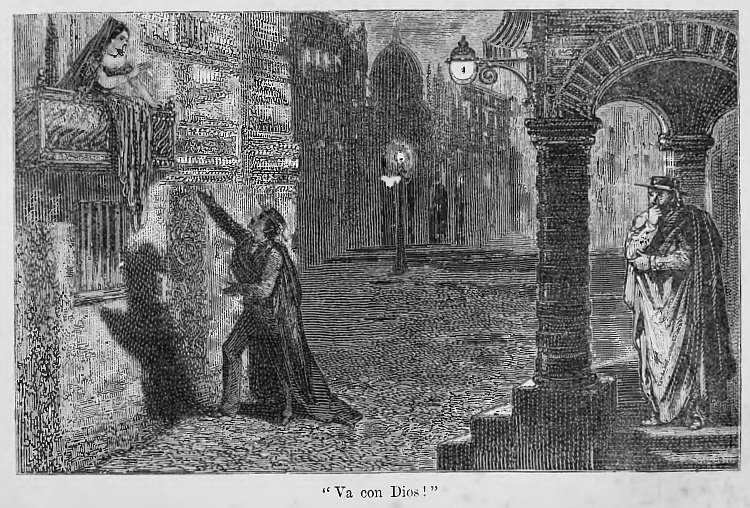
“Adios querido! Hasta la mañana!”
Far sweeter to my ear were some words spoken by Francisco himself.
“Stay! A moment, dear Dolores! one moment—”
I did not hear the conclusion of his passionate appeal, nor the reply—if there was one.
Dolores might have stayed in the balcon, and chatted with her dear Francis for an hour by the cathedral clock, without giving me the slightest chagrin. I was too happy to listen to another word of their conversation.
Mercedes—my Mercedes—was not she who had dropped that little note, and said to him who received it, “Va con Dios!”
There was still a hope that her heart was free; that no “querido Francisco” had yet taken possession of it!
“God grant but that,” was my mental prayer, as I turned to take my departure, “and Mercedes may yet be mine!”
Chapter Fourteen.
Que Cosa?
Giving way to sweet imaginings, I stood for some seconds under the shadow of the portal.
Meanwhile the Mexican had passed out of the street.
As I believed that he had gone back to the saloon we had both lately forsaken, I started in the same direction.
I now longed to have a conversation with him; determined in my own mind that it should be more cordial than any that had yet taken place between us. I could at that moment have embraced him: for my gratitude, hitherto restrained by the thought of his being my rival, was suddenly exalted to a feeling of fervour.
I should seek an interview with the noble youth; make known who it was he had befriended; and ask if there was any way in which I could reciprocate his generosity?
My heart was overflowing towards Francisco Moreno! As he had been the cause of my late misery, I now looked upon him as the instrument of my regeneration.
“Oh! I shall make an ample return to him! But what is it to be?”
Just as I gave thought to the interrogatory, a harsh sound struck upon my ears—as if some one, suddenly stopped in the street, had uttered a cry of mixed anger and surprise. It was followed by the words:
“Que cosa caballeros? Que cosa comigo?” (What is it, gentlemen? What do you want with me?)
“Vuestra bolsa, señor; nada mas” (Your purse, sir; nothing more.)
“Carrambo! A modest demand! For all that, I’m not inclined to comply with it. You may have my purse; but not till after you’ve taken my life. Out of the way, scoundrels! Let me pass!”
“Upon him, camarados! He is loaded with doblones. Al tierra! Down with him!”
These words—not very loudly spoken—were succeeded by the sounds of a struggle, in which several men appeared to take part; five or six, as I could tell by the shuffling of their shoes upon the flagged pavement.
I no longer heard words; or only a few, that seemed spoken under restraint, and scarce louder than whispers!
Even he who had first called out appeared to have become suddenly silent!
For all that the struggle was continuing!
The street in which it was taking place was a sort of narrow passage—leading from one of the main thoroughfares towards the Piazza Grande—and not far from the entrance to the Calle del Obispo.
It was dimly illumined by a solitary lard lamp, whose feeble flickering only served to make the path more uncertain.
I had myself entered the lane—which chanced to be a near cut between the café to which I was returning, and the “calle” I had left behind. It was just as I had got into it that the cry fell upon my ears, followed by the challenge “Que cosa caballeros?”
The rest of the dialogue did not occupy ten seconds of time, before the conflict commenced; and, as the scene of strife was not more than ten paces from where I had paused, another half-score of seconds carried me up to the spot.
I had been thus prompt in rushing to the rescue, because I fancied that I knew the voice of the man who was being assaulted.
I was right. It was Francisco Moreno!
I found him in the midst of five men, forming a sort of quincunx around him; against all five of whom he was industriously defending himself; while they were as busy in the endeavour to get him down.
They were all armed with machetés; while he wielded a sword, which he had drawn from under his cloak.
I could see that the attacking party carried pistols, but did not attempt to use them—perhaps from fear of causing an alarm, and thus defeating their purpose: to all appearance plunder!
I was not so chary about the discharging of mine. The moment I caught sight of the Red Hats—for the assailants were so distinguished—I had a clear comprehension of the sort of gentry with whom the Mexican had to deal, as well as the character of the attack.
The blood ran scalding within my veins. But that very day I had been sickened at hearing the details of an atrocity, committed by these precious pets of our commander-in-chief; and I had mentally vowed, if I should ever chance to catch one of them at their tricks, to make short work with him.
The chance had come sooner than I expected; and I remembered my vow.
The shout with which I interrupted their pastime was almost loud enough to hinder them from hearing the report of my pistol; but one of them caught the bullet that came out of it, and went groaning into the gutter.
I might have shot down a second, or even a third, before they could get out of the way; though they were anything but slow in making disappearance.
I was satisfied with having put an end to one: for this had I done, as was evident from the silent lump of humanity that lay doubled up along the stones.
Chapter Fifteen.
Life for Life.
“Gracias!” cried the young Mexican, “mil gracias, caballero! That’s all I can say till I get back my breath.”
He stopped. I could hear his respiration, quick and heavy, as that of a horse halted after a rapid run.
“I hope you have not received any serious injury?” I said, on becoming assured that the only Red Hat remaining in the street was the one lying along the kerb-stone. “Are you wounded?”
“Nothing to signify, I think. A cut or two, perhaps. They’re only scratches.”
“You’re sure?”
“Not quite, caballero; though I fancy I’m all right. I don’t feel disabled—only a little fatigued. It was rather quick play, keeping guard against all five at once. I had no chance to get a thrust at them, else I might have reduced the number. You’ve done that, I perceive. Once more let me thank you for my life.”
“There is no need. It is simply a debt paid in kind; and we are now quits.”
“Señor, your speech mystifies me. I cannot tell whether I have the honour of knowing the brave man who has done me such signal service. Your voice sounds like one I’ve heard before. You’ll excuse me. It’s so dark here—”
“You and I are so much in the habit of having encounters in dark places, I begin to think there’s a fatality in it.”
“Carrambo!” exclaimed the Mexican, still further mystified by my remark. “Where have we had these encounters? Pray tell me, señor?”
“You don’t remember capitan Moreno?”
“It is my name! You know me?”
“I have good reason.”
“You astonish me. If I mistake not, you are in uniform—an American officer?”
“I am.”
“May I ask where we have met? At the monté table?”
“We have met at monté more than once. It was not there, however, that I had my first introduction to you, but—”
“Where?”
“In your house.”
“Una burla, señor! No matter; you are welcome.”
“No jest, I assure you. Our first exchange of speech was under your own roof.”
“Caspita! You confound me.”
“’Tis true, I did not go inside—only just over the doorstep. There we met and parted—both a little unmannerly. For the first I was to blame. The last, I think, you ought to share with me. By your abrupt closing of the door, you gave me no chance of showing politeness; else I should have stayed to thank you for doing, what you say I have just done for you. I intended to seek an opportunity some day. It seems I have found it without seeking.”
“Santissima Virgen! you, then, are the gentleman—”
“Who on a certain night so unceremoniously made entrance into the house of Don Francisco Moreno, in the Callecito de los Pajaros; who went in head-foremost, and no doubt would have been carried out feet foremost, but for the fortune that gave him such a generous host. Ah! captain Moreno,” I continued, in the ardour of my gratitude grasping the young soldier’s hand, “I said we were quits. Far, far from it; you owe me perhaps your life. To you I am indebted for mine; and—and much more.”
“Por Dios, caballero! you continue to mystify me. What more?”
Under the dominion of a sweet excitement, I was on the point of confessing my amourette with Mercedes, and telling him how he had interrupted it—in short, telling him all. No longer rivals, but fellow-suitors for two fair sisters, we were journeying along the same road. A common motive—each having a different object—instead of estranging, ought rather to unite us?
And yet there was a doubt. Something counselled me to reticence. My secret remained unspoken; not even mention being made of the Calle del Obispo.
“Oh!” I answered, taming down my tone of enthusiasm, “Much more depended on my life. Had I lost it—”
“Had you lost it,” interrupted the young Mexican, relieving me from the necessity of further explanation, “it would have been a sad misfortune for me: since this night I should have lost mine. Five minutes more, and these footpads would have overpowered me. As for my having saved your life, that is scarcely correct. Your own comrades did it. But for their timely arrival, we might not have been able to withstand the assault of the angry patriotas; who were led by a man of no common kind.”
“So much the greater reason for my gratitude to you.”
“Well, you have amply acquitted the debt. But for your interference here—the more generous that you did not know for whom it was exerted—I might now be lying in the place of that red-hatted, red-handed wretch; who has been alike a traitor to his country and his God!”
The last words were pronounced with a scornful emphasis, as if the speaker’s patriotism had become fired at the sight of the renegade robber.
“But, caballero!” he continued, changing to a more tranquil tone, “you say we have also met at the monté table. Lately?”
“Our latest meeting has been to-night.”
“To-night!”
“About an hour ago. Perhaps a little less.”
“Carrambo! You must have been there at the time I left the saloon. You saw me go out?”
“Every one saw you. More than one remarked it as strange.”
“Why strange, señor?”
“It is not usual for a player to run away from such luck as you had—without a very powerful motive. Something of the kind carried you off, I presume?”
“Par Dios! Not much of that. Only a little errand that required punctuality. I executed it; and was on my way back, when these picarones attacked me. Thanks to you, sir, it may still be in my power to gain another onza or two; which I intend doing, if the luck has not been drawn out of me along with these drops of blood. But come, caballero! are you going back yourself? ’Tis not too late to have another albur.”
“I shall go with you, to see whether you’ve received any wounds that require looking after.”
“Thanks, thanks! They’re nothing; else I should have thought of them before now. No doubt they’re scarce worth dressing. A little soap and water will set them all right. Are we to leave him here?”
“If dead, yes. He don’t deserve even the scant honour of being carried upon a stretcher.”
“You are not partial to your red-hatted associates?”
“I detest them; and so does every officer in our army who cares for its escutcheon. They were regular professional robbers, these renegades—were they not?”
“Were, are, and will be. Salteadores del camino grande!”
“Many of us consider it a scandal. So the world will esteem it. A band of brigands taken into the service of a civilised nation, and treated as its own soldiers! Who ever heard of such a thing?”
“Ah, señor! I see you are a true soldier of civilisation. I am sorry to say that in my poor country such travesties are but too common. In our army—that is, the army of his most Illustrious Excellency, General Don Antonio Lopez de Santa Anna—you may discover captains, colonels—nay, even generals, who—. But no. It is not for me to pour these sad revelations into the ears of an enemy. Perhaps in time you may find out for yourself some strange things; which we of the country are accustomed to call—Cosas de Mexico!”
Chapter Sixteen.
Early Birds.
I supped with Francisco. The goddess Fortuna did not show any grudge against him, for his short flirtation with the sister divinity; but, on his return to the monté table, again smiled upon him—as she did upon myself.
By way of a change we paid our addresses to Coena and Bacchus—to the latter more especially—keeping up our devotions to a late hour of the night.
It did not hinder me from being early abroad on the morning after. I saw the rose-tints upon the “White Sister,” as Phoebus imprinted his first kiss upon her snowy brow. I saw this as I entered the Calle del Obispo—the magnificent mountain appearing like a white wall stretched across at the termination of the street!
You will scarce ask why I was there? Only, why at such an early hour?
I could but gaze at the house—trace the frescoes on its façade—feast my eyes upon inanimate objects; or, if animate, only nest-building birds, or domestics of the mansion.
You are thinking of Park-lane—not Puebla, where the angels rise early. In Park-lane they sleep till a late hour, having “retired” at a late hour. In Puebla they are up with the sun, having gone to bed with the same.
The explanation is easy. Puebla is Catholic—a city of orisons. Park-lane is Protestant, and more given to midnight revels!
Had I not known the peculiarity of Mexican customs in this respect, I should not have been traversing the “Street of the Bishop” before seven o’clock in the morning.
But I did know them; and that the lady who, at that hour, or before it, is not on her way to church—capilla, parroquia, or cathedral—is either too old to take an interest in the confessional, or too humble to care for the Church at all!
Few there are of this sort in the City of the Angels. It was not likely that Mercedes Villa-Señor would be among the number. Her sister, Dolores, had let me into a secret—without knowing, or intending it.
In Mexico there are two twilights—equally interesting to those who make love by stealth. One precedes the rising, the other follows the setting, of the sun.
It seems like reversing the order of nature to say that the former is more favourable to the culte of the god Cupid—but in Mexico it is even so. While the Belgravian beauty lies asleep on her soft couch, dreaming of fresh conquests, the fair Poblana is abroad upon the streets, or kneeling before the shrine of the Virgin—in the act of making them!
Early as I had sallied out, I was a little behind time. Oracion bells had commenced tolling all over the town. As I entered the Calle del Obispo, I saw three female forms passing out at its opposite end. Two walked side by side: the third a little behind them.
I might have permitted them to pass on without further remark, had it not been that the great gate of the Casa Villa-Señor stood open.
The portero was closing it, as if a party had just passed out; and it could only be they who were going along the street.
The two in advance? Who should they be but the daughters of Don Eusebio Villa-Señor?
The third I scarce spent a thought upon; or only to conjecture, that she was Tia Josefa.
The Calle del Obispo had no further attractions for me. Folding my cloak around me, I followed the trio of señoras.
A spurt of quick walking brought me close upon the heels of Tia Josefa, and within good viewing distance of the two damsels—over whom she was playing dueña.
I had no longer any doubt of their being the daughters of Don Eusebio, though both were veiled to the eyes. Over the eyes in fact: since their shawls were carried tapado. Instead of hanging from the shoulder, they were drawn across the crown of the head, and held under the chin—so as completely to conceal the countenance!
The black Spanish eye sparkling in shadow was all that could have been seen; though I saw it not: as I was at some distance behind them.
I saw that of Tia Josefa—as she turned, on perceiving my shadow projected before her on the pavement.
There was a sudden glance, accompanied by the bristling of a fan, as the maternal hen ruffles her feathers when the shadow of the hawk is seen sailing towards her chicks.
Only for an instant was I the object of aunt Josefa’s suspicion. My meek look, directed towards the “White Sister,” at once reassured her. I was not the bird of prey she had been cautioned to keep guard against: and, after a cursory glance at me, she went on after her pair of protégés.
I did likewise.
Though they were dressed exactly in the same style—wearing black lace shawls, with high combs holding them above their heads—though their figures were scarce to be distinguished in height, shape, or tournure—though the backs of both were toward me—I could tell my chosen at a glance.
There is something in the physical form—less in its muscular development than its motion—in the play of the arms and limbs—that proclaims the spirit within. It is that unmistakeable, and yet undefinable essence we term grace; which Nature alone can give, and Art cannot acquire. It is a quality of the soul; and not belonging to the body—to the adornment of which it but lends itself.
It proclaimed itself in every movement of Mercedes Villa-Señor—in her step, her carriage, the raising of her hand, the serpentine undulation perceptible throughout her whole frame. Every gesture made was a living illustration of Hogarth’s line.
Grace was not denied to Dolores; though to her given in a lesser degree. There was a sprightliness about her movements that many might have admired; but which in my mind but poorly compared with the grand, queen-like, air that characterised the step of her sister.
I soon became aware that they were on their way to the Cathedral—whose matin bells were filling the streets with their clangour. Other intended devotees—most of them women, in shawls and rebosos—were hastening across the Piazza Mayor, in the same direction.
Dolores alone looked round. Several times she did so—turning again towards the Cathedral with an air of evident dissatisfaction.
Her seeing me made not the slightest difference—a stranger accidentally walking the same way.
I felt no chagrin at her indifference. I divined the cause of it. I was not “Querido Francisco.”
Mercedes appeared to be uninterested in aught that was passing around. Her air was that of one a little “out of sorts”—as was shown by the cold salutations she exchanged with the “caballeros” encountered upon the way, and who one and all seemed to court a more cordial “buenas dias.”
Only once did she show sign of being interested:—when an American officer in the uniform of the Mounted Rifles came galloping along the street. Then only during the six seconds spent in scrutinising him, as he swept past; after which her eyes once more turned towards the Cathedral.
Its massive door stood open to admit the early devotees, who were by this time swarming up the steps.
The sisters became part of the throng, and passed on inside—Tia Josefa closely following, and keeping up her espionage with as much strictness, as while passing along the streets!
I did the same—with a different intent.
Chapter Seventeen.
At Matins.
It was the first time I had made my devotions in a Roman Catholic Cathedral; and I shall not say that I then worshipped as I should have done.
Santa Gaudalupe—beautiful as the sensuous Mexican priesthood have had the cunning to conceive her—glorious as she appeared in her golden shrine—was scarce regarded by me.
More attractive were the black lace shawl and high comb of Mercedes Villa-Señor—not for themselves, but for the lovely countenance I knew to be underneath them.
I watched them with eyes that wandered not. In my heart I anathematised them as the most detestable screens ever interposed between a lover’s eye and its idol.
While engaged in her devotions a Mexican señorita assumes three distinct attitudes. She stands, she kneels, she squats. I regret my inability to express in more elegant phrase, that peculiar species of genuflexion, which may be described as the dropping down from the kneeling attitude to one a degree lower. It is a feat of feminine gymnastics that has long mystified me; and I am not anatomist enough either to comprehend or explain it.
Mercedes Villa-Señor appeared perfect in every posé. Even her squatting was graceful!
I watched her changing attitudes as the ceremony proceeded—the chant, the prayer, the lesson. During all these she never once looked round. I thought she must be a saint—a thought scarce in keeping with the conjectures I had hitherto shaped concerning her.
It gave me but slight pleasure to think she was so holy. I should have preferred finding her human—that angel of angels!
Dolores appeared less devout. At all events, she was less attentive to her prayers. Twenty times I perceived her eyes averted from the altar—turned toward the doorway—peering into shadowy aisles—looking everywhere but upon the officiating priest.
His shaven crown had no attraction for her. She searched for the shining curls of “querido Francisco!”
He was not in the Cathedral—at least, I could not see him. I had my own thoughts about the cause of his absence.
Less accustomed to “sparkling wine,” he had not borne its effects like the boon companion who shared the revel along with him; or had not so readily recovered from it.
Certainly he was not there. So much the less trouble for Tia Josefa!
I could have told Dolores a tale that would have given her gratification. I wanted to do as much for Mercedes.
The time passed—chant and psalm, lesson and prayer, rapidly succeeding one another. Bells were tinkled, incense burnt, and wax candles carried about.
Still kept Mercedes her eyes upon the altar; still seemed she absorbed by a ceremonial, which to me appeared more than absurd—idolatrous.
In my heart I hated it worse than ever in my life. I could scarce restrain myself from scowling upon the priest. I envied him the position that could make his paltry performance so attractive—to eyes like those then looking upon him.
Thank heaven they are mine at last—at last!
Yes: at last they were mine. I was seen, and recognised.
I had entered the Cathedral without thought of worshipping at its altar. The love I carried in my heart was different from that inculcated within those sacred walls—far different from that inscribed upon the tablet: “God is love.” My love was human; and, perhaps, impure! I shall not say that it was what it should have been—a love, such as we read of among troubadours and knights-errant of the olden time. I can lay claim to belong to no other class than that of the simple adventurer; who, with tongue, pen, or sword—as the chances turned up—has been able, in some sort, to make his way through the world!
In my designs there may have been selfishness; but not one iota in the passion I felt for Mercedes Villa-Señor. It was too romantic to be mean.
In her first glance I read recognition. Only that and nothing more,—at least nothing to gratify me.
But it was soon followed by another, on which I was pleased to place a different interpretation. It was the warm look that had won, and once more seemed to welcome me!
There was a third, and a fourth, timidly stolen through the fringe of the chalé. The very stealth flattered my vanity, and gave a new impulse to my hopes. There was more than one reason for it: the sacredness of the place; the reticence of maiden modesty; and perhaps more than either: the presence of Tia Josefa.
Again our glances met—mine given with all the ardour of a love long restrained.
Once more they met in sweet exchanging—once more, and once more. I had won Mercedes from her worship!
No doubt it was wicked of me to feel joy at the thought; and, no doubt, I deserved the punishment that was in store for me.
Chapter Eighteen.
A Challenge in a Church.
While carrying on my eye-courtship with the kneeling devotee, I stood somewhat in shadow. A column, with the statue of some canonised churchman, afforded me a niche where I was concealed from the other worshippers.
But there was a darker shadow behind me—occupied by a darker substance.
Tia Josefa was not the only spy present in the Cathedral.
I was made aware of it, by hearing a voice—of course spoken in a whisper, but so close to my ear, that I had no difficulty in distinguishing every word.
The voice said:—
“Por Dios, caballero! You appear greatly interested in the oracion! You cannot be a heretico, like the rest of your countrymen?”
The sting of a wasp could not have caused me a more unpleasant sensation. The double meaning of the speech was not to be mistaken. The speaker had observed the eye signals passing between Mercedes and myself!
I glanced into the gloom behind me.
It was some seconds before I could see any one. My eyes dazzled with the splendour of the church adornments, refused to do their office.
Before I could trace out either his shape, or countenance, the whispering stranger again addressed me:—
“I hope, señor, you will not be offended by my free speech? It gratifies us Catolicos to perceive that our Holy Church is making converts among the Americanos. I’ve been told there is a good deal of this sort of thing. Our padres will be delighted to know that their conquest by the Word is likely to compensate for our defeat by the sword.”
Despite the impertinence, there was something so ingenious in the argument thus introduced, that I was prevented from making immediate reply. Stark surprise had also to do with my silence.
I waited upon my eyes, in order that I might first see what sort of personage was speaking to me.
Gradually my sight overcame the obscurity, and disclosed what the corner contained: a man several degrees darker than the shadow itself, up to his ears in a serapé, with a black sombrero above them, and between hat and “blanket” a countenance that could only belong to a scoundrel!
I could see a bearded chin and lip, and a face lit up by a pair of eyes sparkling with sinister light. I could see, moreover, that despite the badinage of the speeches addressed to me there was real anger in them!
The sarcasm was all pretence. He, who had given utterance to it, was too much in earnest to deal long in irony; and I did not for a moment doubt that I was standing in the presence of one who, like myself, was a candidate for the smiles of Mercedes Villa-Señor.
The thought was not one to make me more tolerant of the slight that had been put upon me. On the contrary, it but increased my indignation—already at a white heat.
“Señor!” I said, in a voice with great difficulty toned down to a whisper, “you may thank your stars you are inside a church. If you’d spoken those words upon the street, they’d have been the last of your life.”
“The street’s not far off. Come out; and I shall there repeat them.”
“Agreed!”
My challenger was nearest to the door, and started first. I followed three steps after.
In the vestibule I paused—only for a second—to see whether my exit was being noted by the kneeling Mercedes.
It was. She was gazing after me—no longer by stealth; but in surprise; I fancied in chagrin!
Had she divined the cause of my abrupt departure?
That was scarcely probable.
In the position lately occupied by my unknown challenger, she could not have seen him. The statue interposed; and the column covered him, as he stepped towards the door.
I returned her glance by one intended to reassure her. With my eyes I said:—
“A moment, sweet saint, and you shall see me again!”
Chapter Nineteen.
A Quiet Street.
I was not so confident of being able to keep my promise, as I stepped out into the sunlight, and saw a little before me the man who was to be my antagonist.
He stood six feet in his russet boots, with a frame that seemed as sinewy, as herculean. He had all the look of a vieux sabreur; and I knew he would insist upon the sword for his weapon.
A Mexican makes but a poor fight with firearms. They are too noisy for taking life—in the way he oft wishes to take it. I was certain my challenger would choose the sword.
By the etiquette of the duello, I might have insisted upon having the choice; but I was too angry to stand upon punctilios.
The Cathedral of Puebla stands upon a raised dais—with a stone stairway along its façade, and around three sides. Down this the stranger preceded me—having already descended several of the steps before I came out.
At the bottom he paused to await me; and there, for the first time, I had a fair chance of scrutinising him.
Forty, but with that tough, terse figure that betokens a man who has passed his life in energetic action, and whose nerves have never been a day out of training.
The face was not a whit improved by the light of the sun. It looked as foul as I had fancied it, when seen under the shadow of the Saint. It told of an ill-spent past, and prognosticated an evil future.
What could the man want with me?
Under other circumstances I might have asked the question; but I did not then. I had a tolerably clear comprehension, of what had stimulated him to seek the desafio.
Like myself, he was in love with Mercedes Villa-Señor; like myself, ready to defy to the death whoever might present himself as a rival!
He had recognised me as such; a successful one—if his interpretation of her glances corresponded with my own.
I had no doubt about this being the reason for his having so deliberately provoked me.
“It’s rather public just here,” said he, on receiving me at the bottom of the stair. “The Piazza is not the best place for a purpose like ours.”
“Why not?” I asked, impatient to put an end to an episode that was causing me annoyance.
“Oh! only that we are likely to be interrupted by policemen, or patrols. Perhaps you would prefer it that way?”
“Lepero!” I cried, losing all temper. “Take me where you will—only be quick about it! Once on the ground, there won’t be much chance for either policeman or patrol, to save you from the sword you are tempting from its scabbard. Lead on!”
“There’s a quiet street close by,” said he, with a coolness that surprised, and, but for my rage, might have disconcerted me; “There we can have our game out, without risk of interruption. You consent to our going there?”
“Certainly. The place is all one to me. As to the time, it won’t take long to teach you a lesson, that will last you for your life.”
“Nos veremos, señor! Nos vamos!” was the singular response of my challenger, as he started to conduct me to the “quiet street.”
Mechanically I walked after him, though not without misgivings. Had I been in a proper state of mind, I might have reflected more seriously on the step I was called upon to take.
It could scarce have appeared other than it really was—imprudent.
After passing through several streets, we came to the entrance of that we were in search of.
On turning into it, some vague remembrance flitted across my brain. I fancied I had been there before.
I glanced up to the coign of the corner house. In black lettering I read the inscription:—
“Callecito de los Pajaros!”
I next looked at my man. I had also some vague memory about him—associated with the “Little Street of the Sparrows.”
The locality quickened my recollection; and before proceeding farther, I stopped short, and demanded his name.
“Carrambo! Why do you ask that?” he inquired, in a taunting tone. “Do you intend to report me in the other world, for despatching you prematurely out of this? Ha! ha! ha!”
“Well,” he continued, “I won’t disappoint you. Tell the devil, when you see him, that he is indebted to Captain Torreano Carrasco for sending him a subject. Now, señor! are you ready to die?”
There needed no further proof to tell me I was entrapped. If there had, it was furnished by sight of a half-score savage-looking pelados, who, issuing from the adjacent doors, came running towards us—evidently intending to take part in the combat.
No longer to be a duel. I saw that my challenger had no thought of such a thing. He had changed his chivalric tone, and his voice was once more heard leading the contemptible cry—
“Muera el Americano!”
Chapter Twenty.
Rescued by Red Hats.
The Street of the Sparrows appeared to be my doomed spot. For the second time there seemed no chance of my getting out of it alive; and for the second time I made up my mind to die hard in it.
Despite the suddenness with which Carrasco had surprised me, I was upon my guard—before he or any of his comrades could come to close quarters.
But this time, alas! I was without revolver, or pistol of any kind. Not dreaming of danger at that early hour of the day, I had sallied forth, wearing only my parade sword. With this fickle weapon I could not possibly defend myself against half a score of men armed with thin long-bladed machetés.
Grasping its hilt was like leaning upon a reed.
I thought of Francisco of again throwing myself upon his protection.
But which of the fifty dwellings was his?
Even could I have told the right one, would I have time to reach it, or would he be at home?
There was a chance that he might be—that he might hear my cries, and come out. It was so slight as to seem hopeless; and yet I clutched at it, as a drowning man at a straw!
Shouting, I retreated along the street—in what I believed to be the direction of his dwelling.
I am not ashamed to acknowledge, that I called loudly for help—coupling my calls with the name of Francisco Moreno. A man, with death staring him in the teeth, may be excused for dropping a trifle of his dignity. I shouted like a respectable shopkeeper attacked by a gang of garotters.
The Street of the Sparrows was fatal to me only in promise; and for the second time fortune favoured my escape from it.
Help came; though not from the quarter so loudly solicited. Francisco’s door remained shut; at least it was not opened by him. It was thrown open by a score of Red Hats, who at that moment appeared entering the street.
At any other time the sight of these sanguinary allies would have caused me a thrill of antagonism. Now they seemed saints—as they proved saviours!
They had shown themselves in the nick of time. Carrasco and his compeers were close behind me—so close that the points of their machetés were within six inches of my spine.
On espying the Red Hats they retreated in the opposite direction—going off even faster than they had been following me!
Seeing myself disembarrassed of the danger, I advanced to meet my preservers. I had no idea of what they could be doing there; until I saw them stop in front of a house—where they demanded admittance.
The demand was made in a rude manner, and in terms of an unmistakeable determination to enter.
As no one opened the door, they commenced hammering upon it with the butts of their escopetas; for several of them were armed with this weapon.
The door finally gave way—having yielded at the hinges—and, swinging round, stood partially ajar.
Not till then had I the slightest suspicion of what the Red Hats were after. Some “bit of burglary,” I supposed, done in open day; for there was no reason to think the contrary. I could see they were a straggling lot—out on their own account, and without authority.
I was not enlightened about their object, till I saw the face of Francisco Moreno behind the half-opened door, scowlingly confronting them!
It was his house; though I had not before recognised it.
The conclusion came quick as electricity. They were there to arrest him, for killing one of their comrades on the night before, or being an accomplice in the act!
I heard them make the declaration to the young soldier himself.
They had sufficient respect for the law to treat with him for a quiet surrender. More probably they feared his resistance—as he stood sword in hand in the doorway—looking like anything but a man who was going to give himself up!
Had he yielded, they would scarce have kept faith with him. I had no doubt of their intention to slay him upon the spot, instead of taking him to their quarters.
It was a crisis that called for my interference; and I interfered.
It only needed the throwing open my cloak, and pointing out the “spread eagle” on my button.
The slightest disobedience to me would have cost them a score of lashes each—“on the bare back, well laid on.” Such was the phrasing of our military courts.
Nothing of the kind was attempted. I had full control of my rescuers—who were altogether unconscious of the service they had done me—ignorant also of the fact that it was I, not the Mexican, who had sent their camarado to his long account!
For myself I had no fear of them. I only feared for my friend: who, if left to their tender mercies, would never have paid another visit to the Street of the Bishop.
I did not leave him to be judged by the Red Tribunal. I made a compromise with their self-esteem—by taking a lead in his arrest!
To this the accused man, with some show of reluctance, submitted; and, in ten minutes after, he was transported to the Cuartel, occupied by the Rifle Rangers—though not to suffer the degradation of being shut up in its guard-house.
Chapter Twenty One.
Six O’clock—in the Alameda!
I had little difficulty in clearing the paroled officer from the charge of assassinating “a member of the Spy Company.”
As soon as his accusers discovered what I knew of that affair, they not only withdrew their accusation, but their own precious persons, beyond the reach of court-martial inquiry.
When “wanted,” to give testimony in the investigation that ensued, not one, but five, of Dominguez’s followers were reported “missing!” The four coadjutors of him who had been killed thought it more prudent not to press the charge; and when sent for, could not be found either in the “Spy” quarters, or elsewhere in the City of the Angels!
They had taken their departure a los Montes; and I was left alone to tell the story of that nocturnal encounter.
For their testimony I cared not a straw; though the episode was not without some beneficial effects. It taught our renegade allies a little lesion; which was no doubt afterwards profitable—if not to themselves—to those who were so unfortunate as to have dealings with them.
I was not so indifferent to the escape of the scoundrels who had attacked me in the “Street of the Sparrows;” and who appeared to have their head-quarters there.
In half an hour after leaving it with my escort of Red Hats, I was back again—accompanied by a score of Rifle Rangers, who assisted me in making an exploration of that interesting locality.
But the birds we went in search of had flown; and during the remainder of my stay in La Puebla de los Angeles, I never more set eyes upon my quaint challenger.
I learnt something more of him from Francisco—some chapters of his history that did not fail to astonish me. He had been a captain in the Mexican army; and would be so again, should the tyrant Santa Anna get restored to his dictatorial power. Whenever the star of the latter was in the ascendant, the former was sure of a commission.
But as the light of Santa Anna’s star had been of late only intermittent, so also was the holding of his commission by Captain Torreano Carrasco.
During the intervals which Francisco jocosely styled “his leaves of absence,” the gallant captain was in the habit of spending a portion of his time among the mountains.
“What does he do there?” I innocently inquired of my informant.
“Carrambo, señor! It is strange you should ask that. I thought everybody knew,” was the answer.
“Knew what?”
“That El Capitan Carrasco is un pocito de salteador.”
I was less astonished at the declaration, than the manner in which it was made.
The young Mexican appeared to treat the thing as of no great consequence, but rather a matter of course. He seemed to look upon it in the light of a levity—scarcely a crime—one of the Cosas de Mexico!
He was more serious when replying to my next question: “Has this Captain Carrasco any acquaintance with the daughters of Don Eusebio Villa-Señor?”
“Why do you ask, caballero?” he said, turning pale at the mention of the name; “You know them?”
“I have not the honour of knowing them, except by sight. I saw them this morning at matins. I saw Carrasco there too. He appeared to take an interest in their devotions.”
“If I thought so I’d—. Bah! it is not possible. He dare not—. Tell me, caballero; what did you observe?”
“Oh, nothing more than I’ve said. What do you know about it yourself?”
“En verdad, nothing either! It was only a thought I had—from something I once saw. I may have been mistaken. ’Tis of no consequence.”
We spoke no more upon the subject. It was evidently painful to Francisco Moreno—as it was to myself.
At a later period—when our acquaintance became better established—further confidence was exchanged between us; and I was told the story of Francisco’s courtship—to a portion of which, without his knowing it, I had listened before.
It was as I had supposed. There was an objection to his being united to his dear Dolores—her father being chief objector. The young soldier was but a “poor gentleman”—with no other prospect, save that at the point of his sword—not much in Mexico, to a man with an honest heart. There was a rival who was rich; and to this “party” Don Eusebio had promised his daughter—with the threat of a convent in the case of her refusal.
Notwithstanding this menace, Francisco was full of hope—based upon the promises of Dolores. She had expressed her determination to share penury with him rather than wed the rico, who was not of her choice—to die, or do anything rather than go into a convent!
I was not so communicative as my new acquaintance—at least as regarded my relationship with the family of Villa-Señor. To have spoken of Mercedes to another would have spoiled the romance of my passion. Not a word said I to Francisco of that hopeful affair.
From that day I became noted, as one of the earliest risers on the muster-roll of the American army. Not a morning did I outsleep the reveille; nor once missed matins in the Cathedral.
Several times I again saw Mercedes. Each time there was an exchange of glances—each day becoming better understood between us.
And still not a word had we exchanged! I feared to risk speech—the humiliation that would follow, if perchance I was mistaken.
I was again on the eve of resorting to the epistolary mode of communication—and had actually written the letter, intending to deliver it—not second-hand through the cochero, but, in propria persona, to the lady herself.
At each succeeding oraçion I watched for an opportunity; when the fair worshipper, passing out along with the crowd, might come within delivering distance.
Twice had I been disappointed. On the third time I had the chance, without taking advantage of it!
It was not needed. The wish I had expressed in my epistle was better worded by Mercedes herself. As she descended the steps on her way to the street, her lips came so close to my ear, that I was enabled to catch every syllable of that sweet whisper:
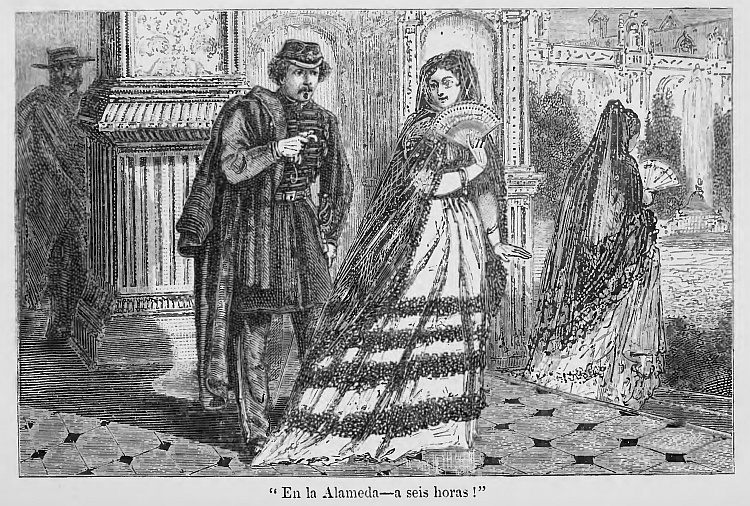
“En la Alameda. A seis horas!” (At six o’clock, in the Alameda!)
Chapter Twenty Two.
Appointment and Disappointment.
In most Mexican cities of the first and second class, there is both a “Paseo” and an “Alameda;” the former a public drive—riding included; the latter more especially set apart for pedestrians, though there is also a carriage way around it.
In the capital itself there are two Paseos—Bucareli and La Vega. The latter extending along the famed chinampas, or “floating gardens,” is only fashionable at a certain season of the year—during the week of Carnival. At all other times it is neglected for the more magnificent drive of Bucareli.
The Paseo of Puebla is poor by comparison; but its Alameda is not without merits. It is a large quadrangle lying on the western edge of the city; with trees, walks, statues, flowers, fountains, and all the usual adornments of a public garden. Around it is a road for carriages and equestrians, as well as a path for promenaders—with benches at intervals on which they may rest themselves.
Its view includes the teocalli of Cholula, with the church of the virgin “Remedios” on its top; beyond, the snow-cone of Popocatepec, and the twin nevada of the “White Sister.”
It was not to look upon these that I was “in the Alameda at six o’clock;” or, perhaps, a half-hour earlier.
With such an appointment as mine, no living man could have restrained himself from anticipating the time.
As the place is devoted to the three several kinds of recreation—walking, riding, driving—it was a question in which way Mercedes would present herself.
The last was the most likely; though the first would have been the more convenient—keeping in view the supposed purpose.
It was the mode I had myself adopted: having entered the enclosure as a simple pedestrian, and in civilian dress—to avoid observation.
I sauntered along the walks—apparently admiring the flowers, and criticising the statues. It was sheer pretence—to deceive the promenaders, who were moving before and behind me. At that moment I had no thought, either of the elegancies of Art, or the beauties of Nature; not even for its sublimities, displayed within sight on the snow-clad slopes of the great “Cordillera.”
I was thinking only of the beauty of woman—impatient to behold it in its most perfect type.
Was it to appear on foot, on horseback, or between wheels?
Considering the character of the times—and that Red Hats were in the Alameda—the last was the most likely.
Notwithstanding this conjecture, I scrutinised every female pedestrian who came inside the enclosure—even those coifed by the cheapest reboso.
Though her sister had said otherwise, Mercedes might not always be free to go forth? She might have to take her recreation by stealth, and disguised?
My surmises soon came to an end; and, to my joy, proved erroneous. Dolores had been right. The cochero in black glaze hat and jaqueta of blue camlet cloth, driving a pair of frisones, could be no other than he who had once lost a doubloon by staying too late over his stable duties?
I took no further note of him. Thenceforth my eyes were occupied with a countenance seen through the windows of the carriage. It was a carretela of elegant construction—all glass in front—best plate, and clear as crystal.
The face inside was but improved by its interposition—toned to the softness of tinted wax.
It needed no scrutiny to identify it. There was no mistaking the countenance of Mercedes.
I had done this before; but that was under the uncertain glimmer of a street lamp.
I now saw it in the full light of day; and well did it bear the exposure. If possible it was more perfect than ever; and the jetty eyes, the carmine tinted checks, the lips—but I had no time to observe them in detail before the carriage came close up.
I saw that she was its sole occupant—unaccompanied either by sister, or chaperone. Even Tia Josefa was not with her!
It was true, then, what Dolores had said. Poor Dolores! I could not help feeling sympathy for her; the more so that I was now the friend of her Francisco.
The carriage was coming on at a slow pace. The frisones scarce trotted. I had time to take some steps, which simple prudence suggested. Even love has its instincts of caution; especially when full of confidence.
Mine was to seek some solitary nook of the Alameda, where I might observe without being observed—except by the occupant of the carretela.
Fortune favoured me. A clump of Peruvian pepper-trees stood close by—their pendant fronds drooping over the drive. Under their shadow was a recess—quiet, cornered, apparently unoccupied. It was the very spot I was in search of.
In ten seconds I had placed myself under the pimentos.
In ten more the carriage came abreast of me—still slowly moving on.
My eyes met those of Mercedes!
Half blinded by the blaze of her beauty, I stood gazing upon it. My glance must have betrayed my admiration; but not less the faltering fear that had hold of me. It was in my heart, and must have been symbolled in my countenance. It was the humility of a man who feels that he is not worthy of the woman he would worship; for I could have worshipped Mercedes!
In five minutes afterwards I was cursing her! She passed, with her eyes full upon me, but without showing any sign of recognition, either by speech or gesture!
It was only after they were averted that I thought of interpreting their glance; and then I was prevented by a surprise that stupified me—a rage that almost rendered me frantic.
Instead of the smile—the something more which I had been fondly expecting—the look vouchsafed to me was such as might have been given to a complete stranger!
And yet it was not like this. There was salutation in it, distant, disguised under some strange reserve—to me unreadable.
Was it caution? Was it coquetry?
It stung me to think it was the latter.
I gazed after the carretela for an explanation. I was not likely to get it—now that the blind back of the vehicle was towards me, and its occupant no longer to be seen.
But I had it the instant after.
A little farther along the drive I saw a man pass out from among the pepper-trees; who, like myself, appeared to have been there “in waiting.”
Unlike me, he was on horseback—bestriding a well caparisoned steed. The man was no stranger to me. At a glance I saw who it was.
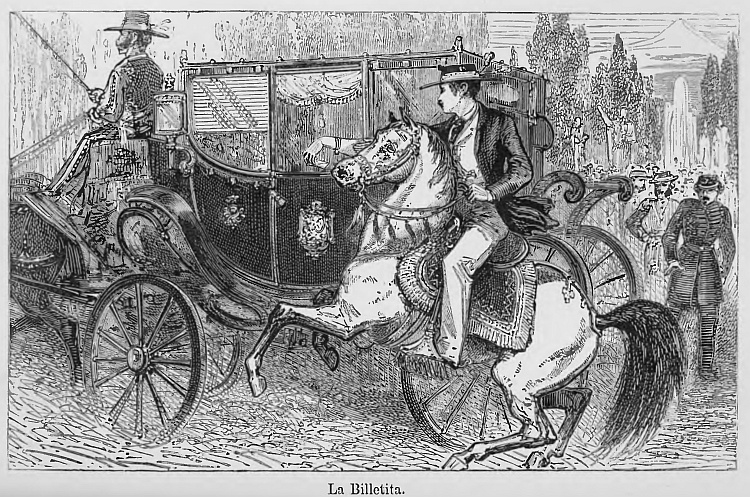
Yielding to a touch of the spur, his horse launched himself out into the road; and was pulled up close to the carretela—through the opened window of which a white arm was at the same time protruded.
I saw the flashing of a jewelled wrist, with a billetita held at the tips of tapering fingers!
Stodare could not have taken that note more adroitly, or concealed it with quicker sleight, than did my friend Francisco Moreno—never more to be friend of mine!
Chapter Twenty Three.
Her Name is Dolores.
There is one subject upon which there can be no question—nothing to admit of discussion. It is, that jealousy is the most painful thought that can torture the soul of man.
In painfulness it has its degrees—greater or less, according to its kind: for of this dread passion, conceit, or whatever you may call it, there is more than one species.
There is the jealousy that springs after possession; and that which arises from anticipation. Mine, of course, belonged to the latter.
I shall not stay to inquire which is the more disagreeable of the two—as a general rule. I can only say, that, standing there under the Peruvian pepper-trees, I felt as if the shades of death and the furies of hell were above and around me.
I was angry at the man who had made me feel so;—but mad—absolutely mad—with the woman!
What could she have meant in leading me such a measure? What profit did she expect by practising upon me such a damnable delusion?
“En la Alameda—a seis Horas!”
I was there, true to the time,—and she, too. Six o’clock could be heard striking from a score of church towers—every stroke as if the hammer were driving a nail into my heart!
For some seconds I listened to the tolling—tolling—tolling. Were they funeral bells?
Oh! what a woman—in beauty an angel—in behaviour a devil!
I had no longer a doubt that such was a true description of Mercedes Villa-Señor.
To excuse my thus quickly coming to conclusions, you should know something of Mexican society—its highest and best.
But it is not for me to expose it. My souvenirs are too sweet to permit of my turning traitor.
That was one of the most bitter—although it was also one of the most transient.
Perhaps I should not say transient; since, after a very short interval of relief, it came back bitter as before—with a bitterness long, long, to continue.
The illusion was due to a process of reasoning that passed through my mind as I stood looking after the carretela, after the incident described.
I had conceived a half hope.
Mercedes might be only a messenger? The note might have been from Dolores—the guarded Dolores, who dared not go out alone?
The sisters might be confidantes—a thing not uncommon in Mexico, or even in England? Dolores, threatened with a cloister, might have no other means of corresponding with her “querido Francisco?”
This view of the case was more pleasing than probable.
It might have been both, but for my knowledge of “society” as it exists in the City of the Angels. From the insight I had obtained, I could too readily believe, that the handsome Captain Moreno was playing false with a pair of sisters!
Only for an instant was I permitted to indulge in the unworthy suspicion.
But the certainty that succeeded it, was equally painful to reflect upon: for I left the Alameda with the knowledge that Francisco Moreno had one love; and she the lady who had driven past in her carretela!
I obtained the information through a dialogue heard accidentally behind me.
Two men, whom I had not noticed before, had been sharing with me the shade of the pepper-tree. One was plainly a Poblano; the other, by his dress, might have passed for a haciendado of the tierra caliente—perhaps a “Yucateco” on his way to the capital. Small as was the note surreptitiously delivered, and rapid its transition from hand to hand—both these men had observed the little episode.
The Poblano seemed to treat it as a thing of course. It caused surprise to the stranger; whose habiliments, though not without some richness, scarce concealed an air of rusticity.
“Who is she?” inquired the astonished provincial.
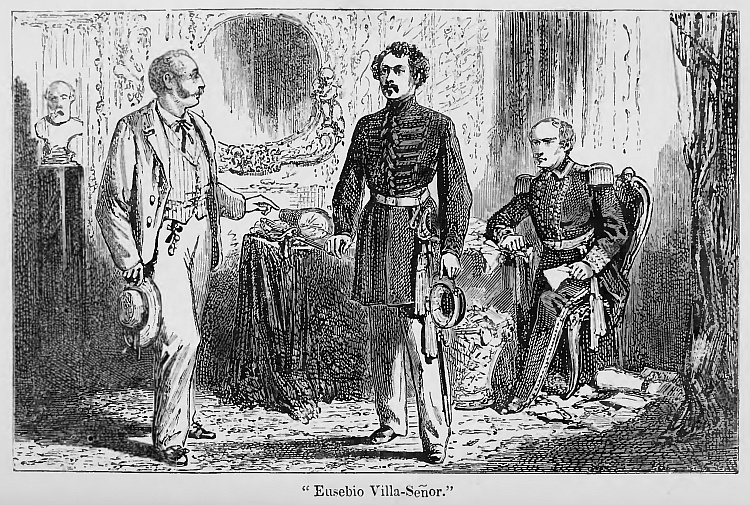
“The daughter of one of our ricos” replied the Poblano. “His name is Don Eusebio Villa-Señor. No doubt you have heard of him?”
“Oh, yes. We know him in Yucatan. He’s got a sugar estate near Sisal; though he don’t come much among us. But who’s the fortunate individual so likely to become proprietor of that pretty plantation? Such an intelligent fellow would make it pay; which, por Dios! is more than I can do with mine.”
“Doubtful enough whether captain Moreno could do so either—if he had the chance of becoming its owner. By all accounts he’s not much given to accumulating cash—unless over the monté table. Independently of that, he’s not likely to come in for any property belonging to Don Eusebio Villa-Señor.”
“Well, without knowing much of your city habits,” remarked the Yucateco, “I’d say he has a fair chance of becoming the owner of Don Eusebio’s daughter. A Campeachy girl who’d do, what she has just done, would be considered as marked for matrimony.”
“Ah!” rejoined the denizen of the angelic city, “you Yucatecos are a simple people: you leave your muchachas free to do as they choose. In Puebla, if they don’t obey the paternal mandate, they are inclosed within convents—of which we have no less than a dozen in our sainted city. I’ve heard say, that such is to be the fate of Dolores Villa-Señor—if she insist on marrying the man to whom you have just seen her handing that pretty epistle.”
“Dolores Villa-Señor?” I asked, springing forward, and rudely taking part in a conversation that so fearfully interested me.
“Dolores Villa-Señor? Do I understand you to say that Dolores is the name of the lady just gone past in the carretela?”
“Si señor—ciertamente!” responded the Poblano, who must have supposed me insane, “Dolores Villa-Señor; or Lola, if you prefer it short: that is the lady’s name. Carrambo! what is there strange about it? Every chiquitito in the streets of Puebla knows her.”
My tongue was stopped. I made no further inquiry. I had heard enough to tell me I had been chicaned.
She who had passed was the woman I loved—the same who had invited me to the Alameda. There could be no mistake about that, nor aught else—only that her name was Dolores, and not Mercedes!
I had been made the catspaw of a heartless coquette!
Chapter Twenty Four.
A Parting Glance at Puebla.
From that hour I felt that Puebla was no place for me. Any métier but that of the singed moth. I determined thenceforth to shun the candle that had cruelly scorched, and might only scorch me more.
Attractive as was the light that had lured me, I resolved never more to let my eyes look upon it. It had proved too resplendent. It would not be with my own will, if I should ever again see Dolores Villa-Señor.
How easy thus to talk—thus to resolve—during the first throes of a wounded vanity—when the spirit is strengthened by its discomfiture. But ah! how difficult to maintain the determination! Hercules had no such task.
I endeavoured to fortify myself with reflection: by conjuring up every thought that might restore my indifference, or enable me to forget her.
It was all to no purpose. Such memories could only be chastened by time.
They were not universally painful. It was something to think that I had interested, even in the slightest degree, one so grand, so famed, so incomparable; and there were moments when the remembrance soothed me. It was but a poor recompense for the sacrifice I had made, and the suffering I endured.
In vain I invoked my pride—my vanity, if you prefer so to call it. It no longer availed me. Crushed in the encounter, it made one last spasmodic attempt, and then sank under a sense of humiliation.
Untrue what I had been told by other tongues. They must have been sheer flatterers, those friends who had called me handsome. Compared with Francisco Moreno, I was as Satyr to Hyperion. So must Dolores have thought? At times, reflecting thus, I could not help feeling vengeful, and dwelling on schemes of retaliation,—of which both were the object. By good fortune none appeared feasible, or even possible. I was helpless as Chatelar, when the sated queen no longer looked lovingly upon him.
There was no hope except in absence—that grand balsam of the broken heart. I knew it by a past experience. Fortune favoured me with the chance of trying it the second time; and soon. Three days after that sweet encounter in the Cathedral—and the bitter one in the Alameda—our bugles summoned us to get ready; and, on the fourth, we commenced moving towards the capital of Mexico.
The counsel I had received from my sage comrade, along with the excitement of opening a new chapter in our campaign, gave temporary relief to my wounded spirit. An untrodden track was before us—new fields of fame—to end in that long anticipated, much talked-of, pleasure: a revel in the “Halls of the Moctezumas!”
To me the prospect had but little attraction: and even this was gone, before we had passed the Piedmont of the Cordillera that overlooks the classic town of Cholula.
On entering the “Black Forest,” whose trees were to screen it from my sight, I turned to take a parting look at the City of the Angels.
The chances were nearly equal I might never see it again. We were about to enter a valley close as that of Cabool; and from which retreat would be even more difficult. Our troops, all told, mustered scarce ten thousand; while the trained regiments of our enemy were of themselves three times the number. Besides, we were about to penetrate a capital city—the very heart’s core of an ancient nation. Would it not rouse our adversaries to a gigantic effort—a throe sufficient to overwhelm us?
So supposed many of my comrades.
For myself I had no reflections about the future—either of its conquests or defeats.
My thoughts were with my eyes—wandering over the vast vega—resting on the spires of a city, where I had experienced one of the sweetest sensations of my life.
Alas! it had proved a deception, and I had no pleasure in recalling it. On the contrary, I looked back upon the place with a cold pain at my heart, and a consciousness, that I had there sacrificed some of its warmest affections without an iota of return!
I remained for some minutes on the edge of the Bosqué Negra—the ancillae of the long-leaved pines sweeping the crown of my forage cap. Under my eyes, as on a chart, was spread the fertile plain of Puebla, with the city projected in clear outline. Besides the Cathedral, many a spire could I distinguish, and that “public walk” where I had suffered such humiliation. My eyes traced the lines of the streets—running parallel, as in all Spanish-American cities—and sought that of the Calle del Obispo.
I fancied that I could distinguish it; and along with the fancy a score of souvenirs came sweeping over my soul.
They were not pleasant—not one of them. Though all bright below—turrets rising gaily against the turquoise sky—domes that sparkled silver-like in the sun—Orizava snow-white in the distance—around me upon the mountain side all seemed dark as death!
It was not the lava that laced the slope, nor the sombre foliage of the pine-trees, under whose shade I was standing.
The shadow came from within—from the cloud covering my soul.
It was not dread of the Black Forest behind me—the terror of stage-coach travellers—nor apprehension of the fate that might be awaiting me in the capital of the Moctezumas, yet to be conquered.
It could not be worse than that, which had befallen me in the City of the Angels!
Chapter Twenty Five.
An Antipathy to Robbers.
After the storming of Chapultepec—the “summer palace of the Moctezumas;” in which I had the honour of leading the forlorn hope—do not mistake a plain statement of fact for a baseless boast—after a seclusion of three months within the walls of a sick chamber, caused by wounds in that action received; I stepped forth upon the streets of the Mexican capital fully restored to health.
Three months more were spent in partaking of those joys—the reward of the victorious soldier, who has completed a campaign.
As in the “City of the Angels,” so was it in that of the Moctezumas. The officers of the invading army were excluded from the “interiors”—such of them as were worth entering.
But as it was no longer an army of invaders, but conquerors, the exclusion was neither so strict nor general. There were exceptions on both sides—extending to a limited number of courageous hosts and welcome guests.
It was my fortune to be among the favoured few. One or two incidents had occurred along the route—one more especially during the march upon Mexico—in which I had the opportunity of bestowing favour and protection. They were reciprocated tenfold by protégés—who chanced to be of the familias principales of Mexico.
During the three months that I lay upon the couch of convalescence, I was surrounded by luxuries brought me by grateful brothers. In the three months that followed I was overwhelmed by the caresses of their sweet sisters; all, of course, in an honest way.
It was a pleasant time; and, if anything could have made me forget Dolores Villa-Señor, this should have done it.
It did not. The sweetest smile I received in the Valley of Tenochtitlan did not, and could not, stifle within my breast the bitter souvenir I had brought with me from the other side of the Cordillera.
Six months after the capture of the Summer Palace, my life in the city of the Moctezumas became dull indeed.
The theatres, slimly attended by the feminine élite of the place; the balls not attended at all, or only by questionable poblanas, and the plain wives and daughters of the foreign residents (why are they always plain in such places?) soon became unbearable.
Even dissipation could not redeem the dulness of the times.
For me the monté table had no longer an attraction. The green cloth was spread out in vain; and I could stand by and hear, without the slightest emotion, “Cavallo mozo!” “Soto en la puerta!”
In truth my interest in all things appeared gone—all upon earth, with the exception of Dolores Villa-Señor; and she I could scarce think a thing of earth.
Just at this crisis there came a chance of distraction. I hailed it with a feeling of gladness.
The stray troops of the enemy had forsaken the roads that surrounded the capital—as had also their guerilleros. But still the ways were not safe. Partisans had disappeared, to be succeeded by salteadores!
From all sides came rumours of robbers—from Puebla on the east, Toluca on the west, Cuernavaca on the south, and the Llanos de Apam, that extend northward from the Valley of Tenochtitlan. Scarce passed a day without “novedades” of the bandits, and their devilish audacity: stage-coaches stopped; travellers commanded to lie flat along the earth, while their pockets were being turned inside out; and some stretched upon the ground never more to stand in an erect attitude!
An escort of our dragoons could have prevented this—that is, upon any particular occasion. But to have sent an escort with every traveller, who had need to go forth out of the capital, would have required a score of squadrons of well-appointed cavalry. At the time we chanced to be short in this arm; and the distribution of our troops to Cuernavaca and Toluca, the strong force necessary to garrison Puebla—and the numerous detachments required to accompany the commissariat trains, left no cavalry disposable for eccentric service.
Till we should receive from Uncle Sam a reinforcement of dragoons, the robbers must be allowed to stop travellers and capture stage-coaches at discretion.
This was the condition of things, six months after the second conquest of Mexico.
I, for one, did not like it. It was but a Christian instinct to hate robbers, wherever found; but in the town of Puebla I had imbibed for this class of mankind a peculiar antipathy.
Experience and suspicion both formed its basis. I remembered Captain Carrasco, and I could not help remembering Captain Moreno!
A young artist who had accompanied our army throughout the campaign—and whose life-like pictures were the admiration of all who looked upon them—had been imprudent enough to risk travelling by diligencia from Mexico to La Puebla. It was not his destiny to arrive at the City of the Angels—on earth; though it is to be hoped he has reached the abode of truer angels in heaven! He was murdered among the mountains of the mal pais—between the “venta” of Rio Frio and that of Cordova.
I had formed a strong attachment to this unfortunate youth. He had oft partaken of the hospitality of my tent; and, in return I suppose for such slight acts of kindness, in his great picture of the storming of Chapultepec, he had fixed my face upon the canvas, foremost—far foremost—of those who on that day dared to look over the well-defended walls.
The consciousness of having performed the feat did not render me less sensible of the kindness of its being recorded. I, a homeless, nameless, adventurer, with no one to sing my praise—save those who had witnessed my deeds—could not feel otherwise than grateful.
He saw, and sang them; in that verse in which he was a master—the poetry of the pencil.
I was half mad, when I heard that he had been murdered.
In twenty minutes after, I stood in the presence of the commander-in-chief.
Chapter Twenty Six.
The Great Strategist.
“What is it, captain? One of my aides-de-camp tells me you have asked for an interview. Be brief with your business; I’m full of affairs just now.” I was not a favourite at head-quarters. I had no flattery for the conceited septuagenarian who at this crisis commanded the American army.
Still his consent was necessary for my purpose. Without it I could do nought to avenge the death of my friend. That granted, I had conceived a scheme.
“What is it?” asked the general, with an air of impatience that augured ill for my success. “What is it you want?”
“Leave of absence, general.”
“Why, you’ve been off duty for six months. How much more do you require?”
“Only six days.”
“Six days! And for what purpose?”
“To punish these brigands who infest the road between here and Puebla. I presume, general, you’ve been informed of their atrocities?”
“Of course I have. But what can I do? If I send a troop, they see the soldiers miles off, and won’t stand to be attacked. It’s like chasing a wild goose.”
“I think I have a plan by which they can be brought to close quarters, and some of them chastised. With your permission, I should like to make trial of it.”
“But I have no cavalry just now to spare—not a single sabre. The Government is so stingy, they won’t give me men enough to fill up the regular regiments. They think I can hold a great country like Mexico without horses—where the enemy are nearly all mounted too! No, Sir, I can’t spare a single dragoon—much less your own company; and I suppose you would want to take that with you.”
“On the contrary, general, I don’t desire a single soldier from the ranks; at least only three or four of my own, whom I know to be men of courage. There are some dare-devils among our camp-followers—just the sort for such a purpose as mine. With a dozen of them, I fancy we can hold our own with the biggest band of brigands to be found among the mountains of Mexico.”
“You are a brave man, captain; but I fear not much of a strategist.”
Strategy was the god of this poor military simpleton, as it was of his favourite pupil, McClellan. It was the same sort of strategy that caused the rout at Bull’s Run, and the consequent prolongation of the American civil war. But for it the army of the North might have stacked arms in the streets of Richmond in three weeks after leaving Washington, and the long sanguinary strife have been shunned.
Well do I remember both preceptor and pupil. There was bad management in Virginia; exactly what I should have expected from my experience of their tactics in Mexico. In our campaign through the country of the Aztecs the latter was scarcely known, or only as a smart drill master. Nor would he ever after have been heard of, but for the patronage of his superannuated Chief—the “Grand Strategist,” as he was desirous of being deemed.
The last remark of the general gave me the cue to flatter him.
In hopes of obtaining my end, I availed myself of the opportunity.
“General!” I said, with a look of real reverence, “I am aware there will not appear much strategy in what I propose—at least to you, who are capable of grand combinations. My idea is of the simplest.”
“Well, let us hear it, captain. Perhaps it may show better in detail. A great deal depends upon that. An army brought into the field en masse—as Napoleon would say—with its infantry here and its artillery there, and the cavalry scattered over the ground, is like a machine without screws. It must soon fall to pieces. I never move my battalions in that way. If I had—”
“If you had, general,” I meekly interposed, seeing that he had made a pause, “you wouldn’t have been here now, as you are—conqueror of the capital of Mexico.”
“You are right, captain; quite right!” rejoined he, evidently beginning to like me, “Quite right, sir. And don’t you think that Cortez’s campaign was inferior to that which I—I—have had the honour of planning; and of conducting, Sir—conducting?”
“A mere skirmish to it.”
“A skirmish, sir—a skirmish! His enemies a crowd of naked savages—that’s what they were—nothing but slings and bows with which to defend themselves. Not a gun among them; while I—I, sir, have defeated a grand disciplined army, under the greatest general these Mexicans have ever produced; for, say what you like of Santa Anna, the rascal is a thorough soldier—a regular, sir, a regular—not a volunteer. I detest volunteers; and it’s a great shame for the Government to have sent me so many of them. They’ve fought well, I admit; but they couldn’t help it. They were properly handled, sir; and they had my old regulars alongside of them. How could they hang back, when they saw who was at their head? My presence inspired them; and the consequence is, that they fought and conquered this great country in less than half the time it took Cortez to do it. Therefore I say, sir, that the conquest of Winfield Scott will shine upon the page of history far brighter than that of Fernando Cortez.”
“No doubt of it,” was my insincere response, scarce able to conceal my contempt for the huge military bavard.
“Well, sir,” said he, after he had paced once or twice across the floor in swelling grandeur, “you haven’t stated your plans? Let’s hear the detail. My giving you permission may depend upon that.”
“What I had intended, general, was to charter the diligencia; and use it, as if it were going on its regular trip between here and Puebla. The robbers are also troublesome upon the Toluca route; so I don’t care which we try first. I should dress my twelve men in Mexican costumes; have a monk or two along with them, and at least a couple of ladies. The reboso would disguise them sufficiently for our purpose. A Mexican uniform or two might aid the decoy: since just before our coming into the country no less than thirteen officers of their army, travelling in the stage-coach, were stopped by a band of only six robbers, and stripped even of their uniforms! I should have liked two or three Mexican militarios among my men; but just now it would scarce look natural, and the bandits might suspect a ruse.”
“Well, sir,” said the general, evidently amused by my ideas, “What would you do with these twelve masqueraders?”
“Arm each of them with a small battery of revolvers; give him a good bowie knife to fall back upon; and, when the robbers make halt around the stage-coach, let all spring out at once, and go at them with a will. I know of twelve men I can muster, who are just the sort for such an enterprise. All of them, one time or another, have done a little bit of street fighting; and I’m much mistaken if there’s one of their number who would shy from an encounter with Mexican brigands anything under ten to one. Our only fear would be that too many of the bandits should be able to get off before we had time to give them a good thrashing. They’re wonderfully quick on their little horses.”
“By the word of Winfield Scott, sir, there’s something in what you propose. For my part, I shouldn’t care to trouble about these robber gentry—who are perhaps only a little less honest than the rest of their countrymen—but it don’t look just the thing that we haven’t put a stop to their depredations—especially as they’ve committed some outrages on our own people. Well, sir!” he added, after a pause, “I’ll consider your proposal, and give you an answer by to-morrow morning. Meanwhile you may hold yourself in readiness—in case I should think proper to approve of it.”
“Shall I retain the diligencia, general?”
“No, no; not this trip—not for to-morrow. There will be time enough. I must think the matter over. It won’t do to be charged with silly things; and, as you ought to know, sir, I have enemies at Washington—foes in the rear, sir, as well as in the front. Besides, you wouldn’t have time to get your fellows ready before to-morrow morning?”
“In an hour, general; if your permission be given. I have sounded them already. They would all be en masque before midnight.”
“I’ll think of it; I’ll think of it, as soon as I’m disengaged. But there’s somebody waiting outside. A Mexican gentleman, my aide-de-camp tells me. I wonder what he wants. Safeguard, I suppose, or some other favour. These people pester the life out of me. They think I’ve nothing to do but to look after every little affair that troubles them. If one of our scamps only steals a chicken, they must see me about it. God knows I’ve given them protection enough—more than they’ve been accustomed to at the hands of their own officers!”
And God did know it: for the statement was strictly true. However contemptible I might esteem General Scott’s military talents, I can bear testimony to the fact, that his enemies had no cause to complain of his inhumanity. Never was conquered foe treated with such leniency as were the Mexicans during that memorable campaign; which I do not hesitate to pronounce the most civilised that has found place upon the page of history.
I had made my salute, and was about stepping out of the “presence,” when I heard the command, “Stay, sir!”
In obedience to it, I once more faced towards the commander-in-chief.
“By the way,” he said, “I may want you for a minute. I’m told you speak Spanish perfectly?”
“Not perfectly, general. I speak it, as the Spaniards say, un pocito.”
“Never mind how—so long as you can hold a conversation in it. Now that I think of it, my interpreter is out of the way; and there’s none of my aides knows anything of their lingo. The Mexican who’s coming in is not likely to understand a syllable I might say to him. So stay, and translate for us.”
“At your command, general, I’ll do the best I can.”
“You may prepare yourself, I suppose, to hear of a hen roost having been robbed; and a claim for compensation. Ah! the claimant is there.”
The door at that moment was opened from the outside; and one of the aides entered, ushering a stranger, who stepped briskly in after him.
Chapter Twenty Seven.
A Bereaved Parent.
The individual thus introduced had all the air of one who had sustained a loss—but of a much graver kind than the stealing of his chicks.
At a glance I could see that he was a Spanish-American of the pure Iberian blood—the boasted sangre azul of Andalusia—without any trace of the Aztecan. Perhaps a Spaniard resident in Mexico—in other words, a Gachupino? He had, at all events, the distinguished bearing of the hidalgo; which was further confirmed by the fineness of his habiliments, that differed very little from what might be seen on a well-dressed English gentleman of the old school: for the stranger was a man of advanced age.
He was clean shaven, without moustache or whisker; the hair upon his head short-cut and snow-white; while that upon his arched eyebrows was as black as it might have been at the age of twenty!
A piercing eye still showed the capability of flashing fire, when occasion required it. Just then it was filled with a sombre light; and his whole demeanour betokened a man who suffered from some overwhelming sorrow.
Under its influence his habitual serenity had forsaken him; and, without pausing inside the door, he walked hurriedly up to the general, and commenced to unburden himself.
Between the two of us there was no possibility of mistaking which was the commander-in-chief—so that the stranger had addressed himself to the proper personage.
As his talk was Cherokee to the general—perhaps not so well understood—he was motioned to make his communication to me.
I had already gathered from his introductory remarks, that he had been travelling in a stage-coach, en route for the capital on a special errand to the general himself; and that a great misfortune had befallen him on the road. I had by this time noticed a slight délabrement in his dress—to say nothing of some scratches on his hands and face—that went towards confirming his hurried statement.
“A misfortune?” I asked, in my capacity of interpreter. “Of what nature, señor?”
“O cavallero; una cosa horrible; un robo! Por los bandoleros!”
“A horrible business—a robbery by brigands!” I said, translating literally to the general.
“How very singular!” remarked the commander-in-chief. “Quite a coincidence! I think, captain, I shall have to grant your request.”
“Of what have they robbed you, señor?” I inquired, in the continuation of my new rôle. “Not your watch—else they would scarce have left you those splendid appendages?”
I spoke of a massive chain and bunch of gold seals, with turquoise, topaz, and other sparkling stones, that hung conspicuously from his waistcoat.
“Por Dios, no! They did not take that!”
“Your purse, perhaps?”
“No, señor; they did not touch it either. They would have been welcome to it, and the watch as well. Ah! they might have had everything else but what they did take.”
“What was it?”
“Mias niñas! mias niñas!”
“Ninyas!” interrupted the general, without waiting for the translation, “that means young girls, don’t it, captain?”
“In its general signification it does. As he has used it, it means his own daughters.”
“What! Have the brigands robbed him of them?”
“That’s what he has just stated.”
“Poor old gentleman—for he’s evidently a gentleman! It’s a hard case, no doubt, to have his daughters carried off by brigands—worse than if Indians had got them. Go on, and question him. Let him give the whole story; and then ask him what he wants me to do. I’ll wait till you’ve finished. You can translate it all in a lump.”
As the general said this he turned away, and speaking to his aide-de-camp, dispatched the latter on some errand that carried him out of the room.
He himself became engaged upon some charts—no doubt covered with “grand strategic plans:” for although we were in the enemy’s capital, it was not certain that our campaign had come to a close, and more fighting might be before us.
Left free to take my own course, I motioned the Mexican to a seat.
He declined it on the score of haste; and standing, I went on with his confession.