"A Marriage among the Mountains" (continued 3)
Reading edition
“How did it happen? When? Where?” was the series of questions I addressed to him in continuation.
“On the road, señor—as we came from La Puebla.”
“From Puebla!” The words startled me into a strange interest.
“Si, señor; but much nearer to this city. It occurred within sight of it, I may say—this side Rio Frio, and not far from the venta of Cordova.”
“You were travelling?”
“We were travelling—myself, my two daughters, and our family confessor, the good Padre Cornaga.”
“In your carriage?”
“No, señor; in the diligencia. We were stopped by a band of ladrones, all wearing crape over their faces.”
“Well?”
“They ordered us out of the coach. Then to lie flat along the ground—with a threat, that if we looked up till they gave the word, we should be shot without ceremony.”
“You obeyed, I presume?”
“Carrai, señor! Why need you ask the question? Not to do so would have been certain death; and, of course, I did as the ladrones commanded. My daughters, I am happy to think, were spared the indignity. But what matters it, since they were carried off?”
“Whither?”
“A los montes!” “Ay de mi! Holy Virgin, protect them!”
“It is to be hoped she will. But why, may I ask, did you risk travelling in the diligencia between this place and Puebla? You had no escort, I take it; and must have known that the road is unsafe?”
“True, cavallero, we had no escort. It was very imprudent on my part, but I trusted to the counsels of our confessor—un hombre muy sabio—who believed there was no danger. The good padre assured us the roads were safe—made so by you valiant Americanos—that there was not a robber to be encountered between Puebla and the capital. Even then I might not have listened to him, but that I had a good reason for coming hither with my daughters; and as they—neither of them—were at all afraid, but rather inclined to it, I ventured to travel by diligencia. Alas! too easily did I yield consent to their wishes—as I have now reason to know. Dios de mi alma! Despoiled of my children! Robbed! Ruined!”
“I presume you had money upon your person, as well as these other valuables?”
I pointed to the chain and seals hanging from the watch-pocket of the petitioner. “They left you these! How do you account for it?”
“Ay Dios, cavallero! That is the strangest thing of all. I had both money—gold money—and this watch. It is one of considerable value, as you may judge for yourself.”
The old gentleman drew out a grand chronometer-like timepiece, with jewelled holes and strong gold cases—evidently worth a couple of hundred dollars.
“They left me this,” he continued, “and my money too! But what signifies that, since they have taken away the muchachas? Pobres niñas!”
“And they took only them?” I asked, becoming interested in the story of a robber episode so little in keeping with the ordinary experience.
“Nada mas.”
“Nothing more! And your fellow-passengers in the diligencia? were they alike sparing of their purses?”
“Fellow-passengers! We had none, señor capitan. There were but the four of us, as I’ve said—all members of my own family: for of course we count the good padre as one of ourselves. True, there were two or three other gentlemen who wished to get in with us at Puebla. They were strangers to me; and, not liking their looks, I chartered the diligencia for myself. I believe they came in another coach after us. I am sorry, now, we did not have them along with us. It might have been better. It could not have been worse!”
“But the padre of whom you speak—this hombre muy sabio—what has become of him?”
“Carrambo, señor! That is the strangest thing of all: they kept him too! After a time the robbers permitted my unworthy self to proceed on the journey. But the monk they compelled to remain. What a scandal to our Holy Church! I hope it will cause the excommunication of every ladron in Mexico, and have them devoted to the perdition they so richly deserve. This comes of having changed our government into a republic. It was not so in the old times, when Spain sent us a viceroy. Then there were no robbers, such as these audacious salteadores, that have this day deprived me of my dear daughters! Ay de mi! Ay de mi!”
“What do you wish the general to do?” I inquired, as the old gentleman became a little tranquillised, after a spasmodic outburst of grief.
“Señor,” he replied, “we have all heard of the humanity of the American ‘Gefe.’ Though he is our country’s enemy, we respect him for the compassion he has shown to a conquered people. Entreat him to take my unhappiness to heart. I know you will do so. Ask him to send out a troop of his valiant dragoons, and recover my lost children. At sight of your brave soldiers the robbers would take to flight, and leave the poor muchachas to be restored to their sorrowing father. O kind capitan; do not deny me! My only hope is in you!”
Although the story of a father thus brutally bereft of his children was of itself calculated to excite commiseration, I should, perhaps, not have felt it very keenly, but for a souvenir it had stirred up within me.
There was nothing at all strange in what he had told me. It was only one of the “Cosas de Mexico,” though, perhaps, not among the commonest. Still it would have given me little more concern than one might feel on reading the account of a lady in London streets—Bloomsbury-square, for instance—having been stopped by a fustian-coated garotter, and relieved of her pocket handkerchief, her card case, and vinaigrette.
Any chagrin the story caused me was but a resuscitation of that already in my mind—the remembrance of my murdered friend, and my antipathy to the whole fraternity of salteadores.
Both might have been freshly excited by his narrative, and nothing more; but for the aroused remembrance, of which I have spoken; and which secured him a sympathy I could scarcely explain. Besides, there was something touching in the appeal of the old Don—not the less that it was made with all the elegance and in the diction of an educated gentleman.
I had no desire to resist it. On the contrary, I at once determined to lay his case before the general, and strengthen it with my own influence—so far as that went.
There was not much generosity in my motive. Without knowing it, the Mexican had done me a service. I felt certain I should now have the chance of chastising—if not the same brigands who had assassinated my artist acquaintance—some who would have behaved quite as badly, had the opportunity occurred to them.
Before turning to translate what had been communicated to me, I thought it might be as well to make myself acquainted with the patronymic of the petitioner.
“Your name?” I inquired, looking him full in the face, and with a vague impression that I had somewhere seen him before, “You have not told me that? The general may wish to know it.”
“Eusebio Villa-Señor. Al servicio de V.”
I started as if a shot had struck me. Oh! the memories that rolled up at the mention of that name!
I was carried back to the City of the Angels—to the Calle del Obispo—to the sorrow from which I had vainly imagined myself to have escaped!
Again was it upon me, full and fell as ever.
With an effort I succeeded in controlling my emotions, or at least the exhibition of them.
Absorbed in his own grief, Don Eusebio did not suspect the existence of mine; and the general was still engrossed with his strategical combinations.
I was now too deeply interested in the suit of the petitioner, to lose a moment’s time in placing it before him petitioned.
I endorsed it with all the eloquence I could command: since it was almost identical with my own—already preferred.
Our joint prayer was heard, and granted upon the spot.
I obtained a commission to chastise any band of brigands, I might choose to go out against.
Need I say, that I had not much difficulty in making the selection?
Chapter Twenty Eight.
A Disobedient Daughter.
I shall not attempt to describe the blackness in my breast as I sallied forth from the President’s palace—Don Eusebio by my side.
Directed by the general, he had placed his affair in my hands, and himself at my disposal.
The announcement of his name had caused me an acute pain—the agony of a reopened wound.
And the pain came not from the story I had heard. It was not the thought that Dolores—for it was no more Mercedes—that Dolores Villa-Señor was in the keeping of brutal brigands! It had pained me as much—perhaps more—to think of her in the keeping of Francisco Moreno!
Truth compels me to the sad, disgraceful confession: that I listened to the tale with a sort of satisfaction! Jealousy was still alive—anger not dead—within my heart!
Though remembered with reluctance, too keenly did I feel the slight that had been put upon me.
The ungentle thought did not for long control me. Soon was it succeeded by one purer and holier—sprung from such chivalry as I possessed. A weak woman in the power of wild, wanton men—two of them, for that matter; though I thought but of one—borne off by brigands to some hideous haunt—some scene of lascivious revel!
They were horrid fancies that came crowding upon me. They drove jealousy out of my heart, and along with it my senseless anger.
These gone, I became inspired by a slight, scarcely definable, pleasure—like the distant re-dawning of a hope that has been for a time extinguished.
What if I should be the means of rescuing Dolores Villa-Señor from the hands of her worse than savage captors—of saving her from a life-long shame?
Might not the gratitude, called forth by such a deed, become changed to that other feeling, I had once fondly fancied to have been entertained in my favour?
I could have risked everything—life itself—to bring about such a revolution!
After all, had I not been too precipitate in my conclusions? Was it certain she had surrendered her heart—her whole heart—to Francisco Moreno?
The episode in the Alameda—of which I had been a spectator—might it not have been but a bit of flirtation, deftly practised by Spanish dames, and oft without serious intent, or termination?
Or might it have been only a chapter of coquetry—myself the object aimed at?
Consoling thoughts—well calculated to stir me to energetic action! Don Eusebio might have been surprised at my ardent espousal of his cause!
He was at least affected by it. Entirely unsuspicious of my motive for questioning him, he not only gave me an unreserved account of the robbery upon the road, but made me the confidant of more than one family secret.
One gave me something more than a surprise. It caused the renewal of my chagrin.
“In your interview with the general,” I said, “you spoke of some important matter that was bringing you to the capital. May I be told it? Excuse me for asking: but in the performance of my duty it may be necessary for me to know what was the object of your journey.”
“Say no more, señor capitan,” he rejoined, interrupting me; “you have taken such a friendly interest in my misfortunes—far beyond what your duty requires—that I have no hesitation in telling you all. Indeed, it is essential I should do so. Hear me, then.”
Without repeating Don Eusebio’s words—with all the circumlocution rendered appropriate by paternal affection, and the sorrow from which he suffered—I learnt from him what might have caused me greater surprise, but for the chance conversation to which I had listened in the Alameda.
The Poblano had spoken the truth to his friend from Yucatan.
Not only had Don Eusebio threatened to immure his daughter in a nunnery; but was actually on his way to carry the threat into execution, when stopped by the salteadores!
Although accompanied by both his daughters, but one of them was to be consigned to her living tomb—the aristocratic convent of La Conception, in the city of Mexico—the abode of some of Mexico’s fairest muchachas.
“Which of your daughters?” I asked with such eager empressement as to startle Don Eusebio, and call forth an interrogative exclamation.
“Oh!” I answered, with an effort to gloss over my confusion, “I understood you to say you had two daughters. Of course one is older than the other—that is, if they be not twins?”
“No señor; they are not twins. One is two years the elder. It was she who intended to devote herself to the service of God. Por dios!” he continued, his brow shadowing as he spoke, “Both must do so now. There is no other future for them—pobres niñas!”
I understood the significance of the sad speech, and remained silent.
After a pause, he proceeded, “It was Dolores, my eldest girl, who intended to take the veil.”
“Was it of her own free will?” I asked.
I could see that the question caused embarrassment. My emotions at the moment were not less powerful—not less painful—than his.
“Pardon me,” I continued, “for making so free with your family affairs; which, of course, cannot in any way concern me. It was a mere inadvertence—quite unintentional—I assure you.”
“O, sir! have I not promised to tell you all—you who have so nobly espoused our cause; you who are about to imperil your precious life for the safety of my children! Why should I conceal from you aught that appertains to their welfare?”
“It is true,” he continued, after a short interval of silence, “true, that my daughter was not altogether reconciled to the step. I myself was inciting her to take it. I had my reasons, señor; and I am sure, that on hearing them, you will approve of what I intended doing. It was for her happiness; for the honour of our family name and the glory of God—which last should be the chief end and act of every true Christian.”
The solemn speech awed me into silence. I made no reply, but stood awaiting the revelation.
“Only of late,” continued Don Eusebio, “in fact within the last few days, was I made acquainted with a circumstance, that caused me both anger and alarm. I learnt that some intimate relations had become established between my elder daughter, Dolores, and a young man in no way worthy of forming an alliance with our family. Know, sir, that the name Villa-Señor is one. But why dwell upon that? I could not look upon my child, and think of her disgrace. For that reason I determined that she should pass the rest of her days in expiating the crime she had committed.”
“Crime! What crime?”
It would be difficult to describe the sensation I felt while putting this question, or the agony with which I awaited the answer.
“That of consenting to unite herself—for it had come to giving her consent—to one of low birth; of listening to vows of love from the lips of a peasant—a lepero!”
“Was he this?”
“Si, señor; was, and is. Through the state of anarchy and revolution from which this unfortunate country has long suffered, like many others of his class, he has risen to the paltry distinction of being an officer in our army—a captain, I believe. Among you, I am aware, the title is one of distinction—not so easily earned, and substantial when obtained. In the army of our so-called Republic, a swineherd to-day may be a captain to-morrow; and the captain of to-morrow a salteador the day following!”
“Of course you know the name of this captain—whom you deem so unworthy of your daughter?”
The question was put mechanically, and without care for the answer. I knew that the name would be “Francisco Moreno.”
It was.
Chapter Twenty Nine.
Don Samuel Bruno.
Before separating from Don Eusebio I received from him a detailed account of the coach robbery, with all the allied incidents. It was necessary I should know everything; and everything was made known to me.
In addition to what he had already communicated, there was one fact of a curious, if not comical, character. Before permitting him to depart in the diligencia, the brigands had taken his bond for ten thousand dollars—as collateral security against the ransom of his daughters!
They had even gone so far as to require it in the shape of a written acceptance—to be cancelled and sent back along with the señoritas, whenever the cash should be forthcoming!
Such were the quaint stipulations of the salteadores!
Though sounding strange to English ears, no Mexican would be at all surprised at them. Oft and again have similar bargains been made—and kept—among the mountains of Mexico!
There was something that still perplexed me. How was this queer contract to be carried out?
I had been told that the usual mode is by a messenger; some one acquainted with the neutral ground—if there be such—lying between robber-land and the precincts of the police. This messenger meets an envoy—deputed by the brigands; the acceptance is honoured; the captives given up, and permitted to depart without further molestation!
In some cases even a cheque has been taken in exchange; afterwards presented at the bank by one of the robbers themselves—and paid!
Who was to be Don Eusebio’s deputy? This was a question that interested me.
The answer gave me great satisfaction. It was the driver of the diligencia that had been stopped—known to his passengers by the name of “Don Samuel Bruno.”
When it is said, that the stage-coaches of Mexico are a modern importation from the United States, I need scarcely add that their drivers have been imported along with them. They are all, or nearly all, States’ men; and “Don Samuel,” despite his sobriquet, was not an exception. He was simply Sam Brown.
Though the intended envoy of Don Eusebio, he had been nominated by the bandits themselves; no doubt for the reason that he knew where to carry the cash, and that it could be safely entrusted in his keeping. Any treachery on his part would put an end to his stage driving—at least, upon the roads of Mexico—and ten chances to one whether he should survive to handle the “ribbons” elsewhere.
Sam knew all this, on consenting to become a “go-between;” though it was scarcely by his own consent: since the office had been assigned to him, not by request, but command.
It was a fortunate circumstance for me—the very thing I would have wished for. My chief difficulty—I had seen it from the first—would be to obtain an interview with the knights of the road. With the stage-driver as a guide, the difficulty seemed more than half removed.
As good luck would have it, I knew something of Don Samuel. I knew him to be intelligent—and notwithstanding the ambiguous rôle he was oft compelled to play—honest.
I was not long in placing myself en rapport with him. As I had expected, I found him ready and right willing to “co-operate.”
There was at this time much talk of our permanently occupying the country. In that case he would have nothing to fear for his future; but in any case he was too gallant to regard consequences where a señorita was concerned.
There was yet another difficulty. Sam’s appointment with the robbers had been made for an early hour of the next morning—the place of rendezvous a treeless plain lying under the shadow of forest-clad hills—not far from the noted inn of Cordova.
Alone he might easily meet the parlamentarios of the other party; but it would be quite a different thing if he should go accompanied by a score of mounted men.
How was the difficulty to be got over?
I put the question to himself.
The intelligent Yankee soon bethought him of a scheme; and one that appeared feasible.
My party should make approach in the night; go into covert under the pine-forest that shrouded the slopes above the place of rendezvous; and leave Sam himself to come on in the morning—carrying the ransom-money along with him. That night he could go with us to a certain distance—as a guide all the way—returning, to return again, at the hour of daybreak.
The plan seemed excellent. There was but one drawback. Our ambuscade could only affect the envoy of the robbers, not the robbers themselves—whose den might be at a distance, among the passes of the mountains.
“Don Samuel” did not see it in this light. With the bandit emissary in our power, and the dollars of Don Eusebio at our disposal, he did not apprehend any difficulty. If there were a salteador in all Mexico proof against gold, Sam Brown did not believe it.
I was satisfied with his reasoning; and consented to act under his guidance.
But little time was required for preparation. The commander-in-chief—not so ungenerous after all, and always liberal in the cause of humanity—had given me carte, blanche. I only drew a score of my own men—Mounted Rifles—with a small supplementary force of the dare-devils already alluded to.
Chapter Thirty.
A Yankee Jehu.
Along the lone causeway, three hundred years ago traversed by Cortez—and now, instead of open water, with a zanca on each side of it—we journeyed in solemn silence.
I had waited for that hour of the night when wayfarers, who might turn informers, were not likely to be encountered on the road.
We passed the isolated hill of El Peñon without meeting any one; and commenced skirting the saline shores of Tezcoco.
The ride, though long, was far from appearing tedious. How could it be in the company of a stage-coach driver—especially one from the “States?”
Who does not know him? Who that has journeyed upon the “corduroy roads” of Kentucky, Mississippi, or Tennessee—who thus dreadfully jolted—does not remember the compensation he has had, in the cheerful conversation of the man who conducted him over these accursed causeways?
In Mexico he is met, just as in the States; mounted on the box of a “Troy” coach; dressed in jacket, or tailed-coat with short skirts; the universal white hat upon his head; and perchance a cigar sticking slantwise between his teeth. Thus he may be seen—and never seen without being liked—almost beloved—by those whose luck it is to have a seat upon the box beside him.
Light, tight, intelligent, and cheery—civil to the humblest outsider—daring to a degree of recklessness—he is as different from the unwieldy six-caped carcase of English stage-coach celebrity, as a butterfly to a buffalo. Who ever sate on the box beside him, without longing to sit there again?
Where is the guide-book that can tell you half so much of the road—every turn and winding—every incident that has occurred upon it for the last ten years—murders, suicides, runaway matches, struggles with black bears, and chases of red deer—in short, everything worthy of being recorded?
And all this with a thorough disinterestedness—his sole design being to entertain you. No thought of the “tip” which your Old World Jehu expects to receive at parting company. Offer it to him, and in all likelihood he will fling it back at your feet! He has not yet been corrupted by the customs of king-loving communities.
Meet him in Mexico: for he is there. He had to go with the coaches imported from “Troy”—not the Troy of the Dardanelles, that “Ammon’s sons ran proudly round”—but its modern, and more peaceful, namesake in the state of New York.
Although under a different name, the diligencia of Mexico is the stage-coach of the States—its driver the same light-hearted happy fellow, with a good word for everybody, and a kindly smile for all the muchachas, plain or pretty, he may pass upon his route.
Interesting as this man is—and has been for a century in the United States—he is still more interesting upon the stage roads of Mexico. Scarcely a day of his life passes without his being in peril. I do not allude to the reckless pace at which he urges his half-tamed mustangs—three abreast—down the declivities of the Mexican mountains. These are occurrences of every hour. I speak of the perils that threaten him from the behaviour of the bandoleros—by whom he is repeatedly surrounded.
Sam Brown’s dealings with these gentry were of almost daily occurrence. At all events, there was scarcely a week without his being witness to a scene—not unfrequently having a tragical termination. More than once had he been present at the spilling of blood!
The diligencia is usually accompanied by an escolta—a troop of dragones, or lanzeros, ill-armed and equipped; whose tattered uniforms, and feet set shoeless in their stirrups, render them more grotesque than terrible.
At times the escort is itself attacked; and a sharp skirmish comes off between troops and bandits—the former not unfrequently fleeing the field, and leaving their protégés, the passengers, to be plundered at the discretion of the triumphant salteadores.
At other times the escolta declines “coming to the scratch”—having taken the precaution just at the critical moment to be riding far in the rear; then galloping up with swaggering demonstration, after the robbers have completed their pillage, and gone away from the ground!
Either a strong escort, or none at all, was Sam Brown’s sentiment; but his preference was, decidedly, for none at all!
In the latter case the diligencia is often permitted to continue its route uninterrupted: the bandits believing, that it carries no passengers worth protecting, and therefore not worth pillaging!
It is no rare thing for the “escolta” itself to be suspected; or at least the officer commanding it. More than once has the connivance been established, by evidence, in a court of law!
Still rarer does punishment follow in any proportion to the diabolical crime—the criminal usually getting clear by turning salteador himself!
On the other hand, there are times when an honest officer—one of action and courage—makes his appearance upon the scene; and by the energetic performance of his duty becomes a terror to the bandits—rendering the roads comparatively safe.
Unluckily this improved state of things continues but for a short period. Some new grito—followed by the usual spasmodic revolution—brings about a change, both in rulers and robbers; who sometimes also exchange situations! The energetic officer is snatched away from the scene—either by death, or promotion to a better post; and the passage of the roads becomes perilous as ever.
Such were a few of the revelations I had from the lips of Don Samuel Bruno, as we journeyed along the lone causeway leading by the lake Tezcoco.
There were two things still unexplained, and which no little puzzled me: how my guide had contrived to come safe out of so many hair-breadth perils? And how he managed to keep his peace with the salteadores?
The explanation was asked for, and freely given.
The secret lay in a nutshell.
No matter what happened, Sam always remained neutral!
“Ye see, cap’n,” said he—by way of explanation rather than apology, “as I’m only the driver, they hain’t no ill-will agin me. They know I’m but doin’ my duty. Besides, if thar was no driver, there ked be no diligencia; an’ if it war off the road, all the wuss for them, I reck’n. They look upon me as bein’ nootral; otherwise I needn’t go that way agin. I keep on my box, an’ leave ’em do as they’ve a mind—knowin’ that I ked be of no sarvice to the poor passengers that’s bein’ plundered. I kin do them more good, arter it’s all over—by drivin’ them on to thar destinashun.”
For a time my companion was silent, and I too. I became absorbed in thoughts, cheerless, if not absolutely sad.
The sight of Tezcoco, along whose shores we were now proceeding, was not calculated to cheer me. The lake looked still, and dark as Acheron itself—its sombre silence relieved only at intervals by sounds yet more lugubrious—the scream of the great curlew, or the screech-like call of the American ibis!
Giving way to a string of unpleasant fancies, I rode on without speaking to any of my comrades.
I was roused from my reverie by the voice of Sam Brown; who appeared desirous of once more entering into conversation.
“Cap’n!” said he, spurring alongside of me, and dragging the pack-mule after him. “’Scuse me for intrudin’ upon you; but I’ve got somethin’ more to say about this business we’re on. What air ye goin’ to do?”
“No excuse, Mr Brown. On the contrary, I was about to put the same interrogatory to you. I confess that I feel a little perplexed. Now that we’ve started on this expedition, I begin to see the difficulty—if not the absolute idleness of it. It seems absurd to suppose that the robbers would send one of their number to meet any messenger, who may be deputed to them,—without taking precautions against a surprise?”
“They never do, cap’n. They ain’t sech consarned fools.”
“Well, I thought as much; or do now—now that I’ve had time to reflect upon it. It isn’t the scheme I had intended to have carried out. After all, there’s no alternative, but to go through with it. What’s your advice?”
“Well, cap’n; my advice might be no better than anybody else’s; only that I’ve took notice to a thing or two.”
“Where? When?”
“I kin answer both yer questions at the same time: whar and when the coach was stopped.”
“You noticed something strange?”
“More’n one thing; several o’ ’em.”
“What were they?”
“First, then, the skunks were craped.”
“I’ve heard the same from Don Eusebio. But what signification is there in that?”
“Not much, I admit; only that it ain’t common for reg’lar robbers to wear crape. They don’t care who sees their faces: bein’ as they make thar home among the mountings; and never put themselves in the power of the sojers, or alguazils. These bein’ craped, shows they’re a lot from the town.”
“What town?”
“Puebla, in coorse. It’s the biggest nest in all the Mexikin domeenyuns. They wore that kiver to keep from bein’ recognised—shed they be met afterwards in the streets. It don’t follow that they were any the less brigands on that account. Them of the town air jest as bad as them that keep out in the country. They all belong to the same school; only the outsiders don’t care whether they’re known by them as they plunder; while the town chaps sometimes do—for sartin reasons.”
“There were some other circumstances that appeared odd to you?” I asked of my intelligent guide.
“One other as looked darnationed odd. It puzzled me at the time, an’ do still. I had my eyes on them two saynoritas as travelled with the old Don, thar father. There’s one o’ them especially I’d like to know who ked keep his eyes off o’. Well, what surprised me was, that instead o’ seemin’ scared-like, and squealin’ out—as I’ve heerd other Mexikin sheemales do when tuk by the robbers—they both flirted off among the trees, with two or three o’ the brigands attending on ’em, jest as if they were startin’ out a huckleberryin’!
“All the while the old Don war down upon his belly—flat as a pancake—from which seetuation he warn’t allowed to stir, till the gurls had gone clean out o’ sight.
“Then one o’ the band bargained wi’ him about the ransom-money—tellin’ him it was to be trusted to me, an’ whar it was to be brought. They then bundled him back into the coach, an ordered me to drive on—the which, I reckon, I war riddy enough to do.”
“But there was a priest along with them. What became of him?”
“Oh! the monk. That ’ere is also kewrious. The robbers usooaly let them go—after makin’ ’em give each o’ the band a blessin’! Him they kep along wi’ ’em; for what purpose the Lord only knows. Maybe to make sport o’ him, by way o’ divarshin. Seein’ that I war no longer wanted, I gave the whup to the hosses; and fetched the old gentleman away, all by himself.”
“Do you think his daughters in danger of being ill-treated?”
“Well, that depends on whose hands they’ve fallen into. Some are worse than others. Some times they’re only a set o’ idle fellows from the towns, who put on robber for the time—just to raise the wind in that way. When they’ve got up a stake, they go back to their gamblin’ at monté; the which pays them better, and ain’t so much risk o’ their gettin’ shot, or shet up. There are officers of the army who’ve been known to take a turn at the business—after they’ve spent their pay, or don’t get it to spend—which last happens beout half the time.
“Then there’s the reg’lar bandoleros—or salteadores, as they sometimes call ’em—who live by it for constant. Of them there’s several seprit bands along this road. One in partickler, called Carrasco’s, who used to be a officer in Santa Anna’s army. There’s Dominguez, too, who was a colonel; but he’s now along wi’ you at the head o’ the Spies. I don’t think it was Carrasco’s fellows that stopped us this time.”
“Why not?”
“They wouldn’t a’ cared to wear crape. I hope it wan’t them.”
I had a painful suspicion why this hope was expressed; and anxiously enquired the reason.
“Because,” answered the guide, “if it hez been Carrasco, I shed say a pity o’ them two young critters. Kewrious thar showin’ so little skeeart!
“Maybe they didn’t more’n half know thar danger. As the robbers don’t allers ill-treat the weemen—’ceptin’ to strip ’em of thar gimcracks and the like—the Mexican sheemales ain’t so much ’fraid o’ ’em as ye might suppose they’d be.”
“Arter all,” continued he, “it may be that I war mistaken. They were so quick bore off into the bushes, I hadn’t much time to take notice o’ ’em—the more so as I had enough to do in keepin’ my hosses from goin’ over the edge o’ a precipice—by the side o’ which we were brought to the stand.”
“In any case,” pursued Sam Brown, riding a little closer to me, and speaking so as not to be overheard by my followers, “It air time ye made up your mind what to do, cap’n. We’re now come to the place, whar we must take leave o’ the main road. The rendezvoos gin me by the robbers lies up one o’ these side gullies, whar there’s nothin’ but a bridle path. Another half-hour’s ridin’ ’ll fetch us to the place o’ appointment.”
“Have you thought of any other plan than that already spoken of?”
I put the question, fancying from his manner that something else had suggested itself to him.
“I hev, cap’n. There’s jest a chance that I know whar them craped gentlemen air at this very minute—jest a chance of thar bein’ thar.”
The last words were spoken slowly, and in a sort of meditative soliloquy.
“Where? Of what place are you speaking?”
“A queery place; and ye wouldn’t know whar it is if I war to tell ye. To understan the lie o’ that shanty, ye’d hev to see it for yourself; which not many ever do, ceptin’ them as have got bizness thar—an’ they ain’t sech as air honest.”
“A shanty—there’s a house? Some solitary dwelling, I suppose?”
“Ye may well call it that, cap’n. It sartinly are the most solitariest dwellin’ I ever seed; an’ what any man ked iver a built it for, beats my recknin’—as I b’lieve it do that o’ most others as hev specklated upon it. Lies up thar.”
I looked in the direction indicated by his gesture. Several dark lists seamed the side of the mountain—at the foot of which we had come to a halt. One of them looked deeper and more cavernous than the rest; though all seemed to trend towards the summit of the slope.
The mountain itself went up with a gradual acclivity; its sides forest-covered—except here and there, where the naked porphyry peeped out through the dark green drapery of the pines.
Though the sky was moonless, there were stars. By their light I could distinguish something white above and beyond the pine-covered track. It looked like a patch of fleecy cloud.
“That ere’s the buzzum o’ the White Woman,” remarked the guide, seeing what my eyes were fixed upon. “She lies jest beyont the big black mountain. There’s only a sort o’ a ridge atween ’em.”
“Ixticihuatl!” I said, now recognising the snowy summit. “You don’t mean that the robbers are gone up there?”
“Not so fur as that. If they war, we shed have a climb for it. The place I’m speakin’ o’ is in that dark gulley ye see straight afore you. It’s this side the lower end o’ it whar I’m to meet thar messenger, and deliver up the dollars. That’s jest why I think we might find them at the shanty I’ve told ye about.”
“There can be no harm in our going there?”
“I reckon not,” answered the guide, reflectingly. “If we don’t find ’em thar, we kin get back to the bottom afore daylight, an’ then carry out the other plan. Thar’s one thing we’ve got to do, afore we reach that ere shanty. We’ve got to hev a climb for it; and the last quarter o’ a mile ’ll hev to be made upon Shanks’s mare.”
“No matter for that,” I said, impatient to proceed. “You lead the way. I’ll answer for myself and men being able to follow you.”
“I ain’t afeerd beout that,” rejoined Don Samuel Bruno. “But mind, cap’n!” added he, in the exercise of his Yankee caution, “I haint said we’ll find them thar—only thet it air likely. All events it air worth while tryin’—considerin’ sech a sweet gurl as she air in the hands o’ sech ruffins. She oughter be tuk from ’em anyhow—an’ at any price!”
I needed not to ask him which was meant by the “sweet gurl.” Too well did I divine that it was Dolores.
“Lead on!” I exclaimed, giving the spur to my horse, and the “Forward” to my followers.
Chapter Thirty One.
Demonté.
It had not yet reached the hour of midnight, as we left the Great National Road, and commenced moving up the mountain,—in a lateral though somewhat parallel course to that we had been following.
For a mile we marched along a path, where wheels might have passed at a pinch.
We could see by the starlight that there were some small settlements on each side, and one more conspicuous above, which we knew to be the hacienda of Buena Vista—famed as the spot where the best view can be had of the valley of Mexico. From this circumstance does the dwelling derive its name; and he who from its azotea can look downward, without having his soul stirred within him, must be incapable of romantic emotion.
On approaching from the coast—I mean Vera Cruz—it is here the traveller first obtains a good view (buena vista) of the world-renowned “Valle of Tenochtitlan;” here that he first comes within sight of the City of the Moctezumas.
Story-telling tourists can see it from the summit of the Sierra—looking through the long-leaved pines! Almost every one who has written a book about Mexico has made this plausible assertion.
But it must be remembered that these books have been mostly compiled after the travellers had returned home; and, in some instances to my knowledge, before they started out—not having started at all!
One and all have followed the first teller of the fictitious talc; who must have been sharper sighted than I. With tolerably good eyes—strengthened by a capital field glass—I could see no city of Mexico from the summit of the Sierra, nor from any part of its sloping declivity, through the dearest break the pine-forest afforded.
Considering the distance, it is not likely that I should. What I saw was the “Valle” itself—not a valley in our sense, but a wide plain; inclosing within its limits several isolated hills, that might almost be termed mountains; mottled with broad expanses of swamp, and sheets of clear water—the largest of these being Lakes Tezcoco and Chalco; here and there a white dot, showing the lime-washed walls of a hacienda, the keener sparkle of a church spire, or the glistening of an enamelled dome amidst the scattered huts of a pueblita.
All this you may see from the summit of the Cordillera; but not the towers of Tenochtitlan. Before you can distinguish these, you must descend—nearer and lower. You must look from the terrace where stands Buena Vista; or the plateau occupied by the “Venta” of Cordova.
When nearly abreast of the latter place, the road we were pursuing ran out, or rather into a bridle path; and my little troop had to stretch out into “twos.”
A mile farther on, and even this slender formation had to be changed to one still more extended. The path was only possible for “single file;” and into this we fell.
Another mile of marching, and it was not possible for cavalry, or horsemen of any kind. Only a pedestrian could pursue it, and he, too, one accustomed to climbing.
I muttered the command to halt, which had become indispensable. It was earned in sotto voce to the rear; and the horses, strung out for a hundred yards, came to a stand—one behind the other.
“There is no road beyond?” I said, interrogating the guide, who had squeezed up alongside of me.
“For horses, no. Only a footpath; an’ scace that eyther. Thar air a horse track further up; but it comes in from t’other side o’ the ridge—on the left. It strikes off o’ the National Road, close to the place whar the coach got stopped. Thet’s why I hev the suspicion the fellurs may be found at the house as lies up hyar.”
“But why have we not gone along the main road, and then taken that you speak of? We could have ridden on to the house?”
“No—not to the house. Thar’s a bit o’ it too—the last hundred yards or so—impossible for bosses.”
“Still it would have been better than to leave them here? I don’t like separating the men from their saddles—especially as we know nothing of the ground.”
“Thar’s another reezun for our not goin’ the other way,” pursued the guide, without replying to my remarks. “If I’d taken you by the road we might a made a mess o’ it.”
“How?”
“If they’re up at the big house there’ll be one o’ ’em on the watch down below—near the joinin’ o’ the roads. They allers keep a sentry there. He’d be sartin to a seen us—whereas, by comin’ this way, we may have a chance o’ stealin’ close to the shanty afore any o’ ’em sets eyes on us.”
“You propose that we dismount, then, and go forward afoot?”
“Thar’s no other way, cap’n.”
“How far is it to the house?”
“As to distance, nothin’; not over six hundred yards, I shed say. I’ve only been there once. It’s the steepness o’ the track that takes up the time.”
I did not much like the idea of dismounting my men, and leading them away from their horses. Not but that the individuals I had selected were equal to good fighting afoot; but it occurred to me that it was possible for us to have been seen, as we marched along the lower road—seen, too, by those who might have a fancy to follow us.
There were guérilleros along the mountain foot, as well as robbers in its ravines. In short, every peasant and small proprietor was at this time a partisan.
What if a band should get together, and come on after us? The capture of twenty American horses—without a blow struck to retain them—would have been a blow to me I should not easily have got over. It would have been the ruin of a military reputation, I had but just commenced making.
I dared not risk such a discomfiture; and I determined upon the men remaining by their horses.
I had no idea of abandoning the enterprise. That would have been a still greater disgrace. I but stayed to consider some plan of approach, involving less risk of a failure.
A few minutes spent in reflection, and a few more words exchanged with the stage-driver, helped me to what I conceived a better: the men to remain where they were; myself and the guide to go up the ravine alone, reconnoitre the house, and then take such measures as circumstances might suggest.
If we should find that the brigands were “abroad,” my troopers would be spared a toilsome ascent, and the chagrin of a disappointment. If “at home,” it might then be worth while to pay them a visit in full force.
The guide thought there would be no danger in our going alone—so long as we made our reconnoissance with proper caution. There was no scarcity of cover, both underwood and tall timber. In the event of our being perceived while making approach, we could fall back upon our friends, before much harm could be done to us. Should we be close pressed, the men could meet us half-way. I had the means of making them hear me at three times the distance.
I had no lieutenant with me—only my first sergeant, who had seen service in three out of the four quarters of the globe. Above all, he had “fit Injun, both in forest and prairie;” and could be trusted on an enterprise like that we had in hand.
Having arranged the signal in a whisper, and communicated to him such other instructions as occurred to me, I dismounted from my horse; and followed “Don Samuel Bruno” in the direction of the “shanty.”
The night was far from being a dark one. These are rare under the skies of Southern Mexico. There was no moon, but myriads of stars; and at a later hour the moon might be expected.
The atmosphere was tranquil—scarce a breath of air stirring the suspended leaves of the pines. The slightest sound could have been heard at a remarkable distance. We could distinguish the bleating of sheep on the plain below, and the screaming of wildfowl on the sedgy shores of Lake Chalco!
Less light, and more noise, would have answered our purpose better.
We ourselves made but little of the last. Though the path was steep, it was not so difficult of ascent—only here and there, as it extended from terrace to terrace by a more precipitous escarpment—and up these we were assisted by the shrubbery.
We had agreed to proceed by signs; or, when near enough, by whispers. We knew that the slightest sound might betray us.
At short intervals we stopped to obtain breath—less from actual exhaustion, than to keep down the noise of our heightened respiration.
At one place we made a more lengthened pause. It was upon a shelf-like terrace of some extent—where there were hoof-prints of horses, and other indications of a trodden path. My guide pointed them out—whispering to me, that it was the road of which he had spoken.
I bent down over the tracks. They were of recent date—made that very day. My prairie experience enabled me to tell this, despite the obscurity through which I scrutinised them. The “sign” promised well for the success of our enterprise.
Beyond, the road became opener and easier. For two or three hundred yards it trended along a horizontal level, and we could walk without strain.
The stage-driver silently preceded me—still going slowly, and without any abatement of caution.
I had time to reflect, as I followed him.
My thoughts were anything but cheerful. The gloomy canopy of the pines appeared to give a tinge to my spirit, and it became attuned to the sad sighing heard high up among their ancillae. The moaning of the great Mexican owl, as it glided past on soft silent wing, seemed meant only to mock me!
I had been under a half belief that I had forgotten Dolores Villa-Señor, or become indifferent to her existence. Vain hallucination! Idle, and I knew it now.
Long weary marches; sieges protracted; battles, and wounds therein received; even the coquetry of other eyes—wicked as hers—had not chased her image from my heart, or my memory. It was there still.
I could see her countenance before me—under the sombre shadow of the trees—plain as I saw the white-winged owls—soft as the weird wafting of their wings!
I had not forgotten her. In that hour I knew that I never should.
And while hastening to effect her rescue, I felt as if I could have gloated over her ruin—so steeped was my soul in chagrin—so brimful of black vengeance!
It was no chivalrous thought that was carrying me up the slopes of Ixticihuatl—only the hope of humiliating her, who had humiliated me!
I was aroused from my unworthy imaginings by the voice of Sam Brown, whispering close to my ear. His words were:—
“Don’t ye hear it, cap’n?”
“Hear what?”
“The music.”
“If you call the hooting of that horrid owl—”
I stopped at a gesture from my guide. In the obscurity I could see his hand uplifted, his finger pointing upwards.
“Don’t ye hear somethin’ up that way?” he continued, “Thar’s the twang o’ a guitar, or one o’ them thar Mexikin bandoleens—as they call ’em. Hear that? Somebody laughin’! Hear that, too? If my ears haven’t lost thar hearin’, that ere’s the voice o’ a sheemale!”
The last remark secured my attention. I listened—as if expecting to hear a summons of life or death!
There was the twang of a stringed instrument—harp or guitar, bandolon or jarana. There was a voice—a man’s voice—and the instant after a series soft tones, with that metallic ring that can only proceed from the feminine throat.
“Yes,” I assented, mechanically, “there’s music there!”
“Moren’ that, cap’n! Thar’s dancin’.”
Again I listened.
Certainly there was the pattering of feet over a floor—with motion timed to the music—now and then a pause—a laugh or an exclamation—all betokening a scene of enjoyment!
“It’s the exact direckshin o’ the shanty,” whispered Sam. “They must be in it. Thar’s somethin’ goin’ on, hear that? There’s a bust! Darn me, if they hain’t got a fandango!”
It was an increased swelling in the sound that had called forth this exclamatory language. A violin had joined its continuous strain to the throbbing of the jarana; and several voices appeared to take part in the conversation, which was carried on during the intervals of the music.
There appeared to be nothing boisterous—no riot or roystering—only such sounds as might be made by a party of pleasure-seekers engaged in a picnic, or dia de campo—the chief difference being that it was in the night!
Certainly the sounds were not such, as I should have expected to proceed from a band of brigands engaged in an interlude of festivity.
“It’s them!” whispered the driver of the diligencia—a better judge of brigand music than myself. “The very chaps we’re in search o’. They’re doin’ a little bit o’ divartin; an’, cuss me, cap’n, ef I don’t b’lieve that them two gurls is joinin’ willinly in the spree!”
I answered his speech only in thought. And a fell, fearful thought it was.
“Dolores Villa-Señor not forced by cruel circumstances, but voluntarily assisting at a carnival of salteadores!”
All thoughts of strategy were chased out of my mind. Even prudence for the time forsook me. The remembrance of the past—the morbid imaginings of the present—alike maddened me.
She upon whom I had fixed my affections—high and holy—the toy of a robber-chief! Worse still; herself wanton and willing!
“Go on!” I said, grasping my guide by the arm; “on to the house! Let us see what it means. On, on! There’s no danger. In ten minutes I can call my men around me; and if need be, we can run back to them. On! on! I must see with my own eyes, if she can be so degraded!”
Without altogether comprehending why, Sam Brown saw that I was determined on advancing; and, yielding to my impulsive command, once more led the way.
Chapter Thirty Two.
Paradise from the Pillory.
Another terrace was ascended; and before us stood the house—a massive structure of quadrangular shape only one story in height, but surmounted by an azotea with a parapet running around it.
It was placed upon a platform of limited extent; backed by a precipitous slope, of which the platform was the base; and flanked by two cliffs that scarped off in the opposite direction—downward.
What might be called the gables of the dwelling were flush with the flanking cliffs; but between its rear and the ascending slope was an inclosed space—forming a corral, or courtyard.
Its façade lay towards the smooth space in front; that declined gently from the walls, like the glacis of a fortification.
A better site for defence could scarcely have been chosen. No foe could advance by either flank; and an attacking party from the front would be exposed while crossing the open ground. The place might be more successfully assailed from the rear—by an enemy coming over the top of the sierra.
The idea of defence could not have been entertained. On the Indian frontier, yes; but in the valley of Mexico—tranquil since the time of Moctezuma—there had been no fighting. The structure could have nothing to do with the revolutionary era. It was too ancient for that.
It was difficult to understand why such a dwelling had been erected in such a place. It could not be an agricultural establishment: there was no arable land within reach. Nor yet a hacienda de ganados: since there was no pasture upon the pine-covered slopes that surrounded it.
Had it been built by the monks? Perhaps by some eccentric recluse, who had chosen the site, for the purpose of contemplating civilisation, without being disturbed by it?
These thoughts were things of an after-time; when, upon an excursion of curiosity, I made myself better acquainted with the topography of the place.
All that I saw then—as we were making our stealthy approach—was a block of dark mason work, with a still darker disc in the centre indicating the entrance door; and on each side of this a large window, from which a stream of light was escaping.
The ground in front had the look of a ruined garden—overgrown with rank grass, and here and there some clumps of shrubbery run wild.
Among these we made our approach—taking care to keep clear of the two bands of yellow light diverging from the windows. Both were mere apertures without glass; defended, as in all Mexican houses, by strong iron bars rising vertically from the sill.
There was neither blind nor curtain, to obstruct the passage of the light outward, or the view inward.
After a few seconds spent in skulking across the lawn, we succeeded in placing ourselves within good viewing distance of one of the windows.
Inside we could see a table set with the paraphernalia of a feast. It appeared a rude piece of furniture; as did also the chairs that stood around it. So, also, were the plates, dishes, and drinking vessels that covered it: though in these we could perceive a grotesque commingling of the cheap and costly.
Common earthenware ollas, and carved bowls of calabash, stood side by side with goblets of silver, and bottles, whose tapering necks told of claret and champagne!
Tall wax candles, that looked as if they had been moulded for the service of the Church, were suspended in chandeliers of the pitahaya cactus, or held in cleft sticks—themselves stuck into the interstices of the slab table!
Only the drink had been as yet brought upon the board; though the meats could be scented from the cocina; while several brown-skinned, leathern-clad, “muchachos” were moving to and fro, with a hurried empressement that showed they were setting the supper.
It was evident that the two windows were in different apartments; the one opposite us being the sala de comida, or dining-room.
It was the sala grande, or drawing-room, I most desired to look into.
Not to listen to the music, or become a spectator to the dancing. Both had ceased some time before; and in their place we could now hear only a single voice—that of a man, who seemed to be speaking in a tone measured and solemn!
It required some strategy to get into position for looking through the second window. But it was worth the effort.
From the grand preparations in the dining-room, there should be corresponding company in the drawing-room? Was its quality alike heterogeneous?
As yet we could not tell. A ruined pile, that had once been a sort of portico, extended between the two windows—overshadowing the doorway. It hindered us from obtaining a view of the second.
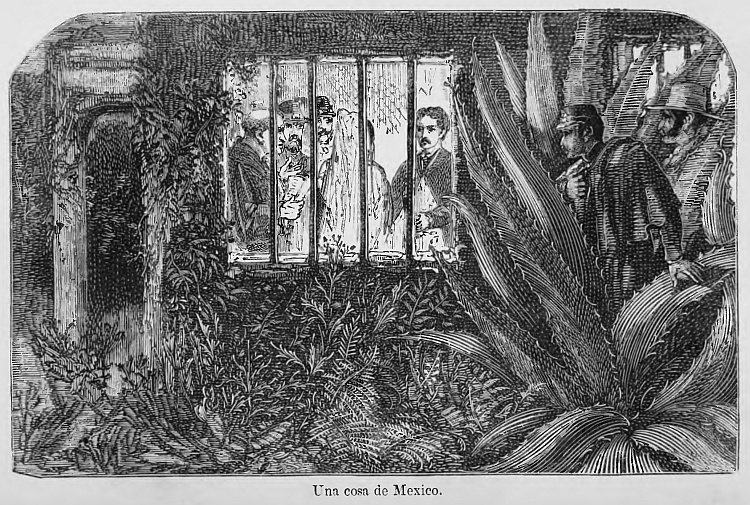
We had been kneeling among rhododendrons—a clump of which grew near the dining-room window. There were none in front of the drawing-room; but instead, an enormous aloe—the maguey of Mexico. Once to rearward of it, and screened by its broad blades, we should be in an excellent place for observation.
The question was how to get there, without being ourselves observed. The ground between the rhododendrons and the “pulque plant” was a smooth piece of turf, without shrub or tree. On this the two bands of light—widening as they went out from the windows—became commingled.
To have crossed from one side to the other would have been to expose ourselves under a light, clear almost as day.
We did not so much fear being seen by those within the sala grande. Their preoccupation—sport, or whatever was going on—would hinder them from looking forth.
But while crouching among the “rose trees” we had noticed that the great gate was open; and in the faint light that fell straggling across the saguan—a little brighter in the patio behind—we could see the dark-skinned domestics flitting to and fro with the supper dishes—like spectres engaged in the preparation of some infernal feast!
Some of these standing in the saguan, or loitering by the outside entrance, might observe us while crossing?
We dared not risk it. The exposure would be too great. Should we attempt to cross there would be scarce a chance to escape detection.
There was only one other course: to steal back down the lawn, cross over through the fainter light, and return along the edge of the other cliff. What a pity we had not taken this route at first!
I was loth to lose the time, but there was no help for it. To have saved it, by going direct, might have resulted in the loss of our lives; or, at all events, in disaster to our expedition.
Ten minutes more, and we stood behind the maguey.
Parting its spinous leaves, and passing in between them, we obtained the desired standpoint.
As I have said, the music had ceased, as also the conversation and laughter. All three had been hushed for some time—having come to a stop while we were skulking among the rhododendrons.
We supposed at first, that supper had been announced to the company in the sala grande, and we might soon see them in the sala de comida.
Although the preparations did not appear complete, we should have stayed to await the going in of the guests—but for what we heard from the other apartment.
The sounds of merriment, abruptly brought to an end, had been succeeded by the solitary voice. It was that of a man, who appeared to speak in slow measured tones—as if addressing himself to an audience.
We could hear him all the time we were changing place; and his harangue was still going on, as we came into cover among the fronds of the pulque plant.
The first glance through these explained everything—why the music had ceased, and the laughter been restrained.
Inside the sala a ceremony was progressing, that, under the circumstances, might well be termed solemn. It was the ceremonial of a marriage!
A monk, whose robe of bluish grey proclaimed him of the order of San Francisco, was standing near the middle of the floor. I mention him first, as he was the first to come under my eye.
He held a book in his hand; and was reading from it the ritual of marriage—according to the Romish Church.
My eyes did not dwell upon him for a single second. They went in search of the bride, and bridegroom.
A little shifting among the leaves brought me face to face with the latter. Imagine my astonishment on beholding Francisco Moreno!
It was scarcely increased when I obtained a view of the bride. A presentiment—sad, almost stifling—had prepared me for seeing Dolores Villa-Señor. It was she!
I could not see her face. She was standing with her back towards the window. Besides, a white scarf, thrown loosely over her crown, and draping down to her waist, hindered even a side view of it.
There could be no doubt about its being Dolores. There was no mistaking that magnificent form—even when seen en detras. She it was, standing at the altar!
A wide space separated the bridegroom from the bride. I could not tell who, or what, was between. It appeared a little odd; but I supposed it might be the fashion of the country.
Behind him were other figures—all men—all in costumes that proclaimed a peculiar calling. They were brigands. Francisco only differed from the rest in being more splendidly attired. But then he was their chief!
I had been puzzled—a little pained—by some speeches he had let fall during our intercourse in the City of the Angels. How gentle had been his reproaches, and tolerant his condemnation, of Carrasco! As a rival, not as a robber, he had shown indignation against the ci-devant captain of Santa Anna!
What I now saw explained all. Don Eusebio had spoken only of probabilities, when he said that Moreno might be a bandit. Had he known the real truth regarding this aspirant to his daughter’s hand, he might have been excused for his design to shut her up in a convent.
The bride was willing; there could be no doubt of it. I remembered what the stage-driver had told me, of her tripping off so lightly among the trees, her present behaviour confirmed it. Even in that solemn hour, I fancied that she was gay. I could not see the face; but there was a free, nonchalant carriage of the head, and a coy vibration of the scarf that covered it, very different from the staid, drooping attitude that denotes compulsion. On the contrary, she appeared contented—trembling only with joy!
It would be vain to attempt a description of my own feelings. For the time, a statue set among the shrubbery could not have been more motionless than I. I stood rigid as the fronds of the aloe around me,—my gaze steadfastly fixed upon the spectacle passing inside. I began to fancy it a dream!
But, no! There was the bride and the bridegroom; and the monk, in dull monotone still reciting from his book!
And now I could hear the promise to “love, honour, and cherish,” and the responsive vow to “love, honour, and obey”—all after the formula of the Catholic faith.
Oh! it was no dream, but a hellish, heart-rending reality!
The woman who had won my heart—whom for six months I had been vainly endeavouring to forget—was before my eyes, surrounded by a band of brigands—not their captive, but the bride of their chief—freely consenting to the sacrifice!
“Otra cosa de Mexico!”
Chapter Thirty Three.
A Rude Interruption.
“Otra cosa de Mexico!”
Another strange occurrence of Mexico; if not the most incomprehensible, certainly the most painful, that had yet come under my cognisance: for it related to myself—the black, bitter part of it.
Words will not convey the state of my mind, as I stood regarding the group inside. I could not move—either to advance, or go back. I could scarce get breath. My heart felt as if compressed under a heavy weight, never more to be removed. It was undergoing its maximum of misery.
My feelings can only be understood by one, who has had the misfortune to pass through a like ordeal. He who has bestowed his affections upon some high-born beauty may feel chagrin, on discovering that they are not returned. It will be deepened by the knowledge, that another has won the wished-for prize. Still is there solace, however slight, in the reflection: that the preference has been given to one worthy, whose fortune has been more favourable.
When otherwise—when the preferred rival is worthless, socially or morally, then is the humiliation complete—overwhelming. It is self-love stung to the quick.
Such a humiliation was I called upon to suffer.
With all my pretensions of pride—a conceit in the possession of certain superiorities, mental as well as physical; courage, talent, strength, activity; a position not humble; a reputation each day increasing; with, and in spite of all these, I saw that my suit had been slighted, and the favour I coveted more than aught upon earth, bestowed upon another.
And who that other? A bandolero! A robber!
It was the very wantonness of woe that swept over my heart, whelming it with terrible desolation!
I stood like a stranded ship with the huge seas breaking over her. Waves of passion rushed impetuously through my breast, black as the billows of the storm-contorted ocean.
The spectacle, while stirring me to anger, at the same time kept me fixed to the spot. I made no movement—either forward or backward. I felt paralysed with a passion, such as I hope I may never feel again. The world seemed full of woe!
For a time I was unable to reflect. My thoughts were but instincts, now woeful, now wicked—now despairing, now tending to resolves.
One a little nobler at length took possession of me. My own fate was sealed; but not that of Dolores Villa-Señor—which to me seemed equally dark, and drear. Was it possible to save her?
I had not heard those mystic words that rivet the golden chain of wedlock, “With this ring I thee wed.” The shining symbol had not yet appeared upon her finger.
There was still time to interrupt the ceremony. A single breath into the silver tube, that hung suspended over my breast, would stay it; and, before it could be resumed, the green jackets would be around me.
It was no thought of danger that withheld me from sounding that signal. I was too unhappy to have a feeling of fear; too reckless to care a straw for any consequences to myself. At that moment I could have rushed into the presence of the bridal group, and defied one and all to the death!
It was neither caution, nor a craven spirit, that restrained me; but an instinct more ignoble than either—an instinct of revenge.
Dolores had adopted her destiny. However dark it might prove, it was not for me to attempt turning it aside. She would not thank me for saving her. Sweeter would be my triumph to show her the man she had chosen for husband, in my power—a scorned captive at my feet.
So ran my ungenerous reflections.
“Let the marriage go on!” I muttered to him by my side. “She shall be wed, and—widowed!”
In all my life I never felt so spitefully cruel—so desirous of retaliation. Every spark of chivalric thought had departed from my soul.
The imperturbable Yankee made no reply. The scene inside seemed to be absorbing all his attention—as it was my own. Far different his interpretation of it. With him it was simple conjecture. He little suspected the knowledge I possessed, or the dread interest stirring within me.
We remained in the maguey, to await the conclusion of the ceremony.
We saw the ring glancing between the fingers of the bridegroom. But it came not in contact with those of the bride. Before that critical moment arrived, a change—quick as the transformation in a pantomime—terrible as the passage from calm to tropic storm—from life to death—went sweeping over the scene!
A phalanx of dark forms rushed past the spot where we were crouching. They were human—but so silent in their movements—so weird-like under the wan light—as to appear spectral!
They could not be phantoms. One or two of them touched the tips of the plant in passing, causing its elastic blades to rebound backwards. They were forms of flesh, blood, and humanity; animated by the spirit of fiends—as in another instant they proved themselves.
We saw them by a rapid rush precipitate themselves into the open doorway—a few scattering along the façade, and taking stand by the windows.
We saw the glittering of armour. We saw spears and machetés thrust through the iron bars. We heard the cocking of carbines, and the rude summons to surrender—followed by menaces of murder!
There was a short scuffle in the saguan, and the courtyard behind it; and then there were death groans, proceeding from the domestics, who fell stabbed upon the stones!
The two apartments appeared to be simultaneously entered. Dark shadowy forms flitted through the dining-room; but in the other the shadows were darker.
There was a rushing to and fro—a changing of places—not as in a kaleidoscope, but in crowded confusion. There was screaming of women—shouting of men—threats and curses—followed by pistol reports; and, what made the fracas still more infernal, an occasional peal of diabolical laughter!
Only for a short while did this continue; so short, that I scarce believed in its reality till it was all over!
Almost at its commencement the lights in both rooms had been extinguished; but whether by chance, or design, it was impossible for us to tell.
What occurred afterwards we knew only by hearing, or from glimpses afforded by the occasional flashing of firearms.
Though there was loud talking all the while that the strife continued—with exclamations, every other one an oath—we heard nothing to give a clue to it.
Nor did we find any explanation in what followed. We could only tell, that the conflict had come to an end; that it was succeeded by the shuffling of footsteps across the paved patio, gradually retiring to the rear, and at length heard ascending the precipitous pine-covered slope that soared darkly above the dwelling!
As they rose higher, they grew fainter; until the only sounds distinguishable were the moanings of the Mexican owl, the hissing of the cascade below, and the sighing of the mountain breeze among the tops of the tall pine-trees.
Chapter Thirty Four.
Padre Cornaga.
Astonishment still held me speechless, as it did my companion—motionless, too, as the maguey leaves, radiating around us.
Had I known the real signification of what had just transpired, I might have acted with more promptitude, and ten times the energy.
As it was, I felt like one slowly recovering from a state of torpidity—from an ill-digested dream!
“What does it all mean?” I inquired of the stage-driver, without stirring from my place.
“Darn’d if I know, cap’n; ’cept it air one band o’ robbers that’s attackted the t’other, and stripped ’em of their spoils. The conq’rors ’pear to be clean gone away, an’ hev took the weemen too! They’ve sloped off on t’other side o’ the shanty. I kin hear ’em yet, making their way up the mountain! Thar’s a path there; tho’ it ain’t so easy to climb. I reck’n they’ve gone up it, toatin up the gurls along wi’ ’em. The reezun they ain’t still screechin’ is, they’ve got ’em eyther gagged, or tapado.”
“Tapado?”
“Yes; muffled up—thar faces covered wi’ something—to hinder them from seeing their way, or singin’ out. They only do it, when the weemen show refactory.”
What mattered it to me? What mattered, whether Dolores Villa-Señor was the wife of one robber, or the mistress of another? Why should I care now? She could never be mine!
I stepped out from among the leaves—leisurely, as one who has no motive for making haste. There was a cold pain at my heart; a callous indifference to the fate of her who had caused it. She was welcome to go higher—to the summit of the mountain she had selected as the scene of her nuptials.
It was Ixticihuatl on whose slope we stood. The “White Sister” could be seen through the clear starlight above, reposing in spotless vestments. How different from the robe of Dolores!
“Let her go!” was my unchivalric reflection. “She has made her own bed: let her lie upon it!”
It was not for the purpose of pursuing—at all events not with any thought of rescuing her—that I placed the call to my lips, and sounded the signal for my men.
In less than five minutes the “Rifles” were around me—their green jackets distinguishable under the brilliant beams of the moon—that on the instant sailed suddenly into sight.
On hearing the shots, and other sounds of strife, they had commenced moving up the mountain-path. Hence the promptness of their appearance.
Selecting half a dozen of them, I stepped straight into the doorway of the house. We entered without opposition—groping our way through the saguan.
Inside all was darkness; though we could tell that the place was still tenanted,—by the groans that proceeded from the adjacent chamber.
A light was struck; and we commenced exploring the apartments. In the dining-room there was no one—a banquet spread—but without guest to partake of it!
We turned into the sala grande—from whence proceeded the lugubrious sounds.
The scene—so late one of merriment—was now a spectacle of death!
Two men were lying along the floor. One might have been supposed asleep: as he lay quite silent. But a red rivulet, trickling from its source underneath him, and terminating on the tiles in a pool of blood—told that it was the silence of death.
The other, also surrounded by seams of smoking gore, still lived and moved. It was he who was making moan.
On stooping over him, I recognised the features of Francisco Moreno. They were still handsome, though terribly distorted by his struggle, as I supposed, with death.
It was no use asking an explanation from him. I saw that he did not know me!
There was a thought in my mind at the moment—an unsanctified thought. A rival had been removed from my path. Francisco Moreno was no longer in my way!
But it could not matter now. The relief had come too late!
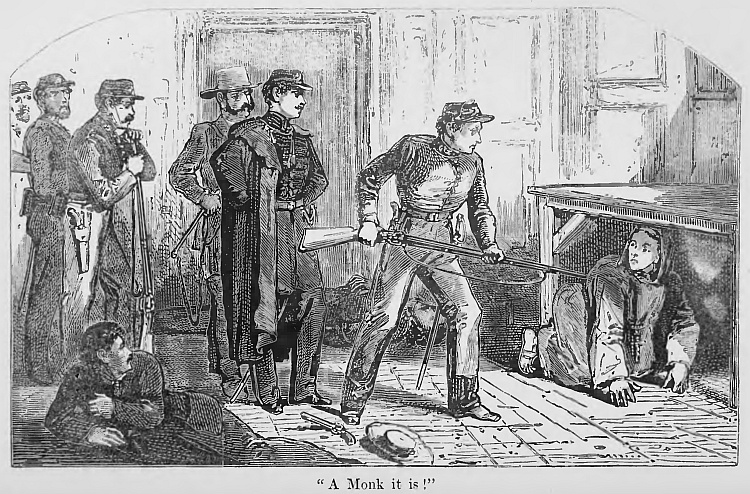
“Hilloa, what’s this?” exclaimed one of the men, poking his rifle under the banquette, and pressing it against what appeared a large bundle done up in Kentucky jeans. “By the Almighty, it’s a monk!”
“You’re right, caballero,” answered a voice, from under the envelope of grey-blue serge, which, on closer inspection, proved to be the gown of a Franciscan friar.
“A monk I am—at your service, caballeros. Sangre de Crista! It’s the merest, accident that I’m a living one. O, señores; I perceive that you are hombres buenos; and that the ladrones have retreated at your approach. Say that they are gone; and that I need have no further fear?”
“Two on ’em haint gone fur,” replied the stage-driver; “thar they lie—right afore yur eyes, Padre Cornaga.”
“Ah! you know me, good sir? Santissima, it’s the driver of the diligencia—the worthy Don Samuel Bruno! What! these robbers? Por Dios, no! They are gentlemen!”
“A queery kind o’ gentlemen, I reckin’.”
“’Tis true as I say it, Señor Don Samuel. Caballeros—hombres honestos—both these unfortunate young men. Ay de mi!” added the monk, stooping down over one of the prostrate forms. “This is the son of our Juez de Letras (judge of the Criminal court). Many a robber have I shrived after sentence passed by his honoured father. And this,” he continued, turning to Francisco, “Ah! señores, this is the bridegroom himself—asesinado—in the presence of his bride, and under the sacred shadow of the altar, that should have protected him from anything! Pobre Dolores! Pobre Dolores!”
“It is the name of a lady. How came she to be here? You say these men are not robbers—what are they?”
“Oh, señor capitan!—for I perceive you are the chief—it is a strange story. Shall I tell it to you?”
“As you please about that. I came here to capture a gang of ladrones; or kill them, if need be. I only want to know which are the thieves, and which the honest men. There does not appear to be any great difference between them?”
“O caballero! why should you say that? Surely you do not mistake the honourable capitan Moreno for a salteador? A worthy young gentleman who but ten minutes ago was standing up to be wedded to one of the fairest and most Christian ladies in our good city of Puebla—the daughter of Don Eusebio—”
“Villa-Señor. I know all that. But how came it to pass? Why was the ceremony here? Why not in her father’s house?”
“You astonish me, señor! What can you know?”
“Never mind what. Tell me, I entreat—I command you—how it is that this marriage—interrupted as I perceive it has been—was taking place here—among the mountains?”
“Señor capitan; you are welcome to know all. Alas! there is now no reason for keeping the scheme concealed.”
“A scheme! There was a scheme?”
“Si, señor! It was contrived between the young people themselves. Don Eusebio was against their being united—so much, that to prevent it he was taking his daughter to a convent—that of La Concepcion, in the capital; which I may be permitted to say to you, a stranger, is the most fashionable of our nunneries. Pobre Dolores! Can you blame her for using means to escape from such a fate? Even I, a religio, do not scruple to say it was wrong. To think of immuring such a fair creature within the dull walls of a cloister!”
“I acknowledge to having been in the confidence of the amantes; and even assisted them to contrive their little scheme; which, alas! has proved so unsuccessful. Ah, worse than that: since it has brought ruin to all engaged in it!”
“What was it?” I asked, impatiently, having but slight sympathy with the regrets of the priest.
“Well, señor, it was this. The gallant youth whom you see there—alas, I fear the victim of his gallantry—with half a dozen of his friends, disguised as salteadores, were to capture the diligencia, and gain possession of the Señorita Dolores,—as also of her sister who accompanied her; another lady as fair—some say fairer—than she; and, with all respect to the gentle Dolores, I am myself of this opinion.
“Need I say that the plan so far was eminently successful?
“Pues, señor! It had been arranged that I was to be one of the travelling party; which, from my office of sacristan to the family of the Señor Don Eusebio, was easily brought about. I too was to be taken prisoner by the sham bandits!
“Pues señor! There was to be a marriage—without Don Eusebio’s consent. It was in the act of being solemnised. Jesu Cristo! what a termination! There lies the bridegroom. Where is the bride? Where her sister Mercedes? Ah, señor! you should see Mercedes—una cosa muy linda—the fairest thing in all the city of Puebla!”
“Excepting Dolores.”
The words went forth with a purely mechanical effort. I was in no mood for playing champion to charms never to be enjoyed by me.
“The robbery of the diligencia was a ruse, then?”
“Si, señor. Una engaña. A little stratagem of Don Francisco and his friends.”
“I thort thar was somethin’ queery beout it,” remarked the stage-driver.
“But what meant the ransom—the ten thousand dollars?” I asked.
“Ay Dios, señor capitan, that was part of the plot. Don Eusebio is muy rico—very rich indeed. For all that he is perhaps a little parsimonious. The young people knew that they would need money to commence housekeeping; and as it might be a long time, before the worthy parent would relent and grant them forgiveness, they thought it might be as well to borrow it from him in that way. Santissima! it has been a mistake—all, all! Oh, señores! you will not betray me? If it becomes known that I was a willing actor in this sad affair, I would not only lose the lucrative situation I hold in Don Eusebio’s family, but perhaps also my gown. Dios de mi alma!”
“My good padre,” I answered somewhat unmannerly, “we have no time to trouble ourselves about your future. We wish you to give some further explanation of the present. The marriage ceremony you speak of was interrupted. We know that. But why, and by whom?”
“Robbers, señor—real robbers! Salteadores del camino grande!”
This was an answer to both my questions. The monk on perceiving it, offered no further explanation.
“Their sole motive was plunder, I suppose?”
“Ah, señor, I wish I could think so!”
“You believe they had some other object?”
“Alas! yes. Look there, caballero!”
The priest pointed to the dead body of the young man, whom he had represented as the son of the Juez de Letras. He was lying with face upwards. I could see upon his breast the sparkle of gold—the guard-chain of a watch—and inside the vest a shape showing that the watch was itself there!
“This is strange,” I said. “Are you sure they were regular robbers who did this?”
“Sure—sure!” replied the padre, with a melancholy shake of the head. “Too sure, caballero. ’Tis true they wore masks, and I could not see their faces. But I heard a name that told me all. I heard it as they passed out, carrying the muchachas along with them.”
“What name?” I asked, with a painful presentiment.
“Ah, señor capitan; one too well known upon these roads.”
“Carrasco?” I half shouted, without waiting for the padre to pronounce it.
“Ay Dios, señor! You know everything! That is the name. I heard it from one of his followers, who spoke to him as they hurried off in the darkness. The robber-chief who has done this foul deed is the noted captain Carrasco! Pobres niñas!”
Chapter Thirty Five.
Sad but Sweet.
I waited for no further explanation on the part of the Franciscan.
I fancied I now understood the situation, as well as he—perhaps better.
With the thought of Dolores in the keeping of common brigands, I should have been, if not content, certainly less tortured. It was a different thing to think of her in the keeping of Torreano Carrasco!
Vividly flashed before me the taunting in the Cathedral—the scenes in the “Street of the Sparrows.”
“Make ready, men! Look to your rifles and revolvers! Sergeant! form in single file, for a march up the mountain-path!”
As he of the triple chevron hastened to execute the order, I turned towards Francisco Moreno.
With an indescribable emotion, I bent down over the wounded man.
At a glance I could see that he had been badly abused.
In addition to several stabs from sword or poignard, the bullet of an escopette had traversed his left thigh—the purple spot appearing right over the femoral artery!
I had myself received just such a shot at the storming of Chapultepec—creasing, but, fortunately, without cutting the vein; and I knew, that if this had been opened in the thigh of Francisco Moreno it was his life-blood I saw upon the floor.
Its quantity, and the deathlike paleness of his face, were points for a sad prognosis.
In a double sense the spectacle gave me pain. In the finely-chiselled features—more perfect in their pallor—I saw that which had deprived me of Dolores Villa-Señor. No wonder she loved him!
But he was going from this world, and my jealousy should go with him.
It went at once, hastened by thoughts of Carrasco; and my first friendship for Francisco Moreno was restored in all its strength.
I looked around the room. There was no furniture, except such as appeared to have been transported thither for the occasion. I stepped into a small chamber adjoining. In this I discovered a catre, or camp-bedstead of leather, stretched upon trestles. Some shawls, scarfs, and other articles of female apparel thrown over it, told of its intended occupancy. It was to have been the bridal bed!
I had the bridegroom placed upon it; to receive the embrace, not of Dolores, but Death!
After a cursory examination of his wounds, I conceived a more hopeful opinion of them. The haemorrhage had been profuse. Still the main artery did not appear to be touched.
He was feeble as a child; and stood in need of some restorative.
I could think only of that which, under circumstances strangely analogous, had given support to myself—a draught of Catalan. My flask was full of refino—the best that could be obtained in the Capital.
I placed it between his lips; and poured down a portion of its contents.
The effect was such as I anticipated—drawing from my own remembrance. The spirit passed immediately through his frame—filling his veins as with fresh blood.
He soon became conscious: he recognised me.
“Ah, señor!” said he, looking gratefully in my face, “It is you—you who are doing me this kindness! Oh! tell me, where is she—Dolores—my own Dolores—my bride—my wife? Ah—no—she was not yet that? But where—where—”
“Do not disquiet yourself about her,” I said, with a bitterness that even his sufferings could not hinder me from showing. “No doubt she can take care of herself.”
“But where is she? O señor! tell me where!”
“Compose yourself, Don Francisco. The lady cannot yet be far off. I fancy I shall be able to overtake the scoundrels who have carried her away.”
“They have carried her away? O God! carried away, by him—by him!”
“By whom?”
It was an idle interrogatory. I knew without asking. There was a voice still ringing in my ears—a voice I had distinguished through the din of the strife, and which even then I fancied having heard before. I now knew it was no fancy. The friar had convinced me of that.
“That wretch, Carrasco!” replied the wounded man; “I am sure it was he. I recognised him despite the crape mask. Lola, Lola! you are lost! And still more Mercedes! pobre Mercedes!”
I did not press for an explanation of this speech, that sounded so ambiguously strange. I only said in reply:
“Señor Moreno, do not excite yourself. Leave the matter in my hands. My duty compels me to use every effort in recovering these ladies, and punishing the vile caitiffs who have carried them off. Have no fear about my doing what I can. If fate wills it, your Dolores shall be restored to you.”
“Thanks, thanks, señor! I feel assured you will do what can be done. If not for Dolores, you should for the sake of her sister.”
“Her sister! What mean you by that speech, captain Moreno?”
“Ah, caballero! if you but knew how she loves you!”
“Loves me!”
“Ay. It was in the hope of seeing you, that she consented to assist in a stratagem, of which I need not tell you now. It was to end by our going on to the Capital; where, since the storming of Chapultepec, she knew you have been residing. She heard of your gallant behaviour in that sanguinary action, and of the dangerous wounds you received. You cannot guess how she grieved for you—despite her chagrin. Pobre Mercedes!”
“Mercedes—grieved—chagrin! You mystify me.”
“Ah, señor—your conduct mystified her. Ay more: it half broke her heart.”
“Francisco Moreno! for heaven’s sake explain yourself! What does all this mean—about Mercedes? Pray tell me!”
“I can tell you little, but what should be known to yourself. Pobre niña! She had made me her confidant,—having long been mine in my correspondence with Lola. O, señor! you have been kind to me. You are doubly so now. But why have you behaved so to Mercedes? Though I may never rise from this couch, I cannot help telling you it was dishonourable,—ay cruel!”
“On what occasion, may I ask, has this cruelty occurred?”
“You are mocking me, amigo? You must remember it. She gave you an appointment in the Alameda; and though you came, and she saw you, you went away without waiting to speak to her. After that slight she never saw you again! To win a woman’s heart, and thus trifle with it! Was it not cruel? I ask, was it not cruel?”
An overpowering surprise hindered me from making reply. There was something more to account for my remaining silent. Through the darkness long shrouding my soul, I discerned the dawning of day.
“You cannot have forgotten the occasion?” continued the wounded man, still speaking reproachfully, “I myself have reason to remember it: since it brought me a message from Lola—the sweetest ever received from my querida. It was a written promise to be mine; a vow registered en papel: that sooner than enter the convent she would consent—huyar—huyar. You know what that means?”
Though I well understood the significance of the phrase, I was not in a state of mind to answer the interrogatory. I had one of my own to put—to me of far more importance.
“You received your letter through the window of a carriage? Was it not the writer herself who delivered it?”
“Por Dios, no! The billetita you speak of was from Dolores. She who gave it me was Mercedes!”
I felt like folding Francisco Moreno in my friendliest embrace. I could have stayed by his bedside to nurse him, or, what was then more likely, to close his eyelids in death!
I could have canonised him for the words he had spoken. To me they had imparted new life—along with a determination, that soon absorbed every impulse of my soul.
I need not tell what it was. In less time than it would take to declare it, I was scaling the steeps of Ixticihuatl in search of my lost love—once more, Mercedes!
Chapter Thirty Six.
The Bandits at Bay.
I went not without a guide, else I might have climbed Ixticihuatl in vain.
The stage-driver still acted in this capacity. By good fortune he had made the ascent before—on some speculative expedition during a recess, when the ribbons were out of his hands; and he knew of a second “robbers’ nest” still higher up than that chosen as the scene of the nuptials.
It was a lone log hut, the residence of a reputed charcoal burner; but the situation was too high to be convenient for charcoal burning; and, in Sam Brown’s opinion, the “carbonero” was in reality a bandolero.
There was just a chance we might find Carrasco at this hut; if not, somewhere else among the mountains.
How different were the feelings with which I now prosecuted the search. No longer indifferent about the escape of the robbers, I was determined on tracking them up, if I should have to traverse every defile in the Cordillera, or climb to the summit of Popocatepec!
Like a second Ordaz, I could have plunged into its fiery crater to rescue the captive, who but a short hour before might have leaped into it, without my stretching forth a hand to restrain her!
It was all changed now. The wound, that had been bleeding for six long months, had become suddenly cicatrised. A load seemed lifted from my heart.
I felt light and lithe as I sprang up the acclivity. No Alpine climber could have equalled me in energy: for never went one with such a purpose to stimulate his strength. It were a trite triumph to scale the summit of the Matterhorn, compared with that of rescuing Mercedes Villa-Señor!
The path was not only difficult, but perilous. It would have been so in the day. At night both the danger and difficulty were doubled. It was all up hill—steep as the side of a cairn, and with footing not much surer. The surface was corrugated with lava runs, that had been liquid some centuries before—now congealed into scoriae that resembled the slag cast forth from a furnace.
It was not treeless; but sparsely covered with cactus, grass-like tufts of zamia, and stunted fir-trees. Here and there were patches bare and coal-black—as if the lava had but recently cooled, after being vomited forth from the volcan above.
Two things greatly delayed us: the darkness, and the necessity of making a noiseless advance. The slightest sound—a word spoken aloud—might frustrate the purpose of our pursuit.
I had given strict orders for no one to speak—even in whispers. In these alone the guide conversed, as he gave his directions. We knew that our voices would be carried upward to the ears of the brigands, while there was not much likelihood of our hearing theirs.
That they were above us we had little doubt; though we neither heard nor saw them. We were assured by the nature of the ground. The path carried us along the combing of a ridge—on either side flanked by a stupendous precipice. It was but the continuation of the twin cliffs that hemmed in the hacienda below. We saw no side track, that the robbers could have taken. We were certain we had them before us.
Our search promised fair for success. The robbers could have no suspicion that they were being followed—least of all by a score of American riflemen. The only enemy they might deem near had been left helpless below.
Silently we toiled on, stepping as lightly as possible over the loose lava.
At intervals we stopped to listen. We fancied we could hear footsteps and the murmuring of men. We were not sure about either. The torrent tearing along the bottom of the “barranca” sent its “sough” into our ears—filling them to the exclusion of almost every other sound.
Still the ravishers could not be far ahead of us. Not suspecting pursuit, they would have no motive for moving in a hurry; though Carrasco might have one—Mercedes!
The horrid thought chilled the blood within my veins, causing me to stride on with nervous impatience.
Though the place we were making for was scarce a mile from that we had left, nearly two hours elapsed before we came in sight of it.
We did so at length.
What we saw was a rude parallelopipedon projected in dark silhouette against the moonlit sky. It was a cabin constructed of hewn tree trunks; very similar to that of the “States,” only with a flat terraced roof instead of the slanting cover of “clap-boards.”
It stood upon the very edge of the abyss, its back being flush with the escarpment of the cliff! Only one aperture appeared on the side towards us—a narrow doorway, with a door upon it; which, as we came within sight, appeared to be shut.
Presently it was opened from the inside—letting out a stream of light that scattered over the cleared track in front. On this we could distinguish the figures of several men, hitherto unseen under the shadow of the walls. The logs were in juxta-position, as if carefully “chinked” to keep out the cold: for the dwelling was situated on the extreme limits of the tierra fria.