THE BOOK OF COURTESY
L. J. Naylor translation
Here beginneth the First Book of Courtesy
WHOSO will of courtesy hear,
In this book it is made clear.
If thou be gentleman, yeoman or knave,
Thee needeth nurture for to have.
When thou comest to a lord’s gate,
The porter thou shalt find thereat;
Take[168] him thou shalt thy weapon to,
And ask him leave in to go,
To speak with lord, lady, squire or groom,
Thereof thou must bethink thee soon;
For if he be of low degree,
Then him falls to come to thee.
If he be gentleman of kin
The porter thee will lead to him.
When thou comest the hall door to,
Take off thy hood, thy gloves off do.
If the hall at the first meat be,
Forget not this lesson concerns thee:
The steward, controller and treasurer there,
Sitting at the daïs, hail thou fair.
80Within the hall set on either side,
Sit other gentlemen, as falls that tide.
Incline thee fair to them also,
First to the right hand thou shalt go,
Sithen[169] to the left hand thine eye thou cast,
To them thou bowest full fast.
Take heed to yeomen on thy right hand,
And sithen before the screen thou stand,
Amid the hall upon the floor,
While marshal or usher come fro the door,
And bid thee sit or to board thee lead.
Be stable of cheer for manners, take heed.
If ye be set at a gentleman’s board,
Look thou be hend[170] and little of word.
Pare thy bread and carve in two
The overcrust from the nether through.
In four thou cut the overdole,[171]
Set them together as it were whole,
After, cut the nether crust in three,
And turn it down—learn this of me.
And set thy trencher thee before,
And sit upright for any sore.
81Spare bread or wine, drink or ale,
Till thy mess from the kitchen be set in hall,
Lest men say thou art hunger-beaten,
Or all men know thee for a glutton.
Look thy nails be clean, in truth,
Lest thy fellow loathe them, forsooth.
Bite not thy bread and lay it down,
That is no courtesy to use in town.
As much as thou wilt eat, that break,
The remnant left the poor shall take.
In peace thou eat and ever eschew
To quarrel at board—that may thee rue.
If thou make mows in any wise
A villainy thou catchest or ever thou rise,
Let never thy cheek be great with meat,
Or morsel of bread that thou shalt eat.
An ape’s mow men say he makes
That bread and flesh in his cheek bakes.[172]
If any man speak that time to thee,
And thou shalt answer, it will not be
But wallowing,[172] and thou must abide;
That is a shame for all beside.
82On both sides of thy mouth if thou eat,
Many a scorning shalt thou get.
Thou shalt not laugh nor speak nothing,
While thy mouth be full of meat or drink.
Nor sup thou not with great sounding,
Neither pottage, nor other thing.
Let not thy spoon stand in thy dish,
Whether thou be served with flesh or fish,
Nor lay it not on thy dish side,
But cleanse it honestly without pride.
Look that no dirt on thy finger be,
To defoul the cloth before thee.
In thy dish if thou wet thy bread,
Look thereof that nought be led
To drip again thy dish into;
Thou art ill-bred if thou so do.
Dry thy mouth ay well and fine,
Whether thou shalt drink ale or wine,
Nor call thou not a dish again
That is taken from the board in plain.[173]
If thou spit over the board or else on’t,
Thou shalt be holden courtesy to want.
83If thine own dog thou scrape or claw
For a vice that is held as men know.
If thy nose thou cleanse, as may befall,
Look thy hand thou cleanse withal;
Privily with skirt do it away,
Or else thro’ thy tippet that is so gay.
At meat cleanse not thy teeth nor pick
With knife or straw or wand or stick.
While thou holdest meat in mouth, beware
To drink, that is an unhonest chare;[174]
And also physic forbids it quite,
And says thou may be choked at that bite,
If it go wrong thy throat into
And stop thy wind, thou art fordo.[175]
Nor tell thou never at board no tale
To harm or shame thy fellow in hall;
For if he then withhold his wrath,
Eftsoons he will forecast thy death.
Wheresoever thou sit at meat by the board,
Avoid[176] the cat, at a bare word;
For if thou stroke or cat or dog,
Thou art like an ape tied with a clog.
84Also eschew, without strife,
To foul the board-cloth[177] with thy knife.
Nor blow not on thy drink or meat,
Neither for cold, neither for heat.
Nor bear with meat thy knife to mouth,
Whether thou be set by strong or couth.[178]
Nor with no board-cloth thy teeth thou clean
Nor eyen that run red, as may be seen.
If thou sit by a right good man
This lesson look thou think upon:
Under his thigh put not thy knee
Thou art full lewd if thou let this be.
Nor backward sitting give thou thy cup
Neither to drink, neither to sup.
Bid thy friend take cup and drink,
That is holden an honest thing.
Lean not on elbow at thy meat,
Neither for cold nor for heat.
Dip not thy thumb thy drink into;
Thou art uncourteous if thou it do.
In salt-cellar if thou put
Or fish or flesh that men see it,
85That is a vice, as men me tells;
And great wonder it would be else.
After meat when thou shalt wash,
Spit not in basin nor water dash,
Nor spit not loosely for any meed
Before a man of God for dread.
Whosoever despises this lesson right
At board to sit he has no might.
Here endeth now our first talking.
Christ grant us all his dear blessing!
Here endeth the First Book of Courtesy
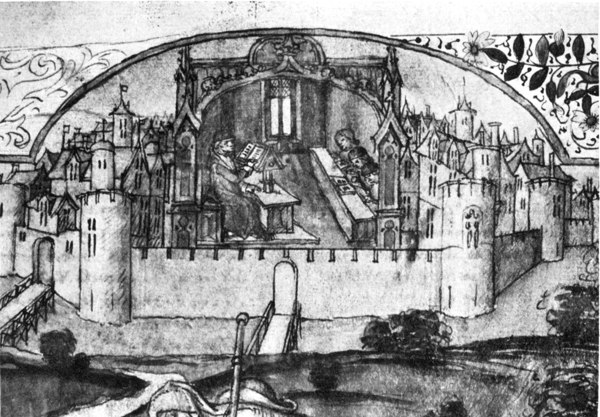
“If thou be a young Infant”
The Second Book
If thou be a young infant
And think the schools for to haunt,
This lesson shall thy master thee mark—
Cross-Christ[179] thee speed in all thy work.
After[180] thy Pater Noster he will thee teach,
As Christ’s own apostles did preach;
After, thy Ave Maria and thy Creed,
That shall thee save at doom of dread.
86Then after to bless thee with the Trinity,
In nomine patris he will teach thee.
Then with Mark, Matthew, Luke and John
With thee Per crucis and the high name,
To shrive thee in general thou shalt learn
Thy Confiteor and Misereatur in turn.
To seek the kingdom of God, my child,
Thereto I rede thou be not wild;
But worship God, both old and young,
To be in body and soul alike strong.
When thou comest to the church door,
Take the holy water standing on floor.
Read or sing or bid prayers
To Christ, for all thy Christian confreres.
Be courteous to God and kneel adown
On both knees[181] with great devotion.
To man thou shalt kneel upon the one
The t’other[182] to thy self thou hold alone.
When thou ministers at the high altar [see]
With both hands thou serve the priest [reverently],
The one to stable the t’other
Lest thou fail, my dear brother.
87Another courtesy I will thee teach:
Thy father and mother with mild speech
To worship and serve with all thy might,
That thou dwell the longer in earthly light.
To another man, do no more amiss
Than thou would’st be done of him and his;
So Christ thou pleases and gets thee love
Of men, and God that sits above.
Be not too meek, but in mean thou hold,
For else a fool thou wilt be told.
He that to righteousness will incline,
As Holy Writ tells us, well and fine,
Never go seek their bread shall his seed,
Nor suffer of man no shameful deed.
To forgive thou shalt thee haste,
To vengeance look thou come at last.[183]
Draw thee to peace with all thy strength,
From strife and debate draw thee at length.
If a man ask thee goods for God’s sake,
And thee want things whereof to take,
Give him debonaire words and manner fair,
With semblance glad, and pure good cheer.
88Also of service thou shalt be free
To every man in his degree,
That one shall never lose for to be kind;
He who forgets one, has another in mind.
If a man have part with thee in gift,
With him thou make an even shift.[184]
Let it not hang in hand for glose;[185]
Thou art uncourteous if thou it does.
Thou shalt fulfil it with all thy might,
Lest God thee strike with great vengeánce,
And put thee into sore penánce.
Believe not all men that speak thee fair,
Whether they be commons, burgess or mayor;
In sweet words the adder was closed,[189]
Deceiving ever and mysloset.[190]
Therefore thou art of Adam’s blood,
Of words beware lest thou be wode.[191]
A short word is commonly sooth,
That first slides from a man’s tooth.
89Look liar that thou never become:
Keep this word for all and some.
Laugh not too oft for no soláce,
Never for mirth that any man has.[192]
Who laughs that all men may him see,
A shrew[193] or a fool him seems to be.
Three enemies in this world there are,
That covet all men to forfare:[194]
The devil, the flesh, the world also,
That work mankind full mickle woe.
If thou may destroy these enemies three
Thou may secure of Heaven’s bliss be.
Also, my children, against thy lord
Look thou strive with no manner word,
Nor wager none with him thou lay,
Nor at the dice with him do play.
Him that thou knows of greater state
Be not his fellow in rest or debate.[195]
If thou be bestead[196] in strange countrée,
Search out no further than falls to thee;
Nor take no more to do in hand,
90Than thou may have worship of all in land.
If thou see any man fall in the street,
Laugh not thereat in dry nor wet;
But help him up with all thy might,
As St. Ambrose[197] thee teaches right.
Thou that stands so sure on seat,
‘Ware lest thy head fall to thy feet.
My child, if thou be at the Mass,
That understand both more and less,[197]
If the priest read not at thy will,
Reprove him not but hold thee still.
To any wight if counsel thou shew,
Beware that he be not a shrew,
Lest he slander thee with tongue,
Among all men, both old and young.
Beckoning, fingering, none thou use;
And privy whispering look thou refuse.
If thou meet knight, yeoman or knave,
Hail him anon, “Sir, God you save,”
If he speak first upon thee there,
Answer him gladly without demur.
Go not forth as a dumb freak,[198]
91Since God has given thee tongue to speak,
Lest men say to friend or gossip:
“Yonder is a man ne’er opens his lip.”[199]
Speak never wrong of womenkind,
Nor let it never run in thy mind.
The book him calls of churlish face
That oft of women speaks villainy base.
For all we be of women born,
And our fathers us beforn;
Therefore it is an unhonest thing
To do them any belittling.[200]
Also to a wife befalls of right
To worship her husband both day and night;
To his bidding to show obediénce,
And him to serve without offence.
If two brethren be in debate
Look neither thou further in their hate;
But help to staunch[201] them of uncharity;
Then thou art friend of both certainly.
If thou go with another at the gate,
And ye be both of one estate,
Be courteous and let him have the way:
92That is no villainy, as men me say.
If he be come of great kindred,
Go not before though thou be bid;
And if that he thy master be,
Go not before for courtesy,
Neither in field, wood nor lawnd,[202]
Nor even[203] with him, unless he command.
If thou shalt on pilgrimage go,
Be not third fellow, for weal nor woe;
Three oxen[204] in plough may never well draw,
Neither by craft, right, nor law.
If thou be proffered to drink of cup
Drink not all off, nor no way sup;
Drink mannerly[205] and give again:
That is a courtesy, to speak in plain.
In bed if thou fall harboured to be
With fellow, master, or their degree,
Thou shalt inquire by courtesy,
In what part of the bed he will lie.
Be honest and lie thou far him fro;
93Thou art not wise but thou do so.
With whatso man, both far and nigh,
Thee falls to go, look thou be sly[206]
To ask his name, and which he be,
Whither he will: keep well these three.
With friars on pilgrimage if that thou go
What they will observe, will thou also.
When at night thou take thy rest,
And bide the day as true man’s guest,
In never house where a red man[206] be,
Nor woman of the same colour certainly,
Take never thine inn for no manner need,
For those be folk to hold in dread.
If any in sternness thee oppose,
Answer him meekly, and make him glose;[207]
But glosing word that falséd[208] is
Forsake, and all that is amiss.
Also, if thou have a lord,
And stand before him at the board,
While that thou speak, keep well thy hand;
Thy foot also in peace let stand.
His courtesy needs must he break,
94Stirring fingers or toes whene’er he shall speak.[209]
Be stable of cheer and somewhat light,
Nor over all wave[210] thou not thy sight.
Gaze not on walls with thine eye,
Far nor near, low nor high.
Let not the post become thy staff,
Lest thou be called a “doted daff.”[211]
Nor delve thou never thy nostril,
With thumb or finger as young girl.
Rub not thy arm, nor claw it naught,
Nor bow thy head too low in aught.
While any man speaks with great businéss,
Hearken his words without distress.
By street or way if thou shalt go,
From these two things thou keep thee fro;
Neither to harm child nor beast,
With casting, turning west nor east.
Nor change thou not in face colour,
For lightness of word in hall or bower;
If thy visage change for nought,
Men say thee: “Trespass thou hast wrought.”
Before thy lord no mows thou make,
95If thou wilt courtesy with thee take.
With hands unwashen take never thy meat:
From all these vices look thou keep.
Look thou sit—and make no strife—
Where the host commands, or else his wife.
Eschew the highest place to win,[212]
Save thou be bidden to sit therein.
Of courtesy here ends the second fit.[213]
To heaven Christ grant our souls to flit!
The Third Book
De Officiariis in Curiis Dominorum[214]
Now of officers speak will we,
Of court, and also of their duty.[215]
Four men there be that yards shall bear:
Porter, marshal, steward, ushér.
The porter shall have the longest wand,
The marshal a shorter shall have in hand;
96The usher of chamber smallest shall have,
The steward in hand shall have a staff
To rule the men of court among.
De Janitore[218]
The porter falls to keep the gate,
The stocks[219] with him, early and late
If any man has in court misgone,
To-porter-ward he shall be tane,
There to abide the lord’s will,
What he will deem[219] by righteous skill.
For “wesselle clothes”[219] that be not sold,
The porter has that ward in hold.
Of strangers, also, that come in court,
The porter shall warn, sir, at a word.
He is found in meat and drink,
And sits with him[219] whoso him think.
Whensoever the lord remove shall,
One castle til t’other, as it may fall,
For carriage the porter horses shall hire,
97Four pence a-piece[220] within the shire,
By statute he shall take[220] on that day:
That is the king’s cry,[221] i’ fay.
De Marescallo Aule[222]
Now of marshal of hall will I spell,
And what falls to his office now will I tell.
In absence of steward, he shall arrest
Whomsoever is rebel in court or feast.
Yeoman-usher and groom also—
Under him are these two.
The groom brings fuel that shall bren,[223]
In hall, chamber and kitchen, I ken.
He shall deliver it every deal,
In hall make fire at each meal.
Board, trestles and forms also,
The cupboard[220] in his ward shall go.
The canopies, curtains to hang in hall—
These offices needs do he shall.
Bring in fire on All Hallows’ Day,
To Candlemas Even,[224] I dare well say.
98
Per quantum Tempus Armigeri habebunt Liberatam et Ignis Ardebit in Aula[225]
So long squires liveries[226] shall have,
Of groom of hall, or else his knave.
But fire shall burn in hall at meat
Until Cena Domini[227] men have eat.
There brought shall be a holly keen,[226]
That set shall be in arbour green;
And that shall be till All Hallows’ Day,
And off be shifted, as I you say.
In hall marshal all men shall set
After their degree, without let.
De Pincernario, Panetario, et Cocis sibi Servientibus[228]
The butler, panter and cooks also
To him are servants without mo.[229]
99Therefore on his yard score[230] shall he,
All messes in hall that served shall be,
Command to set both bread and ale
To all men that served be in hall.
To gentlemen with heated drink,
Else fails the service, as I think.
Each mess at six pence[230] booked shall be
At the counting-house, with other meiny.
If the cook would say that there were more,
That is the cause he has it in score;[230]
The panter also if he would strive
For reward that set shall be belive.[231]
When bread fails at board about,
The marshal gars set, without a doubt,
More bread that called is a reward,
So shall it be proved before stewárd.
De Officio Pincernarii[232]
Butler shall set for each mess
A pot, a loaf, without distress.[233]
Butler, panter, fellows are aye;
100Reckon them together full well I may.
The marshal shall harbour all men in[ward] [234]
That be of any office at court,
Save the lord’s chamber, the wardrobe too,
The usher of chamber shall heed[235] those two.
De Hostiario et suis Servientibus[236]
Speak I will a little while
Of usher of chamber without guile.
There is gentleman-, yeoman-usher[237] also,
Two grooms at the least, a page thereto.
De Officio Garcionum[238]
Grooms shall make litter[237] and stuff pallets out,
Nine foot in length without a doubt,
Seven foot certainly shall it be broad,
Well watered and bound together, craftily trod,
With wisps drawn out at feet and side,
Well twisted and turned again, that tide.
Unsunken in hollows shall it be made,
101Both outer and inner, so God me glad.
That shall be hung with a canopy hollow,
And hooks and loops on bands shall follow.
The valance on a rod shall hang with state,[239]
Three curtains drawn within full straight,
That reach shall even to ground about,
Neither more, neither less, without a doubt.
He strikes them up with a forkéd wand,
And laps[240] up fast about the left hand,
The button[241] up turns and closes on the right,
As a man by the neck that hangs full light.[242]
The counterpane he lays on the bed’s feet,
Cushions on the side shall lie full meet.
Carpets of Spain on the floor beside,
That spread should be for pomp and pride.
The chamber sides right to the door,
And fuel to chimney him falls to get
And screens in cloth[245] to save the heat,
102From the lord at meat when he is set.
Boards, trestles and forms, without let,
All these things keep shall he there,
And water in chafer[246] for ladies fair.
Three perchers[247] of wax then shall he get,
Above the chimney that be set,
In socket each one from other shall be
The length of that other, that men may see
To burn, to avoid what drunken is;
Or else, I wot, he does amiss.
The usher alway shall sit at door
At meat, and walk shall on the floor,
To see that all be served aright—
That is his office, both day and night.
And bid set board when time shall be,
And take them[248] up when time sees he.
The wardrobe he harbours eke of chamber—
Ladies with beads of coral and amber.
The usher shall bid the wardrober
Make ready for all night before the fire.
Then brings he forth nightgown also,
103And spreads a carpet and cushions two.
He lays them then upon a form
And foot-sheet thereon, and it doth return,[249]
The lord shall shift his gown at night,
Sitting on foot-sheet till he be dight.
Then usher goes to the buttery,
“Have in for all night, sir,” says he.
First to the chandler he shall go
To take a night-light[250] him fro;
Both wine and ale he takes indeed.
The butler says without dread:
“No meat for man assayed shall be
But for king or prince or duke so free.
For Heirs-Apparent also it is,
Meat shall be assayed, now think on this.”
Then to the pantry he hies belive:
“Sirs, have in, without strife.”
The panter assays that it be bake.
A mortar[253] of wax yet will he bring
104For chamber, sir, without lying,
That all night burns in a basin clear
To save the chamber at night from fire.
Then yeoman of chamber shall void the rime[254]
The torches have holden well that time.
The chamber door stekes[255] the usher then
With pricket[256] and candle that can bren.
From cupboard he brings both bread and wine,
And first assays it, well and fine.
But first the lord shall wash, i’ fay,
When he comes from the further house away.
Then kneels the usher and gives him drink,
Brings him in bed where he shall wink.
In strong stead on pallet he lay,[257]
Of them takes leave and goes his way.
Yeoman-usher before the door,
In outer chamber, lies on the floor.
105
De Seneschallo[258]
Now will I speak of the steward too;—
Many are false, but few are [true[259]].
The clerk of kitchen, controller,
Steward, cook, and surveyor,
Assent in council without scorn
How the lord shall fare at meat the morn.
If any dainty in country be,
The steward shows it to the lord so free,
Bids to buy it for any cost—
It were great sin if it were lost.
Before the course the steward comes then,
The server it next, of all kinds of men,
Makes way and stands beside,
Till all be served at that tide.
At counting steward shall be seen
Till all be booked in wax so green,[259]
Written into books without let,
That before in tables has been set,
Till accounts also thereon be cast,
And summed up wholly at the last.
106
De Contrarotulatore[260]
The controller shall write to him,
“Taunt resceu”[261]—no more, I mean;
And “Taunt dispendu”[262] that same day;
Uncountable[263] he is, as I you say.
De Supervisore[264]
Surveyor and steward also,
These three folk and no mo
For nought receive, but ever see
That nothing fail and all things agree.
That the clerk of kitchen should not miss—
Therefore the controller, as have I bliss,
Writes up the sum as every day,
And helps to count as I you say.
De Clerico Coquine[265]
The clerk of kitchen shall all things brief,[266]
Of men of court, both loth and lief;
107Of purchases and dispenses then writes he
And wages for grooms and yeomen free.
At dresser also he shall stand,
And fetch forth meat dressed by hand.
The spicery and stores with him shall dwell,
And many things else, as I nought tell,
For clothing of every officer,
Save the lord himself and ladies dear.
De Cancellario[267]
The chancellor answers for their clothing,
For yeomen, falconers, and their horsing,
For their wardrobe and wages also,
And seals patents, many and mo.
If the lord give all for term of life,
The chancellor it seals without strife.
“Tan come nos plerra,” men say, that is,
“Quando placet nobis,”
That is, while us likes, be nought amiss.
Oversees his lands that all be right;
One of the great he is of might.
108
De Thesaurizario[268]
Now to speak of the treasurer I come.
Husband and housewife he is in one.
Of the receiver he shall receive
All that is gathered of bailiff and reeve,
Of the lord’s courts, and forfeits[269] too,
Whether they be false or they be true.
To the clerk of the kitchen he pays money
For victual to buy throughout the country.
The clerk to caterer and poulterer is,
To baker and butler both, so ’tis,
Gives silver to buy in all thing,
What belongs to their office without lying.
The treasurer shall give all kinds of wage
To squire, yeoman, groom or page.
The receiver and the treasurer,
The clerk of kitchen and chancellor,
Reeves and bailiffs and parker,[270]
Shall come to accounts every year,
Before the auditor of the lord anon,
That shall be true as any stone.
109If he treats them not right leal
To a baron of exchequer they must appeal.
De Receptore Firmarum[271]
Of the receiver speak will I
That farms[272] receiveth, verily,
Of reeves and them a quittance[273] makes;
Six pence thereof as fee he takes.
And pays fees to parks as I know;
Therefore at accounts he loved is so.
And oversees castles and manors about,
That naught fall, within or without.
Now let we these officers be,
And of smaller folk tell we.
De Avenario[274]
The avener shall provender wisely ordain,
All the lord’s horses to maintain.
They shall have two cast[275] of hay,
A peck of provender in a day.
110Every horse shall so much have,
At rack and manger that stands with staff.[276]
There is a master of horses, a squire,
Under him avener and farrier.
These yeomen old saddles shall have
That shall be last for knight and knave.
For each horse a farrier shall shoe,
A ha’penny a day he takes him to.
Under be grooms and pages many a one,
That be at wages every one,
Some at twopence by the day,
And some at three farthings, I you say.
Many of them footmen there been
That run by the bridles of ladies sheen.
De Pistore[277]
Of the baker now speak I will,
And what belongs his office till.
Of a London bushel he shall bake
Twenty loaves I undertake:
For chandler and greyhound and hunt reward.
111
De Venatore et suis Canibus[280]
A ha’penny the hunt takes on the day,
For every hound, the sooth to say.
If two leash of greyhounds there are,
To each a bone, that is to tell,
If I the sooth to you shall spell,
Besides his vantage[283] that may befall
Of skins and other things withal.
That hunters better can tell than I,
And therefore I leave it utterly.
De Aquario[284]
And speak I will of other gear
That falls to court, as ye may hear.
An ewerer in hall there needs to be,
And candles shall have and all napery.
He shall give water to gentlemen,
And also to all yeomen,
112“Qui debent manus lavare et in quorum domibus,”[285]
In king’s court and duke’s also,
There yeomen shall wash and no mo.
In Duke John’s[286] house a yeoman there was
For his reward prayed such a grace.
The duke got grant thereof in land
Of the king, his father, I understand.
Whosoever gives water in king’s chamber,
In presence of lord or lady dear,
He shall kneel down upon his knee,
Else he forgets his courtesy.
This ewerer shall cover his lord’s board
With double napery, at a bare word,
The selvage toward the lord’s side;
And down shall hang that other wide.[286]
The uppercloth shall double be laid,
To the outer side the selvage braid;[287]
The other selvage he shall over fold
As towel it were, fair to behold.
Napkins he shall cast thereupon,
That the lord shall cleanse his fingers on;
113The lady and whosoever sits in hall,
All napkins shall have, both great and small.
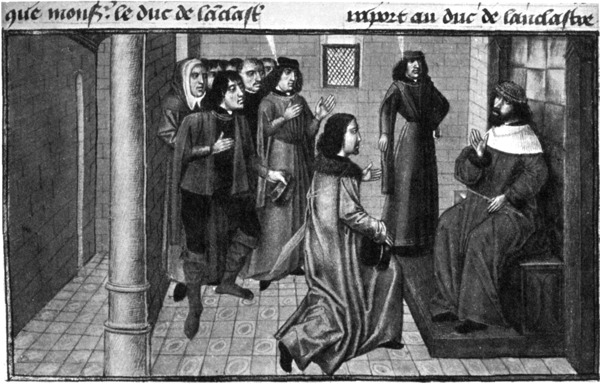
John of Gaunt receives a civic deputation
De Panetario[288]
Then comes the panter with loaves three,
That square are carven for trencher free,
Two set within and one without,
And salt-cellar covered and set en route;[289]
With the overmost loaf it shall be set,
To make up the square, without let.
Two carving knives are placéd soon,
The third to the lord, and also a spoon.
De Cultellis Domini[290]
Of the two the hafts shall outward be,
Of the third the haft inward lays he.
The spoon handle shall be laid thereby,
More trenchers and loaves there full nigh
He sets, and ever must he bear
To duchess his wine that is so dear.
114Two loaves of trenchers and salt too,
He sets before his son also.
A loaf of trenchers and salt at last
At board’s end he sets in haste.
Then bread he brings in towel wrapped aright;
Three loaves shall be given of the white,
A cheat-loaf[291] to the alms-dish,
Whether he served be with flesh or fish.
At either end he casts a cope,[292]
Laid down on board, the ends turned up.
That he assays kneeling on knee—
The carver him pares a slice[293] so free—
And touches the loaves in a circle[294] about;
The panter it eats without a doubt.
The ewerer through towels straineth clean
His water into the basins sheen.
The over-basin thereon shall close,
A towel thereon, as I suppose,
That folded shall be with full great lore,
Two quarters in length and somewhat more.
A white cup of wood thereby shall be,
115Therewith with water assay shall he,
Covers it again before all men.
The carver the basins takes up then,
The announcing squire or else a knight,
The towel down takes by full good right;
The cup he takes in hand also,
The carver pours water the cup into.
The knight the carver holds anon to,
He assays it ere he more shall do.
The cup then voided is in hall away;
The ewerer takes it without delay.
The towel two knights together shall bear,
Before the lord’s sleeves that be so dear.
The over-basin they hold, never the whether,[295]
While the carver pours water into the nether;
For a pipe there is inside so clean,
That water devoids,[296] of silver sheen.
Then sets he the nether, I understand,
In the over and voids with either hand,
And brings to the ewerer where he came fro.
To the lord’s boards again doth go,
And lays four trenchers the lord before,
116The fifth above, by good lore.
By himself three shall he dress
To cut upon the lord’s mess.
Small towel upon his neck shall be seen,
To cleanse his knives that be so keen.
De Elemosinario[297]
The almoner by this hath said grace
And the alms-dish has set in place;
Therein the carver a loaf shall set
To serve God first without let;
These other loaves he pares about,
Lays it amid dish without a doubt;
The small loaf he cuts even in twain
The over-dole[298] in two he lays again.
The almoner a rod shall have in hand,
As office for alms, I understand.
All the broken meat he keeps, I wot,
To deal to poor men at the gate;
And drink that is left served in hall,
Of rich and poor, both great and small.
He is sworn to oversee the service well,
117And deal it to the poor every deal.
Silver he deals riding by the way,
And his alms dish, as I you say,
To the poorest man that he can find,
Or else, I wot, he is unkind.
De Ferculario[299]
This while the squire to kitchen shall go away,
And bring above meat for assay.
The cook assays the meat undight,
The sewer, he takes and covers aright.
Whosoever takes that meat to bear,
Shall not be so hardy the coverture to rear,
For cold nor hot, I warn you all,
For suspicion of treason, as may befall.
If the silver dish be over hot,
A subtlety I will that thou wot:
Take the bread carven[300] and lay between,
And keep thee well it be not seen;
I teach it for no courtesy,
But for thine ease[301]—
118When the sewer comes unto the board,
All the meat he assays at a bare word,
The pottage first with bread y-carven,[302]
Covers them again lest they be starven;[303]
With fish or flesh if they be served,
A morsel thereof for him shall be craved,
And touches the mess over all about;
The sewer it eats without a doubt.
With baken meat, if he served be so,
The lids up-reared ere he further go;
The pasty or pie he assays within,
Dips bread in gravy, no more no myn.[304]
If the baked meat be cold as may befall,
A gobbet of the same he assays withal.
But thou that bearest meat in hand,
If the sewer stand, look thou stand,
If he kneel, kneel thou so long for aught,
Till meat be assayed that thou hast brought.
As oft at high board, if of bread be need,
The butler two loaves takes indeed,
That one sets down, that other again
He bears to cupboard in towel plain.[305]
119As oft as the carver fetches drink,
The butler assays it, how good him think.
In the lord’s cup what is left undrunk,
Into the alms-dish it shall be sunk.
The carver anon without thought,
Uncovers the cup that he has brought,
Into the coverture wine he pours out,
Or into a spare piece without doubt,
Assays and gives the lord to drink,
Or sets it down, as good him think.
The carver shall carve the lord’s meat,
Of what sort of piece that he will eat;[306]
And on his trencher he it lays,
In this manner, without displays.
In alms-dish he lays each deal,
That he is served with at the meal,
Unless he send to any stranger,
A piece that is him lief and dear;[306]
And send him his pottage also,
That shall not to the alms go.
Of carver more if must I tell,
Another fit then must I spell;
120Therefore I let it here over pass,
To make our talking some deal less.
When the lord has eaten, the sewer shall bring
The surnape on his shoulder to him,
A narrow towel, a broad beside,
And off his hands he lets it slide.
The usher leads that one end right,
The almoner the other away shall dight.
When the usher comes to the end of the board,
The narrow towel he stretches well toward,
Before the lord and lady so dear;
Double he folds the towel there.
When they have washen and said is grace,
Away he takes the towel apace,
Lowers the board unto the floor,
Takes away the trestles that be so store.[307]
De Candelario[308]
Now will I speak a little while,
Of the chandler, without guile,
That torches and tapers and prickets can make,
Perchers,[309] small candles, I undertake;
121Of wax these candles all that bren,
And mortar of wax, as I well ken.
The snuff of them he does away
With close scissors, as I you say.
The scissors be short and closed round,
With plate of iron on the end bound.
In chamber no light there shall be brent,
But of wax thereto, if ye take tent.
In hall at supper shall candles bren
Of Paris, therein that all men ken,
Each mess a candle from All Hallows’ Day,
To Candlemas, as I you say.
Of candles delivery squires shall have
So long if it is that man will crave.
Of bread and ale also the butler,
Shall make delivery throughout the year,
To squires, and also wine to knight,
Or else he does not his office right.
Here endeth the third speech.
Of all our sins Christ be our leech,
And bring us to his dwelling-place!
“Amen,” say ye, for his great grace.
Amen, par charite.
122