EXPLANATION OF THE PLATE.
Reading edition
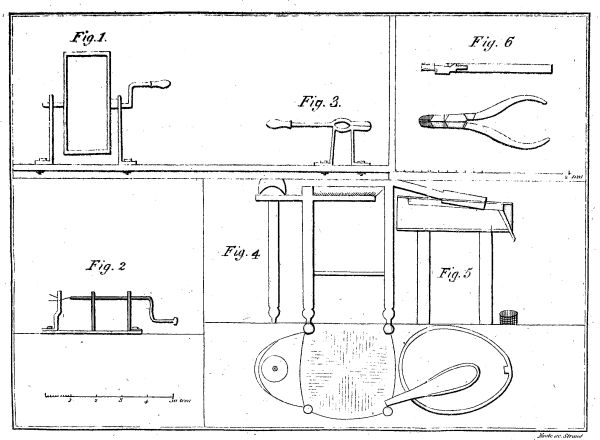
Fig. 1. A reel with two iron bars, made use of to double the wire, and cut the doubled wire twice the length required for fixing the corks in the bottles.
Fig. 2. A small machine for twisting the wire one-third of its length after having been doubled by fig. 1.
Fig. 3. An instrument for compressing (and, as it were, biting) the corks three quarters of their length, beginning at the smallest end.
Fig. 4. A stool stuffed with straw, furnished with a wooden stand on which the bottles may be placed to be tied. The same stool will serve to sit on during the corking.
Fig. 5. A hollow block of wood, called a bottle-boot (Casse-Bouteille), within which the bottle is set when it is to be corked. This bottle-boot is furnished with a strong bat for beating in the corks.
Fig. 6. A front and side view of pointed pincers, used for twisting the wire employed to keep on the corks, and for cutting off the superfluous ends of the wire. I make use of flat pincers and scissars for this operation.
Neele sc. Strand
London Published 25th. Feby. 1811 by Black & Co. Leadenhall Str.